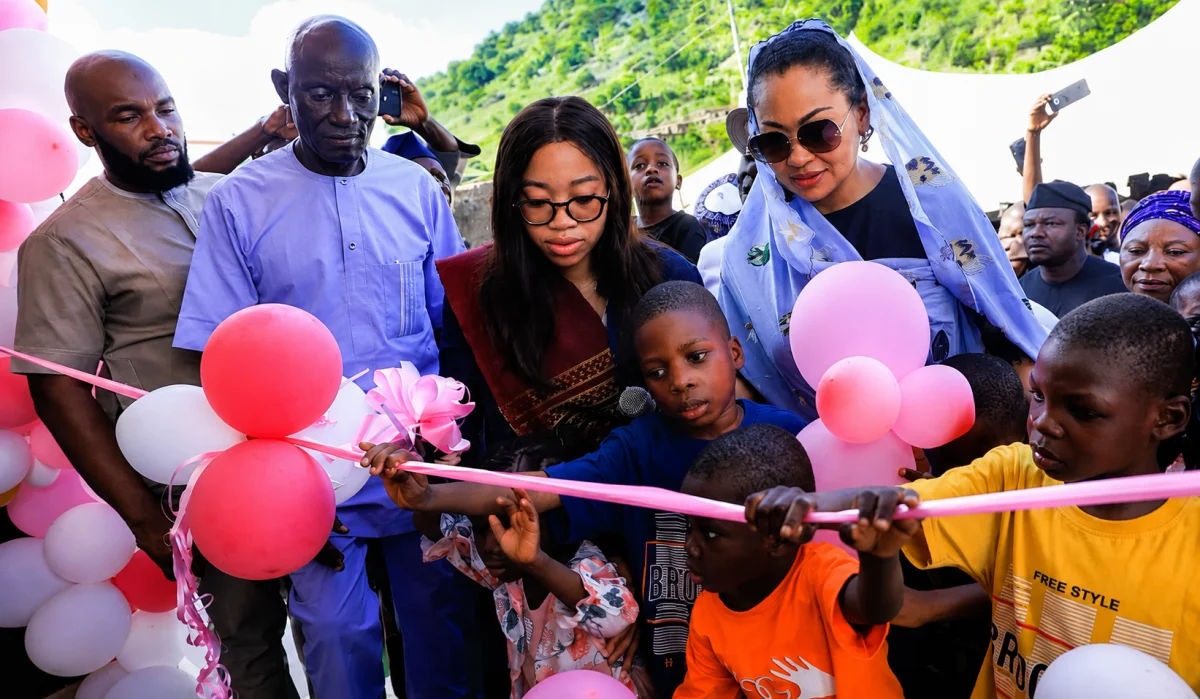
At 16, the daughter of Senator Natasha Akpoti-Uduaghan has built and equipped an orphanage in Kogi — an act of generosity that also exposes the harsh reality facing millions of Nigerian children and the people struggling to care for them
At 15, when many teenagers are still deciding what they want to do with their weekends, Nadia Zakaria had already decided that she wanted to build a home for children who had not been as fortunate as she was.
A year later, the idea has become a building.
Nadia, the 16-year-old daughter of Senator Natasha Akpoti-Uduaghan, representing Kogi Central Senatorial District, has built, furnished and equipped an orphanage home for Oyiza-Salem Divine Orphanage Home in Etahi Community, Okene Local Government Area of Kogi State, raising funds through donations from family, friends and members of the public.
The facility was commissioned on Sunday and formally handed over to the management of the orphanage, giving children who had previously lived in difficult conditions a safer and more dignified place to sleep, study and grow.
For Nadia, however, the building represents more than a completed project.
It began with a question.
She had grown up in what she described as a loving and supportive home and, as she became increasingly aware of children whose circumstances were very different from hers, began wondering why some children should have to grow up without the security and opportunities she had taken for granted.
“Don’t they deserve to feel safe, loved and cared for too?” she asked.
That question eventually became a fundraising campaign, a construction project and, finally, a home.
But it also raises a much larger question about the millions of Nigerian children whose welfare depends on families, charities, religious organisations, community groups and individuals who often operate with limited resources and little institutional support.
A gift that exposes a much bigger problem
Nigeria’s child-welfare crisis is considerably larger than the number of children living in formal orphanages.
The latest UNICEF Nigerian Child 2025 report found that two out of every three children in Nigeria live in multidimensional poverty, meaning they lack access to some of the essentials needed to grow and thrive, including adequate healthcare, education, nutrition, protection, clean water and proper living conditions.
The problem is not confined to children who have lost both parents.
Millions of children live in households where parents are struggling to provide food, school fees, healthcare, adequate housing and protection. Others are affected by displacement, violence, child labour, disability, family breakdown and other circumstances that can leave them vulnerable.
An earlier national analysis by the Federal Government and UNICEF found that 54 per cent of Nigerian children were multidimensionally poor, with deprivation considerably higher in rural communities than in urban areas.
That makes what happened in Etahi more significant than a new building.
The home may accommodate a limited number of children, but the circumstances that produced the need for such homes affect millions.
Before Nadia arrived
The founder of Oyiza-Salem Divine Orphanage Home, Pastor Kisito Zuberu, offered the clearest picture of the conditions from which the children were being sheltered.
“When they came last year, the children were sleeping on the ground,” he said.
That sentence says more about the problem than the size of the new building.
The orphanage had continued to support the children’s education and development despite financial difficulties, according to Zuberu. Its challenge was not necessarily a lack of commitment to the children but the resources required to translate that commitment into adequate living conditions.
Nadia’s intervention has now changed the physical environment.
The larger challenge is ensuring that the organisation can sustain the standard of care.
An orphanage is not simply a roof, beds and furniture. Children who have lost parental care need food, healthcare, education, psychosocial support, protection, trained caregivers and systems capable of responding when they are abused, become ill or face other vulnerabilities.
That requires money, professional support and consistent oversight.
The people who care for the children
This is one part of Nigeria’s child-welfare debate that receives comparatively little public attention.
The country often celebrates donors who construct buildings or provide food, school materials and other immediate assistance. Much less attention goes to the people who remain after the cameras leave: caregivers, social workers, teachers, counsellors, health professionals and administrators who have to meet the children’s needs every day.
Their work cannot be sustained by goodwill alone.
A functioning child-protection system requires trained social workers who can assess children’s circumstances, monitor their welfare, work with families, arrange appropriate care and intervene when children face abuse or neglect.
It also requires properly funded public institutions capable of supervising residential care and ensuring that children are not simply moved from one vulnerable environment into another.
UNICEF’s work on social policy in Nigeria has repeatedly stressed the need for stronger child-sensitive policies, public financing and social-protection systems capable of reaching vulnerable children and families.
The issue is therefore not whether private individuals should build orphanages.
They should be encouraged to help.
The issue is whether charity should have to carry such a large share of a responsibility that ultimately belongs to the wider child-protection system.
Nigeria’s missing safety net
A functioning social-welfare system is supposed to intervene before a child’s circumstances become a crisis.
When a family loses its income, social protection should help prevent children from being pushed out of school.
When parents cannot afford healthcare, the system should help prevent illness from becoming a catastrophe.
When a child is abandoned, abused or separated from family, trained social workers and child-protection agencies should be able to identify the child, assess the circumstances and arrange appropriate care.
When a family is struggling, the first response should ideally be support that keeps children safely within their families and communities whenever that is in their best interests.
Residential care has a place, but it should not become a substitute for a functioning family-support and child-protection system.
UNICEF’s research makes the connection clear: child poverty is not simply a question of household income. It encompasses deprivation in housing, nutrition, education, healthcare, sanitation, water and protection, which means the response must extend beyond occasional donations.
Charity cannot carry the entire burden
Nadia’s story is inspiring precisely because she did something tangible.
She did not simply speak about vulnerable children. She raised money, found support and turned an idea into a physical structure.
She also demonstrated something that is often lost in discussions about young Nigerians: age does not necessarily determine the capacity to contribute meaningfully to society.
She acknowledged that fundraising initially appeared almost impossible because she was only 15 and had never undertaken such a project.
Yet family members, friends and strangers contributed, enabling her to complete the construction and furnish the building.
Her mother, Senator Akpoti-Uduaghan, said she did not contribute financially to the project and that Nadia independently raised the money used to construct and furnish the facility.
The senator also disclosed that her daughter was already developing plans for another humanitarian project, this time aimed at pregnant women in Kogi Central.
Those efforts deserve recognition.
But they should not allow government to retreat further from its responsibilities.
The existence of generous citizens is not evidence that a social-welfare system is unnecessary. In a properly functioning system, private generosity should complement public protection rather than substitute for it.
The child behind the statistic
It is easy to read that two out of every three Nigerian children live in multidimensional poverty and move on to the next statistic.
The children at Oyiza-Salem make the numbers tangible.
A child sleeping on a bare floor is not a statistic.
A child missing school because there is no money for fees or books is not a statistic.
A child who cannot receive medical attention when sick is not a statistic.
A child growing up without a stable adult capable of protecting and guiding them is not a statistic.
Each represents a failure of a support system that is supposed to prevent circumstances beyond a child’s control from determining the rest of his or her life.
UNICEF’s 2025 assessment of Nigerian children similarly found persistent gaps in education, healthcare, nutrition, protection and other areas, despite progress in some indicators.
What happens after the cameras leave?
The new building should therefore be the beginning of another conversation.
Who will pay for the children’s food six months from now?
Who will provide healthcare when one of them becomes seriously ill?
Who will ensure that every child remains in school?
Who will provide counselling to children dealing with grief, abandonment or trauma?
Who will train and support the caregivers?
Who will inspect the home and ensure that the children are safe?
And when a child reaches adulthood, what happens next?
These are not questions Nadia, at 16, should be expected to answer.
They are questions for the institutions responsible for child welfare.
The Nigerian state has obligations to children under its laws and international commitments, while social-protection policy is increasingly recognised as an essential part of protecting children from poverty and exclusion. UNICEF has continued to call for stronger systems that combine financial support with access to health, education and other essential services.
A home is a beginning
For now, there is reason to celebrate what Nadia has achieved.
Children who were reportedly sleeping on the ground have a new home. Rooms have been furnished. A community has witnessed a teenager turn an idea into something tangible.
That is no small achievement.
But perhaps the most important lesson from Etahi is not that a 16-year-old can build an orphanage.
It is that she saw a problem that adults and institutions have struggled to solve and decided that her age was not a reason to look away.
The building she handed over may shelter a relatively small number of children.
The need outside its walls is vastly greater.
Nigeria’s challenge is to ensure that children do not have to depend on the extraordinary generosity of individual teenagers, philanthropists or overwhelmed caregivers to obtain what should be basic guarantees of childhood: safety, food, education, healthcare, dignity and the chance to grow into adulthood without poverty deciding their future.
Nadia has built a home.
The larger task is to build the system that makes such homes less necessary, while ensuring that every child who does need one is protected, supported and given a genuine chance to thrive.