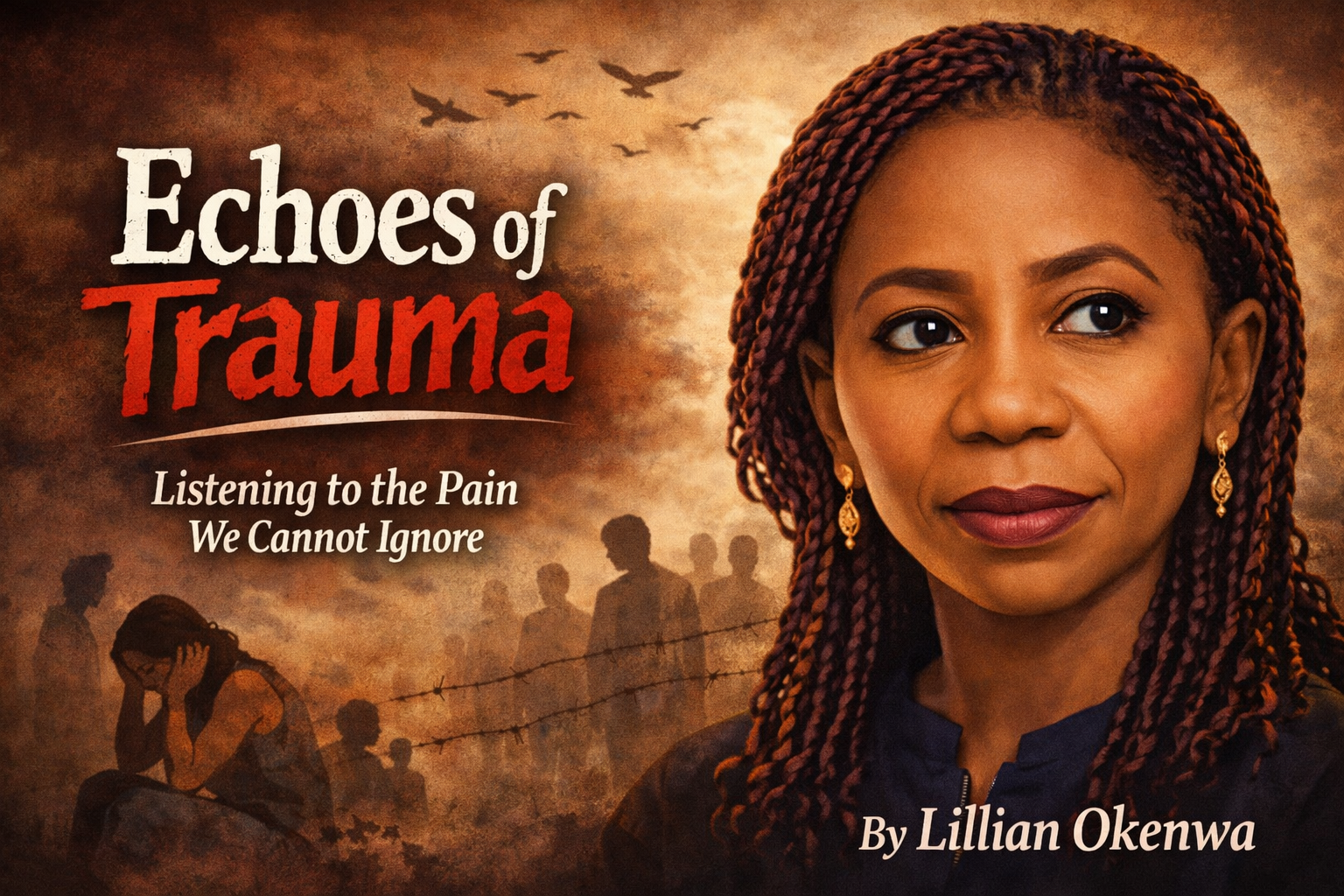
There are people who look perfectly whole until life brushes against an old wound. Then, in a single unexpected moment, yesterday speaks through today.
By Lillian Okenwa
Most of us think of scars as marks left on the body. They are evidence that something happened. A fall, a surgery, an accident, a fight. With time, they become so familiar that we hardly notice them anymore. Then someone asks, “How did you get that scar?” and, in an instant, a story you had almost forgotten comes rushing back.
Emotional scars are not very different. They simply live where the eye cannot see. There are no stitches to remove, no bandages to unwrap and no visible marks to explain them. Yet they have an extraordinary way of accompanying us through life. They appear in places that seem to have nothing to do with the original wound—a marriage, a workplace, a friendship, a difficult conversation. We imagine painful experiences belong to yesterday. Often, they arrive in today before we do.
Read Also: Echoes of Trauma: The stories pain tells us
Not long ago, I read an account that stayed with me. A woman described an unpleasant exchange with a stranger whose manner struck her as unnecessarily abrasive. During the conversation, she noticed that one of his fingers was missing. Nothing was said about it, yet she suddenly found herself wondering whether she was speaking only to the man standing before her or also to years of learning to live with something he had lost. She changed her approach. Almost immediately, his own demeanour softened.
Whether her conclusion was right is almost beside the point. What lingered with me was the possibility that every encounter is larger than it first appears. We rarely meet people at the beginning of their stories. By the time our lives intersect, they have already celebrated victories we know nothing about and endured losses they have never spoken of. Some have rebuilt their lives more than once. Others are still trying to find their way through experiences that altered them forever. Every person arrives carrying an invisible history.
One story that has remained in the public conversation is that of Gospel Kinanee, the young Nigerian who disappeared as a teenager and was eventually found after spending eighteen years in prison without any known charge or record. His release and reunion with his family stirred relief across the country. It was impossible not to celebrate that moment.
Yet another thought lingered.
Freedom does not erase eighteen years.
No one walks away from an experience like that unchanged. Lost birthdays cannot be reclaimed. Childhood cannot be relived. Relationships must often be rebuilt from unfamiliar ground. Even hope sometimes has to learn how to breathe again. There are wounds that close and there are wounds that become part of the landscape a person must learn to navigate.
His story is remarkable only because we know his name.
Across Nigeria, countless people carry histories that will never make the headlines. They survived violence, abuse, displacement, addiction, devastating loss, prolonged illness, crushing poverty or years of rejection. Many rebuilt their lives with extraordinary courage. They go to work, laugh with friends, raise children and keep appointments. From the outside, life appears perfectly ordinary. Yet beneath that ordinary life are experiences that continue to shape the way they move through the world.
Researchers who study trauma have consistently found that recovery is rarely as simple as surviving the event itself. Human beings heal, but healing is seldom the same as returning to who we were before the injury. We adapt. We compensate. We develop ways of protecting ourselves. Sometimes those adaptations serve us well. Sometimes they follow us into places where they are no longer needed. A person who once had every reason to mistrust may struggle to receive genuine kindness. Someone who spent years living in uncertainty may continue preparing for disaster long after life has become stable. Survival has a way of leaving fingerprints on the future.
This does not excuse behaviour that hurts other people. We remain responsible for the choices we make, regardless of what has happened to us. Trauma may explain our reactions, but it cannot become a permanent licence to wound others. At the same time, understanding that unseen scars exist makes room for something our world seems to be losing: Mercy.
Not the kind that ignores truth or pretends wrongdoing does not matter, but the kind that resists reducing people to their worst moments. The kind that pauses before rushing to conclusions. The kind that remembers there may be chapters in another person’s life that we have not been invited to read.
We live in an age of instant judgments. A brief conversation, a social media post, a sharp response at work and we imagine we know who someone is. Yet the human heart has never been that easy to understand. Behaviour is often the final sentence of a story whose opening chapters remain hidden from everyone else.
Perhaps one of the greatest acts of maturity is accepting that what we see is rarely the whole story. The colleague whose words feel unusually sharp may be carrying grief. The neighbour who keeps everyone at a distance may have trusted the wrong people too many times. The stranger whose impatience catches us off guard may be fighting battles that began long before today’s encounter. We cannot know for certain. That is precisely why kindness matters. It leaves room for what certainty cannot see.
Every scar tells a story. Some are written on the skin. Others are written much deeper. We may never read them, but we will meet the people carrying them every day. Perhaps the gentlest gift we can offer one another is the grace of remembering that survival often leaves marks no eye can detect.
A lawyer and equity advocate, Lillian can be reached at [email protected]. X: @OkenwaLillian.