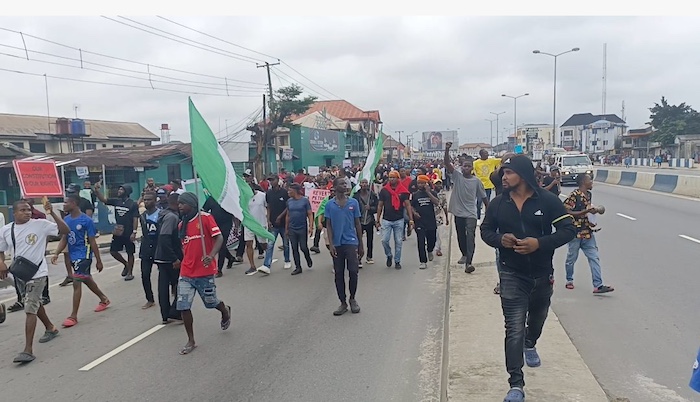
Anger spilled onto the streets of Jos on Monday morning as hundreds of residents defied a government-imposed curfew to protest a deadly Palm Sunday attack—underscoring growing frustration over Nigeria’s worsening security crisis.
The demonstration began in Anguwan Rukuba, the epicentre of the violence in Jos North Local Government Area, where suspected gunmen killed several youths in a late-night assault that has once again shaken Plateau State.
By 9 a.m., crowds had gathered at the scene, chanting and demanding action, their message clear: curfews alone will not stop the bloodshed.
Eyewitness footage circulating on social media showed visibly agitated protesters blocking roads and calling for urgent government intervention as tensions escalated.
A Community Under Siege
Residents say the attackers—believed to be heavily armed and riding motorcycles—stormed the community on Sunday night, opening fire indiscriminately and setting homes ablaze.
While the exact death toll remains unclear, multiple casualties have been reported, deepening fears in a region already scarred by cycles of violence.
The attack, which coincided with Palm Sunday, has intensified outrage, particularly among local Christian communities who see it as part of a troubling pattern of targeted assaults.
Government Response Meets Public Fury
In response, the Plateau State government imposed a 48-hour curfew on Jos North, effective midnight Sunday, in a bid to restore order and prevent further escalation.
The move, however, has done little to calm residents.
Instead, it has sparked defiance.
Protesters insist the restriction addresses symptoms, not causes—arguing that repeated attacks, delayed responses, and lack of accountability have eroded public confidence in security efforts.
At the protest site, Caleb Manasseh Mutfwang arrived amid the unrest, facing a crowd demanding answers and protection.
In an official statement, the government condemned the killings as “barbaric and unprovoked,” assuring residents that security forces had been deployed to track down those responsible.
Fear Spreads Beyond the Streets
The immediate fallout has extended beyond the affected community.
The University of Jos announced the postponement of examinations scheduled for March 30 and 31, citing safety concerns for students and staff—many of whom live in or near the violence-hit area.
Meanwhile, roads within Anguwan Rukuba were reportedly barricaded by angry youths, raising fears of further confrontation and instability.
Outrage Reaches International Voices
The attack has also drawn international attention.
Alex Barbir, in a viral video, sharply criticized Bola Ahmed Tinubu, accusing the federal government of failing to protect vulnerable communities.
His remarks—alleging persistent killings and questioning the government’s response—have added to the growing chorus of voices demanding accountability.
A Pattern of Violence, A Nation on Edge
The latest killings come just weeks after a deadly ambush in Kanam Local Government Area, where more than 20 security operatives and vigilantes were reportedly killed—highlighting the persistent volatility across Plateau State.
Despite billions of naira spent annually on security, attacks by armed groups, bandits, and kidnappers continue to plague communities nationwide.
For many Nigerians, the sense of insecurity is no longer episodic—it is constant.
A Breaking Point?
Monday’s protest may signal more than immediate grief—it may represent a tipping point.
As residents challenge curfews and demand lasting solutions, the question facing authorities is no longer just how to respond to individual attacks, but how to restore trust in a system many believe is failing to protect them.
This is because in Plateau, as in many parts of Nigeria, the crisis is no longer just about security. It is now about survival, and the growing fear that no one is truly safe.