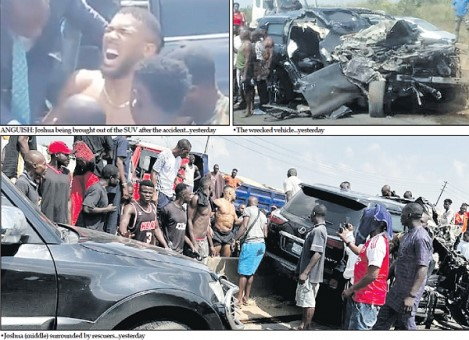
Nigeria breathed a collective sigh of relief when heavyweight boxing champion Anthony Joshua emerged alive from a devastating road crash near Sagamu, Ogun State. But relief quickly gave way to grief: two men in the vehicle—Kevin Latif Ayodele and Sina Ghami, both 36—did not survive.
Their deaths were tragic. But they were also entirely preventable.
The collision with a stationary truck on one of Nigeria’s busiest expressways has reopened a question the country keeps postponing: “Who is accountable for the carnage on Nigerian roads?”
A Deadly Pattern, Not an Isolated Crash
The Federal Road Safety Corps (FRSC) blamed the Sagamu crash on “excessive speed and wrongful overtaking.” Driver error may have played a role. But that explanation dodges a more uncomfortable truth: why was a broken-down truck left on a major highway for days without removal or warning?
Multiple reports indicate the truck had remained on the roadside for up to three days. No hazard signs. No tow. No intervention.
If routine patrols were active, the danger should have been identified and neutralised long before lives were lost. The FRSC’s post-crash response was swift. Its pre-crash failure was fatal.
This is the defining contradiction of Nigeria’s road safety system: reaction without prevention.
Trailer Parks Built, Then Abandoned
Ogun State is not short of solutions on paper. Trailer parks were built—at high public cost—to keep heavy-duty vehicles off highways. The Gateway Trailer Park at Ogere was commissioned with fanfare. Then it quietly decayed.
By 2015, evacuation notices were being issued for abandoned vehicles inside the facility. By 2019, stakeholders were calling for its “revival.” By 2021, a new federal-state partnership was announced to “resuscitate” it.
The result? Trucks still park on expressway shoulders, turning highways into death traps.
The failure is not infrastructural alone—it is institutional. Truck owners ignore designated parks because there are no consequences. Enforcement agencies look away. Infrastructure becomes a photo opportunity, not a functioning system.
The Numbers Nigeria Refuses to Reckon With
The statistics are brutal.
- Nearly 3,000 deaths in road crashes in the first half of 2025
- Over 7,700 crashes and nearly 4,000 deaths by September
- 5,421 fatalities in 2024, a seven percent increase from the previous year
These are not numbers. They are families erased, futures destroyed, and grief normalised.
Speeding, brake failure, abandoned vehicles, poor roads, and the absence of emergency response remain the dominant causes. Laws exist. Enforcement does not.
Nigeria suffers from an enforcement crisis—rules without consequences, agencies without accountability.
When FRSC Does Not Come
That failure is not theoretical. It is lived.
In Anambra State, Benkingsley Nwashara, a legal practitioner and well-known single father, survived a terrifying crash near Onitsha after another vehicle swerved into his lane at a sharp mountain bend.
Soldiers at the scene contacted the FRSC. The nearest unit was reportedly 13 minutes away.
Help never came.
For two hours, Nwashara waited—injured, shaken, and exposed—before mounting a motorcycle to search for a tow truck himself.
“Imagine if we had plunged down the hill,” he later wrote. “Or were trapped inside the car.”
The corruption did not stop there. As his vehicle was towed into Onitsha, every police checkpoint demanded ₦500 to let him pass.
When journalists contacted the FRSC call centre, officers claimed the crash had not been reported—despite the corps’s advertised 15-minute response time. An officer suggested that some crashes “never reach” the system.
In a recent televised interview, an FRSC official insisted the agency’s emergency line was active. When the number was called live on air, the network provider responded: the number did not exist.
Celebrity Attention, Ordinary Silence
Anthony Joshua’s crash drew presidential calls, diplomatic concern, and real-time monitoring by state governors. That attention was appropriate—but it also exposed an ugly truth.
Ordinary Nigerians die the same way every day, without headlines, without outrage, without reform.
As Senator Natasha Akpoti-Uduaghan has warned: “Rules without enforcement are meaningless.” Empowerment without accountability, she argues, is equally hollow.
What Must Change—Now
Nigeria does not lack ideas. It lacks urgency.
Experts and advocates say immediate reforms must include:
- Emergency highway sweeps to remove stationary vehicles within hours
- Mandatory use of trailer parks, with severe penalties for violators
- Electronic speed monitoring across federal highways
- Dedicated highway emergency response teams with ambulances and trauma care
- Clear accountability for FRSC commanders when preventable deaths occur
The Lagos-Ibadan Expressway, often called the “corridor of death,” is a symbol of the crisis: busy, essential, and lethally mismanaged.
A Test of Political Will
Kevin Latif Ayodele and Sina Ghami cannot be brought back. But their deaths—like the ordeal of Benkingsley Nwashara—can still matter.
If Nigeria allows this moment to pass with only condolences and committee promises, then the verdict is clear: the roads will keep killing, and the system will keep excusing itself.
Anthony Joshua survived. The country must decide whether it will continue to survive on luck—or finally choose accountability.