Home Blog Page 982

NIGERIA IS PRINTING MONEY – THE ROAD TO ZIMBABWE

By Nick Agule

Within the last week a war of words has ensued over the management of the Nigerian economy with Gov Obaseki of Edo State firing the first salvo by accusing the FG of the catastrophic management of economy alleging that the FG is printing money to fund federal allocations.

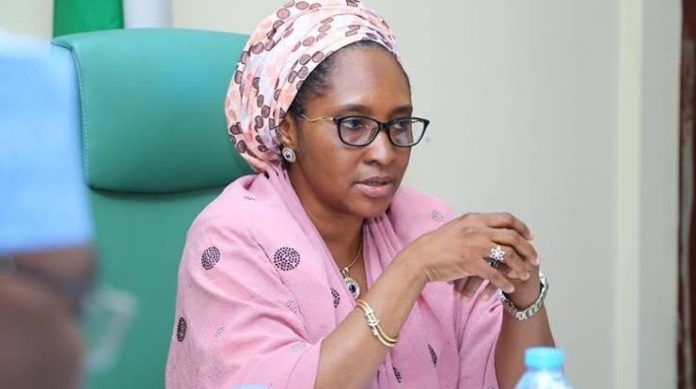
Nigeria’s Finance Minister Mrs Zainab Ahmed fired back in these words:

“The issue that was raised by the Edo State Governor, for me, is very sad because it is not a fact. What we distribute at FAAC is revenue that is generated and in fact, distribution of revenue is a public information. We publish revenue generated by FIRS, the Customs and the NNPC and we distribute at FAAC. So, it is not true to say we printed money to distribute at FAAC. It is not true”.

Gov Obaseki returned fire that as an investment banker he stands by his words. This is how he put his rebuttal of the statement issued by the Finance Minister:

“The Minister of Finance, Budget and National Planning, Mrs. Zainab Ahmed should rally Nigerians to stem the obvious fiscal slide facing our country. Rather than play the Ostrich, we urge the government to take urgent steps to end the current monetary rascality, so as to prevent the prevailing economic challenge from degenerating further. We believe it is imperative to approach the Nigerian project with all sense of responsibility and commitment and not play to the gallery because ultimately, time shall be the judge of us all.”

It became clear that between Gov Obaseki and the Finance Minister, one person was not telling the truth given that their views were diametrically opposed.

All this while as the crossfire raged, the CBN Gov was mute until he was captured on camera issuing threats to Gov Obaseki and other Govs who were bailed out in 2015/16 that recovery action will begin immediately against them if they don’t stop accusing the Govt of printing money! Instructively the CBN Gov did not outrightly deny that the Govt is printing money but did not concede either.

As pressure mounted on the FG specifically on the Finance Minister and the CBN Gov to come clean to Nigerians on what is actually going on, the CBN Gov finally caved in and conceded that Nigeria is printing money in a tweet issued on Friday, 16 April 2021 in the following words:

“The concept of printing of money is about lending money and that is our job…It will be irresponsible for the CBN or any Central Bank or Fed to stand idle and refuse to support its government at a time like this.”

WHAT IS PRINTING OF MONEY

Now that the FG has conceded that they are indeed printing money, let us therefore examine what this means from a layman’s point of view and the impact on our economy.

The CBN prints two types of money:

  1. Physical money – this is the bank notes and coins we use in buying and selling or saving at home. It’s also called cash.
  2. Digital money – this is money in our bank account.
    Thus you can have N1m with N100k in cash (physical) at home and N900k in your bank account (digital).

The printing of money in dispute here is the digital money not the physical cash. When Central Banks print digital money it is called Quantitative Easing (QE).

WHAT IS QE?

QE is a monetary policy tool that central banks use to inject money directly into the economy. So let us say the FG account at the CBN has a balance of N500 billion deposited by the revenue generation agencies of Govt such as the FIRS, DPR, NNPC, Customs etc. But this money is not enough for Govt to spend so the Govt asks the CBN to print money. The CBN simply credits Govt’s account with say N300 billion thus the balance in the Govt account is now N800 billion which Govt will now spend.

To be clear, there is nothing wrong with using QE. Govts all over the world use QE to jumpstart their economies. The US, UK etc Govts used QE in the 2008 economic crash and even more recently in the pandemic hit economies. So if QE is a known, tested and tried monetary economic policy tool, why was the Govt of Nigeria ashamed to disclose to the citizens that it was using QE? And even when they were exposed by Gov Obaseki, why was the Govt still denying until they were forced to concede?

The plausible answer is that Nigeria was making the wrong use of QE.

There are 2 halves to QE which are printing the money and using the printed money, if you don’t get the balance right then QE instead of helping to jumpstart the economy rather ruins it:

  1. Printing the money – by crediting the account of Govt at the CBN with money the Govt did not earn. It is just like you own a bank and you have an account with the bank but did not have money to spend, so you just call the MD of the bank and ask him to credit your account with N1 billion and you immediately see an alert of N1 billion and begin to pay your bills! This is the same thing the CBN is doing for the FG! This is one half of QE.
  2. The 2nd half of QE is how the money is spent. For QE to be effective, there are only restricted ways the Govt can spend the money on. This is because monies earned by Govt from economic activity is backed up with output. So the oil companies must produce oil for DPR to earn money. Oil must be sold for NNPC to earn money. Imports must be made before customs earn revenue. Companies must pay taxes for FIRS to earn money. All these monies are coming from output based economic activities. The difference with QE money is that it is not backed up with output, Govt just increases money supply by fiat and thus it’s a timebomb and if mishandled it will blow off the economy!

To avoid the QE timebomb from exploding on the economy, traditionally the Govts spend QE money in very restricted ways which include:

a. Buy back bonds – bonds are Govt’s debt instruments used in managing the economy. For instance, if there is high inflation (prices are rising because too much money is chasing too few goods/services), Govt in a bid to reduce the inflation will issue bonds. Those who buy the bonds give Govt money and hold the bonds which attract interest payments from Govt. Thus by Govt mopping money from people’s (individuals and companies) pockets, there is less money to spend and the less money that chases goods/services will result in price drop and thus inflation is contained. The reverse is the case when the economy is down and the Govt wants to boost it. The Govt uses the money from QE to buy back the bonds. So bond holders will surrender the bonds back to Govt and collect their money back. With more money in people’s pockets, they buy more goods/services and this will encourage manufacturers and businesses offering services to produce more to meet up with the demand. The greater output means prices drop as more goods/services are now in the market! The economy is thus brought back to life!

b. Bail out the struggling productive sector of the economy – here the Govt uses the money printed by QE to bail out ailing industries suffering from the downtime in the economy so that with the new cash these industries will fund working capital to bounce back to business and boost their production. A boost in production means more jobs will be created as more factories reopen and service centres return back to life. The economy will then be jumpstarted back to life with increased output and jobs! The US for example used QE to bail out the banks, the auto industry etc during the crash of 2008 and Joe Biden has announced an infrastructure plan of $2 trn are some examples of Govts’ use of QE.

So why was the Nigerian Govt ashamed to admit they were using QE? Does it mean the Finance Minister was not aware of the sources of inflow into the federation account upon which she presides by saying the money was from the FIRS, NNPC, Customs etc and not from QE? Or was she fully aware that the federation account was being funded by QE but set out to deceive Nigerians and pull wool over faces? Either option does not look good on the Finance Minister.

The plausible reasons the Govt was ashamed to admit the use of QE is because while they are printing digital money which is the 1st half of QE, they are totally mismanaging the 2nd half because Govt is neither buying back bonds nor bailing out ailing industries with QE. Instead Govt is sharing the money to the 3 tiers/arms of Govt. And we know that the FG, States & LGs are not using the QE to buy bonds or bail out the ailing industries. The States and LGs are not even paying workers! Huge part of these monies end up being looted!

THE CATASTROPHE OF MISMANAGING QE

Let me illustrate what happens when QE is managed well and when it is mismanaged as follows:

  1. If QE is used rightly – it is a veritable economic management tool that jumpstarts comatose economies back to life. So let us say our economy produces 1,000 yams and money supply is N100,000, all the money will buy all the yams at N100 per tuber. Now if Govt adopts QE and prints N900,000 so that money supply is now N1 million and Govt uses the money to boost the agricultural sector by clearing the land, buying farm equipment and building processing plants, there will be a sharp rise in output to 20,000 yams. N1m will buy 20,000 yams at N50 per yam so price has crashed (inflation tamed) and jobs created because the workforce that will produce 20,000 yams will be more than the one that produced 1,000 yams! This is the beauty of QE when used for economic growth!
  2. However and tragically too, if QE is mismanaged, it spells a death sentence to an economy. Nigeria is mismanaging QE by distributing it to the 3 tiers/arms of Govt. These Govts are neither buying back bonds nor bailing out industries. The money is not committed to infrastructure either. Instead the money is used for consumption with a huge chunk looted into the private pockets of those with access to the treasury. This portends danger to the Nigerian economy because the scenario above is reversed in the case of the Nigerian economy.

Let us say that our economy produces 1,000 yams. Money supply was N100,000. All the money used in buying all the yams, a tuber of yam will cost N100. Let us say that through QE money supply has increased to N1,000,000 without an increase in the quantity of yams produced, it means a tuber of yam will cost N1,000. As Govt continues to print money without commensurate increase in output of goods/services, prices will continue to rise until one day you will need a bag to carry the money to buy a tuber of yam! This is what happened to Robert Mugabe’s Zimbabwe’s currency where at a point one needed 35 million Zim dollars to buy a loaf of bread!!! And the shops were even empty as not goods were being produced! This is where Nigeria is heading if the Govt continues on the trajectory they are on right now of printing money without boosting output. Already the impact of the mismanagement of QE is showing with Nigeria’s annual inflation reported to have climbed to a more than four-year high in March 2021, rising 82 basis points from a month earlier to 18.17%. Notably food inflation rose to 22.95% which is making it increasingly impossible for families to feed their children!!!

SOLUTION TO NIGERIA’S ECONOMY

Constructive criticism is the one that comes with viable suggested solutions. When individuals or organisations are struggling financially, there are two ways open to them to drive out of the economic jam! First is to reduce cost and secondly is to increase revenue. This is like a double dose of vaccine to give Govt a fighting chance against infection of financial troubles. Therefore the following are the top 5 suggested economic management tools that are available to the Nigerian Govt to adopt to jumpstart the economy:

  1. Reduction in cost of governance – The Nigerian Govt must take immediate action to reduce the cost of governance. The Orosanye Committee which turned in an 800-page report with far-reaching recommendations on how Govt will reduce cost of governance must be immediately given full implementation. The Committee recommended the MDAs that should be scraped, those to be merged and those to become self-funding, thereby freeing funds for the much-needed capital projects across the country. The Committee also recommended the discontinuance of government funding of professional bodies and councils. Govt expenditure on things like sponsorship of pilgrimages must also be stopped immediately. The salaries of legislators, ministers and other top functionaries of Govt must be scaled down as with their convoys and other pecks of office. Govt must implement full e-govt to cut down on costs of travels, printing etc. Efficiencies in procurement activity must be generated to obtain best value for the least cost etc.
  2. Taxation of the rich – Nigeria is a country where the billionaires don’t pay taxes. All the market women, okada riders, farmers, artisans etc are made to pay taxes daily. Employees who are captured under PAYE also pay taxes monthly. The Billionaires with private jets are paying little or nothing. The FG at the highest level must summon all the billionaires in Nigeria to a meeting in the Villa and ask them nicely to go and pay their taxes else there will be enforcement action. This step alone which only requires an investment of 30 minutes of the President’s time will shore up Nigeria’s revenue by at least N5 trn!
  3. Stop the $1.5 billion PH refinery repair – Govt must stop immediately the planned rehabilitation of the PH refinery with a sum of $1.5 billion. Knowing that Govt projects are never delivered within budget, this rehabilitation may end up costing Nigeria $3-5 billion! The refinery can be sold as scrap for $1 (one dollar) to allow the buyers to bring in $1.5 billion to repair it. Govt must then convert the $1.5 billion into N570 billion (at N380/$) and invest the full money into agriculture in all the 774 LGs in Nigeria. N570 billion is N736 million for each of the 774 LGs in Nigeria. If Govt sinks N736 million into agriculture in every LG in Nigeria, so much food and cash crops will be produced, there will be plenty of jobs for the teeming youths too. Thus the economy will be jumpstarted and begin to grow astronomically as an output based economy and not QE which is like steroids!!!.
  4. Power – it is a shame that Nigeria as a nation well-endowed with one of the world’s richest deposits of gas reserves, takes pains to produce the gas and then sets the gas on fire instead of harnessing it for electricity generation. Qatar a country with 2.8 million people is generating 8,500 MW of electricity and Nigeria a country with 200 million people is generating only 4,000 MW of electricity. The minimum electricity generation required to support the Nigerian economy is 100,000 MW!!! Thus the huge power supply gap in Nigeria can never jumpstart the economy no matter the economic policies we put in place and no matter the qualification/experience of the economic managers we appoint. QE will not help an economy that is this abysmally poorly powered with electricity! The FG must immediately read the riot act to the oil companies to stop flaring Nigeria’s gas else they must shut down oil production. Govt must also take immediate steps to fully privatise the power sector to allow for investments to boost power supply and close the electricity gap!
  5. Rail – no economy will do well with the poor transport infrastructure that is obtained in Nigeria. The roads are not motorable but most importantly there is no rail transport in Nigeria. There is no reason not to have all the 36 capitals connected by rail today just for a start! The FG must take immediate steps to fully privatise the rail sector to allow investments to build and operate rail transportation to link all the cities, towns and villages in Nigeria. This will be a huge boost to the economy by making the movement of goods and people less cumbersome and far cheaper across the nation. It will also create millions of well paying and sustainable jobs for the teeming population of our unemployed youths.

NIGERIA’S ECONOMY MUST BE SAVED!!!

If the FG follows the suggested solutions, the Nigerian economy will begin to explain astronomical growth and this will be real growth and not steroids which QE is. But if the Govt continues on the trajectory of printing money (QE) without output backed, we will be sure on the road to Zimbabwe and a catastrophic end to our economy. This must be avoided at all costs!!!

Copied

ACCI Seeks Creation of Presidential Committee on Cryptocurrency

By James Emejo and Folalumi Alaran

The President, Abuja Chamber of Commerce and Industry (ACCI), Dr. Al-Mujtaba Abubakar, has advised the federal government to set up a presidential commission on cryptocurrency to review the digital currency policy framework globally as well as “assess successful, failing and failed frameworks.

He said the proposed body should also be saddled with the responsibility to integrate and domesticate successful models for draft policy framework for Nigeria.

In a statement he personally endorsed, Abubakar, also called for a plan of action for phased usage of the technological currency within the Nigerian financial system.

He said the chamber’s recommendation was informed by the surging intrusion of the bitcoin into global and local financial system.

He said: “We suggest that members of the commission should be drawn from the Central Bank of Nigeria, Nigerian Stock Exchange, banking /financial institutions, bitcoin community, digital currency experts and relevant MDAs and OPS.

“It is our considered view that such a commission will have all facts on the table and will be able to chart a sustainable path forward for Nigeria.”

He said the chamber had observed recent development in the digital and cryptocurrency currency space within country and internationally, adding that it is also are aware of the recent controversy on the subject, leading to the CBN directives to bank’s and financial institutions.

The ACCI president said: “We are also not oblivious of the policy gap that currently exists on the subject. As noted by the Vice President, Prof Yemi Osinbajo, Cryptocurrency is a global phenomenon which nations must address rather than run away from it.

“The policy lacuna impresses on the administration to consider possible options to prepare the nation to cope with the positive and negative fallouts of this new financial technology.”

According to him, global trends on the subject also make its imperative for Nigeria, the biggest economy in Africa, to act swiftly on the policy plane.

“Just this week, the biggest US cryptocurrency exchange, announced its listing on the Nasdaq, marking a milestone in the economic journey of virtual currencies.

“The listing is the biggest yet of a cryptocurrency company, with the San Francisco-based firm saying last month that private market transactions made the company valued at around $68 billion (€57 billion) this year, versus $5.8 billion in September,” he added. (Thisdaylive)

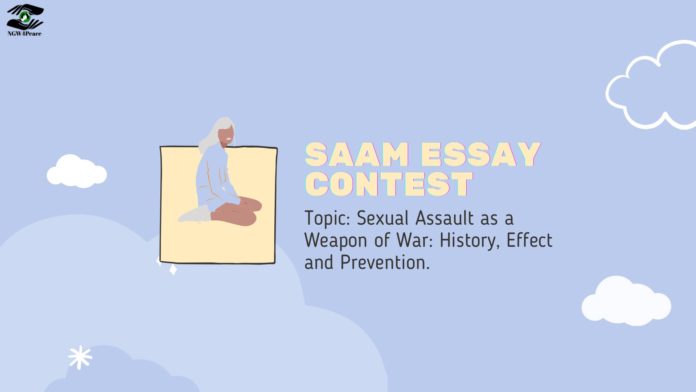
The Sexual Assault Awareness Month (SAAM) Essay Competition

Every year, April is set aside for raising awareness on sexual assault, harassment, and abuse. April 2021 marks the 20th Anniversary of Sexual Assault Awareness Month (SAAM).

As a way of commemorating this milestone, NGWomen4Peace is organizing an Essay Competition for young Female Nigerian Writers, on the Topic: Sexual Assault as a Weapon of War: History, Effect, and Prevention.

The First Place Winner gets a 20,000 Naira Book Voucher; the Second Place Winner gets a 10,000 Naira Book Voucher; and the Third Place Winner gets a 5,000 Naira Book Voucher.

The top three entries will be published on NGWomen4Peace’s Medium.

Criteria For Participation

Submissions will only be considered from participants who are:

● Female Nigerians living in Nigeria.

● Aged 15 — 26.

How to Submit Your Essay

Send an email to [email protected] in this format:

● Full Name.

● Location.

● Short profile.

● Username(s) on Twitter, Facebook, Instagram, and LinkedIn.

Attach your essay to the body of the email.

Deadline for submission is April 24, 2021.

Submissions Guidelines

● Essays must be creative and written in English.

● Essays must be an original work of the participants; any element of plagiarism leads to disqualification.

● Word count must be between 1000 — 1500 words.

● Essays must be submitted in .docx format.

● The essay document must not contain the name of the writer.

● A participant can submit only one essay.

● List of references used in the essays should be included at the end of the essays.

Would you like to become a member of NGWomen4Peace? Click here to join us.

Apply here to volunteer with us.

We look forward to receiving your amazing entries and applications!

credit:medium

Court orders Crown Realities Plc to refund N44.9M to property subscriber for total failure of consideration: Lessons

By: Stephen Azubuike

The Story

Mr. Dan Ngerem v. Crown Realties Plc [2021] 4 NWLR (Pt. 1767) 476

Mr. Dan Ngerem (“The Appellant) entered into a contract under which Crown Realties Plc (“The Respondent”) agreed to sell six houses in Crown Estate, Lekki, Lagos owned by Crown Realties. The agreed completion period was nine months from the date of the initial deposit. Mr. Ngerem paid the agreed initial deposit of N39.08 Million. Crown Realties failed to complete the house at the agreed time. The company completed the houses six months after the due date.

Mr. Ngerem did not complain. On his part, he failed to pay the balance. Instead, he made a proposal to pay the balance in installments. To this end, he paid further deposit of N34 Million, making it a total of N73.08 Million paid to the company.

Crown Realties had something up its sleeves. When Mr. Ngerem presented further payment, the company returned the cheque and revoked the contract on the ground that Mr. Ngerem was in breach of the payment terms of the contract which did not stipulate payment by installments.

On a clever move, the company applied part of the payments made by Mr. Ngerem (i.e. N28.1 Million) as payment for one house, out of the six houses. The company undertook to refund the balance of about N44.9 Million as soon as the other properties are sold. For undisclosed reasons, Crown Realties sold the remaining five houses to other interested buyers but failed to refund Mr. Ngerem’s money.

Aggrieved, Mr. Ngerem sued Crown Realties claiming a refund of the N44.9M and damages for breach of contract. The trial Court made some interesting findings. The Court dismissed the claims of Mr. Ngerem on the ground that both parties were caught up in a mixed show of contract breaches. While Crown Realties breached the contract by not delivering within the nine-month period, Mr. Ngerem waived the breach by accepting delivery after additional six months. In the same way, Mr. Ngerem breached the contract by not paying the balance, instead, he opted for payment by installments. The trial Court held that Mr. Ngerem was not entitled to damages for breach of contract as claimed.

Dissatisfied, Mr. Ngerem appealed to the Court of Appeal. The Court agreed with the trial Court’s position on contract breaches by both parties. It held that Mr. Ngerem had the option to treat the contract as breached the moment Crown Realties failed to deliver within the agreed time. This would have entitled him to damages for the breach. But he ignored the breach and kept the contract alive by subsequently proposing to pay the balance by installments. Failure to pay the balance forthwith was also a breach in itself.

Nevertheless, the Court of Appeal held that Mr. Ngerem was entitled to a refund of the N44.9M. Ogakwu, JCA took time to explain:

Be that as it may, from the analysis herein of the facts pleaded and joinder of issues, it cannot be repudiated that the Appellant (Mr. Ngerem) paid the total sum of N73.08 million to the Respondent (Crown Realties Plc), which amount the Respondent duly acknowledged and which is further established by the documentary evidence on record. From this payment, the Respondent only transferred one house valued at N28.1 million to the Appellant. It does not require rocket science to decipher that based on this, the Respondent still held on to the funds of the Appellant amounting to the total sum of N44.9 million which is the difference between N73.08 million (amount paid) and N28.1 million (value of house transferred). The evidence on record established this and the Appellant is definitely entitled to judgment for the refund of the said amount since the consideration for which it was paid had failed as a result of the Respondent’s revocation of the contract and subsequent transfer of five houses to other purchasers. On the preponderance of evidence or balance of probabilities, the Appellant was entitled to judgment for the refund of the said sum of N44.9 million…

See page 509 of the report.

Thus, failure to refund the N44.9M was an essential aspect of the case which, according to Ogbuinya, JCA, “did not arrest the attention of the lower Court.” Hear him:

It is decipherable from the record, the bible of the appeal, that the feuding parties share consensual view that the Respondent (Crown Realties Plc) has been a custodian of the Appellant’s deposit of the whopping sum of N44.9 Million without a corresponding delivery of any housing unit. The act, in the eyes of the law, is a classic exemplification of total failure of consideration. Where there is a total failure of consideration, the creditor is entitled to a refund of his monetary consideration.

See pages 512-513 of the report.

The Court of Appeal ordered Crown Realties to pay Mr. Ngerem the N44.9M plus interest.

This article was first published on April 20, 2021 by https://stephenlegal.ng/court-orders-crown-realties-plc-to-refund-n44-9m-to-property-subscriber-for-total-failure-of-consideration-lessons/

AUTHOR: STEPHEN AZUBUIKE is lawyer with expertise in Commercial Dispute Resolution and Technology Law practice. He is a Partner at Infusion Lawyers. He has successfully argued cases from the High Courts of various jurisdictions to the Appellate Courts on behalf of financial institutions, other corporate bodies and multinationals. He has worked with a number of startup tech companies. He tweets @siazubuike.

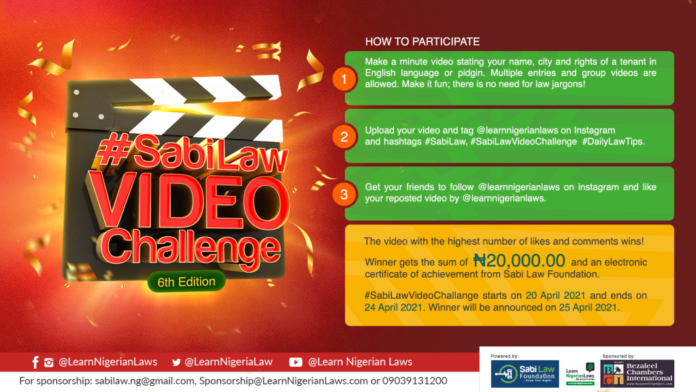
6th Edition of the Sabi Law Video Challenge!

1. The 6th Edition of the Sabi Law Video Challenge (#SabiLawVideoChallenge) starts on 20 April 2021 and will end on 24 April 2021. A WINNER to be announced on 25 April 2021.
2. Sabi Law Video Challenge promotes legal awareness on rights and laws in Nigeria, through short videos. Participants make, upload and publicize their short videos on social media platforms to win prizes. The best video content with highest likes and comments from the online community wins a cash prize of N20,000.00 and a certificate of achievement.
3. The premier edition/season of Sabi Law Video Challenge was held in June 2018 with the cash price of #20,000 won by a certain Miss Okereke Hilda Chisom from Ebonyi state. And the 2nd edition/season held in October 2018 with cash prize of #50,000 won by one Miss Atoyebi Omolara from Osun State. The 3rd edition was won by one Miss Alaka Adaeze from Anambra State <https://www.instagram.com/p/CKv8jW2HulL/?igshid=p5bjf7uwwx3k>. The 4th edition was won by Miss Alaka Adaeze <https://www.instagram.com/p/CL_idSZnfJc/?igshid=bm80b0yjj2xc> and the 5th edition was won by Udeng Otobong Bennet from Enugu State <https://www.instagram.com/p/CNDUZXdnbRI/?igshid=27ph6wus599o>
4. You may watch previous editions of the Sabi Law Video Challenge via our YouTube account: Learn Nigerian Laws (https://youtube.com/channel/UCrDgIdAOOM6-X6dNIL1GJww)


5. To participate, sponsor or learn more on about #SabiLawVideoChallenge via this link:  #SabiLawVideoChallenge
6. To keep up to date on all our free legal awareness projects, follow us via: Facebook Page:@LearnNigerianLaws, Instagram:@LearnNigerianLaws, Twitter: @LearnNigeriaLaw,  YouTube: Learn Nigerian Laws , WhatsApp Groups via (https://chat.whatsapp.com/L7h4f1exItZ38FeuhXG4WN), Telegram Group: (https://t.me/LearnNigerianLaws), Facebook group: (https://www.facebook.com/groups/129824937650907/?ref=share) or visit our website: (www.LearnNigerianLaws.com)
7. The Sabi Law Video Challenge (#SabiLawVideoChallenge) is a project of Sabi Law Foundation, supported by the law firm of Bezaleel Chambers International and other sponsors.
8. Sabi Law Foundation is a Not-For-Profit, Non-Governmental Legal Awareness Organization and owner of LearnNigerianLaws.com.
9. Sabi Law Foundation is a Not-For-Profit, Non-Governmental Legal Awareness Organization and the proud owner of LearnNigerianLaws.com.
10. For sponsorship, advert and partnership, contact: [email protected], [email protected] or +234 903 913 1200.


HOW TO PARTICIPATE
STEP 1:
Make 1-minute video of yourself/group stating your name and city, and then talk about any law or right in Nigeria, using Pidgin or English Language. Make it fun and avoid using law jargons. Multiple entires and group entries are allowed. End your video with a shout out to #SabiLawVideoChallenge, #DailyLawTips and #SabiLaw. Participation is FREE and open to the general public!
STEP 2:
Upload your 1-minute video on Instagram with the following hashtags #SabiLawVideoChallenge, #DailyLawTips and #SabiLaw and tag our official Instagram account: @LearnNigerianLaws.
STEP 3:
Your video will be officially reposted by @LearnNigerianLaws on Instagram. Get your online community to follow the official Instagram account; (@LearnNigerianLaws), and then like and comment on your video.

Signed.

Sabi Law Foundation
(A Not-For-Profit, Non-Governmental Legal Awareness Organization and owner of LearnNigerianLaws.com)

FOR SPONSORSHIP & ADVERT, CONTACT: [email protected], [email protected] or +234 903 913 1200.

Sabi Law Projects:
#SabiLaw
#DailyLawTips
#SabiBusinessLaw
#SabiElectionLaws
#SabiHumanRignts
#SabiLawOnBeatFm
#SabiLawLectureSeries
#CriminalJusticeMonday
#SabiLawVideoChallenge
www.LearnNigerianLaws.com

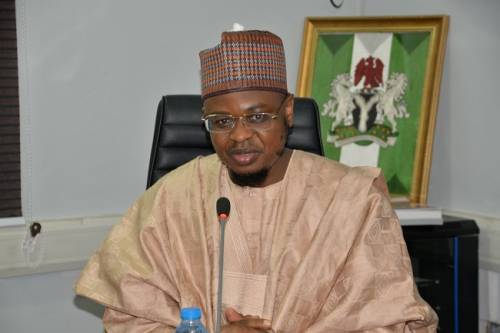
David Hundeyin: Isa Ali Pantami – The Inside Story of Nigeria’s Minister of Communications & Digital Economy

Minister of Communications and Digital Economy, Dr. Isa Ali Ibrahim Pantami is the proverbial chameleon with one eye on the past and one eye on the future. Depending on the situation or who is involved in it, he sometimes comes across as a cosmopolitan technocrat with a strong academic background. At other times, he transforms into a knuckle-dragging troglodyte spewing forth parochial religious and micro-ethnic sentiments.

Perhaps because of the sheer disconnect between the different Isa Pantamis known to different people, it has always been difficult to conclusively nail him down to a singular identity. To those who work around him or watch him on television delivering speeches about Nigeria’s broadband masterplan in his trademark reedy voice, it can be very disorienting to process the idea that this slightly built man with the gold-rimmed prescription glasses could be on of the most dangerous men in Nigeria right now.

Even after extensively-researched exposes about the furious and unrepentant religious extremist that resides somewhere within Isa Pantami’s polite exterior, it is simply difficult for many to accept. How is it possible that this man with a PhD from Aberdeen and several certificate programs at the world’s most prestigious institutions is also a supporter of Al-Qaeda and the Taliban, as well as an instigator of deadly religious crises in Northern Nigeria?

After reading Sheikh Pantami’s mealy-mouthed attempt to distance himself from his own utterances during a Ramadan service on Saturday April 17, 2021, I decided that the best way to break through his manufactured genteel posturing and lift the veil of denial is not to write another extensively-sourced 2,000-word deep dive, but rather to let Pantami himself do the work for us.

Pro-Terrorist Rhetoric and a Buhari Cameo

The man who would later become “Sheikh,” “Imam,” “Mallam” and “Dr” Isa Pantami was born on October 20, 1972 in the Pantami Ward of Gombe State. Pantami Ward is noted for being the last holdout of the infamous Maitatsine Islamic uprisings of the 1980s. Some have argued that these uprisings were in fact precursors to the Boko Haram crisis that would follow 2 decades later.

It is impossible to verify whether the adolescent Pantami was ideologically influenced by the Maitatsine-type Islamic cult which grew in Pantami Ward and culminated in a bloody showdown with authorities on April 29, 1985. What we do know for sure about Pantami is that after graduating in 2003 from the Abubakar Tafawa Balewa University (ATBU) in Bauchi with a BTech in Computer Science, he became the Chief Imam at ATBU and an influential public figure in Bauchi.

On September 12, 2006, roughly one month shy of his 34th birthday, Pantami delivered a now-infamous public lecture in Bauchi titled “Suwaye Yan Taliban” (“Who Are The Taliban?). This was just one several incendiary sermons and public lectures that Imam Pantami delivered over the course of nearly a decade in Bauchi, but the reason it has now become infamous is because it found its way onto the internet. First Italian academic Dr. Andrea Brigaglia of the University of Cape Town Centre for Contemporary Islam published a paper in 2019 with a translation of the question-and-answer segment of ‘Suwaye Yan Taliban.’ Then a 54-minute audio recording of the lecture mysteriously turned up on a Nigerian Islamic community website.

By luck or by design, ‘Suwaye Yan Taliban’ has now become the proverbial bone stuck in Isa Pantami’s throat. At first he denied making such pronouncements outright. Then when the audio recording with his unmistakable voice showed up, he claimed that Dr. Brigaglia’s translation was inaccurate, suggesting that whoever translated it either did not understand Hausa properly, or simply did not like him. Several influential friends of the house eagerly went to work with this narrative, attempting to take advantage of the fact that most Nigerians who have a keen interest in this story are not (native) Hausa speakers.

Credit:newsdirect

Judiciary, legislature make Governors feel above the law

P. D. Pius, Esq

All courts in Nigeria are currently shutdown by Judiciary Staff Union (JUSUN). It is a free for all right now. No matter the dispute, offence or wrong committed there is no court to validly send you to prison or resolve the problem now in Nigeria. We don’t even know how long this will last because it is an indefinite strike action.

Some will be quick to start blaming the President. Just hold on your thoughts on that for a while. Why are the courts shutdown? It is simply because the 36 Governors in Nigeria have failed, neglected or refused to obey provision of section 121 of the Constitution that grants financial autonomy to judiciary at state level and Houses of Assembly at state level. In other words, these issues have been settled and complied at the Federal level by Federal Government. But state Governors refused to comply at State level. This is very sad if you ask me.

But how did the Governors acquire such audacity to violate the provision of the constitution with reckless abandon? In my opinion, it is simply because the State Houses of Assembly are too dumb or they enjoy suffering while smiling with the judiciary watching hands akimbo. Why do I say so? To answer this question you have to understand what is the biggest offence in Nigeria.

The biggest offence in Nigeria is violation of the provision of the constitution. It is bigger than murder or any other offence stated in the criminal law or penal law. This is why, there is no immunity on any Governor that breach the constitution.

It is for this reason that section 188 of the Constitution provide the House of Assembly and the Chief Judge of States with power to remove any Governor that violate or breach the constitution without any regard to immunity. It is sad that the same State judiciary and legislature that has power to remove Governors for violation of the Constitution are same people using JUSUN to shutdown courts in order to address the issue of breach of the Constitution by the Governors.

Come on! This whole JUSUN strike is needless or a political jamboree. As a lawyer I will only advance what the law says and stand on the side of law. I cannot shy away from stating or supporting the law as it is. If truly the Governors are in breach of constitutional provision for judicial autonomy at state level, then the proper action is to commence removal proceedings of any such Governor. It is not to go on strike and request negotiations with the supposed biggest criminal suspect for committing the biggest offence of constitutional breach.

I don’t see any hitch in such removal proceedings in that the breach affects the two persons with power to remove the Governors, State Assemblies and State Chief Judges. There lies the proper parties against whom JUSUN, Lawyers and indeed all Nigerians should take action or engage to reopen the courts fast and probably tomorrow. Why? The action of these two bodies will solve JUSUN problem within few minutes as against strike action.

All the solutions are in the law as provided in the Constitution. We should just follow the Constitution to avoid argument and needless strike action. The judiciary and legislature should stop giving the Governors, a feeling of being above the law.
My one cent!

P. D. Pius, Esq.
Abuja, Nigeria.
[email protected]

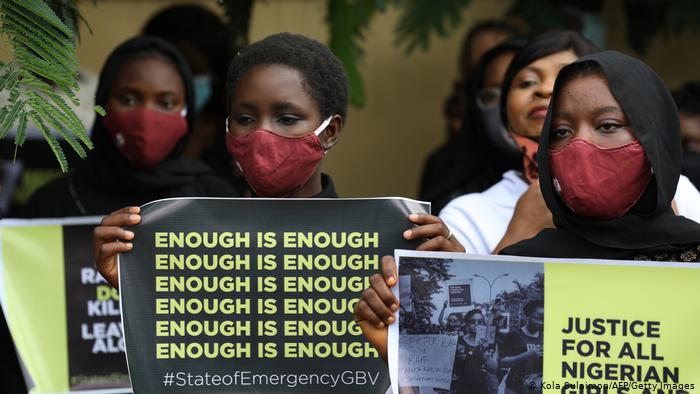
GBV: State is the first perpetrator of violence against citizens, says Gender Rights Activist

By Rahila Dauda

“The state has abused us, raped us, vandalized and ravaged our minds so that we begin to be grateful for the peanuts and breadcrumbs we receive from the state.” – Jude Ifesemen

Jude Ifesemen is a lawyer and principal partner of Ifesemen & Associates. An award winning poet (2020 Unesco Award winner on National Art Competition with the Poem “Sheroes”), author of “Streams of Passion”, a collection of 70 poems published by Tamarand Prints, UK, coordinator of the Jude Ifesemen Foundation, founder of the Heart of Soji Initiative, farmer, Gender Rights activist, Notary Public of the Federal Republic of Nigeria and more, he spoke extensively with Rahila Dauda on gender based violence, its relationship with mental health and the impact on society.

L&S: You’re a certified trainer on gender based violence and a gender rights activist, what prompted you to take this path?

Answer: My Mother was a strong woman! I was raised right. I learnt very early that women are gods and should be worshipped. Being a gender rights activist is just me telling the world to do what’s right.

L&S: With the number of rape of underage children, mostly girls, being reported in the media, do you foresee any danger on the society in the nearest future as they are growing up without any form of counselling or therapy? Do you suppose that the effects of what they went through could impact negatively on the society? Could the wrong done them cause an internal damage that might affect the society at large?

Answer: On the issue of child abuse, the State need not only criminalize child abuse, but should set up a monitoring team. A task force team across all local governments; across villages to monitor and enforce the criminalisation of child abuse. Child abuse is not only when you spank a child. The child is out of school, it is abuse. So most times, the first person abusing the child in Nigeria as an example is the state for not ensuring that the fundamental objective and directive objective of state are actually working. The state has abused us, raped us, vandalised and ravaged our minds so that we begin to be grateful for the peanuts and breadcrumbs we receive from the state. Imagine applauding a governor that is elected doing roads or security.

Every child that is abused, everybody that is abused, no matter the counselling and therapy session given to the person, no matter how long it lasts, that child, that person has a broken spirit somewhere. There may be an attempt to mend a broken glass but the scars remain and anything can trigger it at any point in time. It is not a religious issue. It is a human issue. So for every child that is abused, as much as counselling and therapy is important, it is still not enough. We must actively nip it in the bud. We must be vigilant. Teachers in school must be vigilant. Teachers in religious centres must be vigilant. Parents, neighbours, friends of the family must be vigilant; even strangers passing by. When you see a child that is exhibiting the sign of abuse, take note of it.

I recently retrieved a young girl, a 17 year old girl. She was brought in from the South to Abuja to take care of a lady’s daughter. She also got an additional a job to manage a POS store. When her salary was paid in the POS store, the same lady that brought her from the South collected the money from her. So she was doing the job of taking care of the lady’s daughter for free and the job she’s doing as sales girl at the POS store was also like slave labour. This girl wanted to go to school. The so called madam said – “School? I did not bring you to Abuja to go to school. And if you decide you want to go back to school, you must return the transport money with which I brought you to Abuja.” We were able to retrieve her and end that cycle. But even at that, something has already been broken in her mind. So the issue of child abuse and how the person grows up, the issues will continue to remain.

L&S: Talking about a broken spirit that came about through how we were raised; recently a popular American artiste DMX died. Many spoke about his challenges and troubling past. There are so many DMXs around. How do we avoid creating more of such broken people and how do we deal with the already existing ones?

Answer: We are all DMX. That’s one thing about this abuse story. Everybody is a victim. Whether you’re a direct victim or you’re affected by the actions of a direct victim, you’re a victim. DMX had a beautiful career that would have blossomed to something greater, but he kept having triggers upon triggers. There are a lot of DMXs around. Everybody must watch out for abuse on a child, abuse on a lady, abuse on a man, abuse anywhere; so that where the victim is unable to speak, someone must be able to speak up for them. When you report a case of domestic violence to NAPTIP for example they will want the victim’s testimony. But these victims are held down by the mentality of the society and religious norms that would make them say no, they’d rather not complain. Some of them will even bring the complaints to you and back down at the end. These issues should no longer be so.

The state should set up a proper investigation system when these matters are reported and when they are found to be true, they should swing into action with or without the statement or corroboration from the victim. Remember that a victim is not only a victim physically but also a victim psychologically. Most of them are first broken psychologically before even physically. 

L&S:  Is there any fault of the victim in gender based violence? Could there be a justification for GBV or SGBV? Some people have said that women are the cause. That the ways they talk to a man, the way they behave sometimes trigger the man to the point of beating them. Do you suppose there’s any justification for this? Weeks ago, a man kicked his wife, a young six months pregnant lawyer in the stomach and she eventually died. There are few cases men also being victims. Recently, a woman stabbed her husband to death. I’m wondering, is there a possibility that something from the childhood of these abusive men and women triggers this negative behaviour or they are downright evil?

Answer:  The soldier that goes to war and survives an assault is a warrior. A survivor is a champion not a victim of war, so I will not lay blames on victims.

On the question of whether abusive people are evil, I do not subscribe to good and evil in the sense that one person is good or one person is bad. We are products of how we were raised. Environmental factors and other factors determine the perspective through which we see life and react to issues, so the whole question of somebody being evil is a myth.

There is no justification whatsoever irrespective of the abuse a person goes through, that will justify his or her being abusive. That you have been a victim of gender abuse or child abuse is no reason for you to act as a perpetrator rather you should be empathic.

The person that comes out and opens his or her mouth that women talk too much and that it’s their fault for being abused is an abuser. These are abusers that ought to be arrested. This is what I have been talking about that the state is first the abuser. The states enabled that man to walk out of the TV station without being arrested and sent to a psychological home with machines hooked to his brain.  People are justifying nonsense with nonsense. If a woman abuses you why not walk away. Abuse can be emotional, mental, economical, verbal or psychological. So when someone abuses you in a way you cannot maintain or sustain then you should walk away and not justify it. I know that if there is a background research done in the person justifying such you will find out that there is a foundation of abuse in him or her.

Yes, men are also victims of abuse but there are more women as victims. It is because it’s more difficult for men to come out and say they are victims of abuse or beaten by their wives, but there are more women as victims. The society has already abused the mind of the woman that her role is to be subservient and obedient but that is an insult to the specie of a woman. A woman is not supposed to be subservient to a man. That you marry a man does not make you inferior to him. Everybody has a role to play. I don’t believe in equality but equity.  A man no matter how strong he is cannot do the things a mother can do, else he breaks down.

There is a saying attributed to Albert Einstein that everyone is a genius but if you judge a fish by its ability to climb a tree then you will spend the rest of your life thinking it’s stupid. Nobody is better than the other. We all have our strengths and we can excel in it. Stop the lie that women are weaker vessels. There is no weak woman. There is no man that is stronger than the woman. It is not by big muscles.  What the woman’s body and mind can survive a man cannot but we know where we have our capabilities. So there is no such thing as subservient submission. If you care about someone, it’s all about cherishing, worship submission and honour. And it is both ways. It is not because you’re coming to bow to me.

Imagine a man kicking a woman in the stomach, more so a pregnant woman and his wife. A six months pregnant woman whose husband screams at her but still retains the pregnancy and remains in that relationship has already been defeated psychologically before it gets to the point of physical abuse and kicking. These issues must be dealt with. It is not only about criminalizing the man. He first needs a psychiatric evaluation. He should spend the rest of his life in a mental home to ascertain what is wrong. There should be machines hooked to his brain to look for what went wrong or where he got broken for him to become so insane.  

Credit: DW

The women that stabbed their husbands are likely victims of society and their past but that does not justify that they should turn to violence but need mental help. We all need mental help. Living in Nigeria is enough stress. We all need some time to spend and check on ourselves and do some mental evaluation.

So when we talk about these things, you realise that legislations are of no value if they remain dormant. They should be made to work. Certain things need to be put in place. The state as I earlier said is the first perpetrator of violence against its citizens truly because if the fundamental objectives and directive of state policies are working perfectly, it should reduce certain actions and enable people to be more vigilant. But everyone is on a rat race and everyone is looking for order.

L&S: The VAPP Act has introduced men as victims of rape, but we don’t see men coming out to say they have been raped, what could be the issue?

Answer: Because society made men think sex is a prize. If you realize the number of preteens being raped by maids and cousins at home you’ll be shocked.

Also you see this thing about GBV… it has created a victim state of mind that a boy wonders if he being the man can ever be believed as being raped. People will ask “didn’t you enjoy it.”

L&S: What is the correlation between mental health and GBV?

Answer: GBV is a psychological attack on the abused. More than the physical abuse is the mental abuse. You’re telling me I am less because of my gender. You make me wonder and wish for another gender. I envy the other gender or get angry at them and develop some state of mind against both genders. GBV is a mental assault on society

L&S: As a gender rights activist, what do you believe is the solution to the inequality women keep facing in the society?

Answer: Women are the solution of the world. We are a broken society and the only people with the relevant skill set to fix it are women. I don’t believe men are designed to lead. Men should focus on defence and security while women take over administration.

L&S: You’re also a poet and I have read your last work Streams of Passion and I must confess it is an amazing work of literature.  What is driving force behind your poems?

Answer: Poetry is my safe space, my diary, my life book. I document every thought, every action in poetry. I believe I am the historian future generations will study and so I can document yesterday and today in verses for tomorrow.

L&S: As a multi-talented young man, husband and father, how do you balance all these roles you play?

Answer: To be honest, it’s very easy to balance it all o! My priority is family. After that, everything falls into place. I won’t trade the comfort and peace of my family for anything.

L&S:  What really motivated you to study law?

Answer:  Law is a calling. I wanted to fight for what is right. I wanted to defend the underdog. It’s my driving force as a human.

L&S: A piece of advice for the teeming young lawyers who look up to you.

Answer: Be honest to yourself. Be fearless, and don’t allow anyone or any situation to muzzle your voice. Speak!!!

Finally it’s important we realise that we are creating a society where no one is actually sane. Also, beyond legislations, we need awareness!!! Parents, teachers, religious leaders… Drum it everywhere!!! Tell everyone to tell everyone. GBV is real and it’s bad!!!

Buhari scores another ‘F9’ at Ramadan

Subhanallah, alhamdulillah, astaghfirullah, la ilaha illa Allah! This is my most favourite Islamic chant. I love its rhythm, rhyme and reason. It means, “God is perfect, praise be to Allah, I seek forgiveness from Allah, there’s no other god, except Allah!”

 Of the 12 Islamic months in the Hijri calendar, Ramadan, the ninth month, is the holiest. It’s the month when Muslims worldwide embark on 30-day fasting period. It’s the month when Allah, the most benevolent, the most merciful, rains down mercy from high above on mankind.

For the religious, Ramadan is the month when lips break in dry cracks and stony face grimaces in hungry piety.

For the spiritual, Ramadan goes beyond sunset and sunrise. Its essence is neither in the early morning ‘sehri’ meal nor the breaking of fast in the evening at ‘iftar’. Ramadan is a spiritual journey in obedience to Allah’s laws.

For his advanced age and health, Nigeria’s President, Major General Muhammadu Buhari (retd.), is excused by the Holy Quran from participating in the act of worship which Ramadan fast symbolises.

 Apart from the aged and the sick, however, travellers, pregnant, breastfeeding and menstruating women, and those unable to understand the purpose of Ramadan fast, are also exempted.

For me, the intriguing thing in the uniqueness of Ramadan is the decline in crime rate during the month, presupposing that the coinage, ‘there’s honour among thieves’, is true among criminals.

But if criminals remember Ramadan and keep it holy, it’s not out of place to assume that the Minister of Information and Culture, Alhaji Lai Mohammed, a leader and devout Muslim, who has gone on hajj and umrah a jillion times, will put the lid on his barrel of half-truths, in respect of Ramadan.

With a big lie, Alhaji Lai woke up the sleepy lying dog on the third day of Ramadan when he said Nigerians’ harsh criticism of the Buhari regime was responsible for the citing of Twitter headquarters in next-door Ghana.

Were he alive, the funniest Yoruba stand-up comedian ever, Gbenga Adeboye, would’ve shouted, “Oluwa mi, eyi o wa poju!?” at Lai’s lie, meaning, “My lord, is this lie not too much!?”

Alhaji Lai’s lie is the falling tree in the forest that kills the family head sleeping in bed at home. It’s the windstorm that spills the water inside the coconut.

It’s the holy month of Ramadan, I’ll not lie to President Buhari. I’ll tell him the truth and hope that like the true Muslim he is, he would consider my truths.

Mr President, sir, three of your loudspeakers, Alhaji Lai, Minister of Labour and Productivity, Dr Chris Ngige; and Madam Lauretta Onochie, have torn.

In fact, Alhaji Lai, Dokita Ngige and Aunty Onochie aren’t your friends, they’re your frenemies. But I shall come to that later.

Your Excellency, the heart of man is continuously evil, says the scriptures. I’m not omniscient, and, therefore, cannot claim to know what’s going on in your heart, Mr President.

But going by the speeches issuing from the abundance of your heart, Your Excellency, it’s easy to tell that something is wrong between the mind and body, between the heart and soul.

Sir, on your arrival from London three days ago, you granted a quickie interview. I trust your aides would’ve tipped you off on the playground questions you were asked, yet you made a mess of the interview, again.

Sir, the latest interview exposed the doubts about your health, just like your 2019 shocking public display at a rally in Delta State when you gave the All Progressives Congress flag to the wrong person, instead of the governorship candidate, and said, “I am handing over this flag of honour to our presidential candidate,” forgetting you’re the President.

Mr President, when you were corrected on the podium by a party chieftain, who loudly said ‘gubernatorial’ to you, you probably were lost on the island of incomprehensibility as you thundered ‘senatorial candidate’ into the microphone!

The party chieftain, who didn’t show his embarrassment, again, corrected you by saying ‘gubernatorial’, and you killed all doubts when you said ‘governotorial candidate’. Your Excellency, is ‘governotorial’ a new word?

General Buhari, that wasn’t the first or the second or the third or fourth time when your worrisome answers to questions during interviews have left tongues wagging about the state of your health, prompting patriotic calls on you to step aside while your healthy deputy takes over the Nigerian ship drifting to the precipice. But you never listened because you would rather cling on to power with your last breath even if the country rolls off the world map.

Mr President, in the spirit of Ramadan, I won’t recall other instances of your disturbing public utterances that show the divorce between you and reality. I’ll limit myself to the interview you granted at the Abuja airport upon arrival from your medical tourism in London.

The interviewer asked three patronising questions. First off, he said, “After your well-deserved rest in London, what would Nigerians expect from your administration, going forward?”

Shockingly, Mr President, you answered, “Continuity.”

I ask, “Continuity of what?” Insecurity, hopelessness, poverty, starvation, joblessness and grief? You blew the chance to highlight the policies of your regime in that empty response. Well, your response was the best your ability could carry, I understand.

The interviewer asked his second question: “While in London, you appointed a new Inspector-General of Police, what do you expect from him?”

Buhari: Well, we went through the system, there was a committee by the minister of police affairs, and they gave me some names, and he happens to be the ones (sic) chosen. And he knows his job, he has been in it for a long time, he went to all the training (sic), he has the necessary experience, so we have high expectation from him.

Alhaji Buhari, if neither your family nor your aides have the guts to tell you that you’re too far gone, I will – in the spirit of Ramadan that forbids lying and pretension.

Your Excellency, your answer to the question was a tale full of sound and incoherence, signifying nothing because your answer, yet again, missed the question.

The interviewer asked his third question, “What about the performance of the new service chiefs, Your Excellency?

Buhari: Oh, yes. They’ve been in the system all the way, they know what is wrong, they know what is right. And I think they’re doing their best. I hope their best would be good enough for Nigeria.

I just imagine President Joe Biden, who is older than you, being asked such a question and you would hear an insight into the country’s war against insecurity and the achievements of each service chief, so far.

Back to Alhaji Lai and Twitter, and Dokita Ngige and aunty Onochie.

Alhaji Lai’s delusion is lineal and probably worse than Buhari’s if he (Lai) cannot see the reasons why Twitter chose Ghana over Nigeria in the loss of no fewer than 20 Nigerian lives to insecurity daily and Buhari regime’s intolerance to free speech.

Is Nigerians’ criticism of Buhari to blame for the kidnap of the Ekiti monarch three days ago or the public renouncement of the Minister of Communications and Digital Economy, Isa Pantami, of religious extremism?

Before his appointment, security checks must’ve revealed Pantami as a religious extremist, but Buhari chose to keep him for curious reasons.

Both Ngige and Onochie defended Buhari’s spending Nigeria’s taxpayers’ money on medical treatment in London for more than 40 years now. They argued that Buhari has the right to seek a second opinion on his health.

But both torn loudspeakers failed to point out that the Constitution doesn’t specify that the ‘second opinion’ must be done abroad.

It’s a shame that Ngige and Onochie couldn’t see the shame in Mr Integrity scurrying abroad at the drop of hat when Nigerian hospitals, for which billions are budgeted yearly, remain comatose.

It’s a shame.

– Twitter: @tunde_odesola

Credit:PUNCH

Unmasking A Jihadi Masquerade: The Many Faces Of Isa Ali Ibrahim Pantami

It is no longer a conspiracy theory. There is now hard evidence.

igerian Minister of Communications and Digital Economy, Ali Isa Ibrahim Pantami is a man of many descriptions. To some, he is a bright-eyed, relentlessly intelligent and academically competent Young Turk, who has found his way into the topmost level of Nigeria’s government at the relatively young age of 48.

To others, he is a symbol of how deeply held and unapologetically public religious faith can coexist and interoperates with modernity and cosmopolitanism without contradiction.

His Twitter handle proudly displays his impressive academic credentials side-by-side with his proud elementary educational background at an Islamic Tsangaya (non-Hausa readers might be more familiar with the term ‘Almajiri’).

Despite his impressive credentials and his reportedly genial personality which have endeared him to many however, several whispers and rumours about an allegedly dark past have continuously swirled around him at every point in his 5 year-old career as a public servant. From his 2016 appointment as DG/CEO at the National Information Technology Development Agency (NITDA), through to his appointment as a cabinet minister in 2019, these rumours have refused to go away.

Today for the first time ever, we can authoritatively lift the veil on Dr. Ali Isa Ibrahim Pantami and establish his strong and indisputable connections to – and deeply held sympathies for – the dark world of Salafist Islamic terrorism. It is a story that starts in Pantami Ward in Gombe State; meanders through extreme controversy at Abubakar Tafawa Balewa University in Bauchi State; takes a notable detour through a Saudi Arabian university known as a global hotbed for Salafist terror recruitment; and eventually ends with a known terror sympathiser and ideological ‘gradualist’ sitting in Nigeria’s federal cabinet.

Pantami’s Educational Controversies

Variously known as “Dr Isa Pantami,” “Sheikh Ali Ibrahim,” and “Shaykh Isa Ali Pantami” he has the unique distinction of being one of the very few people to achieve very high levels of academic achievement in both Western and Islamic education. Following a non-standard education path that included 4 years at a Tsangaya and 2 years of independent Islamic study after primary and secondary school, Pantami gained admission to the Abubakar Tafawa Balewa University (ATBU) in the late 1990s where he studied Computer Science. He graduated with a BTech in 2003, followed by an Msc in 2008 and this is where the story gets interesting.

His official Twitter handle includes a bio link to his Wikipedia page, which is poorly referenced and light on detail. On further examination of the sources attributed on his Wikipedia page, it becomes evident that much of what is written there was in fact lifted word-for-word from an official government press release sent out to the media.

Isa Pantami’s page on Wikipedia

Source article from PM News

Both straightforward accounts of his educational career make no mention of any controversy during his academic career. Keep this in mind for later. While digging into his academic qualifications, I was able to confirm that he did in fact obtain a PhD in 2014 from Robert Gordon University in Aberdeen. His impressive PhD thesis is linked here. It was impossible to verify his claims of attending Harvard, MIT, IMD Loussaune and Oxford university independently, although the nature of short certificate programs makes it necessary to extend the benefit of the doubt. We can assume these claims are all true.

The neat cover story starts to fall apart however, when a reference from a U.S. diplomatic cable leaked in 2009 by Wikileaks suggests that in his prior iteration as an academic at ATBU, Pantami was in fact a radical extremist cleric whose views were so repulsive that he was kicked out of the university and from a mosque in his native Gombe State.

It gets more interesting.

Where his personally-approved Wikipedia profile makes no mention of a stint in Saudi Arabia or what happened there, a bit of digging turns up information that significantly changes the clean-cut picture he is eager to present. According to multiple verifiable online and offline sources, Isa Pantami in fact spent a number of years learning and lecturing at the University of Medina in Saudi Arabia.

Isa Ali Pantami Profile on IslamicMarkets.com

This information is very important for two reasons. First, the Islamic University of Medina (IUM) is globally recognised as a hotspot for Salafist Islamic terror recruitment. While it does not itself teach or openly condone terror, it is the undisputed global headquarters of Salafist fundamentalism. The below excerpts from a UK Guardian article from 2001 illustrates how IUM serves as a recruitment pipeline that feeds extremist groups like the Taliban and Al-Qaeda.

Source: TheGuardian

The second reason that we should be very interested in Pantami’s undisclosed sojourn within the world of Islamic education is that according to multiple sources, he studied the teachings of hardline Salafist scholars including Sheikh Muhammad Saleh Al-Uthaymeen. For those who do not know Sheikh Al-Uthaymeen, here is a collection of quotes and fatwas issued by the man described as a “Giant of the Salafi movement.”

Source: Al Araby

Source: IBI Times

Source: UK Independenthttp://saharareporters.com/2021/04/15/unmasking-jihadi-masquerade-many-faces-isa-ali-ibrahim-pantami

Sheikh Al-Uthaymeen says that peace between Muslims and non-Muslims can only be temporary because “jihad is the highest form of islam.”

A transcription of the video above goes as follows:

“If someone was to say; is a treaty permissible between us and the Mushrikeen (variously translated as disbelievers/idolaters/atheists), so that we don’t fight them and they don’t fight us? The answer is yes. If we need this, then it is allowed. For instance if the Muslims are in a state of weakness and they are not capable of fighting the enemy. So there is nothing wrong with carrying out a treaty between us and them. However, would the treaty have to be restricted to a limited time period or not?

We say the treaty is of three types: The first type is the restricted treaty meaning that we (the Muslims) say to the disbelievers, “Between us and you is ten years, or five years or eight years (of the treaty).”[…]The second type is the endless treaty which stipulates that we never attack. This is prohibited and I think it is by consensus because this necessitates abolishment of Jihad, and Jihad is the peak of Islam. There will be no power for a nation except by way of Jihad, if it is capable of this.”

For good measure, Sheikh Al-Uthaymeen also specified that his definition of ‘Mushikreen’ (disbelievers/people without God) also includes Christians and Jews.

Source: Shaykh Ibn Uthaymeen, Fatawa Islamiya, vol. 1, p. 87, Darussalam publishers

Just a Series of Coincidences?

So far, we have established that Isa Pantami has a side to his past educational pursuits that most people are not aware of. However, it is tempting to dismiss these links to Salafist terror and extremism as merely circumstantial. Apart from what is essentially gossip from a Wikileaks cable, the documented views of the teachers he studied with, and the well-earned teror-recruitment-hotspot reputation of the Islamic University of Medina where he taught, there is no actual evidence so far to suggest that Isa Pantami himself is an extremist. Right?

He himself has tried to present himself as the unfortunate victim of such circumstances beyond his control. Commenting on a recent viral video that depicted him in debate with Boko Haram founder Mohammed Yusuf, he claimed that he was in fact a moderate Islamic scholar taking on the self-imposed and heroic task of de-radicalising Salafist extremists using his superior Islamic education and his ability to debate.

He is apparently the victim of bigotry perpetrated by people who do not understand Hausa or context. How on earth could a STEM PhD holder with academic achievements spanning Harvard, MIT, Oxford and Cambridge be a lowkey Islamic extremist and terror apologist? What a ridiculous thought.

Or is it?

Cross Section of Isa Pantami’s “Suwaye Yan Taliban” (“Who Are The Taliban?”) Public Lecture

In his prior iteration as Imam Isa Ali Ibrahim Pantami, our hero has been accused of making several incendiary utterances and expressing support for violent jihadists around the world. With the exception of a Wikileaks cable, there has been precious little to substantiate these claims. Until now.

For the first time, readers can listen to Imam Isa Ali Ibrahim Pantami in his own words expressing deep support and admiration for Osama bin-Laden and the Afghan Taliban, even praying “May God help us to imitate their good.” The following recording is from a public lecture Pantami delivered on September 12, 2006 in Bauchi State, titled “Suwaye Yan Taliban” (“Who Are The Taliban”). The recording is also freely available on the Nigerian Islamic community website DawahNigeria.com.http://saharareporters.com/2021/04/15/unmasking-jihadi-masquerade-many-faces-isa-ali-ibrahim-pantami

The following translation was made by Andrea Brigaglia PhD, Director of the Centre for Contemporary Islam at the University of Cape Town, South Africa. It can be found in her 2019 paper “Debating Boko Haram.

Osama Bin Laden is mentioned in various instances in this section, with his name always followed by the formula haẓahu ’Llāh (may God preserve him). At the same time, however, the government of Saudi Arabia is also the object of unreserved praises, being described as “our qibla” and “the original abode of faith.” The author mentions the Saudi and Pakistani involvement in the Afghani conflict as starting only after the end of the Afghani war, in a section titled “the post-Soviet era.” It was the leadership of the Arab mujāhidīn, Pantami continues, who invited Muslim countries such as Saudi Arabia and Pakistan to be involved in the post-war peace agreement, and not Saudi Arabia and Pakistan who, in coordination with the United States, had funded the mujāhidīn for years.

References are made to a meeting held between all the leaders of the Afghani factions in Medina, with quotes from a book authored by the Saudi scholar Mūsā al-Qarnī, who is one of Pantami’s main sources (and who would later, in 2011, be handed a 20-year prison term by the Saudi government). Similarly, the anarchy that followed the end of the anti-Soviet war in Afghanistan is not attributed by Pantami to the contrasting agendas of the various political actors involved (the Afghani factions, the US, Pakistan, Saudi Arabia, and the Arab foreign fighters), but to the “divide and rule” policy of the kuffār (unbelievers).

[Pantami then says that] it was in response to this anarchy that “the Commander of the Believers, Mullah Mohammad Omar, may God preserve him,” entered the scene. The formation of the Taliban, on 1st Muharram 1415, corresponding to 24 June 1994, is reconstructed through accurate historical detail fused with some hagiographic data: the 313 scholars who first established the Taliban, for example, correspond to the 313 companions who fought the Battle of Badr (624) alongside the Prophet. The ultimate goal of the Taliban was to bring peace and reconciliation in Afghanistan by “establishing an Islamic leadership, a Caliphate and the Sharia, as every Muslim is commanded to do.”

Here Pantami relies not only on the book by al-Qarnī but also on ‘The Rise of the Taliban’ and on a book by the Nigerian Salisu Shehu, ‘Who are the Talibans’. Pantami [says] that the Taliban are not immune from error. His particular concern is that “about 5% of them” have a penchant for Sufism, which obviously is, in his eyes, an imperfection in their credentials. The remaining 95%, however, are rooted in the “purest Sunni doctrine” (tataccen aƙidar Sunna): “they are people raised in the religious way, may God enable us to imitate their good” mutane masu tarbiya ta addini, Allah ya ba mu ikon koyi da alheransu). In particular, Pantami says that the Taliban are to be praised and imitated in three respects.

The first is the destruction of the two “idols of the Buddha” at Bamiyan. In imitating them, the Nigerian Muslims should long for the day in which every “idolatrous image” will be erased from the Nigerian currency, and no picture will be used on passports and electoral posters, for photos and images are contrary to the Sharia. The second is their effort to impose a strict adherence to the Sunna in the dress code of Afghani women (full face-veiling) and men (st-long beard and trousers cut at the length of the ankle). The third is the protection offered to Osama Bin Laden after the Americans rushed to accuse him of being responsible for the events of 9/11, by arguing that not only was there insufcient proof of his involvement, but also that “even if he had done it, according to the Sharia he should not be handed to you.”

The section concludes with a quote from Safar al-Hawali which is also a favourite scare-quote in the reservoir of contemporary islamophobes, according to which “hating America is part of our creed.” This is followed by prayers for the success of the Taliban; new comparisons between the Taliban and the Prophet’s Companions; and prayers for Bin Baz, al-Albani, Ibn al-‘Uthayimin and Azzam. Finally, there is an invitation to learn from the Taliban’s experience by studying hard “medicine and engineering” while patiently preparing for the moment when Nigeria will be ripe for a leader of the stature of Mullah Omar.

The first questioner asks how one should respond to those Salafis who reject Osama Bin Laden because of his killing of innocent unbelievers; this is probably a reference to the quietist and Saudi-loyalist strand of Salafi thought in Nigeria, represented by scholars such as Muhammad Sani Umar Rijiyar Lemo.

Pantami responded to the questioner by saying that yes, these scholars have some truth, for Bin Laden is liable to make mistakes, but “I still consider him as a better Muslim than myself.” “We are all happy whenever unbelievers are being killed,” continued Pantami, “but the Sharia does not allow us to kill them without a reason.” “Our zeal (hamasa) should not take precedence over our obedience to the sacred law.”

The second questioner asks how a jihad could take place in Nigeria when there is no consensus over a leader, in contrast to the consensus that (if one has to believe to the lecture) existed in Afghanistan around the gure of Mullah Omar. Pantami answers that this was precisely the goal of his lecture; in other words, to point out the need to establish in Nigeria an overall Islamic leadership similar to Mullah Omar’s, before moving to the next step.

In Nigeria, continued Pantami (emphasis added), this is the time for correction (gyara) and preparation (isti‘dād): “How can you start a jihad,when your father is still going around without a beard? When your mother is still going around with a mere transparent veil (gyale) rather than with a full-length hijab?

“Any effort to start a jihad without having established correct Islamic practices is doomed to failure, and this is precisely the main lesson to draw from the Afghan Taliban, whose success was established upon their unwavering attachment to the Sunna. This is the reason, concludes Pantami with a new reference to the “Kanamma affair” and to his critical engagement with Yusuf, why “any attempt to start a struggle that you have seen me rejecting so far, [it was because] it was not led by scholars and there was no understanding of the Sunna.” Thus the second question, focused on the possible implementation of jihad in Nigeria, was answered with a call for postponement (irjā’, Yusuf would say).

The third questioner asks how to make sense of the alliance between Saudi Arabia and the western countries fighting Al-Qaeda, such as the United Kingdom and the United States. Unfortunately, the recording stops before one can listen to Pantami’s answer.

Isa Pantami – A Jihadi Gradualist in Sheep’s Clothing

According to a 2017 paper published by the US Institute of Peace and the Wilson Centre, Al Qaeda’s jihadi tactics have morphed over the years from “shock and awe” events like September 11 to a strategy known as “gradualism.” Explaining the subtle difference between open terrorism and gradualist terrorism, the paper says:

“ISIS is a political extremist actor, while al-Qaeda has become an extremist political actor. In other words, ISIS is more of an extremist movement with political goals. ISIS is unwilling to compromise; its behaviour is unlikely to change whatever the incentives. In contrast, al-Qaeda is now more of a political organisation with extremist beliefs, although that does not mean it can be co-opted. Both ISIS and al-Qaeda have long-term strategies to create a Salafist utopia. ISIS’s core strategy is to pursue a Salafi state through continuous confrontations both within Muslim-dominated countries and outside them. ISIS believes muslims can be held to an interpretation of Sharia today.

[…] Al-Qaeda’s strategy is more gradualist. It believes that Muslims must be educated first on Sharia, that the idea of jihad must be popularised, and that Muslims must be convinced to take up arms as the only method of emancipation. It is less exclusionary. It has forged alliances and quietly entrenched itself and its ideas within local communities with the aim of eventually building a pure salafi one.”

The irrefutable evidence of Isa Pantami’s own pronouncements, hitherto hidden behind what he considered to be the veil of the Hausa and Arabic language tells a very clear story about exactly who Isa Ali Ibrahim Pantami is, and what his existential goals are. It is no longer a conspiracy theory. There is now hard evidence.

At this point, the only course of action left is for President Muhammadu Buhari to quickly and unceremoniously fire Dr Pantami from his sensitive job where he sits on the National Executive Council and has access to the personal data of tens of millions of Nigerians. Nigeria can definitely do better than have an openly self-proclaimed Al-Qaeda sympathiser as its Minister of Communications and Digital Economy.

NB: In the few hours between announcing that I would publish this story and when it went live, my Google account was hacked, and an unknown entity tried to hijack control of the working document I used to draft this story.

I have reached out to Isa Pantami for his comment, if any, on the story.

Credit:SaharaReporters

TIPS