Home Blog Page 977

FIDA Abuja set to train Corps members

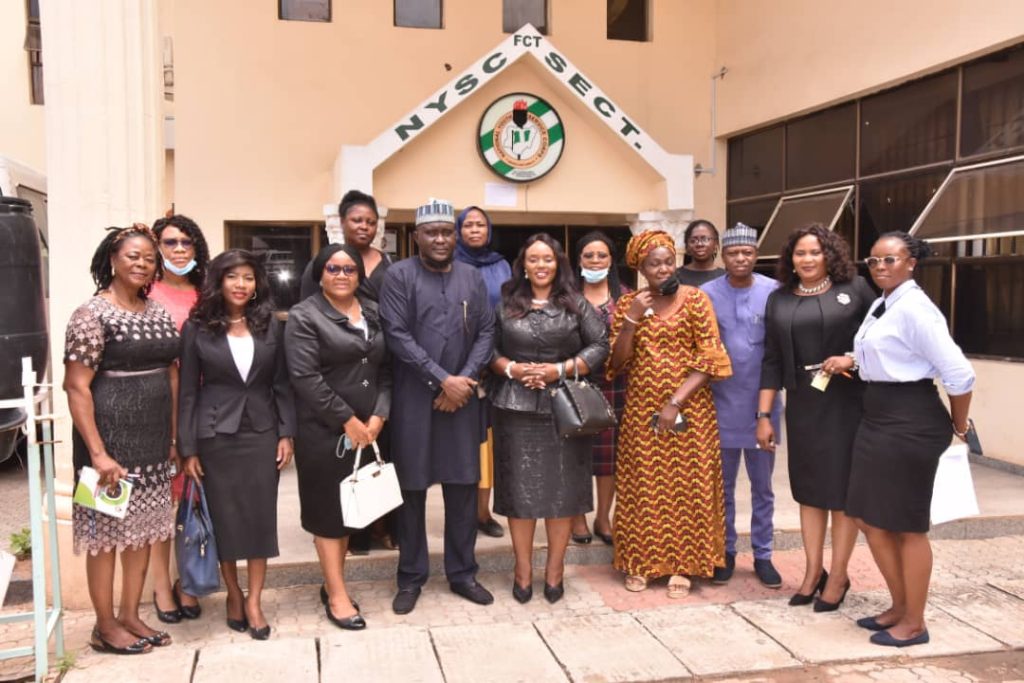
The FCT NYSC Coordinator and Abuja branch Chairperson in the middle with the Management Staff and Other Executives as well as Members of FIDA Abuja

The International Federation of Women Lawyers, FIDA Nigeria, Abuja Branch recently paid a courtesy visit to the Federal Capital Territory, National Youth Service Corps (NYSC) Coordinator, Alhaji Abdul Suleiman.

Leading the team, Chairperson of FIDA Abuja, Mrs. Rekia Rachael Adejo-Andrews said FIDA plans to collaborate with NYSC FCT to train Corps members both as Peer Educators and Community Paralegals in their places of Primary Assignment.

Find here pictures from the visit:

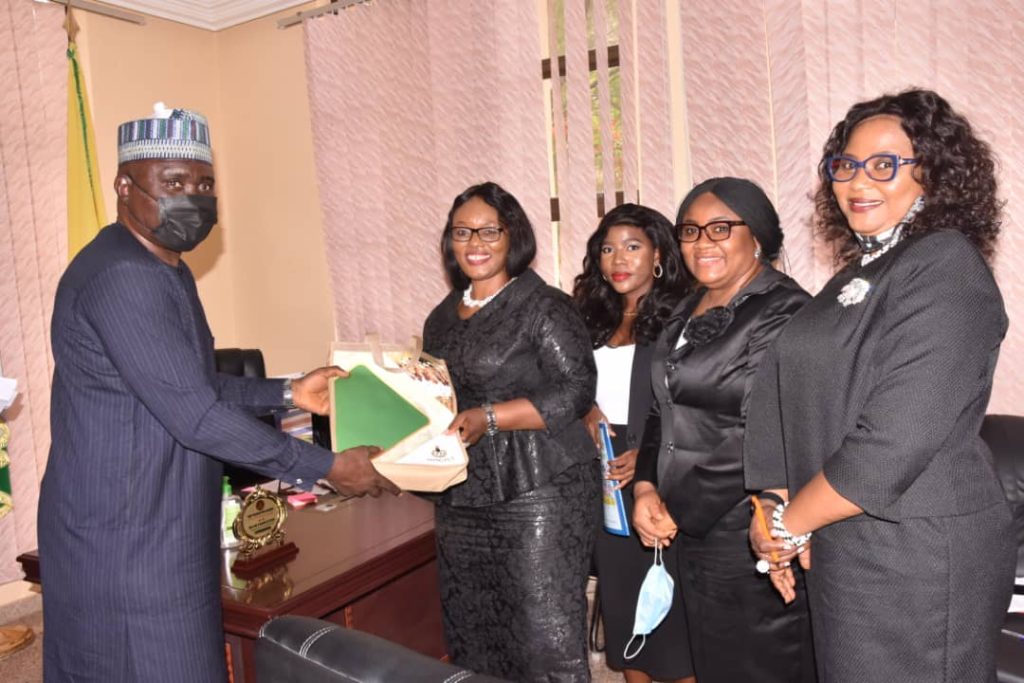
The FCT NYSC Coordinator (Alhaji Suleiman Abdul) presenting some NYSC publications to us. Chairperson receiving with other executive members
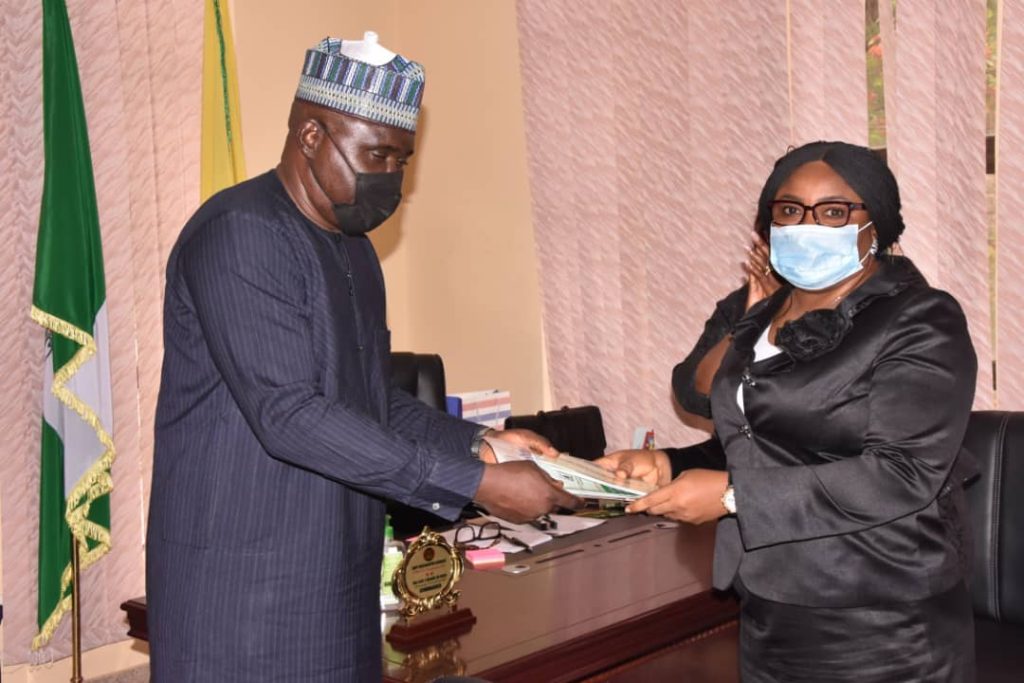
Chairperson signing the visitor’s register.
The Vice Chair Person (Chibuzo Nwosu)presenting copies of copies of simplified VAPP Act to the FCT NYSC Coordinator.

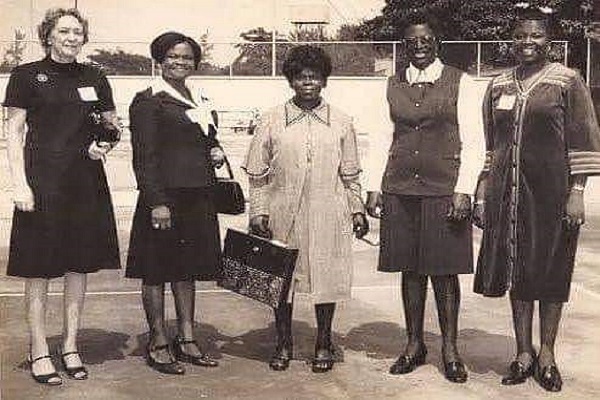
The first five female Jurists in Nigeria

The first five female Judges in Nigeria; this photo was taken in Lagos at a Judges Conference in 1980.

Left-to-Right: Dulcie Ethel Adunola Oguntoye, Roseline Omotosho, Modupe Omo-Eboh, Atinuke Ige and Aloma Maryam Mukhtar!

Hon. Justice Modupe Omo-Eboh (nee Akingbein) was first female High Court Judge in Nigeria. Justice Oguntoye was the second, Aloma Mukhtar third, Atinuke Ige fourth and Omotosho fifth.

The late Hon. Justice Modupe Omo-Eboh was called to Bar on March 14th, 1953. She became the first female High Court Judge in Nigeria on November 10th, 1969.

Modupe Omo-Eboh was the first female judge appointed to the High Courts of Nigeria. Born Modupe Akingbehin, 1922 in Lagos, she is the great-granddaughter of Bishop Ajayi Crowther. She attended Queens College before studying Law in London. Her Lordship occupied various legal positions as a lawyer, Magistrate, Chief Magistrate, Administrator-General and Public Trustee, Director of Public Prosecutions and Acting Solicitor-General before 2002 when she died. There is a Justice Modupe Omo-Eboh Street in Lagos named after her.

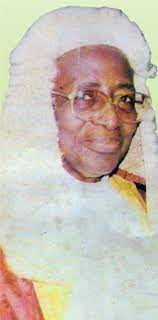
Hon. Justice Dulcie Ethel Adunola Oguntoye was Nigeria’s second female Judge.

Justice Oguntoye, Nigeria's Oldest Female Judge Dies at 95 – Nigerian  Current

Dulcie Ethel Kin was born 29 May 1923 and died 12 November 2018. The English-born Nigerian jurist served in the Women’s Auxiliary Air Force during World War II and then enrolled to study law at the Middle Temple Inns of Court.

Pilots of the Caribbean - Justice Dulcie Oguntoye - YouTube

She married Chief David Ojo Abiodun Oguntoye, the first Ijesha lawyer, whom she had met during the War while he was also serving in the Royal Air Force, on 16 November 1946, and they moved to Ibadan. He gave her the name “Adunola”. He married another five wives after her. They established a law firm, Oguntoye & Oguntoye in 1949. Her husband died in June 1997.

Hon. Justice Aloma Mariam Mukhtar, Nigeria’s third female judge rose to become the first female Chief Justice of Nigeria.

Nigeria: Mukhtar Sworn in As CJN, Emerges First Female GCON - allAfrica.com

A woman of many firsts, she is the first female lawyer from Northern Nigeria, first female Chief Registrar, Kano State Judiciary, first female judge in  Northern Nigeria, first female Judge of the High Court of Kano State, first female Justice of Nigeria’s Court of Appeal and the first female Justice of the Supreme Court of Nigeria!

Hon. Justice Atinuke Omobonike Amoke Ige, Nigeria’s fourth female judge was born on April 4, 1932. She was first admitted for Bachelor’s degree in Arts at the University College Ibadan and thereafter proceeded to commence legal studies at Lincoln’s Inn London. At the same time she enrolled at Kennington College of Commerce and Law Studies. Ige was called to the English Bar on April 28, 1959 and enrolled at the Nigerian Bar on May 18th 1959.

Facebook

In her early practice days, she was the only female lawyer in Ibadan. In October 1963, Justice Ige was appointed Magistrate in the Western region of Nigeria.
In 1977, she was appointed a High Court Judge in Oyo State. On September 6th 1993, she was elevated to the Court of Appeal and retired in 2002.

THROWBACK THURSDAY: CHIEF BOLA IGE | The Culture Custodian (Est. 2014)

Her husband Chief Bola Ige, SAN, felled by assassins in December 2001 was Nigeria’s Minister of Justice and Attorney General of the Federation.

Hon. Justice Roseline Omotosho was the country’s fifth female judge.

Additional source: Wikipedia

Photo source: Oguntoye Family/Bimbola Babarinde/NNP

Common mistakes of the modern day fathers

By Bisi Adewale

During the Mothers’ Day celebration in a prison, a Christian ministry visited the inmates with greeting cards they could send to their mothers. The ministry offered to pay for the postage of the cards to their mothers.

All inmates came out of their cells to send the greeting cards to their mothers to the extent that more had to be provided because there weren’t enough for the inmates.

They all wrote emotional messages to their mothers, appreciating them for their love, care, attention, and support.

These are some of the words they penned for their mothers:

“Sweet Mother, you are the best”

“Mum I disappointed you, I am sorry”

“I love you mum”

“Super Mum”

“Mum, this is your Mum of the Century award”

“I don’t deserve you mum, you are too much”

“You sold all to pay for my lawyer’s fees. I don’t know how to thank you”

“All abandoned me, but you are just there. You are more than a million”

Encouraged with the responses of the inmates, the prison ministry purchased a large number of cards for Father’s Day celebration with the thought that inmates would need to send lovely wishes to their fathers.

They were wrong. Unfortunately, only ten inmates out of thousands came out to pick cards. Three of them wrote negative things on their cards. Curious, the ministry involved decided to interview some of the inmates about their relationship with their fathers. What they said should be food for thought for all fathers. Some of them said:

“My father is the reason I am here. He is a bad example.”

“He was never in my life. I don’t know him.”

“I don’t have a father. He is late, but he is living in Ohio now.”

“He made me wild.”

“I hate him.”

“He beats my mum regularly.”

“He is an idiot.”

“I don’t like him.”

“He made me gay.”

“I met him for the first time when I was 12.”

“He said he was not my father.”

“He divorced my mother when I was 3. I met him twice after.”

“He is a pastor of a church, but a devil at home.”

‘’We are three boys, raised by an idiotic and alcoholic father and we are all in prison.’’

“Please don’t mention his name.”

“He introduced me to porn. I became a sex addict and rapist, here I am.”

“That idiot slept with my sister”

The following summarizes what mothers are doing and the mistakes some fathers are making. Every father who is reading this should take heed and avoid the common mistakes of modern fathers.

ABSENTEE FATHERHOOD

Lots of fathers are absent from the lives of their children. Millions of children are being raised by single mothers worldwide. It’s a mistake on the part of any man to abandon his children for their mother only.

MIDNIGHT FATHERHOOD

Some fathers are home mostly at night while their children are fast asleep.

DELEGATING PARENTING

Some fathers delegate almost everything about parenting to their wives. They believe their only duty at home is to pay house rent, school fees and other bills. This is very wrong. School fees cannot raise a child. An excellent father is much involved in rearing, nurturing, caring, training and parenting his children. He is ready to attend parents-teachers meetings and he is available on important days in the lives of his children.

ORDER, JUDGEMENT SYSTEM

Some fathers run the order-judgement system. They give order to their children in the morning and come out to judge them in the night for any wrongdoing. No love, no interaction, no intimacy and no effective communication.

EXECUTIVE FATHERHOOD

Lots of fathers are executive in nature. They behave like managers at home. Their rooms are their offices. They issue orders which everybody must obey. They have a formal relationship with their wives and children.

CELEBRITY FATHERHOOD

Some fathers who are famous or in a position of leadership and authority are fond of having a celebrity mindset at home. They behave like a tin-god and separate themselves from their children. Some pastors are fond of this too. They fail to know the difference between spiritual and biological fatherhood. They are so far from their children and still busy even when at home. They find it difficult to have a personal relationship with their children.

IRRESPONSIBLE FATHERHOOD

Can you imagine this home? The father gets a fat salary but he hardly drops a dime at home for his wife and children. This is an act of irresponsible fatherhood.

CHILD ABUSE

Some fathers, especially in Africa, believe that the best way to raise a child is to beat them and inflict injury. They use everything to harm their children in the name of discipline. Some even use blades to harm their children.

A father made his 16-year-old daughter stand clad on the street to shame her for committing fornication. This is simply Child abuse, not discipline. The Bible supports child discipline, not child abuse. See this:

“Foolishness is bound in the heart of a child; but the ROD OF CORRECTION shall drive it far from him.” Proverbs 22:15 KJV.

Note that it is the rod of correction the Bible calls it, not the rod of affliction. Child abuse is wrong, don’t do it.

NON INVOLVEMENT

Some fathers are at home but they are never involved in the lives of their children. They pay the bills and provide all things, but they will never raise a finger. They believe that their wives only are responsible for raising children. This is wrong. A father must be involved in all the 6 phases of parenting namely:

Childbearing
Child rearing
Child nurturing
Child discipline
Childcare
Child training
This is what excellent parenting is all about.

WIFE BATTERING

Modern men are still committing the crime of beating their wives, the mothers of their children with impunity. This is a grave mistake that a father must not commit.

CHILD BRIBERY

Trying to bribe a child to behave in a certain way by promising a reward only teaches a child that they get a prize if they act inappropriately first, and then change their behaviour. If you want them to act appropriately for the first time, a good child discipline alternative is to remind them how good it feels to make the right choices or to simply give the predetermined positive consequence for positive behaviour.

Culled from the book Excellent Fatherhood

STAYBLESSED

NNPC incurs N101.69bn losses as operational expenses on three refineries

The Nigerian National Petroleum Corporation (NNPC) has said it spent a whopping sum of N101.69 billion to service three non-operational refineries in 2020Ironically, the three refineries did not process crude in the year under review.The the refineries were the Warri Refining and Petrochemical Company, Port Harcourt Refining Company (PHRC), and Kaduna Refining and Petrochemical Company (KRPC).The refineries, according to the report, have a combined production capacity of 445,000 barrels of oil per day (BPD), adding that all the refineries processed no crude in year 2020.The KRPC recorded the highest overhead expenses of N34.16 billion, with PHRC following with N33.97 billion while WRPC recorded N33.55 billion.Furthermore, in January 2020, the refineries had incurred N9.6 billion operating deficit, while in February, N9.36 billion loss was incurred with highest deficit in March of same year, which was put at about N10.30 billion by the three refineries and N9.6 billion in April as well.However, in May and June, the refineries recorded losses of N9.54 billion and N10.23 billion and N9.05 billion loss was recorded by the three refineries in June.The report  revealed that the operating deficits decreased in the months of August, September, and October, despite the refineries posting N7.08 billion, N7.04 billion, and N5.48 billion losses accordingly.In addition, about N5.9 billion loss was recorded in November before increasing to N8.2 billion in December.It would be recalled that the Federal government recently said it would spend $1.5 billion on the turn- around maintenance of  these non -functional refineries.

Credit: Eyewitnessnews

Why the Lagos new Anti-Corruption Commission Law is valid but will be inoperable

By O. G. Chukkol

Prelude
The governor of Lagos State, Babajide Sanwo Olu, has reportedly signed a new bill into law establishing an agency similar to the Economic and Financial Crimes Commission, EFCC and the Independent Corrupt Practices Commission, ICPC.

TheNigeriaLawyer (https://thenigerialawyer.com/new-law-empowers-lagos-to-take-over-tinubu-fashola-ambodes-alleged-corruption-cases-from-efcc-report/) reported that the legislation is titled ‘Lagos State Public Complaints and Anti-Corruption Commission Law’ and the anti-corruption agency established by the said law will not only have exclusive right to investigate financial crimes and corruption cases involving the finances of the Lagos State Government, it will also take over all the pending cases before other anti-graft agencies.

For the avoidance of doubt, section 13(3) of the law reads, “The commission shall upon the commencement of this law take over the investigation of all anti-corruption and financial crime cases involving the finances and assets of Lagos State Government being investigated by any other agency.”

Also, section 13(5) states, “The commission shall have the power to the exclusion of any other agency or body to investigate and coordinate the investigation of corruption and financial crimes cases involving the finances and assets of the state government.”

Thus, the purpose of this write up is to show how the law is valid but will be Inoperative

Why the Lagos law is valid
The law is valid because it is within the competence of the Lagos State House of Assembly though exercisable concurrently with the National Assembly.

See the case of A.G. Ondo State v. AG. Federation (2002) 9 NWLR (Pt 772)222 where the Supreme Court held that both the Federal Government and State Governments can enact laws to abolish corruption pursuant to sections 4, 15(5), 318, item 60(a), 67 and 68 in Part I of the Second Schedule and section 2(a) of Part III of the Second Schedule of the Constitution of the Federal Republic of Nigeria, 1999 (as amended).

Uwais, CJN, who delivered the Leading judgement remarked thus:

“…both the Federal and State Governments share the power to legislate in order to abolish corruption and abuse of office. If this is a breach of the principles of Federalism, then, I am afraid, it is the Constitution that makes provisions that have facilitated breach of the principles. As far as the aberration is supported by the provisions of the Constitution, I think it cannot rightly be argued that an illegality has occurred by the failure of the Constitution, to adhere to the cardinal principles which are at best ideals to follow or guidance for an ideal situation.”

The above position was later adopted in the cases of Olafisoye v. F.R.N. (2004) 4 NWLR (Pt. 864) 580 and FRN v Anache & Others (2004) 14 WRN 1 61

Why the Lagos law will not operate
The new law will not operate because EFCC Act and ICPC act are already in operation. Remember, the Lagos Law provides that the new commission shall “take over the investigation of all anti-corruption and financial crime cases involving the finances and assets of Lagos State Government being investigated by any other agency.” In other words, EFCC and ICPC are expected to hand over all cases of corruption to the Commission so far as they relate to Lagos Finances.

With profound respect such provision is far reaching and cannot operate side by side with EFCC and ICPC Act. The law has stretched powers of the new Commission too far.

The new Lagos law also provides that “the commission shall have the power to the exclusion of any other agency or body to investigate and coordinate the investigation of corruption and financial crimes cases involving the finances and assets of the state government.” This provision cannot also stand even if the power was not made exclusive.

By Section 4(5) of the constitution, any law made by the National Assembly will prevail over the law made by the State House of Assembly. In other words, the EFCC Act and the ICPC Act are superior to the Lagos Public Complaints and Anti-Corruption Commission Law. However, the Lagos law is not void. In the case of Attorney-General of Bendel State v Attorney-General of the Federation (1981) 10 SC, it was held that under the doctrine of covering-the-field, the state law is merely rendered inoperative while the federal law is in operation. The state law is only kept in abeyance by the higher federal law and therefore rendered inapplicable for the time being. The state law revives in the event of the federal law ceasing to have force. Therefore the use of the term, ‘inconsistency’, in the cases under the doctrine should be taken to mean, not invalidity of the state law, but inoperativeness of the state law arising from the conflict between the two laws; because the State law merely gives way “out of necessity” See also Musa v INEC (2002) LPELR-11119 (CA), 58-59.

Concluding remarks
The enactment of this new law is no doubt a commendable step and apparently a move by the Lagos State Government to deepen the culture of accountability and transparency in the expenditure of appropriated public funds. However, the nature of our constitutional jurisprudence cannot allow it to operate because EFCC and ICPC have covered the field already. Secondly, it is regrettably submitted that one cannot trust states with such initiative as they may end up only shielding their officers from prosecution. While one cannot defend EFCC and ICPC as being fair and unbiased in their operation, leaving the operation of such anti-corruption Commission exclusively to the Federal government as envisaged by section 4(5) of the constitution is the best because decentralizing it will only make things (witch-hunting, shielding of persons in good books of government etc) worse.

PS:

The National Assembly makes laws for the Federal Republic of Nigeria, not federal government. It makes laws for everyone in Nigeria.

The implication of the foregoing is that the National Assembly can validly enact a law and empower an agency to prosecute on corruption related issues even though the subject of crime belongs to the state government.

In the case of Nyame v FRN the second issue for determination was whether EFCC had locus standi to try Nyame given the fact that the funds allegedly embezzled belongst to Taraba State Government.

Rotimi Jacobs , SAN⁩ argued beautifully on behalf of the EFCC that prosecution of offence is not determined by the ownership of the property allegedly stolen or misappropriate or even the subject matter of the charge, what is however relevant to determine are the following:
(a) Who can exercise prosecutorial power over the offence?
(b) The nature of the offence charged;
(e) Where the offence is committed.

That where the offence charged is a Federal offence irrespective of the ownership of the subject matter of the offence, the Attorney General of the Federation or any relevant Federal Agencies may by the provisions of Section 174 of the Constitution 1999 prosecute the accused in any court in Nigeria except court martial.

Though the court was reluctant to delve into the court merit of the case, it however agreed with the distinguished silk and said that the answer to whether EFCC had locus standi or not cannot arise since in the enforcement of the law especially that of the criminal law the Federal Government or its agencies can initiate and prosecute once the relevant statute so authorises

In the light of the foregoing, I do not think ownership of finance is really relevant in determining the power of the National Assembly to legislate on same

                        ✍
    O. G. Chukkol, ACIArb (UK)
             Final Year Student, 
               Faculty of Law,
                   ABU, Zaria
    [email protected]
               08032470318
               April 26, 2021

Armed men stormed her school in a kidnapping raid. Then she found her family in her captors’ hideout

Habiba Iliyasu, 15, was asleep in her school dormitory in northwestern Nigeria when a group of armed men burst in and ordered her and her schoolmates out of bed.The schoolgirls — 279 in total — were rounded up by the men, who arrived at the school on motorbikes.”They fired guns. Some of them came into the school while others stayed at the gate,” Habiba recalls of the ordeal on February 26, which prompted global outrage and prayers from Pope Francis for the release of the captives.Taken from her dormitory at the Government Girls’ Secondary School in the town of Jangebe, Zamfara state, they were forced to walk through the night into the forest where the kidnappers camped out, she tells CNN.Some of the girls did not have time to put on shoes and were forced to walk barefoot, sustaining cuts and injuries, Habiba says.

Inside the kidnappers’ den

nigeria kidnapped schoolgirls released Busari pkg intl ldn vpx_00000423

Tears of joy and relief as 279 Nigerian schoolgirls return home 02:09He says the bandits would put pressure on loved ones to raise money by making him stand on burning coal when he called his family so they could hear his screams of agony.His wife Rukkaya Iliyasu, 58, was left alone, and distraught at home, frantically trying to raise the money from her meager earnings selling groundnuts and bean cakes.”My tears dried up,” she told CNN. “I couldn’t cry anymore. We sold our land, camels, maize, crops. Everything,” she says with a deep sigh.In the end, they say they managed to raise just over two million naira ($5,000) after selling virtually all their belongings and crowdfunding for contributions.It was only after Habiba was freed and told the state governor about his plight that he and others were eventually released, Magaji says.In all, Magaji would spend three months and two weeks in the forest with his eldest daughter and two grandchildren.

No longer ideological

Kidnapping has become one of the major security challenges in Nigeria.Figures are hard to come by due to under-reporting, but a study by the Nigeria Security Tracker (NST), which maps political violence in the country, states that there have been more than 200 kidnapping incidents so far this year with at least 2,043 victims. There were an estimated 437 kidnapping incidents with 2,879 victims for the whole of 2020, NST figures show.Although Asch Harwood, who oversees the tracker, told CNN these figures are likely underestimated due to under-reporting of kidnapping cases.Kidnapping has been prevalent in the oil-rich south of Nigeria for decades as militants fight for control over resources. They kidnapped foreign oil workers and expatriates to attract international attention to their cause. Similarly, the Islamist militant group Boko Haram has carried out thousands of kidnappings in the 12-year insurgency waged in the country’s northeast.However, the landscape has now changed and the new wave of kidnappers are not agitating for political or religious ideology, their motive is simply to make money, analysts say.”Kidnapping has morphed from being ideological, like in the Delta region, where they pressed for demands and control for resources. What we have now is purely criminal and that is what is driving the trend now,” says Don Okereke, a Nigerian security analyst.It is a phenomenon described by Matthew Page, an associate fellow on the Africa program at Chatham House think tank, as “violence entrepreneurship.”Marauding groups, known locally as bandits, operate from forest enclaves in northwestern Nigeria, where they organize attacks and kidnappings on rural areas and Nigeria’s major road networks.Between June 2011 and the end of March 2020, an estimated $18.34 million was paid in ransoms, according to Lagos-based SBM Intelligence in a report last year titled “The economics of the kidnap industry in Nigeria.”Former Nigerian senator, Shehu Sani, who helped in negotiations to free some of the kidnapped Chibok schoolgirls, estimates that the true figure is far higher.”Just in the last five years, even at a rough estimate, over $100 million has been paid by either individuals or organizations to terror groups, or to bandits for ransom … thousands of people have also been killed, and millions of people have been displaced,” he tells CNN.Sani says the bandits are often ruthless and execute people who fail to meet their ransom demands — and make the families pay to pick up their bodies.”I know family members who went to pay ransoms after the deadline but had to pay to pick up the corpse. Ransom encourages kidnapping, but refusal to pay a ransom will lead to the slaughter of innocent persons,” he says.In 2017, Nigeria’s senate approved the death sentence for kidnappings in instances where they lead to deaths but many Nigerians don’t risk reporting to security agencies for fear their family members will be harmed. Most find ways to raise the money, usually by selling belongings and quietly pay ransoms to free their loved ones.

‘The Chibok effect’

As well as raiding villages, there has been a recent surge in kidnappers targeting schools — nearly 800 children have been taken in the past four months alone. There have been four kidnappings from academic institutions in northern Nigeria since the start of the year. In the latest incident, three of the 20 students kidnapped from Greenfield University in Kaduna were killed last week.

In contrast to her family, Habiba was freed along with her schoolmates after just three days. Zamfara’s state governor Bello Matawalle denied paying a ransom but said “repentant bandits” negotiated their release.Many believe that the infamous 2014 Chibok abductions by Boko Haram helped make schools a lucrative target.”They saw what happened with Boko Haram and the Chibok girls and bandits have adopted the same strategy,” Sani says, explaining that authorities paid more attention to abductions of students than of any other sectors of society. “It is difficult for them to stop kidnapping … they have discovered that it is a gold mine.”As for the Iliyasu family, their experience has left them near destitute, but Habiba is back in school and determined to continue with her education.

Credit:CNN

Defining and Classifying Virtual Assets: Does it meow or roar? – Senator Ihenyen

Defining and Classifying Virtual Assets: Does it meow or roar?

by Senator Ihenyen

Cats and the feline family—numbering up to 37 cat specie—have always fascinated me. Whether a cheetah or jaguar, leopard or lion, panther or puma, they are all cats—at least colloquially. Even the graceful, low-slung bodied, white-furred Lidi—a pet in one of my aunts’ home while I was growing up in Lagos—is a cat. A domestic cat. And because Lidi is a cat for the house, she enjoys human company and habitation. A domestic cat, Lidi is expected to meow, not roar; drink milk and eat fish; not hunt down her prey with trimmed claws. Should Lidi ever roar, its classification as a felis catus—a domestic cat—would become questionable. Should Lidi roar, she may most likely lose her human home. Should Lidi roar, her unique specie might merit a redefinition in the feline family. And consequently, a reclassification. If redefined and reclassified, Lidi may end up in a game reserve, a zoo, or a woodland forest preying in the wild. 

What a thing is defined as determines how that thing is classified, and consequently how the thing is treated. One of the major challenges of regulation today is the problem of how to treat virtual assets. This is often a consequence of the definitions and classifications adopted (or not adopted) by regulators around the world. And when you consider that with virtual assets it gets more complex because a particular virtual asset may have the capability to meow and roar depending on what it is used for, the need for a proper definition and classification of virtual assets is critical. In the world of virtual-assets regulation, a blanket, catch-them-all approach does more harm than good. Treatment of virtual assets calls for an adaptive, developmental, innovative, and risk-based regulatory approach. It starts with definitions.

The power of definitions—a matter of life and death

Definitions define the world. They also largely determine our relationships with it. 

Whether you will label a person a tourist or terrorist depends on your definition of who a tourist or terrorist is. It is with that definition in mind you are able to identify what behaviours or characteristics the person has which merits an association with tourism or terrorism. Whatever it is, each comes with its own consequence—life or death. For example, following the Central Bank of Nigeria’s (CBN) recent circular banning cryptocurrencies in Nigeria’s banking and financial system, it defined ‘cryptography’ in the context of cryptocurrencies as “a method of encrypting and hiding codes that prevent oversight, accountability, and regulation”. With such a curious definition, the CBN definitely left no one in doubt that it was going for the kill. A classic giving a dog a bad name to hang it? Maybe. 

Definitions rule the world. What makes the difference between manslaughter, murder, and mercy killing is definition, otherwise all three are simply deaths. So without objective and accurate definitions, disruptive innovations such as virtual assets, including cryptocurrencies, may die in the strangulating grip of rabid regulation. To have responsive and responsible regulation, we must get definitions right.

Why a blanket regulatory approach to virtual assets is a mess.

Virtual assets are dynamic. They have nuances that demand refinement, not blanket approaches. The recent CBN directive effectively banning cryptocurrencies in Nigeria’s banking and financial system, for example, is one of such blanket approaches. A ban—especially without a solution—is an immediate form of control but equally the remote form of losing control.

Speaking of control, what if I told you that CBN’s 5 February 2021 directive to Nigeria’s banking and financial industry only affects cryptocurrencies, not virtual currencies and other noncryptocurrency virtual assets? Yes, technically. What if I also told you that CBN’s ban of cryptocurrencies in Nigeria’s banking and financial system does not completely affect the SEC’s statement on the classification and treatment of digital assets in Nigeria? Yes, technically. How?

First, while all cryptocurrencies are virtual assets and virtual currencies, not all virtual assets and virtual currencies are cryptocurrencies. For example, while bitcoin is a virtual asset and virtual currency it is also a cryptocurrency because it uses blockchain technology which is a link of records that are linked using cryptography, XRP is a virtual asset and a virtual currency but not a cryptocurrency because XRP does not use blockchain technology. Second, regarding CBN directive and the SEC’s statement, while cryptocurrencies are affected, the SEC statement included other digital assets other than cryptocurrencies or ‘crypto assets’. These digital assets are utility tokens providing access to products or services, security tokens having features of investments or security, and derivatives and collective investment schemes of crypto assets, utility tokens, and security tokens. For example, bitcoin is a crypto asset, bnb is a utility token, and bitcoin futures and options are derivatives.

Now if we take the argument to another level, where bitcoin is used as a speculative asset or investment asset, this use case takes bitcoin off CBN’s jurisdiction, as far as that particular transaction is concerned. It becomes subject to the SEC‘s regulatory authority. And where bitcoin is used to perform the function of a currency, this use case takes bitcoin back under CBN’s jurisdiction. 

The point is this: a proper regulation of virtual assets, virtual currencies, and cryptocurrencies require sound understanding. With sound understanding, it would become (more) obvious that CBN’s current blanket approach to virtual assets, virtual currencies, and cryptocurrencies badly needs help.

Understanding the distinction between virtual assets, virtual currencies, and cryptocurrencies and their regulatory implications

First, a ‘virtual asset’ or sometimes called ‘digital asset’ is a value represented in a digital form, making that value capable of being stored, traded, or transferred digitally. This “value”, as I pointed out in my inaugural column here, could be currency, identity, information, intellectual property, security, vote, etc. Also, storing, trading, or transferring this “value” does not require a central authority or third party. As defined by the Financial Action Task Force (FATF), a virtual asset “is a digital representation of value that can be digitally traded, or transferred, and can be used for payment or investment purposes.” Virtual assets include virtual currencies and other assets that have nothing to do with currencies or money such as Non Fungible Tokens (NFTs) for example.

Second, a “virtual currency”, on the other hand, has been defined as “a digital representation of value that can be digitally traded and functions as (1) a medium of exchange; and/or (2) a unit of account; and/or (3) a store of value, but does not have legal tender status (i.e., when tendered to a creditor, is a valid and legal offer of payment) in any jurisdiction.” 

Third, cryptocurrencies are virtual currencies issued by largely anonymous and decentralized entities and secured by cryptography. Cryptocurrencies are convertible virtual currencies because they have equivalent value in fiat currency. They may be exchanged for fiat currencies based on offer and acceptance between the parties transacting in them.

So amongst other benefits, a proper understanding of the nuances of virtual assets will help to avoid unnecessary regulatory encroachments among regulators. For example, CBN encroached on the SEC’s turf when CBN maintained in a recent press release that cryptocurrencies have become more widely used as speculative assets rather than as means of payment. CBN even went as far as contrasting cryptocurrency investments with investments in stocks in the Nigerian Stock Exchange. However tenable that concern may be, this is not CBN’s call. It is SEC’s call. The SEC has decades of experience and knowledge regulating commodities, derivatives, securities, as well as various investment schemes. CBN  may of course come in where virtual currencies or cryptocurrencies are used to enable savings & loans, payments, and cross-border transactions. CBN may also come in where it considers that cryptocurrency adoption in Nigeria directly affects—negatively, positively, or both—the country’s fiscal and monetary policy.

Both the absence of definitions or sometimes a lack of proper definitions have resulted in the seeming cluelessness, confusion, or conflicting policies in Nigeria’s regulatory response to virtual assets.

The current mess in Nigeria’s virtual-asset regulatory landscape suggest—rightly or wrongly—some level of cluelessness, confusion, or conflicting policies. This is unhealthy.

CBN has warned severally about ‘virtual currencies’ in Nigeria, but it failed to define it. When CBN issued its first-ever circular on virtual currencies to banks and other financial institutions in Nigeria on 12 January 2017, CBN neither defined nor explained what virtual currencies were. In that circular, CBN’s drew the attention of banks and other financial institutions to the risks associated with virtual currencies. These risks are as a result of the intersection of “convertible VC activities …. with the regulated fiat currency financial system”. According to the CBN, the risks involve the susceptibility of virtual currencies to “abuse by criminals, especially in money laundering and financing of terrorism.”

But without defining what it was trying to control, CBN’s first love letter on virtual currencies to banks and other financial institutions left many questions unanswered. Nigerians—as you would expect—found their own answers. 

Similarly, the SEC advised against investment in cryptocurrencies, virtual currencies, or digital currencies, but also failed to define any of them. Curiously, the SEC’s first public notice on investments in cryptocurrencies and other virtual or digital currencies was delivered same day CBN’s love letter dropped. The SEC advised the members of the public against investing in “cryptocurrencies such as Swisscoin, OneCoin, Bitcoin and such other virtual or digital currencies”. This left more questions than answers on the lips of many Nigerians. Of course, much more was expected of Nigeria’s capital-market regulator. Again, Nigerians went in search of answers.

When the initial CBN circular did not stop the growing rate of cryptocurrency adoption in Nigeria, CBN dropped a public notice but again without any definition.

Exactly 14 days after what I imagine must have been a bad Valentine’s Day between the CBN and virtual currencies, CBN issued another circular on 28 February 2021. This time, CBN re-emphasized that virtual currencies are not legal tender in Nigeria and remain unregulated. Consequently, according to CBN, should exchangers or entities offering these virtual currencies “collapse or close business”, there would be no redress. The CBN, similar to its initial circular, did not define what cryptocurrencies, virtual currencies, or virtual assets were.

Curiously, 3 years later, virtual-currency exchanges in Nigeria—particularly the indigenous ones—currently face the risk of collapse or threat of closing business. Having warned the members of the public about the risks associated with virtual currencies—with little or no education from our regulators—one would have expected that the CBN would at this point use its regulatory authority to ensure that these risks are at least minimized. How? By adopting a risk-based approach to virtual-currency transactions in Nigeria’s banking and financial system. This was CBN’s approach in its January 2017 letter. That approach, instead of being improved upon, was suddenly abandoned 5 February 2021. And this was after 3 years. Is three years long enough for CBN to have conducted a comprehensive and publicly available research on virtual assets in Nigeria’s banking and financial system? Meow, Lidi would say. I also think so.

When CBN sneezes, others catch a cold. 

By its 5 February 2021 circular, CBN effectively abandoned its initial risk-based approach, preferring an outright ban of cryptocurrencies in Nigeria’s banking and financial system. Before the cock crew twice, the SEC suspended its own regulatory position on virtual assets in Nigeria. All the SEC’s roadmap and whitepapers—as we love to call them in the crypto space—became just that: roadmap and whitepapers. Of course the SEC meant well. I know competent, knowledgeable, and well-meaning individuals who were part of the process that resulted in the SEC’s eventual roadmap for fintech innovation in Nigeria’s capital market.

So why has the SEC suddenly turned Peter overnight? Because CBN sneezed. 

Whenever CBN sneezes, everyone seems to catch a cold in Nigeria. This may understandably be because of the immense responsibilities of CBN in ensuring a sound financial system in the country. Such responsibilities often overlap with certain regulatory concerns of other regulators. And this is why I think CBN needs to engage more, adopting a more collaborative and multi-stakeholder approach to dealing with challenges in the financial services industry. Apart from banks and other financial institutions, the CBN should also consider taking virtual assets service providers (VASPs) along as well. VASPs, including virtual assets exchanges,  could very well be the vaccine that the financial system needs to immune itself against the risks often associated with virtual currencies. Banning cryptocurrencies in Nigeria’s banking and financial system is not a solution. It is only a sleeping pill for borrowed time. The fundamental issues will not disappear. Hopefully, CBN as well as other concerned regulators will wake up to smell the coffee soon. The time is ticking. To understand the urgency, think of it as a timebomb. We don’t have all the time we always seem to think we have.

To secure Nigeria’s future in the emerging virtual-assets industry, the SEC needs to step out of CBN’s encroaching and hovering shadow.

The SEC’s current place in the emerging virtual-asset space leaves much to be desired. Especially when you consider that more than any other regulator in the country the SEC arguably has a more significant role to play in the regulation of virtual assets, the big picture may become clearer. The SEC is the powerhouse of regulation of commodities, derivatives, and securities in the country. Think of Nigeria’s SEC as the US SEC and the US Commodities Future Trading Commission (CFTC) combined. Yes. So whether Nigeria will be left behind or not in the emerging global virtual-asset space will largely depend on the quality of leadership, innovation, and vision the SEC is capable of. 

Presently, the SEC—though independently established under the Investments and Securities Act (ISA)—appears to be a capital-market department of the CBN. Appears, I said. In any case, while intergovernmental-agency collaboration should be encouraged, the SEC needs to be seen—and manifestly so—to be leading regulatory efforts in areas that fall within its regulatory purview. This, as I pointed out earlier, does not suggest that CBN or any other agency cannot also regulate virtual assets in Nigeria. Each regulatory body needs to properly define what virtual assets and their types are and then determine which of these assets fall under their regulatory purview. The SEC generally did so in September 2020 when it issued a statement on the classification and treatment of digital assets in Nigeria. Though not altogether the best of statements, the SEC’s position was historic and significant. To many Nigerians, it was a compass in the middle of nowhere, until now. After the CBN hammer of 5 February 2021, Nigeria is back in the middle of nowhere.

To move from nowhere to somewhere, let’s openly, meaningfully, and truly engage.

It is not enough for the CBN to deny an entire emerging industry access to banking and financial services over certain risks in a country that speaks of a sound financial system. A sound financial system must also be fair and inclusive. It is equally not enough to have the SEC simply say that it has suspended its fintech plans regarding VASPs in Nigeria because these VASPs will need bank accounts. It is a failure of regulation.

First, with the one-step-forward, 5-steps-backward movement Nigeria has in effect been making in the virtual-assets space over the years, I expect the SEC to play a more leading role in this space. This is the case all over the world, at least in countries where institutions and systems work. So it is not out of place if the SEC sent a(n) (open) letter to other concerned regulators as well as stakeholders on its regulatory efforts and in fact issue guidelines. This should address how the SEC will navigate the opportunities and risks towards ensuring innovation support, consumer protection, and investment safety in Nigeria. The SEC should be leading the way.

Second, regulators in the virtual-asset space, including CBN, NDIC, and the SEC, should embrace and incorporate the culture of releasing guidance and advisory on new issues that come within their regulatory purviews from time to time. While circulars and directives are no doubt vital in regulation, the need to constantly educate the public about disruptive innovations and their impact on the current regulatory regime should not be neglected. Consumer & investor education is a critical tool in regulation. It should not be relegated. Without adequate education, circulars and directives may achieve limited or minimal success. This is why research is key.

To leverage virtual assets for Nigeria’s competitiveness in the global economy, we must start having open, meaningful, and true engagements. No one has all the answers.

Senator Ihenyen is the Lead Partner at Infusion Lawyers where he heads the Blockchain Practice and the Intellectual Property & Technology Practice of the virtual law firm. He advises both local and global companies in various areas of law, including emerging technologies such as blockchain. A tech lawyer with interest in policy and regulations, Senator is the President of Stakeholders in Blockchain Technology Association of Nigeria (SiBAN). He is also the current General Secretary of the Blockchain Industry Coordinating Committee of Nigeria (BICCoN). He is the exclusive contributor (Nigeria chapter) to the International Guide to Blockchain as well as exclusive contributor to the Comparative Legal Guide to Data Protection 2019 (Nigeria Chapter). Senator is currently the 1st Vice Chairman, Intellectual Property Committee of the NBA Section on Business Law (SBL) and member of the Information Technology Committee. Contact: [email protected]

Credit:esq-law

Innocent Chukwuma, Nigerian activist, pivotal pro-democracy campaigner and leading justice reform pioneer

Innocent Chukwuma, who died on the eve of Easter Sunday, on 3 April 2021, shortly after being diagnosed with leukaemia. (Photo: Leaders of Africa / Wikipedia) Less

Innocent Chukwuma died too soon. None the less, he led an exemplary and full life as a human rights activist. He was the pioneer of a police reform programme, founder of the Centre for Law Enforcement Education in Nigeria; he built a coalition for ensuring effective discipline and mitigation of police atrocities and started a hub for incubation of innovation and entrepreneurship.

Innocent Chukwuma, who died on the eve of Easter Sunday, on 3 April 2021, shortly after being diagnosed with leukaemia, was arguably the most influential strategist of his generation in Nigeria’s human rights movement and one of the pivotal advocates for more accountable government and the end of military rule in Africa’s most populous country. He was also Africa’s leading expert on police and law enforcement reform. 

Unusually for a country where civic activists are barely credited with any impact in life or thereafter, President Muhammadu BuhariVice-President Yemi Osinbajo and the foundation of former president Goodluck Jonathan have led the lamentation of his untimely passing at the age of 55. 

On a bright morning in May 1991, a squad of men from the Nigeria Police Force invaded a family home in Oko-Oba, Agege, a densely populated settlement on the outskirts of the commercial capital, Lagos, in search, they claimed, of a violent robber. When they left less than one hour later, they had killed an entire family of father, mother and six children. The Oko-Oba massacre became one of the police’s trademark crimes, nearly three decades before impunity for crimes of unlawful policing drove Nigeria’s young people into the #EndSARS uprising in October 2020.

Public outrage over the Oko-Oba massacre forced the Nigerian government to reach a settlement with the family, agreeing to a payout of about $1.91-million. I was involved in the negotiations as a lawyer with the Nigerian Civil Liberties Organisation (CLO). 

At the time Chukwuma, a young graduate interning with the CLO, expressed quiet outrage at the fact that there were no more serious consequences for the police officers who committed the killings. To him, the episode made human life seem cheap in Nigeria. On formally joining the staff of the CLO later in 1991, Chukwuma made it his mission to convince the organisation to take a more ambitious view of the need to prevent and mitigate police atrocities.

Chukwuma credited his father, a produce dealer from southeastern Nigeria, who died while he was still an undergraduate in 1989, with the inspiration for his consequential life in civic advocacy and social justice. 

As a prefect in his final year in high school, he led a protest of students against the theft of their food by a joint enterprise of the food contractors and school authorities. When he was expelled from the boarding house, his father intervened as his advocate to inquire from the school authorities what crime his son had committed. After patiently listening to the school principal’s version of the protest, the old man asked the question: “But did he lie?” His father’s intervention eventually persuaded the school authorities to allow him to take his final examinations, an experience which, he always testified, taught him the first lessons in civic advocacy and the need to always ask the questions that matter.

During his life of consequential advocacy, Chukwuma made a habit of asking questions that mattered and a virtue out of modelling answers to them. At the University of Nigeria, he emerged as a member of the last generation of credible student leadership in Nigeria, becoming the head of the student union parliament. Their contest of wills with the university authorities and later with the Nigerian government prolonged his sojourn in university by one year, at the end of which he needed a court order to graduate. 

Upon graduating with a degree in theology, he joined the ranks of activists in the CLO, where he pioneered a police reform programme. With Nigeria under military rule, he also became an indispensable member of the team that fostered the building of a coalition of Nigeria’s disparate pro-democracy champions into a united front called the Campaign for Democracy (CD). 

At the end of January 2021, Chukwuma retired from the Ford Foundation. He planned to proceed to Oxford University where he had secured a fellowship at the Blavatnik School of Government to write his memoirs and also do some teaching. In an earlier life, he had worked briefly as a lecturer at the Kennedy School of Government at the Harvard University in Cambridge, Massachusetts. 

As the advocacy against the military intensified after 24 June 1993, when the military cancelled the results of the 12 June 1993 presidential elections, which would have returned the country to civil rule, Chukwuma’s nose for effective strategy would prove critical. With most of the leading members of the anti-military coalition exiled or in jail, he was one of the few people able to move in and out of the country, often across borders, sometimes with the quiet support of friendly security services, to take messages across continents. 

As the brutal dictatorship of General Sani Abacha intensified in the mid-1990s, Chukwuma helped to build cells of effective anti-military voices in Europe and North America. He also addressed multilateral institutions across continents, including the now defunct Organisation of African Unity, the United Nations, the European Union and the Commonwealth, seeking effective pressure against Nigeria’s military government, all the while managing to evade prison or exile with an unusual combination of partnership building, courage and wit. 

For this work, Chukwuma won the Reebok International Human Rights Award in 1996.

When military rule ended in May 1999, Chukwuma chose policy over politics. With the proceeds from the Reebok award, he decided to found the Centre for Law Enforcement Education in Nigeria, CLEEN Foundation, as a think-tank on accountable policing. In 2001, he worked with the administration of President Olusegun Obasanjo to reform and re-enact the Police Service Commission Act, in order to ensure effective civilian oversight of the Nigeria Police Force and address deficits of discipline in the force. 

To give civil society a seat at the table of law enforcement reform, Chukwuma incubated the Network on Police Reform in Nigeria, NOPRIN, a 46-member coalition that aggregates advocacy to advance police and law enforcement reform in the country.

To guarantee the health of Nigeria’s electoral experiment, Chukwuma identified a need to address the tendency of incumbent regimes to use the police to rig elections. With his technical leadership, the Police Service Commission in 2003 adopted a set of guidelines to regulate police conduct in elections, which have subsequently been enacted into a code of conduct and rules of engagement for security personnel on electoral duty in Nigeria. Separately, Chukwuma led a vocal coalition of civic election monitors in Nigeria known as the Transition Monitoring Group, or TMG. 

When Nigeria’s crisis of mass violence began in 2001, Chukwuma identified a need for rigorous diagnosis of the problem. With the Geneva-based World Organisation against Torture, better known by its French acronym, OMCT, he convened a team to study the problem. His hypothesis was that these were state-sponsored killings. The report, released in 2002, was explosive. 

The reaction of the government was to instruct the customs authorities to impound the report on landing in Nigeria as a prohibited import. As Nigeria confronts a deeper crisis of mass atrocities today, his diagnosis nearly two decades ago has proved quite prescient. 

In a country in which civic institution building is rare, Chukwuma built CLEEN Foundation into perhaps the most independent non-government advocacy organisation in Nigeria. When, in 2020, the Nigerian government needed a credible organisation to monitor its spending of funds looted by Abacha and repatriated from foreign countries, CLEEN Foundation was a natural choice

Chukwuma navigated the tensions between the global and the local with an eye on how they could complement and reinforce one another. In 2005, he provided leadership in the foundation of the African Policing Civilian Oversight Forum, APCOF, a continental coalition of advocates for, and national institutions involved in, ensuring effective discipline and mitigation of police atrocities.

Seven years later, in 2012, the Ford Foundation appointed him as its regional representative for West Africa. In this role, Chukwuma quietly transformed the influence of Ford in the region, with seminal forays into such areas as art, political memory and impact investing. At the time of his death, he was the vice-chair of the Impact Investors Foundation (IIF) of Nigeria, whose members had channelled a portfolio of more than $4.7-billion in impact investment into the country over a five-year period beginning in 2015. He also chaired the Resilience Fund of the Global Initiative Against Transnational Organised Crime.

At the end of January 2021, Chukwuma retired from the Ford Foundation. He planned to proceed to Oxford University where he had secured a fellowship at the Blavatnik School of Government to write his memoirs and also do some teaching. In an earlier life, he had worked briefly as a lecturer at the Kennedy School of Government at the Harvard University in Cambridge, Massachusetts. 

He had just begun emergency treatment for leukaemia, but died in the week before he was to begin his fellowship. 

Chukwuma spent the final years of his life building a vocational institute, Oluaka Institute of Technology, as a hub for incubation of innovation and entrepreneurship. Death has arrested his plan to retire into mentorship of innovators. That project now is his legacy.

Innocent Chukwuma was born on 26 February 1966. He is survived by his wife, Josephine, and three daughters – Chidinma, Amarachi and Nkechi. DM/MC 

Chidi Anselm Odinkalu is senior manager for Africa with the Open Society Justice Initiative.

Credit: dailymaverick

Travails Of ‘Baby Lawyers’ — Young Practitioners Lament ‘Traumatic’ Experiences In Law Chambers

By KOLA MUHAMMED

Aspiring lawyers, after spending years in the university and law school, often expect smooth and lucrative transition into the legal practice. However, this appears to be far from the reality in Nigeria as legal practitioners just starting out often battle harsh financial conditions in the process of becoming established. KOLA MUHAMMED investigates the state of legal practice in the country as established and young lawyers speak on how things could possibly get better.

When Tola Ogunwusi (not real name) got admission to study Law in the university, his joy knew no bounds. He was finally on his way to fulfilling a dream he had been nursing since childhood to become a lawyer. Over the course of five years in the university, he would devote himself to rigorous study and come out tops in his set.

After managing to secure a scholarship which catered for his Law school tuition, he imagined that things could only get better from there. However, after some seven years in pursuit of his lifelong ambition, including the mandatory National Youth Service Corps (NYSC) scheme, Ogunwusi was raring to go, eager to strut his stuffs and showcase that he is not just ‘the law’ by moniker alone but by substance.

However, it would come as a rude shock to him the kind of offers he got upon attempts to begin his professional career.

“I couldn’t believe my ears when I was offered N10,000 as salary. In fact, it was not called salary; it was called stipend. Apparently, working with an established chamber is some sort of apprenticeship and you don’t get paid for that.

“My lofty expectations were given a rude jolt and it dawned on me that the reality is the direct opposite of my imagination. I can’t even tell my friends who call me ‘the law’ and see me in black and white, that I earn way below the old minimum wage,”Ogunwusi told Sunday Tribune.

The testimony of Ogunwusi might seem incredible to many who are outsiders to the legal profession but Sunday Tribune’s interactions with several young lawyers revealed that rather than be the exception, experienc such as Ogunwusi’s has become the norm over the years and many legal practitioners were not reluctant to share it. It is one experience they wish they could forget in an instant.

Corroborating the hardship many young lawyers undergo, an Osogbo-based lawyer, Abimbola Akinyemi, shared the story of his professional journey, how he was paid a paltry N10,000 salary and made to work very hard for it.

“When I was practising in Ado-Ekiti, I was earning N10,000. I remember there was a week that I was sick and wasn’t able to go to court. My boss told me that he was not going to pay for that week and he deducted N2,500 from my salary.

“There was nothing I didn’t do, to the extent that there were certain times that we would go to court and we would be selling cosmetics. When I moved to Ibadan, the man [employer]said I was going to work from Mondays to Saturdays between 7:30am and 9:00pm.

“My salary was going to be N20,000. I worked for a week and I quit,” Akinyemi further said.

For Lagos-based legal practitioner, Gboyega Adeyemi-Bisileko, the sordid experience of young lawyers reflects the system in place in Nigeria, starting from the Law School.

“Most of us have had issues with how the Law School system treated us and how oppressive it is. It is crazy that Law School which is the place where the law is taught and future lawyers who should more or less represent the rights and freedoms that the constitution gives, is where future lawyers are most broken psychologically.

“You can’t complain about stuffs. So, the average young lawyer that leaves Law School is already scarred, because he has realised that to get out of that system he should just read, endure the hardship, get out and live his/her life.

“It would seem that freedom will come after leaving Law School, but then not everybody is lucky enough to get a good job in the big firms. And it is not that the big firms are devoid of bad behaviour, it is just that it is better to cry in a Lamborghini than inside a keke Napep [tricycle].

“With the big firms, you are comforted in the fact that at the end of the month, you earn a salary better than most of your peers. But the guys working with the middle-class and low class law firms don’t have it so easy.

“They have to deal with all the trauma from Law School, deal with trauma from a boss that uses you so badly,” he narrated.

Speaking of his own personal experience, Adeyemi-Bisileko explained that he once worked with a private law firm. “I worked with a law firm that had me as the only guy. The support staff, the owner of the firm and the head of chambers were all ladies. For me, it was a bit hard because everytime I had a difference of opinion about how to do something, it was always seen from the perspective of challenging them because they are women.

“The idea was not really seen on its merit. And it affected my ability to relate with female authority for a while. Throughout the 16 months I spent at the firm, I was carrying 80 to 90 per cent of the workload of the firm.

“There were weeks on end that I would not be at the office because I’m mostly in court, meeting clients. And when you go out on your own money, recovering it was a tiring process. The time of response after submitting one’s expenses can be up to two weeks, based on their mood.

“When I saw that I was carrying the majority of the firm’s burden months after I started, I asked for a raise from the starting salary of N50,000. I was told that they had got my mail in January 2019 and were looking into it. When I left the firm in September 2019, they were still looking into it.

“Going to work every day was worrisome on its own because you would be wondering where trouble would come from for that day. The boss would blame you for a poor work, yet it is the ‘poor’ work that they would work with.

“Many lawyers do not have their employers covering any form of insurance such as pension and health schemes. I’m sure that up to 80 per cent of young lawyers in firms do not have their employers covering that.

“And I think it is a vicious cycle. When you get exposed to that kind of toxicity from your employers, if you do not deal with it, you would repeat the same to young lawyers coming after you.

“The surprising part is that when I told a friend about my unbearable situation which made me to resign, that friend told me to give him their contact that he could cope with such conditions. You can then imagine how much worse he must have had it.

“it is my personal opinion that lawyers are one of the worst employers of labour. That’s why the ultimate dream for a lawyer is to work in-house within a company, where there’s a definite path to growth, enjoy 13th month salary, leave, insurance schemes and many other things. Work within a law firm is the real ghetto,” he submitted.

Another Lagos-based lawyer who, however, pleaded anonymity, also had similar experience but remarked that there were positives nonetheless for young lawyers.

“I have worked in about six law firms in my six-year post-call experience and I have faced the good, bad and the ugly.

“There was a time I was depressed during my time with a law firm because my principal partner likes to talk down on young lawyers. The first time I resigned, she said that she wouldn’t take it just because of the manner of approach and the manner of communication of information.

“There is a big gap between the senior partners/associates and young lawyers. They [senior associates] need to understand that what is being taught at Law School is not the same with what obtains with them. There is the need to orientate young lawyers in order to bring out the best in them.

“This wasn’t the case at the law firms I worked. Since they are paying you, they want to get value for money. They pay you N30,000 and expect to get the value of N150,000.

“My experience wasn’t about the money, it was about the environment. The first place I worked after internship had a hostile environment. The second law firm I worked with didn’t really align with my career path and whenever I wanted to attend conferences, I would not be allowed, even when I won scholarships.

“The next place was nasty. I didn’t realise on time that she didn’t practise for long. Because of that, she would expect you to file an application in a day, move that day and get judgment the same day! Eventually, when I resigned, I learnt that I was the sixth or seventh person to resign that same year.”

Why young lawyers need the experience

While several young lawyers have not hidden their frustrations at the hands of senior partners and firm owners, Sunday Tribune sought the opinions and reactions of the senior Learned colleagues.

A senior partner based in Ibadan, Samuel Erinle, explained that several reasons abound for what young lawyers go through in the name of growing on the job. However, such reasons, he opined, are fast becoming obsolete.

“The belief in the legal profession is that experience is superior to education. What is being taught at Law School is different from what obtains in the real practice. The number of years spent in school does not matter if you have no experience.

“Therefore, lawyers actually need to build their experience in the profession. It is because of this that senior and managing partners feel that young lawyers should actually pay for the apprenticeship they want to undergo.

“So, to pay them a meagre allowance means that they are even being generous when the expected order is that young lawyers pay for the experience they need on the job.

“Another popular practise is that senior practitioners feel that young lawyers should pass through the same rigours they passed through. Some were not paid at all while those who were paid only got stipends. So, they want people coming after them to experience the same thing because they feel it is the only system that can make them grow.

“Social pressure too is another issue that adds fuel to the fire. Landlords, friends and neighbours of lawyers always call them ‘The Law’ and expect that they earn big because they are lawyers. But the reality is otherwise.

“On the part of young lawyers, I think they need to temper their expectations. Some have this lofty dream of earning six-digit salary as soon as they leave law school. When the status quo hits them, then they are unable to take it. It is like an aircraft. The take-off is always rough but when it reaches certain altitude, it becomes smooth and passengers get to walk about and release their seat belts,” he said.

Corroborating Erinle’s words, a principal partner, Olumiji Martins, explained to Sunday Tribune that Law is just like vocational trades which require apprenticeship and apprenticeship doesn’t usually come cheap.

“I have also gone through this same experience and it was not in any way pleasant. Law is just like a trade, a vocation, like we have carpentry, bricklaying and so on. There is so much emphasis on apprenticeship.

“Although no law stops any lawyer from being independent from day one, but without apprenticeship, no one can get anywhere. Hence, principal partner even expect to be paid for providing the platform for gaining experience. I’ve seen partners who demanded payment. Because of the peanuts lawyers earn, many are forced to live on agreements and even undervalue themselves in order to make ends meet,” he explained.

A decent life for young lawyers

To make things better, Martins said “principals need to encourage learning on the job. They should allow young lawyers to do private practice. There can be a structure of 70-30 which would mean that something goes back to the firm.

“As for Nigerian Bar Association (NBA), they are trying as a body but, actually, there is no salary scale for legal practitioners in private practice. But NBA is stepping in so that young lawyers are properly remunerated. But one of the things NBA can do is to have a salary structure. If you are starting a law firm and you’re employing a lawyer, this is the minimum payment. There is no need to set a maximum payment.”

Former second vice-president of the NBA, Barrister Monday Onyekachi Ubani, in his own reaction disclosed that when he was in office, he recommended that pupil lawyers should be paid a minimum of N50,000 monthly, while starting out with established lawyers.

He told Sunday Tribune that changing times, particularly the COVID-19 challenge on the economy, has made things difficult for lawyers, especially the senior ones, who he said would only be able to pay their pupils, when clients pay.

“In Nigeria, where they want everything free, clients don’t want to pay lawyers and senior lawyers can only pay when paid by clients. COVID-19 has made things very difficult now and don’t forget many of these pupil lawyers are allowed by their bosses, to do PP (private practice) while still with them.

“Some would come and say all they want is to gain experience working under the senior lawyers and the senior lawyers, would arrange something like transportation allowance for them at the end of the month and they would now go out to say senior lawyers are paying them N5,000.

“I am for lawyers being well paid, but I think pupil lawyers should gain experience working under establish lawyers first, before setting up their own chambers,” he explained.

Indeed, the issues of welfare and remuneration, as Martins stated, Sunday Tribune learnt have long been deliberated upon at the highest level in the NBA. The change of leadership at the national level last year, which witnessed the emergence of Olumide Akpata, saw the reiteration of the desire to bring about the change that lawyers see as long overdue.

Editors Note; Originally published in Tribuneonlineng Written By KOLA MUHAMMED

Credit:thenigerialawyer

ACTIVISTS BY DAY, HUSTLERS AT NIGHT: THE MANY SCALES OF A FAILED SYSTEM

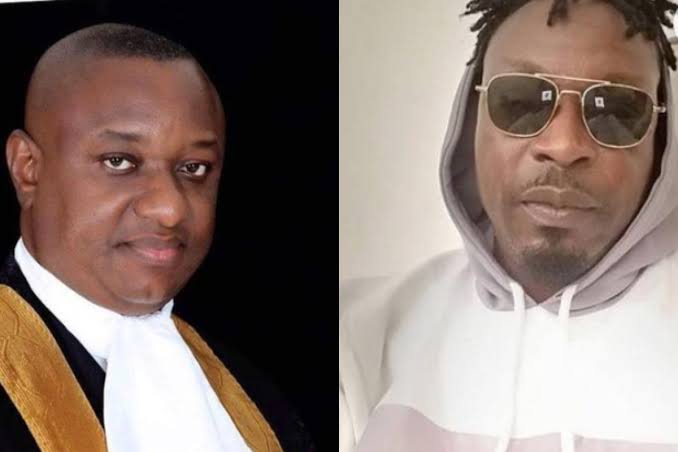
The recent story of what transpired between Mr. Festus Keyamo, SAN (the Hon. Minister of State for Labour and Employment) and Nigerian music artiste, Eedris Abdulkareem, is a classic example of what goes on behind the scenes in the movie starring many Nigerian activists.

Although not a Judge, but for the purpose of the issues I intend to address, I might be tempted to adopt and accept as compelling, the uncontroverted facts as presented by the Hon. Minister, notwithstanding Eedris’ insistence that Mr. Keyamo has “Joined the cabal, he became inner caucus and held the steering wheel spiralling Nigeria into doom…

Mr. Keyamo stated the following as seen on his verified Twitter handle:

1.) Eedris Abdulkareem just released a song, ‘jagajaga reloaded’, where he waxed the following lyrics, “where Festus Keyamo sef? He don dey chop with cabal o”. I laughed out so loud and even danced to the rhythm too. But there’s a small story behind this poor attempt at blackmail.

2.) In 2018, when I was named the Director of Strategic Communications for Buhari Campaign Organisation Eedris waxed a song in support of Buhari & wanted to join us, albeit for a fee. He then made desperate efforts to see me through text messages from his phone no. 070xxxxxxxx https://t.co/rpCh8uwVLB

3.) When I finally met with him, I listened to the songs, but told him I had no budget for such or any for that matter. I explained that my job was voluntary. It was the same thing I told so many other so-called activists-by-day-and-hustlers-at-night who secretly approached me.

4.) He then switched to the fact that he wanted a loan to pay for his hotel bills to the tune of N1.3m & to cater for his ‘sick mum’. That was already running into more than N3m. However, one govt functionary called me to say he told him another story that his child was sick https://t.co/0v6mvyyvTy

5.) He begged me to introduce him to Malami (AGF), Amaechi & the SGF and to paint a good ‘PR’ for him. He pledged that he was with us in the campaign with his whole ‘body and soul’. But at this point, I knew he was a desperate hustler who could embarrass me, so I ghosted him. https://t.co/3yHzMJq3ZN

6.) Shortly after this episode when he could not penetrate the system to get the money he so desperately wanted, he then endorsed Atiku and called Buhari a ‘fraudster’. See one of the links here… https://t.co/WZbS4noVcH. But we decided to ignore his weak voice of opposition.

7.) After our victory, he went berserk and joined every protests against the same Buhari whom he wanted to serve with his whole ‘body and soul’, but needed money to do so. He has been mentioning my name specifically at occasions as if I am the cause of all his troubles in life.

8.) Now, the latest is the ‘jagajaga reloaded’ that he has waxed to vent his frustrations at not getting into the system. His reference to me as ‘chopping’ reminds me of the gaffe of then Minister Sunday Afolabi who infamously said Bola Ige was invited to Govt to ‘come and chop’!

9.) I wish to assure Eedris and any who think being in Govt is tantamount to ‘chopping’, that for some of us (I can’t speak for others) it is just an honour to serve our country and an attempt to move from armchair criticism to a real participant in order to make a difference.

10.) Finally, we can all sit back and enjoy the ‘jagajaga reloaded’. One of the objectives of the song is to call me out since I ghosted him for attempted extortion – he has now succeeded. Another objective is to help promote the song by my reaction – that he has also achieved!

Things are never as they seem

Many Nigerian activists often set out with genuine intent and desire for a better Nigeria. But the system appears to habour Thorns which will choke you, bend you, bruise you, feed and resurrect the natural tendencies in every man. To quote the biblical prophet Jeremiah, “The heart is deceitful above all things, and desperately wicked: who can know it?”

Mr. Keyamo is one man who loves Nigeria from his heart. Like his deceased master, the Late Gani Fawehinmi, SAN, he was prepared to lay down his life. His life chronicles a life of many battles to defend the rule of law and fight to ensure that every corrupt public official pays for his or her crime. He later decided to participate in Government. But he made his choices and decided in which tent to lie. Afterall, he cannot come and kill himself.

Many politicians in the corridors of power today were activists. So too, many Nigerians whom we regard as our heroes of democracy, fought for independence from the British but then hoped and worked for “colonizing” Nigerians for their selfish gains.

Buhari was a great activist. For many years, and, particularly towards the build up to the famous 2015 general elections, he passionately campaigned for good governance and critically analyzed the Nigerian situation, promising that he had the magic wand that could fix virtually everything. While some of us considered the holistic reform a herculean task, Buhari thought differently. He believed there was no big deal in solving the Nigerian problem. He said it was evil to import petrol when all we needed was to revive old refineries and build new ones to cater for the country. Today we still import fuel and could not completely deal with the darkness that pervades petrol importation. Buhari lamented that public officials have no business traveling abroad for medicals when all we needed was to reform the health sector. Today, Buhari has become a notorious medical tourist in the UK. Buhari identified that waste in government is a huge problem. Today, waste in government has assumed a whole new dimension. Buhari believed the economy would be diversified to reduce dependence on oil and improve the Naira. Today, Naira is a shadow of itself and inflation is cutting deep like the teeth of an angry wolf. Unemployment rate is still high, even when Buhari had argued that Nigeria is too blessed to be in such condition. Above all, Buhari promised to fight corruption to its knees, but corruption appears to have forced Buhari to bend the knee.

Nigeria’s problem is beyond what one man like Buhari can salvage. Behold, what we have today is a country with powerful people but terribly weak institutions; a failed system which is almost birthing a failed State.

By Mr. Keyamo’s narrative and definition, Eedris is indeed a personification of a Nigerian “activist-by-day-and-hustler-at-night.” “Day” represents all that transpires within public glare. “Night” represents all the events including dishonourable things that occur behind the scenes. There are many Eedrises in Nigeria whose voices of agitation may crack because of thirst. With little drops of water and oil in their throats, they might sing a new tune. Hypocrisy appears to define everything. For instance, in the mid-2010s, veteran Nigerian musician, Charly Boy, convened a movement called “Our Mumu Don Do” to push for good governance and rally the youths against the government of the day. However, shortly after the 2019 elections, he was accused by Deji Adeyanju, a popular human rights activist, of collecting money to support President Buhari while Adeyanju languished in prison.

Thus, Mr. Keyamo’s revelations mirror the many travails of an average Nigerian activist, whether outside or inside the corridors of power and influence. We must look beyond the rhetorics and still face the question – when are we going to build strong institutions for Nigeria?

Credit:Stephenlegal

TIPS