Home Blog Page 948

‘NIGERIA NEEDS BETTER, NOT MORE UNIVERSITIES’

MARTINS OLOJA

Inside Stuff With MARTINS OLOJA
‘The Guardian’, Sunday June 27, 2021, Back Page.

There is a sense in which one can claim that it is provocative that the authorities in Nigeria have continued to ignore the groundswell of informed commentaries that Nigeria needs better, not more universities at this time that disruptive technologies daily shape economic development through innovation, which only research can touch off.

That is why a report last week that President Muhammadu Buhari had approved N18bn for takeoff of four new specialised universities should not be taken as another meretricious dividends of democracy as the governing party’s cheerleaders have claimed.

Indeed, the President last week approved a takeoff grant of N18 billion for the establishment of new universities of technology and health sciences. The new universities of technology will be located in Jigawa and Akwa Ibom states, while the universities of health sciences will be established in Azare, Bauchi State and Ila Orangun, Osun State. While announcing establishment of the new institutions in Abuja last Monday, the Minister of Education, Malam Adamu Adamu, said the objective is to stimulate rapid technological transformation of the country. The Minister, who was represented by the Permanent Secretary, Ministry of Education, Sunny Echono, noted that the approval was also in fulfilment of Buhari’s promise to establish a National Institute of Technology (NIT) in Abuja with six satellite universities of technology, one in each of the six geo-political zones in the country.

According to the Minister, the new universities of technology would be established in 2021 while the upgrade of the existing four Universities of Technology and the National Institute of Technology would come on stream next year. He said, “after a comprehensive review of the policy by key stakeholders in the education sector, it was resolved that the four existing Universities of Technology located in Yola (North East), Akure (South West), Owerri (South East) and Minna (North Central) would be upgraded and equipped while two additional Universities of Technology to be located in Jigawa and Akwa Ibom States, would be established for the purpose”.

The Minister also announced that similarly, a National Institute of Technology (NIT) shall be established in Abuja. The Institute shall be patterned after similar institutions in Singapore and Malaysia to serve essentially as a postgraduate centre devoted to research and innovation, drawing the best graduates from the six Universities of Technology, as well as other exceptional graduates from reputable universities within and outside Nigeria. The Minister noted that the new universities of technology would be established in 2021 while the upgrade of the existing four Universities of Technology and the National Institute of Technology would come on stream next year.

The Minister explained that “with the recent establishment of the only federal government owned University of Health Sciences, Otukpo in Benue State and the huge gap in Doctor-patient ratio as well as in medical research and production of pharmaceutical products, Government recognised the compelling need to establish two other specialised universities in Health, Nutrition and Medical Sciences to be located at Azare, Bauchi State and Ila Orangun, Osun State. “These shall lay a solid foundation for building national preparedness and resilience in anticipation of future challenges in the health sector while reducing medical tourism to countries like India, UAE, Egypt, Europe and the USA. To ensure early take-off of these institutions, the President approved a take-off grant of N4 Billion each for the Universities of Technology and N5 billion each for the Universities of Health Science from the funding Resources of Tetfund,” the minister added.

There are relevant questions to ask at this time: can a university’s solid foundation be laid with N4 billion just earmarked for a new university at this time? Should universities be so commonly established as hotels? Can’t the curricula of the existing 43 federal universities be expanded to accommodate the new courses the minister just advertised for the new universities? Are the existing universities enjoying adequate funding and manpower needs? What is the relevance of a new university of medical sciences when none of the existing colleges of medicine and teaching hospitals can be relied upon at the moment?

At present, there are 170 universities in Nigeria – 43 owned by the federal government; 48, state government; and 79, privately owned out of which 38 are faith-based (32 owned by church groups and two owned by Islamic organisations). These exclude the 20 licensed in April this year.

Although, the National Policy on Education, promotes the provision of equal access to educational opportunities for all citizens of the country at the primary, secondary and tertiary levels both inside and outside the formal school system; it states that for the philosophy of education to work harmoniously for Nigeria’s goals, education in Nigeria has to be tailored towards self realisation, right human relations, individual and national efficiency, effective citizenship, national consciousness, national unity as well as towards social, cultural, economic, political, scientific and technological progress.

As most commentators including experts have consistently argued, the Nigerian education system must be value-laden and tailored for the betterment of the citizens in order that they may live a better life and contribute to the advancement of society. For instance, shouldn’t Nigeria be thinking about robust funding of existing specialised universities in line with the agenda for the nation’s growth and development instead of establishing new ones? Are the specialised universities in Yola, Abeokuta, Owerri, Akure, etc meeting national objectives for establishing them?

For instance, in the aviation sector today, aircraft are serviced abroad in Africa’s most populous nation. So, can’t policy makers and NUC encourage proposals for how the Aviation School in Zaria can be merged with Ahmadu Bello University and funded to develop Aviation Courses and Aeronautical Engineering? Why do we get our children to be applying and registering for almost the same poorly funded courses, which do not trigger employability skills all over the country? The ordinariness of our curricula of studies has been worsening the employability index of Nigerian university graduates. Yet no one is thinking out of the box, in this regard.

In 2006, a departing expatriate (Dutch) chief executive officer of Nestle in Nigeria granted an interview to a newspaper in which he specifically advised Nigerian leaders to focus on quality of tertiary education instead of wasting time to fight corruption. He lamented that Nestle was always spending millions of naira retraining and reskilling Nigerian graduates to be employable in all fields of production. The late Ambassador Isaac Aluko-Olokun, an avid reader drew my attention to the article in a business journal. No one noted the Dutch manager’s conclusion that Nigeria’s main trouble wasn’t corruption but education that no one is still paying attention to.

In April this year, the national Universities Commission (NUC) granted provisional licences for 20 new universities. The new owners received their licences from the Minister of Education, Adamu Adamu, in Abuja. With the approval, Nigeria now has 99 private universities.

In my article on this same challenge titled, ‘Why we need better universities, not more”, published here on June 4, 2016, (part of the serial that gave me the ‘2017 DAME Award on Informed Commentary’, I wrote:

‘…But I would like to visit the roots of most of the challenges and so, I have to sensitize all the state actors from all the 774 local governments, 36 states and Abuja to lend me their ears: I would like us to interrogate Professor Wole Soyinka’s ‘thesis’ about the expediency of closing down all the Nigerian universities for a year or two with a view to restructuring them into “Ivory Towers”, citadels of learning and centres of innovation that they should be. This is not a seminal paper on the role of the university in a developing country. Nor is it a research topic on the role of public intellectuals in development. Rather, it is a thought-provoking discussion point on why all our representatives in government should halt the “hollow rituals” called licensing of new private universities and the federal government’s own obsession with political project called federal universities in all the states of the federation…’

I had then asked too if there was anything that could be more insufferable than a situation whereby most Nigerian universities had become mere factories for producing unemployable graduates at all levels. All the major highways have become attractions for private universities, most of which are just for ways of laundering money for some politically exposed people who have become wealthy without work. Such characters can no longer hide their slush and stolen funds abroad.

But sadly, most of the lecturers of most of our universities can no longer allow their children to be admitted into the universities where they teach. This is critical and that is why university and polytechnic teachers are always on strike. They have been asking for proper funding at all levels so that we can have universities as citadels of learning and centres of excellence and innovation.

At this juncture, NUC and indeed our leaders should pause and ask: What is university education doing for Nigeria? Is university education addressing the manpower deficits in Nigeria? Again, do we want a knowledgeable populace or a certificate society? Again, while it is important to improve access to tertiary education, the issue of quality should be of concern to all. While there are good private universities, there are concerns that some of them have fallen short of expectation as their quality and standard of education have been markedly compromised. Some of the allegations levelled against the private universities include over inflation of unhealthy parallel grades to attract ‘customers’; inability to fulfill admission quotas allocated to them per session; inadequate funding; ownership interference, paucity of qualified teachers, among others.

Furthermore, it is important for NUC to take stock of the available manpower before approving more universities. There are reports that the number of lecturers available perhaps will only be adequate for about 40% of the existing universities in the country today. The implication of this is that even the resource verification carried out before approval of programmes, to a large extent, is merely ‘fulfilling righteousness’ because the name of one lecturer most often than not, appears on the list of lecturers for many private universities as an adjunct lecturer, some of which are in states that are very far from where the lecturer is working full time.

This raises questions about the frequency and quality of teaching that such an adjunct lecturer offers. Furthermore, if lecturers spend all their time teaching, when will they write grant proposals, carry out researches, participate in professional activities and do community service? In fact, it will be in public interest for NUC to do some introspection before licensing more universities even for the federal government. Therefore, for a nation that is serious about its own sustenance and improvement, it should constantly look in the direction of the quality of its tertiary education, not just more institutions of higher learning for political reasons. Higher education is for development.

***Let’s continue this healthy debate next week!

Family Mandates Woman to Drink Late Husband’s Bathwater to Prove Innocence

A 34-year-old widow, Mrs Chioma Asomugha from Ubahuekem in Ihiala area of Anambra, has raised alarm that her in-laws were forcing her to drink water used in bathing her late husband’s corpse.

Chioma, the widow, confirmed the report in a telephone interview with the News Agency of Nigeria (NAN) on Sunday in Awka.
She alleged that the brothers of her late husband, Charles, said she must drink the water to prove that she was not responsible for her husband’s death, but that she would not do that.
Chioma said that she and her late husband lived peacefully in Ojo area of Lagos before his death.
“I have four children with my late husband and we lived at Ajangbadi, Ojo area of Lagos before his demise.
“The burial is fixed for Monday June 14, but since we came home for the burial, the relatives of my husband forced me out of my matrimonial home.
“They insisted that before I will be allowed to come in that I will drink the water used in bathing my late husband’s corpse,” she claimed.
Chioma said she took the matter to National Human Rights Commission (NHRC) in Awka as well as her Oraifite people with a view to resolving the matter.
Mrs Laura Ugwuanyi, Coordinator of NHRC in Anambra, confirmed the report, describing it as obnoxious.
She said efforts made to handle the matter did not yield positive results as the family members were not cooperating.
Chief Gerald Nnabugwu, a community leader in the area, told NAN that the leadership of the community was looking into the matter.
Mr C-Don Adinuba, state Commissioner for Information and Public Enlightenment also promised to intervene in the matter.
When contacted, Mr Okey Chukwu, President General of Ubahuekem community said he was in a meeting and promised to call back, but as at the time of this report his phone was switched off.

We Don’t Allow Takeaways.

We Don’t Allow Takeaways. Daily Law Tips (Tip 812) by Onyekachi Umah, Esq., LL.M, ACIArb(UK)

Introduction:

For pleasure or business, there are several reasons to stay away from home. From hotels, motels to hostels, there are often buffet and complimentary meals. However, like most services in Nigeria, the meals are often very tasty but the staff are never well mannered. “We don’t allow takeaways” is a common statement in most dining halls in hotels, with a frowning staff dismissing the requests of guests to take away their meals. Guests are forced to eat their meals at a given time and eat them in dining halls or lose them.

Every stay in a hotel starts with a contract (oral, written or a mixture of both) but this is often vitiated by hoteliers and their staff. Most guests are often too busy or ignorant to detect such breaches and to seek legal remedies. This work examines one of the most common breaches of Hotel-Guest Contract that happens in most dining halls when guests are stopped from taking away their meals by hotel staff. It focuses on simple contract, implied covenants, contract termination and remedies. It applies the theory of “Adighi ebu egwu eje’be Osadebe” in explaining the takeaway policies of hotels.

Takeaways to Hotels:

Every relationship starts with an agreement, whether written or unwritten or a combination of both. A typical stay in a hotel starts with a reservation. Most reservations are made based on an advertisement or referral or just by roaming the internet. Where an intending guest calls or writes a hotel and the hotel makes a reservation for the guest, both parties are deemed to have commenced their agreement. It is often an agreement to offer a habitable room/space (and other services) on the part of the hotel and the agreement to pay for such services on the part of the guest. The Hotel-Guest Agreements are often made up of series of services offered by the hotel (Offer) and the services are the basis for the acceptance from the guest.

It is expected that hotels will list out and highlight their services, dos and don’ts to an intending guest. And an intending guest is expected to highlight his desired services. Both are to reach a comprise and then hit an agreement. They can only be an agreement when both parties are on the same page (agreement). This also means that the moment a party goes outside the agreement, the party may be breaching the agreement.

There is a popular saying in Igbo land in Nigeria, that; “Adighi ebu egwu eje’be Osadebe” (you don’t take singers to perform in the residence of Chief Osadebe, the renowned musician). One of the most celebrated highlife musicians in Nigeria was Chief Osita Osadebe. It was said that the residence of the music maestro had a lot of music experts, trainers and trainees. So, it was useless for any person (guest of Osadebe) to seek to impress Osabebe by bringing street singers to perform in Osadebe’s residence. It is another way of saying, you don’t add a spoon of water to an ocean.

Most hotels have large restaurants with resident cooks, churning out local and continental meals in minutes. So, it is almost unnecessary for any guest to come to a hotel with his own meal.  Most hotels also have large barns of good wines and as such will not allow a guest to come in with his own wine. Selling food and wine is a huge part of hotel business, so hotels have policies that stop guests from coming in with their own food and wine. Some hotels allow guests to bring in their own wines, so far as the guests pay corkage fee to the hotel. Most uninformed hoteliers and their untrained staff will defend their policies under the pretense that the hotel does not want to have its guest poisoned and as such prefers to provide all meals for all their guests. And, one wonders if guests cannot eat outside the hotel or play host to some slow working poisons ahead of their stay in such hotels.

Truly, there is nothing wrong with having business policies designed to promote business; like stopping guests from bringing in their own food and wines. Hospitality businesses are really businesses and will only remain in business if operated as businesses. However, such policies should be communicated to intending guests ahead of their reservations and agreements with hotels. It is morally and legally wrong for any hotel to communicate its restrictive policies only after guests contract and pay the hotel.

Takeaways from Hotels:

Food is a huge factor in Nigeria, as food insecurity increases across Africa. Dishing out very small rations as complimentary meals is possibly a survival route for most hotels in Nigeria. Buffets are organized in hotels in Nigeria (including the few five start hotels) with a legion of staff (if not armed officers) scrutinizing meal cards and often frowning at full plates of guests. At times, guests are forced out of dining halls for eating a lot by the standards of the hotel or stopped from taking a particular food by the hotel staff. The attitude of most hotels spur guests to wonder if hotels truly understand the word; “buffet”.

“We don’t allow takeaways” is a common statement among hotel staff manning dining halls. While guests are attracted to hotels by the services promised to be offered by hotels (including buffet), most hotels will not allow a guest take his food out of the dining halls or to eat outside certain periods. Whether the guest had eaten any part of his meal or not, most requests by guests to take away their meals are met with “we don’t allow takeaways”. Resident guests are even stopped from taking their meals to their rooms or out of the hotel (unless some earlier unknown charges are paid). Such oppositions only change when guests demand to speak with the managers of the hotels or a senior staff, the managers knowing the rights of guests will often allow takeaways.

Booking and staying in hotel is the expression of a lodge agreement between hotels and guests. It could also include a buffet agreement, gym agreement, spa agreement, internet agreement, tour agreement and club agreement. These agreements are made to make the stay of guests memorable. Where a guest and a hotel agree on any service to be rendered by the hotel, the hotel has no rights or powers to amend, restrict or vitiate any part of the agreement without the consent of the guest. So, where a hotel offers a buffet and a guest accepts and pays the buffet separately or as part of the total hotel fee/package, the hotel cannot vitiate the agreement without huge legal consequences.

A guest could prefer to eat his meal at any time outside the dining hours of a hotel, for whatever reasons. In that case, the guest will need to takeaway his meal from the dining hall. It is unlawful for any hotel to force guests to eat meals against their wishes. It is unlawful for guests to be forced to pay extra money for such guests to takeaway food that the guests are entitled to eat.  It is only logical and implied that a guest that pays for a food in a hotel will eat his food at his time. It is implied that a hotel will allow a guest that is entitled to a meal to have his meal at his time, so far as the time does not inconvenience or cost the hotel more.

However, a hotel that wishes to depart from the implied consequences and conditions of hoteling and dining, should express their restrictions early, at the point of contracting with a prospective guest. It is wrong for a hotel to amend its contract with a guest in the course of the contract/stay of the guest and without the consent of the guest. Hotels are expected to pre-inform guests about their restrictions on smoking, dining, pets, corkage fee and others. It is rude to suddenly restrict access of guests on issues already expressly or impliedly permitted by the contract of parties.

Conclusion:

A stay in a hotel is bound by the agreement between a guest and its host (the hotel). The agreement may be written, unwritten or both. A guest does not stay at the mercy of the hotel, since the hotel is offering a paid service and bound by the agreement of parties.

Where providing food is part of the agreement of parties, the hotel must provide food. Also, the hotel should allow the guest to access and eat his food, including to eat such food at a convenient time of the guest. This includes, allowing the guest to takeaway his food from the dining hall or hotel. Guest are never to be forced to eat meals. A hotel that intends to charge fees for meals to be a takeaway or that does not even want food to be taken away, should discuss such restrictions with guest during contracting.

Hotels must learn to honor the rights of guest and their agreements with guests. Hotels should engage good lawyers to drafts well covering agreements that will include all necessary hotel policies, to avoid spinning rights-violating surprises to guests. Guests should learn more about their hotel rights and always speak with their lawyers whenever they feel their rights are threatened or violated. Where there is a breach of contract (including agreements between Guests and Hotels), the violating parties should be sued in court and legal remedies sought, including damages (huge financial costs).

My authorities, are:

  1. Sections 1, 2, 3, 4, 5, 6, 318 and 319 of the Constitution of the Federal Republic of Nigeria, 1999.
  2. The judgment of the Supreme Court (on “offer” and “acceptance”) in the case of ASHAKACEM PLC v. ASHARATUL MUBASHSHURUN INVESTMENT LIMITED (2019) LPELR-46541(SC).
  3. Onyekachi Umah, “Requirements for the Importation of Petroleum Products in Nigeria” (LearnNigerianLaws.com, 6 May 2021) < https://learnnigerianlaws.com/requirements-for-the-importation-of-petroleum-products-in-nigeria/> accessed 23 June 2021
  4. Onyekachi Umah, “Requirements for Filling/Fuel Stations in Nigeria” (LearnNigerianLaws.com, 24 April 2021) <https://learnnigerianlaws.com/requirements-for-filling-fuel-stations-in-nigeria/> accused 5 May 2021
  5. Onyekachi Umah, “Punishment for Illegal Dealing on Petroleum Products” (LearnNigerianLaws.com, 8 February 2018) <https://learnnigerianlaws.com/punishment-for-illegal-dealing-on-petroleum-products/> accessed 23 April 2021
  6. Onyekachi Umah, “Punishment for Price Increment during COVID-19 Lockdown in Lagos State” (LearnNigerianLaws.com, 13 April 2020) <https://learnnigerianlaws.com/punishment-for-price-increment-during-covid-19-lockdown-in-lagos-state/> accessed 23 April 2021
  7. Onyekachi Umah, “Dangote Group, BUA Group, the FCCPC & Sugar Price Fixing” (LearnNigerianLaws.com, 7 May 2021) <https://learnnigerianlaws.com/dangote-group-bua-group-the-fccpc-sugar-price-fixing/> accessed 23 June 2021Onyekachi Umah, “How to Certify Documents & Make Affidavits Without Courts” (LearnNigerianLaws.com, 14 April 2021) <https://learnnigerianlaws.com/how-to-certify-documents-make-affidavits-without-courts/> accessed 27 April 2021
  8. Onyekachi Umah, “Effect of Power of Attorney Not Executed Before a Notary Public” (LearnNigerianLaws.com, 23 March 2021) <https://learnnigerianlaws.com/effect-of-power-of-attorney-not-executed-before-a-notary-public/> accessed 14 April 2021
  9. Onyekachi Umah, “You Don’t Need To Register Any Agreement In Courts or With A Notary Public” (LearnNigerianLaws.com, 2 December 2020) <https://learnnigerianlaws.com/you-dont-need-to-register-any-agreement-in-courts-or-with-a-notary-public/> accessed 14 April 2021
  10. Onyekachi Umah, “How To Make Power Of Attorney To Be Genuine And Acceptable.” (LearnNigerianLaws.com, 16 April 2019) <https://learnnigerianlaws.com/how-to-make-power-of-attorney-to-be-genuine-and-acceptable-daily-law-tips-tip-312-by-onyekachi-umah-esq-llm-aciarb-uk/>  accessed 14 April 2021
  11. Onyekachi Umah, “Agreements in Nigeria Do Not Require Signatures of Notaries Public or Magistrates or Court Staff to be Legal and Binding” (LearnNigerianLaws.com, 13 January 2018) <https://learnnigerianlaws.com/daily-law-tips-by-onyekachi-umah-esq-tip-121-agreements-in-nigeria-do-not-require-signatures-of-notaries-public-or-magistrates-or-court-staff-to-be-legal-and-binding/> accessed 14 April 2021
  12. Onyekachi Umah, “Stamps and Seals of Courts and Commissioners for Oath Are Not Needed for Agreements To Be Valid.” (LearnNigerianLaws.com, 8 June 2018) <https://learnnigerianlaws.com/daily-law-tips-by-onyekachi-umah-esq-tip-118-stamps-and-seals-of-courts-and-commissioners-for-oath-are-not-needed-for-agreements-to-be-valid/> accessed 14 April 2021
  13. Onyekachi Umah, “Requirements For A Lawyer To Be Appointed As A Notary Public For Nigeria” (LearnNigerianLaws.com, 3 June 2020) <https://learnnigerianlaws.com/requirements-for-a-lawyer-to-be-appointed-as-a-notary-public-for-nigeria/> accessed 14 April 2021
  14. Onyekachi Umah, “It Is Not “Notary Public Of Nigeria” But  “Notary Public For Nigeria” (LearnNigerianLaws.com, 30 January 2020) <https://learnnigerianlaws.com/it-is-not-notary-public-of-nigeria-but-notary-public-for-nigeria/> accessed 14 April 2021
  15. Onyekachi Umah, “Power Of Attorney Can Not Transfer Ownership/Title Of A Property” (LearnNigerianLaws.com, 19 July 2018) <https://learnnigerianlaws.com/daily-law-tips-by-onyekachi-umah-esq-tip-145-power-of-attorney-can-not-transfer-ownership-title-of-a-property/?> accessed 14 April 2021
  16. Onyekachi Umah, “Contents of a Valid Affidavit of Change of Name” (LearnNigerianLaws.com,17 May 2018) <Contents of a Valid Affidavit of Change of Name> accessed 23 June 2021
  17. Onyekachi Umah, “Things that Cannot Be Contained In An Affidavit” (LearnNigerianLaws.com, 15 May 2018) <https://learnnigerianlaws.com/daily-law-tips-by-onyekachi-umah-esq-tip-101-things-that-cannot-be-contained-in-an-affidavit/> accessed 23 June 2021
  18. Onyekachi Umah, “The Central Bank of Nigeria Notices on Cryptocurrencies; a Ban or a Banger?” (LearnNigerianLaws.com, 9 February 2021) <https://learnnigerianlaws.com/the-central-bank-of-nigeria-notices-on-cryptocurrencies-a-ban-or-a-banger/> accessed 23 June 2021
  19. Onyekachi Umah, “Who Are The Shareholders Of The Central Bank Of Nigeria” (LearnNigerianLaws.com, 7 February 2019) <https://learnnigerianlaws.com/daily-law-tips-by-onyekachi-umah-esq-tip-263-who-are-the-shareholders-of-the-central-bank-of-nigeria/> accessed 23 June 2021
  20. Onyekachi Umah, ”How To Prove That A Bank Is Licensed In Nigeria” (LearnNigerianLaws.com, 30 March 2019) <https://learnnigerianlaws.com/how-to-prove-that-a-bank-is-licensed-in-nigeria-daily-law-tips-tip-300-by-onyekachi-umah-esq-llm-aciarb-uk/> accessed 23 June 2021
  21. Onyekachi Umah, “Contents Of A Genuine ATM Receipt In Nigeria” (LearnNigerianLaws.com, 19 March 2019) <https://learnnigerianlaws.com/contents-of-a-genuine-atm-receipt-in-nigeria-daily-law-tips-tip-292-by-onyekachi-umah-esq-llm-aciarb-uk/> accessed 23 June 2021
  22. Onyekachi Umah, “Is It Illegal To Spray Or Dance On Naira Notes (Money) In Nigeria” (LearnNigerianLaws..com, 21 December 2018) <https://learnnigerianlaws.com/daily-law-tips-by-onyekachi-umah-esq-tip-254-is-it-illegal-to-spray-or-dance-on-naira-notes-money-in-nigeria/> accessed 23 June 2021
  23. Onyekachi Umah, “No Bank In Nigeria Can Unilaterally Change /Vary Interest Rate In Its Agreement With A Customer” (LearnNigerianLaws.com, 23 August 2018) <https://learnnigerianlaws.com/daily-law-tips-by-onyekachi-umah-esq-tip-168-no-bank-in-nigeria-can-unilaterally-change-vary-interest-rate-in-its-agreement-with-a-customer/> accessed 23 June 2021
  24. Onyekachi Umah, “Use/Demand for Foreign Currency in Nigeria is a Crime” (LearnNigerianLaws.com, 7 June 2018) <https://learnnigerianlaws.com/daily-law-tips-by-onyekachi-umah-esq-tip-117-use-demand-for-foreign-currency-in-nigeria-is-a-crime/> accessed 23 June 2021
  25. Onyekachi Umah, “Can the Central Bank of Nigeria blacklist a Bank Employee?” (LearnNigerianLaws.com, 29 March 2021) <https://learnnigerianlaws.com/can-the-central-bank-of-nigeria-blacklist-a-bank-employee/> accessed 23 June 2021
  26. Onyekachi Umah, “Banks Should Not Refuse Affidavits/Documents Made By Notaries Public” (LearnNigerianLaws.com, 28 April 2021) https://learnnigerianlaws.com/banks-should-not-refuse-affidavits-documents-made-by-notaries-public/accessed 23 June 202
  27. Photo Credit: istockphoto.com 

Sabi Law Projects:

#SabiLaw

#DailyLawTips

#SabiBusinessLaw

#SabiElectionLaws

#SabiHumanRights

#SabiLawOnTheBeatFm

#SabiLawLectureSeries

#CriminalJusticeMonday

#SabiLawVideoChallenge

Speak with the writer, ask questions or make inquiries on this topic or any other via [email protected], [email protected] or +2348037665878 (whatsapp). To receive free Daily Law Tips, join our free WhatsApp group via https://chat.whatsapp.com/L7h4f1exItZ38FeuhXG4WNor Telegram group, via the below link: https://t.me/LearnNigerianLaws

To keep up to date on all free legal awareness projects of Sabi Law Foundation, follow us via

Facebook Page:@LearnNigerianLaws,

Instagram:@LearnNigerianLaws,

Twitter: @LearnNigeriaLaw,

YouTube: Learn Nigerian Laws,

WhatsApp Groups via (https://chat.whatsapp.com/L7h4f1exItZ38FeuhXG4WN),

Telegram Group: (https://t.me/LearnNigerianLaws),

Facebook group: (https://www.facebook.com/groups/129824937650907/?ref=share)

or visit our website: (www.LearnNigerianLaws.com )

Please share this publication for free till it gets to those that need it most. Save a Nigerian today! NOTE: Sharing, modifying or publishing this publication without giving credit to the author or Sabi Law Foundation is a criminal breach of copyright and will be prosecuted. This publication is the writer’s view not a legal advice and does not create any form of relationship. You may reach the writer for more information.

This publication is powered by www.LearnNigerianLaws.com  {A Free Law Awareness Program of Sabi Law Foundation, supported by the law firm of Bezaleel Chambers International (BCI).} Sabi Law Foundation is a Not-For-Profit and Non-Governmental Legal Awareness Organization based in Nigeria. For sponsorship and partnership, contact: [email protected], [email protected] or +234 903 913 1200.

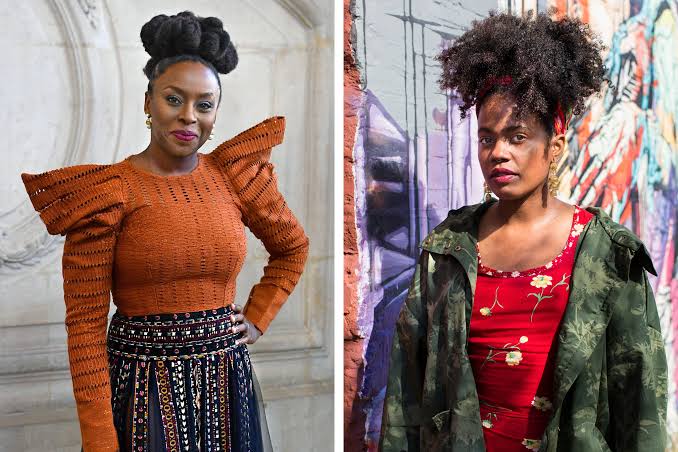
Adichie versus Emezi: When sisters feud, By Osmund Agbo

There is a raging showdown between two literary Amazons, both of whom have played a crucial role in shaping contemporary African literature and helped expand its global appeal. Am losing quite a bit of sleep. My initial approach was to let time sought things out as prior experience had shown. On a second thought however, I decided it’s better to summon the two erring sisters to a court where chiefs with red caps festooned with feathers wield the big stick. At least, this should serve as a cautionary tale as well offer a teachable moment for those who would rather wash our dirty linen in full glare of the public and dare Amadioha in his face.
Tufiakwa!

You know that you are inching closer to the twilight zone when all of a sudden you start to feel like the moral arch of the universe rests upon your shoulder. It comes with that feeling of a weighty responsibility to wade into every crisis and intervene even between those that have zero idea about your existence. May God help.

Akwaeke Emezi. Gosh! how I love that soul. Even her name alone is awe-inspiring and in Igbo anthroponymy, it translates to a Unicorn. I know! Funny enough, before now I had only chanced upon some of her writings, mostly as short stories in the Brittle Papers, an African literature platform. It’s just recently that I learnt of the body of work that clearly defines her as a multi-talented video artist and accomplished writer who had been nominated in many literary categories and has gone on to win multiple awards.

Emezi currently signed a two-book deal with Riverhead Books. The first of the two, a New York Times best seller called The Death of Vivek Oji was released in August 2020 and the second one is titled Dear Senthuran: A Black Spirit Memoir.

Her debut novel, Freshwater which explored the Igbo concept of gender and spirituality vis-a-vis western culture, was named a New Yorker Best Book of the Year and received glowing reviews from reputable organisations like the New York TimesLos Angeles Times and even The Guardian ofLondon. In 2019, Freshwater was nominated for the Women’s Prize for fiction which was historic in the sense of being the first of its kind by a transgender author.

Talking about gender, Emezi identifies as a non-binary. She is a strong advocate for the LGBTQ community, champions transgender rights and draws inspiration from Binyavanga Wainaina. It’s not totally surprising therefore, that gender identity and the politics of it is at the front and center of her public spat with a former mentor and world-famous author, Chimamanda Ngozi Adichie.

With the serendipitous discovery of Emezi’s treasure trove of literary work, I arrived at two conclusions. First is that the feud came with its own silver lining for those of us late to Emezi’s party. The second is that if her wish as the underdog in this fight is to gain more visibility and claim a greater market share in the literary space, she may have achieved that beyond her wildest dreams. But truth be told, there is a different dimension to this issue that is beyond the literati which is why the New York TimesThe GuardianNPR and even the Daily Mail picked up the story and ran with it.

Problem started when Chimamanda granted an interview to UK’s Channel 4TV in March 2017 in which she stated that a trans woman is a trans woman. By that, she was attempting to draw the distinction between the experience of women born female as opposed to those of trans women. Chikena.

Following that interview, she was excoriated and roundly condemned by a section of the LGBTQ community as being transphobic. Even the series of subsequent media statements and Facebook posts in an attempt to douse the fire and showcase her long track record of support for LGBTQ right were not enough to stop her trolls. Emezi was particularly disappointed and deeply incensed, feeling that such statement was emblematic of the culture of transphobia that exists in the larger society. She called Adichie’s statement not just a serious betrayal by a friend, mentor and a role model but also a denial of her existence as a transwoman.  And she made that known publicly. Oh dear!

Of course, we may never know all that transpired in a long-term relationship between two friends gone awry but certain inference could be made sorting through their correspondence. It appears that Emezi later realized her mistakes of lashing out in public, wrote an apology letter and hoped to warm her way back into Chimamanda’s world. The later, very angry and feeling betrayed by someone she went out of her way to help, played the defense and rebuffed all overtures. Having tried repeatedly without success, Emezi got frustrated, called Chimamanda’s bluff and went full scale on the offensive. She called her a” murderer” and from what we heard, launched a scorched-earth social media campaign to discredit her. Not only that, she went on a mission to permanently damage her brand. Mba nu!

People often say that all is fair in love and war but that is not necessarily true. Or why do we have the international court sitting in Hague that tries war criminals?  Believe it or not, it is expected that even in war situations, rules of engagement still need to be upheld. It’s human nature to be angry and act out but the response should also be commensurate with the perceived wrong. In this fight, Ms. Emezi took no prisoners.

To describe someone as transphobic and call her a murderer for simply refusing to commingle feminism with transgender activism is to miss the whole premise of the LGBTQ campaign which is about respecting individual choices and differences even when they don’t align with yours. Cyber bullying and reverse discrimination are also not behaviors to be encouraged.

Hopefully this one issue may offer a window of opportunity into discussing the relationship between the Transgender and Cisgender, Heterosexual and LGBTQ in general, in order to define expectations on each side. As the campaign to educate more and more heterosexual people about LGBTQ rights and the push for increased sensitivity to gender fluidity is being ramped up, it’s important to educate the other side as well. The crucial need to support LGBTQ rights and interact with the community in a respectful and non-threatening way is something that a whole lot of people are still struggling with and remains a work in progress.

Though it’s not yet uhuru and a lot more need be done to protect such a vulnerable population, we should also acknowledge that tremendous progress has been made in these past few years. With increasing public enlightenment and awareness, many are now evolving from an initial hardline position to that of showing willingness to listen and learn. More effort should be channeled however, in that direction. Even though one can sense the impatience in opting for such a slow and time-consuming process, the alternative is to adopt a fire brigade approach meant to blackmail or beat every questioning voice to shape. Such method is unlikely to help in the long run and would only amount to conversion without conviction.

Like all art aficionados, one is deeply burdened by the ugly ramifications of this fight, given its tendency to polarize people and force the family of African writers to take sides. But this is not the first. There is a long history of feuds between writers and am convinced that the two will settle scores, knock themselves over a couple of times, but in the end, each will get up and be just fine. What is more worrisome, however, is the unintended consequences when two Elephants fight. The problem is the grass being trampled upon in this case takes the form of all forgone alternatives. Not in the least is the squandered opportunity to beam a searchlight on the human carnage that has since become an everyday Nigerian story.

Dr. Agbo, a public affairs analyst is the coordinator of African Center for Transparency and Convener of Save Nigeria Project. Email: [email protected]

How Okada rider abandoned wife in hospital for delivering twins

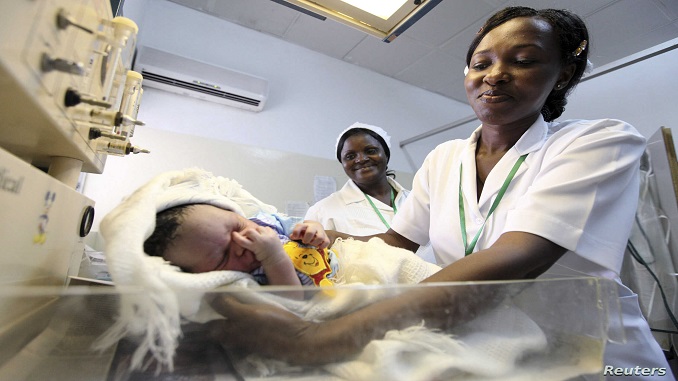
A nurse weighs a baby before the launch of a global strategy for the health of women and children by U.N. Secretary-General Ban Ki-Moon at the Maitama district hospital in Nigeria's capital Abuja May 22, 2011. REUTERS/Akintunde Akinleye(NIGERIA - Tags: HEALTH SOCIETY) - RTR2MRKT

As Nigerians groan under harsh economic realities a confused young father simply bolted on hearing that his wife has been delivered off a set of twins,

24-year-old Abibat Kehinde and her new babies were abandoned by her husband at the Epe General Hospital, Lagos State, following his inability to pay their hospital bills amounting to N131,000, three months after she gave birth to the set twins at the hospital.

Kehinde told the News Agency of Nigeria (NAN), on Friday, in Epe that her husband absconded after delivery on March 21, without paying the bills to facilitate her discharge from the hospital.

“My husband is a commercial motorcycle rider. He absconded since I gave birth to the twins on March 21. I wasn’t ready for the second child before, but God knows best,” she said.

The mother of twins said that she lacked sufficient food to eat while the babies also lacked basic nutrients since her abandonment three months ago.

“My husband said that he couldn’t afford to feed one child, not to talk of feeding two children with their mother; and he complained about the huge hospital bill before he left.

“Since he left the hospital, he has not returned to check on me and the children till date. He abandoned us in the hospital and absconded, ” Kehinde said.

She said that she managed to raise N30,000 out of her medical bill of N161,000, leaving a balance of N131,000 yet to be settled.

“I have been in the hospital since March without being discharged by the management of the hospital.

“The hospital bill keeps increasing every day and I don’t have alternative means to offset the hospital bills,” she said.

Kehinde appealed to the hospital management to discharge her and the baby twins.

Mr Ayanbisi Rauf, Social Welfare Officer at Epe General Hospital, confirmed that the woman had been abandoned by her husband.

“The husband abandoned the patient in the last three months and all efforts made by the hospital authorities to locate him proved abortive,” Rauf said.

He said that the patient would only be discharged if she pays 90 per cent of her total bills.

Rauf said that two other nursing mothers having similar plight with Kehinde would remain in the hospital until they settle their bills.

He appealed to benevolent individuals and organisations to assist the women in settling their bills so as to discharge them from the hospital. (NAN)

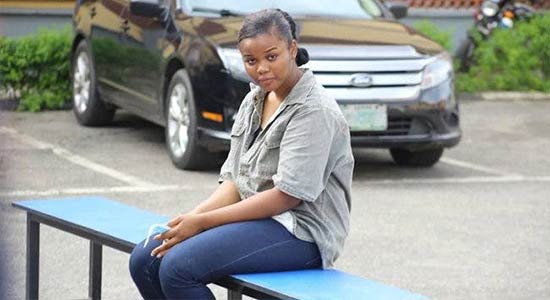
Chidimma And Usifo Ataga: Salient Points To Note

By Funke Cole

– She is 21, he was 50 – adults, both of them.

– They were lovers – two mutually consenting adults in a romantic relationship.

– She agreed to meet and be with the man at an apartment. She wasn’t forced. In fact, she booked the apartment, while he transferred money to her to pay for it.

*Watch the video of how she defended herself here

– She used an app to generate a fake international phone number to book the apartment.

– It was a lovers’ tryst – food, alcohol, drugs, and sex were on the table.

– She had a fake identity card with her face but a different name on it.

– For whatever reason, she stabbed the man three times (twice in the neck, once in the stomach). She cut off the artery that supplies blood through the neck.

– SHE KILLED HIM.

– After killing him, she had the presence of mind to steal his iPhone before she took to her heels.

– After she escaped, she withdrew N380,000 from his account… And maybe she would have withdrawn more if the account wasn’t blocked.

– Both of them are very good-looking.

Credit:thenigerialawyer

Why Northerners have ceased to love

By Ikechukwu Amaechi

“Some Nigerians believe that such fringe groups should be ignored. I disagree. Not when Buhari has joined in reminding Ndigbo how much property they have in the North.

Why are Northerners so obsessed with the properties of Ndigbo? Why is Buhari, in his words and actions, endorsing these vile and incendiary rhetoric? Why are security agencies promoting these dangerous narratives?

Some may have forgotten how in April 2016, the Department of State Service (DSS) raised an alarm that it had discovered mass graves of “Hausa-Fulani” residents allegedly abducted and murdered by the Indigenous Peoples of Biafra (IPOB) in Abia State.

“The Service has uncovered the heinous role played by members of … IPOB, in the abduction/kidnap of five Hausa-Fulani residents, namely Mohammed Gainako, Ibrahim Mohammed, Idris Yakubu and Isa Mohammed Rago at Isuikwuato LGA in Abia State,” the then DSS spokesperson, Tony Opuiyo, told bewildered Nigerians.

“The abducted men were later discovered at the Umuanyi forest, Abia State, where they were suspected to have been killed by their abductors and buried in shallow graves, amidst fifty (50) other shallow graves of unidentified persons,” DSS claimed.

To date, the DSS refused to disclose the identities of the other 45 “victims.” Were they also Fulani herdsmen? They didn’t say. Apparently, they had achieved their goal which was to incite northerners against innocent Igbos living in the North. Why would a government security agency funded with tax payers’ money play such a dangerous game? The answer, as they say, blows in the wind.

And the pattern has been consistent. Unknown gunmen breached security in Imo State, and even when Governor Hope Uzodimma insists that over 70 per cent of the 400 people arrested were non-Igbo, the police blamed Igbo youths.

Ahmed Gulak was gruesomely murdered in Owerri. Uzodimma cried foul, insisting it was political assassination and urged the police to carry out thorough investigation.

Police said there was nothing to investigate, after catching up with the culprits where they were sharing “onions from the North” one hour after the crime was committed.

The alleged assassins, labelled IPOB members, were all killed and their bodies burnt beyond recognition. Case closed! As I write, no one knows the real identities of those Police claimed killed Gulak. Investigations were concluded even before Gulak was killed. And ultimatums and threats started flying about.

Many Northerners believe their own lies.

That is, perhaps, the greatest threat Nigeria faces today, because, as Fyodor Dostoevsky, the 19th century Russian author and journalist, once noted: “The man who lies to himself and listens to his own lie comes to a point that he cannot distinguish the truth within him, or around him, and so loses all respect for himself and for others. And having no respect he ceases to love.” Lack of love explains the carnage all around us.”

The Posture Of Nigerian Bar Leaders Before And After NBA General Elections: Who Then Shall Bring The Difference We Seek? Or, Will Things Remain This Way?

By Sylvester C. Udemezue

They’ve come again. Note the pattern: long before the general election year, they say nothing, do nothing and contribute little or nothing towards the good of the NBA or the welfare of its members. Then suddenly, when/because an election year (2022) is almost around the corner, one begins to see them everywhere, attending all bar dinners and all ceremonies, celebrating their own birthdays publicly, they personally get themselves invited everywhere, to every event, for everything, delivering lectures and papers at every conference, workshop, seminars, webinars, and everywhere, issuing statements, pretending to be altruistic and to be showing concern in everything, promising heaven on earth for lawyers in Nigeria. I can see them; they’re all over the place; by their actions, we know them. They’re here again only because 2022 is around the corner.

SEE THEIR PROMISES BEFORE AND DURING NBA GENERAL ELECTIONS:

▪️(1). I will improve the welfare of the young lawyer;
▪️(2). I will pursue to ensure the progress of the legal profession;
▪️(3). I will look into the plight of thousands of jobless lawyers across Nigeria to ensure they get fixed;
▪️(4). I will work for justice-sector reforms, among others, to kill corruption, expedite trials and avoid all delays and court congestion;
▪️(5). I will expand the scope of employment for lawyers in order to create employment spaces for jobless lawyers in Nigeria;
▪️(6). I will ensure peace, unity and harmonious coexistence among the various segments and sections and levels of the Law profession in Nigeria;
▪️(7). I will give LOAN (public law officers) and other lawyers in public service, their fair share in terms of equitable representation within and outside the profession;
▪️(8). I will change the face of legal education in Nigeria, because the current system is appalling;
▪️(9). I will work to stop brutalization of lawyers, and sexual harassment in workplaces among lawyers.
▪️(10). I will work to stop all manner of encroachment by outsiders, into the law practice Space;
▪️(11). I will look into the plight of physically challenged lawyers.
▪️(12). I will institute a mandatory “minimum wage” for lawyers in Nigeria.
▪️(13). I will do this. I will do that and all.
Chai!!!

BUT, PLEASE, SEE THE FOCUS OF THE PROGRAMS AND ACTIVITIES OF THE SAME BAR LEADERS AFTER NBA ELECTIONS (& TOWARDS FULFILMENT OF THEIR CAMPAIGN PROMISES):

(1). Vigorous drive towards collection of Bar Practicing Fee and Branch Dues, with subtle threats and unceasing reminders. However, the truth is, lawyers in Nigeria don’t need such reminders, drives or threats, if lawyers were/are really getting true value for the money they pay to the NBA. It is because the Annual BPF and Branch Dues we pay are a case of total failure of consideration, that’s why it usually takes reminders and subtle threats from bar Leaderships to extract these fees, dues and many other levies, from unwilling, disenchanted lawyers.

(2). Handing out University-Undergraduate-Level-Lecture-Series as Continuing Legal Education. Anyway, the lectures would perhaps have been useful (??) if many lawyers were employed or had anything doing, so that they would have a place to pour out the knowledge (if any) gained —- yes, if any, because there’s no need for these repetitions of all what we have already done as undergraduates in the various University.

(3). Issuing of press releases and public statements that are never followed up to logical conclusion. Anyway, the governments and other public bodies to which most of the statements are directed have learnt to not take us seriously; they know we’re not proceeding beyond issuing statements, into any serious action to follow up. They know us even better than we know ourselves. They don shine them eye! But we can make then start taking us seriously, if we repent and be up and doing!

(4). Fighting those lawyers who don’t agree with them, to ensure they suppress them or harass them into silence. The funnier aspect is that some NBA leaders who have the habit of attacking and chastising Governments and government agencies for suppressing free speech, ironically turn around to themselves suppress and oppress freedom of speech within the NBA. A clear case of “Quod Approbo Non Reprobo” (approbating and reprobating at the same time)._ But, honestly, we should learn to practice what we preach na. To remove the log in your eyes before looking at the speck in someone else’s eyes!!! The Holy Bible has a word for us: “First, remove the beam out of your own eye, and then you can see clearly to remove the speck out of your brother’s eye” (Matthew 7:5). Charity must begin at home, in order to be appreciated. Over to NBA! We have a duty to give everyone the liberty to know, to utter, and to offer opinions freely, according to conscience. This liberty ranks above all liberties; it is slavery to stop people from voicing out their thoughts. We must take more seriously the words of Benjamin Franklin as expressed in the book titled, Silence Dogood: “Whoever would overthrow the liberty of a nation must begin by subduing the freeness of speech.” Jess C. Scott, in the literary work, Bad Romance: Seven Deadly Sins Anthology, :had this to say: “Only hypocrites get offended by the truth.”

(5) Revival of “insurance policies” whose impacts are hardly felt anywhere, for NBA members. Is this what we need in the legal profession? I respectfully answer no, or nay. In fact the “nays” have it. Learned Colleagues, help me tell NBA leaders that NBA members (especially young lawyers) desperately need employment before insurance and CLE. NBA has the capacity and wherewithal to kickstart processes that lead to creating gainful jobs for lawyers in Nigeria. There are thousands of untapped jobs at the Local Government level, for lawyers. There are many jobs at the various government Ministries, Departments Agencies (MDA’S) for Lawyers. There are many jobs at the Police Force waiting to be taken by those for whom these jobs are meant. See section 66(3) of the Nigerian Police Force (Establishment) Act (NPFEA), 2020 to agree with this point. ETC. Many of our traditional jobs are being stolen by outsiders. Indeed, outside the Law Firm, there are many other professional legal jobs for lawyers, yet untapped. But it takes an NBA leader with foresight, and who has ears for advice, for the NBA to take necessary steps to get the right results accordingly. As long as we’re preoccupied with non-issues, instead or facing real issues, nothing serious or positive happens among us or to us or for us, even while tens of thousands of Nigerian disenchanted lawyers roam the streets and cities of Nigeria jobless, hungry, helpless, hopeless, and frustrated while waiting for the next NBA Administration to come (during elections) with their stories and promises that are thrown over-board immediately after the elections.

IN WITNESS OF WHICH, I have offered my humble opinion in the aforesaid manner on the day and year herein-below named, and pursuant to my right to free speech within the laws of Nigeria, even as I come in peace.

Dated this 23rd Day of June, 2021.
Signed and delivered by the within-named:
Sylvester C. Udemezue (Udems) (08109024556.[email protected])

ABARIBE ON BIAFRA, KANU AND NIGERIA

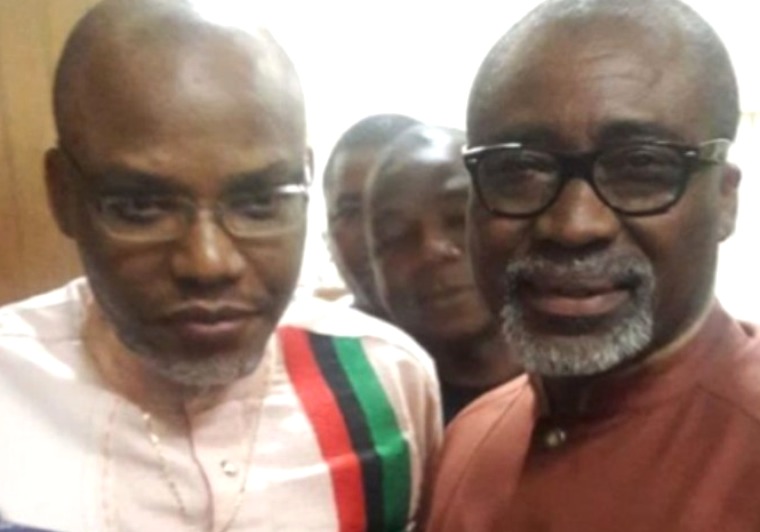
Enyinnaya Abaribe, the brilliant and brave senator who signed the bail for Nnamdi Kanu’s release delivered perhaps the most perceptive and wisest speech on Igbos and Nigeria last week in Mississippi, US. Every Igbo who cares about the present and the future of our people should read it. It’s a bit long but the effort is worth it. Please see below:

“What I will say here today may come as a surprise to many of you. For those that I will rub the wrong way, I apologize in advance.

However, “NDIGBO si na owu onye nke mmadu na ghu ya ahu na agbata ukwu”. If I fail to say the truth about the existential challenges that we face today in our country Nigeria, and how we believe we should face them, then I would not be true to myself and to you who sent me to represent you in the red chamber.

From the Past to Today.

1970

We can situate our position today following the end of the civil war in 1970. Igbo’s in 1970 were impoverished having lost an estimated 3 Million Igbo souls in the war, with a ruined and destroyed landscape and infrastructure. Every Igbo man/woman with savings in the banks before the outbreak of hostilities were pauperized as the military government decreed that one would only get 20 pounds notwithstanding the amount you had. The indigenization decree was passed in 1972 and no Igbo could participate since all had been reduced to penury.

2017

Today the Igbo have the largest pool of educated Nigerians. In 2007, Imo State had more subscribers to the JAMB UTME exams than the 19 Northern States put together. In 2017, 56% of of NYSC members are from the South East. Our feat in education means that we now have the army to win the war of competition in a market driven economy. Since 1999, the south east states have been the best in all exams.

The largest group of direct domestic investors in Nigeria are from the south east. Igbo investments in property in Abuja alone probably has more than any other ethnic group. We are the most travelled in Nigeria. In all parts of Nigeria after the indigenous population, Igbo’s are the next largest group. We are the largest propertied class of all ethnic groups in Nigeria and despite all this confusion, we have grown the most economically since the inception of the current democracy in Nigeria. We have the richest and largest pool of Nigeria diaspora population.

Taking an example of Lagos state, Ndigbo form a large proportion of the economy of the state. We created the following from nothing;
Computer Village in Ikeja. Ladipo Spare Parts market. Alaba Electronic Market. Balogun Int’l Market.
Balogun (Trade Fair) International Market. Aspamda market in Festac.
Orile Market for house fittings & appliances etc.

All second hand clothing markets in Lagos. About 4 markets. The combined turnover daily of these markets run into billions daily. Lagos state benefits by collecting taxes and now its economy contributes 56% of all VAT collected in Nigeria. Above scenario is replicated in most big cities in Nigeria. Go to Kano, Port Harcourt, Benin City, Kaduna, Sokoto, not to talk of Abuja. Ndigbo are very large players in the economy of all parts of Nigeria. I will return to this.

The ALLURE of BIAFRA

So the question is, given all the advantages that we as Ndigbo have in Nigeria, why the clamour by our youths and others for a separate state of Biafra?

The present agitation in the South East for a sovereign state of Biafra seems very tempting under the prevailing circumstance given the manifest sectional approach to governance at the center. To some especially the youth and the disadvantaged it is the way to go and when viewed critically you cannot help but to agree with the agitators. Of a truth there is an obvious feeling of alienation within the Nigerian state today. But has this always been the case? Apart from the civil war and the pernicious policies of the military regimes, we have not fared badly during civil rule until presently.

Given that following the civil war, there seemed to have been a glass ceiling in certain professions in Nigeria where it looked as if Igbo should not aspire to. In the police, military etc. But we can posit this as the lingering effects of the war where the victor in a war finds it very difficult to fully integrate the other party they fought with into all areas. In the US for example, I understand that it took a very long time for someone from the southern part of the US several decades after the civil war which they lost to break the stranglehold of the north for the presidency of the US. (Correct me if I’m wrong).

But come to think of it, Dr Alex Ekwueme became the Vice President of Nigeria barely 9 years after the civil war. The glass ceiling was on its way to being broken! The military interregnum from 1993 led by the same Muhammadu Buhari put a hold on this. In the US, Germany, Japan and other climes deliberate policies were used by governments to build stronger ties among groups and opposing tendencies. This helped to forge a bond within their nations. Nigeria seemed to think that a policy of benign neglect will resolve our problems. Of course it didn’t and that’s why we are seeing a resurgence of separatist agitation going on all over the country.

Fast forward to the civil rule era starting from 1999. Nobody would accuse Presidents Obasanjo, late Yar’adua, or Jonathan of what seemed like sectionalism as state policy. A look at the pattern of appointments by President Obasanjo evinced the fact of an all inclusive government from all parts of the country. Same as President Yar’adua. President Jonathan took it a step further by appointing the first Igbo chief of army staff, first Igbo secretary to the federal government, coordinating minister for the economy etc. In fact, one of the criticisms we face today in Nigeria is to explain why should this agitation for separation be under President Buhari when it was not done under the previous administration? However, that criticism is not true. Recall that under President Obasanjo and Yar’adua there was Massob which was managed much better than today.

However, you will recall that when this government came into place, President Buhari went to the US where he made a most unfortunate statement that was widely condemned at that time. He reportedly said that he doesn’t need to bother about the 5% that didn’t vote for him but will rather concern himself with the 97% that voted for him. I had at the time the statement was made raised concern that such declaration from an elected President sounds discriminatory and may create the impression that our elected President Buhari is sending a message to those who didn’t vote for him that he will be partial in his decision making. Unfortunately, it seems also that the people who are in and around the president didn’t advise him properly.

They left him to make appointments and take decisions that gave the impression that there are some parts of the country that are not supposed to be part of Nigeria. Little wonder that our youths feeling left out and not having anything to give them hope in Nigeria, started believing that a separate country would be better. But I say it is NOT. I will come to this later.

I recall that in November of 2016, after seeing how things were going, the South East caucus of the Senate sought for and got an appointment with the President Buhari. Our discussion centered on the south East perception of not being part of this administration thereby giving rise to our people feeling disconnected from the government. We pointed out that it should be a cause for concern if a major part of the country is not represented in the security architecture of the country in addition to other critical sectors from the inception of the administration. We were promised that our concerns would be looked into. Sadly, this was not done till today.

Our country Nigeria is supposed to be for inclusion; for making sure that everyone makes his or her input into its affairs. Allowing such fairness and equity to prevail in a plural society like ours will make us a bigger and better nation. Today that is not the case. Either as a deliberate act as it seems or a willful omission geared towards achieving a pre-determined goal, Ndigbo have been pushed to the fringes of the Nigerian Union in so many ways by the present government. The unfortunate scenario is enough for one to ask the hypothetical question….why am I here?

WHAT ALTERNATIVES

As much as the music of separatism stirs the soul, one must ask the question; Is relapsing into a sovereign state of Biafra the optimum option or is it a restructuring of the state such that all the federating units would have greater autonomy in the mould of a near quasi self determination the better option? When these two options are posed; a sovereign state of Biafra or restructured Nigeria, the position of most Nigerians as of today is for the latter.

Apart from the problem of even determining the boundaries of the state of Biafra and the multifarious and multifaceted problems a simplistic solution such as Biafra poses, perhaps it makes more sense for those who have tasted war to be a little more discerning when matters affecting their race comes up in Nigeria. Nigerians have been known to come together to use the Igbo head to break coconuts (apologies to late Abiola). Despite the problems that befell the Yoruba race following the annulment of the June 12 elections, they didn’t seek to break out out of Nigeria despite some of them calling for an Oduduwa country. They simply used the sympathies of other Nigerians to create an economic haven for themselves which has led to massive relocation of industries by all Nigerians to Lagos and Ogun States. They also got the Presidency of Nigeria.

Our brothers from the Niger Delta have not sought to go away either. They also got the Presidency of Nigeria. However we seem to be in the unfortunate position of seeming to drag the Niger Delta into a Biafra unwanted by them. The agitation for Biafra and how it was being prosecuted by IPOB has rather elicited hate and disdain for our people from other ethnic groups notwithstanding that they may have been nursing such tendencies. The agitation as championed by IPOB somehow gave muscle to traditional traducers of Ndigbo to spew out hate and envious vituperations. This was exemplified by the October 1st quit notice given to Igbos to leave the North by the so-called Arewa youths which persons are yet to be arrested for hate speech and breaching the law. They claimed to be responding to our own hate speeches etc.

Indeed, other people seem to want to see us fall into the trap for them to use us to solve their own problems with Nigeria. That notwithstanding, we as political leaders from the South East were unequivocal in asserting that that the rights of Ndigbo to peaceful and democratic engagements must be respected. On this score we made it clear that no amount of threat will cow Ndigbo from consistently demanding for an equitable, fair and just society within the Nigerian State. We also cautioned our youths on their vituperative calls and employed the Igbo concept of “bu uzo chu fuo Ufu, tutu ta wa Okuko uta”! This of course was misunderstood by other Nigerians as support rather than constructive engagement.

WHY NOT BIAFRA?

We believe that the best way to go given our situation today is to look before we leap. We must not be pushed to abandon our huge contribution to the modern Nigerian state. As we pointed out in the beginning of this paper, Ndigbo have been the single ethnic group that have welded the country Nigeria together given our way of life as sojourners everywhere in Nigeria, West Africa, Africa and the world. I dare say that we make up to 50% or more of Nigerians in the US. The question is why would we look to confine ourselves to a small landlocked entity when we have the whole of Nigeria to cavort in?

I have deliberately left out of this discussion the practical impossibility of even getting our brothers from the Niger Delta to go with us in this quest. Not to talk of the Idoma or the Kogi that we insist are part of us.
One thing seems to elude our people when these questions are posed. We look at the determination of the present government to treat us dismissively and feel that it is well nigh an impossible task to get our wish for a just society but we fail to look at the historical evidence before us.

When the 97% vs 5% controversy erupted, I told our people that my people the Ngwa says that “Ohu afor abughi ndu ebighi ebi”. Governments come and go. PDP government lost election and quit the stage for this APC government. Who says they cannot also lose? Why are we then acting as if it’s the end of the world? The maximum any government can stay is two term totaling 8years. “Obughi ndu ebighi ebi”!

Restructuring is an idea whose time has come and it will happen.
Biafra should be a last option, only after every other avenue to realize a restructured Nigeria where every component part is allowed a measure of autonomy and self determination fails. Let me state here that if the dominant views in Nigeria is for restructuring, then that should be the minimum that Ndigbo should demand, so that every component part of this country can substantially harness its resources and develop at its own pace.

Do not forget that the breached Aburi accord was about restructuring and today this call has garnered overwhelming momentum even from quarters that hitherto opposed it. Just recently former President Ibrahim Babangida, former Vice President Atiku Abubakar and lately Asiwaju Bola Tinubu and a host of others have joined the fray. Restructuring has become a singsong which we must explore vigorously. Even the ruling APC has set up a committee led by Governor el-Rufai to bring about a considered view on it. Forget the fact that it was part of their manifesto. The fact is that the discussion is on, as it should be.

I recall that in August, the Igbo political elite, Ohaneze, Governors, National Assembly Caucus met in Enugu and affirmed that the terms of our marriage in Nigeria is stifling to everybody and therefore we must have another look at it. That position has not changed but has in fact been reinforced by the agreement by other parts of Nigeria that it is time to look at the matter as evidenced by the South West Political Summit where they endorsed restructuring back to the 1963 constitution.

To me the strident calls by IPOB for a referendum should be seen as a legitimate demand to compel the state to see the urgency of having a second look at our marriage, with the ultimate aim of enthroning equity and fairness, where our people will no longer be treated as second class citizens in Nigeria. Though the methods may be misconstrued, the true colour of the agitation would have come out had there been a concerted effort at dialogue. The agitations gives fillip to the Igbo idiom…”Ma Opara emeghi nkpotu, agaghi ilughi ya Nwanyi “.

Our people are saying this union is stifling us, and we are making a lot of noise so we can find a solution.
The solution I think can be found in a restructured Nigeria. The beauty of it is that while we can enjoy near wholesale autonomy, our people as itinerant business people could have an unrestrained space in a larger market provided by a united Nigeria.

We should not be swayed by what we think is the attraction of an exclusive opportunity to be provided by a sovereign Biafra. No. That would box us into a tiny corner which has its own challenges which would prove overwhelming as time goes on. This is a topic for another day.

DIASPORA IGBOS AND US.

One of the problems those of us who attempt to show a direction to our people at home is the near universal disdain that some of our brother Ndigbo in Diaspora have for our leaders and elected representatives at home. Nowhere is it more apposite than in this matter of Biafra agitation. While some of our brothers/sisters here in the comfort of their homes seems to urge our youths through their utterances and actions to use unconstitutional means and disparage other ethnic groups that which actions seems to alienate us from our neighbors and the Nigerian State, we the leaders at home have been been left with the task of intervening in such a manner to dissuade the government from deploying the coercive instruments of state against the agitators. The aim was to stop bloodshed and waste of human lives. We have lost enough from the civil war. Those egging our youths on from here do not seem to appreciate this fact.

Most distressing is the labeling of those who disagree with their positions as “cowards, saboteurs, Hausa slaves etc”. This tends to discourage those who genuinely strive to lead our people through a very distressing period in our history as a nation.

Nnia Nwodo as President of Ohaneze has been vilified for taking a stand for restructuring in Nigeria for Ndigbo, a position agreed by all of us in the earlier summit I referenced. Governors come in for bashing everyday. As for us legislators, we have been called all sorts of names such as ‘legislooters’ etc.

Yet, when it came to taking a stand at ground zero, to bail Kanu; to reject the Federal Government ascribing Terrorism to IPOB, we are the people doing so and we never hesitated to say that agitation in every clime is constitutional. We take the bullets from other ethnic groups and the government for standing firm and demanding that Nigerians should be left to talk to each other about the best way forward without preconditions. We would use this opportunity plead with our internet warriors who stay here in their comfort zone here that our Igbo say, “ma Opara nzuzu adighi nwuo, Opara ma izu aga beghi ibichi ezi”.

SOME FINAL THOUGHTS

Why are we not Investing at Home.

Lack of Infrastructure.

Should we continue to blame the Federal Government for the dilapidated infrastructures in Ala Igbo? What of our home governments in Igbo States? Sam Mbakwe of blessed memory did not wait for the Federal Government before undertaking massive rebuilding of old IMO State. We think that we have not given our best to our people with the little we got.

Insecurity.

Nowhere have we hurt ourselves and investment in Ala Igbo than in the insecurity pervading all parts of our homeland. Of course the latest imbroglio in Abia especially in Aba and Umuahia has worsened matters. We run the risk of undoing all the efforts made in promoting ‘made in Aba’ that we had embarked on as a catalyst for growth in Ala Igbo. Industries have relocated from Ala Igbo to other parts of Nigeria especially Lagos and Ogun States because of the very serious insecurity such as kidnappining and armed robbery faced by those who invest at home. We cannot be looking for investors and yet make our place not conducive to investment.

Unemployment

Unemployment is the single biggest problem we have in Ala Igbo today. Before this time due to our domestic investments and industry, this was not a very big problem but due to the dis-investment going on today in Ala Igbo today we are faced with a existential problem in our hand. Diaspora Igbo’s have to assist us to also invest at home despite the problems and reduce the unemployment in Ala Igbo. Once we get Ala Igbo right the frustrations that fuel the agitation in ala Igbo will be dampened. What we have playing out in the world today is a knowledge economy. Oil is going out of fashion. As I pointed out earlier, we are poised through our educational exploits in Nigeria to dominate the economy of tomorrow. Why would we turn a blind eye to this emerging scenario?

In ending let me quote what the great son of Igbo land, the great Zik of Africa said about himself:

“Despite the mythic heights to which he was raised, Azikiwe was nothing if not pragmatic, a realist, always conscious of his limits and ever eager to extract all that was possible from that limited horizon”. May we be guided by such humble thoughts as we seek a better Nigeria for us all. What we should look for is a BIAFRA of the MIND like some have suggested in order to play our role in the emerging Nigeria that will come…

ABARIBE ON BIAFRA, KANU AND NIGERIA
Enyinnaya Abaribe, the brilliant and brave senator who signed the bail for Nnamdi Kanu’s release delivered perhaps the most perceptive and wisest speech on Igbos and Nigeria last week in Mississippi, US. Every Igbo who cares about the present and the future of our people should read it. It’s a bit long but the effort is worth it. Please see below:

“What I will say here today may come as a surprise to many of you. For those that I will rub the wrong way, I apologize in advance.

However, “NDIGBO si na owu onye nke mmadu na ghu ya ahu na agbata ukwu”. If I fail to say the truth about the existential challenges that we face today in our country Nigeria, and how we believe we should face them, then I would not be true to myself and to you who sent me to represent you in the red chamber.

From the Past to Today.
1970
We can situate our position today following the end of the civil war in 1970. Igbo’s in 1970 were impoverished having lost an estimated 3m Igbo souls in the war, with a ruined and destroyed landscape and infrastructure. Every Igbo man/woman with savings in the banks before the outbreak of hostilities were pauperized as the military government decreed that one would only get 20 pounds notwithstanding the amount you had. The indigenization decree was passed in 1972 and no Igbo could participate since all had been reduced to penury.
2017
Today the Igbo have the largest pool of educated Nigerians. In 2007, Imo State had more subscribers to the JAMB UTME exams than the 19 Northern States put together. In 2017, 56% of of NYSC members are from the South East. Our feat in education means that we now have the army to win the war of competition in a market driven economy. Since 1999, the south east states have been the best in all exams.
The largest group of direct domestic investors in Nigeria are from the south east. Igbo investments in property in Abuja alone probably has more than any other ethnic group. We are the most travelled in Nigeria. In all parts of Nigeria after the indigenous population, Igbo’s are the next largest group. We are the largest propertied class of all ethnic groups in Nigeria and despite all this confusion, we have grown the most economically since the inception of the current democracy in Nigeria. We have the richest and largest pool of Nigeria diaspora population.
Taking an example of Lagos state, Ndigbo form a large proportion of the economy of the state. We created the following from nothing;
Computer Village in Ikeja.
Ladipo Spare Parts market.
Alaba Electronic Market.
Balogun Int’l Market.
Balogun (Trade Fair) International Market
Aspamda market in Festac.
Orile Market for house fittings & appliances etc
All second hand clothing markets in Lagos. About 4 markets
The combined turnover daily of these markets run into billions daily. Lagos state benefits by collecting taxes and now its economy contributes 56% of all VAT collected in Nigeria.
Above scenario is replicated in most big cities in Nigeria. Go to Kano, Port Harcourt, Benin City, Kaduna, Sokoto, not to talk of Abuja. Ndigbo are very large players in the economy of all parts of Nigeria.
I will return to this.
The ALLURE of BIAFRA
So the question is, given all the advantages that we as Ndigbo have in Nigeria, why the clamour by our youths and others for a separate state of Biafra?
The present agitation in the SouthEast for a sovereign state of Biafra seems very tempting under the prevailing circumstance given the manifest sectional approach to governance at the center. To some especially the youth and the disadvantaged it is the way to go and when viewed critically you cannot help but to agree with the agitators. Of a truth there is an obvious feeling of alienation within the Nigerian state today. But has this always been the case? Apart from the civil war and the pernicious policies of the military regimes, we have not fared badly during civil rule until presently.
Given that following the civil war, there seemed to have been a glass ceiling in certain professions in Nigeria where it looked as if Igbo should not aspire to. In the police, military etc. But we can posit this as the lingering effects of the war where the victor in a war finds it very difficult to fully integrate the other part they fought with into all areas. In the US for example, i understand that it took a very long time for someone from the southern part of the US several decades after the civil war which they lost to break the stranglehold of the north for the presidency of the US. (Correct me if I’m wrong).
But come to think of it, Dr Alex Ekwueme became the Vice President of Nigeria barely 9 years after the civil war. The glass ceiling was on its way to being broken! The military interregnum from 1993 led by the same Muhammadu Buhari put a hold on this. In the US, Germany, Japan and other climes deliberate policies were used by governments to build stronger ties among groups and opposing tendencies. This helped to forge a bond within their nations. Nigeria seemed to think that a policy of benign neglect will resolve our problems. Of course it didn’t and that’s why we are seeing a resurgence of separatist agitation going on all over the country.
Fast forward to the civil rule era starting from 1999. Nobody would accuse Presidents Obasanjo, late Yar’adua, or Jonathan of what seemed like sectionalism as state policy. A look at the pattern of appointments by President Obasanjo evinced the fact of an all inclusive government from all parts of the country. Same as President Yar’adua. President Jonathan took it a step further by appointing the first Igbo chief of army staff, first Igbo secretary to the federal government, coordinating minister for the economy etc.
In fact, one of the criticisms we face today in Nigeria is to explain why should this agitation for separation be under President Buhari when it was not done under the previous administration? However, that criticism is not true. Recall that under President Obasanjo and Yar’adua there was Massob which was managed much better than today.
However, you will recall that when this government came into place, President Buhari went to the US where he made a most unfortunate statement that was widely condemned at that time. He reportedly said that he doesn’t need to bother about the 5% that didn’t vote for him but will rather concern himself with the 97% that voted for him.
I had at the time the statement was made raised concern that such declaration from an elected President sounds discriminatory and may create the impression that our elected President Buhari is sending a message to those who didn’t vote for him that he will be partial in his decision making.
Unfortunately, it seems also that the people who are in and around the president didn’t advise him properly. They left him to make appointments and take decisions that gave the impression that there are some parts of the country that are not supposed to be part of Nigeria. Little wonder that our youths feeling left out and not having anything to give them hope in Nigeria, started believing that a separate country would be better. But I say it is NOT. I will come to this later.
I recall that in November of 2016, after seeing how things were going, the South East caucus of the Senate sought for and got an appointment with the President Buhari. Our discussion centered on the south East perception of not being part of this administration thereby giving rise to our people feeling disconnected from the government. We pointed out that it should be a cause for concern if a major part of the country is not represented in the security architecture of the country in addition to other critical sectors from the inception of the administration. We were promised that our concerns would be looked into. Sadly, this was not done till today.
Our country Nigeria is supposed to be for inclusion; for making sure that everyone makes his or her input into its affairs. Allowing such fairness and equity to prevail in a plural society like ours will make us a bigger and better nation. Today that is not the case. Either as a deliberate act as it seems or a willful omission geared towards achieving a pre-determined goal, Ndigbo have been pushed to the fringes of the Nigerian Union in so many ways by the present government. The unfortunate scenario is enough for one to ask the hypothetical question….why am I here?
WHAT ALTERNATIVES
As much as the music of separatism stirs the soul, one must ask the question; Is relapsing into a sovereign state of Biafra the optimum option or is it a restructuring of the state such that all the federating units would have greater autonomy in the mould of a near quasi self determination the better option?
When these two options are posed; a sovereign state of Biafra or restructured Nigeria, the position of most Nigerians as of today is for the latter.
Apart from the problem of even determining the boundaries of the state of Biafra and the multifarious and multifaceted problems a simplistic solution such as Biafra poses, perhaps it makes more sense for those who have tasted war to be a little more discerning when matters affecting their race comes up in Nigeria. Nigerians have been known to come together to use the Igbo head to break coconuts (apologies to late Abiola).
Despite the problems that befell the Yoruba race following the annulment of the June 12 elections, they didn’t seek to break out out of Nigeria despite some of them calling for an Oduduwa country. They simply used the sympathies of other Nigerians to create an economic haven for themselves which has led to massive relocation of industries by all Nigerians to Lagos and Ogun States. They also got the Presidency of Nigeria.
Our brothers from the Niger Delta have not sought to go away either. They also got the Presidency of Nigeria. However we seem to be in the unfortunate position of seeming to drag the Niger Delta into a Biafra unwanted by them.
The agitation for Biafra and how it was being prosecuted by IPOB has rather elicited hate and disdain for our people from other ethnic groups notwithstanding that they may have been nursing such tendencies.
The agitation as championed by IPOB somehow gave muscle to traditional traducers of Ndigbo to spew out hate and envious vituperations. This was exemplified by the October 1st quit notice given to Igbos to leave the North by the so-called Arewa youths which persons are yet to be arrested for hate speech and breaching the law. They claimed to be responding to our own hate speeches etc. Indeed, other people seem to want to see us fall into the trap for them to use us to solve their own problems with Nigeria.
That notwithstanding, we as political leaders from the South East were unequivocal in asserting that that the rights of Ndigbo to peaceful and democratic engagements must be respected. On this score we made it clear that no amount of threat will cow Ndigbo from consistently demanding for an equitable, fair and just society within the Nigerian State. We also cautioned our youths on their vituperative calls and employed the Igbo concept of “bu uzo chu fuo Ufu, tutu ta wa Okuko uta”! This of course was misunderstood by other Nigerians as support rather than constructive engagement.
WHY NOT BIAFRA?
We believe that the best way to go given our situation today is to look before we leap. We must not be pushed to abandon our huge contribution to the modern Nigerian state. As we pointed out in the beginning of this paper, Ndigbo have been the single ethnic group that have welded the country Nigeria together given our way of life as sojourners everywhere in Nigeria, West Africa, Africa and the world. I dare say that we make up to 50% or more of Nigerians in the US.
The question is why would we look to confine ourselves to a small landlocked entity when we have the whole of Nigeria to cavort in?
I have deliberately left out of this discussion the practical impossibility of even getting our brothers from the Niger Delta to go with us in this quest. Not to talk of the Idoma or the Kogi that we insist are part of us.
One thing seems to elude our people when these questions are posed. We look at the determination of the present government to treat us dismissively and feel that it is well nigh an impossible task to get our wish for a just society but we fail to look at the historical evidence before us.
When the 97% vs 5% controversy erupted, I told our people that my people the Ngwa says that “Ohu afor abughi ndu ebighi ebi”. Governments come and go. PDP government lost election and quit the stage for this APC government. Who says they cannot also lose? Why are we then acting as if it’s the end of the world? The maximum any government can stay is two term totaling 8yrs. “Obughi ndu ebighi ebi”!

Restructuring is an idea whose time has come and it will happen.
Biafra should be a last option, only after every other avenue to realize a restructured Nigeria where every component part is allowed a measure of autonomy and self determination fails.
Let me state here that if the dominant views in Nigeria is for restructuring, then that should be the minimum that Ndigbo should demand, so that every component part of this country can substantially harness its resources and develop at its own pace.

Do not forget that the breached Aburi accord was about restructuring and today this call has garnered overwhelming momentum even from quarters that hitherto opposed it. Just recently former President Ibrahim Babangida, former Vice President Atiku Abubakar and lately Asiwaju Bola Tinubu and a host of others have joined the fray. Restructuring has become a singsong which we must explore vigorously. Even the ruling APC has set up a committee led by Governor el-Rufai to bring about a considered view on it. Forget the fact that it was part of their manifesto. The fact is that the discussion is on, as it should be.
I recall that in August, the Igbo political elite, Ohaneze, Governors, National Assembly Caucus met in Enugu and affirmed that the terms of our marriage in Nigeria is stifling to everybody and therefore we must have another look at it.
That position has not changed but has in fact been reinforced by the agreement by other parts of Nigeria that it is time to look at the matter as evidenced by the South West Political Summit where they endorsed restructuring back to the 1963 constitution.
To me the strident calls by IPOB for a referendum should be seen as a legitimate demand to compel the state to see the urgency of having a second look at our marriage, with the ultimate aim of enthroning equity and fairness, where our people will no longer be treated as second class citizens in Nigeria.
Though the methods may be misconstrued, the true colour of the agitation would have come out had there been a concerted effort at dialogue. The agitations gives fillip to the Igbo idiom…”Ma Opara emeghi nkpotu, agaghi ilughi ya Nwanyi “.

Our people are saying this union is stifling us, and we are making a lot of noise so we can find a solution.
The solution I think can be found in a restructured Nigeria. The beauty of it is that while we can enjoy near wholesale autonomy, our people as itinerant business people could have an unrestrained space in a larger market provided by a united Nigeria.

We should not be swayed by what we think is the attraction of an exclusive opportunity to be provided by a sovereign Biafra. No. That would box us into a tiny corner which has its own challenges which would prove overwhelming as time goes on. This is a topic for another day.

DIASPORA IGBOS AND US.
One of the problems those of us who attempt to show a direction to our people at home is the near universal disdain that some of our brother Ndigbo in Diaspora have for our leaders and elected representatives at home.
Nowhere is it more apposite than in this matter of Biafra agitation. While some of our brothers/sisters here in the comfort of their homes seems to urge our youths through their utterances and actions to use unconstitutional means and disparage other ethnic groups that which actions seems to alienate us from our neighbors and the Nigerian State, we the leaders at home have been been left with the task of intervening in such a manner to dissuade the government from deploying the coercive instruments of state against the agitators. The aim was to stop bloodshed and waste of human lives. We have lost enough from the civil war. Those egging our youths on from here do not seem to appreciate this fact.

Most distressing is the labeling of those who disagree with their positions as “cowards, saboteurs, Hausa slaves etc”. This tends to discourage those who genuinely strive to lead our people through a very distressing period in our history as a nation.
Nnia Nwodo as President of Ohaneze has been vilified for taking a stand for restructuring in Nigeria for Ndigbo, a position agreed by all of us in the earlier summit I referenced.
Governors come in for bashing everyday.
As for us legislators, we have been called all sorts of names such as ‘legislooters’ etc.

Yet, when it came to taking a stand at ground zero, to bail Kanu; to reject the Fed Govt ascribing Terrorism to IPOB, we are the people doing so and we never hesitated to say that agitation in every clime is constitutional. We take the bullets from other ethnic groups and the government for standing firm and demanding that Nigerians should be left to talk to each other about the best way forward without preconditions.
We would use this opportunity plead with our internet warriors who stay here in their comfort zone here that our Igbo say, “ma Opara nzuzu adighi nwuo, Opara ma izu aga beghi ibichi ezi”.

SOME FINAL THOUGHTS
Why are we not Investing at Home
Lack of Infrastructure. Should we continue to blame the Fed Govt for the dilapidated infrastructures in Ala Igbo? What of our home governments in Igbo States? Sam Mbakwe of blessed memory did not wait for the Fed Govt before undertaking massive rebuilding of old IMO State. We think that we have not given our best to our people with the little we got. Insecurity. Nowhere have we hurt ourselves and investment in Ala Igbo than in the insecurity pervading all parts of our homeland. Of course the latest imbroglio in Abia especially in Aba and Umuahia has worsened matters. We run the risk of undoing all the efforts made in promoting ‘made in Aba’ that we had embarked on as a catalyst for growth in Ala Igbo. Industries have relocated from Ala Igbo to other parts of Nigeria especially Lagos and Ogun States because of the very serious insecurity such as kidnappining and armed robbery faced by those who invest at home. We cannot be looking for investors and yet make our place not conducive to investment. Unemployment is the single biggest problem we have in Ala Igbo today. Before this time due to our domestic investments and industry, this was not a very big problem but due to the dis-investment going on today in Ala Igbo today we are faced with a existential problem in our hand. Diaspora Igbo’s have to assist us to also invest at home despite the problems and reduce the unemployment in Ala Igbo. Once we get Ala Igbo right the frustrations that fuel the agitation in ala Igbo will be dampened. What we have playing out in the world today is a knowledge economy. Oil is going out of fashion. As I pointed out earlier, we are poised through out educational exploits in Nigeria to dominate the economy of tomorrow. Why would we turn a blind eye to this emerging scenario?In ending let me quote what the great son of Igbo land, the great Zik of Africa said about himself….”despite the mythic heights to which he was raised, Azikiwe was nothing if not pragmatic, a realist, always conscious of his limits and ever eager to extract all that was possible from that limited horizon”. May we be guided by such humble thoughts as we seek a better Nigeria for us all. What we should look for is a BIAFRA of the MIND like some have suggested in order to play our role in the emerging Nigeria that will come…This is a MUST-READ


Gliz, glamour as Plateau hosts Justice Monica Dongban-Mensem

Lalong presenting portrait to Justice Monica Mensem

Glitz, glamour, entertainment and tributes marked the Thanksgiving Mass and Grand Reception in honour of the President, Court of Appeal Hon. Justice Monica Dongban-Mensem as the activities came to a climax with a dinner at the New Government House, Little Rayfield Jos.

The grand reception organised by the Plateau State Government was preceded by a Thanksgiving Mass which took place at the St. Monica’s Catholic Church in Rantiya, Jos.

The event attended by the cream of the legal profession from the Bench and the Bar featured the display of the rich cultural heritage of Plateau State with performances of some exotic dances and displays by reknown cultural groups in the State.

Photos:

Governor Lalong said at the dinner that the State Government decided to celebrate Justice Dongban-Mensem not only because she is from Plateau State, but simply to demonstrate that charity really begins at home and also buttress that her journey to the top started from the State.

He said “we also want her to know that we appreciate the enormity of the burden laid upon her shoulders in leading her colleagues at the Court of Appeal in the task of delivering justice and interpreting the laws of the land. Ours is to assure her that we shall continue to stand behind her and pray for her to discharge this duty with excellence and the fear of God”.

Lalong stated that he had no doubt that she will make her family, Plateau State, Nigeria and above all, God Almighty proud as many who have known her over the years attest to her passion for doing the right thing as well as disdain for cutting corners.

Justice Monica Dongban said she was highly overwhelmed by the solidarity and goodwill shown her by the Government and people of Plateau State, revered members of the bench and bar, her colleagues, schoolmates, and well wishers who have continued to pray for her for wisdom and courage to carry out her duties with the fear of God.

She promised to do her best and make Nigerians proud as well as usher a new era of service delivery, judicial integrity and transparency.

Justice Raphael Agbo of the Court of Appeal and Justice C.C. Nweze of the Supreme Court said the entire Judiciary is proud to have Justice Monica in its fold and will continue to benefit from her forthrightness, passion and experience.

Chief Judge of Plateau State Justice Sati Dakwak said having started from a humble beginnings in the Plateau State Judiciary, Justice Monica Dongban-Mensem is an inspiration for the Judiciary and a source of motivation for the younger generation.

NBA Chairman Plateau Yakubu Bawa said Justice Dongban represents the finest of the Nigerian bench with a rich background of integrity, incorruptibility, intelligence and hardwork. He assured that the Nigerian bar will work closely with Justice Monica and the Justices of the Court of Appeal to strengthen justice delivery and the rule of law.

TIPS