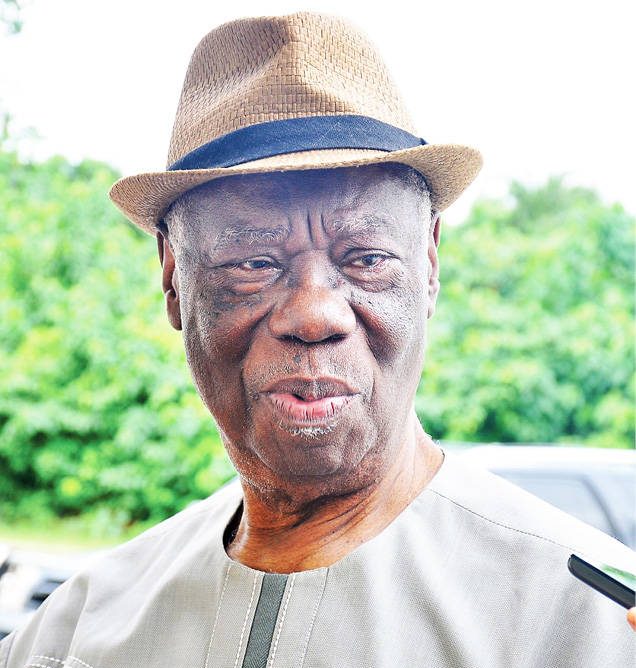
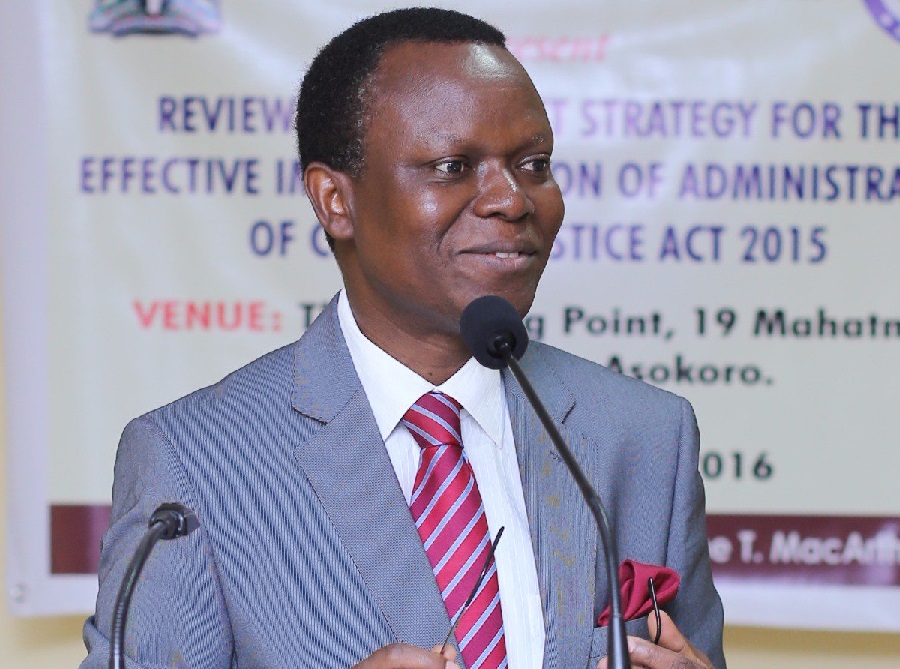
On Wednesday, June 16, elder statesman, Dr. Uma Eleazu, marked his 91st birthday. A day after, he sat down with IKECHUKWU AMAECHI for an exclusive interview that lasted two hours.
And what an interview it was. At 91, Elder Eleazu has seen it all. His life story is like a chronicle of post-independent Nigeria.
He was doing his Ph.D. when the civil war started. He regrets not being around to defend Biafra as most of his age mates did.
But when he came back to Nigeria, there was no dull moment. He tells the story of his one and only encounter with Head of State, General Murtala Muhammed at the then seat of power – Dodan Barracks – in Lagos. “Two weeks after, he was assassinated,” he recollects.
He set up the National Institute for Policy and Strategic Studies (NIPSS), Kuru. He served in the 1978 Constitution Drafting Committee (CDC) set up by General Olusegun Obasanjo to midwife the 1979 Constitution and was also a member of the Constituent Assembly.
“Literally, I wrote the section on the Executive in the 1979 Constitution except the bit under the Directive Principles which Prof. Ben Nwabueze wrote almost single-handedly,” he says.
He was also invited by General Abdulsalami Abubakar to be part of the Constitutional Debate Coordinating Committee that supposedly midwifed the 1999 Constitution but regrets that Abdulsalami used Justice Nikki Tobi and Prof. Auwalu Yadudu to defraud Nigerians in the process. “It is a fraud!” he exclaimed.
When General Ibrahim Babangida started his ill-fated transition programme, Dr. Eleazu threw his political hat in the ring.
“I did so many other things during the military regimes and I had got enough experience to run the country. I was in the team that wrote the original Social Democratic Party (SDP) manifesto from which I developed my own personal manifesto.
“I had looked at other leaders of the world, so I thought I should go into politics. And I didn’t want any other thing except to be president so that I will be able to do exactly what I think this country required.”
But he got his fingers badly burnt in the political arena.
“They use all kinds of underhand means, including devilish means to ensure that the good candidates don’t emerge,” he moans.
“In Jos, Babagana Kingibe was giving N25,000 per delegate and MKO Abiola topped it to N30,000. As a student of politics, I wanted to see what was actually going on and money was moving from hotel to hotel. Abiola was giving N30,000 per delegate and there were over 3,000 delegates in Jos. So, you can imagine the amount of money he spent and, of course, he won. I was so sad.”
He was invited to be part of the Traditional Council of the Indigenous Peoples of Biafra set up by IPOB but refused to join unlike Dr. Dozie ikedife. His reason for declining? “I didn’t think we should give Nnamdi Kanu that aura,” he says, before adding, “right now, he [Nnamdi Kanu] has played into the hands of Buhari. That is the way I see it.”
The interview was conducted two weeks before Nnamdi Kanu was arrested and extradited back to Nigeria.
He says President Muhammadu Buhari is suffering from dementia. That is why he “tends to remember only things that happened long ago. He is too old to be sitting where he is sitting.”
His verdict on the Buhari presidency: “In my own opinion, the country is already finished. What we are doing now is to see how to pick up the pieces. Buhari has destroyed the country. And if we allow him to continue, I even doubt if we will have any election in 2023. So, I think he has messed up the country.”
At 91, Dr. Eleazu is too alert. He remembers things that happened decades ago as if they happened yesterday.
If you think Professor Anya O. Anya’s interview was classic, wait until you read Dr. Uma Eleazu’s interview.
Now, Igbo elders are talking and they are doing so, forcefully, through your favourite online newspaper – TheNiche. Keep a date with us on Monday, July 5, 2021. Visit www.thenicheng.com. You will be glad you did.
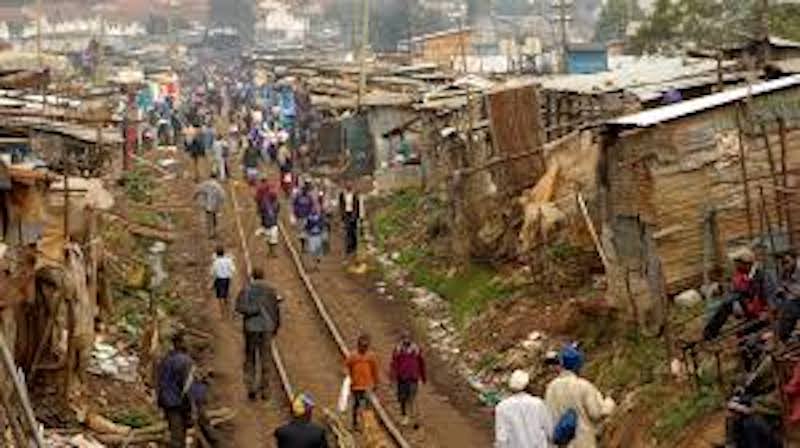
You may have come across on the internet the reports of two bizarre incidents that speak volumes about the grinding poverty ravaging Nigerians. The two incidents allegedly occurred in 2018. The first incident was how a poverty-stricken mother of six living in Ilesha, Osun State, traded off her eldest daughter for a basket of garri. This mother allegedly went to the market one day with her eldest daughter to buy garri. After the garri seller had told her the price of the garri, she had no money to pay for it. Thereafter she deceitfully told the garri seller that she was leaving her eldest daughter whilst she rushed home to bring the money and pay for the garri which she was taking home with her. Never did the garri seller suspect that this poor mother had ingeniously traded off her daughter for the garri. After waiting in vain for this mother to come back and pay her for the garri as she promised, the garri seller quickly invited the police into the matter if not for anything to avoid being accused of kidnapping the girl. When the police arrived, they ordered the girl to take them to the home of her fleeing mother. On getting to this mother’s home, the police met her and her remaining daughters feeding on the garri. Before the police could interrogate her, she opened up and told the police that her family had been starving for days and consequently she had no other option but to trade off her eldest daughter for the garri in order to avert the death of her whole family. Unworried that the police might arrest her for false pretence and stealing, she pleaded with the police to allow her eldest daughter to join her and her sibling in eating the garri because she too had been starving for days. The Police wept. Thereafter they went away. Case closed.
The second incident is similar to the first. A certain poor Warri woman (Warri no dey carry last) was arrested for exchanging her child for a mudu of garri under the pretence of buying garri. This woman went to the market with her child. After the garri seller had delivered the garri to her and was expecting payment, the woman told the garri seller that she was leaving her child behind with her in order to quickly go to the other parts of the market and buy other things and thereafter would return and pay for the garri and pick up her child. But after waiting for hours and hours and not seeing the woman return as she promised, it dawned on the garri seller that the Warri woman had traded off her child with the garri. To cut the long story short, after the woman was arrested by the police, she made the following confession. “It’s President Buhari’s hard administration that caused it. I and my family and I have been starving for a very long time. I have 5 children, I decided to exchange one of them with a mudu of Garri.”
The aforesaid incidents may sound apocryphal or like fairy tales but they are negligible compared to the woeful poverty-related stories being told these days in Buhari’s Nigeria. I don’t think the Warri lady was too uncharitable or inconsiderate in tracing her predicament to President Buhari’s failed administration. The truth of the matter is that the economic hardship in the Buhari administration has led to the death of many Nigerians. I don’t know about you but I must tell you that I come face to face with the poorest of the poor in Nigeria almost day by day. For example, last week my intervention was needed in a certain hospital in Lagos (name withheld) where a middle-aged housewife was being detained for the inability of her husband to pay the outstanding balance of her hospital bills. The lady underwent a complicated surgery at the hospital. Her husband, a retired civil servant, was only able to offset half of the bill leaving a gargantuan sum of N2.7 million unpaid. Sobbing uncontrollably in front of me, this man claimed that God had told him that his wife would survive the surgery and live for a long time because he (the husband) did not steal government money while he was in government service. Moved by his faith, honesty and simplicity, I went to the hospital proprietor and told him to look at heaven and release this daughter of Eve from false imprisonment. He did. The poor lady regained her freedom. Her highly-elated husband took her home. Sad stories of this nature abound in Nigeria today. For the first time in the history of Nigeria she has become a suicidal country. Today Nigeria is ranked fifth in the world among countries whose citizens are most prone to commit suicide.
The most tragic is the simmering soaring prices of foodstuffs in Nigeria at the moment. When was the last time you went to the market to buy foodstuffs such as garri, rice, tomatoes, tubers of yam, egusi, pepper, egg and so forth?. A mudu of garri that sells N400 today could sell N1,400 tomorrow. Ordinary sachet of “pure” water now sells for N10. Meat is no longer affordable. Ditto for fish. A bag of rice now sells between N18,000 to N22,000. Nigerian farmers are in agony. Some of them have lost their farmlands to the ravaging Fulani herdsmen. The crops of others have been uprooted by the cows and cattle of the Fulani herdsmen.
President Buhari should look at heaven and have mercy on his fellow Nigerians. Taking care of the sick is a religious duty for all Muslims. Allah will not have mercy on anyone, except those who give mercy to other creatures. What does it profit Mr. President to be junketing to and fro London every three months for expensive medical treatment at the expense of tax-paying Nigerians who are dying of poverty in Nigeria? Meanwhile the World Poverty Clock has named Nigeria the poverty capital of the world with statistics showing that 87 million people live in abject poverty in Nigeria. It is no longer news that Nigeria has overtaken India as the poverty capital of the world. What perhaps is news is that Nigeria’s frightening poverty statistics, instead of diminishing, is increasing day by day. About 152 million Nigerians live on less than $2 a day, representing about 70 per cent of the country’s estimated population of 200 million.
It is wicked to think only about one’s welfare or one’s health. Obsessed with his Fulanization Policy and the open grazing right, President Buhari hardly spares a thought for poor farmers whose farm lands are consistently being destroyed by the cows and cattle of the Fulani herdsmen thus resulting in acute food shortage in Nigeria. This is sad. Life is live and let live. Whatever a man soweth so he reapest. When maximum dictator Sani Abacha was busy stealing government money and inflicting injuries on many Nigerians little did he know that he would die one day. This is it. This world is not our home. We are all wayfarers. Sooner or later all of us would one leave this world in answer to the call of our Maker.
In consideration of this timeless truth, Mr. President should lessen the worsening hardships and living conditions in Nigeria before it is too late. First, Mr. President should stop the Fulani herdsmen from destroying the crops and farmlands of farmers. The Buhari government should stop uttering the meaningless phrase, ” lifting 100 million Nigerians out of poverty” . Why? Because the phrase is a hoax. It is just a convenient catchphrase to give the impression that the government is doing something when in actual fact this government has been slumbering in the last six years. Amid the plummeting oil prices, the government should deploy millions of idle Nigerian young to meaningful mechanized agriculture. Instead of deceiving God and man with the dodgy phrase, ” lifting 100 million Nigerians out of poverty” the Buhari administration should within the next few months marshal out some concrete plans on how to intensive agricultural activities capable of raising the abysmal low level of food production in the country and by extension reducing poverty in Nigeria.
In one of my early journalism classes, my teacher, Olatunji Dare, said nothing sells like a judicious mix of crime, sex and money. It’s well over 35 years since he said those words and yet they ring true like yesterday.
For over one week now, the country has been riveted on the tragic story of the murder of Michael Usifo Ataga, the CEO of Super TV, a Lagos-based content company. The heart-rending episode appears to have an injudicious mix of all three ingredients that Dare spoke about in one crime scene.
It’s a deeply tragic and troubling tale that has produced emergency marriage counsellors, family advisors, motivational speakers, criminologists, moral crusaders, avengers and an assorted bandwagon of saints and sinners.
But like all tragedies, this one is messy, very messy. Anyone looking to the press, that is, traditional news channels, to find meaning and clarity might have noticed that there’s hardly any difference in quality between what the press is reporting and what is on offer in the seedy recesses of social media. The Ataga saga is where frenzy meets insanity and the press, already charged with testosterone, is reporting this story with its third leg.
The coverage has been one of the most disgraceful races to the gutter in the tabloid culture of our recent journalism history.
The police set it up nicely and journalists couldn’t resist the temptation of finishing a bad job, with everything Ataga left behind including his wife and children, getting dragged in the mud. Initial police reports said Ataga, who was reportedly missing for days, had been found dead at a service apartment in Lekki, Lagos.
Investigations led to the suspect, Chidinma Ojukwu, a student in the department of Mass Communication, University of Lagos, who was alleged to have been the last – or one of the last persons – with the victim on the crime scene.
Because of the high-profile status of one of the parties, the police were obviously under pressure to resolve the crime. With a lot of help from the media, whose appetite in the matter kept shifting gears, the police took the bizarre culture of trial by the press to the next level.
First, they said the suspect used Ataga’s ATM card to withdraw N5m from the victim after the crime. Later the story changed to N380,000 as did the number of potential suspects involved and the circumstances surrounding the crime. But that was just the beginning.
To complete the travesty in one of the most outrageous stories ever told since Shylock in The Merchant of Venice, the police arranged a press conference where the suspect, like in all suspects in public interest cases in Nigeria, was made to sing like a fowl with a broken beak.
And she did sing! Everything – from raunchy late-night parties to wild experiments with drugs and sex orgies. The more she sang, the more the public – or at least a section of the public – wanted. Press reports feasted on the story relentlessly and TV stations reeled off so-called interviews with the suspect.
At one point, even after the suspect had mentioned her state of origin and local government, her inquisitor, a supposed journalist, asked which village she hails from, as if her village people had sent her to the crime scene.
There appeared to be no end to the salacious tales and the police were happy to help any willing reporter to keep the juices flowing. When the tap appeared to be drying up, some journalists went to the University of Lagos to find out how long it would take before the Mass Communication department would rusticate the suspect and clear the school’s good name.
They seemed prepared to break down the Vice Chancellor’s door with microphones and notepads, to extract an answer on the spot. As part of the frenzied efforts to deconstruct the anatomy of the crime, dispatches also came from journalists who purportedly interviewed Chidinma’s friends and teachers in the Mass Communication department. It didn’t matter that the suspect had not even been formally charged!
Chidinma’s father was not spared. The press and the police did not spare him. They dragged him out for “shielding” the suspect. Others moralised about how the suspect’s parents had failed in their parental duties, as if there’s any parent worth their name that would not give everything to secure their children’s future.
But there was more to come. The victim, Ataga, was portrayed in the most horrible light possible. He must be turning in the morgue as journalists, armed largely with hearsay, self-righteousness and half-truth, dealt him more deadly blows than the consequences of his own choices.
Even before the autopsy was done or the report filed and tested in court, the jury was out and everyone with WhatsApp on their phones already knew, for sure, that Ataga died of drug overdose or multiple injuries from stab wounds inflicted by the suspect. Case closed.
The doctor’s report can come later, the public autopsy conducted by the press and supervised by the police has told us everything we need to know. The court process is a fait accompli, it seems.
But there’s more yet. The mob also had to find a way to drag Ataga’s wife, Brenda, into the story. The fact that she is a senior adviser to the Minister of Petroleum Resources, Timipre Sylva, became fuel for the story, while others screen-grabbed pictures from her closet as a monumental rebuke to her husband’s infidelity.
Thanks to irresponsible coverage also, we now know more about the young woman’s troubled marriage and her private life than we know about those responsible for bringing the country into its present misery. So, perhaps we can monetise her grief to improve foodsupply and bring down inflation?
Of course, I’m aware that high office comes with scrutiny, but can we rein in our appetite for bad belle and self-righteousness? Can we restrain that killer instinct and the penchant for indulging the single-plot story? It’s not the first time this year that the police, ably assisted by the press, will not let the facts get in the way of a sensational story. It probably won’t be the last.
In May, when 26-year-old job-seeker Iniobong Umoren was ambushed and allegedly murdered by a suspect, Frank Akpan, we also witnessed a bizarre spectacle of police parade of the suspect and an even more bizarre spectacle of journalists interviewing the suspect.
In a scene seared in my memory, some of the journalists were asking the suspect, face-to-face, how it felt having sex with the victim, and if “he was in love with her!” Seriously?
I don’t know what sort of answer their depraved minds expected. But I know that it was one of those moments when words tell you not just what you need to know about the speaker, but also where they are coming from and the state of the institution they claim to represent.
If the police don’t know that a suspect is innocent until proven guilty, that every suspect, however heinous the crime they are charged for, deserve to have their day in court; if investigating authorities believe that pre-emption and trial by ordeal are proper, then responsible journalism is not obliged to lend a helping hand to such travesty.
It’s not just that reckless sensationalism is a disservice to the profession; it also undermines diligent and thorough investigation, weakens the system further and, in the end, allows criminals to go scot free. In the end, the mob wins, but who knows the next victim?
The Ataga saga might be a good Nollywood script, but shambolic police and press handling may have distracted the public from finding out exactly what happened and how justice might have been best served. And that’s double tragedy for the bereaved and grieving family that deserves nothing but justice.
And this happens all the time when police – or investigating authorities too lazy or too compromised to do their work – look for a short cut to closure.
We’re the worst for it, however judiciously this brew has been mixed.
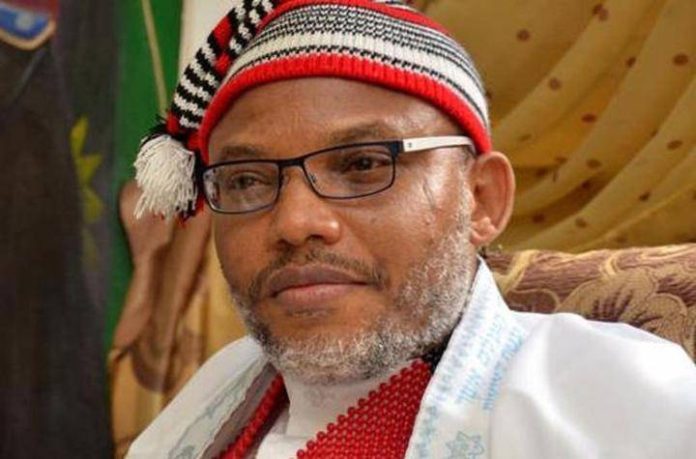
Nnamdi Kanu, leader of Indigenous People of Biafra, IPOB.
By Prof Abdussamad Umar Jibia
On Thursday June 24, 2021 I stumbled on a viral video from Zamfara state. In the four minutes clip, a notorious bandits’ kingpin could be seen boastfully confessing in front of senior security officials of the atrocities he committed against the Nigerian state and its people. The man, popularly known as Dan-Karami is said to be one of the senior gang members of the deceased Buharin daji, a bandits’ general who controlled the rural areas of Zamfara until his death in 2018 in the hand of one of his other gang members, Dogo Gide. Dogo Gide had ‘repented’ and submitted himself to the Government of Zamfara state under Abdulazeez Yari and Yari decided to use him to kill his boss. Gide had since resumed crime and is operating from his base in the vast forest reserve spanning several North Western and central states. He and Dan-Karami were among the many gangsters that sealed and breached several peace agreements with Governments of Zamfara and Katsina states.
I watched the video clips several times and upon enquiry I came to know that the senior Government officials were there to beg him to allow people to go to farm in the areas he controlled now that it is rainy season. The areas he controlled, as he stated in the clip are south of the Jibia-Gusau highway where he claims to be responsible for “any crime you hear of”. It is noteworthy that a week earlier 53 people were killed in the area. That is many times the number of Nigerians killed due to IPOB activities since it started.
Going by what he stated, the Nigerian Government has no other option except to go and beg him since, according to him, he has victoriously repelled all attempts by the Nigerian Army to defeat him. In one of those attempts, he stated, he was attacked by a combined team of Nigerian and Nigerien security forces and he defeated and killed more than half of them. He also confessed of kidnapping forty children from Zurmi township at another point in time.
Another thing he stated worth examining was the initial rejection by the now deposed Emir of Zurmi to dialogue with him or any other terrorist for that matter. If what he said was true, the Emir only agreed to speak to him after it was clear to the Emir that Government could not defeat him. The question to ask here is, if the Emir decided to be communicating to the outcast in order to protect his people, was he doing or not doing the right thing? Why was he deposed by the same Government that now decided to go and smile with a confirmed criminal who has admitted killing several people including our soldiers? When has the Nigerian Government become a coward that aims only at soft targets?
After watching that video, I began to wait for a statement from Federal Government. None came, at least not to my knowledge. The expectations of any citizen who watched that video would be the Government would now launch a major manhunt for the criminal to face charges of murder, treason, kidnapping, etc. Alas! The attention of the leaders of APC and PDP is not there. Their concern is not how Nigerians can sleep with their eyes closed or how many criminals are brought to justice but how many politicians from one party defect to another. Unfortunately for the people of Zamfara state the next thing they heard is that their Governor was now defecting to ruling (sorry “governing”) party as if that is what would solve their problem.
But there is one thing I did. After watching that video I decided to send it to the media aide of the Attorney General and Minister of Justice and requested him to give it to his boss in case he had not seen it along with our message of disappointment.
My choice of Abubakar Malami is deliberate for two reasons. One. He is not one of those opportunists who only began to support Buhari with the windstorm of 2015. He has been the supporter of Buhari from day one and is thus a witness to all the promises his Oga made to Nigerians. Two. He is the Attorney General and Minister of Justice.
Nothing has changed. The Sheikh Gumis are busy going from one bandits’ camp to another and calling on Buhari to give salaries to Fulani criminals. The Kabiru Gombes are all over the place telling masses that Saint Buhari is not responsible for the protection of their lives and property since he has appointed Northerners to take charge of security. The Masaris are there blaming the masses for waiting for Government to give them protection. That is the very sad predicament Northerners have found themselves. You are on your own if fate makes you an ordinary Northern Nigerian.
Yesterday, while the rest of us were still waiting for action (although sincerely speaking most Northerners have lost hope), Malami appeared on our television screens to tell Nigerians that Nnamdi Kanu, the leader of IPOB was arrested “through the collaborative efforts of Nigerian intelligence and security services”. That is a good news, I thought, but it is no news. Kanu has never been the major problem of the rural farmers of the North. His arrest will never make Kaduna-Abuja, Kaduna-Birnin Gwari, Jibia-Gusau, Kankara-Sheme or any of those highways safe. It will never stop the harassment of our people killed, kidnapped and raped by bandits on daily basis. So what if he is arrested?
But Kanu is being “accused of instigating violence especially in the Southeastern Nigeria that resulted in the loss of lives and property of civilians, military, paramilitary, police forces and destruction of civil institutions and symbols of authorities.” Here is someone right here on the Nigerian soil boasting of having committed all these atrocities and daring Government. Yet, the Government is going there to smile at him. Is that not an irony?
Justice, equity and fairness are veritable ingredients for peace and amicable human co-existence. Human frailties account for the neglect of these essential existential ingredients which in turn lead to agitations and disharmony. But where love and understanding abide, issues are quickly identified and addressed in order to promote peace and harmony, as they engender collective growth and development. However, when issues are ignored or swept under the rug, they continuously rear up their ugly heads and metamorphose into hydra-headed conflicts that are more difficult to confront or handle. As Nigeria is currently enmeshed in unprecedented insecurity and disharmony, it is pertinent we address some subtle but far-reaching matters, grossly dismissed, but resentful to many as unjustifiable, unfair and punitive. The government policy on admissions into institutions which border on discriminatory standards based on differential cut-off marks for states of the federation is a case in point. When State A is allocated a higher cut-off admission mark than State B, how justifiable and fair is it that applicants from State A, but born, resident and schooling in State B are considered on the higher cut-off mark allocated to their state of origin, State A, a state they had never stepped into? Meanwhile candidates from State B but resident in State A with a higher cut-off mark are considered based on the lower cut-off mark of their state of origin. This does not make academic sense or reasonable logic. But Nigeria has continued to abide with this unjustifiable education policy. This is a policy parents from the South whose children school in the North, find particularly unfair and unjust, as their wards suffer admission limitations arising from the discrimination explained earlier. But this has been going on over the years unchecked and uncertified. This is the time for the Education ministry to rectify this anomaly so that Nigeria can begin to disabuse all minds harbouring other glaring evidences of injustice, unfairness and inequity, prevalent in their states or zones. The time is now. Jonas Odocha. Abuja, Nigeria.
On behalf of the Civil Society and millions of ordinary Nigerians we commend the entire National Assembly for the on-going efforts to alter the Constitution with a view to strengthening the judiciary and improving the administration of justice.
However, we reject vehemently the attempt to elevate the status of Islamic Law under the secular or better still, multi-religious Constitution of the Federal Republic of Nigeria.
We hereby call attention to the dangerous proposals in the Senate and House of Representatives to alter Sections 262, 277 and 295 of the extant Constitution of the Federal Republic of Nigeria,1999 (As amended).
Proposed Amendment of Sections 262 and 277 of the Constitution as contained in Constitutional Amendment Bill No: 24: Judicial Reform Proposals.
Under the extant Constitution, Section 262(1) and 277(1) provide respectively that, “The Sharia Court of Appeal shall, in addition to such other jurisdiction as may be conferred upon it by an Act of the National Assembly, exercise such appellate and supervisory jurisdiction in civil proceedings involving questions of Islamic personal law”
“The Sharia Court of Appeal of a state shall, in addition to such other jurisdictionas may be conferred upon it by the law of the State, exercise such appellate and supervisory jurisdiction in civil proceedings involving questions of Islamic personal law which the Court is competent to decide in accordance with the provisions of subsection (2) of this section.”
The above provisions only permit Islamic personal law in civil proceedings. This is clearly defined in section 262(1) and (2) and 277(1) and (2). All references under these provisions are to “Islamic personal law.”
The Constitutional Amendment Bill No 24: Judicial Reform Proposals before the senate contains a bill titled: A Bill for An Act to Alter the Provisions of the Constitution of the Federal Republic of Nigeria, 1999 to further Strengthen the Judiciary for Speedy Dispensation of Justice; and for Related Matters
Clause 11 of the said bill contains a proposal for the alteration of section 262 of the Constitution. It reads thus, “Section 262 is altered by substituting for subsection (1), a new subsection “(1) – The Sharia Court of Appeal of the Federal Capital Territory shall, in addition to such other jurisdiction as may be conferred upon it by an Act of the National Assembly, exercise such appellate and supervisory jurisdiction in civil proceedings where the subject matter of the claim is on or relates to Islamic law”
Clause 14 of the said bill, contained a proposal for the alteration of section 277 of the Constitution and its substitution with a new section “277” which reads thus “section 277(1)- The Sharia Court of Appeal of a state shall, in addition to such other jurisdiction as may be conferred upon it by the Law of the state, exercise such appellate and supervisory jurisdiction in civil proceedings where the subject matter of Islamic Law. The Danger in the Proposed Amendment
The courts have in several cases interpreted the extent of the jurisdiction of the Sharia Court of Appeal. Some of the cases include: Magizawa v. Magiziwa (2017) LPELR-42133(CA), Abdulsamad & Ors v. Abdulahi & Ors (2015) LPELR-40746 (CA) and Magaji v. Matari (2000) 2 NSCQR 636. And these judicial authorities are to the effect that the Sharia Court of Appeal does not have jurisdiction to hear any matter outside Section 262 (1) & (2) (a-d) and 277 (1) & (2) (a-d) of the Constitution of the Federal Republic of Nigeria (1999) as amended.
It is our view that the proposed amendment will elevate Islamic law to the status of general law. Once the word “personal” is removed from Sections 262 and 277 of the Constitution, it opens the door for a wholesale importation of Sharia Law including Sharia Criminal Law in the FCT or any part of the federation. The National Assembly will be empowered to pass an Act of general application introducing Sharia Criminal Law which will not require Constitutional Amendment since the only impediment which is the word “personal” would have been removed from the Constitution.
The proposed amendment being considered by the House of Representatives, recommends the deletion all references to “Islamic personal law” both in section 262 (1) and (2) and section 277 (1) and (2).
No Justification to Replace “Islamic Personal Law” with “Islamic Law”
There is no justification for replacing the clause “Islamic personal law” with “Islamic Law”. The Constitution is secular, or better still, multi-religious. Thus, there is no justification for elevating the whole of Islamic Law into the Constitution by making it a general law.
The amendment will give the Sharia Court of Appeal unlimited jurisdiction to entertain all kinds of matters both civil and criminal using Islamic Law. It will interfere with the jurisdictions of both the Federal High Court and the State High Courts. The Appellate jurisdiction of the High Courts to hear criminal appeal from the Area Court would be eroded if the Sharia Court of Appeal is given this unlimited jurisdiction to entertain all forms of appeals brought under Islamic law.
In line with the foregoing, we propose that the provisions of the extant law (the Constitution of the Federal Republic of Nigeria (1999) as amended) be retained.
Attempt to Weaken the Judiciary
Section 295 of the Constitution provides for reference of questions of law from lower courts to higher courts (Case stated). The essence of case stated as contained in section 295 of the Constitution is to give the lower court an opportunity to refer a particular issue to the higher court for decision which will aid the lower court in deciding the case before it and such referral must be a question relating to the interpretation or application of the Constitution.
The constitutional amendment proposal before the House of Representative which seeks to delete section 295 of the Constitution is therefore a dangerous move to weaken the judiciary; such will open the door for conflicting decisions at the lower courts. Thus such proposal should be rejected and the extant provision retained.
Conclusion The alterations suggested in respect of sections 262, 277 and 295 0f the 1999 Constitution will weaken the judiciary and give unlimited jurisdiction to the Sharia Court of Appeal making it possible for the court to decide all matters including criminal appeals, civil appeals which are not within the meaning of Islamic Personal Law in accordance with Islamic law. It will usurp the jurisdictions of the State High Courts, Federal High Courts, FCT High Court and the National Industrial Court. If it is allowed to sail, it will create room for every subject matter to be brought under the jurisdiction of Sharia court, and by extension, the Sharia Court of Appeal. This will remove the safeguards put in place to protect a non-Muslim from being subjected to the jurisdictions of the Sharia Court of Appeal and by extension, the Sharia Courts. There is no justification for this. The proposed alterations should be rejected in its entirety and the extant law on their subject retained.
Signed: Prof Yemi Akinseye-George, SAN, President, Centre for Socio-Legal Studies (CSLS)
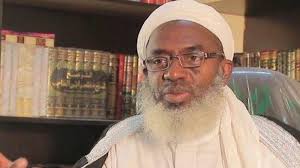
For the unrepentant spokesperson of bandits terrorising different parts of the country, particularly the North West, Sheikh Ahmad Gumi, the only solution to the incessant kidnapping for ransom takings by this group of people, would be for the federal government of Nigeria to sit side by side with these criminals, in a conference table, and begin to dialogue and negotiate the terms under which they would end their nefarious activities.
Gumi who spoke in a television interview had stated that the bandits were kidnapping in order to make money, and that they were being aided by some bad eggs within the security forces who supply them with weapons. He maintained that there was no way the calibre of weapons used by these bandits would have entered the country without the active collaboration of local security officers.
According to Gumi: “I know that these bandits are cooperating with a lot of bad elements in our security system. This is a business, and you would be surprised that so many people are involved. How can these big weapons cross our borders and get into the hands of bandits without the cooperation of some bad elements within our security system? It is not possible! If I give you the same amount of weapons, can you take it into the UK? It won’t be possible because their security is alert”.
Gumi insisted that since the bandits were currently holding a lot of Nigerians hostage in the forests, the only way out would be for the government to negotiate with them rather than attack them. While accusing the federal government of taking sides against the bandits, he warned that without dialogue or negotiation, there would be no end to the spate of kidnappings and other violent crimes in the country.
In his words: “The herdsmen have told me that they are ready to sit down with the government and negotiate. If the herdsmen come together and say no more kidnapping, the war is finished, I don’t see any other Fulani man breaking that agreement and continuing with the crime.
“When militants in the Niger Delta region were vandalising pipelines, the nation negotiated with them and they were given the pipelines to guard for a period of time. The herdsmen too are now controlling a large portion of land and are preventing farmers from farming, because when we leave a big chunk of the population hungry without farmers going to farm, it will be bad”, he stated. Thus, for Gumi, the term of negotiation with the bandits is for the Fulani herdsmen to be employed as forest guards in order to protect us from themselves. In other words, Gumi would want the Fulani herdsmen to takeover all our lands as forest guards, and then be showing our farmers where to farms. That is why they will not be disturbed or prevented from going to their farms to cultivate food for us, otherwise, we would all die of starvation.
For Sheikh Gumi, the term of negotiation between the federal government and the bandits will be for the Fulani herdsmen to be employed as forest guards in order to protect us from themselves. In other words, Gumi would want the Fulani herdsmen, employed as forest guards, to takeover all our forests, and then, they will be showing us where to farm and where not to farm.
This will be an indirect way of giving out our land to the Fulani herdsmen, who have been anxious to takeover our land. Then, our farmers, as Gumi as proposed, will no longer be disturbed or prevented from going to their farms to cultivate food to feed us, otherwise, we will all die of starvation.
For us, it will be wrong, as Sheikh Gumi had proposed, to compare the Niger Delta agitators or militants fighting for the well-being of their people, with the criminally-minded Fulani herdsmen or bandits, who seize and occupy other people’s land, kidnap, maim, rape, and kill the owners of the land, and burn down their houses.
The Niger Delta agitators had a genuine grouse. Crude oil is explored and mined in their area. Gas is also flared there. The activities of the crude oil explorers and miners have caused a whole lot of environmental degradation in the area – farmlands were destroyed, and fishing waters polluted. The people could not farm, and they also could not fish.
In the same vein, in the course of flaring of gas, the air is polluted, while electricity light resulting from gas flaring continue to shine unceasingly, day and night, making many the people uncomfortable. They could not sleep at night, and thus, brought in their trail, a lot of health implications.
Aside of these, the impact of the huge resources from oil and gas being exploited from the Niger Delta region was not felt by the people. None of them owned any oil block, while the revenues from oil were used to develop other areas outside of their region. These were what had agitated the Niger Delta people, and they began to protest and to blow up oil pipelines, and to kidnap oil workers, before the federal government saw the necessity of talking to them, and to negotiate with them.
But for the bandits and the Fulani herdsmen who have been terrorizing and kidnapping innocent men and women, including school children, what is their own grouse? Nobody was able to come out clearly to state their grouse, other than their collecting huge sums of money as ransom, before their victims are released.
Some people however believe that the main term of the negotiation between the Fulani herdsmen and the federal government, which Sheikh Ahmed Gumi is pushing forward, could centre on the necessity by the latter to allow the Fulani access to all the forests in the country, as the Niger Delta militants were given contract to protect oil pipelines.
This would be based on the oft-stated claims by the Fulani that they own all the lands in Nigeria. When this happens, the all-conquering Fulani would resume their interrupted mission of trying to establish their caliphate in all parts of Nigeria, and also of dipping the Koran inside the Atlantic Ocean. That seems to be the trust of Gumi’s gospel of negotiation with the bandits.
Our Minister of Agriculture is Alhaji Muhammad Nanono from Kano State. The Minister of State for that ministry is Alhaji Mustapha Baba Shehuri from Borno State. You are wondering why the two of them come from the far north? Where else do you have farmers in Nigeria except in the North East and the North West? If you sincerely desire an answer to that question, you will need to ask your president, Muhammadu Buhari. My interest in discussing that ministry, however, is not the bigness of the babanriga sweeping its floor and its purse. I am interested in how, between those two gentlemen, the agric ministry became ministry of religious affairs. The ministry of agriculture under them, recently built a N30 million mosque for a community in Borno State and they justified it as being “appropriate in all ramifications.” They said they built the mosque for livestock farmers displaced by Boko Haram. So, how about farmers displaced by bandits in Benue, Niger, Zamfara, and those sacked by herdsmen in Oyo? If you are as troublesome as I am, you are likely to ask more questions.
The mission and mandate of the Federal Ministry of Agriculture is stated on its website. The ministry says it “has the mandate to ensure food security in crop, livestock and fisheries, stimulate agricultural employment and services, promote the production and supply of raw materials to agro industries, provide markets for the products of the industrial sector, generate foreign exchange and aid rural socio-economic development.” I can’t see ‘praise and worship’ here. But that is what the ministry did with my money and has proceeded to tell me and all others who may not like what it did to shut up.
The news of this ‘act of worship’ broke a few weeks ago. I have waited to hear or read of a rebuke from the person who employed those who did it. It would appear that a rebuke would come from the Villa the day the sun rises from the West. The gentlemen who did it have even moved on to other things like tracing grazing routes and cow roads and things like that. I have waited to hear custodians of faith from the far north repudiating that expenditure as a sinful act. But there has not been one voice of reason from that pious zone on that misbehaviour. There is inverted spirituality here. The elite in that part of the country use religion to worship their politics and inanities. But I am a Muslim, so why am I wailing here? Where I come from, no matter what religion we profess, we see warts as intrusions into our beauty; we slam acts like this as indefensible steps in governmental misconduct. That is, perhaps why former president Goodluck Jonathan a few days ago described Western Nigeria as “the only part of Nigeria that has been able to manage religion and development very well.” Why would a religious nation see nothing wrong in using filthiness to water the flowers of piety? Even the direct victims of this baldness of sense in governance applauded it. Maybe we should just keep quiet and pretend that it is normal for the ministry of agriculture to leave grains and tubers and start planting mosques and churches here and there.
An American wrote that “without relentless scrutiny, the government will misbehave.” The rational must agree with that point of view. Nigeria is right in the eye of a food crisis yet our Federal Government, through its ministry of agriculture, is working furiously to address hunger by building worship centres. Our country is officially recognised by the United Nations as a ‘famine country.’ There is trouble everywhere you turn in the land – and we all know it. The World Food Programme once stressed that “by the time a famine is declared, it is too late. . . it means people are already dying of hunger.” We know this is true with us from the north to the south, yet we have a government that is drooling behind cows and planting prayers with money meant for farm works.
Farmers loiter around their homes in Nigeria because pampered bandits and terrorists have chased them out of their farms. There is, therefore, a pandemic of hunger in the country with only the very rich inoculated against it by the system. On December 10, 1948, the General Assembly of the United Nations passed Resolution 217 A (III) through which it declared the right to food as a universal human right. Yet, as I write this, 73 years after that declaration, the figure from the world body exhibits a Nigeria in the throes of starvation. The UN has stated that as many as 5.1 million people in North-East of Nigeria alone faced starvation which would happen between June and August 2021. Yet, it is in that very North East that the government is misbehaving, applying scarce money to fund faith.
There is a country called Venezuela. If anyone is in doubt of where a mismanaged country is headed, that is the current example. A journalist’s account of what that country has managed to become is sobering: “Most Venezuelans eat fewer than two meals a day. People awaken late in the morning so they can skip breakfast and go directly to lunch. Water scarcity has made us bathe in nearby rivers; water plants are not working to capacity. All of this speaks eloquently to the national mismanagement of resources…” Bloomberg also has an example: “She’s crying. And she’s furious. Both she and her husband have lost their jobs, she explains in a rapid-fire staccato, and so she had been doing hairdressing work to help make ends meet. That, too, ended when she decided to sell her scissors and blow-dryer to pay some bills.” The Bread for the World Institute has an elegant description of Venezuela’s tragedy: “The nation’s economy and political structure collapsed even though it possesses the world’s largest known petroleum reserves. More than 5 million people have now fled the country and an estimated 91 percent of those who remain live in poverty. Nearly a third of all Venezuelans—more than 9 million people— are food insecure or malnourished.” In Venezuela, traders set prices and sell in American dollars because the country’s local currency, the bolivar is worth less than the wrapper on sweets.
But any normal Nigerian would read his country in the Venezuelan horrid story. We are there already. During the last sallah, I was to buy crates of Coca-Cola and Fanta in a shopping mall. But the sellers asked me to choose one of the two products; “you can’t buy both,” the cashier told me. I didn’t understand. I asked why? There is a scarcity of these products, someone whispered to me. The picture got clearer this last Saturday: an alarmed shopper photographed and posted online what he saw on a fruit juice shelf in a popular supermarket: “Dear Customer, kindly note that you can only buy 2pcs (two pieces) of juice (per customer) due to low stocks of juices.”
Everything takes us back to the structure of Nigeria. There is nothing you won’t see in a structurally defective country. What is the business of the Federal Government intruding into building worship houses? Someone in Kano would wonder why anyone would be wasting his time writing about this. He would say it is spiritual, normal and politically correct and makes a lot of sense to embrace religion and abandon farming. But where I come from, we say what is not good is bad. A ministry of religious affairs building a worship house is within its mandate. A ministry of agriculture declaring its building of a worship centre as ‘appropriate’ is aberrant.
In a Nigeria rebuilt to its original shape, there won’t be an overfed Federal Government itchy to misapply resources. That is why the south is loud and insistent on federalism as designed by its authors. But the political north would rather protect what they see as their advantage in the current setup. Is that why the two ministers in the agric ministry are northerners? What is so special about that ministry that it has to be cocooned in the bed chamber of the north? Someone said the elite of the north are already sculpturing ‘restructuring’ in the image that suits their greed. They think the south is a fool forever. They want the beat of death to sound on. You read a former Nassarawa State governor, Abdullahi Adamu who would rather see the southern demand for sanity in this federation as separatist. He was in the news on Sunday lambasting southern governors. He said by making structural demands of the federation, “the southern governors are sounding like a broken record..” He then, for emphasis, proceeded to ask his interviewer: “You know what a broken record does? It cracks.” He said each of the governors “is under an oath of loyalty, and of preservation of the sovereignty of this country.” He said “that means that each of them is duty-bound to stay away from any act, or word that has the tendency to be perceived as being separatists….” What else have the governors done beyond banning trekking of people from the north to the south, grazing cows and spreading devastation, death, rape and tears? But Adamu, like his other people, would rather invoke the right of the trekkers over the customary and legal rights of the land owners. He even issued threats. He said: “These governors know the constitution, and they know that every Nigerian has the right of movement, association, and the right to pursue legitimate goals. However, if these governors are saying no to cattle routes and open grazing, what are the alternatives that they have provided? If northern governors come together and take a position, what will happen? What right have you to tell Nigerians not to move freely? If northern groups also say no to southern businesses in their domain, how will that end up? There is a limit. Not that we can’t talk. We have the capacity to do more. But what we won’t take lightly, is for any part of this country to think that they have a louder voice. That is not true. When the North starts talking, maybe there will be sense. If we want this country to stay on, we will.” Interesting.
Adamu said “when the north starts talking, maybe there will be sense.” But that is exactly what the south is asking the north to do. Come out and TALK and let Nigeria have ‘sense.’ A sensible Nigeria will work well for all; it will not defend the ‘right’ of some people to suffering, to trekking barefooted from Kaura Namoda to Katsina Ala, and down to Kara Market in Lagos. A Nigeria with ‘sense’ will not load a federal ministry with persons from a part of the country to enable crass misbehaviour to fester. It won’t. Adamu should lead his brothers to come out and talk. Keeping quiet and manipulating one part of the oppressed against another will expire soon. And when that happens, it will be too late to raise a hand and say, “excuse me sir, I have something to say.”
How on Earth could anyone explain President Muhammadu Buhari’s recently advertised opposition to the massive calls that Nigeria be restructured? And does anyone know the exact reasons why he supports Rural Area Grazing Reserves (RUGA)?
What exactly did the President have in mind when on Saturday, June 19, 2021, he said in Kaduna (through a representative) that “those calling for restructuring are afraid of partisan politics”? He spoke that Saturday as a Special Guest of Honour during the Launch of Kudirat Abiola Sabon Gari, Zaria Peace Foundation which took place at Ahmadu Bello University Hotels, Zaria, Kaduna State. I hope he does not believe that once a man has been elected President he becomes a national teacher that can’t go wrong?
If any of the President’s speeches could be called a declaration, in terms of the importance of the speech in national affairs, it was that open repudiation of the concept of national restructuring to bring about a true federalism. Unfortunately, the President’s speech did not go as deep as Declarations go; he simply stated some positions but refused to fully develop them. For instance, Buhari said “there was nothing Nigerians needed now than Peace, and the country would be better if Nigerians remain united as a sovereign nation than fragmented entities”.
My question: if there is no peace now in Nigeria, a united Nigeria, how would that peace emerge later unless we do something differently? Would it come about if Nigeria does nothing else but “remain united as a sovereign nation than fragmented entities”? How would that much needed peace come about if Nigeria does not change what in its entity has become inimical to peace? Has it not become clear to Buhari that for decades, there were little calls for fragmentation …until peace was shattered? That was true for 1967 when the Nigerian Civil war broke out as it remains true at present when peace has fled from Nigeria as a result of the Boko Haram, bandits and killer herder’s insurgencies. Most of all, Buhari has been in power for six years now, has his administration solved the insecurity problem? Had it done so, there would be no agitation.
Yet, perhaps apart from IPOB and its calls for Biafra, and talks in the fringe Yoruba circle, and both remain distractive side-talks, most agitators actually called for restructuring of the Nigerian polity, especially in fiscal and internal security matters such as the adoption of state and community police. Mainstream agitators did not at any time call for the dismembering or fragmenting of the nation. For instance, there is no doubt that numerous communities in the Middle Belt, the South- South, South West and South-East have been sacked by Fulani herders who came with blazing AK47s. It is a fact that the President has ordered that anybody seen holding AK47 illegally should be shot. But that has not solved the problem. That is why people are asking for restructuring.
Also, the President has called for land from states for RUGA. Some people have responded that such a thing has no place in a Federation. Such an answer was repeated when Buhari called for the implementation of the grazing routes as gazetted in 1963.
In that same speech Buhari said: “And again those who are discussing restructuring, my question is what are you going to restructure? If you ask many Nigerians what they are going to restructure, you will find out that they have nothing to talk about. Some of them have not even studied the 1999 constitution. The 1999 Constitution is almost 70 to 80 percent 1979 constitution.”
So, does the 1999 constitution, being a 90% adoption of the 1979 one, obliterate any need that it be amended to meet the needs of 2021? Even then, has Buhari asked the NIGERIANs what they want to restructure?
He said: “It is okay to demand for restructuring, renewal of constitution, but what is most important now is how the Nigeria state can make local government functional, how can Nigerian states make judiciary independent? Rather we ask Nigerians to focus on putting pressure on National Assembly members to make sure that that autonomy as enshrined in our constitution is respected and implemented.”
Gosh, it is Buhari’s duty as President to listen to Nigerians and satisfy their desires, not talk down on them. Restructuring is not against independent judiciary or optimally functional LGAs.
Did the President actually say this: “There is no government in the world that will cede their authority to the people that are not elected? You are telling us to resolve a system and call for an obscure conference to come and discuss how we can move forward as a nation, that can never be done and no country will agree to that.”
Power belongs to the people and the citizenry imbued that power on Buhari as President. National conferences are organized to distil the thoughts of a nation through their representatives. That was how the 1979 constitution came about. And if Buhari so wants, he should organize a referendum to okay decisions of a national forum. Finish! He could demand that the forum members be elected and the National Assembly would pass the law.
On cattle routes: until details emerge, I fear the 1963 gazetted Cattle Routes may have passed through the State House, Abuja. Numerous bats nestle in the Aso Rock Presidential Villa area. When they fly out in the evenings, they darken the sky. Also, the entire Three –Arm Zone (Presidency, the National Assembly and the Supreme Court) is home to a large set of monkeys. That was why the Villa area was earmarked for a National Zoo in the Abuja Master Plan. That would have been a unique zoo; apart from the caged animals, free-ranging bats and birds would have joined the happy monkeys in entertaining animal lovers. And when you remember that the very first source of water supply into Abuja was from under the real Aso Rock itself, you would suspect that a cattle route could have led directly to it.
Now Buhari has asked that the gazetted 1963 law be dug out. And I suspect that the Justice Minister and the Attorney General of the Federation, Abubakar Malami (SAN), may have already done so. So, what if the powers that be have decided to implement that Northern Region law? Abuja was within the defunct Northern Region!
So, do we tear down the Villa… if, if the 1963 cattle route passed through it? And what if it was even a cattle reserve? It might have come to that because that is what you get when you do the unthinkable; jettison the search for tomorrow for the quest for yesterday.
One would have thought in this cattle routes, cattle reserve, and cattle colony issue, that the tomorrow is personal ranches. And cattle routes and open grazing should be yesterday. Or are we not talking of a 1963 gazette, 58 years ago?
Now, it says a lot that no Minister has resigned over Mr. President’s insistence on cattle routes and open grazing. So, they all believe in it. So, to give the rest of us an inkling into this tomorrow they wish for Nigeria, could someone answer a few nagging questions?
Item: After the government has built the Cattle Reserves or ranches (including water facilities, schools, hospitals, markets, etc, and the herders and their cattle have moved in, would they be paying any fees? Or would Nigeria be supporting the herders in their personal businesses indefinitely? And if more Fulani herders from other countries arrived here and contended for space, do we simply construct more free herders’ havens? If not, why not?
Item: And as the Justice Minister has likened cattle husbandry to auto spare parts business, would shopping complexes, containing schools, hospitals, water supply, electricity, etc, also be made available to the spare parts sellers and cocoa farmers and timber merchants? And for free if the government provided cattle reserves gratis?
Item: As Malami has asked the state Governors who have banned open grazing to first pursue a constitutional change, could he please spell out the constitutional passage that should be changed? I hope he would not include freedom of movement for cattle for that would begin and end in their owner’s ranches. Or should the Minister welcome some spare parts sellers to operate their shops from his personal property?
Item: Is the President unaware of the fact that some states have duly passed the ban on open grazing into law? And does he not see the need to go to court to challenge such laws first?
Item: In giving out spaces in the government-built Cattle Reserves to herders, how would the bona fide Nigerian Fulani herders be differentiated from the non-Nigerian ones? Or would that not be necessary?
Item: What has informed this need for the government to even begin to think of constructing Cattle Reserves for herders? Are we saying that it would be wrong to ask herders to pen in their animals? Or that right now in Abuja, anyone could just put up a chicken poultry anywhere and anyhow? If not, why has cattle husbandry been treated differently? And since when did governments start building business offices or farms or spare part shops for business people? And what would be provided for the fishermen?
Item: Fulani cattle herders have always had the need to have a Seriki wherever they go. Why can’t they live under the guidance of the chief or king of a village where they ply their trade? Must they live apart from their host community? And how would a traditional ruler be held responsible for security in his domain when he does not even know that some Fulani herders have arrived at a particular place?
Item: Mr President has asked that Governors, LGA Chairmen and traditional rulers see to the security needs of their areas. As he understands such grassroots security needs, why does he not support the State and Community Police idea? Who do the Police Commissioners report to?
The answers should help the All Progressives Congress (APC) administration and Nigerians hold a real discussion. Enough of the monologues, please.
Jimoh Moshood, police spokesman, during a parade of suspected armed robbers and kidnappers in Kaduna
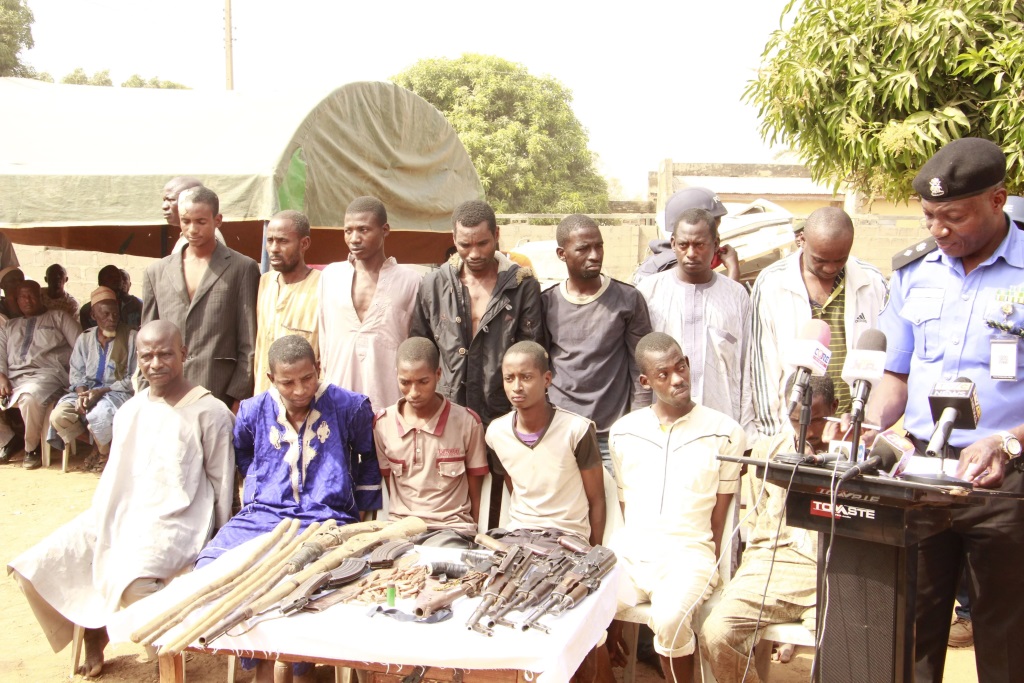
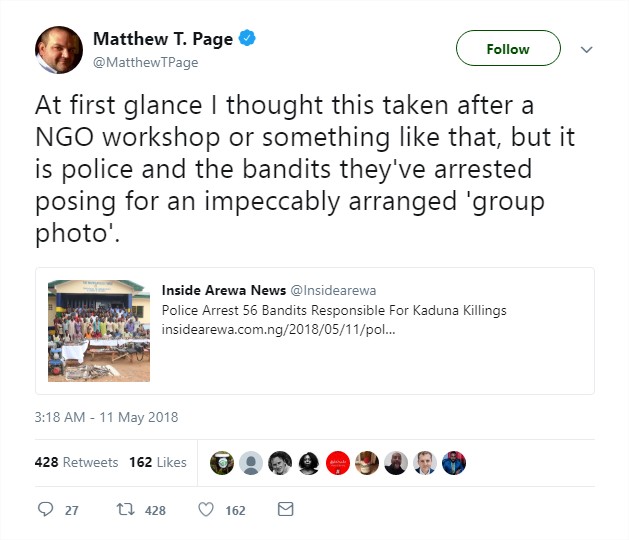
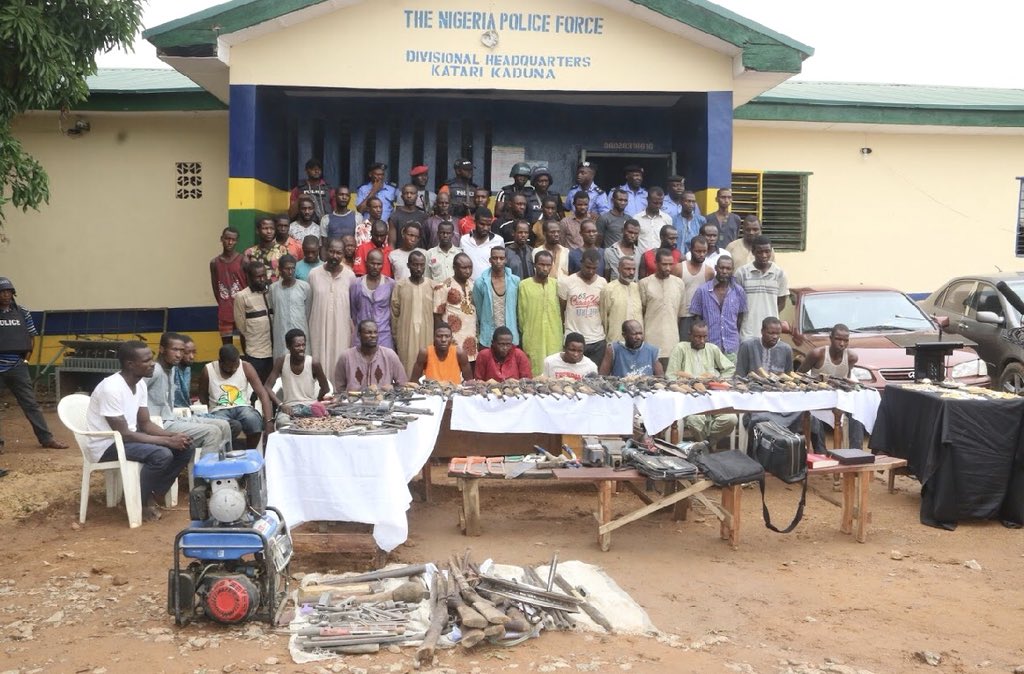
MEDIA parades of criminal suspects by the Nigeria Police has, for a long time, been a subject of heated public debate. It involves not only the dramatic arrest of persons suspected to have committed a crime but also group photographs taking in public and press conferences.
Emmanuel Ojukwu, former Enugu state Commissioner of Police, has justified this practice by saying it helps to create credibility for the police, assure the public that their job has been done, and douse tension in the society.
On Thursday, the Inspector General of Police, Ibrahim Idris, also gave the practice a stamp of approval. In his response to a question asked during the #AskThePolice session on Twitter, he said the parade of suspects “is simply the Force letting the public know the efforts and achievements of the Police in curbing and reducing crime to the barest minimum”.
Thanks Sesan, I guess you are talking about the parade of suspects. This is simply the Force letting the public know the efforts and achievements of the Police in curbing and reducing crime to the barest minimum. #AskThePolicehttps://t.co/HcroNtqIgX
In confirming what the position of law is regarding this issue, the ICIR spoke with prominent lawyers in Nigeria; and almost all of them, except one, emphasised that the tradition is unlawful and unconstitutional.
HOW IT ALL STARTED
In a chat with the ICIR, Charles Odenigbo, president of Law, Media and Social Justice Development Initiative (LMSJI) and former chairman of Lawyers in the Media Forum (LIM), described the practice as “grossly illegal”, adding that it has its roots in the military era, when human rights abuses were rife.
“They did it under the military, which set up tribunals at that time” he said. “And the first thing they do when they are in power is they suspend the constitution, come out with decrees, and bypass all fundamental human rights and laws, so they can apply jungle justice.
“So the Inspector General of Police is borrowing the military coup style by applying this principle. It is a military coup mentality that the IGP and the Nigerian Police Force is using. For me, it is a rape of the Constitution of the Federal Republic of Nigeria, which appoints the IGP and created the Nigerian Police Force.”
IT IS UNCONSTITUTIONAL, LAWYERS SAY
Ernest Ojukwu SAN, professor of law and immediate past Deputy Director-General and Head of Campus of the Nigerian Law School, Enugu campus, told the ICIR that parading of suspects as it is often done “is an abuse of fundamental rights in the extreme”.
“It is more worrisome that these parades and media trials by the police take place even before investigations begin or are concluded,” he added.
Peter Obutte, Deputy Director of the Centre for Petroleum, Energy, Economics and Law (CPEEL), University of Ibadan, also observed that the act is not only worrisome, but unlawful.
He said: “It is … curious that such practice has been accepted as normal by the individuals, society and even the courts. The suspect enjoys Constitutional protection of ‘presumption of innocence until proven guilty under S. 36(5) CFRN 1999 and respect of his person or properly put, right to dignity of human person under S. 34(1)(a) CFRN, 1999.
“The political rationale that such parading may be to prove that the government is succeeding with its crime-fighting is not sufficient to permit such practice because it does not add value or efficiency in the criminal investigation and conviction; if anything, such practice undermines the investigation process and worse still defames someone’s reputation in an irreversible manner assuming he is proven innocent. And even if the suspect is proven guilty by the Courts, then, it would seem the suspect would suffer double punishment and sentence – first as being paraded and second, serving actual sentence.”
Matthew Page, former state department Africa analyst, thought suspects’ parade was an NGO workshop
Misbau Alamu Lateef, legal practitioner and law lecturer at Obafemi Awolowo University, cited past cases where the court ruled the parading of the accused persons to be a ” clear breach” of their fundamental human rights, and said it must be condemned by all lovers and advocate of rule of law. He also asserted that such suspects are entitled to sue and recover damages.
“Firstly, there is the provision of section 36(5) of the 1999 Constitution on presumption of innocence. That is, no one is entitled to be pronounced guilty or punished or shamed for any allegation of crime until proven guilty before a competent court of law by his accusers. Public parade of criminal suspects before trial and conviction is therefore a breach of that provision since such a public parade is a demonstration of conclusion of guilt by the accusers.
“Secondly, there is also the provision of section 36(4) on fair hearing. This simply means the accusers cannot at once be the judge and that a pronouncement of guilt may only be reached after an accused has been tried by an impartial judge and his right of defence has been fully accorded to him.
“Further, the courts have in several decisions condemned such public parade of criminal suspects as an illegal practice. For example, in Ndukwem Chiziri Nice v. AG, Federation & Anor. (2007) CHR 218 at 232 Justice Banjoko held that ‘The act of parading him (the suspect) before the press as evidenced by the Exhibits annexed to the affidavit was uncalled for and a callous disregard for his person.’
“Similarly, the Ecowas Community Court of Justice sitting in Abuja in Dyot Bayi & 14 Ors. v. Federal Republic of Nigeria (2004-2009) CCJLER 245 at 265 the Community Court of Justice, ECOWAS Court condemned what it called ‘media trial’ of the Applicants in the following words: ‘The Court is of the opinion that for the fact that the Defendants presented the Applicants before the press when no judge or court has found them guilty, certainly constitute a violation of the principle of presumption of innocence’.”
Police parade 56 vicious suspected bandits, militia in Birnin Gwari, Kaduna and Zamfara
According to Chioma Unini, Editor-in-Chief of TheNigeriaLawyer, the Nigerian constitution does not provide that parading suspects is part of police investigation and the act may in fact sabotage such investigations.
“What happens if after exposing him or her to the public and eventually the person is charged and found innocent at the end of the day?” she asked. “How will the wrong done to his or her character be remedied by the Nigeria Police in view of the fact that men of the Nigerian police after trial do not come back to tell members of the public that the person(s) paraded has been tried by the court and discharged or acquitted?”
Adavize Alao, legal practitioner and public affairs commentator, who also spoke to the ICIR, said parading of suspects is an unconstitutional act, which violates the suspect’s right to fair hearing.
“The law is clear on identification of suspects in Nigeria which has a clear description on how such should be done, unfortunately the Nigerian police rather use identification use such parades to show the public they are working whilst trampling on the rights of accused persons but most times they parade innocent persons.
“Parading of accused persons acts as a means of psychological torture for suspects to be forced to accede to various criminal offences before the public. It would therefore be wrong for any person to say public parade of suspects or accused persons is not prohibited by any law when the constitution is clear on this.”
THE SOLUTION
Charles Odenigbo told the ICIR that the best way to put an end to the abuse of human rights with the parading of suspects is through the courts of law. According to him, the IGP does not have the power to parade suspects and should be sued.
“It is better that a case is filed in court to challenge such kinds of action,” he recommended. “The people paraded should sue the IGP. It is for the law court to make a pronouncement saying that there is no power under the Police Act, Constitution or any law that gives the police power to parade suspects of crime even without any trial going on.”
Tochukwu Ohazuruike, legal and documentation director at the Independent Service Delivery Monitoring Group (ISDMG), similarly recommended for victims of such parade to approach the high court “to enforce his rights and declare the parade as unlawful, unconstitutional and void”.
Indeed, Femi Falana, Senior Advocate of Nigeria and human rights activist, in a 2017 article, gave an example of one of such court cases: Dyot Bayi & 14 Ors. V. Federal Republic of Nigeria (2004-2009). In that case, he noted, “the Court proceeded to award damages of US$42,750.00 to each of the 10 Applicants and the US$10,000.00 as costs payable by the Federal Government for the illegal actions of the naval personnel who carried out the illegal parade of the applicants.”
BUT NOT EVERYONE AGREES
While it is true that many, if not most, lawyers believe it is completely wrong to parade suspected criminals before their conviction by court, there are exceptions. One of them is Itse Sagay, Professor of Law and Chairman of the Presidential Advisory Committee Against Corruption. He, however, said persons who are paraded and eventually acquitted by the court are free to institute action for damages.
In a conversation with the ICIR, Sagay said: “The tendency is that you find judges and a lot of lawyers saying that it is wrong to parade anybody after arrest and before the completion of a trial because the person has not been convicted and therefore, by our Constitution, he is innocent until he is convicted.
“I think that’s very good interpretation of law as it should apply in a developed country that appreciates the freedoms and rights provided by the Constitution. In a country like ours where freedoms and rights are grossly abused and people do not have a sense of responsibility or discipline, I think some deviation from the way it is handled in some developed countries is called for. And to that extent, such parading may be a deterrence to such matters. I think it is not unsuitable for the type of climate that exists here.
“So, personally, I don’t quite agree with the elitist lawyers and judiciary who say that we shouldn’t parade anybody. What I will say is this: if a person is wrongly paraded, in other words if he is cleared subsequently of any charge arising from the arrest, the person is free to go and sue the police and government for damages. I prefer that approach in a type of underdeveloped society in which there is so much impunity with regards to crime, conduct and indiscipline like ours.”
Our site uses cookies. By clicking “Accept All Cookies”, you direct Law and Society Magazine to store cookies on your device and disclose information in accordance with our Cookie Statement: cookie policyACCEPTREJECT
Privacy & Cookies Policy
Privacy Overview
This website uses cookies to improve your experience while you navigate through the website. Out of these cookies, the cookies that are categorized as necessary are stored on your browser as they are essential for the working of basic functionalities of the website. We also use third-party cookies that help us analyze and understand how you use this website. These cookies will be stored in your browser only with your consent. You also have the option to opt-out of these cookies. But opting out of some of these cookies may have an effect on your browsing experience.
Necessary cookies are absolutely essential for the website to function properly. This category only includes cookies that ensures basic functionalities and security features of the website. These cookies do not store any personal information.
Any cookies that may not be particularly necessary for the website to function and is used specifically to collect user personal data via analytics, ads, other embedded contents are termed as non-necessary cookies. It is mandatory to procure user consent prior to running these cookies on your website.