Home Blog Page 929

Mahmoud Mattan: The Horrible Court Case Of British-Somali Seaman Wrongly Hanged In 1952

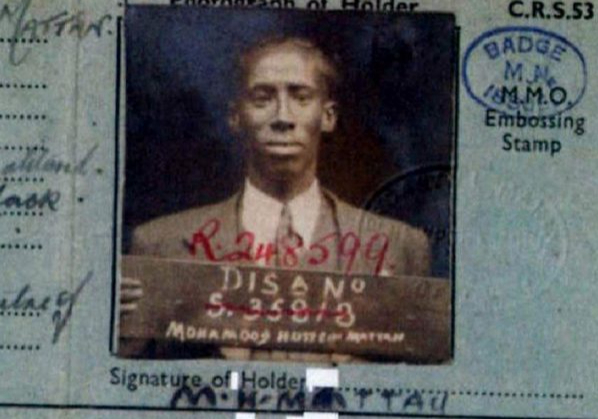
Mahmoud Mattan, a British-Somali man was hanged to death in September 1952 after being convicted of murder. The father of three was wrongly found guilty of the murder of shopkeeper Lily Volpert in Cardiff’s Tiger Bay. At just 28 years old, the British-Somali seaman was the last man to be executed in Wales following a horrible court case. His wife and family fought for years to prove his innocence.

Forty-six years after he was executed, he was posthumously acquitted after authorities found evidence had been mostly fabricated and manipulated by police at the time, BBC reported. Today, The Fortune Men, a novel about Mattan’s story, has been longlisted for the Booker Prize. Somali-born woman Nadifa Mohamed, whose father met Mattan when the two emigrated to Hull, is the author of the book.

A Brief History

“People who knew him said he was spikey, brave, happy to stand up for his rights and for those of the people around him,” Mohamed said of Mattan. “I believe that is, in part, why the police had singled him out to take the blame for the next major crime to be committed in the area.”

https://youtube.com/watch?v=8bvp0fL1nwU%3Fautoplay%3D1%26controls%3D1

Born in what’s now Somaliland in 1922, Mattan arrived in Butetown, otherwise referred to as Tiger Bay or The Docks, within the 1940s. a bit like many others who arrived to figure there from different parts of British Empire including British Somaliland, Mattan got employment on a ship. He met Laura Williams from the Rhondda Valley, who was then 17 and was working during a paper factory.

The two got married three months after they met. it had been tough for the 2 as interracial couples were unwelcomed. albeit that they had three sons, they found it difficult to seek out an area where they were allowed to measure together. So Mattan and his wife lived separately, in several houses on an equivalent street. Then disaster occurred.

How He Was Incriminated

On the evening of March 6, 1952, someone slit the throat of shopkeeper and moneylender Volpert at her shop in Butetown, Cardiff, shortly from the docks. Police found her dead during a pool of blood, her throat cut by a razor. The sum of £100 (more than $4,000 today) had been stolen. When the police questioned people including Mattan, he told them he wasn’t on Bute Street that day but at a cinema. He said he was at the cinema until 7:30 pm then went home. The murder happened at 8.15 pm.

The police searched Mattan’s house but produced no evidence. However, he was arrested following a press release a Jamaican man, Harold Cover, told the police. Cover said he saw a Somali with a gold tooth and no hat or overcoat leaving Volpert’s patronize the time of the murder. Meanwhile, Mattan didn’t have gold teeth, and other people who saw him that evening, before and after the murder, said he was wearing a hat and coat, BBC reported. It emerged recently that Cover identified the person he saw as another Somali called Taher Grass.

Yet, Cover gave the police a second statement, which was discrepant together with his first. This was after the Volpert family had offered a £200 reward. At the trial, Cover said he saw Mattan leaving the patronize 8.15 pm. Meanwhile, four other witnesses who had been round the shop on the evening of the murder didn’t pick Mattan out at an identification parade. The police withheld this evidence from the jury and defense. They also didn’t disclose Cover’s first statement about Grass.

To make matters worse, Mattan’s own defense counsel, T E Rhys-Roberts, in his closing speech, described his client as “this half-child of nature, a semi-civilised savage”.

Mattan was found guilty and sentenced to death. British Somali seaman wasn’t allowed leave to appeal. He was hanged in Cardiff Prison on September 3, 1952. “I still believed right up to the top that they might let him go, but they didn’t, they hung him,” Laura, Mattan’s wife, was quoted by the Independent in 1997.

“When they did that I just locked myself away in my room with my kids, then for a few time afterwards I wont to think I could see him walking down the road towards me. He was a really good husband and father,” she said of Mattan.

Authorities didn’t let Laura know of her husband’s execution as she only acknowledged when she visited visit him in prison.

Cover, whose evidence sent Mattan to his death, was later jailed for all times for attempting to murder his daughter by slashing her throat with a razor. Grass was also convicted in 1954 for the murder of a person . He was however found acquitted on grounds of insanity.

His Sentence

In the 1990s when the Criminal Cases Review Commission was found out , Mattan’s case was the primary to be mentioned it. His conviction was finally overturned by the Commission in 1998, the primary case to be quashed by the organization. Lord Justice Rose described the case as ‘demonstrably flawed’, saying that there was a scarcity of evidence including an entire absence of forensic evidence connecting Mattan to the murder of Volpert. Mattan’s family was awarded £1.4m, the primary time the house Office compensated the family of a person who had been wrongly hanged.

Laura died 10 years after the compensation. Mattan’s children also are no more, although a number of his grandchildren and great-grandchildren are often found in Cardiff today. Last September, a vigil was held outside Cardiff Prison to recollect Mattan. His granddaughter Natasha Grech spoke at the event: “Everybody knew that my grandfather was innocent. My mum and pop always said the impact it had on the community was really awful.

“Mahmoud’s sons were ridiculed, bullied, outcast. They couldn’t do normal things. Everyone called them ‘murderer’s children’, my dad hated that especially afterward in life once they actually pardoned him.”

“All of these lost years, all of that point . Things could’ve been so different for the three sons. They grew up without a father.” (Scooper)

Like George Floyd, Nigerian diplomat in Jakarta pleads for his life: “I can’t breathe” (+Video)

.

A Nigerian diplomat has been brutalised by Indonesian Immigration officials.

It is unclear what led to the incident but the official was harassed in front of the Nigerian diplomatic mission in the Asian country, on Saturday.

Reacting to the ugly development, Geoffrey Onyema, Minister of Foreign Affairs, summoned the Indonesian Ambassador to Nigeria, Usra Hendra Harahap.

In a statement, Nigeria’s foreign affairs ministry said the Indonesia envoy confirmed that the incident happened in his country and he tendered an apology.

“Before the envoy was summoned, Nigerian government had also sent an official protest to the government of Indonesia.”

“The government of Indonesia has apologized to Nigeria over the manhandling and arrest of Nigerian Embassy staff by immigration officers in Jakarta.

“The Ambassador explained that he understood what happened and apologized unreservedly on behalf of the Government of Indonesia.

“The Ambassador has confirmed that the immigration officials involved had since come to the Nigerian Embassy to apologize to the Ambassador and the diplomat concerned.”

The ministry, while describing the incident as “unacceptable”, added that it was against international law and the Vienna Conventions governing Diplomatic and Consular Relations between States.

In a video of the incident currently circulating on social media, three men were seen wrestling a black man inside a car.

They pinned his neck to the car seat and he kept begging for help.

The men kept pressuring him as he screamed “My neck”, “I can’t breathe!”.

▪︎ Report by Daily Trust

▪︎ Video by TVC

Kanu is technically still in Kenya

By ALOY EJIMAKOR

Yes, that’s right: In the purest interpretations of foreign relations law, as applied to Britain and Kenya, Mazi Nnamdi Kanu is technically speaking, still in Kenya. How? Dual national or not, Kanu departed Britain and travelled to Kenya as a British citizen and Kenya admitted him as such. That’s the starting point.

So, after his admission to Kenya, it happens that Kanu must be expelled from Kenyan soil (with or without due process), the next natural and legal thing to do is for Kenya to expel him to Britain, not Nigeria. Choosing to expel him to Nigeria means that he could’ve also been expelled to any other country than Nigeria.

Why? Because Kanu presented himself to Kenya as a British citizen, not a Nigerian citizen or even a dual citizen. In international law, it was clearly a three-way immigration contract between Kanu, Britain and Kenya. Nigeria was not a party to it; and Nigeria was never in reckoning at the Kenyan port of entry when Kanu presented himself for admission. Lawyers call it privity of contract.

Further, counting from the time of Kanu’s abduction to the infamous rendition, Kenya sighted no other travel document that could’ve, in addition to Britain, attributed another nationality to Kanu, including that of Nigeria. Or, was Kanu admitted to Kenya on a Nigerian birth certificate?

So, it’s dubious that Kenya attributed Nigerian citizenship to Kanu merely because those that sponsored the abduction and rendition presumably told Kenya that Kanu was borne in Nigeria. What about the credible claims (in public domain) that Kanu had renounced his Nigerian citizenship? If place of birth should count, then renunciation should count for more.

Put another way, unless Kenya was shown Kanu’s Nigerian birth certificate, it is expected to presume Kanu as a British citizen only. After all, beyond a birth certificate, a passport is the next best proof of citizenship. Verbal assertions of place of birth is, as a matter of immigration and nationality law, an insufficient proof of citizenship.

Nonetheless, if Kenya was in any doubt as to where Kanu should be expelled, it should have resorted to the competent international laws on point.

The most obvious of such laws is codified at Article 5 of the Hague Convention on Certain Questions Relating to the Conflict of Nationality Law, which states that: “Within a third State, a person having more than one nationality shall be treated as if he had only one. A third State shall, of the nationalities which any such person possesses, recognise exclusively in its territory either the nationality of the country in which he is habitually and principally resident, or the nationality of the country with which in the circumstances he appears to be in fact most closely connected”.

As can be seen from above, Kanu was required to meet one of two conditions in order to be treated by Kenya ‘exclusively’ as either a citizen of Nigeria or Britain.

So, let’s put Kanu into what the Hague Convention says and see how he comes out.

Fact: Kanu is 53 years old. Out of this, he has spent some 30 years in Britain and 23 years in Nigeria. His wife and children are domiciled in Britain and they are British citizens, either by birth or naturalization. Kanu has his home in Britain and pays his taxes there.

Another fact: Kanu’s main occupations – Radio Biafra and IPOB – are corporate citizens of Britain in good standing, both having been duly registered in Britain. And Kanu runs both of them from British soil.

Conversely, the last time Kanu visited Nigeria, he was arbitrarily arrested, persecuted and detained for eighteen months. In time, he was nearly killed under circumstances that would be considered State-sponsored murder, which is a crime against humanity under the Rome Statute.

So, as you can easily see from above, Britain is where Kanu is ‘habitually and principally resident, as well as the country with which, in the circumstances, he appears to be in fact most closely connected’. If, like Kenya, you think Nigeria qualifies by a stretch, then you must be thinking that being in jail for nearly two years and surviving extrajudicial murder are good attributes of citizenship.

Thus, Kenya (being the third country) should have treated Kanu exclusively as a British citizen because, even as the Hague Convention required Kanu to meet one of two conditions, he actually over-qualified by meeting both conditions.

Therefore, as a strict matter of foreign relations law, as applied to Britain and Kenya (minus Nigeria), Kanu is technically still in Kenya. How? Because Kenya was the last country in which Kanu – a bonafide British citizen was lawfully admitted.

In other words, subsequent to his admission to Kenya, Kanu desired to depart from Kenya, the only country he could have legally departed to was Britain, not Nigeria. Why? Kenyan immigration would not have allowed Kanu to depart to Nigeria without him presenting either a Nigerian passport or a Nigerian visa.

In view of the foregoing, the next best steps for Britain to take, especially in the face of Nigeria’s intransigence, is to ask Kenya to account for the whereabouts of her citizen, Nnamdi Kanu, last seen in Kenya as of June 19th, 2021 as her Majesty’s subject and a free citizen of Britain, not a criminal suspect.

Once Britain sits up, Kenya – whether complicit or not – would begin to appreciate the true legal and diplomatic implications of failing to protect a bonafide British citizen who made his last lawful immigration stop on Kenyan soil. And Nigeria too will begin to realize that Kanu’s presence in Nigeria is unlawful and unsustainable.

Ejimakor is a Special Counsel to Mazi Nnamdi Kanu

Saving Jaafar Jaafar from Gov Ganduje’s SLAPP, By Godwin Onyeacholem

Despite persistent calls by authentic advocates of good governance for a conducive atmosphere for a thriving democracy and freedom in Nigeria, the reactionary wing of the ruling class and its agents are not giving any chance for that to happen. The more they are caught red-handed—with self-incriminating evidence—and exposed in the very act of a crime, the more they grow the liver to deflect and seek revenge.

Abdullahi Ganduje, the 72-year-old governor of Kano State, occupies the top rung of state officials who seem hellbent on punishing journalists for doing nothing other than acting in accordance with the demands of their profession. Recall that sometime in October 2018, Jaafar Jaafar, journalist and publisher of Daily Nigerian, published a roughly two-minute video showing Ganduje hastily shoving bales of dollars said to be totalling $230,000 in his kaftan as part of a $5millon bribe deal offered by contractors. That was one rare piece of investigative work with a telling impact.

The scandalous video reverberated across the country, drawing intensely cynical comments about the ruling All Progressives Congress government and its much-hyped fight against corruption. Obviously deeply flustered, Ganduje tapped Muhammad Garba, the state’s commissioner for information, to deny the genuineness of the video. Garba then released a statement saying there was no “iota of truth” in the entire package and describing the video as “cloned.” He said the governor would go to court to seek redress.

As the pall of embarrassment the video had generated thickened and widened, the Presidency’s reaction was to promise a thorough investigation after President Muhammadu Buhari had reportedly seen the video. Of course, everyone knows Ganduje is a favoured ally of President Buhari. And as all persons lucky enough to be in the good books or enjoy the privileges of that exclusive corridor of influence, the outcome of that promised investigation was easily predictable.

Suffice to say, however, that at the time of writing this piece not a single presidential panel was known to have been set up to investigate the video, much less release any report in that regard. Nor has there been any official statement from the Presidency beyond the claim to investigate. In fact, Buhari himself in one instance was to say that he marvelled at the technology behind the production of the video. So much for his vaunted fight against corruption.


But the Kano State House Assembly took a step that could be described as meaningful, even if conspicuously half-hearted in view of the well-known servile attitude of lawmakers to governors in this clime. The Assembly set up a seven-man committee to unravel the validity of the video and invited Jaafar, who appeared and stood his ground that the video was for real. That was a golden opportunity for Ganduje to also show up at the hearing and counter the journalist with his own facts. He was nowhere in sight. And as expected, the committee has submitted no known report till date.

Since publishing the video, Jafaar has not known peace. Threats upon threats, and intimidation from known and unknown quarters have been piling up to make life difficult for him. Ganduje went to court as he vowed, but as can be seen, not to ask for justice but to conscript and deploy the court as a tool for intimidating and hushing up journalists like Jaafar and active citizens who are exposing wrongdoing and demanding accountability from leaders.

By going to court, Ganduje and others like him make it seem as though they are following due process. But it’s all pretense. What they are in fact engaged in is called Strategic Lawsuit Against Public Participation, SLAPP for short. It’s a euphemism for an abuse of the law to shut down vital public interest oversight and public access to information. Often, these powerful wrongdoers who have been found out by the press and exposed in public know they have no case, yet they have continued to hire big lawyers and go to court ostensibly for redress, in most cases fishing around for pliant judges that will do their bidding, which is nothing but to exact revenge through heavy fines and muzzle the press thereby.

That’s exactly what Ganduje is doing to Jaafar, who has since fled the country following mounting threats to his life. Barely a month after the publication of the video, the governor sued him and Daily Nigerian for defamation at the Kano High Court and demanded N3billion as damages. Somehow, there was no progress on the matter and suddenly, in June this year, the governor withdrew the matter from court with no reasons. Daily Trust reported that the court fined him N800,000 for the action.

Many people thought with the withdrawal of the matter from court some relief had come to Jaafar. They were wrong. Ganduje travelled all the way from Kano to Abuja to turn the screw harder at an FCT High Court, this time asking for N5billion as damages for an alleged defamation. No citizen deserves this kind of orchestrated persecution, least of all a journalist who was simply doing his work.

Thankfully, Amnesty International (AI) and Committee to Protect Journalists (CPJ), as they would always do in matters like this, have called on Ganduje and the Nigerian government to ensure that neither Jaafar nor his family suffers any retaliation because of his journalism. If there is anything the journalist deserves, it is commendation for performing his constitutional obligation of holding power to account as enjoined by his profession, and for his patriotic act of embracing this government’s call for citizens to help fight corruption by reporting corrupt practices and other kinds of wrongdoing whenever they see one.

To that extent, Ganduje will do well to free Jaafar and his family from the prolonged trauma to which they have been subjected for about three years now. The fresh court case the governor has instituted in Abuja is totally unnecessary and should be withdrawn immediately so that the journalist can return to practise the profession that has been the only source of livelihood for him and his family.

This is also the time to appeal to lawyers to always support freedom of the press as enshrined in Section 22 of the 1999 constitution. Everything should not be about money. Lawyers should show an acute sense of discrimination in the briefs they collect. Journalists are not criminals; therefore, they should be supported to do their work in an atmosphere of freedom. Lawyers should learn to say NO to briefs seeking to intimidate journalists and wittingly gag the press or aiming to further harass or threaten citizens (whistleblowers), among whom you would count Jaafar, who have demonstrated the courage to report crime.

•Onyeacholem coordinates the whistleblowing project, Corruption Anonymous, at the African Centre for Media and Information Literacy (AFRICMIL).

Of kidnappers, Emir of Muri, Abba Kyari and the doctrine of self-help; By Hassan Gimba

This year’s Eid-el-Kabir came at a time Nigerians, especially those living in the North, were at their wits’ end over incessant kidnappings. Less than ten-year-old Islamiya pupils from Tegina in Niger State are still with their bandit abductors, College of Forestry Students from Kaduna, too. These are more known because they are students. Hundreds are in the hands of kidnappers all over the North minus a few states. It is amid this national malaise that Muslims celebrated Sallah.

Kidnappers negotiate openly with relations, and friends of victims, collecting ransoms before their release. Sometimes, couriers of ransom get detained and fresh negotiations open. In other instances, females abducted get married off to their abductors. Sometimes abductors request airtime, foodstuff, and motorcycles before releasing abductees. People are concerned as day after day it becomes glaring that the hoodlums are running rings around our police.

It is amid this that the Emir of Muri in Taraba State, Alhaji Abbas Tafida, took the bull by the horns and threw down the gauntlet. He threatened bandits, seen majorly as the foreign Fulani Bororo, with death if they did not leave his forests in 30 days. Immediately after the Sallah prayer, he took the microphone and said: “Our brothers, the nomadic herdsmen (Bororo) from neighbouring countries, you came to us to allow you to stay in our forest. We allowed you because you are our brothers. When you came, we welcomed you. We regarded you as fellow Muslims. But the question you must answer is, are you Muslims?

“This is a question we are waiting for you to answer. We deserve to know if you are Muslims. If you are one of us (Muslims) and you decide to stay in the forest, only to kidnap us one by one for ransom, stop it because your attitude is not acceptable to Allah. But if you are not Muslims, I want to tell you, like we fought the infidels before, we are ready to fight you with all our strength. So I have given you (Bororo) 30 days to leave my emirate. If we see any of you after the expiration of my ultimatum, we will kill him.

“I am calling on my subjects to know that and be ready to fight or else I will draw the line. We kill him without asking him what he came to do or ask his name or where he comes from. If we are going to be all killed, let it be. If we will all die, let it be. We will not allow bastards to come and kidnap our wives, take them to the forest and rape them or commit adultery with them. In one village, we have the report of a District Head who is conniving with these criminals. The police arrested and granted him bail and the people are watching him. I think such a leader is not supposed to be living among us. Are you crazy to allow such a person to continue to live among you? Listen to me, henceforth any person who is found to be conniving with these criminals, we will kill his mother, and other siblings.

“For the police, we expect you to do your duty. If you arrest any kidnapper and set him free, we will not accept that. We will direct our armed youths to go after the kidnappers. There is no way we cannot be free in our homes; and worse, we cannot sleep with our two eyes closed. I am calling on Ardos (leaders of Fulani) to stop these barbaric acts in my emirate because you all know who is carrying out these criminal activities. I want to reiterate that any kidnapper that is set free by the security will not be spared. All those responsible for maintaining peace in my domain should come together to end the menace or we know what to do. Peace be upon you.”

The emirate of Muri is known for its gallantry, having been founded in 1817 as a Fulbe Jihad state. It was briefly a de facto French protectorate between 1892 and 1893, under Governor Louis Mizon. It wound up as a province of the British Protectorate in 1901. Muri has produced emirs that do not mince words; they spoke their minds without fear. This trait was a subject of national discourse when, on August 12, 1986, Alhaji Umaru Abba Tukur, its powerful emir, was dethroned by Colonel Yohanna Madaki, the military governor of Gongola State. He became too strong for the Colonel to handle.

Ultimately, this thought of the emir is what may inform the actions of Nigerians as more public influencers think of mobilising the people to take their fate into their hands.

Hushpuppi and Abba Kyari

Talking about security issues and the police makes me sad over the travails of Deputy Commissioner of Police Abba Kyari. The man has posted significant achievements, cracking high-profile cases and bringing notorious criminals to justice. It is a pity if such a personality crashes ignominiously at the zenith of his career. He was flying beyond the skies with a future twinkling brightly, like the stars far above the sky.

Looking deeply and beyond Kyari, is there a reason a police officer trained and paid to arrest criminals will hobnob with them instead of remaining their nemesis? One may say lack of motivation, lack of proper training or absence of the weaponry/equipment or a result of being overstretched because of inadequate numbers.

In an interview with the Weekly Trust of 16 October 2010, a former Inspector General of Police, the late Gambo Jimeta said: “I think I’m qualified to talk about the development of the police force since independence because these are the exact years I have been in the force. The police force I joined fifty years ago was a highly trained and motivated one. We were very proud of our profession and we had a lot of support from the public who felt that we were there for them, to help them.

“We were well equipped; we had vehicles, laboratory equipment and we had everything that it took to run a modern police force. Unfortunately, since independence, we have been put along the line of what they call competing demands from other services in Nigeria. This has downgraded us and has brought us to where we are today, almost at a standstill.”

While we expect the police to risk their lives for us, yet they lack enough weapons and many criminals are better armed than them. Most police officers are treated shabbily, earning peanut salaries and can barely afford to feed themselves, not to talk of taking care of their dependents. A good number are homeless, with many squatting in slums. In such situations, the faint-hearted will cheaply compromise.

Even though 10,000 constables are to be recruited, the population of the Nigeria Police is less than 400,000. The United Nations (UN) standard for the police-to-population ratio is one police officer for every four hundred and fifty citizens. With the ever-growing population of over two hundred million Nigerians, according to the worldometer and about three hundred and seventy-one thousand, eight hundred (371,800) police officers, according to the Nigeria Police Force, the present police-to-population ratio in Nigeria is one police officer to five hundred and forty (540) citizens. Perhaps that’s why in 2017, the former Inspector General of Police, Ibrahim Idris, said that Nigeria needs to recruit 30,000 police personnel annually for five years to meet UN recommendations.

Even at that, the Police Service Commission in a report published by The Guardian stated that as of 2018, over 150,000 police officers were attached to VIPs and unauthorised persons in the country. Translated differently, every police officer attached to one VIP is denying at least 450 Nigerians access to police security and, by extension, the safety of lives and property across the country. This may be a conservative figure as despite the alarming rate of robberies, kidnappings, insurgencies, a then Assistant Inspector-General of Police (AIG), Zone 5 in Benin, Rasheed Akintunde said that over 80% of police officers are attached to either private business owners, multinational companies, corporate organisations and government officials while the remaining 20% are attached to their actual civic duties.

However, the number may not be the issue as the late IGP Jimeta, in that interview, said that: “A more equipped and civilised environment will require fewer police officers than the sort of situation we have now. The vast unplanned country and poverty-stricken and ill-motivated police force we have cannot do much. A well-equipped police officer will do a job that ten cops would do. One police horse for crowd control will do the job of fifty police officers. You see what I mean. So, the strength of the force is irrelevant to its capacity to perform its duty. It is not about the number, it is about skills and equipment available.”

According to some sources, the average amount paid per police officer attached to a VIP monthly is N75,000 with an initial documentation fee paid to the commission ranging between N250,000 and N1,000,000.

That means N11.25 billion is potentially generated every month from attaching 150,000 police officers to VIPs. In a year, at least N135 billion would have accrued to the Nigeria Police Force, which is about thirty-seven percent of the total budget allocation to the Force in 2019.

This amount, according to some experts, could pay the annual salary of over 132,000 new police constables, at an average salary of N85,000 per month. It can buy for the police 885 Robinson R44 Raven II helicopters, meaning that each of the 36 states and the Federal Capital Territory can own at least 24 helicopters each.

That money can buy over six thousand Toyota Hilux 2018, providing at least 165 police Hilux vehicles for each of the 36 states and the Federal Capital Territory. It can also buy over one million, four hundred and seventy-five thousand (1,475,409) police bulletproof vests at N91,500 each.

But where is this money?

Leveraged capacity: Traversing the near zero sum capacity conversion, By Ngozi Bell

If you have lived long enough, you know of the relationship; Capacity = Productivity – λ or some similar equation or definition variant. If you have not thought about it quantitatively, you have lived it out literally because it is a fact. 

Capacity is the measure of containment, the amount that can be held. Many times, we like to envision capacity with the largesse of infinity. But the truth is that capacity is always finite, it can absorb your gift and skills, your time and assets but remain finite. The secret weapon of capacity is its ability to regenerate. Regeneration allows something new to come out of what was. It can create headroom for so much more, it can change the trajectory of capacity as it retrieves the abilities of the inputs positioning them for desired outcomes.

Leveraged Capacity!

Proverbs 18:16 says a gift opens the way and ushers the giver into the presence of the great. If we look at this scripture from the perspective of a physical gift, it will literally mean that your gift (a part of your capacity /input) has created an influence (effect of catalysation of the input) that brings you access (outcome). By the way, a friend AHG, pointed this interpretation out to me weeks ago, ironically clear as day, I had missed it. Now to be clear, Proverbs 18:16 is a Living Word and has many living manifestations! 

To illustrate further, I remember when candidates would declare for a big elective office, if you could organise a fundraising that could bring in good donors, you would immediately go from obscurity to someone the campaign would call back and engage with and in many cases, gain access to a would-be president right in your living room! Your gift literally ushered you to the front of the line with all the potential that such access holds! 

In the example, above, the gift had the effect of amplifying some outcome considered as desirable to the great. That is leverage!  

Leveraging is the ability to use an asset, far beyond it’s known or calculated value. It is the application of strategic advantage. For example, in leveraged capital, we use debt (a borrowed asset) to amplify (multiply) returns from an investment!

Now let us walk through the basics to eventually get to the end.

Your capacity defines what you are able to hold or contain within your purview! For example, there are several people who are multidisciplined.  One person is a speaker, leader investor, teacher, researcher, employee, employer, parent, spouse, caregiver etc. That person’s personal capacity allows all these, done well simultaneously, concurrently or in whatever process format works. 

Your capacity can as such be measured as the maximum value you represent or can produceCapacity and productivity go hand in hand but are not equivalent

Productivity defines what you put out, your measurable output or outcomes. For example, a technical writer generates 10 publications a month (capacity might be 12), an entrepreneur has built 2 businesses (capacity might be 3), a leader started 5 viable teams in 2021 (capacity might be 12), an engineer developed 3 new products (capacity might be 4), a CEO grew capital from X to Y (capacity might be 1.2Y). These are specific, measurable outcomes! We see a trend where outcomes/productivity suggest, unexhausted capacity. 

The first law of thermodynamics says that energy is always conserved, basically energy is neither created nor destroyed only changed, the equation gives a clearer illustration  Δ− W.

ΔU – Change in internal Energy of the system, W – work done by the system, Q – Net Heat transferred into the system

The point here is that the total internal energy of the system does not equal the work done by the system, there is heat present that cannot be captured as work done. It is noteworthy that the ability to do work is 100% dependent on energy, to that point the more energy you can convert to work done, the higher the throughput!

In a Pareto optimal scenario also known as the zero sum; all input resources translate to an output or outcome. 

Noting the universal first law of thermodynamics, is a Pareto optimal scenario possible? A better question is how do we improve efficiency significantly enough that your input resources approach the outcome. How can capacity tend to or approach productivity?

Here’s how!

Capacity Factors (CF):

Capacity Factors are factors of capacity that can be catalyzed to achieve Productivity. Below is a list.

Education (acquired degree or knowledge), skills (know-how, tangible), contacts (accessible networks), assets (money, equity, tangible and intangible), characteristics (habits, image, creativity, giftings, character etc.), opportunities (access, fortuity, favor) etc.

Capacity Factors can be placed into two broad groups, objective Capacity Factors (CFo) and subjective Capacity Factors (CFs) 

The objective Capacity Factors have been studied by major researchers and come in many variants. Some research combine both objective and subjective attributes, for example John Maxwell teaches on the five success factors that combine both objective and subjective attributes. 

Our work concluded that identifying them in the two main groups have been most applicable to broad spectrums of people. 

The objective Capacity Factor can be further placed into three verticals

Objective Capacity Factors (CFo)

The objective Capacity Factors can be placed in three verticals of Talents, Training and Tools (CFo)

Talents – know how and skills, practical knowledge, converted knowledge, must be practicable (eg build a table, write software code)

Training – education, role, job (engineer, doctor, artist, COO, builder, seller)

Tools – what / who you can engage, leverage or access, the opportunities available to you (capital, decision makers, networks, media) 

With our broad list of Capacity Factors subsequently bucketized into three verticals; what we have clearly identified are the objective factors! What happens to the subjective factors? Let us look at them more under wider lenses.

Subjective Capacity Factors (CFs)

The subjective Capacity Factors account for attributes that are mainly intangible and particular but not necessarily unique to the individual. They are typically inherent but can be manipulated and modulated albeit with a great deal of will power and discipline. Subjective Capacity Factors can be dependent on circumstance, or environment and be influenced by the dominant ecosystem. They also can be honed and transformed to skills. They are represented by Characteristics such as habits, charisma, personal image, creativity, giftings, character etc. they are for the most part subjective and capture this categorization. Others include integrity, teamwork, resilience, patience, drive, will power, ambition, courage, luck etc.

So now that we have reviewed the subjective Capacity Factors, then what? This is the classic hard skills, soft skills dilemma, assessing the tangible versus the mostly intangible factors. 

Are the contributions of subjective Capacity Factors too diminutive to count? On the contrary, they are extremely important and account for the delta that determines either a convergence towards or divergence away from Productivity! The sum of the objective and subjective Capacity Factors make up the resultant Capacity Factor.  

Basically, this very simple equation illustrates the relationship, 

CFr (Resultant CF) = CFo (Objective CF) + CFs (Subjective CF)

The λ (lambda) Effect

What is notable is that the objective Capacity Factors because of their tangibility are more fixed terms somewhat analogous to hard skills for a job. You can acquire them through specific steps. So, you either have them or not at each given point in time.

The subjective Capacity Factors are far more ambiguous because some can be biological, inherent, acquired, influenced etc. They are mostly intangible and hard to decipher except via outcome or some action.

Remember our capacity equation

Capacity = Productivity – λ. λ accounts for the gap between Capacity (what is possible) and Productivity (what is outputted). 

If we can reduce λ using efficiency techniques, then Capacity will be almost equal to Productivity. In contrast if the converse is true, then Productivity will be divergent away from Capacity. 

By the way this relationship in some variant is a standard used by every global manufacturing, production, or economic development sector to capture progress, monitor efficiency and to measure the impacts of improvementsIt directly relates to profitability, a key currency of success!

λ is the inverse of the resultant Capacity Factor, λ = 1/ CFr, or λ = 1/ (CFo + CFs). 

Reducing λ. Improving Productivity

To decrease λ and allow capacity trend closer to productivity; the λ equation above shows us that it is very straightforward to do. To reiterate, while λ is the quantity that separates the capacity from productivity, it is measured as the inverse of the resultant Capacity Factor or 1/CFr, this means that λ = 1/(CFo + CFs) will decrease every time the Capacity Factors increase! So the higher the resultant capacity factor, the smaller λ gets and the closer Capacity approaches Productivity!

Now we noted that the objective Capacity Factors are tangible and more fixed, take more time, have more tie dependence and are typically more expensive. For example if a role calls for Blockchain development expertise. It would be an imperative to know how to program a ledger, know the tools like truffle Hyperledger fabric and learn solidity to write smart contracts. These will take time and possibly money and the interactions with different entities. There is no escaping it. The subjective are more fluid, If you want to get your Capacity so optimized that it approaches Production, adjusting the subjective Capacity Factors will be the most efficient and most impactful way to do so. For example adjusting attitudes toward a team, creating better working environment, being more attentive to remove roadblocks and inefficienciesin a production line could drastically improve outputs without much outside intervention!

A simple illustration of the Leveraged Capacity:

Just like each of us have the ability to self-govern, Kanayo is CEO of Kanayo Inc. How can Kanayo effectively improve her Capacity to Productivity relationship. While Kanayo might be unable to make drastic adjustments to her objective Capacity Factors, assuming she holds a PhD in “Kanayomics” and has worked several years in this personal field, honed every skill, attended many trainings and has a well-oiled network that is slightly overused; with nothing much to do in short order on her objective factors, Kanayo can drastically improve her emotional quotient. She can connect more wholistically to herself. More effectively manage her temprament; she can leverage her charisma more situationally. She can make integrity central to the way she leads her team. Make fairness, equality and openness more the hallmark of her engagements. As CEO of Kanayo Inc she would through these subjective acts drastically improve her personal economy by many folds. More would listen, engage and be influenced by her!

The Leveraged Capacity is Capacity that is powered to approach Productivity, where the equation between the two terms have a very low value λ. It is one that uses its Capacity Factor assets far beyond their known or calculated value. It is the application of strategic advantage to supercharge the contributions needed for a desired outcome. 

You can do the same every day, for your personally economy, your workplace, your business, your life, the world you desire to live in. Reduce the λ! Power your Capacity to high Productivity! Make the adjustment, it’s in your purview! Now you know, go do it!

Please note that terms like Capacity Factors and other terms used in this writing are all part of research done by Miranet LLC Inc and used to develop a series of commercial evaluation tools including the Economic Capacity Calculator a product of the Economic Posterity Series.

About Ngozi Bell

Inspiration, Hard Work, Innovation. These three foundational elements anchor Ngozi’s core belief that manifesting the extraordinary is always within reach. Inspired by her mother A.C.Obikwere, a scientist and author, she learned the privilege of living at the edge of important encounters and dedicating herself to robust and perpetual learning. Ngozi’s background is a combination of Physics, Engineering, Venture Capital/Private Equity, regulations, and business where she has managed over $1B in cumulative revenue. Ngozi is a speaker, storyteller, and writer on a diverse set of topics including AI, iDLT, ML, Signal Processing, iOT, women, entrepreneurship and more. She contributes regularly to VOA, has been a TEDx speaker and is published on tech and non-tech platforms. She is a champion of STEM, women, youth, art and the Africa we must engage. Ngozi is an adjunct professor of Physics and management with work experience in Asia, Europe, Africa, Middle East, and North America. She is a founder of a number of a number of enterprises and host of the podcast Stem, Stocks and Stews (https://anchor.fm/stemstocksstews-podcast).Https://www.LinkedIn.com/in/ngozibell/

Credit: This article was originally published by Sundiata Post

‘Rivers State, Not FG Should Collect VAT’- The Judge ‘Erred’

By Akinyele Oladeji

This judgment, with respect, does not accurately capture the intendment behind the ease in the efficacy, or in giving effect to the otherwise black letter law in operation. It, inevitably, will also lead to chaos in practice. The learned judge erred in the ruling perhaps due to lack of appreciation of the background facts and the complexities that compelled the states to cede their rights of collection of Value Added Tax (VAT) to the Federal Government through the instrumentality/offices of the Federal Inland Revenue Service (FIRS) ab initio. I will explain.

Even though it is incontrovertible that VAT being a consumption tax is in the residual list constitutionally and thus under the line of sight and collection right of the States, however- to make for ease of monitoring and compliance- it is not unusual for a taxing authority to appoint another as ‘an agent’ of collection. This is usually done for exigency, effectiveness, and efficacy of collection. I must be quick to underscore here that I said ‘appoint as an agent’ advisedly. This is because you cannot legally cede a constitutionally guaranteed right but you can legally appoint an agent to exercise that right on your behalf. When the VAT law was introduced in Nigeria during the military era, it was soon realised if practised (in monitoring, compliance and enforcement) stricto senso, it will be cumbersome and visit untold hardship on consumers, hence the MILADs ( military administrators) agreed to appoint FIRS as an agent of collection. For simple illustration to demonstrate the underpinning reason for this arrangement, imagine rice cleared at the Lagos Port liable to VAT, but offloaded and sold at Agbeni market in Ibadan, liable to OYSG for another VAT, then the purchaser being a Hausa trader who finally transports same to Kano to sell to final consumers in his shop in Kano ( liable to Kano State Government for VAT) as well. The level of inflation can only be imagined! Claiming back as input will be cumbersome as which state will the final consumer claim back from? The duplicity must necessarily be avoided! It is therefore exigent and expedient for the states to appoint FIRS as the agent of collection. And that’s why FIRS only keeps 4% of total collection as cost of collection and distributes the balance to the states based on agreed metrics such as population, size of IGR etc.

Lagos State ingeniously came up with ‘Hotel Occupancy and Consumption Tax’ to tax those goods and services that are consumed in Lagos and cannot reasonably be said to be susceptible to any form of movement. The 5% Tax applies to residency in hotels in Lagos, use of event centres, and consumption in eateries and hotels. The law was challenged in court in the case of the Attorney-General of the Federation v. Honorable Attorney-General of Lagos State (2013) LPELR 20974 SC vide an originating summons taken by the Federal Government as Plaintiff against Lagos State. The Supreme Court declared that it is only a State House of Assembly that can make laws on tourism, licensing and grading of hotels, restaurants, fast food outlets and other hospitability establishments in the country and it dismissed the case filed by the Attorney General of the Federation.

Successful examples of arrangements where one taxing authority appoints another as agent of collection abound in Lagos- Land Use Charge which is an aggregate a combination of Tenement rate, Ground rent, Neighbourhood Improvement Charge. Tenement rate belongs to the Local Governments but is collected by the State and distributed to the Local Governments. Remember how cumbersome it used to be when LG agents will serve you tenement rate in the morning and State officials will harass you for ground rent in the afternoon! Another example is Signage fees which is payable to LGs. It should be recalled the predicament one suffered for having any kind of logo on his/her vehicle moving from one local government to the other. Ikeja will hold or distrain you for mobile advert and once you drive into Oshodi, you are again liable and so on and so forth. Lagos State Signage & Advertisement Agency (LASAA) a statutory body, now collects and distributes amongst the local governments.

In conclusion, the learned trial Judge, to my mind, erred by recognizing the collection rights of Rivers State without putting the exigencies that led to the appointment of FIRS as agent of collection of VAT into consideration in his ruling.

Taking all the foregoing into keen consideration, I am fortified in my view that this decision stands a good prospect of been overturned on appeal. As to avert any possible disorder or temporary setback in the practice as highlighted above, I am sure that once the Federal Government files an appeal, and an application for injunction pending appeal- in effect to restrain the judgment from been given effect to pending the resolution of the appeal, it will operate as an injunction to maintain status quo antebellum.

Akinyele Oladeji B.SC, MBA, LL. B, FCTI, FCNA
MD
CSDC CONSULTING – ENTERPRISE SOLUTIONS

Who says you can’t have it all?

Anthonia Egbujiobi – Soldier, lawyer, wife, mother, author

By Lillian Okenwa

“The beauty of life is not only how happy you are, but how happy others can be because of you. Your little can make a big difference. Start now.”Anthonia Egbujiobi

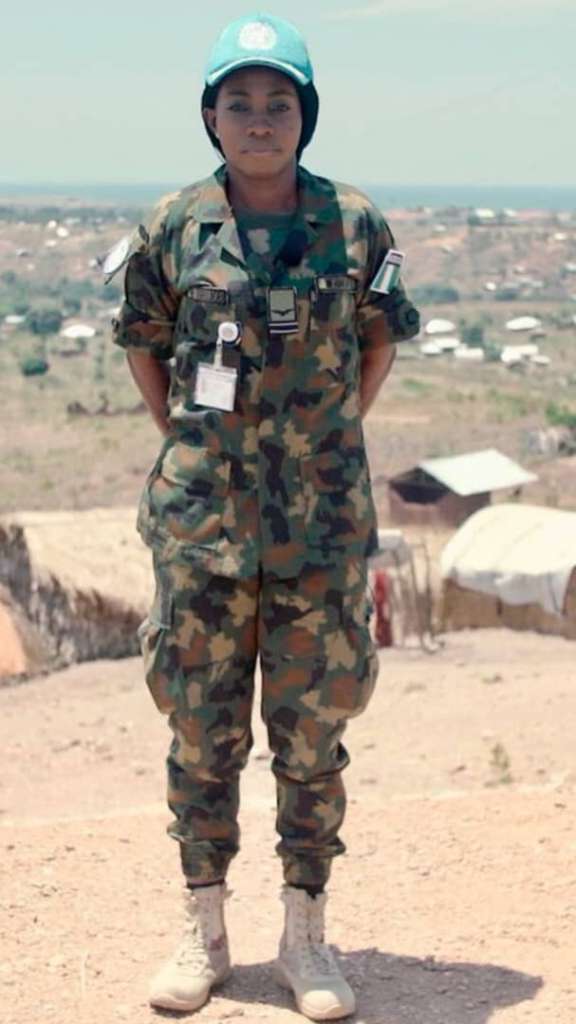
As the aircraft touched down at the International Airport in Goma, Democratic Republic of Congo (DRC), she was excited. Thrilled about the new experiences that were unfolding before her, the privilege to serve as a United Nations (UN) Military Observer, the great opportunity to meet and work with people from different parts of the world, and the honour of being one of other women from Nigeria and other countries to represent her country in this very momentous task. But it was also with mixed feelings. Anthonia Egbujiobi’s second baby was just a year and two months old. Momentarily, she mused about the little one who had just stopped breastfeeding. She thought about his elder brother who was barely four years old, but duty called and the job must be done.

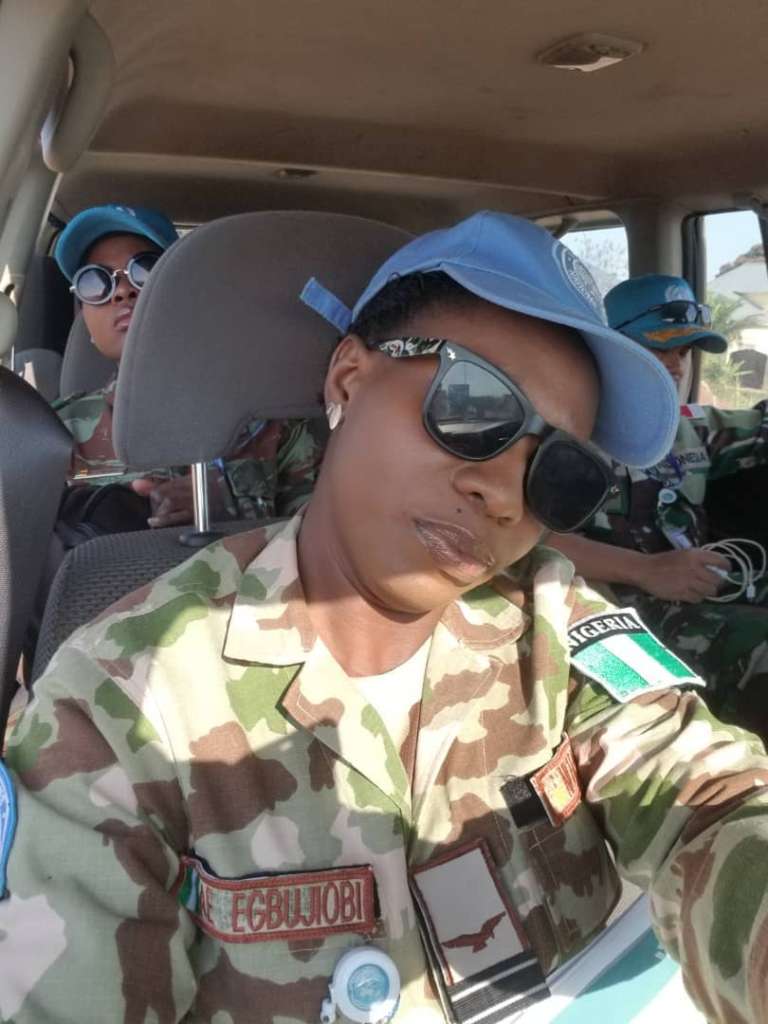
Squadron Leader Egbujiobi

Officer of the Nigeria Air Force, lawyer, motivational speaker, professional negotiator and mediator, member of International Federation of Women Lawyers (FIDA), Internationally Certified Civil-Military expert, Anthonia  is also author of two books; Building Castles With Pebbles and Bridging Civil-Military Gap as well as co-founder, Antodec Foundation, an NGO that helps illegally detained persons in prison. This Squadron Leader, an equivalent to a Major in the Army is mother of three active boys.

Typical military, she has an impressive daily routine.

The Egbujiobis

Her day begins from 4.30am with prayers and 45 minutes exercise which involve regular sit-ups, press-ups, running, amongst others. From Monday to Saturday, she is disciplined to engage in her daily aerobics and other vigorous exercises.

A stickler for wellness and healthy living, Anthonia maintains a very strict diet with the healthy nourishment of fruits, vegetables and water.

Explaining her wellness regimen, Egbuijobi says, “It takes Determination, Discipline and Dedication (3Ds) to stay fit.”

Prior to her military training, she wasn’t familiar with push-ups and all the rigorous drills but had to learn it. It was a daily routine at the military training camp.

Beginnings

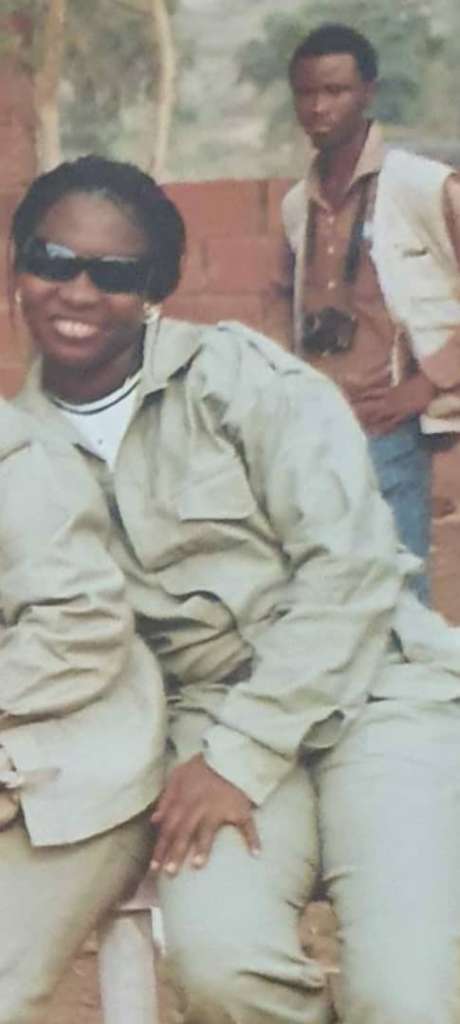
A 2007 law graduate of Delta State University, she completed her National Youth Service Corps (NYSC) at the National Human Rights Commission in 2008, where she served as a Human Right Desk Officer. Called to the Nigerian Bar in 2009, she was later employed at the law firm of Samuel Zibiri, SAN. It was while working there that she saw an advert requesting for lawyers and other professionals to join the Nigeria Air Force.

Although she was a bit of a tomboy growing up, joining the military never crossed her mind. Actually, she wanted to be a Judge like her father who died at 46years of age, when she was in 300 level at the university. But knowing that judicial appointment requires 10 years of legal practice, and being the first child, with four siblings still in school, the quest for a better job spurred her to join the military.

An advocate for women empowerment, it is her belief that: “An empowered woman will never be at the mercy of anyone.” Reminiscing over dad’s death, she revealed that when he passed, her mum remained strong for them. Her mother who recently turned 60 on July 10th retired from the Ministry of Education, was into different kinds of businesses, to ensure they got the life they were used to. Anthonia’s siblings went to Private Universities (Igbinedion and Madonna). Her mum made it happen. “I have a sister who is a medical doctor. She was in year one when our dad died. People were not there for us. My mum was the only one. I saw it. I have first-hand information, so I can talk about it,” she recalled.

And that was because Anthonia’s mum insisted she’d work. When they married, she had only a secondary school certificate. She was 19 when they married. Anthonia’s dad trained her in the university but when she finished, he tried to stop her from working. He was already a Judge and felt he could take care of his home. “But my mum said: ‘If I went to the university, I should work.’ So she got a job at the Ministry of Education in Delta State. That was what helped us when my dad passed on. That is why each time I talk to women, I tell them it’s important to work. Nobody knows tomorrow. Your husband can tell you I will pay you monthly but, if he dies tomorrow, and you don’t even know where his properties are, what are you going to do?

“My mum sacrificed a lot for my younger ones and I so, when I see people in need, I want to help. If you empower a woman, you have empowered the whole community. An empowered woman will take care of her home, not minding if the man is working or not,” she said.

Military Training

Anthonia joined other cadets for a 6 months training at Kaduna when she was enlisted. It was rigorous, notwithstanding that before joining the Air Force, she asked some questions. “Nobody really explained how tedious the training was going to be until I saw for myself,” she recalled. “I had to cut my hair. Skin cut. No hair was left. We had lectures too, but after lectures, we did some drills. It was really, really hectic. At a point, some people wanted to run away but, I stayed back because I knew how I entered. It was my second attempt. The first time I applied, I got to the final stage before selection, and was put on reserve. Two people from my state, Delta were chosen. Two persons were actually taken from every state in 2010. They told me if someone leaves the training, they will call me, but never did. The next year I applied and started the process all over again, and the second time I was taken and went for training. I went through the rigorous training, but never gave up. “My focus was to be a commissioned officer after 6 months. I was looking at what was ahead of me.”

Peacekeeping

When the information came that United Nations (UN) needed female soldiers for peace keeping, little did Anthonia know her life was about to be altered in the most remarkable way. The experience no doubt sounded good but what happened at the end of it all was one that marked her in the most positive way. She continues with her story.

Peacekeeping Mission at DRC

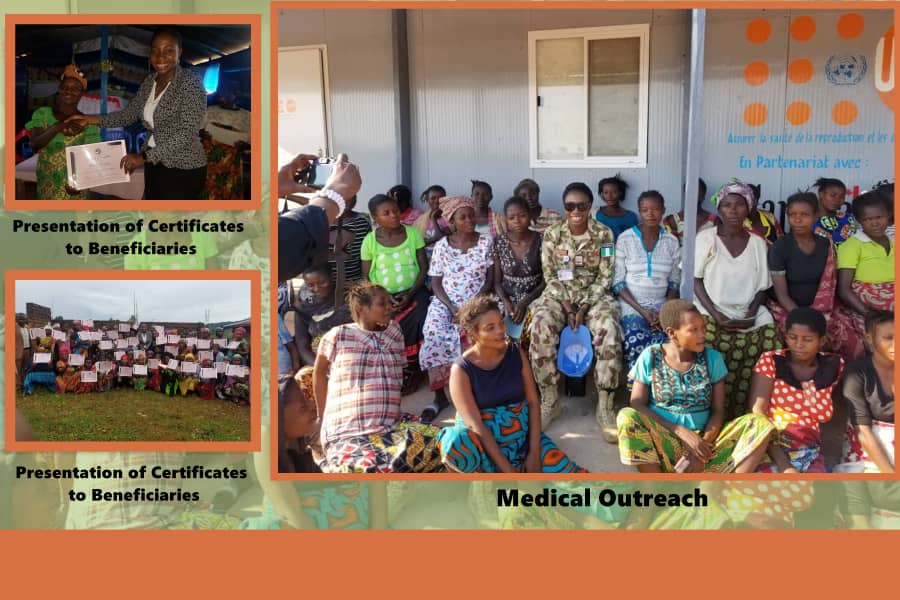
“Twelve of us were selected and our names were sent to New York. I did my documentation here in Nigeria and was posted to the Democratic Republic of Congo (DRC). I was there from January 2018 to January 2019. That one year marked the turning point in my life. It brought out what was inside of me.

“My second son was a year and two months when I went to DRC and my husband is not based in Nigeria. Thankfully my mother took my two kids to Asaba where she lives and enrolled them in a school. My husband has been very supportive, always encouraging me to be my best.

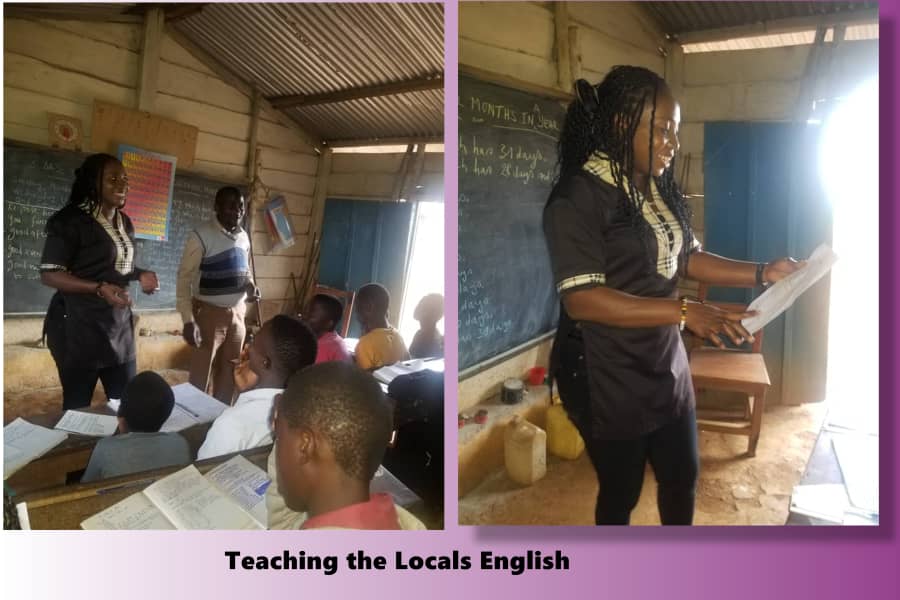
“As a peacekeeper, you’re essentially tasked to get security related information, write reports and send to New York. You’re not obliged to do extra. But I was stuck by the level of poverty in that country each time we go on patrol. It’s unbelievable. The children are malnourished; the women have neither skills nor jobs. They looked hungry. The men too were not working. So they all relied on peacekeepers for hand-outs. I felt I could empower them instead of giving out 10 dollars here and 5 dollars there. I figured that teaching them life skills will help them more so I went on YouTube and learnt soap making, baking, making chin-chin, and more. The only thing I could make before I left Nigeria was the bean cake; our akara and moi-moi. I kept on praying, because I needed direction on what to do. I needed to change their mind set.

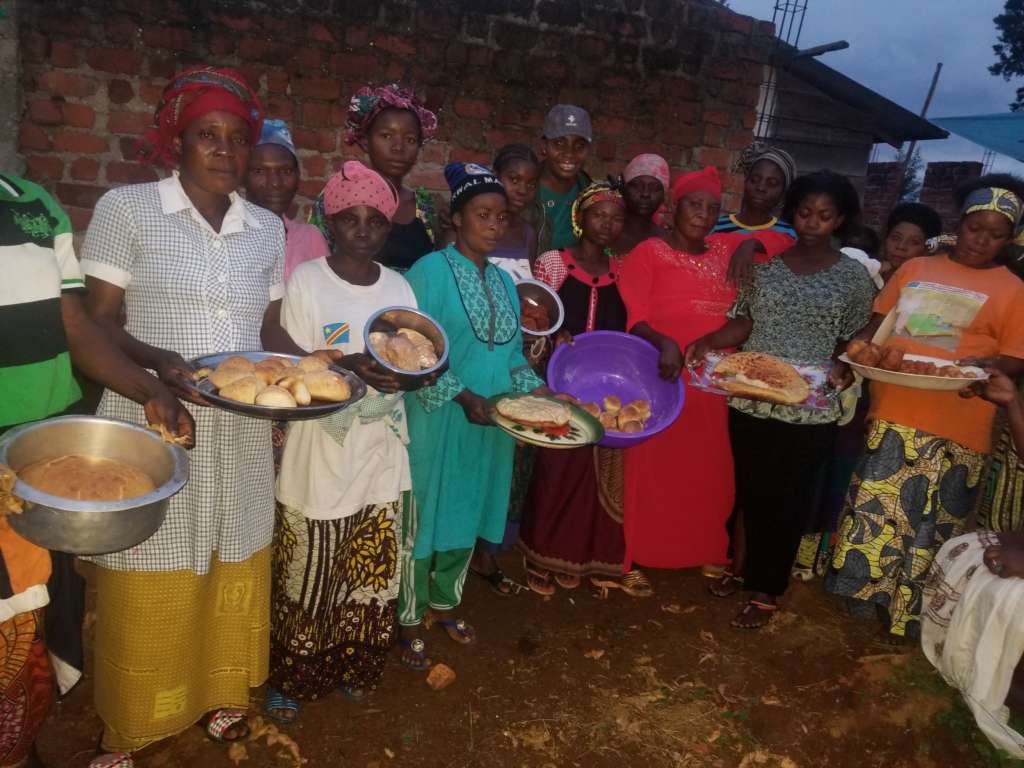
Trainee Bakers at DRC

“The people have this sense of entitlement but, I made them understand that nobody owes them anything. I had meetings with them, to change their mind set. They needed to understand I am doing the humanitarian work, out of my own volition. When I saw the attitude change, I knew it was time to empower them.

“I served in different communities. In each community I went especially the IDP camps, I gathered women and taught them all that I learnt and knew previously. Using improvised ovens we made our bread and cake. We made moi-moi, fried akara, chin-chin and puff-puff. I was using my personal funds. That’s how I got the award. I wasn’t even expecting an award. I was just helping out. I was happy. The people were happy.

“After teaching them, I wanted to know if they actually learnt what I taught them, so I got them into groups and gave them money with which to start business. To make them committed, I told them it was a loan even though I knew it wasn’t a loan. I asked them how many weeks it will take to start the business and return the profit. Some of them said one month. So I appointed leaders and I stayed in touch with them, and I told them after one month, someone will take the profit and give the capital to another person to start doing their own business. Having taught them baking, they started selling their own bread. Do you know community stopped buying bread from the city?

“Most of them are still running their businesses till date and even the men joined. Some learnt how to make soap, while some started employing people. These were the things that won the hearts and the minds of the people. In IDP camps, I helped restructure their camp. I was renovating churches, buying chairs and other equipment for the camp. I bought books and other educational materials for students in schools. I was basically doing Quick Impact Projects (QIP). News got to the UN about a military observer using her own funds on the locals and they sent journalists from New York and Denmark to come see first-hand and interview me. That was where I got the idea for my books. Everything revolved around the peace keeping mission. It’s really mind blowing. It earned me a United Nations Award for the Best Contribution to Humanitarian Activities.

“When I came back the former Chief of Air Staff Air Marshal SB Abubakar heard about it, and also gave me an award for representing the country in general and the Nigerian Air Force in particular. The UN had written him a letter about my impact and he was impressed. That gave me recognition in the Armed Forces and other government bodies invite me to deliver lectures on civil-military relations, empowerment and about my books. I do humanitarian work here too in some orphanages and some IDP camps. I didn’t stop.”

Legal Officer

Legal officers in the military don’t get to practice, Anthonia explained. The Ministry of Defence lawyers do the actual representation on behalf of the Air Force. But they usually accompany the ministry lawyers and monitor proceedings. However, Legal Officers do appear in Courts Martial where one could be a Prosecutor, Defence Counsel, or Judge Advocate.

On patrol during peacekeeping

Essentially, what they do as legal officers is give legal advice just like their civilian colleagues in legal practice but they also hold lectures and seminars. When speaking with personnel, the Legal officer emphasizes they are first citizens of Nigeria before being military officers. “So having that at the back of your mind, it means the law is for everybody. We are a democratic country so whatever applies to the civilian applies to those in the military,” she stressed.

Fulfilment

The civil-military expert related that aside from earning recognition for her work, she won the respect and admiration of the locals. Many of their ladies related well with her and other female soldiers. “And most importantly”, she confessed, “from the experience I got, I am now more knowledgeable on how to organize meetings, mediate and negotiate on issues. It was a learning process for me.

Also serving as a Peace Keeper afforded me the opportunity to meet military personnel from different countries and we all worked together as UN officials. I have kept in touch with a lot of my colleagues I worked with in at DRC. Also, my relationship with them gives me access to any country I travel to. All I need to do before I go to any country is to call my former colleagues and notify them of my arrival. That has made me a global citizen in a way because they make me feel comfortable each time I travel to any country. My experience was indeed very fulfilling,” The beauty of life is not only how happy you are, but how happy others can be because of you. Your little can make a big difference. Start now, she concluded.

Gezawa, BUK’s “Brain on a Wheelchair,” one year after

By Ikechukwu Amaechi

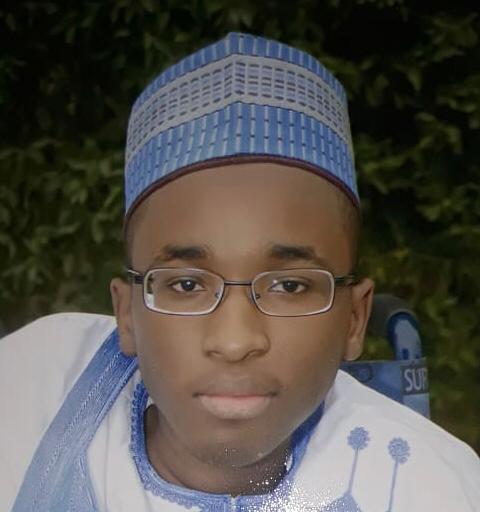
When Usman Shehu Gezawa died on August 6, 2020 at the age of 21, not many people outside his neck of the woods took notice. He was just two months short of 22 years, having been born on October 8, 1998.

I first knew him through his father, Mr. Abdulkareem Shehu Gezawa. But like every other person who had the privilege of knowing him, his educational accomplishments stood him out.

For someone who was not a “royalty” and died so young, his death, ordinarily, would have been unsung. But to so expect is to betray ignorance of Gezawa’s personage. His death devastated not only those who knew him personally, but also people who just heard about him.

He was royalty in his own right, a crown placed on his head by his prodigious intellect. Therefore, at death, he was mourned by all. One year after, most people are still grieving. And those who know or heard about his academic exploits rue that in his death, Nigeria lost a gem. The sense of loss is acute.

Gezawa suffered Spinal Muscular Atrophy (SMA), a genetic neuromuscular disease that causes muscles to become weak and waste away.

People afflicted with SMA often lose a specific type of nerve cell in the spinal cord called motor neurons, which control muscle movement.

He walked for some months after birth before the degenerative disease immobilized him. In primary four, he was already in a wheelchair.

But he was a prodigy in a wheelchair. What he lost through his physical disability, he gained through an extraordinary brainpower.

He was the overall best graduating pupil from the Kano Capital Primary School in 2010, a feat he repeated in 2016 at the Crescent International School Kano, where he acquired his secondary education, making straight “As” in all the subjects and carting home all the academic prizes awarded by the school at the graduation ceremony.

But it was at the Bayero University Kano (BUK), where he gained admission to read Computer Science in 2018 that the science world took notice. He shone like a million academic stars.

Gezawa set the Computer Science Department on fire, literally, with his awesome brainpower and became the toast of the university. He could do with only his hands, of course aided by his phenomenal brain, what many people who are not physically challenged can hardly do with their whole bodies.

In the three years he spent at Bayero University, he was on Chevron Nigeria Limited scholarship.

Trust him. He did not disappoint. Had death not brought his fairytale academic trajectory to an abrupt halt, Gezawa was on his way to doing an encore the feat he achieved both in primary and secondary schools, having ran a perfect 5.0 Cumulative Grade Point Average (CGPA) on a 5.0 Scale in all the semesters in his three years at the university. He was First Class-bound. And not just First Class, his was building up to be the best result ever in any discipline in the school’s history.

He not only loved but also excelled in those subjects – Mathematics, Algebra, Calculus, Programming, etc., – which the average student dreaded. So brilliant was he that his fellow students nicknamed him “Brain on a Wheelchair.” For some others, he was “Kano’s Stephen Hawkins,” named after the legendary Stephen William Hawkins, an English theoretical physicist, cosmologist, and author who was director of research at the Centre for Theoretical Cosmology at the University of Cambridge, who died of Amyotrophic Lateral Sclerosis (ALS) disease in 2018.

In 2019, Gezawa was one of the most impactful speakers at the TEDx AminuKano Way where he talked about his condition in the presentation titled “Ability in Disability.”

After his poignant, personal and evocative presentation which attracted a standing ovation and brought tears to the eyes of many, a philanthropist instantly offered him another scholarship.

The young man bore his disability with uncommon equanimity. In a tribute after Gezawa’s death, his best friend, Nour Bashir Galadanci, a medical student at the BUK, wrote: “He was never embarrassed of who he was. Always grateful to Almighty.”

Those were the qualities that endeared him to all. Even in his disability, he was a role model to many. Younger ones looked up to him as a mentor.

He inspired his mates and made them look up to tomorrow with expectations. He dreamt dreams and had lofty ambition. He was hopeful and only saw the sunny side of life.

Gezawa believed in the wise saying of Charles Haddon Spurgeon, the English Baptist preacher, that “hope is like a star – not to be seen in the sunshine of prosperity, and only to be discovered in the night of adversity,” a sentiment which was amplified years later by Martin Luther King Jr., the American Baptist minister and civil rights icon, who said “we must accept finite disappointment, but never lose infinite hope.”

Rather than become a hindrance, his disability was the catalyst that he needed to reach for the moon. And he was almost there.

The Northern elite took notice. Former Governor of Kano State, Senator Ibrahim Shekarau honoured him. Former Emir of Kano, His Highness Muhammad Sanusi 11, also did when he broke protocol, rose from his seat and walked up to Gezawa in his wheelchair to present a certificate of graduation (in a slate form) as it is done by Islamic schools.

The honour was unprecedented. Traditionally, the graduating student walks up to where the Emir is seated, kneels down to receive the slate. The hall erupted in thunderous applause at Sanusi’s gesture.

Gezawa’s fame spread like wildfire. At his death, Minisiter of Communications and Digital Economy, Dr. Isa Pantami, tweeted: “May the soul of Usman Shehu Gezawa rest in comfortable peace. Our condolence to this role model.”

His friend, Galadanci, summed up Gezawa’s essence in his elegy, thus: “Usman was a genius; always ready to explain to anyone who didn’t understand something in class. His character was outstanding. He was amazing, friendly, nice, patient and strong.”

It will be no exaggeration to say that no natural death of a student has impacted the Bayero University as much as Gezawa’s.

He has been mourned for one year not only by fellow students, but also the teachers and entire school administration.

One year after, the wound which his death inflicted on the academic community seems not to have healed.

But there seems to be closure, at the same time, in the fact that his memory remains a blessing to all who had the good fortune of making his acquaintance. (thenicheng)

This Toronto doctor now has a Barbie made in her image to honour her work as a health-care hero

Dr. Chika Stacy Oriuwa recognized for her advocacy against systemic racism in health care

Dr. Chika Stacy Oriuwa remembers dressing up her Barbies as doctors, poets and performers when she was a young girl, but none of the dolls looked quite like the woman she aspired to be.

Now, the Canadian physician, spoken word poet and advocate is not only living out her childhood dreams, but also has a Barbie made in her image to show for it.

Oriuwa hopes the creation of a one-of-a-kind doll celebrating her success will show kids there aren’t any limits on their play or their potential.

“What is even more beautiful about this opportunity is that the Barbie is a Black female doctor that is made in my image,” said Oriuwa, a psychiatry resident at the University of Toronto.

“That really speaks to my core value and my core belief that you can truly become anything and you can truly occupy any space and thrive.”

Oriuwa is one of six women who inspired Mattel’s special collection of Barbies honouring health workers on the front lines of the COVID-19 crisis.

Also among the female scientists being celebrated are U.K. vaccinologist Sarah Gilbert, who co-developed the Oxford-AstraZeneca jab, and Brazilian biomedical researcher Dr. Jaqueline Goes de Jesus, who is credited with leading the sequencing of the genome of a COVID-19 variant in Brazil.

Only one doll was made for each of the real-life “role models” and will not be available for sale, a Mattel spokeswoman said.

British Prof. Sarah Gilbert holds a Barbie doll made in her image in honour of the Oxford vaccine co-creator. (Andy Paradise/Mattel via The Associated Press)

The toymaker recognized Oriuwa for her advocacy against systemic racism in health care.

The 27-year-old has spoken openly about the discrimination she faced as the only Black student in her class during her first year in medical school in 2016, and helped spearhead efforts to diversify the program.

She became the first Black woman to be selected as sole valedictorian for University of Toronto’s faculty of medicine upon graduation last year.

From a young age, Oriuwa said she strained against the “subconscious messaging” that she didn’t fit the mould to work in the medical field.

Even as she played out her fantasies of adulthood with Barbies, Oriuwa said the brand didn’t offer many Black dolls, particularly ones with her skin tone and Afro-textured hair.

“Not only did I not necessarily have a Barbie that looked like myself in the field I wanted to pursue, but I actually didn’t know any Black female doctors at all until much later on in life,” she said.

Dr. Chika Stacy Oriuwa has been honoured with her own Barbie to mark her efforts combating racism in health care. She said the doll is an “actualization” of her dreams.

“It would have been so pivotal for me to have had a Barbie that can really help to solidify more of my dreams and letting me know that it really is something that is tangible.”

Oriuwa worked with the Barbie team to design a doll that depicts her features accurately, complete with medical accessories including a white coat and a stethoscope.

“A part of this is also changing the narrative of what a doctor looks like,” she said.

“I really wanted to be able to send that messaging back to the younger generation of girls to inspire them and let them know that truly any one of them can occupy this field or any field that they aspire towards.”

For more stories about the experiences of Black Canadians — from anti-Black racism to success stories within the Black community — check out Being Black in Canada, a CBC project Black Canadians can be proud of. You can read more stories here. (cbc)

TIPS