Home Blog Page 930

How to Open Bank (Deceased / Estate) Accounts for a Dead Person.

How to Open Bank (Deceased / Estate) Accounts for a Dead Person. Daily Law Tips (Tip 818) by Onyekachi Umah, Esq., LL.M, ACIArb(UK)

Introduction:  

Since death is one of the characteristics of a living thing, then planning for death is part of living. Like birth, death comes at its time and its victim must let go all movable and immovable properties that he/she acquired and owned. Upon the death of the owner of a property, there is always the need for the property of the dead to be managed and administered by the living in memory of the dead and for the benefits of the family of the dead. This often may include, the management of the income and interest yielding investments and property left by the dead for his loved ones.

Defrauding the estate of a dead person is common, often due to lack of accountability and transparency of Estate Executors and Administrators of the property of dead persons. Having a bank account (Deceased / Estate Account) in the name of the estate of a dead person is one of the few ways of avoiding mingling and undue access to the funds of a dead person by Administrators and Executors. This also makes accounting and reporting on such property easier.

This work reveals the steps and requirements for a bank in Nigeria to open and maintain a deceased account for the estate of a dead person. It considers the following issues; Why Does the Estate of a Dead Person Need Bank Accounts?; Steps and requirements for opening bank accounts for the Estate of a Dead Person; and ends with actionable advice to Administrators and Executors in Nigeria.

Why Does the Estate of a Dead Person Need Bank Accounts?

Where a person dies with a WILL, the dead person (the deceased) may have died with or without a WILL. Click to read more about the legal implications of dying with or without a WILL and how to manage the property of a dead person https://learnnigerianlaws.com/how-to-recover-property-of-the-dead-in-nigeria/. Where the deceased made a WILL before dying, the WILL must have appointed persons to manage his property upon his death and such persons are called the Executors. They manage the property in line with the desires of the dead person and for the benefit of the beneficiaries of the WILL, like the loved ones, children and institutions. Any sane person can be an Executor of the WILL of a person. Wise people make Will to ensure that their property are managed according to their wishes and desires even after death.

Where a person dies without a WILL, the court will appoint persons (often relations) to administer the estate (property) of the dead person and the managers are known as Administrators. Unfortunately, unlike in WILL, where there is no WILL, the dead person cannot choose the persons to manage his property rather the court of law will choose such persons. Any person of sound mind and good character can be appointed an Administrator, especially, persons with family ties to the deceased. Click to read more on how to obtain Letters of Administration from a court; https://learnnigerianlaws.com/how-to-obtain-letters-of-administration/.

There is a hierarchy of persons that may be appointed as Administrators. For instance, a wife/husband will be considered first, before a son/daughter may be considered. Also, a parent will be considered first before a brother/sister. Click to read more about the hierarchy of persons that can inherit the property of a dead person; https://learnnigerianlaws.com/daily-law-tips-by-onyekachi-umah-esq-tip-144-who-can-inherit-property-of-a-dead-person-in-nigeria/

To avoid abuse, promote transparency and ensure accountability in the management of the property of the dead, it is advisable to open bank accounts (deceased account) in the name of the dead person. The account will be managed by the living and for the living. Managing and administrating the property and monies from the estate (property) of a dead person could lead to confusion and distrust.

Mingling such monies with the personal monies of the Administrators/Executors is common and often leads to fraud. Hence, the need for a separate bank account (deceased account / Estate) in the name of the dead person but operated by the Administrators/Executors of the estate of the dead person. This will also ensure that clear reports showing inflows and expenditures are easily tracked. Also, the death of an Administrator/Executor will not affect the estate of the dead person that was being managed by an Administrator/Executor before death.

Steps and requirements for opening bank accounts (Deceased Accounts) for the Estate of a Dead Person:

With the rise in financial crime, terrorism and the need to protect funds, Nigerian banks are more serious with the processes of opening bank accounts. First of all, a bank must understand the purpose of the desired deceased account and the true identities of the prospective bank account owners and operators. In this case, the deceased account belongs to the beneficiaries of the dead person (ie, the loved ones that have inherited or that will inherit the property of the dead person). The operators of the deceased account will be the Administrators/Executors that are managing the estate of the dead person on behalf of the dead person and for the beneficiaries of the estate.

To ensure a reliable “Know Your Customer” (KYC) approach and in line with relevant laws, banks will request for information and documents to prove the identity of the dead person and that the dead person is truly dead. Also, the bank will need information to show that the Administrators/Executors seeking to open a deceased account are truly and duly appointed Administrators/Executors, with the clear powers to perform such task. Then, the bank will require to truly identify and know the Administrators/Executors that will be operating the deceased account.

To achieve a reliable KYC for a bank account (deceased / estate account) of the estate of a dead person in Nigeria and in line with banking laws and regulations, Nigerian banks will request for the following information;

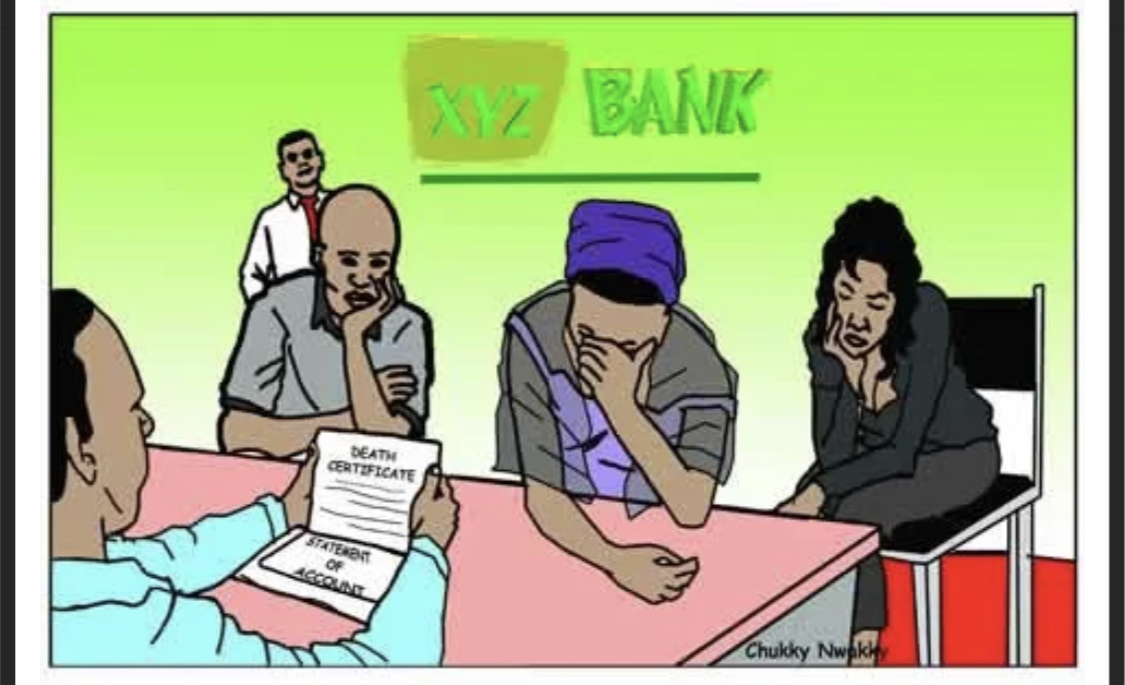
Death Certificate (Many banks prefer death certificates gotten from the National Population Commission and not the ones from hospitals).
A WILL/Grant of Probate or a Letter of Administration from court.
Government issued means of identification of the Administrators/Executors of the Estate that will be the signatories to the account.
Passport photograph of the signatories to the account.
Proof of payment of Utilities/bills of the signatories to the account, showing their physical addresses.
Completed Referee Forms (where the desired bank account is a “Current Account”)
Bank Verification Number (BVN) of the signatories to the account.
Phone numbers and emails of the signatories to the account.
National Identification Number (NIN) of the signatories to the account.
Signatures of the signatories to the account.
Competed Account Opening Form.
Any other information peculiar to the estate or the bank or that may be introduced by government.

Conclusion:

Since death is inevitable for now, then, it is only sensible to plan for it. In planning for death, one should decide the fate of the property (and liabilities) that he/she may leave at death. Make a WILL and let you wishes and desires outlive you.

For the surviving ones that will manage the property of the dead, accountability is key. Fighting the temptation of fraud and mismanagement of the property of a dead person starts with the opening of deceased accounts. Surely, “Deep-Shame” will include being convicted for embezzling the property of a dead person.

Actionable Advice: Get bank accounts (deceased / estate account) for the property of the dead person that is in your care and be transparent in your dealings. Speak to your lawyer and your banker.

My authorities, are:

Sections 1, 2, 3, 4, 5, 6, 7, 318 and 319 and the Fourth Schedule to the Constitution of the Federal Republic of Nigeria, 1999.
Onyekachi Umah, “Who Can Inherit Property Of A Dead Person In Nigeria” (LearnNigerianLaws.com, 18 July 2018) < https://learnnigerianlaws.com/daily-law-tips-by-onyekachi-umah-esq-tip-144-who-can-inherit-property-of-a-dead-person-in-nigeria/> accessed 5 August 2021
Onyekachi Umah, “How to Recover Property of the Dead in Nigeria. (A legal guide on Probate Matters in Nigeria)” (com, 10 March 2016) https://learnnigerianlaws.com/how-to-recover-property-of-the-dead-in-nigeria/ accessed 5 August 2021
Onyekachi Umah, “How to Obtain Letters of Administration” (com, 19 February 2021) https://learnnigerianlaws.com/how-to-obtain-letters-of-administration/ accessed 5 August 2021
Onyekachi Umah, “List Of Agreements And Transactions That Are Invalid If Handled By A Non Lawyer In Nigeria” (com, 3 October 2019) https://learnnigerianlaws.com/list-of-agreements-and-transactions-that-are-invalid-if-handled-by-a-non-lawyer-in-nigeria/ accessed 5 August 2021
Pic credit: Punchng. com

The Most Notorious Armed Robber In Nigeria ‘Anini’ Started Off As A Taxi Driver

Since the days of Anini, the DNA of crime and criminality has mutated. Crime has mushroomed into variants and hybrids whose eerie natures sometimes confuse law enforcement. Today, kidnapping, cattle rustling, cultism, cybercrime, yahoo plus, money ritual, identity theft, and terrorism rule the roost.

Once upon a time, there was a dare-devil armed robber who ‘ruled’ the old Bendel State like a mythical king over a thousand thrones. He was believed to be invincible and had the power to appear and reappear. Some people even risked the heretic postulation that the gangster was a spirit, therefore, immortal. His name conjured so much trepidation that many men fainted at the mere mention of it, no matter how brave they were.

Lawrence Anini AKA ‘the law’

Lawrence Anini, also known as ‘the law’, was born in 1960, the same year Nigeria gained independence, to the Owuo family in Orogbo village, Orhionmwon area, about 20 miles from Benin city, the capital of Bendel, presently Edo State. The 26-year-old robber kingpin terrorized the nook and cranny of Benin city and some other neighbouring towns; he unleashed havoc on civilians, police and banks as well with his gang of five men which included his brutal sidekick, Monday Osunbo.

Lawrence Anini started off as a taxi driver, then as a transporter for thieves and drug lords till he finally became a notorious daylight robber who sent fear down the spines of rich, middle class and poor Nigerians. Anini’s major concentration in his robbery career was robbing banks and as$as$inating top government officials. During his trial, he allegedly accused a Deputy Superintendent of Police, George Iyamu, of masterminding the as$as$ination of an As$istant Inspector General, Christopher Omuben, who was in charge of investigating Anini and his men.

The as$as$ination however was unsuccessful as Anini and his gang only killed Omuben’s driver, a Sergeant named Albert Otue who was mistaken for Omuben. Otue was beheaded and dumped in a shrub along the Benin- Agbor road. Lawrence Anini and his gang also killed one Mrs Remi Sobanjo and Frank Unoarumi who formerly worked with the Nigerian Observer newspaper.

Anini unleashed terror

On the 1st of October, 1986, Anini attacked the state’s commissioner of police, Casmir Igbokwe, who was mercilessly beaten and shot several times but eventually survived the attack with several injuries. That same year, Mr. A.O Emojeve, a medical doctor living in Benin, was also killed along the Textile Mill Road, Benin City. Several accounts revealed Anini’s tactics during his robbery operations. It was said that he would drive recklessly and spray some of the stolen money on the road for people to pick thus slowing down the police chasing him.

Some other account said that Lawrence Anini and Monday Osunbor sprayed money out of their generosity and because they knew Nigerians were really suffering. This earned Anini another nickname, ‘The Governor‘. Anini’s popularity over-shadowed that of Ishola Oyenusi, Babatunde Folorunsho and other armed robbers in the 1970s. His fame reached its peak when in October 1986, he attacked some military men under President Ibrahim Babangida’s regime. This incident made the infuriated President ask the then Inspector-General of Police, Etim Inyang, a very popular question, “My friend, where is Anini?”.

When he couldn’t get a definite answer, he ordered an immediate manhunt and arrest of Anini, Monday Osunbor and other members of the gang. This manhunt didn’t stop Anini from moving around the country, unleashing terror. During this period, several superstitions about Anini had spread round the country like wildfire, particularly among children.

People thought Anini was immortal

There were several accounts about whom Anini really is. Some said, he drove from Lagos to Benin in reverse and full speed in a police pursuit. Some also said that Anini was a spirit and can’t be arrested by the police, no matter how hard they try. But as an adage says, every day belongs to the thief, while the owner owns a single day. This adage was for Anini on the 3rd of December, 1986 when nemesis cornered him.

On the 3rd of December, 1986, Lawrence Anini was arrested by the police, led by the Superintendent of Police, Kayode Uanreroro, in a house (No 26, Oyemwosa, opp. Iguodala Primary School, Benin) in the company of his girlfriend who allegedly betrayed him. While trying to escape the arrest, he was shot in the left leg which was later amputated in a military hospital. Monday Osumbor and other members of the gang were also apprehended by the police and were brought before the law. Anini and his team, including George Iyamu, the police officer accused of working for Anini, were sentenced to death by Justice James Omo- Agege in the High court of Justice, Benin City. 

During the trial, George Iyamu denied the allegations of helping Anini, and in return, the infuriated Anini who could hardly speak in English shouted from the back on his wheelchair “You be shameless liar, you be shameless liar!“. While passing the judgement, Justice Omo-Agege said, “Anini will forever be remembered in the history of crime in this country, but it would be of unblessed memory. Few people if ever, would give the name to their children.” Lawrence Anini, Monday Osumbor and other criminals were executed by a firing squad on the 29th of March, 1987 and that was the end of Anini’s reign of terror in Nigeria.

Credits: Scooper news

The Smiling Armed Robber: How the first celebrity robber in Nigeria was apprehended

In the history of crime in Nigeria, Oyenusi was a cold-blooded armed robber who held sway in the early 70’s, stands on a very special threshold that none can ever dream of attaining. He was a terror. He and his gang carried about operations in Lagos City and neighbouring states. In criminal books, Dr Oyenusi was the first celebrity armed robber in Nigeria in those days. He took the nation by storm shortly after the Civil War ended and before he was executed on Wednesday, September 8, 1971, at the famous Bar Beach show in front of 30,000 watching Nigerians, no one believed that ‘The Doctor’ would be captured, as he was famed for ‘disappearing’ or his body not penetrable by bullets.

Oyenusi’s first amateur robbery

His full range of crimes included armed robbery, carjacking, and murder. He robbed banks and looted stores. It is safe to say, Ishola Oyenusi was a menace. He unleashed boundless terror on many Nigerians and would even kill for a stick of cigarette. He called himself Dr. Oyenusi to be fancy. He was far from a medical doctor. Information on his background is sketchy. His date of birth is not known. It is however known that he came from a poor background which ultimately led to a life of crime. His parents couldn’t afford his secondary school education, so he had to drop out.

He committed his first major robbery when he snatched a car along Herbert Macaulay Road in Yaba, Lagos, and killing its owner just because his girlfriend was broke and needed money to buy her make-up. He eventually sold the car for 400pounds (Nigeria’s currency then) and handed the money to the lady. He actually snatched the first car he saw on the road. Such was the ferocious nature of his audacity. This is the reason why he is sometimes referred to as the romantic armed robber. He had a mean streak in him also as he was hot headed and very arrogant, even to the law.

Oyenusi and his terror robbery gang

His professional criminal career started after the Civil War in 1970. Dr. Oyenusi and his gang of robbers went on a spree, robbing banks and killing people in cold blood. His knack for killing his victims made people call him “Doctor Rob and Kill”. By the end of the Civil War, Oyenusi had metamorphosed into a cold-hearted robber who took delight in causing pains to his victims. Oyenusi’s arrogance was also legendary. In 1970, he was arrested and handcuffed by a Police Officer. As the Policeman was ordering him around, Oyenusi blasted him and thundered: “People like you don’t talk to me like that when I am armed. I gun them down’. When Oyenusi reigned at the height of his regal confidence, he declared: ‘The bullet has no effect over me’.

Abubakar Tsav, a former Lagos Commissioner of Police who was an Assistant Superintendent of Police (ASP) in Lagos during the notorious days of Oyenusi told The Punch in March 2020 that “he (Oyenusi) was an expert robber and was ruthless and very notorious because that was the first time we experienced a case of armed robbery”. Tsav witnessed, first hand, the days of his reign of terror as a police officer. He was only comparable to Lawrence Anini who confined his reign of terror to Bendel State (present day Edo and Delta states).

Watch this heart-breaking video;https://www.youtube.com/embed/GWOeJfO5E7k?autoplay=1&controls=1

His last robbery was when he and his gang attacked the WAHUM factory in Ikeja in March 1971, where they stole 28,000 pounds, which was unprecedented in those days. A Police officer was killed in the process. The Nigerian Police Force caught him during the armed robbery operation. 

Though he had no medical training, he preferred to be called ‘doctor’. The perception at that time was that he was invincible and possessed some mystical powers that could make him appear anywhere when his name was mentioned, this created fears in the mind of the people and even security operatives who avoided mentioning his name. “Some policemen were afraid of him. Many of them were scared of mentioning his name,” Tsav said. “They thought he could suddenly appear in their midst with the mention of his name.”

Armed with native charms and weapons – Dane guns and the rest, the lives of his victims had no value to him, he wasted them at will in the most gruesome manner after dispossessing them of their valuables.

Oyenusi’s execution

After evading arrests at different times, the law finally caught up with Oyenusi in 1971 when he was arrested, tried before the Military tribunal and executed by firing squad on September 8, 1971 with his gang members at the Lagos Bar Beach. Justice was swift for the dare devil killer. He was sentenced to death. On the day of Dr. Oyenusi’s execution, which took place at the Lagos Bar Beach by firing squad, it was reported that about 30,000 Nigerians showed up to see his end.

Up to the point of his execution, Oyenusi was so confident it was not the end of the road for him. “When he was arrested, he kept on boasting that he would escape and that was why he was kept under strict security watch,” Tsav said. “He believed he had mystical powers that could make him disappear, and that if we shot him, the bullet would not penetrate.” He missed it, at that point all the charms he depended on failed him, it was clear that whatever grass the charm was made of had withered and the flowers had faded, it was all over for the man who threw many homes into mourning and turned many into sudden widows, orphans and widowers. It was a sad end for Oyenusi, but the beginning of relief for the populace and end to a reign of terror.

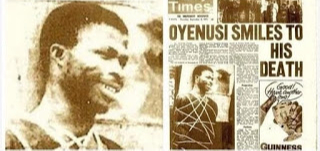
At 10 a.m, Oyenusi and his gang were brought in trucks. People booed them as they slowly got down and marched towards their death. Oyenusi was “sweating profusely but managed to smile all the way to the stakes. He kept smiling and smiling and smiling but could still not hide the agony and terror written boldly on his face”. Some witnesses claim that he would have never become a criminal if only his parents had had enough money to send him to school. After journalists interviewed the criminals, the soldiers pointed the gun at them and fired. That was the end of Ishola Oyenusi.

“Oyenusi smiles to his death,” read the lead story on the front page of Daily Times newspaper the morning after his execution. Despite his public execution alongside other members of his gang, the fear of Oyenusi did not clear off easily in the land, it was so prevalent at that time that in 1977, six years after his death, no actor was willing to play his role in a movie by veteran movie director, Eddie Ugbomah, titled “The Rise and Fall of Dr. Oyenusi”. “Everyone feared retribution from the “Dr.s” gang, so the director played the role (of Oyenusi) himself,” Frank Ukadike wrote in his book “Black African Cinema”.

37 years later, Nollywood actor, Odunlade Adekola, made another attempt at retelling Oyenusi’s story. This time without any fear of retribution, ‘Oyenusi’ was released in 2014 to tell the story of the life and atrocities of the dreaded armed robber. The movie was a huge success. Though his life and atrocities have been adapted into movies, Oyenusi lived a far more ruthless life than Nollywood could depict him.

In the history of crime in Nigeria, Ishola Oyenusi’s name aka ‘Dr Rob and Kill’ can never be erased. He was a daredevil armed robber and expert at what he did.  If robbery was a course in an institution, Oyenusi would probably graduate with a first class degree and would likely be retained as a lecturer in the faculty to pass on his knowledge to those behind him. (Scooper news)

Nigerian Police and Kyari: Romance with criminals
Daily Times Nigeria
4th August 2021
Promise Adiele – Convener, Third Force Movement

Joining the bandwagon does not hold any attraction for the prudent. Often, the burden of responsibility demands that one does not keep quiet in the face of national malaise especially when falsehood, blatant fabrication, ignorance, and wilful mendacity gradually assume the nature of truth. At such times, the cognitive process is roundly insulted. When events steadily unfold, the arising responses call to question the claims to intelligence by those who react to these events. How indeed can people be so short-sighted and blind to naked truth? Or is it that some people gain undisclosed satisfaction by adorning the garment of dissimulation even when the truth stands exposed in public glare. Could it also be that some people willingly outsource their humanity to the devil to use them in advancing treachery, ignominy, and compound misrepresentation?

Since the news of Nigeria’s former police poster boy, DCP Abba Kyari’s indictment by the FBI hit the news space, many reactions have followed. Some of these reactions are reasonable. Some are the advertisement of base reasoning while some others are the mere personification of idiocy. Some disorientated people have argued along the distorted prism of ethnicity and religion, while some have reacted based on one feeble consideration or another. It grieves the heart because the issues involved are not complicated at all, they are as clear as a sunny sky on a summer morning.

A high-ranking police officer, Abba Kyari is implicated in a scam scheme and people are surprised. That is shocking. With due respect to genuine, hardworking police officers across the country, the force is redolent with officers, high and low, who collude and constantly romance with criminal elements in the country. Anyone who doubts this submission is living in denial and ignorance. There are armed robbers, internet scammers, kidnappers, bandits, and sundry scofflaws who are hand-in-gloves and drink from a common trough with ignoble officers of the police force. Some criminals have police stickers on their cars given to them by their police accomplices. Once they ‘settle’ in heavy sums, they revel in their filthy lucre. This should be common knowledge to any critical social observer. Why do some police officers live like kings and own properties across the country, even outside Nigeria? Why is it that in some robbery scenes, recovered arms and ammunition indicate ownership by the Nigerian Police Force? Why are we pretending not to know these facts as if they don’t exist? Why is everybody surprised about Abba Kyari’s fate? Were we deceived by his poster boy image? Shall we also feign ignorance that some police officers are on the payroll of criminals in Nigeria? No, we should not do that, please.

Right now, Abba Kyari has not been pronounced guilty of any crime. The issue is, he has been accused of culpability in a scam scheme and his presence is required in the US to clear his name. Although the available evidence from the FBI suggests deep complicity on the part of Abba Kyari, his opulent behaviour and rich-boy disposition has not helped his cause. The young man is a billionaire. How did he make his billions? His automobile collection and real estate acquisitions are all mind-boggling. How did they come about? Why would some people ignore the issue and chase shadows over this matter? I am not going to get into the legal technicalities of the issue but if Kyari is the famed super cop he pretended to be and innocent of all the allegations, let him travel to the US, simple.

Some people who query the right of the US to arrest a Nigerian citizen on Nigerian soil are ignorant of Nigeria’s membership of some international organizations. As a sovereign nation, Nigeria has conceded parts of her sovereignty through her voluntary membership of some international organizations and is inevitably bound by international regulations. Nigeria first signed the Extradition Treaty with the US in 1931 and 2014, the Extradition modification Order was signed too. This was followed by the Extradition Acts Proceedings of 2015. Under those acts, Nigeria agrees to extradite Nigerian citizens accused of one form of crime or another against the US to the US. This has nothing to do with ethnicity or religion. Kyari has been accused of involvement in a scam scheme, so let him go to the US and defend himself.

Abba Kyari’s saga has once again beamed a critical searchlight on the activities of police officers and their putrid romance with criminal elements in the country. Of course, we are aware that a man of means, perhaps a criminal or anybody, can call upon the police to deal ruthlessly with a citizen who is considered a threat or a nuisance to the complainant. So anybody who pretends to be shocked that Kyari is alleged to do the bidding of a rich scammer is an enemy of truth. In 1986, the notorious armed robber Lawrence Anini implicated a senior police officer DSP George Iyamu. According to Anini’s confessions, George Iyamu supplied the robbery gang arms/ammunition and gave them security information that aided their operations. DSP George Iyamu also arrested and crushed a rival robbery gang leader and his group in Benin to make way for Anini and his gang to flourish. Anini’s gang and DSP George Iyamu along with some other police officers were found guilty and executed on March 29, 1987. Before his waterloo, DSP George Iyamu lived like a rich prince, drove exotic cars, and had choice women at his beck and call. Yet, before his demise, he was trailed by such accolades as a ‘super cop’.

That Kyari unlawfully detained and tortured Vincent Chibuzor for thirty days to make way for Hushpuppi to prosper is not only heinous but insidious. One begins to wonder if the practice of removing a criminal for another criminal to make progress is a regular practice in the police force. It appears that one drug lord, kidnapper, armed robber, bandit, or scammer can be arrested and put away for a rival group to make progress. Since Evans the kidnapper was arrested, why has he not been convicted? Could it be that he was busted to make a way for a rival criminal to prosper? The last time Evans appeared in court, the trial judge warned that he will be set free if the police fail to come up with convincing evidence. But we had all thought that there was more than enough evidence to send him to jail in a matter of weeks following his arrest, yet, Evans is still standing trial and may walk away as a free man. Abba Kyari arrested him.

Certainly, there are dutiful and responsible police officers but the activities of hoodlums in the Police Force have diminished the image of the force. Kyari has done well as a police officer but he has also defaced the already battered image of the force, bringing it to disrepute. The statement credited to Yerima Shettima, the national president of the Arewa Youth Consultative Forum (AYCF) that “nothing must happen to Kyari” is irresponsible, unfortunate, and shameful. That Miyetti Allah has accused the FBI of conniving with Southern leaders in Nigeria to persecute Kyari is the most jejune, moronic statement I have heard in recent times. The statement oozes of crass banality characteristic of backward, retrogressive savages. Are AYCF and Miyetti Allah not aware that Kyari has been accused with incontrovertible evidence and his presence is needed to refute or admit these accusations?

It is commendable that the IG has suspended Kyari from the Nigerian Police Force. The suspension is to allow independent and transparent investigation into the case because Kyari’s presence could obstruct the cause of justice. While we congratulate DCP Tunji Disu on his appointment as the head of the IRT unit of the Nigerian Police Force, he should know that it will never be business as usual. Let him learn from his predecessor. Kyari may be innocent or guilty. The only way to determine his innocence or otherwise is to encourage him to travel to the US to clear his name. If he does not do so, his image remains tarnished for good and his place in the fetid hall of infamy is historically assured.

© Promise Adiele PhD
[email protected]

COVID-19: Managing Nigeria’s 3rd wave surging cases, By Isaac N. Obasi

It is no longer news that the coronavirus (COVID-19) third wave is here in Nigeria, and unfortunately its emergence coincided with the discovery of the highly transmissible and deadly Delta Variant of the virus in some parts of the country. Confirming this development, the Chairman of the Presidential Steering Committee on COVID-19 (PSC on COVID-19), Mr. Boss Mustapha, announced during a briefing of the Committee on Monday, 2 August 2021 that officially, Nigeria is now in the third wave of the ravaging virus. According to him again, “Nigeria has been recording about 500 cases daily in the last seven days”, as “Nigeria’s Test Positivity Ratio has increased to about 6 per cent”, against the background “that the Delta variant has made its way into Nigeria”. Furthermore, the PSC, he said, is “particularly concerned about the situation in Lagos, Akwa Ibom, Oyo, Rivers, Kano, Plateau and FCT as this variant has made its way into these states and accounts for the rising cases in these states and across the nation…. And Lagos alone accounts for over 50 per cent of the number of cases”.

Lastly, according to the Director-General of the Nigeria Centre for Disease Control (NCDC) Dr. Chikwe Ihekweazu, “Nigeria has recorded 32 cases of Delta Variant of the COVID-19” (See https://allafrica.com/stories/202108030672.html based on original report by the Leadership newspaper). More worrying is the emerging fact from the NCDC that 747 new cases were recorded on Wednesday, August 4, 2021.

The arrival of the Delta Variant into Nigeria was not unexpected even though the PSC on COVID-19 had long taken pro-active measures to prevent the importation of the virus into Nigeria. It would be recalled that the PSC had banned air travels to and from India, Brazil and South Africa over two months ago because of the emergence of the deadly Delta Variant and other variants in those countries. The PSC also took other measures with respect to testing of all passengers arriving into the country. But given the behaviour of some unscrupulous Nigerians, we knew that it was only a matter of time before the deadly variant would be imported into the country. Sadly, the PSC has now revealed that as many as over 500 travellers violated the travel protocol meant to prevent the importation and spread of the deadly variant. The unscrupulous and unpatriotic behaviour of some of these Nigerians is a national embarrassment to say the least. The PSC should come harder on these flagrant violators of our well-reasoned and well-intentioned safety protocols.


Although policy measures to manage the surging cases so far by the PSC and the NCDC are commendable, there is still a lot more to be done. Nigeria and Nigerians are yet to come to terms with the serious threats posed by this ravaging Delta Variant. Business-as-usual mentality has re-emerged against the little gains we made in the past. In actual fact, the expected psychological state of consciousness of an emergency is yet to prevail in official and unofficial quarters. For example, the risk communication strategy is yet to be fully activated to gain traction. One or two messages from the NCDC have been received in recent past which is commendable but the messages have to come back fully as it was the case during the lockdown days. The Lagos State Government has reactivated its full enlightenment campaigns on COVID-19 as everyone can see these days in its Lagos Television (LTV), but as I would argue later, this laudable measure is not enough. Enforcement of the safety protocols is what is seriously required now.

Perhaps the NCDC is still in a fatigue mood or perhaps still, it is experiencing financial constraints with respect to the intensification of its risk communication measures. But the current threats posed by the Delta Variant demands adequate funding for it to fully activate its risk communication messages. The increasing danger signs from other lands are very instructive enough to force Nigeria into a full emergency situation once again. The WHO reported over a week ago that global cases have been rising for the fifth consecutive week. Some countries for example, have been setting up make-shift hospitals as existing hospitals were filled to capacity. In Senegal (an African country close to us here in Nigeria), patients were rejected in hospitals for lack of bed spaces. Officially Nigeria should by now be in a psychological mood of a lockdown, without physically imposing national or regional lockdown measures.

In the absence of imposing lockdown measures, the way to proceed is to begin a total enforcement of compliance with safety protocols. For instance, defaulters of the non-pharmaceutical protocols should be arrested and prosecuted as was done during the lockdown period. And this can begin right away in the states earlier mentioned (i.e.Lagos, Akwa Ibom, Oyo, Rivers, Kano, Plateau and FCT). The enforcement of the non-pharmaceutical protocols in these states is very urgent because the prevailing official approach is more like an advice, appeal or moral preachment, all of which lack legally prescribed sanctions for non-compliance.

Since a good number of Nigerians are still sceptical about the reality of COVID-19, the time has come for the government to take the enforcement of compliance very seriously. In our campuses for example, many staff and students pay lip service to the observance of social distancing, wearing of face masks and some other safety protocols. It takes repeated announcement of the necessity to observe the safety protocols by some us in lecture rooms, before students comply fully. It is as bad as this.

•Prof. Obasi of the University of Abuja, is a Visiting (Adjunct) Research Professor at the Anti-Corruption Academy of Nigeria, (ACAN), ICPC, Email: [email protected].

The sense in quota system; By Fredrick Nwabufo

The quota system in Nigeria was conceived to address an inequitable system, but the prevailing “unjust system” betrayed the purpose for which the quota system was ideated and actioned. The quota system, principally, is not an unjust system. And it does not confer advantage on the north against the south. Much of what has been said about the quota system is jaundiced.

Quotaism became a principle in Nigeria in 1958, essentially, as a response to fears of marginalisation and ethnic domination in education and government. Rightly so, the system was contrived to resolve the atavistic misgivings. The federal character principle as well was devised — and it became a constitutional provision in 1979 — to manage Nigeria’s diverse character; so that no section of the country will lord it over others or become overwhelmingly dominant in the public service. It was designed to ensure inclusive and equitable demographic/ethnic representation at all levels of government. It was for socio-political balancing.

Nevertheless, I am of the view that the federal character principle and the quota system be reviewed when sufficiently practicable.

It is sheer ignorance to assume ‘’quotaism’’ is a Nigerian thing or as some have said a ‘’northern concept’’. Quotaism is country specific and it is to address peculiar disproportions and to build a more equitable system. In the US, there is the racial quota which was conceived to ensure equal opportunity for all classes of citizens. In France, there has been a series of racial quotas. And in about 21 EU countries, there is a form of gender quota.

So, quotaism is not a northern contrivance, and it is by and large a gizmo of national cohesion, if effectively and efficiently deployed. What we have experienced in Nigeria over the years since 1966 is an abuse and disregard of the quota system. If the quota system, as conceived by Nigeria’s forbears, is righteously implemented it will solve some of the country’s immortal problems.


The argument against quotaism is that it encourages ‘’mediocrity and indolence’’, and discourages industry, performance and excellence. This is not exactly accurate. An abuse of the quota system, and not the system itself, is what promotes laziness and kills merit. Quota system is designed to give opportunities to the best of under-represented segments of society while not shutting the door to others in the opportunity pool.

In the UK, there is the Equality Act 2010 which protects people with ‘’certain characteristics’’ on job opportunities. “Section 159 of the Equality Act 2010 allows an employer to treat an applicant or employee with a protected characteristic (eg race, sex or age) more favourably in connection with recruitment or promotion than someone without that characteristic who is as qualified for the role. The employer must reasonably think that people with the protected characteristic suffer a disadvantage or are under-represented in that particular activity. Taking the positive action must be a proportionate means of enabling or encouraging people to overcome the disadvantage or to take part in the activity,’’ XpertHR, UK says in its article, ‘What positive action is permitted under discrimination legislation?’

In Canada, there is the Employment Equity Act. In the US, there have been several affirmative polices to protect blacks and minority groups. In Germany’s Basic Law, where a man and a woman have same qualifications, the woman should be preferred for the job. These are chief ingredients of quotaism.

We cannot run a country without justice where only the fittest of the majority shall survive. Everyone; all classes of people; the weak and the strong must be accommodated. If we insist only the strong amongst us should stand, how have we done justice to the weak – people who are made vulnerable not by their own disability but by classist designs?

The South-east is the loudest antagonist of the quota system. Being Igbo, I understand the concerns of my people. But even in our region, there are clamours and demands for quotaism at the state level and in every socio-demographic stratum. In Anambra state where I come from, some citizens in certain senatorial zones allege they are being excluded from holding political offices by the more dominant groups. Quotaism addresses the human problem of belonging and representation.

In the state, there is a debate and agitation on why the next governor should not come from a certain zone because that area has had its turn. At the local government and communal level, there is also the importunity of quotaism. So, if quota system is desired at the sub-national level, it is unacceptable at the national level?

SOUTHERN PREJUDICE

‘’Quota system product’’ – this is a quotidian ethnic slur often hurled at northerners by southerners. But we are all ‘’quota system products’’. Our universities and high schools accord special consideration in admission to candidates from the region where they are located (catchment area). Even in some jobs in the private sector, some were employed to fill in a quota.

Some of Nigeria’s finest minds come from the north. Intelligence is a gift of the divine which every group and class of people have proportionally.

Let’s stop the prejudice.

Twitter/Facebook/Instagram: @FredrickNwabufo

What Jega Didn’t Say About APC and PDP, By Azu Ishiekwene

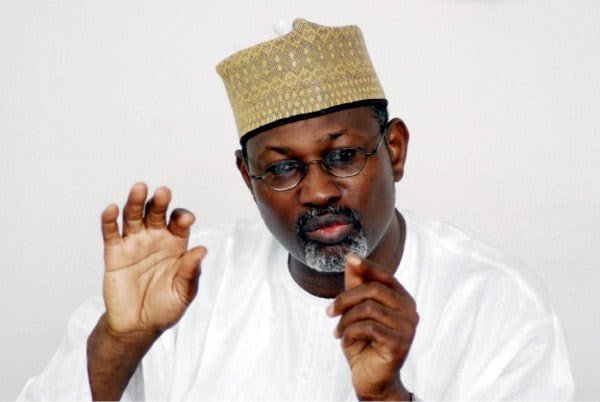
•Prof Attahiru Jega

The former Chairman of the Independent National Electoral Commission (INEC), Professor Attahiru Jega, got himself in soup last week.

His offence was saying it is futile to compare Nigeria’s two main political parties – the All Progressives Congress and the People’s Democratic Party (PDP). Without mincing his words, he said there’s nothing to compare and nothing to choose from and that both were the refuge of scoundrels.

That comment has earned him a beating to hell and back at the hands of members of both parties. It’s not new that political parties have rotten roots, but they evolve. America’s founding fathers despised partisan politics so deeply that George Washington was not a member of any political party throughout his eight-year tenure as president.

When they finally decided to form parties, they were polarised over race, war, reconstruction and even the nature and role of central banking, bringing to pass their own worst fears about partisanship.

But it helped a lot that the politicians of that era painstakingly wrote down what they wanted to do and passionately debated how. They had a compass as the parties evolved.

In our own case, however, politicians are desperate for power grab first before thinking about what to do with it. We appear to have settled for a pattern of one step forward, two backwards.

Anyone who has any doubt only needs to look at the record of the two main parties in office – the first 16 years of the PDP at the centre or the six years of the APC so far. It’s largely a sordid tale of failed promises that has left Nigerians poorer, more divided and less secure.

That we’re living in a broken country today is largely a legacy of the main parties. That was all Jega said that got him into trouble.

It’s the bitter truth. But the parties, far gone in their conceit and game of Ostrich, will not see the point. Instead, they have responded by abusing Jega. They have accused him of joining a “mushroom” party and declaring his remark as “unpardonable”, as if he just took the wives of their party leaders.

While the APC rejects resembling the PDP even remotely, the PDP says it would rather disband than stand being compared with the ruling APC.

A top member of the PDP and former governor of Jigawa State, Sule Lamido, took the matter further in an interview over the weekend. He said the APC was founded on lies and blackmail and won’t go beyond 2023, adding that the party had “brainwashed Nigerians to believe that everything evil is caused by PDP.”

If the APC would go into extinction in two years’ time, it would not be because Lamido said so. Or because the PDP is qualified to perform the funeral rites. It would be because for the last six years, the ruling party has carefully dug its own grave, prepared the gravestone and given the shovel to those who will seal its fate.

The APC is its own worst enemy. It won’t be long before all the pretence will disappear, leaving the party with only its jaded, opportunistic soul. The APC isn’t a party, but a makeshift vehicle fabricated to knock President Goodluck Jonathan from power in 2015.

Its inherent contradictions became manifest afterwards when a civil war broke out among its factions, comprising nPDP, ACN, CPC, APGA and ANPP. In an act of extreme desperation, Bukola Saraki had to make an adulterous deal with PDP to emerge Senate president.

With nPDP barons frustrated out (except Rotimi Amaechi who has since become a General without troops in Rivers State) the remnants of CPC and ACN are now locked in a fratricide over the control of the party.

This is in spite of a foundational pact in 2014 that whereas CPC would produce the president, ACN would control the party. But like most promises made in the heat of the moment, this one was inseminated with the seed of its own failure. The winner kept the spoils, all of it. The palace coup against former party Chairman Adams Oshiomhole last year was masterminded by CPC foxes who imposed one of their own as caretaker.
 

The party has not held a formal meeting in months, and all decisions are taken ad hoc in a coven called Aso Rock. There is no Board of Trustees, no governance structure, no substantive officers, no programme, nothing. 

It’s like a house without a roof or windows, a tent without pegs or pillars. It has drawn three governors into its fold in the last one year or so, not because it offers anything materially different from the other finger of the leprous hand, but because it is the most secure sanctuary for fugitives from public accountability. 

And of course, there’s the promise that on election night two years from now when votes would have been written, since APC gods forbid electronic transmission of results, candidates on the platform of the ruling party can depend on the security forces to help them deliver results by hand.

The APC maintains an appearance of a party. But it is a party only in name. A faction of it, in alliance with influential forces in the Presidency, who are not even party members, have crushed other legacy parties, triumphing over them and holding the country hostage.

But the long knives are out and the fight back promises to be nasty. We’re already seeing signs of that with the parallel APC congresses and the mutiny against the Governor Mai Mala Buni’s interim leadership of the party.

Yet, the PDP is not a haven, regardless of the bad things that Lamido has to say about the ruling party. In fact, the PDP is all the bad things that anyone can justifiably say about APC, except that it’s a worse version of it. 

On top of the corruption and lawlessness prevalent during the 16-year reign of the PDP at the centre, the party also holds the record of the worst random murders, including the specific, targeted killings of both opposition and its own party members, who were either slightly out of line, or who seemed to have a bright future.

The murders of Bola Ige, Marshall Harry, Aminasoari Dikibo, Barnabas Igwe and his wife, and Ahmed Pategi, on the watch of PDP government, are among the 51 high profile murders comprehensively compiled by Lauretta Onochie three years ago.

If APC was founded on lies and blackmail, which the party can hardly deny with a straight face, PDP was founded on and has thrived on something more sinister: lies, blackmail and blood. It is a legacy that continues to haunt it to this day.

When Jega said the two main parties are hopeless, he was not telling voters anything new. He was only repeating what they couldn’t forget. With less than two years to the next general elections, however, he was also reminding voters of a future they are condemned to face again. 

I say “condemned” because apart from calling out the main political parties, idealists like Jega have yet to say how voters can overthrow the existing parties. How?

The current mutiny in the APC and PDP does not mean that either one is about to become extinct. Since 1999, we have seen this blood sport every four years and somehow mainstream politicians still manage to reinvent their baggage and retain power. Any hope that the system would change in two years is a pipe dream. 

Before the conventions of the two parties are over, angry losers from both parties will align and form a third force but the crooked nature of our politics and the sheer enormity of the cost of being on the ballot on the eve of a general poll will ensure that they won’t get far.

Jega is right that the two main parties are useless. The only challenge is that it will take more than just talking about it on the eve of the next election cycle to build an alternative vehicle.

Ishiekwene is Editor-In-Chief of LEADERSHIP

Revamping Nigeria’s Criminal Justice System

By Sonnie Ekwowusi

I don’t know about you but I must confess that I am still unable to come to terms with the name correctional centres, the new name of the Nigerian prisons. Why? Because Nigerian prisons are not correctional centres: they are punishment centres, or, poignantly, human dignity violation centres. The Nigerian prisons, for lack of better expression, are hells on earth notwithstanding the change of their names to correctional centers. And since there is no correction in hell no prisoner can regain his humanity after passing through any of the Nigerian prisons. By the way, I don’t know why we like fighting skirmishes and symptoms instead of main problems. For instance, the name of NEPA has been changed to Power Holding Company of Nigeria (PHCN). Has that improved electricity supply in Nigeria? No. We are still experiencing the same, if not aggravated, erratic and epileptic electricity supply. The uniform of the police has been changed. So what? Has that changed the extortionist mindset, defeatist psychology and corruptibility of the Nigeria police? No. The policeman in the new police uniform has not changed. He is the same corruptible man.

In the same vein, the Nigerian prisons have not changed notwithstanding their new baptismal name. The last time I visited the prison in the company with members of the Nigerian Bar Association (NBA), Premier Branch, I saw for myself the hellish dungeons now called correctional centres. I interviewed about 23 prisoners all of them victims of miscarriage of justice. They had been dumped and forgotten in prison without bail, without arraignment, without trial. In case you don’t know, about 70% of prisoners in Nigerian prisons are Awaiting Trial Inmates (ATM), that is, prisoners who have not been charged, tried and convicted by any court of law. There are over 28,000 ATM languishing in the various prisons across the federation. No institution can give what it does not have. The inhuman condition and maltreatment of prisoners in Nigerian prisons are not correctional measures: they are punitive measures. The truth of the matter is that the Nigerian prisons are colonial relics- they were built during the colonial times by our erstwhile colonial masters and have not been rebuilt or reconstructed since that time despite the bourgesening population of prison inmates in the prisons. The over-bloating population has resulted in the over-congestion of the prisons. For example, a prison that has the capacity for 800 inmates, is over-bloating with 1, 700 inmates. No wonder the suffocating odious smell constantly oozes out from the prisons. Little wonder the Nigerian prisons suffer frequent outbreak of infectious diseases.

The most nauseating is that most of the ATM languishing in our various prisons had spent more than the number of years they would have spent, if from the outset, they had been charged to court, tried, convicted and sentenced. About one and half months ago, my lawyer friend Ben Abraham, founder and Executive Director, Zarephath AID (a Lagos-based NGO which over the last 17 years has been intervening in the challenges confronting Nigerian prisoners in the various Nigerian prisons) delivered a paper at the Helmbridge Study Centre on the challenges in the criminal justice administration in Nigeria with special emphasis on the plight of Nigerian prisoners in the various prisons across Nigeria. In his paper, Ben mentioned the name of a former prisoner, who, prior to coming in contact with Ben and regaining his freedom, had spent a grueling 8 years in prison as an ATM without trial in a court of law. Ben also mentioned how the new entrants to the prisons are punished by their senior fellow prisoners by ordering them to sleep in a toilet room containing a bucket of stinking human faeces and urine.

The most tragic is that about 3008 condemned prisoners presently on death row in the country’s 227 prisons are yet to be executed. Why? Because the various State Governors are not signing the death warrants for their execution as required by law. Last week Minister of Interior Rauf Aregbesola urged the State governors to sign the death warrants of convicts on death row who have exhausted all avenues of appeal. Aregbesola’s concern is understandable. In the last 25 years or so no State Governor has signed a death warrant endorsing the execution of any condemned prisoner. Now since the State Governors are still undecided on whether or not to sign the death warrants of the condemned prisoners languishing in our prisons the condemned prisoners should be released forthwith. To continue to keep them in prison to be agonizing there indefinitely is a violation of their right to life and personal dignity as enshrined in section 33 of the 1999 Constitution and Article 4 of the African Charter on Human and People’s Rights and as decided by the court in Peter Nemi V Attorney-General of Lagos State. It is now trite law that the right to life is available even to condemned prisoners or prisoners on death row until their execution is carried out according to the law.

Therefore, the Buhari government should muster the political will to revamp our criminal justice delivery system. There should be massive decongestion of our various prisons to alleviate the untold inhuman sufferings of prisoners therein. Government should stop procrastinating and launch itself out to implement the various recommendations tabled before successive Nigerian governments on prison reforms. We have been waiting for long to see concrete actions and concrete results and prison reforms in Nigeria to no avail. All what we are treated with are mere rhetoric. But mere rhetoric cannot solve the problem. We need concrete actions and results. Apart from government intervention, public-spirited individuals, NGOs, Corporate organizations, Churches, Mosques and others should erect frameworks of solidarity in assisting prisoners. Beyond making money and answering big names, lawyers should render pro-bono legal services to ATMs in order to secure their freedom.

Moved by the plight of the ATM in Nigerian prisons, the last Obasanjo administration ordered for the immediate commencement of case-by-case audit of ATM who have spent upwards of five years in prisons including those who were held for minor offences; those whose case files were missing; those about sixty years of age; those with life-threatening diseases and those who had stayed on death row for upwards of ten years. The then Federal Attorney-General and Minister for Justice, Chief Bayo Ojo SAN launched a massive Prison Decongestion Project aimed at facilitating the release of many inmates perpetually languishing in our various prisons. Chief Ojo even enlisted the services of some lawyers across the 36 States of the Federation to take up the cases of detainees languishing in various Nigerian prisons. The current Federal Attorney-General and Minister for Justice should emulate the good example of Chief Ojo. Vice-President Prof Yemi Osinbajo should do something. He is an expert in the Administration of Criminal Justice system. Lawyers and the judiciary cannot claim to have a pass mark when almost 80% of the detainees in our various prisons are victims of miscarriage of justice.

Abba Kyari: Have the enemies done their worst?

Ikechukwu Amaechi

In Nigeria, unseen enemies are always doing their worst. They seem to have their eyes, this time, on Nigeria’s ‘most decorated’ policeman, Abba Kyari.

But are they? Or is Kyari his own worst enemy? Time will tell.

In the last couple of weeks, global news outlets have been awash with the story of Kyari, a Deputy Commissioner of Police, hitherto famous for catching notorious criminals, a reputation that earned him an enduring nickname, “Super Cop,” now standing accused of abusing his power to support a global fraud ring.

The story of Kyari typifies the grace to grass idiom. Worshipped, literally, at home as a god in police uniform by his numerous admirers, Kyari’s woes started overseas, disputing the Biblical wisdom of prophets not without honour except in their own country. Back home in Nigeria, he had all the honour he craved for, becoming Head, Intelligence Response Team (IRT) of the Nigeria Police Force, and perhaps, on a good stead to becoming the country’s Inspector General of Police someday.

But all that reputation hangs on the balance because Kyari has been indicted in a 64-page document attested to by Andrew John Innocenti, Special Agent, Federal Bureau of Investigation (FBI), before Hon. Patricia Donahue, U.S. Magistrate Judge, on February 12, 2021.

In turn, the Court has issued an arrest warrant on him.

Right now, he is a fugitive from the long arms of American law. And the American legal system does not forget. It is only a question of time.

On July 28, the Department of Justice, U.S. Attorney’s Office, Central District of California, released a one-page document titled, “Six indicted in international scheme to defraud Qatari school founder and then launder over $1 million in illicit proceeds.”

Kyari is one of the names in the infamous list that includes 37-year-old Ramon Olorunwa Abbas, alias “Ray Hushpuppi, an acclaimed international fraudster, who has already pleaded guilty, and his partner-in-crime, 40-year-old Kelly Chibuzo Vincent.

They were indicted by a U.S. federal grand jury for an alleged “elaborate scheme to steal more than $1.1 million” from a Qatari businessman attempting to finance the construction of a school for children in Qatar, and the subsequent laundering of illicit proceeds therefrom through bank accounts around the world.

It was a three-count indictment of conspiracy to commit wire fraud, conspiracy to engage in money laundering, and aggravated identity theft, which was unsealed in July.

Kyari is a victim of greed, not necessarily of his making. But he is an accessory-after-the-fact.

Ordinarily, even among thieves, there is, or should be honour; a code of conduct, which presupposes that they may neither steal from one another nor testify against themselves to the police.

Anytime this code is breached, it spells doom for the syndicate as it happened in this case.

When the sharing formula went awry, Vincent, shortchanged, allegedly contacted the victim to squeak and an enraged Hushpuppi beseeched his friend, Kyari, to help him exact a cold revenge. The “super cop” obliged.

Vincent was arrested by Kyari at Hushpuppi’s behest and clamped into detention. Not only that, he sent the detainee’s pictures to Hushpuppi in Dubai.

But the conspirators did not reckon with the Americans who arrested Hushpuppi in the United Arab Emirates and extradited him to the U.S.

As usual, the FBI investigation was top notch and Hushpuppi pleaded guilty to the charges in April.

The investigation report was damning, particularly for Kyari.

After he arrested Vincent at the behest of Hushpuppi, he sent him a text message: “He is in my Cell now.”

Beside himself with joy, the fraudster riposted: “I want him to go through serious beating of his life,” and the “super cop” had a hearty laugh. “Hahahaha,” he responded.

Encouraged, Hushpuppi urged Kyari, to beat Vincent “like an armed robber.”

“Please sir, I want to spend money to send this boy to jail. Let him go for a very long time,” he further requested.

Kyari responded this time, according to the FBI by sending his “client,” Hushpuppi, a photo of Vincent in police cell.

The fraudster pledged enduring loyalty to Kyari. “Am really happy to be ur boy,” and later, “I promise to be a good boy to u sir.”

And for the “super cop’s” services, there was bountiful monetary reward.

Expectedly, the story has generated enormous interest, not only in Nigeria, but globally.

But three reactions were particularly instructive.

First was the reaction from the accused himself. Shortly after the news broke, Kyari took to the social media and flatly denied the allegation even as he admitted having a relationship with the international fraudster to the extent that he was running fashion errands for him.

When the news of his indictment broke, he tweeted: “Hahahaha, indicted where, How? On social media, abi…good luck to dem bad belle people waiting to see us arrested.”

When the Inspector General of Police, Usman Alkali Baba, ordered an internal review of the allegations against him, the “super cop” ridiculed his boss.

“Hahahahaha. This is the funniest one so far, we are enjoying the show,” he wrote on Facebook.

But he is no longer laughing. He has pulled down the Facebook post already shared by over 600 persons with over 4,000 comments.

On Tuesday evening, he edited his earlier post where he said Hushpuppi sent N300,000 for native clothes.

“Nobody demanded or collected any money from Abbas Hushpuppi. He can be interviewed publicly in the presence of the world media by the people holding him to confirm this,” Kyari wrote in the new post.”

The second significant intervention was by former Aviation Minister, Femi Fani-Kayode, who claimed that Kyari’s predicament was a deep conspiracy to destroy his career.

“I urge Abba to continue the good work he has been doing and not allow himself to be distracted by his numerous detractors. This is a deep conspiracy to destroy his career and it will not work,” he tweeted.

The third reaction was a statement by Arewa Youth Consultative Forum (AYCF), signed by the president, Yerima Shettima.

The group dismissed the allegations against Kyari as “the attempted intimidation of a police officer right inside his independent fatherland,” warning the U.S. that “nothing must happen to him,” even as they insisted that the indictment was “totally unacceptable, a slap on the sensibility of our compatriots and a ridicule on one of our finest crack detectives.”

Kyari’s posts manifested the hubris that has characterised his actions as a police officer. He is a sacred cow, who saw himself as being above the law. And he was really above the law. The only reason why the Nigerian authorities suspended him and constituted a panel to probe the allegations is because the international community, especially the U.S., is involved.

He has done worse things in Nigeria without the authorities caring a hoot. Impunity is his middle name. As a policeman, Abba Kyari does as he wishes, not as the law dictates. He rides roughshod on anyone that crosses his path and innocent lives have been lost even as the Nigerian state pampers him.

If Nigerians paid enough attention before now, they would have since realised that the glittering Kyari is by no stretch of imagination gold. The tell-tale signs are there and Kyari provided most of the evidence himself, just like his high-value client, Hushpuppi, on the social media. But a people in perpetual search for a hero most often beatify villains without knowing it.

But this time, the Hushpuppi case has put not only him but also Nigeria in the global spotlight.

Abba Kyari was so assured that nothing will happen to him that he started living a very lavish lifestyle that was totally out of sync with his position and legitimate means.

Fani-Kayode is looking for evidence. The FBI document provided telephone numbers, pictures, texts and messages, account numbers, dates and names of accomplices.

Besides, the concluding part of the report was graphic.

“Approximately a month later, on February 19, 2020, Kyari sent a message to Abbas, saying, ‘Hello hush with [sic] need to talk about the subject under detention with me,’ the report narrated.

“Abbas asked, ‘Should I call u on this number sir?’ to which Kyari replied ‘Yes call me.’

“The following day, Kyari sent Abbas multiple photographs of Chibuzo, including close-up photographs showing a rash or skin disease on Chibuzo’s torso and arms.

“Abbas responded, ‘I don pity am, make them leave am from Tuesday.’ Kyari wrote, ‘Ok bro, they just brought him from hospital. The fever and the rashes is giving him serious wahala. He got the disease from other suspects in the cell.’

“Abbas responded, ‘I see am, I no too pity am. That’s what people like him deserve, but I go forgive am for God sake.’

“Abbas then said, ‘No problem sir from Tuesday he can go.”

“Kyari responded, ‘Ok bro. We will also keep his phone and other gadgets for some weeks.’ Abbas responded, “Yes those ones they should not give him again, those ones are gone . . . Make he no see those ones again for life.’

“Kyari responded, ‘Yes he will not see it again,” indicating that he would accede to Abbas’ request.”

This is Nigeria’s “super cop” taking instructions from an international felon for a fee.

This is the story of most victims of Kyari’s “anti-crime” exploits.

Arewa youths manifested the idiocy that has kept the country down by their reaction.

Is Abba Kyari guilty? No! Not yet. But he has to prove his innocence.

He has a once in a lifetime opportunity to be the idol he has always craved to be by confronting his accusers.

If he does that, he will not only be celebrated forever as a “super cop,” he will shame his enemies who his friends, like Fani-Kayode and Arewa youths, claim are working very hard to rubbish his hard-earned reputation.

The world is watching and waiting.

See how they’re being sent to God to answer for their crimes By Femi Adesina

It amazes, even confounds, to hear some people say President Muhammadu Buhari should go after Boko Haram terrorists and bandits with the same gusto he has displayed against separatists in the country.

Amazing and confounding because what the Buhari government does daily in the North-east, North-west, and North-central parts of the country, where terrorists and bandits abound, is send them to God to answer for their crimes.

This much has been confirmed by the Chief of Army Staff, Lt Gen Faruk Yahaya.

Hear the Army Chief, on the day he was decorated with his new rank: “That’s what we have started doing already. Many of them have been sent to God to answer for their crimes, and we will continue to do that.”

President Buhari had ordered the security forces to crush all violent criminals and those sponsoring insurrection in the country, vowing that they would be treated “in the language they understand.” And it is happening without let or hindrance, without fear or favor.

Why then do some people claim that certain troublers of the country are being treated with softer hands, than some others? This could be due to deliberate ignorance, mischief, or pure hatred. Those who keenly follow the war against insurgency and banditry in the northern part of the country, and who want to be honest, would admit that no quarter is boing asked, and none is being given. Every effort is being made to extirpate the evil from our body polity.

PR Nigeria is a pioneer Press Release distribution agency in Nigeria. It keeps the country abreast with what is happening, particularly on security and defense matters. For a graphic picture of what has been happening in the anti-terrorism/banditry war, let’s look at some of the information that had been disseminated in the past eight months, or thereabouts.

On January 7, 2021, PR Nigeria reported: ‘Nigerian troops eliminate 30 terrorists in an ambush..’ This happened at the Timbuktu Triangle, along Kara and Gorigori axis of Borno State.

Ten days later, on January 17, this was the despatch: ‘Air troops hit Boko Haram convoys, kill many terrorists in Marte.’ According to the report, scores of terrorists were neutralized in their bid to attack Marte, in Borno State.

On February 23, Marte was in the news again, after the terrorists had launched an attack, seizing the town temporarily: ‘Nigerian troops recover Marte, scores of terrorists killed.’

On March 9, this was the news item: ‘Nigerian troops eliminate 33 Boko Haram fighters.’ That happened at Chikingudu, also in Borno State.

Buhari not treating Boko Haram with iron hand as he does separatists? Hear this one from PR Nigeria, on March 21: ‘NAF helicopters kill dozens ISWAP/Boko Haram fighters in Damasak, destroy 4 gun trucks.’

And on April 2: ‘Police, soldiers repel attack on Commissioners’ convoy, kill 7 Boko Haram terrorists.’

Three Commissioners in the Borno State government were reportedly traveling from Monguno to Maiduguri, when their convoy came under attack. The assailants paid a heavy price for their foolhardiness.

Check this one out, on April 16: ‘Troops eliminate ISWAP commander.’

Bukar Gana Fitchmeram (a.k.a Abu Aisha) and scores of his fighters fell to the firepower of Nigerian troops, following their attempt to avenge the earlier killing of 12 high value ISWAP commanders in Mobbar Local Government Area of Borno State.

April 27: ‘Renewed military attacks kill ISWAP/Boko Haram terrorists in Wulgo/Gwoza.’

Do the naysayers want more evidence? June 2: ‘Scores of Boko Haram fighters killed, as military destroys 6 gun trucks.’ And four days later: ‘Troops eliminate 6 Boko Haram at Kumshe Town.’

July 3: ‘Troops eliminate 28 ISWAP/ Boko Haram terrorists on Maiduguri-Damaturu Highway.’

And on August 3: ‘Troops kill scores of ISWAP/ Boko Haram terrorists at Bula Yobe, Jabullam.’ No less than 37 of them bit the dust.

These are human beings, not banana suckers, who had sadly been misguided, mis-oriented, misdirected. Human beings, the crown of God’s creation. What else can society do, than to take them out, so that the decent majority can live in peace? Sad, very sad.

How about bandits, especially in the North-west and North-central? The Buhari government is cleaning the country of vermin. The baby that swears that his mother will not sleep, will himself keep forceful vigil.

Checklist in some months past.

September 17, 2020: ‘NAF aircraft kills 100 armed bandits in Zamfara.’

December 25, of same year. Christmas Day, when normal people are rejoicing : ‘NAF helicopters eliminate 38 bandits in Katsina.’

February 9, 2021: ‘After the death of 23 persons, NAF aircraft eliminates scores of bandits in Kaduna LGAs.’

March 6: ‘Troops eliminate bandits in Marina-Safana, Katsina State.’

April 8: ‘Zamfara police eliminate notorious bandit, recover weapons.’

May 5: ‘NAF aircraft eliminates congregation of bandits in Birnin Gwari.’

And on June 6, ‘Zamfara police eliminate scores of bandits on Gusau-Sokoto Highway,’ while on July19, PR Nigeria told us : ‘Police eliminate scores of bandits, lose 13 personnel in Zamfara.’

July 13: ‘NAF fighter jets eliminate 120 Zamfara bandits in Sububu Forest.’ And on, and on, and on…

All over the country, terrorists, bandits, kidnappers, all types of criminals are being spoken to in the language they understand. And victory of good over evil is sure, inexorable. Yet some people say they see nothing that government is doing. Pitiable souls. Of all men most miserable.

May God bless our troops. May He protect them, reward their labor of love. As for the cynics and septics, may God have mercy on them, open their eyes, and help them not to hate their own country any longer.

*Adesina is Special Adviser to President Buhari on Media and Publicity

TIPS