Home Blog Page 927

If not infrastructure, then what? by Femi Adesina

“Former Governor of Anambra State and running mate to Atiku Abubakar in the 2019 presidential election, Mr Peter Obi, flew into the eye of the storm some days ago, when he said on the breakfast show of a television station that the Nigerian economy couldn’t be driven on infrastructure development.

Mr Obi, my friend of many years, and member of the People’s Democratic Party (PDP) simply carried opposition politics too far, and got himself into a jumble. What did he spend eight years doing as Governor of Anambra State? Building and developing infrastructure to boost the economy of the state. If not infrastructure, then what? Why then did he say this? “You can’t use infrastructure to drive economic growth. You invest in education and the SME (Small, Medium Enterprises) sector instead to deal with poverty.”

I think the successful businessman and former Governor got completely flummoxed, perplexed, bewildered and bemused, all in the process of trying to run down the Muhammadu Buhari administration, which has been doing great things in infrastructural development in the past six years.

Obi said the thing was to invest in education and the SME. By Jove, where would education or SME be, without infrastructure? And by the way, what is infrastructure? The basic physical and organizational structures and facilities like buildings, roads, power supply, bridges, airports, and others, needed for the operation of a society or enterprise. How does education function without all these? And how do SMEs succeed without them? Our dear friend, Peter Obi got trapped in a labyrinth, became confused and confounded, all in the name of opposition politics.

President Buhari had always lamented the decay and collapse of infrastructure this administration inherited in 2015. No roads, no rail, no power (where is the power?), rickety airports, no bridges, nothing. And he said there couldn’t be development without infrastructure. So he set his sights on reversing the trend. Today, only cynics, skeptics and naysayers would deny the strides made in infrastructure: roads, bridges, rail, airports, pipelines, and many others. By 2022, when most of the massive infrastructural projects are commissioned, even the blind would see it, and the deaf would hear.

While Peter Obi tries in vain to run down infrastructure (we forgive him; he got confused by petty politics), the American government under President Joe Biden has enunciated what it calls The American Jobs Plan. And what is it anchored upon? Fix highways, rebuild bridges, upgrade ports, airports, and transit systems. In fact, Kamala Harris, the American Vice President says; “Infrastructure is the foundation of a good economy. And when we invest in infrastructure, we create good jobs. That’s exactly what the American Jobs Plan will do.”

Heck! I say heck again! What then was our Peter talking about? The Okute missed it, and missed it big time. That is what unbridled and virulent opposition does to an otherwise good man.

Let’s look at the shape of things to come, particularly in 2022 and 2023 in terms of infrastructure development in our country.

The Lagos-Ibadan Expressway had been under one form of rehabilitation or the other in the 16 years of the PDP. No rhythm, no rhyme. No progress. Just the macabre dance of one step forward, and two steps backwards. Now, the estimated completion date of that road is July 2022, and it is being jointly handled by Julius Berger and Reynolds Construction Company. The multi-billion naira project is being heavily financed by the Presidential Infrastructure Development Fund (PIDF). It takes a government committed to the welfare of the people to undertake such. If it was merely interested in stealing, it would simply pocket the funds, as many past administrations had done.

The Second Niger Bridge. Built by PDP with mouth for 16 years. The Buhari administration has pumped in N133.7 billion so far, out of the N206.2 billion contract sum. The bridge is about 70% per cent completed, and estimated commissioning time is last quarter of 2022.

The Abuja-Kano road. Original contract sum was N155.72 billion, out of which N111.1 billion has been disbursed. Work is going on at frenetic pace, and the original 92.5km of the dual carriage way was almost ready, before the scope of the project was changed to total reconstruction of 375km. Estimated time of completion is 2025, and commissioning will be done by the successor to the Buhari administration. A good government transcends its time.

What of the Bodo-Bonny road, in Rivers State? Built under special contractual arrangement with the Nigerian Liquefied Natural Gas Project (NLNG), the 39km project over muddy and swampy soil conditions, cross culverts and 17 large and mini bridges, is due for completion next year. And the people of Bonny will for the first time ever commute on road to the mainland, and not over water. Give me more infrastructure, please.

What of the Ajaokuta-Kaduna-Kano (AKK) pipeline project? Massive. Colossal. Mammoth. And estimated completion date is 2023. Yet, those who institutionalized corruption in this country, and those who perpetuated it for 16 years, are trying to tell us stories about the current level of graft. They should tell it to the marines. Corruption is being robustly fought, and we see remarkable things being done. What did they do in their time, despite huge earnings from oil? Nothing. Absolutely nothing. They only ran the country into a hole.

Monumental rail projects have been awarded, to run round the country. Some are up and running already. Roads neglected for upward of four decades are being rebuilt. Airports have been commissioned. Infrastructure everywhere. And somebody says it should rather be education and SMEs. I hear. Where would those end up without infrastructure?

I remember a meeting we held early last year, at the outset of COVID-19, when it had become apparent that the economy would be shut down, and the country would suffer immensely. President Buhari had told Mrs Zaynab Usman, Minister of Finance, Budget and National Planning: “No matter what happens, ensure that salaries of government workers do not fail. Pensions must be paid. And funding of infrastructure projects must not stop.”

Now, we are at the threshold of reaping the benefits. Yet, some people want to downplay infrastructure, and play up insecurity, all in an attempt to vitiate the achievements of the Buhari administration. Will they succeed? Never! Insecurity will end, and soon too, and infrastructure will hugely decorate the landscape.

I am glad Buhari came our way when he did, otherwise, what would we be talking about today? Hard to contemplate.

*Adesina is Special Adviser to President Buhari on Media and Publicity”

Kano Islamic Police Arrested Us In Our Hostels, Conducted HIV, Pregnancy Tests On Us—Bayero University Student Narrates Ordeal With Hisbah

A postgraduate student of Bayero University Kano has narrated her encounter with officials of the Islamic police, Hisbah corps.

The lady told Newsmen that Hisbah officials barged into her hostel some months ago while she was cooking and arrested her because she had a male guest with her.

She said she was taken to a building alongside the male guest where she saw 30 other students of the institution and some others who were not students.

“They took our phones from us. We met other people there, many others. About 30 students of BUK or more while others were non-students. They had arrested some prostitutes too. All of us were held at the same building. While we were there, some funny things happened.

“The Hisbah officials conducted HIV and pregnancy tests for everyone there. Those who tested positive for HIV were taken to the hospital and one person’s pregnancy test was positive.

“She was given a drug to abort the pregnancy without her consent, this happened in the same building where they took us hostage. When we confronted the woman who gave the pills for the abortion because she claimed to be a health worker, the woman said they were doing that because the girls were prostitutes.

“The girl cried so hard. She cried from the pain of the forceful abortion and losing her child. I saw her washed blood. They gave her N500 to buy food.

“While we were also there, the Hisbah boys were asking girls there to have sex with them, saying they would release them. Some ladies there slept with them in the building, then let them go.

“One of the boys physically abused me. He didn’t rape me because it was in the open. But he was touching sensitive parts of my body. I could only hit his hand.

“I boldly told them I was not aware that men can’t visit me. I have men in my class, in my church, in my house. Most of the occupants in my house are men. Why will they take me?

“They asked for ‘a ransom’ (bail money) from everyone there. I didn’t pay though because my uncle came and took me home. I didn’t pay a dime but others paid between N15, 000 and N20, 000. I thought our school would come for us.

“Some Igbo ladies there told me they just lodged in a hotel, two sisters, they came to the market to buy foodstuffs and lodged in the hotel. The Hisbah corps forcefully barged into their hotel room and took both of them. In fact, just two ladies, no man but Hisbah was like, why should they lodge in the hotel, that they are prostitutes. They said after all, what are hotels for.

“They took people from the streets, hotels, and houses.”

Officials of Hisbah in March similarly invaded some off-campus hostels at Danbare, a small community directly opposite the university’s gate.

It was learnt that the Islamic police broke into the students’ rooms and took them to their office.

Despite condemnation from Nigerians, the Hisbah group has continued its push for an Islamic agenda in the North.

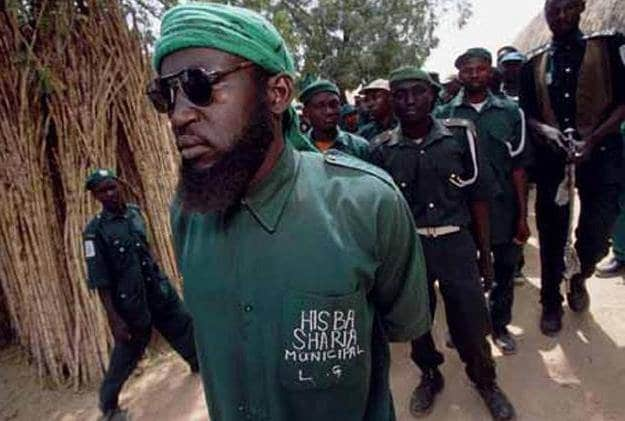
The agency established to enforce Sharia law in some states in the region recently banned stylish haircuts, sagging of trousers, playing of music at social events by disk jockeys and tricycle riders from adorning their vehicles with pictures considered to be obscene and against the tenents of Islam.

This was in addition to other unusual directives reeled out by the Islamic police.

Hisbah recently made headlines for shaving stylish haircuts of young men in Kano and arresting people for improper dressing.

They are also notorious for destroying truckloads of alcoholic drinks. (Barristerng)

An encounter with a doctor: It’s your life, By Azu Ishiekwene

This is not a good time to talk about medical doctors, especially when those in the public sector are on strike to press for better conditions of service. But I didn’t choose this encounter; the encounter chose me.

And, in any case, my own experience was not at a public hospital. I have heard of all sorts of patient-doctor stories before and taken a good many with a pinch of salt.

Too often, we hardly get to hear of the extraordinary courage and devotion of doctors and other medical personnel who give so much under extremely difficult – and even hostile – conditions to save lives.

In a society like ours where soldiers are sent to war with bare hands and teachers are deployed in schools without roofs or tables, doctors and medical personnel who save lives in spite of the odds are miracle workers.

But three times in about two months, I have heard stories of medical personnel whose negligence could have complicated matters, and cost lives. I also recently encountered a doctor at a high-brow private hospital in Abuja, who, for a moment, I thought may have entered the consulting room that night with a loaded gun, in a manner of speaking.

Each story reminds me that when all is said and done, sometimes – and they may well be the most crucial times in your life – what you know beforehand, and not what the man in the white coat does or prescribes, may well be the difference between life and death.

Let me share two of the other stories first, and then mine later. A friend told me last month, before the doctors’ strike, that she had taken her son who was diagnosed with malaria to the hospital for the second of a three-day treatment which consisted of a prescription of three doses of different injections on each day.

Because her son, who is a teenager, had also been diagnosed with urinary tract infection, antibiotics were also prescribed along with the three daily doses of anti-malarial injections.

Things went off pretty smoothly on the first day. On the second day, it was the father who took the boy for the injection, and she assumed that all went well. On the third day, however, she discovered that one of the two antibiotics that should have been administered on the second day was not. Rather than giving the boy the 2mg prescribed by the doctor, he was given only 1mg.

On getting to the hospital, she requested to see the nurse and demanded to know how such an error could occur. The nurse replied offhandedly that she didn’t figure out what the doctor wrote.

“I thought he wrote 1mg!”, the nurse said. “But it doesn’t matter. Madam, she can take it another day.” Not on the day the doctor prescribed or on the day that the patient needs the correct dose, no. The patient gets the treatment, if he is lucky to be alive, on the day and time convenient for the nurse. That’s how we roll.


Her second encounter was the same day at the medical records department to retrieve her son’s folder. After a long, anxious wait, with patients groaning and discharging a slew of hisses that would shame a python, my friend went to the head of the queue to find out what was happening.

She was told that the officer who was supposed to attend to the patients had gone to pray. They waited, shuffled about and grumbled but nothing happened – until she staged a mild scene.

That was when a kind-hearted senior medical staff weighed in and admonished the head of the unit who finally dragged herself up to attend to the crowd of agitated and distressed patients and visitors. At the time my friend and her son left, the prayer warrior officer had still not returned to his station and his prayer had obviously not helped the crowd of distressed patients.

On another occasion, an elderly friend of mine recovering from malaria recently shared the story of how the tardiness of the medical staff nearly complicated his recovery, and potentially, his life.

After three days of injection, he was supposed to have closed out with oral therapy, as follow up treatment. Unfortunately, the staff responsible “forgot” to tell him, and later “apologised profusely” for the omission. He had to start his treatment all over again!

Mine was an encounter of a different kind. After a shoddy attempt at self-help, I turned up at a private hospital on Monday evening with a worsening bout of malaria.

In the past few years whenever I have had early signs of malaria, which is perhaps once or twice in a year, I have managed to overcome it with a normal dose of any of two commonly used anti-malarial drugs – Lonart or Coartem – usually, the latter more than the former.

I tried it this time, but it failed. As I was driving back from work on Monday, I was feeling as if I had been apprenticed to one of the numerous construction sites in Abuja, under a foreman from Julius Berger. I drove straight to the hospital, with hurting joints.

After my vitals were taken a nurse asked me to wait for the doctor. I didn’t wait long before a smallish looking, light complexioned man, flying a checkered long sleeve shirt over a pair of faded blue jeans and black slippers, walked into the “consulting room.”

As soon as the door closed behind him, the nurse asked me to enter.

That was when I experienced suspended misery, even before I opened my mouth.

“I’m just coming in!”, he hollered. “You have not allowed me to settle down!”

I froze.

“The nurse asked me to come”, I replied.

Then he relented and motioned me to a seat. There were two chairs, not facing him, but to the right of his something like a seven-by-four feet cubicle of an office. I sat on the chair farther away from him as he struggled with the glare in his eyes.

“What is the problem”, he asked, at last, without looking at me.

I rattled off, starting with my Coartem misadventure to my aches and pain, blah, blah, blah.

“Any cough, fever or sore throat,” he murmured, all the while punching, with considerable effort, at his HP desktop computer with his right forefinger.

“None,” I replied as if speaking to myself.

He continued, ta…ta…ta…ta…with his forefinger.

And then I added, as if to myself, “I stopped using my multivitamins before I started the Coartem, because one of the capsules contains Vitamin C, which I understand tends to propagate free radicals….”

“That is nonsense!”, he roared, looking at me for the first time since I entered the cubicle. I thought he would pull a gun.

“It is not nonsense”, I replied. “You may disagree but you don’t have to say it is nonsense. What I have said is based on studies which I have read.”

He stood his ground, repeating that such notions have no basis in science and then, ta…ta…ta….

Apart from writing out a laboratory test and a three-day injection of artesunate and diclofenac, he prescribed antibiotics, sleeping pills and folic acid. I didn’t complain of poor sleep, but ta…ta…ta…the blue pill was right there!

The next day, by some stroke of good fortune, Dr. ta…ta…ta…was not consulting when I turned up for my test result and medication. A young doctor next door took a look at my case file and without a word, asked why I had been placed on folic acid along with my prescriptions.

I told him it was Dr. ta…ta…ta….and he smiled. He also asked, in a most friendly way, if I had been having any sleeping problems. I said no, after which he then said I should immediately discontinue the folic acid and blue pill.

According to some accounts, medical errors are the third leading cause of deaths in the US, after cancer and heart diseases. A John Hopkins University study said medical mistakes kill more than 250,000 people, every year – and that is in the US where they have and keep records.

A June 2017 study by Gabriel Uche Pascal and others on medical errors in Nigeria with specific interest in Abia State said of three most common medical errors reported 95.2 per cent is linked to medical prescription, while radio laboratory test follows with 83.9 per cent.

As I left the young doctor’s office after what was for me a redeeming encounter, I was relieved. Not because he provided a miracle cure, but because he listened, showed interest, and most of all, demonstrated that he cared for his patient.

It confirmed to me what I always suspected about many things in life, especially matters of health: always seek a second opinion, and possibly, a third.

In the end, it’s your life.

Ishiekwene is the Editor-In-Chief of LEADERSHIP

Terrorist Ali Kachalla Must Be Brought to Justice

Ring True By  Yemi Adebowale   Phone 08054699539 Email: [email protected]

For those who have not been following the story, this first bit of information will be useful. Ali Kachalla is the leader of the main gang terrorising Zamfara State in particular and other parts of the North-west. He has been doing this for almost five years. This Fulani militia leader, based in Dansadau, has the blood of hundreds of innocent people on his hands. Kachalla enjoys a free rein in Zamfara State and beyond. He goes about, unhindered, killing, maiming and kidnapping for money. Everybody in the state knows Kachalla has his major camp in the notorious Kuyambana forest (Maru Local Government Area) from where attacks are launched on other parts of Zamfara, Sokoto, Kebbi and Katsina states. Security agents know this. Governor Bello Matawalle knows this. Unfortunately, concrete steps have not been taken to checkmate him. The military, Police and DSS pretend to be unaware of his location. Perhaps, they are waiting for “clear instructions” from President Muhammadu Buhari before moving against Kachalla.

This outlaw has an estimated 200 fighters stationed in the Kuyambana forest, all armed with AK-47. His armed men outnumber those of other terrorists in the North-west. Last month, Kachalla masterminded the downing of the fighter jet of the Nigerian Air Force near Kabaru village, about 15 kilometres west of Dansadau town. There were no repercussions. That tells you how powerful Kachalla has become. This terrorist, in his thirties, has become a law unto himself. Daily, he whips residents of Dansadau who dare to oppose or hinder his lawlessness. The people persistently send ransom to him. Recently, when some people in the community blocked supply of food to his troops, Kachalla captured and inflicted pain on them. The fear of Kachalla is palpable in Dansadau.

In an attack on the community on July 23, Kachalla killed four villagers, abducted scores and set ablaze a military armoured personnel vehicle in the community, while the soldiers fled. On that occasion, the villagers were punished for reporting his movement to security agents. Kachalla also punished them for allegedly assisting security personnel to rescue the pilot whose fighter jet was shot down.

Daily, Kachalla kills and kidnaps Hausa farmers in Dansadau. He has cornered hundreds of plots of land from these people and uses them for his own cattle rearing. Kachalla’s cattle graze with ease on this conquered land in Maru LG. A resident of Dansadau remarked: “Kachalla’s settlements, consisting of several strings of thatched huts, is on Birnin Gwari side of the river. But, his large herd of cattle, manned by his heavily armed boys, is based in Zamfara State. As I’m talking to you, his boys can be found in Dandalla, Madada and Gobirawa Kwacha communities. The villages are all situated southeast of Dansadau town. They are all controlled by his armed men.”

Right in Matawalle’s backyard is another notorious Fulani militia leader, Dogo Gide, who controls the southern part of the Zamfara forest and further into Niger State. Matawalle knows the whereabouts of Gide and his boys. All the security agents know this location; yet, the militias still launch attacks unhindered. Dogo Gide’s gang also operates in Kaduna State. This team is suspected to have recently killed 18 people, including a police officer, in five communities in Chawai chiefdom, Kauru Local Government Area of Kaduna State.

Another terror kingpin enjoying free rein in Zamfara State is Halilu Sububu. His men are based in the Sububu forest located between Shinkafi and Maradun local government Areas. From the forest, they launch attacks on travelers on Sokoto-Gusau Road as well as villages in Sokoto and Zamfara states.

Dungun Muazu forest located in the Sabuwa Local Government Area of Katsina State is also home to hundreds of military-uniform-wearing terrorists who attack across the North-west. Here, there is no clear leader. Dogo Najaballah, who many thought was the leader of the bastards in Dungun Muazu forest, was killed few weeks back in a fight that broke out between his gang and a rival gang of bandits in the state over the marriage of a woman.

It is so painful watching these terrorists control territories, kill and maim citizens, in a country supposedly with a government. Many women have been widowed and children orphaned across the North-west by these guerrillas. Last Wednesday, the gang rampaging in Zurmi Local Government Area of Zamfara State abducted the father of the Speaker of the state’s House of Assembly, Nasiru Muazu Magarya. They also kidnapped the Speaker’s stepmother, uncle and four others in a raid on his community, Magarya, Zurmi LGA.

I will never forget how the terrorists based in Kadawa Village, in the same Zurmi LGA, butchered 93 people early last June. Residents of this Zamfara State village are still mourning their loved ones killed. Within three days last April – 20 to 22 – 80 people were killed by the terrorists and counter killings by Yan Sakai who defend Hausa farmers, in series of attacks in four villages – Gobirawa, Rini, Gora, and Madoti Dankule – in Bakura and Maradun LGAs.

In Zamfara State, the terrorists control vast areas in Maru, Dansadau, Zurmi, Shinkafi, Bungudu, Bakura and Maradun LGAs. In Katsina State, they control large land in Batsari, Jibia, Faskari, Sabuwa, Safana, Kankara, Danmusa, Dutsin-ma, Danja and Kurfi. Governor Bello Masari lamented when he met Army Chief, Faruk Yahaya, last Wednesday, saying: “10 out of the 34 Local Government Areas in Katsina state are under severe daily attack by bandits. These bandits kill, rape, injure the people, burn houses and rustle cattle.”

I’m shocked the Army, police, DSS and other security agencies are yet to invite leaders of these terrorists in the North-west for questioning. Our security agencies have not declared them wanted. They know them and the territories they control; yet, special squads are not after them. Even when President Buhari ordered that people carrying AK-47 should be dealt with, nothing happened. Of course, it was just a comical instruction from the President. The extremists are enjoying a free rein while security agencies look the other way. Clearly, there are things the Buhari government is not telling Nigerians about these terrorists and their leaders.

Members of the House of Lords, the upper chamber of the British parliament – Caroline Cox, Rowan Williams, David Alton, Mervyn Thomas and Ayo Adedoyin – were apt when they noted that Nigerians under President Buhari administration are at the mercy of non-state actors who unleash attacks on individuals and communities at will. They expressed their fears in a recent protest letter to the UK foreign secretary, Dominic Raab, citing a recent event where bandits shot down a Nigerian Air Force fighter jet.

“We fear that Nigerian citizens are now at the mercy of non-state actors who have been allowed to evolve and now have the capacity to shoot down a fighter jet, as has recently occurred in Kaduna. These non-state actors are currently unleashing terror at will, particularly in the North-East and North-West,” the letter said.

The world must not allow Nigeria to sink. These British Lawmakers must go beyond protest letters. They must hold Buhari accountable and put him under pressure to secure the lives of Nigerians. Perhaps, a push from outside would do the magic. I’m just hoping.

A Word for Mai Mala Buni

My dear Governor Mai Mala Buni, you have spent virtually the last 15 months in Abuja, working as the Chairman, Caretaker Committee of the All Progressives Congress, APC, at the expense of your main job as the elected governor of Yobe State. You need to be honest about your impact on the party in the last 15 months. Apart from successfully intimidating some PDP governors to join the APC, you have nothing tangible to show in terms of achievements.

The APC remains a divided house, with the CPC, ANPP and New PDP legs permanently at daggers drawn. Besides, majority of the founders of the APC see you as an agent of destruction, out to terminate the APC. Of course, you were not there when the APC was formed. I guess that is why you, a sitting governor is insisting on running the show for the APC as National Chairman, even when it is obvious that it will destroy the APC. My advice to you this morning is a straight forward one: Resign honourably and let the APC be. You have no business being the party’s National Chairman.

I am also surprised that you said governance was not suffering in your beloved Yobe State because of your APC job. My dear governor Yobe, you have simply abandoned your people. This is the truth that must be told. How can a man elected governor be this cruel to the electorates? You once said you visit Yobe at least three times in a month, in defence against the accusation of desertion. This is preposterous. Were you voted to spend just few days in a month in Yobe State? Obviously, there is no way these two jobs can be combined. They are both tasking. Project Yobe is now suffering because Buni is spending more time on project APC. Huge files are always on your table in Damaturu waiting for attention. The other day when Boko Haram attacked Geidam, you were not even available for condolence visit to the traumatised people. The Yobe APC stakeholders were right to demand your impeachment because of your “unavailability in the state to discharge your constitutional duties as governor.”

The Chairman, Yobe APC Stakeholders, Hussain Muhammad, said recently: “Buni has abandoned the state and only visits once in a month. It has become expedient to draw the attention of the public, especially the state House of Assembly, to the aberration of having a governor who is non-functional. Buni was not elected as APC’s Acting National Chairman, but as Yobe State governor and he swore to obey the constitution. It is our position that he had become a self-serving governor, who failed and betrayed his people when they needed him the most.

“As stakeholders, we have made both individual and collective efforts at letting Mai Mala Buni realise his mistakes, but it appears that as we inch closer to making him realise, he digs in further into his sit-tight plans at the party’s national secretariat. We, therefore, call on the Yobe State House of Assembly to begin impeachment process if he fails to resign as governor.”

These Yobe stakeholders are making sense. Unfortunately, the Yobe State House of Assembly is incompetent. Buni, please return to Yobe and face your constitutional duties. Allow the APC to look for another person to pilot its affairs. This is clearly not a job for an incumbent governor.

War in Katsina Emirate over Open Grazing

The Wakilin Kudin Katsina, Alhaji Abdu Iliyasu has never hidden his dislike for open grazing of animals in the Emirate. Hundreds of lives have been lost in clashes between herders and crop farmers in this domain. But getting the Emirate Council to join the clamour for a ban of open grazing has been tough, despite the atrocities of herders. An obviously angry Iliyasu did the extraordinary last Wednesday, when he openly made a case for the ban of open grazing in Katsina metropolis and its surrounding communities. He wants the Emirate to put machinery in place for its effective implementation. But the palace was quick to openly repudiate Iliyasu. The spokesman for the Katsina Emirate Council, Mallam Iro Bindawa, said it was not an official position.

Pressure is also mounting on Iliyasu to renounce the statement. For now, he is still standing by his position. But I doubt if it would be for long. My message to the Katsina Emirate Council is a simple one: Open grazing of animals is an aberration in modern societies. Katsina can’t be an exception. This Emirate must work towards ending this abnormality and close the killings arising from clashes between herders and crop farmers. This is the only way forward for Katsina Emirate in particular and Nigeria in general. The truth is constant.

Kyari: The Trial of Nigeria Police

Litmus Test for Nigeria

There was a quote which trended on social media a couple of weeks ago – something to the effect that, in a court case between two parties, it is the Judge that is really the one on trial and not the parties, since both parties know the truth of exactly what transpired between them. It is for the Judge to pass the test, by doing a proper evaluation of the evidence before the court, and delivering judgement based on the evidence and in accordance with the relevant laws. Putting this quote in the context of the new FBI saga concerning DCP Abba Kyari aka ‘Super Cop’ (these days, aka ‘Cop-Puppi’!), this time it is not just Abba Kyari that is on trial, but also the executive arm of Government (including the Nigeria Police Force (NPF)) and the Nigerian legal system that will be facing the court of global opinion. This will be another litmus test for Nigeria. So far, the NPF has taken a step in the right direction by suspending DCP Kyari; but, certainly much more is required from the Nigerian Government.

Granted, it is certainly more than embarrassing that a high ranking Police Officer, an award winning ‘Super Cop’ and Intelligence Officer for that matter, could be associated with a criminal like Hushpuppi for whatever reason, even if it is for tailoring services as DCP Kyari claimed! I would even venture to say that having clothes made for someone, connotes a form of closeness and intimacy. A high standard is undoubtedly required from an officer of the law, such as DCP Kyari whose job it is to fight crime and criminals, and not to become ‘besties’ and ‘bro’ with them.

Be that as it may, it is trite law that DCP Kyari is presumed innocent until proven guilty (Section 36(5) of the 1999 Constitution of the Federal Republic of Nigeria (as amended) (the Constitution). This principle of the presumption of innocence is also firmly enshrined in the American criminal justice system, and even though it is not explicitly stated in their Constitution, the 5th and 14th Amendments thereto, ensure that a Defendant will not be convicted of a crime, unless the Prosecutor proves beyond reasonable doubt that such a person is guilty. See the 1895 Supreme Court of the United States case of Coffin, et al v United States 156 U.S. 432 where the court held that it is the duty of all Judges to explain the presumption of innocence to the juries in their charge (whether asked to or not), and stated the principle of proof beyond reasonable doubt for a pronouncement of guilt. Additionally, DCP Kyari must not be denied his right to fair hearing (Section 36 (1) of the Constitution and Article 6 of the US Constitution).

Allegations of Money Laundering

That said, it is no longer news that the FBI is looking for DCP Kyari on some allegations of money laundering, bribery and wire fraud, vis-a-vis receiving funds from one Ramon Abbas aka Hushpuppi, who pleaded guilty and was recently convicted in the US for offences bordering on Money laundering, Fraud and Business Email Compromise (BEC), for which he is facing up to 20 years imprisonment. Money laundering is also a crime in Nigeria, so also is receiving stolen property. Specifically, Section 15(2)(a-d) of the Money Laundering (Prohibition) Act 2011 (MLA) prohibits anybody directly or indirectly, inter alia, from collecting funds which are known to be proceeds of an unlawful act or that such a person ought to have known were unlawful proceeds. The punishment prescribed by Section 15(3) of the MLA, is seven to fourteen years imprisonment.

In short, what DCP Kyari stands accused of in USA, is not only a serious crime in Nigeria, but qualifies as an extradition crime (double criminality). See Article 3 of the Extradition Treaty between Nigeria and USA. See also Section 427 of the Criminal Code Act (CC) (applicable in Southern Nigeria) and Section 316 of the Penal Code Act (PC) (applicable in Northern Nigeria). Needless to say, ‘scamming’ which was Hushpuppi’s occupation, is also an offence in Nigeria, as even most Nigerian children are aware of what ‘419’ is (obtaining by false pretences with intention to deprive the owner etc), aside from the Cyber crimes involved in his actions.

Extradition

It would definitely be awkward for the FBI to try any kind of chicanery in Nigeria, that is, extraordinary rendition – abducting DCP Kyari, and forcibly taking him to USA; though, if they did, it would not be the first time. In December, 2000, in connivance with the Nigerian Government (the operative word here being connivance), an abductee was forcibly taken to US by the American Government to answer to money laundering charges. The District Court in New York, however, freed the abductee, on the grounds that it lacked jurisdiction to entertain the matter because Nigeria and US had violated their Extradition Treaty. It is doubtful that any such connivance can happen in DCP Kyari’s case, because as a decorated Police Officer, if anything, he will probably enjoy sympathy in some quarters. Definitely, things will have to follow the proper procedure.

In Case No. 2:21-cr-00203, USA v Abba Kyari, the FBI prayed the US District Court in California to order the arrest of the Defendant, and a warrant of arrest has been so issued. In matters of extradition, a person is deemed to be wanted for trial when a warrant is issued by the court of the country applying for extradition (requesting country), that such a person be brought back to answer to criminal allegations levelled against them.

Presently, it has been reported that, so far, there has been no formal request to extradite DCP Kyari to the US to face trial. Again, like Nnamdi Kanu and Sunday Igboho, DCP Kyari does not fit into the definition of a Fugitive as stated in Section 21(1) of the Extradition Act 1966 (EA), because even though he is accused of committing a crime in the US, he didn’t go there physically to commit the crime, nor did he flee from there to Nigeria like Senator Kashamu, to escape prosecution. See the case of Udeozor v FRN 2007 15 N.W.L.R. Part 1058 Page 499 at 522. The EA requires amendments to be updated to present day, not just in its definition of a Fugitive, but to accommodate offences like BEC which can be committed from anywhere, without the actual physical presence of the perpetrator on the soil of the legal authority accusing them of the crime, and without fleeing from prosecution from the foreign land; the definition should also include Fugitives who have committed crimes in Nigeria, and have fled to other jurisdictions to escape prosecution or imprisonment.

Nigeria/USA Extradition Treaty

Be that as it may, Nigeria has an Extradition Treaty with USA (ET), though it was signed by the British on December 22, 1931 (and came into force on June 24, 1935) during the colonial days. However, Nigeria is bound by the ET, because it inherited the treaties and laws of its colonial masters on the attainment of independence on October 1, 1960. The ET is recognised by Section 1 of the EA, and will be applied in accordance thereto. See the case of Udeozor v FRN (Supra), where the Court of Appeal also affirmed the existence of the Extradition Treaty between Nigeria and USA.

Article 1 of the ET states that both countries undertake to give up to each other, persons accused of or convicted of specific crimes, which are enumerated in Article 3, and include receiving money or other property knowing same to have been stolen or unlawfully obtained or through fraudulent means and bribery (which I believe may be part of what DCP Kyari is wanted for). The ET also states that the crime must be a crime in both Contracting Party States; and I have cited some relevant provisions above to evince the fact of double criminality, in the charges against DCP Kyari.

Extradition Process

The NPF has set up a Committee to investigate this matter. But, here comes the twist. Article 4 of the ET states that an individual shall not be extradited for several reasons, including if such a Defendant is already under trial in the country applied to for the extradition (requested country), for the same offence for which extradition has been demanded (Section 3(5) of the EA). What is the essence of the NPF’s investigation of DCP Kyari? To genuinely establish the facts, so that an informed decision can be made by the Attorney-General of the Federation (AGF) on whether he should institute extradition proceedings when he eventually receives the extradition request? Or to frustrate America’s extradition request, by using the investigation ‘findings’ to file a charge against DCP Kyari here, knowing it can take 10/15 years of litigation all the way to the Supreme Court, in order to prevent his extradition to USA or to have the resultant effect of adjourning it sine die, that is, with no date for resumption of extradition proceedings?! Simply delay the extradition process, especially as the wheels of justice may sometimes move rather slowly in Nigeria. In the 2014 case of USA v Kayode Lawrence Criminal No. 4:03-cr-436-1, even though the Defendant was arrested and detained by the Nigerian authorities in 2004, he was not extradited to the US to face drug charges until 2013.

In any event, how fair or unbiased can the Police investigation be, seeing as they are investigating one of their own? Nemo judex in causa sua – no one should be a judge in a matter which he has an interest – can this principle of natural justice be extended to the Police investigation of DCP Kyari?

To activate the extradition process, the US Government through its Embassy, will make a formal application to the AGF for DCP Kyari’s extradition (See Section 6 of the EA). Upon receipt of such request, the AGF has the discretion to refuse to grant the extradition request based upon conditions set out in the ET which may not have been met, or on the aforementioned conditions that preclude extradition, and in this case, the extradition process will end. On the other hand, if the AGF grants the request, he will commence extradition proceedings at the Federal High Court, by virtue of Section 251(1)(i) of the Constitution which vests the Federal High Court with extradition jurisdiction. See the case of AGF v Godwin C. Nzeocha Charge No. FHC/L/336c/2011. The Administration of Criminal Justice Act 2015, also guides the process to be adopted in extradition proceedings.

The evidence against DCP Kyari has to be sufficient in the eyes of Nigerian law for the extradition request to succeed (Article 9 of the ET), and this would be contained in the warrant for his arrest attached to the extradition request. Since DCP Kyari has the right to oppose the extradition request in court, his legal team will try to vehemently prove inter alia, that he received the funds from Hushpuppi for tailoring purposes, and didn’t know they were proceeds of an unlawful act! Of course, many social media enthusiasts who followed Hushpuppi may argue otherwise, and say that the ostentatious and lavish lifestyle which he constantly displayed on Instagram left no one in doubt of his dubiousness, and would be a cause for concern for most responsible, reasonable people, let alone an Intelligence Police Officer. A stronger reason which could be canvassed against his extradition, would be that he won’t get a fair trial in the US, possibly on the basis of racism and nationality, because of America’s aversion to Nigerians accused of BEC crimes and the like (Section 3(2)(b) of the EA).

Conclusion

This new saga, ‘Cop-Puppi Gate’ or ‘Kyari Gate’, even if he is found not guilty by the American court, has further damaged the already battered image of Nigerian law enforcement. At least one other Nigerian has come out to accuse the Super Cop of brutalising him in the name of collecting money for someone who claimed that he owed him, or something to that effect. It is trite that law enforcement agencies like the EFCC, the Police and Army, are not debt recovery agencies, and they should not be used as such. This allegation is similar to that of Kelly Chibuzor Vincent, who Hushpuppi asked DCP Kyari to deal with for double crossing him; again, this matter is not within the purview of the functions of NPF. See Ogbonna v Ogbonna 2014 LPELR-22308 (CA); Anogwie v Odom 2016 LPELR-2014 (CA); Skye Bank Plv v Emerson Njoku 2016 LPELR-40447 (CA).

That these are trying times for DCP Kyari, is an understatement. However, I wonder whether he actually realises it. Last week, there was a feeble attempt by some spurious websites, in an obvious attempt to defend him, to mislead the public by claiming that DCP Kyari’s name was only mentioned, and that the FBI had explained that he has no case to answer! Hogwash! Again, this does not augur well for Nigeria, as it simply shows our penchant for ‘white-washing’.

I urge the NPF, AGF and the Nigerian legal system, to do justice to this matter. Rome was not built in a day, but eventually, it was built. Nigeria needs to start to repair her global image – and this will be a start. Guilty or not, the decent thing to have done in the face of such serious allegations, would be for DCP Kyari to resign, but, I can bet my bottom dollar that he will not – doing the honourable thing in this kind of situation, is not a common occurrence in Nigeria. We prefer to do ‘bold face’ and ‘wrong and strong’! This is not to say that DCP Kyari should be extradited if the Americans cannot prove that he has a case to answer; but rather, that if it is established that DCP Kyari definitely has a case to answer in US, that Nigerian system should not resist his extradition. In any event, extradition is certainly not proof of guilt. Since the world is watching, America will also be constrained to do justice to the matter.

Abba Kyari
Super Cop

A Cop and the Cult of Mammon

ENGAGEMENTS By Chidi Amuta

My ordinarily serene estate neighborhood suddenly erupted in unusual cacophony. Loud shouts of joy broke the Saturday morning peace on the streets close by. Collections of residents gathered to celebrate some unexpected but apparently cheery event. Unknown to this reporter, the police had just made an unusually remarkable arrest two streets away. I enquired from my domestic staff what was going on. It turned out that a team of crack detectives mostly in mufti had just arrested the notorious alleged kidnapper, Chukwudidumeme Onwuamadike alias Evans, right in my neighborhood. The relief radiated throughout Lagos and neighbouring states that had for months been traumatised by the kidnapping exploits of Evans and his franchise network of vicious kidnappers. Mr. Evans did regale the media with accounts of his exploits soon after his arrest though he is still standing trial for the offences.

Unknown to me, Evans was a close neighbour, having recently bought a newly completed luxury duplex two streets away from mine. The buildings, which were going for some frightening nine figure price tags, had recently been snapped up by a new set of moneyed landlords. The story of Evans’ arrest quickly spread in the media. It turned out that the Inspector General of Police’s Intelligence Response Team (IRT) had meticulously scoped the estate for weeks in a bid to track down the suspected kidnapper. Sometimes, the undercover detectives had reportedly disguised as refuse collectors or power company technicians on duty around the suspected neighborhood.

On this fateful Saturday morning, they zeroed in on Mr. Evans right in his bedroom and arrested him with minimum effort or resistance. In a dramatic exclamation resonant with his Catholic upbringing, the alleged villain exclaimed at the moment of his arrest: “It is finished. This is my end…!” Among the trove of exhibits the police recovered in his house were a jute sack containing several military grade assault rifles, countless rounds of ammunition and several cell phones and numerous sim cards. The police team was led by a Deputy Superintendent of Police, Mr. Phillips, under the overall command of then Assistant Commissioner of Police Abba Kyari as head of the IG’s Intelligence Response Team (IRT).

Mr. Abba Kyari’s name subsequently and gradually assumed mythic dimensions as the ‘super cop’ who would deploy the latest tracking technologies to unravel the communications and itinerary of tough criminal lords around the country. But in 2019, Mr. Kyari’s winning team, including some of the heroes of the Evans Lagos operation, ran into a storm in Taraba State. A special operation by the team was dispatched to arrest the notorious kidnaper Hamisu Wadume. On their way back to Jalingo with their quarry, they were attacked by soldiers who killed three of the police officers and freed the kidnap kingpin. The subsequent inter agency bickering and investigations led nowhere. It was a good operation that suddenly went bad. Nonetheless, this unfortunate incident did not quite dim Abba Kyari’s rising profile both in the police hierarchy and among the public.

At the height of the recent wave of IPOB related violence and criminality in the South-east, President Buhari ordered a special security crackdown in the region. The new Inspector General of Police, Mr Usman Alkali Baba, drafted Mr. Abba Kyari to lead the police component of the operation. Some degree of progress was being recorded in the pacification of South Eastern Nigeria through a rough combination of indiscriminate arrests and a spate of extra judicial liquidations by the police and the military.

Amnesty International has just released a report indicating that at least 150 innocent persons may have been killed by security forces in the South-east operation so far. Legal minded civil society activists and lawyers in the South East have raised uneasy eye brows about Mr. Abba Kyari’s methods and those of his counterparts in the military contingents deployed in the South-east.

In spite of a trove of suspicious awards and accolades, Mr. Abba Kyari’s trajectory of heroism has been trailed by clouds of allegations of professional impropriety, controversy and sometimes outright infamy. While he held sway in the Lagos police command, Mr. Kyari was once in charge of the notorious SARS unit. A 2017 Amnesty International review returned a damning indictment of this officer on grounds of a not so glorious record of human rights infractions. The report pointed to arbitrary arrests, ill treatment of suspects and alleged corrupt entanglements with proceeds of crime in cases that came under his purview. Unconfirmed eye witness chatter from his native Maiduguri home base have spoken of massive multi million Naira real estate acquisitions traceable to Kyari. Even if these end up being typical Nigerian beer parlor guesses, Mr. Kyari’s choice of company and undue visibility may have earned him such inglorious reputation.

For instance, on October 28, 2020, a Lagos businessman, Afeez Mojeed, accused Kyari of defrauding him of the sum of N41m. He had petitioned the Judicial panel investigating the abuses of SARS to complain that in 2014, Kyari ordered his men to break into his home, accusing him of being an internet fraudster. During the operation, the complainant alleged that the combined sums of N280,000 and N50,000 were taken away from his wardrobe and car respectively. These monies were never returned even after he was charged to court by Kyari and his men who never showed up in court. The case was struck out for lack of prosecutorial interest or substantiated evidence.

Nonetheless, Mr. Kyari is widely acknowledged as a pan Nigerian officer with a cosmopolitan outlook. A man who is widely recognized as a very good detective also enjoyed celebrity limelight and worrisome media visibility. He loved publicity and routinely invited camera crews to make video recordings of him and his team hunting down kidnappers even if he found none in most of those escapades of foolish showmanship.

Deliberate showmanship and attention seeking in the media would ordinarily not be among the qualities of a good detective. Worse still, Mr. Kyari was severally on display in the company of sundry celebrities and wealthy men of doubtful enterprise at social occasions. For instance, he was a sight of public interest at the recent lavish funeral ceremony of the mother of one Mr. Obi Cubana in Oba at which there was an excessively vulgar display of sickening affluence and trivialisation of cash. A cop who deliberately courts such wide media publicity and who is comfortable in the company of businessmen of unclear wealth and undefined specialization undermines his basic credibility as a law enforcement agent.

Correspondingly, businessmen with murky lines of trade and fuzzy income streams who desperately court the friendship of prominent police chiefs may have something to hide or paths to cover. The most elementary attribute of good detectives is their love for the shadows, almost like professional spies. Mr. Abba Kyari frequently failed this test as has been revealed in the FBI documents on his murky association with Mr. Abbas Rammon, alias Hushpuppi, the opulent former Dubai based internet fraudster now on trial in California.

The FBI’s charges against Mr. Kyari in the Hushpuppi case range from the bizarre to the sublime and outrageously laughable. In one of the charges, Mr. Kyari is said to have briefly converted his detective’s office into a fashion fitting and purchasing agency for the procurement of traditional attires for Mr. Abbas. Mr. Kyari served as the receiving clerk for payments to the dress maker in respect of which he generously supplied his account details for all manner of payments. The pledge of mutual allegiance between Kyari and Hushpuppi reads more like an adolescents’ playground script. For Mr. Kyari’s faithfulness in doing his criminal biddings, Hushpuppi undertakes to be Abba Kyari’s ‘boy’ forever! In a Facebook reaction to the FBI order of his arrest, Mr. Kyari admitted playing the ignominious role of garment procurement agent for Hushpuppi and saw nothing unethical or criminal about it. Neither did he regret such close association with a widely known internet fraudster.

In another instance, he was charged with indirectly receiving orders or tips about criminals from Hushpuppi. On the directives of Hushpuppi, Mr. Kyari is alleged to have arrested a certain Vincent Chibuzor who was spuriously accused by Hushpuppi of threatening the life of his family back in Nigeria. It turned out that the fingered man-Vincent Chibuzor- was an ally of Mr. Abbas (Hushpuppi) in an internet scam operation in which the victim was a Qatar based businessman. Mr. Kyari had Vincent Chibuzor arrested and detained and sent the photos to Abbas as proof of mission accomplished. This ended up as a paid service for which Abbas requested for Kyari’s bank accounts for wire transfer payments which the FBI tracked and documented. It is further alleged that a total of N8 million was transferred to Abba Kyari by Hushpuppi for this single assignment.

The FBI court documents further indicated that Mr. Kyari ran protection rings for ‘big men’ in society while restricting the freedom of their less privileged victims and rivals. His reputation as an effective cop and detective earned him a popularity that attracted more high profile ‘clients’. This revelation may eventually cast doubts on some of the successes for which Kyari was celebrated and rewarded.

While the specific details of the full FBI indictment of Mr. Kyari remain classified, the Americans seem determined in their bid to have Mr. Kyari extradited to the US for prosecution. As is typical with the FBI, the full details of Kyari’s criminal involvements with Hushpuppi will only be revealed when he is extradited and arraigned. His initial bluster has yielded place to administrative procedures by an embarrassed Nigerian police establishment.

At first the Inspector General of Police ordered an internal investigation of the charge while granting audience to visiting FBI agents. Thereafter the IGP and the Police Service Commission have both instructed the suspension of Mr. Kyari who is now facing the internal police investigation panel. These are sensible due process measures on the part of Nigeria’s police authorities.

In quick succession also, the Inspector General of Police has replaced the embattled Mr. Kyari with Mr. Tunji Disu, a Deputy Commissioner of Police in the Lagos Police Command as the new commander of the Intelligence Response Team. The mere fact of being fingered in the FBI inspired investigations is bad enough news for a cop who had shown considerable career promise. In all likelihood, Mr. Kyari is unlikely to regain his former position let alone enjoy the visibility and social media hype that brought him both past success and present perdition. He might as well say good bye to the loud ovations of Nigeria’s evanescent celebrity circus.

The matter of Mr. Kyari’s possible extradition to the US to answer the charges against him is different matter entirely. It is not likely to be a very straightforward process. In spite of a subsisting extradition agreement between Nigeria and the US, there are complicated issues of judicial sovereignty and independence that must be addressed. Complicated legal processes in Nigerian courts must be overcome in order to clear the way for a possible extradition of Mr. Kyari. It is also quite possible that legal battles could become poisoned by Nigeria’s familiar noisy politics of religion and ethnocentrism guided by silly compass reading of straightforward matters. I hear that Miyetti Allah, the noisy cattle breeders association has already accused the US FBI of acting on behalf of Southern political interests! There could be more from where that came!

Even without such predictable political posturing, I do not see Mr. Kyari’s extradition happening so quickly or easily. There is a precedent in the endless extradition procedures of late Kasumu Buruji of Ogun state. He was indicted by a US court and related drug enforcement agencies for narcotics related infractions. He launched a series of protracted legal procedures in Nigeria that stalemated the extradition process. He even went ahead to contest elections and became a senator. In the last general elections, Mr. Kasumu Buruji ran for the governorship of Ogun state and lost. He could not be extradited till he died in 2020.

In the Abba Kyari case, the things that can happen quickly have already taken place. The Inspector General of Police has already initiated an internal investigation while Mr. Kyari has been suspended from service. The Police Service Commission has similarly suspended Mr. Kyari from service. The IG can still take further steps if the internal investigations return a verdict of guilty on the officer.

While the public awaits the outcome of the police investigations into the Abba Kyari matter, we might as well bid Mr. Abba Kyari farewell from the Nigeria police as he regains the freedom to join the ranks of his favorite businessmen friends and associates as an ex-cop.

However, his plight throws into bold relief so many issues in the relationship between police officers and the cult of money and celebrity. It even goes to the root of a corruption riddled police culture in Nigeria.

There is a whole bag full of anecdotes on the troublesome relationship between police bosses and criminal gang leaders and people with murky money around the world. It is often said that if you are looking for the address of organized crime syndicates in New York, Mexico City or Sicily, you can save time by going straight to the office of the police chief. Include Lagos and Johannesburg to the mix of bad places and you are near home.

The rationale is simple and ancient. The first quality of any good police boss is his familiarity with the whereabouts of all prominent criminals in his precinct. When politicians and the public get too noisy about rising crime figures, the exceptional police boss is the one who knows exactly where to go and fetch some inconsequential bad guys for display before television cameras. Accolades and promotions follow for the ‘super cop’. Thereafter, the most prized criminal kingpins may leave town for a while or get missing as a contingent occupational hazard.

No one can blame a police boss for getting to know major criminals. That is their constituency. But knowledge is different from consciously enrolling into the cult of criminals or getting on their pay roll or running their errands. The ability to walk the treacherous tightrope between familiarity with the dark underground world of bad guys and enrolling into their brotherhood is what distinguishes the real super cop from a desperate hustler. From the FBI files, there is reason to conclude that Mr. Abba Kyari may have scammed the Nigerian police establishment and the general public into abetting his enrolment into the shady cult of mammon.

Mr. Abba Kyari’s journey into the shadows of tragic failure is not quite a solo flight. He is cascading down with the already tattered reputation of the Nigeria police and the increasing sad perception of the nation itself. Internationally, our police force has variously been rated at the bottom of the ladder of police forces in the world. At home, the public distrusts the police and readily associates the force with sordid corruption and epic incompetence. Yet, the Nigeria Police has produced some brilliant and reasonably honest and professional officers in the past and even now. Without the FBI and Hushpuppi fallout, it was reasonable to expect that Mr. Abba Kyari could have risen steadily to the rank of even Inspector General or close to it. This incident has now dimmed his personal aspiration while further damning the tattered reputation of the Nigeria police force.

An FBI indictment of a top Nigerian cop is a major public relations disaster for Nigeria. His association with an internet fraudster of international repute even casts doubts on his reputation as a detective with basic common sense. In a country that has earned wide international notoriety for all manner of internet scams, the Hushpuppi? Kyari debacle is particularly consequential. This makes the Abba Kyari case a major political test for the Buhari administration. For the police as an institution, the challenge is straightforward: rigorous internal disciplinary processes which have already been activated. But for the Buhari administration, the case is a symbolic test of the level of commitment of the president to it’s a rhetorical anti-corruption drive. The indiscretion of this one toxic cop could further poison the chalice in Mr. Buhari’s much tainted legacy banquet.

Make things right with God

‘Humble yourselves in the sight of the Lord, and he shall lift you up.’
James 4:10 KJV

In the Old Testament God marked His priests by putting blood on their right ear lobe, their right thumb, and the big toe of their right foot. That meant they were called to honour God in their hearing, their skills, and their daily walk. You can’t just do your own thing; you’re called to walk according to God’s Word. When you don’t, God will call you to repentance. And if you don’t repent, He will discipline you. ‘

‘Do not make light of the Lord’s discipline, and do not lose heart when he rebukes you, because the Lord disciplines the one he loves’ (Hebrews 12:5-6 NIV). Note two important phrases: 1) ‘Do not make light of the Lord’s discipline.’ Your ‘Nobody’s-going-to-tell-me-what-to-do!’ attitude will rob you of God’s best and prevent Him from using you effectively. ‘God opposes the proud, but shows favour to the humble’ (James 4:6 NIVUK). 2)

‘Do not lose heart when he rebukes you.’ Instead of seeing God’s correction as rejection, see it as proof that you’re His child…that He has a plan for your life…and that it begins when you humble yourself and do what He tells you. God’s patience is amazing – but He won’t wait forever. He said of Jezebel, ‘I gave her time to repent…and she did not…I will cast her into a sickbed’ (Revelation 2:21-22 NKJV). On the other hand, when Ahab, Jezebel’s wicked husband, humbled himself, God healed and restored him. Humbling yourself before God will turn things around in your life when nothing else will work. So, the word for today is: make things right with God!

Bible in a Year: Proverbs 1-2, 1 Corinthians 11:1-16

The Word for Today

Chevron CMD Divorce Gets Messier, Throws Wife, 8-Year Old Daughter Out Of Matrimonial Home

  • Says, he wants to seek happiness elsewhere

What started as a sweet love story between a top staff of Chevron Nigeria Limited and his once darling wife ended in the most unexpected manner recently.

The matter has since become a messy divorce issue.

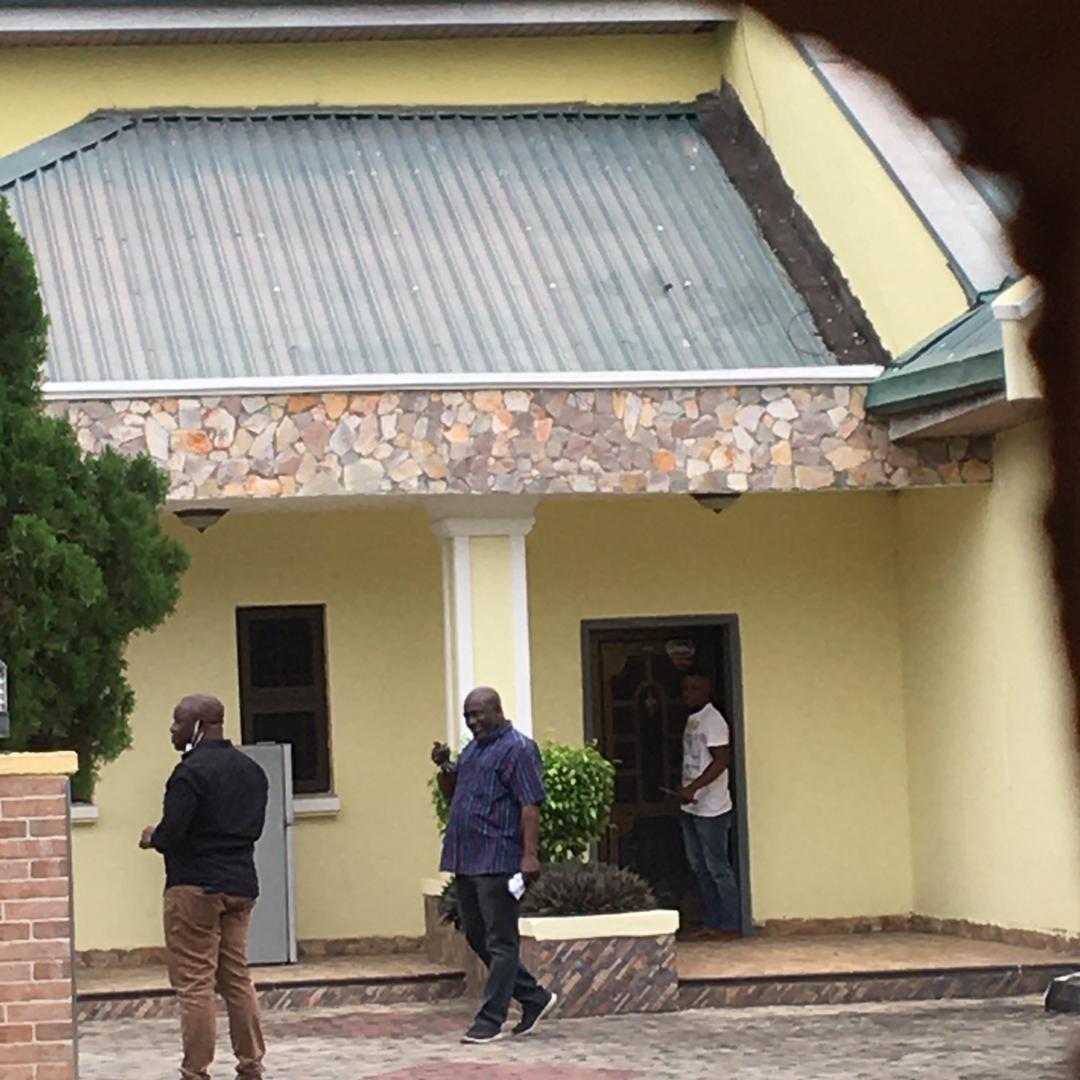
Dr. Rotimi Babalola, who works as the Chief Medical Officer of Chevron Nigeria Limited reportedly threw his wife, Mrs Adediwura Adebukola Babalola, and their 8 year-old child out of their home unto the streets of the highbrow Cooperative Village Estate in Badore, Ajah, Lagos State, where they live.

Narrating the sad experience, Mrs Adebukola Babalola, said that her once sweet marriage which has lasted 10 years, started falling apart when her husband’s work schedule changed from his usual two weeks out and two weeks in, to one month out and one month in.

She said that Dr Rotimi Babalola suddenly became hostile to her.

“We have been married now for ten years. We had our good times, though, when it was rough, it was really rough!

“We never lived as a couple on a stretch, he normally went to work. He works two weeks in, two weeks out.

“Later, it was changed to one month in, one month out, so the times that it was good were when he came home after a long period that he had been away from home, he tried to be loving and at such moments i reciprocated.

“Though as a woman, I tried to cover up a lot of things because I wanted my marriage to work. I never dreamt that my marriage would end up like this. I’m that kind of person that when it comes to marriage, I try as much as possible, to make it work out by all means.

“I ignored the fact that he never allowed my family visit. My mother has never been to our home. Even when I gave birth to my child, my husband said that he didn’t want to see any of my family members. My siblings couldn’t come around.

“I wasn’t particular about that because I could always go to see them.

“Suddenly, he started becoming too involved with too many women, which I had to confront him on several times. I won’t lie, I had to confront some of the women sometimes too. And I told him I did not understand the way our marriage, was going.

“He moved out of our home since January 1st. When he moved out, I learnt that he moved into his friend’s house in Victoria Garden City.

“I sent people to beg him even my family members, but he wouldn’t see them, and to those he saw, he told them that he is done.

“He left a message that he had been enduring the marriage for too long, that he is now ready to go and find his happiness that he is not finding happiness in this marriage anymore.

“I sent him a message that I have been doing the best I could in this marriage but if that is what he wants, it is okay. So I allowed him to be.

“But only for him to come back and pack the whole household items, the beds, television, the chairs, he took them away during my absence.

“So I sent him a message that he could’t do that because he is making the house uncomfortable especially when I have an 8 year old child at home.

“He said he needed them where he was moving to. I didn’t argue with him. I just said it is okay.

“Then he started sending messages to my brother that he will throw me out of the house. And my brother asked him why he wanted to do that.

“He replied that I brought somebody to the house and I didn’t tell him. And my brother told him that the person in the house is my sister and it was because he was no longer staying there and I was living all alone with an 8 year old.

“He told him that I have been very sad and alone in the house and needed someone to be around to comfort me.

“He said no that he didn’t want any other person in his house. So my sister left that same day.

“He came home after then and removed all the solar system, the generator, the inverter and everything in the house and disconnected the light.

“So I told a lawyer, who wrote him a letter and his lawyer replied and called for a conference.

“So we went and he told the lawyers that he was no longer interested and I said too that I was no longer interested.

“So what is the way forward, he said he would rent me a two bedroom flat and pay for one year and that is all he could do.

“I asked him what will happen when the rent is due after the first year, he said hat is all he could do.

“Meanwhile, to my knowledge he owns five houses in different places,” she said.

Mrs Adediwura Babalola continued amidst weeping, “I rejected the offer because I asked him what will happen to my daughter and he said that’s all he could do.

“His lawyer called me back because he is a family friend, a Senior Advocate of Nigeria, that I should give him a chance to intervene in the matter.

“He said he had talked to him that I should please call him now and try to beg him.

“I did as I was told, but he refused to pick his calls. His lawyer was surprised because he told me that my husband had told him that he would pick my call and hear me out.

“He begged me and I listened to him as a father. My daughter called, yet he didn’t pick the calls.

“I went to his Pastor at Winners Chapel, who also called him for a whole month, but he didn’t pick his calls. When he picked he told them he would see them. Till today, he didn’t go there to see the pastor. So the pastor gave up.

“The shock I received was that he came again during my absence to pick the refrigerator, dropped our cooked foods on the floor and disconnected the lights, and this landed me in the hospital.

“But he wasn’t done. He sent people to the house, soldiers, to come and take the only car, which I was using to move around and also take the child to school daily. That was when the neighbours intervened.

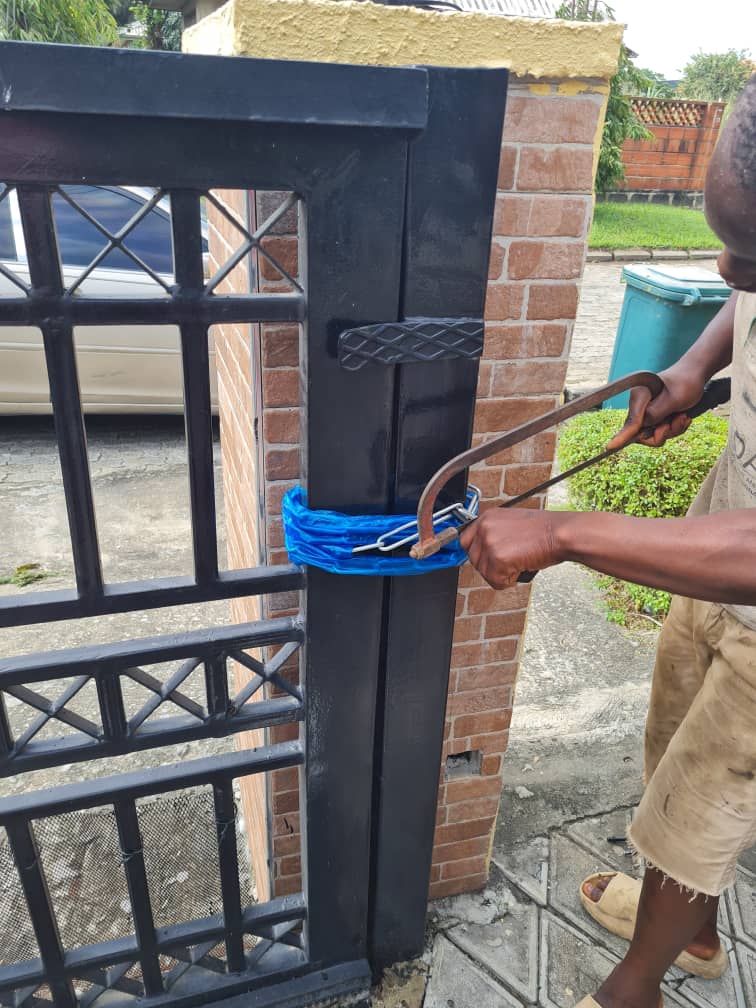
“It actually took the intervention of a colonel in the eastate to stop those soldiers from dragging me away that day with the car. And the final straw was when he came home with some people and sealed the house, throwing my daughter and I on the estate street.

“Of course, the neighbours intervened again asking him what I had done that couldn’t be resolved within the family closet.

“They asked him if it was adultery and he couldn’t answer because the neighbours knew the quiet lifestyle I live.’

After speaking to Mrs Babalola, we tried to speak with the husband, but all efforts proved abortive.

Meanwhile, one of the neighbours who did not want her name in print, said that the estate neighbours had at different times tried to make the Babalolas seek peace but that the husband didn’t show up.

“When he came to seal the house, we told him that he shouldn’t do that, that he should take the matter to court, and that if he wanted to divorce his wife he should do it honourably.” (firstweeklymagazine)

How Nigerians are being tactically de-Nigerianised

By Azuka Onwuka

It is doubtful if there is any country that had more of its nationals competing for other countries than Nigeria at the just concluded Olympic Games tagged Tokyo 2020, which held in 2021 because of the COVID-19 pandemic. From European countries to North American countries and to Asian countries and Oceania, Nigerians were busy helping other countries to win medals, while finding it hard to win medals for their own country.

The image Nigeria cut was that of a slave woman kept for the sole purpose of producing children that would be sold into slavery to work for other people. She would deliver a baby and nurse it. Once weaned, the baby would get sold and she would be made pregnant again for the “production” of another baby or babies.

Although Nigerians had been representing other countries at the Olympics and World Cup, what happened at this year’s Olympics was more of an embarrassment because of the sheer number of Nigerians competing for other countries. It looked like the case of a people who officially had no country and were dispersed across the world, competing for other countries. Many even helped to edge the Nigerian teams out of their respective competitions like the Japanese female basketball team where Monica Okoye helped to beat Nigeria. Some countries like the Greek male basketball team even had two Nigerian brothers: Giannis Antetokounmpo and Thanasis Antetokounmpo.

Italy won their first 4×100 metres relay for men in the Tokyo Olympics. A Nigerian (Eseosa Fostine Desalu) helped to achieve that feat. They edged out the UK team by 0.01 second. A Nigerian (Chijindu Ujah) was in the UK relay team.

A photograph being circulated in the social media captured this sorry state of Nigeria’s “dispersion” succinctly. Two victorious ladies were wrapped in the flags of two different countries. The one with the name “Eze” was wrapped in the British flag, while the one with the name “Adeleke” was wrapped in the Irish flag. They were in a conversation. They had just won medals for their adopted countries. But contrary to the impression created, the photo was not taken at this year’s Olympics. It was the 2021 European under-20 Championships at Tallinn, Estonia. Rashidat Adeleke won gold medal for Republic of Ireland, while Joy Eze won bronze for the United Kingdom. That gold medal by Adeleke gave Republic of Ireland the record of winning the women’s 100-metre gold medal back-to-back, having won it for the first time in 2017 at Grosseto, Italy. Guess who made the country win that gold medal for the first time? Gina Akpe-Moses, another Nigerian, created that feat for the country of less than five million people.

Curiously, all the Nigerians competing for other countries are from the South of Nigeria. This also plays out in other spheres of life: medicine, nursing, teaching, soldiering, policing, etc. The bulk of Nigerians fleeing Nigeria to reside and work in other countries are from the South. The high majority of people using the extremely dangerous desert route to attempt to cross over to Europe are from the South. The majority of those who are taken out as sex slaves from Nigeria are from the South. The majority of those who are lured out by drug barons to act as couriers for them (including taking hard drugs to countries which have the death penalty for convicted traffickers) are from the South.

What has become clear is that Nigerians, especially from the South, are desperately eager to flee from Nigeria to other continents. Even the fear of death is not a deterrent. They seem to feel that it is better to die trying to leave Nigeria than die living in Nigeria.

It is known that the slave merchants that took Nigerians away during the slave trade used force. But there is a joke in Nigeria today that if slave ships were to berth at the different ports in Nigeria, most Nigerians would willingly board the ships to flee into slavery in Europe and North America.

Without using force to chase Nigerians out, they are being indirectly forced out in droves. The first force that makes Nigerians to leave is the economy. From the mid-1980s, professionals and non-professionals began to leave Nigeria in search of better opportunities. Today, millions of Nigerian graduates happily work as labourers in different countries where they earn wages which, once converted into the Nigerian naira, become of high value.

In recent years, insecurity has become a strong force driving Nigerians out. Even though the economy has worsened, the most disconcerting is that Nigerians feel unsafe to even live their life of privation in peace. Some years ago, the threat of Boko Haram was limited to some parts of the North-East. People felt safe in other parts of Nigeria. But the addition of murderous herdsmen and bandits into the security crisis in Nigeria turned things around in a frightening way. No part of Nigeria can be called safe today.

Due to aggravated discontent as well as the activities of the murderous herdsmen and bandits, there has been a rise in separatist agitations from the eastern and western parts of Nigeria, which have been met with more violence by the police and military, thereby making people feel more unsafe. Today, it is easy for young men in transit or even at home to be tagged terrorists and shot dead. Raising young men in Nigeria has become a scary enterprise, as one is always afraid of hearing that one’s sons in the university or out of the university have been shot dead or arrested for having a laptop or a good mobile phone – which are seen by security operatives in Nigeria as signs that such youths are involved in cybercrime. This same attitude was what gave rise to the #EndSARS protest in 2020, which was also met with violence by the security operatives.

Finally, there is the frustration caused by mediocrity. The Nigerian system celebrates mediocrity. It is ingrained in the Nigerian Constitution as “quota system” and “federal character”, but it is accentuated through tribalistic cronyism. Many feel short-changed and stifled when their juniors and less qualified colleagues are promoted far above them.

All these fears have culminated in making it clear to many, especially in those from the South, that Nigeria is not safe to live or raise children in. The physical insecurity also aligns with the insecurity of not being able to access good education, good health care, good facilities, justice, etc. The alternative is to flee Nigeria to other countries where one can have a better and safer life.

Unlike nationals of other countries who seem to travel to acquire some educational and professional skills and return to their home countries to put their new skills to use, Nigerians seem to be fleeing for good. Any person who succeeds in travelling out of Nigeria is congratulated and warned not to come back to live in Nigeria again. Such a person can come back on holidays but not to reside here anymore. Such Nigerians apply for the citizenship of their countries of residence. They feel that their future is guaranteed once that is achieved. They start making plans to take as many of their relatives as possible out of Nigeria.

The treatment Nigeria metes out to its citizens representing it in sports is also a discouragement to those who wish to represent the country. The video of a Nigerian Olympics shot put finalist, Chukwuebuka Enekwechi, washing his jersey because he had only one was shameful. The way the Nigerian contingent landed in Tokyo wearing different clothes was also embarrassing. Nigeria also has a history of abandoning its injured athletes to their fate. Nigerian athletes also face the challenge of the unavailability of adequate tools and facilities. Many have to use their personal funds and resources to train for competitions. All these make it more attractive for many Nigerian athletes to abandon Nigeria for other countries.

The sad part is that there is no sign this sad situation will not get worse.

Contact: [email protected]

Buhari and the Education Summit

By Sonnie Ekwowusi

Speaking at the Global Education Summit in London last week, President Buhari stated that no person can succeed outside his educational qualification. Hear Mr. President, “You can’t succeed outside your educational qualification. Anybody who missed education has missed everything. Nigerians are acutely aware of the priority of education, and parents are making sacrifices to ensure that their children and wards get educated.”

“You can’t succeed outside your educational qualification. Anybody who missed education has missed everything,” is Buhari’s personal allusion to his educational qualification and how it has impacted his job as the President of Nigeria. Justice is something profoundly personal. A guilty person might escape human justice: he might take flight from his guilt through ingenious rationalization, but what he cannot escape from is the ultimate justice in the recesses of his conscience. In Fyodor Mikhailovich Dostoyevsky’s Crime and Punishment, Raskolnikov tried to erase his crime from his heart by ingenious rationalization, but upon discovering the inescapable basis for ultimate justice in his heart, he travelled to Siberia and served an eight year prison term in order to at least appease his conscience. President Buhari is not succeeding outside his educational qualification: he is succeeding within his educational qualification. Mr. President has educational qualifications. He acquired his West Africa Examination Council certificate. He is a graduate of the University of Cambridge. So says the 9/11 Tribunal judgment. So has the Supreme Court, Nigeria’s apex court, affirmed. If the Tribunal and Nigeria’s apex court have ruled that President Buhari has a certificate, who are you to question whether or not President Buhari has a certificate? Who are you to continue grumbling and gossiping that President Buhari did not go to school? Pursuant to the combined effects of sections 131(d) and 318 (1)(a-d) of the 1999 Constitution a person shall be qualified for election to the office of a President of Nigeria if he possess a school certificate or a secondary school certificate or its equivalent or even a primary school certificate or Grade 11 Teacher’s certificate. Note that sections 131(d) and 318(a-d) viva voce stipulate that the candidate seeking election as President must provide the certificates issued to him by the relevant authorities in his educational pursuit. President Buhari has satisfied the aforesaid constitutional requirement. He is a holder of Cambridge University certificate. I am sure none of these arm-chair Buhari critics has seen the four walls of Cambridge University let alone possess a Cambridge certificate.

President Buhari has brought his education to bear on governance. That’s why he said last week that “anybody who missed education has missed everything”. Mr. President came to power on the mantra of eliminating corruption in Nigeria under the ideological catchphrase “war against corruption”. This phrase is impregnated with a very deep meaning. Only highly philosophical minds can understand the phrase. In fact, the phrase reminds us about the political ideologies of Zik and Awo. “War against corruption”. This is Buhari’s brain-child. Today Nigeria is free from corruption. All politicians and others who stole government money are being sent to jail. You cannot find corrupt people in the ruling party APC. This is why any politician who decamps from his party and joins the APC will no longer be accused of corruption. So, no corrupt people in APC. The only political party where you can find corrupt people is the PDP, and, government is sparing no effort in sending all those corrupt PDP people to jail. Those who accuse President Buhari of corruption are missing education otherwise why should they be accusing President Buhari who did not miss education of corruption.

President Buhari is being accused of nepotism. His critics say that despite stating in his Inauguration Speech “I belong to everybody and I belong to nobody, President Buhari has ended up becoming a President only for the Fulanis. It is obvious that Buhari’s critics do not understand the complex Cambridge English language spoken by Buhari. Well, it is not their fault. Unlike Buhari who holds a Cambridge University certificate, his critics only hold village secondary school certificates. I want to advise Buhari’s critics to go back and reread what he said in his Inauguration Speech. Mr. President did not say that he did not belong to the Fulanis or any other tribe: he said that he did not belong to anybody. And truly President Buhari has shown that he does not belong to anybody. For example, Asiwaju Bola Tinubu used to believe that Buhari belonged to him until Mr. President told him viva voce in Lagos in June 2021, “You cannot sit there in Lagos, for instance, and decide on the fate of APC on zoning”. So, you can see that Buhari is a master of the English language. You can see how in one simple stroke of sentence he destroyed Asiwaju’s vaulting political ambition to become the President of Nigeria in 2023.

“Political appointments in Nigeria under the Buhari administration do not reflect the Federal Character. The appointments are lopsided. They are skewed in favour of Buhari’s friends, cronies and country people”. In response, Cambridge-certificate holder Buhari says “the constituents that gave me 97% [of the vote] cannot in all honesty be treated on some issues with constituencies that gave me 5%.”. The import of this is that constituents which did not vote for Buhari or sparingly voted for him during the last Presidential election should be punished or denied what ordinarily in justice should accrue to them for rejecting Buhari at the last polls. Very few Igbos voted for Buhari during the last presidential election. So, why should Igbos be expecting to be treated well with the rest of the country who voted for Buhari?. Mr. President is right because he did not miss education neither did education miss him. His certificate is with the military. His official WAEC Statement of Result bearing the name Mohamed Buhari and showing the different school subjects that he passed is there for everybody to inspect. Those arguing that candidate Mohamed Buhari is different from candidate Mohammadu Buhari should be arrested by the DSS and detained in Kure prisons for embarrassing Mr. President. During the Tribunal hearing, President Buhari tendered through his then Chief of Staff Abba Kyari, a Cambridge WAEC Statement of result where he scored different grades in different school subjects. So the President did not miss education.

For the umpteenth time President Buhari has told Southern State Governors banning cattle grazing routes to come to him for proper education on cattle grazing rights. They should listen to the President because he is annoyed with them. Many of them were either not born or were babies during the First Republic when cattle rearing was practiced in Nigeria. These Southern Governors did not consult Mr. President before banning cattle grazing. Therefore Mr.President has commanded the Federal Attorney General and Minister for Justice to recover all confiscated cattle grazing routes in Nigeria and make them accessible to the Fulani herders. Educating us on the general insecurity in Nigeria, Mr. President has told us to stop worrying because his government is on top of the bad situation. Cambridge education. So why worry when you can rely on President Buhari? I hope you are now convinced that “anybody who missed education has missed everything”

TIPS