‘Your enemy the devil prowls around like a roaring lion looking for someone to devour.’ 1 Peter 5:8 NIV
Your areas of vulnerability will change as the seasons of your life change, but the truth is that you’ll always be tempted in some way. But the good news is that you can be tempted and triumphant. Jesus showed us how to do it. When He faced the tempter in the wilderness He stood on God’s Word.
Here are some Scriptures you can stand on when you’re tempted.
1) ‘The Lord knows how to rescue godly people from their trials’(2 Peter 2:9 NLT).
2) ‘This High Priest of ours understands our weaknesses, for he faced all of the same testings we do, yet he did not sin. So let us come boldly to the throne of our gracious God. There we will receive his mercy, and…find grace to help us when we need it most’ (Hebrews 4:15-16 NLT).
3) ‘Put on every piece of God’s armour so you will be able to resist the enemy in the time of evil. Then after the battle you will still be standing firm’ (Ephesians 6:13 NLT).
4) ‘The God of peace will soon crush Satan under your feet…the grace of our Lord Jesus be with you’ (Romans 16:20 NLT).
5) ‘I give unto you power…over all the power of the enemy: and nothing shall by any means hurt you’ (Luke 10:19 KJV).
6) ‘The temptations in your life are no different from what others experience. And God is faithful. He will not allow the temptation to be more than you can stand. When you are tempted, he will show you a way out so that you can endure’ (1 Corinthians 10:13 NLT).
Bible in a Year: Proverbs 3-5, 1 Corinthians 11:17-34
Twenty-four hours after paying an inter-infirmary visit to his co-Londoner, co-APC founder, comrade and power-sharer, President Muhammadu Buhari came back last week to meet his Nigeria as dying as he left it. Nigeria’s definition under him has remained sorrow, tears and blood. In his absence, unremitting mass murders continued casting very long shadows here and there and everywhere. Then he came back. And, on Saturday, 25 travellers were killed in cold blood in Plateau. Beyond issuing a knock-kneed statement, what else has the president done to still the war? The old man spent 18 days and 18 nights in London in peace and comfort while the nation burned. Only powerful people who are in government and in power do that without counting the costs. You and I, of course, know that the journey, his presence abroad and the absence at home were at no personal cost to him and all around him. The cost and the loss are for Nigeria to count.
While the president was away, a commissioner was abducted in Niger State. The very day the president came back, the man got his freedom from the kidnappers. He spent just five days in captivity, paid no ransom and was not rescued by anyone. He said he was, just like that, freed miraculously by his abductors. He said it was divine intervention, that it was his God that freed him. But before the president travelled, 134 students of an Islamic school in Tegina, in same Niger State, were abducted – and marched at gunpoint into the forest by bandits. That was on May 30, 2021 – seventy-eight days ago. They are still there in rain, in sunshine – like monkeys in the wild. Could it be that those children do not have God? That they are unworthy of divine intervention – unlike the powerful commissioner who just found himself in freedom. Or why is no one, spiritual and temporal, interceding for the children? The kids didn’t know that the president travelled, they still do not know that after 18 sunny days in Queen Elizabeth’s country, their parents’ beloved president is back. The president is not aware that 78 days and still counting, some parents have been weeping day and night, mourning children who are not dead.
While the president was away, the BBC, without permission, interviewed parents of the Tegina kids. One of them is Hadiza Hashim who had five children among the abducted kids. She said the two youngest, Walid and Rahama, who were just two and three years old were soon let go by the abductors because they were too fragile for the great trek into slavery. But Hadiza said the kids three elder siblings, the eldest just 13 years old, were still in captivity. She told the BBC that her children were being forgotten because they were poor. “People have ignored what has happened because they are the children of nobodies. If they were the children of somebody, they wouldn’t be left in the wilderness for weeks with no news. It wouldn’t be allowed,” Mrs Hashim said. She was right, poverty has politics; the poor are not citizens. Think about the fact that the commissioner spent just five days in captivity and Hadiza’s kids will soon mark their third month in Nigeria’s forest of a million demons.
Nigeria is a country of death. It breeds demons and pampers them. Just before the president came back, the army said Boko Haram terrorists were surrendering in droves to Nigeria’s superior firepower. The army posted photographs of the surrendered; it showed them begging for mercy and for forgiveness. Felons who said western education was sin were shown holding placards with English inscriptions. One of the placards read: “Borno State remains the home of peace.” And I ask: Since when? Another read: “Nigerians, please forgive us.” Again, I ask: Who is fishing for mercy for terrorists? By putting (or allowing) those placards in the hands of the terrorists, the Buhari government is already setting itself up as complicit in the campaign of death. The president’s government is carousing these people, it calls them repentant terrorists. The government is talking of de-radicalising and reintegrating them. The president’s Nigeria wants to reintegrate the terrorists into a society where they murdered more than 350,000 and displaced over three million people in their 12 years of bloody campaign. In 12 years, the insurgents murdered 13 district heads; they killed scores of ward heads across Borno State alone. Why is the government pursuing reintegration of these terrorists with unusual seriousness? When a regime makes the comfort of surrendered murderers a project, it invites more than furtive glances. Abuja and its agencies say they chose that route because they were sure it would lead to peace. But will there really be peace? The president and his strange government sure know more than we do.
Mid-July, before the president travelled, the army announced the release of 1,009 cleared suspects to the civilian authorities for reintegration into the society. It is not funny. Their victims were shocked and are asking questions. Even the Shehu of Borno, Abubakar El-Kanemi, is leading traditional and religious leaders in Borno to say no to having murderers embedded in their homes. “It is easy to forgive for the destruction of many lives and property, but difficult to forget the wanton loss of lives in the various communities of my chiefdom. Many people were killed with their property destroyed for 12 years. And you people and the media expect us to forget and forgive the repentant terrorists?” the Shehu of Borno asked. It is said that true repentance can atone for the worst of crimes but is that the case in this case? Or is it that what we have as government is Geoffrey Chaucer’s cynical Pardoner who “sells indulgences” and plies ecclesiastical forgiveness of unpardonable sins?
Igbo people say if the oracle that eats seven fold has not eaten seven fold, it won’t rest. Unless the demon of Boko Haram is fed blood which it is used to, it won’t stop hunting for the heads of innocent people to cut. The bandits of the North West that were sensationally photographed for repentance, did they not go back to their kidnap-for-ransom vomit? Has our government, with its armed forces, asked itself if it is really possible for mass murderers to suddenly have a sincere change of heart? How about Boko Haram’s mass-surrender being another phase in the terrorists’ plan to overwhelm the sub-region? The ones surrendering and smiling, will they not end up as the nuclei of diffused terror networks in far and near places? The Republic of Ghana, for instance, is ringing the alarm bell already. Ghana’s National Peace Council (NPC) last week said it had credible intelligence that terrorists were targeting key coaster cities in West Africa. It listed our Lagos as one of them. Speaking in an interview with Starr News, the NPC’s Executive Secretary, Ali Anankpieng, said: “The terrorists have voiced their intention to reach coastal West Africa. It is one of their avowed aims. We’ve heard they want to be in cities like Accra, Cotonou, Lagos, Abidjan, et cetera. That is their aim because these are the economic centers in the coastal countries within West Africa. Lagos is the economic center of Nigeria. Accra is the economic center of Ghana. I think Cotonou is the same for Benin. If they are coming to Ghana from Burkina Faso, they can do that through our borders here in the Upper East Region as one of their routes…” From which pool will these terror groups get their soldiers?
Katsina State governor, Bello Masari, provides a frightening insight. He told the News Agency of Nigeria (NAN) at the weekend that ISWAP (Islamic State’s West Africa Province) was planning a ‘family’ base in Nigeria’s North West. He said: “We have infiltration from Niger Republic, and Mali which have very large ungoverned spaces and you know the problem in Libya has unleashed arms and ammunition on sub-Saharan Africa. And we have to accept that within these areas, Nigeria is the richest and an attraction for all forms of criminality and kidnapping. Even ISWAP will want to at least stay in the North West to institute family here…” This casual comment from a state governor should be very bad news for the Nigerian state. ISWAP that he coldly referenced has an unbounded capacity for mischief. The International Crisis Group, in a 2019 report, said ISWAP operates by filling gaps in governance and service delivery. “Displacing ISWAP will not be easy. Although the group’s methods are often violent and coercive, it has established a largely symbiotic relationship with the Lake Chad area’s inhabitants. The group treats local Muslim civilians better than its parent organisation did, better than its rival faction, Jama’tu Ahlis Sunna Lidda’awati wal-Jihad (JAS), does now, and in some ways better than the Nigerian state and army have done since the insurgency began in 2009. It digs wells, polices cattle rustling, provides a modicum of health care and sometimes disciplines its own personnel whom it judges to have unacceptably abused civilians. In the communities it controls, its taxation is generally accepted by civilians, who credit it for creating an environment where they can do business and compare its governance favourably to that of the Nigerian state.” That is part of the report the security group.
The world all around us is sick and sad. But our Buhari has renewed his own health in London and is back, very happy in Abuja. The president is back to attend to another very important state matter – the wedding of his son. Shakespeare’s Julius Caesar said “what touches us ourself shall be last served.” Not all leaders do that – or can do that. But at least, if the affairs of state won’t be the first to be served, let it, for God’s sake, be on the to-do list. That is the job that pays the bill for the state weddings and the off-shore medical tours of the leader. We, therefore, seek the president’s help in getting back home the poor, abducted kids in the forests of northern Nigeria. My people say the journey may be long and tortuous and the distance very far, but the slave certainly is not without a father. Those abducted kids have dreams too and their poor parents want them to live and grow and also do weddings – like the president’s son. I also join the Shehu of Borno to beg our president to stop exchanging handshakes with ‘repentant’ terror and rupturing peace where fear is receding.
The South-East has remained a conquered territory since the Nigerian civil war ended over 50 years ago. Oftentimes, security operatives harass, intimidate, extort, torture and even kill innocent youths under different guises. Some of the incidents are reported. Some are not. The people appear caged. But there is always an end to every season.
For now, we are in the season of extra-judicial killings. International human rights organisation, Amnesty International (AI), in a recent report, chronicled the most recent killings in the region. According to the organisation, security operatives killed over 115 civilians between March and June this year.
AI added, “Nigerian security forces have committed a catalogue of human rights violations and crimes under international law in their response to spiralling violence in southeast Nigeria, carrying out a repressive campaign since January, which has included sweeping mass arrests, excessive and unlawful force, and torture and other ill-treatment.”
President Muhammadu Buhari had warned, a few months ago, that troublemakers in the region would soon have the shock of their lives. He made allusion to his civil war exploits and said his government would treat such people in the language they understand.
“We are going to be very hard sooner than later,” he said.
Perhaps, this civil war language is what is playing out now. Otherwise, why would any sane soldier kill Mr. Oguchi Unachukwu, a German-based Nigerian who was unarmed and posed no threat to anybody? The man was on his way to Owerri Airport to catch a flight en route from Lagos to Germany on May 31, 2021, when the officer of the Nigerian Air Force shot him dead at a checkpoint in Owerri. In the same Imo State, soldiers also killed a 45-year-old man, Matthew Opara, who was going home from work at a place called Orji near Owerri in May this year. This man was the breadwinner of the family. But one moment of military madness has left his family traumatized.
This siege did not start today. In December 2015, soldiers killed about 12 youths and wounded many others at Head Bridge, Onitsha, in Anambra State. The crime of the victims was that they trooped out to jubilate after they heard that a court had ordered the release of the detained leader of the Indigenous People of Biafra (IPOB), Mazi Nnamdi Kanu.
In February 2016, some unarmed members of IPOB went to a school compound to hold a prayer session in Aba, Abia State. Some minutes after they started clapping and singing, security agents swooped on them. By the time the operation ended, 22 IPOB members were confirmed dead and over 30 others wounded.
In 2017, the military hierarchy launched what it called Operation Python Dance to consolidate the siege of the South-East. Although the intention was to restore sanity and security in the region, soldiers ended up intimidating and even killing people at random. Then, it became extremely risky for anyone to have a tattoo or to be seen with any insignia of Biafra. It could lead to one’s death. Some newspaper free readers and vendors, tricycle riders, artisans and passers-by were victims.
The security situation in the region worsened from January this year when security men became targets of attacks. In Imo State, about 21 policemen were killed. In Anambra, Abia and Ebonyi, dozens of security agents were also killed. Media reports attributed the killings to unknown gunmen. But Nigerian authorities believe the culprit is the Eastern Security Network (ESN), an armed wing of IPOB.
The ESN came about in the wake of the rising spate of insecurity, especially attacks by criminal herdsmen in the South-East and elsewhere. Security operatives were unable to contain such attacks. The South-East governors dilly-dallied on their promise to establish a regional security outfit. By the time they came up with Operation Ebubeagu to coordinate the security of the region, it was too late. Apart from Ebonyi State that has sewn a uniform for the outfit, Ebubeagu appears dead on arrival.
Besides, IPOB warned Igbo youths to steer clear of the government security outfit or risk joining their ancestors. The Nigerian government sees this and other activities of the ESN as an affront. Recall that the Federal Government had declared IPOB a terrorist organisation.
But in a bid to clamp down on the Biafran agitators, security operatives, most times, disregard the rules of engagement. Rather than go after identified criminals who are killing people and destroying private and public properties, they unleash their anger on innocent citizens.
Perhaps, the South-East is suffering this injustice because it has nobody to speak for it in top security circles. In the security hierarchy of this country, the Igboman is missing. When a decision is being taken at that level, nobody represents his interests.
Anarchy is what reigns in a society that cannot guarantee justice and security for its citizens. It has happened in Somalia, Iraq, Syria, Libya, Afghanistan and some other places. It is happening in Tigray region of Ethiopia. Nigeria is coming close to it, as life in Africa’s most populous country has no value anymore. Herdsmen, bandits, hoodlums, terrorists, security operatives kill at will. The government we elected to protect life and property is handicapped and overwhelmed.
We must learn to stop doing things with impunity. All those found culpable in the extra-judicial killing of innocent citizens must be brought to justice. That is one major way the traumatized family of the victims will find some peace. And that is how to put a check on such killings.
There is crime in every society. But what makes the difference between an advanced democracy and a crawling one like ours is adherence to the rule of law. Derek Chauvin, the police officer who killed a Black American, George Floyd, in the United States of America in May 2020, did not go free. He was prosecuted for the crime he committed and sentenced to 22 years and six months in prison in June this year. If I may ask, what has happened to the security agents that killed some youths in Onitsha, Aba, Owerri and elsewhere? Have they been tried and made to pay for what they did?
Nigerian government should take charge of the security of the nation. Those who kill extra-judicially should be tried and punished according to the law, if found guilty. Ultimately, dialogue and restructuring remain the best option to lasting peace in Nigeria.
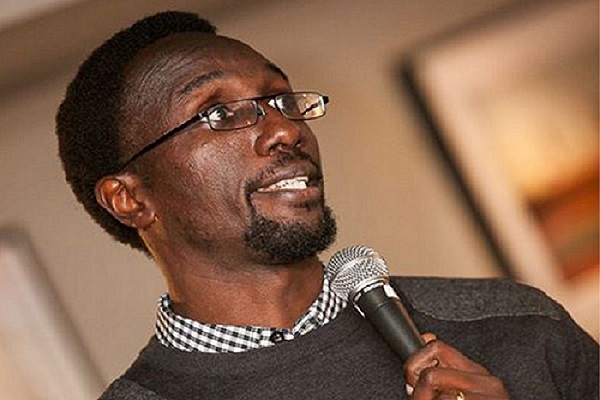
Do you read Dike Chukwumerije? You should. He is a national treasure.
Below is his 3-part essay titled, “I Know Why Lizzy Wept.”
——- I KNOW WHY LIZZY WEPT (PART 1) ——- I was 17 when I went to Uni. And I remember writing down two goals. One was to graduate with a First Class. The other was to go to the Olympics. And I set off in pursuit of these goals with one of the four super powers I know I was born with – Perseverance. I spent my days in the library, never missed my classes, and – no matter what pleasures the night promised – went to bed early. At dawn or dusk, almost every day, under the cover of darkness, I would train. Sometimes, my closest friend would come, just to watch. You see? He was the only company I had.
For my school had no sports program (well, apart from 5-a-side football, and later on basketball). It had no gym, no sports complex, no sports culture, no sports mentality. Nothing. I didn’t even have the local competition circuit I had grown up on in Lagos, where Taekwondo clubs on the mainland and island would routinely meet. For Abuja was still a concrete city. Nothing. But I kept punching and kicking the best I could. But who can stay sharp without competition? True. And, I tell you, that competition did not come till the tail-end of my 4th year. In its history, this was the first time my school would go for the NUGA games. But, by then, honestly, I was no longer sharp. 4 years of isolation had dulled me. So, I lost my 2nd fight.
But I was back on the circuit! And having now discovered Taekwondo in Abuja, made it onto the FCT team, to go to the National Sports Festival the next year. This was at the start of my final year. You see? From my first year, in the absence of any way of actualizing my sports ambitions, I had given myself completely to the pursuit of my academic one. And it was now within sight. But, suddenly, so too was a chance to take a small step towards my Olympic dream. So, for a few weeks, I lived the life of a professional athlete. And at the Sports Festival, fought my way into the finals. And lost. True. Sometimes, it is less painful to come last than to come second. True. In the aftermath, I weighed the cost of continuing to pursue sporting glory (which included the left eye I almost lost in the ring) and that of chasing a First Class. And decided to let one go, and focus on the other. You understand? It was a heart-wrenching decision, but it did not make me cry.
I focused on my studies. And after 5 years of giving it everything I had in sun-scorched Gwagwalada, imagine? I graduated with a Second Class Upper – less than a quarter of a point away from a First Class. This broke my heart, but it did not make me cry. I squared my jaw and said, I will make this right in Law School. At Law School, from my campus (Agbani), there was only one First Class. And it wasn’t me. Again, a Second Class Upper. At this point, I looked at what I had written down at 17 – 2 goals, and here I was 7 years of graft and discipline later, and I had failed to meet any of them. You see? Success is subjective. So, honestly, it did not matter to me that those who thought they would Fail and made Pass, or those who thought they had Pass and staggered into Third Class were looking at me (are even now still looking at me) as if I was crazy, deep in my heart, I felt like a failure. And there in that valley of extreme self-immolation, tears came to my eyes.
Till I noticed something. That while working hard through school in single-minded pursuit of one goal, I was always that student other students looked for in class to ask, ‘Please, Dike, can you help me explain this topic?’ As a result, I had spent my entire time at Uni and Law School giving tutorials and mini-lectures. And in the process had discovered 3 other super-powers I was born with. One, the ability, after a long time in thought, to suddenly see complex things in simple pictures. (My mother calls this – Insight.) Two, the ability to communicate those complex things I could now see in simple pictures to others in a language that allowed them to see it too. And three, well, that if I really, really want to, I can memorise for Africa. And in that eureka moment I understood something – that sometimes when God puts a goal in your heart it is not so that you can achieve it. No. Sometimes, He puts it there is so that in reaching for it, you can stretch to your own full height. You see? Because, self-realization is, really, the only objective God TRULY cares about when it comes to you. You understand?
And it made me happy again. Plus, the fact that if after a series of deep, soul-wrenching, heart-breaking disappointments, you can still find joy, and meaning, and the motivation to roll out of bed with a spring in your step, love in your heart, to get stuck back in, then – honestly – nothing do you. True.
Ehm, I know you think the title of this article is a strange one, but if I remember to write the follow-up to it next week, it will make sense.
——- I KNOW WHY LIZZY WEPT (PART 2) ——- One of my earliest memories of my youngest brother is of me trying to teach him a poomsae. That’s a Korean word in Taekwondo (TKD) for a specific set of movements. Sort of like learning a poem. Only that the poem is in physical movements. And at each stage in TKD, you have to master the ‘poem’ for that stage so you can go to the next. Like this, the ‘poems’ progressively grow more complex as you move up. Yes. One of my earliest memories of my youngest brother is of me teaching him the first – most basic and simplest – of all the poomsaes. For he was a white belt and I was brown, both of us children, but I cannot forget the levels of irritation I felt each time he failed to get it.
Yes. Looking back, I now know that what I thought irritation was actually love. You see? I wanted him to get it. I wanted it so much that I held my breath each time, watching him struggle to remember whether what came next was a block or a punch. And if he went on to make the wrong move, my heart would twist itself into a painful knot. Yes, I accept. I called him ‘block-head’ a few times, on account of this. Yes. I accept. But it is not easy to teach someone you really love. No. It is not easy to have to watch them try and figure things out themselves. You know? Like this, twenty years later, I could not sit and watch him fight at the Beijing Olympics either. No. I stayed in the bedroom, and shouted out to wifey – ‘Is he winning?’ I don’t know. Between the person in the ring, and the person watching, I do not know who suffers more.
Like this, I have watched my brother grow, from when I towered over him to when he began to tower over me. See, I am not here to tell his story. Not really. Only that, often, the road the Nigerian athlete must travel just to get to the starting line-up of an Olympic event is a long torturous one. But, like Spartans, we do not complain. Like this, in between graduating with a 2.1 in Mechanical Engineering from FUTO, finishing his NYSC, and going on to a distinction in his masters, he fought his way into 3 consecutive Olympic finals. No, it was no chwa-chwa. It is not chwa-chwa to go undefeated as national heavyweight champion for 13 years. It is blood and sweat, miles and miles of open road. It is broken bones. Like this, I tell you, in the qualifiers for the 2012 London Olympics, he went to Egypt to battle it out. And, there, his opponent – who you must allow me to call a complete arsehole – deliberately stomped on him as he lay on the floor. And broke his nose. But, like Spartans, we do not complain. He got up and got the job done.
For his heart and soul was set on winning Gold in London. For 12 years, it was all he had lived for. From his first Olympics at Athens where he got nothing, to the next one in Beijing where he won Bronze, it was inevitable, surely, that at this one – the last of Olympics for him, now an athlete in his twilight years – he would do better. Surely, this was inevitable? This was the weight of expectation he carried on his shoulders as he stepped into that ring. As Captain of Team Nigeria and veteran competitor, surely, if nobody else could do it, he could? This was the weight. And, as it had been 4 years before, I could not watch. So, I stayed close to my phone, waiting. And when it came it was like when we were children, when his every failure to get it broke my heart. Yes. In London – after everything he had been through to get there – he lost his very first fight. And ended his dream of Gold at the Olympics.
Honestly, I don’t know. Between the person in it, and the one watching them go through it, I don’t know who suffers more. Honestly. But when Life raises its hammer up to the skies and brings it crashing down on your life, that is when you are in the best position to find out who you truly are. Yes. This is what my people mean when they say, ‘mberede ka-eji a ma dike’. I tell you. Greatness, true greatness, is always a come-back act. No doubt. And if you have not yet passed through your own Dark Night of the Soul, I tell you, no matter how much you think you have achieved, you are not yet at full potential. So, to encourage him, at the time – I wrote him a poem. But, as it is in life, this was not what resurrected him. No. It was him realizing for himself that, always, when God slams a door in your face it is because He wants you to take a second look around. And that is what my brother eventually did. He raised his head and took a second look around. And that is how we come to the story of this Lizzy I keep talking about…You see? But it is not good to write too much on Facebook, is it? So, let us leave the concluding part till next week.
——- I KNOW WHY LIZZY WEPT (PART 3) ——- I’ll tell you this, Nicholas is not your typical Nigerian. For one, he practices what he studied. You know? Not like us who read Library Science and are running hair salons. You know? Or Law and are now writing poems. I tell you, Nigeria is the universal condition that bends the crayfish. But not Nicholas. No, Nicholas is what he studied – a Guidance Counsellor. That is One. Two, when he sees Abuja Environmental chasing street hawkers, he does not dwell on the irony of government destroying jobs in a jobless economy. No. He dwells on how fast those kids run to escape. And should he catch up with one such out-of-breath child, he is the type of Nigerian who asks, ‘Come, have you ever considered Athletics?’ Yes. This is Nicholas.
Yes. This is the Nicholas that, one day – 7 years ago – went to Government Secondary School Lugbe for work. And, on his way out, noticed some students chatting. One of them was so tall she towered above the others. This is what he noticed. So, he went to this girl, on account of her striking height, and asked if she was interested in Sports. In typical teenager fashion (she was 15), she shrugged and said, ‘I guess so’. So, he gave her his number. ‘Give this to your parents please. And let them call me.’ That girl was Lizzy. And two days ago, the Chika Chukwumerije Sports Foundation (CCSF) organized a reception to welcome her back from the Tokyo Olympics.
You see? It was at this reception that I met Lizzy’s parents. They are the type of Christians we may respectfully call ‘jim-jim’. You know? Not the type you think would free a teenage girl so easily. But when he was younger, Lizzy’s father was a boxer. But had a coach who, instead of showing him the ropes, told him to submit himself to local science (aka witchcraft) for ultimate success. So, he quit. But, you see, even if you give up on your dreams, your dreams will not give up on you. No. They will haunt you for the rest of your life. So, he thought, maybe Lizzy can make them come true. And made the call.
This is how Lizzy started going to the stadium with her father to meet Nicholas. And there, at the stadium, Yaga spotted her. Yes. The same Yaga I told you about last week. The 3-time Olympian whose quest for Gold ended in heart-breaking disappointment. And had turned that disappointment into a determination to make champions. So, he set up a Foundation, and – like Nicholas – was actively combing through the public school system for prospects. Yes. He was at the stadium that day, training with another brother, Uche, who is himself an African Champion, on account of the fact that our father, many years ago, had invested so passionately in sports that 5 of his 8 children had become National Champions, 2 African Champions, and 1 an Olympic Bronze medallist. Yes. This Yaga was training with this Uche at the National Stadium, when he looked up and noticed Lizzy. Again (apologies to the vertically challenged), it was her height. So, he walked over and said: ‘If you allow me to train you, I guarantee you that you will win gold for Nigeria in Taekwondo’. True. Today, Lizzy is the current national champion in her weight category, and recently won Gold at the Beijing Opens.
Anyanacho Elizabeth Oluchi
And, no, it did not happen by local science. Or jim-jim prayers. It happened by the application of a structured, experience-inspired, evidence-based training program. I tell you, watching Yaga train his team – all discovered in public secondary schools – sprains my ankles. I tell you. Watching them kick gives me back pain. And he tells them too – I want educated champions. You know? That is why – at that reception in her honour – Lizzy spoke with ease. For she is now a 300 level student at FUTO. And, yes, CCSF paid her acceptance fee, and sponsored her through First Year, but she has now made enough money as an athlete to provision for the rest of her time at Uni. Imagine? This was the burden she carried into the ring in Tokyo – this knowledge, of how much had been invested in her, how hard she had trained, how many people were willing her to win. You know? It is one thing to train the body, but only experience can train the mind to handle the pressure of the big moments. So, she lost. And it broke her heart to a million pieces. And, yes, this is why she wept.
But, no matter, we made her smile again. As we gathered to welcome her home. You see? AIT was there. NTA was there. AriseTV was there. Imagine? For a girl who lost her first fight at the Olympics. But we are not typical. No. We do not tune in every four years to watch a fellow Nigerian at the Olympics, and tune out with a hiss the moment they lose. No. Gathered that day were people who understand that, ultimately, to win is to refuse to be defeated by defeat. That is why Yaga organized that reception. For Lizzy was no longer a 15-year-old girl, mentally limited by the fact that she was born in Nigeria to lower-income parents. No. She was now the 28th ranked female Taekwondo player in the whole wide world. And it was important to let her know this, that on days when how far you have to go discourages, how far you have come must encourage. This is all it takes to keep walking…
Now, imagine it. Yes. Imagine it. If instead of chasing hawkers through traffic, Local Government was actively doing what the private citizens in this story are doing. Imagine it. A country so talented a random girl picked from a random school in a random city could, in 7 years, be competing at the Olympics. Just imagine what this country would be.
First of all, I hereby wish Gen. Ibrahim B Babangida (rtd) a most happy 80th birthday anniversary. I say this from the bottom of my heart. I sincerely wish I could reminisce about the laudatory and gay experiences of this Reporter, who in April 1986 became State House (Dodan Barracks) Correspondent for the leading newsmagazine of that era, the Newswatch. As experiences go, I could focus on, say my first trip to Abuja, for the 1986 Independence Anniversary. There was no Aso Rock Presidential Villa State House then. A few flats in Wuse Zone Three, very close to the Halli Brothers junction was what could then be called the State House.
It was in one of the rooms there that I overheard a telephone conversation that later became consequential in Nigeria. Babangida’s Number Two man, Commodore Ebitu Ukiwe (rtd) asked his media aide how things were in Abuja. The aide related to him that a new programme for the anniversary activities had just been released, and that instead of Ukiwe going into the parade grounds (in Area Ten) directly before the military President, that in the new one Ukiwe would enter the parade grounds before the Army Chief of Staff, Gen. Domkat Bali, and then Gen Ibrahim B Babangida (rtd) would come in.
I heard Ukiwe say clearly: “In that case then, I will not come to Abuja. It had been agreed that I will not be attending purely military activities, where Gen Bali would be the Number Two after the President. But he too will not attend non-military activities, where I will be the Number Two to the President”. And because Ukiwe failed to attend the 1986 Abuja ceremonies, he was cashiered.
Yet, to write about such would be a disservice to Nigeria. This is especially so as some persons have started a calculated attempt to, by sheer force, browbeat all of us into forgetting the disaster Babangida brought on the nation when he annulled the June 12, 1993 election. Beneath that in order of consequence lies his smuggling of Nigeria into the Organisation of Islamic Countries (OIC) and his introduction of Structural Adjustment Programme (SAP) into the country.
Recently, there has been a burst of activities in the Nigerian firmament as Gen. Ibrahim B Babangida’s associates try to paint the legacy of his eight- year long administration in a favourable light for his 80th birthday. But all their efforts may be as fruitful as deodorized bullshit; it will still smell and appear nasty.
Those same associates of IBB, may not remember it now, but they and their champion had a chance to work out a wholesome legacy but that did not matter to them as they pursued their narrow-minded and personal interests, as against the interest of the nation. They were sure and autocratic footed in their despotic ways, disdaining all attempts to call them to order or to walk in another direction.
The result is that for almost 30 years Babangida has remained alive to see his name being used as a bye word for nothing wholesome. Before I go into the intricate details, I must take journalistic notice that soon, President Muhammadu Buhari’s associates will also ask the citizenry to be magnanimous enough as to grant Buhari stratospheric pass marks concerning the way and manner he ran his administration. In fact, Buhari said recently that he hoped history would be fair to him. On reading him, I wondered if he does not know that the moment he assumed office as President, he started writing his personal and his administration’s history. Attempting to change that history after he would have left office would be akin to someone blowing against the wind. Even Babangida himself has shown us how to judge Buhari; he said that compared to is successors’, (and that includes Buhari’s), his own anti-corruption record appears angelic. Ah ha!
So, what I have for the likes of the newspaper columnist and Economist, Mr. Dele Sobowale, is serious pity, as he attempts to present Babangida in more favourable light. It is a mission impossible.
I know that the likes of Sobowale have argued that it is satanic to judge a man whose presidency spanned all of eight years on just one act; his annulment of the June 12, 1993 election. Some have even argued that 28 long years have passed since 1993 and so Nigeria must have had several opportunities since then to correct that mistake, no matter how costly. To such people I have only a reminder: “ä fool does not know the gravity of an offence”. IBB and Dele Sobowale are no fools but verybright minds, and so they should know the gravity of that terrible offence. There is another reminder; societal wounds are difficult to heal. I sincerely wish that the present leaders should take this lesson to heart and begin to correct their mistakes, because the since 2015, Nigeria’s unity has been steadily shredded.
Unlike coup speeches, Independence Anniversary addresses are often well-prepared documents and are signpost for the future. On October 1, 1995, IBB pointed out four main problems with the Nigerian economy which he had to tackle. One; “Decrease in our domestic production while our population continues to rise”. But did the domestic production increase under IBB? No, is the answer. Many manufacturing plants began to close under Buhari’s military administration owing to a lack of raw materials. But this industrial sickness turned an epidemic under IBB. And that trend has yet to be reversed.
Two; “Dependence on imports for both consumer goods and industrial raw materials”. Yes, IBB vowed to change that trend, but he failed woefully. That failure has been replicated by every succeeding administration.
Three; “A grossly widening gap between the rich and the poor.” That gap became really accentuated for the first time during IBB’s regime and has only worsened afterwards.
Four; “The big role played by the public sector in economic activities with hardly any concrete results to justify such a role.
In that speech IBB announced a ban on the importation of maize, rice and vegetable oil to “shift attention from buying and selling syndrome ad parasitic services …to increased total real production, rising labour productivity and greater efficiency in investment”. Please, could anyone point out in which way IBB’s regime succeeded in any of the above points.
In his 1986 Independence Anniversary speech, IBB promised to: 1; Restructure and diversify the productive base of the economy to reduce dependence on the oil sector and imports. 2; To achieve a fiscal balance of payments viability over the medium term and 3; to lay the basis for a suitable non-inflationary growth over the medium and long-term. Did he succeed?
New Year day 1986, IBB increased petrol pump price from 20kobo per litre to 39.5 kobo; a near 100% increase. That introduced Nigeria’s to IBB’s legacy – Structural Adjustment Programme. I am not an Economist but I am ready to debate any pro-IBB Economist on the effects of SAP.
Yet, SAP had actually started on January 27, 1986, when IBB introduced the Second-tier Foreign Exchange Market (SFEM). In two weeks flat the value of the Naira fell by 66%. In January 1985, the N1 fetched $1.2. Within five months of SFEM, five Naira bought a dollar, at the official rate and it was N7 to $1 at the parallel market. The 5.4 pre- SFEM inflation rate surged to 10.2 within a year.
Since then, the economy has been crashing and crashing. Let nobody tell me about the Third Mainland Bridge or the Rural Life for Women but instead tell me how IBB grew the economy and jobs. My challenge is mainly directed at Mr. Dele Sobowale for he is an Economist. Sobowale and the other Babangidaists whould be ready after that to join me in revisiting the June 12, 1993 election annulment and the result of IBB’s smuggling Nigeria into the Organisation of Islamic Countries.
Babangida has not apologised to Nigerians for foisting SAP on the nation. He has not appologised to the nation for smuggling Nigeria into the OIC and thus added, by that singular act, the religious divide that is tearing Nigeria apart today, into the age-old ethnicity issues. Now ethnicity and religious divide have turned Nigeria into a killing field.
Then there is the Babangidanomics which was hinged solely on SAP. He has not yet appologised for it. Not even when ani-SAP riots broke out in May 1989 did he plead with Nigerians or try to seek a better route to economic paradise for Nigeria. He berated Nigerians then, saying that the rioters were merely using SAP “as an excuse to wage war against the government in order to destroy the credibility of the military institution”.
A month after that, at the inauguration of the Armed Forces Consultative Assembly on June 5, Babangida told critics of SAP that he would not change the direction he was taking Nigeria to economically because: “This administration is committed to the programme because there is no viable alternative. We cannot and should not abandon this programme midway because the pains of trying to re-introduce it at a later stage will be worse than the current pains”.
And he actually said this then, to justify the SAP decisions: “The reports we have received and which we would like the opponents of SAP to know is that the prevailing situation in Nigeria is by far better than in any other African country. It is even better than the condition in most Third World states”.
Did Babangida bother to listen to the Manufacturers Association of Nigeria (MAN)? Actually, Babangida listened to nobody. Had he a listening ear, he would have heard MAN’s complain in August 1988, that capacity utilization was a lowly 35 percent “because of inadequate and inefficient infrastructural facilities, high interest rates, especially for the small and medium-scale manufacturing enterprises, sharp increases in the cost of imported inputs arising from the devaluation of the Naira”.
And on top of all the social and economic and religious problems Babangida unleashed on Nigerians, he annulled the freest and fairest election in the land to date. And what is his excuse: that he was forced to do so or there would have been a violent overthrow of the civilian regime that would have resulted. Haba, IBB, haba, have you forgotten the person who said, proudly, satiated with power, that his critics should remember that “we are not only in government; we are in power?” Why didn’t he use that power to retire the coupists if he knew what they were up to? Instead, he used the power to annul an election. IBB is 80 years old. I will respect his age and even pay due homage. That is why I am seeking soft ways of telling him that even his Number Two man, the late Augustus Aikhomu was not aware of his decision to annul that election. The Military High Command did not know. His spokesman, Duro Onabule, did not know. His political advisers such as the late Prof Omo Omoruyi did not know.
IBB annulled that election because he wanted to remain in power. And for that, he owes Nigeria an apology.
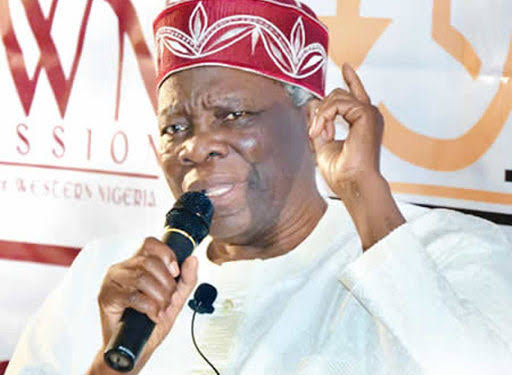
As an Octogenarian inching towards becoming a Nonagenarian, Professor Stephen Adebanji (Banji) Akintoye (born 1935), should be enjoying a well-deserved retirement and rest rather than being in the trenches against retired Gen. Muhammadu Buhari’s creeping fascism, complicity with, and duplicity on the vexed issue of insurgency and the Fulani expansionist aggression that have combined to lay to waste a sizeable portion of the country while also endangering the peace and security of virtually everyone else. Akintoye has laboured and deserves to have some peace and rest in the twilight years of his sojourn on Mother Earth; he deserves to look back on his many struggles and toils, his daring exploits and close shaves with death, and the comforts he had forfeited and the sacrifices made – all in the quest for a better and greater Nigeria, and a just and egalitarian society fulfilling its mantra of “where no man is oppressed” and “where peace and justice shall reign”. Alas! Akintoye’s efforts – and those of the other nationalists and patriots like him – have, in this respect, all amounted to nothing but a waste of precious time and resources. The lofty dreams, the nationalistic fervour, the patriotic zeal of our founding fathers, and the labours of our heroes past have not only been in vain, they have also all been eaten up in the same manner that Fulani cows eat up farms all over the country, causing food scarcity and an exponential increase in the cost of living never before experienced in this country.
Akintoye qualifies as one of the “last of the origins”, being, as he was, a disciple of the late sage, Chief Obafemi Awolowo, as against the present-day caricature “Awoists” defined only by their Awo caps and spectacles! Akintoye remains one of those forged in the crucibles of struggle in the Awo era; a trusted foot soldier, a power-house of the intellectual fervour that set Awo and his political party apart from his contemporaries, and a reliable confidante that gave his all to the Awolowo “deutsche machine” that remains, till today, a reference point in the developmental strides it engineered way back ever before Independence in 1960. In the academic field, Akintoye leaves a formidable presence and is still counting; his curriculum vitae are, to say the least, intimidating.
According to Wikipedia, Akintoye attended Christ’s School Ado Ekiti from 1951–1955 and studied history at the University College (Overseas College of the University of London), Ibadan (1956–1961), and doctoral studies from 1963-1966 at the University of Ibadan where he was awarded a Ph. D. in History in 1966. He taught at the History Department at the then University of Ife (now Obafemi Awolowo University), Ile-Ife where he became a professor and Director of the Institute of African Studies from 1974-1977. He also taught African History in universities in the United States, including the University of South Florida, Tampa, Florida; Montgomery County Community College, PA, and Eastern University, St. Davids, Pennsylvania. Akintoye has written four books, chapters in many joint books, and several articles in scholarly journals. He took a leading part for some time in the politics of Nigeria and served on the Senate from 1979–1983 during the Second Republic. Akintoye is one of the current leading scholars on the history of the Yoruba people. His most recent work, A History of the Yoruba People (Amalion, 2010), draws on decades of new findings and thinking on Yoruba studies that challenge some previously dominant notions about the origins of the Yoruba. This work dispels the Middle Eastern and Arabia origins propounded by such scholars as the late Samuel Johnson (1846–1901) and also gave prominence to the works on the Pre-Oduduwa Period by Ulli Beier, among others. Akintoye also gave prominence to the role of Ilé-Ifè over that of Oyo. A reviewer, Prof. Wale Adebanwi, notes: “…this book directly contests and shifts the focus of Yoruba history away from what many have called the Oyo-centric account of Samuel Johnson… Where Johnson avoids the creation myth that positions Ife as the sacred locus of Oduduwa’s original descent and the orirun (creation-source), Akintoye, justifiably, restores Ile-Ife to its proper place as ibi ojumo ti mon wa’ye (where the dawn emerges)…”
Scripture says from the mouth of two or three witnesses, the truth of a matter is established (2 Corinthians 13: 1); so let us consider what another source (Careerbridge Africa…serving the disadvantaged) says of Akintoye on the occasion of its appointment of the erudite professor as chairman of its Board: “Prof. (Senator) Stephen Adebanji Akintoye brings to the service of Careerbridge Foundation a dignified career of high level service in academia and scholarship, governance and political leadership, assistance to businesses and entrepreneurship, experience in international relations, and extensive travel and contacts throughout the world.
“Prof. Akintoye attained his Doctor of Philosophy degree at the University of Ibadan in 1966, became a lecturer at the then University of Ife (now Obafemi Awolowo University) immediately, and rose very rapidly to the position of full professor in 1974, based on the exceptional quality of his academic work in research, publications, and impressive teaching. He was subsequently appointed Director of the Institute of African Studies in the same year. Prof. Akintoye has led an exemplary academic career spanning nearly five decades in Nigeria and the United States.
“Prof. Akintoye was the first employee of the new University of Ife (now Obafemi Awolowo University) to take residence on the university’s new campus at Ife in 1967 and during his tenure he earned commendations for his contributions to various aspects of the development of the new campus and university community. He was appointed Hall Master of the first male Hall of Residence, Fajuyi Hall, served for several years as the Secretary of the Ife chapter of the Nigerian University Teachers Association, and as the University Orator and, on commission by the University Council, wrote the first history of the university. Prof. Akintoye has also served as Visiting Professor at a number of American universities and contributed significantly to the establishment of an African and African-American Studies Program in one.
“Prof. Akintoye is one of the most eminent scholars of African History in our time. He has authored two books that are acclaimed as classics in Yoruba History, as well as five other books on various other aspects of African History. Additionally, Prof. Akintoye authored and co-authored many chapters in joint books, articles in academic journals, research papers for seminars and conferences worldwide, and hundreds of articles in newspapers and magazines.
“Prof. Akintoye is also a distinguished and influential elder statesman. One of the best known intellectual leaders in the political life of Nigeria in the era of the Nigerian Second Republic, he served as one of the founders and executive officers of one of the foremost political parties of the era. He was elected to the Nigerian Senate in 1979, where he served with great distinction for four years. He also briefly served as the Commissioner for Health in Ondo State of Nigeria.
“Prof. Akintoye is still admirably busy in the task of contributing to the building of the country of his birth, Nigeria. In particular, he invests much thought and energy in encouraging start-up businesses and growth among Nigerians. It is a great honour and inestimable asset to have Prof. Akintoye as the first Chairman of the Board of Careerbridge”.
Akintoye lived in Pennsylvania, United States for a long time before coming back home finally and was, in August 2019 at Ibadan, the Oyo state capital, elected president, Yoruba World Congress, by a conglomeration of Yoruba self-determination groups. The ovation, however, did not last long as personality clashes and differences in modus operandi between Akintoye and some other leaders of the YWC led to its splintering a year later. After efforts to paper over the cracks failed, Akintoye and his loyalists changed their name to Ilana Omo Oodua in October 2020. Incidentally, none of the Yoruba self-determination groups that fought bitterly over “ownership” of the Yoruba World Congress is making waves with the name today! Every one of them adopted new names and moved on! Akintoye’s “Ilana Omo Oodua”, however, appears the frontrunner of them all. His insistence on self-determination, and not restructuring, sounds the right chord with most Yoruba nationals home and abroad who insist on the Yoruba going their separate ways from a floundering and tottering Nigeria rendered impotent and incapacitated by Buhari and his Fulani clan. Only the unbundling of Nigeria may put an end to its arrested development.
Enter Sunday Ighoho! The street protests by Igboho, actively supported by Akintoye’s Ilana group, have heightened the tempo of the Yoruba or Oodua self-determination struggle. Those who point at the reported tainted pedigree of Igboho miss the point; same also with those alarmed at the sudden radicalization of 86-year-old Akintoye. US President JF Kennedy said “Those who make peaceful revolution impossible make violent revolution inevitable” Another speaker said when you drive discussions away from the open place; you drive them into cellars where revolutions are made. Many knew why Igboho had to run for dear life after his house was invaded by the DSS in the dead of the night, with an unconfirmed number of his aides killed in cold blood, but not many were aware that Akintoye himself had been profiled, tracked, hounded and hunted silently by the same agents of the State. Only recently did information about his likely or impending arrest filter into the open. During the COVID-19 lockdown Akintoye discretely relocated from his Magodo, Lagos home to a secret location at Ife. When Ife also became unsafe, he had no choice than to move again, this time outside the shores of the country.
Akintoye has no apologies to offer for “fleeing” Nigeria, even if that is what some have chosen to call it. And he should not be in a hurry to return. He must ensure he does not put himself in harm’s way. He has nothing to prove by hastily returning to the vice-like grip of jackals and bloody hounds who have demonstrated scant regard for justice and low respect for the rule of law. It is to the eternal shame of the Buhari junta if an illustrious citizen like Akintoye is run out of town by fellows inferior to him in all materials in particular. In saner climes, Akintoye will be toasted and celebrated, not harried and hounded. But, then, this is Nigeria! I am sure you know what I mean! A popular saying is that he who fights and runs away lives to fight another day! I also heard the following saying from Mr. Osuolale Mustapha, a one-time General Manager of the PUNCH newspapers, to wit, “It is the cowardly General who tells the story of how the valiant General died in the battle field!” In the contest between two rams, the one that engages the reverse gear does so to muster more strength!
The two prominent leaders do not need any introduction. They are well known all over our world. One is leading the richest and most populous nation in Africa and indeed the black people of the world. The other one is leading the economic capital of West Africa. He was elected to lead the sixth largest economy in Africa barely 22 years ago. He was in office from 1999 to 2007 and has since 2007 till the present, been in power in the main nation within our nation. Yes, he rules in the commercial capital that harbours the only two functional sea ports in the country of more than two hundred million people scattered in six geo-political regions.
The more powerful leader of our nation today had contested the position three times and failed before 2015 when he borrowed some political brilliance from the other more influential national leader of the ruling party – that year (2015). Those who knew the subterfuge approach that brought Muhammadu Buhari to power in 2015 continue to insist that the Great ‘Jagaban Borgu’, Bola Tinubu actually combined resources with another wise investor from Rivers State and an Artful Dodger from Kwara State, among other resourceful risk-takers who invested heavily in the man they advertised to us as the only solution to all our corrupt orientations.
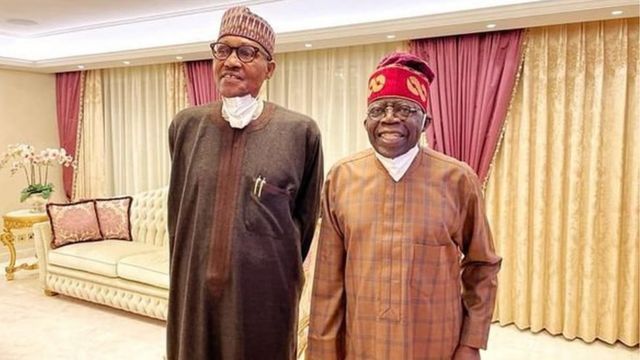
This isn’t a piece to blame the 2015 wise investment of the ‘Three Musketeers’ who saw raw gullibility of men and imposed what was thrice a hard sell. It is not a time of lamentation about those who stirred the conscience of the nation in 2015 when some rainmakers triggered the rain that has been beating us since. This is just a note to deconstruct the significance or should I say the consequences of a chance meeting in London last week between the two great leaders I have been blabbing about – Buhari and Tinubu.
They are great leaders. That is why they are in a great country where their minor ailments are being examined by some of the world’s greatest medical scientists so that they can continue their great work in their great ‘nations’ waiting for the greatness even Mandela foresaw before he flew away to the great beyond.
Not many of us would recall that I have noted several times here that I trained originally as a teacher – in a Teacher Training College when men had chests to believe in their children’s teachers. And so I know the power of repetition in classroom operations. That is why I would like to repeat the point I have been making since 2017 here when our elected leader on whose table the buck should really stop that it is not gratifying to note that the leader of the most robust economy in Africa has been flying to London for medical examination more than 60 years after the same London granted us independence and republican status.
The other day some cheeky and unchiselled commentators on digital platforms were even arguing that it is not good enough for us that our leader has been travelling to London for medical check-up; when his only son had a power-bike accident, he was flown to Germany for proper treatment and whenever his wife isn’t feeling fine she always flies to the United Arabs Emirate (UAE) where another great man and our former vice president, Atiku Abubakar prefers as his Plan-B home. Great men’s charity should always begin from abroad.
The other big man, whose cognomen is ‘Oba l’ola’, Yoruba people’s metaphor for ‘tomorrow’s king’ wasn’t around in his domain at the last Sallah celebration. He wasn’t in his empire a few weeks ago too when the crucial local government council elections were held. Yet his absence wasn’t noticed as they, as usual, won all the Council seats. Anyway that was how his supporters and indeed his people confirmed his rumoured medical condition, which has just been confirmed that it wasn’t a big deal, after all.
He was seen with the commander-in-chief he assisted to seize, I mean return to power in 2015. It can now be seen by all of us who have been circulating some dangerous intelligence that despite the secret pact so many eye-witnesses have hinted at, the lanky beneficiary of his 2015 stratagem would not honour the covenant to hand over to him, after all. We have all seen the great friends, political mentor and mentee together in London where it is said they have always met to renew their loyalty to each other concerning that #Covenant-2023. All doubting Thomases have thus seen that the two friends are as fit as fiddle. Don’t misconstrue the walking stick you thought you saw: it is a symbol of wisdom, which comes with old age. It is also a badge of royalty for ‘Oba l’ola’ (Furure King) in the old Western region. Don’t read their body language anyhow in the United Kingdom. They are great men and we have all felt great seeing them together in high spirit. They need our great prayers for good health and indeed healing too for our great nation as Nigeria’s leader returned home at the weekend.
It wasn’t clear whether ‘Oba l’ola’ too returned home at the weekend.
And so as our leader has returned to his kingdom after the great summit on education and examination of his health in the United Kingdom, he should listen to the voices of wisdom and reason, which most of us have been reiterating since 2017 that Nigeria’s commander-in-chief should take advantage of his summits and health-care experiences in London to invest purposefully in even a few hospitals where our leaders and our people and indeed Africans can also be cared for. Recall that Mandela told us before he joined his ancestors that Africa and indeed the black race would wait for Nigeria to lead Africa and the black race. Do you want me to quote Madiba again here? ‘The world will not respect Africa until Nigeria earns that respect. The black people of the world need Nigeria to be great as a source of pride and confidence’.
One thing is clear from this Madiba’s thought: The world will not respect Nigeria and indeed the black people of the world will not need Nigeria as a source of pride and confidence if Nigerian leaders at all levels cannot invest robustly in social services, notably education and health and human services. The world Mandela was talking about is beginning to look in the direction of Ghana because instead of investing in better universities, Nigerian leaders are strangely investing in more meretricious universities that could not produce even a department of computer science that could manage artificial intelligence centre for Google in West Africa. That was how the hi-tech giant found one in Ghana that has better but fewer universities than even Ogun state.
Before Nigeria began its war on #Twitter corporation too, the company had found Ghana as a better place to site its operations centre in West Africa, leaving the giant of Africa in the cold.
I think our great ‘Asiwaju of Lagos’, needs to reflect deeply too on why Lagos, our economic capital he has been shaping for more than 22 years hasn’t impressed the big data firms, Google and Twitter corporations, despite Mark Zuckerberg’s prediction that Yaba, Lagos would be a technology hub when he was in Lagos in August 2016.
Zuckerberg, founder and CEO of Facebook, was in Nigeria on his first trip to Africa, using his time in the country to visit the Yaba technology hub in Lagos, meet with developers and partners, and explore Nollywood.
According to reports then, Zuckerberg was in Nigeria to “listen and learn” and take ideas back to California on how Facebook could better support tech development and entrepreneurship across Africa.
One of his first stops on the trip was a ‘Summer of Code Camp’ at the Co-Creation Hub (CcHub) in Yaba, known as Nigeria’s Silicon Valley. CcHub opened in 2011 and at the time didn’t even have an office. Five years later, there were three floors and the roof of a building when Facebook CEO came calling. At CcHub people can learn how to code, developers can get help launching their first products, and find mentors and funding. At CcHub in 2016, Zuckerberg met with developers like Temi Giwa, who runs a platform called ‘Life Bank’. Life Bank saves lives by mobilising blood donations, taking inventory of all blood available in the country and delivering blood in the right condition to where it is needed. After visiting CcHub, Zuckerberg said: “This is my first trip to sub-Saharan Africa. I’ll be meeting with developers and entrepreneurs, and learning about the startup ecosystem in Nigeria…The energy here is amazing and I’m excited to learn as much as I can…The first place I got to visit was the Co-creation Hub Nigeria (CcHUB) in Yaba. I got to talk to kids at a summer coding camp and entrepreneurs who come to CcHub to build and launch their apps. I’m looking forward to meeting more people in Nigeria.”
Zuckerberg went to Andela, an engineering organisation building the next generation of technical leaders in Africa. Andela is a business that recruits the most talented technologists in Africa and shapes them into world-class developers through a four-year technical leadership programme. His visit then reinforced not only his support of Andela’s mission, but his belief that indeed the next generation of great technology leaders would come out of Lagos, Nigeria and cities across Africa.
Zuckerberg’s visit demonstrates to all Nigerian developers and entrepreneurs that they had caught the attention of the tech world, and they are capable of succeeding on a truly global level.
What happened to that Hub since 2016 when Zukerberg left Nigeria? Tinubu, the man who has been producing governors and political leaders for Lagos and most Southwest states should not allow the answer to that question to blow in the wind.
And so the urgent task before Buhari and Tinubu who rule Nigeria from Abuja and Lagos is that next time, we would like to see them after their medical examination in a Nigerian hospital. As they return home, the two great men should note that their greatness will be diminished by their abysmal failure to invest in even two British-class hospitals in Abuja and Lagos where they rule Nigeria. We don’t want to see them abroad together again on any health grounds. They need to pay attention to at least the University of Abuja Teaching Hospital,(UATH), National Hospital Abuja, (NHA), University of Lagos Teaching Hospital (LUTH) and Lagos State University Teaching Hospital (LASUTH). These are their low hanging fruits they can easily invest in to prevent the reproach of a great nation whose great leaders always fly over ill-equipped hospitals to get treated in great hospitals abroad.
Rule of Law is the law that rules and it has many other principles under it; supremacy of the law and equality before the law amongst many others. Over the years, rule of law has been a subject of agitations, controversies and divergent opinions – what it is and how it should be. The aim of this article is give a general overview of the concept of Executive Immunity in Nigeria and how it limits the applicability of the Rule of law in practice. Although, a cardinal principle of Rule of Law is Equality before the law, it may not always be the case in a modern Democracy, as some individuals enjoy some certain privileges which ordinarily a common man may not enjoy.
Additionally, the concept of Rule of Law being advocated for by various countries of the world, in a bid to implement same, may not fully apply as espoused by the ancient philosophers, but as espoused by modern philosophers due to certain changes and circumstances which have gradually evolved with time.
2.0 EXECUTIVE IMMUNITY
By virtue of section 5 of the 1999 Constitution of the Federal Republic of Nigeria (as amended), the Executive Powers in the Country are conferred on the President and Vice President at the Federal level and on the Governor and Deputy Governor at the State level while section 308 provides for the scope of the concept of Immunity conferred on the aforementioned citizens as far as Nigeria is concerned
A perusal of the provisions of Section 308 of the Constitution will show that the scope of this immunity clause applies to anybody holding the office of President, Vice President, Governor and Deputy Governor for the period of their tenure in office – the period of their stay in office is a period within which they hold the office in the respective capacities aforementioned. It follows therefore that the immunity clause will not shield the aforementioned persons who have left office. Worthy of note also, is that Immunity clause does not extend to Local Government Chairmen, Ministers, Commissioners or Traditional rulers. It should also be noted that the immunity guaranteed under this section is personal and not official. Meaning that, they can only be sued as President and or Governor respectively and only on matters relating to their actions as Public Office Holders and not in their own name.
The section absolutely prohibits the institution of or in any event of prior suit, the continuation of civil or criminal proceedings against the President, Governors and their Vice or Deputies respectively. Thus, all Nigerian Courts are therefore bound to take judicial notice of this provision even when not pleaded. The effect of Section 308 on proceedings against the aforementioned persons render such proceedings whether civil or criminal, null, void and of no effect. In Industrial & Commercial Serving Nigeria Ltd V. Balton BV, it was held that once one of the parties to the suit belongs to the category of office holders mentioned under Section 308(3), the suit must be struck out and this is the appropriate order the Court should make in such circumstance. Also, in R V. Madan, it was held that immunity need not be expressly pleaded, and that its existence alone renders the exercise of jurisdiction null and void. Thus, the Court is robbed of its jurisdiction where the party to the suit enjoys immunity. It is therefore no surprise that a High Court sitting in Kaduna state struck out an action once instituted by the Economic and Financial Crimes Commission (EFCC) against Former Governor Joshua Dariye of Plateau State on his assumption of office.
Moreover, the Court in A.G. Federation V. Abubakar also construed the meaning of the word “notwithstanding” which was used in opening the section. It held that when the word “notwithstanding” is used in a section of a statute, it is meant to exclude an impending effect of any other provision of that statute or other subordinate legislations so that the said section may fulfill itself. It follows therefore that, as used in section 251(1) of the 1999 Constitution, no provision of that Constitution shall be capable of undermining the said section. Thus, the above authority makes Section 308 absolute and not undermined by any statute.
The immunity clause as earlier stated is purposely provided to protect the aforementioned persons from any civil or criminal proceedings that might be instituted against them while serving in their respective capacities.
The question that however arises at this juncture is that in the event of a suit instituted prior to their assumption of office, whether a person can pursue an appeal against a President or Governor while still serving in their respective capacities.
The poser above has received judicial blessings by the Court in the case of Tinubu V. I.M.B Securities Plc, where it held that the combined effect of paragraphs (a) and (c) of subsection (1) of section 308 constitutes a total prohibition to the proceedings and any step taken to proceed with the Appeal pending, will amount to a nullity. This entails that where such a circumstance exists, the Court can suo motu raise the issue of the validity of such Appeal. Consequently therefore, a person to whom section 308 applies cannot while in office, pursue an Appeal before an Appellate Court.
It should be added however, that nothing stops a Governor or President from initiating a suit to obtain remedy from wrongs done to him. This principle was laid down as early as 1981 in Chief Victor Onabanjo V. Concord Press of Nigeria, the Plaintiff, the Governor of Ogun state in his personal capacity sued the Defendant, publishers of Concord Newspapers for Libel, and the High Court held that since the Governor was not expressly incapacitated by any provision of the Constitution, he could sue in his private and personal capacity. This decision has been cited with approval in Duke V. Global Excel Communications Limited. This case commenced at the High Court of Rivers State. The Respondent who at the material time, was the Executive Governor of Cross River State, instituted an action against the Appellants for an alleged libelous publication in the Global Excellence Magazine. Upon service of the writ, a conditional appearance was entered on behalf of the Appellants who also filed a Notice of Preliminary Objection based on the provisions of section 308 of the Constitution, challenging the jurisdiction of the Court to entertain the suit as constituted. The main ground of objection was that in line with the immunity clause enshrined in the Constitution and enjoyed by the Plaintiff under section 308, he too could not institute, maintain, or continue with any legal proceedings, including the present one in any court of law. Swayed by this submission, the trial court held inter alia that a serving Governor could not sue or be sued in his personal capacity while still in office. On Appeal, the Court of Appeal by a majority decision allowed the Respondent’s Appeal by holding that although a serving Governor cannot be sued, he can sue in his personal capacity while in office. On a further Appeal to the Supreme Court, the decision of the Court of Appeal was upheld.
This position of law has been criticized by many jurists and writers for not being a true reflection of the principle of Rule of Law. A tacit point raised by a writer is that if a person who enjoys Executive Immunity decides to institute a civil action in a private capacity and the defendant’s counter claim against him, should the office holder still be accorded immunity against such a counter claim? The writer opined that the answer should be negative as the office holder has unwittingly stripped himself of the constitutional protection. It is difficult to say what interpretation the Courts would give in such a situation. A counter claim by its very nature is regarded as a separate and independent action that may proceed irrespective of the dismissal, stay or discontinuance of the plaintiff’s action.
This being the effect of a counter claim, the Courts may be reluctant to sustain a counter claim against the beneficiary of executive immunity. Also, in A.G. Federation V. Abubakar (supra), The issue was whether having regard to the provisions of section 142(1) and (2) and Section 308 of the Constitution, the Plaintiff being a serving Vice President of Nigeria can have any civil or criminal proceedings including that which is commenced by filing a charge before the Code of Conduct Bureau established in the Fifth Schedule of the Constitution, instituted against him during the tenure of his office. The Court held that this category of people can sue but cannot be sued in their personal capacity during their tenure in office in order to enable them concentrate on the business of governance and shield them from unnecessary distractions (emphasis mine).
It is interesting to note that apart from the immunity clause shielding this category of persons from prosecution; it also prevents them from compellation to give evidence before the Court. Section 175 of the Evidence Act provides that all persons are competent to testify unless the court considers them incapable of understanding questions put to them or of giving rational answers by reason of tender years, extreme old age or disease of the body or mind. Consequently, the President, Governors and their Deputies are all competent witnesses. They are however by virtue of Section 308(1) (c) of the Constitution not compellable witnesses. No Court or even the National Assembly (in some circumstances) can issue a subpoena of whatever form, requesting the Executive either at the Federal or State levels to testify, tender documents or give Oral Evidence. Again, a person to whom Section 308 applies cannot waive such privilege.
3.0 CONCLUSION
The legislative intent for providing immunity clauses in most commonwealth jurisdictions is to protect the dignity and integrity of the holder of an Elective Office. This intention is particularly more fundamental and essential in Nigeria given the fledgling and emerging nature of the nation’s democratic institutions. Removing the immunity clause could open a floodgate of frivolous litigation against elected officers especially from “professional litigants” with the sole aim and objective of distracting the officer from the very serious business of governance.
The investigation of the activities of the incumbent office holders should continue as it does not conflict with the provisions of the section and they can be made to answer to these investigations as soon as they leave office.
This writer is of the candid opinion that the doctrine of immunity is in order in Nigeria and the rationale provided is also valid. However, it is also the writer’s opinion that Limitations should be provided in a separate Legislation, on the Doctrine of immunity to make for its easy amendment to suit the changing political realities of Nigeria considering the cumbersome procedure of amending the provisions of the Constitution. Afterwards, measures should be put in place to curb other limitations of Rule of Law in Practice to wit: Corruption, Illiteracy, Bad Leadership and Lack of Patriotism; and put proper measures in place to enforce the said legislation and the doctrine as a whole. The writer is confident that if these limitations are eradicated and limitations put in place against this doctrine, Rule of Law will enjoy smooth applicability in practice, especially in Nigeria.
4.0 REFERENCES
B.O. Nwabueze, Presidentialism in Commonwealth Africa Ojo, Constitutional Law and Military Rule in Nigeria Akande J., Introduction to Nigerian Constitution Ese Malemi, The Nigerian Constitutional Law A. Yakubu, Constitutional Law in Nigeria Bradley A.W., Administrative Law 3rd Edition C. Okanny, Administrative Law in Nigeria Sesan Fabamise, Constitutional Immunity Clause and the Fight against Corruption in Nigeria Nwogu Mary-Imelda Obianuju, The Rule of Law in Governance in Nigeria O. Igwenyi, Modern Constitutional Law Mohammed Mustapha Akanbi, Ph.D & Ajepe Taiwo Shehu, Rule of Law in Nigeria https://bscolarly.com/limitations-of-rule-of-law-5-factors-that-limits-rule-of-law Muhammad Yasir Abubakar is a fourth year Law Student of Faculty of Law | Bayero University | Kano. He is a Senior Advocate of Bayero University Kano (SABUK), an ardent Reader, Sterling Advocate, Researcher and Writer.
He has special interests in Advocacy, Constitutional Law, Corporate Law Practice and Alternative Dispute Resolution (ADR) amongst others.
He can be reached via E-mail: [email protected], Phone/WhatsApp Number: +2348144020560
Abba Kyari, Nigeria’s ‘super cop’ reputable for investigating celebrated criminal cases, is in the news for about two weeks now after an arrest warrant was issued against him by a United States District Court for conspiracy to fraudulently obtain and launder money. The Deputy Commissioner of Police is currently wanted by the Federal Bureau of Investigation (FBI) to face not less than three charges in his role in the internet scam spearheaded by Nigerian celebrity, Ramon Abbas, popularly known as Hushpuppi. The indictment is embarrassingly heavy and it is capable of leaving the international reputation of the Nigerian state in questionable corners if not well managed. Regardless of what may be said, the trials of Abba, the son of Kyari, would expose the battered image of our country to untold shame and leave its leadership to ridicule.
Ever since the news broke, there have been some disturbing legal and political insinuations by some quarters; coming after the empty exculpatory denial by Kyari. From being a super cop, he became a tailor, debt collector and later an editor; all within a twinkle of an eye. Considering the serious nature of the indictment, the infamous Facebook statement, which was later deleted, tells more about the intelligence of a decorated police officer that headed the Intelligence Unit of the Nigerian Police. That said, in the light of the controversies trailing the imminent extradition of Kyari, this article seeks to make a dispassionate analysis of the law and politics of extradition in Nigeria.
Nigeria is a sovereign state and no foreign authority can encroach its territory to effect an arrest or carry out an extradition without lawful justification. As a constitutional democracy, everything done by all authorities and persons must follow the law as established under Section 1(1) of the 1999 Constitution of the Federal Republic of Nigeria. It is on this ground that the extradition of Kyari must be carried out in accordance with the dictates of the law.
Under international law and Nigerian law, there are a number of factors that must be considered and conditions that must be met before a person can be considered extraditable. To start with, Nigeria and the United States must have in existence an extradition treaty. Interestingly, Nigeria and the United States have signed an Extradition Treaty long ago; precisely December 22, 1931 and entered into force on June 24, 1935. In fact, the existence of this treaty is incontestable as Nigeria has invoked its provisions to extradite a number of its citizens to the United States. In the case of UDEOZOR V FEDERAL REPUBLIC OF NIGERIA 2007 15 N.W.L.R. Part 1058 Page 499, the Supreme Court affirmed the existence of an Extradition Treaty between Nigeria and the United States. However, apart from the Extradition Treaty between the two countries, the Extradition Act of 1966, (Extradition Modification) Order, 2014 and Extradition Act (Proceedings) Rules, 2015 are sacred laws that set out the legal and procedural framework for extradition in Nigeria.
By virtue of Section 6 of the Extradition Act, an extradition request shall be made in writing to the Attorney-General of the Federation (AGF) by a diplomatic representative or consular officer of the United States and shall be accompanied by a duly authenticated warrant of arrest. Thereafter, upon the satisfaction of conditions precedent, the law places upon the Attorney General of the Federation the power and discretion to commence an extradition proceeding against a person named in the warrant of arrest in a Federal High Court. This discretion, it is submitted, shall be exercised judiciously and in furtherance of public interest. Importantly, the intervention of the court in the extradition process is to ensure that the provisions of the Extradition Act and other relevant laws are fully complied with. Therefore, where there is a breach of law in the process, there is likelihood that the court would not grant the extradition order.
Section 3 of the Extradition Act empowers the Attorney General to, among other things, reject an extradition request where the offence described in the arrest warrant is one of “a political character” and where “criminal proceedings are pending against him in Nigeria for the offence for which his surrender is sought”. Consequently, it becomes crystal clear that the success or otherwise of Kyari’s extradition lies principally on the shoulders of the Attorney General.
Curiously, the Office of the Attorney General of the Federation and Minister of Justice hurriedly stated that it has not received any official communication on the arrest warrant issued against Kyari. He emphasized that “everything will be done according to the rule of law and based on the dictates of the extant provisions of the law”. Indeed, I completely agree that due process must be followed in a matter like this. With profound respect, however, I find the Federal Government’s insistence on due process very hypocritical. For a government that treats rule of law and due process with contempt, the strange insistence on the dictate of the extant provisions of the law is sheer dissimulation. It is shameful and scandalous that a government that abducted Nnamdi Kanu from Kenya and attempted to whisk away Sunday Igboho from Benin Republic – all in brutal violation of international law and diplomacy – is the same government propagating the ‘rule of law’ in Kyari’s case; looking more like a suspicious defence to a loyal servant of the corrupt system. A government that shamelessly selects when to respect the rule of law should not be trusted and taken seriously.
In what looked like a melodrama, the Nigeria Police Force went ahead to set up a probe panel headed by the Deputy Inspector General of Police in charge of Force Criminal Investigations Department, Joseph Egbunike where Kyari has appeared no less than four times. It beats the imagination how the Nigerian Police Force is conducting an investigation, setting up panels and taking disciplinary actions against Kyari when the Federal Government of Nigeria is saying it has not received any official communication. I really worry if the panel probe is not an attempt to hurriedly commence a criminal proceeding against Kyari which would legitimately frustrate any extradition proceeding against him – bearing in mind the fact that the offence alleged to have been committed is recognized and punishable in Nigeria.
Finally, as a regime that claims to be allergic to corruption, I would prefer to give the Nigerian government a benefit of doubt despite the glaring predilections. The Federal Government must be sincere, dispassionate and cooperative with the United States. This is because Kyari’s travail will not only put Abba on trial. Kyari’s travail puts the Nigerian Police Force on trial. Kyari’s travail puts Nigeria on trial. More significantly, Kyari’s travail puts Buhari’s anti-corruption crusade on trial. While the law strongly supports Kyari extradition, the political and ethnic dispositions peculiar to Nigeria should not be deployed to scuttle the whole process. We must not misuse this rare opportunity to score a point.
Presumed innocent under the extant laws in Nigeria and the United States, Kyari has nothing to fear and the government should not desperately ‘protect’ him if indeed his hands are clean. With the little law I know, Kyari would have broken no law if he travels to the United States to answer the tough questions put to him by the District Court. Only the guilty are afraid!
Festus Ogun is a Lagos-based lawyer and human rights activist. [email protected]
There is light on the horizon for Nigeria. The fight against insurgency in the North East is now succeeding since the change of military chiefs and the acquisition of new weapons. We can also say this for the fight against the bandits in the North West. The South West is calming down since Sunday Igboho’s disappearing charm failed him in Cotonou. From all indications the South East too will normalise since the arrest of Nnamdi Kanu, their enfant terrible. However, North Central is now in turmoil as schools are being closed, some indefinitely, by governments because of the escalating activities of kidnappers. The state governments are now the ones doing the biddings of Boko Haram, unfortunately understandably.
Yet the question remains: What are we bequeathing our children and their children and the children of their children? I am here repeating what I wrote here in May this year:
Our next generation may not know what our generation knew, may not have what we had. We have failed to give them what the previous generation gave us. The peace and tranquillity we knew, the comfort and ease we had, the security and brotherhood we enjoyed, the careful laying of the foundation for our future we witnessed–all these we have failed to transfer to the next generation because we have thrown away the baton.
The problems of Nigeria are such that you get lost when talking about them. Where do you start from? The betrayal of confidence by leadership that much hope was placed on? Or is it the systemic and systematic decay in its affairs? The “me first” attitude of its people that see the country as a milking cow? Our lack of seriousness about what we should be serious about?
In Chinua Achebe’s book The Trouble With Nigeria, published in 1983, he professed that the only trouble with Nigeria is the failure of leadership. He wrote that with outstanding leaders, Nigeria could resolve its inherent problems, such as tribalism, lack of patriotism, social injustice and the cult of mediocrity, indiscipline, and corruption.
However, Joseph F. Mali, in his A Quiet Revolution: Some Social and Religious Perspectives on the Nigerian Crisis, thinks differently. He thinks corruption and failed leadership are not at the heart of the Nigerian crisis. He opined that even though corruption and misrule have done terrible harm to the country; they are by-products of something in the same way smoke is the by-product of fire.
The real trouble with Nigeria, says Mali, “is the lifestyle of profound selfishness the people and their leaders have in common”. And the nation still bleeds because of this evil, he said. Unless Nigerians cure this (disease), he maintains, no system of government is likely to succeed. “In vain do Nigerians seek political solutions as long as selfishness remains their credo!” Since Nigeria’s problem is moral, Mali insists, the remedy must also be ethical. He proposes A Quiet Revolution as a cure for Nigeria’s ailment. This revolution is not a silent coup to overthrow the Nigerian government. It is not a French-style rebellion with masses on the streets and peasants in the country put an end to centuries of absolute monarchy. Rather, the Quiet Revolution is an interior change, an individual transformation. As long as this change has not happened, Mali declares it will be difficult to repair and restore Nigeria.
This is quite in tandem with the Qur’anic verse that says Allah (SWT) changes, not the condition of a people until they change what is in their hearts. Here, the verse is widely quoted out of context by people wanting to give their idols in power excuses. People don’t just wake up and say: “We must change.” He always gives them someone who sensitises and organises them by leading them as their guide. Such a person is the leader; even the greatest revolutions and mass uprisings in history have guides, so it still comes back to the question of leadership.
God sends prophets to lead people to cleanse their hearts and become new. One by one, people change internally and get transformed individually, as Mali said, and collectively, a changed society is born. There is always the one who is a society’s mirror.
In July last year, I wrote on this page “God raises the living out of the dead and brings forth light out of the dark, He raises from among a people their type who leads them from deprivation to well being. Out of the palace of the Pharaoh, He raised Moses (AS); out of the family and society of idolaters, He brought forth Abraham (AS), and out of the heathendom of Arabia, He revealed Muhammad (SAW).
“Chaka the Zulu founded the Zulu Empire and led them for twelve years before he was assassinated on September 22, 1828. He moulded his people into a dominating fighting force never seen before in southern Africa. Mao Zedong, known as Chairman Mao, was the founding father of The People’s Republic of China and laid the foundation of what China now is. You can go on and count leaders who changed their people and their countries’ fortunes by leading by example. Cuba’s Fidel Castro was one; we also had Muammar Gaddafi from Libya, Dr Martin Luther King who raised the consciousness of Blacks, Dr Muhammad Mahathir of Malaysia and Mahatma Gandhi of India.
“These leaders raised the consciousness level of the people and changed them to better human beings, by being what they wanted their people to be. They did not look their people in the face condescendingly and patronisingly, pointing a finger at them singing “change” while they indulged in the vices of yore. Mao viewed such leaders as “swollen in the head, weak in legs, sharp in tongue but empty in the belly.”
Perchance this is one reason in 1999, years after he published his work, and despite Mali’s treatise, Achebe still maintained that Nigeria’s problem is that of leadership. He had returned to the country after a decade overseas, receiving treatment for a back injury sustained in an automobile accident. At his home in the South East, he met with Cunliffe-Jones to discuss the Nigerian crisis. Achebe’s view had not changed at all. He reiterated his old message: “If poor leadership caused the problem then, it is still the case today.”
Someone once explained our social and political reality: “those in power enjoyed the oil money while most other Nigerians languished in poverty. The masses, he said, could be described as innocent sufferers, like the biblical Job, or the Suffering Servant of Yahweh. (Nigerian masses) watch their leaders ruin the nation but could do nothing to stop them,” he concluded.
Unfortunately, the quality of leadership seems to dwindle, deteriorating by the day despite Nigeria being more populated than forty years ago when Achebe wrote his political polemic. We have more professors, more PhDs, more professionals, more intellectuals, more exposure, more enlightenment–more everything. Yet we have regressed so much concerning providing quality leaders and leadership in the country.
Because of this dysfunction in providing formal leadership responsive to the yearnings of people, tribal quasi-irredentists and jingoists have appeared on the landscape, setting the agenda and providing base leadership as stunted as their intellect.
The South-East produced Zik of Africa, Eton College-trained Ojukwu, Kingsley Mbadiwe of the Timber and Calibre rhetoric and Ambassador Extraordinary and Plenipotentiary fame. It also produced Alex Ekwueme, intellectual giants like Chuba Okadigbo, etc. Now it has a Mazi Nnamdi Kanu.
The South West sired Obafemi Awolowo, Adelabu Adegoke, Lamidi Adedibu, MKO Abiola, Lateef Jakande, Adeniran Ogunsanya, Pa Adekunle Ajasin, Chief Bola Ige, Olusegun Obasanjo, etc. But now it is Sunday Igboho after Ganiyu Adams.
The North? The North that produced Aminu Kano, Hassan Usman Katsina, Shehu Shagari, Shehu Musa Yar’Adua, Waziri Ibrahim has no one now, sadly. It has been searching since the demise of the Sardauna of Sokoto 56 years ago.
The lack of leaders who love this country has been our problem. While the current crop of leaders had the best of everything, they have not improved on what they got for those coming after them. The great public school system that groomed them is no more. They prefer to send their children abroad for tertiary education and private schools for their primary and secondary education. The American government recently said about 14,000 Nigerians pursuing graduate and undergraduate degrees across communities in their country spent $501 million (about N190 billion) last year. And this is just America!
The public health system that took care of them while growing up is a shadow of itself, as private hospitals and clinics have taken over. The leaders now indulge in medical tourism, spending billions of naira in hospitals abroad. In 2016, Price Waterhouse Coopers in its report stated that Nigerians spend $1 billion annually on medical tourism. It also said that 60 percent of it is from oncology, orthopaedic, nephrology and cardiology patients.
When the world was virtually locked down this time last year because of Covid-19, the average Nigerian patiently waited for conditions to ease. He believed that having realised our incapacity, Nigeria will witness massive developments in its health and education sector and an aggressive drive in food production. Outstanding leaders would also think that way.
It is unfortunate our generation has not replicated for the next generation what the last generation did for us. Instead of even giving them peace to do for themselves what we failed to do for them, we are bristling and threatening to push them into turmoil. Turmoil and uncertainty. We better retreat because the path we are treading will not stand us well in the books of posterity.
If we have failed in taking care of their welfare, we should not fail in securing their lives in a united Nigeria and giving them peace to thrive.
Our site uses cookies. By clicking “Accept All Cookies”, you direct Law and Society Magazine to store cookies on your device and disclose information in accordance with our Cookie Statement: cookie policyACCEPTREJECT
Privacy & Cookies Policy
Privacy Overview
This website uses cookies to improve your experience while you navigate through the website. Out of these cookies, the cookies that are categorized as necessary are stored on your browser as they are essential for the working of basic functionalities of the website. We also use third-party cookies that help us analyze and understand how you use this website. These cookies will be stored in your browser only with your consent. You also have the option to opt-out of these cookies. But opting out of some of these cookies may have an effect on your browsing experience.
Necessary cookies are absolutely essential for the website to function properly. This category only includes cookies that ensures basic functionalities and security features of the website. These cookies do not store any personal information.
Any cookies that may not be particularly necessary for the website to function and is used specifically to collect user personal data via analytics, ads, other embedded contents are termed as non-necessary cookies. It is mandatory to procure user consent prior to running these cookies on your website.