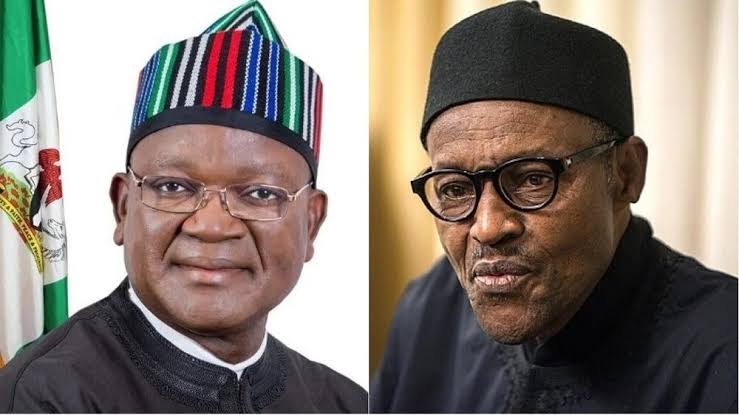
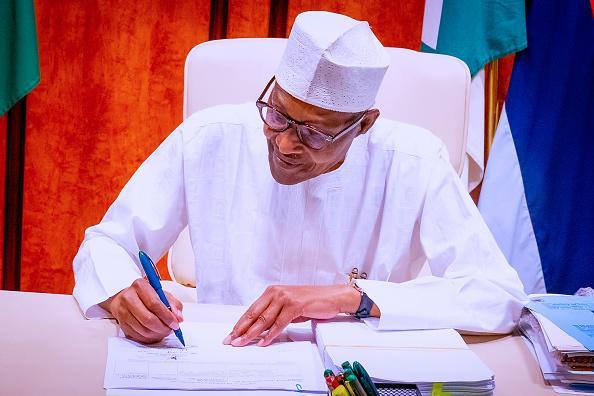
“Clothing Buhari in borrowed robes, Garba Shehu described him as compassionate, just and fair to all.
That is a false portrayal. No leader with Buhari’s nepotistic inclination can at the same time be fair and just…
“Nigerians are being kidnapped for ransom, raped, maimed and killed in their hundreds everyday and Buhari’s government has no coherent response.
Today, embattled governors, including Aminu Bello Masari of Katsina, Buhari’s home state, frustrated at the government’s impotence, are asking the people to defend themselves.
“That is the loudest vote of no confidence in the Buhari Presidency.
“Coming from his state governor makes it more jarring…
“These are the issues. Any other thing is mere red herring.
“Life has become worthless under Buhari’s watch and he must be called out because the bulk stops on his table.
“He cannot enjoy all the presidential perquisites without living up to the responsibilities of the office.
“Buhari’s presidency has become, without exaggeration, an existential threat.
“Nigeria, dangerously fractured, is tottering on the precipice largely because of the actions and policies of the President.
“His handling of the “Fulani Question” is the reason why Nigeria is plumbing the depths of death and despair.
“So, the President is the issue. It is tantamount to playing the axiomatic Nero, who fiddled while Rome burned, to ignore Buhari’s foibles in office while looking for solutions to the country’s myriad of problems.”
Please click on the link below to read the full article:
I simply guffawed when someone first drew my attention to President Buhari’s alleged much expected cabinet reshuffle. I told him tp hold his peace because it was impossible for Buhari to reshuffle his cabinet, as he was quite happy, comfortable with, and fixated with unbalanced lop-sidedness of his cabinets in the well over 6 years of his rudderless and lack- lustre administration.
Was it that President Buhari wanted power for the sake of it? Just to match Olusegun Obasanjo as having been both military and civilian President? Just to enjoy the unending pecks of office, fly presidential jets and get sent forth and heralded by kakaaki- blowing trumpeters and a horde of fawning obsequious and fawning aids? I cannot understand. Or, can you understand?
I was proved right afterall, upon reading the text of the alleged reshuffle. Buhari did not carry out any any cabinet reshufflement. All he did was to merely toss out two unwanted Northern Ministers and immediately, but expectedly, replace them with two wanted Northern serving Ministers whom he disingenuously drew from existing ministries. Thus, Minister of Agriculture, Alhaji Mohammed Sabo Nanono, was replaced by the Minister of Environment, Alhaji Mohammed Mahmoud Abubakar.whom he poached from the Environment Ministry. Similarly, Buhari replaced Alhaji Mamman Saleh of the Ministry of Power with Alhaji Abubakar Aliyu, the erstwhile Minister of State, Works and Housing.
As expected, I saw only Alhajis on the chessboard of his four players. I searched in vain, but did not see or hear of a Revd Tunji, Evangelist Okechukwu, Chief Ejiro, Dr Oshozokha, Elder Tyehimba, Mosignor Effiong, Mrs Toritsefe, Miss Ibiere, or Mr Anoko, I didn’t see any. Or, did you?
So, what has changed, nearly two and half years down the road after Buhari cobbled together one of the most impotent, uninspiring and incompetent cabinets ever assembled in the history of Nigerian governance ? Nothing; absolutely nothing at all !. At best, Buhari merely put new recycled wine into old tired skins.
Mind you, fellow compatriots, if the two sacked Ministers were of Southern extraction, Buhari would have promptly, with immediate alacrity, replaced them with Ministers from his Northern geopolitical enclave. Such nepotistic, prebendalistic, cronystic and sectionalistic mindset is what has done, perhaps the greatest damage to his colourless leadership.
My humble suggestion to Buhari, as a full- blooded Nigerian patriot ( not imported marauding AK-47- wielding foreigners killing and seizing indegenes’ lands and ancestral homes ) , is that he should immediately dismantle the entire cabinet, rejig and reinvigorate it with some flesh blood that can lift from the sorry State of nadir, his already failed government. He can of course retain some of the very few performing ones if he so desires. They are quite few and in-between. You can simply count them on your right hand finger tips.
President Buhari has told Nigerians that he will, in due course, replace the dismissed Ministers with substantive ones. Mr President sir, I hereby humbly challenge you to prove me wrong for once, only just for once, by appointing Southerners in place of your sacked Northern clique. Prove me wrong sir; and I will applaud you from my little inconsequential corner.
After 10 years of writing about capitalism I saw that the erasure of women is not only palpable, it’s bound to my own flesh and blood
… is the economics profession a functionary and tool of patriarchy – or is patriarchy a functionary and tool of economics? – Marilyn Waring
Economically, the rupture of 2020 showed us two things: that our lives depend on care work, especially the unpaid care work still mostly done by women; and that another way is possible.
It’s timely that Covid-19 has brought women’s traditional realm, the household, into clear and blinding view – because economics, the intellectual discipline that most shapes policy and funding decisions around the world, has its root in the ancient Greek word for household management. And if any discipline is in need of an influx of expert household managers to transform its ossified thinking and reimagine it for this new millennium, it’s economics.
In its current state, mainstream economics is failing to address the many critical issues of our times, including gendered and racial violence, climate change, inequality, poverty, hunger, species extinction, ecosystem destruction, land theft and the privatisation of water. As Ross Gittins, economics editor of the Sydney Morning Herald, wrote in 2020: “leading thinkers among the world’s economists are still grappling with the embarrassing question of why their profession’s advice over many decades seems to have made our lives worse rather than better.”
As the past year has demonstrated, women excel in household management. Yet it was thanks to a series of deliberate decisions made during the 19th century that women’s critical labours were designated “unproductive” and simply wiped from view. Key to these erasures was Alfred Marshall, the revered father of neoclassical economics, who advocated strict limits on women’s choices lest they behave selfishly. Women’s reproductive labour had already been excluded from the realm of economics by Adam Smith and others, but Marshall mapped this onto a new distinction between market and non-market work.
Economics has its root in the ancient Greek word for household management. Photograph: Westend61/Getty Images
It was bad enough that the 1881 census of England and Wales had explicitly placed wives and other women engaged in domestic duties in the “Unoccupied Class”; but subsequently, following Marshall’s advice, the “Unoccupied Class” was struck from the census categories altogether. Why? Because if this main female occupation had been included in the reckoning, “the proportion of occupied women would resemble that of men”. In his influential work Principles of Economics, published in 1890, Marshall wrote that employing women was “a great gain in so far as it tends to develop their faculties; but an injury in so far as it tempts them to neglect their duty of building up a true home, and of investing their efforts in the personal capital of their children’s characters and abilities”.
Women’s unpaid domestic labour and all unpaid caring work are not counted and so don’t contribute to GDP
Does this sound outdated? Marshall’s view continues to inform the mathematics of the global economy, the census reports and national income accounts that generate the allegedly objective numbers that global policymakers depend upon.
This erasure was institutionalised in the United Nations System of National Accounts (UNSNA) in 1953, an accounting system that had come into its own in the 1940s to allow the US and Great Britain to manage their wartime economies. Governments now use the UNSNA to generate annual gross domestic product (GDP) figures, which have become the default measure of economic growth. By their calculus, the following expenditures all boost GDP and so, by definition, boost economic growth: the costs of war (currently estimated at US$14 trillion a year globally), illegal people and drug trafficking, and cleaning up pollution such as oil spills.
But women’s unpaid domestic labour and all unpaid caring work are not counted and so don’t contribute to GDP or economic growth. Yet in 1995 the UN Human Development Report estimated the value of women’s unpaid work at US$11 trillion per annum. It suggested that if women’s work was properly valued, it’s possible women would emerge in most societies as equal if not the major breadwinners, given they put in longer work hours than men. If national statistics fully recorded women’s “invisible” economic contribution, the report stated, it would be impossible for policymakers to ignore them in their policy and funding decisions.
If only our work were counted – then we couldn’t be ignored! We are half the world’s population: the numbers are on our side. So what if we demanded, in this new Covid-inflected world, that every government redirect that US$14 trillion currently spent each year on war and death-mongering into our life-giving and nurturing work?
Brilliant women at a wrong moment in history
If the economic erasure of women is palpable, it’s bound to my own flesh and blood. In 2018, after ten years of writing about capitalism, I began to think specifically about women and economics. It’s a recurrent theme in my family: my grandmother, as a runaway teen, worked as a clerk at the Bank of England during the first world war; two of her daughters graduated in economics during the second. I studied economics in the late 1980s and now my daughter is studying economics.
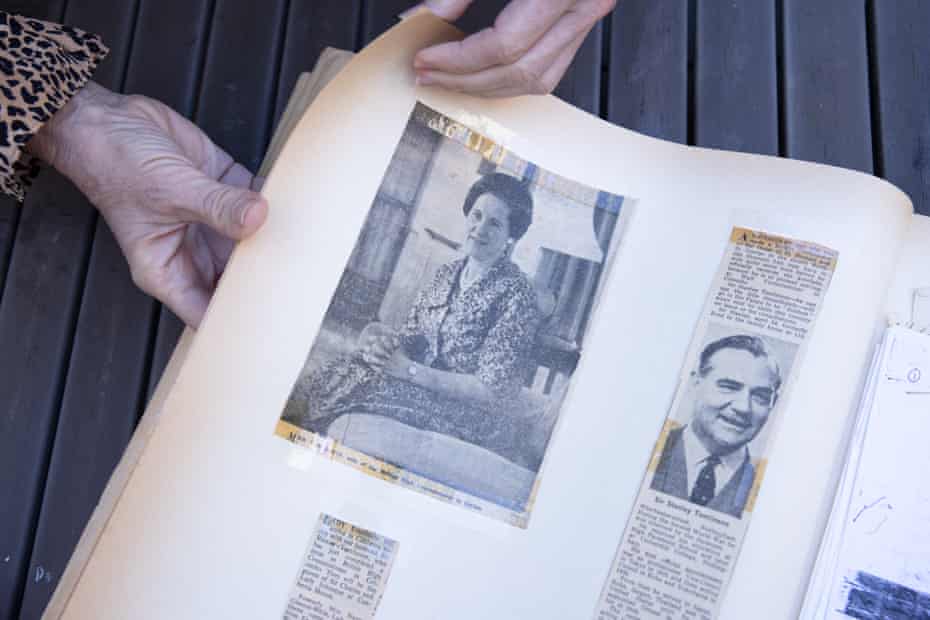
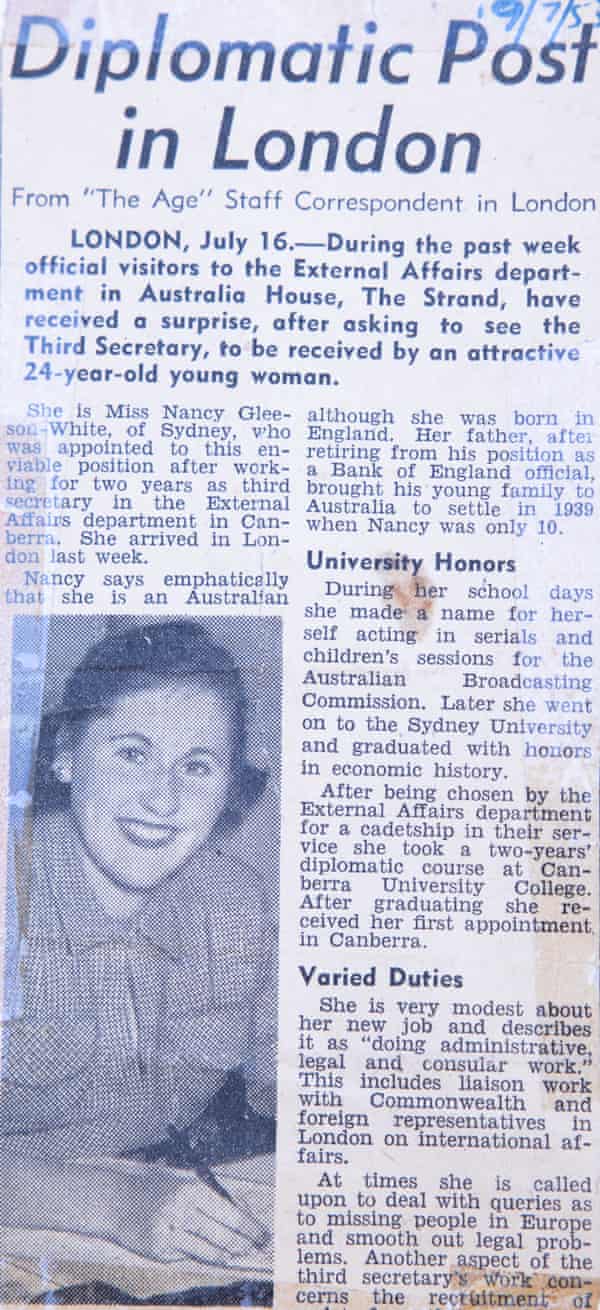
Clippings left to Jane Gleeson-White by her grandmother. Photograph: Carly Earl/The Guardian
When my grandmother died she left me her scrapbook. The tale I read there in newspaper cuttings is one of four dazzling children: three girls and a boy, my father. But there’s a darker story behind its fragments, a story of women and economics. My father’s lifelong illustrious career stands out, first in economics journalism, then in finance and banking – and behind it sit the thwarted careers of my aunts, brilliant women at a wrong moment in history. The early promise of the youngest, Nancy, is told in a flurry of press clippings.
When Nancy first appears aged 12, she’s already a radio veteran: “In the two years she has been in Sydney since coming from England, Nancy Gleeson-White … has made 150 appearances on the radio.” Soon after, there’s this:
Trained for the stage, Sydney actress Nancy Gleeson-White has won high economics honours at Sydney University, being the only woman in the history of the economics school to graduate with first-class honours. Now a cadet with Department of External Affairs … she hopes her career will take her abroad. Aged 20, she was one of three women from all over Australia to fill cadetship vacancies.
In 1953, aged 24, she became the first Australian woman diplomat to be appointed to Great Britain. As I understand her life, this was the moment of her undoing. In London she fell in love with a leading British diplomat and, in order to marry him, she had to give up her own career. That was the rule of the day. From then on in my grandmother’s scrapbook, Nancy is Lady Tomlinson, the charming wife and society hostess of a star British ambassador. She fades from view, first engulfed by articles about her husband, then vanishing completely.
In 1974, after breaking down, Nancy was given one of the last leucotomies in England – or lobotomies, as they’re called in America.
Five decades on, the female erasures my aunt so horrendously and literally embodied still infect and misdirect the mechanisms that govern the global economy.
In 1993, the UNSNA did introduce “satellite accounts”, which give guidance on valuing unpaid household work by calculating either its inputs (what the unpaid labour would cost if paid for) or its outputs (the value of the goods and services produced). But this labour is still defined as being outside the UNSNA production boundary, so it’s still excluded from “The Economy” and therefore from the official statistics that run it. In Australia in 2006, the last time this work was measured by the Australian Bureau of Statistics (ABS), unpaid household work would have increased the GDP by 39.2%. While the ABS parroted that measuring the value of this work was “a worthwhile pursuit” because it gives “a more complete picture of the nation’s economic activities”, it nevertheless continues to churn out incomplete pictures of Australia’s economic activities: annual GDP figures that give unpaid household and other care work the exact value of zero.
This, along with the erasure of the rest of the living systems of the planet, is literally killing us. Economics is historically blind to women and households, and to the natural world.
Still undervalued and underpaid
The subject of women and economics is vast and ancient – but as a scholarly enquiry, it’s relatively recent, dating to the landmark 1988 book Counting for Nothing: What Men Value and What Women Are Worth,by Marilyn Waring, former New Zealand politician and founder of feminist economics. Waring has said of her research into the UNSNA: “As a feminist in the 1970s, discipline by discipline, we were uncovering the ways in which male experience spoke for all. I suspected economics would be the same, and yes it was.” When she finally read the UNSNA’s many volumes, what she found made her weep: a passage that “casually dismissed all the unpaid labour traditionally done by women as ‘of little or no importance’”. This value judgement was used to justify its exclusion.
Marilyn Waring. Photograph: Fairfax Media/Getty Images
If this begins to suggest the systemic magnitude of the problem, here are three more facts that bring it home. First, in Australia in 2020, women were paid an average of $242.90 per week less than men – women are still undervalued and underpaid, and our work is generally more precarious than men’s.
Second, one in every 130 women and girls on the planet – 29 million people – lives in modern slavery, a term that includes forced labour, forced marriage, debt bondage, domestic servitude and human trafficking.
And finally, men own over 80% of arable land on Earth. This shocking statistic was calculated by Oxford economist Linda Scott, author of The Double X Economy: The Epic Potential of Empowering Women. By cornering humanity’s main source of material wealth, men have been able to retain power over the world’s capital for hundreds, even thousands, of years.
Given this, it’s not surprising to learn that economics is still the most male-dominated discipline in universities across the globe – even more so than science, technology, engineering and mathematics. It’s time to change this. Reproductive rights, freedom to leave abusive relationships and other freedoms are nothing without economic empowerment. This is about more than improving individual conditions; this requires wholesale systemic change, the sort envisioned by writer and feminist activist Rickey Gard Diamond and her colleagues in 2020 when they founded An Economy of Our Own (AEOO) to unite, educate and economically empower women and minorities.
Reproductive rights, freedom to leave abusive relationships and other freedoms are nothing without economic empowerment
The discipline of modern economics is usually dated to Adam Smith’s iconic book An Inquiry into the Nature and Causes of the Wealth of Nations, published in 1776. Smith’s upbeat view of the emerging factory system and its purported governing mechanism, the market, still infects economics more than two centuries on. His deification of the market as supreme arbiter and manager, and the subsequent institutionalisation of cost-benefit analysis as its unerring compass, smack of magical thinking, such as Smith’s belief that if each man acts selfishly, an equilibrium of wealth distribution will result.
Yet Smith’s blindness set the key for the UNSNA, which was rolled out across Europe as part of the postwar investment program under the Marshall Plan. It was imposed on the “developing” nations by postwar financial behemoths such as the UN and World Bank, whose investments in their economies required measurability and accountability – and economic measurement and accountability are synonymous with the UNSNA and GDP accounting. Since then, these figures have been used as policy tools to help national governments maximise economic growth, governed by the “Kuznets curve”. This is economist Simon Kuznets’s theory that “income inequality would automatically decrease in advanced phases of capitalist development, regardless of economic policy choices or other differences between countries, until eventually it stabilised at an acceptable level.” Or, as economist Robert Solow put it: “Growth is a rising tide that lifts all boats.” Kuznets later described the thinking behind his Nobel Prize-winning theory as “5% empirical information and 95% speculation, some of it probably tainted by wishful thinking”. And Solow’s “Growth Model” came with this footnote: “One can imagine the theory as applying as long as arable land can be hacked out of wilderness at essentially constant cost.”
In 1988 Waring correctly called these “propagandistic models”. Rickey Gard Diamond and her team at AEOO are contesting this economic sophistry by educating and empowering women and minorities to become agents for change in the public conversation about our money. Gard Diamond says: ‘For us, economics is not just about numbers and the bottom line, but about a gendered system of values that valorises money bullyboys and demeans all things “feminine” including our Mother Earth.’
This is the momentfor redefining our ideas of work itself and its value. It’s time to make unpaid and underpaid care work central to our economy, our global household. It’s time to invest in the structural change required to create an economy that actually values the work that’s essential to sustain us and the ecological systems that make life on Earth possible.
Speaking the wrong language
It’s devastating to learn that what you know to be the real wealth of the planet – not only all that unpaid care work but also the living biosphere – is defined as unproductive and valued at zero. I’ve written extensively about what seems to me the insanity of attempting to include these values in the existing global accounting systems as quantified monetary measures (insane because this economic calculus can never express the infinite value of the Earth’s living systems) – and simultaneously about the horrendous erasures and trashings that go on if we don’t.
In 2014 I explored these issues in Six Capitalsthrough a new accounting paradigm that attempts to address contemporary social and environmental crises by asking businesses to account for four “new” stores of value, or “capitals”, in addition to traditional financial and manufactured capital: intellectual, human, social and natural.
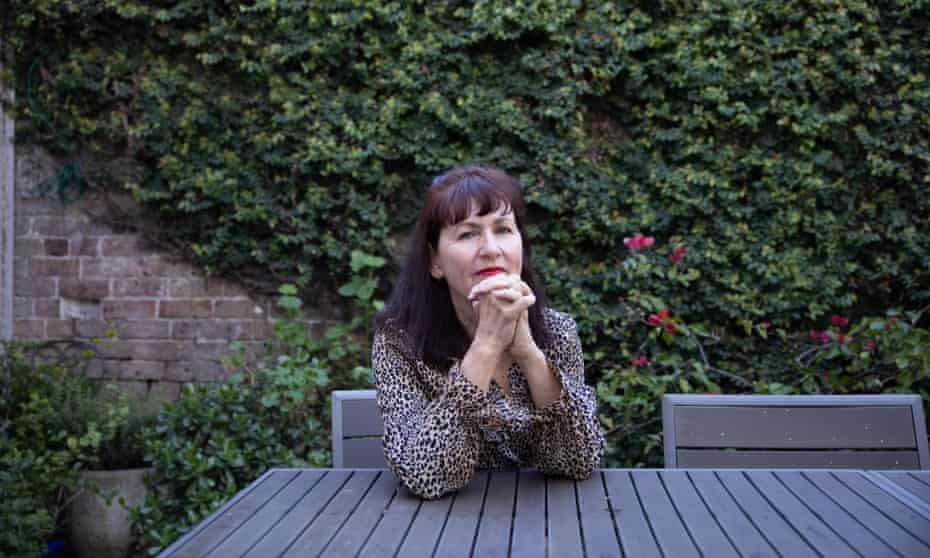
Jane Gleeson-White. Photograph: Carly Earl/The Guardian
Since then, I’ve been in the uncomfortable position of believing the problems my book addresses, the missing wealth of “people and the planet” and the failure of our current corporate and national accounting systems to value them, are critical issues of contemporary economics – while also fervently believing that the proposed way to address this, by conceiving of this uncounted wealth as “capitals”, is the wrong way to make them count. I state this in my book. But because I named it Six Capitals, its title became a shorthand that effectively erased my reservations and the complexities and alternatives I discuss, giving the idea a kind of iconic resonance that has sounded loud and clear in the global halls of power.
If, as economist Kate Raworth contends, economics is the “mother tongue” of public policy because all policy is expressed in its terms, then the words it utters have material effects. The scale of destruction caused by the language of capital and its casual deployment to describe a unique living forest, an ecosystem’s only source of fresh water, the harried people working for a multinational corporation or the women in a Bangladeshi factory working punitive hours for paltry wages finally tore me apart.Advertisement
In 2016, I was in Manhattan to speak at the New York Hedge Fund Roundtable’s inaugural sustainability conference – an event itself inspired by Six Capitals. I’d accepted the invitation because I believed that speaking from the heart, or attempting to, in these centres of power might crack open just one mind, one heart. But on that occasion, it was my own mind that cracked, at a morning session where three high-profile investment managers extolled the next sure-fire sustainable source of value, a natural capital.
They called it “blue gold” – and it took me some moments to realise they were talking about water. Not a capital, not gold of any sort. But a priceless, life-sustaining molecule. During that long day, I was filled with an inchoate sense that I was speaking the wrong language, a language that was somehow defaulting me to the wrong side, the side of those financiers who saw water as the next big thing rather than a basic human right.
Their terms are too small for us
For all those years I’d been speaking in my father’s voice, not my mother tongue: that was how I later put it to myself. And by using my father’s voice I was somehow betraying and silencing myself, one of the erased and uncounted in the economic system. But I was versed in economics – and I’d thought I could use its language and logic to demonstrate its own flaws to itself, to expose the omissions in the systems we’d constructed over several centuries.
The problem was right there, with that “we”. There was no we about it. This was an economic system that had been constructed piece by piece, law by law, concept by concept, economic theory by economic theory, over centuries by men.
That day in New York I felt the force of this truth to my core: I’d somehow got trapped in the language of applied patriarchy. My books had plunged me into an underworld of global capitalism where I’d met people in business, government and non-profits, mostly men, who were attempting to deal with a multitude of increasingly obvious social and environmental crises. After five years of listening to their rhetoric and following their initiatives, I realised that although many of them genuinely wanted to care for “people and the planet”, their thinking, language, work and institutions remained locked in a system the default of which is set to privilege money, profits and economic growth at the expense of everything else on Earth.
In January 2020, preparing to speak about the book in Europe and the US, I broke down again. I’d never been reluctant to speak in public before – and now I was positively petrified. As it turned out, Covid-19 postponed these conferences. But looking back now, I think I was scared of betraying myself – and violently – by speaking that old patriarchal language of capital once again.Advertisement
That was my point of no return. I will no longer speak of those six capitals and of attempting to value “society and nature”, “people and the planet” in their terms. I reject their terms. Their terms are too small for us: too small for all that we are as humans and the Earth’s living systems. I still stand by my book: it does important synthesising, clarifying and narrating work, and it continues to inspire those working within the system – but while the “six capitals” accounting model is an effective diagnostic tool, it is not a cure.
Clippings left to Jane Gleeson-White by her grandmother. Photograph: Carly Earl/The Guardian
Several months after that breakdown, I agreed to write this essay. Almost immediately, I pulled out. When the editor asked why, I was shocked by the flood of rage and grief this question unleashed – grief from my own experience in the belly of capitalism, and rage at the enormous “invisible” work done by so many countless women over so many, many years. And I found that I was still haunted by my brilliant aunt, Nancy Gleeson-White, whose early promise is written in the clippings that fill my grandmother’s scrapbook. And whose beautiful mind had been erased – sundered – forever, when she was just 45 years old. Nancy embodied the idea of erasure, so terribly and so powerfully, in a family whose lives were shaped by the language and expectations of economics.
A sacred social space
On the day of the Sydney March 4 Justice rally against gendered violence, I looked around at the crush of people of all ages and genders, from grandmothers to babies. It was one of 40 marches across the country that drew an estimated 110,000 people, all mobilised by a tweet from Janine Hendry, who called for a circle of women around our national Parliament House. That massing crowd reminded me, of all things, of the realisation reached by Steve Bannon, arch-right US political strategist and former investment banker, that these global women’s marches are a formidable new political force: “It’s not Me Too. It’s not just sexual harassment. It’s an anti-patriarchy movement. Time’s up on 10,000 years of recorded history. This is coming. This is real.”
I listened to the voices of those women who spoke, the leaders, powerful, undaunted and determined, some of them survivors, whose stories testified more potently than any statistic to the systemic erasure of women – we, who are 51% of Australians – that has rendered us invisible and silent. Aboriginal elder Aunty Shirley gave a welcome to country and described “the systemic mistreatment of Aboriginal women as ‘less than human beings’ since colonisation”, adding that “the historical facts of rape of women … go back to 1788”.
And from within this urgent protest, I saw how a radically reformed economics might look some day. In my vision, economics students sit outside barefoot on the ground, whose touch and smell tell them that this very earth is the matter at hand. They listen to the wisdom of their elders, First Nations women first, welcoming them to country, this land, telling their stories and sharing their wisdom. They learn that economics is the art of managing and caring for the Earth, this planetary household, and therefore for ourselves, all of us, equally; and that the economy is a sacred social space organised around relationships of care.
Just as my own lived experience inside the language and matter of economics has taught me that women and the Earth do count, it’s also taught me that relationships of care, not quanta of capital, are the things that we must maximise. Urgently. Now.
This is an edited extract from Griffith Review 73: Hey, Utopia! edited by Ashley Hay
A particular Nigerian politician popularised the axiom: “If this country does not kill corruption, corruption will kill it.” The axiom gained wider currency as a result of the level of impunity with which public officials fritter funds running into billions, without any serious consequence and the resultant retrogression it foisted on the nation’s development.
The trend of corruption and the failure by Anti-graft Agencies to effectively check the menace, according to an anti-corruption watchdog, Socio-Economic Rights and Accountability Project (SERAP), has hampered the ability of government to meet the needs of citizens.
SERAP argued that had the anti-graft agencies recovered the “missing” funds, the money would have helped the government to invest in public goods and services, and improve the living condition of citizens.
In a fresh suit before the Federal High Court in Abuja, SERAP argued that recovering the alleged missing public funds would reduce the pressure on the Federal Government to borrow more money to fund the budget, enable the authorities to meet the country’s constitutional and international obligations, and reduce the growing level of public debts.
The plaintiff, therefore, blamed President Muhammadu Buhari “over his failure to probe allegations that N106 billions of public funds are missing from 149 Ministries, Departments and Agencies (MDAs), and to ensure the prosecution of those suspected to be responsible, and the recovery of any missing public funds.”
The suit followed the grim allegations by the Office of the Auditor-General of the Federation in its 2018 annual audited report that N105, 662,350,077.46 of public funds are missing, misappropriated or unaccounted for across 149 MDAs.
Similarly, the Senate also uncovered an illegal collection of N76 billion by the Independent National Electoral Commission (INEC), Nigerian Army, Office of the National Security Adviser (ONSA) and others. The funds were said to be drawn by the Agencies from the Office of the Accountant General of the Federation, but were never repaid.
This was brought to the fore by the 2015 Auditor General’s report, submitted by the Senate Public Accounts Committee, chaired by Senator Mathew Urhoghide and approved by the upper chamber.
According to reports, N922.4 million was allegedly withdrawn from 25 per cent husked brown rice levy as a loan; N7 billion was collected from the one per cent Comprehensive Import Supervision Scheme (CISS) levy as a loan and N10 billion as a loan to the Independent National Electoral Commission (INEC) to finance the 2015 elections.
The record revealed that N17.92 billion was released to INEC as a loan on January 12, 2015, but was never repaid. Also, from the 15 per cent wheat grain levy, N31.4 billion was released to the Nigerian Army, National Youth Service Corps (NYSC), Revitalisation of Universities Infrastructures Account and Federal Ministry of Agriculture and Rural Development.
From the N31.4 billion, the Nigerian Army allegedly collected N4.7 billion to fund some of its activities; NYSC collected N6.4 billion to also fund its undertakings; Revitalisation of Universities Infrastructures Account collected N10 billion for funding Federal Universities, and the Federal Ministry of Agriculture and Rural Development took N10.2 billion to fund the 2013 dry season farming.
A quick reference to instances of alleged pervasive corruption being perpetrated in the country would buttress the inherent danger it portends to the nation’s socio-economic life.
A global coalition against corruption, Transparency International (TI) had estimated that about US$20 to 40 billion were stolen yearly from developing countries and hidden abroad, and said sometimes a small proportion was successfully confiscated and returned to the country of origin. Today, the scale of corruption from the prism of ordinary Nigerians is higher and above the one being projected by the international group against corruption.
Fifty-five officials of the government, ministers, state governors, public officials, bankers and businessmen were allegedly said to have stolen N1.34 trillion ($6.8 billion) from Nigeria’s public purse over the last seven years, Nigeria’s information minister had once alleged. While these massive lootings were going on at Federal Ministries and Agencies, Governors were allegedly having field days in their various states.
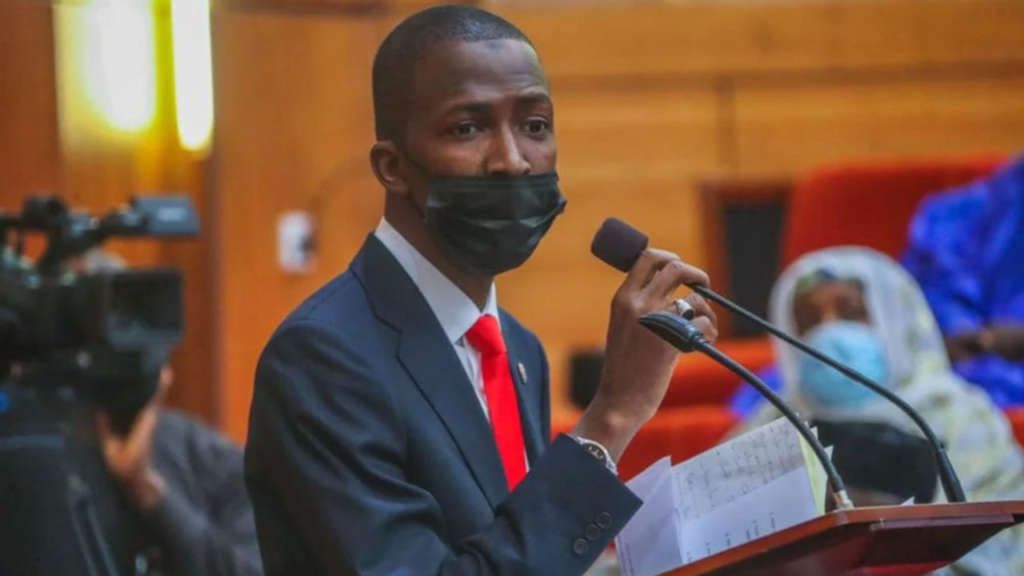
Abdulrasheed Bawa
Abdulrasheed BawaFight Corruption: Save Nigeria Group, a civil society group, in a petition, alleged that a former governor of Abia State received and diverted N383 billion revenue from federation accounts, N55 billion excess crude revenue, N2.3 billion Sure-P, N1.8 billion ecological funds, N10.5 billion loan from First Bank of Nigeria through the Ministry of Chieftaincy and Local Government Affairs, N4 billion loan from Diamond Bank, N12 billion Paris Club refund, N2 billion agricultural loan for farmers and N55 billion Abia State Oil Producing Areas Development Commission (ASOPADEC). Abia’s case only represents just an example of what allegedly happens across most states of the Federation, says the anti-graft watchdog.
The big question is: will the nation succumb to the fight against corruption or overcome it? Determined to win the war against the hydra-headed monster, the country had set up a number of anti-graft outfits such as the Economic and Financial Crimes Commission (EFCC), the Independent Corrupt Practices and other related Offences Commission (ICPC), the Code of Conduct Bureau (CCB), the Bureau of Public Procurement (BPP), the Nigerian Extractive Industries Transparency Initiative (NEITI), Technical Unit on Governance and anti-corruption reform as well as the regular Police units to check the decadence.
Other bodies with similar mandates to fight corruption include the office of the Auditor General of the federation and the Public Complaint Commission. Despite the presence of these bodies and the enactment of a plethora of laws to tackle graft, corruption still festers and seems intractable.
Of a truth, public perception of the performances of the agencies’ and their commitment to fight corruption is unsatisfactory. This is more so, given that Nigeria has dropped to 146 out of 149 in Transparency International ranking, even though the government had dismissed the rating, describing it “as senseless and baseless”.
However, data from the National Bureau of Statistics (NBS) confirm that corruption remains a major problem for Nigeria. Stakeholders and analysts have attributed the poor fight against corruption to several factors. One of such is the lack of a clear institutional framework for the enforcement of the laws against corruption by the relevant agencies.
In an event organised by the ICPC in conjunction with the National Orientation Agency (NOA), the ICPC boss, represented by a member of the National Ethics and Integrity Policy Board, Dr. Grace Chinda, said the country does not lack laws and policies aimed at curbing corruption and indiscipline, but lacks the implementation and effective enforcement based on well designed and implementable procedures.
The Chairman of the EFCC, Abdulrasheed Bawa, had also raised the need for partnership. He had in a function admitted that the EFCC is doing a herculean task. He said that they alone cannot do it. “We have to have partnerships; partnership with the banks and others,” he quipped.
Some industry analysts have proposed to the EFCC to explore multilateral technical cooperation on corruption. The Anti-graft body was also advised to develop a mechanism that will minimise opportunities for stealing of public funds and to develop an anti-corruption war that relies on forensic evidence, well-trained personnel, and freedom from unnecessary controversies.
Legal experts also identified genuine synergy and cooperation with the Banks as part of the ways to curb the large-scale corruption among government officials. They are also of the view that Nigerian leaders must be willing and capable to demonstrate personal commitment to the war against graft, not only in words but in deeds.
Others recommend that the EFCC should adopt a multi-faceted, multi-disciplinary and knowledge-driven approach. They argued that such would assist all institutions of government in re-establishing norms and standards of governance, assist the public, and even the legislature in monitoring compliance with set standards.
An Abuja-based lawyer, Idoko Abah charged the EFCC to endeavour to effectively utilise the provisions of the Act establishing it. Abah said Part III, section 12, subsection 1(c) and subsection (2) of the EFCC Act provides for the establishment of a research unit and committees to assist the Commission. “These are avenues the EFCC should explore to raise its fight against graft at par with global best practices,” he said.
Owasanoye
OwasanoyeHe said as an institution responsible for leading the war against corruption, EFCC should remodel its strategies for prosecuting accused persons. “Situations such as slamming 100-count charges on a person accused of being corrupt while in public office without being able to establish any of them, should be jettisoned with a fact-based process of prosecution, where the Commission gets its solid facts before charging the accused persons to court,” he stressed.
Oludayo Tade of the University of Ibadan explained that a mechanism must be put in place to reduce opportunities for corruption. In his article, titled: “Why Buhari is losing the anti-corruption war,” Tade argued that the more direct contact between government officials and members of the public, the higher the culture of bribe-taking and giving. He, therefore, suggested that the Government should adopt the use of technology to reduce direct contact between government officials and the public.
According to Tade, the fight against corruption also requires strong institutions that would not acquiesce to the whims of politicians. He stated that such institutions must be free from undue executive, legislative and judiciary interferences. The EFCC, he said, needs more teeth. “A starting point would be to increase its budget. This would enable the Commission to hire more personnel. It must also be freed from political interference to allow it to fight corruption without fear or favour. This is important because of the role politically exposed persons play in festering corruption in the country,” he said.
Tade suggested the creation of specialised anti-corruption courts to hasten the trial of corruption cases. His idea is that judges that would be engaged in such specialised courts must be properly motivated to mitigate abuse of office and corruption. Again, he suggested that punishment for corruption must be certain for all offenders and should be proportionate to the magnitude of the offence committed.
Allen Sowore, also a lawyer, said success in the performances of the agencies should be considered based on the number of infractions discovered, prosecuted and convicted. He stated that if the anti-graft agencies carry out their duties diligently and effectively according to the law, the level of corruption being uncovered at the National Assembly today would have been reduced.
According to him, there is no proper record of offenders, who have been successfully prosecuted and convicted. Otherwise, many of them will not be able to still resurface during election periods to vie for offices. What the anti-graft agencies do, he noted, is media trial, which according to Sowore does not deter other corrupt politicians and public servants.
He suggested that public office holders and other politically exposed persons, who are not covered by the immunity clause, should be regularly investigated and tried, where there is sufficient evidence to do so. “Although the governors are covered by an immunity clause while in office, the immunity does not extend to the offices of the Accountant-Generals and Commissioners in States,” he pointed out.
However, another lawyer, Pius Danba, believes that the Anti-graft agencies are doing their best in the fight against corruption. Danba commended the efforts of the Anti-graft agencies, saying they can only operate within their capacity. “The volume of monumental corruption going on at the Local Government, State Governments and the Federal Government levels, is far beyond the capacity of all our Anti-graft agencies at the Federal level to handle,” he argued.
He said: “Given their limited staff strength and resources, it is scientifically impossible for them to monitor all local governments in Nigeria, all state governments and their agencies as well as the Federal Government and its agencies. There is a need for State Governments to key into the fight against corruption.”
He further argued that since the creation of states, no state government has taken the fight against corruption seriously. “We have not seen the various Attorney-General’s prosecuting state government officials or local government officials within their states for corruption,” he pointed out.
Danba declared that state governments are condoning corruption, such that it has become a norm. According to him, only in a few cases when whistle blowers petition Anti-graft agencies at the Federal level that officials of state governments are called to offer some explanations.
He said: “If we must get it right, every state government must take ownership, responsibility and be proactive in the combat against graft. Citizens must also develop the habit of reporting to Anti-graft agencies cases of corruption for investigation and be willing to assist in investigation activities until the prosecution is completed,” he advised.
Also, an Abuja based legal practitioner, George Agbaminoja believes that the anti-graft agencies are not doing badly. According to him, to appreciate the level of work put in by them, one has to look at their pre-2015 operations. Agbaminoja noted that though the level of insecurity and nepotism are high in the current Federal administration, looting of public funds cannot be compared to the previous administration.
He, however, called for the strengthening of the relevant anti-graft agencies for efficient performance. He also noted the need for proper documentation of anti-corruption matters executed by the current administration so that Nigerians will appreciate its efforts in curbing corruption.(guardian)
A Calabar-based lawyer Samuel Udoh, has alleged that some police officers rudely invaded the Magistrate Court, at Oruk Anam, disrupting its activities while the court was in session.
The Facebook user Samuel Udoh who witnessed the incident in court described the actions by the Police officers from the Zonal Headquarters Calabar, as “A Violent RAPE of the Temple of Justice!!”.
Read the shared by Samuel Udoh:
A Violent RAPE of the Temple of Justice!!
A Police officer from the Zonal Police Headquarters, Calabar- Zone 6, in connivance with his cohort from the Oruk Anam Divisional Police Headquarters, invaded the Magistrate Court, Oruk Anam this morning in an attempt to arrest a suspect INSIDE THE COURTROOM.
They successfully disrupted Court proceedings and caused His Worship; the Magistrate, to escape into Chamber..
Thank God for the Swift intervention of Barr. Glory Daniel and other members of the Bar, who responded timeously and tenaciously by staking their lives to rescue the court from being outrightly defiled, even in the face of barrels of Guns.
This is an act tantamount to a desecration of the Hallowed Temple of Justice. And an action capable of awakening the sensory Organs of the Nigerian Bar Association.
These police officers should be cited for Contempt, arrest, prosecuted and summarily dismissed from the Nigerian Police Force.
Meanwhile, We have engaged our team of high-powered Private Investigators to unravel the full identity of these Contemnors for Commencement of necessary action in a Court of Competent Jurisdiction, to serve as a deterrent to any officer of the law with a motive or intention to Rape the Hallowed Sanctuary of Justice.
Interestingly, but very, unfortunately, we have been informed that the Principal Contemnor is a lawyer duly Called to the Nigerian Bar. This is regrettable, unforgivable and inconceivable because once the Police is done with him, the Legal Practitioners Disciplinary Committee shall do the needful.
ADR and Resolution of Labour & Employment Disputes in Nigeria
Sexual Harassment & Workplace Discrimination in Nigeria
Validity & Enforceability of Mutual Separation Agreements under the Nigerian Labour & Employment Law
Constructive Dismissal under the Nigerian Labour & Employment Law
A Review of the NIC Rules & Judgements on Workplace Sexual Harassment
Fundamentals of Trade Disputes Resolution in Nigeria
Measure of Damages in Master-Servant Employment Disputes
An Overview of the NIC ADR Rules & NIC ADR Centre
Trade Unions Immunity under the Nigerian Labour Law
National Industrial Court & the Adjudicatory Settlement of Labour & Employment Disputes in Nigeria
Wait, so sun energy ate itself? Not exactly. Let us start from the beginning.
The energy industry is currently booming, having risen by over 16 times since 1950. Unfortunately, though, nearly 81% of the energy we generate and use is reliant on fossil fuels, a type of non-renewable natural material that is typically combusted to produce usable energy, e.g. burning coal. The average American home uses 10,649 kilowatt-hours (kWh) of electricity annually. This is nearly 11 million watts of energy per hour being used by each American household, amounting up to 96.3 billion watts every year for each household, and with each kWh of energy is equal to 0.92lbs of CO₂, there are over 1.9 billion short tons of CO₂ released per year in the United States. Due to the low-throughput of traditional electricity generation, the utility is expensive, costing 13.19¢ per kWh on average; this contributes to why over 16% of the world does not have access to power.
As technology and industrial activity continues to take precedence over the developing and the developed economy, the demand has increased from 11.4 billion tons of oil equivalent to a projected 17.7 billion and a 50% energy usage increase by 2030. Add to that the 2 billion extra individuals that will need electricity by 2040, and it is clear that the continued method of electricity generation will be detrimental for the environment, not only polluting the atmosphere, but the hydrosphere and geosphere, as coal combustion can also cause acid rain, and improper disposals can acidify oceans. Many times, power plants can cause myriad public health risks including asthma, cancer, heart and lung ailments, and even neurological problems. Residual coal ash can also result in respiratory issues.
Solar Energy & Others If we cannot rely on fossil fuels to scale, we will need to design better energy generation schemes that are conservative from both a monetary and environmental standpoint. That is where a solution such as solar energy, or the harvesting of the energy from photons emitted by the sun through various types of material elements, such as silicon. Because solar energy relies on a physical phenomenon known as the photovoltaic effect, in which solar energy causes electrons in a material to move around, thus creating usable electricity, there is a limit to the efficiency of the materials. For example, crystalline-silicon based solar panels have a maximum output of 15%, meaning 85% of the absorbed solar energy is wasted.
However, with a CAGR of 20% and a recent $200bn market cap projection by 2027, the solar energy industry is rapidly evolving, with new technologies and materials such as thin-film, perovskite, and organic solar panels with higher versatility and efficiency, such as being flexible enough to be integrated into cars and windows. Solar is even being used into other inefficient and unsustainable industries, such as transportation. Fortune 500 companies such as Tesla have also begun introducing themselves to the solar market. Here’s a summary of the current solar tech innovations:
Beyond just solar energy, there are many other renewable elemental sources, such as wind and water, that are also being used to generate energy. There are also some unique electricity generation methods being used in low-income areas, like lamps powered by a glass of saltwater and using the kinetic energy from rocks on a swing to turn on light bulbs.
| For an in-depth article on how solar technology works, and the current state of photovoltaics and energy consumption, see my other solar article on Sundiata!
Unfortunately, analyses of these technologies indicate that they are self cannibalizing. You might be wondering, “how is solar energy or a windmill going to eat itself?” Well, this cannibalisation effect actually describes how when the penetration of renewable energy increases, wholesale electricity prices decrease as a result of the merit-order effect. Therefore, cannibalisation comes from penetration having an adverse effect on the energy market, reducing its value factors and revenue. It is therefore necessary for these technologies to complement each other; for example, increased solar penetration increases the value of wind energy. So, how will you, a consumer, play a role in the elaborate climate-tech web? Well, time will tell, but ultimately, there is a lot you can do with solar panels. As technology continues to grow and develop, we will see prices drop and demand increase! Until then, invest in solar through stocks, crypto, and by supporting companies using and selling solar by placing your financial support in their products.
Together, we can create the future we want to see.
Together – with solutions in hand and our support in the other – we can create that future.
Before you go… My name’s Okezue, a developer and researcher obsessed with learning and building things, especially when it involves any form of STEM. Currently, I’m working at Microsoft making diagnostics more equitable, but I really love sustainability, neurotech, etc. contact me: [email protected].
Credit: This article was originally published by Sundiata Post
“Without the opinion of an expert there’s no such thing as certainty.”
–Joanna Ruocco
We opened a debate here on July 5, 2021, on the loss of value of the Naira. Subsequently on August 5, we published one of the feedbacks we got from Mr. Eustace Odunze an economist, banker and lawyer. Since then, we have continued to receive interesting reactions from readers from across the world and we feel highly honoured that this matter is generating a significant level of interest and we are gratified that the column enjoys very wide global readership. Today, we will publish another reaction this time around, from Prof. Ifeanyi Uzoka, who we can deduce from his name, is a Nigerian, and a Professor of Economics at the Pilon School of Business, Sheridan College, in Mississauga, Ontario, Canada. We thank Prof. Uzoka for writing in and enjoin others who have useful contributions on this important topic to follow suit.
RE: THE DEPRECIATION OF THE NAIRA, BY PROF. IFEANYI UZOKA
The value of the Naira is just a manifestation/symptom of the deteriorating state of affairs in Nigeria. The current low international value of the Naira did not happen overnight (it started in the 1980s), and rectifying it will require sustained purposeful efforts that go beyond the obvious imbalance between the Demand and Supply to addressing the following:
a. the drivers of the FOREX market forces (Demand and Supply),
b. purposeful integration and coordination of Monetary, Foreign Exchange and Fiscal Policies and
c. Political Will (to fight corruption and other societal ills).
On the Demand side, we should deal with the Psychology (behavioural tendencies) driving our FOREX Demand. As long as most Nigerians continue to value foreign products more than local products (that address their needs better), forex demand will continue to exceed supply and Naira’s depreciation will not stop.
How do you explain that most Nigerians prefer processed foreign food to their own natural/organic food? How do you explain that a Nigerian will prefer to send his child to a foreign University (that grants a next-to-worthless degree certificate without any employability skills) just to brag that his child is schooling abroad? A Nigerian parent terminated his child’s education in a Nigerian Federal University, only to send the child to a West African country where the child graduated with a ‘First Class’ Degree. When the child applied for a master’s degree and submitted transcripts for evaluation, the Degree was adjudged to be less than a Canadian Bachelor’s degree.
We need to deal with the inferiority complex, that makes many Nigerians feel that everything foreign is better than what is obtainable locally, if we must curb this insatiable demand for FOREX.
There is also a need to cease treating the different Macroeconomic policies as Silos (like it happened sometime ago when the Finance Minister was pleading with the CBN Governor to reduce interest rates in order to boost Aggregate Demand, and the CBN Governor, standing on the same podium, said that CBN will be raising interest rates to fight inflation). Nigeria’s Macroeconomic policies must be designed and coordinated to support one another to advance the economic wellbeing of Nigerians.
In this regard, there is need to design and implement fiscal policies that will incentivise economic agents to make decisions that support the effectiveness of our Monetary and FOREX policies. For example, beside increasing IGR and boosting local production of cars, such policies like PROGRESSIVE ROAD TAX on (Private/Luxurious) vehicles will go a long way in curbing our inordinate desire to spend FOREX on imported Luxury cars and frivolities. If there is a quarterly Road Tax of N500,000 on private Luxury vehicles with Engine Capacity of 3.0 liters, manufactured in the last 5 years, how many of us will still be willing to have a fleet of luxury cars in Nigeria? Our expectations drive our choices!
Rather than banning Foreign undergraduate studies from accessing FOREX, the Government can impose a graduated Foreign Education Tax, exempting some Medical Science courses. This can range from 5% to 20% – the higher range being for Secondary Schools. Failure to pay the tax when due will attract penalties. The income generated from this will be applied to public education in Nigeria. Similar treatment for medical tourism could be imposed.
Beyond the introduction of Policies, there must be a Political Will to implement them and, a revitalised independent Judiciary to try alleged offenders. These kinds of Policies, addressing the psychology that drives FOREX Demand, will do more to curb our insatiable demand for FOREX than the current knee-jerk reaction called Monetary and FOREX Policies.
On the Supply side, I agree that there is a need to increase supply of FOREX. Much of our supply is driven by Oil revenue and Remittances. In addition to increasing our FOREX earning potentials through exports of other commodities, we should also actively pursue the export of Services, especially, in the form of Human Capital. We have an abundance of it. All we need is to add more value to our Human Capital through re/training to enhance their employability skills.
According to Philippine Statistics Authority, Philippines’ remittances in 2019 was $35.17bn from 2.2m migrant workers. About 40% of these migrant workers were in Elementary Occupations, while about 17% were Technicians and Professionals*.
Imagine the upsurge we will have on remittances to Nigeria if we have a policy to re/train some of our youths and professionals to meet labour demand abroad? Recently the UK Govt came calling for 5,000 doctors from Nigeria because they know the high performance of Nigerian doctors. With the proper policies, the Government can earn FOREX through fees from foreign employers and taxes from the expatriate workers (which will be used to fund public education in Nigeria) apart from the remittances of these expatriates. Nigeria should leverage the potential of the Knowledge Economy to boost her FOREX earnings.
As long as our government continues to import Fuel our FOREX Supply will always be less than the demand, and our Naira will continue to depreciate while investment will be drying up in the country due to rising inflation. The government has to stop this madness of fuel importation! The government should design and implement viable policies that will increase refinery capacity and make Nigeria self sufficient in refined petroleum products (even, an exporter of refined products as was envisaged in the 3rd or 4th National Development Plan).
Even with the best of Political Will, coordinated macroeconomic policies, regular electricity supply, improved local production and infrastructure amongst others, a sustained reversal of Naira’s depreciating trend will still take some years of consistent and purposeful efforts, from the Nigerian authorities (and Nigerians).
REACTION FROM ALEX OTTI
I want to thank Prof. Uzoka once again, for his feedback which I must confess is very germane and helpful in the debate. Just like any other economic subject, addressing the matter of the depreciation of the currency does not have, nor require, any silver bullet. Just one month since we started this debate, the Naira has lost over N20 in the foreign exchange market. This situation is distortionary and makes planning virtually impossible. The Central Bank has so far responded by cutting out one set of middlemen, the Bureaux De Change operators, from the official market and asking their customers to henceforth approach the banks instead for their needs. The banks have also responded by restating their ability to meet demands. The truth, however, is that the banks can only handle documented transactions. There are many undocumented transactions which customers have inevitably resorted to the parallel market to fund. It is this pressure that has pushed the rate at that market beyond N520 per dollar, as at last Friday, August 27.
Prof. Uzoka was spot on in his recommendation on the alignment of fiscal, monetary and foreign exchange policies. The risk with not doing this is that sometimes, an adjustment in one area could undo the gains or even stability of the other. For instance, monetary policy may dictate increasing interest rates to deal with speculative attack on the Naira while the same action would discourage borrowing leading to reduction in productivity, reduction in GDP and increase in unemployment. This is the challenge of economic policies, managing the interplay of the ‘unholy trinity’, namely free movement of capital, an independent monetary policy, and a fixed or managed exchange rate policy.
On the issue of the penchant of Nigerians to patronise foreign goods, foreign education and medical tourism, I believe that these require further debate. While it is agreed that moral suasion is one of the instruments available to monetary authorities (central banks), I believe that being rational economic beings, desired results can be achieved if backed by sound economic policies. I have always held the view that once the forces of demand and supply are distorted through government action or inaction, rational reactions cannot be guaranteed.
If exchange rates are subsidised one way or the other, it becomes cheaper to consume imported products and may actually lead to the unintended consequence of discouraging local production, since the market is driven by competition and profit. Therefore, the question to ask is whether the local currency is appropriately priced. On education, I am of the view that greater attention needs to be paid on the quality and quantity of education in our country. The educational standards in Nigeria have dropped quite badly and continue to drop on a daily basis. Recently, videos were circulated on the social media on the state of the facilities in some of our premier universities. Those videos were such a sorry sight, but not much action seems to back up the outrage that followed the viral circulation. The curricular and the quality of the teachers cannot meet up to what we expect in the 21st Century global environment. Most of our graduates are unable to compete in the emerging scenario of globalisation, robotics, artificial intelligence and 3D printing. In the light of all these, it will be difficult to sustain the argument of discouraging Nigerians who can afford it, from sending their children for education abroad.
I believe the same argument goes for medical tourism. There are very few hospitals that can boast of state of the art medical and diagnostic equipment in the country today. Yes, our medical personnel remain well sought after and that is why England and very recently Saudi Arabia have been engaging in massive recruitment drive from Nigeria. It is also difficult to ask someone who is poorly (or even hardly), paid not to jump at the opportunity for greener pastures. Patriotism comes after the stomach is full.
Just like Mr. Odunze, Prof. Uzoka believes that the supply of forex can be enhanced by remittances from Nigerians in the diaspora. While this is not debatable, we must also understand that many of our people may not fit into the jobs that are available abroad. Those who fit into the profile have either left or are in the process of leaving. These are the highly trained professionals and skilled workers who still have age on their side.
The kind of skills and temperament Filipinos have is difficult to find in many of our people. I know some of us would feel upset and might want to debate this and they are welcome. Instead of exporting poorly skilled and trained people, can we not properly train them and productively engage them for the growth of our economy. It is agreed that our level of economic activity and therefore productivity is very low. Over 33% of our labour force are not contributing anything to our GDP. Over 60% are contributing less than their potential. I implore that we be deliberate for a change and sit down and say we want to get everybody doing something that will add to our productivity. That is where the political will comes into play. For starters, we can decide that no matter what it takes that we want to double our electricity generation capacity in one year and double that in another year.
This is not rocket science! This singular action would make hitherto unprofitable economic activities become viable once again. The admonition about importation of refined petroleum products could not have been better put. Just like in the power sector, the neglect of this sector is not excusable. While it is laudable to refine our petroleum products locally as it will cut the logistics cost of exporting crude and reimporting the refined version of the same product and create employment, it must be noted that this will not necessarily improve the supply of foreign currency. This is because the share of the crude that would be refined locally would not be available to be sold offshore.
Having said all these, this column still believes that less attention should be placed on the foreign exchange market. We should see forex as a product just like any other product. Forex should be sold and bought by the central bank and other participants just like any other product where demand and supply determine price. With more productivity and production, foreign exchange earnings would naturally improve and foreign exchange demand to fund imports would reduce. This interplay would determine price at the equilibrium level.
Separated by great distance but proximal in influence and geostrategic thinking, Nigeria and Afghanistan are drifting closer. For most Nigerians, Afghanistan is not exactly their next favorite tourist destination. But aspects of Afghanistan’s undulating history of trouble making and theocratic fixations are beginning to resonate more with Nigeria and indeed the rest of the world where jihadist terror has become a permanent concern.
The strategic importance of the unfolding situation in Afghanistan for our terrorism situation may not immediately concern our security experts. But the two elements that make Afghanistan a country of permanent interest are present here: jihadist violence bred by atrocious governance in a faulty state. If we recognize the interplay of these two elements in our current security headache, we had better stay tuned to the news from Kabul.
In tandem with the last minute efforts of the US to wrap up what is unarguably a nasty withdrawal and evacuation process, ISSI-K terrorists have bombed the vicinity of Kabul airport, the immediate theatre of the evacuation effort. The attack and its large casualties is a quick reminder to the US and the Taliban that the calculus of power change in Afghanistan must include the presence of terror squads like ISIS and remnants of Al Queda. To the rest of the world, especially in places like Nigeria that are wracked by jihadist terror and governance instability, there is an even more harsh and direct message from Kabul: Jihadists everywhere are emboldened whenever jihadists in one place score a triumph over a perceived great power. At such moments, the good of sectarian puritanism seems to triumph over the evil of the secular corrupt state. Jihadists everywhere jubilate through intensified violence campaigns. A latent terror virus finds oxygen and explodes to infect more places. America’s carelessness has fed a familiar monster which is returning to torment the world.
For the US and the Biden presidency in particular, this avoidable nasty outcome may not bode well for the politics of the Afghanistan misadventure in Washington. The last minute janitorial oversights may yet cause the Democrats a few sleepless nights unless they can quickly and stoutly remind Americans that Mr. Biden was merely fulfilling an agreement entered into by the tardy Mr. Trump. And in any case, Americans are better off with keeping their dollars at home to pay for weekend shopping and medicare than burying it in sink holes in a hellhole of terror.
If the containment of terrorism or indeed its reduction was touted as a benefit of the 20-year Afghan mission, this latest attack underlines the falsity of the optimism. Of course terrorist episodes remained an active part of the Afghanistan ecosystem while the American occupation lasted. The several attacks on Kabul and its environs were conveniently attributed to the Taliban.
Now the Taliban is in power. It cannot possibly bomb itself and fellow Afghan citizens. ISIS-K has rudely stepped in to announce its stake as part of the present and future of a bad place. For the Taliban, the terrorist attack at Kabul airport poses an instant credibility problem of immense proportions. The resurgent Taliban that is still clawing its way back to power in Afghanistan is busy making initial noises about a change of heart and a slightly reformed image. No one is certain what Taliban 2.0 really is. It is uncertain if it has overtly abandoned the kind of terrorism that it used to support and sometimes sponsor. The old Taliban would ordinarily turn a blind eye to the kind of gruesome attack that has just taken place in Kabul. In its original format and iteration, the Taliban remains an extremist fundamentalist movement with jihadism at its very foundation. From 1996 to 2000, the purist Sharia driven government of the Taliban distinguished Afghanistan as a safe haven for all manner of terrorist franchises. The challenge of Taliban 2.0 is to redefine its relationship with terrorism. The attitude of the world will fall into place.
While the world awaits the full meaning of the unfolding Afghan quagmire, nations with known jihadist terrorism problems can already feel the psychological impact of the Afghanistan outcome. Jihadists all over the world, are likely to be emboldened by the Afghan outcome. Nigeria’s long running Boko Haram enterprise remains an ideological off shoot of both Taliban and ISIS-type extremism and jihadism.
Such boldness is most likely to enhance the belief that the ultimate vindication of the jihadist campaign in dysfunctional secular states is to conquer and overthrow them. This audacity is reinforced by the atrocious governance record of such failing or faulty states. For instance, the main thrust of international opinion on the reason behind Nigeria’s prolonged jihadist insurgency is the inherent dysfunction and corruption of the state. Says the London Economist: “Jihadists in north-eastern Nigeria are hard to beat because locals detest the central government and army officers sell their own men’s weapons to the guerillas and pocket the cash.”
In addition to deriving original inspiration from the Taliban, Nigeria’s Boko Haram shares traits with classical Taliban. Like the Taliban, Boko Haram subscribes to a medieval version of Islam which abhors western education and modernization. They raze schools and kill teachers. They have the same attitude to the status of women, women’s education and basic freedoms. They enslave women and prefer men with scraggy beards without grooming and have no room for freedom of expression, respect for the media and other manifestations of the open society. Jihad is its driving force. Divine ordained violent retribution against infidels is its fuel while terrorist violence remains its principal vehicle.
Therefore, last Tuesday’s bandit attack on the Nigerian Defence Academy (NDA) points in a bad direction in the nation’s expanding lethal handshake with jihadist terrorism. So far, two officers are dead while a third, who was abducted by the gunmen, faces an uncertain fate. In the process, the credibility of our military has taken a direct hit. The message is undisguised: a military establishment that cannot protect the officers and men in its premier national academy can hardly reassure the general populace of safety and security. Such a military establishment cannot justify its huge charge on the public purse or indeed its very professional capability. Why did the bandits target the NDA? Our attention should be on the historical and strategic importance of the Defence Academy in our national defence and security profile to date.
Since its establishment in February 1964, the Nigerian Defence Academy has remained the nation’s apex citadel of military training and professional excellence. In these 57 years, the Academy has become the benchmark for establishing the seniority of a succession of officers who have come to lead the Nigerian military and indeed the nation for most of our history both for good and for ill. The NDA is our equivalent of Britain’s Sandhurst, America’s West Point or India’s Indian Military Academy. It is the apex laboratory for the best training that our military can give to its officers, combining strategic, tactical, academic and practical combat training. The standard expectation is that the NDA would showcase the best capacities that our military can boast of. The terrorist attack on the institution is therefore a direct hit at the professional integrity and prestige of the military establishment. This is the first time that the security and professional credibility of the institution would be so brazenly breached and assailed.
Official Abuja has not helped itself or the citizenry with its responses to this incident. The usual attempt to find a political spin to anchor this incident has fallen flat on its nose. The attempt to politicize the incident by ascribing it to political opponents has come out as a tragic trivialization and an outright show of official foolishness. To insist, as the president himself has done, that the incident will merely rouse the military into more serious action is simplistic and pedestrian. Nor will the enlightened public buy the claim that this is the handiwork of just casual criminals or political busy bodies.
The attack on the NDA is plainly what it is: a calculated strategic targeting of a symbolic national military institution by a dangerous and methodical insurgent adversary. That adversary knew what to target, when to strike and the class of casualties to inflict without suffering any itself. This is an enemy that understands news and the value of media. A military training formation that pleads surprise as an excuse for the loss of lives and compromise of its space is deficient. The enemy that struck the NDA seems fairly determined to strike at the vertebra of national security with a clear message. That message was delivered with devastating effect. It is a bad message of demonstrating the vulnerability of even our most respected and best protected national security institutions and high points.
We cannot diminish the import of this incident by ascribing it to bandits loosely defined as squads of opportunistic criminals out to extort money from government and individuals. That is simplistic, lazy and naïve. Opportunistic business minded bandits cannot be so foolish as to expect to make money out of an attack on a government military installation. The accounting process is long and laborious. No individual will feel so pained as to dole out huge sums because the NDA was attacked and its officers abducted or killed. And in any case, why kill your captives if you need a ransom? Abducting a low level army officer in expectation of a ransom in hundreds of millions of Naira does not quite make sense. To do so in a city full of low risk targets with immense commercial heft does not fit into the mind set of any entrepreneurial set of criminals who want to carry out successful abductions and live to enjoy the loot of an attractive ransom.
Only a jihadist minded set of gunmen would dare to attack a military institution of the level of the NDA where they should expect stiff resistance. The operation was carried out fully mindful of the symbolism of the NDA in relation to the risk. To have done it and inflicted casualties without suffering any themselves indicates some degree of training and preparation that should be of interest to serious investigators. And in any event, jihadist terrorists do not care about death since it guarantees them instant martyrdom and the ultimate reward of virgins and eternal happiness in heaven.
It is foolish for our security people to continue seeing the bandits roaming most of the northern states as free mercantile agents without either an ideological or political compass. There is a contrary belief that sees the so-called bandits as the roving department of the larger Boko Haram jihadist movement. They consist of operatives trained, indoctrinated and armed by the parent organization. As foot soldiers, they have shown very good weapons training. They are more mobile than the more administratively minded master organization. They operate in smaller formations and can spread out to a wider targeted or designated territory. Their political guidance and target selection seems to be centrally controlled. More importantly, the bandits seem to be a mobile fund -raising machinery of Boko Haram. They demand and collect ransom in large sums as against the small taxes and rates collected by the parent organization. Their ransom collections seems to be geared towards reinvestment in new stocks of armaments and remittance to the parent organization for heavy logistics outlays. The funds are moved around through shadowy conduits including bureau de change operators and sundry unlicensed money changers.
Sensitive observers and analysts ought to have noted the ease with which some of their captives and abductees end up in Boko Haram camps should be of interest to our managers of violence. It would also be of further interest to security analysts to explore the relationship between the roving bandits of the northern ecosystem and the itinerant herdsmen accompanying cattle in the southern states who in the last six years have suddenly showed up with military grade assault rifles to terrorize communities, highways and settlements, robbing, killing and collecting ransom as well.
We should also be interested in the territorial focus of bandits and their operations. The axis of coverage now spans Katsina, Zamfara, Kaduna, Niger and parts of Nassarawa states with active operational flanks out to Plateau and Benue states. The most intense theatre of bandit interest seems to be Kaduna state and Kaduna city. The strategic importance of Kaduna state in matters of sectarian violence and religion inspired instability have been a permanent part of successive disruptions. In addition to being the headquarters of the original northern region, Kaduna remains attractive as the location of a number of strategic military and civilian government institutions. The long standing historical restive relationship between native Hausa and settler Fulani populations has remained a matter of serious security interest in the story of our national insecurity. It becomes a soft fault line for bandit infiltration and activity for ends that go beyond criminal extortion and ransom collection.
By most sensible intelligence estimates, there is a clear and present danger that Boko Haram and its affiliate terror squads have their eyes trained on Abuja. They have all shown a common interest in disrupting the business of the government in Abuja if only to demonstrate their capacity to challenge the prevailing sovereignty. There are very recent indications that Boko Haram is expanding its theatre of operation southwards. From its original base in the North East, Boko Haram activities have spread to Yobe, Katsina, Zamfara and lately Niger State. The governor of Niger State recently revealed that Boko Haram has taken over control of five local governments in the state and was within two hours of Abuja.
The highway between Abuja and Kaduna has become a favourite operational thoroughfare and playground of all manner of bandits and gunmen. Similarly, at the height of the Shiite campaign to free Mr. El Zakzakky, militants of the sect freely invaded Abuja and quickly turned the central business district of the city into a battle theatre of free exchange of fire with security forces. Taken together, therefore, there is a palpable but latent strategic instability around Abuja.
The city of Abuja seems surrounded by both sectarian and criminal armed threats united by a common interest in subversive disruption of the Nigerian state. Concerned interest groups and leadership factions in Nigeria have already begun to caution President Buhari to be mindful of the political risk of jihadist bandits and terror squads hovering around the northern precincts of the country. Opposition from partisan political adversaries can make Buhari uncomfortable. It is only the concerted onslaught of a coalition of Boko Haram militants and their bandit foot soldiers that pose a danger of overrunning Abuja and occupying Aso Rock Villa which they see as the citadel of an evil empire.
In all of this, there are overriding strategic implications that ought to challenge our security managers to reach beyond surface solutions. An internal security strategy that cannot see the interconnections among all jihadist forces operating to subvert the Nigerian state would fall flat on its face.
Will President Buhari Ever Conquer the Terrorists? editorAugust 28, 2021 3:59 Am PENDULUM BY DELE MOMODU
Fellow Nigerians, I do not know what you think individually but I’m sure many Nigerians are now collectively worried that the Taliban style capture and overthrow of the Afghanistan Government and people may eventually happen in Nigeria, in not too distant future, but sooner rather than later. The .interesting and sad state of our own situation is that we do not have the US and its European allies being sympathetic to our cause. And of course, it is not that the support they gave Afghanistan eventually proved to be of much help to the Afghans Rather it merely delayed the inevitable and made the fall of the Afghan government even more spectacular once America decided to withdraw its troops.
The whole country collapsed like a pack of cards before the very eyes of the Afghans who now feel very much let down by the Americans. With the way things are going in our defenceless country, it is becoming crystal clear by the day that Boko Haram will soon subjugate vast swathes of the northern part of our country, and it will not be too long before they push for the capital, Abuja in the federal Capital Territory, itself. It is only those who are naïve that cannot see this bleak future for our country. We do not need to be seers or soothsayers to be able to predict the impending calamity for our nation and its innocent citizens. We are not prophets of doom rather our aim is to achieve the contrary and reverse our fortunes which for now seem to be going in a fast downward spiral, like a raging tornado. However, we hope that by vociferously voicing our concerns, those in authority, particularly President Buhari, may be jolted to act, and to act decisively.
I’m also aware about the complacency of some other Nigerians who live perpetually on, and cling to, the phantom hope that our problems, especially our insecurity problems, will just vamoose the same way they came without us lifting any finger. It is such unbridled optimism, buoyed by faith in whatever religion that they profess, that baffles me endlessly about our people. For me, God will only come to our assistance when we have shown a penchant or proclivity for helping ourselves to identify, proffer solutions and then resolve our problems. We cannot continually raise our face and offer endless entreaties and pleas to God and believe that without more, salvation will come. No, it is perdition that will follow if we persist on embracing such a foolhardy and foolish course.
I’m a relatively good student of world history and I’m reasonably assured of the fact that the greatest nations on earth did not have to fold their arms akimbo, but had to work feverishly and assiduously, to achieve greatness. As for me and my house, we do not rule out the possibility of some terrorists, masquerading as bandits, invading our southern frontier townships and villages to unleash the sort of mayhem that would scare the living daylights out of all of us. If truth be told, we are already quite scared, and some are pissing in their pants knowing that the gory stories that we heard about in Borno State and its environs is fast becoming the story of the whole of Northern Nigeria including the Middle Belt.
It is obvious to me that this Buhari administration lacks the capacity to confront terrorists headlong in Nigeria. This is not because we do not have brilliant, courageous and brave men and women in our armed forces, but for the simple reason of nonchalance and seeming protection of rabid criminals by those in overall authority who should be fighting them to a standstill. It is obvious that top government functionaries are complicit in the wholesale terrorist incursion of Nigeria which we are now witnessing. I also do not believe that there are many sincere and altruistic reasons for the more than tacit support being given to these scoundrels and infidels by the Government and its cronies. Whilst some are convinced that the whole agenda is the Islamisation of the country, I am beginning to believe that there is some more sinister and underhand motivation at play and it can all be captured by one word, greed.
I am starting to feel that there is a selfish and economic angle to all this. There is the allure of gold and the lust for filthy lucre which comes from the trade in arms. One part of the solution is that we must start to be our brother’s keeper. Our private intelligence network must be sharpened and honed. We cannot rely any longer on so-called military or government led intelligence. It has failed woefully so far in protecting the government and our armed forces. I also believe that the time is fast approaching when we may all have to start bearing at least small arms. If the government will not protect us, if the government is busy deploying the might and array of its vast military arsenal on puny innocent subjects like Nnamdi Kanu and Sunday ‘Igboho’ Adeyemo, instead of attacking the marauding terrorists that want to hold us all hostage, then it is incumbent on us to start looking at other means of protecting ourselves. In the past we have had to fend for ourselves for all the simple things of lives.
These now all pale into insignificance when our security and well-being is seriously endangered and our very lives and existence, individually and as a nation, is put into dire peril. Instead of being just our own little local government, we must now apparently become self-dependent and self-sustaining, We must become our own government and take over our own security. We must be actively proactive. Pacifism and sitting on the fence cannot help us any longer. I will never advocate violence, but we must be ready to defend our homes and homestead. Our holes are our castles, and we must defend them with all that we possess. If government has lost the plot and its raison d’etre for asking for our votes, then we must not lose everything else. I hasten to add that while I believe in the efficacy of prayers, that alone will not solve our problems because even the scriptures have taught us that heaven helps those who help themselves. This is the brutal reality and truth of life.
Where lies our hope and salvation when the retired Major General we brought back from the dead of forced retirement is unable to fulfil the most basic of our expectations for reviving and resuscitating him, an end to insecurity. It is like a hawk not being able to capture some little chickens. Nothing has disturbed and embarrassed Nigeria in the comity of nations more than the almost total breakdown of law and order across the country, because there is supposed to be a no-nonsense old soldier at the helm of affairs. Notwithstanding this fact, the government seems only concerned with covering its shame and embarrassment in areas that do not matter, as for example sending DSS to disperse young and old Doctors intent on making a living outside the country when their own country has deliberately chosen to forsake them. If it were not so tragic it would be just too hilarious. The stuff of which slapstick comedy is made,
We are already bored and tired of hearing and listening to the same repeated tales by moonlight from Buhari’s spin-doctors who wish to blindfold, hoodwink and convince us that some evil enemies are out to deliberately frustrate Buhari and his government. This type of cock and bull stories have become so nauseating. If the government has enemies, they are these same spin doctors, lackeys and charlatans who believe that this is all the old man wants to hear. The truth is this government has been in power now for over six years. If it is still finding and giving excuses for its failure, then something is tragically wrong somewhere. It is the height of shamelessness for anyone to keep regurgitating the same frivolous reasons for failing to deliver on his promises to the helpless and hapless people of Nigeria. Enough is enough. Face front. There is nothing back there. It is instructive and worthy of note that this government is actively romancing the much-maligned Goodluck Jonathan as a potential successor. Where then is the sense in blaming him for the current ills and woes of this government if they are turning to him for salvation?
If President Buhari and his acolytes are not tired of lamenting like the Biblical Jeremiah, I’m embarrassed on their behalf. But they can’t blame anyone for their collective woes. The fault is theirs and theirs alone. No one is under any illusion that this government is serious about fighting terrorism and terrorists. There is now apparently an overt cover and protection for the terrorists. It is the reason no appreciable progress has been made despite the huge resources and manpower wasted in the last decade. Our military personnel are being sacrificed on the altar of personal expediency and greed. It is a wonder that there has been little attempt at mutiny, and this probably just demonstrates the great discipline and resolve of our noble and gallant officers and men. I salute them. They must now act to save us by doing their duty to their Fatherland first and foremost and rooting out the insurgents and terrorists no matter the body language of our present leadership. It is the only way in which we will still have a country!
I feel goosebumps all over me whenever I remember that President Muhammadu Buhari has less than two years to go and there’s nothing tangible to see on ground. If we move away from the debilitating matters of insecurity, our infrastructure deficit is most appalling. That is another story for another day!
The Caroline Akinloye I Knew
I knew of MRS CAROLINE ONYEMAECHI EBENUWA ADISA-AKINLOYE long before we met in person. Her persona was larger than life. She was a paragon of beauty, very sociable, confident, outgoing, intelligent, smart and unmissable in any gathering.
Her name had been in the news early in her life when she got married to one of Nigeria’s most influential politicians, the Chairman of the all-powerful National Party of Nigeria, Chief Augustus Meredith Adisa Akinloye (AMA – Always Mentally Alert). Their whirlwind romance was talk of the town. I was naturally intrigued by their love story. All manner of tales were weaved and woven around the famous couple. She was likened to a modern-day Cleopatra, a living goddess with wiles and charm.
Mrs Akinloye and her husband were forced to flee into exile in 1984 after the coup that toppled the government of President Shehu Usman Aliyu Shagari. They lived together in exile for a lengthy period.
Fast forward. On July 25th, 1995, I also fled Nigeria, through the smugglers’ route into Cotonou, in Benin Republic, and eventually meandered my way into England. I was on the run from the much-dreaded military junta of General Sani Abacha. I would spend the next three years in exile under very excruciating circumstances and conditions.
It was while in London that the idea for Ovation International magazine was conceived and delivered. Like all new publications, of the lifestyle genre, we needed to attract the attention of the rich and famous. One of the stories that would perform the magic for us was the one titled “100 Nigerian Stormy Women.” It was a gathering of who’s who. One name featured prominently, that of Caroline Akinloye.
However, we never met until much later. We were introduced by a mutual friend. I had expected her to complain about the way she was described and portrayed in our story but instead she told me actually enjoyed our package. She was cosmopolitan and very liberal. We instantly became friends. And her sociability and affability were remarkable. I expected her to be standoffish, but she was clearly simple and humble even if highly sophisticated in taste. She introduced me to her young kids, two boys and two girls who were twins. Lagun was closest to me. He’s always been sociable even at an early age, like his mum.
Mrs Akinloye liked to host special guests in her Belgravia palace. Her parties were legendary and were always must attend treats for the high and mighty.
We didn’t see much after I returned to Nigeria from exile, but we spoke from time to time. She was very comfortable with me and always trusted my judgment and as a result confided in me a bit.
I was stunned to hear of her sudden transition last year, from Lagun, now a big man in his own right. I was saddened and immediately commiserated with the children. One year has already passed and I’m happy to keep the memory of my very dear friend alive by penning this tribute to her.May her beautiful soul continue to rest in peace…
It is no longer news that many of the Boko Haram insurgents are repenting and quitting terrorism. It would not be the first time that these troublers of Nigeria are claiming to have repented. Few years ago, the Kuje prisons, in Abuja was full of such persons. Federal Government was spending huge money on “consultants” who said they are experts in de-radicalisation of persons with criminal tendencies.
But we know that months after such “de-radicalised” persons were released and let into the society, they returned to their old ways and became a pain to their various communities. While a few truly turned a new leaf and started engaging in legitimate means of livelihood, some others sharpened their criminal skills by becoming informants to those yet in the criminal trenches.
This explains why Senator Ali Ndume has been shouting himself hoarse about not believing wholesale, the claim of repentance of the Boko Haram insurgents.
Those who believe that there is a new dawn among the terrorist group, must have been jolted when early this week, the so-called “unknown gunmen” struck at the almighty Nigerian Defence Academy (NDA), Kaduna; killing two officers and kidnapping another. The attack on NDA had jolted the security architecture in Nigeria, as it portrays the impression that indeed, no where is safe in Nigeria.
So, here are the two scenarios:
Dilemma one is that for twelve years, the Boko Haram “war” has been raging in northern Nigeria. First, it had begun in Maiduguri, spread to Bauchi, then Adamawa, Yobe and other parts of the North east. For the same period, Nigeria had recorded huge losses in human and material sense.
Gov Babagana Zulum of Borno State, on Tuesday stated that Borno State alone had lost over 100, 000 persons to the ire and fire of Boko Haram attacks, just as many have been dislocated from their homes. This is not to count the number of soldiers, policemen and civilian JTF members who have been killed by Boko Haram terrorists. To their (dis)credit, several schools have been attacked, with some children killed and many others abducted. The infamous Chibok Girls abduction took place seven years ago. There have been many others since then, all carried out by the Boko Haram terror gang. Many of the Chibok girls are yet to return. A few returned recently (with their ‘husbands’), each of them with two children. The story is long, sad and heavy.
There has been no respite in the war. It has spread far beyond the north east to almost every part of the country, with the intensity essentially still in the northern part of the country. Boko Haram had regenerated and produced satanic off springs like Banditry and kidnappings, plus cattle rustling. None of which is a lesser evil.
The federal government, on its part, had spent huge sums of money every year in fighting the Boko Haram menace.
Not much of a victory can be claimed in the true sense of it, not minding the claim of having “technically defeated” Boko Haram.
What is worse, it had further metarmorphosed to different factions like ISWAP et al.
So, after a serious and sustained 12-year fight, the Boko Haram insurgents, perhaps wearied or perhaps yielding to the preachments for peace, have now embarked on a wholesome surrender.
As at last Wednesday, a total of 2,600 insurgents from the Boko Haram camp had surrendered. More are prepared to surrender, but yet watching the reactions of the rest of society. So, the debate has been running on what to do with those who have surrendered. Should they really be pardoned and re-integrated into the society, just like that? What about the crimes they committed? What about the people they killed? What about the crimes of kidnap and forceful abductions, robbery and the like? Should their many sins be simply blotted out and admitted into the society as if nothing ever happened? How will those children who have been made orphans by Boko Haram, or women made widows react to re-absorbing those who killed their fathers and husbands in the same communities? Would the swift and sweeping pardon not sell the impression that crime pays and those who commit the most heinous crimes sooner or later get pampered by government?
What about the issue of stigmatization? Would the Boko Haram returnees be wholly accepted as normal members of the society? Would a responsible family, for instance, marry out their daughter to a repentant Boko Haram member?
Should they be accepted just like that? Not many think that even the Pope will not grumble.
But what is the option? Put them through full scale trial? That leads to the second option.
Dilemma Two: the other option is to re-arrest all those who are surrendering, willfully or not willfully. Get them quarantined and prepared to be arraigned before the laws of the land. They get prosecuted for all the crimes they committed, convicted and then get jailed. At that, prospective repentant terrorists zip the thought and continue the fight, killing and maiming more innocent people. And the fire of insecurity rages on and on, with all the attendant tension and feelings of unrest.
Should the government pardon the returnee terrorists and encourage the remnants to come forth and surrender, regardless of the huge irrecoverable harm and damage they had done to various families and the nation in general, so the nation will ultimately return to the path of peace and quiet?
Or should the government insist on dealing decisively with those who repented and returned, according to the laws of the land and thus scare those who may yet be thinking of denouncing terrorism, and thus inadvertently stoke on the fire of the offensives?
Many Nigerians, including this writer believe the first option is better in pursuing the agenda of peace and healing
The other concern for many Nigerians however, is that those so pardoned must remain under intense surveillance from the security agencies as well as the community leaders for a long time, to ensure that they have been completely “de-radicalised” and have broken all ties with the terror group.
It is only when that happens will it be that the pardon is neither foolish nor an act of arming one’s known enemy.
PDP: A Kingdom Divided Against Itself
Did you hear the latest development in the opposition party in Nigeria?
What development again? Have they said they won’t contest the 2023 presidential election?
How can they say so? Don’t you know it is one of the most viable alternative political platforms in Nigeria?
So what is happening within the Umbrella party? This is rainy season!
The Political party is trying to restructure, so it can weather the pending storm of 2023.
(Mimicking) Viable political platform my foot! Is that how to be a viable political party? Can’t you see that the so-called viable opposition political party is wearing itself thin with needless troubles and crises?
Don’t worry, it is the way of political parties. It will soon rejig itself and get re-kitted for the battle ahead. The elders of the party are in the Board of Trustees. They will soon intervene and flog everybody into line,
You don’t seem to understand that this crisis is being brewed from the same homestead. It is easier managed when it is existing between two far-flung allies, not people of the same kindred spirit. Or did you not hear that the Court injunction stopping the former National Chairman, Prince Uche Secondus, from parading himself as one, was granted by a court in his own Rivers State?
Trust me, when I say the BoT will intervene and restore order very very soon. It is a family affair. The PDP is one big indivisible family.
Sir, you are not only deluding yourself, you are deceiving yourself, if you still think the PDP is indivisible. This is a political party that has lost two major governors—one in the South (Cross River) and another in the north (Zamfara) in less than two months. The Ebonyi governor, Dave Umahi had earlier dumped the party. And you say it is one indivisible political family. Sir, this your PDP family is not better than the Cain-and-Abel family.
Don’t be naïve. Don’t you know that the APC is fueling the crisis so it will have a smooth sail into 2023? But I tell you that Nigerians and indeed the PDP is wiser. We have seen through the gimmick of the APC and all efforts are being put in place to foil the plan of our enemies. We shall emerge stronger, bigger and better from this little shake up.
You call this a “little shake-up”? Secondus has been stopped. Two Deputy National Chairmen of the party are already feuding between themselves on how to take-over the party and whatever that is left of it. Sir can’t you see that the PDP is like a Kingdom fighting against itself? Did the Holy Book not say, a Kingdom divided against itself cannot stand?
(cuts in)… Don’t quote unrelated scriptures here. The PDP Kingdom is not divided against itself. It is a minor squabble, which is not unexpected in the quest for power matrix. Look, I advise you not to be hasty in judging the PDP. It will bounce back to rescue Nigeria and Nigerians from the maladministration we are experiencing now in this country. The APC knows this, that is why it is not comfortable having a peaceful and cohesive PDP. We know these silly gimmicks!
I will remind you that the politicians in Rivers are highly adept in the use of the courts to fight their cause. Or did you forget that these same persons behind the court order against Secondus are the same persons who funded and influenced the court injunctions that barred the APC from participating in the 2019 contest in Rivers State? Have you forgotten? Can’t you see they are experienced political litigants? So, do not think that Secondus will soon be out of the woods he has been thrown into, not even if he suddenly becomes Firstus.
The BoT will not spare anybody trying to sabotage the reconciliatory efforts of the party, no matter how highly placed. The party’s disciplinary measures will be fully and unsparingly applied, no matter whose Ox is gored.
Sir, it is either you don’t know what you are saying or you do not mean what you are saying. Are you implying that you need any investigation to know that it is the River State governor, Nyesom Wike that is behind the travails of Secondus? When the BoT forced Secondus to survive the onslaught against him recently against the wish and moves of Wike, did you people think that the Ikwerre politician will go home sulking and confounded?
Wike and co wanted their kinsman removed. You Hausa people wanted him retained. Now the rug has been summarily pulled off his feet, right from home. So tell me how you strangers will come and fix the crack in the domestic hearth.
And I dare you tell me who will sanction Wike in the PDP structure. Who will discipline him, Is it BoT or ToB?
You see why the PDP has ego problem? There are too many Big men with Bigger ego in the PDP. Everybody talks like he or she is a political Deus Ex Machina. And unless the party is weaned of this malaise, it will cost the PDP the presidency again in 2023.
I take exception to false prophecy. There is nothing like that. Nigerians are tired of the antics and strategies of poverty and suffering unleashed on them by the APC-led government. They are waiting for the PDP to redeem Nigeria and wrest it from the grip of hardship and stress. So don’t you speak of what you do not know here in the name of political prophecy.
I am not a political prophet. But I can tell you that from what is on the horizon, the PDP Is in for a long drive in the dark. A kingdom not governed by law and discipline can never make sustained progress. The political demagogues in the party are too many. If they are not careful, they will soon feud till they will cancel themselves out and the field will be open for the APC all over again.
God forbid! But truth be told: Secondus also caused some of these uprisings. He suddenly and unilaterally shifted the early convention agreed to by the BoT to late November, instead of September that was agreed to, all so he can remain longer in power.
Well, I agree that everybody must be reined in if the party will survive.
Our site uses cookies. By clicking “Accept All Cookies”, you direct Law and Society Magazine to store cookies on your device and disclose information in accordance with our Cookie Statement: cookie policyACCEPTREJECT
Privacy & Cookies Policy
Privacy Overview
This website uses cookies to improve your experience while you navigate through the website. Out of these cookies, the cookies that are categorized as necessary are stored on your browser as they are essential for the working of basic functionalities of the website. We also use third-party cookies that help us analyze and understand how you use this website. These cookies will be stored in your browser only with your consent. You also have the option to opt-out of these cookies. But opting out of some of these cookies may have an effect on your browsing experience.
Necessary cookies are absolutely essential for the website to function properly. This category only includes cookies that ensures basic functionalities and security features of the website. These cookies do not store any personal information.
Any cookies that may not be particularly necessary for the website to function and is used specifically to collect user personal data via analytics, ads, other embedded contents are termed as non-necessary cookies. It is mandatory to procure user consent prior to running these cookies on your website.