While we agree that the president is the father of all, but decisions around him should be well thought out. Some things should be done in secret, if circumstances warrant an unpopular approach.
For lack of a viable alternative, we have chosen democracy as a system of governance. The problem with our kind of democracy is that it’s all about numbers. The winner takes all! The composition of those who make it win does not matter. It is despicable, but that is the reality. Political parties are not meant for good people alone. It’s for everyone: the good, the bad, and the notorious.
But parties should have boundaries. They should be driven by manifestos built on philosophy, ethics, values, and principles to guide members and persuade people to join them. If one is joining a party, there should be a rational reason. If a party is accepting members, there should be a benchmark. Unfortunately, too, our current political parties are not driven by philosophies. It’s all about how to acquire power first and then decide on what to do with it later.
How any party will accept Femi Fani-Kayode (FFK) as a member beats my imagination. For what purpose, I ask? Is it for political value or nuisance value? I doubt if he can deliver his ward in any free and fair election. For being a nuisance through his well-documented unacceptable behaviour – being abusive to journalists, regular conjuration of hate speech, incitement and bigotry? Who would ever want such a baggage? So why would a party in power accept a member like him? Does he have a future political value, or its all part of mass mobilisation? It’s their prerogative, and they owe no one an explanation, but then, he is even taken to see the President! What message are they sending to the public? This is where it involves you and I.
Some years ago, U.S. President Barack Obama had to cancel a meeting with controversial Philippine President Rodrigo Duterte, who had earlier called him the “son of a whore”. The Philippine leader, known for his ‘colourful’ language, had insulted prominent figures before, but it had diplomatic consequences when such a meeting was scheduled. Citizens were not happy, despite the magnanimity being exhibited by President Obama. I recall an episode where Senate President Ahmad Lawal hired a qualified individual to be his aide. But due to the vexatious past of this individual, the appointment had to be rescinded. But that’s someone with a conscience that had the mental capacity to reflect.
Femi Fani-Kayode is an highly divisive figure who has been oscillating from regional to ethnic chauvinism, extreme bigotry to tribalism, to very opportunistic nationalism as a minister, irredentism of the most pernicious form, to insufferable rascality. It’s the president’s choice and within his freedoms on who he chooses to associate with, and we sympathise with his ordeal. We all have different inspirations and are entitled to live our lives the way we deem fit. But the party’s actions and the giving of an audience with our president fo Fani-Kayode affects those who mean well for this country. It’s a bad example and a wrong message to the young ones.
As parents, we usually try to regulate who our kids meet. We even try to control what they watch on TV and YouTube – and there are logical and rational reasons for that. As adults, we are wary of public perception. We avoid issues that would put one to seem to be in a compromised position. Illicit behaviour is engaged in with caution. People don’t even want to be seen as identified with certain toxic persons in society. In the streets, we avoid people with mental disabilities.
While we agree that the president is the father of all, but decisions around him should be well thought out. Some things should be done in secret, if circumstances warrant an unpopular approach. Even when the Americans are meeting with the Taliban, they do it at night. That’s why most politicians hold meetings in the small hours too. It’s not purely out insomnia, but strategy – to keep dark many things where they belong. This meeting should not have been held, and if it had to, it should have happened behind the camera.
In more intense democracies, details of meetings are requested by the public. Imagine if the president had a meeting with Abubakar Shekau or Nnamdi Kanu. Citizens would want to know why. On this meeting, some are so horrified that they would rather not know the details. We hope it was done in the best interest of the country.
•Umar Yakubu is with the Centre for Fiscal Transparency and Integrity Watch. Twitter @umaryakubu
The guns of Nigeria’s three-year civil war were silenced 51 years ago, but in the battle for a truly federal state, the echoes of warfare have never been more resonant.
On August 10, Rivers State, which at an average monthly federal receipt of N12b, is the third richest by dole amongst Nigeria’s poor 36 states, started a war with the Federal Government over the collection of Value Added Taxes (VAT).
The state governor, Nyesom Wike, a lawyer by training and leading member of the opposition People’s Democratic Party (PDP), found a loophole in the tax law. He got a ruling of the Federal High Court in Port Harcourt which affirmed that states, and not the Federal Government, are supposed to collect 100 percent of VAT.
The ruling, which could cost an already cash-strapped Federal Government significant revenues, also set off a chain of reactions from Lagos – and at least five other states – eager to cash in and reverse decades of lopsidedness in the country’s fiscal landscape. Only Kogi State, pleaded for charity and brotherly love, instead of law or economics – a plea that should have been directed elsewhere.
The current row may have been sparked by the nearly 60 percent drop in state revenues in a season when COVID-19 and the crash in oil prices have brought Nigeria’s prodigal government to its knees.
But the war between states and the Federal Government has a long, chequered history, dating back to the civil war era. Carving out the oil-rich Rivers State from the Eastern region was, perhaps, the first significant move to redraw the federal map at the onset of the war. It was an emergency, a strategic move by the federal authorities to cut off supply, especially oil supply, to Biafra. It proved decisive.
It would turn out to be not the last, but the beginning of a series of brazen encroachments that has left states which were mostly created by the military without a thought for their viability, as mere receptacles of federal benevolence and brutality. The long spell of military rule after the civil war made matters worse. In contrast to the pre-civil war era, it reduced the states to zombies of Lagos (and later Abuja from 1991).
Victor Attah, former governor of the Southern Nigerian state, Akwa Ibom, said in a paper on the onshore/offshore dichotomy, for example, that up till 1970, derivation (revenue from minerals derived in the regions), stood at 50 percent.
After the civil war, Attah said, Decree 113 of 1970 put forward by the late sage Chief Obafemi Awolowo and promulgated by General Yakubu Gowon reduced derivation to 45 percent and at the same time appropriated the entire offshore oil revenue to the Federal Government.
The states endured. There was not much resistance that could reasonably be expected under the unitarist military rule. Also, it was thought that after the civil war, the Federal Government required considerable resources to rebuild the country.
But soon, like in most emergencies, understanding became indulgence and indulgence turned into abuse.
In his first coming, General Olusegun Obasanjo extracted another 20 percent to the centre, and his successor, President Shehu Shagari, took yet another 20, reducing onshore derivation to five percent.
By the time Obasanjo returned to office as civilian president 20 years later, the restiveness in the Niger Delta had boiled over. It had become so dangerous that the ad hoc measures, such as the creation of special funds and agencies by the governments before his, could barely contain the negative impact of the crisis on the country’s oil receipts.
Again, the perennially extravagant Federal Government hooked on cheap oil money, needed more fixes to shore up its falling income.
Instead of risking any legal landmines, however, Obansanjo settled for a “political solution”, in the now infamous onshore/offshore dichotomy, a fiscal gerrymandering which left at least 20 states worse off and the Federal Government twice as crookedly rich.
Nigeria is back at the same spot. Only this time the dispute is not about oil or derivation, but about VAT, the crown jewel of the top seven taxes in the country. It’s politically convenient to demonise Wike or to treat the current dispute as some sort of abhorrent beggar thy neighbour politics.
But the trouble is not with Wike. It is with those whose thinking has been so jaded by years of military rule they just can’t get over themselves. This VAT crisis should be a welcome lobotomy.
There’s nothing that Wike has done in respect of the current VAT controversy that is outside what the constitution provided for. The tax items under the exclusive jurisdiction of the Federal Government, such as stamp duties, taxation of incomes, profits and capital gains are listed in the exclusive legislative list. No one is quarrelling with that.
It’s shocking that those who have spent years clamouring for the restructuring of the country have conveniently lost their tongue or yielded to be taken hostage by cowardice in the current VAT debate.
It’s not about Wike. In a viral video, the Chairman of the modified VAT committee, Emmanuel Ijewere, told Channels TV in an interview apparently even before the increase in the VAT rate to 7.5 percent, that the original plan when VAT replaced sales tax in 1994, was for states to keep 100 percent of VAT income. The Federal Inland Revenue Service (FIRS) was supposed to receive five percent of the proceeds as administrative cost, for easing the confusion brought on by multiple sales taxes in the states.
That plan was discarded in spite of the original intention of the military government and in total disregard of the clear provisions in section 162 (1) of the constitution which excludes VAT or taxes on sales and consumption from the schedule of Federal Government taxes. Abuja grabbed more than its legitimate share.
This is not a one-off transgression. It’s a consistent pattern of wide-ranging impunity which began with appropriating minerals to prosecute the civil war and later expanded to cover swathes of economic and social activities from policing to prisons, copyright to trade and waterways, among others.
Lagos State, especially under Governor Bola Ahmed Tinubu, reclaimed acres of federal wasteland through judicial intervention and brought relief to the states in areas such as betting, town planning laws, creation of administrative councils, and taxes in the hospitality sector.
I’ve heard the argument that in the end, Rivers State and the six other states challenging the VAT law may not benefit from it as much as they thought; that the VAT on alcohol which is the favourite trope of opponents of the current system is only three percent; and that on account of the considerable receipt from the VAT element of import tax, the Federal Government may, in fact, be better off in the end.
Nonsense. It’s the same warped argument that has kept the Federal police a monstrous shambles that it has been all these years, because some say that whereas it’s OK for the Federal police to brutalise and exploit innocents, police in the hands of states would be turned loose on the enemies of governors. We love federal oppression so much we’re happy to be sacrificed for it.
The point is not whether states will gain or lose more if they got 100 percent of the VAT. It is whether in a democracy, we are ready to do what the law says, however inconvenient. Until the law is amended – and the Federal Government’s desperation indicates that it knows it’s on a wrong footing – the government of President Muhammadu Buhari should obey and stop the authority stealing.
The matter of efficiency of modes of collection can be discussed by all parties and hopefully, they can reach a common ground. But the unilateral decision of the Federal Government to appropriate VAT beyond its residual administrative fees for the past 27 years must be condemned by all and called out for the fraud that it is.
The benefit of not being a lawyer is that I enjoy the freedom to not think in blinkers. Those hiding under the ruling of the Court of Appeal that the parties should maintain the status quo ante as excuse for delaying the enforcement of the ruling of the lower court are mistaken.
Status quo ante, in this case, cannot be a return to the illegality of the Federal Government stealing VAT that does not belong to it. Status quo can only mean a return to what the constitution provides explicitly – which means states, and not the Federal Government, are entitled to 100 percent of VAT.
Buhari’s government must end the shameful avarice and illegality and do what the law says – until it is amended.
‘What is the status of FCT-Abuja?’ has been a lingering and somewhat bedevilling question over the years. Perhaps even going back to 1976 when Federal Capital Territory-Abuja (FCT-Abuja) was established by Decree No.6 of 4th February, now Cap. 503 LFN, 2004. Why even the question in the first place, one may want to ask. The answer is simple. It is found and caused by two ordinary words of; “…as if….”. The word ‘if’ has always been a big word. Its’ use orally or written always conjectures ‘uncertainty’ or worse, the complete ‘unknown’. ‘If’ is shadowy. It speaks only to ‘near reality’ and never real. It puts things in the grey zone. Never white or black. It is bad enough to use it alone, how much more when you add another word to it. A word like, ‘..as…’. And so there you have it. ‘…as if…’
“As if…” is even worse. It leaves things to only possibility of being so or not so. I can go on and on but I believe the message and clarity of the begging question is well understood. Now what is it all about and how did it all come about? Well that is not for conjecture as would be seen anon.
By virtue of Section 1 of Decree No.6 1976 (now Cap.503), the over 9,000= sq.km of the area and constituent that is FCT-Abuja was carved out of the former States of Niger, Plateau (now Nasarawa) and Kwara (now Kogi). Effective 4th February, 1976 FCT-Abuja ceased to belong or be part of the said former States and assumed a new status and become the seat of the Government of Federal Republic of Nigeria.
The return to democratic governance in October 1st 1979 ushered in a new constitution. Section 2(a) the said Constitution (now 1999 Constitution -CFRN) states Nigeria to be a Federation consisting of States and a Federal Capital Territory. Subsection 4 further defines FCT to also be Abuja to which the provisions of Chapter VIII Part 1 apply. The said Cap consists of Sections 297 to 304. With respect to the res under reference, I will concentrate on Section 299.
Section 297(1) defines the boundaries of FCT-Abuja. Subsection (2) states the ownership of all lands in FCT-Abuja shall vests in the Government of the Federation. Section 298 on its part states FCT-Abuja to be the Capital of the Federal Republic of Nigeria and seat of Government of the Federation.
Section 299 is the source of the res under discourse and thus becomes necessary to reproduce verbatim its provisions as follows:-
Section 299 Application of Constitution
The provisions of this Constitution shall apply to the Federal Capital Territory, Abuja as if it were one of the States of the Federation; and accordingly-
all the legislative powers, the executive powers and the judicial powers vested in the House of Assembly, the Governor of a State shall, respectively, vest in the National Assembly, the President of the Federation and in the courts which by virtue of the foregoing provisions are courts established for the Federal Capital Territory, Abuja;
all the powers referred to in paragraph (a) of this section shall be exercised in accordance with the provisions of this Constitution; and
the provisions of this Constitution pertaining to the matters aforesaid shall be read with such modifications and adaptations as may be reasonably necessary to bring them into conformity with the provisions of this section.
It has earlier been noted that the phrase; ‘…as if…’ creates a definition or meaning grey zone. It leaves matters only for conjecture or possibility as against reality and truth. However as shadowy as it is, it remains no longer a mystery or grey or conjecture. The phrase or words has been x-rayed, and a definitive interpretation given. Not once but on three occasions. The more recent searchlight was by the Apex Court itself.
It all began with the first exposition of Section 299 and its said nebulous phrase of ‘…as if…’ was undertaken in a seemingly ordinary civil case filed at the FCT-Abuja High Court in May 2001. The case; OKOYADE vs. FCDA pertained a simple case of contractual debt which however turned to be a life-wire issue. As it were, the case was instituted in the wake of Supreme Court’s Locus Classicus of NEPA vs. ENDEGERO(2002) LPELR-1957(SC) that expounded the jurisdiction of the Federal High Court. This is to say the ‘exclusive jurisdiction’ provided by Section 251 -1999 CFRN in respect of cases where Federal Government or any of its agencies is a party. Now because FCDA was sued in the FCT-High Court, the question thus became ‘whether the FCT-High Court was forum competents to entertain the suit in which FCDA as contended by the said party was ‘an agency’ of the Federal Government. The Honorable Trial Judge suo moto felt that the said Supreme Court decision (NEPA vs. ENDEGERO) had occasioned a; ‘substantial issue of law’ warranting a ‘case stated’ to the Court of Appeal for interpretation as per Section 295(1-2) CFRN.
Expectedly, at the Court of Appeal (Abuja Division) a ‘Full Court’(5 Justices) was empanelled, coram; Hon Justices; (Raphael O. Rowland JCA, Olufunlola O. Adekeye JCA (as then was) , Amina A. Augie JCA (as then was), Stanley S. Aloaga JCA (as then was) and Tijjani Abdullahi JCA). There were two main ratios pertaining the ‘status of FCT-Abuja in law’. For the benefit of doubt the ratios are as follows:
Whether the Federal Capital Territory is a “State” by virtue of the provisions of Section 299 of the Constitution of the Federal Republic of Nigeria, 1999, the court declared thus;
It seems to me that the first question in this matter that one should ask is whether the Federal Capital Territory is a “State” by virtue of the provisions of Section 299 of the Constitution of the Federal Republic of Nigeria, 1999. Section 299 provides thus – “The provisions of this Constitution shall apply to the Federal Capital Territory, Abuja as if it were one of the States of the Federation and accordingly- (a) all the legislative powers, the executive powers and the judicial powers vested in the House of Assembly, the Governor of a State and in the Courts of a State shall, respectively, vest in the National Assembly, the President of the Federation and in the Courts which by virtue of the foregoing provisions are Courts established for the Federal Capital Territory, Abuja; (b) all the powers referred to in Paragraph (a) of this Section shall be exercised in accordance with the provisions of this Constitution, and ???(c) the provisions of this Constitution pertaining to the matter aforesaid shall be read with such modification and adoptions as may be reasonably necessary to bring them into conformity with the provisions of this Section.” The above provision of the Constitution to my mind is very clear and unambiguous. It is trite that where a provision of statute is clear and unambiguous, only its natural meaning is to be given to its interpretation. See A-G., Abia State v. A-G., Federation (2002) 17 WRN 1; (2002) 6 NWLR (Pt. 763) 264 at 485 – 486, Texaco Panama Inc. v. Shell P.D.C.N. Ltd. (2002) 14 WRN 121; (2002) 5 NWLR (Pt. 759) 209 at 227 – 228, Tasha v. U.B.N. Plc. (2003) 36 WRN 64; (2002) 3 NWLR (Pt. 753) page 99 at 106, O.A.U. Ile-Ife v. R. A. Oliyide and Sons Ltd. (2001) 7 NWLR (Pt. 712) page 456 at 473, Akpan v. Umali (2002) 23 WRN 52; (2002) 7 NWLR (Pt. 767) page 701 at 729.
It is therefore doubtless clear that by virtue of Section 299 of the Constitution of the Federation, the Federal Capital Territory is in law a State.In others words the Federal Capital Territory should be treated as one of the States in the Federal Republic of Nigeria. It follows therefore that bodies like the Federal Capital Development Authority are to be regarded an agency of “a State” independent of the Federal Government. It would appear that the only relationship existing between the Federal Government and the Federal Capital Territory is that its executive and legislative powers and duties are exercised for it by the President through the Minister of the Federal Capital Territory and the National Assembly respectively. From the provision of Section 299(a), where the President through the Minister of the Federal Capital Territory Acts, he does so as a Governor of a State, so also where the National Assembly legislates for Abuja it does so as a State House of Assembly. See Fawehinmi v. Babangida (2003) 12 WRN 1; (2003) 3 NWLR (Pt. 808) page 604 where the Supreme Court endorsed the status of Federal Capital Territory as a “State” of the Federation. At page 677 the Supreme Court per Onu, JSC held as follows- “Returning to the case in hand, the power to make a law under the 1999 Constitution for the establishment of a Tribunal of Inquiry is now a residual power, which only the States can exercise. The National Assembly can only pass such a law in regard to the Federal Capital Territory, Abuja. Thus, while the Commission of Inquiry Act Cap, 447 is an existing law, it has no general application to Nigeria. It is only applicable to the Federal Capital Territory a law deemed enacted by each House of Assembly for the respective States.” I hold the strong view that the intendment and general purpose of the Constitution of the Federal Republic of Nigeria particularly its Section 299 is that the Federal Capital Territory should be a separate administrative unit distinct from the Government of the Federal Republic of Nigeria. This is the position in reality. For example the Abuja Environmental Protection Board is an agency created for the development, enhancement and beautification of Abuja environment while the Federal Government has a similar agency called Federal Environmental Protection Board. Section 5(e) of the Abuja Environmental Protection Agency Decree No. 10 of 1997 provides as one of the objectives of the board to “co-operate with the- Federal Environmental Protection Agency and such other States, Environmental Protection Agencies to achieve effective prevention or abatement of trans boundary movement of wastes.” It seems to me that the above provision further confirms the status of Abuja as a separate administrative unit distinct from the Government of the Federation. I consider Section 301 of the 1999 Constitution to be very germane to the subject matter. Section 301 reads- “Without prejudice to the generality of the provisions of Section 299 of this Constitution in its application to the Federal Capital Territory, Abuja, this Constitution shall be construed as if – (a) references to the Governor, Deputy Governor and the Executive Council of a State (howsoever called) were references to the President, Vice President and the Executive Council of the Federation (howsoever called) respectively; (b) references to the Chief Judge and Judges of the High Court of a State were references to the Chief Judge and Judges of the High Court, which is established for the Federal Capital Territory, Abuja by the provisions of this Constitution???” From the above provisions of Section 301 of the 1999 Constitution, it is my view that all institutions created for the Federal Capital Territory only carry the appellation “federal” while in the real sense they are State agencies because they are institutions meant for the Federal Capital Territory as a State. I must say it loud and clear again that from the provisions of Section 299 of the Constitution one should not be left in doubt: (i) That the provision of the Constitution shall apply to the Federal Capital Territory, Abuja as if it were one of the States of the Federation. (ii) All legislative powers, executive powers and judicial powers vested in the House of Assembly, the Governor of a State and in the Courts of a State shall respectively vest in the National Assembly, the President of the Federation and the Courts established under the Federal Capital Territory. From the foregoing provision of Section 299(a) of the Constitution, if the legislative powers to make laws for the Federal Capital Territory lies in the National Assembly, the executive powers lies in the President, then the judicial power to interpret and adjudicate on matters relating to federal matters also lies in the Federal Capital Territory High Court. Therefore, I hold the strong view that the High Court of the Federal Capital Territory has jurisdiction to entertain suit of two dimensions: ???(a) Suits in which agencies of the Federal Government are not parties – Section 257(1) and Section 259(1) of the Constitution. (b) Suits in which agents of the Federal Government are parties and agencies of the Federal Capital Territory. –Per RAPHAEL OLUFEMI ROWLAND ,JCA (Pp. 7-13, para. A-A)-underline added
As to interpretation of Section 299 of the 1999 Constitution (as amended) with respect to status of the Federal Capital Territory as a separate administrative unit distinct from the Government of the Federal Republic of Nigeria the court held as follows;
Section 299 (1) of the Constitution of the Federal Republic of Nigeria, 1999 provides thus:- “299 (1) the provisions of this Constitution shall apply to the Federal Capital Territory, Abuja as if it were one of the States of the Federation and accordingly: (a) all the legislative powers, the executive powers vested in the House of Assembly, the President of the Federation and in the Courts which by virtue of the foregoing provisions are Courts established for the Federal Capital Territory, Abuja. (b) all the powers referred to in Paragraph (a) of this Section shall be exercised in accordance with the provisions of this Constitution; and (c) the provisions of this Constitution pertaining to the matters aforesaid shall be read with such modifications and adaptations as may be reasonably necessary to bring them into conformity with the provisions of this Section. The provisions of Section 299(1) a – c, stated above are clear and unambiguous and one does need any aid to interpret same. In the case of Texaco Panama Inc. v. Shell P.D.C.N. Ltd. (2002) 14 WRN 121; (2002) 5 NWLR (Pt. 759) page 209 at pages 226 – 227, the Apex Court, when faced with the problem of interpreting the word “any” in a statute held thus:- “It is now settled that the cardinal principle of interpretation of statutes is that where the ordinary plain meaning of the words used in a statute are very clear and unambiguous, effect must be given to those words without resorting to any intrinsic or external aid. The duty of the Court under those circumstances is to interpret the words strictly giving them their intended meaning and effect.” See the following cases:- (i) A-G., Abia State v. A-G., Federation (2002) 17 WRN 1; (2002) 6 NWLR (Pt. 763) page 264 at 485 – 486. (ii) O.A.U Ile-Ife v. R. A. Oliyide and Sons Ltd. (2001) 7 NWLR (Pt. 712) page 456. (iii) Akpan v. Umah (2002) 23 WRN 52; (2002) 7 NWLR (Pt. 767) at 707. I am of the considered view that the natural meaning to be given to Section 299 of the Constitution of the Federal Republic of Nigeria, 1999 is that the Federal Capital Territory should be a separate administrative unit distinct from the Government of the Federal Republic of Nigeria. I further add that every institution created for the Federal Capital Territory only carry the appellation Federal while in the real sense they are State Agencies because they are institutions meant for the Federal Capital Territory. -Per TIJANI ABDULAHI ,JCA (Pp. 48-50, paras. D-E) –underline added
Although the reasoning and implications of OKOYEDE vs. FCDA’s case is very explicit, it would appear that instead of shading light to the provisions of Section 299 CFRN as per FCT-Abuja legal status, more dusts was raised. And the doubt and controversy still persisted and did linger on.
In February, year 2015, the indigenes of FCT-Abuja decided to put to test the validity and legal implications of the ground breaking case of Okoyode (supra). A certain Musa Baba-Panya a Lawyer (and then General Counsel of OIDA-Original Inhabitants Development Association of Abuja) and Danladi Jeji as President of OIDA filed a suit the Federal High Court (Abuja Division) vide an Originating Summons against the President of the Federal Republic of Nigeria and Attorney-General of the Federation seeking the interpretation of the combined provisions of Sections; 147(1-3) 14(3), 42 and 299 CFRN. They raised the following ‘questions’;
Whether by the combined provisions of Section 147 (1), (3), 14(3) and 299 of the 1999 Constitution the indigenes of FCT-Abuja are entitled to Ministerial appointment into the Federal Executive Council.
Whether the continued refusal, failure and default by previous and current Presidents to so appoint an indigene of FCT-Abuja as minister of the Federation tantamount to a flagrant violation of the 1999 Constitution.
Whether the continuous refusal, failure and default by previous and current presidents to so appoint an indigene of FCT-Abuja as Minister of the Federation tantamount to acts of discrimination and same is a breach of the fundamental right of indigenes of FCT-Abuja.
Amongst the reliefs claimed were the following;
A declaration that the indigenes of FCT-Abuja are entitled to ministerial appointment into the Federal Executive Council.
A declaration that the continuous refusal failure or default by previous and current Presidents to appoint an indigene of FCT-Abuja as a Minister of the Federation is a flagrant violation of the constitutional rights of indigenes of FCT-Abuja.
A declaration that the continuous refusal failure or default by previous and current Presidents to appoint an indigene of FCT-Abuja as a Minister of the Federation is a flagrant violation of the fundamental rights against discrimination of the FCT-Abuja indigenes.
An order compelling the President (1st defendant) to the immediate appointment of an indigene of FCT-Abuja as a Minister of the Federation
The case was MUSA BABA-PANYA & ANOR vs. PRESIDENT-FRN & ANOR – SUIT NO. FHC/ABJ/CS/14/2015. The Federal High holden at Abuja coram; Hon Justice Mohammed Ahmed adjudicated the matter; he reaffirmed Okoyode’s case on legal status of FCT-Abuja to be; ‘in law a State.’ He however determined the suit to be incompetent and thus struck it out. Dissatisfied with the judgment of the court, the 1st Plaintiff only filed an Appeal at the Court of Appeal Abuja Division. The case thus became; BABA PANYA vs. PRESIDENT –FRN & 2ORS –CA/A/412/2016.
The Court of Appeal coram Honorable Justices; Tinuade Akomolafe-Wilson JCA, Emmanuel Akomaye Agim JCAand Mohammed Mustapha JCA delivered what has turned out to be a Landmark judgment on 15th January, 2018. The case has since been reported as BABA-PANYA vs. PRESIDENT, FRN (2018) 15 NWLR (pt. 1643)395; (2018) LPELR-44573(CA). The NWLR extracted 30 ratios amongst which are the following notable pronouncements as per Tinuade Akomolafe-Wilson JCA; who wrote the lead judgment. Hear the learned jurist anon;
On Scope and application of the Constitution of Federal Republic of Nigeria, 1999-
By virtue of section 299 of the Constitution of the Federal Republic of Nigeria , 1999 the provisions of the Constitution shall apply to the Federal Capital Territory, Abuja as if it were one of the States of the Federation.
On whether the Federal Capital Territory, Abuja is a State-
By virtue of section 299 of the Constitution of Federal Republic of Nigeria, 1999, the Federal Capital Territory, Abuja is a State. In other words, the Federal Capital Territory should be treated as one of the states in the Federal Republic of Nigeria. Section 299 of the Constitution of Federal Republic of Nigeria, 1999 has a clear and unambiguous provision to the effect that the Federal Capital Territory, is in law a State. Where provisions of statute are clear and unambiguous, only its natural meaning will suffice. The wordings of section 299 Constitution are quite simple, clear and direct, and also mandatory. It simply means that the provisions of the Constitution of Federal Republic of Nigeria, 1999 shall apply to the Federal Capital Territory as if it were one of the States of the Federation.
On Purport of section 14(3)of Constitution of Federal Republic of Nigeria, 1999-
The purport of section 14(3) of the Constitution of the Federal Republic of Nigeria 1999, is to ensure equality or fairness in the representation of each State in the conduct of the affairs of the Government of the Federation so that no one State or ethnic group will be deprive of participation in running the affairs of the Federal Government.
On Need for reflection of federal character in the appointment of ministers-
The wordings of section 147(1) and (3)of the Constitution of Federal Republic of Nigeria, 1999 are crystal clear and simple. They specifically express the need for the reflection of federal character in the appointment of Ministers so that each State has at least one Minister who shall be an indigene of the State.
On Justiciability of provisions under Chapter II of the 1999 Constitution-
By virtue of section 6(6)(c) of the 1999 Constitution, generally, the provisions under Chapter II of the 1999 Constitution are not justiciable.
On Justiciability of section 14(3) of the Constitution and relationship between specific provision and general provision-
In view of the importance of the reflection of federal character in the appointment of Ministers by the President, section 14(3) was incorporated into the provisions of Chapter II of the Constitution of Federal Republic of Nigeria, 1999 for mandatory compliance. The inclusion of section 14(3) for its compliance by the President in section 147(3) makes section 14(3)in relation to Ministerial appointment justiciable. A specific provision prevails over and above a general provision in an enactment.
On Purport of section 147 of the Constitution of Federal Republic of Nigeria, 1999-
Section 147 of the Constitution of Federal Republic of Nigeria, 1999 brings to fore the intent of promoting social equilibrium in Nigerian society, by ensuring the balance in the composition of the governance of the Federation hence the issue of Federal Character is engraved in the Constitution. In the instant case, the failure of the President to comply with the provisions of section 147(3) of Constitution of Federal Republic of Nigeria, 1999 was tantamount to a derogation of the Constitution.
On Who is an indigene of the Federal Capital Territory, Abuja-
By virtue of section 1(3)(a) and (b) of the Part II of the Federal Character Commission (Establishment, etc.) Act, Cap. F7, Laws of the Federation of Nigeria, 2004, an indigene of the Federal Capital Territory-
is a Nigerian citizen other than by naturalization, who cannot lay claim to any State of the Federation, or
is a person born in the Federal Capital Territory and whose descendants lived in the are presently constituting the Federal Capital Territory before 26 February, 1976 and has continued to reside in the Federal Capital Territory after that date.
Notable Pronouncement:
…a judge…. is hired to interpret the laws of the country which include the Constitution and Statutes. Therefore once there is an infraction of the law, the court has a constitutional duty to say so. In carrying out this duty, the proper approach when faced with clear words of a constitutional provision is to follow them in simple, grammatical and ordinary meaning. The clear simple ordinary grammatical interpretation of section 147(1) and (3) of the Constitution is that the President must, mandatorily, appoint at least one Minister from each State of the Federation, who shall be an indigene of that State. As I have stated earlier, it is no more in doubt that the Federal Capital Territory is regarded as a State.
Nigeria is a plural and dynamic society; therefore the tenets of the provisions of the Constitution must be complied with to the letter so as to fulfil its purpose; to promote unity. Ipso facto, where the provisions of the Constitution enshrine certain rights, the provisions must be applied strictly. The provisions of section 147(3) and its proviso are meant to create a happy egalitarian citizenry in the country as envisaged by the preamble to the Constitution. The provisions are aimed at ensuring equal and fair participation of all States in the recognition of the diversity of the people of the country and the need to for national unity, promote a sense of belonging among all the people in the Federation.
LANDMARK PRONOUNCEMENT:
On Duty on President of Nigeria to appoint at least one Minister from the indigenes of the Federal Capital Territory, Abuja to represent them in the Federal Executive Cabinet of the Federation-
By the combine effect of the provisions of Sections 299, 147(1)and (3) and 14(3) of the Constitution of Federal Republic of Nigeria, 1999 it is obligatory or mandatory for the President of Nigeria to appoint at least one Minister from the indigenes of the Federal Capital Territory, Abuja as a Minister to represent them in the Federal Executive Cabinet of the Federation . Failure to appoint any Minister from amongst the indigenes of the Federal Capital Territory, Abuja is a flagrant violation of the Constitutional right guaranteed by section 147(3) and its proviso, Section 299 and section 14(3) of the 1999 Constitution. In the instant case, the failure or 1st and 2nd respondents to appoint a Minister from amongst an indigene of Federal Capital Territory, Abuja, was a violation of their constitutional rights guaranteed by section 147(3) and the proviso there and section 299 of the 1999 Constitution.
At the end of the suit the Court of Appeal declared the appeal to be meritorious and thereafter issued the following Orders:-
A declaration that the indigenes of FCT-Abuja are entitled to ministerial appointment into the Federal Executive Council,
A declaration that the continuous refusal, failure or default by the previous and current Presidents to appoint an indigene of FCT-Abuja as a Minister of the Federation is a flagrant violation of the constitutional right of indigenes of FCT-Abuja,
An Order compelling the 1st respondent to the immediate appointment of an indigene of FCT-Abuja as a Minister of the Federation forthwith.
The 1st and 2nd respondent shall pay costs of N100,000= to the appellant.
The judgment was served on the President vide Attorney-General of the Federation on 23rd March, 2018. It is now over 3years and still the judgment has not been implemented.
On 30th January, 2019 following a formal Petition about the non-compliance with the judgement by MC Ezekiel on behalf of the Coalition of FCT-Abuja Indigenous Associations, the Senate passed the following resolution to wit:-
The indigenes of FCT-Abuja be granted approval by Mr President of the Federal Republic of Nigeria to appoint a minister of the Federal Republic of Nigeria to represent FCT-Abuja in the Federal Executive Council.
The said Senate resolution has equally not been heeded by the President. One wonders what it would take for President Mohammad Buhari to implement or comply with the said judgment. The President is doubly sworn (oaths of allegiance and office) to; ‘…preserve protect and defend the Constitution of the Federal Republic of Nigeria…’. The President is equally sworn to; ‘…do right to all manner of people according to the law without fear or favour, affection or ill-will…’ President Mohammad Buhari lives failing the Indigenes of FCT-Abuja. The violation of the Constitution and indeed the Oaths of Allegiance and Office are acts of ‘…gross misconduct…’as provided inSection 143(11)and same constitutesgrounds for impeachment.
Evidently, a constitutional judgement of the Court Appeal is not worthy of respect or heavy enough to command compliance. This is exactly the body language from the respondents (President and AGF). What an unfortunate situation. The current dispensation of selective justice, i.e., choosing which court judgments or orders to comply with has become the hallmark of PMB’s administration. A prevailing regime where ‘exparte orders’ are complied with or executed with unmatched speed and alacrity whenever it favors or suits Mr President and political associates. It is a regime where ‘political rights’ far outweighs constitutional rights. It is the reign of utter political whim and expediency. Constitutional rights that really matter remain being derogated from with reckless impunity. What manner of legacy, it may be asked.
On 13th March, 2020 the apex Supreme Court delivered a judgment with notable pronouncement on the legal status of FCT-Abuja and thereby putting to paid for ‘…all time…’ the hitherto lingering doubt or controversy. Because of the importance of the pronouncement it becomes necessary to reproduced verbatim the relevant holdings pertaining the subject of discourse. The case only recently reported (March last) is BAKARE vs. OGUNDIPE (2021) 5NWLR (pt. 1768) SC. 1.The recently retired eminent jurist OLABODE VIVOUR-RHODES JSC delivering the lead judgment had this to say ‘on status of the Federal Capital Territory, Abuja’ as Ratio 1:-
By virtue of section 297(a),(b),(c) of the Constitution of the Federal Republic of Nigeria, 1999(as amended), the provisions of the Constitution shall apply to the Federal Capital Territory Abuja, as if it were one of the States of the Federation; and accordingly all the Legislative powers, the Executive powers and the Judicial powers vested in the House of Assembly, the Governor of a State and in the courts of a State shall respectively, vest in the National Assembly, the President of the Federation and in the courts which by virtue of the provisions are courts established for the Federal Capital Territory, Abuja; all the powers referred to in paragraph (a) of the section shall be exercised I accordance with the provisions of the Constitution; and the provisions of the Constitution pertaining to the matters aforesaid shall be read with such modifications and adaptations as may be reasonably necessary to bring them into conformity with the provisions of the section.
By virtue of the provisions of section 299 of the Constitution, it is so clear that Abuja, the Federal Capital Territory of Nigeria, has the status of a State. It is as if it is one of the States of the Federation. (pp. 36-37, paras. E-A)
So there it is. No doubt, no grey, no conjecture no probability or otherwise and certainly no more argument.. In law FCT-Abuja is a State period. The court of infallibility, not because of perfection, but because of finality. The all mighty Supreme Court has spoken. If not acceptable then appeal lies only to God. It is no longer about Court of Appeal. It is now all about the Supreme Court. Is the President and Attorney-General going to appeal to God?
According to Peter Tosh(Reggae Musician);‘Everyone is crying out for peace yes, none is crying out for justice. But there will be no peace ‘till men get equal rights. All I need is equal rights and justice. What is due to Caesar you better give it to Caesar, what belongs to I and I, you better give to I. Equal rights and justice.
It was Thomas Jefferson(writer and founder of America’s Constitutional democracy) who said thus;
The most sacred of the duties of a government is to do equal and impartial justice to all citizens.
Like it or not, take it or leave it, FCT-Abuja is the 37th State of the Federation. It’s that simple. This being so, there remains no more doubt reason or ground to not appoint an indigene of FCT-Abuja into the Federal Executive Council as a Minister of the Federation.
For 22years and counting Abuja indigenes have been deprived of voice in the affairs and governance of the country. 22 long years, not 8mins 43sec, the Federal Government (and indeed all Presidents) has had its knees on their necks. They can’t breathe. The Lives of Abuja Natives Matters!!
Baba-Panya Musa
Rights Activist/Constitutional Lawyer
Currently one of Legal Consultants to Senate Committee on Review of the 1999 Constitution, 08059174048; [email protected]
Human beings have always sought for ways to make life easier and more enjoyable. Therefore, man in his intelligence decided to take advantage of the natural resources provided by nature, to ensure survival. Exploration of Oil and Gas, Farming and Agriculture are all human activities geared towards economic stimulation and survival. However, these activities originally discovered to help man, have unfortunately become both ‘a blessing and a curse’. This is because these human activities have led to serious environmental degradation such as global warming. Thus, according to the Natural Resources Defense Council (NRDC), “Since the Industrial Revolution, the global annual temperature has increased in total by a little more than 1 degree Celsius, or about 2 degrees Fahrenheit. Between 1880—the year that accurate record keeping began—and 1980, it rose on average by 0.07 degrees Celsius (0.13 degrees Fahrenheit) every 10 years. Since 1981, however, the rate of increase has more than doubled: For the last 40 years, we’ve seen the global annual temperature rise by 0.18 degrees Celsius, or 0.32 degrees Fahrenheit, per decade”[1].
This is a clear revelation of how industrialization and other human activities have quickened the rate at which the Globe warms. Today, Global warming has become a source of concern, as the catastrophic increase in the earth’s temperature and its concomitant effects, are threatening human existence on earth.
We shall therefore briefly consider Global Warming, the causes of Global warming and its effect. We shall also consider carbon pricing and its role in mitigating or curbing global warming.
2.0 WHAT IS GLOBAL WARMING?
According to the National Aeronautics and Space Administration (NASA), Global warming is the long-term heating of earth’s climate system observed since the pre-industrial period (between 1850 and 1900) due to human activities, primarily fossil fuel burning, which increases heat-trapping greenhouse gas levels in Earth’s atmosphere[2]. It therefore goes without saying, that the various human activities that increase concentration of Greenhouse gases (GHG) in the atmosphere, are primarily responsible for global warming
Greenhouse gas is defined as any gas that has the property of absorbing infrared radiation (net heat energy) emitted from Earth’s surface and reradiating it back to Earth’s surface, thus contributing to the greenhouse effect.[3] In simpler terms, GHG are gases that trap heat in the atmosphere.[4] These gases are called greenhouse gases because they absorb heat in the atmosphere, which causes the greenhouse effect. By trapping heat in the atmosphere, the greenhouse gases help to keep the earth warmer than it would otherwise be, allowing life on earth to exist.
While the greenhouse effect sustains warmth on earth to enable life on earth exist, the enhanced greenhouse effect is on the other hand, harmful to life on earth. The enhanced greenhouse effect, otherwise called global warming, is caused by human activities which increase concentration of greenhouse gases in the atmosphere, thereby making the earth warmer than it ordinarily should be. The stages of enhanced greenhouse effect are illustrated below[5]:
Step 1: Solar radiation reaches the Earth’s atmosphere – some of this is reflected back into space.
Step 2: The rest of the sun’s energy is absorbed by the land and the oceans, heating the Earth. Step 3: Heat radiates from Earth towards space.
Step 4: Some of this heat is trapped by greenhouse gases in the atmosphere, keeping the Earth warm enough to sustain life.
Step 5: Human activities such as burning fossil fuels, agriculture and land clearing are increasing the amount of greenhouse gases released into the atmosphere. Step 6: This is trapping extra heat, and causing the Earth’s temperature to rise.
Steps 1 -4 above reflect the greenhouse effect, while steps 5 & 6 reflect enhanced greenhouse effect. The problem therefore, is the increased concentration of greenhouse gases caused by human activities which culminates to global warming.
2.1 AGENTS OF GLOBAL WARMING
As earlier said, human activities, are responsible for the increase in emission of GHG and concentration of same in the atmosphere, which then leads to global warming. GHGs include; Carbon dioxide, methane, nitrous oxide, water vapor, and synthetic fluorinated gases. According to the European Commission, the various human activities responsible for increase in GHG concentration in the atmosphere and global warming include6:
Burning coal, oil and gas produces carbon dioxide and nitrous oxide.
Cutting down forests (deforestation). Trees help to regulate the climate by absorbing CO2 from the atmosphere. When they are cut down, that beneficial effect is lost and the carbon stored in the trees is released into the atmosphere, adding to the greenhouse effect.
Increasing livestock farming. Cows and sheep produce large amounts of methane when they digest their food.
Fertilizers containing nitrogen produce nitrous oxide emissions.
Fluorinated gases are emitted from equipment and products that use these gases.
2.2 EFFECTS OF GLOBAL WARMING
Some of the effects of global warming are as follows;
Increase in average temperatures and temperature extremes
Extreme weather events
Ice melt
Rise in sea levels and ocean acidification
Extinction of plants and Animals
3.0 ROLE OF CARBON PRICING
3.1 What is carbon pricing?
Carbon pricing is one of the strategies employed by some Nations in-order to discourage emission of GHG. It is an instrument that captures the external costs of (GHG) emissions— the costs of emissions that the public pays for, such as damage to crops, health care costs from heat waves and droughts, and loss of property from flooding and sea level rise—and ties them to their sources through a price, usually in the form of a price on the carbon dioxide (CO2) emitted[6]. In other words, a carbon price gives an economic signal to polluting businesses to reduce and eventually discontinue their harmful activities emitting CO2 and other GHG[7].
The popularity and widespread adoption of carbon pricing can be traced to the 1997 United Nations Framework Convention on Climate Change (UNFCC) in Kyoto, Japan. Here various nations of the world agreed that carbon credits were a good way to reduce emission of GHG. The emission trading system and carbon credits were discussed and implementation of same began.
Thus, according to the World Bank, there are two major types of carbon pricing; Emission Trading System; and Carbon Taxes. There are other indirect types of carbon pricing such as taxing fossil fuels or removing fossil fuel subsidies, but the focus here shall be on the two bedrocks of carbon pricing.
3.2 Emission Trading Systems
Emission trading system (ETS), also referred to as the cap and trade system, is a system of carbon pricing that caps the total level of GHG emissions and allows those industries with low emissions to sell their extra allowances to larger emitters[8]. In other words, the Government prescribes the total level of allowable GHG emissions and ascribes emission rights to various emitters, while allowing emitting who do not exhaust their total allowable emissions to sell their emission rights to the larger emitters. Thus, ETS helps ensure that the total allowable emissions are not exceeded.
According to the 2015 report of the International Carbon Action Partnership (ICAP)[9], there are 17 ETS in force across four continents, covering 35 countries, 12 states or provinces and seven cities, which altogether produce about 40% of global GDP. ETS is therefore becoming increasingly acceptable as a machinery to reduce emission of GHG which causes harm to the planet.
Various studies have considered the effectiveness of ETS in reducing emission of GHG. In a study by ICAP, it was found that ETS accounted for a great percentage reduction in GHG emission. According to ICAP, EU ETS impacts range from an estimated 3% of aggregate emissions to 25-28% at the firm level. The RGGI participating states witnessed a 50% reduction in the energy sector between 2009 and 2012 and emissions would have been 24% higher in the absence of ETS. The study further revealed that aside reducing emission of GHG, ETS had other impacts including: decrease in carbon intensity, promoting the deployment and innovation of clean energy, generating revenues from auctioning emission permits, amongst others[10].
In a related article by Ellerman and Buchner, which discussed the preliminary stage of EU
ETS[11][12], the authors found that in phase 1, CO2 emissions were between 2.4 and 4.7% lower than what they would have been without the EU ETS. Similarly, Anderson and Di Maria estimated that about 2.8% of emission reduction can be ascribed to EU ETS[13].
It portends therefore, that even though there may be disparities in various studies on the extent of ETS induced reduction in GHG emission, there is a consensus that the ETS is responsible for some level of reduction in emission of GHG.
3.3 Carbon Tax
Carbon tax is a form of carbon pricing that focuses on making emitters of GHG pay for such emission by establishing a tax rate on GHG emissions. According to the World Bank, a carbon tax directly sets a price on carbon by defining a tax rate on GHG[14]. Contrary to the ETS, the emission reduction outcome in a carbon tax system is not pre-defined, as emitters are allowed to emit as long as they pay for it. Therefore, a carbon tax places a tax or price on each ton of GHG emitted, which is aimed at discouraging emitters from further emission, while influencing the adoption of clean energy and environmental friendly alternatives.
The earliest carbon tax regimes are those of Finland and Sweden, implemented in 1990 and 1991 respectively. Sweden levies the highest carbon tax rate in the world, at US $126 per metric ton of CO2. According to Johnson and Ydstedt[15], Sweden’s carbon tax covers only about 40% of all GHG emitted nationally. The writers found that between 1990 and 2018, Sweden decreased its GHG emissions by 27 percent, which can be attributed to the carbon tax as well as a push for C02-free electricity production.
Another popular carbon tax regime is the carbon tax of British Columbia (BC). Implemented in 2008, the tax established a price on GHG emission, beginning at $10/ton, with planned increases to $50/ton by 2022. The aim of the carbon price is to help provide an incentive for sustainable choices that produce fewer emissions[16]. Professor Stewart Elgie has posited that the policy has been a real environmental and economic success and it is a world-leading example of how to tackle environmental pollution[17].
Various researchers have also studied the impact of the BC tax in reducing GHG emissions, revealing some level of reduction in emission of GHG in BC.
Murray and Rivers conducted an analysis of various studies that estimate the effect of BC’s carbon tax on GHG emissions and fuel consumption. The studies analyzed, adopted different methods such as the numerical simulation model and the difference-in-difference approach in arriving at varying degrees of carbon tax induced reduction in GHG emissions[18]. Premised on the studies, they concluded that the effect of the carbon tax led to a reduction of GHG emissions between 5-15% in BC. Similarly, the study by Scher revealed that total GHG emissions in BC declined by 7% relative to the baseline.
Carbon tax, as with the ETS, it is agreed induces reduction in emission of GHG. While the degree of reduction in emission may vary, its ability to influence reduction in emission of GHG is proven and should not be neglected.
4.0 CONCLUSION
Global warming is a real problem threatening not only man’s existence on earth, but also the existence of plants and animals. Carbon pricing is an ingenious method which helps to cut down human activities that have led to the emission of and enhanced concentration of GHG in the atmosphere. By reducing emission of GHG, concentration of GHG in the atmosphere will be reduced.
As concentration in the atmosphere of excess GHG has been identified as the major reason for global warming[19], a policy such as Carbon Pricing which drives down GHG emission is very instrumental in climate actions. While it has been argued that global warming cannot be stopped even in the next several decades, we can however limit future warming to well below 2 degrees Celsius as envisaged by the Paris Agreement20.
To achieve the above, all hands must be on deck and intentional policies, such as carbon pricing, amongst other policies, must be effectively implemented in ensuring that GHG emission is drastically reduced, thereby limiting future warming.
Anderson, B., Di Maria, C. “Abatement and Allocation in the Pilot Phase of the EU ETS”, Environ Resource Econ 48, 83-13 (2011). https://doi.org/10.1007/s10640-010-9399-9.
Murray and N. Rivers, “British Columbia’s Revenue Neutral Carbon Tax: A Review of the latest Grand Experiment in Environmental Policy” (2015) NI WP 15-04. Durham, NC: Duke University. http://nicholasinstitute.duke.edu/publications.
British Columbia, climate action legislation (blog), online:
Conference of the Parties, Adoption of the Paris Agreement, December 12, 2015, U.N. Doc. FCCC/CP/2015/L.9/Rev/1 (Dec. 12, 2015).
Eden. A, Unger. C, Acworth. W, Wikening. K, Haug. C, “Benefits of Emissions Trading: Taking stock of Emissions Trading Systems Worldwide”, International Carbon Action Partnership, (Updated: August, 2018)
Ellerman, A.D., Buchner, B.K. “Over-Allocation or abatement? A preliminary Analysis of the EU ETS Based on the 2005-06 Emissions Data”, Environ Resource Econ 41, 267-287 (2008). https://doi.org/10.1007/s10640-008-9191-2.
European Commission, Climate Action Directorate, “Causes of Climate Change”, online:
https://ec.europa.eu/clima/change/causes_en
International Carbon Action Partnership, “Emissions Trading Worldwide, International Carbon Action Partnership (ICAP) Status Report 2015”
[13] Anderson, B., Di Maria, C. “Abatement and Allocation in the Pilot Phase of the EU ETS”, Environ Resource Econ 48, 83-13 (2011). https://doi.org/10.1007/s10640-010-9399-9.
[18] B. Murray and N. Rivers, “British Columbia’s Revenue Neutral Carbon Tax: A Review of the latest Grand Experiment in Environmental Policy” (2015) NI WP 15-04. Durham, NC: Duke University. http://nicholasinstitute.duke.edu/publications.
[19] EU, “Causes of Climate Change”, online: https://ec.europa.eu/clima/change/causes_en20 Conference of the Parties, Adoption of the Paris Agreement, December 12, 2015, U.N. Doc. FCCC/CP/2015/L.9/Rev/1 (Dec. 12, 2015).
On the 12th day of September 2020, information went viral, within and beyond the Nigerian Legal Circles, that the Honourable Attorney-General of the Federation and Minister of Justice, Abubakar Malami, SAN, has amended certain provisions of the Rules of Professional Conduct (RPC) for Legal Practitioners.
In the Official Gazette of the said amendment dated 3rd September, 2020, with Serial Number S.1 No.15 of 2020, it declares thus, “The Rules of Professional Conduct for Legal Practitioners, 2007 is amended by deleting the following rules, namely: 9(2), 10, 11, 12 and 13”. And, the citation reads, “These Rules may be cited as the Rules of Professional Conduct for Legal Practitioners (Amendment) Rules, 2020”.
While Rule 9(2) prohibits a legal practitioner from claiming that he has paid his Bar Practicing Fees (BPF) when he is actually in default, Rule 10 deals with Stamp and Seal. Rule 11 provides for Mandatory Continuing Legal Education, Rule 12 provides for Annual Practicing Certificate and Rule 13 provides for Notice of Legal Practice upon setting up a private legal practice.
Further explanatory note states that, the Rules were amended, ‘…to bring them in conformity with the Legal Practitioners Act, the Law Officers Act and the Constitution of the Federal Republic of Nigeria, 1999.’ The HAGF, Mr. Malami SAN claimed the said the amendment was made in exercise of the powers conferred on him by section 12(4) of the Legal Practitioners Act as Attorney-General of the Federation and Minister of Justice and President of General Council of the Bar.
The wider implications of this development have agitated the minds of many concerned legal practitioners over the past one year, with public out cries, calling for the amendment to be rescinded for apparent non-adherence to due process. As part of the communique issued at the end of the quarterly meeting of the National Executive Committee of the Nigerian Bar Association held on Thursday 18th March 2021, it was specifically resolved that, “the President should make final attempts towards an amicable resolution with the AGF of the issues surrounding the purported amendment of the RPC failing which the President is authorised to commence legal action to seek redress on the unilateral amendment of the RPC by the AGF” (emphasis mine).
While it is expected that this will still form a part of the discussions at the Annual General Conference of the NBA slated for this October, it is noted however that the NBA has not shown dexterity in its approach to the resolution of controversies of this nature. The outcome of the scheduled engagements between the NBA President and the HAGF is yet to be made known to the general body of the Association. As the polemics around the said amendment linger, legal practitioners appear to be keeping quiet, thereby condoning impunity.
The relevance of the Rules of Professional Conduct for Legal Practitioners cannot be over emphasized. It is one of the pillars upon which the legal profession in Nigeria stands. Legal practitioners should therefore faithfully adhere to its tenets and principles and pay true allegiance to the oaths as administered to them during the Call to Bar ceremony; to be true ministers in the temple of justice, promoting and upholding the rule of law.
Given the present impasse, who then are the beneficiaries of the seeming politicization of the amendment? What advantage does it confer on the Bar? What mischief, if any, does it curb? What solution has it proffered to the multitude of challenges facing the Nigerian lawyer today, especially the younger ones? The writer may not have answers to any of the above questions.
However, flowing from the above, the almighty question begging for answers is; did the HAGF in purporting to amend the RPC comply with the laid down provisions of law for such an amendment? In response to this, it is important to state that the Rules are made by virtue of the powers conferred on the General Council of the Bar by section 12(4) of the Legal Practitioners Act 2004.
Section 1 of the Legal Practitioners Act 2004 as amended establishes the General Council of the Bar (referred to as “the Bar Council”). The Bar Council consists of-
(a) the Attorney-General of the Federation, who shall be the president of the council; (b) the Attorneys-General of the States; and (c) twenty members of the Association.
The quorum of the Bar Council shall be eight and the Council may make standing orders regulating procedure and proceedings of the Council. Being a Council of distinguished and highly respected legal luminaries, the functions of the Bar Council cannot and should not be hijacked by any individual member of the Council.
A critical, contextual and detailed examination of the issue at hand indicate the HAGF cannot unilaterally make the Rules of Professional Conduct for Legal Practitioners because neither the HAGF nor any other individual is so conferred. An office holder cannot exercise the powers he does not have. It is ultra vires, an act of over-reaching, and an aberration, akin to beating a baby and not allowing him to cry.
The fact that no one has challenged the obvious irregularity in the way and manner the preamble to the RPC 2007 is drafted does not render nugatory section 12(4) of the Legal Practitioners Act 2004 as amended. Excuses given for overlooking this error were that the 2007 amendment was in consultation with the relevant stakeholders and in compliance with the extant procedures as provided in enabling Act. The preamble to the RPC 2007 is reproduced below for readers:
In exercise of the powers conferred on me by section 12(4) of the Legal Practitioners Act 1990, as amended, and of all other powers enabling me in that behalf, I, BAYO OJO, Attorney-General of the Federation and Minister of Justice/ Chairman, General Council of the Bar hereby make the following Rules:
Sequel to the above, it is safe to argue that the current HAGF misconceived or ignored the surrounding circumstances of the 2007 amendment and misdirected himself into replicating the wordings of the preamble without following the approved process. There is no evidence of any meeting of General Council of the Bar where such amendment was proposed or discussed and approved. The Nigerian Bar Association was not consulted. It is a clear case of shaving someone’s head in his absence. This is why the 2020 amendment is not valid and should not be allowed to stand.
For clarity, section 12(4) of the LPA 2004 as amended is reproduced below:
It shall be the duty of the Bar Council to make rules from time to time on professional conduct in the legal profession and cause such rules to be published in the Gazette and distributed to all the branches of the Association.
Therefore, it is germane to suggest that the appropriate wording of the preamble to the RPC, in compliance with the provisions of the enabling Act, ought to be and should read thus: “In exercise of the powers conferred on the Bar Council by section 12(4) of the Legal Practitioners Act 1990, as amended, and of all other powers enabling the Bar Council in that behalf, the, General Council of the Bar hereby make the following Rules:”
Now, let us briefly examine the effects of those RPC Rules said to have been deleted.
It is observed that Nigerian legal practitioners have actually ignored or downplayed the purported amendments because members of the NBA (Every Nigerian Lawyer is an Automatic Member) have continued to pay Annual Bar Practice Fees and by implication, the accompanying various branch dues. Although there are no known punitive measures taken against those that might have refused to pay yet, legal practitioners are still applying for, obtaining and making use of their Stamp and Seal.
The NBA Institute for Continuing Legal Education at the National level and some branches have vigorously organized and delivered (more are still lined up as I write) series of topnotch lectures, seminars and webinars geared at enriching the intellectual and professional practice capacity of members, while not making such endeavours compulsory for anyone. It is noted that the required certificates are yet to be issued to participants, therefore satisfaction of the mandatory Continuing Professional Development (CPD) programme credit hours may be difficult to access.
The current NBA leadership and its immediate two predecessors are not known to have issued any Annual Practice License to members as provided under Rule 12 of the RPC 2007. Therefore, it will be wrong to assume that the purported 2020 amendment has prevented this, because, available evidence shows that the last issuance of such Annual Practice License was done in 2015.
In conclusion, whereas the jury is still out in measuring the impacts of the HAGF, Abubakar Malami SAN’s actions after one year of claiming to have amended the RPC, it is settled that the legislative powers to make, review and amend the RPC which the Legal Practitioners Act confers on the Bar Council cannot be appropriated and personalized by the occupant of the office of the Chairman of the Bar Council. May wisdom prevail, in order to resolve this conflict and cause the necessary changes that will be in the general interest and wellbeing of Nigerian Legal Practitioners, and for the good of the larger society in need of competent and professional legal services!
*CHUKWUMA ONYEKWELU, a Legal Practitioner and Consultant writes from Abuja. e-mail: [email protected] twitter: @chuma_onyekwelu mobile: +234 808 862 6300
My Authorities are: 1. Rules of Professional Conducts for Legal Practitioners, 2007. 2. Rules of Professional Conducts for Legal Practitioners (Amendment) Rules, 2020. 3. Legal Practitioners Act, as Amended, Cap L11, LFN 2004. 4. Constitution of the Federal Republic of Nigeria, 1999 (as Amemded). 5. Communique of the NBA NEC At Its Meeting of 18th March, 2021.
In the last few weeks there has been a remarkable and devastating onslaught on the killer bandits and murderous terrorists of North Western Nigeria.
Zamfara State has been the model case and other North Western states including Katsina, Kaduna, Sokoto, Jigawa, Kebbi and Niger State have taken the cue and have also risen to the occassion.
What the Governors of these states have done has been inspiring and has brought hope to millions of people all over the North and indeed all over the country.
They have labelled the bandits as terrorists, they have cut off their supplies and supply lines, they have cut off their communication networks, they have freed thousands of captives, they have killed and captured hundreds of terrorists and they have scattered their cells and operations and put them in dissaray.
I have spoken to countless people in the North West over the last one week and at least three families whose children and relatives were released from captivity and there is a deep sense of relief that at last something is being done.
Hope has been restored and the fact that the governors of these states are taking the battle to the gates of the terrorists in conjunction with the DSS, the Army, the Airforce, the Nigerian Police Force and all the other security and Intelligence agencies has proved that once there is a strong resolve and the political will to do something about insurgency and terrorism there is always a way.
For this effort we must commend each of the governors of these respective states and particularly the Governor of Zamfara, the heads of all our security agencies, the military service chiefs and President Muhammadu Buhari himself.
It is incumbent upon us to encourage the federal and state governments when they get things right and to encourage our security agencies and military when they cultivate the courage and take up the the initiative and fight the evil that has plagued our land just as it is important for us to tell them when they get things wrong.
I sincerely hope that the governors of the states of the South and other parts will also cultivate the political will to take the sort of drastic measures that have been taken by the North Western governors in order to save lives.
One of the most innovative and effective measures that has been taken which is unique to Zamfara and which I hear will also be introduced in some of the other North Western states at the soonest is the shutting down of all communication networks within the state.
This has totally crippled the terrorists and their kidnapping operations and it has worked wonders.
The fact that the Minister of Communcatiins, Dr. Isa Pantami, can implement such measures at the behest of the Governor of Zamfara and help in this way speaks volumes for him.
No other minister has dealt such a heavy blow to the terrorists over the last six years and none has cultivated the sense of urgency to do so.
No matter what anyone says, they cannot take this from Isa Pantami. On this matter he has done very well indeed.
The truth that this measure and policy alone has dealt a death blow to banditry and kidnapping in Zamfara and the only thing left to do is to send in the security forces to kill the terrorists which, I have been reliably informed, they are now doing with relative ease.
Pantami has done well here and few can deny it. I commend his courage as I do Matawalle’s.
Those that believe that this policy ought to be terminated and that want the communication lines reconnected at the soonest can best be described as the enemies of Nigeria and the friends of terror.
They seek to undermine our security, divide our country, profit from terror, shed the blood of the innocent and take the lives of our people for no just cause.
They want to take us back to the dark days of unchallenged terror and carnage and they wish to push our nation over the brink and into the hellish inferno of a second civil war.
Worse still they are agents of foreign governments who’s agenda is to utterly destroy our country and turn us into the laughing stock of the world.
We know who they are and we will expose them soon.
For now we must focus on encouraging those that are doing the right thing, that have risen to the occassion and that have taken the bull by the horns.
I will stand shoulder to shoulder with anyone or any group of people that will fight the terrorists and send them to hell where they belong and that will seek to save the lives of Nigerians and restore peace and sanity in our land.
Kudos to all those involved in this noble initiative and to those that are still sitting on the fence I say the following:
Wake up, rise up to the occassion, grow some balls, enter the field of battle and join hands with others regardless of party affiliation, tribe or faith and let us save Nigeria together.
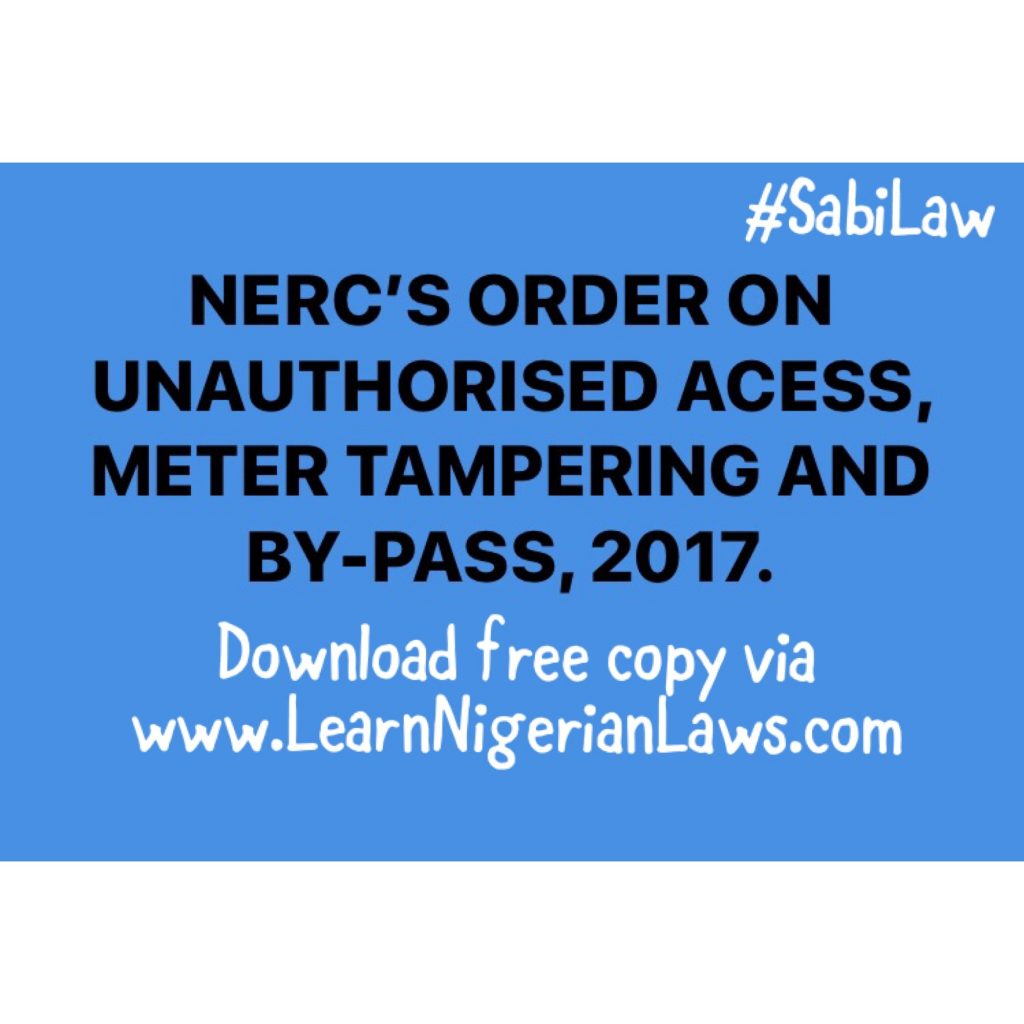
The Nigerian Electricity Regulatory Commission’s (NERC) ORDER ON UNAUTHORISED ACCESS, METER TAMPERING AND BY-PASS, 2017 (ORDER NO.:NERC/REG/41/2017, was made to reduce unauthorised access to electricity supply by tampering and meter bypass. It provides conditions for reconnecting a customer that was earlier disconnected for unauthorised connection to electricity. The Order has 6 paragraphs and tables of punitive charges. It is your right to Sabi Law (understand law).
Terms like Known demand, credit utilisation, pent-up demand are all too familiar terms, bantered around by economists and lay people alike as telltale indicators of a country’s or business’ economic health. Well, they matter in relational engagements too!
Known demand – amount of good and services consumers are willing and able to purchase at a given price.
Credit utilisation – the percentage of your total credit that you are using, if you have a 50% rate of credit utilisation it would be above the recommended number.
Pent-up demand – a situation where the demand for a service or product is unusually strong. For example, the general public’s return to consumerism. Basically, the backlog of demand held at bay during a recession and unleashed when the signs of a recovery emerges!
The secret to partnership is in the mutuality of benefit. Many people want you to participate in their idea and for you to serve a cause they have determined is good. Think of it as their idea universe or idea economy.
However, partnerships should be bounded yes, but they must have enough space for participants to roam and create and make sustainable the idea that inhabits the space. To participate in an idea universe or an idea economy that encompasses more than yourself, you must be able to identify the known demand – what is needed of it, what are people willing and able to pay for it? What is the credit utilisation ratio, – how much of other resources are people for which the idea would matter, willing to spare and make available to be leveraged into the idea universe without over borrowing? What is the pent-up demand – how much of the idea are people already implementing, utilising or willing to invest in?
The characteristic of a healthy idea, is one in an idea universe that has measurable indicators of life and viability. An idea economy within which participants can recognise the “known demand, the credit utilisation and the pent-up demand”. So much so that you deduce how alive that idea is and could become!
Characteristics of a sound idea economy:
Open to flexibility – like a strong economy, a robust idea must have the ability to adjust, understand the lean and plump aspects of the universe it plans to serve. It must be open to interpretation, calibratable, open to supporting ideas that serve the broader idea. It must be alive – some people have already baked their thoughts and are looking for people that will fall in line in something that they have determined as the only solution. They see themselves as architects of solutions and all they need are couriers and carriers of activities. The truth is that when you bake something, you are placing it in an unnatural place of high heat, everything alive in it is activated, creates the necessary reactions, and then devalues itself and dies! Ideas are not meant to do this! Have and pass a litmus test – an idea that comes with the “I have lived it and know the solution attitude” is a failure in the making – the test is embedded in the attitude, so in this case the litmus test would simply be, “if you have lived it, then fix it, if you cannot fix it, then you do not completely understand it, in spite of your lived experience”. You see the way each person lived a situation is reasonably unique because life is complex. Einstein said that no problem can be solved from the same level of consciousness that created it. It must be multifaceted in balance – good ideas must be pairable with good methodologies, good practices, good resources to create something fresh and viable. When someone wants you to append your name, resources, and time to their idea, consider the framework in which it dwells, does it have the balanced structure to uphold the idea sustainably? If you accept a non-living idea; one that is fully baked – It must support other living metrics. For example, we may bake a fruit cake base and fill it with loads of fresh fruit and fresh creams and sauces etc. things that are nourishing and alive, the baked good becomes the support to the cake’s robust architecture – In a fully baked idea, you must be able to gape into the mutuality of benefit in the idea to see if it supports other things that are alive. For example, financials, stability, an opportunity to hone a skill, basically the baked idea must be strong enough to support the architecture of other important living and desirable metrics. Anything less than this is a half-baked idea that requires others to fall in line, stress, and work on the behalf of the owner of the idea! This is never healthy, while the idea owner might get the accolades of “good, nice, kind etc.”, half-baked ideas float on, minimally invasive and maximally evasive in their impact!
What is good and nice is an idea that encapsulates a cause that changes lives, makes a difference, accentuates positives and deters negatives, a cause that can be big or small, that is sustainable and can accommodate many moving parts of life’s complexities etc., however such an idea must be flexible and possess the pre-identified characteristics.
We have too many “idea leaders who loathe the ideation process” their mantra being I want to partner with you if you don’t change anything I have done, you do it exactly as I have dictated it, you allow it look exactly like I designed it, your expertise and resources must be applied in exactly the way I have planned it. You are to engage just to serve a predetermined need, methodology and thought process, in essence they want to control you within the idea universe”. The truth is that when it is said and done, they want it recognizable as their original idea, so that the credit is fully theirs! That is not mutual partnership, that my friend is self-idealism from which you must run, run, run…….
Now on to some bonus points to bring it all home……
When fixing a faucet, placing the spout’s O-ring slightly off center will cause the faucet to fail even when other parts are placed correctly, no matter how much you adjust the faucet lever, the outcome stays the same – failure! Until you reopen the entire faucet assembly and adjust that seemingly insignificant O-ring and orient it correctly. As soon as you do that, the faucet works flawlessly. This is exactly how ideas are, even the best ideas need micro and macro adjustments to ensure they work flawlessly and achieve results that sustainable and broad! When the idea comes fully baked and untouchable, the idea arrowhead is hardened, incapable of listening or hearing, it is all about the idea holder and none about you; so you must run, run, and never turn…………
There are 4 parts to Idea leadership that are crucial
Ideas must be governed by principles – Principles that are not grounded in personality but in practice! In manufacturing the Good Manufacturing Practice, provides a set of universal guiding principles to do make products well consistently – For Ideations, key principles ensure that things are done well using a process of checks and balances!
Ideation does not equal leadership originality – There are very few original ideas – very few ideas are radical and wholly new. Ideas are embedded in what we know, experience or are exposed to. How many times do you hear of a new idea and say, “oh my, I had that idea some time ago!” If you bring many technical people together that know the same things, they will have similar ideas if they have been exposed to the same technologies even when separated by continents and cultures; they will craft solutions that are uncannily alike!
Execution is the difference maker – the ability to compel someone to step out, believe and do! The impetus to do something well with expertise, to bring their resources to bear, their time, their hearts and desires, that is where ideation leadership really rests. When you shepherd the heart of another into something that was not originally theirs! The reason why that is so important, and so beautiful and so big is because that person caught the vision, they caught it on their own terms, not the terms of the original ideator! This is partnership at its utmost! If they get the vision on your terms, they cease to become partners but employees! The most empowered people are those that get the vision on their own terms!
Control, ultimate control is a delicate thing – the more you give away pieces of it the more you retain it. But people think the opposite that the more you hold on to the more you have control, but no, the more you hold and pull on it, the likelihood you will lose it. Control is elastic, if you hold on to it too tight or pull on it too hard you will break it. Instead, what you do, is you stretch it a little gently in different places, you massage it a little so that its elasticity is retained while its reach expands! That is how you get good control. Good ideas must have this characteristics, good idea leaders must practice this to win!
Be careful who you engage, it might only be a waste of your time; when they seek your participation not your heart, when they seek your time not your expertise, when they seek your resources not your enablement or benefit; then you must run, run, run, and never turn…….
About Ngozi Bell
Inspiration, Hard Work, Innovation. These three foundational elements anchor Ngozi’s core belief that manifesting the extraordinary is always within reach. Inspired by her mother A.C.Obikwere, a scientist and author, she learned the privilege of living at the edge of important encounters and dedicating herself to robust and perpetual learning. Ngozi’s background is a combination of Physics, Engineering, Venture Capital/Private Equity, regulations, and business where she has managed over $1B in cumulative revenue. Ngozi is a speaker, storyteller, and writer on a diverse set of topics including AI, iDLT, ML, Signal Processing, iOT, women, entrepreneurship and more. She contributes regularly to VOA, has been a TEDx speaker and is published on tech and non-tech platforms. She is a champion of STEM, women, youth, art and the Africa we must engage. Ngozi is an adjunct professor of Physics and management with work experience in Asia, Europe, Africa, Middle East, and North America. She is a founder of a number of a number of enterprises and host of the podcast Stem, Stocks and Stews (https://anchor.fm/stemstocksstews-podcast).
Few days ago, Dr Raphael Christopher made a beautiful publication on the above subject matter which was published by the Nigeria lawyer’s news accessible at https://thenigerialawyer.com/the-vat-controversy-where-will-the-chips-land/. I must say that the piece was more than a post graduate university lecture. Very holistic and historic. The writer must be eminently commended for such a wonderful research and write up.
At this point, I must say that I have painstakingly read through the draft by the learned author on the agitating issue of VAT that is raining thunder and brimstones. While I appreciate the position of the learned author on the vivid bifurcation of the tax regime and origin, I am of the firm view that some submissions and legal arguments were misplaced and misconceived.
No doubt, the doctrine of laches and acquiescence as posited by the legal author is part of our legal system. However, the said doctrine does not ipso facto apply in all situations. The mere fact that a party fails or was unable to act at an earliest time does not necessarily invoke the application of the doctrine. An illegal and unconstitutional act will not become legal and constitutional simply because it was not challenged early enough. An illegal act remains illegal and the fact that it was unnoticed will not make the act legal to enjoy the application of doctrine of laches and acquiescence as a defense.
Where an act is illegal, and no one seems to challenge same, the act will continue but can never defeat the intendment of the Constitution especially, when the illegality is frowned at by the Constitution. The doctrine of laches and acquiescence applies mostly to the acquisition of land. It does not apply to defeat the intendment of the the mother of all laws the Constitution. Arguing otherwise, will amount to turning the law on its head. The issue of who can collect VAT is a constitutional issue. It is not a land law issue. It is not a case of a man dragging his land with another man after many years of adverse possession. Even in land matters, where another encroaches on another man’s land without the owner of the land knowing same, upon discovery of the encroachment, the owner can still maintain an action for trespass and title to land if he can show that based on circumstances, he was not aware or in the position of knowing when the trespass occurred.
The learned author submitted that it is difficult to argue on the legality or validity of the VAT Act that has been in operation for many years without any one challenging same. Well, assuming that the doctrine of laches applies, the doctrine does not give one what he does not have. The law that delay defeats equity does not apply in all cases especially, constitutional cases as this. An illegality no matter how long it has stayed remains an illegality. If truly, the Constitution does not empower the National Assembly to make law on VAT, the mere fact that the National Assembly made a law that has been in operation will be of no moment. It is immaterial whether the law has been in existence even before Christ was born. The constitution is the supreme law upon which all laws are tested. Any law inconsistent with it shall to the extent of its inconsistency be void. In AG Abia state and Ors v AFG, the apex court held that the constitution is the source of law to every other law, without which no other law can exist independently. Accordingly, if it is discovered that the VAT Act runs contrary to the provisions of the constitution, it must collapse irrespective of how old it has operated. Every law draws its inspiration from the Constitution. Accordingly, a law cannot be drawn and inspired by the Constitution only for the said law to override the provisions of the Constitution. If it tries it, it must fail. The beauty and power of a law is not on how long it has stayed but on the constitutionality of the law. Okra they say cannot outgrow it owner. If it is established that the VAT Act is unconstitutional, it doesn’t matter that states have acquiesced to its provisions for a long time, it remains illegal and must be set aside. Hence, it does not lie on the mouth of any one to say, why didn’t you challenge it early?
But wait, assuming though without conceding to the erroneous believe that the doctrine of laches and acquiescence applies to the controversy of VAT collection, the law is firmly settled that there are certain conditions that must be fulfilled before the doctrine can be activated. One of such conditions is that there must be prior knowledge. In other words, the person who stood by and allow his right to be taken away must indeed actually know that such rights existed and accruable to him. He must know from the outset that the said right actually belongs to him. If it is discovered that the rightful owner was ignorant of the said right, the doctrine cannot be activated because the law is that a man cannot acquiesce to what he does not know to exist. Accordingly, if the doctrine of laches is to be invoked as posited by the learned author, it must be shown that states knew from the beginning that they were actually indeed the rightful owner of VAT but decided to let it go. But because, the issue at hand is a constitutional issue, all argument surrounding the doctrine of laches is only but academic as no law can override the Constitution even if the law is older than late Chief Methuselah of the Old Testament. The proper argument should be on the legality and Constitutionality of the Vat Act including any other law that enables the FIRS to be collecting VAT and not whether states have acquiesced for a length of years without complaining. That argument is even less than academic and holds no water at all.
In all, while I appreciate the views and recommendations of the learned author, I am of the firm view that the judgment of the federal high court be allowed to stand even in the Supreme Court. It will go a long way in reducing financial crime in various states as the governors will have little or nothing to steal from. State will be forced to look inward and see how to better their lives instead of feeding fat on the sweat of another while claiming holier than thou. Every child should eat the food of his mother.
Written By Stanley Maduabuchi Ofoegbu Esq, 08068515340, email; [email protected], Abuja.
Our site uses cookies. By clicking “Accept All Cookies”, you direct Law and Society Magazine to store cookies on your device and disclose information in accordance with our Cookie Statement: cookie policyACCEPTREJECT
Privacy & Cookies Policy
Privacy Overview
This website uses cookies to improve your experience while you navigate through the website. Out of these cookies, the cookies that are categorized as necessary are stored on your browser as they are essential for the working of basic functionalities of the website. We also use third-party cookies that help us analyze and understand how you use this website. These cookies will be stored in your browser only with your consent. You also have the option to opt-out of these cookies. But opting out of some of these cookies may have an effect on your browsing experience.
Necessary cookies are absolutely essential for the website to function properly. This category only includes cookies that ensures basic functionalities and security features of the website. These cookies do not store any personal information.
Any cookies that may not be particularly necessary for the website to function and is used specifically to collect user personal data via analytics, ads, other embedded contents are termed as non-necessary cookies. It is mandatory to procure user consent prior to running these cookies on your website.