Home Blog Page 906

Nigeria: What they said about another 60 years, By Azu Ishiekwene

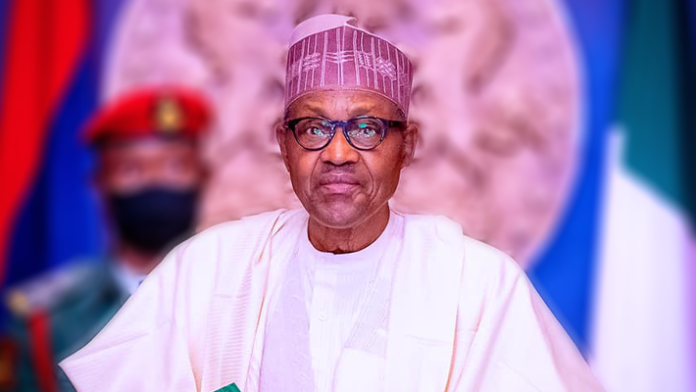
President Muhammadu Buhari

This is the time of year when we moan about everything wrong with Nigeria. Quite often, we do so not necessarily from a place of spite but out of frustration and hopelessness.

It’s true that the life of a nation is not necessarily measured in biological age. But most might agree that if potential, that hackneyed word so often ascribed to Nigeria, was a child, it should have come of age at 61. 

Yet, even by the most gracious of accounts, this Nigerian child is stunted, a problem offspring not only to its parents, but also an enigma, if not a source of perplexity, to its friends and neighbours. 

I’ve been reading two books in the last few weeks set on the eve of the celebration of Nigeria’s milestone independence anniversaries. Both are anguished collections lamenting the country’s unfinished greatness and highlighting a dream deferred. 

“Nigeria at fifty,” edited by Attahiru Jega and Jacqueline W. Farris, and “Remaking Nigeria: Sixty years sixty voices”, edited by Chido Onumah, are wide-ranging and extraordinary reflections on the country’s odyssey. They were published 10 years apart, but you’ll hardly notice the difference in tone or resonance.

If you changed a few names, places and dates, the essays would still read like the story of the hopes, frustrations and missed opportunities told a million times on the eve of every independence anniversary in at least the last 50 years or more. 

Even the October 1 speeches once so full of promise and highfalutin phrases have lost every pretence to substance and quality. They have become a yearly rehearsal of empty boasts and microphone chewing – a hollow ritual. 

Once, Independence Day speeches inspired hope. ln 1960, for example, Prime Minister Tafawa Balewa said at the dawn of independence that after the long, harrowing wait, with nation after nation overtaking Nigeria, he was sure that “Nigeria now stands well-built upon firm foundations.” 

The speeches also made you laugh; like when President Shehu Shagari spent the bulk of his first October 1 speech reminding us that colonialists’ oppression was still prevalent, when his political rivals at home were still seething that his own electoral victory that year was stolen!  

The speeches sometimes depressed you, too. Like President Goodluck Jonathan trying in his speech to excuse MEND from the horrific October 1 bombing at Eagle Square. But now, even depression is a golden era. The speeches mean nothing, stirring only the worst of emotions – indifference. 

This year, I thought there was no use treading the beaten path. Perhaps we could use fresh voices from folks who might still be here in another 50 or 60 years, just to get a sense of the future they see, the future they hope for, and what they’re doing to bring it about.

Instead of waiting to hear what President Muhammadu Buhari would say on October 1 when I know it would be the same tepid stuff from the last six years, I invited a number of Nigerians between 25 and 35, to share their visions of the shape of things to come and what consequential role they think they may play in bringing about that future.

Keep in mind also, that in about three weeks, it would be exactly one year since the #ENDSARS protests. That event signalled the anguished cry by young people against police brutality, poor governance and lack of accountability. 

I thought this might be a good time to set aside the old, broken record, and to hear the voices of another generation, before they spill onto the streets in violent rage. 

I asked them four questions: 1) Where do you think Nigeria would be 50-60 years from now? 2) Do you think you have a consequential role to play in it? 3). How? 4). What is the single biggest threat facing Nigeria today and how can we deal with it?

The answers are a breath of fresh air, a far more uplifting – and certainly thought-provoking – collection than anything you can find in the yearly potpourri of warmed-over October 1 speeches.

Elizabeth, a 33-year-old development professional and social justice enthusiast, said:

“I think Nigeria will experience a lot advancement and automation in the next 50-60 years. However, a lot of people will be left behind and there’ll be a huge gap between the haves and the have nots. 

“The informal sector and communities at the last mile will have a huge influence on how we do business. For example, I feel they will affect language and the mode of doing business. The formal language may switch from English to Pidgin English, and the concept of suit-and-tie may be history.

“Talking about history, there’ll be a lot of distorted facts and people may hardly use the past to determine the future and just go with the flow.

“As for how, that’s a broad question. But I’m confident I have a consequential role to play. The place to start is not to be part of the problem I see but the solution. Whatever I do no matter how insignificant it looks (positive or negative) has a larger role to play in the scheme of things).

“What’s the single biggest threat facing Nigeria and how can we deal with it? The system is broken to the core. People have mounted several levels of corrupt values in the bid to survive. I would propose focusing on the family as the smallest unit of socialisation, as if the country was made up of only people from my family. I’m just here hoping that one day, evil will destroy itself.”

Nengi, a 25-year-old interested in human resources, social issues and psychology, said:

“The challenges we face as a nation are not bound by time. Nigeria has a vast number of ethnic groups sharing various boundaries. This creates a challenge in uniting these ethnic groups and developing a sense of belief in national unity. 

“The current government structure does not allow for equal participation and allocation of resources. In essence, power is highly centralised and it creates a general sense of disbelief and disenfranchisement. The challenges that Nigeria would face in the next 50 years are highly dependent on how we handle these foundational issues.

“Without proper dialogue, restructuring, and good representation, Nigeria will face the same issues of insecurity, poverty, and a declining economy. Historically, the Nigerian government does not seem to learn from the past, putting us in a very difficult position of recurring issues. On this note, there will be some progress, but still very similar problems.

“Do I think I have a consequential role to play in solving the problems? Yes, I do. I believe in ripple effects and that collective efforts begin with individual actions in various fields, irrespective of background (ethnic, religious etc.). 

“We all have a social responsibility in standing up against bad governance and having the right discussions with people, educating those less exposed and enlightening them on social issues.

“The single biggest threat facing Nigeria is corruption and this is because the system gives room for gross mismanagement. A lot of state-owned resources are not being controlled and managed by the right stakeholders. 

“Corruption is not peculiar to Nigeria as popularly believed. The system gives room for financial crimes because of lack of proper checks and balances. The greatest weapon against corruption is proper restructuring of the governmental system, decentralising power and giving more room for inclusion.

Aisha Ibrahim Ata, 29:

“It’s very hard for me to predict the next 50-60 years. Technology might drive growth in certain aspects of the nation. However, this growth may not be significant if the very fundamental challenges of the country remain unsolved. 

“But I believe I have a role to play. By carrying out my responsibilities honestly and to the best of my capacity. I believe in the power of the individual. If every Nigerian is able to carry out their duties (be it carpentry, banking, teaching, governance etc.) in the best way possible, it will collectively result in significant changes in the country.

“Insecurity is the biggest problem. The most effective solution to this challenge will be strong government intervention. But on the individual level, the best we can do is be watchful in our neighbourhood and communities.”

Adekunle Adewumi, 30, Lawyer and Bridge Policy fellow:

“Where Nigeria would be 50-60 years from now? Our current reality indicates that there are several projected pathways, some of which spell doom. However, as the eternal optimist I am, I believe that changes to our governance structure will ensure that Nigeria remains a unified entity. I project that within 50 years, Nigeria will regain its status as Africa’s powerhouse.

“I’m hopeful I will have a role to play in shaping how Nigeria develops. The inability to address injustice done both in the past and present, in my opinion, is the greatest threat to Nigeria’s continued existence.

“Nigeria will benefit from some truth and reconciliation process.”

My guess is that in 50-60 years, if Nigeria is saved, it would not be difficult to see from these reflections, who was the true salvation army.

Ishiekwene is Editor-In-Chief of LEADERSHIP

The Akunyilis deserve justice

By Dare Babarinsa

The assassination of Dr Chike Akunyili on Tuesday night diminishes our country. It is a direct assault on our humanity. He was the widower of Professor Dora Akunyili, the amazon who blazed the trail at the National Agency for Foods, Drugs Administration and Control (NAFDAC), and later served as the Minister of Information under President Shehu Musa Yar’Adua and Goodluck Ebele Jonathan. What happened was a massacre as Dr Akunyili’s security detail, his driver and two other persons were all killed. Dora must still be awake in heaven as her son just escaped the bloodbath when he decided to ride in another car instead of following his father.

Dora, because of her frontal war against the fake-drug mafia, was the target of several assassination attempts. When she died in 2014 in far-away India after a long battle with cancer, someone said she had been spiritually assassinated. Yesterday, her husband joined her in a hurry. What a burden for one family to bear!
This is a trying time for the Akunyili’s family, especially the children who suddenly became orphans in such a brutal and final way. On Tuesday, Dr Akunyili was at an event organised by the University of Nigeria Alumni Association (UNAA). The event was at the Sharon Hall at the All Saints Cathedral, Onitsha. Akunyili had come to the event with his son.The UNAA had decided to honour Dora posthumously and Dr Akunyili felt it was proper that he and the son should be present. He donated N500, 000.00 to the association on behalf of his family. His son, Obum, walked his father to the car at the end of the ceremony. Father and son embraced and then parted ways. The son did not know that his father was headed for the sunset.
It was reported that gunmen at Umooji in Idemili Local Government Area accosted Akunyili. They shot him repeatedly and made sure he was dead. They also killed four other persons with him. The assassins then disappeared. It was a well-executed assignment. When gunmen attacked Professor Dora Akunyili on December 26, 2003 in her hometown, Agulu, Anaocha LGA, she escaped. Two men eventually stood trial for the attempted assassination. I can’t remember what fate befell the two accused persons. Are they back to the comfort of their homes?

But we need to bemoan the fate that has befallen us. Some people have started blaming elements sympathetic to the outlawed Indigenous People of Biafra (IPOB), for Akunyili’s gruesome fate. The police authorities are yet to issue a statement as at the time of writing. IPOB has not issued any statement either, but in recent weeks, especially since the arrest of its leader, Nnamdi Kanu, who is already standing trial in Abuja for alleged terrorism, the group has been threatening hell and brimstones. Now this!
The security situation in the country is worrisome, but that of the heartland of the Igbo people is truly frightening. We have had prison breaks and attack on police stations. In recent weeks, we have had attack on banks. Only last week, IPOB issued a statement that all public institutions must not fly the national flag of Nigeria during the Independence Anniversary celebration tomorrow. No one is sure what protections bank branches, especially those who are outside the state capitals, can be given. Believe it or not, IPOB has become a giant shadow over the South East and Igbo leaders appear helpless about it.
The objective of IPOB as stated openly is the secession of the South East from Nigeria. How they want to achieve this is not clear. What they have achieved so far is the disruption of lives of the ordinary people in the East. That the leaders appear helpless is a crying shame.
We await police statement on this gruesome assassination. As usual, the governors would make their statements too. Then the President would also issue a statement, ordering the Inspector-General of Police to find the killers. We would have a lot of movements and then Nigeria would go on as usual while the killers would most likely be allowed to move to the next target. How did we get to this pass?

There is no doubt that our military is doing its best in the North East where it is confronting the terrorist group, Boko haram and its backers. There is also a serious action going on in the North West. There is military operation going on in many parts of the country, including the constant pursuit of IPOB and its military wing. What is lacking is the apparent failure to penetrate the high commands of all these terrorist organisations, including those ones that the Federal Government continues to refer to as bandits.
This war against terror cannot be won on the battlefield alone. It needs to be carried to the battlefield of the mind. We need to know those who are financing this war against our country. It is apparent that they are getting a lot of returns on their investments through regular and handsome ransom payments. This situation is not acceptable. And when there is a gangland execution like it happened to Dr Akunyili, then we know this was not an accident. Some people somewhere are planning to profit from this.
One thing that is curious about the violence in the East is that the IPOB claimed they are fighting for the Igbo but they are also busy killing the Igbo. Is it not obvious that this IPOB love for the Igbo is really not the kind of love that the Igbo would love to have? So you ask yourself, this IPOB love is for what purpose, to which end? Good or evil? Freedom or slavery? They would not even permit the elementary democratic freedom of choice or debate. For them, anyone who disagrees with them is already a traitor. You cannot talk of new style of resistance or new method to wage the struggle. Any deviation is viewed as sabotage! What kind of organisation is that?

Even if IPOB is not involved in this assassination, its opponent would try to hang it on its neck. Whether you like it or not, IPOB is going to have an impact on the presidential contest of 2023. Though there are many political parties on paper, everyone knows that when it comes to the presidency, only two parties are to be reckoned with: the ruling All Progressives Congress (APC), and the opposition Peoples Democratic Party (PDP).
During the era of President Goodluck Ebele Jonathan, the PDP had its greatest support base in Igbo land. Despite the loss of power in 2015, most Igbo voters have remained faithful to the PDP. With the rude intrusion of IPOB, the PDP leaders may have realised that the party can no longer put its biggest egg in the Igbo basket.
Under normal circumstances, the presidential ticket of the PDP in 2023 should go to an Igbo candidate considering the weight of the party in the South East. However, with the coming contest for the chairmanship of the party, it is now becoming clear that the PDP is looking towards the North for its next presidential candidate. All those who are signifying interest in becoming the next national chairman of the party are from the South. It is elementary that in Nigeria both the presidential candidate and the party chairman cannot come from the same zone.
Apparently, IPOB wants Biafra. Majority Igbo would prefer the presidency. There is no way the Igbo can get the two at the same time. For now, they can help us get the killers of Dr Akunyili. That family deserves justice.

 
© 2021 Guardian Newspapers. All Rights

A Christian Wife And The Nigerian Law

A CHRISTIAN WIFE AND THE NIGERIAN LAW

by: Olakunle Bamisile

In law, sometimes, there are defenses that exempts the defendant from liability because of some circumstance. In some cases, the defendant may have actually committed the crime but may not be criminally responsible for it. These defenses includes, but not limited to, involuntary intoxication, duress and insanity. One carefully placed excuses in the Criminal Code Act of Nigeria is that of the Christian wife. Yes, the Christian wife. The status of the Christian wife is not limited to the Bible (or laws of the Bible) as the laws of our land equally weighs in on the Christian wife. It is therefore of utmost importance to cruise into the Criminal responsibility of the Christian wife viz a vis her husband and the Nigerian Law.

Section 32 of the Criminal Code Act of Nigeria had enunciated some circumstances upon which a person is not criminally responsible for an act he does or omits to do. Section 33 then weighs in on the Criminal responsibility of a Christian wife as it provides that: “a wife of a Christian marriage is not criminally responsible for doing or omitting to do an act which she is actually compelled by her husband to do or omit to do, and which is done or omitted to be done in his presence, except in the case of an act or omission which would constitute an offence punishable with death, or an offence of which grievous harm to the person of another, or an intention to cause such harm, is an element, in which case the presence of her husband is immaterial”.

The provision of the above stated law is to the effect that when the husband of a Christian wife compels her to do an unlawful act or omit to do something (when omission to do is unlawful), the Christian wife is not criminally responsible for the act or omission of the act as long as

(i) act or omission of the act is in his presence;

(ii) the offence is not punishable with death;

(iii) the offence does not constitute grievous harm; or

(iii) there is intention by the wife to commit such act.

The inclusion of this law as it relates to a Christian wife, knowing fully well that Nigeria is not a religious state, is worth pondering. The rationale behind this inclusion remains unclear and debatable, though it could perhaps be an agreement to the Christian principle that the husband is the head of the wife. Criticizing this inclusion, weighing in on this debate or investigating the rationale is however not the purpose of this piece as it only aims to enlighten the public on the Nigerian Laws.***************************************************************************************DISCLAIMER:This publication is not a piece of legal advice. The opinion expressed in this publication is that of the author(s) and not necessarily the opinion of Sabi Law Foundation, its staff and partners.FREE PUBLICATION (Get Published):You too can publish your law articles for free on our website (www.LearnNigerianLaws.com) and enjoy increased visibility and readership on all our social media handles. No fess, no charges, no conditions and no submission guidelines are required. Just send your article and picture to our email ([email protected]). We want your voice to be heard, as we all increase legal awareness, together! It pays to Sabi Law (understand law)! #SabiLawKEEP IN TOUCH:Get updates on all the free legal awareness projects of Sabi Law Foundation (#SabiLaw) and its partners, via:Facebook Page: @LearnNigerianLawsInstagram: @LearnNigerianLawsTwitter: @LearnNigeriaLawYouTube: Learn Nigerian LawsWhatsApp Groups via: (https://chat.whatsapp.com/L7h4f1exItZ38FeuhXG4WN),WhatsApp Chat via: (+234 903 913 1200)Telegram Group: (https://t.me/LearnNigerianLaws),Facebook group: (https://www.facebook.com/groups/129824937650907/?ref=share)or visit our project Website: (www.LearnNigerianLaws.com)ABOUT US & OUR PARTNERS:This publication is powered by www.LearnNigerianLaws.com {A Free Law Awareness Program of Sabi Law Foundation, supported by the law firm of Bezaleel Chambers International (BCI).} Sabi Law Foundation is a Not-For-Profit and Non-Governmental Legal Awareness Organization based in Nigeria. It is the first of its kind and have been promoting free legal awareness since 2010, through the efforts of its founder.DONATION & SPONSORSHIP:As a registered not-for-profit and non-governmental organisation, Sabi Law Foundation relies on donations and sponsorships to promote free legal awareness across Nigeria and the world. With a vast followership across the globe, your donation will assist us increasing legal awareness, improving access to justice, and reducing common legal disputes in Nigeria. Make your donations to us via :https://learnnigerianlaws.com/donate/ or contact us for sponsorship and partnership, via: [email protected][email protected] or +234 903 913 1200.************************************************************************************

Nigeria at 61: Time for introspection

Ikechukwu Amaechi

By Ikechukwu Amaechi

“Our response to the Buhari presidency and the demons it has unleashed on the country may be the last chance to get it right.
 
“But it won’t be by mere wishful thinking. As 2023 beckons, there must be a conscious effort to walk away from Buhari’s tunnel vision and nepotism.

“Conscious effort must be made by all to build a nation around a vision that promotes common good.

“Fairness, equity and justice must be the pivot around which any agenda to save Nigeria revolves because sustenance of the Nigerian Federation demands a union of equals.

“The hubris of the former military Head of State, General Ibrahim Babangida, who recently claimed during an interview on Arise Television that he and fellow travelers on the boulevard of deceit had decided, unilaterally, on the country’s indissolubility no longer suffices.

Neither is the rest of Nigeria prepared to continue tolerating the puerile tantrums of ungrateful immigrants such as Dr. Hakeem Baba-Ahmed, spokesman of the Northern Elders Forum (NEF), whose father, Alhaji Baba Ahmed, a Mauritanian cow seller, only came to Nigeria from Mauritania in 1920.

Baba-Ahmed still goes to his home country, Mauritania, for family celebrations, the same way Buhari goes to Niger Republic to felicitate with his first cousins.

Yet, all that indigenous peoples of Nigeria get from these dual nationality citizens are insults, which is why Baba-Ahmed would have the effrontery to tell the rest of the country that, “We will lead Nigeria the way we have led Nigeria before. Whether we are president or vice-president, we will lead Nigeria.”

This anniversary should afford Nigerians the opportunity to decide what they want. But one thing is clear: The status quo is no longer sustainable. We either change course or Nigeria as we know it today perishes.”    

*Please, leave your reactions in the comments box at the end of the story.
**Click on the Google adverts on the site even if you are not buying. Window shopping is allowed 😁😁.

***Please click on the link below to read the full article

Nigeria at 61: Time for introspection

Who will tame the mad dogs Nnamdi Kanu left behind?, by Kalu Nwokoro Idika

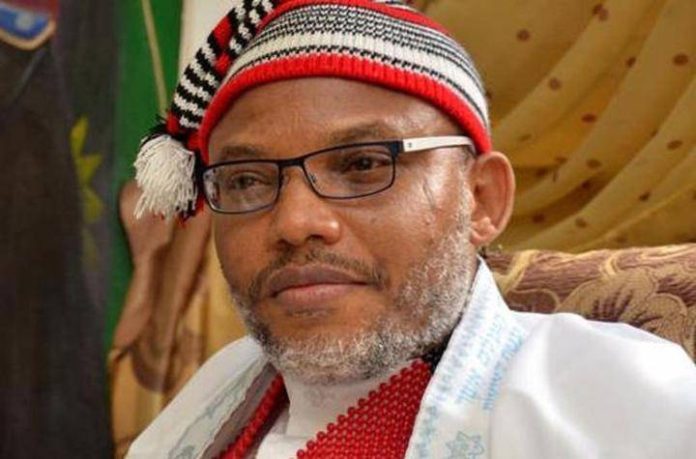
Nnamdi Kanu, leader of Indigenous People of Biafra, IPOB.

Since the leader of the Indigenous People of Biafra (IPOB), Nnamdi Kanu was re-arrested by General Muhammadu Buhari led regime, the separatist group appears to be sliding into an irredeemable anarchy. The present situation in IPOB however, can be likened to that of sheep without a shepherd.

Beginning from the Central Command of IPOB (DOS), down to the unit level, there is serious chaos as the shepherd who arrogated the supreme commander title to himself is no longer around to control the sheep.

Many have wandered away, while others have vowed to unleash mayhem and drink the blood of the innocent.

The disturbing question on the lips of everyone is, who will save the Southeast region from the mad dogs Nnamdi Kanu left behind before his arrest armed with AK47?

From chasing terror herdsmen away from the bushes, now the same AK47 is being used to intimidate and chase students away from school in Ala Igbo! The same gun is being used to kill innocent men and women who disagree with their antiquated approach to civil issues!

Who will tame these mad dogs for Ndigbo?

The Directorate of State (DOS) of IPOB seems helpless as the absence of Nnamdi Kanu has finally exposed their emptiness and powerlessness. Nobody takes orders from the DOS again. Even before now, the figure heads that make up the DOS are nothing but bootlickers of the supreme commander.

Ala Igbo is burning and some folks have chosen to keep quiet because they don’t want to be insulted or get killed. The other day, an Anglican priest in Imo State, Emeka Merenu was murdered in his church, while another young barrister, Darlington Omekagu was brutally shot on the chest by these same ruthless murderers who claim to be owners of Biafra.

The Anglican priest who was killed and his car set ablaze was only trying to secure the mission school, where he was the principal, according to multiple sources.

Sources said the sit-at-home on the 14th of September degenerated into an exchange of gunfire between the outlawed Eastern Security Network (ESN) and Nigerian military in Orsu Local Government Area of Imo State.

The priest according to reports was worried over the safety of his students who were writing West African Examination. So, he decided to shut down the school gate to prevent any form of attack. There was never a time he invited soldiers into the school for protection as alleged but IPOB in their barbaric manner, tagged him a saboteur and later butchered the innocent man with gun in his parsonage.

Who will tame these mad dogs for Ndigbo as the shepherd is out of sight? IPOB USA and Europe are in complete disarray, each fighting to outsmart one another for money. It has become a case of dog eat dog!

These untamed dogs and their media bandwagons have succeeded in setting Ala Igbo on fire over a convoluted dream that is beyond their immediate reach.

This evil has lingered enough, and we have to bail the water while it’s still ankle deep before the evil that will come with it will consume what’s left of Ala Igbo.

A stitch in time saves nine!

Kalu Nwokoro Idika is a writer and investigative journalist

Should A Confessional Statement Be Rendered Inadmissible On The Grounds Of Non Compliance With Section 15(4) And 17(1) & (2) Of (ACJA) Act 2015?

By Folorunsho Faozy Aduagba

INTRODUCTION

In recent times, following the enactment of the Administration of Criminal Justice Act (2015) (“ACJA”) in Nigeria, there have been controversies over the provisions of section 15 (4) and 17 (1) & (2) of the ACJA, as well as other similar sections in the Administration of Criminal Justice Laws of some states, as it relate to the mode of obtaining confessional statements of the accused person (now defendant). Indeed, the sections have been the subject of opposing court of appeal decisions.

Before delving into the meat of the discussion, it is necessary to define the phrase confessional statement. The term “confession” is defined in section 28  of the Evidence Act as;

“A confession is an admission made at any time by a person, charged with a crime tending to show or suggest the inference that he committed the crime.”

It follows therefore, that confessional statement is an extra judicial statement made by an accused person to a police officer or other law enforcement agency in which he admits to committing a crime.

Interestingly, in our criminal justice system, confessional statement has indeed been held to be the finest evidence the prosecution can present to secure a defendant’s guilt, because confessional statements can be relied on solely by a court to convict a defendant if the confessions are direct and positive  vide the case of ADOGA v. FRN  (2019) LPELR-46931(CA) where it was lucidly pointed out as follows;

“Where  a  Court  is  satisfied  that  a  confessional  statement was  made  voluntarily  and  it  is  clear,  positive  and unequivocal  as  to  the  accused  person’s  participation  in  a crime,  it  is  sufficient  without  more  to  ground  a  conviction.  It is  trite  that,  an  accused  person  can  be  convicted  on  his confessional   statement   if   properly   proved   and circumstances  make  it  probable.  In  criminal  procedure, such  confessional  statement,  like  admission  in  civil procedure  is  the  best  and  strongest  evidence  of  guilt  on  the part  of  an  accused  person.  Indeed  stronger  than  the evidence  of  eye  witness.”

As a result of the evidential value of confessional Statements, it is not uncommon for the defendant’s counsel to object to the admissibility of the defendant’s confessional statement on the grounds that;

  1. The confessional statement was made but not voluntary, or
  2. The defendant has retracted his confessional statement, or
  3. The defendant is not the maker of the statement.

However, following the enactments of the ACJA, the defendant now oppose the admissibility of a Confessional Statement on the grounds that the prosecution has not complied with the provisions of section 15(4) and 17 (1) & (2) Supra and as such the confessional statement should not be admitted in evidence. For ease of reference, the Sections provides as follows;

Section 15(4) “Where a suspect who is arrested with or without warrant volunteers to make confessional statement, the police officer shall ensure that the making and taking of the statement shall be in writing and may be recorded electronically on retrievable video compact disc or such other audio visual means”

Section 17(1) “Where a suspect is arrested on allegation of having committed an offence, his statement shall be taken”

Section 17(2) “Such statement may be taken in the presence of a legal practitioner of his choice, or where he has no legal practitioner of his choice, in the presence of an officer of the Legal Aid Council of Nigeria or an official of a Civil Society Organisation or a Justice of the Peace or any other person of his choice. Provided that the legal practitioner in this subsection shall not interfere while the suspect is making his statement.” (Bold for emphasis)

There are similar provisions in ACJL of some states which are in Pari material with the above cited. For example, section 9(3) of ACJL Lagos states 2011, S. 17 of ACJL Sokoto state 2019 et al

It can be garnered from the above mentioned provisions that;

  • The police officer (this includes any officer of a law enforcement agency established by an Act of the National Assembly – Section 494(1) of the ACJA 2015) SHALL ensure that the making and taking of the confessional statement shall be in writing;
  • Such statement MAY BE recorded electronically on retrievable video compact disc or such other audio visual means;
  • the statement of a suspect, confessional or not, MAY BE taken in the presence of a legal practitioner of his choice, or where he has no legal practitioner of his choice, in the presence of an officer of the Legal Aid Council of Nigeria or an official of a Civil Society Organisation or a Justice of the Peace or any other person of his choice.

It should be noted that the law givers used the words SHALL and MAY in the respective sections of the Act, as indicated by the bolded words. It’s worth noting that courts have held that the term “SHALL” in statutes denotes something that must be done, as opposed to the word “may,” which is permissive but not mandatory. see UGWU & ANOR. V. ARARUME & ANOR. (2007) 6 SC (Pt.1) 88

The lingering question at this point is should a Confessional Statement be rendered inadmissible if the prosecution fails to satisfy the forgoing provisions?.

As earlier stated it has been subject to conflicting court of appeal decision. There have been arguments in support of rejection and admission.

On the one hand, the Court of Appeal has held that such a statement should be inadmissible; the crux of the court’s reasoning is that the term MAY in the section connotes SHALL, implying that compliance with the foregoing provisions is necessary for the prosecution. Specifically in  CHARLES v. THE FEDERAL REPUBLIC OF NIGERIA (2018) LPELR-43922(CA) the court reasoned as follows;

“Sections 15(4) and 17(2) of the ACJA impose a duty on public functionaries (police officers and other officers of any law enforcement agency established by an Act of the National Assembly and this includes the EFCC) to record electronically on retrievable video compact disc or such other audio visual means, the confessional statements of a suspect and to take statements of suspects in the presence of the person/s set out in Section 17(2)…… The use of the word “may” in those provisions are in those circumstances mandatory and not permissive.”   See also NNAJIOFOR v. THE FEDERAL REPUBLIC OF NIGERIA (2018) LPELR-43925(CA) ; OLUWATOYIN v. STATE(2018) LPELR-44441(CA) et al

In the aforementioned case  the confessional statement of the appellate was expunged from the record of appeal on the basis of non compliance with the provisions of sections 15(4) and 17(2) of the ACJA.

On the contrary, in yet another decisions of the court of appeal albeit different judicial divisions held that notwithstanding non compliance with the provisions, the confessional statement is admissible. The court reasoned that it is the Evidence Act that governs admissibility of any documents not ACJA or ACJL.. My Lord, Lawal Shuiabu, J.C.A in ENANG v. THE STATE (2019) LPELR-48682(CA)  Consider the decisions in support of rejection and then ruled as thus;

“In any event, the above decisions did not as well take cognizance of the fact that Evidence is listed as Item 23 of the Exclusive legislative list, part 1, 2nd schedule to the 1999 Constitution (as amended). Also, the Evidence Act being a specific Act on evidence including admissibility takes precedence over the ACJA in matters of admissibility.”

see also OGUNTOYINBO v. FRN (2018) LPELR-45218(CA)(where the court interprets the word May in it usual meaning) ;GODWIN ELEWANNA v. THE STATE (2019) LPELR-47605(CA); et al

Moving further, Does the ACJA or ACJL determines the admissibility of confessional statements?   

 This writer submit that the sections under reference have no bearing on the admissibility of confessional statements. The section that governs the admissibility of a Confessional Statement is section 29 of the Evidence Act, it is also submitted that a cursory look at the section under reference there is nothing implying that the confessional statement be admitted or rejected. Therefore, as rightly held in ENANG v. THE STATE (Supra) that  evidence Act takes precedence over ACJA or ACJL. The same court while considering section 9 (3) of the ACJL of Lagos state per Ogakwu, J.C.A in EMEKA IKE v. THE STATE OF LAGOS (2019) LPELR-47712(CA) was quite emphatic as follows;

“The matter does not end there. It remains to examine if a confessional statement that satisfies the admissibility requirements under Section 29 of the Evidence Act, will be rendered inadmissible if no video recording of its making and taking is produced at a trial upon an objection being raised as to its voluntariness. Without a doubt, the enactment dealing with the admissibility in evidence of a confessional statement is Section 29 of the Evidence Act. It provides the circumstances in which a confessional statement shall not be allowed to be given in evidence.”

Similarly in OLISAELOKA v. STATE (2017) LPELR-45255(CA) Obaseki-Adejumo, J.C.A in his concurring judgement also note that;

“I shall make some remarks just for emphasis. Section 9(3) of the Administration of Criminal Justice Law (ACJL) is in no way meant to take the place of the provisions of Section 29 of the Evidence Act. The provision will not by itself render inadmissible a confessional statement. It provides for procedure that should be complied with in the taking of confessional statement of an accused person at the pre-trial stage.”

Furthermore, having established that it is the Evidence Act that governs admissibility of confessional statements. This writer further submit that the  provisions of the ACJA or ACJL will only come into play if the defendant’s confessional statement is challenged on the premise of involuntariness. In this wise, the prosecution may produce a recorded video of the defendant making his statement and  lead evidence that the statement was taken in the presence of his legal practitioner or any other officer, as specified in section 17(2) supra. In a more recent decision, the court of appeal came to the same conclusion per Ogakwu, J.C.A in EMEKA IKE v. THE STATE OF LAGOS (Supra) wherein he admonished as follows:

“So, it is only if during trial when the confessional statement is sought to be tendered and an objection is raised that it was not made voluntarily that the stipulation requiring that the video recording may be produced at the trial kicks in. Where no such objection is raised, the prosecution is not obligated to produce the video recording, since the confessional statement is not inherently inadmissible

As a corollary, this will only assist the trial judge in deciding whether the statement was made voluntarily. The requirements in S. 15(4) and 17(2) can not ipso facto be the only determinant whether a statement is made voluntary or otherwise. My Lord further held ;

“I still hold firmly to the views reproduced above. The absence of video recording and the fact that the statement was not made in the presence of a legal practitioner of the choice of a defendant can only be pointers, which taken along with other established evidence, can result in the inference that the statement was not voluntarily made.”

Again Ogakwu, J.C.A, in OLISAELOKA v. STATE (supra) had this to say;

“[I] shudder to think that it could be the intendment of the law that once there is no video recording of the making of a confessional statement and it was not made in the presence of a legal practitioner of the choice of an accused person, such a statement will be inadmissible. No. It cannot be! Compliance with the provision can only be a fact which with other proven facts can conduce to a finding that a confessional statement was obtained by oppression or in circumstances which make the confession unreliable.”

CONCLUSION/RECOMMENDATIONS

In sum, the provisions are designed to protect defendants in criminal cases where confessions are obtained through torture and coercion. Hence, it is a laudable provision that protects a defendant’s fundamental rights. Therefore, it is hereby recommended that Where a defendant is aware that the provisions are not being followed he should challenge the confessional statement on the basis of involuntariness in order to benefit from section 15(4) and 17(1) and (2) of the ACJA, as argued above.

Folorunsho Faozy Aduagba writes from Faculty of Law,  Usmanu Danfodiyo University, Sokoto. He can be reached via 08106500985 or [email protected]

Project Giant E-Naira CBDC Rides On Legacy Legal Tender Law Wave

By Boulevard A. Aladetoyinbo

The Central Bank of Nigeria(CBN) has no plans to amend its extant legal tender laws, in view of its Central Bank Digital Currency(CBDC) project pilot launch October 1st, 2021, and beyond if successful. This came to fore after the Nigeria apex bank sent a strategic pilot implementation roadmap presentation to the Deposit Money Banks(DMBs) et al. weeks ago, ahead of e-Naira pilot phase launch 1st October later in the year. One of the instant implications is that the central bank enabling statute-law CBN Act (2007) and other legal tender laws remain intact; no amendment(s) in the face of fundamental monetary design policy changes or enhancement, and innovation to actualise the sovereign nation-state actor Nigeria cashless society policy objectives. The Central Bank of Nigeria(CBN) monopoly fiat money creation and control authority; “issue legal tender currency in Nigeria”, remains as enshrined in Section 2(b) of the Central Bank of Nigeria(CBN) Act 2007. Thus, the minting, issuance, distribution, redemption, and the e-naira CBDC digital currency destruction remain collectively the CBN regulatory remits.

E-Naira Design

The e-Naira Central Bank Digital Currency(CBDC) legal tender complements the existing paper money Naira banknote, and has features and characteristics, some of which are common with the extant fiat paper Naira banknote. Some of the  design features and characteristics highlights to wit:

  • E-Naira Automatic Legal Tender Status. The e-Naira is a legal tender without any new legal tender law conferring legal tender status on it. Therefore, the e-Naira is regulated under the Nigeria extant legal tender laws, regulation and compliance regime.
  • Value Parity. The e-Naira has the same value as the extant fiat paper Naira banknote. Therefore, a non-electronic one extant fiat paper Naira banknote is worth the same nominal value and purchasing power as one e-Naira cash.
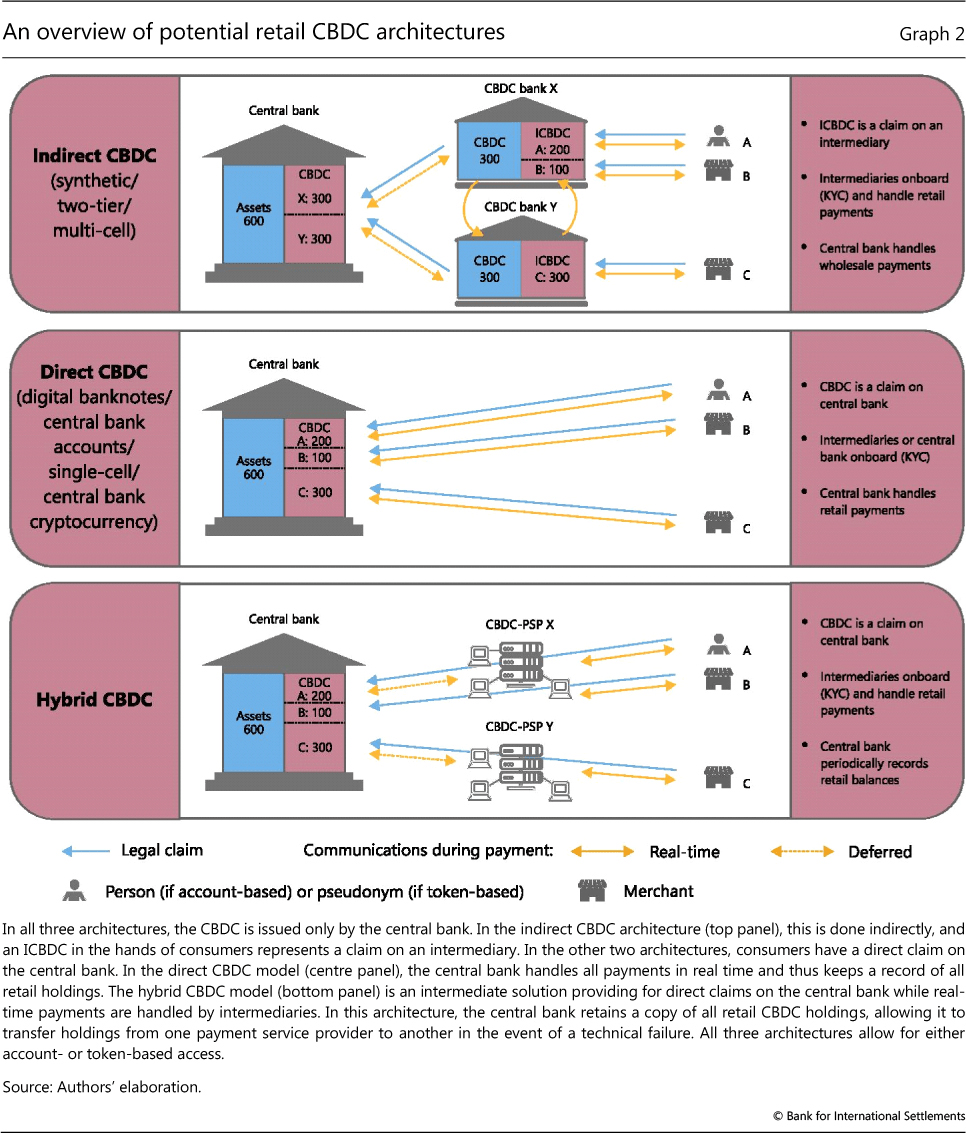
  • Two-tiered Central Bank Digital Currency(CBDC) model. Various Central Bank Digital Currency(CBDC) design choices and considerations are:
  • retail Central Bank Digital Currency(r-CBDC),
  • wholesale Central Bank Digital Currency(w-CBDC),
  • hybrid Central Bank Digital Currency(h-CBDC),
  • synthetic Central Bank Digital Currency(s-CBDC),
  • multi-Central Bank Digital Currency(m-CBDC).

Among sovereign central bank digital currency design choices available, Central Bank of Nigeria(CBN) has settled for a two-tiered retail Central Bank Digital Currency(r-CBDC) creation, distribution and management model, which runs through commercial banks and Payment Service Providers(PSPs) who can create wallets, but will be supported by the Central Bank of Nigeria(CBN) with speed wallet to meet 1st October 2021 pilot deadline purpose. e-Naira CBDC operating model cascades from Central Bank of Nigeria(CBN), Financial Institutions(FIs), Ministries Departments and Agencies(MDAs) to banked and unbanked consumers.

See source URL link

Account-based Wallet. The e-Naira CBDC has account-based wallet (opposite being token-based/value-based) features by allowing third party transaction validation, ledger updating and system security enhancement. The account wallet can be credited and debited. Further on the token-based system, a CBDC token created has a specific denomination. When there is a

token transfer between or among parties, it equates near immediate ownership transfer, and there is no database reconciliation requirement. The scenario that plays out is best akin to when one party hands down a banknote to another. On the other hand, the CBN in this account-based wallet system approach holds and manages users’ CBDC accounts.

CBDC experts have always recommended a tokenised CBDC model on the grounds among others to avoid the responsibility of:

  • large scale account keeping
  •   ”           ”         ”      reconciliation
  • attendant reputational risks in any event that things go wrong, i.e. poor service quality.

Customer Transaction Limit. There is a consumer wallet tier structure Tier 1, Tier 2, Tier 3.

Tier 1 applies to a consumer type that has no existing bank account. Such consumer daily characteristic transaction limit is send: NGN50,000 and receive: NGN50,000, while the cumulative daily balance is NGN300,000. This Tier 1 consumer minimum requirement consists of their telephone number validation with National Identity Number(NIN) attached. The existing as per MMO consists of the consumer’s passport photograph, name, place & date of birth; gender; address; (and the telephone number included).

Tier 2 applies to a consumer type that has an existing bank account. Such consumer daily characteristic transaction limit is send: NGN200,000 and receive: NGN200,000, while the cumulative daily balance is NGN500,000. This Tier 2 consumer minimum requirement consists of their Bank Verification Number(BVN). The existing as per MMO consists of, in addition to Tier 1 requirement and BVN, Identity (ID) evidence.

Tier 3 applies to a consumer type that has an existing bank account. Such consumer daily characteristic transaction limit is send: NGN1,000,000 and receive: NGN1,000,000, while the cumulative daily balance is NGN5,000,000. This Tier 3 consumer minimum requirement consists of their Bank Verification Number(BVN). The existing as per MMO consists of the Tier 2 requirements in addition to physical verification, full Know Your Customer(KYC) as stipulated in the extant CBN AML/CFT regulations, i.e. Central Bank of Nigeria(CBN) (Anti-Money Laundering and Combating the Financing of Terrorism in Banks and Other Financial Institutions in Nigeria), 2013.

A merchant also comes under the Tier 3, and has consumer daily characteristic transaction limit, which is send: NGN1,000,000 and receive: NGN1,000,000, while cumulative daily balance has no limit that they can sweep to their bank account. And full KYC as stipulated in the extant CBN AML regulations is applicable to them.

Tiered AML/KYC Approach(NIN, BVN as unique identifiers). There is a consumer due diligence tiered structure approach as evident in the “Customer Transaction Limit” vis-a-vis consumer identity verification applicable to Tier 1, Tier 2, and Tier 3 from the telephone number validated as NIN attached minimum requirement where no bank account exists prior to the BVN requirement where a bank account exists prior, and finally Tier 3 which consists of Tier 2 requirements such as BVN, physical verification, and full KYC as stipulated in CBN AML/CFT Regulations.

Non-Interest Bearing e-Naira CBDC. The two major questions in CBDC design consideration choices are whether the CBDC is interest-bearing and whether network effects matter. Where a CBDC is non-interest-bearing, like the e-Naira CBDC, its cash similarity becomes its sole design instrument. The e-Naira non-interest-bearing CBDC design choice is deemed the most optimal CBDC design choice, as CBDCs though blend in features of cash and deposits, could also equally crowd out cash and deposits demand. In specifics, the e-Naira CBDC designed cash-like, can cause cash demand reduction beyond the point where the e-Naira network effects cause cash disappearance, while a deposit-like CBDC design choice causes an increase in deposit, loan rates, and bank-to-lender contraction. This bank intermediation decline as a result curtails investment and output. In any case that cash vanishes, the e-Naira CBDC moves optimally toward cash, as it bears the brunt of servicing former cash users, and remains in existence instead of having the three money forms cohabitation. It should be obvious that where CBDC network effects occasion no monetary policy constraint, the CBDC should be designed with zero interest rate. Reason for this is that it could cause price distortions in a household payment instrument choice.

The e-Naira CBDC, like the fiat paper banknote before it, has no interest-bearing feature whatsoever, i.e. therefore the e-Naira will not;

  • be a storehold of wealth
  • generate any interest or returns
  • have an intrinsic value

Settlement Finality. The e-Naira CBDC has the power to discharge a user from an obligation when used for fund transfer purposes to effect payment and settlement. It could be used to settle an obligation irrevocably and unconditionally as a payment or financial instrument. Finality of settlement in a financial securities capital market context entail irrevocable and unconditional fund and securities transfers.

Boulevard A. Aladetoyinbo, Esq.

Head, Crypto-asset Capital Formation Practice.

Lex Futurus (Africa Region).

Follow @BoulevardLP on Twitter.

Disclaimer

This article has no legal advice piece intention. It serves informational and educational purposes only.

Separation Of Powers, Checks And Balances (1)

By Mike Ozekhome SAN

Introduction

“Et tu Brutus?” is a paraphrase from Julius Caesar, a tragic play about political rivalries, written by renowned English playwright, William Shakespeare, about 1599.

In the play, Caesar is already one of Rome’s highest officials and is about to be crowned king. Jealous of Caesar for personal reasons, Roman Senator Cassius convinces another senator, Brutus, that Caesar must die. The lofty-minded, idealistic Brutus fears that Caesar will destroy the Roman republic by having himself crowned king. After Brutus joins the conspiracy against Caesar, Cassius, despite his sounder judgment, defers to Brutus’s wishes and makes the mistake of sparing the life of Mark Antony, Caesar’s protégé.

As Caesar walks to the Senate forum the next morning, a soothsayer attempts to alert him, warning, “Beware the Ides of March.”

Caesar ignored the message, stating that, “Cowards die many times before their death; the valiant never tastes of death but once.”

At the forum, the conspirators stab Caesar to death. A dying Caesar sees Brutus among the killers and delivers the famous line, “Et tu, Brutus?” (Thou too, Brutus?). As Shakespeare poetically put it, “When the noble Caesar saw him stab, ingratitude more strong than traitors’ arms quite vanquished him and then burst this mighty heart.”

We shall underpin, in this discourse, the connexion of this famous line with the doctrine of separation of powers, the present Nigerian judiciary, vis-à-vis the government’s anti-corruption fight.

It is interesting to note, for primary reasons, that the judiciary is the third arm of government under a democratic system of governance, bellowed by the hallowed principle of separation powers.

The doctrine of separation of powers

Separation of powers is the doctrine and practice of dividing the powers of a government among different branches to guard against abuse of authority. A government of separated powers assigns different political and legal powers to the legislative, executive and judicial branches. The legislative branch has the power to make laws, for example, the declaration of what acts are to be regarded as criminal. The executive branch has the authority to administer the law primarily by bringing lawbreakers to trial and to appoint officials and oversee the administration of government responsibilities. The judicial branch has the power to try cases brought to court and to interpret the meaning of laws under which the trials are conducted.

A government of separated powers is less likely to be tyrannical and more likely to follow the rule of law: the principle that government action must be constrained by laws. Separation of powers can also make a political system more democratic by making it more difficult for a single ruler, such as a monarch or a president, to become dictatorial. The division of powers also prevents one branch of government from dominating the others or dictating the laws to the public.

Development of the doctrine of separation of powers

The doctrine of separation of powers developed over many centuries. The practice of this doctrine can be traced to the British Parliament’s gradual assertion of power and resistance to royal decrees during the 14th Century. English scholar, James Harrington, was one of the first modern philosophers to analyze the doctrine. In his essay, Commonwealth of Oceana (1656), Harrington, building on the work of earlier philosophers Aristotle, Plato, and Niccolò Machiavelli, described a utopian political system that included a separation of powers. English political theorist, John Locke, gave the concept of separation of powers more refined treatment in his Second Treatise of Government (1690). Locke argued that legislative and executive powers were conceptually different, but it was not always necessary to separate them in government institutions.

Modern idea of the doctrine

The modern idea of the separation of powers was explored in more depth in The Spirit of the Laws (1748), a study by French political writer Baron Montesquieu. Montesquieu outlined a three-way division of powers in England among the Parliament, the king, and the courts, although such a division (he did not use the term “separation”) did not in fact exist at the time.

Baron de Montesquieu (1689-1755) was a French writer and jurist. Charles Louis de Secondat, Baron de la Brède et de Montesquieu, was born in the Château of la Brède and educated at the Oratorian school at Juilly and later at Bordeaux. He became counsellor of the Bordeaux parliament in 1714 and was its president from 1716 to 1728. Montesquieu first became prominent as a writer with his Persian Letters (1721; trans. 1961). In this work, through the device of letters written to and by two aristocratic Persian travellers in Europe, Montesquieu satirized contemporary French politics, social conditions, ecclesiastical matters and literature. The book won immediate and wide popularity; it was one of the earliest works of the movement known as the Enlightenment, which, by its criticism of French institutions under the Bourbon monarchy, helped bring about the French Revolution. The reputation acquired by Montesquieu through this work and several others of lesser importance led to his election to the French Academy in 1728.

His masterpiece was The Spirit of the Laws (1748; trans. 1750) in which he examined the three main types of government (republic, monarchy, and despotism) and stated that a relationship does exist between an area’s climate, geography and general circumstances and the form of government that evolves. Montesquieu also held that governmental powers should be separated and balanced to guarantee individual rights and freedom.

Society did not just happen suddenly from the blues; it has been evolving over time. The judiciary the world over is a sacred and consecrated arm of government. It is an hollowed institution, preserved only for the finest breeds of men and women.

The typical division of branches is into a legislature, an executive, and a judiciary. It can be contrasted with the fusion of powers in a parliamentary system where the executive and legislature (and sometimes parts of the judiciary) are unified. Separation of powers, therefore, refers to the division of responsibilities into distinct branches to limit any one branch from exercising the core functions of another. The intent is to prevent the concentration of power and provide for checks and balances. The simple rationale is that power corrupts and absolute power corrupts absolutely.

The term ‘tripartite system,’ as already noted, is ascribed to French Enlightenment political philosopher Baron de Montesquieu. In The Spirit of the Laws, Montesquieu described the separation of political power among a legislature, an executive, and a judiciary. Montesquieu’s approach was to present and defend a form of government that was not excessively centralized in all its powers to a single monarch or similar ruler. He had based this model on the constitution of the Roman republic and the British constitutional system. Montesquieu took the view that the Roman republic had powers separated so that no one could usurp complete power. In the British constitutional system, Montesquieu had discerned a separation of powers among the monarch, Parliament, and the courts of law. Montesquieu did actually specify that “the independence of the judiciary has to be real, and not apparent merely.” “The judiciary was generally seen as the most important of powers, independent and unchecked,” and also was considered dangerous.

He stated: “The independence of the judiciary has to be real, and not apparent merely. If the ruler pulls strings behind the curtains, people will notice where ultimate decision-making power lies, and the steps of the ruler’s palace will again swarm with harassing crowds hoping to influence upcoming decisions of the court.”

Renowned foremost constitutional lawyer, Professor Nwabueze, while emphasizing the importance of the principle of separation of powers says: “Concentration of governmental powers in the hands of one individual is the very definition of dictatorship end absolute power is by its very nature arbitrary, capricious and despotic. Limited government demands, therefore, that the organization of government should be based on some concept of structure, whereby the functions of law-making, execution and adjudication are vested in separate agencies, operating with separate personnel and procedure. We are not prepared, write Vile, ‘to accept that government can become, on the ground of ‘efficiency,’ or for any other reason, a single undifferentiated monolithic structure, nor can we assume that government can be allowed to become simply an accidental agglomeration of purely pragmatic relationships…By separating the function of execution from that of the law-making, by insisting that every executive action must, in so far at any rate as it affects an individual, have the authority of some law, and by prescribing a different procedure for law making the arbitrariness of executive action can be effectively checked.”

Concepts of the rule of law

Many conceptions of the rule of law place great emphasis on legal certainty, predictability, and settlement on the determinacy of the norms that are upheld in society, and on the reliable character of their administration by the state. Citizens need predictability in the conduct of their lives and businesses. Knowing in advance how the law will operate enables one to plan around its requirements and how they have to act if they are to avoid its adverse impact on their affairs. However, the rule of law is not just about general rules but is also about their impartial administration. For example, one of the great 19th Century theorists of the rule of law, Albert Venn Dicey, placed at least as much emphasis on the normal operation of the ordinary courts as he did on the characteristics of the norms they administered. The law inevitably creates a great danger of arbitrary power.

The rule of law is designed to minimize the danger created by the law itself. Thus the rule of law is a negative virtue; the evil which is avoided is evil which could only have been caused by the law itself.

(To be continued)

Sounds and bites

Week after week, henceforth, this column will deliberately include short bites on some sounds and bites. It would include jokes (to soothe our aching nerves), philosophical platitudes (to redirect our steps) and scriptural quotes (to pave the way to eternity). We commence this week.

Man A: I have a perfect son.

Man B: Does he smoke?

Man A: No, he doesn’t.

Man B: Does he drink whiskey?

Man A: No, he doesn’t.

Man B: Does he ever come home late?

Man A: No, he doesn’t.

Man B: I guess you really do have the perfect son. How old is he?

Man B: He will be six months old next Wednesday.”

Thought for the week

“On the mountains of truth you can never climb in vain: either you will reach a point higher up today or you will be training your powers so that you will be able to climb higher tomorrow.”

(Friedrich Nietzsche)

The Nigerian Judiciary: A Call To Poverty And Denigration?

By Onikepo Braithwaite

Temptation and LKY

With all due respect to Judicial Officers, especially those who have remained faithful to their Oath of Office, some home truths must be told about the Nigerian Judiciary, no matter how embarrassing; with the hope that Government will immediately address some of the issues, which are the root causes of what many now have come to refer to as the rot in the Nigerian judicial system. Recently, when the Chief Justice of Nigeria, Hon. Justice Ibrahim Tanko Muhammad CFR (CJN) was swearing in the new Court of Appeal Justices, he advised them not to succumb to temptation. Some people complained that, the CJN should not have made such a statement; but the fact is, he was only speaking the truth, because those who lack financially are the softest targets for falling prey to temptation. And, even though we certainly expect a high level of morals and integrity from judicial officers, at the end of the day, they are human beings like anybody else (not super humans or saints), who have responsibilities for the upkeep of their families (especially the men who may be the sole breadwinners of their families). I am not in any way trying to justify corruption or bad behaviour in the Judiciary, but, rather, I am trying to draw our attention to the plight of judicial officers, who by virtue of their remit, are unable to voice their complaints since their demeanour is expected to quiet, guarded and of the highest etiquette.

We like to use Lee Kwan Yew (LKY), Lawyer and former Prime Minister of Singapore, and how he turned his country around as an example, but we fail to follow his example – he tried to create a more equitable society in which Civil Servants, the Judiciary etc, were not just paid living wages, but were well paid, so that there would be no reason to envy those in the private sector or who were well-to-do, and no need for corruption. As the economy became more buoyant, even pensions were increased, to reflect the improvement. Can we say that the same obtains in present-day Nigeria? No. My point? In trying to stamp out corruption, LKY’s Government played it’s own part, and ensured that all workers were adequately remunerated, unlike here where just a minute fraction like the National Assembly are overpaid. On the contrary, the Nigerian middle class which judicial officers formerly belonged to, has been eroded in great part by negative and inequitable Government policies, leaving only the top class, which includes Politicians, a few businessmen and the corrupt, and the bottom class, which the judicial officers and other workers now find themselves belonging to, along with the impecunious.

Inapplicability of the Doctrine of Separation of Powers in Nigeria

I have maintained for quite a while that Baron de Montesquieu’s Doctrine of Separation of Powers which states that the three arms of Government, that is, the Executive, the Legislature and the Judiciary are independent and co-equal (See Section 4-6 of the 1999 Constitution of the Federal Republic of Nigeria), is not applicable in Nigeria, as the Executive takes first place, the Legislature second, and our Judiciary, a distant third place.

Aside from the fact that when the hierarchy of the Nigerian Government is listed anywhere in order of seniority, it is listed thus: President, Vice President, Senate President, CJN, and Speaker, House of Representatives, another area in which the Judiciary’s relegation can be seen, which is an aspect which people do not readily pay any attention to, is in the area of National Honours. The award of National Honours was established by the National Honours Act No. 5 of 1964, to reward those who have distinguished themselves in their various endeavours, or served the country admirably in one way or the other. If the Judiciary is equal to the Executive, why is it that only the President is awarded the Grand Commander of the Order of the Federal Republic (GCFR), while the CJN (and Senate President) can only get the lower award of merit, that is Commander of the Order of the Federal Republic (CFR) or Grand Commander of the Order of the Niger (GCON)? In the past, Supreme Court Justices were awarded with the Commander of the Order of the Niger (CON), but it seems that apart from the CJN who is a Commander of the Order of the Federal Republic, the other Supreme Court Justices have not been awarded with National Honours, despite being more than overdue for it. Let’s hope that they will be part of the next award exercise.
These days, aside from the fact that the Legislature is perceived to be a rubber stamp on the decisions of the Executive as opposed to being a check and balance on it, the Judiciary has been made to depend on the Executive for its funding at both the Federal and State levels (even on a day-to-day basis), thereby eroding its independence and role as a check and balance on the Executive, seeing as it is difficult to bite the hand that feeds you. In short, our system has been structured to disfavour the Judiciary, overwork it, underfund it, and make it subservient to the Executive from the get-go, both at the Federal and State levels.

Poor Remuneration

The most obvious departure we can see from Montesquieu’s doctrine as it pertains to Nigeria, is that of remuneration. The call to the Nigerian Judiciary, unlike that of the Legislature and Executive and a lot of its Judiciary contemporaries around the globe, is a call to poverty. Even the Catholic Priests who take a vow of poverty, live more comfortably than our judicial officers, and are taken care of in their retirement until death! The vow of poverty does not permit the Priests to own property, but even at that, it is unlikely that they can be rendered homeless in their retirement (like many of Judges are), since they can possibly reside in an accommodation in a Parish, or even be provided with a comfortable home, courtesy of their Parishioners.

The President of the Court of Appeal’s Plea

Last Friday, I watched a news clip of the President of the Court of Appeal, Hon Justice Monica Dongban-Mensem (PCA) delivering her address at the beginning of the 2021-2022 Legal Year, and frankly, I felt sad and ashamed when she was reeling off the basic salaries of judicial officers – their remuneration is definitely poor, including that of the Supreme Court Justices – just a few notches above that of clerks! From the figures Her Lordship mentioned, it seems that the monthly ‘newspaper allowance’ of Senators (just over N300,000), is higher than the monthly basic salary of the CJN and all the Appellate Court Justices!

Her Lordship quoted former President of the Court of Appeal, Hon, Justice Mustapha Akanbi CFR (of blessed memory) in a publication titled “The Main Obstacles of Justice According to Law”: “That a good judgement flows from a mind that is not bogged by the thought of – where do I get my next meal? Or where do I get the money to pay my son’s school fees? Poor conditions of service, disturb the mind. It is an obstacle to clear and positive thinking”. The PCA therefore, made a passionate appeal, saying: “We therefore, call upon the Federal and State Government to live up to their obligations under the law. I also implore the Government of the Federation and the States, to urgently review the salaries and allowances of judicial officers and staff. The salaries of Justices are static, with no graduation as in the Civil and Public Service. We have been on one salary scale, for over 10 years now”. Let me make use of a practical example here. A judicial officer of the appellate courts who earned a monthly basic salary of approximately N250,000 10 years ago (many earn a bit less), earned about £1,000 (with an exchange rate of roughly N250 to £1). Today, still earning N250,000 – about £445 (at the CBN exchange rate of roughly N561 to £1, the parallel market is much worse, in excess of N700 to £1), about N200 better parallel market), over 200% less in real terms! Meanwhile, school fees, the prices of food stuffs, petrol and diesel – basic essential commodities, have obviously risen astronomically .
Some are quick to say that, if you are not satisfied with your remuneration as a judicial officer, why not quit and get another job? The response is, is it that easy to secure a job in Nigeria where people remain unemployed for years, where graduates have to do menial jobs just to survive, especially after having passed the employment age? I think not. Also, having served as a Judge in Nigeria, there are restrictions on how you can practice law thereafter, including not being able to appear as counsel in court. The irony is that, being a litigator would probably be the ‘forte’ of a former Judge and the area in which they would be able to excel, as a result of the experience garnered from being a judicial officer.

Retirement

Apart from Lagos and Rivers State who provide accommodation for Judges, even after retirement, the same cannot be said to obtain in other States or Federal Courts. What about the Magistrates? Their fate is obviously worse, in all ramifications.

I was shocked when I heard the amount that Supreme Court Justices were given upon retirement, to secure accommodation. Again, let me give a practical example. When the Supreme Court was still situated in Lagos, Justices were given accommodation in Ikoyi, the best residential area in Lagos at the time – detached houses with three or four bedrooms. Then upon retirement, they are given an amount of money which will not buy them a house even in VGC, GRA Ikeja or the Opebi/Allen part of Ikeja, or even a two bedroom flat in Lekki Phase 1 or a house in the better part of Surulere! With their package, they would be aiming for outlandish areas like Ilasamaja, Ipaja and the like. For other Judges, it is ‘to your tent, O Israel’. They are left to look for alternative accommodation to rent in cheap neighbourhoods, due to lack of funds and low pensions. Yet, a Governor who serves for a maximum of eight years, has a fabulous pension including a house in a high brow residential area of his State.

While Federal Legislators at least, are given brand new state of the art cars when a new administration cycle commences every four years, Judges are not. Some Supreme Court Justices use their vehicles, for six years or more. In the past, it was not unheard of, for the vehicles to be taken back from the Supreme Court Justices upon retirement. I know of a case in which, upon retirement, the vehicle was repossessed from his Lordship.

The Wheels of Justice at the Apex Court

Then there’s the argument that the wheels of justice are slow, especially when you get to the appellate courts, particularly the Supreme Court – in fact, the Apex Court Justices have been much vilified for this. Even if the Supreme Court was at its full constitutional capacity of 21 Justices, the question is, why wouldn’t the wheels of justice still be slow? The case we reported in our publication today, is a case involving a dispute between DHL (the courier service) and its customer. I wonder what such a matter would be doing at the Supreme Court, taking up precious time! Even Landlord and Tenant disputes originating at the Magistrates Court, lie to the Apex Court! The Supreme Court has virtually been turned to a playground by litigants, especially Politicians, and even our colleagues, who, in a bid to ramp up the number of cases they have handled, file the most frivolous appeals.

The truth is that, many of the matters that lie to the Supreme Court, have no business going past the Court of Appeal. Let’s restore the dignity of our Apex Court, by streamlining the appeals that can lie to it; and indeed, the role of the Court of Appeal as an appellate court, instead of the transit intermediary court that it has been turned into.

Again, in the past, only Presidential election petitions reached the Supreme Court. Today, not just Governorship election petitions, but every other matter pertaining to the political process, right from the question of qualification of candidates to run for office, primaries and so on, reach the Supreme Court, and they are time-bound! The time-bound never-ending political matters, then clog up the dockets of the appellate courts, especially the Supreme Court, leaving other matters to suffer delays. Even if the Supreme Court Justices were increased in number to one million, as long as every little matter is allowed to lie to them, the wheels of justice will not move any faster.

Conclusion

There is so much to do, to get our judicial system to run optimally. However, better conditions of service for judicial officers, is one crucial assignment that must be undertaken by Government, in order to improve the administration of justice sector. My dear colleagues, kindly, share your thoughts on this issue. Thank you.

Imperative of e-transmission and collation of election results

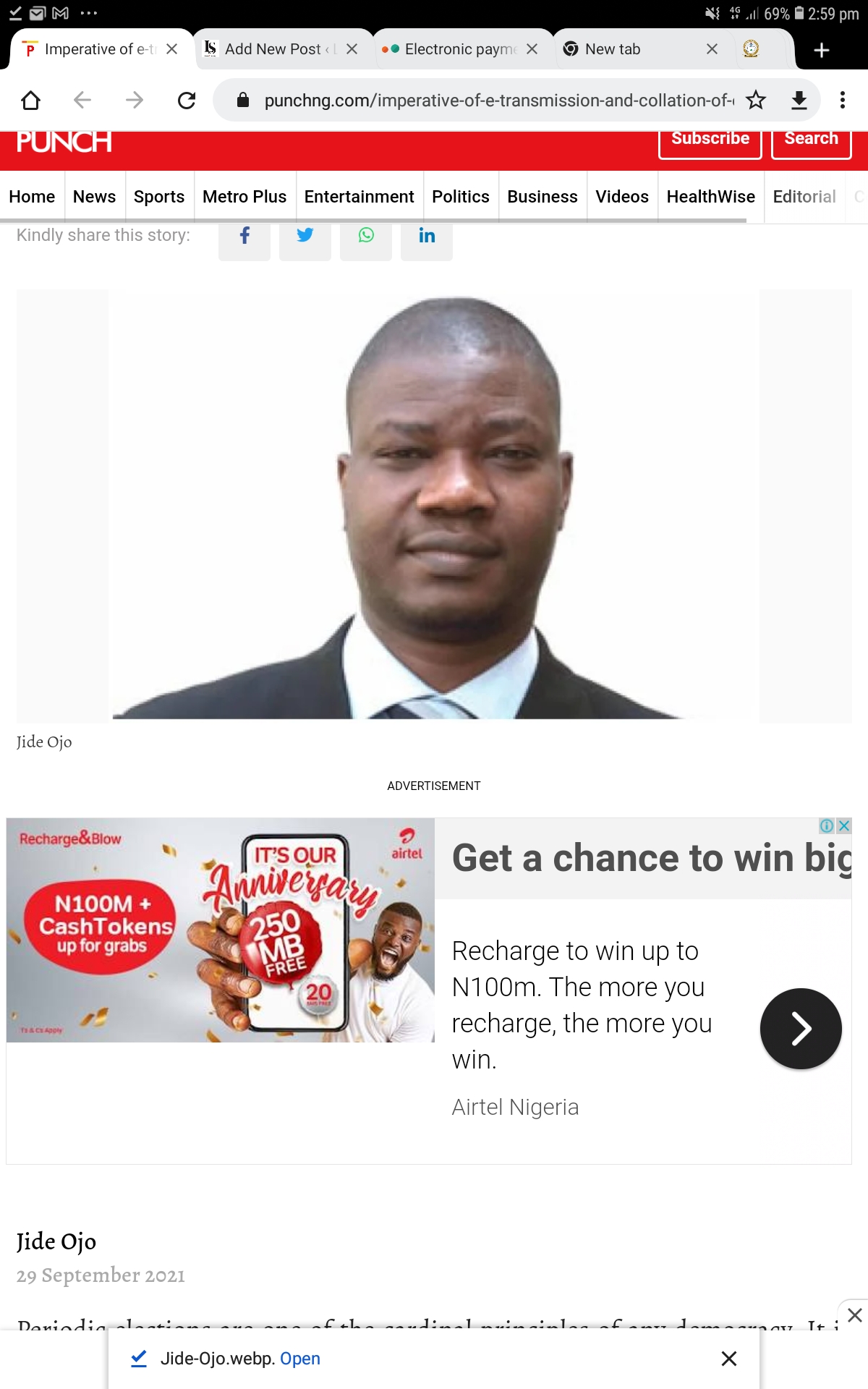
Jide Ojo

Periodic elections are one of the cardinal principles of any democracy. It is not enough to hold elections but such polls must be deemed free, fair, peaceful and credible.  This is a sensitive exercise given the fact that it is a political and governance leadership recruitment exercise. Nigeria’s electoral democracy started in 1923 after the enactment of the 1922 Clifford Constitution.  This 98-year old journey has been characterised by all manner of intrigues, charades and shenanigans so much so that the Transition Monitoring Group official report after the 2003 general election was titled, “Do the votes count?”

It is noteworthy that badly conducted elections were stated among the reasons for many of the military coups. Let me affirm that controversial elections are not peculiar to Nigeria. It is a global phenomenon. In fact, the last presidential election in the US was widely condemned by the members of the Republican Party especially those loyal to former President Donald Trump who believed that the poll was fixed to favour the Joe Biden.

In order to shore up the credibility of elections in Nigeria, there have been a number of institutional, legal and administrative reforms. The National Assembly in the course of this Fourth Republic has passed three Electoral Acts in 2002, 2006 and 2010 with an amendment in 2015 since inception of this republic in 1999. The federal lawmakers passed another Electoral Bill in 2018 which was not assented to by the President, Major General Muhammadu Buhari (retd.) while another one was passed in July 2021 ahead of the annual vacation of the lawmakers. There were also constitution amendments aimed at strengthening the legal framework of our elections in 2010 and 2018. The Independent National Electoral Commission, as the main electoral management body, has also been carrying out a lot of institutional and administrative reforms in order to enable it improve on its service delivery to the nation. The commission has carried a number of internal restructuring of its departments, directorates and units as well as operational procedures.

The credibility of any election is incumbent on all the actors and stakeholders in the electoral process. It behoves INEC, National Assembly, political parties, civil society organisations, media, security agencies, the judiciary and indeed the electorate to play their individual parts in order to ensure reliable electoral outcomes.

Since 2011, both national and international election observers have adjudged Nigeria’s elections as improving and largely reflecting the will and wishes of the electorate. However, as the saying goes, you can always better your best. INEC and CSOs have consistently partnered the National Assembly on ways and means of tightening the nuts and bolts of the legal framework for elections. So, after the missed opportunity of amending the Electoral Act in 2018, the Ninth National Assembly after inauguration in June 2019 pledged electoral reform as part of its legislative agenda and has so far kept to that promise.

Not only have the federal lawmakers passed the Electoral Bill 2021, the Senate has also gone ahead to pass the elusive Electoral Offences Commission Bill which has been proposed since 2008. However, the pending challenges now are that the Senate and the House of Representatives passed different versions of the electoral bill. This comes as a surprise as both chambers agreed to set up a joint committee on electoral reforms and the advantage that should have accrued from this is to have a harmonised bill that will be passed thereby making it unnecessary to set up a conference committee to unify their different positions.

Not only was there a joint committee of the Senate and House of Representatives that worked on the electoral bill, there was a larger technical committee which I learnt comprised the Senate Committee on INEC, House of Representatives Committee on Electoral Matters, representatives of the Office of the Attorney General and Minister of Justice and representatives from INEC. Policy and Legal Advocacy Centre provided support to the technical committee. It is therefore shocking to see that different versions of the bill were still passed in July. While the most controversial aspect of the bill is Clause 51 (3) of the Senate Electoral Bill which states that “The Commission may consider electronic transmission of results, provided that the national coverage is adjudged to be adequate and secured by the Nigerian Communications Commission and approved by the National Assembly”, PLAC’s review of the versions passed by the two houses shows a total of 18 differences. The clauses that need to be harmonised are: 1, 5, 6, 15, 16, 22, 23, 24, 35, 42, 48, 49, 51, 61, 74, 85, 131 and 151.

TIPS