The North East came into existence on the 5th of May, 1967 when, in his bid to check the influence of Odumegwu Ojukwu in the East, General Yakubu Gowon created 12 states out of the four regions in the country.
On the 3rd of February, 1976, General Murtala Ramat Mohammed divided the monolith North Eastern state into three – Borno, Bauchi and Gongola. These three states were further divided into six by General Ibrahim Badamasi Babangida on the 27th of August, 1991. From Borno we got Yobe, Bauchi gave birth to Gombe and from Adamawa came Taraba.
From a part of the Northern Region to an independent state, the North East, which now boasts of six states, has always been number one among its peers in almost all aspects of human endeavour – but from the rear.
For instance, in 2017, Taraba State was number 21 in Nigeria in WAEC, Borno number 25, Adamawa 28, Bauchi 31, Gombe 34 and Yobe 37. These are the kinds of results we have been getting through the years.
But we all know that education is the foundation upon which individuals, communities, nations develop. Without it, no barriers can be broken.
When you look at the health sector, we have the least number of tertiary hospitals and research institutes in the country.
We have dilapidated infrastructure and a poor road network with a lot of hinterlands unopened, so our farmers have limited access to urban markets. There is currently no functional railway network in the whole of the North East.
All these have not helped because insecurity, fuelled by the Boko Haram insurgency, has ravaged the zone.
Despite all these disadvantages, we have the potential to feed the nation. We have some of the best agrarian fields in the country, with a plateau that boasts of the best temperate climate around.
We have produced some of the best brains in the country. The Golden Voice came from here. The North East has produced great technocrats, captains of industry, politicians and statesmen that have contributed to making Nigeria a great nation.
What many cannot understand is that it is the North East that has given stability to a political North that allows such to be translated into national stability.
In 1978, a son of the North-East, Malam Adamu Ciroma, despite being arguably better qualified, embraced a North Westerner to form the central government. When the opposition wanted to destabilise the government of Alhaji Shehu Shagari, Alhaji Waziri Ibrahim, a North Easterner, stood against that.
By joining the government of General Sani Abacha in 1993, Ambassador Babagana Kingibe yanked the carpet from under the feet of those who wanted to destabilise the nation because of the annulment of the June 12 elections.
One of the greatest North-Easterners of all time is Alhaji Atiku Abubakar. A true democrat if ever there was one. He, more than almost everyone, has deepened our democracy through seeking court pronouncements to restore his rights after his falling out with his then principal, President Olusegun Obasanjo, and many other democratic actions. He has pushed us towards democratisation and the acceptance of democracy.
Even though the North West and North Central are bigger than the North East, the zone has always acted as the big brother for peace to reign. Politically, we have always given in to the two other zones to produce the president.
This is not because of incapacity. No, we have always at all points produced capable people who could steer the ship of state successfully and to the satisfaction of all. We have always given in to maintaining our bond and ties. We view all as our brothers and we love being our brothers’ keepers.
We have never cried over this. While others may want to see it as marginalisation if it were them, we see it as a unifying gesture. But now is the time for them to reciprocate.
The North-East should henceforth mobilise and sensitise people on the fact that it is now its turn to produce the next president.
Another sound argument is that we have capable hands that can take this nation forward. We have them: those who will be fair to all and have the nation at heart; those who will give everyone their rights; those who can turn around the fortunes of this nation and make it into the great nation that it ought to be.
But we should not mouth such an agenda as a slogan. We have to be deliberate in working for it and working towards it. We have to start by empowering ourselves. Those with the opportunity to empower people should do so; those empowered owe it as a duty to build up others.
Some of the senior North Easterners have done so – building institutions and businesses that would take many people off the streets and thus cutting down on the recruitment base of insurgents and perpetrators of violent crimes.
Our political stakeholders must, as a matter of urgency, look into our political recruitment process. Governors should not be afraid of having capable hands in the houses of assembly in their states. A situation where nitwits, instead of brilliant young chaps, are pushed to the legislature will not augur well for our present and future development.
When a governor recruits those brilliant minds, they don’t take his glory away because he remains “His Excellency” in the state and any success must be linked to his name, but he gets them to apply their God-given resources to work for the people, the state and the region. They also learn the fine points of politics, leadership and governance which will prepare them for service to the people at local, state and national levels.
By surrounding themselves with such good heads, the governors and other political office holders will provide good leadership not only now but also in the future.
This is, however, a short, medium and long-term plan.
From now till 2023, we must mobilise the North-East to know that the presidency should come here. Not for any personal gain, but because taking Nigeria out of the woods has once more fallen on its shoulders.
Once more?, people ask. Yes, once more, is the answer. The North East is the hub of northern politics. Northern politics that reached out to dominate national politics started in this zone. The discussions for the formation of the Northern People’s Congress (NPC) which culminated in its fruition in Zaria, started in Bauchi.
The first political party in Nigeria, the Northern Elements Progressive Union (NEPU) was founded in Bauchi and its intellectual fountain was Sa’ad Zungur. Malam Aminu Kano keyed in because he was a teacher in Bauchi then. We should also not forget Ibrahim Imam and his Borno Youth Movement.
Perhaps we do not want our brothers from the North West and North Central to think because Nigerian politics started in our zone, that’s why we want to Lord it over them. And so we always bend backwards for them.
People with vast resources, rich culture and history always make good leaders.
The North East is the richest zone in the country. The exploration of the Mambila Plateau will reveal one of the most natural resources endowed areas of the world. Apart from that, we have many other natural resources that can turn any nation into an economic superpower if harnessed.
We have had Mali and Songhai empires not to talk of the thousand-year-old Kanem Bornu empire. The Adamawa Kingdom is transnational.
When you look at it from the angle of national unity, the bulk of those who fought to keep Nigeria one were also from the Northeast.
Therefore, a North-Easterner coming out of such an endowed region will be a blessing to the entire nation.
As we leave this hall, we should all disperse into the nooks and crannies of this blessed country and call all to join us in producing a leader who will salvage this country. Tell them there is a Northeasterner that can.
•Being a speech delivered by Hassan Gimba, publisher of Neptune Prime online newspaper and magazine, chairman Northeast Publishers’ Forum, as the Guest Speaker at the 6th Annual Awards and Recognition Night of the Northeast Star magazine, held on the 21st of October, 2021 at the Conference Hall of AUN, Yola, Adamawa State.
I read Camara Laye’s ‘A Dream of Africa’ in secondary school. I still see the sky-high gate of his walled Africa; the murderous giants and guards; the cowering captives, terrorized and traumatized in their condemned prisoners’ cells. I remember the homicidal, militant ‘nationalists’ and the ‘revolutionary’ tyrants. I see homelands in the throes of fear and turmoil. The prisoners are many but the love of self won’t let them band together and throw off the yoke of their cruel keepers. The guards are hawkish but few, yet their many victims see no answer in rearing together to freedom. The African story is a dream of mass suffering, frustration, and fruitless flight from torture and death at the hands of terrorist giants. It is a story of certain disaster, a crash that would happen while the people abet their tormentors. The novel, published in 1966, says that was the future fate of Africa. That future is here, tragic and certain as the prophecy.
The hero’s dream genie was right and prescient; it was correct. The writer is always a dreamer; a prophet. And Camara Laye was not the first storyteller to see the future. George Orwell, author of ‘1984,’ like Laye, the African child, had a vision of sorrow in tomorrow. His own prescience, however, covered the whole of human skies and his rendition of that vision is grueling and painful in its reality. Hear him: “There will be no curiosity, no enjoyment of the process of life. All competing pleasures will be destroyed. But always, — do not forget this, — always, there will be the intoxication of power, constantly increasing and constantly growing subtler. Always, at every moment, there will be the thrill of victory, the sensation of trampling on an enemy who is helpless. If you want a picture of the future, imagine a boot stamping on a human face— forever.” Orwell’s 1984 was published in June 1949.
I hold, strongly, that the prophet’s vision was of today’s Nigeria. This is a very hard time to live. ‘The crime scene at the heart of Africa’ is the title of an editorial published last week by ‘The Economist’ to the discomfort of the Nigerian government. It is an attempt at dissecting the conundrum that Nigeria has become. I am interested here in the last of the 12 paragraphs of the piece: “The biggest barrier to restoring security is not a lack of ideas, nor of resources. It is the complacency of Nigeria’s cosseted political elite — safe in their guarded compounds and the well-defended capital. Without urgent action, Nigeria may slip into a downward spiral from which it will struggle to emerge.” Did you notice the warning in the last sentence?
Terrorist governance has mutated before our very eyes. The spiked boot of life is on the face of the helpless Nigerian. He is down and bleeding. The government is doing its own inadequate things in Abuja; bandits and terrorists are in the forests unleashing plagues on everyone of any value. They shot down a jet in Zamfara; they have paved almost all the roads as expressways to hell. Last week, they added to what we knew of their ruinous ability. They attacked a train and our rail lines in Kaduna. They have taken over the broad road to the farm and the narrow path to the stream. The question then arises: where now is the road to survival – and to escape? They are not done with us. Still last week, ‘unknown gunmen’ dashed across the Niger into Western Nigeria. On Thursday, they engaged soldiers in a shootout in Ikole Local Government Area of Ekiti State. The police said they abducted three persons during the confrontation. The following day, Friday, ‘unknown gunmen’ were in Akure, Ondo State where they abducted two schoolgirls at the gate of their home.
Later the same day, ‘unknown gunmen’ invaded a Nigerian prison in Oyo town, Oyo State. They shot their way in and freed over 800 inmates. What kind of country is this? The state knows only what it wants to know. Shall we ask: who were those villains of the night who outgunned the Nigerian state in Oyo? Are they really unknown? Should they be unknown for more than 24 hours to a 21st-century state? Reports said they were many and they came heavily armed. Was that not how Boko Haram started in Borno and Yobe; and the bandits in Zamfara, Sokoto, Kaduna, and Katsina? How did the gunmen arrive in Oyo town undetected? Yorubaland is a very urbanized part of Nigeria. Oyo town, surrounded by a tangle of towns and villages, is just 51 kilometers to Ibadan, the state capital. You cannot travel five kilometers along that route and around Oyo Alaafin without entering a major settlement. And there are police checkpoints everywhere. Yet, no one saw the slithering terror as it came visiting. Is Nigeria so sure these are mystery men?
Fyodor Dostoevsky, the 19th-century Russian novelist, and essayist has a bit of advice here: “above all, don’t lie to yourself. The man who lies to himself and listens to his own lie comes to a point that he cannot distinguish the truth within him, or around him, and so loses all respect for himself and for others. And having no respect, he ceases to love.” Amidst all the horrendous happenings being harvested daily, the Nigerian state has a solution: It is asking the media and all storytellers to stop writing bad news about bad things – because they are no longer bad. In his Eid-el-Maulud message last Monday, President Buhari called on the media “to address the tone, content, and standards of reporting into security and safety measures.” He said “time has come to revise the prefix ‘rising insecurity’ with ‘declining insecurity.’”
He added more sternly that “the reality of ‘declining insecurity’ should replace the inaccurate narrative of ‘rising insecurity in the country.” I do not seem to understand what the president is asking the media to do here. It is not raining, it is pouring; and we are out here with no roof over our heads. How do we then deny that we are drenched? Where I come from, there is a bird called Ayekooto (the world rejects truth). It says it at it sees it. But truth-saying has always been dangerous. And you remember what happened to Cinna the Poet in Shakespeare’s Julius Caesar? On Saturday, a journalist, with cynical satirist fingers, typed a private message on the Oyo prison attack: “The correct headline of this story should be, ‘Firecracker men visit Oyo prison, take all prisoners out for a picnic.’ What happened in Oyo on Friday was not a jailbreak. It was a terrorist attack. How do we ‘manage’ that story?
There is this character in Oscar Wilde’s ‘The Importance of Being Earnest.’ He is asked if his name is really John. And he answers, standing rather proudly: “I could deny it if I liked. I could deny anything if I liked.” That is the character that has wormed itself into the heart of our state and its operatives. Did you notice how the government scrambled to play down the terror attack on the Kaduna-bound train and the rail line? How will a denial prevent the next attempt from an unrelenting enemy? This government denies anything it wants to deny. If you caught it in bed with its neighbour’s wife, it would shout: “it is not what you think.” It has no trouble calling its dangling dick corncob. What the media gives to Buhari and his government is not hatred; it is duty. If the president gets up today and makes assessment tours of scenes of attacks. If he flies one of his numerous jets to Ibadan in sympathy with victims of the Oyo attack. If he goes to Kaduna and rolls out measures to prevent another attack on rail lines and passengers.
If he lands in the east with a message of peace, fairness, and justice. If he declares bandits of all tribes and tongues as terrorists and leads from the front doing the job of a wartime president, the media will clap for him. It was one of the reasons he became president in 2015. But he promised a secure Nigeria, and it is not happening and his people think that failure should be fatal and the fatality should go unreported. No. It should not happen if the living would live beyond now.
We all know this government needs help outside its circle of bumbling cousins and nephews. It is employing denial as a self-help strategy. Its operatives want a passmark outside the pigeonhole of truth. Like failing pupils, they are copying the correct arithmetic answers from the back of their Larcombe. They said a key solution to our insecurity is for the media to start playing down bad news. And, I fear, some ‘journalists’ are echoing that thinking already. “You can’t get away from yourself by moving from one place to another,” celebrated American novelist, Ernest Hemingway tells people who think exactly as our government does. We are in a ditch, the way out for us is not by being pentecostally ‘positive’ that we are out in the safe field. We are not. We are trapped in an interminable spiral of violence and bloodletting – and terrorism of the worst strain. We need a lot of noise and shoutouts to rescuers. The Federal Government should get up and work; the media is not the problem.
There are so many perks of office and enjoyment in the president’s office. Nigerian presidents (Buhari and his successors) need to take more than gold and diamond benefits from this presidential democracy. There are ropes of presidential empathy and responsibility with the Americans who gave us this system of government. Our leaders should learn leadership from the authors of what we run. In October 1983, a suicide bomber murdered scores of US Marines in Beirut, Lebanon. The lion of President Ronald Reagan roared out of the White House. He “stood in a downpour on an Air Force tarmac” literally calling the shots against the murderers. Reagan would recall this as “the saddest day of my presidency, perhaps the saddest day of my life.” That was a president. Let our own president – and those scheming to take over from him – go and read Bill Clinton, George W. Bush; Barack Obama; Donald Trump’s reaction to the many security challenges their country faced, home and abroad. They should read Biden’s tough take on the murder of American troops at Kabul airport in August 2021.
“We will not forgive, and we will not forget. We will hunt you down and make you pay,” vowed Biden. And it was not an empty promise. The murderers paid within that week. I listened to the Oyo State governor, Seyi Makinde’s broadcast to the state on the Oyo prison attack. He spoke well and I saw him doing what President Buhari ought to do. The governor said he was using the opportunity “to put the citizens on alert.” He said there was “no better time to repeat the call to action: if you see something, please say something.” Governor Makinde “directed the security agencies to deploy personnel to critical national assets within the state and to monitor all entrance and exit points across the state.” I think that was leadership, prompt and firm.
But how much control has the governor over the security agencies? Has Abuja, with all in its arsenal, said or done something specifically useful and impactful on this incident? Oyo is too far and too remote to Abuja for anyone in that city to feel the pangs of the carnage. Nigeria is a structural tragedy. A soldier was killed; an Amotekun operative was murdered. There are several others in the hospital critically injured so that we all may be safe. The governor has visited the injured; his government is paying the bills; he has mourned with the bereaved families. But, where is our Commander-in-Chief?
NOTE: This story you are about to read started many years ago between two sisters but the truth only came out 3 weeks ago when Mercy opened up to me and also gave me the permission to write her story so that you can advise her on what to do and also learn from her mistakes. Below is the story.
Three weeks ago I heard a knock on the door of my consulting room. Somehow many years of my practice have taught me to come to understand the moods of my different patients based on the way they knock on my consulting room door. Those in emergency knock hard and several times. Those who are depressed knock weakly and only once or twice. This knock was just once and very weak, I know it was that of a patient in despair and despondency. I said “yes, come in”. She opened the door and came in. My guess was right. Standing before me was a young woman in her late 20’s looking dejected and rejected.
“You are welcome. What can I do for you?” I asked. She managed to answer me “Doctor I am tired of life”. That response hit me and made me readjust my seat. I knew I had a serious life matter in my hands.” I called my file attendant who was opening her card to bring it quickly which he did. I asked her to have her seat and asked for her name. She answered MERCY ( NOT THE REAL NAME).
“So what is the problem? Why are you tired of life? Hope you don’t have any plan killing yourself?” I asked. She said “Doctor if death could just come for me right now, will I not be better off? “. I answered her “The most important thing in life is life itself. As far as you are alive, there is hope no matter the situation” I counselled her, not knowing that I was about to hear the worst secret of my entire career so far. In fact we got to a point when she was telling me her story, I almost agreed with her within me that truly death might actually be better but thank God whose mercy is infinite and limitless, no matter the depth of our decadence.
Are you ready to read MERCY’s true life story? Then take your seat, let’s go.
“So MERCY I am all ears. Tell me everything that happened to you that made you think death is better”. She breathed in deeply and tears started rolling down her cheeks as she asked me the scary question : “DOCTOR I AM PREGNANT FOR MY ELDER SISTER’S HUSBAND: DO I ABORT THE PREGNANCY OR DO I MARRY HIM?” I didn’t know when I breathed deeply in too and said “your elder sister’s husband?” “The same father the same mother?” She said yes. I breathed deeply in again and composed myself like a professional. “Okay MERCY how did you get here? How did you get pregnant for your elder sister’s husband? Is your sister aware? Tell me more about this whole thing”. Little did I even know that I had not heard the deepest and worst secret. She went ahead to ask me the second question without responding to any of my serial questions. “DOCTOR DO YOU KNOW THIS IS SECOND PREGNANCY? I HAD A CHILD FOR HIM ALREADY WHO IS LIVING WITH US BUT MY SISTER DID NOT KNOW THAT HER HUSBAND IS THE FATHER”. At this junction I didn’t know if I dropped my pen on the floor or my pen dropped from my hands to the floor. I had to manage to bend down, pick it up and sit down very well again so that I wouldn’t lose my balance on the seat.
“Mercy are you serious about what you just told me?” I asked unbelievably. She said yes doctor. I said how? “Okay can you tell me your whole story with your sister and how you got to this level?” Then the sad story began.
Doctor I will blame our parents for all this”. “Why” I asked. She continued. “When we were growing up doctor, our parents had always preferred my elder sister to me. They would always say she is more responsible than me. They would always say I am useless, I should go and look at my elder sister how she is living her life and emulate her. I became competitive with my sister as early as I could remember in life as children. Anything she had I wanted it. I competed with her in everything in life. This cut across even her boyfriends when we grew up. Doctor I dated two of her boyfriends when we were staying together as sisters in the university but she didn’t know. I even aborted for one of them.” I was trying not to sweat and keep my calm and composure. We doctors hear deep things of life behind those closed doors of our consulting rooms. We carry them with us as burdens everyday even to our graves. Only those secrets we are permitted by the owners to share can be revealed. Sometimes we get depressed hearing these stories. Sometimes my wife would notice I looked depressed she would ask me what the problem is I will say nothing, yet there are millions of secrets you can’t share because you swore to an oath to die with them. May God help all doctors world over. Please keep praying for us for strength.
Back to our story. MERCY continued “doctor I have even broken up some of my sister’s relationships in the past that she was not aware that I was the one that broke them. She was not a saint after all like our late parents painted her. There was a time she was planing to marry one responsible, rich, successful guy that loved her so much but I noticed she and one of her exes were still talking. I went ahead to tell the other guy that was planing to marry her which led to their break up. She almost died from the incidence and till today she never knew it was me that told the guy. Doctor I am an horrible person right?” She asked me as guilt was written all over her and was crying bitterly. I consoled her and urged her to continue her story because truly I didn’t want to answer that question.
She continued, “Doctor, so to how I got here with my sister’s husband… 5 years ago she got married and you know we have been staying together since we lost our parents. We were the only two our parents had. So when she got married I followed her to her husband’s house to be staying with her. After two years into the marriage that she could not conceive I started giving her husband signal that I was available if he wanted me. Doctor I never knew the extent this childhood rivalry had eaten me up until now. Doctor my sister’s husband and myself started having intimacy right under her nose and on her matrimonial bed. Anytime she travelled and left me at home with her husband, I took care of her husband till she returned. Eventually I got pregnant for the husband. I wanted to ABORT it but he begged me and begged me that I shouldn’t. He would find a fake father for the child who would take responsibility for the pregnancy and the child without my sister knowing. The whole issue of being pregnant became fight between me and my sister but the fake man showed up and claimed responsibility for it and begged my sister to please calm down he would marry me but not now because he was still job hunting which made my sister to leave me in her house to continue staying with her with my child but she could not help the way her husband loved the child so much. She noticed it.”
“Doctor I regretted all this. I felt my betrayal of my sister had gone too far. I cried and repented after the whole incident but I was scared to death to confess to my sister what I had done to her but I vowed nothing would happen between me and her husband again. I kept to this promise doctor until 2 months ago. All this while my guilt gave me strength to fight off the husband anytime my sister was not at home and the husband wanted to play with me. I thought I had even overcome him until 2 months ago when one thing led to another and it happened again. Doctor I never saw my period again which made me to do pregnancy test yesterday lo and behold POSITIVE. Doctor help me, how do I go about my life from here? To now make matter worse doctor do you know that till now my sister has still not gotten pregnant for the husband? And I told the man yesterday about the second pregnancy and he told me I should marry her, he would divorce my sister and marry me. Doctor please help me I am finished.”
I was looking at Mercy like a lucozade for almost 5 minutes after hearing her story because I didn’t even know the way forward. Till now I don’t know the way forward which made me to ask for her permission to throw it open to the whole world for advice and suggestions. Please the matter is now in your court what do you think is the solution to this problem?
As for Mercy’s questions to me if she should ABORT the pregnancy or MARRY her sister’s husband; my own answer is NO to the two questions.
DON’T ABORT THE CHILD AND DONT MARRY ANOTHER WOMAN’S HUSBAND EVEN IF THE WOMAN INVOLVED IS NOT YOUR SISTER.
As to where to go from here I will leave you readers to offer your pieces of advice and suggestions on this delicate matter. As for me I learnt some powerful life lessons from this matter which I will like to share with you before I leave the floor open for comments and suggestions. Below are the lessons:
LESSON NUMBER 1: My first lesson goes to the parents. STOP comparing your children with one other. Stop telling one child to look at another one. Handle each child according to their uniqueness and correct them without comparing them to one another. You dont know the depth of sibling rivalry you are creating and how far into generations it can go.
LESSON NUMBER 2: Your own blood sister or brother can betray you. What am I even saying? Can kill you and take over your life. Trust people but NEVER trust ANYBODY I repeat anybody BLINDLY. It is only God that is infallible.
LESSON NUMBER 3: This lesson goes to all married women. Be careful the level of closeness you allow between your sister or friend and your husband. The best of men are still men, they can crumble in the face of temptation. Put cautions and boundaries in place. Don’t say she is my sister or friend. He is my husband. Nothing can happen between them. It will shock you.
LESSON NUMBER 4: This is to all the husbands. Do everything not to betray the confidence your wife has in you. She will never always be there to monitor you or what you do but let your oath before God and man the day you married her be your bond.
LESSON NUMBER 5: This is to my fellow doctors. Don’t share in anybody’s sin of murder to take an innocent life. No matter how bad the situation don’t help anyone to commit any abortion. Allow them to face the consequences of their action. God is watching you and you will give account on the last day when you face God on the judgement day
NOTE: KINDLY SEND ANY ADVICE OR SUGGESTION YOU HAVE FOR MERCY. I WILL DEFINITELY GET THEM ACROSS TO HER. PLEASE LET US AVOID ABUSING HER, IT WILL NOT SOLVE THE PROBLEM ON GROUND. IT IS SOLUTION WE ARE LOOKING FOR.
END
Thank you for your time for reading this article. By What are other lessons you have learnt from the story?
Nigeria and other ECOWAS members are suppose to move freely and enjoy common trade, among other benefits, like the European Union 🇪🇺 . This is not working and in this public lecture across 3 continents (Italy, Tunisia & Nigeria), I proffered solutions!
This paper highlights the ECOWAS Protocol on Free Movement & the Insecurity in the region. It provides insights on the mechanisms for curbing regional insecurity through the ECOWAS Protocol on Free Movement & other regional instruments. Link to the full presentation is below 👇🏿
LECTURE CONTENT:
1) Profile of Onyekachi Umah
2) Presentation Plan & Outcome
3) Justification
4) Assumptions
5) Facts/Statistics
6) Overview of the ECOWAS Protocol on Free Movement
7) Regional Security and the ECOWAS Protocol on Free Movement
8) Rethinking the ECOWAS Protocol on Free Movement for a Secured Region
9) Recommendations
10) Conclusion
Read more via:https://learnnigerianlaws.com/is-reviewing-the-ecowas-protocol-on-free-movement-the-way-to-go/
‘When we revolt it’s not for a particular culture. We revolt simply because, for many reasons, we can no longer breathe’. ― Frantz Fanon
The classic of Franz Fanon from which the dominant element in the title of this piece, ‘The Wretched of the Earth’ is taken, is quite instructive.
It is a 1961 book originally written in French. Let’s explore it for our understanding of the message here today. ‘The Wretched of the Earth’ (French: ‘Les Damnés de la Terre’) is a 1961 book by the psychiatrist Franz Fanon, in which the author provides a psychological and psychiatric analysis of the dehumanising effects of colonisation upon the individual and the nation. The book discusses the broader social, cultural, and political implications of establishing a social movement for the decolonisation of a person and of a people. The French-language title derives from the opening lyrics of “The Internationale”.
Through critiques of nationalism and of imperialism, Fanon, a French West Indian psychiatrist and political philosopher from the French colony of Martinique presents a discussion of personal and societal mental health, a discussion of how the use of language (vocabulary) is applied to the establishment of imperialist identities, such as coloniser and colonised, to teach and psychologically mold the native and the colonist into their respective roles as slave and master and a discussion of the role of the intellectual in a revolution.
Fanon proposes that revolutionaries should seek the help of the lumpenproletariat to provide the force required to effect the expulsion of the colonists. In traditional Marxist theory, the lumpenproletariat are the lowest, most degraded stratum of the proletariat—especially criminals, vagrants and the unemployed—people who lack the class consciousness to participate in the anticolonial revolution.
Fanon applies the term lumpenproletariat to the colonial subjects who are not involved in industrial production, especially the peasantry, because, unlike the urban proletariat (the working class), the lumpenproletariat have sufficient intellectual independence from the dominance of the colonial ruling class, readily to grasp that they can revolt against the colonial status quo and so decolonise their nation.
One of the essays included in ‘The Wretched of the Earth’ is “On National Culture”, in which Fanon highlights the necessity for each generation to discover its mission and to fight for it.
You know ‘the wretched of the earth’ in this milieu called Nigeria, currently one of the poverty capitals of the world. This is therefore another warning signal note to all the duty bearers and the authorities in Nigeria that the next revolution heat they will feel may not come from the ranks of the followers of Nnamdi Kanu, or Sunday Igboho, or unknown gunmen or even the terrorists we call bandits.
The rage next time may not be from the artistry of Omoyele Sowore’s ‘RevolutionNow’ operatives. The next revolt is not likely to be from the armoury of the experienced tormentors inside Sambisa Forest. The fire next time will come not from a particular culture but it will come in unexpectedly because ‘the wretched of the earth’ in Africa’s most populous nation will sooner than later scream, ‘we can no longer breathe’.
The oppressors in Nigeria should not ask me, for whom the bell tolls: hold your breath, it tolls for thee!
The two clear signals on the imminent fire have curiously appeared in the two capitals of Nigeria, Abuja and Lagos, one a political capital and the other commercial capital, where the oppression of the vulnerable and the oppressed ones, have become dominant. And so those who run Nigeria from these two capitals had better watch it as the dust of the aftermath of the first anniversary of the remarkable #EndSARS (20-10-2020) hasn’t settled. Here are the warning signal notes:
‘Lagos NURTW generates N123bn annually’ On July 22 this year, the International Centre for Investigative Report (ICIR) revealed in a major report that the Lagos chapter of the National Union of Road Transport Workers, (NURTW) locally tagged ‘agberos’ generates about N123.08bn annually, which could service the annual budgets of Nasarawa, Niger, and Yobe states put together. The data released on Thursday July 22, showed that the money was realised through levies on passenger vehicles, motorcycles and tricycles. According to the reliable report, other sources of income not included in the report were money levied on hawkers, articulated vehicles, and persons who visited certain markets to buy goods.
The report recorded a total of 75,000 buses; 50,000 tricycles; and 37,000 motorcycles in Lagos.
It showed that on a daily basis, N3,000, N600, and N1,800 were levied on buses, motorcycles, and tricycles respectively. These levies sum up to N82.1bn for buses; N8.1bn for motorcycles; and N32.9bn for tricycles yearly; making a total of N123.078bn yearly.
Speaking on how the union could generate such money, a close associate of the NURTW who spoke to ICIR correspondent on condition of anonymity, said, “It is a highly connected and well-organised syndicate…Take Idumota, for example; some ‘agberos’ work in the office, others work on the streets; some work in the morning, some are constantly on afternoon shifts… “Some also have days that they work. Although, there is a fixed price, the rule of the game is that the ‘agberos’charge the drivers based on the amount they charge the passengers.”
He added that in Idumota, there were over seven chairmen who get deliveries from the boys that work on the streets. “The boys have delivery targets, which is the reason they act rudely to drivers and passengers alike,” he added. He narrated further that to work with them, one must know one NURTW chairman or another renowned hoodlum on the street. The source mentioned the case of a young man who went to Badagry to get diabolic fortifications so that he could be effective on the job.
A passenger, Emmanuel Francis, expressed concerns over the activities of NURTW members. He urged the Federal Government to regulate their activities. When contacted by ICIR, a spokesperson for the Lagos Internal Revenue Service, (LIRS) Monsurat Amasa, said she could not comment on the amount the NURTW generates, but added that as a part of the informal sector, the body pays taxes to the government.
‘The Abuja multiple taxation on the poor’
Meanwhile, the same investigative report organ also revealed ‘how payment of multiple taxes has been frustrating ‘okada’ riders in Abuja’, Nigeria’s capital. Part of the fact file:
‘DANIEL Chogwu, 33, had moved to the Federal Capital City, Abuja from Kogi State in 2014 in search of a paying job with his high school certificate. Unable to earn a pay after being owed three months’ salary working as a security guard for a firm in Abuja, he started looking for his next best option. Several of his friends who were commercial motorcyclists advised him to try Okada riding temporarily till he finds a better job. Fast forward to 2020, Daniel works from 5 a.m. to 6 p.m., six days in a week as a full-time commercial motorcyclist plying the Nyanya – Mararaba axis. On a good day, he says he makes about ₦2,000 daily but on some other days, he comes home with as low as ₦800. Because of his meagre earnings from the “Okada” business, he spends frugally.
But no matter how small his daily income is, he is charged an average of ₦250 on taxes weekly, which he pays to the Abuja Municipal Area Council, AMAC. If he fails to pay the levy of ₦50 daily before 2 p.m., his motorcycle would be confiscated and he would have to pay ₦1,500 to get it back. “Since I started this business in 2014, I’ve been buying tickets and paying one tax or another but I don’t know why we are paying because it has not benefited me in any way. All they [the tax collectors] are after is to collect money from us, sometimes with support from the police, and they would seize our motorcycles if we don’t pay,” he said angrily (ICIR)
Daniel’s experience is not different from the plight of commercial motorcyclists operating in satellite towns and rural areas in the Federal Capital Territory (FCT) whose motorcycling taxi business is stifled as a result of paying multiple taxes and levies enforced by transport unions and government agencies. This is happening in Nigeria’s capital where a policy on social protection policy at a perilous time such as this is being implemented.
Nigeria is generally believed to be the second-largest market for commercial motorcycling in Africa, providing an alternative means of employment for the 231,544 unemployed residents of the FCT according to a 2018 data published by National Bureau of Statistics, NBS. But this group of workers pays more in tax than their counterparts who earn better income.
Specifically, for authenticity of this intelligence, the ICIR operative visited five locations in Nyanya where tax agents of the Abuja Municipal Area Council, AMAC operate. As early as 8:00 am, they are out issuing ticket and collecting daily levies from commercial motorcyclists. Mopol Junction, Redeemed Junction and Nyanya market are some of the popular routes commercial motorcyclists within Nyanya axis ply daily and tax agent are stationed at various spots to collect the stipulated ₦50 every weekday from Monday to Friday. Though the activities of motorcyclists are not allowed within Abuja’s city centre, they operate within the suburbs providing an alternative means of transport for ease of movement in areas where they are unrestricted. Curiously, checks have also revealed that at Nyanya Phase 4, policemen usually accompany the officials of AMAC to collect taxes from commercial motorcyclists plying the route. In Lugbe, the trend is the same except that there are three different bodies that collect levies from commercial motorcyclists namely Motorcycle Transport Union of Nigeria (MTUN), Amalgamated Commercial Motorcycle and Tricycle, Owners, Repairers and Riders Association of Nigeria (ACOMORAN) and Federal Capital Territory Authority, FCTA. The levy ticket for “Okada” riders in Lugbe is accompanied with a printed receipt to acknowledge payment made by a commercial motorcyclist usually from Monday to Saturday every week.
In his early fifties, James Madaki, also captured in the scoop, is a tickets agent who rarely smiles while working for AMAC’s motorcycle revenue collection office in Nyanya. He struggles to wake up by 5 am daily and drags himself to the road, his job is to sell tickets to motorcyclists on AMAC’s behalf for a commission. James is not on the payroll of AMAC, if he does not go to the road to sell tickets then he will be broke. For every ticket he sells he earns a commission of ₦10, he acknowledges that this amount is small but it is better than being idle. If he hits the road very early, he could smile home with ₦1,200 for the day, which he says doesn’t happen often. “I always wake up very early so I can sell these tickets and get my money for the day. This job is very demanding because I have to be on the lookout for “Okada” riders and persuade them to buy from me so I can eat and government can eat,” he said.
However, the National Tax Policy recommends that tax establishments shall ensure that primary tax functions, which include assessment and collection of taxes, are only carried out by career tax administrators who are public servants and not by ad-hoc consultants or agents. There are different groups all collecting taxes and even when the police arrest a motorcyclist there is no group that will speak out for the person and they are all printing receipts to collect taxes. And when these motorcyclists default on paying the tax the police and agents will violently make life difficult for the riders.
***Let’s continue the discussion of the next revolt of ‘the wretched of the earth’ the government and politicians have been exploiting next week…
The Indian Express
Johnson & Johnson set to begin India trial of its single-shot vaccine soon | India News, The Indian Express
By Gbenga Ajileye
While commending the Nigerian government for their efforts in ensuring that Nigerians get all possible protection from the dreaded COVID-19 pandemic by making the vaccines available to Nigerians in all spheres of our national life, it is however crucial to quickly point out a very crucial observation, which may greatly embarrass Nigeria and Nigerians – especially those who might be travelling to other countries very soon. My observation is based on personal experiences on Saturday, 23rd October, 2021.
I was at the vaccination centre to get my second shot of the Moderna vaccine. The encountered bottlenecks in the procedure were nothing strange, considering our obtuse way of making every simple thing complicated. I managed to get the jab and left the venue. As soon as I got home, I decided to verify if all my data, especially my names and date of birth, were correctly captured. The card as designed has no space to indicate the owner’s date of birth. That and other details regarding the type of vaccine taken and number of jabs received are encoded in the barcode seal. I remember I had earlier installed a QR CODE READER app on my phone. I activated the app and scanned the barcode on my card. The result showed that my name was correctly captured, but my date of birth was 6 months and 5 days off. I quickly returned to the vaccination centre to demand that that crucial data be corrected. The officers politely agreed to verify from their databank. They discovered that the code reader was correct and immediately effected the correction. One young man who was there for his second dose approached me and asked how he could check if his own data were correctly captured too. I offered to scan his barcode and again his birthday was 3 years wrong. I scanned the cards of 4 others in the crowd and discovered that the birthdays of 3 were off on several scores. I returned to my Sports Club and shared the day’s experiences with friends and members. This started us off on another round of barcode scanning. The results were baffling: out of the 8 scanned only one was without errors in the date of birth. The most disturbing was the case of a 60-year old gentleman from Anambra State who had completed 2 doses of the Astra Zeneca vaccine since June 2021 but whose data read that he is 40-year old Ahmad Sule who has taken only one dose of the Moderna vaccine. The consequences of these errors are dire and are better imagined especially for travellers at the entry points of countries where the barcodes on travellers’ cards would have to be scanned for verification. My intention for sharing this experience and observations is to encourage everyone who has commenced the vaccination process to go through the following simple steps:
Download any QR CODE READER or BARCODE READER app from the Google Play Store or Apple Store.
Open the app and position the aperture in such a way that the barcode will be completely inside the aperture. Once the scan is complete your full details will appear on the phone.
As staff members allege high-handedness, massive corruption and gross incompetence against Registrar General
Code of Conduct Bureau accused of unholy alliance with Commission
By Lillian Okenwa
As various groups and organisations petition the Presidency, National Assembly, and Code of Code of Conduct Bureau (CCB) against the Registrar General (RG) of the Corporate Affairs Commission (CAC), Alhaji Garba Abubakar, over alleged high-handedness, massive corruption, and gross incompetence, members of the Commission’s top management have been resigning in droves.
Rattled by the mass resignation, CAC in a memo dated 4th October 2021 and signed by its Director of Human Resources, Mrs. Olayemi Oyeniyi warned that the Commission would no longer accept sudden resignation without the mandatory one month or three months’ notice as stipulated in the Commission’s condition of service. The massive resignations are said to be at all levels – Directors, middle Management, and other Cadres.
However, one of the many aggrieved staff of the Commission who spoke with Law & Society under anonymity for fear of victimisation described the notice as illegal and laughable. “The above memo has been foolishly, sheepishly, blindly, and ignorantly signed. It is illegal and contrary to law, common sense, and logic; both at Common Law and Statute. In a contract of employment being a contract of personal service, nobody can force an unwilling employee to work. The memo is laughable and scandalous. One can give the statistics of the number of people that resigned during his less than 2 years tenure. The harassment and intimidation is too much.”
It is worthy of mention that during the maiden meeting between Graba Abubakar, CAC Management Team, and the Hon. Ministers of Industry, Trade and Investment, Otunba Adeniyi Adebayo and Hajiya Aisha Abubakar at the Ministry here he (The RG) was presented with his Letter of. Appointment, both Ministers cautioned Abubakar as an insider who ultimately got the job after a lot of wranglings, manipulations, and in-fightings not to “use his appointment as an opportunity to settle scores or embark on vendetta” given the bad blood that the Commission witnessed for 2 years of the vacancy of the RG position. Both Honourable Ministers offered to “carry out close oversight” functions over CAC.
The distressed staff further observed: Curiously, the same Ministers are still in Office while Abubakar is on a rampage of unprecedented vendetta hat led to the shock resignation of 4 Senior Directors within 6 months of his assumption of Office as the RG. At that maiden meeting, both Ministers indeed urged the RG to extend a “green leaf” to all and sundry upon assumption of office as RG. Sadly, less than 2 years into his tenure the Commission has since become a “theatre of vendetta and oppression” The Commission has become something else with the weapon of transfers not based on manpower needs but a tool of suppression and vindictiveness.
“In his first six months, the Directors of Administration, Finance, Procurement, Human Resources, resigned en-mass! Too many people are leaving CAC. This is the first time over 200 people are leaving an office within a year; hence the rather unwarranted illegal Circular. Besides, the decision as contained in the Circular which is contrary to the CAC Staff Conditions of Service was not discussed at any Management meeting but the unilateral decision of the RG. Besides Over 30 members of Staff who were past and present Union members and those perceived to be loyal to the Union have been transferred to different State Offices across the Country. Note that this is not based on manpower needs of the Commission but as a vendetta to destabilise the Union and its activities. In addition, any Member of Staff perceived to be loyal to the Lady Azinge led past administration was subjected to transfer out of Head Office as a means of settling scores and destabilizing such Staff.
Registrar General of CAC, Alhaji Garba Abubakar
“In the process of such malicious and vindictive transfers informed by the quest to settle personal scores, a Senior Deputy Director was recently transferred to Jalingo to Head a State Office; first in the over 3 decades history of the Commission for an Executive Staff of the rank of Deputy Director to head any State Office. He was even transferred without any relocation allowance. This is a classic case of abuse of office.”
Another insider told Law & Society that the said circular is manifestly illegal. “It is very illegal. All the things that the RG has been doing here are illegal and gross abuse of power. There was a recent judgment against him from the National Industrial Court because of a similar attitude. He doesn’t have the power to dissolve a union but he issued a circular to dissolve the Union. He consequently transferred all the Union Executives and issued a circular that none of the 28 Staff who were transferred to various States should be given any form of leave, whether annual, casual, sick leave, or otherwise until after six months. This circular has no bearing on the Conditions of Service or indeed Public Service Rules. Now that he’s seen people are resigning he issued yet another Circular that if one resigns, he/she will not get his/her benefit until next year. People still kept on resigning so he issued yet another Circular impairing on Staff options to exit. In spite of that, people are still paying money and resigning.
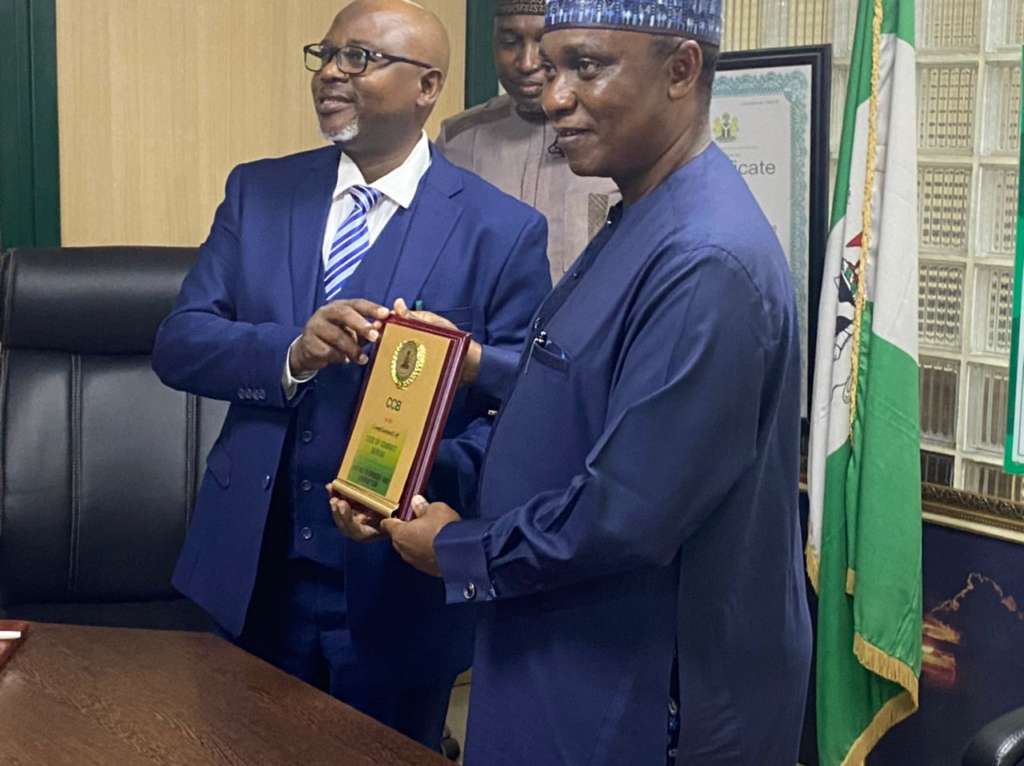
Abubakar and the CCB Boss during the courtesy visit to CAC Headquarters in Abuja
“From 4th October till date, over 10 people have resigned. Previously Staff used to access various forms of loans from the Cooperative Society but when he came on board he cancelled all. Cooperative Society funds have nothing to do with the Management. It belongs to the Staff. He stopped the Cooperative Society from giving Staff loans. We have a shop where if you need something, you pick and they deduct it from your salary for some months. He stopped that too. Aside from the general Cooperative Society, there is also the Muslim Cooperative Society, which he stopped from giving loans to people. The office used to give introductory letters to banks to enable people access credit facilities from banks.
“He stopped the issuance of the introductory letter. Even with mortgage loans, he stopped it. He stopped anything that could give benefit or any sort of relief to staff. Staff arrears too he refused to release. Above all, he has glorified gossiping. If you can gossip and tell him things, he’ll bring you closer to him. People now record conversations, record videos, take pictures and send to him. His boys even brag that ‘if you dare me, I will transfer you’.”
This is coming on the heels of a National Industrial Court of Nigeria’s decision which awarded damages to the tune of One Million Naira (N1, 000,000.00) against the Commission for undue interference with activities of the Staff Union, Amalgamated Union of Public Corporation Civil Service, Technical and Recreational Employees (AUPCTRE), by the CAC Management.
President Muhammadu Buhari
In a landmark judgment, the President of the National Industrial Court, Hon. Justice Benedict Kanyip, Ph.D. declared the Circular of January 11, 2021, issued by the CAC, dissolving AUPCTRE null and void and of no binding legal effect. RG Garba Abubakar had proscribed the Staff Union and transferred about 28 past and present Officials of the Union all over the Country. These are transfers not informed by manpower needs but a “scores settling” exercise. Such transfers involve hundreds of Millions of Naira…what a waste of Government meagre resources for personal vendetta! This is sad coming at a time even the Federal Government is borrowing money for public infrastructure.
As a result, the Union dragged CAC before the National Industrial Court, where Justice B. B. Kanyip declared that the decisions reached against the Union through the Circulars were arbitrary, unwarranted, oppressive, and amount to interference and violation of the Union’s right to freely associate and organize as a trade union.
Meanwhile, inside sources at CAC revealed that the Commission has a lot of Court actions against it arising from instances of impunity and abuse of power. “Such litigations”, according to the source “are very unnecessary and imposes a huge financial burden on the Commission. For instance, a former Acting RG is in Court against the CAC for acts of vendetta at the behest of the current RG. The court has just given judgment in favour of the Union over acts related to abuse of Office by the RG. Another Deputy Director is also in court against the Commission arising from personal feud and acts of abuse of power, claiming hundreds of Millions as special, general, and aggravated damages.
“These avalanche of cases are being defended by Senior Advocates of Nigeria for which the professional fees are in Millions. For an agency that is supposed to be remitting money to FG for infrastructural development to indulge in these acts of waste of public funds is no doubt ridiculous. The number of Staff that have resigned from the Commission within less than 2 years of the Garba Abubakar led Management including Directors calls for serious concern.”
Equally worrisome is what AUPCTRE, an affiliate of the Nigeria Labour Congress, NLC has described as a recent unholy alliance between CAC and the Code of Conduct Bureau. The group in a September 9, 2021 petition addressed to President Muhammadu Buhari and signed by its General Secretary, Comrade Waheed Sikiru, the Union alleged that it petitioned the CCB with substantial evidence against the Registrar-General. According to him, the petition was acknowledged and when the Union was invited to defend its position, it honoured the invitation and defended the allegation, hoping that justice would be done “but this has not been addressed till date.”
He said the union was shocked beyond imagination watching the same CCB in an “unholy partnership” with CAC on issues of fighting corruption in the country in spite of numerous corruption allegations hanging on the neck of the Registrar- General of CAC that have not been addressed by the CCB. AUPCTRE then urged President Buhari to intervene speedily to save the soul of CAC, employees, and the nation, while also appealing for an investigation into the unholy and less than transparent partnership between CCB and CAC.
On September 5, 2021, Prof. Muhammad Isah, Chairman of the CCB paid a courtesy visit to the Commission. The RG/CEO of the Commission, Garba Abubakar while receiving him said CAC will grant the CCB access to its database to enable it to carry out seamless investigations of companies involved in illicit activities.
Faulting the visit, a CAC insider said: “There are pending petitions against the RG and they came to pay him a courtesy call. For what reason? Look at the timing. We don’t even have any synergy with them like the EFCC and other investigative agencies that when they need access to our data we allow them access. He now claims that he wants to give them access to our database. We’ve not been receiving applications from them for an investigation like other agencies we normally partner with. We receive hundreds from EFCC, ICPC, and DSS. They would have been the one that needs access with the CAC database, not people we don’t have any relationship with. It’s only now that there are pending unresolved petitions against the RG that we’re suddenly seeing this collaboration. Now his boys are bragging that the Code of Conduct Bureau has been settled so nothing will happen. The report of the meeting arising from the petition against him is currently before the Chairman Code of Conduct Bureau who is supposed to forward same to the Chairman of the Tribunal but it’s clear he’s not likely to do that. Otherwise, how do you explain this type of courtesy visit?”
Another area of concern according to insiders is the Structure of CAC Management. For instance, the CAC has only the RG as the CEO and the only executive member of the Board. There are no Executive Directors to check the excesses of any RG. The Board members are mere ex-officio members and representatives of professional bodies like NBA, ICAN, MAN, NACCIMA, FMOJ, FMITI, and a Chairman who are all part-time members of the Board. There is therefore no corporate governance for such a critical supervisory and regulatory body.
This is a serious lacuna on the part of the Legislature. A regulatory and supervisory institution like CAC should have a sound corporate governance structure like CBN that has Deputy Governors on its Board who also works at the apex Bank on full time; with executive powers, and members of the Management/Board. Other critical supervisory agencies like NDIC have executive directors to checkmate arbitrary use of power by the CEO. This lacuna has become obvious as a result of the excesses and impunity of the current RG. Perhaps, all the previous RGs exercised caution and were not that lawless and reckless with power. The prevailing impunity has never been the case in the helms of affairs of the over 31 years of the institution.
This according to an insider “is not the case at CAC at all. The RG is more of a Sole Administrator. The Heads of Department/Directors hardly have the opportunity to contribute to what I’d call mock Management meetings. The RG as sole Administrator intimidates and ridicules all the Directors through autocratic policies such as withdrawing officially attached cars to the Directors. During meetings, nobody contributes. The RG simply dishes instructions to Directors like school children. This is unhealthy for such a sensitive organisation with its enormous powers and far-reaching responsibilities under the CAMA 2020. The leadership attitude of the current RG led to the resignation of four Directors within 6 months of his tenure between February and July 2020. Most of the remaining Directors are only marking their times to retire and go. The Commission has become a witch-hunting arena, such that once the RG does not like your face or your state of origin you are a subject of transfer outside the Head Office.
R.G CAC
“Perhaps one reason why the RG is very reckless in running the Commission aground is that he has no stake in the future of the Commission. Upon his appointment as RG he terminated his public service career with the Commission and within one week of assumption of duties; immediately collected his gratuity of over N55 million. Therefore, whatever happens to the Commission including the inability to pay gratuity to retiring staff does not bother him. Of late, the RG even threatened to stop payment of gratuity entirely after collecting his full gratuity!!”
Meanwhile, the House Committee on Finance has threatened to shut down CAC for having a higher expenditure than it generated revenue between 2016 to 2021. The panel also asked the Budget Office to suspend the budgetary approval for the commission until the Commission presents reports of all expenditures. At the interactive session on the 2022-2024 Medium-Term Expenditure Framework (MTEF) organised by the committee, James Faleke, chairman of the panel, questioned Abubakar, on its operational expenditure.
Accused amongst other things of having scant regards to Civil Service Rules to the point of approving payments far beyond his statutory threshold limit of N2.5m, the Commission on 15th March 2021, appointed a legal firm, of a top Senior Advocate of Nigeria to represent it in two cases by the Christian Association of Nigeria (CAN) and Socio-Economic Rights & Accountability Project (SERAP) contesting certain sections of the new Companies and Allied Matters Act 2020. The firm forwarded an acceptance letter dated 17th March 2021 requesting for N25.5m as professional and filing fees, on the 18th March 2021 the letter was processed and approval given in effect where the sum of N11m as 50% part payment was eventually paid to the firm.
Documents made available to Law & Society showed that Abubakar paid the legal fees far above his approval threshold going by a 14 January 2016 Circular signed by the then Secretary to the Government of the Federation Babachir Lawal. It was also alleged that he has been making that kind of illegal approval beyond his approval threshold with impunity.
On July 18, 2021, so-called bandits shot down an Alpha Jet belonging to the Nigerian Air Force on the boundary between Zamfara and Kaduna states. Then on October 7, 2021, the Wall Street Journal, whose news section is adjudged as one of America’s most credible, got a scoop that the Nigerian Air Force paid N20 million to bandits to buy back “an antiaircraft gun” that the bandits had seized from the Nigerian military in a clash.
The antiaircraft gun, the paper said, “posed a threat to President Muhammadu Buhari, who had been planning to fly to his hometown….”
On October 20, 2021, the bandits, whom the Wall Street Journal says have “collaborators inside the army” and who are “better equipped with larger-capacity advanced weaponry than national security agencies,” detonated explosives on the Abuja-Kaduna rail tracks and caused the indefinite suspension of rail transportation between Abuja and Kaduna.
What has become transparently apparent in the last few months is that the plague of so-called Fulani herdsmen banditry is way deeper and more complex than we have persuaded ourselves to believe. The menace we self-deceptively and simplistically attenuate as mere “banditry” is nothing short of well-oiled, deep-rooted, well-practised, and well-organised mercenary terrorism whose tentacles have spread to unthought-of social territories of the Nigerian society.
Early this month, I had a lengthy conversation with a well-placed Nigerian government official on a whole host of issues, including the escalating, never-ending scourge of mass abductions for ransom in vast swathes of the country. In the course of our conversation, he casually shared with me a disturbing story that, for me, strikes at the core of why terroristic banditry won’t go away anytime soon.
He was involved in negotiations for the release of abductees some months back. The multi-million-naira ransom paid to the “abductors,” he said, went through a tortuous chain of command that finally ended up with some armed, well-nourished, out-of-state individuals. In other words, although the kidnappers were bucolic Fulani, the people who finally received the ransom weren’t.
In any case, as most people know, most of the cattle that the Fulani herders rear don’t belong to them; they belong to wealthy city dwellers (and some prosperous rural folks) from all over Nigeria.
Well, the anecdote that the government official shared with me recalls a viral video of a “bandit” in one of the northwestern states swearing in Hausa that “bandits” aren’t independent actors, that they are armed and financed by well-placed people in the society who take advantage of their poverty and disaffiliation from mainstream society to recruit them.
To be clear, I am not by any means absolving Fulani herders from responsibility for kidnapping. I just want to transcend the surface on which we have dwelled for far too long.
I also connected the dots between what the government official told me and a message that trended in Nigerian social media circles in May 2019 about a woman who was threatened with abduction but given the option to pay N5 million into a bank account to avert her kidnap.
A portion of the narration is worth reproducing without authorial intervention: “She took it up. Went to the bank with some assistance from influential friends. They asked that the account be flagged…. Bank did checks. Bank said the account cannot be flagged else they will lose influential clients. How so? The names attached to the account are powerful names. That the kidnap ring pays some top persons percentage from the ransome [sic] paid. She was advised to jejelygoan [sic] pay her POTENTIAL KIDNAPPERS. I was speechless for over 5 minutes.”
If you think this is a made-up story, read Daily Trust’s July 28, 2021 story titled “Kidnappers in FCT Begin Collection Of Ransom Through Banks.” When a Mrs. Aminat Adewuyi was kidnapped in Niger State, the kidnappers threatened to slaughter her if her relatives didn’t deposit N5 million naira into an Access Bank account.
The amount was later scaled back. “The ransom payment slip, a copy of which was obtained by Daily Trust showed that Adewuyi’s husband paid N500,000 into an Access Bank account with number 1403762272 and the name Badawi Abba Enterprise,” the paper reported.
Also recall that late last month even the National Youth Service Corps advised youth corps members posted to abduction-prone roads like “Abuja-Kaduna, Abuja-Lokoja-Okene, or Aba-Port Harcourt” to let “family members, friends and colleagues to have someone on hand to pay off the ransom that could be demanded” in the event of their abduction. This piece of advice was frozen in a handbook distributed to corps members.
It’s easy to explain away the NYSC advice as merely an organisation being pragmatic and making peace with the ever-present reality of mass abductions in the country. But the listless capitulation to mercenary terroristic bandits by almost all segments of the Nigerian government, including security outfits, points to high-profile complicity, in my opinion.
The Daily Nigerian reported on October 21 that security agencies had intercepted communication between “a notorious bandit” and his “associate.” “The report, dated October 19, 2021 and entitled ‘PLANNED ATTACK ON TRAIN AROUND RIJANA, KADUNA STATE,’ said the terrorists were heard discussing about the planned attack by Darul Salam terrorists in concert with two bandit kingpins, Danlami and Lawan (not real names),” the news site reported.
It quoted the security report to have said, “Baffa informed Bala that members of Darussalam (Boko Haram) in collaboration with bandits led by Danlami and Lawan are currently on their way to plant a bomb at a bridge on the railway in Rijana to hijack a moving train and kidnap the passengers. Baffa said he decided not to participate in the operation because it is risky but believed that DANLAMI and LAWAN will blow up the bridge.”
Why was the report, which the paper said was “circulated across security agencies,” ignored? Was this complicity, incompetence, or indifference? I am inclined to think it’s complicity, especially in light of the Wall Street Journal’s not-surprising revelation that mercenary terrorist bandits have “collaborators inside the army.”
Here are my own extrapolations based on the facts I’ve encountered these past few months. While uneducated, pastoral, semi-nomadic Fulani herders are the public face of mass abductions for ransom in the country, they are just branches of a tree whose roots are buried deep beneath the surface. The herders are mere expendable foot soldiers of people who have privileged connections to the government and the private sector.
Peasant, semi nomadic Fulani herders who have lost their cattle have historically served as an inexhaustible pool of lumpen proletariat to conscript into all kinds of conflicts. In the early 1800s, for instance, they constituted a huge percentage of Afonja’s army in his fight against the Alaafin of Oyo. In “A Little New Light: Selected Historical Writings of Professor Abdullahi Smith,” the late Abdullahi Smith wrote that Fulani pastoralists who lost their cattle to tsetse fly bites in Yoruba land and “had nothing to lose” became Afonja’s mercenaries.
The domination of abduction for ransom by Fulani pastoralists who have lost their cattle seems to me like the recrudescence of what happened in the 1800s—and at other historical epochs. Killing the abductors will do nothing to stop the problem because they are merely the branches of a tree. You don’t kill a tree by cutting off its branches because new branches will sprout in time.
You kill a tree by uprooting it. That means identifying the funders and real beneficiaries of mass abductions in the country. From the information I am privy to, they are elites who are not necessarily Fulani. They are a pan-Nigerian gang of ruthless buccaneers who are united by rapaciousness and vileness.
But instead of confronting this grave existential threat to Nigeria, Abubakar Malami, the Attorney General of the Federation and Minister of Justice, is obsessed with blabbering about who the “sponsors” of Sunday Igboho and Nnamdi Kanu are.
This is the same guy who refused to name and identify people who have been exposed by the United Arab Emirates as sponsors of Boko Haram terrorists because, according to him, “naming and shaming of suspects is not embarked upon as a policy by the federal Government out of sheer respect for the constitutional rights of Nigerians relating to presumption of innocence.”
Naming and shaming of sponsors of terrorism is unconstitutional but the naming and shaming of the “sponsors” of Nnamdi Kanu and Sunday Igboho isn’t. That is all you need to know on why mercenary terroristic banditry will endure for as long as incompetent hypocrites like Malami hold and control the levers of government.
Goro is the Hausa word for kolanut, the caffeine fruit commonly consumed in the tropical part of Nigeria. Gorontula therefore literally translates to Tula’s kookaburra, meaning that unlike the common kolanut, gorontula is only found in Tula communities in Kaltungo Local Government Area of Gombe State and Michika in Adamawa State, both on the mountainous belt stretching across the two states.
In English language, gorontula is known variously as tree hibiscus, snot apple or African chewing gum because it is sweet and chewy with lots of fibre. Botanically, it is known as azanza garckeana or azanza for short.
There are four Tula communities, namely Wange Tula, Yiri Tula, Baule Tula and Kaltin Tula, all located in the mountainous and rocky parts of the state. But for reasons that probably border on climate or weather of the mountain, gorontula can only be found in Tula and Michika and nowhere else around the world, hence the reason it is called gorontula; a kind of kolanut peculiar to the Tula tribe in Gombe State.
The Tula communities were predominantly agrarian until recently when Gorontula began to attract the attention of fun seeking men and women who are rushing to the affected communities to obtain the fruits in order to satisfy their sexual fantasies.
“Men who want to satisfy their women come from as far as Chad, Niger and Cameroon to buy gorontula because it makes sex sweet for both women and men. It also works for fertility, diabetes and high blood pressure,” said Heman Ephraim, the Seriki Gorontula.
Tula Entrance “I have a history of high blood pressure, and each time I notice the sign, I just take the Gorontula and I will sleep and become normal,” he added.
Until 10 to 12 years ago, gorontula was just a fruit the Tulas took to the farm to assuage hunger and derive energy while working on their farms.
“We can work long hours on the farm taking only water and gorontula without feeling hungry,” said Salisu Malare, a gorontula produce trader in Tula.
According to him, the wide acclaim about the sexual ability of Tula women and men did not originate from Tula. “It was the testimony of men who married our women to confirm that they were brought up well,” he said, laughing.
Indeed, talks about sex usually elicits excitement from both sexes around Tula communities. Serah Jodah, for instance, said she had been eating gorontula from childhood and could not imagine that any other women could beat Tula women on bed. She said: “It is very true that gorontula makes our women sexually active and also repairs and cleanses the reproductive organs. We have been using it for long without even knowing the medicinal values of the fruit.”
On her part, Esther Umar said: “We took it for granted because we have always seen the gorontula as our own and it has become part of our daily food.
“Some women also use gorontula to cure infection, boost their fertility and increase libido.
“If a woman finds it difficult to conceive, we often take gorontula to enhance our fertility. Even those who experience dryness during intercourse use gorontula. And it is not only for women; both sexes use it. Men, in particular, come from different places to get it.”
gorontula is an essential ingredient of Kayamata, a popular sex enhancing herb among Hausa people.
“Its honey, seeds and leaves are extracted and used for various medicinal purposes. It is the mainstay of the economy of Tula communities. (The Nation)
RECENTLY, Nigeria’s Minister of Finance, Zainab Ahmed, reportedly stated in an interview that the country’s high debt service is connected with the huge expenditure being incurred in the satisfaction of workers on the government’s payroll.
According to the media report, she noted as follows: “Our debt service to overall revenue is high because we have a very large expenditure base. We have a large proportion of our budget dedicated to payroll, and Mr. President had decided from the beginning of his administration that we were not going to disengage staff.
So, you have to pay salaries, you have to pay pensions. And also, we have to fund the other arms of government, which are the judiciary and the legislature”
The Minister pitched her hopes in the potential rise in oil revenue as a way of earning more revenue and cushioning the effect of the astronomical rise in the nation’s high debt service.
Meanwhile, Nairametrics had, in July 2021, published that the Federal Government spent N1.8 trillion on debt servicing in the first five months of the year, representing about 98 per cent of the total revenue generated in the same period. A total of N4.86 trillion was spent by the Federal Government between January and May 2021, from which N206.89 billion was spent as statutory transfers.
While recurrent expenditure in the review period stood at N3.67 trillion, debt service was N1.8 trillion. The implication of Nigeria’s ever-increasing debt service, however, is that the government is expending nearly all its revenue in servicing recurrent expenditure and debts, consequently causing the Federal Government to have recourse to foreign loans, and thereby further increasing the nation’s external debt profile.
The relationship between crude oil and astronomical debt service dates to the 70s when the fall in oil prices had a devastating effect on government expenses, thereby causing the government to have recourse to borrowing for payments and project financing.
This increased the nation’s debt profile to US$2.2 billion in 1980. However, in 1991, it had risen to $33.4 billion, and rather than decrease, the nation’s debt profile continued to witness an upsurge, particularly with the spate of debt servicing and the insatiable desire of political leaders to obtain loans for the execution of dubious projects.
This amount continues to rise even as more external loans are being approved and obtained by the Federal Government. A major undermining factor for a country’s economic growth is its huge debt stock and as such, Nigeria’s humongous debts ratio is directly linked to the decades of misrule and financial imprudence of its military and political leaders.
With incessant foreign debts being accumulated by successive governments, Nigeria became caught up on crippling foreign debt crisis which, till date, compromised its economic progress and political stability in spite of the paradox of being an oil exporting country.
President Olusegun Obasanjo once identified factors responsible for Nigeria’s debt crises, i.e., ‘political rascality, bad governance, abuse of office and power, criminal corruption, mismanagement and waste, misplaced priorities, fiscal indiscipline, weak control, monitoring and evaluation mechanisms, and a community that was openly tolerant of corruption and other underhand and extra-legal methods of primitive accumulation’.
In similar terms, President of the African Development Bank, Dr. Akinwumi Adesina, equally noted that Nigeria was using about 50 per cent of its revenue to service its debts, compared to the average of 17 percent for other African countries.
It is, therefore, commonsensical to conclude that at this rate, unless by some stroke of luck, Nigeria will not be free from debt anytime soon. Nigeria’s external indebtedness is not only worrisome, but calls for urgent reforms and the adoption of sound economic practice – first which is to stop obtaining any other foreign loans.
Debt crises management and recovered loots: Not too long ago, part of the Abacha loot, amounting to US$4.6 billion was repatriated to Nigeria and notwithstanding, this has not had much positive impact on reducing Nigeria’s internal and external debt profile.
Out of the repatriated Abacha loot, the Federal Government recovered US$322 million from Switzerland in 2017 and US$308 million from Jersey Island, United Kingdom in February 2020, with the condition that the funds will be utilised for three major projects in Nigeria, namely:
i. Lagos-Ibadan Express Road (Western Region)
ii. Abuja-Kano Road (Northern Region)
iii. 2nd Niger Bridge (Eastern Region).
The same year, in March 2020, the Nigerian Senate approved a US$22.7 billion loan request and later in May, another US$5.513 billion loan request was sent by the President. Interestingly, the Director-General of the Debts Management Office reportedly noted that year that the coronavirus pandemic might incapacitate Nigeria from servicing its debts appropriately. This is, however, coming in the wake of over N25 billion internal and external donations which the country has received in its fight against the pandemic.
Regardless, Nigeria’s debt profile under President Muhammadu Buhari rose from N12.1 trillion in 2015 to a whooping N33 trillion in the last quarter of the previous year. I am of the opinion that the recovered Abacha loot can be adequately managed to sustain the deficit in the budget, rather than further plunging the nation into deeper mires of internal and external indebtedness.
Over the decades there has been little sustainable development in Nigeria to rationalise the stupendous indebtedness of the country. Rather, successive governments have continued to plummet Nigeria’s external debt portfolio to unfathomable degrees, and sadly, more funds will be borrowed in the nearest future.
While it may not be totally true that the current unresolved debt service crisis is attributable to the payroll of Nigerian workers as stated by the Minister of Finance, the grand cause of Nigeria’s unresolved debt crisis may not be unconnected to the fact that crude oil revenue, foreign loans and recovered loots are not being fully utilised for recurrent expenditure and development purposes, but for other interests and parochial purposes.
It is usually tied to party politics, patronage, and elevation of primordial interest rather than the promotion of national interest and overall socioeconomic development.
Other causes have been identified to be inefficient trade and exchange rate policies, adverse exchange rate movements, adverse interest rate movements, poor lending and inefficient loan utilization, poor debt management practices, and accumulation of arrears and penalties.
Certainly, the government can do more to change the status quo and ensure that the country is able to ensure self-sustenance without further recourse to external financing. There is, therefore, the need to look inwards and adequately manage the country’s debt ratio.
The country should place firm restriction on obtaining any other loan. Nigeria is blessed with more-than-enough human and natural resources which, if adequately managed, is capable of sustaining the nation’s infrastructural and socio-economic ideals.
Our site uses cookies. By clicking “Accept All Cookies”, you direct Law and Society Magazine to store cookies on your device and disclose information in accordance with our Cookie Statement: cookie policyACCEPTREJECT
Privacy & Cookies Policy
Privacy Overview
This website uses cookies to improve your experience while you navigate through the website. Out of these cookies, the cookies that are categorized as necessary are stored on your browser as they are essential for the working of basic functionalities of the website. We also use third-party cookies that help us analyze and understand how you use this website. These cookies will be stored in your browser only with your consent. You also have the option to opt-out of these cookies. But opting out of some of these cookies may have an effect on your browsing experience.
Necessary cookies are absolutely essential for the website to function properly. This category only includes cookies that ensures basic functionalities and security features of the website. These cookies do not store any personal information.
Any cookies that may not be particularly necessary for the website to function and is used specifically to collect user personal data via analytics, ads, other embedded contents are termed as non-necessary cookies. It is mandatory to procure user consent prior to running these cookies on your website.