Living Royalty
Red Light, Green Light | Living Royalty
‘They tried to go…but the Spirit…would not let them.’ Acts 16:7 CEV
When God gives you a green light, you must go. And when He gives you a red light, you must stop. ‘Paul and his friends went through Phrygia and Galatia, but the Holy Spirit would not let them preach in Asia. After they arrived in Mysia, they tried to go into Bithynia, but the Spirit of Jesus would not let them. So they went on through Mysia until they came to Troas. During the night, Paul had a vision of someone from Macedonia who was standing there and begging him, “Come over to Macedonia and help us!”
After Paul had seen the vision, we began looking for a way to go to Macedonia…sure that God had called us to preach the good news there’ (vv. 6-10 CEV). After a series of green lights, God gave Paul a red light. Why?
1) Because the timing wasn’t right. Apollos had to go there first and lay the groundwork.
2) Because God needed Paul and Barnabas elsewhere.
3) Because God wanted them to be more seasoned before embarking on such a major mission.
Note the words, ‘They tried to go…but the Spirit…would not let them.’ How reassuring! God loves you so much that He will save you from your own misguided plans.
The Canadian preacher A.B. Simpson said: ‘Often there’s nothing as godly as inactivity on our part, or nothing as harmful as restless working, for God has promised to work His sovereign will.’
Today God may be saying to you, ‘Be still, and know that I am God; I will be exalted [in this situation]’ (Psalm 46:10 NKJV). Please pay attention!
The Executive sets in motion an extra-judicial prosecution since no reference had been made to the National Judicial Council before prosecuting a judicial officer and making an Order that deprives him of rights to fair hearing and the same Executive acting through the Nigerian President orders and effects the suspension of Justice Walter Onnoghen, Chief Justice of Nigeria, again without recourse to the National Judicial Council, the body duly empowered with the disciplinary authority over judicial officers…”Hon. Justice Mary Peter-Odili, JSC
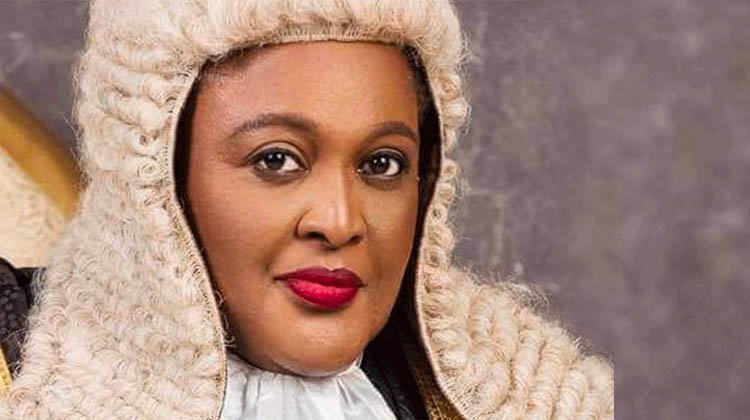
That night’s invasion of the home of Nigeria’s Supreme Court Hon. Justice Mary Peter-Odili brought back dark memories of the night of 7 October 2016 when the State Security Service raided the homes of some Supreme Court judges. Stephen Azubuike in the article below titled: ONNOGHEN: SUPREME COURT SAYS CROSS RIVER STATE IS AN “UNSOLICITED MOURNER,” analysed the apex court’s decision on Cross River’s intervention but also drew attention to the fact that Justice Mary Peter-Odili, JSC was once the only Justice of the Supreme Court who boldly condemned, and stood up against, the removal of the former Chief Justice of Nigeria (CJN), Honourable Justice Walter Samuel Nkanu Onnoghen (CJN), and how he was bundled out of office.
Introduction
Histories are usually made up of both sweet and bitter stories; believable and unbelievable stories. Facts and fictions. Lies and truth. The History of Nigeria is not left out. The popular story of the former Chief Justice of Nigeria (CJN), Honourable Justice Walter Samuel Nkanu Onnoghen, CJN (Hon. Justice Onnoghen) and how he was bundled out of office remains one story of dual taste, bitter in the tongues of some, but sweet in the tongues of others.
The brief summary of the story was that Charge No. CCT/ABJ/01/19 between Federal Government of Nigeria v. Hon. Justice Onnoghen, was filed against Hon. Justice Onnoghen for offences bordering on breach of code of conduct for public officers – non-disclosure of assets – at the Code of Conduct Tribunal (CCT). At the time, relying on an ex parte Order of the CCT, the President of the Federal Republic of Nigeria, Muhammadu Buhari, suspended Hon. Justice Onnoghen as the CJN.*
A. G. Cross River State v. Federal Republic of Nigeria [2019] 10 NWLR (Pt. 1681) 401.
Cross River State, whose indigene Hon. Justice Onnoghen is, believed that the charges filed by the Code of Conduct Bureau against Hon. Justice Onnoghen and his subsequent suspension from office by the President were in breach of the Constitution of Nigeria. Consequently, the Attorney General of Cross River State, as Plaintiff, on behalf of the Government of Cross River State, commenced a suit against the Federal Republic of Nigeria and the Attorney General of the Federation (the Defendants) at the Supreme Court by means of an Originating Summons under Section 232 of the Constitution – the Section that makes provision for approaching the Supreme Court as court of first instance, that is, invocation of the original jurisdiction of the Supreme Court.
The Plaintiff sought an interpretation of the relevant provisions of the Constitution, urging the Supreme Court to declare as follows (among other reliefs), that:
1) the Constitution recognises and guarantees separation of powers amongst the arms of Government – Executive, Legislature and Judiciary.
2) only the National Judicial Council (NJC) has the powers to recommend the appointment or removal of a judicial officer.
3) the CCT has no power over any judicial officer for any alleged official misconduct without a formal complaint of such misconduct being first made to and investigated by the NJC.
The Plaintiff sought other reliefs, all geared towards urging the Court to nullify the proceedings before the CCT at the time against Hon. Justice Onnoghen.
The Defendants raised a preliminary objection to the suit contending that the Plaintiff lacks the power to file the action as it has no personal interest in the suit and that there is no dispute between the Government of Cross River State and the Federation to warrant invoking the original jurisdiction of the Supreme Court.**
In deciding the case, the Supreme Court sat as a Full Court (7 Justices). 6 of the Justices (Rhodes-Vivour, Ariwoola, Muhammad, Kekere-Ekun, Okoro and Baje – Justices of the Supreme Court) upheld the preliminary objection and struck out the case without addressing on the merits, the main issues raised. 1 Justice (Mary Peter-Odili, JSC) dissented, upholding the contentions of the Plaintiff and granting the reliefs sought.
Position of the Majority
In delivering the leading Judgment of the Majority, Ariwoola, JSC concluded:
…I am unable to see where lies the dispute between the Government of Cross River State and the Federal Republic of Nigeria as to confer the Plaintiff with standing to invoke the original jurisdiction of the Supreme Court. There is no doubt that the issue involved in this matter, inter alia, is the suspension of Mr. Justice Walter Samuel Nkanu Onnoghen, GCON from office as the Chief Justice of Nigeria by the President of the Federal Republic of Nigeria. And without going into the merit or otherwise of the action of the President in suspending the Hon. Chief Justice of Nigeria, one wonders how that has created a dispute between the Government of Cross River State as an entity and the Federal Republic of Nigeria. In my view, the appropriate person to challenge the suspension and subsequent trial before the Code of Conduct Tribunal is the officer who is on suspension but certainly not Cross River State of which the Hon. Justice is said to be an indigene. I am therefore not in the slightest doubt that the Plaintiff in this case lacks the required standing to institute this action as constituted. In other words, the original jurisdiction of the Supreme Court is not being properly invoked to adjudicate over this matter.
Kekere-Ekun, JSC held:
Throughout his submissions, the learned Senior Counsel (to the Plaintiff) failed to demonstrate what legal right Cross River State seeks to protect by this suit. I am inclined to agree with learned Counsel for the Defendants that the subject matter of this suit is personal to Hon. Mr. Justice Onnoghen. The Office of Chief Justice of Nigeria is not a prerogative of Cross River State. Whether or not the Federal Government rode roughshod over the powers of the National Judicial Council in instituting the charges against the Hon. Mr. Justice Onnoghen is, at best, an issue to be taken up by Hon. Mr. Justice Onnoghen and/or the National Judicial Council and not the Cross River State Government.
On his part, Baje, JSC, said:
What more should I add or say in view of the above, beyond amplifying the obvious facts that this suit is defective. This suit needlessly and unjustifiably attempted to over-drag this Court into murky waters!!! This is because the reliefs sought in this matter are not for the benefits of Cross River State as an entity. The ultimate beneficiary is Hon. Mr. Justice Onnoghen and/or the NJC. The Plaintiff would appear to me acting as a meddlesome interloper or unsolicited mourner who, for certain personal reasons which may or may not be noble, opted to ‘cry and shed tears’ more than the actual bereaved person(s).
Rhodes-Vivour, JSC:
It must now be abundantly clear that the Plaintiff has no locus standi to institute this suit in the Supreme Court under its original jurisdiction. His Lordship has a cause of action but unfortunately one that cannot be heard in the Supreme Court in its original jurisdiction for the simple reason that his Lordship is not a State. See Section 232(1) of the Constitution. The proper forum for these claims is a High Court.
Dissenting opinion of Mary Peter-Odili, JSC
Although the Majority Judgment is not lacking in good logic, however, Mary, Peter-Odili, JSC, the lone voice in the wilderness, gave us something to consider regarding the preliminary objection:
With the happening, the question automatically arose as to the constitutionality or otherwise of the actions of the Code of Conduct Tribunal and the Executive acting on the Order of this questioned process emanating from the Tribunal. Again thrown in the mix is whether in the light of the various definitions given to the word “dispute” what has taken place has not qualified to be termed a dispute as envisaged by Section 232 (1) CFRN for which the Plaintiff would act upon the platform endowed it by the same Constitution which offers a direct route igniting the original jurisdiction of the Supreme Court rather than take the laborious, time consuming procedure of the three legged route of the High Court, Court of Appeal and finally at this point of the Supreme Court in a clear emergency situation since what is at stake is the threat or actual violation of the Constitution in chopping the third leg of the tripod holding the nation. Another way to say it is that in this democratic Nigerian nation there are three arms of government: Executive, Legislature and Judiciary and then the Executive sets in motion an extra-judicial prosecution since no reference had been made to the National Judicial Council before prosecuting a judicial officer and making an Order that deprives him of rights to fair hearing and the same Executive acting through the Nigerian President orders and effects the suspension of Justice Walter Onnoghen, Chief Justice of Nigeria, again without recourse to the National Judicial Council, the body duly empowered with the disciplinary authority over judicial officers including the said individual and can one rightly say a dispute has not arisen for which any State of the Federation and particularly State of Origin from which the individual came to be a Nigerian would sit back and do nothing. I think not. I say so because what has presented has the capacity, if not properly addressed, to destroy the structural foundation on which the Nation is built. Therefore, the Plaintiff, as any other person or State, has the locus standi to rush to the Supreme Court in alarm at what it has seen as a flouting of the Constitution and a thorough violation of its provisions. The Supreme Court itself is duty bound to hear the Plaintiff and the defence, on the grievance of the Plaintiff in the apex Court’s position as the custodian of our Constitution.
Hon. Justice Peter-Odili, JSC also decided on the merits of the case and granted the reliefs sought by the Plaintiff. His Lordship made further compelling remarks:
Again, in full measure to add is the fact that any State of the Federation as a federating unit has the right to ask if any encroachment into the Third Arm of Government has not taken place by the suspension of Justice Onnoghen CJN, as each State of the Federation is a stakeholder in the Supreme Court of Nigeria and the justices therein, also with regard to judges of the various courts at the Federal level. That Cross River State is not involved in the appointment of a Justice of the Supreme Court or Chief Justice, it is an interested party in ensuring that the procedures provided for in the Constitution for such an appointment or removal are strictly adhered. Therein lies the spirit of brother’s keeper reiterated variously by this Court.
Conclusion
Whatever the merits of the opinion expressed by Mary Peter-Odili, JSC, her Ladyship’s opinion remains a minority opinion. The Majority Judgment which remains the position of the law as at today is that it is only Hon. Justice Onnoghen and/or NJC that can sue to address the issues of constitutional breaches raised in this case. More so, that the action can only be commenced at the High Court and not at the Supreme Court. The Supreme Court can only hear and determine any appeal emanating from any decision of the High Court.
Also, what is equally clear from the Judgment of Mary Peter-Odili, JSC is that her Ladyship acknowledges the overwhelming troubles of every common Nigerian in approaching the High Court, Court of Appeal and Supreme Court, for preserving and asserting rights. The delays are incredibly infuriating. While efforts being made to address this problem are acknowledged, the solution appears to still be far from sight.
Are we going to ever have any opportunity to have the suspension of Hon. Justice Onnoghen judicially addressed? Only time will tell. For now, the tale may be bitter or sweet, depending on your taste buds.
STEPHEN AZUBUIKE is a lawyer with expertise in Commercial Dispute Resolution and Technology Law practice. He is a Partner at Infusion Lawyers. He has successfully argued cases from the High Courts of various jurisdictions to the Appellate Courts on behalf of financial institutions, other corporate bodies and multinationals. He has worked with a number of startup tech companies. He tweets @siazubuike.
Odimegwu says the President has not shown any capacity in any department of leadership
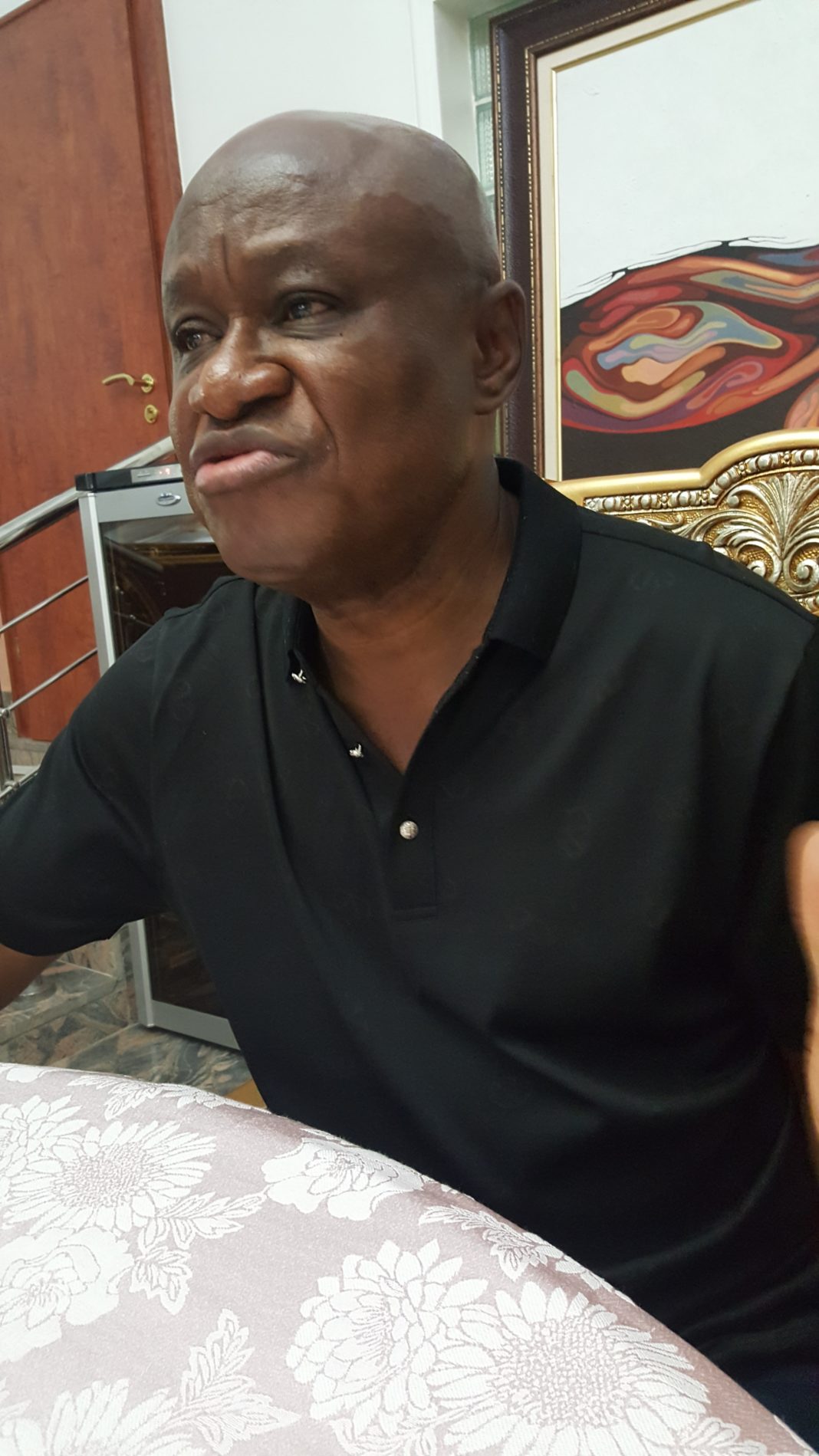
Eze Festus Odimegwu, erstwhile Managing Director of Nigerian Breweries Plc and former Chairman of the National Population Commission (NPC), is a man of conviction who does not speak tongue-in-cheek. He is passionate about Nigeria and bemoans what he calls leadership failure at all levels. On Saturday, January 18, he broke his self-imposed five-year censorship on interviews to speak to IKECHUKWU AMAECHI at his Abuja home. For close to three hours, he spoke on the failures of the Buhari presidency, 2019 elections, 50th anniversary of the end of the civil war, Supreme Court judgement that sacked Governor Emeka Ihedioha, Nigerian President of Igbo extraction and what he called the hegemonic inclination of the Fulani, among other issues. The interview will be published in three tranches and this is the first.
A lot of people have tried to get an interview from me and I didn’t feel like granting any interview until I met you last night and I made a deliberate choice to give you this interview because when you write, you also write like a modern person.Advertisement
You write from logic, you write from what is scientifically sensible and you present issues the way you see them. You may be right or wrong but you put it in a perspective that one would consider reasonable.
That is why I said, let me talk to you again. If not, since that 2015 till date, I have not granted any interviews but people will always say let us talk to you, but I tell them that Nigerians talk too much and do too little and I didn’t want to be party to that.
Now, coming to your question, I will start by saying that it is still good that President Goodluck Jonathan was voted out of office because he under-performed and he was a big disappointment.
I have seen people trying to ask, was it right or wrong? It was good that he was voted out because as somebody who claimed to be educated up to PhD level, when he had the opportunity to use that knowledge to transform Nigeria to a modern nation-state, he failed woefully.
He was busy playing cheap politics the third world mentality way. So, it was good he was voted out.
And of all the people then who were running with him, current President Muhammadu Buhari came across as somebody who was very serious minded and who had this desire, persistent desire to do something for Nigeria as we saw it then.
And not just because of this image, the people around him also were people that had the credentials of progressive politics. People who you could say are egalitarian in their outlook. And their manifesto also had content that made sense.
So, putting these three things together, it was appropriate to support him. It was logical to support him. The possibilities that he would do well were there if you analyse it properly.
But on assuming office, Buhari has been an unmitigated disaster and a complete failure to put it mildly. In fact, he has failed to the level that he has become a security risk to Nigeria.
Some people say it is those around him that are the problem, but leadership makes you to be responsible for what is happening. And the failure of his leadership is comprehensive. He has not shown any element of capacity in any department of leadership and it is very unfortunate.
And all the people around him, as far as I can see are not there to help him. All of them are there to run their own personal agenda and he doesn’t even know what is happening to begin to control these people.
So, everybody around him is a power unto himself. That is why you see all this confusion and disorder in his administration and then they transfer it to the country.
The only person around him who means well for him is his wife, Aisha. And in fact, the only person around him who shows any element of intelligence, sense of responsibility, is the wife, the First Lady of the Federal Republic of Nigeria.
Outside her, every other person around Buhari is as disappointing as Buhari himself.
Why did you single out the First Lady? What has she done in particular?
Leadership has three main dimensions that you can analyse to infinite dimensions. And the core of those three dimensions is the intention of the leader which is encapsulated in the value and visions of leadership. That is what holds what any leadership is doing together.
Aisha has come across as somebody who has conscience, not conscience in the religious sense, the way Nigerian hypocrites would always bring religion and talk nonsense but conscience in ethical sense. Somebody who knows the right things to do. She has that sense and she gives advice and when they don’t take her advice or even allow her to give that advice, she has enough conviction herself to explode and come to the public and criticise the husband’s administration and people around him.
And in the Nigerian set-up particularly in northern Nigeria where she, Buhari and all the people around him come from, it is exemplary for a lady to do that.
So, I think from her intentions, from the things she says, if she is the president of Nigeria herself, this administration will do better just like if Patience Jonathan had been the president and Jonathan was the First Man, that administration would have also done better. And I can say a lot more about that in terms of leadership meaning to do what is right from the basic intentions. She is a very good lady by my estimation.
You were a member of the Buhari Transition Committee prior to his inauguration in 2015. Many thought you were going to be appointed a minister. At what point did you realise that Nigerians may have had a bad deal in electing him president?
The question itself implies that or has an undertone that I supported Buhari so that I could be made a minister. I mean, you are in my house, if you look around, you will see that I am not looking for a job. It would be demeaning of my person, who I am to think I would do something because I will get a job. I am an employer of labour. I am not looking for a job. So, I didn’t get a bad deal from Buhari.
I am not talking about you as a person. The question is, at what point did you realise that Nigerians may have made a mistake in electing Buhari President?
Ok! You spoke about a bad deal after talking about my not being appointed a minister. If Buhari had made me a minister, I would not have accepted it.
Why not
Because it was very clear and I actually made that known to former President Obasanjo when some of these issues started emerging, I also made that clear to somebody like Ahmed Joda and the current Minister of Education, Adamu Adamu.
If Buhari had made me a minister after he started doing certain things, I wouldn’t have stayed. First, I would not have accepted the appointment because if I do, and he continues doing the things he has been doing since then, when we are in FEC meeting, I will challenge him and when I do that, if he continues doing what he is doing, I will resign. I will not stay to be a witness to the nonsenses that have been happening since then. And if I challenge him also, he may decide to sack me himself since he is the one who would appoint.
So, in order not to face the same story of what made me resign as chairman of the National Populations Commission (NPC), I didn’t just want to bother myself, messing around when people are not serious to do what is right.
And it was very early that Buhari showed his hand that he didn’t really mean to do anything serious when he started talking about people who voted 97 per cent and 5 per cent for him. When he started making his first few appointments, and everyone on the list are from the North, Northwest in particular, all Muslims. When he started marginalizing some people in his own party who helped him to come to power, and then instead of getting his kitchen cabinet from his party, the APC, who helped him to come to power, he decided to go back to family and friends. That type of nonsense, I mean I shouldn’t be party to such things.
The level of decisions and actions was very primitive to say the least. Some people will say provincial or nepotistic. No modern person like me would think that such a thing is good.
So, he failed from the very first day he started up till today.
How would you rate Jonathan and Buhari’s failure on a scale of 1 to 10? Who, in your estimation, failed most?
Two of them are failures. Failure is failure. There is no comparative analysis for failure. When you are a leader, you are there to improve the situation. Once you are not able to improve the situation, either incrementally or dramatically, depending on who you are, your capabilities, you have failed.
So, if two of them were to be working for Nigerian Breweries when I was the MD/CEO and I was going to write their appraisal, I will give two of them D, that means they didn’t do well. You cannot compare failure. Jonathan failed and Buhari has failed in terms of making Nigeria a better place.
That will be the top level assessment I will give. But when you dig down and you want to cherry pick to say who is better than the other, Jonathan was better in the sense that he didn’t do the right things that he was supposed to do but he was not malicious. And he was not reckless in a sense that can bring security problems to the country.
Buhari also is not doing the right things like Jonathan didn’t do the right things, but he is reckless and he has this impunity that could set the country ablaze. And when people do things without thinking of the consequences, it can be very dangerous indeed.
So at that level, Jonathan is far better than Buhari but that doesn’t mean that Jonathan shouldn’t have been voted out. It is good that he was voted out just like if the last election was free and fair, Buhari would have been voted out as well. There was no election. If there was, there was no way he would have won a second term.
Supporters of Buhari, and there are many of them, will disagree with your assessment. Even the President insists he has done well in the three core areas – economy, fight against corruption and improvement of security – he promised Nigerians.
You know, sometimes you read in the newspapers that this person said this, that person said that, Buhari said this and this person around him said that, the question is, who are those people, what do they know?
You know the worst thing in this world is ignorance. The major problem in Nigeria is ignorance. The leadership failure in Nigeria from the first day is caused by ignorance. People who do not know and who do not know that they do not know, and they are behaving as if they know, the result is the Nigeria you have.
So, people around him can say what they like, Buhari himself can say what he likes, but the empirical evidence of the state of Nigeria today in the three areas you have mentioned are worse than they were in 2015 on an objective analysis.
Governance by the way has nothing to do with cherry picking – corruption, security, economy. When you start cherry picking like that, you don’t even understand the issues.
If Buhari, for example, when he was inaugurated as the president of Nigeria consulted his own party, he has people in his party that have brain, the people who wrote the manifesto of his party, the people who wrote the speeches that he gave during the election, they are there. If he consulted only those people or if he used what we told him from the transition committee, and for instance, if he comes to say on his inauguration day in a two-paragraph speech that: “I thank you Nigerians for electing me president. This country is in a position it should not be and as I promised, I will make sure that Nigeria starts on the road to greatness and to kick that, from tomorrow morning, my first day in office, we will start the process to restructure Nigeria.” Full stop. And he signs his name Buhari.
This short statement which has a loaded intention that represents what leadership means at that level, the moment he starts to restructure Nigeria, every problem in this country will disappear.
There is what you call the fulcrum of an issue. For every problem, when you are a professional, when you understand the issues, when you look at every problem and you analyse it, you can see where the problems is tied. But maybe it has millions of ramifications.
If you start dealing with those ramifications, you do not understand the issue. You are ignorant. But if you go to that place it is tied and untie it, everything will unfold and become beautiful again. That is the magic of informed leadership.
And what Buhari should have done, on being elected the president of Nigeria, the first act according to the manifesto of his own party is to start the immediate restructuring of Nigeria. That would have exponentially exploded the economy because all the regions would take responsibility for their people. And then everybody will get busy.
Economics is creating an environment where everybody will be useful to himself and his environment. That is the simple definition of economics.
And when you start restructuring and every region takes responsibility for their people, enable them with education, skills, environment, infrastructure, security, and then point them in directions where they have comparative advantage, the economy will burst.
The government itself doesn’t have to do anything. Governments don’t create the economy. Governments don’t create jobs, governments create the environment for people to be busy.
So, by focusing on the economy the way he is saying it, what do they know, all the things they have been doing where has it led the country? There is more unemployment today than ever. More people are out of school than ever.
So, the people who are talking don’t understand the issues.
Nigeria is more corrupt today than ever. I am a business man and you are a Nigerian, you know that Nigeria is more corrupt today than ever. People around Buhari are more corrupt than people around Jonathan. They are even corrupt with impunity. Jonathan had only one or two people around him that were corrupt with impunity but everybody around Buhari is corrupt with impunity.
They claim that they own the land, they own Nigeria. So, who is fighting corruption? If you want to fight corruption, maybe 10 people who stole 90 per cent of the money we are looking for, everybody knows them, has he arrested any of them? If he is fighting corruption, he should arrest them because nobody is above the law.
I have books in my library where some people listed those who stole Nigeria’s money, has he arrested any of them? So, there is no anti-corruption fight. What is happening is just semantics, what they use to pursue political enemies and things like that.
Security, are you safe? Insecurity has gotten worse. It has gone beyond Boko Haram, which has become a business for some northern elites and their military collaborators. They use it to steal money and say they are fighting Boko Haram. Fulani herdsmen have become empowered by the Federal Government to take people’s lands in North Central, South East and South West.
And one day, they will overreach themselves. And Nigeria will unravel. Kidnapping and rape are everywhere. Assault, banditry, youths out of school are on drugs. Is this the Nigeria of your dream?
So, he cannot lay claim to any parametres since he became president that has improved in Nigeria.
In Nigeria, people talk for the sake of talking. But truth matters. And for every issue there is only one truth. You don’t have alternative truths. Truth matters. That is the fundamental basis of epistemology – knowledge. And because truth matters, you see when a chemist – I am one, I am a scientist – when a chemist comes here to say, I will make water out of hydrogen and oxygen under these conditions, you say do it let me see, and he will do it and you will have water. Everywhere he goes in the entire cosmos, not only on planet earth, and recreates those conditions, hydrogen and oxygen will become water because truth is one, truth matters.
You need knowledge to speak about truth. Truth is not alternate truth or emotional truth, or because Buhari said it, it is true, then Festus said it and because Festus is not President, then it is not true. Office doesn’t make the man. It is the man that makes office. I have been in high offices before. I was the one who made those offices. Some people are in an office and they don’t know what is happening. I have seen so many of such examples. They are confused.
Leadership needs knowledge. When they tell you somebody is a leader, you need to know three things about that person. If you ask him, who are you, how will he answer it? And if you ask him, what are you, how will he answer it? Those two questions will establish his identity and his intelligence
And what people call divinity, what is the difference between divinity and humanity? And what is the difference between archaeology, anthropology and theology? Not many people understand that.
When you understand that, you will know that people just don’t wake and say they are leaders. When do you become a leader? You become a leader when you have reached a certain level of evolution. And you begin to create things that make sense. It is not by talking.
So, when I say they have failed, and somebody says they have succeeded, and I want to waste my time, and you arrange a debate with that person, I will come on television with that person and I will prove to the person that he does not understand the issues, that he is ignorant. Because every village woman, every village man, every child in Nigeria knows that Nigeria has gotten worse.
Outside the identity and intelligence of the person who calls himself a leader, you have to check his competence and his capacity and you have to check his values and his vision.
In these three departments, Buhari is zero. And everybody around him, as far as they relate to him, they are all zero because they are all pursuing their personal agenda.
Eze Odimegwu
That sounds rather harsh
It is not because Buhari himself says his primary objective of appointing people is to reward those who have been supporting him through his political life, he said so.
How can the president of Nigeria, a country like this say such a thing if he is not ignorant. He does not understand the issues.
So, if you are fighting corruption, why do you put family and friends and you say you are rewarding them? They will steal with two hands and two legs. The child that his father sent for armed robbery uses his leg to break the door and says daddy is there. So, who is going to arrest that person?
Some people will say, ok, when the next government comes, let them fight that corruption but can’t we prevent it?
So, I won’t be exchanging words with people who are ignorant. I don’t express opinion. What I am telling you are matters of fact. And truth matters. If you climb a ten-storey building and I tell you there is something called gravity, don’t jump out you will die and you say, no, when you are flying down, some angels will use wings and carry you, and because I don’t want you to die, I will put a chain on your waist and chain you somewhere. I won’t let you fall because I know that once you jump out there, you will die.
The delusion you have in your head is not a reality. If you break that chain and jump out, you will simply die and I won’t be surprised that you have died because truth matters. You will see what gravity means.
Everything in life is like that. Humanity is reality. It matters. Anthropology is reality, it matters. Some people may project their idealistic mirror type and begin to blow grammar about them. That is their opinion which does not exist in reality. Truth matters.
Buhari was not an unknown quantity before 2015. He was former head of state, so Nigerians knew him and his antecedents. Is it that you didn’t quite know the man you were praising then or that office changed him?
When you are older, meaning you have acquired knowledge, as you get older, not just older by nonsensical counting in age, there is what you call evolution, there is what you call transformation, and there is what you call development. There is what you call phenomenology, you see that someone that was here today, is there tomorrow. People who talk about religion as metaphors and anecdotes that Nigerians like, they will explain it from their perspective like Saul later becoming Paul.
I knew Buhari by history not as a person, but by what he did – his war against indiscipline then even with the saga of 53 suitcases, the missing money in NNPC, how he executed retroactively the drug boys – I know all that.
But after the man was removed in a coup, and he started running round that he wanted to be a politician, that he had this desire to serve Nigeria, it will not be logical to think that he never learnt anything running up and down. At his age, it is not illogical for him to say I have learnt for example not be a dictator, I am now a democrat. You cannot just dismiss all that with a wave of the hand.
When you do that, then you are not yourself open. You should be open to reason, to logic. He said it and a lot of people challenged him and said it is not true. And then he kept talking and talking and when you then look at him saying it and you look at the other man, Jonathan, it made sense to say, let us give Buhari a chance.
Now, he has got the chance and he messed it up. So, it is not as if the people who said, let us give him a chance are completely stupid or completely right. We can also say yes we made a mistake because he has failed, he is our recommendation, and he has failed. But it made sense to give him chance because he had the opportunity actually to do well if he had come with his party and say okay, gentlemen, let us do what is in this manifesto, let us restructure Nigeria, let everybody go and really do things the way they are because the six regions of Nigeria are actually different nations, different people.
Their cultures are different, their ways of life are different, the people themselves are different, what they eat, drink and wear are different. Their aspirations for the future are different, their ways and means are different.
So, it made sense that everybody in the six regions will be organised to really start developing their area while the federal government is doing a synergy and leveraging kind of job. It makes sense and he could have done that. He could still do that even now that he has written himself in that he won a second term.
But he came and then there were these forces of do the right thing, you are the president, you wanted this job, do it. And then there were people, the parochial, fanatical, hegemonic, demonic forces who were also telling him, come, this is the time we have to take over Nigeria and within six months of his election, the hegemonic, demonic forces won and took him in.
And he is responsible that such forces took him in and that is what his wife, Aisha, is always referring to because there was really a context between the APC people who helped him to get power, who wanted to pursue a progressive agenda and the hegemonic people around him, who thought okay, they would take over Nigeria,
Fulani people thinking that they will take over Nigeria is the climax of folly. If you know Nigeria and analyse it, it will never happen.
But they are succeeding
No, they are not. They will simply one day overstep themselves and get hurt. The Fulani people cannot succeed in taking over Nigeria. It is not possible. Anybody that believes they can doesn’t know Nigeria. A group of two, three million people? Even if they bring their brothers from all over West Africa, they will not be more that 10 million people overrunning a country that Igbo are part of?
It is not possible because you have to go into people’s culture and see what makes them who they are. Even the people in the Middle Belt who used to act as slaves, some of them have got the bad side of injustice because injustice to one is injustice to all and some of them have woken up.
Maybe on January 20, they will remove Governor Samuel Ortom, who is the best governor in the 2015 to 2019 era standing for his people, doing what governance is all about, doing why people elected him. But when you use the Supreme Court to remove him, it doesn’t mean you have won.
The Operation Amotekun in the South West is unravelling. The issue of the Igbo is permanently there. The Igbo can never be suppressed because in their culture, they are republicans, it is in their blood.
The Yoruba who wanted to play hanky-panky, many of them are also beginning to see that this is not leading us anywhere. So, one of these days, the Fulani will overreach themselves through what Buhari is doing with his people because it is not all the Fulani who are doing it. It is him doing it with their name.
And if they do not call him to order, the day he overreaches himself, they will all bear the consequences. Because I asked a Fulani man once, why do you people elect these characters that know next to nothing, why can’t they elect you who is a modern educated man and he said, they can never elect me, they don’t think I am Fulani enough. And from that answer, it means that to be Fulani enough, you have to be medieval, you have to be nasty, hegemonic, carry daggers but this is the 21st century where killing with dagger is a difficult way to kill. There are smarter, simpler ways to kill. And you can wipe out one billion people and yet all the buildings will be standing. This is 21st century.
So, the Fulani that are modern have a responsibility to call Buhari and people around him to order because if they overreach themselves, the Fulani will bear the consequences.
Obasanjo gave a four-step scenario once and he used the Rwanda example to buttress it. Such things can happen. So, the Fulani as an ethnic group does not have what it takes to overrun Nigeria. It will not happen.
The Nigerian army is made up of Nigerians. The bravest, most-skilled and professional among them are not all Fulani. When they use them to begin to kill Nigerian people, the Igbo among them will not agree with them to kill their Igbo brothers, the Yoruba won’t agree to kill Yoruba people.
Setting up Nigerians to kill themselves that happened in 1967 to 1970 may not happen again because this is the era of social media, communication goes freely.
So, the world today is actually different from what it used to be. Every Fulani that means well has a responsibility to call Buhari and the hegemonics and religious fanatics around him to order because they are acting in their name.
Do you have any fears for Nigeria?
People fear when they are ignorant. Fear is not a virtue. When you are knowledgeable, you know everything technically because you know the dynamics of things, the laws that govern them, how things move, and the dialectics.
You know the components that are playing those dialectics and you can project to eternity. So you have a clear picture of things and you decide what the right thing to do is. When to speak truth to help address the situation if people are listening and not blinded or intoxicated by power because power intoxicates ignorant people.
When a knowledgeable man has power, he is thinking of the responsibility of what to do with that power. He sees it as a burden, he sees it as an opportunity to do good. He sees it as an ethical, what some people call categorical imperative, the universality of the goodness of man, such a person cannot be parochial because humanity is one. Nature is one. Life is one. Man is one.
When you do something that favours these four things, it will also be good for you because you are a man, you are a life, you are nature and it will be good for everybody.
That is what knowledgeable people do. But if you are not knowledgeable, you will say Ikechukwu has this land in Mbaise and he has 1000 family members. If I kill him and his 1000 family members, I will take this land. For you to say that, because you are stronger than Ikechukwu, you have not looked behind you to see infinite number of people that are stronger than you that will do exactly the same thing to you. And for you to say that, it means you think land is important. But you go outside there and they try to suffocate you and you can’t breathe air, you will now know that air is more important than land. Or you are in outer space and you go far and you look at this planet earth, and it will be one tiny, pale blue dot, a speck of dust, in cosmic rays, people who know that don’t do certain things.
Ignorance is a disease. And ignorance is a state of being because being and knowing and doing are the same singularity. Your being and what you know and what you are doing are the same thing.
Some people call it spirit. I call it personality. I will try to approach it from psychology and from neuro-science. So, people can change for good, people who want to but people who don’t want to, they can keep fooling themselves and eventually, the situation can unravel.
Look at history. It doesn’t repeat itself but people repeat their foolishness. . But I have no fears at all for Nigeria. Nigeria is a big country.
The Federal High Court of the Federal Republic of Nigeria has reportedly, issued a new Practice Direction reviving payment of monetary claims and default fees in cases bordering on fundamental human rights. The new Practice Direction which was issued and came into force on 26 October 2021, reads, “In exercise of the powers conferred on me by Order 57 Rule 3 of the Federal High Court (Civil Procedure) Rules 2019, I, John Terhemba Tsoho, The Honourable, The Chief Judge of the Federal High Court of Nigeria hereby make the following Practice Directions for the Federal High Court of Nigeria for matters pertaining to or arising from default in filing of processes under the Fundamental Rights (Enforcement Procedure) Rules 2009″. ORDER II Rule 1 of the New Practice Directions, dealing with “PAYMENT OF DEFAULT FEES” provides as follows: “Any process filed outside the time provided for in the Fundamental Rights (Enforcement Procedure) Rules, 2009, shall be liable to default fees as provided in Order 48 Rule 4 of the Federal High Court (Civil Procedure) Rules, 2019”. (See: “Federal High Court Rescinds Practice Direction, Revives Payment Of Default Fees In FREP Cases in Thenigerialawyer of 28 October 2021).
Now, during LDP-Discussions of/on the said new practice direction, a question struck me as very vital. Asked by a great LPDite (member, Legal Practice Discourse) and former AG of Oyo State Nigeria, Michael Lana, Esq, the question reads: “Does the CJ of FHC possess the necessary vires to issue practice direction on a matter on which he has no right to make rules?”.
This question is the most apt because, as I said earlier, “An ultra vires act is going to be totally void and it’ll not bind anyone; is not enforceable. Besides, any person with requisite locus standi (legal standing) may commence a legal action either for an injunction to restrain a planned ultra vires act or to nullify an act taken or law made ultra vires the person making the law or doing the act”. (See: Udemezue, S.C., “The Federal High Court (Federal Inland Revenue Service) Practice Directions, 2021 and Questions of (Dis)Respect for Rule of Law, Human Rights and Access to Justice” (Law Breed Blog, June 14, 2021) <https://lawbreed.blog/the-federal-high-court-federal-inland-revenue-service-practice-directions-2021-and-questions-of-disrespect-for-rule-of-law-human-rights-and-access-to-justice/> accessed October 29, 2021). Further, the question by the learned former AG calls to mind some other questions all of which bother also on validity or otherwise of the said new Practice Directions of the FHC
First, section 46(3) Constitution of the Federal Republic of Nigeria, 1999, places the power to make rules on practice and procedure in re Fundamental Rights Enforcement matters exclusively on the Chief Justice of Nigeria (CJN): “THE CHIEF JUSTICE OF NIGERIA may make rules with respect to the practice and procedure of a High Court for the purposes of this section”.
However, a counter-question may be asked as to whether Order 17 Rule 4 of the Fundamental Rights (Enforcement Procedure) Rules (FREP Rules), 2009 may be of help to save, or make applicable/valid, the said Practice Directions on Default Fees made on 26 October 2021 by the Chief Judge (CJ) of the Federal High Court in re FREP Proceedings: “Where in the course of any Human Rights proceedings, any situation arises for which there is or appears to be no adequate provision in these Rules, THE CIVIL PROCEDURE RULES of the Court for the time being in force shall apply”. Recall that Order 1 Rule 2 of the FREP Rules 2009 defines court to include the Federal High Court: “Court” means the Federal High Court or the High Court of a State or the High Court of the Federal Capital Territory, Abuja”. See also GRACE JACK v UNIVERSITY OF AGRICULTURE, MAKURDI (2004) 14 WRN 91; (2004) 5 NWLR (pt 865) 208.
Unfortunately, however, Order 17 Rule 4 FREP Rules only permits (makes reference to) the application of “CIVIL PROCEDURE RULES of the Court” (and not Practice Directions) in such circumstances of lacunae in the FREP Rules 2009. Or, could interpretation of Order 17 Rule 4 FREP Rules be validly extended to include application/relevance of Practice Directions where, for example, both the FREP Rules and the relevant “CIVIL PROCEDURE RULES” do not have any (or do not make adequate) provisions on such areas as payment of DEFAULT FEES? Or, would/does the rule of statutory interpretation, “exclusio unius est exclusio alterius”, apply to forbid the relevance/application of any Practice Directions in such a case/scenario, especially because Order 17 Rule 4 FREP Rules specifically/expressly refers to “the CIVIL PROCEDURE RULES of the Court” and does not make mention or nor permit any recourse to Practice Directions: the express mention of one or more things of a particular class may be regarded as impliedly excluding others?
This is not even the end of discussion. A final question is then thrown up: assuming without conceding that the CJ of the FHC has powers to make Practice Directions in the circumstances, can a Practice Direction validly prescribe default fees that are not already/earlier provided for in either a statute or in a Rules of Court? This question appears to be at the very root of all other issues. And towards addressing same, may I respectfully refer to my earlier suggestion on the meaning, nature, and scope of a Practice Direction: “I doubt some of the heads of our courts and their advisors truly appreciate the exact limitations of Practice Directions as a source of Civil or Criminal procedure. The way I see it (unless I am wrong; after all, I am not all-knowing), a Practice Direction does no more than provide guides on how to comply with existing Rules of Court (Rules made by the person issuing the Practice Direction), or on implementation of the rules or any aspect thereof. In UNILAG v AIGORO b(1984) 11 SC 152 at 159, the Supreme Court of Nigeria defined Practice Direction as ‘a direction given by the appropriate authority stating the way and manner a particular rule of court should be complied with, observed or obeyed”. In Nwoko v. Nzekwo (2012) 12 NWLR (PT 1313 160 at 175, the Court of Appeal stated thus: ‘A Practice Direction is a written explanation or guideline on how to proceed in a particular area of law or court…. Practice Directions have the force of law and parties must adhere to it’. It could be seen from the above that a practice direction is merely a supplemental protocol to rules of civil and criminal procedure in the courts, a sort of device to regulate minor procedural matters on matters already provided for by existing Rules/law. (See: ; NAA v Okoro (1995) 7 SCNJ 292 at 301). Besides, some advisory pronouncements by courts of law, providing guides on practice and procedure have also been equated or described as Practice Directions (See Abubakar v Wada). See also Nwankwo v. Yar`adua (2010) 12 NWLR (Pt 1209) 518 to appreciate the status of Practice Direction in Election Cases as well as the effect of non-compliance therewith.
Although Practice Directions are treated as law or as having the force of law, they nevertheless come/rank last in the hierarchy of laws in Nigeria (See Buhari v. INEC (2008) 19 NWLR (pt 1120) 236 at 341-342). Further, Practice Directions lack the capacity to establish a court or to make substantive provisions hitherto not provided in any law…. It’s obvious from the pronouncement of the Supreme Court in UNILAG v. AIGORO that a Practice Direction has no power to introduce a new provision not contained in the Rules; cannot introduce a provision inconsistent with the Rules (or with any law) and cannot give provisions or explanations on a new subject not contemplated by the Rules or other existing law” (Udemezue, Op. Cit.). To be continued.
Respectfully, Sylvester Udemezue (udems). 29 October 2021.
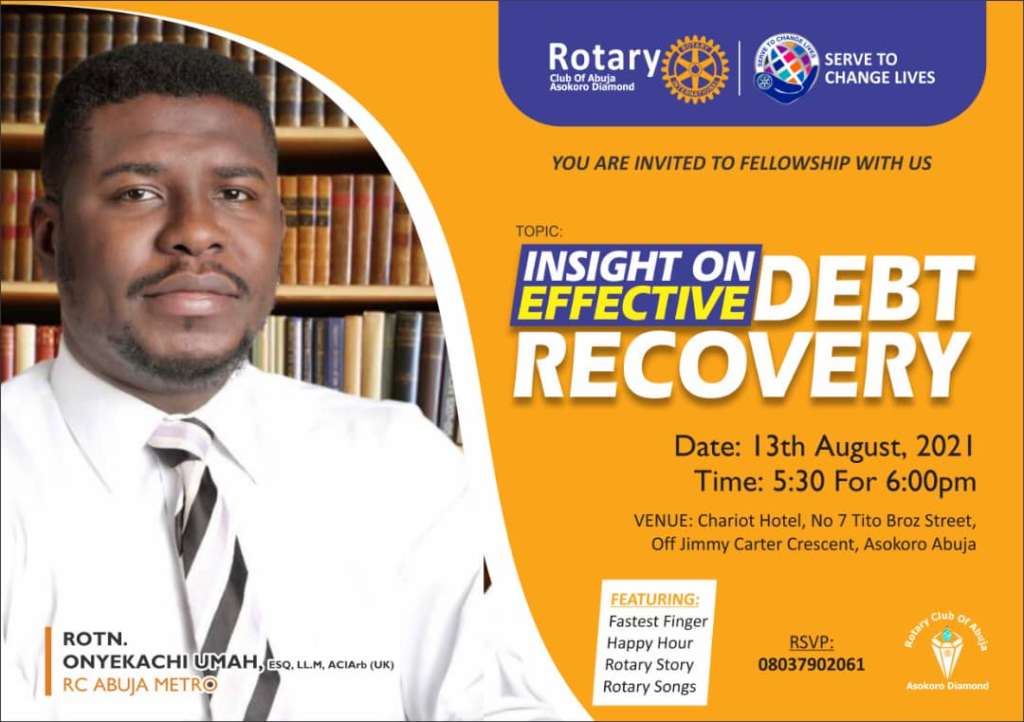
Onyekachi Umah presented a paper titled “Insights on Effective Debt Recovery in Nigeria” at the Club Meeting of the Rotary Club of Abuja, Asokoro Diamond, held at the Chariot Hotel, Asokoro, Abuja; on 13 August 2021. The event was organized by the Rotary Club of Abuja, Asokoro Diamond.
This paper highlights the nature debt and effective processes of debt recovery in Nigeria. It provides insights on the rights of debtors and creditors as well as the lawful and effective debt recovery options in Nigeria.
Any document signed by a lawyer without affixing his customised NBA stamp can be declared useless by court. Such documents include affidavits, agreements, letters and reports.
See Rule 10 of Rules of Professional Conduct for Legal Practitioners.
Federation (AGF) and Minister of Justice is the only ministerial portfolio specifically mentioned in the Constitution with certain powers given to it. The AGF is the country’s Chief Law Officer.
A former occupant of the office, Mohammed Adoke, noted in his book, Burden of Service: Reminiscences of Nigeria’s Former Attorney-General, thus: “As Chief Law Officer, the responsibilities of the AGF is like no other in the Federal Executive Council (FEC) … the AGF has a special responsibility to be the guardian of the Constitution. He has a special role in advising the government to ensure that the rule of law is maintained and that government actions pass acid test of constitutionality.”Advertisement
Section 150(1) of the 1999 Constitution provides that: There shall be an Attorney-General of the Federation who shall be the Chief Law Officer of the Federation and a Minister of the Government of the Federation.
As the Chief Law Officer, the actions and utterances of whoever occupies the position must transcend partisanship. Bigotry must be a definite no-no. The position requires a man of character who will rise above debilitating primordial cleavages that undermine national cohesion.
The fact that ideally, an Attorney-General is answerable to no one other than his conscience and the interest of justice makes it even more imperative that whoever is in that office must rise above the maddening fray for the common good.
Unfortunately, Nigeria’s Attorney-General, Abubakar Malami, delights in playing politics to the hilt to the detriment of the rule of law. In situations that require sobriety and clear-headedness, he is irascible.
It is within the purview of the Attorney-General to advice the president and the government on all matters of law and correct interpretation of the Constitution. Such is the enormous powers and responsibilities of the office that any misstep in recruitment has dire consequences.
That seems to be Nigeria’s fate with Malami who sees himself not as the Attorney-General of the Federation but chief law officer to President Muhammad Buhari and interests he is beholding to, including the Miyetti Allah Cattle Breeders Association of Nigeria (MACBAN).
Malami would rather uphold the right of way of cows than ensuring the entrenchment of the rule of law and protection of the fundamental rights of Nigerians.
President Buhari’s serial violation of the rule of law and fundamental rights of Nigerians is a poor reflection of the quality of legal advice he is getting from his Attorney-General.
Malami’s latest harebrained move that seriously calls to question his capacity to act in the position he has found himself is the press conference he addressed on October 22, a day after Nnamdi Kanu, leader of the Indigenous People of Biafra (IPOB), was finally arraigned in court on a seven-count treasonable felony charge after months of legal pussyfooting.
The AGF, a Senior Advocate of Nigeria (SAN), gathered journalists in Abuja to pronounce Kanu guilty and accuse some unnamed countries of culpability.
If he had stopped there, perhaps, many eyebrows wouldn’t have been raised. Nigerians would have simply concluded that it is in his character to be so insipid.
But what he said next was beyond the pale.
Malami, literally, convicted Kanu for the gruesome murder of former presidential adviser, Ahmed Gulak, on May 29, and Dr. Chike Akunyili, widower of former Director-General of the National Agency for Food and Drug Administration and Control (NAFDAC), Prof Dora Akunyili, on September 29.
He also alleged that Kanu and IPOB masterminded the burning of the palace of the Oba of Lagos and other public infrastructure across the country during last year’s #EndSARS protests.
The minister said after Kanu was re-arrested in June, Buhari inaugurated a 24-member presidential ad-hoc committee drawn from the Ministry of Justice, Ministry of Information, Police, Department of State Services (DSS), National Intelligence Agency (NIA), and Defence Intelligence Agency (DIA) to investigate activities of the IPOB.
And the 24 wise men came to a predictable conclusion: IPOB and the Eastern Security Network (ESN) have so far killed 175 security personnel comprising of 128 policemen, 37 military personnel and 10 other security operatives.
“Members of IPOB attacked and killed security personnel and burnt down police stations, correctional centers, INEC offices, bus terminals, the palace of Oba of Lagos, banks, hospitals, shopping malls and vehicles, amongst others,” he bawled.
Now, make no mistake. This article is not a plea of allocutus for Kanu and IPOB. But something was egregiously amiss that journalists joined issues on matters of law with the country’s law officer numero uno at the press briefing.
First, Malami was prejudicial to Kanu’s right to a fair trial. The press conference was harmful and injurious to the defence because it amounted to premature judgment and unwarranted pretrial publicity. A matter already under judicial consideration is prohibited from public discussion elsewhere. That is trite law. The press briefing was extremely sub judice.
Second, Section 174 of the 1999 Constitution which provides the AGF powers over criminal prosecutions makes Malami the chief prosecutor in the case. The court is sitting at the pleasure of his high office. If he has convicted Kanu, what else is the judge expected to do? So, a guilty verdict becomes a fait accompli unless the judge is calling the AGF a liar.
Third, scuttlebutt is a taboo in the temple of justice where cases are supposed to be proved beyond every reasonable doubt. All the allegations Malami made at the press conference are mere tittle-tattle as he provided no convincing evidence.
In any case, even if investigations had been concluded, it behoves him to present the facts in court as the prosecutor-in-chief. It is the prerogative of the court to pronounce guilt. What the country’s Attorney-General did amounted to a judicial arm-twist. It is as unethical as it is immoral – a gross professional misconduct.
Asked if Kanu’s presumption of innocence will not be affected by findings of the committee, he said “the court is the final arbiter that will eventually determine.” And you wonder how anyone could say that and with a straight face.
Malami claims findings of the presidential committee will not affect the case, yet he couldn’t resist the urge of using it to convict the accused in the court of public opinion. That is rather disingenuous.
But above all, the intent. And this is what worries me the most. Accusing Ndigbo of being responsible for the #EndSARS mayhem and wanton destruction of properties across the country as Malami did is a deliberate attempt to incite other ethnic nationalities, particularly the Yoruba, against Ndigbo.
When the minister accused IPOB/ESN of burning down the palace of the Oba of Lagos where 12 flats were completely looted and vandalized, over 150 buses at the Lagos Bus Terminal, Lagos State DNA and Forensic Centre, City Hall Race Course, First Bank branch Lagos, Lagos State Public Works Commission, Nigeria Ports Authority (NPA), Marina, High Court Igbosere, Lagos, he knew exactly what he was doing.
It was ethnic baiting – the same sadistic game Lagos State Police Commissioner Hakeem Odumosu played in May when he alerted Lagosians of a purported impending plot by the IPOB to attack soft targets in the state.
As I noted in my May 12, 2021 article titled, “CP Odumosu, Ndigbo are not Nigeria’s problem,” there is always a grand conspiracy to demonise Ndigbo in order to harm their collective interest. Malami has taken that devious gambit a notch higher.
Today, so-called bandits from his Fulani ethnic stock have rendered his home state of Kebbi, and, indeed, the entire North desolate, but Malami and his principal, President Buhari, have refused to brand them terrorists despite the clamour by the Conference of Nigerian Speakers, Katsina State Governor, Aminu Bello Masari, Kaduna State Governor, Nasir el-Rufai, and the National Assembly.
Malami, who would rather not name people already exposed by the United Arab Emirates as sponsors of Boko Haram terrorists because, according to him, “Naming and shaming of suspects is not embarked upon as a policy by the federal Government out of sheer respect for the constitutional rights of Nigerians relating to presumption of innocence,” has no qualms naming and shaming alleged sponsors of Nnamdi Kanu and Sunday Igboho, a Yoruba Nation agitator.
To Malami, terrorists who shot down a Nigerian Air Force Alpha Jet, seized antiaircraft guns from the Nigerian military, detonated explosives on the Abuja-Kaduna rail tracks, breached the security of the Nigerian Defence Acadeny (NDA), killing two officers, have constitutional rights which lesser mortals like Igboho don’t have.
The AGF who said the Buhari government cannot name and shame suspected financiers of terrorism before they are tried and convicted because “shaming remains a consequence of judicial conviction,” gleefully pronounced Kanu guilty before trial.
Malami may think he is smart, but he is only hiding behind his finger as Nigerians are seeing through his fiendish theatrics and political maneuvers aimed at demarketing Ndigbo before the 2023 polls. That is not how to be a country’s Chief Law Officer.
No hiding place for incompetent RGand inefficient CAC says NBA President
By Lillian Okenwa
“If A. G. Abubakar and the CAC would not like us to mention the inefficiencies at the CAC, it’s not going to happen.” – Olumide Akpata
The Registrar General of Nigeria’s Corporate Affairs Commission (CAC) Alhaji Garba Abubakar on Wednesday declined to present the Commission’s Annual Statutory Report at the Annual General Meeting (AGM) of the ongoing Annual General Conference of the Nigerian Bar Association (NBA).
He sent a letter notifying NBA that he will not be presenting the statutory report. Last year when the conference was held via zoom due to Covid-19, he failed to present the Annual Statutory Report. However, most glitches that occurred last year were however blamed on Covid-19.
A. G. Abubakar who has been in recent times enmeshed in several controversies was alleged to have declined the customary presentation of the Commission’s report on the grounds that CAC cannot condescend to submit its statutory report to a Non-Governmental Organisation (NGO) registered by the Commission.
Expressing displeasure over Abubakar’s absence and CAC’s inability to present the statutory report, NBA President, Mr. Olumide Akpata said: If A. G. Abubakar and the CAC would not like us to mention the inefficiencies at the CAC, it’s not going to happen. If they’re not efficient, we’ll call them out.”
This will be the second time in the Commission’s history that its Annual Statutory Report would not be presented at the NBA AGC where members of the Bar ask questions and demands explanations.
The Statutory Report session of NBA AGC is the forum where heads of some federal government agencies render an account of their stewardship to delegates. Abinitio the heads of agencies are appointed by the government on account of their membership in the legal profession.
Consequently, the NBA, being the umbrella body for the legal profession in Nigeria, usually demands this kind of report in line with the principle of transparency and public accountability —a core pillar to rule of law.
The RG’s absence from delivering the Commission’s Statutory Report for the year suggests a successful evasion of public accountability of his alleged actions over which members had previously lodged formal complaints to NBA but with no meaningful result. Many petitioners have been waiting for this opportunity to demand explanations. It would be recalled that on account of his alleged mal-administration and ill-treatment of Lawyers there were several public demonstrations by Lawyers as well as the Nigeria Labour Congress (NLC) at the Commission’s headquarters in Abuja within his less than 2-year tenure.
Over the years all the Directors who are Lawyers attended as Management Team to provide answers to issues raised by members of the Bar during the AGM. This time only the Director of Commission Secretariat, Justine Nidiya B, who submitted a report yesterday on Ease of Doing Business, a Deputy Director, and an Assistant Director were the top management staff from CAC. They were accredited only yesterday for the event.
Meanwhile other Statutory bodies like the Nigeria Institute of Advanced Legal studies (NIALS), Council of Legal Education, National Human Rights Commission (NHRC, Legal Aid Council have submitted Annual Reports to the NBA during its Annual General Conferences over the Years and continue to. These agencies are also led by Lawyers Besides NBA is on the Board of CAC by Law.
Garba Abubakar, a 1988 law graduate of Ahmadu Bello University (ABU), Zaria worked as a Senior Officer at NICON Insurance after his Call to Bar. Thereafter, he was engaged at CAC as Principal Manager in 2005. In 2009, he was made a Special Assistant to Alhaji Bello Mahmud the then RG of CAC. He became a Director in 2017 at the tail end of Bello Mahmud’s tenure.
Speaking with Law & Society, a CAC insider said: “In the Commission where the Organisation is endowed with brilliant legal minds including some with Ph.D. in Law, he resorts to acts of harassment and intimidation borne out of hate and envy. Even as the Special Assistant to the then RG his impunity was not hidden, as most of his actions then always caused rifts between the Staff Union and the Bello Mahmud administration.
“One of such rifts led to the closure of Companies Registry in Nigeria for 12 working days in 2017, a first in the history of the Commission. Most Staffs of the Commission are therefore not totally surprised at how he has been carrying on as RG, as the dictatorial traits were noticed during his 8 years as Special Assistant.
“During the two years, Acting tenure of Lady Azuka Azinge Abubakar hardly attended Management meetings. He was all along busy plotting the fall of Lady Azinge. As soon as Lady Azinge was removed in an unfashionable manner similar to the unceremonial removal of CJN, Hon. Justice Walter Onnoghen, Hajiya Saratu Mama Shafi’i , being the most senior director then, acted for two weeks before A G Abubakar was appointed RG.
“Amongst the Directors in the Commission, he was the most junior and the most unqualified to hold the Office by all criteria. It is not therefore surprising that he refused to submit the Annual Statutory Report at the ongoing NBA AGC in Port Harcourt. Is Abubakar bigger than the NBA? Only time will tell.”
Meanwhile, a group of Concerned Citizens in a statement titled “A CLARION CALL FOR MEMBERS OF CONSCIENCE TO SAVE THE LAW PROFESSION FROM DISREPUTE tabled some of their grievances against the RG. They include:
“1. Illegal and discriminatory banning of Lawyers and the general public from gaining access to CAC premises to obtain services, but rather subjecting them to poor, epileptic and incomplete online services thereby crippling corporate practice and governance in the country;
“2. Public exhibition of incompetence in implementation of the new CAMA 2020 when he publicly announced the registration of a law firm as a Limited Liability Partnership, in clear contravention of CAMA, Legal Practitioners Act (LPA) and Rules of Professional Conduct (RPC);
“3. Subjugation of CAC staff in contravention of Nigerian labour laws, practices, and conventions.”
The statement made available to Law & Society, and signed by one Mohammed Bello further disclosed that: “He remains conceited and defiant to wisdom calls, and advice, but would rather spend government resources on hype and falsehood including the filing of vexatious court cases and giving false evidence in defence of genuine complaint against him. See the twin cases CAC vs. AUPCTRE and AUPCTRE vs CAC Unreported, suit nos. NICN/ABJ/45 2021 NICN/ABJ/62/2021 respectively.
“It is high time for NBA to stop handling the impunity of this member with kid gloves. Decisive action must be taken and the time is now. He who comes to equity must come with clean hands as a stitch in time saves nine. Thank you.”
Says Malami’s allegations against Nnamdi Kanu defamatory, prejudicial, prosecutorial misconduct
Insists Kanu believes nobody deserves to live in bondage, mortal fear of own country
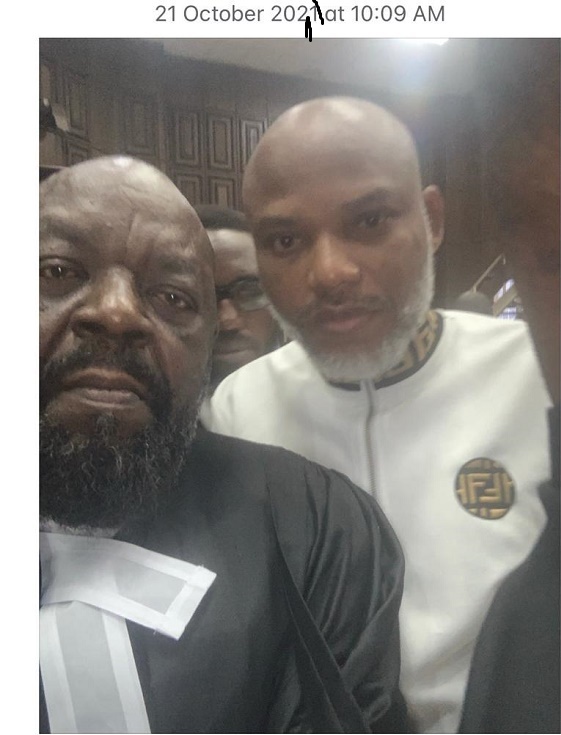
Barrister Aloy Ejimakor with Nnamdi Kanu in court on October 21, 2021
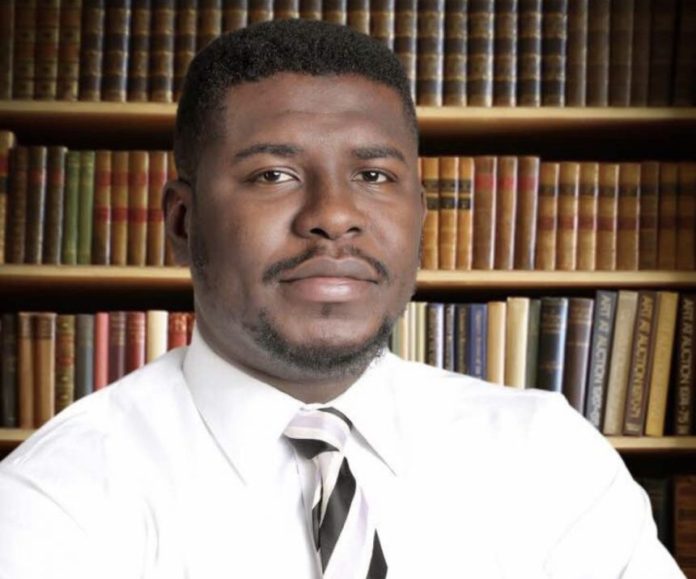
Barrister Aloy Ejimakor, the Principal Partner at Adulbert Legal Services, Abuja, with affiliates in the United States, is cerebral. An activist, he understands law and deploys it maximally in fighting causes he believes in.
One of such causes is the right of Ndigbo to self-determination which explains why he is special counsel to the Indigenous People of Biafra (IPOB) and the group’s leader, Mazi Nnamdi Kanu, who is championing the cause and paying a steep price for his efforts.
In this exclusive interview with IKECHUKWU AMAECHI, Ejimakor, an expert in international law, says the Nigerian system has mistreated Kanu in profound ways.Advertisement
The leader of the Indigenous People of Biafra (IPOB), Mazi Nnamdi Kanu, was finally arraigned in court on Thursday, October 21 after a long delay. Were you satisfied with the proceedings?
No. I was not. That it took almost four months to arraign a victim of extraordinary rendition is itself a form of torture. It also strains constitutionality and gives cause for genuine concerns about whether he is going to get a fair shake in the system. I am also disappointed that a routine request to transfer him to prison custody was denied. The truth is that the Nigerian system has mistreated Kanu in profound ways that would have broken an ordinary man. That he is still standing tall and remaining true to his convictions is the only silver lining that has come from all these trials and tribulations.
How hopeful are you now that he has finally taken his plea?
Taking a plea really goes to no material issue, especially in view of the weight of the preliminary objection that is standing against his trial. It remains to be seen whether the Court would do the right thing by declining jurisdiction. In the unique circumstances of this matter, jurisdiction (not trial) is the main issue for now.
Nnamdi Kanu’s supporters claim that he is a good man who is largely misunderstood. Those not within that circle disagree. As someone who knows him well, what kind of a person is he?
He is a very extraordinary man, with a helluva of good intentions. He hates nobody. He hates no religion. Ha hates no tribe. He only hates unjust systems. He is the poster child for all the angst of the downtrodden in society. His ideals and aspirations go beyond the peoples of former Eastern Nigeria.
The Federal Government that has labelled him a terrorist will obviously disagree with you. A terrorist is a vile character, are you saying that tag does not fit him?
Nnamdi Kanu is not a terrorist and the entire world, except the Nigerian State, knows it. He doesn’t deserve anything close to that tag. It is a characterization that shocks the conscience and runs contrary to the universal standards for designating anybody a terrorist.
The question concentrating many minds is what motivates him. What does he really want?
He is motivated by his quest for freedom from oppression. So, all his actions are geared towards putting an end to oppression. He believes, as other millions of people do, that Biafra is the best means to ending such oppression.
But some believe that his actions paradoxically have led to a spike in insecurity in the Southeast. What in your opinion will calm things down?
First, we have to tell ourselves the truth. The tendency to blame Kanu or IPOB for the insecurity in the Southeast is what is driving the insecurity, because it forecloses every effort that should have been made to identify the true culprits.
Another problem is this tendency to quickly resort to military options, which in and of itself fuels another genre of insecurity, this time coming from the State itself. So, my recommendation is this: Stakeholders need to get beyond shenanigans and sit across from one another and tell themselves the truth. The scapegoating won’t help anybody.
It was another way of alerting his true followers that anybody who insults his lawyers, but pretends to love him, is not a true supporter.
On Tuesday, September 7, you filed an application for the enforcement of the fundamental rights of Kanubefore the High Court of Abia State sitting in Umuahia. Doesn’t that amount to a distraction considering the ongoing trial in Abuja?
The very serious business of suing to enforce Kanu’s fundamental rights can never be described as a distraction. Distraction from what? Rushing his trial and rushing to his conviction? The suit in Abia State is sui generis and actually aimed at recompense for Kanu, including particularly stopping his prosecution. So, anybody that considers it a distraction is secretly lusting for Kanu’s summary conviction. Simple!
Treasonable felony is a grievous crime that can even attract death penalty. Does that worry you and your client?
No. It doesn’t, because Kanu did not commit any treasonable felony. What Kanu did and does is a legitimate political opinion but one which the government of the day is suppressing by means of punishment of some sort. So, the treasonable felony charge, having sprouted from his spirited demands for self-determination, does not pass the muster of any criminal offense known to law.
To what extent does the fact of extraordinary rendition impact on this case?
The impact is profound. You have to get past the prosecutorial complications it has created before you can bring Kanu to answer to the Charges leveled against him. Extraordinary rendition is a barrier to prosecution in every clime that it has occurred. Nigeria won’t be the first country to do otherwise, because doing so would amount to legalizing it and rewarding the executive branch for such manifest illegality.
Nigeria’s attempted extraordinary rendition of Umaru Dikko in 1984 was the singular factor that blocked his prosecution for corruption in Nigeria. It also drew other countervailing measures that saw Britain severing relations with Nigeria for two years; the persons implicated were convicted and jailed; the aircraft detailed for the rendition was interdicted and a slew of Nigerian diplomats in UK were expelled. Across the world, Britain was applauded to have done the right thing by the way it reacted. In this matter of Kanu, the global community is looking to the Nigerian judiciary to also do the right thing.
What is Nnamdi Kanu’s message to his followers and Ndigbo generally?
His message is clear, and it is one of hope and consistency in remaining true to the ideals of freedom and social justice. He believes that nobody, Igbo or not, deserves to live in bondage and in mortal fear of the very country he calls his own. He wants people to know that there is an alternative to that.
What then do you make of the allegations levelled against him by the Minister of Justice and Attorney General of the Federation, Abubakar Malami, at a press conference in Abuja on Friday?
The allegations are mere tales by the moonlight, as they do not reflect the Charges that are extant before the Court. They are also defamatory and highly prejudicial to the cases in court. In a sense, it smacks of prosecutorial misconduct of a kind that underscores the other misconducts that have become rampant in the overall handling of Kanu’s case.
Given that those grievous allegations were made just a day after Nnamdi Kanu appeared in Court, what do you think was Malami’s motive?
The motive is simple: trial by ordeal. Or trial by propaganda. If he has other motives, none of them can truly be said to be noble.
In view of this subjudicial step of trying to convict Kanu in the Court of Public Opinion, how hopeful are you that the trial will be free and fair and serve the ends of justice?
Every criminal defense counsel abides by a perpetual concern that his client will get a fair trial. Even the Constitution abides by the same concern, which is why it contains strict and copious provisions mandating fair trial for all. Some of the things that have happened in the Kanu matter have raised this concern to category red. Yet, as a Lawyer, I have no other choice than to hope that the judiciary will rise to the occasion and do manifest justice. All of that justice will turn on how the overriding issue of the extraordinary rendition will be handled by the court.
Igbo leaders and many lawyers were prevented from accessing the courtroom on Thursday. What do you say about the treatment meted out to Ezeife and others?
It is customary for Judges to permit non-parties, whether lawyers or lay people, to sit in Court to observe proceedings. This includes persons who are in court to ‘watch brief’ because of their special interest in the outcome of such proceedings.
At Kanu’s last adjourned hearing before the one on October 21, Dr Chukwuemeka Ezeife was allowed into Court and was introduced as watching brief for Ohanaeze Ndigbo. So was Goddy Uwazuruike, a senior lawyer, who sat next to me and was given leave to briefly address the Court from the bar. It is a routine thing that happens every day in various courts of Nigeria.
I was therefore troubled that on October 21, these eminent persons were not even allowed entry into the court premises, not to talk of the courtroom itself. A motley of Lawyers who volunteered their appearance for Kanu were also served the same treatment. It shouldn’t be this way and I minced no words raising my objections in a brief press briefing I gave on the spot.
How does that reflect on the Nigeria security personnel, particularly the police?
It reflects badly on the entire society. It is an exemplar of the institutional oppression that has boomeranged to the point of becoming the cannon fodder for agitations.
IPOB has once again declared a one week sit-at-home if Kanu is not released unconditionally before November 4. Do you think that is necessary?
Historically, sit-at-home is a nonviolent form of civil disobedience. It was deployed with remarkable success against the British Raj in India by Mahatma Gandhi. At the time in India, I think Gandhi was asked if it was necessary, and his measured response was that it was a necessary evil against the greater evil of British oppression.
In their reaction, the British colonialists saw it as the greatest sign ever that Indians were never relenting in their quest for freedom. And what did the British do? They abandoned their usual course of levying force and rhetoric against the people and resorted to dialogue. So, the issue is not whether any sit-at-home is necessary but why the authorities are not deploying the facility of a dialogue to containing it.
But what particular purpose will sit-at-home serve in the circumstance that Ndigbo have found themselves?
The IPOB that declared it clearly stated that it is aimed at encouraging the authorities to reverse the rendition of Mazi Nnamdi Kanu by releasing him from his current incarceration.
Is Kanu in support of the sit-at-home?
It is not within my brief to know that; so I don’t know.
Won’t it impact negatively on the conduct of the Anambra governorship election on November 6?
I read somewhere that the Independent National Electoral Commission (INEC) said it won’t. Then, it later changed course and now says it will. If INEC thinks it will adversely impact the elections, it lies within its powers and mandates to seek solutions; civil solutions.
There seems to be a conspiracy of silence in the international community over the Kanu case. What is going on?
There is no such “conspiracy of silence”. I have laid the matter before the appropriate international tribunal that possesses jurisdiction and it is receiving the attention that it deserves. I am constrained from making all the details public but one thing I can tell you is this: Kanu’s extraordinary rendition will live in infamy and it won’t stick.
Isn’t Alaigbo suffering more from the consequences of the IPOB agitation?
This is a political question that I believe to be beyond the brief I am presently handling for Kanu.
Ndigbo seem to be standing between the devil and deep blue sea – a President Muhammadu Buhari that seems to be enjoying the macabre dance in the Southeast and an IPOB that is unrelenting. What is the way forward?
When last did you check the bank charges slammed on you by your bank to ascertain whether they are appropriate charges or not? If you have not formed the habit of assessing your bank charges better start off today otherwise your bank will be slowly and steadily stealing your money in the name of bank charges without your knowledge. Nigeria is challenged from within on all front-political democracy, security of lives and property, economy, cultural identity, humanitarianism, moral renaissance and so forth. To many discontented Nigerians, the faiths which had been the mainstay of a way of life in Nigeria for generations now appear too static and removed from pressing everyday problems. We have lost faith in practically everything. Consequently our salvation in Nigeria clearly lies in our hands. You have to provide your own electricity supply, security of life and property, drinkable water, housing, transportation, primary health care and so forth. You also have to monitor and protect your bank account otherwise your bank will be stealing your money under the guise of charging you stamp duty charge, maintenance charge, upgrading charge, value-added tax, service charge, alert charge, charge on transfer (COT), new cheque booklet charge, overdraft charge, returned cheque charge and other unfounded bogus charges.
Last week the Federal High Court, Asaba in Rupert Irikefe V Central Bank of Nigeria, Zenith Bank Plc and the Attorney-General of the Federation held that that there is no express or implied duty in the Stamp Duties Act or any other law in Nigeria authorizing Zenith Bank Plc and other commercial banks in Nigeria to charge, impose and deduct N50 as stamp duty on any electronic transfer of monies from N1, 000 upwards. Therefore the court held that the imposition, deduction of N50 as stamp duty from the account of Rupert Irikefe by Zenith Bank Plc is unlawful and illegal. The court also ordered Zenith Bank to refund to Rupert Irikefe the total cumulative sum of money which it had illegally, unlawfully and wrongly deducted from Rupert Irikefe’s account as stamp duty. In handing down the aforesaid judgment, the court relied heavily on the valid and subsisting 2016 Court of Appeal decision in Standard Chartered Bank Limited V Kasmal International Services and 2017 Retail Supermarkets of Nigeria Limited V Citibank Nigeria Limited and the Central Banks of Nigeria.
The import of the aforesaid judgment is that commercial banks in Nigeria are barred from charging their customers stamp duty and other illegal charges. The Central Bank of Nigeria (CBN) must take note of this. My bank is Access bank. Permit me to reiterate once again an encounter with Access bank which had instilled in me a certain revulsion against anything called bank in Nigeria. It was a bright Monday morning. I needed to rush to the bank and make a quick withdrawal. Before going to the bank, I checked my statement of account and there was money in my account. But upon getting to the bank and presenting my cheque at the counter, the smiling teller first grabbed it, held it out in the light for proper scrutiny, tapped the keyboard momentarily with her right thumb and thereafter returned it with the most foolish answer a bank could give to its customer on a busy Monday morning. “Sorry, sir, are you expecting some money? Insufficient fund in your bank account. Please see the inquiry desk”. “What?” I retorted. “I said, sir, that you have insufficient fund in your account”, she repeated. “Since when?”. My current bank statement of account tells me I have some money in my bank account”, I thundered. “Yes sir, that is why I said you should see the desk officer, sir”. I angrily left the counter and confronted the desk officer with the cheque. She quickly snatched it from me, perused it carefully, took a quick glance of it on the screen and returned the cheque back to me. Thereafter the following hot argument ensued:
“There is something wrong with your account sir?”
“What is wrong with it?”
“Sir, you failed to migrate that was why the bank charged you N10,000”
“Migrate to where?”
“You failed to migrate to the new non-chargeable account, sir”
“What do you mean by that nonsense?”
“Sir, as at last three months ago, we gave all customers deadline to exercise the option to migrate to the new non-chargeable current account and those customers who failed to migrate were charged N10,000”
“You are not serious. Did you inform me before proceeding to remove N10,000 from my account?”
“Sir, we informed all customers”
“I said, did you inform me personally in writing or otherwise?. At the time of opening this account the bank never told me that it would at any time deduct N10,000 from the account. Besides, my current statement of account indicates that I have sufficient funds in my account”
“Sir, we sent out letters informing all customers”
“My friend, listen, you may not understand the meaning of personal contract. I said: did you inform me personally?”
“We did, sir”
“Okay, where is the proof?”
“I am sorry, sir, we don’t have it”
“Then you must be a thief. How can you steal N10,000 from a customer’s account against customer’s wish. Is that your money?”
“No, sir”
“So, why did you steal it?’
“I am sorry, sir. Please speak to my manager”
“I am not speaking to any manager. Just return my N10,000”
“I am so sorry, sir”
“Sorry for yourself. You must return my money. Look, I am giving this bank 48 hours to return the N10,000 failure for which it would suffer many undesirable consequences”.
Anyway, to cut the long story short, I left the banking hall fuming and threatening in anger. The next day the bank manager came calling with a letter of apology that the bank was going to sort itself out and make amends within one week. So, we must continue to demand for our rights in this country. It is not only the streets urchins, local government touts, SARS police and political thugs who are extorting money from hapless citizens. The banks are also extorting money from us. It beats the imagination that commercial banks which ought to protect their customers’ funds are now turning round to steal their customers’ funds. This is Nigeria for you. No idle moment in Nigeria. From the moment you get up in the morning until you return to bed in the night you are constantly ruffled by one thing or the other. If the kidnapper is not laying siege to the highway to capture you and whisk you away to their hideout where you will be handcuffed and chained to the ground until you have paid the last ransom, a staff of your bank is sitting down in an air-conditioned hall and secretly pilfering the money in your account under the guise of bank charges. So, you must get your bank to render you justice. You must stand up for your right. Always arm yourself with a copy of the judgment of the court in Rupert Irikefe V Central Bank of Nigeria, Zenith Bank Plc and the Attorney-General of the Federation. And anytime your bank misbehaves and charges you stamp duty, you must not hesitate to bring out a copy of the judgment and show it to your bank as a warning to remove the charge. The rule of law must prevail over arbitrary and capricious exercise of power.
Our site uses cookies. By clicking “Accept All Cookies”, you direct Law and Society Magazine to store cookies on your device and disclose information in accordance with our Cookie Statement: cookie policyACCEPTREJECT
Privacy & Cookies Policy
Privacy Overview
This website uses cookies to improve your experience while you navigate through the website. Out of these cookies, the cookies that are categorized as necessary are stored on your browser as they are essential for the working of basic functionalities of the website. We also use third-party cookies that help us analyze and understand how you use this website. These cookies will be stored in your browser only with your consent. You also have the option to opt-out of these cookies. But opting out of some of these cookies may have an effect on your browsing experience.
Necessary cookies are absolutely essential for the website to function properly. This category only includes cookies that ensures basic functionalities and security features of the website. These cookies do not store any personal information.
Any cookies that may not be particularly necessary for the website to function and is used specifically to collect user personal data via analytics, ads, other embedded contents are termed as non-necessary cookies. It is mandatory to procure user consent prior to running these cookies on your website.