Home Blog Page 872

Doing Grown-Up Tasks, in Millennial Slang

“Reaching biological maturity” doesn’t quite capture it.

By Caleb Madison

English words constantly evolve, not only in terms of what they mean, but how they mean. They transform their parts of speech all the time without so much as a changed syllable. The adjective green came to mean the part of the golf course that can be described by this adjective. The prepositions up and down came to mean the experiences in life that feel like the spatial relationships that these prepositions describe—life’s ups and downs. We transform proper names willy-nilly into adjectives, such as when we see a dress our friend Jessica would love and describe it as “so Jessica.” But the most fascinating method of linguistic conversion is to verbify—an autological (self-describing) word denoting the transformation of a noun into a verb. Such a process recently occurred with the noun adult, which became to adult, or, more commonly, adulting.

Verbification happens all the time. Soon after the website Google allowed us to search web pages for specific keywords and phrases, we verbed that act into Googling.We tend to verb animal names to mean human behavior that evokes that animal, such as parrot, grouse,and monkey (or horse) around. Verbs as common as to access began as nouns (we once said “to gain access”). We could probably understand almost any noun as a verb, given the right context: “The flight attendant Pepsied my cup” or “I playlisted all your song recommendations” or “Can anyone peace the world?” Calvin said it best (to Hobbes, of course) in a 1994 Bill Watterson comic strip: “Verbing weirds language.”

But what allows some nouns to become widely verbed? To me, commonly verbed nouns typically seem to contain an action within them—a specific Deed linked closely enough to the Thing for the conversion to be intuitive and useful. You can only do one thing on the website Google; we all know what a parrot is famous for doing all the time; having access is inextricable from the activity of accessing. Meanwhile, Pepsiplaylists, and peace have a multitude of associated activities and therefore must rely heavily on context if we’re going to verb them. To turn a Thing into an Action, you need the Thing to be bound up in an associated Action to begin with, so the meaning of the new verb unfurls naturally from the old noun.

So what action unfurls naturally from the noun adultAdulting means more than just “reaching biological maturity” or “becoming fully grown.” To adult is to engage in the responsibilities of modern adulthood. Filing taxes, cooking a meal, buying renter’s insurance—Millennials coming of age use the verb to describe engaging in the mundane tasks of mature life with characteristic self-effacing irony. The so-called snowflake generation, for whom stages of development, such as starting a family or owning a home, have commonly been delayed, engages in the normal day-to-day activities of adulthood with a smirking, surreal surprise. Adult became adulting as a generation entered that period feeling somewhat unprepared, wanting to express that maturity means not only reaching a certain point in your life, but also attending to the concomitant tasks. Hence our Thursday-level clue: “Doing grown-up tasks, in Millennial slang.”Caleb Madison is the crossword-puzzles editor at The Atlantic.

Credit:theatlantic.com

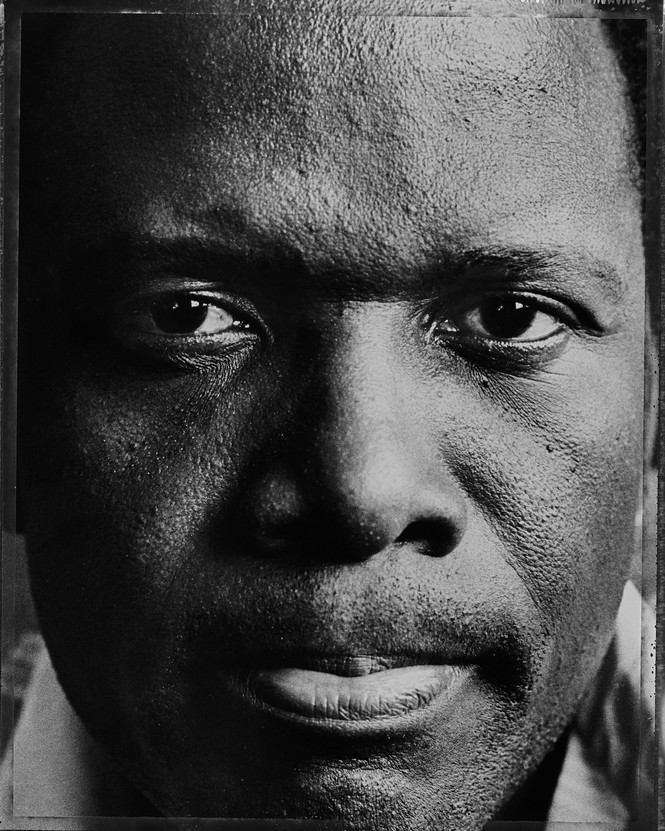
SIDNEY POITIER GAVE MORE THAN HE WAS GIVEN

BEVERLY HILLS, CA - 1978: Academy Award-winning actor and film director, Sidney Poitier, poses during a 1978 Beverly Hills, California, photo portrait session. Poitier won "Best Actor" in the 1963 film "Lilies of the Field." (Photo by George Rose/Getty Images)

Though the late actor was constrained by Hollywood’s disinterest in Black complexity, he fought to inject doses of reality into each of his performances.

By Samantha N. Sheppard

During his 1964 acceptance speech for the Academy Award for Best Actor, Sidney Poitier, slightly winded from his trek to the stage, breathily asserted, “Because it is a long journey to this moment, I am naturally indebted to countless numbers of people.” Poitier’s labored emphasis on the “long journey to this moment” underscored both the stamina of his onscreen appeal and his protracted route to acclaim that began with his 1950 film debut in No Way Out. It also gestured toward the adverse conditions that characterized his unprecedented trajectory in Hollywood.

Poitier, the pioneering Black actor and activist who died Thursday at age 94, had a complicated career. From his successful buddy pictures (The Defiant Ones, Duel at Diablo) to his spate of critical hits (To Sir, With LoveIn the Heat of the Night; Guess Who’s Coming to Dinner), Poitier played characters who expanded the range and repertoire of Black masculinity. His talent, charisma, good looks, and unquestionable success made him a star unlike any Black actor before him, many of whom were caricatured or overlooked during Hollywood’s studio era. Yet even with his superstardom, Poitier was constrained by the industry’s conservative ambitions and disinterest in Black complexity. With his sexuality neutered and his dignity firmly in place, Poitier embodied a model minority in films, a noble ebony saint who represented palatable Blackness and interracial harmony during a fraught time of racial struggle. His nonthreatening characters, who challenged systems by working within them, were thoroughly embraced by white audiences.

Black audiences, for their part, were not uniformly convinced. Roles such as Poitier’s well-mannered Black doctor—who sought approval from his white fiancée’s family—in Guess Who’s Coming to Dinner drew harsh criticism from some viewers who craved not only positive Black representation but also resonant depictions of Black life and struggles. Reprisals of benign Black characters made Poitier a lightning rod for criticism and resentment, including being called a “showcase nigger” in The New York Times by the playwright Clifford Mason. But it was James Baldwin’s 1968 Look magazine profile of Poitier that truly captured the actor’s exceptionalism and isolation in the industry.

While critical of many of Poitier’s films, Baldwin exhibited an extraordinary appreciation of the actor’s eminence and talent. In his rebuke of Blackboard Jungle, for instance, Baldwin wrote that though he loathed the film, he thought that “Sidney was beautiful, vivid, and truthful in it. He somehow escaped the film’s framework, so much so that until today, his is the only performance I remember.” Baldwin understood that Poitier’s profound gift as an actor was to give more than what was on the page.

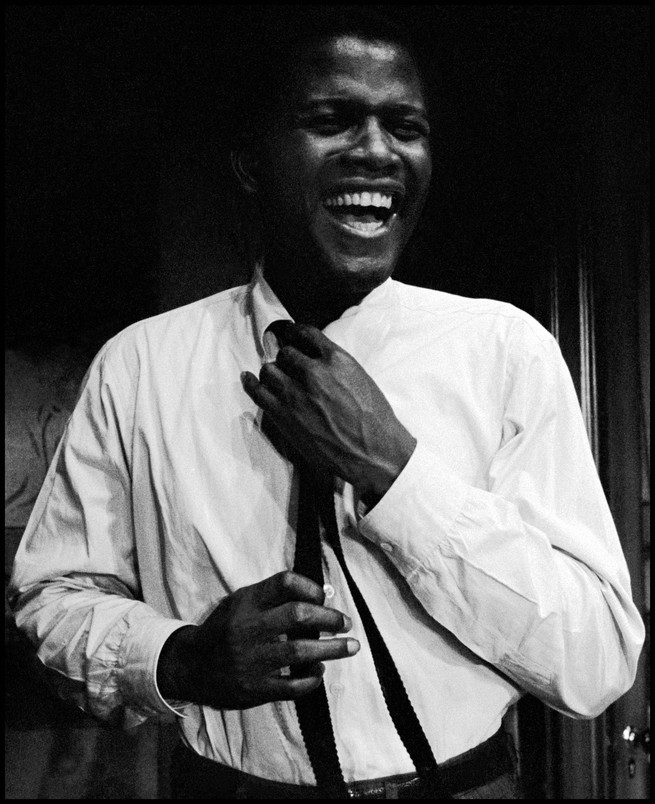
Poitier in a with hands to his tie laughing
Sidney Poitier during the filming of A Raisin in the Sun in 1959 (Dennis Stock / Magnum)

Baldwin used the fact of Poitier’s singular Black superstardom to indict a Hollywood system predicated on the disavowal of Blackness, writing:

The industry is compelled, given the way it is built, to present to the American people a self-perpetuating fantasy of American life … And the black face, truthfully reflected, is not only no part of this dream, it is antithetical to it. And this puts the black performer in a rather grim bind. He knows, on the one hand, that if the reality of a black man’s life were on that screen, it would destroy the fantasy totally. And on the other hand, he really has no right not to appear, not only because he must work, but for all those people who need to see him. By the use of his own person, he must smuggle in a reality that he knows is not in the script.

Baldwin acknowledged the restrictions placed on Poitier and other Black actors at the time, but he also recognized Black agency in these performances. Poitier “smuggled in reality” in his gestures, intonation, and, perhaps most significantly, the slap that his character Tibbs gives the racist white plantation owner in 1967’s The Heat of the Night. It was the first major motion picture scene in which a Black man retaliates in this way, and according to Poitier, he insisted that the smack remain in all versions of the movie.

Later in his career, Poitier leveraged his appeal to control authorial aspects of production, taking his directorial turn with the standout film Buck and the Preacher in 1972. Starring himself and his longtime friends Harry Belafonte and Ruby Dee, Poitier’s Black-cast Western thrilled Black audiences with an adventurous tale that brought radical politics to the forefront and fought back against white-supremacist villainy. This version of Poitier, for some, seemed antithetical to the composed and conciliatory leading man many audiences loved. However, the film’s Black consciousness reflected his, Belafonte’s, and Dee’s activism during the civil-rights movement. It was Belafonte who convinced Poitier to help deliver $70,000 to Freedom Summer volunteers in 1964. Explaining the magnitude of Poitier’s influence, Belafonte once said, “I don’t think anyone [else] in the world could have been anointed with the responsibility of creating a whole new image of black people, and especially black men.”

Poitier was fully aware of the paradoxes and limitations of his celebrity. “During the period when I was the only person here—no Bill Cosby, no Eddie Murphy, no Denzel Washington—I was carrying the hopes and aspirations of an entire people,” he said in a 1989 New York Times interview. “I had no control over content, no creative leverage except to refuse to do a film, which I often did. I had to satisfy the action fans, the romantic fans, the intellectual fans. It was a terrific burden.” And because of this burden, his cinematic contribution should be measured by more than just what the scholar Sharon Willis describes as “the Poitier effect,” meaning Hollywood’s lasting obsession with the kind of racial fantasies and figures that Poitier portrayed in his films. He strategically pushed against the constraints of Black representation in film, juggled disparate audiences’ desires and expectations, changed the face of a Hollywood leading man, and showed Black actors how to exist within and also escape the industry’s limited framework. His impact on American cinema cannot be overstated. Samantha N. Sheppard is an associate professor of cinema and media studies at Cornell University.

Credit:theatlantic.com

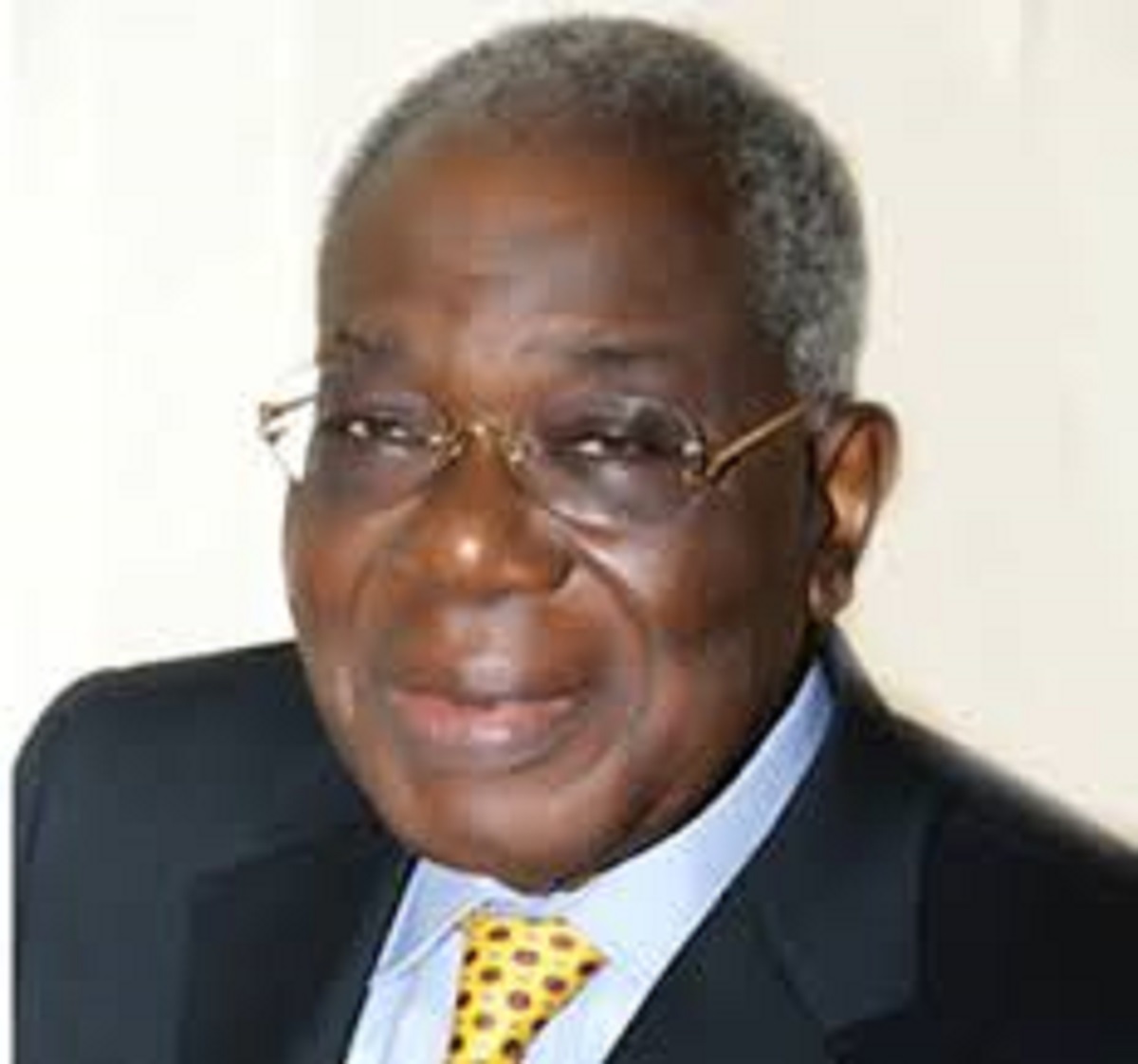
Things you probably didn’t know about Ernest Shonekan

Chief Ernest Shonekan, former head of the Interim National Government which succeeded General Ibrahim Babangida’s military government on August 25, 1993, died on Tuesday at 85. However, there are things you probably didn’t know about him.

  1. He was born on May 9, 1936 into a family of six children and had his education at the CMS Grammar School and Igbobi College, Lagos before bagging a law degree from the University of London.
  2. Shonekan who also studied at Harvard Business School was a lawyer and businessman by profession before he ventured into politics.
  3. He was given the Abese of Egbaland in 1981 in addition to various other titles he held.
  4. He served as chairman and chief executive of the United African Company of Nigeria which succeeded the Niger Company.
  5. The boardroom guru was made chairman and managing director of United Africa Company of Nigeria in 1980.
  6. Shonekan served as the interim Head of State of Nigeria from August 25, 1993 to November 17, 1993.
  7. His interim National Government was ousted by the late General Sani Abacha, who was then the Chief of Army Staff.
  8. He founded the Nigerian Economic Summit Group, an advocacy group and think-tank for private sector-led development of the Nigerian economy.
  9. Shonekan was married to Margaret Shonekan and they have four children, Adeboye, Korede, Kemi and Yele.
  10. He was announced dead on January 11, 2022.
  11. At the time of his death, he was the third oldest surviving Nigerian head of state by age after Elizabeth II and Yakubu Gowon.

Drugs

“I destroy homes, tear families… apart – take your children, and that’s just the start.

I’m more costly than diamonds, more costly than gold – the sorrow I bring is a sight to behold.

And if you need me, remember I’m easily found.
I live all around you, in schools and in town.
I live with the rich, I live with the poor, I live down the street, and maybe next door.

My power is awesome – try me you’ll see.
But if you do, you may never break free.
Just try me once and I might let you go, but try me twice, and I’ll own your soul.

When I possess you, you’ll steal and you’ll lie.
You’ll do what you have to just to get high.
The crimes you’ll commit, for my narcotic charms, will be worth the pleasure you’ll feel in your arms.
You’ll lie to your mother; you’ll steal from your dad.
When you see their tears, you should feel sad.

But you’ll forget your morals and how you were raised.
I’ll be your conscience, I’ll teach you my ways.
I take kids from parents, and parents from kids, I turn people from God, and separate from friends.

I’ll take everything from you, your looks and your pride, I’ll be with you always, right by your side.

You’ll give up everything – your family, your home, your friends, your money, then you’ll be alone.

I’ll take and I’ll take, till you have nothing more to give.
When I’m finished with you you’ll be lucky to live.

If you try me be warned this is no game.
If given the chance, I’ll drive you insane.
I’ll ravish your body, I’ll control your mind.
I’ll own you completely; your soul will be mine.
The nightmares I’ll give you while lying in bed.
The voices you’ll hear from inside your head.
The sweats, the shakes, the visions you’ll see.

I want you to know, these are all gifts from me.
But then it’s too late, and you’ll know in your heart, that you are mine, and we shall not part.

You’ll regret that you tried me, they always do.

But you came to me, not I to you.

You knew this would happen.

Many times you were told, but you challenged my power, and chose to be bold.

You could have said no, and just walked away.
If you could live that day over, now what would you say?

I’ll be your master; you will be my slave.
I’ll even go with you, when you go to your grave.

Now that you have met me, what will you do?
Will you try me or not?

Its all up to you.

I can bring you more misery than words can tell.

Come take my hand, let me lead you to hell.”

Signed
DRUGS

Reclaiming Nigeria’s Judiciary: An Inconvenient Manifesto

By Chidi Anselm Odinkalu

“It is important to move debates about human rights out of courts and legal academies and back to where they belong – in Parliaments and newspapers and among groups of volunteers moved by injustice and cruelty wherever they occur.” Geoffrey Robertson, QC, Bad People and How to be Rid of Them: A Plan B for Human Rights, p. xiv, (2021)

Over the past three weeks, I have addressed various aspects of the multi-dimensional crisis of both credibility and mission that afflicts Nigeria’s judiciary and legal profession. The first article dealt with the crisis of judicial fixation with “political cases” at the expense of providing access to and timely exit from courts for citizens and court users. The second traced the contours of the high-level judicial assault on accountable government through whimsical decisions that cynically subvert both principle and long-established precedent. The third describes the mechanics of judicial capture which now characterizes the Nigerian judiciary.

I chose the medium of popular platforms for this series because the subject matter is too serious to be abandoned to the cloistered communities of the wig, the gown, the politicians and academic footnotes.

These pieces have been the subject of gratifying debate. Many readers have contacted me to ask that I propose my own counterpoise. Such requests clearly flatter me and, simultaneously, ignore the considerable body of official literature already in existence on these issues within the portals of government. They also imply that the terminal rot of impunity that afflicts Nigeria’s legal and judicial process at all levels is caused by cognitive limitations rather than the assurance that whatever happens will attract no consequences.

On 29 December 1993, the government of General Sani Abacha inaugurated the Justice Kayode Eso Judicial Panel for the Reform/Reorganisation of the Judiciary. After 18 months of work, the panel reported on 5 July, 1995 and complained then, nearly 30 years ago, that the military government treated the judiciary as “a mere parastatal of the executive arm of government, a department of the Ministry of Justice”, a situation that led them to compromise some judges. The panel recommended 47 judicial officers for termination.

It took another seven years before the report received the attention of the National Judicial Council (NJC) in 2001. The result was the Justice Bolarinwa Babalakin Panel which built on Kayode Eso Panel’s recommendations. Both panel reports ended in considerable controversy over their recommendations for disciplinary action against certain judges. Only six ever got disciplined in the end.

Four years later, in 2006, the United Nations Office of Drug and Crime (UNODC), with the then Chief Justice of Nigeria (CJN), Mohammed Lawal Uwais, undertook and issued a report on the Integrity and Capacity of the Justice System in Nigeria. It found that “political influence in the hiring and promotion of judicial officers, prosecutors and court staff was strongly linked to the perceived quality of justice delivery” and concluded that “[b]oth the perceptions and experience of the quality of justice delivery can be improved by reducing the importance of political connections and enhancing meritocracy in recruitment, hiring, retention, promotion, retirement and the overall management of staff.”

This background should make it clear that fighting this rot does not require new proposals. Proposals have long existed and the applicable rules are clear. What is needed is the will to implement them and relocate the system to a place that improves the odds that there will be both consequences for malefaction and incentives for appropriate behaviour. For this, there is no magic bullet. What is clear is that doing nothing is not an option nor is continuing as normal. The Bar, the courts, Senior Advocates and the NJC must urgently find the will to change.

First, a regime of consequences will need to begin with the Nigerian Bar Association (NBA). In December 2020, the Independent Corrupt Practices and Other Related Offences Commission (ICPC), reported that “lawyers were mostly responsible for offering bribes for favourable judgments mostly in electoral and political matters.” According to the Commission, between 2018 and 2020, “11 out of the 123 judges surveyed, reported experiencing offers or payment of N3.307 billion and N392.3 million as a bribe”, indicating that buying and selling judges is a highly profitable enterprise. 63 lawyers admitted “to have paid or offered N5.77 billion as a bribe for a favourable judgement.” Lawyers who can shell out an average of N91.59 million or nearly $200,000 in bribes per case are neither poor nor junior. Tragically, these crimes will not travel further than the gossip mills of the crooked legal cognoscenti.

Second, the courts are reluctant to ensure consequences. In the Anambra governorship election, which took place in November 2021, various political factions turned the courts into the battleground for their partisan one-upmanships, fighting their cases in multiple court systems in Nigeria including Delta, Federal Capital Territory, Jigawa, Imo, Oyo, all outside Anambra State. They traveled up to the Court of Appeal in Kano and Awka before ending up at the Supreme Court. Some of these cases involved plaintiffs whose existence was dubious at best. For instance, the claimant in Suit No. HCK/40/2019 in the High Court of Delta State against the All Progressives Grand Alliance (APGA), was the improbably named “High Chief Ogonetus Okponetus”. Not even the lawyers could confirm the existence of this claimant.

In its decision in Appeal Number CA/KN/146/2021 in the case of Alhaji Rabiu Garba Aliyu on 10 August 2021, also in connection with the Anambra election, the Court of Appeal in Kano explicitly found that the claimant had procured an “abuse of court process” because “[h]e sought for a favourable court to entertain his suit.” Yet the court inexplicably failed to refer the lawyers for disciplinary action. The Court of Appeal in Awka made a similar finding in the appeal from Suit Number A/201/2021 by so-called “Barrister Sylvester (Sly) Ezeokenwa” and, like their peers in Kano, abstained from a disciplinary referral. These matters now default to the NBA leadership to ensure consequences.

Third, the Body of Senior Advocates of Nigeria (BOSAN), must decide to be part of the solution where in the past it has itself mostly been the problem. A 2020 study of misconduct and corruption cases in Nigeria’s legal profession concluded that “[u]nfortunately, most of those misconducts were committed not by new wigs or junior lawyers but by senior lawyers, and, more surprisingly, Senior Advocates of Nigeria (SAN).” The BOSAN was eloquently silent when Kunle Kalejaiye and Joseph Nwobike were found guilty of buying and selling judges. Such complicit silence invites people to treat the body as a squalid collection of high sounding misfits or, for the charitably inclined, another Nigerian club defined essentially by a fixation with titles, honorifics and accoutrements. Unlike the BOSAN, however, social clubs in Nigeria do ostracise even powerful members for serious infractions. The BOSAN must decide whether it is a social media content provider or a leader in the legal profession. If it chooses to be the latter, then it must clearly demonstrate zero tolerance for even the faintest whiff of improper conduct among its members, or worse still, of their buying and selling judges. For a start, they can begin with Kalejaiye and Nwobike.

Fourth, the NJC must become something more than a statutory shrine to the patronage networks and caprice of incumbent CJNs. This requires a de-concentration of the powers and roles of the NJC. There is good reason why the NJC read back-to-front translates into the CJN: S/he chairs the Council and appoints 19 of its 23 members. In a hierarchical system like the judiciary, this guarantees that the Chief Justice owns the NJC. The mechanisms of the Council broke down in 2011 when its two most powerful members, the then CJN and the President of the Court of Appeal, (PCA), went public with allegations against one another of procuring political interference in judgments. The same thing happened again in 2019 with allegations against another incumbent CJN. On both occasions, the opportunity was missed to reform the NJC. That cannot much continue.

The roles of appointment, promotion, discipline, training and appellate control of lower courts cannot justifiably all be located in one person and office. The realignment of these roles will require constitutional amendment, and will take time. It will also be resisted by incumbent CJNs, who may even be able to lubricate politicians against undertaking it. It should be evident, however, that, quite apart from the clear conflicts and contradictions between the multiple roles of the CJN, no one person has the bandwidth to combine these roles effectively. The vast margin for natural slippage is what encourages the impunity gap that now threatens the very foundations of Nigeria’s judiciary.

From 2000 to 2020, the NJC received 919 complaints of judicial malefaction, out of which it disciplined the judges in 129 cases. 14.04% is a high strike rate, made much more significant by the fact that many of unsuccessful cases were declined on technical not substantive grounds. Of these 129, the NJC recommended compulsory retirement in 50 cases and dismissal in 19, suggesting that most of these were serious cases of corruption.

No judicial system can afford this kind of blight. On 25 January, the NBA, the NJC and the Justice Research Institute (JRI) will be hosting a leadership summit in Abuja on judicial reform. They must rise from there with an acknowledgement of crisis and a plan of action for a state of emergency on the judicial sector in Nigeria. Anything less will not do.

A lawyer and teacher, Odinkalu can be reached at [email protected]

An extra that did more than just waka pass in Mamma Mia.. the Musical -Peju Akande

Whenever I go to the movie with my partner, we always wait to watch the credits even when everyone in the audience gets up as soon as they see it’s the end of the film.

Being in the communications sector, we are aware there’s a lot to movies, shows, commercials… than the main characters that make it blaze.

There are stunts men, extras, even screen writers/or play writers…there is a lot more that makes a show than the characters we see.

Someone stood out for me at Mamma Mia..The Musical, Lagos edition.

Mamma Mia…The Musical was staged in Lagos at the once prestigious Muson centre between the 25th of December 2021 and January 3rd, 2022.

The highly entertaining stage drama was produced by Ireti Bakare-Yusuf of Jarin Seriki Productions and directed by Najite Dede.

Jarin Seriki got the licence in 2021 for the adaptation of the original musical created in 1998 by British theatre producer Judith Cramer, who engaged British playwright Catherine Johnson, to write a story woven around the multiple hit songs of Swedish pop group ABBA, composed by Bjorn Ulvaeus and Benny Andersson.

Simply put, it’s the story of a single mother who’s 21 year old daughter is about to get married. Unknown to her, her daughter had invited three men who were likely to be her father to the wedding. They all showed up and the consequences thereof is what makes the drama a must watch whenever it comes to town again.

Among the stellar cast that featured veteran Jide Kosoko, who acted as Father Alexandrias and Chioma Odimba as Donna, who is the star of the musical. She is the woman who has no idea who the father of her daughter is among the three men that showed up in her home.

Donna’s acting is on point, her strong vocal chords tingled more than a few ears the whole evening. I watched her and her acting is simply mesmerizing. While you may want to blame her as a loose woman, the way she rendered the songs like a pro, to tell her side of the story, erases all blames.

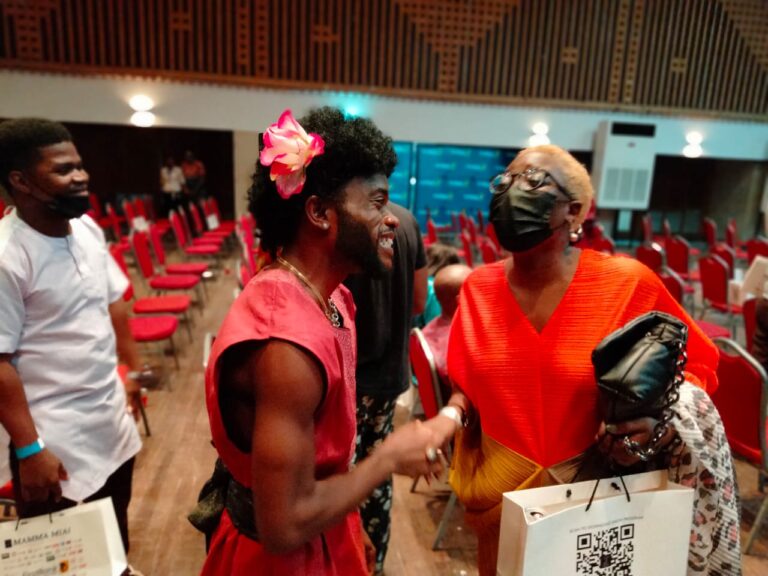
But Donna aside, her daughter aside and the crazy friends aside and even her three ex-lovers aside, one individual, one actor, who incidentally had no speaking part throughout the show is a young man, who wasn’t even given a name nor referred to in the drama, he it was that stood out for me.

He was clearly an extra, what we call “waka pass” in Nigerian lingo. But he was one “waka pass” who walked the extra mile to give an already superb show something else for its audience to talk about.

Like earlier noted, he had no name, he just had a big head of shiny hair with pink rose stuck on the side. His strutting stood him out, his gestures stood him out, everything he did along with the other extras stood him out so much your eyes lingered on him longer than the rest of the cast.

For me, it was the pure joy on his face as he pantomimed on stage making the audience wonder, will he be given speaking parts?

Is he the ex-boyfriend?

Will he have something to say because all of the extra acting he is putting out there must mean he has a speaking role. This can only be the reason the eye of the audience rests more on him than the other extras.

But that is all he was, an extra!

When do extras do more than they are meant to, especially as no one would even notice them?

You would notice him, however.

His megawatts smile outshone the lighting on the stage; his dance steps were rendered like he was the sole character on stage. He waltzed about the stage, thrilled to be able to show his dance skills even though he had absolutely nothing to say…that is the stuff of thespians, I think.

At the end of the show, I wanted to tell him I enjoyed watching him. To tell him that, of all the characters that totally killed it on stage, he stood out for me.

He was gracious, happy to have contributed in his own way, a dollop of joy into the proceedings.

And I got to know his name, he is Oscar Chihurumnanya Adiele.

Credit:thisislagos

National Road Traffic Regulations 2012 with the 2016 Amendments

National Road Traffic Regulations 2012 with the 2016 Amendments.

The Federal Road Safety Commission (FRSC) is the federal government body that is responsible for the prevention of accidents on the highway and other ancillary services. The FRSC in line with section 5 of the Federal Road Safety Commission (Establishment) Act made the federal regulation; the National Road Traffic Regulations 2012.

Click to download the National Road Traffic Regulations 2012

National Road Traffic Regulations 2012 is made by the FRSC to give (a.) “… effect to the Geneva Convention on Road Traffic of September 19, 1949 and the Vienna Convention on Road Signs and Signals of November 8, 1968;”  (b.) ” provide operational requirements, rules and regulations ….” and (c.) “provisions relating to exempted bodies, operators of transport services, operation of ambulance services and towing vehicles;” and (d.) “provide miscellaneous motor traffic regulations to ensure road safety”. The National Road Traffic Regulations 2012 came into action on 13 August 2012.

Click to download the National Road Traffic Regulations 2012

Ahead of the National Road Traffic Regulations 2012 is the National Road Traffic Regulations 2004. The National Road Traffic Regulations 2004 has been repealed (invalidated and replaced) by the National Road Traffic Regulations 2012. On the 4th day of January 2016, the National Road Traffic Regulations 2012 was amended by the National Road Traffic (Amendment) Regulations, 2016.

Click to download the National Road Traffic (Amendment) Regulations 2016

The National Road Traffic (Amendment) Regulations 2016, amended 41 regulations and 3 schedules in the National Road Traffic Regulations 2012. Hence, the National Road Traffic (Amendment) Regulations 2016 does not replace the National Road Traffic Regulations 2012, rather the National Road Traffic Regulations 2012 is still valid and operational, although with amendments brought in by the National Road Traffic (Amendment) Regulations 2016. So, to have a complete version of the National Road Traffic Regulations 2012, one has to read the National Road Traffic Regulations 2012 and the National Road Traffic (Amendment) Regulations 2016, until both documents are merged into a single document.

In summary, below are the 2 documents that make up the the National Road Traffic Regulations;

  1. Click to download the National Road Traffic Regulations 2012
  2. Click to download the National Road Traffic (Amendment) Regulations 2016

Credit:Sabilaw.org

Love is a decision

‘‘You must love…’’Matthew 22:37 NLT

When a lawyer asked Jesus what the greatest commandment was, He replied that he must love God, others, and himself (see vv. 37-39 NLT). Observe that He said, ‘You must love’ (emphasis added). This tells you a lot about the true nature and behaviour of love. If love can be commanded, then it can’t be only emotional, or a matter of feelings. Genuine love is much more than feelings; it’s a matter of the will. That’s why Jesus could command us to express it. It’s a commandment followed by a commitment. Although feelings are important, true love functions regardless of how you feel. In his book The Fred Factor Mark Sanborn writes: ‘I learned a long time ago that liking people and loving them are different. Liking someone is an emotional response. Unlike love, “like” is a feeling. The tough part is that we can’t control our emotions. We can control how we choose to express those emotions but not the feelings themselves. A healthy person can choose to be angry and still choose to act lovingly…A feeling is a reaction. Maybe that’s one reason Jesus didn’t say, “Like your enemies.” He knew that liking or not liking someone was not always in our immediate control…I have learned that love is, among other things, an action. I can love someone I don’t necessarily like. I can do something or act towards that person in a certain way because I know it is the right thing to do even if I don’t feel warm and fuzzy doing it.’ And here’s the thing: when you act lovingly towards another person, your emotions begin to line up with your actions. Go ahead, try it and see!

Bible in a Year: Genesis 18-19, Matthew 6:1-15

JOS

Every night in Jos,
angels wielding brushes of light
borne on clouds of colour
tiptoe down from celestial heights,
and alight soundlessly on a world stilled by sleep…

…then with impish glances fore and aft,
dart through slumbering streets
smile through windows at snoring humanity
deftly duck the doddering drunks

as they flit feverishly
from bush to shrub,
shrub to flower,
flower to blade,

smearing
daubing,
smudging
dipping

overwhelming all as far as the eyes can see
in hues
and dyes
and shades
and tints
that outrainbow the rainbow

Next morning…
The world wakes up to beauty
And everywhere you turn
You’re spellbound by loveliness

By Paul C Nwabuikwu.

In Pursuit of Closure

“I need to get closure.”

You’ve probably heard that phrase in a conversation or a movie or a song. And some instances, you’ve probably said those words yourself. But what exactly is closure?

BY Racheal Abiriba

The abrupt end of a significant piece of one’s life – a relationship, a job, a friendship – may be difficult to process and get over. We all deal with loss differently so when something that you once counted on as very important to – and maybe even infinite in – your life is over, you try to find ways to move on without it. Thinking of moving on is the easy part; the actual process of moving on is where the real work begins. So does the concept of ‘closure’ actually help? Can you really expect other people to give you closure?

Getting over an ending, a couple of years ago, was one of the most difficult things I have done. I lost every urge to get out of bed. Even on the days I managed to leave my bed, I put no effort into getting dressed. I was a mess, and I let it go on that way for too long until my mum noticed and talked to me about it.

It’s not easy to flip the page when a chapter in one’s life has just ended. When we seek closure, we are looking for answers as to the cause of a certain loss in order to try and resolve the painful feelings it has created. In doing this, we appear to form a mental puzzle of what’s happened – examining each piece and its relationship to the overall picture. Closure is believed to be achieved when we conclude that the puzzle has been assembled satisfactorily; that the answers have been drawn and it is therefore possible to move on.

When people most need closure it is usually because the thing they have lost so abruptly is significant to them; holding particular value and meaning. With a breakup, for example, you may find yourself questioning every single moment, every fight, everything you believe you could have done differently, in search of an answer. The concept of closure is such that you believe that answers to these and many other questions you might have, would somehow provide the full stop to the chapter and enable you to turn the page.

It is important to remember that you are in charge of obtaining “closure” – others can’t do it for you. Even if your ex-partner talks about what went wrong in the relationship, there’s no way of knowing that they are being honest or correct in their assessment, nor is there any guarantee that this will bring you the satisfaction you are seeking.

So what then is closure? And when did we conclude that it was the thing we needed in order to move on?

You have to accept that you may never have the perfect answer to the many questions you have. But you can nevertheless give yourself some time to feel your feelings, learn what needs to be learnt and decide, for yourself, to move on from it, to grow from it. Maybe that’s closure.

Credit:genevievemagazine.com

TIPS