A Victor’s Story Of Tribulation, Triumph and The Road To Attaining Endless Fortune
Moving to a far-off country, at a young age and becoming largely separated from your family is undeniably one of the most life-altering events that any human being can encounter. Factor in starting a family, building a career and studying at university, while still adjusting to living in a new setting for years to come and you’ll find a journey that’s expectedly challenging but all too fulfilling, nonetheless.
This is exactly the life Ify Adenuga made for herself when she left the shores of Nigeria in 1980 and journeyed to London, England to find greener pastures as a young woman in her 20s. Her life prior to this point was however much more riddled with trials that shaped her childhood and upbringing.
Ten years before her move to London, the Nigerian Civil War had just come to an end. A defining moment in history, the war caused the deaths and vastly upended the lives of millions of members of the Igbo community, who were forced to relocate from other parts of Nigeria to their home states in the South-Eastern region. Adenuga was one of these individuals – a young girl who had to move back home with her family, to find a safe haven, away from the violence that was being inflicted on her tribespeople.
As you can imagine, her life during this harrowing period was far from smooth sailing. As the eldest of a family of eleven children, she had to take on the responsibility of caring and looking after her siblings, some of whom she sadly lost to illnesses, and assisting her parents throughout this period, while enduring gruelling experiences and even falling victim to an illness herself, which nearly claimed her life.
“[My] work ethic [was] inbuilt in me and that’s what has carried me on, driven my inspiration to achieve and guided me non-stop.”
On learning about her story, it’s safe to assume that Adenuga’s experiences of not only living but growing through and surviving the war solidified her unwavering resolve and provided her with an inspiring level of fortitude which guided her as she grew into the young woman who would later find herself in the unfamiliar territory of London.
Her experiences have also unsurprisingly moulded her outlook on life and how she manoeuvres it, till date. “When I was growing up, my parents [toiled] non-stop, irrespective of whatever the circumstances were” she says to me in conversation. “That work ethic [was] inbuilt in me and that’s what has carried me on. That’s what has driven my inspiration to achieve and guided me non-stop.” This work ethic is glaringly evident when you look at Ify Adenuga’s life and the many ways she’s achieved success.
Long recognised as a motivational figure for the younger generations, she has intentionally dedicated her life to developing youth empowerment projects and working with organisations both in the UK and Nigeria to provide support and guidance to young people and help them to live rewarding lives. And this was a field she was always bound to end up in as her quest to “understand how to bring up a child happily” is something that has always fuelled her passion to educate the youths.
Beyond her professional life, Adenuga’s family life has definitely not straggled in contributing to her boundless fulfillment. Not long after moving to the UK, she found love and got married to Joseph Senior Adenuga and along the way, they became parents to four bright and exceedingly talented children. As the mother of artists and producers, Joseph Junior, popularly known as Skepta and Jamie, popularly known as JME and younger siblings, Julie, a radio presenter and Jason, a graphic designer, Ify Adenuga has won glory as one half of the parental unit to heirs who are undeniably some of the most successful and celebrated names in the UK’s creative space today.
“We allowed [our children] to be themselves and engaged with them, we stepped away from the parent-child [dynamic].”
And she partly owes this to the non-conventional ways in which her children were brought up and the fact that restrictions weren’t placed on them as to how much they were able to express themselves. She and her husband raised her children to see the entire family as a team, they didn’t “put boundaries on what a child could and couldn’t say” she says. “We allowed them to be themselves and engaged with them, we stepped away from the parent-child [dynamic].” And this clearly allowed her offspring to blossom into the talents that they are today.
Having found fulfilment in both her professional and family life, through the milestones she’s achieved and the extraordinary experiences she’s had throughout her life, it was no doubt the perfect moment for Ify Adenuga to share her journey, which she had been documenting from a young age, with the world. And so, her soon to be released memoir, ‘Endless Fortune’ was born.
As a prelude to its release, she shared her reasons for writing the memoir:
“Firstly is to inform my children and my grandchildren about my life growing up and how it’s so different to theirs, an opportunity I missed with my own parents. And secondly, to recognise and appreciate the fellow diaspora, regardless of where they call home.”
Endless Fortune is an enthralling and moving chronicle of survival, perseverance, love, family and all the ordeals and victories of growing up and attaining success as a migrant in a foreign land. It’s also a story of how the author did this in her own way, refusing to let society’s dictations or rules place any restrictions on her goals and how she was determined to achieve them.
To round up our conversation, I ask Ify Adenuga about some of the major lessons she’s learnt so far. For such a formidable woman who has conquered so much in life, you might expect a highly layered answer but her response is more grounded, displaying a level of humility that’s more than inspiring.
“If you take away all the human social constructs, we’re all one” she says to me. “We’re all chasing two goals in life, happiness and freedom. And that’s what we should be concerning ourselves about, nothing else.”
An empowering frame of mind that boldly shines through the narrative of Endless fortune as she takes us through her journey and the experiences which have all contributed to her becoming the woman she is today. And perhaps, the most important thing to note about Ify Adenuga’s story is that, despite the hurdles life has thrown at her, she has gained a type of fortune, way more prized than the assets or material valuables that have come into her possession over the years. A fortune that most, if not all of us, perpetually seek throughout our individual journeys – a life abound in happiness, fulfilment and love, in all its remarkable forms.
Working from home can sometimes blur the lines between work and other activities including rest. Often when I work from home, I find myself stuck at a place and sometimes I even forget to eat. I would look up and the entire place was dark. This is not a healthy lifestyle as it could negatively impact your mental and physical health. And this is where self-care tips come in handy.
– Oma Ehiri
Here are five self-care tips that will come in handy when working from home;
1. Have a routine:
If you had to leave home for work, you typically have a resumption time that influences when you start your day. The same should apply when you work from home. While you enjoy the laxity of not stepping out of the house, you should have that resumption time – and closing time – in place. In the same vein, have a lunch break.
2. Have a to-do list:
Now that you have walked into your workspace, you need to start off with a to-do list. The more detailed, the better. You do not need anything fancy to do this, but I find that fancy makes it more attractive to me. You can start off by writing the things you remember, and building the list as the day goes by. If you’re unable to tick off everything on the list, do not beat yourself up. The next day is another chance to give it a shot.
3. Take walks at intervals:
A sedentary life is very common with working from home. I remember attending an event where a life coach encouraged us to do some form of exercise at work. According to him, this can also help with our mental health as well as the physical, such as our posture. On some days, I wear my fitness watch which prompts me to take a walk every hour.
4. Set a reminder for meals:
The tendency to forget to eat while working from home, can be high. If this is the case for you, set an alarm that prompts you to get your food. Not everyone typically likes to have breakfast, but you could have an apple and some tea right beside you to kickstart your day. Do not forget your water. Staying hydrated is important.
5. Set boundaries:
If you can, set up a work corner. When you need to work, go into that space to get your work done. As soon as you close for the day, leave every work-related tool right there and focus on other areas of your life. You must also note that more tasks may come in or show up in the day. Where this happens, tackle what is of utmost importance and defer the rest for the next day. This includes work-related calls from colleagues after work hours.
‘If we could control our tongues, we…could…control ourselves.’’James 3:2 NLT
When it comes to your tongue, here are three rules: 1) Don’t speak too quickly. ‘We all make many mistakes. For if we could control our tongues, we…could…control ourselves in every other way’ (v. 2 NLT). Because you can never be totally aware of all the sensitivities of a person, you must rely on the Holy Spirit to direct your speech in a way that doesn’t tap into their pain or other negative experiences. Everybody has a different sensitivity level, depending on their past experiences. That includes you too. So practise not being easily offended, and giving others the benefit of the doubt when they say something that could be misconstrued as offensive. 2) Don’t respond too quickly. ‘To answer before listening – that is folly and shame’ (Proverbs 18:13 NIV). Before you speak, listen carefully and make sure you understand what is really being said. And if you don’t – say so. Your need to ‘look good’ can cause you to lose respect in the eyes of the person you’re seeking to impress. 3) Don’t commit too quickly. Solomon writes, ‘Do not be rash with your mouth, and let not your heart utter anything hastily before God’ (Ecclesiastes 5:2 NKJV). Then he goes on to explain how we shouldn’t try to drop out of a commitment by saying we made a mistake. Your word is your bond, and when you break a promise, you hurt people and forfeit their trust. So pause before you speak, and if need be, take time to pray. Your time and your words are two things that can never be taken back, so carefully weigh what you say.
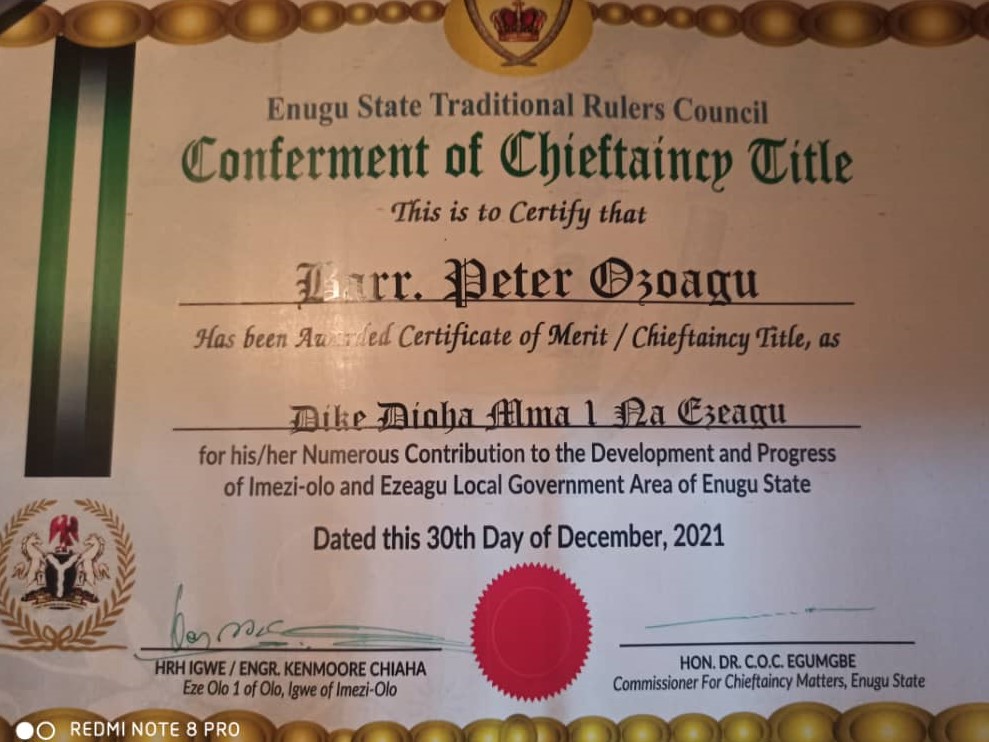
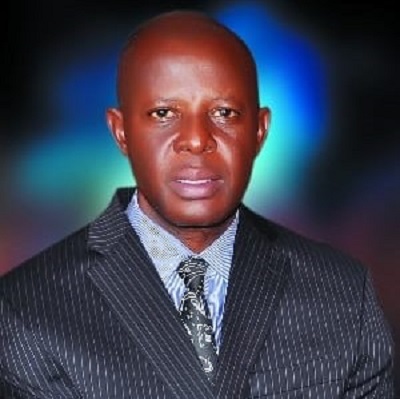
For some time to come, 30th December 2021 will remain memorable in the ancient community of Ezeagu Igbudu in Ezeagu Local Government Area of Enugu State. Indeed it was all merriment and jollity as HRH Igwe/Engr. Kenmoore Chiaha, Eze Olo 1 of Olo, Igwe of Imezi -Olo conferred a rare chieftaincy title on Barr. Peter Chinedu Ozoagu an Abuja-based legal practitioner.
Ozoagu a retired Army Captain bagged the title Dike Dioha Mma 1 Na Ezeagu Igbudu (The warrior who is loved by all). He retired voluntarily from the Nigeria Army in 2010 after 25 years of meritorious services to the country.
During this period, he served in various capacities in the Nigerian Army Corps of Military Police and Directorate of Legal Services, Nigerian Army. Ozoagu equally featured in many Military Courts-Martial as Prosecutor, Defence Counsel, and Judge Advocate respectively.
Born at Amankwo Oghe in Ezeagu Local Government Area, Enugu State Nigeria into the family of Mazi Umuzuruike Ozoagu (Oji Egbe Aza Oku Na Umueshim) and Madam Tessy Ozoagu (Ada –Eze 1, Amankwo Oghe, Peter Ozoagu had his early education at Community Primary School, Amankwo Imezi Oghe and St. Teresa’s College Nsukka respectively.
He obtained a National Diploma with an Upper Credit in Secretarial Studies from the Nigerian Army School of Finance & Administration, Apapa, Lagos, and was a recipient of two Academic Awards of Excellence in 1992.
Chief Ozoagu is Principal Partner, PC Ozoagu & Co, a firm of Legal Practitioners, Arbitrators, Notary Public & Consultants based in Abuja with affiliate offices in Lagos and Enugu. He had worked briefly with the Law Firms of B.O. Olusola & Co in Lagos and C.A.C Uzoegwu & Co Abuja before establishing his own.
A 1999 law graduate from Nnamdi Azikiwe University, Awka, Anambra State, he was called to the Nigerian Bar in 2001. Thereafter, he obtained a Master of Laws (LL.M) degree from the prestigious University of Lagos. A Member of Nigerian Bar Association (NBA), Nigerian Society of International Law (NSIL), Associate Member, Chartered Institute of Arbitrators, Nigeria (ACI.Arb), and Member, International Society for Military Law and Laws of War, he became a Notary Public in November 2013.
Chief Peter Ozoagu is Secretary/Legal Adviser to the Governing Council, European African Management School, Lagos, and Legal Adviser to Raberto Schools Ltd, Abuja. In addition, he is both an External Solicitor and a board member of many blue-chip companies.
Some of the many Military and Civil appointments held by the retired Army Captain include:
Military Assistant to the Chief Legal Adviser (Army) in 2010. Military Assistant to the Provost Marshal (Army) in 2019. Officer Commanding – 34 Brigade Provost Company in 2008. Second-in-Command, Alpha Company and Legal Officer, Eleventh Nigerian Battalion,(NIBATT 11)African Union Mission in Sudan (AMIS) in 2007. Officer Commanding – 22 Brigade Provost Company Sobi Cantonment in 2006. Member, Editorial Board, Juris Catolica, a Publication of National Association of Catholic Lawyers, Abuja.
Also, he is Editor-in-Chief – Eleventh Nigerian Battalion in the African Union Mission in Sudan (NIBATT 11), Magazine, El-Salam. Member of Board of Inquires on the attack on African Union Peacekeepers in Hasakanita, Sudan. President, Oghe Social Development Association, Abuja (OSDA) in 2018; Chairman, Enugu State Lawyers Forum, Abuja in 2019 -2021. Secretary-General, Ezeagu Patriots in 2020. Member Governing Council, Abuja Chambers of Commerce and Industry in 2020.
Immediately after his secondary education, during the Second Republic in 1983, a very young but audacious Peter Ozoagu contested for the office of Member, House of Assembly, Ezeagu North Constituency under the platform of Unity Party of Nigeria (UPN) in the then Old Anambra State House of Assembly and by so doing become the youngest to contest such a political position as at that time.
In his capacity as President OSDA (2018 – 2021), he awarded scholarships to 98 secondary school students from all seven Communities in Oghe from SS1 to SS3. The students have all passed out from secondary school after writing their final examinations in 2021. In addition, teaching aids and writing materials like magic boards, wipe, markers, and customised bundles of exercise books were provided to all the primary schools in Oghe to enhance teaching, research, and learning in the various communities.
The Ozoagus
Again, the Widows were not left out since he empowered them with cash gifts and material things ranging from clothing and food items. Other indigent members of the Association were all assisted one way or the other based on case-by-case merit.
As OSDA representative in Enugu State Indigenes General Assembly, Abuja, he ensured that all the benefits of his Constituents— Oghe People — were not denied them. During the COVID 19 pandemic, he ensured that they got their fair share of palliatives. Likewise, the Annual free bus service by the State Government is another assistance he sought for his people to benefit from.
In the same vein, as the Chairman, Enugu State Lawyers Forum Abuja 2018-2021, he was able to bring together most of the Lawyers from Enugu State, thereby affording them a strong voice in the affairs of Lawyers in Abuja.
He sits in the Governing Council and various committees of the Abuja Chamber of Commerce and Industry from where he has advocated for the welfare and elevation of the less privileged via the Micro, Small, and Medium Enterprises Trade Group. Chief Ozoagu is a member of the Committee that Organised the EP Petty Traders’ business which empowered 72 petty traders from all the Communities in Ezeagu Igbudu and is currently a member of the AGM Committee.
Dike Dioha Mma 1 Na Ezeagu Igbudu
Married to Lolo Ifeoma Ozoagu (Nee Omenka) and blessed with three children, he was honoured with a Meritorious Service Award in 2005 for selfless service to God and humanity by St. Michael’s Military Catholic Church, Tarmandu Barracks, Apapa Lagos.
Every Company intending to carry on business in Nigeria must take all steps necessary to obtain incorporation as a separate entity in Nigeria and until so incorporated, the foreign company shall not have a place of business in Nigeria for any purpose other than the receipts of notices and other documents, as matters preliminary to incorporation.
A foreigner may choose to register a business name as a sole proprietor or partnership or he may wish to incorporate a Company with other foreigners or Nigerians, or he may wish to buy shares in an existing Company.
REQUIRMENTS FOR THE REGISTRATION OF ACOMPANY IN NIGERIA
The body responsible for the registration of companies in Nigeria is the Corporate Affairs Commission (CAC). The following are the requisite requirements to register a Company with the Corporate Affairs Commission in Nigeria;
PERSONAL DETAILS:
The full names, addresses and occupations of the directors and every other person concerned in the promotion of the company, eg the subscribers.
NAME OF THE COMPANY:
A primary name and an alternative name will be required for preliminary search on the Directory of Registered Companies on the CAC portal.
PROHIBITED NAMES:
Certain names are prohibited and restricted by law. These are;
Names which are identical with a Company already in existence/registered or nearly resembles that name as to be calculated to deceive.
Names which contain the words “Chamber of Commerce” unless it is a company limited by guarantee.
Names capable of misleading as to the true nature or extent of its activities or is undesirable, offensive, or otherwise contrary to public policy.
Names which would violate any existing trade mark or business name unless the consent of the owner of the trade mark or business name has been obtained.
The use of the following words is subject to approval by the CAC; Federal, National, Regional, State, Government, Municipal, Chartered, Co-operative, Building Society, Group or Holding, Bank, Insurance.
Upon name search and confirmation of availability of the said name on the CAC portal, an availability and reservation of name would be done. A name may be reserved by the CAC for a maximum period of 60 days pending incorporation.
TYPE OF COMPANY:
The Company to be incorporated may be limited by shares, limited by guarantee or unlimited. It may also be a private or public company whether, unlimited, limited by shares or guarantee.
SPHERE AND ADDRESS OF OPERATION:
The registered office of the Company must be situate in Nigeria. Every company registered in Nigeria must comply her appropriate laws and regulations.
CAPITAL:
Generally, the capital of a company connotes the totality of its assets including borrowed money, which is loosely called loan capital. Specifically however, the capital of a company refers to the share capital. The minimum share capital of a private company is N10,000.00 (25.77 USD) while a public company is N500,000.00 (1,288.36 USD)
SUBSCRIBERS:
These are persons who sign the Memorandum of Association (for a number of shares) and the Articles of Association. Their full particulars must be obtained. They have the capacity to form a Company and they must not be less than 2 and must together subscribe shares amounting in value to at least 25% of the authorised share capital.
MEMBERSHIP:
Membership of a company is made up of the subscribers who are deemed to have agreed to become members and whose names must be entered in the Register of members and also every other person who agrees in writing to become a member.
DIRECTORS:
Directors are the persons appointed by the company to manage the affairs of the company and need not be members of the company. Every company must have at least two directors. The number of the directors and the names of the first directors shall be determined in writing by the subscribers to the memorandum or a majority of them or may be named in the articles of association.
DOCUMENTS REQUIRED BY CORPORATE AFFAIRS COMMISSION (CAC) FOR COMPANY INCORPORATION
Form CAC 1.1. Application for Registration
Memorandum and Articles of Association
Proficiency certificate (where applicable)
Recognized form of identification (passport bio-data page, drivers’ licence or National Identity Card) for Director(s)/Shareholder(s) and Secretary
Foreign Certificate of Incorporation and Board resolution for subscription to Nigerian company (where applicable)
Residence permit of resident foreigners (where applicable)
Stamp duty evidence of payment
Evidence of payment to CAC (the fees to be paid for incorporation is dependent on the volume of shares to be registered).
A Company incorporation agent is required to put all the requisite documents together and duly attest to same in line with the extant statutory provisions in Nigeria.
THE MINIMUM SHARE CAPITAL REQUIRED FORREGISTRATION OF A COMPANY BY A FOREIGNER
Every foreigner seeking to participate in Nigerian business by registering a company in Nigeria must register a company with the minimum of N10,000,000.00 (Ten Million Naira) (25,820.38 USD) authorized shares capital to be able to subsequently register with Nigerian Investment Promotion Council (NIPC). A foreign Company may join in forming a Company subject to the provisions of any law regulating the rights and capacity of foreigners to engage in trade or business in Nigeria.
EXEMPTION FROM REGISTRATION
A foreign company may apply to the Federal Executive Council for exemption from the requirement to register locally if it belongs to one of the following categories;
Foreign companies invited to Nigeria or with the approval of the Federal Government to execute a specified loan project,
Foreign companies which are in Nigeria for the execution of specified individual loan project in behalf of a donor country or international organisation.
Foreign Government – owned companies engaged solely in export promotion activities and
Engineering consultants and technical experts engaged on any individual specialist project under contract with any of the governments in the Federation or any of their agencies or with any other person, where such contract has been approved by the Federal Government.
HOW TO APPLY FOR EXEMPTION FROMREGISTRATION
An application for exemption is made to the Secretary to the Federal Government (SFG) setting out eight specified particulars and such other particulars as may be required by the Secretary to the Federal Government.
STATUS OF AN EXEMPTED COMPANY
An exempted company has the status of an unregistered Company. This provision does not affect the liability of a foreign Company to be sued by Nigerians in Nigeria or their right to sue Nigerians in Nigeria.
TAXES APPLICABLE TO COMPANIES
A business is usually profit-oriented and just like any other working individual or company, it is expected that the Company will pay taxes. Some of the applicable taxes for a Company operating in Nigeria include the following:
COMPANY INCOME TAX:
This is the tax levied on the income of the business. Company income tax is charged at 30% of the profit earned by the Company after all allowable deductions for a Company with more than N100 Million Naira annual turnover. The tax is charged at 20% for a company with a turnover between N25 Million and N100 Million.
VALUE ADDED TAX (VAT):
It is payable by the customer and is imposed on the supply of goods and services. The VAT is currently charged at 7.5%.
CAPITAL GAINS TAX:
This is 10% tax imposed on capital arising from sales, exchange or any other dispositions of properties. It is charged to the chargeable assets of a business. It is triggered when an asset is sold.
STAMP DUTIES:
This is a tax payable on instruments. The rate of this tax is dependent on the document and the value of the transaction on the face of it. It is usually charged at a fixed rate and ad valorem.
WITHHOLDING TAX:
The withholding tax is usually charged at the rate of 10% to 5% of the payable sum, depending on the type of payment. The withholding tax is normally deducted at source when payment is to be made to the beneficiary. It is an advance payment of income tax.
INDUSTRIAL TRAINING FUND:
The tax is charged at 1% of the company employees’ payroll. It is only applicable to a company with a minimum of 50 Million Naira turnover or having more than 5 employees.
NATIONAL SOCIAL INSURANCE TRUST FUND (NSITF):
The NSITF is also charged at the rate of 1% of the company employees’ payroll. The NSITF payment is not actually a tax, but a form of mandatory insurance for the employees of all companies operating in Nigeria.
EDUCATION TAX FUND:
This tax is applicable to all companies operating in Nigeria. It is levied at 2% on the profits of companies operating in Nigeria.
PETROLEUM PROFITS TAX:
This tax is applicable to only companies engaging in the exploration and production of crude oil. It is charged at the rate between 50% to 85% of ascertained profits after deductions of all operational expenses.
The duty of collecting tax is vested in the 3 arms of government. The Federal Inland Revenue Service (FIRS) is the body in charge of the taxes payable to the Federal Government. The taxes payable to the State Government is paid to the State Boards of Internal Revenue (SBIR). The Local Government also administers some levies, which they collect through various Councils within Nigeria.
TAX IDENTIFICATION NUMBER (TIN)
The Taxpayer Identification Number (TIN) is a unique number allocated and issued to identify a person (individual or Company) as a duly registered taxpayer in Nigeria. Taxpayer Identification Number (TIN) is to be used by that taxpayer alone. Registration for tax purposes is a legal obligation of every person who is required to pay tax in Nigeria. The law stipulates that upon incorporation, every Company is to register for tax purposes. Upon registration, the Company acquire its TIN. The Joint Tax Board has an improved electronic system for obtaining TIN.
DOCUMENTS REQUIRED TO OBTAIN TAX IDENTIFICATION NUMBER
FOREIGN DIRECT INVESTMENT
A foreign Company may operate alone or in joint venture with Nigerians by means of a Company, which must first of all be formed and registered by the Corporate Affairs Commission (CAC) and thereafter registered with the Nigerian Investment Promotion Commission (NIPC). This permits a foreigner to invest and participate in the operation of any Enterprise in Nigeria except Enterprises in the “Negative List” which include the following products:
Production of arms and ammunition,
Production of and dealing in narcotic substances and psychotropic substances,
Production of military and paramilitary wears including those of the Police, Customs, Immigration and Prison Services and
Such other items as the Federal Executive Council may from time to time determine.
REGISTRATION WITH THE NIGERIAN INVESTMENTPROMOTION COMMISSION (NIPC)
Section 20 of the NIPC Act requires all Enterprises in which foreign participation is permitted to apply to the Commission for business registration. The NIPC Act allows foreign nationals to own up to 100% equity and invest in any business in Nigeria except those indicated on the negative list as defined by section 31 of the Act such as production of arms, ammunition, narcotics and related substances.
DOCUMENTS REQUIRED FOR REGISTRATION WITHTHE NIGERIAN INVESTMENT PROMOTIONCOMMISSION (NIPC)
To apply for NIPC Business Registration Certificate, the following documents are required:
Duly completed NIPC Form I;
Memorandum & Articles of Association;
Certificate of Incorporation;
CAC Form 1.1 (or CAC Forms CO2 and CO7 for old companies);
Power of Attorney/ Letter of Authority (where applicable);
Approved Remita payment receipt
NIPC payment receipt
FOREIGN PORTFOLIO INVESTMENT (FPI)
A foreigner not wishing to establish a business in Nigeria may buy shares in a Nigerian Company in any convertible currency. Investment will be effected with foreign currency imported freely into Nigeria through an authorised dealer and converted into the Naira at the official foreign exchange market. The authorised dealer will issue a certificate of capital importation. Imported capital is guaranteed unconditional transferability and repatriation of funds with regard to both earnings and capital. This is called foreign portfolio investment.
PERMITS, EXPATRIATE QUOTA, CERPAC ANDAPPROVALS
BUSINESS PERMIT:
The Immigration Act and the Immigration Regulations of Nigeria does not permit any person other than a Nigerian citizen to, on his own account or in partnership with any person practice a profession or establish or take over any trade or business whatsoever or register or take over any Company with limited liability for any purpose without the written consent of the Minister of Interior. What this connotes is that a foreigner is expected to obtain the consent and permission of the Minister of Interior before the foreigner can be permitted to carry out business in Nigeria.
DOCUMENTS REQUIRED FOR THE ISSUANCE OFBUSINESS PERMIT
The certificate of incorporation of the applicant’s Company
Tax Clearance Certificate
Memorandum and Articles of Association
CAC Forms CO2 and CO7
The shareholding of the company.
Joint venture agreement
Approval from all appropriate professional bodies. This approval depends on the type of business being carried out by the Company.
EXPATRIATE QUOTA:
The Laws of Nigeria do not permit any person other than a citizen of Nigeria to accept employment (not being with the Federal or State Government) without the written consent of the Comptroller General of Immigration (CGI). Initial expatriate quota is sought and obtained usually along with the Business Permit. They are two types of expatriate quota;
PERMANENT UNTIL REVIEWED (“PUR”): As the name implies, this expatriate quota is usually for a long period of time to be reviewed at a much farther date. This type of expatriate quota is usually for the post of the Chairman of the Company’s Board of Directors or the Managing Director.
TEMPORARY EXPATRIATE QUOTA: This type of expatriate quota is given for the purpose of positions to be occupied by the foreigner for a short period of time. It is usually for directors and other employees of the company. The maximum number of years granted in the first instance is 5 years renewable for a further period of two years. It is usually the duty of the company and not that of the employee to apply for expatriate quota.
DOCUMENTS REQUIRED FOR AN EXPATRIATE QUOTA
Copy of Certificate of Incorporation of Company.
Copy of return of allotment form
Copy of particulars of directors’ form.
Copy of memorandum and articles of association.
Proof of acquisition of business premises.
Tax clearance certificate.
Technical service agreement or joint service agreement.
Feasibility report
Nigerian Content Development and Monitoring Board (NCDMB) approval for oil companies.
Certificate of Capital Importation.
Business permit in the case that the applicant company is wholly owned by foreigners.
Company profile.
ADDITIONAL DOCUMENTS REQUIRED FOR APERMANENT UNTIL REVIEWED (PUR) QUOTA
In the event that the application is for a permanent until reviewed
RESIDENT PERMIT:
A foreigner may enter Nigeria and stay for fourteen days without a residence visa (Tourist Visa). A foreigner who intends to stay longer must obtain a residence permit.
The combined CERPAC scheme makes provision for foreigners (except ECOWAS citizens, accredited diplomats and children below the age of 15 years) working or living in Nigeria to carry CERPAC card. The scheme is expected to simplify the process of acquiring residence permit and alien registration certificate. The residence permit allows a foreigner and his dependents or family to reside in Nigeria. This is in addition to the visa requirement as stated above. Unlike the residence permit, the alien registration certificate is essentially a movement chart under CERPAC scheme. Registration is valid for one year, after which application for revalidation must be made. In Nigeria, a foreigner doing business is required to have business, resident permit, alien registration card and visa. Only residence permit and alien registration have been combined. The validity of CERPAC is two years, after which application for revalidation must be made.
DOCUMENTS REQUIRED FOR THE ISSUANCE OFCOMBINED EXPATRIATE RESIDENCE PERMIT ANDALIENS CARD (CERPAC)
•
Expatriate quota approval
•
International passport with STR visa endorsement
•
A duly completed CERPAC statutory form
•
Company’s board of directors’ resolution confirming the appointment as director (where applicable)
•
Application letter from the employer requestingRegularization of stay and accepting Immigration Responsibility (IR) on behalf of the expatriate.
•
Letter of Appointment/Employment
•
Acceptance of the offer of Appointment/Employment.
•
Vetted Credentials
•
Payment of prescribed fees
However, individuals seeking to enter the country must procure the appropriate visa to suit their purpose.
THE NIGERIAN VISA
The Nigerian Visa categories are as follows;
Visa on arrival
Transit visa
A foreigner with intentions to live and work in Nigeria for a long period of time is required to come into the country with a Subject to regularization (STR) visa. The application for this Visa type must be made by the employer Company to the Nigerian Embassy or
Consular office in the prospective employee’s country or residence. The validity of the STR visa is 90 days during which an application will be made to the Comptroller General of Immigration (CGI) for regularization of the employee’s stay. Prior to the expiration of the STR Visa, the employer is required to apply to the CGI requesting the regularization of the Combined Expatriate Residence Permit and Aliens Card (CERPAC).;
DOCUMENTS REQUIRED FOR A SUBJECT TOREGULARIZATION (STR) VISA
Below are the general requirements of an STR Visa;
Letter of Application for Regularization of Stay and Acceptance of Immigration responsibilities by the employer/school/embassies/High Commission/ International Organisations/ INGOs/ NGOs/MDA’s (for government Officials).
Passport bio-data of the expatriate.
Copy of the STR Visa page and arrival endorsement page.
Form IMM 22 (Visa Application Form)
2 Recent passport photographs
Expatriate’s valid national passport
Evidence of purchase of CERPAC form
Fresh applications are to be submitted to the Office of the Comptroller General, Nigerian Immigration Service Headquarters, Abuja or to the Office of the Comptroller of Immigration Service at the State Command where the expatriate is resident accepting full immigration responsibilities.
REGISTRATION OF SECURITIES BY SEC:
The Securities and Exchange Commission is required to keep and maintain separate registers of foreign direct investments and foreign portfolio investments. Foreigners are expected to register with the Securities and Exchange Commission.
TRANSFER OF TECHNOLOGY:
Every contract or agreement entered into by any person in Nigeria with another person outside Nigeria involving the transfer of foreign technology to Nigerian partners shall be registered with the National Office of Technology Acquisition and Promotion (NOTAP) in the prescribed manner not later than sixty days from the execution or conclusion of the agreement. Every application for the registration of a contract or agreement shall be addressed to the Director of NOTAP and shall be accompanied by such number of certified true copies of such contract or agreement and by all other related documents and information as may be specified. Non registration with NOTAP does not render the contract void or unenforceable between the parties but merely frustrates transfer of any fees or payment due under the contract to the account of the foreigners outside Nigeria.
DOCUMENTS REQUIRED FOR REGISTRATION BYNOTAP
•
A copy of the duly completed application form.
•
Certificate of Incorporation with the Corporate Affairs Commission.
•
Memorandum and Article of Association of the company.
•
A duly completed TAA Pre-Qualification Form.
•
Tax Payer Identification Number (TIN).
•
A draft copy of the Technology Transfer Agreement to be registered.
•
A copy of the duly completed NOTAP questionnaires for different sectors.
•
A duly completed copy of the Monitoring Form.
•
A copy of the feasibility study report of the company.
•
Annual audited accounts for the preceding three years.
•
Evidence of tax payment for the preceding three years.
•
Profile of the technical partner.
•
Performance bond for advanced payment.
•
A comprehensive training programme which must include the number of personnel, skill or knowledge to be acquired.
•
Approval or licenses obtained from the relevant authorities and bodies such as the Nigerian CommunicationCommission (NCC) for agreements on communication etc, where applicable.
INTENTION TO INCUR CAPITAL EXPENDITURE:
Any person proposing to start a new undertaking or in the case of an existing undertaking, to incur additional expenditure must give to the Director of the Industrial Inspectorate Division of the Federal Ministry of Industry notice of his intention. If the Director is satisfied with the valuation for the property, he issues a certificate of acceptance which binds other government agencies e.g the Board of Customs and Excise, the Federal Board of Inland Revenue.
ONE STOP INVESTMENT CENTRE (OSIC)
The One-Stop Investment Centre (OSIC) brings together relevant government agencies to one location to provide fast tracked services to investors. The centre is coordinated by the Nigerian Investment Promotion Commission (NIPC). The objective of the Centre is to simplify business entry processes by removing administrative and regulatory bottlenecks pertaining to doing business in Nigeria. The centre presently has 27 participating agencies
SERVICES AT OSIC
OSIC provides the following services:
Granting of business entry approvals, licenses and authorizations within the shortest possible time.
Provision of general information on the Nigerian economy, investment climate, legal and regulatory framework, as well as sector and industry specific information to aid existing and prospective investors in making informed business decisions.
Facilitation and follow-up services on behalf of investors in all government ministries, departments and agencies.
AGENCIES AT OSIC
The centre presently has 27 participating agencies as listed below;
Corporate Affairs Commission (CAC)
Department of Petroleum Resources (DPR)
Federal Capital Territory Administration (FCTA)
Federal Inland Revenue Service (FIRS)
Nigerian Customs Service (NCS)
Nigerian Export Promotion Council (NEPC)
Nigerian Electricity Regulatory Commission (NERC)
Nigerian Export Processing Zones Authority
Federal Ministry of Budget and National Planning (FMB & MP)
Federal Ministry of Finance (FMF)
Federal Ministry of Interior (FMI)
Federal Ministry of Mines and Steel Development (FMMSD)
National Agency for Food and Drug Administration Control (NAFDAC)
National Bureau of Statistics (NBS)
Nigerian Copyright Commission (NCC)
Nigerian Investment Promotion Commission (NIPC)
Nigerian Immigration Service (NIS)
Nigerian Maritime Administration and Safety Agency
(NIMASA)
New Nigeria Development Company (NNDC)
National Office for Technology Acquisiton and Promotion (NOTAP)
Odu’a Investment Company Ltd
Oil and Gas Free Trade Zone Authority (OGFTZA)
Pharmacists Council of Nigeria (PCN)
Standard Organisation of Nigeria (SON)
Central Bank of Nigeria (CBN)
OPENING OF A CORPORATE BANK ACCOUNT INNIGERIA
Opening of a bank account is very crucial to business operation. The Nigerian bank accounts can be opened in Naira, Dollars, Euro or Great British Pounds (GBP). Having a bank account enables companies to easily run its businesses. It also enables foreign investors to obtain the Certificate of Capital Importation.
The procedure for opening a business account include:
Select a bank
Fill out the application form and attach required documents such as passport, means of identification etc.
Provide the bank with your business license and business registration documents
Provide the bank with your Tax ID Number.
INTELLECTUAL PROPERTY PROTECTION
Intellectual property commonly referred to as IP refers to creations of the mind, such as inventions; literary and artistic works; designs; and symbols, names and images used in commerce. It is a category of product that in includes intangible creations of the human intellect. The Black’s Law Dictionary defines Intellectual Property as a category of intangible rights protecting commercially valuable products of the human intellect. The category comprises primarily trademark, copyright, and patent rights, but also includes trade – secret rights, publicity rights, moral rights, and rights against unfair competition”
TYPES OF INTELLECTUAL PROPERTYTRADEMARK:
A trademark is a distinctive name, sign or logo which uniquely identifies the source of goods and services. It’s primary purpose is to ensure that no-one uses the trademark of another which is similar or identical, so as to prevent confusion in the course of trade in relation to the goods and / or services in which it is registered. It is a special mark which distinguishes the goods and services of one entity from another. An example of a trademark is the “just do it for nike logo, the pepsi sign logo, the apple sign logo for apple products. The list goes on.
PATENT:
A patent is a form of intellectual property that gives its owner the legal right to exclude others from making, using, selling and importing an invention for a limited period of years, in exchange for publishing an enabling public disclosure of the invention. It is the right granted to anyone who invents any new and useful process or fundamentally impresses an existing process. A typical example of a patent
INDUSTRIAL DESIGN:
Industrial design is the ornamental or aesthetic aspect of a useful article which may consist of the shape, pattern and / or colour of the article and must appeal to the eye. It could simply be said to be a combination of lines or colour or both and any three dimensional form.
COPYRIGHT
Copyright is that aspect of the law that deals with the rights of intellectual creators in preventing unauthorized copying or reproduction of the literary or artistic works. The principal purpose of Copyright is to protect against the appropriation of the produce of another person’s literary and artistic work or effort. Copyright consists of exclusive rights given to the creator in the exploitation of his works; this includes painting, music, poem, architecture, computer software, maps and technical drawings.
HOW TO REGISTER/PROTECT A TRADEMARK, PATENTAND INDUSTRIAL DESIGN IN NIGERIA
Essentially, there are three major stages involved in intellectual property registration, which I will briefly explain as follows:
SEARCH & APPLICATION
The first step required to be taken for any person or organization desiring to register a trademark is to brief an Agent, usually a Lawyer and inform him of the trademark or the description of a symbol or logo or design to be registered. A search is conducted on the trademark at the Trademarks,PatentsandDesignsRegistry,CommercialLawDepartment of the Federal Ministry of Industry, Trade and Investment, Abuja and if it is not in conflict or too similar with any existing trademark, an application for the registration can proceed. The Registrar will issue an acknowledgement upon the recipient of any due application and different payments are made for search and application processing.
ACCEPTANCE
Where an application has been approved after a successful search has been conducted, the Registry will accept, register the trademark and issue an Acceptance Letter to the applicant. The Acceptance
Letter is initial evidence that the trademark has been duly registered.
PUBLICATION AND CERTIFICATION
The third stage involves publication in the trademark journal and certification. Upon the acceptance of the registration of a trademark, the Registrar will ensure the notice of the application is published in the Trademark Journal. Such notification will include the full details of the application and the applicant. By virtue of this publication, any interested person would have the opportunity to oppose or object to the registration. Any person or organization who considers that a trademark being sought may likely confuse or mislead the public in light of any pre-existing trademarks may protest to the Registrar to stop such registration by filing a noticeofopposition in a prescribed form. Protests or oppositions containing the grounds upon which the protest is made must be sent to the Registrar of Trademarks within two months of publication of notice in a journal. The Registrar will notify the applicant of any protest or opposition received. The applicant may respond to such opposition within one month from the date of receipt of such notice from the Registrar. An applicant who failed to respond to the opposition received with his or her own counter-statement may be deemed to have abandoned his or her application.
Where Registrar received the response of the applicant stating why the applicant is entitled to such trademark, the Registrar of Trademark shall constitute a Tribunal to determine the conflict in favour of one of the contending parties. Where there is no opposition to the publication in the journal, or opposition has been made and successfully resolved in favour of the applicant, the Certificate of Registration will be issued for the trademark sought. The Certificate indicates the evidence of due registration and completion of all processes. It confers a right on the proprietor or the owner to use the trademark to the exclusion of every other entity. However, where any other person or entity successfully challenged the applicant in opposing a trademark registration, the Registrar will issue a letter of refusal to the applicant.
BASIC REQUIREMENTS FOR TRADEMARK
PROTECTION IN NIGERIA
The basic requirements every intending trademark applicant should prepare or provide include the followings
Logo, which may include Words and/or Device
Name of the applicant
Contact details of the applicant
Power of Attorney appointing an agent to conduct such registration (an accredited agent/lawyer may help to prepare the power of attorney)
BASIC REQUIREMENTS FOR PATENT PROTECTION INNIGERIA
A petition or request for a patent signed by the applicant or his agent and containing the applicant’s full name and address.
A specification, including a claim or claims in duplicate, plans and drawings, if any in duplicate.
Where appropriate, a declaration signed by the true inventor requesting that he be mentioned as such in the patent and giving his name and address.
A signed power of attorney authorizing an agent.
An address for service in Nigeria, if the applicant’s address is outside Nigeria, and payment of the prescribed fees.
SETTLEMENT OF DISPUTES IN THE COURSE OF INVESTMENT
In case a dispute arises between an investor and any Government of the Federation in respect of an enterprise, all efforts shall be made to reach an amicable settlement through mutual discussion, failing which the dispute may be submitted to arbitration at the option of the aggrieved party. In the case of a foreign investor, settlement of disputes shall be carried out within the framework of any bilateral or multilateral agreement on investment protection to which the Federal Government and the country of which the investor is a national are parties.
Where there is a disagreement between the investor and the Federal Government as to the method of dispute settlement to be adopted, the International centre for settlement of Investment Dispute Rules will apply. The Nigerian Investment Promotion Commission (NIPC) will act as liaison between the foreign enterprise and relevant Government Departments especially with regard to issuance of permits.
LAWS GOVERNING BUSINESS OPERATION IN NIGERIA
Business setup and operation in Nigeria are governed by various laws. These laws include but are not limited to:
The Companies and Allied Matters Act (This is the primary law that governs companies’ formation and maintenance in Nigeria)
Companies Income Tax Act
Value Added Tax Act
Withholding tax Act
Nigerian Investment Promotion Commission Act
Labour Act
Immigration Act
Immigration Regulations 2017
Employee Compensation Act
Banks and other Financial Institutions Act
Tel: 07084241826 By: The Corporate Law Department of The Jubilee Chambers, a full service commercial law firm based in Uyo, Nigeria.
The news stream was agog with the news of the arrest of private security guards in Lagos on the 2nd of January, 2022, by the Commissioner of Police, Lagos State, Mr. Hakeem Odumosu. According to a press release said to have been issued by the Lagos State Police Command Public Relations Officer, CSP Adekunle Ajisebutu, “all appeals to the security men to allow the CP go (sic) to see someone (no name provided) at a function (no information about the kind of function) where an urgent matter bordering on security was to be discussed fell on deaf ears even when they had foreknowledge of his coming (no information about who had foreknowledge of his coming)…..The CP after about 30 minutes humiliation ordered the arrest of four of the security men…”
The estate executives also issued a press release and denied the allegations of the Lagos State Police Command. The estate executives confirmed that there were social events going on in the estate that day and that no one had any foreknowledge of the CP’s impending arrival. The estate also alleged that the CP ordered the arrest of a widow and her three young children who were unfortunate to be at the scene.
Section 12(1) of the Administration of Criminal Justice Act, 2015 provides that “Where a person or police officer acting under a warrant of arrest or otherwise having authority to arrest, has reason to believe that the suspects to be arrested has entered into or is within any house or place, the person residing in or being in charge of the house or place shall, on demand by the police officer or person acting for the police officer, allow him free access to the house or place and afford all reasonable facilities to search the house or place for the suspect sought to be arrested.”
Section 12(2) of the ACJA further provides that “Where access to a house or place cannot be obtained under subsection (1) of this section, the person or police officer may enter the house or place and search it for the suspect to be arrested, and in order to effect an entrance into the house or place, may break open any outer or inner door or window of any house or place, whether that of the suspect sought to be arrested or any other person or otherwise effect entry into such house or place, if after notification of his authority and purpose, and demand of admittance duly made, he cannot obtain admittance.”The Nigeria Police Act, 2020 contains similar provisions.
The press release of the Police PRO, Lagos State Command, did not state that the CP and his retinue of heavily armed men were at the estate to effect the arrest of any person or search any house in the estate. They also did not produce any arrest or search warrant. The name and address of the person they wanted to see “where an urgent matter bordering on security was to be discussed” was never disclosed to the estate security guards. The estate did not report any security breach to the police that would necessitate the invitation of police officers. Attending social events is not part of the official functions of any police officer. The estate was a private estate and subject to laws of Nigeria and Lagos State; it has the right to put in place its own private security protocols, and therefore regulate entry and movement within the estate. There is no law that authorises any police officer free access to any private property except for the purpose of arrest of a suspect or to conduct a search, and such information must first be disclosed to the owner or person in charge of the property or place. This, the Lagos State Commissioner of Police, CP Odumosu, failed to do.
As said by foremost human rights activist, Femi Falana SAN on this incident “if the FG/LASG had provided adequate security in the State would the rich who live in estates have engaged the services of private security personnel? If criminals have not been posing as military or police officers in order to gain entry into estates to rob residents of their properties would the security guards have subjected the CP to any scrutiny?”
The CP having failed to comply with the provisions of the law that he was employed to enforce lacked the authority to order the arrest of the security guards or any other person because of the “humiliation” he allegedly suffered as a result of the “delay” in granting him access. That is an abuse of the power of his office. As a matter of law his forcible entry into the estate without proper authority could be said to be illegal and trespassory and the estate may wish to exercise their rights and seek for legal remedies. No police officer is above the law. They are also subject to the same laws as the citizens of the Federal Republic.
It was good a thing that in a space of one week, the Association of Nigerian Electricity Distributors (ANED) which represents the 11 Electricity Distribution Companies (DisCos) had taken it upon itself to explain to Nigerians two knotty issues raising dust in the power industry. The first is why DisCos take ownership of equipment donated by consumers/customers. Second, is justification for billing customers on estimation. The association should be commended for at least finding it worthy of addressing Nigerians on what it feels is right in sustaining the business of DisCos on one hand and delivering exorbitant charges with less efficient supply and yardstick to our homes, businesses and offices on the other.
On the first, I have addressed the issue in a national daily. And for the interest of the general public and the good of DisCos, it is trite to also address constructively the second which bothers on justification for estimated billing of electricity consumers. First, what is estimated billing? It is an arbitrary non conventional method of allocating monthly charges for un-metered customers without any valuation, acceptable yardstick or scientific approach.
According to newspaper reports, the Electricity Distribution Companies (DisCos), through its mega phone and umbrella body – ANED had insisted that; “billing of end-users by estimation is normal across the world. They stated that the practice is scientific and follows necessary methodology, stressing that the masses must drop ‘misinformation’ that the companies were billing consumers unnecessarily to meet revenue targets.”
The Estimated Billing Methodology, 2012 issued by the Nigerian Electricity Regulatory Commission (NERC) is the only guide to be relied on in estimating customers at all but it is complied with more in breach by DisCos. Sections 8 and 9 vividly captures how estimation of bills for the Un-metered MD customers – MD and Non MD customers respectively can be done. However, for the purpose of this discussion, we shall be dwelling on section 9.(1-3) – “Un-metered Non-MD Customers.” It states inter-alia; “the methodology applicable to these categories of customers and others not captured above shall be termed “Inventory of Connected Load Method”. This method involves the subtraction of all the metered load from the energy supplied to the feeder (33 or 11KV) and the application of an appropriately determined availability factor and correction of losses which is aggregated among the various number and classes of customers supplied by the feeder.
9.2 The method shall require the determination (in advance through statistical analysis of historic information) of the averages of the proportions of the consumptions for the various classes of customers in the urban and rural areas and the relationship derived below is applied to determine the proportion of the energy supplied to the feeder which shall be proportionately distributed among the various customers.
9.3 The above methodology shall be determined as follows: On the assumption that the total grid energy supplied to a Disco is equal to the energy on all its feeders, if energy on all feeders is X then, Energy available for billing, Z =X – µX. Where µ = % of Distribution technical loss (10% – MYTO rate). Then Z =X – 0.1X = 0.9X. If Zm = Energy consumed by metered customers (both prepaid and manually read) Zu = Energy consumed by un-metered customers. Zi = Energy of illegal connections (non Technical or commercial loss of 18% – MYTO rate for the Disco), then total energy available for billing which should be equal to the total energy billed will be, Z = Zm+Zu+Zi.
Therefore, the energy which should be billed to un-metered and legally connected customers, Zu = Z –Zm- Zi = 0.82Z – Zm. Or Zu = 0.72X – Zm (in terms of the total grid energy to the feeders). Considering that load on a feeder may be prone to shedding, availability factor= α = (Number of hour the feeder is on) / (Total number of hours in the billing cycle). Then total energy for the un-metered customers becomes Zu = α Zu = α (0.82Z – Zm). Or Zu = α Zu= α (0.72X – Zm).
Determination of the load for each Class and a customer in the class, If ℓC represents the proportion of the load consumed per customer class based on a historic figure per feeder (which could be the feeder being considered), then ℓc = Where: Na = Number of Customer in a class in the feeder Ca = Average consumption or load of a class in the feeder NiCi = Total Consumption or load of all classes in the feeder.
Consequently, the consumption per customer per class of Un-metered Customer can be determined as: Zci = ℓc. Where: Nc =Number of customer in a class being considered in the feeder. Consumers/customers deserve the right to understand the entire processes culminating into the huge charges received monthly. Therefore, customers should be eager to learn by asking relevant questions. However, it is a known fact from time immemorial that; DisCos from all indications sit at the comfort of their offices, minus the metered load only from each feeder and allocate whatever amounts they feel like to any consumers/customer.
They purposely neglect the other components of the procedure such as analysis of historic information of the averages of the proportions of the consumptions for the various classes of customers in the urban and rural areas and the relationship derived to determine the proportion of the energy supplied to the feeder which shall be proportionately distributed among the various customers. One had thought that doing the right thing, inviting the general public possibly to seminars and conferences to share knowledge by ANED serves better purpose than choosing the easy way out or trying to be smart by half. What is the big deal in being transparent? What does it take DisCos to teach their customers how they are billed?
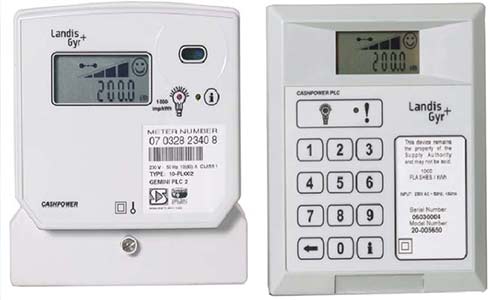
One of the major problems in the power sector is the manifest inability of DisCos to meter majority of Nigerians. ANED said, “for billing to be fair, consumers are expected to be provided with prepaid meters. But effort to meter consumers has been problematic in the country.” Metering of customers cannot be problematic if DisCos have genuine intention to do so. The Mass Metering Programme (MMP) is currently being sabotaged by some DisCos. Meters provided under that programme are currently being sold to desperate consumers/customers. One DisCo in Northern Nigeria had embarked on a road show selling the said meters under the guise of Meter Access Provider (MAP) designed to roll out three million electricity metres.
NERC’s Key Operational and Financial Data of the Nigerian Electricity Supply Industry (NESI) for January 2019 to September 2021 showed that out of the 12,784,685 registered customers as at September 2021, only 4, 772,906 representing 37.33% had been metered in seven years while 8,011,779 representing 62.67% of electricity consumers in the country were still on estimated billing.
After failed deadlines and prescribed numbers of customers to meter annually, DisCos had no option than to estimate customers to cover cost. It is no “misinformation” that DisCos are billing unnecessarily and even arbitrarily to meet target. It has become a routine monthly nightmare for the estimated. Imagine billing an estimated customer between N21000 – N50000 per month while his neighbor who feeds from the same feeder/transformer but has PPM buys token of between N5000-N10000. Where is the justification and science in billing?
Furthermore, ANED’s Executive Director for Research and Advocacy, Sunday Oduntan, said; “the companies were only concerned with market ‘receivables’, which is the money owed to the DisCo for a service already rendered. This is money earned by the DisCo based on the energy consumed. If this is what is being wrongly and ignorantly defined as cooked up figures, then it is our responsibility to help save the public from those spreading this misinformation.” DisCos has to for emphasis cover its cost of “receivables” to break even but it should not be to the detriment of non-metered customers.
The scam in estimated billing had recently caught the attention of the National Assembly. In 2018, the House of Representatives moved to criminslise electricity estimated billing system except where a consumer’s metre cannot be accessed by the service provider. The Speaker, Femi Gbajabiamila had sponsored a bill in the 8th House titled; “An Act to amend the Electric Power Sector Reforms Act to Prohibit and Criminalise Estimated Billing by Electricity Distribution Companies and provide for compulsory installation of prepaid metres to all power consumers in Nigeria and other related matters.”
The bill introduced when Gbajabiamila was the House Leader was passed into law but was not assented to by the president. However, it was reintroduced again in the 9th House. What are the intended provisions? “Discos must install prepaid metres on the premises of a consumer within 30 days of receiving an application and payment from such consumer or face penalties. The bill stipulates that any Disco which fails to provide prepaid metres within the stipulated window is stopped from denying a consumer/customer access to power supply, disconnecting them, where connection has already been granted, or reverting to estimated billing.”
Once the piece of legislation becomes law, it will become an offence for Discos to estimate bills, and any contravention of the provision attracts either a one-year jail term or a fine of N1 million or both. The House has concluded work on the bill and sent same to the Senate for concurrence before it will be transmitted to the president. The Speaker is by this medium encouraged to work harmoniously with the Senate for quick concurrence and the executive to ensure presidential assent to the new bill. He should also resist external pressure and complete the good work he started in the interest of public good.
Advocacy, Public Relations and Information management are the best, worst and hardest global professions. The best, when managers address issues with the truth, convincing facts and superior argument. The worst and hardest is when managers flog a dead horse. In this case it is obvious at the back of the minds of the public that the manger is simply brow-beating the matter. The snag most atimes is that the managers in a bid to cover up the truth and please their paymasters leave some uncovered trails which will continue to hunt them after spewing deliberate falsehood.
This ANED in my estimation is de-marketing DISCOs. Sunday Oduntan seems to take Nigerians for fools. It is good to defend and promote official issues but telling bare facet lies undermines good PR. The old and new developments in the power sector is disheartening. A country where children joyously shout up NEPA in appreciation of restored power supply after days, months or years of darkness means a lot.
The Nigerian Electricity Regulatory Commission (NERC) has not lived up to its expectations with respect to estimated billing. The commission tend to work in cahoot with DisCos to exploit consumers/customers. Even after issuing policy guidelines for conduct of business in the power sector, it ends there. The commission does not care if DisCos adhere to the rules or not. How many times has NERC issued statements to the effect that customers who are not metered should not pay estimated billing? How many times did NERC direct DisCos to meter certain customers annually without result?
It is on record that customers are at the receiving end of the general inefficiency of DisCos. Therefore, it is our obligation as Nigerians to speak up and ensure that the right things are done. DisCos have flagrantly abused the procedures for estimated billing of electricity consumers/customers. Therefore, one thinks there is no justification for estimated billing of electricity customers.
Sunday Onyemaechi Eze, a Media and Communication Specialist, wrote via [email protected] and could be reached on 08060901201
Our expectations are high for the year 2022 and this is expectedly so, for many reasons. The year gone by was a very difficult one for many, especially in the area of dwindling economic capacities, given all the variables of inflation, the climbing exchange rate, unemployment and the consequences of the global pandemic. Ordinarily, many are on the fringes, barely managing to survive the biting effects of recession and the economic downturn, even though constant promises from the leadership reverberated to cushion the effect, with little or no tangible results. The major challenge as it were, is the crippling effect of insecurity, which has more or less put the nation at a standstill. The reason why the Constitution in its section 14 (2) (b) gives priority attention to security as the yardstick to measure governance is because of its strategic importance to human existence. A society where life is not secure, where living has no guarantee and where the fear of death grips the larger populace would necessarily experience slow development. So, we cannot exhaust discussions on security since it is the primary purpose of the government.
Without any doubt, one of the reasons that led to the ouster of the previous administration was the growing insecurity in the land at the time and the seeming inability of that government to contain it. The emergence of an infantry expert, a war hero and an experienced soldier gave hope to many, but things have not changed much. Even though serious acts of terrorism have been contained and limited to the base of the insurgents, we do not seem to be getting out of the woods, going by spate of attacks in recent times. The nation at large has wondered why the President has not been able to tackle the security challenges facing the nation headlong, given his experience and knowhow, on the subject. On March 24, 2018 during the convocation ceremony of Taraba State University, another war veteran, General Theophilus Danjuma (Retd), shocked the nation when he stated pointedly that the Nigerian armed forces were colluding with insurgents and killer herdsmen, saying that Somalia would become child’s play, should the President fail to act promptly. He called on the people to rise up to defend themselves.
“The Armed Forces are not neutral. They are conniving with armed bandits that kill people. They facilitate their movement. They cover them. You must rise to defend yourselves from these people. If you are depending on the armed forces to protect you, you will all die one by one. I ask every one of you to be alert and defend your country. Defend your territory, defend your States, because you have nowhere else to go.”
As usual, government propaganda went agog, vilifying the retired general, until reason prevailed and the President had an audience with him, after which everything returned to business as usual. We have heard stories (though not verified) of helicopters with military men said to be aiding terrorists and bandits with supplies of weapons and foodstuffs, in line with General Danjuma’s assertions. In answer to this malady, military intelligence can be deployed effectively to combat the connivance, if indeed it is true, or else we may just be going round in circles. Long after the dust gathered on General Danjuma’s explosive revelation, a former Naval officer, Commodore Kunle Olawunmi (Retd) on August 26, 2021 on national television, stated that terrorists named current governors, senators and Aso Rock officials as their sponsors during interrogation by the military authorities. He said the government had not been able to prosecute the sponsors because it was partisan. You then wonder how low things can go. Let’s hear him.
“I told them that the centre of gravity of Boko Haram in Nigeria is the sponsors of the programme. It was beyond us because the job we needed to do was kinetic but we cannot resolve issues of sponsors of Boko Haram that were in Buhari’s government that we know them. That was why we couldn’t pursue that aspect that could have resolved the issue because we need to arrest people.”
The late former deputy governor of Central Bank of Nigeria, Obadiah Mailafia, said in August 2020 that repentant terrorists revealed that a serving northern governor is a Boko Haram leader. So, why is the government pretending not to know what to do? This matter is not peculiar to terrorists though but also extends to armed robbers, kidnappers, fraudsters and other criminal elements, who all make society ungovernable. What is needed to tackle them is the will power from those who are in authority. This is why the solution of state police or community policing as the case may be, should be embraced by the government holistically. The Neighbourhood Watch in Lagos State has proved to be an excellent idea, just as the Amotekun Corps in Ondo and Osun States have proved effective in combating the festering crisis of kidnapping. This should be replicated in other parts of the country, with necessary modifications.
Commodore Olawunmi had stated that most military formations had been compromised by the infusion of religion into the system, which the insurgents exploit to maximum advantage. When criminals invade religious places of worship, it becomes easier for them to take advantage of the spiritual atmosphere to perpetrate their evil deeds. Recently, two ex-convicts who were absorbed into a church for rehabilitation, turned around to kill the pastor in order to rob him of money belonging to the church. Though a delicate choice to make in the prevailing circumstance of present-day Nigeria, the government must nonetheless insulate all military formations from religion, at least in profiling the civilian populace that throng these centres to perform their spiritual obligations. This concern was recently confirmed by the former Chief of Army Staff, General Tukur Buratai (Retd) who was reported to have said that “there is a strong religious affinity between the people in the town and the bandits and terrorists in the forests”.
According to the United Nations Development Programme (UNDP), as at June 2021, Boko Haram terrorists killed about 350,000 people in the North-East alone, 90 per cent of whom were children. The crisis is compounded in the South-East, where officers who sacrifice themselves to protect others have become targets of brutal attacks by so-called unknown gunmen, whom we now understand are being sponsored by politicians to settle scores. In the final analysis, it all boils down to the will power of the government to tackle the issues headlong, or else there is a failure of government. The President along with the Governors of the States all pride themselves as Chief Security Officers over the people and huge sums of money go to service this nomenclature without accountability, annually, in the name of security votes. This then leads us to the issue of conspiracy of corruption by the leaders. Given all that we now know from Dasukigate, it is actually possible for leaders in power to collude with terrorists, bandits, unknown gunmen, pipeline vandals, kidnappers and armed robbers, to fuel insecurity in order to loot the common purse. That is the way it would seem to us, if this particular government cannot rein in this monster.
Unfortunately, the situation seems to be slipping out of the hands of the government, given the scenario of greed, corruption, collusion and religious affiliations that have been unveiled to us by those who should know. Nigerians did not elect bandits, terrorists and criminals as their leaders. People with known identities canvassed for votes from us upon certain promises. Let them brace up to the challenges of their offices and secure the country. The government should be bold to adopt the concept of state police nationally as a first step towards tackling this menace. Since those who are colluding are all known to the government, they should be relieved of their positions in order to cleanse the system. Going by the declarations of the Katsina State Governor, the situation is already deteriorating. That is from the home State of the President himself, so it cannot be said that leaders are immuned from the crisis. Right Honourable Aminu Bello Masari once presided over the House of Representatives before he was elected governor in 2015 and he is currently serving his second tenure in office. If such an influential leader should confess to helplessness in begging the people to buy guns to defend themselves, then the government has failed.
“It’s Islamically allowed for one to defend himself against attack. One must rise to defend himself, his family and assets. If you die while trying to defend yourself, you’ll be considered a martyr. It’s surprising how a bandit would own a gun while a good man trying to defend himself and his family doesn’t have one.
We’ll support those who come with the initiative to procure arms because residents need to also complement the efforts of security agencies. These people (security agencies) don’t have the number to protect the people … Count it yourself, how many policemen do we have in this country? How many soldiers do we have? Even if we say every policeman should go back to his home state, it’ll still not be enough. So, if we fold arms and decide to do nothing, we’ll be the ones to suffer the most.”
In a way, the governor is right, to the extent that the concept of a federal military might is insufficient to combat the gravity of the issues surrounding insecurity in our land. This then takes us to the issue of restructuring, in amending the Constitution to take away the exclusivity of security as a federal agenda. The National Assembly has the golden opportunity through the pending constitutional amendment to balance the forces on the side of state police. In the same vein, it is anachronistic to have the governor of a State as Chief Security Officer when he is really not in charge of security. He has no control over the operations of the security within his state, legally speaking, since the Constitution puts the operations and command of all security agencies in federal officers. In the meantime, Nigerians will be delighted to see an active Commander-in-Chief that will rise up to tinker with the security architecture to end insecurity in the new year. Happy new year all.
As the year comes to an end, Nigerians will soon be regaled, entertained and gripped with the theatricals and Baba Sala’s Alawada Kerikeri histrionics of many fake Prophets, Imams and marabouts that generously abound in the Nigerian religious space today. Nigerians may not be irreligious nor unreligious, afterall. But, many are superficially religious without actually being religious, holy or Christ-like. Many are gullible and easily susceptible to the beguiling wiles, shemes and false prophesies dished out yearly by so called men and women of God.
Some await these doomsday prophesies with relish, eclat and bated animation. Some do with fear, anxiety and suspense. Once in a while, some prophesies appear to come true. Afterall a Minister that dies after a prophet globally ‘profesies’ that “a prominent politician will die”; and a Governor that defects from his now suffocating political party on whose platform he ascended to office, is attributed to the prophesy of a Prophet who had said, “I see a Governor crossing over from his political party ro another”.
Pray, are these not mere educated guesses and conjectures? Who does not know that some prominent politicians must die, or that some Governors must escape from the asphixiating iron grip grip of their suffocating political parties, to breath some free oxygen of freedom and political liberation; or be with the ruling party at the centre to be EFCC-compliant ? So, most of these so called prophesies are false, alarmist and constitute mere analytical guesswork. They merely prey on the simple receptive minds of a suffering and conqered people looking for succor and comfort zone from any source, howsoever.Karl Marx was right afterall when he once described religion as an opium of the masses.Religion intoxicates and inebriates like an afrodisiac, giving a false sense of grandeur of illusion.
In the holy Bible ( Matthew 7:15-20 ), Jesus Christ had warned his followers, “beware of false prophets, who come to you in sheep’s clothing but inwardly are ravenous wolves. You will know them by their fruits. Are grapes gathered from thorns, or figs from thistles? So, every sound tree bears good fruit, but the bad tree bears evil fruit. A sound tree cannot bear evil fruit, nor can a bad tree bear good fruit. Every tree that does not bear good fruit is cut down and thrown into the fire. Thus you will know them by their fruits”.
True to form, many fake Prophets, Alfas, para-psychologists Imams, marabouts, star- gazers, seers, nichromansers, witch doctors and fake prediction peddlers use the precious name of our Lord Jesus Christ of Nazareth, or the holy Quran, or Ogun, the god of iron, to undeservedly elevate themselves to lofty heights and win unwary converts to their lucrative business centres, otherwise called churches, mosques and shrines. The situation is quite ugly.
There are people who suffer from the Stockholm syndrome, people who ironically show love and affectation to their traducers and repressors. There is also the story of Stalin and the chicken, regarding how to Perpetually put a people down and repress them. It was in the last days of the collapsing Marxist experiment in the Soviet Union. Stalin was said to have called for a live chicken to make an unforgettable statement before some of his henchmen. Stalin forcefully clutched the chicken in one hand and with the other hand, he began to brutally and systematically remove the chicken’s feathers, until the screaming and struggling chicken was dropped featherless. Then, Stalin was said to have done the unthinkable. He told his audience, “now you watch”, as he placed the chicken on the floor and walked away. Stalin threw a handful of grains at the poor bird, which inspite of the excruciating pains, began to follow Stalin about. Shockingly, the bird bent down and began to eat the grains from his hand. Turning to his dumbfounded colleagues, Stalin intoned quietly, “ this is how to rule the people..did you see how that chicken followed me for food, even though I had caused it so much torture? People are like that chicken. If you inflict inordinate pain on them, they will follow you for food the rest of their lives”.
Jesus Christ had seen this story about false prophets coming on board when he warned long ago, “ take heed that no one leads you astray.Many will come in my name, saying, I am he! and they will lead many astray. And when you hear of wars and rumors of wars, do not be alarmed; this must take place, but the end is not yet..And if anyone says to you, Look, here is the Christ or look, there he is! do not believe it. False Christs an false prophets will arise and show signs and wonders, to lead astray, if possible, the elect. But take heed, I have told you all things before hand” ( Mark 13:5-7; 13:21-23; Matt 24:4-5; 24:11; 24: 23:26 ).
The Ghanaian authorities have just moved against such end-of-year peddlers of fake and alarmist predictions. This is therefore one area (amongst many), where the Nigerian authorities have so far abysmally failed, and where Ghana now appears to have excelled.They have decided to bring to book through their law courts, any fake Prophets and false prediction peddlers that cause undue fear, alarm, panic and needless rockus in the society. Such people are not only disturbing the public peace; they are actually disturbing the souls and hearts of innocent citizens with their doomsday prophesies that rankle and terrorise the unwary. Such people who suffer thereby are entitled to legal remedies in our law courts against such doomsday prophets in civil actions.
Besides, such fake predictions are also criminal. Sections 114, 392, 399, 417, 418, et al, of the Penal Code which operate in the northern parts of Nigeria, deal with publication of false news that may constitute offences against public peace; or excite hatred between classes of people; insult, annoyance, criminal intimidation; or breach of the peace. There are equivalent provisions in the Criminal Code that operates in the southern parts of Nigeria. Section 39 of the Criminal Code applicable to Lagos state is very loud and clear on it, as it prescribes two years imprisonment for those who publish rumours and false statements calculated to cause fear and alarm in the larger society.
Sections 1, 24 the Cyberimes Act also outlaws cyberstalking, offensive, obsene, pornographic or menacing messages intended to cause annoyance, insult, obstruction, hatred, illwill, needless anxiety, inconvenience, danger, fear of death, violence or bodily harm.
Beyond the shores of Nigeria, section 505 ( 1) of the Indian Penal Code and Section 54 of the Disaster Management Act, prohibit and criminalize the making, publishing or circulating of statements, false alarm, warnig, rumour, or any report that are capable of causing fear,panic or alarm. Similarly, section 18 par 1038 of the US Code criminalizes hoaxes, false and misleading information.
Even section 46 of the EFCC ( Establishment Act), 2004, criminalizes any act which is a violation of the Criminal or Penal Code and which may endanger the life of a person, or intimidates, or causes fear, force, coercion or incitement.
Many Nigerian government officials, being largely superstitious and fearing their own shadows for grand larceny of our common patrimony, go nochodemusly, cap in hand at night,to secretly patronize these agents of doom. They hire and pay heavy sums of money to marabouts, Imams, Champlains, Alfas, Evangelists, Witch doctors, Prophets and Nichromansers, to predict the unknown bowels of tomorrow.
These gullible thieving politicians forget that only God knows tomorrow. Ruben Abati, former presidential spokesman for former president, Dr Goodluck Ebele Jonathan, once wrote extensively on Aso Villa and the types of looming spirits and apparitions that inhabit it. He told us some government officials even complain of loss of manhood.What Abati didn’t appear to know is that it is simple law of Karma that afflicts them. They were merely reaping the whirlwind of th wind they had sown.
So, Nigerians, I urge you to collate the avalanche of fake prophesies that would soon deluge us, for possible court actions.The law is clear: “ ubi jus ibi remedium” ( where there is a right there is a remedy”.
Wishing all of us, dejected, repressed, oppressed, denied, marginalized, brutalized,suffering, yet, smiling Nigerians, a blissfu yuletide, even in the midst of our individual and collective sweat, sorrow, pains, pangs and blood. Nigeria shall be great again, amen.
On November 1, 2021 the Court of Appeal got new Rules for the court and it came into force on same day. The new 2021 Court of Appeal Rules will govern practices and procedures at the Court of Appeal sitting in any part of Nigeria, both physical or virtual.
The Court of Appeal is the 2nd most superior court in Nigeria, after the Supreme Court of Nigeria. So, here you can access, read and download the Court of Appeal Rules 2021 for Free.
Our site uses cookies. By clicking “Accept All Cookies”, you direct Law and Society Magazine to store cookies on your device and disclose information in accordance with our Cookie Statement: cookie policyACCEPTREJECT
Privacy & Cookies Policy
Privacy Overview
This website uses cookies to improve your experience while you navigate through the website. Out of these cookies, the cookies that are categorized as necessary are stored on your browser as they are essential for the working of basic functionalities of the website. We also use third-party cookies that help us analyze and understand how you use this website. These cookies will be stored in your browser only with your consent. You also have the option to opt-out of these cookies. But opting out of some of these cookies may have an effect on your browsing experience.
Necessary cookies are absolutely essential for the website to function properly. This category only includes cookies that ensures basic functionalities and security features of the website. These cookies do not store any personal information.
Any cookies that may not be particularly necessary for the website to function and is used specifically to collect user personal data via analytics, ads, other embedded contents are termed as non-necessary cookies. It is mandatory to procure user consent prior to running these cookies on your website.