Most times you look at Nigeria, you seem to lose hope of getting things right. This crass politics of President Muhammadu Buhari in Abuja on Tuesday commissioning reported rice pyramids is totally in bad taste. The world has top nine rice producers and all in Asia but Brazil. China, India, Thailand, Bangladesh, Vietnam etc sell rice to the whole world and none of us ever saw any media fanfare of the real rice the world consumes. As at last December, a 50kg bag of rice sold at an average of N30,000 which is higher than the federal minimum wage and almost twice the state range. When Buhari took over power, there was no rice pyramid and the common man afforded a 50kg bag of rice at about N10,000.
Just because Buhari’s party is angling to retain power in 2023 and compound the hardship in Nigeria, APC has started building rice pyramids when Nigerians go to be bed hungry, watching mirage pyramids beyond their reach. Years ago in his first tenure, Buhari started a propaganda through Audu Ogbeh that Nigeria exported yam tubers which most were rejected as rotten and returned here. Buhari is really playing politics with the interest of Nigerians and getting away with it every day. This is objectionable as we know the rice we saw on TV would not move from the mystery pyramids to the markets of Abuja for the hungry millions to buy and feed their famished families. It’s a disgrace. From the pyramids, the borrowed rice from where ever would vanish while poor Nigerians, a number that keeps increasing, live with hunger with basic foods beyond the reach of the poor. We wonder where Buhari and APC got the rice from to create the political pyramids when bandits and Boko Haram have been killing thousands of farmers and stopping them from farming since 2015 he came to power.
These objections will be escalated to the Court of Appeal if overruled by the High Court, and thereafter to the Supreme Court.
On Friday, February 5, 2021, the Supreme Court brought joy to many landlords across the land when it delivered a landmark judgment which buried the ago-long antics of some tenants who hide under the technical rules of justice to frustrate landlords from reaping the fruit of their sweat and investment over many years. It is the case of Pillars (Nigeria) Ltd. v. Desbordes (2021) 12 NWLR (Pt.1789) 122. It has become almost established in Nigeria to have situations whereby tenants deploy legal gymnastics to battle their landlords, either against lawful ejection from a building or from collecting the rent due to them from their occupation of the said property. Especially in urban cities like Lagos where the courts are heavily congested, landlords who dare to sue their tenants before any court are made to ‘forfeit’ their buildings temporarily. There are cases that last for as long as ten years in court, with one preliminary objection or the other, filed by the tenant as land mines to frustrate the landlord. These objections will be escalated to the Court of Appeal if overruled by the High Court, and thereafter to the Supreme Court.
The technical issues that have plagued landlord and tenant cases are those of proper issuance and service of quit notices. Lawyers and judges have always laboured under the regime of appropriate notices. In some very disturbing cases, the tenant would acknowledge receipt of the quit notice but still proceed to challenge its validity on the ground that it was not properly issued, and on that ground alone, he would remain in the property for as long as the case lasts, without paying any rent whatsoever. Of course, there are landlords who operate as shylocks, using every occasion to extort money from the hapless tenant, in the name of providing accommodation. These ones are not the focus of this piece this week, but rather the tenants who delight in exploiting the systemic rot in the judiciary to punish their landlords.
How has the Supreme Court brought reprieve to landlords? No doubt, yes. The facts of the case of Pillars v Desbordes supra as narrated in the Nigerian Weekly Law Reports is typical of many cases pending in our courts across Nigeria. There was a contract of lease in respect of a plot of land lying and being at Plot B, Sabiu Ajose Crescent, Surulere, Lagos. The contract of lease was completed on 24/10/1977 when the respondent as lessor entered into a 26-year developer’s lease to erect a building within two years on or before 1979 on payment of annual rent payable in advance. The suit was initiated by the respondents as lessors on 13/5/1993, to recover the property due to non-compliance with the leasing terms of erecting a building on the land. The trial High Court (Akinsanya, J of blessed memory) on 8/12/2000 entered judgment in favour of the lessor, the landlord. The lessee, the tenant, filed an appeal against the judgment of the High Court before the Court of Appeal. The Court of Appeal dismissed the appeal on 8/5/2009, having found that the appellant, the lessee, breached the terms of the lease, whereupon the lessee appealed further to the Supreme Court, which delivered its final judgment on 5/2/2021, about eleven years after the appeal was filed in the Supreme Court. The portion of the judgment of the Supreme Court delivered by Ogunwumiju, J.S.C. that has buried the dirty and unethical games of technicality reads as follows:
“The justice of this case is very clear. The appellant has held on to the property regarding which it had breached the lease agreement from day one. It had continued to pursue spurious appeals through all hierarchy of courts to frustrate the judgment of the trial court delivered on 8/2/2000, about twenty years ago. After all, even if the initial notice to quit was irregular, the minute the writ of summons dated 13/5/1993 for repossession was served on the appellant, it served as adequate notice. The ruse of faulty notice used by tenants to perpetuate possession in a house or property which the landlord had slaved to build and relies on for means of sustenance cannot be sustained in any just society under the guise of adherence to any technical rule. Equity demands that wherever and whenever there is controversy on when or how notice of forfeiture or notice to quit is disputed by the parties, or even where there is an irregularity in giving notice to quit, the filing of an action by the landlord to regain possession of the property has to be sufficient notice on the tenant that he required to yield up possession. I am not saying here that statutory and proper notice to quit should not be given. Whatever form the periodic tenancy is, whether weekly, monthly, quarterly, yearly, etc., immediately a writ is filed to regain possession, the irregularity of the notice, if any, is cured. Time to give notice should start to run from the date the writ is served. If for example, a yearly tenant, six months after the writ is served, and so on. All the dance drama around the issue of the irregularity of the notice ends. The Court would only be required to settle other issues if any, between the parties. This appeal has absolutely no merit and it is hereby dismissed.”
There is no better way to say it than as My Lord has put it so eloquently. In this way, the ends of justice can be served in ensuring that what litigants get on paper is not just the empty judgment that is bereft of any modicum of remedy but rather a satisfactory reward for trusting the legal system as an effective route to justice. The case of Pillars v Desbordes supra is reminiscent of what happens in our courts day in day out. This case took 28 years from 1993 when it was filed in the High Court to 2021 when the final judgment was delivered by the Supreme Court. It was in the High Court between 1993 and 2000 (seven years), in the Court of Appeal between 2000 and 2009 (nine years), and in the Supreme Court between 2009 and 2021 (twelve years). This is how the judiciary works in Nigeria, where litigants who file their cases in Court are not sure that they will still be alive when the case is finally decided. By default, the courts serve the interests of the defendant, in this case, the lessee who must have remained in the property for the duration of the cases, for 28 years from the High Court to the Supreme Court, perhaps without paying rent. This is why impunity practitioners taunt their victims to go to court, knowing that the system is damn too slow to deliver real justice to most people. And to imagine that this could have been a commercial transaction where time is of the essence. Which investor would commit his money into an economy where it takes twenty-eight years to resolve an issue as simple as a breach of a lease agreement? This is why something needs to be done urgently to address the rot that is currently plaguing the judiciary across the States and even in the federal judicial sector.
Lagos State Government attempted in 2011, to address these lapses through the promulgation of the Tenancy Law now reproduced in the 2015 Laws of Lagos State. In section 13 of the said Tenancy Law, the length of the notices to be issued was specified in detail. In section 13 (4) of the said law, it is stated that “notice to tenants … need not terminate on the anniversary of the tenancy but may terminate on or after the date of expiration of the tenancy”. However, cases still linger on in the courts due to the wrong interpretation of this section. What is required now is for the Houses of Assembly of the States to study the decision of the Supreme Court in Pillars v Desbodes supra and proceed to amend their tenancy laws to conform with the judgment and thus remove all the technical jargons that tenants and their lawyers latch on to, to deny landlords of the reward of their sweat and labour, over the years. Property has become more of an investment for retirement in the latter part of life, so you can imagine how it feels for one to be denied such a benefit when it is needed most.
The other solution is for the government to invest massively in the housing sector through deliberate construction of houses for the masses. Given the projected explosion in our population by the United Nations, the housing deficit must be addressed frontally by the government not only through direct investment but also to create the level-playing field for the private sector to undertake some initiatives that will address the needs of the people and in that wise, help to ameliorate the burden placed upon the government in this regard. Housing falls under the statutory responsibility of the government to provide for the welfare of the people and it is also one of the basic necessities of life. Although the Supreme Court has ended the agony of landlords on paper through this landmark judgment, there are still so many cases like Pillars v Desbordes in various courts across Nigeria. In this case, the original owner of the property died, a substitution was effected on 14th May 2018, suggesting that even some of the children also died in the course of the case, most unfortunately.
The technical areas of our laws, the practice and procedure of the courts and general administration of justice, which help to hinder the resolution of the real issues in controversy between the parties in litigation should be addressed and removed. Nigerians yearn for true justice, which we have paid for in sacrifices through our limbs, lives, and liberties. Access to justice is a cardinal point to which we are committed, in order to give room for the oppressed, the common man, and indeed all victims of injustice, to call their oppressors to account. In this regard, our laws should reflect the true desires of our people and offer them a genuine remedy against all forms of deprivations that they are constantly subjected to by the high and mighty. Both on the side of the tenant and the landlord, none should be able to exploit the law to frustrate the due entitlement of the other. When any society gets to a stage where it takes an average of twenty-eight solid years to conclude a case to finality, it will be extremely difficult to assert that the court still remains the last hope of the common man.
This article written by Ebun-Olu Adegboruwa, SAN was originally published by Sahara Reporters on Jan. 18, 2022
Says justice administration is systemic and may not be solved but only temporarily ameliorated by special courts
FG has inadvertently destroyed the institution of the judiciary through disobedience to court judgments
When a man has many wives and children, he becomes gradually absent and distant from view…
And did you know that the River Nile is one of only three rivers worldwide to flow northwards, that is, from south to north? That when you’re flying between Kilimanjaro and Mount Meru at an altitude of 35000 feet above sea level, the two mountains completely dwarf your plane? You’d find many more nuggets in this revealing interview with Ikeazor A. Akaraiwe, Senior Advocate of Nigeria. Lillian Okenwa reports.
As a 300 Level Law undergrad, I found reading the 328 page The Nigerian Law of Torts by Kodilinye and Aluko super tedious! This is aside from other heftier volumes on The Law of Torts. I must confess that back in the days, I found reading through summaries that broke down tedious subjects more attractive. Now how in the world a 13-year-old managed with the subject is beyond me but that is the story of the then 13-year-old Ikeazor Akaraiwe.
Mum, Ike, Nneka, Obi, Dad c. 1969
His father, Edward Akaraiwe, gave him marching instructions to read law. When he was 13, in Form 3, his dad gave him a book— The Law of Torts, at the beginning of summer holidays, and commanded him to finish it before school resumed. The senior Akaraiwe had wanted to read law but took a B.A. instead from the University College, London, in 1960. While his son was already studying law, Edward Akaraiwe who had a life-long love for law started a correspondence course in law with the University of London but discontinued along the line. He eventually retired as a school principal. His mother, Madam Elizabeth Akaraiwe née Scott-Emuakpor read French – Education for her undergraduate studies and went on to Harvard for her masters in Psychology – Guidance and Counselling. Madam Elizabeth Akaraiwe was also a school principal who on her return from Harvard, refused to teach at a university. She instead returned to her job as a secondary school principal where she could impact the lives of children.
Ikeazor Akaraiwe, SAN, Principal Counsel at Akaraiwe Associates (Lex Rehoboth Partners) established in 1994 has been in legal practice for nearly four decades. Called to Bar on December 7, 1985, he is a Chartered Arbitrator, Notary Public, a former 1st Vice President of the Nigerian Bar association (NBA), Member, Governing Council, NBA Human Rights Institute as well as Member, Steering Committee, NBA Section on Public Interest and Development Law (SPIDEL). The Senior Advocate has held several other positions in the NBA including— Alternate Chair, Nigerian Bar Association Section on Public Interest and Development Law (NBA-SPIDEL) (2010-2012), Chair, NBA Human Rights Institute (HRI) — 2008 to 2010. As Chair, NBA HRI, he became Chair, Civil Societies Action Group on the Jos Crisis, a position he held from 2009 to 2010. While serving as Chair, NBA HRI, he convened the 1st NBA Conference on Human Rights(2009) and in the following year (2010), introduced the Gani Fawehinmi Award for Human Rights and Social Justice.
An ex-Chairman of NBA Enugu Branch, former Chair and Member of Governing Council, Institute of Chartered Mediators and Conciliators (ICMC) Enugu State, Member— International Bar Association (IBA), amongst other international bodies Ikeazor Akaraiwe, is a man of many parts.
Married to a medical doctor, Dr. Nkiru Kizor-Akaraiwe, their daughter Somto Kizor-Akaraiwe chose to become a lawyer like him. And although he is the first lawyer in his father’s family, there are other lawyers in the family as well. His uncle (mother’s immediate older brother), C.O. Scott-Emuakpor, called to the bar in 1971, one-time Chair and Publicity Secretary of NBA Warri branch was 3rd Vice-President and 2nd Vice-President—NBA National. Another uncle (mother’s younger brother), Isaac Scott-Emuakpor, lectured at the Faculty of Law, Delta State University. He also has cousins who are lawyers.
But for his father’s orders that he should study law, his choice would have been journalism given his love for writing. During his secondary school days at the famous Edo College, he was Editor in Chief of the school magazine — The Candid Voice. Besides, he has contributed articles to newspapers and magazines; written and edited many law books including:
One – The 9 volume Oputa: Socrates of the Supreme Court comprising all the judgments of Hon. Justice Oputa who was nicknamed Socrates, from his days as high court judge of Eastern Region through East Central State, defunct Biafra, Imo State, and the Supreme Court.
Two – Onyeama: Eagle on the Bench – authorised biography of the first Nigerian judge at the ICJ in The Hague.
Three – A Manual on Pre Trial Proceedings and Front-loading.
Four – A Manual on Fundamental Rights Enforcement Procedure Rules of 2009. Currently, he publishes Court of Appeal Reports (C.A.R.) as Chief Editor.
Aside from writing, the Learned Silk who describes himself as a nerd loves music, walking, reading widely, listening to people, and admiring nature. It is this love for nature that makes him shun the glitz of Dubai and the skyscrapers of Manhattan when he is on vacation. Rather than “whirl away to the great cities, all aglow with life and enterprise”, to borrow the words of Frederick Douglass, that African-American social reformer, abolitionist, orator, and writer in his famous 1859 lecture, “Self-Made Men,” he elects to discover the thrills and beauty of Africa.
Nkiru and Ikeazor Akaraiwe at the Zambezi River, Livingstone, Zambia
“I have been to about 12 African countries”, he said. “We miss a lot going to Dubai when we can go to Jinja in Uganda and see the very spot where the River Nile begins its journey from Uganda through nine countries. The River Nile is one of only three rivers worldwide to flow northwards, that is, from south to north. One of the most breath-taking sights is flying to Kilimanjaro in Tanzania, and all of a sudden, the plane flies between two mountains, Mount Kilimanjaro on the right and Mount Meru on the left, and although, you are flying at an altitude of 35000 feet above sea level, the two mountains completely dwarf your plane, and you cannot see the top of Kilimanjaro even from inside a plane flying at 35000 feet above sea level! Livingstone in Zambia with the amazing Victoria Falls is such a lovely place. But if your idea of a holiday is to be among skyscrapers, Africa is not for you. I once nearly broke my neck trying to see the top of skyscrapers in Manhattan, New York, and really, discovered that I prefer nature.”
L-R: Wife, cousin Barrister Alex Scott-Emuakpor, ‘Kizor, cousin Bemigho Scott-Emuakpor, younger brother Don Kenobi Akaraiwe, and mother Madam Elizabeth.
This father of six who confessed that above all, he loves being with his family equally admitted that his upbringing shaped his worldview in many respects particularly with regards to family life. Moreover, he revealed that his mother— a very prayerful woman and his father — an incorruptible ascetic influenced him a lot. “If it is possible, to be honest to a fault, my father was. A disciplined disciplinarian and a living storehouse of information. A compulsive reader and orator. He also influenced me. My parents’ legacies are the thousands of students who benefitted from their outstanding tutelage. But it wasn’t all bed of roses.
Blessings form mum
“The fall out of parental separation just before I turned 10 consolidated in me the imperative of a happy marriage. And I made up my mind to have one. By the way, family values are the main values people carry through life, which is why the failure of marriage is so tragic because it throws a spanner in the wheel of whatever family values had already been built.
“It is for this same reason I counsel against polygamy, however culturally acceptable. But I do not judge polygamists. Who am I to judge my fellow man? But when a man has many wives and children, he becomes gradually absent and distant from view. The role of the father figure cannot be taken for granted. Likewise the mother. Both are needed ingredients for effective establishing and transmitting of family values.”
With Damian Dodo SAN and Hon. Ndudi Elumelu of the Federal House of Representatives.
An early riser, he describes his daily routine. “I am seldom in bed after 3.00. am and seldom awake after 10.00. pm. A quiet time of prayer and reflection modelled after Jesus who rose up long before dawn to a place apart to pray is my model. I seldom eat after 6.00. pm unless it is fruits and vegetables. I endeavour to take a minimum of ten thousand steps daily so as burn up calories and keep fit.”
Practice and other matters
While Akaraiwe doesn’t quite recall his most hilarious case he now finds his nervousness and stage fright in court early in his career quite hilarious. But he does remember a most challenging case and an occasion when litigants on the other side tried inducing him to lose his client’s case.
With Emeka Anaenugwu SAN
“The most challenging has to be Agbo v Mathew Onwuka / Christ Ambassadors, which lasted from 2009 to 2019. Too many knotty issues traversing Land Law, Company Law, Law of Unincorporated Associations, etc., and it took a knowledgeable and experienced judge like Chief Judge Ngozi Priscilla Emehelu to dissect the issues and arrive at a justiciable decision.
“But in two matters, about 20 years ago, I was approached by the litigants on the other side with money to not fight my client’s case to the best of my ability. What audacity!!! And I always asked them— ‘If I took this money from you, would you ever recommend me to anyone looking for a good lawyer?’ I am proud to say that I went on to win those two cases, and with respect to one of the two, they came back to me to brief me for three other matters including an appeal, with the request to me, always, to ‘fight this case for me the way you fought that one against us.’”
With former Chief Judge of Enugu State, Hon. Justice Priscilla Emehelu
On his long journey from being a very senior and successful lawyer of many years to recently becoming an SAN:
“I am loathe to classify myself a successful lawyer. Senior, perhaps; at 37 brief years at the bar. Indeed, it has been a long journey doing my own cases from the high court to Supreme Court; even advising some clients not to go to court or not to appeal when I sincerely felt they had no case; writing my books, editing my law reports, and involving in the bar association from branch office to the national office to committee/section office. When I say the words, ‘Thank God,’ I mean it from the depths of my heart, and not as a trite overused platitude.”
With wife, Dr Nkiru Kizor-Akaraiwe
On where he draws strength from, the Senior Advocate said: “Ephesians chapter three verse sixteen contains a prayer: that I be strengthened with might by the spirit of God in my inner man.”
The Justice System
To facilitate speedy conclusion of Sexual and Gender-Based Violence (SGBV) cases, there has been a call for the creation of special courts. However, Ikeazor Akaraiwe maintains that the problem of justice administration is systemic and may not be solved but only temporarily ameliorated by special courts.
With mother and younger brother Don Kenobi Akaraiwe
“Firstly, we must take a holistic view of the problems of justice delivery, and move away from longhand recording of cases. A combination of electronic and stenographic recording is ideal. What is the main factor militating against electronic recording in courts? Power supply. We should deal with the problem of power supply by ensuring a combination of generators, solar energy, and inverters for every court in the land. This goes beyond SGBV. It solves a problem across board.
“Secondly, we need to have a judicial policy that judges or magistrates should not have more than 50 cases in his / her docket in a given year. This is to enable day-to-day trials, and therefore, soon a conclusion of cases. Nigerian lawyers and judexes do not know that adjournments of one, two, three months during hearing are an aberration.
“Thirdly, the judicial policy should insist on day-to-day trial of all cases. When cases are filed, judges may fix hearing against 6 or 12 months’ time, and thereafter, hear those cases daily until the conclusion. Adjournments should not be entertained.
With representatives of Law Class of ‘84 University of Nigeria
“Fourthly, the judicial policy should ensure that when judges’ dockets begin to go beyond 50 cases in a year, new judges are appointed. I still cannot get over the 60 court complex we saw in Vancouver, Canada in 2010, when some of us took a break from the 2010 IBA Conference to visit their courts. We wondered if the 60 court complex was for the entire Province of British Columbia, and the court administrator said ‘no, Victoria City, the capital next door had a similar court complex!’ Directly opposite this court complex was a similar-sized magistrates’ court complex!
“My drift? While special courts for SGBV or for corruption or financial crimes may ameliorate present delays, they will soon get choked with cases. The solution, aforesaid, is to deal with causes of delay, beginning with infrastructural – electronic recording of hearings as opposed to longhand recording with the necessary electricity infrastructure put in place by policy, appointments of many more judges, on a ratio of 50 cases per judge in a given year, with a disciplinary mechanism to ensure that those who cannot conclude 50 cases in a year are shown the way out. Why can’t Lagos State, for example, have a minimum of 200 judges, and 200 magistrates?”
On disobedience to court orders by the Federal Government vis-à-vis the rule of law.
“It seems to me that the FG has inadvertently destroyed the institution of the judiciary through disobedience to court judgments. And I attribute this to the following:
“Firstly, ignorance. Secondly, ignorance, and Thirdly, ignorance. Our leaders are largely ignorant people. Our school system has produced, by and large, ignorant people who lack sufficient knowledge of the relationship between the rule of law and prosperity.
“The World Bank’s path-breaking study: Where is the Wealth of Nations? convincingly demonstrates that the ‘mainsprings of development’ are the rule of law and a good school system. Kindly permit me to quote from Ronald Bailey’s article, THE SECRETS OF INTANGIBLE WEALTH, written for REASON magazine, on the relationship between the Rule of Law and Prosperity of Nations, a thought-provoking article, by the way, which throws light on how countries become wealthy.
‘Two years ago the World Bank’s environmental economics department set out to assess the relative contributions of various kinds of capital to economic development. Its study, “Where is the Wealth of Nations?: Measuring Capital for the 21st Century,” began by defining natural capital as the sum of non-renewable resources (including oil, natural gas, coal, and mineral resources), cropland, pastureland, forested areas, and protected areas. Produced, or built, capital is what many of us think of when we think of capital: the sum of machinery, equipment, and structures (including infrastructure) and urban land.
But once the value of all these are added up, the economists found something big was still missing: the vast majority of the world’s wealth! If one simply adds up the current value of a country’s natural resources and produced, or built, capital, there’s no way that can account for that country’s level of income.
‘The rest is the result of “intangible” factors — such as the trust among people in a society, an EFFICIENT JUDICIAL SYSTEM, clear property rights, and effective government. All this intangible capital also boosts the productivity of labour and results in higher total wealth. In fact, the World Bank finds, “Human capital and the value of institutions (as measured by RULE OF LAW) constitute the largest share of wealth in virtually all countries.”
‘Once one takes into account all of the world’s natural resources and produced capital, 80% of the wealth of rich countries and 60% of the wealth of poor countries is of this intangible type. The bottom line: “Rich countries are largely rich because of the skills of their populations and the quality of the institutions supporting economic activity.”
‘What the World Bank economists have brilliantly done is quantify the intangible value of education and social institutions. According to their regression analyses, for example, the RULE OF LAW explains 57% of countries’ intangible capital. Education accounts for 36%.
‘The RULE – OF – LAW index was devised using several hundred individual variables measuring perceptions of governance, drawn from 25 separate data sources constructed by 18 different organizations. The latter include civil society groups (Freedom House), political and business risk-rating agencies (Economist Intelligence Unit), and think tanks (International Budget Project Open Budget Index).
‘Switzerland scores 99.5 out of 100 on the RULE – OF – LAW index and the U.S. hits 91.8. By contrast, Nigeria’s score is a pitiful 5.8; Burundi’s 4.3; and Ethiopia’s 16.4. The members of the Organization for Economic Cooperation and Development — 30 wealthy developed countries — have an average score of 90, while sub-Saharan Africa’s is a dismal 28.’
“THE WAY FORWARD — Divine intervention. We have exhausted all human possibilities. God has to raise up new men/women – new wine in new wineskins. The old order, the current order has failed. In this regard, I am reminded of JG Holland’s prayer ‘God Give Us Men.’
‘God give us men. The time demands; Strong minds, great hearts; True faith and willing hands; Men whom the lust of office does not kill; Men whom the spoils of office cannot buy; Men who possess opinions and a will;
‘Men who have honour; Men who can stand before a demagogue and damn his treacherous flatteries without winking; Tall men, sun-crowned, who live above the fog in public duty and in private thinking.’
“This is the prayer all Nigerians irrespective of creed or tribe must pray continually now.”
But has God not given Nigeria men and women of great intellect and wisdom? How come a select few appear to have captured governance, using every means possible to keep out people who can actually make real change possible?
“It is this conundrum, which you describe, that makes me say that we need further divine intervention. There are many ways God intervenes in the affairs of men. I won’t list them out,” he concluded
Who functions as the subject of a verb (including auxiliary verbs) or the complement of a linking verb.
Here’s who as the subject of a verb: Please call the associate who prepared that prospectus. This is another example: The association engaged an attorney who they think can represent them effectively. (who is the subject of can, they think being parenthetical).
Here’s who as the complement of a linking verb: She knows who she wants. (wants links the subject she to the complement who).
Whom functions as the object of either a transitive verb or a preposition.
Here’s whom as the object of a transitive verb: Kome Oruade is the brilliant attorney whom I mentioned in the Acknowledgments (_whom is the object of mentioned).
Here’s whom as the object of a preposition: Mustafa Ibrahim is the accountant to whom I owe much gratitude (whom is the object of the preposition to).
For who and whom, sometimes you can flip the sentence around, answer it if it is a question, or somehow try to substitute he or him for who or whom.
If you would use him in the sentence, then whom is correct.
Alternatively, if you would use he, you need to use who.”
Let’s try this together: should it be Who did you invite? or Whom did you invite? Let’s answer the question: I invited him. So, the correct question is Whom did you invite?
A deed poll isn’t an affidavit and shouldn’t be combined with an affidavit. They’re two separate documents. They’re two separate concepts.
A deed poll is nothing new in our jurisprudence. Look 👀 up deed poll in Black’s Law Dictionary and other sources.
A power of attorney is a good example of a deed poll, although many lawyers, ex abundanti cautela, make the donee a party. Only one party executes a deed poll. Deed poll samples abound in Kelly’s Draftsman and its younger editions.
As we all know, a deed, whether poll or otherwise, is a document under seal.
Note: If, as a lawyer, you don’t use a law dictionary every week and an English dictionary several times a week, you might be on a fast track to illiteracy.
When someone corrects you, be teachable and not unreachable. ‘ Let every man be quick to listen but slow to use his tongue, and slow to lose his temper .’
( James 1:19 PHPS )
If you do the first two things, the third one naturally falls into place. If you are quick to listen and slow to answer back, you’re going to be slow to lose your temper.
‘ Whoever heeds correction is honoured .’
So use your ears more than your mouth, and be willing to accept correction. The wisest people have a ‘ teach me ’ attitude and are willing to learn from others. You can learn from anyone if you just know the right questions to ask. It is important that you never stop asking questions, because the moment you’re through learning in life, you’re through! Full stop!
Be teachable, not unreachable.
Husband, can you learn from your wife, or does that threaten you? When she makes a suggestion, do you get defensive? Do you take every comment as a threat to your manhood?
Wife, can you learn from your husband? Parent, can you learn from your children? If you want to end up lonely in life, never admit your mistakes, never learn from anyone, and never let anyone teach you anything.
How long has it been since you admitted to your spouse, ‘ Honey, I was wrong; it was my fault ’?
Some people haven’t said that in years.
The Bible says, ‘ Humbly accept the word planted in you .’
( James 1:21 NIV )
The word ‘ humble ’ here means ‘ gentle ’. When you approach God’s Word, you ought to approach it with a gentle, or humble, attitude that says, ‘ Lord, I’m willing to be taught .’
‘A gentle answer quiets anger, but a harsh one
stirs it up.’
Proverbs 15:1 GNT
When someone
disagrees with you, be tender without surrender. You will never be able to
please everyone. You will always meet people who like to argue and quarrel.
Some people will contradict everything you say. How should you respond to them?
One of the
tests of spiritual maturity is how you handle those who disagree with you. Some
people have a need to demolish anyone who disagrees with them. If you challenge
them or offer a comparison, complaint, or criticism, they respond with a
full-blown personal attack. Then what do you do? You have three alternatives:
1) You can retreat in fear. Many people choose this route because they haven’t developed the ability to respond in gentleness. So, if you’re a ‘peace at any price’ person, it will have hidden
costs in your life’s most important relationships.
2) You can react in anger. Anger is often a
a tell-tale sign that you feel insecure and threatened by someone’s disapproval.
It’s a warning light that tells you you’re about to lose something, often your
self-esteem. When we become angry, often we become sarcastic and attack the
other person’s self-worth.
3) You can respond in gentleness. ‘A gentle
answer quiets anger, but a harsh one stirs it up.’ This is the kind of response
that requires a fine balance between maintaining your right to an opinion,
while equally respecting another person’s right to their opinion. It requires
being tender without surrendering your convictions.
Accept the one whose faith is weak, without quarrelling.’
Romans 14:1 NIVUK
When someone upsets or disappoints you, God expects you to be gracious towards them instead of judgmental. The Bible says, ‘If someone is caught in a sin, you who live by the Spirit should restore that person gently. But watch yourselves, or you also may be tempted (Galatians 6:1 NIV).
You say, ‘Tempted how?’ Tempted to become judgmental or ‘holier than thou’. That’s the wrong response. ‘Accept the one whose faith is weak, without quarrelling.’ Instead of criticising their faults, you’re supposed to help strengthen their faith.
You set yourself up for Satan’s attack in your own areas of weakness the moment you begin to pass judgment on someone else. What’s your reaction to people when they mess up their lives?
Do you say, ‘I told you so,’ or ‘I could see it coming,’ or ‘It serves you right,’ or ‘How could you be such a fool?’ Jesus didn’t do that! His reaction to the woman caught committing adultery was full of compassion and sensitivity.
He defended her publicly, then restored her privately. He was gracious, not judgmental. Why should you work at not being judgmental? Because that is the way Christ treated you. ‘
Accept one another, then, just as Christ accepted you, in order to bring praise to God (Romans 15:7 NIV). God puts up with a lot from you, right? And if He puts up with your inconsistencies and weaknesses, you can learn to put up with other people’s shortcomings.
Whenever you’re tempted to judge another person, pause and remember how much God has forgiven you. The more you recognise God’s grace to you, the more gracious you will be to others.
The Greek word used for Gentleness means ‘ strength under control ’. It pictures a wild stallion that has been tamed. It doesn’t mean to be weak and wimpy. The only two people in the Bible who were called gentle— Moses and Jesus —were both strong.
Gentleness is restraining your reactions. It’s choosing your response to people rather than merely reacting to them.
For the next few days, let’s look at what it means to be gentle.
When someone serves you, be thoughtful and not demanding. Paul writes, ‘ Don’t just think about your own affairs, but be interested in others, too, and in what they are doing .’
( Philippians 2:4 TLB )
How do you treat restaurant servers, clerks, administrative assistants, employees, bank tellers, police officers, and others who serve you? Are you rude and difficult? Are you aloof and impersonal, as if they were just ‘part of the machinery’? Do you realise they may have had a difficult day too, or do you think only of yourself?
The first way you develop gentleness is to try to understand those who serve you. And the first place you should be gentle is at Home. The Bible tells wives to adorn themselves with ‘a gentle… spirit .’
( 1 Peter 3:4 TLB )
Peter is simply saying that gentleness can be more attractive than any clothes or jewellery you choose to wear.
To husbands, he says, ‘ You husbands should try to understand the wives you live with .’
( 1 Peter 3:7 PHPS )
If you are normally insensitive and overbearing, you will have to work extra hard on this. The Scriptures say you must be understanding, not demanding, towards the people who serve you and the people with whom you live.
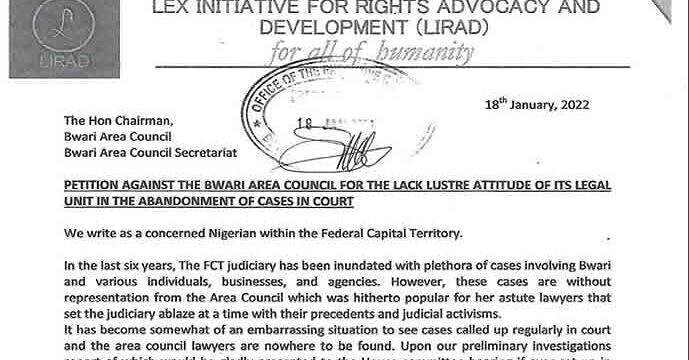
For lack of diligent prosecution and clogging the dockets of courts in the Federal Capital Territory (FCT), a civil society organization Lex Initiative For Rights Advocacy And Development (LIRAD), has petitioned the Bwari Area Council Chairman, demanding a record of all funds paid to its external solicitors.
LIRAD in the petition signed by its Executive Director which was copied the FCT Minister, Area Service Commission, House Committee on Area Council and Ancillary Matters, and House Committee on Public Petition, accused the Bwari Area Council Chairman of abandoning the cases filed against the Area Council in the past six years.
The petition titled: “Petition Against the Bwari Area Council for the Lack Lustre Attitude of its Legal Unit in the Abandonment of Cases in Court” reads:
“We write as a concerned Nigerian within the Federal Capital Territory.
“In the last six years, The FCT judiciary has been inundated with a plethora of cases involving Bwari and various individuals, businesses, and agencies. However, these cases are without representation from the Area Council which was hitherto popular for her astute lawyers that set the judiciary ablaze at a time with their precedents and judicial activisms.
“It has become somewhat of an embarrassing situation to see cases called up regularly in court and the area council lawyers are nowhere to be found. Upon our preliminary investigations report of which would be gladly presented to the House committee hearing if ever set up in partnership with the British Council and the American Embassy for transparency purposes, it was discovered that rather than pay legal officers the meagre allowances for cases being handled, an external solicitor was briefed and paid in millions for years yet no reasonable case was concluded by the said external solicitor. This negates the Principles of prudence and the values of His Excellency President Mohammed Buhari in his bid to stomp out corruption.
“While we further research the alleged manipulation by political office holders within the Area Council in thwarting rules of service whereby junior officers head positions over their seniors to enable kickbacks and unprofessional dealings, the questions begging for answers at the moment are:
1. What is the essence of legal officers if cases will be outsourced to external solicitors?
2. Why pay external solicitors in millions when the excuse for not paying staff was paucity of funds?
3. What is the competence of the legal officers of the council as against the external solicitors?
4. Is the allure of the external solicitor a result of graft and kickbacks to the council management?
5. What is the means of evaluating the competence of the legal officers of the council by way of Bar practice fees, NBA collaboration like AGC, and other trainings for legal officers Mandatory continuing legal education?
Many questions come to mind but the question of paucity of funds, yet some members of the council seem to move funds while the majority are left in squalor.
It is on this note that we demand and request for a record of:
1. All cases handled and concluded by each legal officer since 2015.
2. Records of all funds/allowances paid for those cases.
3. Record of all concluded cases by the external solicitors.
4. Record of all funds paid to the external solicitors.
5. Record of all pending cases involving the Council.
6. Record of all out of court settlements done by the council.
7. Record of all legal opinions by the legal officers of the council on such out of court settlements
We anticipate your immediate cooperation within the next two weeks.
Our site uses cookies. By clicking “Accept All Cookies”, you direct Law and Society Magazine to store cookies on your device and disclose information in accordance with our Cookie Statement: cookie policyACCEPTREJECT
Privacy & Cookies Policy
Privacy Overview
This website uses cookies to improve your experience while you navigate through the website. Out of these cookies, the cookies that are categorized as necessary are stored on your browser as they are essential for the working of basic functionalities of the website. We also use third-party cookies that help us analyze and understand how you use this website. These cookies will be stored in your browser only with your consent. You also have the option to opt-out of these cookies. But opting out of some of these cookies may have an effect on your browsing experience.
Necessary cookies are absolutely essential for the website to function properly. This category only includes cookies that ensures basic functionalities and security features of the website. These cookies do not store any personal information.
Any cookies that may not be particularly necessary for the website to function and is used specifically to collect user personal data via analytics, ads, other embedded contents are termed as non-necessary cookies. It is mandatory to procure user consent prior to running these cookies on your website.