There is difference between betrayal and freedom of association or right to change political opinion. Section 40 of CFRN 1999 permit you to change your political opinion or party at anytime. It’s not betrayal. It is a legal right.
Gifting a political fan job or money in return for political loyalty to vote or continue to vote a particular politician is a criminal offence punishable under section 124 of Electoral Act with at least 12 months imprisonment. When a politician brags of gifting money or job for loyalty, he is simply confessing to his crimes.
My wife occasionally jokes that my stressful, high-strung lifestyle could mean I’ll die before her. I’ve hardly paid any attention, until recently. Three weeks ago, we both visited a friend who lost his father on New Year’s Day. The deceased was over 90.
We went in company with my friend and neighbour who also came along with his wife. We met two other friends at the home of the bereaved family. Before we departed, the five men – including our bereaved friend – took pictures. I didn’t make anything of it until the next day when I got a call from one of those in the pictures, a jolly good fellow who holds a top job in one of Nigeria’s leading telecom companies.
“Of all five of us in that picture,” he asked, “how many still have their fathers alive?”
The question struck me oddly. I fetched my phone, looked at the picture again and noticed that the fathers of four of us in that picture had died. Only one had lost his mother. Our mean age was probably 55, yet four of us were fatherless. While the mothers – including the mother of my bereaved friend – are still alive and yes, well.
My telco friend then launched into a very long homily on why he has personally championed a campaign for men to live it up, instead of enduring a life (as many do), of perpetually paying bills – bills for wife, bills for children, bills for family, bills for relations – and dying bereft and miserable, while life goes on.
This is the sort of thing my wife often said could happen to me if I didn’t do anything about overworking and under-caring for myself. However frequently she may have warned in the past, hearing it afresh from a man like me with sincere, evangelical zeal, made me stop and think.
He didn’t stop there. He also shared the story of a potentially suicidal friend of his who snapped back to his senses after they both visited a nearby bar where he conducted a random census which showed that 18 of the 20 men at the bar had lost their fathers. On the other hand, the mothers of most of the folks were still alive, a piece of information that struck his suicidal friend. Suddenly, he said, his friend didn’t want to become the next dead father. He ordered a bottle of cold beer.
All of this may sound rather anecdotal, but since my friend had obviously invested considerable interest in this matter, I was curious to find out from him why he thought men – or fathers – often die first.
He was blunt, going back to his own father’s experience. He recalled how the load of raising 10 children crushed his father in an era when male pride and ego made it a taboo for a man to share his burden. It was bad enough that his father had many children, it would have been a mortal blow to his ego to moan about it or outsource his responsibilities to anyone of his fairly successful children. He carried his own cross because “tough men don’t cry” – or ask for help.
His father took his medicine like a man, worked himself to hell and back to look after his family in spite of his misery. He died just when his children were turning out well. His father’s life was a parable he would never forget. Not only had he decided that he would work hard, play hard, possibly outlive his own spouse and die happy, he had also decided that he would become a malevangelist, promoting the gospel of male spousal longevity!
After our conversation, I decided to go beyond the anecdotal to explore why husbands often die first. What I found surprised me: it’s not only a matter of anecdotes; it is supported by statistics.
In an article in the Harvard Health Blog of June 22, 2020 entitled, “Why men often die earlier than women,” a medical doctor, Robert H. Shmerling, addressed the concern of his wife who wondered why he often assumed he would die first.
“I answered, as matter-of-factly as I could,” he said, “with one word: statistics. I knew that on average, women live longer than men. In fact, 57 percent of all those aged 65 and above are female. By age 85, 67 percent are women. The average lifespan is about five years longer for women than men in the US, and about seven years longer worldwide.”
The reasons, according to Shmerling, are the tendency by men to take bigger risks (which could be a factor of “biological destiny”); a higher percentage holding more dangerous jobs, not to mention life-threatening habits such as smoking, drinking and reckless driving; greater predisposition to death by heart disease at a younger age (men are 50 percent more likely than women to die of heart disease); and even the theory of natural selection at early chromosomal stages.
Other reasons, according to the article, range from prevalent poor social connection among men (as illustrated in the story of my friend’s father) to a higher suicidal tendency and a plain, almost suicidal reluctance to see the doctor even for routine medical checks.
Data on spousal life expectancy in Africa is scarce. Perhaps one reason for the longevity gap is the tendency, largely for cultural reasons, for African men to marry much younger spouses, sometimes with age differences of up to 10 years or more. The closest data on spousal life expectancy in Africa was a global report by the World Health Organisation (WHO) in 2019 which said men are more likely to die before women because of unequal access to health services. The report, which was disaggregated by sex for the first time, said women outlived men everywhere in the world, particularly in wealthy countries.
Again, reluctance by men in developing countries to seek or access medical advice, for certain health conditions as a result of cultural reasons, ego, irrational fear, concerns about their estate, the relatively high cost of medical care even when the will is present, or a combination of these factors, continue to leave most men, married or not, as endangered species.
Even though anecdotal evidence tends to support higher female spousal life expectancy in Africa, some factors are reloading the dice. For example, relatively high maternal death rates, especially in rural areas, is a strong factor. Rising poverty and deadly conflicts have also increased the number of women who are primary providers for their families. Also, better education, which now places more female professionals in dangerous frontline jobs, may alter the spousal longevity landscape in the years to come.
There is, however, a culturally peculiar factor, which my telco friend suggested could also be responsible for some women in a number of African societies living longer: the concept of omugwo. It’s a form of social bonding loop in which an increasing number of mothers (hardly ever fathers) with wealthier children abroad travel the world either to babysit their grandchildren or just to recharge their batteries.
Yet, spousal longevity need not be an exclusive experience or something enjoyed at the expense of the other half. According to Schmerling, some of the factors are modifiable, while reducing the longevity gap for men, for example, can also help reduce the average spousal mortality rate among large numbers. Men can join the omugwo train and spouses can take health checks more seriously, be mindful of family health history, and cut individual risk factors.
In a recent study in the UK, actuaries found that even where knowledge is present, inequalities could also significantly hinder life expectancy. If communities work to reduce inequality among sexes, that could potentially improve spousal longevity and ensure that everyone wins.
We can live longer, happier lives but until then, we may have to accept that not just anecdotes, but statistics favour the wives: men often die first.
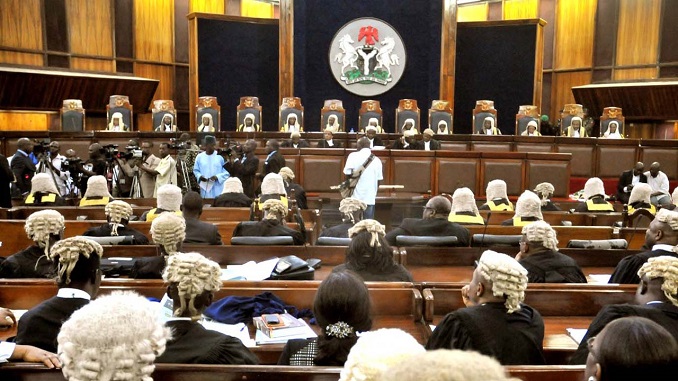
So, the Supreme Court can reconsider an earlier decision in the face of a compelling evidence? That was the question that concentrated many minds on Friday when the news broke that Nigeria’s apex court had reversed its earlier dismissal of an appeal by GTBank against a N2.4 billion judgment given in favour of Innoson Motors Nigeria Limited by the Court of Appeal in Ibadan, Oyo State.
Eyebrows were raised for a good reason. On January 14, 2020, a seven-member panel of the Supreme Court led by Chief Justice Tanko Muhammad unanimously annulled the election of Governor Emeka Ihedioha in the March 9, 2019 governorship election and handed Hope Uzodimma victory on a platter of controversy.Advertisement
It was a judgment that confounded the entire nation. Uzodimma, candidate of the All Progressives Congress (APC), polled a paltry 96,458 votes in an election 70 candidates representing various political parties took part, to come a distant fourth.
Ihedioha polled 273,404 in the same election and was dutifully declared winner by the Independent National Electoral Commission (INEC).
Two years after, many are still scratching their heads, trying to come to terms with that verdict of shame.
Nigerians know that their Lordships are humans, after all, and, therefore, fallible. That being the case, it was agreed that if their error was pointed out to them, they would retrace their steps and mitigate what had already become an open sore on the country’s jurisprudence.
So, going back to seek a reversal of the befuddling judgement was an attempt to save the Supreme Court from ridicule.
And who else was hired to do the job other than the respected Chief Kanu Agabi, a Senior Advocate of Nigeria (SAN), former Senator, Attorney General and Minister of Justice.
Agabi’s appeal was straightforward: The Supreme Court erred on many fronts by allowing Uzodimma to wheedle the unwary Justices with his self-tabulated results from 388 polling units.
Agabi insisted that based on the spurious results disingenuously produced by Uzodimma and curiously accepted by the Supreme Court, the number of voters in the Imo governorship election outnumbered the accredited voters, a situation that would ordinarily invalidate an election. Based on that, he contended that the court was misled into giving the judgment and insisted that it was better to correct the error by reviewing the judgment than retaining it for the future.
The Justices knew they were cornered. The whole world was watching and waiting and with no other avenue for further gaming the system, they resorted to judicial abracadabra. It was an open sesame, a hocus-pocus of the worst hue.
On March 4, 2020, seven Justices of the apex court, again led by CJN Muhammad, threw out Ihedioha’s plea. But unlike the January 14, 2020 ruling which was unanimous, the verdict was split. The CJN led five other members of the panel – Justices Olukayode Ariwoola, Sylvester Ngwuta, Kudirat Kekere-Ekun, Amina Augie and Uwani Abba-Aji – to dismiss the application on the weird ground that the court’s decision was final. It was too cheap a gimmick.
The judgement read by Ariwoola carefully avoided the issues raised by Chief Agabi and became hyperbolic in its interpretation of the powers of the apex court. It was an archetypal voilà moment.
He held that the Supreme Court lacked the jurisdiction to review its judgment once it is delivered.
“Generally, by the provision of the Rules of this court, it shall not review any judgment once delivered by it save to correct any clerical mistake or some errors arising from any accidental slip of omission, or to vary the judgment or order so as to give effect to its meaning or intention,” Justice Ariwoola bawled.
“A judgment or order shall not be varied when it correctly represents what the court decided nor shall the operative and supportive part of it be varied and a different form substituted,’ he further said, quoting Order 8 Rule 16 of the Supreme Court Rules.
“It is settled law that this court has no power to change or alter its own judgment or sit as an Appeal Court over its own judgment.
“It is clear from the tone and the wording of the instant application that what is being sought is asking the court to sit over its own judgment already delivered and executed. That is certainly beyond the competence of this court.
“It is not disputable that the jurisdiction of the court is derived from the Constitution and an Act of the National Assembly. There is no constitutional provision for the review of the judgement of the Supreme Court by itself. And, therefore, once it delivers its final judgment, the Supreme Court, subject, of course, to the slip rule principle, it becomes functus officio in respect thereof,” Ariwoola further said.
Justice Centus Nweze, who was not a member of the panel that delivered the January 14 verdict, sharply disagreed in his minority judgement.
“In my intimate reading of the January 14 judgement, the meat and substance of Ihedioha’s matter were lost to time frame. This court once set aside its own earlier judgment and, therefore, cannot use the time frame to extinguish the right of any person.
“This court has powers to overrule itself and can revisit any decision not in accordance with justice,” Nweze said, peeved, rightly, that Uzodimma mischievously misled the court into unjust conclusion with phantom votes he credited to himself.
When his colleagues paid no heed to his admonition, he warned: “The decision of the Supreme Court in the instant matter will continue to haunt our electoral jurisprudence for a long time to come.”
He was prophetic.
A clearly distressed Chief Agabi, who could not believe what he was hearing, simply lowered his head into his hands in distress. Lawyers walked out of the courtroom dazed as Uzodimma’s governorship became a fait accompli.
But the good thing about a lie is that, unlike truth, it is too weak to stand for long. Every lie has an expiry date and two years down the road, this lie has expired.
And guess what! It is poetic justice that the Supreme Court itself declared the obituary and the chief priest who officiated the requiem is the self-same Justice Ariwoola.
In the judgment earlier referenced, a five-man panel, led by Ariwoola, admitted that the Supreme Court can reverse itself and “confessed” that it erred when, in a ruling on February 27, 2019, it dismissed the appeal marked SC/694/2014 filed by GTBank.
In the lead judgment, written by Justice Tijani Abubakar but read by Justice Abdu Aboki, the panel, which also had John Okoro, and Helen Ogunwumiju as members, held that it was misled by its Registry, which failed to promptly bring to the notice of the panel that sat on the case on February 27, 2019 that GTBank had already filed its appellant’s brief of argument.
Relying on the almighty Order 8 Rule 16 of the Supreme Court’s Rules, Justice Abubakar held that the apex court has the power to set aside its own decision in certain circumstances, like any other court.
He said such circumstances include where any of the parties obtained judgment by fraud or deceit, where such a decision is a nullity or where it is obvious that the court was misled into giving a decision.
Of course, Hope Uzodimma’s case fulfils all these conditions. He obtained the judgement fraudulently and deceitfully by misleading the court into giving an egregious verdict.
In the instant case, the Supreme Court blamed its Registry for the “error.”
“It will be unjust to visit the sin of the court’s Registry on an innocent, vigilant, proactive and diligent litigant. The order dismissing the appeal was, therefore, made in error. It ought not to have been made, if all materials were disclosed. The application is, therefore, meritorious and hereby succeeds,” the court ruled.
Not many people believe the Supreme Court on this matter and that is a dangerous phenomenon. if citizens of a country can no longer trust their apex court to deliver justice, then all is lost.
Just like the reason the Supreme Court gave in not reversing the verdict in the Ihedioha case was damn too cheap, the reason it gave for reversing its earlier decision this time around does not add up.
How come it took the apex court more than three years to realise that its Registry played hanky-panky? How come no one was sanctioned for the dubious conduct assuming it was true?
Beyond that, what this instant case has proved is that the Supreme Court can set aside its own judgement. Therefore, it lied when it claimed that it had no powers to do so on March 4, 2020.
Why did the country’s apex court wittingly subject Ndi-Imo to indescribable humiliation and unending misery by foisting an illegitimate government on them and refusing to redress the injustice when given the opportunity?
One thing is certain. Just as we now know that it is not a taboo for the Supreme Court to reverse its decision if need be, one day, Nigerians will know the true story of what happened on January 14 and March 4, 2020. It is just a matter of time.
One Nura Aliyu (the Appellant) was arraigned in Court for stabbing one Jamilu Yahaya with a knife on the head and stomach. The man died.
The Appellant confessed to the crime. His confessional statements were admitted in evidence without objections.
When the statement was read to the Appellant in open Court, the Appellant retorted, by way of correction, that he actually used his shovel and not a knife on the victim. A medical report also admitted in evidence explained that a sharp object must have been used to inflict the injury on the deceased victim.
The Appellant was convicted and sentenced. His appeal to the Court of Appeal failed. At the Supreme Court, his Counsel tried some legal acrobatic display in the name of advocacy. The Counsel argued, to the astonishment of the Supreme Court, that the Appellant’s statement that he used a shovel instead of a knife to strike the victim amounted to a retraction of the confessional statement and that the trial Court and the Court of Appeal were in error in convicting the Appellant based on the confessional statement.
Eko, JSC was livid. His Lordship, at page 215, criticised the Appellant’s Counsel for attempting to confuse issues. Hear him:
The lingua franca of the two courts below is English Language. Page 32 of the records is the proceeding of the trial Court written in simple laconic English that would not take a final year pupil of a primary school preparing for his Common Entrance to comprehend. Here is a lawyer, before us at the Supreme Court appearing not to understand very simple English Language. And it is not to his credit to insist that he has come before us merely to confuse issues and thus pander to the beer parlour gossip or glib that the lawyer is he who turns black into white and vice versa. This common man’s impression of the lawyer, though false, should of course be scandalous of us all lawyers!! The Appellant’s lawyer is, like every lawyer, an officer of the Court enjoined not to do any act or conduct himself in any manner that will adversely affect the administration of justice. A deliberately mischievous distortion of facts, no doubt, is a conduct unbecoming which is not only capable of adversely affecting the administration of justice, but does actually affect the administration of justice. Every lawyer appearing in his professional capacity before a court shall deal with the court mostly candidly and fairly. Rules 30 and 32 of the Rules of Professional Conduct for Legal Practitioners, 2007 should, and indeed, offer very basic precept to every lawyer called to the Nigerian Bar and enrolled in the Supreme Court after Law School. It is not palatable to call an officer of this Court a liar, as I am tempted to call the Appellant’s Counsel.
It is well.
The argument of the Appellant’s Counsel boggles the mind, really. The Appellant confessed to the crime. His only correction was that he used a shovel and not a knife on the victim. This means that either way, whether with shovel or knife, he stabbed the deceased victim with a sharp object, causing his death. There is no way this corrective intervention would amount to a retraction of the confessional statement. According to the Court, “retraction” means “to say that something you said earlier is not true or correct or that you did not mean it.” In effect, the Appellant’s Counsel was trying to convince the Court that the correction supplied by the Appellant meant his entire confessional statement was not true or correct.
The spirit of win-a-case-at-all-cost may be to blame. According to Jauro, JSC (at page 230), “Being desperate to win a case at all cost is a preposterous act that should not be exhibited by a Counsel in the temple of justice.”
The Appellant’s Counsel got what he bargained for on 23 April 2021 (when the Judgment was delivered by the Supreme Court), a day he will live to remember.
This article was originally published on 18 January 2022 by https://stephenlegal.ng/supreme-court-berates-a-lawyer-who-tried-some-legal-acrobatics-but-collapsed/
AUTHOR:STEPHEN AZUBUIKE is a lawyer with expertise in Commercial Dispute Resolution and Technology Law practice. He is a Partner at Infusion Lawyers. He has successfully argued cases from the High Courts of various jurisdictions to the Appellate Courts on behalf of financial institutions, other corporate bodies, and multinationals. He has worked with a number of startup tech companies. He tweets @siazubuike.
The Registered Trustees of Apostolic Church of Christ v. The Registered Trustees of Grace Church of Christ [2021] 16 NWLR (Pt. 1801) 105
The Story
A pastor known as Pastor Igbeare was a pastor of the Apostolic Church of Christ and rose to the position of Vice President. The Apostolic Church of Christ was registered in 1963 as the Registered Trustees of Apostolic Church of Christ. (The Appellant). It had several branches, which included the Mushin branch, headed by Pastor Igbeare.
Sometime in 1976, while Pastor Igbeare was still a pastor in the employment of the Apostolic Church of Christ, Mushin branch, he purchased a parcel of land at Ejigbo Town, near Mushin, Lagos, from the Agbeke Family for the Apostolic Church of Christ, Mushin branch. The purchase receipt was in Pastor Igbeare’s custody.
In 1996, the Mushin branch led by Pastor Igbeare broke out from the Apostolic Church of Christ to form a church registered as the Registered Trustees of Grace Church of Christ. (“The Respondent).
After purchasing the land, the Respondent (Grace Church of Christ) applied for Land Information in respect of the land which revealed that the land had been acquired by the Lagos State Government as far back as 1972 vide Official Gazette No. 60 of 7/12/72, Volume 59.
Realising this, the Respondent applied in its own name (Grace Church of Christ) for ratification. The ratification was approved, necessary fees paid and Certificate of Occupancy issued to the Respondent in 1997.
Trouble started
The Appellant sought to organise a revival service scheduled to take place on the disputed land. The Respondent would have none of it. The Respondent claimed that it wrote letters to the Appellant to stay away from the land and move elsewhere for the programme but to no avail.
The Respondent approached the court seeking a declaration that it was entitled to a right of occupancy over the land, perpetual injunction, and damages against the Appellant.
The Respondent contended that each branch of the Appellant generated its own funds and that the branches were coordinate with and not subordinate to the headquarters.
The Appellant (Apostolic Church of Christ) was of the position that the land belongs to the Appellant since all its branches, including the Mushin branch, were under the control and authority of the parent body (the Appellant).
The Appellant contended that Pastor Igbeare was trained by the Church and posted to the Mushin branch where he served with another pastor and that their salaries were paid by the parent body. The Appellant argued that the land in dispute was purchased with funds belonging to the Appellant.
The Appellant stated that after it discovered that the land had been acquired by Lagos State Government, it made efforts to seek a release of the land from Government acquisition but that Pastor Igbeare got wind of the moves and surreptitiously pursued the release of the land on his own for the benefit of the Respondent without the knowledge of the Appellant. Pastor Igbeare was said to have taken advantage of the fact that the purchase receipt was in his possession to get the ratification done in favour of the Respondent.
The trial court held that the land belongs to the Appellant and that the Respondent had no right to apply for ratification.
The Respondent’s appeal to the Court of Appeal succeeded. The Court of Appeal held that the Agbeke Family, having been divested of its title to the land by Government acquisition, had nothing to convey to the Appellant. Therefore, the Court of Appeal upheld the allocation by the Lagos State Government to the Respondent on the basis that upon government acquisition of the land, it was for a public purpose to allocate the land to the Respondent for a place of worship.
The problem with the position of the Court of Appeal was that, significantly, both parties claimed to have purchased the land from the Agbeke Family in 1976 at a time when the Lagos State Government had already acquired the land since 1972. The Respondent’s actual claim to the land was based on the earlier purchase by Pastor Igbeare and a subsequent ratification done in the name of the Respondent. Thus, the Respondent’s claim wasn’t squarely resting on the said Government allocation simpliciter but also on the earlier purchase from Agbeke Family. More so, there was no evidence directly linking the Respondent to Agbeke Family since the Respondent was not in existence in 1976 when the transaction was done.
It is compelling to note that the land was purchased in 1976 while Pastor Igbeare registered the Respondent in 1996, 20 years after. More so, Pastor Igbeare was clearly in the employment of the Appellant when the land was purchased in 1976 and he had admitted that the land was purchased for the Mushin branch of the Appellant.
The Supreme Court was moved along these lines when it upturned the decision of the Court of Appeal. Kekere-Ekun, JSC held at page 138:
Having discovered that there was a defect in the title obtained from the vendors [Agbeke Family], the Appellant [Apostolic Church of Christ] was the party entitled to apply to the Lagos State Government for ratification of same and for the grant of a statutory right of occupation in respect thereof.
The Supreme Court criticised the Court of Appeal for holding that it was for a public purpose to allocate the land under Government acquisition to the Respondent for a place of worship. The apex Court clarified that the evidence on record showed that the allocation to the Respondent was for a residential purpose. In any case, it would be wrong and unconstitutional for the Government to acquire land compulsorily for overriding public purpose or interest and then allocate the same land for religious purpose or a place of worship.
The Supreme Court concluded that the Certificate of Occupancy was obtained by the Respondent on the basis of fraudulent misrepresentation and could not confer a valid title on the Respondent.
AUTHOR:STEPHEN AZUBUIKE is a lawyer with expertise in Commercial Dispute Resolution and Technology Law practice. He is a Partner at Infusion Lawyers. He has successfully argued cases from the High Courts of various jurisdictions to the Appellate Courts on behalf of financial institutions, other corporate bodies, and multinationals. He has worked with a number of startup tech companies. He tweets @siazubuike.
Underlining inside your text can be useful for emphasis when you write longhand.
It was useful when your ancestors typed on a typewriter. “Underlining is an unsightly relic from the typewriter era, when italics weren’t usually available.” Bryan A. Garner, ‘Ban Underlining in your legal documents,’ LawProse Lesson 271, lawprose.org (accessed 17 Jan. 2020).
With a typewriter, our ancestors used underlining to simulate italics. Italics are “the print equivalent of underlining.” Lynne Truss, Eats, Shoots & Leaves: The Zero Tolerance Approach to Punctuation, Gotham Books, 2004, 146.
Now you can italicize to your heart’s content on your computer, device, or tablet. Now, you emphasize, when you must, with italics and (rarely) with boldface.
Avoid using underlining for emphasis, for instance to highlight your prayer or relief in an application or other court document, or to set out the questions for determination in a brief, or to set out a corporate resolution. Underlined text is not as easy to read as free text.
Underlining can obscure, if not obliterate, the descenders of these lowercase letters: f, g, j, p, q, and y. Underlining also obscures commas and semicolons. Underlined text is unkind to the human eye. “Underlining is ugly, both on-screen and in printouts.” Garner, The Redbook, 4th ed., 85.
For headings, prefer boldface to underlining. Use boldface for your letters’ subject lines. Don’t combine boldface and underlining in your headings or anywhere else: that’s the stylistic equivalent of wearing a belt and suspenders.
Here’s another reason you shouldn’t underline: your work may end up on the Internet. On webpages, underlining signifies a hyperlink. Your underlined text will create confusion unless the word or phrase you underline is actually a hyperlink. Readers who click on your presumed hyperlinks will be frustrated.
When people lose their temper, one of the most common expressions used to describe their reaction is ‘ flying off the handle ’.
The phrase refers to the head of a hammer coming loose from the handle as you attempt to use it. And several not-so-good things happen as a consequence.
(1)
The hammer becomes useless.
Your message may be all-important, but the manner in which you deliver it determines whether or not you get the results you desire. Simply stated, when people don’t take you seriously, you don’t get the outcome you hoped for.
(2)
The hammerheaddoes damage.
By flying out of control, it’s likely to damage anything in its path. Words spoken in anger cause wounds, and sometimes those wounds can last a lifetime. James writes: ‘Remember this, my dear friends! Everyone must be quick to listen, but slow to speak and slow to become angry. Human anger does not achieve God’s righteous purpose .’
( James 1:19–20 GNT )
(3)
Repairing both the hammer and the damage may take a long time.
In some cases, it simply can’t be done. Here are some Scriptures to keep in mind before you vent your anger.
Again, ‘ A quick-tempered person does foolish things.’
( Proverbs 14:17 NIV )
‘ Refrain from anger and turn from wrath; do not fret—it leads only to evil .’
( Psalm 37:8 NIV )
‘ A person’s wisdom yields patience; it is to one’s glory to overlook an offence.’
( Proverbs 19:11 NIV )
‘ Do not be quickly provoked in your spirit, for anger resides in the lap of fools .’
( Ecclesiastes 7:9 NIV )
So the word for today is —‘ Don’t fly off the handle.’
The Nigerian security forces, presently structured along Northern Muslim lines and deployed in Eastern Nigeria had in fourteen months or between late October 2020 and December, 2021 killed about 1,400 defenseless citizens of Eastern Nigeria origin.
All the victims are members of Judeo-Christian Faith and mostly ethnic Igbo citizens. Their killings represent monthly average of 85 deaths and daily average of three and could be monthly average of 155 and daily average of 5.5 deaths if the presumed dead 1000 missing citizens are added.
The security forces also abducted and disappeared till date in the same past 14 months at least 1000 unarmed civilians; arrested alive and unarmed and taken into security custodies outside the knowledge of their families or lawyers, from where they have gone missing till date.
Soldiers of the Nigerian Army are found to be responsible for at least 70% of their abduction and disappearances while DSS, NPF, Nigerian Navy and Nigerian Air Force are separately and jointly responsible for the remaining 30%.
In the area of ‘perpetrator ratio’, soldiers of the Nigerian Army and various ‘special squads’ of the Nigeria Police Force are the lead-killers or perpetrators.
The trio of Governors Hope Uzodimma of Imo state, Nyesom Wike of Rivers state and Dave Umahi of Ebonyi state are the most vicariously culpable Governors that aided and abetted the killings and property destruction including burning of civilian homes and sanctuaries.
On the other hand, the widely believed Nigerian state protected Jihadists especially the Jihadist Fulani Herdsmen are responsible for hacking to death in 2021 alone of at least 270 Igbo Christians.
Their death had majorly occurred in Ebonyi, Enugu, Anambra, Imo, Abia and Igbo parts of Delta, Edo (Obiaruku and Igbo-Akiri), Benue and Kogi States.
The killings by Jihadist Fulani Herdsmen have brought the total number of defenseless citizens traceably killed in Eastern Nigeria in the past 14 months to at least 1,400. This is when added to 1,150 defenseless civilian deaths perpetrated by security forces.
The Death Toll Could Be 2,400 If 1000 Missing/Presumed Dead Citizens Are Added
It is, therefore; likely correct to say that in all, not less than 2,400 unarmed civilians lost their lives to Nigerian security forces and the Jihadists in Eastern Nigeria in the past 14 months-covering October 2020 to December 2021.
This is on account of the fact that the not less than 1000 missing persons are likely to have been killed in custodies and most unlikely to be returned alive to their families again.
This is more so when strong evidence abounds showing no traces of location and securing the release of citizens abducted by soldiers of the Nigerian Army in Eastern Nigeria since January 2021.
They also hardly handover or transfer those arrested or abducted to the Police. From our investigation, most, if not all those abducted by them since January 2021 have never been located by families or seen alive till date.
Same was the case during and after the Army’s war grade attack on Obigbo in late October-early November 2020. It is shocking that while dozens died in different secret military custodies within and outside Eastern Nigeria, not less than 550 of the abductees were later independently located, out of the number, 418 were freed through courts and 95-100 others were discovered in late November 2021 to have been dumped in Kaduna Prisons and Lock Centers.
“Over 40 of the abductees were also found to have been killed in custody through torture and infliction of injuries as well as starvation and lack of medical treatment.
Estimated number of 200 Obigbo abductees is still unaccounted for and their whereabouts are unknown till date. Intersociety has continued to receive enquiry messages from dozens of families of those searching for their loved ones.
The Nigerian Army is further acting roguishly by holding their abductees for over a year through intra and inter-agency detention transfers-whereby the abductees are secretly held without trial in several military and security agencies’ detention facilities leading to scores of custodial deaths.
4,800 arrested, 2000 still held, 700 freed, others killed or disappeared
Analytically, estimated 4,800 unarmed citizens of Eastern Nigeria have been arrested or abducted by security forces in the past 14 months (since late October 2020), out of the number, 660 were traceably killed in security custodies, about 500 were killed in open shootings mainly carried out by soldiers of the Nigerian Army and personnel of other branches of the Armed Forces-with a clear case in point being dumping of over 100 dead victims of Army’s open shooting of civilians at the Owerri Federal Medical Center.
Not less than 1,000 mainly abducted civilians have disappeared or presumed dead mainly in military custodies, and no fewer than 2000 unarmed civilians are still detained without trial and only 700 of the arrested 4800 citizens have regained their freedom in the past 14 months.
The freed 700 citizens had included 418 Obigbo abductees and some 300 other civilian citizens arrested by security forces in the East since January 2021.
Most of them got freed after being forced to offer average of N1m per freed detainee. This was majorly the case in the hands of the Nigeria Police Force especially its “IRT”, “STS”, “CTU”, ”Anti Kidnapping”, “SWAT/SARS” and “the Special Forces” comprising the operatives of the Army, Police, DSS, Navy, Air Force, NSCDC, etc.
Other Summarized Findings
This Special Investigative Report also found that not less than 400 leaders/members of the African Instituted Churches, derogatorily called “White Garment Churches” including Sabbath sects and their likes have been abducted or killed in security custodies.
Through religious profiling and persecution and fueled by false labeling and without concrete and indictable pieces of evidence, the Nigerian security forces have designated them as ‘terrorist religious group’ and hatefully accused them of membership and sponsorship of “ESN/IPOB”.
Many, if not most of their sacred sanctuaries and symbols of worship and dwelling houses have also been burnt down or destroyed by security forces. Traditional herbalists across Eastern Nigeria have also become endangered species in the hands of security forces.
From the camps of about five designated categories of “Unknown Gunmen” operating in Igbo parts of Eastern Nigeria, not less than 100 civilian deaths have been recorded in the Region since July 2021 with Imo, Anambra, Enugu and Abia as the worst hit.
From the angle of international law’s recognized “legitimate deaths” or deaths arising from battlefields’ combats between security forces and armed opposition groups (i.e. ESN/’Unknown Gunmen’), a total of 300 security operatives and 100 opposition armed men have lost their lives in the past 14 months.
It was our further investigative discovery that no fewer than 100 Igbo communities have been invaded by security forces in the past 14 months and caused not less than 1000 homes or dwelling houses to be raided and razed during which properties such as the land housing each of the buildings, the building structure, electronics and electrical appliances, chairs and house utensils, food items, economic trees, domestic animals, automobiles and other valuable items were destroyed or burnt to ashes or looted.
From our conservative estimates, each house, its land and properties is worth not less than N35m, translating to N35billion for the estimated 1000 dwelling houses destroyed or burnt down. The remaining N5b arises from other outside-the-house properties destroyed or burnt down including market stores and their wares-totaling N40billion as total properties’ value lost in the hands of the Nigerian security forces particularly soldiers of the Nigerian Army and other branches of the Armed Forces.
Igbo Nation, target of the killings
“The killings by Nigerian security forces had occurred mostly in Igbo-Christian parts of Eastern Nigeria including Imo, Rivers, Abia, Ebonyi, Anambra, Enugu and Akwa Ibom states as well as Delta and Cross River States which recorded the lowest number of deaths.
Further breakdown indicates that the Nigerian security forces were specifically responsible for killing of at least 1000 defenseless citizens in the East in 2021, while Jihadist Fulani Herdsmen killed not less than 270 in the same 2021.
The Nigerian Army had also between October and November 2020 killed not less than 150 defenseless civilians in Obigbo (Oyigbo Local Government Area), and its environs in Rivers state and abducted over 700 civilians; and out of the number, 418 have been independently located and freed.
While no fewer than 110 defenseless citizens were killed in Obigbo and its environs, the remaining 40 deaths occurred in different secret Army custodies where the Obigbo abductees were secretly detained amidst torture and starvation.
Another 100 abducted defenseless citizens were recently (in late November 2021) traced and discovered to have been dumped at Kaduna Prisons and Lock Centers, out of the number, five died. Over 40 of the over 700 abductees were also found to have been killed in various secret Army custodies.
Researched and Compiled By:
Emeka Umeagbalasi. President, International Society for CivilLiberties and Rule of Law. Assisted By: Chinwe Umeche Esquire, Head of Democracy & Good Government Department,
Obianuju JoyIgboeli Esquire, Head, Civil Liberties & Rule of Law Department, Chidimma Eva Udegbunam Esquire, Head of Campaign & Publicity Department, Chinaza Ndidiamaka Bernard Esquire, (ICT Law), Head of Int’l Justice & Human Rights Program, Comrade Samuel Kamanyaoku, Head of Field Data & Documentation, Comrade Chibueze Nwajiaku, Deputy Head, Policing & Law Enforcement Department.
In 2021, the Supreme Court invoked the doctrines of equity to do justice in many appeals before it. For those who are not lawyers, equity is a principle of law which softens the perceived harshness of the common law. One of those cases is PILLARS NIGERIA LIMITED V. WILLIAMS KOJO DESBORDES & ANOR. (2021) LPELR-55200 (SC). In that decision, the Supreme Court did not allow the appeal of an appellant who claimed that the notice to quit served on him was irregular. The Honourable Justice Agim, who delivered the leading judgment, based the reasons for the decision on five main grounds, namely:
Failure of the appellant to appeal against the decision of the Court of Appeal on the validity of the notice to quit.
Appellant is estopped from contending that the notice of breach of covenant was not pleaded as it was tendered and admitted in evidence as Exhibit E without its objection.
Appellant did not appeal against the decision of the Court of Appeal that it is estopped from contending that the notice of breach of covenant was not pleaded as it was tendered and admitted in evidence as Exhibit E without its objection.
Evidence of respondent was more credible than that of the appellant.
Appellants falsified the years for which rent had been paid hence it could not argue that the respondent had waived the right to forfeiture by demanding and collecting rent up to 1995 before the purported notice to quit was allegedly issued.
Based on the leading judgment, the decision of the Supreme Court is sound. It indeed did justice according to law. The reputation of the PILLARS’ Case is however based on the concurring judgment of Honourable Justice Ogunwumiju. A review of the available judgments of this erudite jurist indicates that we have an amazon of equity, who is not afraid of new frontiers, at our apex bench.
First, we need to note that a concurring judgment is not the leading judgment of the court. In OLUFEAGBA V. ABDUR-RAHEEM (2009) LPELR-2613 (SC) at pages 70 to 71, a concurring judgment was held to have equal weight with or as a leading judgment and could be an improvement of the leading judgment when the Justices add to it certain aspects which the writer of the leading judgment did not remember to deal with. In that case, a concurring judgment should not deviate from the leading judgment and should not supplant the leading judgment. Where the concurring judgment deviates and or supplants the leading judgment, it is either an obiter dictum or a dissenting judgment. In OSUN STATE INDEPENDENT ELECTORAL COMMISSION V. ACTION CONGRESS (2010) LPELR-2818 (SC) 83-85, the apex court held that where there is inconsistency between a concurring judgment and a leading judgment, the former would give way to the extent of the inconsistency.
In the concurring judgment, Ogunwumiju, JSC held that the filing and service of writ in commencing an action in court cures any irregularity that attaches to the statutory notices which are requirements of The Rent Control and Recovery of Residential Premises Laws and other Landlord and Tenants Laws. Specifically, the learned Jurist held as follows:
“The justice of this case is very clear. The Appellant has held on to property regarding which it had breached the lease agreement from day one. It had continued to pursue spurious appeal through all hierarchy of Courts to frustrate the judgment of the trial court delivered on 8/2/2000 about twenty years ago. After all, even if the initial notice to quit was irregular, the minute the writ of summons dated 13/5/1993 for possession was served on the appellant, it served as adequate notice. The ruse of faulty notice used by tenants to perpetuate possession in house or property which the landlord had slaved to build and relies on for means of sustenance cannot be sustained in any just society under the adherence to any technical rule. Equity demands that wherever and whenever there is controversy on when or how notice of forfeiture or notice to quit is disputed by the parties, or even where there is irregularity in giving notice to quit, the filing of an action by the landlord to regain possession of the property has to be sufficient notice on the tenant that he is required to yield up possession. I am not saying here that statutory and proper notice to quit should not be given. Whatever form the periodic tenancy is whether weekly, monthly, quarterly, yearly etc immediately a writ is filed to regain possession, the irregularity of the notice, if any, is cured. Time to give notice should start to run from the date the writ is served. If for example, a yearly tenant, six months after the writ is served and so on. All the dance drama around the issue of the irregularity of the notice ends. The Court would only be required to settle other issues, if any, between the parties.”
If this dictum of Ogunwumiju JSC had ended as an obiter dictum or a dissenting judgment, it would have been an expression of the jurisprudential inclination of the learned jurist on property rights. However, the Court of Appeal recently enforced the novel principle in the concurring judgment of Ogunwumiju JSC in the PILLARS’ Case in BANKOLE & ANOR. V. OLADITAN (2022) LPELR-56502 (CA). It therefore shows that courts and practitioners have naturally taken the dictum of Ogunwumiju JSC as a part of the leading judgment.
On its surface, while there is no jurisprudential or historical basis to fault the leading judgment, the concurring judgment of Ogunwumiju, JSC, where a thorough analysis of the jurisprudential basis for it in the light of the historical background for the enactment of the requirements for statutory notices is done, shows that the learned Jurist did not take some far-reaching principles into consideration. We need to note that, originally, the relationship between landlord and tenant is contractual. However, due to socio-political and class interest consideration, that relationship as noted by Prof. I.O. Smith at pages 9 to 10 of his seminal book, LANDLORD AND TENANT LAW IN NIGERIA, “has grown beyond being a private law relationship traditionally rooted in the common law, and is now susceptible to complex statutory regimes, varying socio-economic circumstances, discernible state policies on housing and human right regime…The focus of judicial interpretation on the subject of landlord and tenant therefore cut across the foregoing consideration in light of dynamic socio-economic interaction.” Any decision such as the PILLARS’ Case, which though is a pronouncement on the contractual relationship of the parties, must take into consideration the statutory regimes, socio economic circumstances, state policies and the human rights of both the landlord and the tenant. The statutory regimes include the received common law, doctrines of equity and statutes of general application, the Tenancy Laws, Rent Control Laws and Nigerian case laws.
A look at the reason for the enactment of Rent Control Laws and other landlord and tenant laws reveal that it is essentially to protect the tenant from unreasonable increment in rent and unjust ejection from his tenure. It is for that reason that the landlord cannot resort to self help and must comply strictly with the provisions of the law in ejecting a tenant. In Lagos State where the PILLARS’ Case originated, the applicable law at the time of the dispute was the Rent Control and Recovery of Premises Law (No. 9) 1976 which has been replaced by the 2015 Law. Under that old law, the appellant in the PILLAR’s Case is a contractual tenant. According to the Supreme Court in AFRICAN PETROLEUM LIMITED V. J.K. OWODUNNI (1991) LPELR-213 (SC) at page 21, such a contractual tenant holds an estate which is subject to the terms and conditions of the grant and once the tenancy comes to an end by effluxion of time or otherwise and the tenant holds over without the will or agreement of the landlord, he becomes a tenant at sufferance or a statutory tenant where there is a statute protecting him. This is because the Rent Control and Recovery of Premises Law has given him security of tenure after his contractual tenancy has expired. In OWODUNNI’S Case, the Supreme Court in the same circumstances held that possession of premises can only be wrestled from him if the court makes an order for possession against him after due notices to quit and intention to apply for possession.
It is conceded that Ogunwumiju, JSC did not state that the statutory notices are not required. At least, the laws must be obeyed. Her qualified dictum is that where the notices are invalid, mere filing of writ in court will cure the defect based on the intervention of equity. This dictum of Ogunwumi JSC, if allowed to stand, has the effect of amending the statutes, leaving tenants at the whims and caprices of landlords, upturning decades of case laws and changing government policy. This revolutionary view by the learned Jurist seems to be in the interest of the few propertied class who hold the approximately seventeen million housing stocks that house over two hundred million Nigerians.
More importantly, the learned jurist misapplied the doctrine of equity. Equity does not have the power to amend statutory laws. It only follows the common law. The common law was applied by Agim, JSC in the leading judgment and there was no injustice when the law was applied. As noted by Karibi-Whyte, JSC in COL. HALILU AKILU V. CHIEF GANI FAWEHINMI (NO. 2) LPELR-339 (SC) 82, equity follows the law and is applied to ameliorate the rigidity and inflexibility of the common law. Similarly, equity does not act in vain and is buttressed on solid facts that would induce the court to act in favour of the applicant where the common law has failed it. That is also not the case in the PILLARS’ Case. Finally, equity does not make law. As noted by the apex court in AMAECHI V. INEC (2006) LPELR-446 (SC) at page 281, equity is to assist the law and it is not a warlord determined to do battle with the law. The purpose of equity is to be part of the legal system for the purpose of achieving justice. Where justice has been done at law, there is therefore no need for the intervention of equity.
Lastly, it is agreed that the Justices of the Supreme Court are humans who have their own ideologies, class inclinations and backgrounds. As judex, their duty is to interpret the laws and not to make laws. In as much as all practitioners have been beneficiaries, in one way or the other, of the equitable liberalism of the apex court, it is not the duty of judges to make laws. As held by ESO, JSC, “it is the function of judges to keep the law alive, in motion and to make it progressive for the purpose of arriving at the end of justice; without being inhibited by technicalities, … short of being a legislator.” What the dictum of Ogunwumiju JSC has done in this instance is to make law, which is the sole prerogative of the legislature.
In conclusion, while the revolutionary and activist inclination of the learned jurist is quite commendable, practitioners and courts need to be wary in applying the dictum of Ogunwumiju JSC since it did not complement the leading judgment. It, in fact, supplants the leading judgment and should be regarded as a strong obiter dictum which is not binding on any court. The application, hook, line and sinker by the Court of Appeal on the ground that the dictum of Ogunwumiju, JSC has changed the law, as stated by Sirajo, JCA in BANKOLE & ANOR. V. OLADITAN, is erroneous. The law is still AP V. OWODUNNI and the provisions of the applicable tenancy laws of the different States. Contrary to the holding of the Court of Appeal that the Supreme Court has now ‘responded to the sad occasion by coming to the rescue of landlords and property owners whose cantankerous and recalcitrant tenants have over the years been clinging on to the issue of improper service of statutory notices’, the dictum of Ogunwumiju, JSC does not represent the judgment of the apex Court. Indeed, statutory notices must still be served and should be served properly. The issuance of writ therefore in law and equity cannot cure that irregularity unless there are amendments to the various laws regulating the relationship between landlords and tenants. This is because there is no rule of equity that permits equity to amend a statute. The dictum of Ogunwumiju, JSC, as revolutionary as it is, is an entrenchment of the interest of the propertied class contrary to the extant provision of our laws. We however commend my Lord’s activism and trust that more judgments borne out of good conscience, but devoid of class interest, come out of the hallowed chambers of the apex court.
Olaniran Obele is a Partner at Tayo Oyetibo LP and heads the Dispute Resolution Practice Group
Recently the Attorney-General of the Federation and Minister of Justice, Abubakar Malami (SAN) invoked the law and declared the bandits operating in Nigeria are terrorists. Because President Buhari has been running a totalitarian Fulani hegemonic regime that provides cover for killer Fulani herdsmen, he and Malami are turning a blind eye to the unspeakable acts of terrorism being committed in Nigeria by the killer Fulani herdsmen in violation of the Terrorism (Prevention) Act 2011, Terrorism (Prevention) (Amendment Act) 2013, Criminal Code Act Cap C38 Laws of the Federation of Nigeria 2004 and the international anti-terrorism instruments. Why shield criminals?. Sad. Last Sunday about five villagers were killed in a fight between the Fulani herders and local farmers in Idofa area of Imeko-Afon Local Council, Ondo State. The farmers accused the herders of destroying their farmlands through open grazing of their cows.
It is noteworthy that much of the international law of terrorism are in the form of multilateral treaties. These multilateral treaties include the International Convention Against the Taking of Hostages, the Convention for the Suppression of Unlawful Acts Against the Safety of Civil Aviation and the Convention on the Prevention and Punishment of Crimes Against Internationally Protected Persons, including Diplomatic Agents. Now, the aforesaid treaties other treaties on terrorism contain several important provisions in combating terrorism. These provisions which include articles that define particular acts of terrorism as criminal offenses for the purposes of the treaties oblige states parties to make the offenses punishable by appropriate penalties under their domestic laws. In Nigeria, the extant domestic laws under which terrorism is defined and punishable are the Terrorism (Prevention) Act 2011, Terrorism (Prevention) (Amendment Act) 2013), the Criminal Code Act Cap C38 Laws of the Federation of Nigeria 2004. Section 1 of the Terrorism (Prevention) Act 2011 states that— “A person who knowingly— (a) does, attempts or threatens to do an act preparatory to or in furtherance of an act of terrorism; (b) commits to do anything that is reasonably necessary to promote an act of terrorism; or (c) assists or facilitates the activities of persons engaged in an act of terrorism,, commits an offence under this Act.
Section 2 of the Act defines “act of terrorism” to mean as act which is deliberately done with malice, aforethought and which : (a) may seriously harm or damage a country or an international organization ; (b) is intended or can reasonably be regarded as having been intended to— i (unduly compel a government or international organization to perform or abstain from performing any act; (ii) seriously intimidate a population ; (iii) seriously destabilize, or destroy the fundamental political, constitutional, economic or social structures of a country or an international organization ; or, (iv) otherwise influence such government or international organization by intimidation or coercion; and (c) involves or causes, as the case may be—, (i) an attack upon a person’s life which may cause serious bodily harm or death: (ii) kidnapping of a person ; . (iii) destruction to a Government or public facility, a transport system, an infrastructure facility, including an information system, a fixed platform located on the continental shelf, a public place or private property, likely to endanger human life or result in major economic loss; (iv) the seizure of an aircraft, ship or other means of public or good transport and diversion or the use of such means of transportation for any of the purposes in paragraph (b ) (iv) of this subsection; (v) the manufacture, possession, acquisition, transport, supply of weapons, explosives or of nuclear, biological or chemical weapons as well as research into, and development of biological and chemical weapons without lawful authority; (vi) the release of dangerous substance or causing of fire, explosions or floods, the effect of which is to endanger human life ; (vii) interference with or disruption of the supply of water, power or any other fundamental natural resource, the effect of which is to endanger human life
Under the watch of the Buhari government the killer Fulani herdsmen have been committing unspeakable acts of terrorism in Nigeria and getting away with them. Apart from killing, maiming, kidnapping and raping their victims to death, the killer herders, in conspiracy with their cohorts from Niger Republic, have been aiding and abetting mutinous acts, threatening to levy war against Nigeria, forcing and compelling President Buhari and the National Assembly to change their measures and policies, destroying, encumbering and confiscating farmlands across Nigeria (resulting in the scarcity of foodstuffs and soaring prices of foodstuffs in Nigeria) in violation of Nigeria’s territorial sovereignty which is contrary to section 2 (a) (b) (i) (ii) (iii) (iv) and c (i), (ii) (iv) (vii) of the Terrorism (Prevention) Act 2011 (as amended). Nnamdi Kanu is being charged under sections 1 and 2 of the Terrorism (Prevention) Act 2011 (as amended) and sections 41, 44, 45 and 375 the Criminal Code Act for alleged acts of terrorism. Just last week they slammed terrorism charges against the Oyo traditional ruler Oba Solomon Akintola and 10 of his High Chiefs for allegedly invading Aagba Community in Oyo State and kidnapping three persons and injuring others. The pertinent question remains: Why is this Buhari government charging Nnamdi Kanu, Oyo Chiefs and others to court for alleged acts of terrorism while exonerating the Fulani herdsmen who have inciting the public in order to destabilize, or destroy the fundamental political, constitutional, economic or social structures of our country?
Explaining why the bandits were declared as terrorists, Malami, said, inter alia, “our assessment took into consideration that they are causing a major threat to territorial peaceful co-existence and causing a major threat to lives with weapons.” Are the murderous Fulani herdsmen not causing a major threat to Nigeria’s territorial peaceful co-existence? If the answer is in the affirmative, why are President Buhari and Malami conspiring to exonerate them from the heinous act of terrorism? Why have the duo acquiesced in the endless massacre of the innocent Nigerian citizens by the AK-47-carrying Fulani pastoralists and Miyetti Allah their sponsors? For example, in the aftermath of the massacre of about 200 villagers in Riyom, Barkin Ladi and Jos South local government areas of Plateau State in June 2018, Miyetti Allah quickly issued a statement accepting responsibility for the massacre. It admitted that it carried out the massacre in retaliation for alleged Fulani herdsmen who had been killed in the area. According to the then Chairman of the North Central zone of Miyetti Allah Danladi Ciroma, “These attacks are retaliatory Fulani herdsmen have lost about 300 cows in the last few weeks — 94 cows were rustled by armed Berom youth in Fan village, another 36 cows were killed by Berom youth. In addition to that, 174 cattle were rustled and the criminals disappeared with them to Mangu [Local Government]…Since these cows were not found, no one should expect peace in the areas”. Why didn’t the most excellent Abubakar Malami SAN and most righteous President Buhari dispatch the DSS to arrest or interrogate Ciroma for uttering the aforesaid inflammable terrorist statement in violation of sections 1 and 2 of the Terrorism (Prevention) Act 2011 (as amended) and sections 41,44, 45 and 375 the Criminal Code Act?.
Anyway, whether Buhari and Malami like it or not, the Global Terrorism Index (GTI) rates the Fulani herdsmen militia as the fourth deadliest terrorist organization in the world. The GTI has ranked Nigeria, for the sixth consecutive time since 2015, as the third country with the most impactful deadliest terrorist organization. The GTI says that in 2018 the killer Fulani herdsmen killed more Nigerians than Boko Haram. So why is the Buhari government refusing to tag the killer Fulani herdsmen as terrorists and treat them as such?
Our site uses cookies. By clicking “Accept All Cookies”, you direct Law and Society Magazine to store cookies on your device and disclose information in accordance with our Cookie Statement: cookie policyACCEPTREJECT
Privacy & Cookies Policy
Privacy Overview
This website uses cookies to improve your experience while you navigate through the website. Out of these cookies, the cookies that are categorized as necessary are stored on your browser as they are essential for the working of basic functionalities of the website. We also use third-party cookies that help us analyze and understand how you use this website. These cookies will be stored in your browser only with your consent. You also have the option to opt-out of these cookies. But opting out of some of these cookies may have an effect on your browsing experience.
Necessary cookies are absolutely essential for the website to function properly. This category only includes cookies that ensures basic functionalities and security features of the website. These cookies do not store any personal information.
Any cookies that may not be particularly necessary for the website to function and is used specifically to collect user personal data via analytics, ads, other embedded contents are termed as non-necessary cookies. It is mandatory to procure user consent prior to running these cookies on your website.