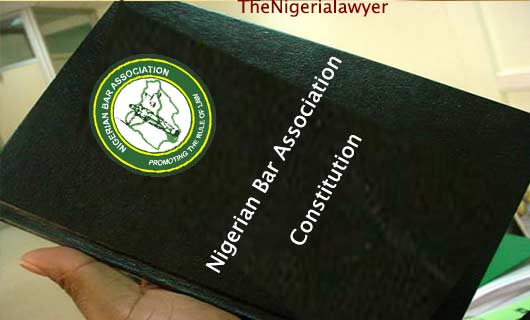
1. To be a member of the NBA, you must be registered as a member where you have office and/or reside provided that any member who resides or practices outside the country may register in any branch of his choice.
2. Branch NEC Representative (NEC Rep) position abrogated.
3. Young lawyers now have representation in NEC- 15 members.
4. Co-opted members in NEC reduced from 180 to 150.
5. The chairmen of young lawyers forum in the branches to now be co-opted members of executive committees of branches.
6. All past vice chairmen to now be statutory members of advisory committees of branches.
7. Decisions of election committee is no longer final, same is now subject to appeal to an appeals committee.
8. Where the chairman of a branch refuses to give a letter of good standing to a member, the national exco may give same.
9. NEC is now known as National Executive Council instead of National Executive Committee.
10. Lawyers in public office can now aspire to national offices except that of the President, 1st Vice President and the General Secretary.
11. Office of Financial Secretary scrapped.
12. National Secretariat Management Committee to be constituted only of General Secretary, National Treasurer and National Welfare Secretary.
13. Diaspora members must register with a branch and exempted from the requirement of residence or practice within a branch.
How long should Nigerian judges and magistrates hide how they spend public money?
According to a recent report by the Independent Corrupt Practices and Other Related Offences (ICPC), the Nigerian judiciary tops the corruption index across the public sector with a N9.4 billion bribe from lawyers. This is the same court system that hides its financial books and expenditure from the people. Incredible!
Some days ago, Prof. Sani Adam, a lawyer and the Deputy Vice-Chancellor, Administration, at the University of Abuja, in a media report said, “I must admit that there is so much corruption in the judiciary and all lawyers must work to revamp the judiciary because if the judiciary is doing what it is supposed to do, there will be timely dispensation of justice without delay.” “All the problems we are having today are because the judiciary has failed, and it has failed woefully. It is our collective responsibility to reform our laws to ensure that cases are dispensed immediately, with all honesty and sincerity. ”
Now we hear from the Attorney General of the Federation and Minister of Justice, Abubakar Malami, apparently overwhelmed by the dishonorable approach to public service and judicial practices, that he is publicly raising concerns about why the judiciary has not been transparent on how it is spending the funds allocated to it in its annual budgets.
Up till now, this issue has not been raised openly by any higher up in the government. As such, the AG deserves our thanks for saying an institution like the Judiciary cannot continue to operate with impunity.
The judges, magistrates, registers, and other court personnel are funded by the legislature, which appropriates funds for the judiciary to carry out its constitutional duties, execute administrative services, and engage in courthouse construction and maintenance. As such, doesn’t the public have the right to know if the judiciary is spending public funds in an impartial, responsible, and cost-efficient way?
In a democracy, it is essential that the chief justice and two or three of his deputies come physically before the legislative committee on appropriation on an annual basis to present the judiciary budget with details of their requests such as staffing, salaries, renovation, maintenance, buildings and grounds, research, education, and development, equipment, technology, accommodation, and other items. They are expected to also comment on other issues relating to law schools, prison legal services, contracting, scholarship, publications, entrainments, insurance, travel, security, and electronic documentation, as well as the budget impacts of workload and caseload.
For generations, the judiciary, meaning the chief judge or his or her deputies, has for the most part not directly appeared before the legislature to give testimony on the detailed usage of the funds they request annually. Yet, they keep requesting as if the people are stupid and therefore should not ask questions because the spenders are lords, judges, and magistrates. Well, see this link for reality education:
No matter how troubled our democracy is, the judiciary must always ensure high ethical standards and transparency when it comes to judicial budgets.
Henceforth, this present government and successive ones should, by way of executive order or law, make the judiciary account for all the money appropriated to them and various fees paid to the courts.
The Nigerian judiciary must begin to move away from pre-historic times by taking advantage of new technologies. It must take a futurist view, which includes maintaining court records electronically, enabling electronic filing of pleadings and orders, and constructing high-tech courtrooms for evidence presentation. To save time and money, the courts should learn to electronically zoom in and out. Court lawyers should learn to use tablets to present evidence in the courtroom, so the judges can see an exhibit on a TV monitor.
We cannot continue with the old way of doing business because of personal convenience and a refusal to engage in new learning. To maintain the public’s trust in the judiciary, and as part of updated judicial practices and mechanisms, there is a need for strong counsel to the laissez-faire attitude of the National Judicial Council (NJC). Yes, we need to spend money on the judiciary, but it must commit to spending public funds in a responsible and cost-efficient way. Court audits by the office of Auditor-General and legislative oversight mechanisms always work together to hold judges and judicial staff responsible for their financial conduct as government officials and for efficient management of public funds. These notations should equally apply to others like the military, customs service, immigration service, the Nigerian Police Force, DSS, prisons, the National Intelligence Agency, and others. Institutional accountability and integrity are crucial if the place called Nigeria is to grow into a democracy.
John Egbeazien Oshodi who was born in Uromi, Edo State in Nigeria, is an American based Police/Prison Scientist and Forensic/Clinical/Legal Psychologist. A government Consultant on matters of forensic-clinical adult/child psychological services in the USA; Chief Educator and Clinician at the Transatlantic Enrichment and Refresher Institute, an Online Lifelong Center for Personal, Professional and Career Development. A former Interim Associate Dean/Assistant Professor at the Broward College, Florida. The Founder of the Dr. John Egbeazien Oshodi Foundation, Center for Psychological Health and Behavioral Change in African settings. In 2011, he introduced the State-of-the-Art Forensic Psychology into Nigeria through N.U.C and the Nasarawa State University where he served in the Department of Psychology as an Associate Professor. A Virtual behavioral Leadership Professor at the ISCOM University, Republic of Benin. Founder of the Proposed Transatlantic Egbeazien Open University (TEU) of Values and Ethics, a digital project of Truth, Ethics, Openness. Author of over forty academic publications/creations, at least 200 public opinion writeups on African issues, and various books. He specializes in psycho-prescriptive writings regarding African institutional and governance issues.
On November 23, 2021, when the Nigerian government announced that it will remove petroleum subsidy in 2022, every Nigerian got a blasting hit of the national panic attack. Since the pronouncement, Nigerians had been losing their sleep, making the country a tinderbox where protests could explode at any moment as the usual reaction to fuel subsidy removal.
As pundits and civil society weighed in, I have been troubling my mind, as a civic advocate and businessman, with imaginations of the imminent socio-economic crisis should the policy take Nigerians by storm without an appealing social contract in place. Finally, I found a must-engaged answer in the 2022 Budget Analysis released by BudgIT on December 10, 2021. It reads:
“There are speculations that subsidy will be removed in 2022 due to deregulation of the sector, however, this is highly doubtful as it is more difficult for any government around the world to remove subsidy programs during an active election campaign year; this is even more true in Nigeria which has a huge trust deficit between the government and citizens. The resultant increase in petrol prices that would accompany subsidy removal could trigger public backlash, an unwanted outcome for incumbent political parties during campaigns.”
Put simply, BudgIT means the government has only bluffed (that was eventually true). But if deregulation of the oil sector is irrefutably critical to dire economic reforms and national development, should sheer political interests be allowed in the way let alone prevail?
Unpopular facts
Fuel subsidies in Nigeria are sky-high—around N1.8 trillion annually, according to the latest declaration by Nigerian National Petroleum Corporation (NNPC). That is nearly the combined budget of the Health Ministry and the Ministry of Works and Housing (covering aviation, water resources, transportation, power, and works and housing). Ironically, the Nigerian subsidy regime is notoriously corrupt such that it serves vested interests more than it benefits common citizens. The Nigerian National Petroleum Corporation (NNPC) admitted that 42 million of the 102 million litres (41.18%) of subsidised petrol for Nigerians’ daily consumption is smuggled out of the country despite the N20 billion invested in technologies to eradicate smuggling. “We unwittingly subsidise fuel for the whole of West Africa,” Mele Kyari, NNPC group managing director, recently confirmed. Even though citizens coalesce against removal, the strongest but less open fight to keep the status quo comes from vested interests, it is clear.
The Buhari government has announced subsidy removal four times since 2015. Immediately in 2016, it made no budgetary provision for the programme. The non-inclusion in the year’s budget touted the end of fuel subsidy. Ironically, the government swiftly restored it the same year without appropriation by the National Assembly nor demonstration by the public. Yet, even with the return of the subsidy regime, fuel price remained on the rise since 2016 except for a short while in that year and 2020, March to November, when the fall in the global price of crude oil precipitated pump price reduction from N145 to N125 per litre. However, the price jumped to N165 in 2021, despite being subsidised, as a result of the increase in crude oil prices in the international market. It is noteworthy that the actual amount spent on petrol import subsidy in 2021, unappropriated by the National Assembly, remains unknown to the public. What is known is that the government spent an estimated N864 billion in seven months, February to September. This ‘financial flow’ is irreconcilable with the reality of an economically-ill nation and a federal government with an ever-rising debt profile, N29.46 trillion as of June 2021, alongside snowballing budget deficit, N5.6 trillion in 2020 and N6.62 trillion in 2022 as proposed.
A case for fuel subsidy reform (removal)
Any subsidy removal that will lead only to high fuel prices, imposing more hardship on the economically downtrodden masses, is unjustifiable by Nigeria’s status as the poverty capital of the world (with 93.9 million citizens living below the poverty line) and the massive income gap between Nigerian workers and their counterparts in other oil-producing nations. However, the politics of fuel subsidy in Nigeria has markedly proven to be predatory than beneficial to the masses – even when they are not aware.
Who benefits from the subsidy? Akanle and Adebayo in a contextually grounded paper “Fuel subsidy in Nigeria: contexts of governance and social protest” have a boggling answer from one analyst:
So who benefits from the subsidy? Nearly everybody does except the masses of Nigeria. The cabal of the profiteers have been exposed. A combination of a few corrupt oil thieves, privileged individuals, political appointees and elected ones who as major sponsors and backers of government, are milking the economy of this country dry. For instance, they give the Government (the officials of whom are in collaboration with the cabal) false invoices, which inflate the amount of crude they actually lifted by up to 1000% or more, e.g. they lift 30,000 barrels but claim 3 million barrels. And the Government pays, knowing this to be false. The cabal shares the illegal profit with the government and NNPC officials. The people/masses are thus the ultimate losers and they are yet powerless and voiceless in the short and long run.
Politics versus national interest
Political corruption, like the egregious Malabu scandal, has destroyed Nigeria and is unwilling to stop, as the country faces the dilemma of perpetual subsidy corruption versus removal imbroglio. The vibrant participation by political actors in the 2012 protests was inherently political, as proved by developments in the current dispensation. But shrouding bias by excuse, it has been suggested that the incumbent ruling party only acted in ignorance. The talks about subsidy removal commenced immediately after the reality dawned in 2015. Be that as it may, BudgIT’s postulation calls for serious debates on whether the politics monster is back or not. Unsurprisingly, the Buhari government has again backtracked, sidestepping critical national priority in favour of swirling 2022/2023 political interests. On Monday, January 24, 2022, the Minister of Finance, Budget and Economic Planning announced the postponement of fuel subsidy removal till further notice. National interest, earlier espoused by the same government, is again defeated by political interest.
It is worthy of note that the problems – especially the undisguised looting culture of the previous administration that worsened the existential trust deficit – with previous attempts are considered decimated today. Such a feeling is why informed Nigerians and observers “expected that the Buhari administration would use its political capital to eliminate the existing fuel subsidies within the first six months of the administration’s first term.” But quite regrettably, the Buhari government has blown away nearly all the social capital, while its last dangling attempt at subsidy removal was even about to be hoisted on a fertile land of corruption. No surprise the evangelism by reform advocates and institutions like the Nigeria Extractive Industries Transparency Initiative (NEITI) has no meaning to the public.
Replacement of fuel subsidy with transport subsidy
The subsidy regime has perpetuated enormous corruption. Shockingly, the government’s plan to end it was being packaged in the enthronement of another subsidy programme even more susceptible to corruption and political abuse. The Finance Minister startled Nigerians when she laid down the buffer plan: “We are working with our partners on measures to cushion potential negative impact of the removal of the subsidies on the most vulnerable at the bottom 40% of the population. One of such measures would be to institute a monthly transport subsidy in the form of a cash transfer of N5,000 to between 30 – 40 million deserving Nigerians.” Who determines the “deserving Nigerians” and what processes in a country with zero data? What is the possibility of cash transfers to the most vulnerable (unbanked) in marginalised rural communities? So many questions poke holes in the buffer plan and pre-empt flawed implementation. The fairest judgement is that the plan was not a thoughtful consideration when compared to emerging recommendations like “investment in transport infrastructure to ease movement, create more transport choices, and thereby reduce the cost of transportation and logistics.”
Even with the postponement, it is still important to interrogate the plan through the lens of recent cash payment schemes by the government for necessary extrapolation. For instance, in June 2018, the federal government launched the biggest social safety net scheme in the history of Nigeria — the Social Investment Project (SIP) — among which was TraderMoni, a collateral-free loan programme starting with N10,000 for the lowest level of market traders. As laudable as the people-oriented project was, its timing, political abuse, corruption and reported favouritism earned it negative judgements including being a scheme for ‘vote buying’. Not only did the Vice President launch the scheme in Osun State barely two weeks to the state’s 2018 gubernatorial election, but there are also claims of evidence that traders’ Permanent Voters Cards (PVC) and Bank Verification Number (BVN) were obtained even as many of them were defrauded, being paid less than N10,000, as the Vice President toured prominent markets across the country literally until the eve of the 2019 general elections.
If the government removes the subsidy, it would prove sceptics like BudgIT wrong, while upvoting national interest. However, Nigeria might be grappling with a scourge bigger than fuel subsidy corruption if the savings are diverted to vague cash payments in lieu of critical developmental projects. It is paramount that efforts to avert such malady begin now with serious conversations and policy engagements by all Nigerians and international stakeholders.
Shakir Akorede is an international development expert, civic advocate, and digital communications consultant based in Abuja, Nigeria. He tweets via @akorive001.
I don’t know whether to say, as we say in Hausa, ‘Na sha mamaki’ (I was amazed)! or in Yoruba slang, ‘giri gbe mi’ (literal- convulsion carried me; I convulsed; slang – I was shocked) – because these days nothing really should be shocking; there do not seem to be any boundaries or limits to questionable behaviour. I read in the news that Senator Orji Kalu had asked the Federal High Court to strike out his name and that of his company from the N7. 1 billion fraud charge filed against them by the Economic and Financial Crimes Commission (EFCC), and not recharge him; and the court found in his favour! How absolutely bizarre.
Though I have not had the benefit of reading the full judgement of the Federal High Court per Inyang Ekwo J. in this case, I read the highlights of it, and I must say that I disagree with the argument raised on behalf of Senator Kalu and the judgement.
You will recall that sometime in 2020, in Appeal No. SC 622C/2019 Ude Jones Udeogu & Ors v FRN (Kalu’s case), the Apex Court declared Section 396(7) of the Administration of Criminal Justice Act 2015 (ACJA) whose purpose is to make the wheels of justice roll faster, by allowing a Judge who has been elevated to a higher court, complete his/her part-heard criminal matters, null and void, because it is inconsistent with the Constitution (particularly Sections 250 & 290 (1) thereof) (See Section 1(3) of the Constitution). Justice M.B. Idris had been elevated to the Court of Appeal, when he was given a Fiat by the then President of the Court of Appeal to complete the hearing of the Kalu’s case. The Apex Court found that Idris JCA was no longer clothed with the jurisdiction to hear the matter, since he was no longer a Judge of the Federal High Court. It is trite that no matter how well-tried a matter is, if the court lacks the requisite jurisdiction to hear it, the proceedings are null and void ab initio, and of no effect.
See the cases of Madukuolu v Nkemdilim 1962 2 S.C.N.L.R. 341; Obasanjo v Yusuf 2004 9 N.W.L.R. Part 877 Page 144 at 233 per Niki Tobi JSC. It is also trite that it is the Constitution (and enabling Statute) that confers a court with the requisite jurisdiction, and not the President of the Court of Appeal, the Head of any court or by the agreement of the parties to the action.
In short, on the basis of the nullification of Kalu’s case, Senator Kalu’s conviction (and that of the other parties), and his sentence to 12 year’s imprisonment is null and void and of no effect, since the court lacked jurisdiction to complete the matter from the time Baba Idris J. was elevated. Senator Kalu was therefore, released from prison.
Analysis of Section 36(9) of the Constitution
Fast forward to now, when the Federal High Court upheld the argument of Senator Kalu’s counsel based upon Section 36(9) of the Constitution which provides thus:
“No person who shows that he has been tried by any court of competent jurisdiction or tribunal for a criminal offence and either convicted or acquitted shall again be tried for that offence or for a criminal offence having the same ingredients as that offence save upon the order of a superior court”. I humbly submit that, this constitutional provision is inapplicable in this case for several reasons.
Firstly, Senator Orji Kalu, cannot be said to have been convicted. It has been established that the court that completed the trial of Senator Kalu and Others lacked jurisdiction, and became incompetent/improperly constituted when the trial Judge was elevated to the Court of Appeal. Also see National Bank v Shoyoye 5 S.C.Page 181 at 191; Gafar v Government of Kwara State 2007 4 N.W.L.R. Part 1024 Page 375 at 411.
Secondly, due to this lack of jurisdiction, since the trial was nullified, the conviction of the Defendants in Kalu’s case was also nullified and of no effect. This means that the conviction does not exist (Senator Kalu and Others, were obviously not acquitted).
Therefore, this matter does not qualify as the one referred to in Section 36(9) of the Constitution, that the Defendants are being tried again for the same offences, or offences with the same ingredients that requires the order of a superior court to proceed, since the initial conviction has been declared null and void, and it is therefore, non-existent.
According to Black’s Law Dictionary, 6th Edition “Null” means ineffectual, nugatory, having no legal force or binding effect….”. In the online Merriam-Webster Dictionary, the definition of null and void is: ‘having no force, binding power, or validity’; Dictionary.com: ‘Cancelled, invalid, ineffective’. In UAC v Macfoy 1961 All E.R. 1169, Lord Denning held that a nullity in law is a void act; an act which has no legal consequence. The act is not only bad, but is incurable bad”. In Adefulu v Okulaja 1996 9 N.W.L.R. Part 475 Page 668 at 693, “Null and Void” was also defined as “that which binds no one or is incapable of giving rise to any rights or obligations under any circumstances, or that which is of no effect…..” – per Ogundare JSC. “When a judgement or order is a nullity, it is as if it was never made” – Adefulu v Okulaja (Supra).
This is the exact same fate suffered by Kalu’s case. The nullification of the case, automatically gave rise to Senator Kalu’s release; the order of conviction was never made; he was not bound by the purported conviction and sentence, because they were of no effect. Also see the case of Ugba v Suswan 2014 14 N.W.L.R. Part 1427 Page 264 at 317 per Onnoghen JSC (as he then was).
The last part of the provision in Section 36(9) of the Constitution, that a consequential order is required, would also be inapplicable were the EFCC to start the trial de novo before a new Judge, seeing as for instance, the requirement that a person must be convicted or acquitted have not been fulfilled, as by virtue of the law, neither occurred in this case. Whether the Supreme Court mentioned the name of Orji Kalu or his company or not in their decision, are neither here nor there, and go to no issue. Mr Kalu and his company, Slok Ltd, were co-Defendants in the matter which was nullified.
What is required in a case like this which was declared a nullity because of lack of jurisdiction, is for the Chief Judge of the Federal High Court to reassign the case to a new Judge to start the trial de novo; in this case, no consequential order is required. “When an appellate court nullifies a judgement, as for want of jurisdiction or for any other cause, the case is not commenced de novo by the filing of a new writ of summons etc. What is commenced de novo is the trial. The original writ of summons and the pleadings (when they are not tainted with similar fatal defects) are unaffected by the pronouncement of nullity” – see Utah v Independent Brewery Ltd (1974) 2 S.C. 7 – per Ogundare JSC in Adefulu v Okulaja (Supra). The pleadings in the matter had already been concluded in Baba Idris J’s Federal High Court; and all that is required is for a new trial to commence before a new trial Judge of the Federal High Court. The fact that the matter was declared a nullity, does not necessarily mean that the pleadings are bad. GTB v Innoson
However, the situation in Kalu’s case must be distinguished from one in which the decision was made in error, like that of Appeal No. SC/694/2014 GTB v Innoson. An erroneous judgement, which could be erroneous in law or in fact, is one that can be appealed, in order to correct the error by setting it aside. See the case of Ugba v Suswan (Supra).
The Apex Court had mistakenly dismissed GTB’s appeal in that case for lack of diligent prosecution, because the Court Registry had failed to bring to the attention of the Court that GTB had already filed its Appellant’s brief of argument. Order 8 Rule 8(4) of the Supreme Court Rules 2015 provides that an Appellant whose appeal has been dismissed under Order 8, can bring a motion applying for the appeal to be restored, and such motion may be granted if exceptional circumstances are shown. In this case, the fact GTB’s brief of argument had already been filed, shows that the Bank was prosecuting its appeal diligently. In Iteogu v LPDC 2018 LPELR-43845 (SC) the Apex Court held that it has the discretion to set aside its own judgement in exceptional circumstances -1) where the judgement was reached per incuriam (without due regard to the law or facts); 2) where the judgement is erroneous in law; and 3) where the previous judgement is contrary to public policy or occasioning a miscarriage of justice or perpetuating injustice.
Giving a decision based upon an erroneous premise, certainly occasioned a miscarriage of justice on the part of the Bank, visiting the mistake of the Supreme Court Registry on a litigant, thereby depriving the Bank of its right to fair hearing guaranteed by Section 36(1) of the Constitution. See the case of John Andy Sons & Co. Ltd v Mfon 2006 12 N.W.L.R. Part 995 Page 461 at 481-482 per Omokri JCA. The GTB matter was not dismissed having been heard the case on its merits, that is, having determined the legal rights of the litigants, but, for an alleged breach of procedure or practice. Ordinarily, if a matter is dismissed, litigants can no longer go to court on the same matter, as they can do when it is struck out. They go on appeal. Dismissing a matter means that a properly constituted court went into the merits of the case, before dismissing it. When this is not the case, possibly the matter should be struck out instead. See the case of Oloriode v Oyebi 1984 1 S.C.N.L.R. Page 390 at 400 per Irikefe JSC (as he then was).
In this circumstance, the matter was before the final court of the land, from which there is no appeal, but there can be a review in limited circumstances. See Order 8 Rule 16 of the Supreme Court Rules and Iteogu v LPDC (Supra). The Apex Court was correct to restore the matter in this case to serve the interest of justice. The Apex Court was right to restore the matter, in the interest of justice.
Outcome of 2023 elections will determine the future of Nigeria
By Ikechukwu Amaechi
“Elections have consequences.” Those three words, first uttered by former U.S. president, Barack Obama, during a meeting with congressional Republicans just three days into his first presidential term in January 2009, should be the catchphrase of the current political times in Nigeria.Advertisement
If Nigerians are serious about redeeming the fading promise of their beloved country and securing the future of their children, then who wins the 2023 presidential election should matter.
There can hardly be any room for mistakes, particularly the type that was made in 2015 with the election of President Muhammadu Buhari. And here, the electorate matter because as another U.S. president, John F. Kennedy, once said, “The ignorance of one voter in a democracy impairs the security of all.”
I doubt if there is any Nigerian who will argue the fact that we are in a deep hole. The situation is parlous. Seven years of the Buhari presidency has pushed the country to the edge of a cliff. And as the first law of holes, a time-tested adage, states: “If you find yourself in a hole, stop digging.” The reason is simple. Digging a hole makes it deeper and, therefore, harder to get out.
It is a metaphor which supposes that when one is in an untenable position, it is best to stop making the situation worse. As it is for individuals, so it is for collectives aggregated into nations.
Nigerians that are right now in a deep hole will continue digging if they decide to replace Buhari with another Buhari, metaphorically speaking, in next year’s election. They don’t need to go for someone worse than Buhari because there is hardly anyone who fits that mould. To stop digging will entail electing someone far better than what we have right now.
That is why the 2023 elections will be consequential. Of course, in a country of over 200 million people, there are many who have the requisite skill sets to extricate this country from the dungeon of poverty and utter hopelessness.
Nigerians must diligently seek out those people and empower them. It is not a perfunctory task.
For too long, the people have handled elections as inconsequential affair. Never again.
The electorate must consciously evaluate everyone who is offering himself or herself for service. Fortunately many aspirants are beginning to raise their hands to be counted. While some are serious, others want to be recognised as former presidential aspirants. We love titles and it is always the case after every election cycle that some letterheads will be redesigned with Nigeria’s Coat-of-Arms and such ridiculous and nebulous titles as, “Former Presidential Aspirant. Such people have a right to their fantasy.
But those who are serious must be tested. Nigerians must be able to ask those who are applying to be hired as the Chief Executive Officer (CEO) of this huge enterprise called Nigeria, which needs a turnaround manager, what they are bringing to the leadership table.
If corporate organisations take issues of recruitment of their CEOs seriously, why shouldn’t nations? A president ideally is the CEO of a country. He makes the authoritative allocation of the people’s collective values. There is no Nigerian entrepreneur in need of a turnaround manager that would have made the same mistake the country made in 2015 in its leadership recruitment gambit. So, why were the same people known to be so deficient in leadership skills hired to superintend over the affairs of the country?
Where was the due diligence that would have otherwise ensued in such an all-important recruitment process? What did Buhari promise Nigerians in 2015 and what was the yardstick for evaluating his capacity to deliver on those promises?
Truth be told, there was none. The campaigns were mere shindigs. But if we must stop digging this national hole of embarrassment, the time of going for jamborees in the name of political rallies where candidates mount the rostrum and entertain delirious crowds for five minutes with new dance steps without uttering a word must stop.
As the elections get closer, Nigerians must insist on interrogating those applying for the job of the country’s CEO. There must be conscious effort to separate the pretenders from the contenders.
Last week, TheNiche started the “Presidential Aspirants Interview Series.” Two questions will be thrown at anyone who features on the platform: Why do you want to be Nigeria’s President? How do you intend going about it?
Nigerians have a right to know the thinking of the man they are hiring as the CEO of their country on the economy, insecurity, corruption, foreign policy, among other things. And it shouldn’t end at knowing their perspectives on the issues but how to go about solving the problems.
If Nigerians are defrauded again in the upcoming 2023 elections as they were in 2015, it can only be because they have allowed themselves to be fooled a second time.
Fortunately, those who have indicated interest so far – career politicians and technocrats – are all known quantities whose abilities and characteristics are well known. Their track records in public and private offices are also well known.
When it comes to the presidency or the chief executive of a state, no one should be granted the luxury of learning on the job.
In the course of TheNiche Presidential Aspirants Interview Series, I have spoken to at least two aspirants who, in addition to the answers they supplied to the questions posed to them, gave me books which they have written addressing those issues.
Last week, Professor Kingsley Moghalu boasted, even at the risk of being labelled immodest, that: “I am an economic thinker. I have written books on economic transformation with ideas about how economies like that of Nigeria and other African countries can actually create prosperity. So, I have done it at the practical level, I have done it at the conceptual level and I have been a professor of international business and economic policy at one of the world’s most prestigious institutions of international affairs – the Fletcher School of Law and Diplomacy at Tufts University in Boston, Massachusetts.”
That is the way to go. Granted, everyone aspiring to be president must not be an Ivy-league scholar but time when the only credential those who lay claim to leadership in Nigeria flaunt is that they fought in the Abagana or Nsukka sector during the civil war must be in the past.
Nigerians no longer need dinosaurs and relics of our failed past as today’s leaders. The country definitely needs a 21st century president who, according to Ann Masterson, a senior lecturer and programme director in leadership development at Dublin Business School, must be authentic, self-aware, passionate, have the ability to think critically and strategically, courageous and confident, positive, emotionally intelligent, dare to be different, proactive and above all must have clear and succinct communications skills.
Because modern times call for a special set of leadership skills, the leader Nigeria needs next year must be creative, empathetic and inclusive in governance. Such a person must have an inspiring vision for the future.
The leader who will stop digging the harrowing hole where inept leadership has pushed Nigeria into and start the onerous process of climbing out must be one who is able to speak the language of multiple generations, who understands how ever-changing technologies are shaping society and who is prepared to embrace diversity in all its forms.
It is only Nigerians that can make that choice. And that is the beauty of democracy. Every four years, it affords a people the opportunity to make a new beginning. So, rather than running into economic exile, Nigerians should avail themselves the opportunity of electing a leader who will change the dire fortunes of their country for good.
While we cannot stop anyone from aspiring, we have the inalienable right to reject those who have over the years made Nigeria a laughing stock in the comity of nations. The future of the country depends on the outcome of the 2023 elections and the leadership choices we make.
We can decide to leapfrog Nigeria into a First World orbit or continue to plumb the depths of misery. That is why elections have consequences. And the consequences of the 2023 elections are momentous.
Section 35(2) of the Constitution of the Federal Republic of Nigeria, 1999 (CFRN), as severally amended, provides that “Any person who is arrested or detained shall have the right to remain silent or avoid answering any question until after consultation with a legal practitioner or any other person of hos choice”.
It is therefore, the fundamental right of every person who is arrested or detained to abstain from making any statement or answer any question being asked him by any personnel of the security, military, other agencies of government or by any private person that initiates an arrest. The provisions of section 35(2) of the CFRN did not limit its application only to Policemen or any particular class of person that effects an arrest or detention.
The reasons adduced for this constitutional safeguard includes the fact that some suspects may not be able to understand the nature of the charge against them or that they may out of fear incriminate themselves. However, Section 36(5) of the CFRN justifies it; it provides that “Every person who ischarged with a criminal offence shall be presumed to be innocent until he is proved guilty.” By these constitutional provisions nobody is required by law to prove his innocence. The duty is on the accuser or the Prosecution to prove the allegations that a person has committed a crime. The suspect may therefore, decide to remain silent.
Section 17(1) of the Administration of Criminal Justice At, 2015 (ACJA, some States in Nigeria have similar provisions in their adopted versions) provides that “Where a suspect is arrested on allegation of having committed an offence, his statement shall be take, if he so wishes to make a statement.
Section 17(2) of the ACJA, 2015 further provides that “Such statement may be taken in the presence of a legal practitioner of his choice, or where he has no legal practitioner of his choice, in the presence of an official of a civil society organization or a justice of the Peace or any other person of his choice…”
From the foregoing statutory provisions it is mandatory that before any arrested or detained person should make a statement to any of the security agencies or any other arresting authority he may exercise his right to remain silent or if he desires to make statement then he should avail himself of the services of a legal practitioner or any other person of his choice. However, where the arrested or detained person has no or is unable to acquire the services of a legal practitioner, Section 17(2) of ACJA, 2015 makes it mandatory that the arresting agency must provide “an official of a civil society organization or a justice of the Peace”.
The essence of all these legal safe-guards being availed persons that are arrested or detained, is to ensure that only the guilty are punished. It is better that 99 guilty persons are set free, than for one innocent person to suffer for a crime that he did not commit. It is rather saddening that these provisions are not complied with by the security and arresting bodies. It is an irony that in every criminal case investigated in Nigeria there must be confessional statements. Is that an indication that Nigerians are quick at being remorseful whereas the moral decadence and crime rate in the society are at their peak?
It has been observed by keen followers of the justice system in Nigeria that because of the desire of some security agencies to obtain convictions at all cost, investigations are done in complete disregard of the standard procedure and the suspects constitutionally guaranteed rights. The penchant of the Police to always initiate an investigation by arresting “suspects” and thereafter start looking for evidence has done incalculable harm to the prosecution of many criminal cases and the society, as many suspects or accused persons are set free on technical points.
Mandatory COVID vaccination, if I may reiterate for the umpteenth time, is illegal. Mandatory COVID restrictions are also illegal.
Consequently, Nigeria should lift its COVID mandates and restrictions in order to ameliorate the economic hardships heightened by the COVID pandemic. It is preposterous that instead of scrapping or easing COVIC restrictions, the Nigerian government is toughening them. No Nigerian citizen should be deprived of anything or suffer anything or any discrimination on account of his or her refusal/failure to take the COVID vaccines.
Under Nigerian law, the Federal Government has no right to mandate or force its citizens to be vaccinated or to do the COVID-19 PRC test. The rule of law ought to prevail at all times over arbitrary and capricious exercise of power or over a government directive. A directive not backed up by law goes to no issue and therefore should not be obeyed. Happily, the Federal Government has been dragged to court over this directive. In the same vein, I am reliably informed that some Nigerian banks and private companies have fired their staffers for failure to take the COVID-19 vaccination or PCR test. This is equally illegal and unconstitutional. The sacked workers and others are advised to seek remedy in court immediately.
If countries that had experienced or experiencing the worst COVID prevalence rate are lifting their COVID restrictions, why should Nigeria, which has successfully managed her lower COVID prevalence rate (as of December 31, 2021, Nigeria had only recorded 214,113 reported COVID cases and 2,977 COVID deaths) be toughening her COVID mandates and restrictions. Last week the UK Prime Minister, Boris Johnson, announced that starting from this week, COVID mandates deployed to fight the latest wave of the COVID pandemic-compulsory wearing of COVID face masks, mandatory COVID vaccination and other COVID protocols-will no longer be enforced in schools, public places such as night clubs in England. In Ireland, almost all COVID restrictions have been lifted.
The Irish government had announced that with effect from January 22, 2022, compulsory vaccination, recovery certificate to access hospitals, social distancing, and restrictions on numbers attending indoor and outdoor events or activities would no longer be enforced. Equally all pubs, nightclubs and restaurants can return to normal opening times (no longer must close at 8:00 pm) in Ireland. Ditto for Thailand. The Scottish government has lifted restrictions on outdoor gatherings and reopened nightclubs although the mask mandate and vaccine passport requirements are still remaining. The World Health Organization (WHO) has urged nations to lift or ease COVID-19 travel restrictions because they have proven to be of little public health value but detrimental to economic growth. Netherlands, Denmark, South Korea, Australia, Israel, Sweden, and other nations have lifted their respective COVID restrictions. In the Netherlands, the wearing of face masks has long been abandoned. Wearing a face mask is no longer compulsory in Israel and Australia.
Over the last two years, the U.S. Supreme Court has struck down some COVID mandates on the ground that they violate individual human rights. For example, in Tandon v. Newsom the U.S. The Supreme Court ruled 5-4 that the 9th Circuit should have preliminarily struck down California and Santa Clara County’s COVID-19 rule permitting only three families to gather in homes at a time. At the moment there are more than a dozen cases pending before federal courts seeking to strike down the mandate of President Biden (whose approval rating has irretrievably been sagging, even sagging to the low level of 30%) that federal employees should be vaccinated compulsorily. Specifically, on January 13, 2022, the U.S Supreme Court overturned the Biden administration’s Occupational Safety and Health Administration (OSHA) Act that required about 80 million American workers to be compulsorily vaccinated against Covid-19 or be regularly tested or masked and tested weekly for COVID. In fact, most states in the US have struck down or eased their COVID mandates. Face-mask wearing is no longer compulsory in about 40 states. https://61b68987c9a048b7e3bb7a7fee084c6c.safeframe.googlesyndication.com/safeframe/1-0-38/html/container.html Nigeria should take the right steps in the right direction by not mandating her citizens to be vaccinated compulsorily or even forcing them to do PCR tests or to wear a mask. Of course, the temptation is high to continue to enforce the COVID mandate because it has suddenly become a money-spinning commercial venture. For example, in September 2021, the Federal Government of Nigeria received approval from the World Bank Board of Directors for a $400 million credit in additional financing for COVID-19 vaccine acquisition and deployment within the country. Nigeria’s COVID-19 Response programme was expanded to purchase affordable COVID-19 vaccines for 18 percent (40 million) of Nigeria’s population and support effective vaccine deployment to 50 percent (110 million) of its citizens.
Enough of all this gambling and experimentation with human life aimed at making quick money. Agreed, COVID-19 or Omicron should be combatted but not at the expense of human life. Since there are other effective COVID-19 prevention measures out there in the market coupled with the fact that the vaccines do not offer full-proof prevention against COVID, the government should allow the citizens to make their respective choices and avail themselves of the numerous preventive measures out there in the market.
Relying on the case of Denloye v Medical & Dental Practitioners Disciplinary Tribunal the Nigerian Supreme Court held in the case of Medical and Dental Practitioners Disciplinary Tribunal v Dr. John Emewulu Nicholas Okonkwo (2002) AHRLR 159 that failure to extract a patient’s informed consent before administering a blood transfusion on him constituted an infraction of his fundamental human rights to privacy (section 37) and right to freedom of religion and conscience (section 38).
The Supreme Court held that the patient’s constitutional right to object to medical treatment or, particularly, as in this case, to his tissue, blood or blood products or his organ being taken away from his body is founded on fundamental rights protected in the 1999 Constitution under the (i) right to privacy: section 37; (ii) right to freedom of thought, conscience and religion: section 38. The Court further held that the right to privacy “implies a right to protect one’s thought conscience or religious belief and practice from coercive and unjustified intrusion; and, one’s body from unauthorized invasion. The right to freedom of thought, conscience or religion implies a right not to be prevented, without lawful justification, from choosing the course of one’s life, fashioned on what one believes in, and a right not to be coerced into acting contrary to religious belief… ”
Section 35(2) of the Constitution of the Federal Republic of Nigeria, 1999 (CFRN), as severally amended, provides that “Any person who is arrested or detained shall have the right to remain silent or avoid answering any question until after consultation with a legal practitioner or any other person of hos choice”.
It is therefore, the fundamental right of every person who is arrested or detained to abstain from making any statement or answer any question being asked him by any personnel of the security, military, other agencies of government or by any private person that initiates an arrest. The provisions of section 35(2) of the CFRN did not limit its application only to Policemen or any particular class of person that effects an arrest or detention.
The reasons adduced for this constitutional safeguard includes the fact that some suspects may not be able to understand the nature of the charge against them or that they may out of fear incriminate themselves. However, Section 36(5) of the CFRN justifies it; it provides that “Every person who ischarged with a criminal offence shall be presumed to be innocent until he is proved guilty.” By these constitutional provisions nobody is required by law to prove his innocence. The duty is on the accuser or the Prosecution to prove the allegations that a person has committed a crime. The suspect may therefore, decide to remain silent.
Section 17(1) of the Administration of Criminal Justice At, 2015 (ACJA, some States in Nigeria have similar provisions in their adopted versions) provides that “Where a suspect is arrested on allegation of having committed an offence, his statement shall be take, if he so wishes to make a statement.
Section 17(2) of the ACJA, 2015 further provides that “Such statement may be taken in the presence of a legal practitioner of his choice, or where he has no legal practitioner of his choice, in the presence of an official of a civil society organization or a justice of the Peace or any other person of his choice…”
From the foregoing statutory provisions it is mandatory that before any arrested or detained person should make a statement to any of the security agencies or any other arresting authority he may exercise his right to remain silent or if he desires to make statement then he should avail himself of the services of a legal practitioner or any other person of his choice. However, where the arrested or detained person has no or is unable to acquire the services of a legal practitioner, Section 17(2) of ACJA, 2015 makes it mandatory that the arresting agency must provide “an official of a civil society organization or a justice of the Peace”.
The essence of all these legal safe-guards being availed persons that are arrested or detained, is to ensure that only the guilty are punished. It is better that 99 guilty persons are set free, than for one innocent person to suffer for a crime that he did not commit. It is rather saddening that these provisions are not complied with by the security and arresting bodies. It is an irony that in every criminal case investigated in Nigeria there must be confessional statements. Is that an indication that Nigerians are quick at being remorseful whereas the moral decadence and crime rate in the society are at their peak?
It has been observedby keen followers of the justice system in Nigeria that because of the desire of some security agencies to obtain convictions at all cost, investigations are done in complete disregard of the standard procedure and the suspects constitutionally guaranteed rights. The penchant of the Police to always initiate an investigation by arresting “suspects” and thereafter start looking for evidence has done incalculable harm to the prosecution of many criminal cases and the society, as many suspects or accused persons are set free on technical points.
Warns against discriminatory ethnic and class profiling
As Intersociety poses 24 questions for Nigerian Army over alleged killing of Igbos
As the International Society for Civil Liberties and Rule of Law (Intersociety) and the Nigeria Army continue to trade blame over unlawful killings and disappearance of thousands of defenseless citizens of mostly Igbo Christian Faith origin, rights activist and Legal practitioner Douglas Ogbankwa Esq., has called on the Army to stop asking passengers in public vehicles to walk past the Army checkpoint at Ihiala in Anambra state.
Douglas Ogbankwa in a statement on 25th January 2022 condemned what he described as ethnic and class profiling by the soldiers.
“I just passed the Army Checkpoint, at Ihiala, Anambra State and I am perplexed by the way the Nigerian Army conducts Ethnic profiling and class profiling by asking all passengers travelling on commercial vehicles to walk by foot past the Checkpoint, while those with private vehicles are saluted and given official complements inside their AC Vehicles not knowing whether or not, they have guns in their boot . This only happens in Igbo Land in the South and it is completely unacceptable. I demand that the Nigerian Army stop with their ethnic profiling and class profiling of maltreating Igbos on that route, failure of which we shall Institute a class action for and on behalf of all persons traveling through the checkpoint in Ihiala in Anambra State.
“Section 42 of the Constitution of the Federal Republic of Nigeria, 1999 (As Amended), By the 4th Alteration, states that no person shall be discriminated against based on tribe, race, religion, gender, creed, or circumstance of birth. The Nigerian Army is hereby given 7 days to stop their discriminatory Ethnic Profiling, Class Profiling, and Maltreatment of the Igbos plying that road. All other components of the country should also condemn same. An injury to one is an injury to all. Douglas Ogbankwa Esq @ [email protected], Port Harcourt, Nigeria.”
On its beef with Intersociety, the Nigerian Army said it has been notified of the activities of individuals and groups masquerading as civil rights organizations, whose activities have clearly endorsed the mindless criminalizes of proscribed Indigenous People of Biafra (IPOB) and its armed affiliate, Eastern Security Network (ESN).
However, the apex Igbo socio-cultural organisation, Ohanaeze Ndigbo, had earlier accused the Nigeria Army is allegedly clamping down on Igbo youths, as well as secretly killing them. The group in a statement by its spokesperson, Chief Alex Ogbonnia said the army was labelling random youths in the region members of Indigenous People of Biafra (IPOB) and Eastern Security Network (ESN) as an excuse to arrest and kill them without any evidence.
In its response to the Army’s latest reaction, Intersociety posed 24 questions for the military high command to answer.
The statement reads in full:
It is the position of the Int’l Society for Civil Liberties and Rule of Law that the authorities of the Nigerian Army have admitted involvement in the killing and disappearance outside the law of thousands of defenseless citizens of mostly Igbo Judeo-Christian Faith origin and razing of their dwelling houses in Eastern Nigeria. Having carefully read and analyzed the two different reactions of the Nigerian Army issued within 24 hours on 19th/20th January 2022, they are conclusively nothing short of self-indictment and admission of responsibility in the heinous conduct atrocities.
Intersociety further wishes to state that the reaction of the Ebonyi State Government is not worthy to be responded to. The State Government, apart from lacking technical and structural expertise in the subject matter, cannot morally exonerate itself of mountainous security challenges facing the State including its inability to account for the whereabouts of five field Engineers and scores of security personnel that were abducted and disappeared in Effium, Ohaukwu Local Government Area on 3rd Nov 2021 and afterwards in connection with the construction of the all-important AfDB funded Ring Road Phase 2 Project.
However, the authorities of the Army deserve commendation for speaking out and wittingly or unwittingly admitting responsibility. As it has chronically become part of the Army in addition to its culture of impunity and incorrigibility, the Army’s two reactions were filled with irrelevancies, frivolities, false labeling, stigmatization, distraction, and diversion of the core issues.
Intersociety as an Organization reputable in forensic facts finding and corporately statistical has no time for such. As knowledgeably and statistically contained and explained in our Special Investigative Report, the Nigerian Army and other relevant security forces or operatives failed woefully in ensuring that their operations in Eastern Nigeria are grounded in due processes and procedures contained in written laws including the Laws of Nigeria and several regional and international Treaty Laws willingly acceded to by the Federal Republic of Nigeria and inescapably binding on Nigeria.
Other than the Nigerian Army’s wittingly or unwittingly admission of operational culpability, the NA also failed to provide answers to the following 24 Critical Questions: A. based on intra and inter agency intelligence available to the Nigerian Army, if any, how many groups of “Unknown Gunmen” exist in the Southeast and what is their numerical strength? B. are all the 4800 arrested/abducted in the past 14 months armed ESN members or “Unknown Gunmen? C. in the unbiased opinion of the Nigerian Army, how many Easterners had been ‘arrested’ in the past 14 months and where are they? D. how many of them have been freed, if any, and how many have been handed over to the Police if any, and as legally required? E. by the extant Laws in Nigeria including the Armed Forces Act 2004, can Nigerian Army detain, investigate and prosecute arrested civilian citizens who are not subject to the Armed Forces Act of 2004? F. going by our Special Investigative Report, “who and what are the names of those killed or abducted and disappeared in Eastern Nigeria in the course of the Army and security forces’ operations in the past 14 months? G. how many of them were killed and abducted? H. what are the whereabouts of those abducted and bodies of those killed openly and in custody? I. when, where and why were they killed or abducted? J. who killed them and abducted others?
Others are: K. is it also part of the Nigerian Army’s “Rules of Engagement” under UN System to abduct civilian citizens alive and disappear or kill them in custody? L. are they also part of the Army’s use of force, proportionality of same and legitimate self-defense under the same UN System? M. who killed 110 residents at Obigbo in Rivers State between 21st October and 18th November 2020? N. who abducted and bundled away over 700 civilian residents of the area including over 50 non-menopausal women? O. which law authorizes the Army to abduct civilian residents of Obigbo in the hours of the Blue Law and secretly held them for more than one year in faraway Northern Nigeria without trial? P. who sexually molested about 70% of the over 50 abducted Obigbo women? Q. who killed over 40 of the Obigbo abductees in custody? R. who set ablaze or burnt down or razed or destroyed civilian dwelling houses, sanctuaries, or sacred places of worship and their symbols and livelihoods in Eastern Nigeria in the past 14 months? S. how many dwelling houses, sacred places of worship, and livelihoods in villages or communities in the Muslim North have soldiers of the Nigerian Army set ablaze or burnt down in reprisal for killing of soldiers including Generals?
The rest are: T. when has it become a military tradition and art of modern warfare for the Army to kill or permanently disappear citizens arrested or abducted alive and taken into custody alive? U. under International Rules of Engagement in interstate armed conflict involving Nigeria and another, can Nigerian Army or Armed Forces kill in custody its captured Prisoners Of War (POWs) or surrendered rival combatants or wounded others? V. when has it become a military tradition or art of modern warfare or policing of turbulent Civil Space for Army to engage in wanton destruction of civilian dwelling houses including sacred places of worship, especially in Eastern Nigeria? W. is the present-day Nigerian Army truly “Nigerian Army” with compositional reflection of the country’s multi-ethnic and religious groupings? X. when was the last time the Nigerian Army impartially investigated allegations of professional or operational misconducts or gross misconducts against its personnel and superior officers in conformity with the Int’l Law Principles of Complementarity and No Impunity?
Finally, contrary to Nigerian Army’s welcomed reactions, Intersociety’s Special Investigative Report was thorough, statistically grounded and objective. For instance, the Report, apart from containing the civilian casualties of the security forces and Jihadist Herdsmen killings also included the estimated number of defenseless citizens killed by “Unknown Gunmen” as well as the number of security operatives and members of the “Unknown Gunmen” that also lost their lives. The Report further condemned in strongest terms the use or resort to offensive violence by both state and nonstate actor armed groups.
In all, our major grouse against Nigerian security forces particularly the Army is ‘killing outside the law’ and abduction and disappearance of unarmed citizens as well as burning or destruction of civilian homes and their sacred places of worship and livelihoods using ethnic and religious profiling fueled by false labeling and absence of detective policing intelligence and investigation.
As the Nigerian Army was effortlessly explaining itself, its personnel of the 144 Battalion at Ukwa West in Abia State were busy two days ago burning citizens’ houses and properties in Owaza Community, a boundary community between Abia and Rivers State over a report of killing of some military personnel in the area by suspected oil thieves.
The Nigerian Army’s generalization of its butchery and arsonist operations in the East in the past 14 months and description of their slain, injured, tortured, abducted, disappeared and property victims as “belonging to criminals and criminal entities or irredentist groups or callous criminals or cannibals masquerading as freedom fighters” is sad and unfortunate. It further speaks volumes of the Army’s un-repentance and remorselessness in its rapacious use of false labeling and jungle justice soldiering through which thousands of innocent souls have been sent to their early graves in the country especially in Eastern Nigeria.
We make bold to say that we at Intersociety are only sympathetic and strongly supportive of principles of International Law under UN System including due processes and procedures and we owe no one or group any apology for such bold step or position. For the avoidance of doubt, the link to Intersociety’s Special Investigative Report (Massacre In Eastern Nigeria: Security Forces, Jihadists Killed 1,400 Defenseless Citizens, Arrested/Abducted 4800, Disappeared 1000, Attacked 100 Igbo Communities, Raided 1000 Homes And Burnt Down Or Razed Or Destroyed N40B Properties), dated Wednesday, 19th January 2022 is here: https://intersociety-ng.org/massacre-in-eastern-nigeria-a-special-investigative-report/
Signed:
Emeka Umeagbalasi, Chinwe Umeche Esquire and Chidimma Udegbunam Esquire
For: International Society for Civil Liberties and Rule of Law
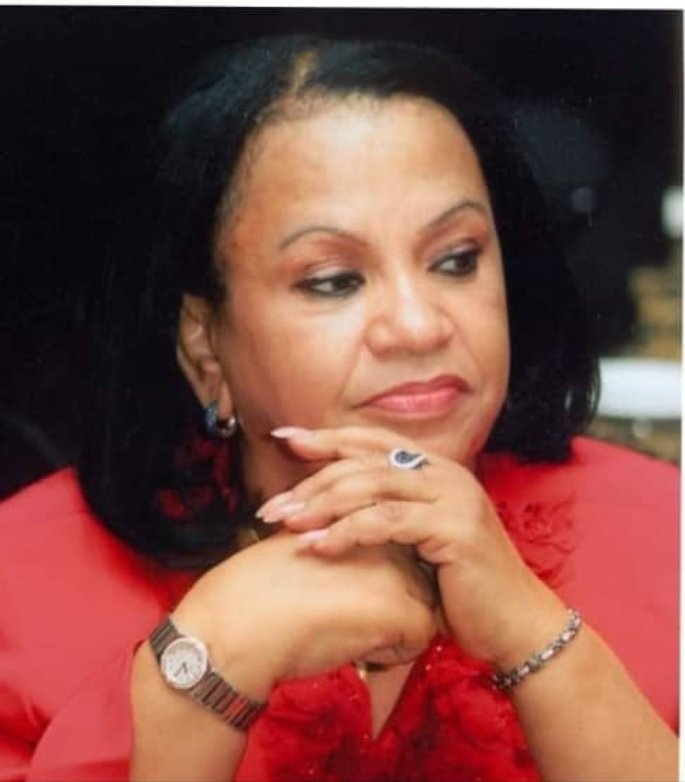
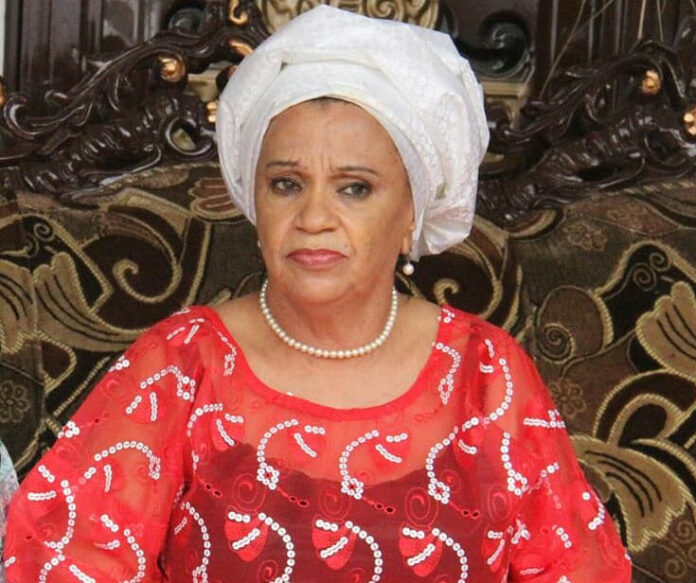
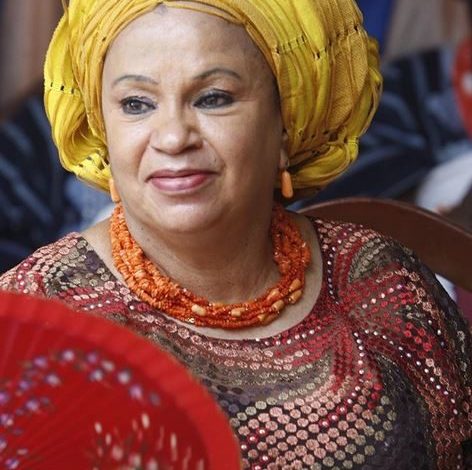
The former Secretary to the Lagos State Government, Princess Adenrele Adeniran-Ogunsanya who died Tuesday at 74 started her career as a Development Assistant at Shell Petroleum Development Company, and later went to become a Media Relations Assistant at the same firm (which later became ConOil) before venturing into private practice.
Born in Manchester, the United Kingdom on January 18, 1948, she died seven days after her birthday.
She lost her mother, a Briton at age four and consequently lived with her father.
Her father, Chief Suberu Adeniran-Ogunsanya, QC, SAN was a Nigerian lawyer, politician and a close associate of Dr Nnamdi Azikiwe, during the First and Second Republics. He also served as the Lagos State Commissioner for Justice and Education in the second republic.
The frontline politician, who took after her father in politics studied at the Anglican School Girls Seminary, Broad Street and eventually completed her secondary school education at Our Lady of Apostle, Yaba, Lagos.
Unlike her father who read law, she went to Sorbonne University, Paris, France where she studied French Civilisation. She also bagged a diploma in International and Industrial Law at the University of Lagos.
She followed him to political meetings and always sat close by each time Adeniran Ogunsanya hosted meetings in his house.
Her dad used to plait her hair as a child.
Adenrele Adeniran-Ogunsanya was the auditor for the Social Progress Party, and a coordinator for political pressure groups; the Lagos State Women Opinion Leaders Forum, and the Torch Bearers group during the Second Republic.
She was constituency chairperson for the United Nigeria Congress Party, Eti-Osa. She also held the same position when she joined the All Peoples Party.
Princess Adeniran-Ogunsanya was picked as the running mate to Chief Dapo Sarumi of the Peoples Democratic Party ticket, in 1999, but stepped down for Buraimoh Adeniji Adele. She moved to the Action Congress which transformed into the Action Congress of Nigeria, after the death of Chief Funsho Williams in 2006.
In 2002 Adeniran-Ogunsanya became a member of the Board of the National Broadcasting Corporation, and between 2007 to 2011, she was the Secretary to the Lagos State Government, during Governor Babatunde Raji Fashola’s administration.
She was married to a dental surgeon, Adeniyan Adeniji; they had four children but she is survived by only three of the children.
Princess was one of the leaders of the Lagos4Lagos Movement whose members recently defected to the People’s Democratic Party (PDP) from the ruling All Progressives Congress.
The People’s Princess as she was called by admirers served as SSG during the first term in office of Babatunde Raji Fashola, SAN between 2007 and 2011.
In an interview she granted to ThisDay on 2 April 2016, she made an interesting revelation. “My dad used to plait my hair as a child. He would plait my hair very early in the morning, because I lived with him, with my nanny and my cousin, Aremo of Ikorodu, Chief Adeniyi Ogunsanya. He (Aremo) took care of me, and he would take me to school.”
Read the full interview below:
Tell us about your background
My name is Princess Adenrele Oyebola Oyetokunbo Adeniran – Ogunsanya. I was born on 18th of January 1948. I am a native of Ikorodu. I am a Princess of Ikorodu. I was born in Manchester in the United Kingdom (UK). I had my nursery education in England. Subsequently, I came back as a child, when my dad returned home as a qualified barrister. I now went to a private nursery school in Yaba, Lagos, Saint Agnes, and later, I went to Anglican School in Broad Street, Lagos, Girl’s Seminary. It is a typical Lagos school, where one meets very wonderful people, who were older than me. And it was a good mix and it made and grounded you as a Lagos person. I enjoyed the school nicely and I have always loved to be among people. I don’t like going or moving with stuffy people, but I think my dad got an inkling when I started sitting at meetings as a child of the Zikist National Vanguard, that were always held in our home at 13, Obaloke, in Apapa Road, Lagos. In those days, all the lawyers, that lived in that area, like Tunde Coker, Ladner, Frank Akinrele, Desalu, Gbajabiamila, GNA Okafor, Alli Balogun, and other prominent Lagos lawyers at that time, very distinguished and colourful people lived in that area. Then Apapa Road was not different from what it is today. I grew up and enjoyed my childhood there. In it again, my dad was a very happy person and it was there my dad won an election in 1959 into the House of Representatives. After that, I went to Our Lady of Apostle, Yaba, Lagos, for my secondary education for one year. Because, at a time, I did a Common Entrance Examination and I was picked to go to Methodist Girl’s High School, Sabo, Yaba, Lagos, and my dad wanted nothing other than Queen’s College, Lagos, for me.
He even decided that, if I did not go to Queen’s College, I would go abroad. And my dad was an old King’s College, Lagos, boy, and if I was a boy, he would have sent me to King’s College. Because with all that my dad had, he was very passionate about them. And so, I had my secondary school and I did my O/Level and A/Level. I left there and went to Sorbonne, University of Paris, France. I did a course there called, ‘civilization francais’ (French Civilisation). It was an 18 – month course and, then I came to Nigeria. I went to the University of Lagos, Akoka, Yaba, Lagos, and did a diploma course in International Law, Industrial Law, Business Law. It was a course made for people going into the industry. And from there, in 1971, I went to work in Shell Nigeria Limited from 1971 to 1983. It was Shell Nigeria and later became Conoil, but when I started there it was Shell Nigeria Limited. We had a lot of expatriates there and I was an assistant to one of the managers in the department for training and development and employees’ relations.
It was there, I was until 1983. After 1983, I started doing business and along the line, my dad contested an election in 1979. And since I have interest in politics, when I was young, my dad used to discuss politics with me. In fact, he used to allow me to sit at meetings, especially, to sit at meetings with any youth group that came from Ikorodu in order to discuss Ikorodu matter. I used to be very angry because there was a game we used to play, then, ‘ten-te’, so badly, and this man would say, come and sit down. But I would ask, “What concerns me with all these things? He would convince me that, it would let them know I was. In addition to that, he would send me to Ikorodu and I would spend a nice time with my grandmother. I used to enjoy it because there were festivals in Ikorodu and he would send me home to go and be there. You know, parents have ways of knowing the attributes of every child. From there, he was sending me to represent him at every meeting, and that was how my journey into politics started.
You were very close to your dad, why didn’t you take after him to become a lawyer?
He wanted me to. I was in a hurry. Well, I don’t know. I did law, but I didn’t do the law course. And when they were talking (lawyers) and I used to quote what I had learnt and he used to get angry. But God has control of everything that we do in life. He would say, ‘I told you, you could do this. I don’t know they were circumstances.
You haven’t said anything about your mother. Were you not close to her?
My mother is dead. Well, I lost my mom, when I was four years old, but I was in close contact because my dad made sure I went to England on holidays when I was small so that I would stay with my mom and grandmother. My mom’s name was Helen John. She was a native of Manchester, England.
It seems your dad loved you…
I think my dad was hard on me, but I knew, that he loved me greatly, but I don’t know. I wouldn’t see my dad for any other father. And if I have to come to this world again, I wish he would still be my father. He was a very down-to-earth gentle person, but he was strict. And he understood and I think, like his father, late Odofin of Ikorodu, Chief Suberu Ogunsanya, who was down-to-earth too. And I can tell you instances of what he did, and I think, he did it purposely to teach me lessons. Like I would go to the family house, even after I had married. He would ask, ‘where are you going? And I would say, ‘nowhere! Why’? ‘It was because I wanted you to follow me somewhere. And I would go out with him. He would say, ‘Turn right, turn left,’ and we would get to this house. He would come out and see any of his friends and he would be excited. The friend would shout, ‘Ogunsanya wa wo mi o’ (Ogunsanya has come to visit me o). The friend would say, ‘you can’t come into my house’, and my father would ask, ‘don’t you love me,? And he (dad) would go into the house. The friend would also say, “I can’t offer you anything”, but my father would drink a bottle of Coca-cola. Sometimes, my dad would say, ‘se won nta akara l’adugbo yi’? (Are they selling bean cakes in this area?). I could remember that the friend would tell my dad, ‘e fi mi se eniyan l’adugbo yi o’ (you have made me an important person in this area). That was the kind of person my dad was. My dad used to plait my hair as a child. He would plait my hair very early in the morning, because I lived with him, with my nanny and my cousin, Aremo of Ikorodu, Chief Adeniyi Ogunsanya. He (Aremo) took care of me, and he would take me to school.
Could you remember vividly any particular time your dad sanctioned you for doing wrong?
I remember all the time. My dad was extremely strict, and you couldn’t just go to him unless you had an invitation. When you had an invitation, you would have to give him, at least, a week before you could see him. And you would have to behave well. I laugh when many people think that he was strict, but he would impress it on me that, not loving you, but remember, that one day, I would be alone or you would be alone. For instance, if when I was in secondary school, I came home early during the holiday from London and he had got a job ready for me. One time, he got a job for me from a public relations outfit and I was doing the holiday job. Some people think that he loved his child and loving a child doesn’t spoil a child. They are two different things.
On these occasions when you were being sanctioned, how did your mother react, being a white woman?
My mother wasn’t around, and I had told you earlier, that I had come home with my dad at the age of four and she was not staying with us.
Don’t you have male siblings?
I do. I have two brothers. I had a brother who was also of the same mother with me, but he died when he was young.
But none of them was close to your dad as you were…
I would not want to say that, but my dad was close to all his children.
How would you describe the relationship between Late Chief TOS Benson and Justice Michael Odesanya who were close friends of your dad? They all hailed from Ikorodu and also went to the United Kingdom together to study law?
They didn’t go to the same school, but I think, they went to the same primary school in Ikorodu. And I think, it was Madariola Private Nursery/Primary School in Ikorodu. It was a well-known school.
How would you describe their friendship when they used to visit your dad at home?
It was interesting. I had the honour of going out around with them during one summer in London, and I enjoyed myself thoroughly when they were all in a black car. This is because they all cracked jokes and laughed like they were young boys. They were talking about all those things young men talk about. And they made me laugh and it is something I would always remember. In fact, they were fond of one another. They were a great delight and it was nice to sit in a black car with them, just the three of them.
How would you feel if some people tell you that you rode on your father’s back? Wouldn’t you feel offended?
Why would they offend me? I worked hard for whatever I have. But if I say my father’s name has not helped me, I would be an ingrate. It is a gift from God and my father gave it to me if I rode on his back. When my dad was alive and he would also look at me and say, that is my daughter. And that is it. I have no apology for that. At a stage, when I was much younger and people would say it to me and I would get offended. For an instance, I did an interview where somebody asked me if I wanted to fit into my father’s shoe and I told them my father’s shoe was too big for me. He was alive and in a hospital, but he called me when I came home to take food for him, in the evening. And somebody said he said I should come now, and I went. When I asked what’s the problem, he said, ‘I am angry,’ And I was wondering what I had done wrong. He waved a paper in front of me and said, ‘my shoes are too big for you? Adenrele, my shoes are not big for you. You are going to be great as I am’. I said, ‘I didn’t say I want to fit into your shoes, because you are a great person’. I don’t take offence to that. I am glad that I belong to the family that I belong to. I am glad of the name he has left for me. I am glad for all the things he did and I am proud of him. I have no apology. It is not my fault if some people don’t have somebody like my father.
Who is your husband?
I married a doctor, a dental surgeon. His name is Adeniyan Adeniji. He hailed from Ibadan, Oyo State. And we had four children, but I had a child that I lost, a girl. So, I have three boys. We were cordial. There was no misunderstanding.
Where did you meet him?
I met him when I was in University of Lagos, Akoka, Yaba, Lagos. He was in the College of Medicine.
How did you meet him?
We met at a club. It was the normal way you meet through friends, through associates.
Was he also from a rich background?
I don’t know why there is much emphasis on this rich or poor background. What makes people rich is not money or cars and it is the background that they have. And some people don’t have as many cars. And a Yoruba adage says, “bibire ko se fowora”. Sincerely, he came from good family background and they were all educated. And I think, his parents were educationists and they retired from there. So, I don’t know, why people pay more attention to riches and I think it is a problem, particularly when we Yoruba people use to say, “Awon ibo like owo” (that Igbo people love and worship money). What concerned me, if the man was rich, but he had prospects. He was handsome. He came from a good home. His mother came from a good home. His father was educated. What is money? Money can’t buy certain things. We pay too much emphasis on money and that is why we are in a position we find ourselves today. People just grab and grab. He came from a rich family and they owned their home. They had cars. His siblings were all educated. And that is what matters. We have people who are rich, with no substance.
You are very fluent in Yoruba dialect, how did you learn the language?
I was four years old when I came to Lagos and my dad was a nationalist. He was also someone who would always want me to be a traditionalist. Traditionalist in that I know my tradition. I think we are not fair to our tradition and the things you must do as a Yoruba girl like when I started my first job, I had to distribute my first salary to everybody. My dad was like that. Of course, it is not easy for a young person to pick up a language and I picked it up and I could speak it. I speak in Ijebu dialect too, and when I started speaking Ijebu dialect and everybody would shout at campaigns. It is not as fluent as my Yoruba, but it is getting better.
Initially, you were in the opposition party, PDP. Why did you defect to AC which later metamorphosed to ACN and subsequently, APC?
Well, the main reason was that Funsho Williams died and when he died I could not get someone that could be like him. It was very difficult for me to change. If you had known my father, he never switched parties. So, I switched and that is why it is difficult for me, I can’t and I don’t have any intention of switching to any party. I think, when you are jumping, today, you are in APC, tomorrow, you are in PDP and I had been in AC, ACN and I am now in APC, which is the same thing since 2006. That is 10 years ago. I know there is a change coming and I don’t know how, but I know it would evolve and I know it is coming. I intend to remain in APC and go about my politics. I try and keep my people close to me. I do what I can do and sit and watch, as it goes along. But I think, a politician must have followership. Some of these high-table politicians don’t have followership. We gather people together and help them, and it is not necessarily money all the time, but I am there for them. I think, it is a great thing and that is what politics is all about. It is about concern and where you come from, your own constituency. I do that and sit and watch, as the game plays out. But I know, it would be interesting and I know, people will learn a new lesson. I think politics is important to the people that you represent to have a rapport with them. And that is how you will know their needs and problems, while some keep their distance.
You were once Secretary to the Lagos State Government between 2007 and 2011 under Mr. Babatunde Raji Fashola, SAN. What was the experience like being your first time in public office?
I don’t think so. I had been on the seat of an international organisation before, Shell Nigeria Limited.
But public office…
I have been at the Nigerian Broadcasting Corporation (NBC). I served four years on the board, and I was quite active. I don’t think, it is different, but I enjoyed it immensely. I learnt a lot. I was particularly happy to work in that very dynamic cabinet, the cabinet of 2007 to 2011. For me, it was a glorious journey. I have no regret. I feel privileged to have served with Mr. Babatunde Raji Fashola. It was good for me and I learnt a lot of lessons. You know sometimes, it is good to get to see people, as they really are. And it was a wonderful thing. I enjoyed it because, if you had come to my office, then you would see how I was close with the people there. And I am enjoying now and when I go to places people start milling around when they see me because one way or the other, their lives have been touched and I know. For me, I think that is what service is all about. The acknowledgment is the dividend that you get. Many people don’t understand it. I was telling someone that Bola Ahmed Tinubu has touched the lives of a number of people and that says something, and it goes a long way.
Your father was a politician and you are also a politician, would you allow or encourage any of your children to join partisan politics?
I would because I encourage other people’s children to be politicians. I would encourage my children but it has to be their choice. It must come naturally from them and it is not what they do not want to do. And I will definitely not push my children, but I would like my children to join and some of my siblings too if they have keen interest and it is important. Most of what I do, I do truly, because I have no apology. And I say it, with passion, that I had a wonderful father.
Hasn’t any of them signified an intention?
I have two brothers that are into politics.
What about your own children?
They just told me, one is showing interest. But I am leaving him to take the decision on his own.
Our site uses cookies. By clicking “Accept All Cookies”, you direct Law and Society Magazine to store cookies on your device and disclose information in accordance with our Cookie Statement: cookie policyACCEPTREJECT
Privacy & Cookies Policy
Privacy Overview
This website uses cookies to improve your experience while you navigate through the website. Out of these cookies, the cookies that are categorized as necessary are stored on your browser as they are essential for the working of basic functionalities of the website. We also use third-party cookies that help us analyze and understand how you use this website. These cookies will be stored in your browser only with your consent. You also have the option to opt-out of these cookies. But opting out of some of these cookies may have an effect on your browsing experience.
Necessary cookies are absolutely essential for the website to function properly. This category only includes cookies that ensures basic functionalities and security features of the website. These cookies do not store any personal information.
Any cookies that may not be particularly necessary for the website to function and is used specifically to collect user personal data via analytics, ads, other embedded contents are termed as non-necessary cookies. It is mandatory to procure user consent prior to running these cookies on your website.