Home Blog Page 867

Malicious Prosecution, And The Right Available To The Injured Party

By Deborah Iniye Warrie Esq.

FICTIONAL STORY

Theophilus and Sunday were business partners, operating a motorcycle rental agency together. One day, a customer came and sought the sole service of Sunday to convey some goods for him, for a whole day.

Enraged by the customer’s choice, Theophilus wrote a petition to the National Drug Law Enforcement Agency (NDLEA), alleging that Sunday and the customer illicitly, trafficked narcotic drugs and psychotropic substances. The Agency on receipt of Theophilus’s petition, charged the duo (Sunday and the said customer) to Court.
What is the meaning of Theophilus action in law?
What is the position of Nigeria’s Jurisprudence on Theophilus action.?
How has Theophilus’s action, been addressed, in the international scene.
What are the legal remedy available for Sunday and the customer?
All these and more have been addressed in this article.
What is the meaning of Theophilus action in law?

It is called Malicious Prosecution. Malicious prosecution is a common law intentional tort. It entails intentionally and maliciously, instituting and pursuing (or causing to be instituted or pursued) a legal action (civil or criminal) that is brought without probable cause. In some jurisdictions, the term “malicious prosecution” denotes the wrongful initiation of criminal proceedings.

Origin of Malicious Prosecution

The tort originates in the (now defunct) legal maxim that “the King pays no costs”; that is, the Crown could not be forced to pay the legal costs of a person it prosecuted, even if that person was found innocent. As The London Magazine stated in 1766: “if a groundless and vexatious prosecution be commenced in the King’s name, his ministers who commenced, or advised commencing that prosecution, ought at least to be obliged to pay the costs which an innocent subject has thereby been put to”.

The history of the origin of malicious prosecution can be traced back to the writ of conspiracy which was in existence as early as Edwards I’s reign. Malicious prosecution has its origin in England and evolved in the 18th and 19th centuries. It was an outcome of misusing the due procedure of law since the 18th and 19th centuries in England. Later it spread its wings across the globe, in different countries.

Elements of Malicious Prosecution

Prosecution by the defendant
The very first essential element which the plaintiff needs to prove in a suit for damages for malicious prosecution is that he (plaintiff) was prosecuted by the defendant.

Absence of probable and reasonable cause
In a suit for damages of malicious prosecution, the plaintiff is also required to prove that the defendant prosecuted him without reasonable and probable cause. The question related to the reasonable and probable cause suit for malicious prosecution should be decided on all facts before the Court.

Defendant acted Maliciously
In a suit of damages for malicious prosecution, it is another essential element which the plaintiff has to prove that the defendant acted maliciously/wrongfully in prosecuting him and not with a mere intention for carrying the law into effect. Malice need not be a feeling of enmity, spite or ill will or spirit of vengeance but on the other hand, it can be any improper purpose that motivates the prosecutor, such as to gain a private collateral advantage.

Termination of proceedings in the favor of the plaintiff
In a suit of damages for malicious proceedings, it is essential to show that the prosecution complained or terminated in favor of the plaintiff. Termination in favor of the plaintiff does not mean the judicial determination of his innocence; it means the absence of a judicial determination of his guilt. Malice need not be a feeling of enmity, spite or ill will, or spirit of vengeance but it can have any improper purpose which can motivate the prosecutor, such as to gain a private collateral advantage.

Plaintiff suffered damage as a result of the prosecution
In a suit of damages for malicious prosecution, it is the other essential elements which the plaintiff is required to prove that the plaintiff had suffered the damage and as a result of the prosecution. In a claim for prosecution, the plaintiff can claim the damages on the following three counts

Damage to the plaintiff’s reputation as a criminal
One of the important sources of pleasure in a man’s life is a good reputation, and the most traumatizing pain is a bad reputation. The biggest pain in a person’s life is a bad reputation. A bad reputation in society negates the work of a person who is trying towards creating goodwill. Moreover, a bad reputation also brings along the ill will of the society, as well as social non acceptance and this is in direct deprivation of the fundamental right of life.

Damage to the plaintiff’s person
The amount of physical injury can also be involved through a maliciously instituted proceeding. Criminal charges often include arrest as an important consequence of the procedure once the law is set. The injury and the damages to the person may have an effect in case of arrest due to malicious prosecution. Also unnecessarily and unjustly the person would have to sacrifice their personal liberty and freedom. Furthermore, this trauma is bound to cause great mental stress to the aggrieved person. Therefore, a malicious prosecution case is capable of causing a great deal of injury to the person who is on the receiving end of a maliciously instituted proceeding.

Damage to the plaintiff’s property
An unjust and malicious prosecution means that the person who is accused has to use his resources and money in defending the prosecution. This unnecessary expenditure in large amounts is an injury to his property.

What is the position of Nigeria’s Jurisprudence on Theophilus action?

OKOLO & ANOR v. OBI (2017) LPELR-44039(CA) Circumstances where a defendant would be liable for malicious prosecution
“When a report is made to the police against a plaintiff, and the defendant instigates his arrest and or detention, a complaint of false imprisonment could arise. When the report or charge, as instigated by a defendant, is carried on before a judicial officer, a complaint of malicious prosecution may arise; UAC (Nig.) Plc v. Sobodu (2007) LPELR-7740 (CA). Thus, a defendant who maliciously makes a false statement against a plaintiff and causes a judicial act, like the issue of a summons or warrant of arrest, to the prejudice of the plaintiff, will be liable for malicious prosecution even though he may not technically have been the prosecutor in the strict sense; Agi v. First City Monument Bank Plc (2013) LPELR-20708(CA). The elements required to prove the complaint must be evident in the evidence adduced before the trial Court.” Per ONYEKACHI AJA OTISI, JCA (Pp 9 – 9 Paras B – F)

ADEBOWALE v. ROBINSON (2018) LPELR-44424(CA) Ingredients that must be established in order for a plaintiff to succeed in an action for malicious prosecution
“For a claimant to succeed in an action for malicious prosecution, he must plead and prove with credible and cogent evidence the following ingredients; (a) That the defendant put the machinery of prosecution on motion. (b) That the result of the criminal action is a favour of the accused. (c) That the defendant has no reasonable cause to prosecute the accused. (d) That the prosecution is as a result of malice. See the case of Balogun V. Amubikahun (1989) 3 NWLR (Pt. 107) 18. The Respondent must prove all the above ingredients concurrently in order to establish a case of malicious prosecution and failure to prove any one of the above ingredients, his claim will fail and be dismissed. The ingredients for the tort of malicious prosecution must be proved.” Per PAUL OBI ELECHI, JCA (Pp 47 – 48 Paras F – D)

“For a claimant to succeed in an action for malicious prosecution, he must plead and prove with credible and cogent evidence the following ingredients; (a) That the defendant put the machinery of prosecution on the motion. (b) That the result of the criminal action is a favor of the accused. (c) That the defendant has no reasonable cause to prosecute the accused. (d) That the prosecution is as a result of malice. See the case of Balogun V. Amubikahun (1989) 3 NWLR (Pt. 107) 18. The Respondent must prove all the above ingredients concurrently in order to establish a case of malicious prosecution and failure to prove any one of the above ingredients, his claim will fail and be dismissed. The ingredients for the tort of malicious prosecution must be proved.”

ISHOLA v. ISHOLA & ANOR (2014) LPELR-23082(CA) When will a defendant be liable in a claim for malicious prosecution
“It is decipherable from the foregoing that to be liable for malicious prosecution, the defendant would have done more than merely reporting an incident to the police. If for example at the conclusion of the investigation of the report lodged by the defendant, the police informs him that there was no cause to prosecute the plaintiff but the defendant insists that the plaintiff be charged to Court; or even where the defendant does not himself believe in the truth of his allegation, the said defendant will not escape liability for malicious prosecution. See also Bhagatsingh & Ors. vs. Pandit Tewari (1908) 24 LTR 884.” Per CORDELIA IFEOMA JOMBO-OFO, JCA (Pp 53 – 53 Paras C – E)

How has Theophilus’s action, been addressed, in the international scene.

England
England has been the birthplace of the tort law and law of malicious prosecution. As early as the 10th century, the English people understood the need to restrain malicious litigation initiated with vested interests. Back in the 18th and 19th centuries, the law of malicious prosecution matured in England. But, the application of the law of malicious prosecution has two distinctions, first the application exclusively to the criminal law; and second, the extending of application to civil law as well.

United States of America
The United States of America has been quite liberal in its usage and codification of the law of malicious prosecution. Historically, and even today it has not limited the scope of the tort to criminal proceedings alone. Also, it has time and again codified the tort in legislation.

There seems to be no specific reason why action should not lie for the institution of unfounded and malicious proceedings before a court or some administrative or domestic tribunal. The adverse decision of such a body may cause serious damage to the reputation or livelihood of the person accused. This essentially expresses present-day principles of elucidating the claims regarding malicious prosecution. Broad-spectrum of clarifying is applied to the principles of the tort so as to give maximum benefit or profit to the victim, which in return also acts as an essential deterrent for malicious litigation.

New Zealand
New Zealand has codified the means of discharging successful innocent defendants. The possible remedies in New Zealand for all those people who are prosecuted for offenses that they have not committed are an award of costs for tort remedies of malicious prosecution.

On the 25th of October 2007 a Donegal publican, Frank McBrearty settled his action against the state for personal damages arising from malicious prosecution, wrongful imprisonment, defamation, and wrongful arrest for €3 million, albeit without any admission of liability. Mr. McBrearty was the victim of a police conspiracy to frame him for the murder of one Richie Barron; who had in fact died accidentally. Such a substantial award could encourage a greater number of malicious prosecution actions coming before the courts. See Frank McBrearty & Company Ltd V Commissioner of an Gardi Siochana & Ors [2007] IEHC 373 IN THE HIGH COURT IRELAND.
BROWNING v. RAY 1968 OK 52 440 P.2d 721 Case Number: 41719 Decided: 04/23/1968 Supreme Court of Oklahoma. RAEFORD E. BROWNING, PLAINTIFF IN ERROR V. D. PORTER RAY, DEFENDANT IN ERROR.
In a malicious prosecution action, a plaintiff may recover for injuries such as mental or emotional distress and injury to reputation which necessarily result from such wrongful acts without specific proof that same have resulted in such harm.

There is a lack of probable cause for the prosecution of one who allegedly committed a crime if the known facts and circumstances are not such as to justify a man of prudence and caution in believing that the accused has committed the offense with which he was charged. We do not find it necessary herein to choose between these two lines of authority relative to mistakes of law. In our opinion, the facts that the incident occurred out of the presence of the defendant and that he hastily filed a complaint against the defendant, without having conferred, insofar as this record presently shows, with an attorney to determine whether a criminal offense had been committed, and the further fact that the county attorney dismissed the purported complaint against plaintiff, indicate that a man of prudence and caution would not be justified in believing a criminal offense had been committed and tend to establish that defendant lacked probable cause to institute the criminal proceeding against the plaintiff.

What are the legal remedies available for Sunday and the customer?

Being a victim of malicious prosecution can cause a wide range of injuries, whether it’s from unsubstantiated criminal charges or a bogus civil claim.

In either case, the plaintiff/victim may claim compensatory and sometimes punitive damages. Compensatory damages consist of both the actual damages that were a direct result of the malicious prosecution (which may include pain and suffering and other non-monetary injuries), and special damages that identify quantifiable monetary losses – such as lost earnings, additional domestic costs such as childcare, etc.). The Plaintiff/Victim also may claim a damaged reputation, loss of future earning potential, attorney fees, court fees.

Conclusion for Litigants.

Like the popular saying in pidgin goes “no be who go police station first, na dey win case.”

Litigants must understand that it is not every grievance, or wrong done to you, that you can take to court. The Court in the interest of justice will always question the motive behind your Complaint. This is while you must first consult a lawyer before taking any case to the police station to avoid stories that touch.

Any complaint maliciously filed in order to intimidate, harass, defame, or otherwise injure the other party, is referred to as malicious prosecution, whether it’s Emeka suing Obiora his fellow, motor spare part dealer in order to put the competition out of business, or an unscrupulous politician filing false charges against a journalist who dished out his biggest secret, or Amara suing her husband’s mistress, the rationale behind such suits are sometimes probed, to checkmate any element of malicious prosecution.

Conclusion for Lawyers

Although both Malicious Prosecution and Defamation claims deal with the publication of false statements the main differences between the two are that a claimant in a malicious falsehood claim is not required to prove damage to reputation and the false statement does not need to have a defamatory meaning. While Defamation deals strictly with Civil law, Malicious Prosecution deals strictly with Criminal law.

References

https://en.wikipedia.org/wiki/Malicious_prosecution#U.S.use_of_English_Rule https://www.legalserviceindia.com/legal/article-2434-malicious-prosecution.html https://primsol.lawpavilion.com/ https://www.dppireland.ie/app/uploads/2019/03/Budapest_Paper-_Helen_Whately_06052010.pdf
https://www.findlaw.com/injury/torts-and-personal-injuries/malicious-prosecution.html
https://www.lawblacks.com/2018/01/10/the-difference-between-defamation-and-malicious-falsehood/
For more legal advice and tips, follow DEBBY G CONSULTS ON 09018561398 Or

https://wa.me/message/6OOIP3WVZXE6G1 OR
https://www.facebook.com/DEBBY-G-Consults-123260913269689/ or blogspot.com
https://www.blogger.com/?hl=en&tab=jj&authuser=1.

Disclaimer

The information provided by this blog does not, and is not intended to, constitute any legal advice.
All information, content, and materials available on this blog are for general informational purposes only.
Information on this blog may not constitute the most up-to-date legal or other information.
This blog contains links to other third-party websites. Such links are only for the convenience of the reader, user or browser; reader, user, or browser of this blog should refrain from acting on the basis of information on this blog without first seeking legal advice from a lawyer, in their relevant jurisdiction.

Written By Obioma Ezenwobodo Esq

Legal Reprieve For Landlords (2)

By Ebun-Olu Adegboruwa, SAN

The feedback from the first edition of this piece has been a great relief for me and I’m sure for many, especially those hapless landlords that have been at the mercy of very stubborn tenants, who have taken them through sorrow and tears, in order to reap the fruits of their investment. I know there are landlords who behave as if the whole world revolves around them, taking the slightest opportunity to extort tenants through mindless increment in rents, constant harassment and bullying. Well, these are in the minority and surely and certainly, their days are numbered. This column will focus on those godless landlords in the near future.

Another thorny legal issue that was resolved by the Supreme Court in the case of Pillars (Nigeria) Ltd. v. Desbordes (2021) 12 NWLR (Pt.1789) 122 is that of the legal consequence for a landlord who has issued proper quit notice to a tenant and then subsequently collected rents. There are many scenarios. In some cases, some landlords just issue quit notices in order to scare the tenant to concede to an arbitrary increment in rent, whilst some do so genuinely due to several factors ranging from strained relationship with the tenant, failure to pay rents or some other reasons. Some schools of thought have always held the view that collection of rent by a landlord who had previously issued a quit notice amounts to a repudiation of the said notice whilst others hold the view that it means a renewal of the expired tenancy. Some others even say that it amounts to a waiver. This issue has now been laid to rest in the following immortal words of Ogunwumiju, J.S.C. at page 144, paragraphs A-C of the report:

“The strongest point made by the appellant is that the respondents had waived their right to forfeiture by demanding and collecting rent till 1995. I agree with the inference of the court below in agreeing with the High Court that even though the Respondent collected rent till 1991, there was a letter by the respondents’ counsel – exhibit N – written in 1992 clearly showing an intention to terminate the lease. The fact that a landlord collected rent on a property still in occupation or possession of the tenant after notice to quit cannot by any stretch of the law, equity or imagination amount to a waiver of the notice to quit even where the notice had expired and the tenant refused to yield possession in time. The notice to quit would subsist until it is formally rescinded by the landlord and or when a fresh tenancy agreement is entered into.”

So long as the property remains that of the landlord and the tenant is in occupation, whatever rent that is paid on the property should justifiably be ascribed to the owner thereof as part of his legitimate income and that of itself alone should not rob him of the right of action against the tenant. Now I have read opinions on the laudable judgment of the Supreme Court wherein some have stated that the concurrent judgment of Ogunwumiju J.S.C. was an obiter that did not tally with the leading judgment of Agim, J.S.C. For me, Pillars v Desbordes is revolutionary in many respects, especially in the area of the burial of technical procedures at the expense of substantial justice. The Supreme Court is a policy court that should use every opportunity that comes its way to make landmark pronouncements that will enhance justice and equity. This is reflected in most of the responses to the first article on this point, some of which I will share with you.

Victor Umana:

“Thanks learned Ebun-Olu Adegboruwa San for this in depth exposition that is very revealing and comforting to landlords whose lifetime investment in property to denial “the sweat of their blood”. The issue of housing & school fees are two strong areas that populace had been mortgage due to cost of building materials particularly cement that is unpredictable like fx, almost #5k per bag now, despite production ingredients sourced locally but a stiff entry barrier placed for only larfage,BUA & Dangote to exploit the masses. In other climes like Ghana, cement marketed by these same manufacturers are cheaper than Nigeria, a seeming paradox for uncontrollably population explosion without a roadmap for habitation!

Arinze Christian Chukwuma

Thanks a million my learned friend for this insight. I hope that our court system improves and the parties comply with the rule of law for the benefit of the entire society. Kudos.

Albert Oladapo Ogunwusi

But where there is an appeal, the creditor is still obliged to wait till the decision of the appellate court. The reprieve is too little too late. The judgment only addresses notice. Our system still indulges delay tactics that arise from nothing literally. Adjournments and other systemic delays are always there.

Usman G. Akano

In many jurisdictions Landlord/Tenant Tribunals are used to adjudicate such cases, instead of regular courts. The tribunal rulings are binding on all parties and are enforced by law enforcement agencies, including carrying out evictions, garnishing wages, seizing properties to cover rent debt. Appeals not allowed; the entire process lasts a few months, not years.

What Ebun narrated here is a travesty, not justice. Why are charges and penalties not running throughout the so-called appeals process? That should deter some frivolous appeals. But I recommend the Tribunal route.

Edwin Abraka

A lot needs to be done to reform the Nigerian Judiciary to make it investment-friendly. Unfortunately, those saddled with championing these judicial reforms, the Legislatures and Attorney Generals do not see the urgency in it. Which investors would wait for 28 years for final decisions of courts to recover their investments. Nigeria needs to separate the office of the Justice Minister from Attorney General because the former attends too much to political matters to the detriment of the economy.

Sadly enough, multinational corporations prefer now to sign contracts with Nigerians overseas to bypass overburdened Nigeria courts, should the need to go to court arise.

A slow judiciary can be a prohibition to foreign direct investment in the country. Even the citizens are weary of investing in their own country due to lack of confidence and then the economy suffers severely. A bad economy can unsettle a government as the masses groan under this vicious cycle.”

Pillars v.Desbordes has exposed to us the vagaries and challenges that litigants face in Nigeria. So it is not so much the notable pronouncement of the Supreme Court which has ended the nightmare of landlords over the years, but rather the urgent need for all stakeholders, within the Bar and Bench and indeed all lovers of justice, to come together to fashion out a mechanism that will make cases like Pillars v Desbordes become a thing of the sad past in the history of administration of justice in Nigeria. The concept of statutory notices was developed by the monarchical rulership in England in line with the concept of the Queen can do no wrong. So, even to sue the Queen, you still have to notify her and give her enough time to prepare herself for your potential claims against her. This was extended to the nations colonized by the British, including the then Protectorate and Colony of Nigeria. These laws should have no place in our laws after our independence. Nigeria is now a republic with its own unique Constitution and we should not be held down by the relics of colonialism. The right of access to court granted under section 6 of the Constitution and all other laws in that behalf, should be exercised by all citizens unfettered. There is no basis to seek to placate the aggressor with statutory notice when he/she did not give any notice of aggression. Some employers terminate employment without following due process of law, yet the employee is to give notice of his intention to sue, you jump upon my land without notice to me but I have to first issue you a pre-action protocol notice before I can file a suit against you to recover my land. The injustice in this is too glaring. It is fairly well settled in our law for instance that a counterclaim is an independent action but defendants are not required to issue out any pre-action protocol before they file their counter-claim to your action.

For now, Pillars v. Desbordes is a revolutionary decision that will save landlords and remove the bottlenecks associated with landlord and tenant cases. We can develop another framework to help tenants who are victims. Whether the decision is obiter, a concurrent judgment or even a passing remark is not so much the concern but that we have on our hands a ready tool that we can use to defeat technicality. The purpose being served by these notices is antithetical to our national development and our jurisprudence. In some cases, when defendants get the notice, they quickly devise means to outsmart the proposed case in order to overreach the claims of the intending plaintiff. To my mind, there is no justice in such selective protection of one litigant against the other. Indeed, it is simply discriminatory. Similar provisions exist in some other archaic laws, such as the Sheriffs and Civil Process Act which requires the consent of the Attorney-General of the Federation or of a state in order to execute a judgment duly obtained from the court against the government. In some very disturbing cases, the Attorney-General is listed as a defendant in the case for which he is required to grant consent for execution. How can a person who participated actively in the trial proceedings, took a position against the case and was roundly defeated in court be asked to grant consent? We cannot continue like this as a nation and still profess our love for justice. Let the apex court give us more of Pillars v Desbordes.

Written By Obioma Ezenwobodo Esq

Doctrine Of Last Seen In A Charge Of Murder

In the Supreme Court of Nigeria Holden at Abuja On Friday, the 11th day of June, 2021

Before Their Lordships Amina Adamu Augie Uwani Musa Abba Aji Mohammed Lawal Garba Tijjani Abubakar Emmanuel Akomaye Agim Justices, Supreme Court

SC. 996C/2018

Between

Nancy Aiwuyor Appellant

And

The State Respondent

(Lead Judgement delivered by Honourable Mohammed Lawal Garba, JSC)

Facts

The Appellant and two other persons were charged and tried for offences bothering on conspiracy, child stealing and murder, contrary to the provisions of Sections 516, 317 and 319 (1) of the Criminal Code. Five witnesses testified for the prosecution; while the Appellant was the sole witness. The trial court convicted the Appellant and others for the offences charged, and they were sentenced to death for the offence of murder. The Appellant’s appeal to the Court of Appeal, was dismissed. The Appellant further appealed to the Supreme Court.

Issue for Determination

The Supreme Court considered the following sole issue as being central to the appeal and decided the appeal thereon:

“Whether the lower court was right, that the prosecution had proved the offences the Appellant was charged with beyond reasonable doubt by the evidence adduced before the trial court.”

Arguments

Relying on the decision of court in COP v AMUTA LPELR- 41386(SC), counsel for the Appellant submitted that in criminal trials, the burden of proof is beyond reasonable doubt, and this burden rests on the prosecution throughout trial. Counsel contended that the burden is to be discharged by credible and cogent evidence, which is sufficient to eliminate reasonable doubt that it was the accused person who committed the offence he was charged with. Counsel relied on IGBABELE v STATE (2006) 5 NWLR (Pt. 975) 100 for the three ingredients of the offence of murder which the prosecution is required to prove together or conjunctively, in order to satisfy the proof beyond reasonable doubt. It was the position of counsel that the prosecution did not, by the evidence adduced at trial, prove any of the offences against the Appellant, particularly murder, beyond reasonable doubt. He argued that the witnesses called in the case did not give evidence in that regard, and that the Court of Appeal erred in law to have affirmed the conviction of the Appellant in the absence of proof beyond reasonable doubt. Further relying on the case of ORISA v STATE (2018) 11 NWLR (Pt. 1631) 457, Counsel argued that the evidence of the Appellant was cogent, unequivocal, and remained unshaken during cross-examination, but the trial court simply disregarded it in its judgement. Counsel argued that it is the duty of the trial court to resolve any doubt in the circumstantial evidence in favour of the accused person where it is capable of two interpretations; one showing the innocence and the other, the guilt of the accused person.

In response to the submissions above, counsel argued for the Respondent that the prosecution had discharged the burden of proof of the offences the Appellant was charged with, and that the trial and lower court were right to have convicted and affirmed the conviction of the Appellant; respectively. Counsel submitted that the concurrent findings of the two courts are not only borne out of abundance of evidence, but also based on relevant principles of law in Section 135(1) of the Evidence Act. Relying on OSENI v STATE (2012) 208 LRCN 151, he posited that that proof could be in any of the following ways: confessional statement by an accused person, circumstantial evidence or evidence of eyewitness of the crime. Counsel submitted that conspiracy, which is an offence that may not always be proved by direct evidence, and is distinct from the main offence, can be inferred from the facts and circumstances of a case – IKEMSON v STATE (1989) 3 NWLR (Pt. 110) 455. Counsel contended that the evidence of the prosecution witnesses, depicted vividly how the Appellant in company of the 1st & 2nd accused persons in consensus ad idem, stole and eventually murdered the victim for ritual purposes, and that the evidence of DW1 and DW2 corroborated the prosecution evidence to prove the charge of conspiracy as required by law. For the offence of child stealing, counsel argued that citing the evidence of PW1 and statement of the Appellant, established that the Appellant actively participated in the commission of the offence and that no evidence was given in rebuttal by the Appellant. On the offence of murder, counsel relied on EDAMINE v STATE (1996) 3 NWLR (Pt. 438) 530 for the essential ingredients of the offence, and argued that the law is settled that where the victim was last seen with the accused person and has not been found after a period of more than seven years, death would be presumed by virtue of Section 164(1) of the Evidence Act. Learned counsel submitted that the evidence before the trial court, was that the victim was last seen by and with the Appellant who received her from the 2nd accused person, and the victim has not been seen or found since February 24th, 2009, thereby giving rise to the reasonable presumption of death. Counsel submitted further that concurrent findings by the two lower courts, was rooted in the evidence which sufficiently established the ingredients required to prove the offences beyond reasonable doubt against the Appellants.

Court’s Judgement and Rationale

Before deciding the sole issue, the Supreme Court pointed out that the law permits a Respondent who did not file a Cross-appeal or a Respondent’s Notice of Appeal, to formulate issues from the grounds of appeal filed by the Appellant, and in so doing, adopt a favourable slant. Such Respondent does not have to adopt the form or style of the Appellant, in the formulation of the issues for determination -ATANDA v AJAYI (1989)3 NWLR (Pt. 111) 511.

Deciding the sole issue, the Supreme Court held that it is elementary in all superior courts of record in Nigeria, that by the combined provisions of Section 131, 132, 135(1) and 139 of the Evidence Act 2011, the burden of proof in all criminal trials is on the prosecution, to prove the offences which the accused persons are alleged to have committed beyond reasonable doubt. Another settled principle of law is that, the burden of proof imposed on the prosecution in criminal trials can be effectively discharged, and the presumption of innocence in favour of an accused person completely displaced by any of the following ways: confessional statement of the accused person which satisfies the requirements of law, direct eyewitness evidence or circumstantial evidence which meets or satisfies the requirements of the law – IGBABELE v STATE (2006) 5 NWLR (Pt. 975).

The court held that for the evidence to be adduced by the prosecution in the discharge of the burden of proof in any of these ways, by law, all material ingredients or elements which constitute the offence with which he was charged before the court, must be established together or conjunctively. Where a trial court failed or omitted to adequately, properly, and fairly consider a defence disclosed in the evidence before it which is open and available to an accused person before convicting him for the offence he was charged with, an appellate court would readily consider such defences in the event of an appeal on the failure or omission by the trial court – OJO v STATE (1973) 11 SC. An appellate court lacks the judicial competence to consider, deal with, pronounce and decide any issue or point which is outside of and not related to the grounds of an appeal contained on the Notice of Appeal filed before. In this instance, however, the Appellant did not, by his Grounds of Appeal or the issues submitted to the lower court for its determination, raise the issue of omission or failure by the trial court to consider the defence raised by the Appellant during trial, in the judgement appealed against. Not being an issue submitted to it or arising from any of the grounds of appeal before it, the lower court had no obligation or duty in law, to deal with or make pronouncement on the alleged omission or failure by the trial court to consider the defence raised by the Appellant at the trial court – IYAJI v EYIGEBE (1987) 1 NWLR (Pt. 61) 523.

Further, the proof of the offence of conspiracy lies in the inferences to be drawn from subsequent illegal acts or conducts by the individual conspirators. towards meeting or achieving the common intention and purpose. From the series and sequence of the acts and conduct by the accused persons, as narrated in their respective statements, there is no reasonable doubt that they could only come from the personal knowledge and common intention of persons who had agreed to commit an illegal act for a common purpose as envisaged by the provisions of Sections 7 and 8 of the Criminal Code, in order to constitute the offence of conspiracy between them. The evidence adduced by the prosecution through PW3 – the victim’s father, established beyond reasonable doubt that the victim who was a three-year-old at the material time, was taken away from their care, possession, and protection, forcibly and with the clear intention to steal her for an illegal purpose. The evidence leaves no reasonable doubt that the offence of child stealing under Section 371 of the Criminal Code was committed, in furtherance and pursuit of the common intention by the Appellant and her co-conspirators; the first and second accused persons. Consequently, the offences of conspiracy to commit felony and child stealing have been proved by the evidence, adduced by the prosecution, beyond reasonable doubt, as required by the law and the lower court was right to have affirmed her conviction for the said offences.

On the charge of murder, the court held that the law is firmly settled, as seen in loads of judicial authorities, that for the prosecution to secure a conviction for the offence of murder, the following crucial, vital and essential elements must be proved conjunctively, beyond reasonable doubt, that the death of the human has actually and in fact, taken place or occurred, the death was caused by the acts done or attributable to the accused person charged with the offence and the acts was done by the accused person with the intention to cause the death or that at the material time he knew or had reason to know that death was the probable, and not only a likely consequence of the act- OKORO v STATE (1988) 12 SCNJ.

In this case, the child who the Appellant and other accused persons conspired with, and stole was not found up to the time her trial commenced and ended. The lower court believed and relied on the evidence that since the Appellant and the co-accused conspired and stole the missing child who had not been seen or found for a period of seven years thereafter, there was the presumption of her death, and the Appellant had the duty to explain what happened to her because they were last seen with her. As shown by the evidence, the Appellant and the 2nd accused person were the last persons seen with the victim, when she was handed over to them by the 1st accused person on the 24th February, 2009 and they took her away alive, but she had since then, not been traced, seen or heard of or about. The Appellant has the duty to give or offer an acceptable explanation on the whereabouts, the condition or situation that the baby victim has been from the time they took her away from the village until she was traced, found or heard of or about, if ever. The fact that there was no direct evidence of her death or that her dead body was not found, would not affect or detract from the statutory presumption of her death, or its proof by the cogent and compelling circumstantial evidence placed before the trial court – STATE v SUNDAY (2019) 9 NWLR (Pt. 1676) 115. The court held further that the lower court was right that the presumption provided for and envisaged in the provisions of Section 164(1) of the Evidence Act applied in the Appellant’s case such that until rebutted by the Appellant, it was safe to say that the death of the child was proved beyond reasonable doubt in the circumstances of the case.

On the element that the death of the child was attributable to or resulted from the acts of the Appellant, the court held that the prosecution has proved, beyond reasonable doubt, that the acts of the Appellant along with her co-conspirators, caused the statutorily presumed death of the child they stole for ritual purposes. Thus, the second element of the offence of murder was thereby, satisfied. On the last of the elements, their Lordships held that with the brutal removal of nine fingers and the hair of the three year old victim, no reasonable doubt exists in the Appellant’s case that she indeed intended and knew that the death of their unfortunate victim was the inevitable result or consequence of their nefarious acts. The court therefore, affirmed the conviction of the Appellant.

Appeal Dismissed.

Representation
Olayiwola Afolabi for the Appellant.
Paulyn O. Abhulimen for the Respondent.

Reported by Optimum Publishers Limited, Publishers of the Nigerian Monthly Law Reports (NMLR)(An affiliate of Babalakin & Co.)

Do Prison Inmates Receive Transport Fare When They Are Released?

#OBSCURELEGALFACTS BY AROME ABU

In Nigeria, prison inmates receive transport fare to their place of abode after serving their sentence.

This is traditionally known as “gate money”.

See section 19(1)(a) of the Nigerian Correctional Service Act.

Arome Abu is the Managing Partner of TCLP.

CAVEAT: Note that this information is provided for general enlightenment purposes and is not intended to be any form of legal advice.

Obscure Legal Facts is an exclusive daily publication of THE COUNSEL L-P.
H.3 16A POW MAFEMI CRESCENT, Utako, Abuja, Fct
abuarome@[email protected]
www.thecounsellp.com
+234 803 262 2359
+234 708 1156 539
Twitter:
@TheCounselLP
@de_legist

Nigeria’s tearful education sector

Jide Ojo

“Education makes a people easy to lead, but difficult to drive; easy to govern, but impossible to enslave”– Henry Peter Brougham (1828)

Last Monday, January 24, 2022 was the commemoration of the International Day of Education. According to an internet source, it was celebrated under the theme, “Changing Course, Transforming Education.” The event, led by the UN Educational, Scientific and Cultural Organisation, showcased the most important transformations that have to be nurtured to realise everyone’s fundamental right to education and build a more sustainable, inclusive and peaceful futures. On December 3, 2018, the UN General Assembly adopted a resolution (resolution 73/25) proclaiming 24 January as International Day of Education, in celebration of the role of education for peace and development.

How has my dear native land, Nigeria fared in this respect? Poorly, I dare say. One of the popular reading texts while I was in secondary school between 1980 and 1985 was “English Without Tears” authored by Pryse, B. Elizabeth. Unfortunately, for Nigerians, it is education with tears. How else can one describe an education system characterised by dilapidating infrastructure, unqualified manpower, cultism, industrial unrest, mass abduction of students and staff, ill equipped schools, corruption and examination fraud, to mention but a few.

Nigeria’s education sector has undergone a lot of reforms over the decades. The sector has long been privatised and commercialised. Just like in the health sector, there have been private schools existing alongside the public ones since the 1960s. There has been adoption of different educational curriculum. There was a time we had six years of primary school, five years of secondary school and minimum of  four years of university education. Thereafter came the 6-3-3-4 educational system when the secondary education was broken into junior and senior secondary schools.  There are also specialised schools such as those for the deaf, the blind and other persons with disabilities. There are also technical schools for vocational studies, schools for nomadic education, for adult learning and other specialised fields such as Petroleum Training Institute, School of Marine and Oceanography, catering schools, etcetera.

It should interest you that education is on the concurrent legislative list with the three tiers of government sharing responsibilities on it. There is a Federal Ministry of Education just as all the Nigeria’s 36 states have ministries of education while local government areas similarly has education secretariat. My research shows that the Federal Ministry of Education, aside from having two ministers, also have the highest number of agencies in Nigeria which is put at 24. They are National Universities Commission, National Board for Arabic and Islamic Studies, National Board for Technical Education, National Commission for Colleges of Education, Universal Basic Education Commission, National Commission for Nomadic Education and National Commission for Adult Education Mass Literacy and Non-Formal Education.

Others include: Nigerian Educational Research Development Council, Joint Admissions and Matriculation Board, West African Examination Council, National Examination Council, National Business and Technical Examinations Board, National Institute for Educational Planning & Administration, National Teachers Institute, Nigerian Mathematical Centre, Nigerian French Language Village, Nigerian Arabic Language Village, and National Institute for Nigerian Languages. The remaining are Tertiary Education Trust Fund, National Library of Nigeria, Teachers’ Registration Council of Nigeria, Computer Professionals Registration Council of Nigeria, Federal Scholarship Board and lastly, Librarians’ Registration Council of Nigeria. Despite this plethora of agencies under the education ministry, their impact on education development has been minimal, if any. This is because many of them are mere white elephants that were established for political reasons and are therefore not well resourced to be impactful.

There are complaints of Nigeria’s education sector being starved of funds, however, the Federal Government of Nigeria did well to establish two interventionist agencies to shore up funding for the country’s education sector. They are the Universal Basic Education Commission and the Tertiary Education Trust Fund. The UBEC is a Federal Government agency saddled with the responsibility for coordinating all aspects of universal basic education programme implementation.

UBE was introduced in 1999 by the Federal Government of Nigeria as a reform programme aimed at providing greater access to, and ensuring quality of, basic education throughout Nigeria. TETFund on the other hand was originally established as Education Trust Fund by the Act No 7 of 1993 as amended by Act No 40 of 1998 (now repealed and replaced with Tertiary Education Trust Fund Act 2011). It is an intervention agency set up to provide supplementary support to all levels of public tertiary institutions with the main objective of using funding alongside project management for the rehabilitation, restoration and consolidation of Tertiary Education in Nigeria.

Could you believe that despite the noise about lack of sufficient funds to run Nigeria’s education sector, information gleaned from the website of UBEC shows that between 2005 and 2019 there is an unaccessed matching grant of N51,612,874,700.70 by states as of July 22, 2019. The principle is that to claim the dividend each state must bring equal amount of the sum of money due to it as a matching grant before the one by the Federal Government is released to it. A state like Ekiti as of 2019 has N4,477,470,982.05 unaccessed fund with UBEC while Enugu has N3,464,873,598.26. I do hope the situation has changed by now with all the states drawing down on their UBEC grants. On August 24, 2021, the TETFund approved the sum of N292.7 billion for disbursement to select public universities, polytechnics and colleges of education across the country this was according to the Executive Secretary of the Fund, Prof Suleiman Elias Bogoro.

Despite all these interventions, Nigeria’s education sector is still plagued with industrial unrest with many of the unions in the sector going on protracted strikes to demand better funding and welfare for their members. The strike action which is limited to public schools has led to mass withdrawal of pupils and students from public schools to private schools within and outside of the country.  Nigerian Tribune of January 18, 2018 quoted a former Vice Chancellor of the Covenant University, Ota, Ogun State, Professor Charles Ayo, as saying that Nigeria loses a minimum of N1 trillion to education tourism with about 75,000 Nigerians as at then studying in Ghana, Benin Republic and Egypt.

Report in the Vanguard Newspaper of August 10, 2020 said Nigeria’s universities are not in the reckoning of countries benefiting from the International Students’ Market, whose value has been put at over $100 billion annually. Nigeria, which was once a choice of such students in the past, is now completely out of the list, realising almost nothing from the international students’ market. Investigation by Vanguard Newspaper showed that poor infrastructure and unstable academic calendar are the main reasons for the development and that rather than drawing international students to the country, Nigeria has become a major exporter of students to foreign institutions. According to a research conducted by Studyportals, a company based in The Netherlands and which specialises in linking students who want to study in foreign countries with their preferred universities, the top 10 countries of international students are China, India, Korea, Canada, Japan, Germany, France, Mexico, Turkey and the United Kingdom.

A June 22, 2021 report in Premium Times says the mass kidnapping of students from their schools is becoming a norm in Nigeria, particularly in the Northern part of the country. The country has witnessed (as of then) at least 11 cases of kidnapping of pupils and students from their schools since 2014. Over 700 students and pupils have been kidnapped since December, 2020. However, after the publication of that report, there have been several other mass abductions of students and lecturers. It was after that that the kidnapping of 140 students of Bethel Baptist High School in Kaduna State took place on July 5, 2021. These unrelenting spate of abductions has led to shutdown of schools and high level of withdrawal from schools making the aim of Homegrown School Feeding programme of Federal Government as well as Education for All to become unattainable.

Aside all these, the recent unwarranted deaths of Premiere Academy student, Karen-Happuch Akpagher, Sylvester Oromoni of Dowen College and that of five-year-old Hanifa Abubakar from molestation at their respective schools leave a sour taste in the mouth as schools which used to be safe spaces for pupils and students have now turned to havens of tears, blood and sorrow.

It is imperative to reset Nigeria’s education sector if we ever intend to meet SDG Goal 4, which aims to “Ensure inclusive and equitable quality education and promote lifelong learning opportunities for all.” Truth be told, Nigeria’s education sector is in shambles and need to be salvaged by government regulatory agencies and system operators.

 Twitter @jideojong

Build on your strengths

‘Who makes you different from anyone else?’
1 Corinthians 4:7 NIV

Your success isn’t found in your similarity to others, but in your difference. Instead of comparing yourself with somebody else and competing with them, try to discover your point of God-given difference, for that’s where you will excel. Singer Pearl Bailey said, ‘There are two kinds of talent, man-made and God-given talent. With man-made talent you have to work very hard. With God-given talent, you just touch it up once in a while.’ Paul writes, ‘God has…given each of us different gifts’ (Romans 12:6 CEV). Would you rather fight to develop skills where you have a small natural gift, or run with the talent God has given you to find out where it takes you? Dreams don’t come true because you do something well every once in a while. They’re fulfilled because you perform with excellence day after day. And that happens only if you work within an area of strength. You can’t be like the high school home-run hitter who received an invitation to spring training from a major league baseball team. After the first week, he emailed home to say, ‘Leading all batters. These pitchers aren’t so tough.’ The second week he boasted, ‘Hitting .500. Looks like I’ll be starting in the infield.’ The third week he wrote, ‘They’re starting to throw curveballs today. Will be home tomorrow.’ You can’t achieve success without consistency, and you can’t achieve consistency working outside your God-given strengths. It will take all the talent you have to achieve your God-given dream. Following that talent will give you the best chance to be consistently good at what you do. So the word for today is – build on your strengths.

Bible in a Year: Exodus 1-3, Matthew 14:1-21

Credit: The Word For Today

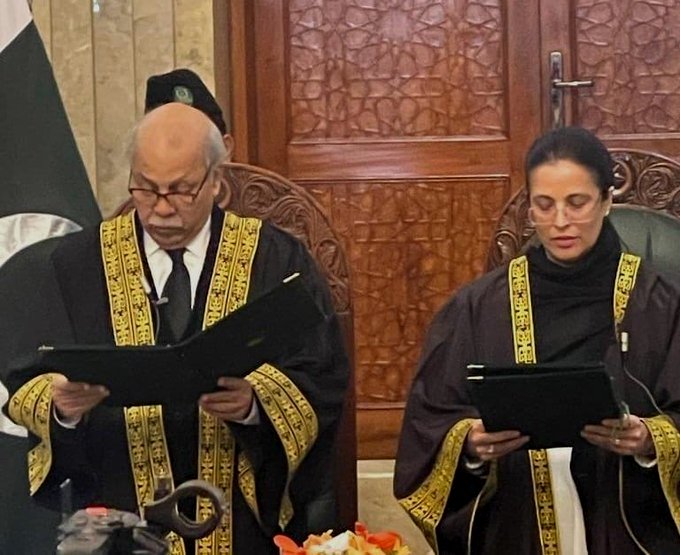
The Remarkable legal career of Pakistan’s first female Supreme Court Justice

After completing her basic education from schools in Paris, New York, and
London, Ayesha Malik earned degrees from the Government College of Commerce
& Economics in Karachi, studied law at the Pakistan College of Law in
Lahore city; then went on to pursue higher studies at Harvard University in the
US, where she was named a London H. Gammon Fellow 1998-1999 for outstanding
merit.

Justice Malik worked at two different law firms before becoming a high court
judge in the eastern city of Lahore in 2012, according to a court biography. She’s
also taught banking and mercantile law at various colleges, served as pro bono
counsel for NGOs focused on poverty alleviation, and contributes to publications
including the Oxford Reports on International Law in Domestic Courts.

This mother of three also authored a number of publications on trade and
financial services, the issue of judicial independence, and Pakistan’s secular
laws.

Known for her integrity and discipline, Ayesha Malik who has also been
credited with rolling back patriarchal legal mores in her Punjab province
jurisdiction was involved in delivering a number of landmark verdicts on major
constitutional issues, including on the enforcement of international
arbitration in Pakistan, declaration of assets in elections and, most
importantly, a ban on carrying out virginity tests on female rape survivors.

Last year, she outlawed the deeply invasive and medically discredited virginity
test used on women who reported being raped or sexually assaulted. Women in
Pakistan struggle for justice in rape and sexual assault cases and the test was
seen as a way for investigating authorities to discredit victims by casting
aspersion on their character.

Though her appointment to the Supreme Court is historic, considering that
it’s coming after 75 years of Pakistan’s independence, the judicial
commission’s move to elevate her has sparked controversy.

The nine-member body that was to confirm her appointment turned down her
elevation to the top court last year. The recent vote was close, with five
committee members opting for her while four were against.

Some lawyers and even judges said her selection was made in violation of
seniority lists, as she was not among the top three most senior judges of the
lower court from which she was elevated. Earlier this month, the Pakistan Bar
Council staged a strike to protest against Malik’s nomination.

“There is no question more representation of women is needed in the
judiciary. Having a woman there is a positive development but we cannot condone
the process through which arbitrary and non-transparent decisions have been
made — not just in this instance but prior to this appointment as well,” Imaan
Mazari, an Islamabad-based lawyer, and rights activist, told DW.

“I don’t think the opposition of the bar should have been made controversial
— it was not specific to Justice Ayesha Malik, nor did anyone question her
competence as a judge. The debate was over the judicial commission’s process,”
said Mazari.

Usama J Malik, a senior lawyer, also told DW that there is a misconception
that the majority of male lawyers in Pakistan have opposed Ayesha Malik’s
elevation to the top court because of her gender.

“Many male lawyers wholeheartedly support her elevation and feel that
there should be more female, ethnic and religious minority members in the
higher judiciary.”

The digital rights lawyer said that despite the latest move, more efforts
should be made to ensure a greater number of female judges in the nation’s high
courts and the Supreme Court.

“There should be an increased focus on promoting women judges from
lower courts to high courts. Malik has been promoted based on merit and there
are many other female judges and lawyers capable of working in higher courts.”

According to the Human Rights Commission of Pakistan, women make up only
about 17 percent of all judges in the nation and less than five percent of
judges in the high courts.

In truth, Pakistan may have been one of the countries on Michelle Obama’s
mind when the former United States First Lady said: “No country can ever truly
flourish if it stifles the potential of its women and deprives itself of the
contributions of half of its citizens.”

In 2005, Hon. Justice Aloma Mariam Mukhtar became the first female justice
of Nigeria’s Supreme Court and Nigeria’s first female Chief Justice of Nigeria
in 2012.

Many have said Justice Malik’s elevation to the Supreme Court of Pakistan
might clear the way for more women to enter the historically conservative and
male-dominated judiciary of the Muslim-majority republic.

“She has broken all barriers in the judicial system and it will allow other
women in the system to move forward,” said lawyer and women’s rights activist
Khadija Siddiqi. “I hope this will lead to more women-centric decisions by the
judiciary in the future.”

In the meantime, Vice-President Yemi Osinbajo has said that the appointment
of judges in Nigeria should be more rigorous. Speaking on Tuesday at the 2022
justice sector summit organised by the Nigerian Bar Association (NBA) and the
Justice Research Institute in Abuja, Osinbajo said it is “stunning” that the
process for evaluation of judges in Nigeria “is one of the least rigorous
processes imaginable”.

The vice-president, who made a comparison between Nigeria and foreign
countries like the United Kingdom, said the appointment of judges should
involve the critical evaluation of candidates.

“In the United Kingdom from where we derive most of the structures of our
judicature, applicants to judicial office in superior courts go through several
screening processes. At some point, it was 17 stages, including written
examinations, interviews, and role-play exercises,” he said.

 “They are subjected to rigorous background investigations covering
professional credentials and abilities, public records, judicial
pronouncements, personal financial affairs, evaluation by the bar association
on integrity, professional competence, and judicial temperament.

“And in the US, Supreme Court appointments involve rigorous public screening
by the senate, which sifts through the entire public and sometimes private
lives of candidates.

“That is the nature of the rigour that anyone who should hold the power of
life and death, and power over other people’s livelihoods, should go through.

 “It shouldn’t be a ‘take a bow’ situation at all. It must be rigorous
because the moment the person is appointed into a high office of that sort;
they are unleashed as it were on the rest of us.”

Relationships (3)

‘Don’t participate in the things these people do.’
Ephesians 5:7 NLT

Letting go of a person doesn’t mean you no longer love them; it just means the relationship is not right for you. How should you handle it? 1) A gradual separation is sometimes the best solution. There are relationships you need to get out of for your own good. But because you have a cord to cut, doesn’t mean that it should be ripped. Dissolving a relationship is stressful, so try to end it graciously. If the cord that binds you is constant phone calls, emails, and visits, that’s a good place to start. 2) Don’t keep going back. Some of us are just so ‘nice’ that we can’t end the relationship and move forward. We keep going back, second-guessing ourselves and re-evaluating our decision. Make it one time, make it right, and make it decisive. Often people will come back to entice you by suggesting you were wrong the first time. That’s why you must resolve any doubt before you make the decision in the first place. If you find yourself in a pattern of going back to old, unhealthy relationships, you may be drinking from the wrong well. You may be trying to fill an emptiness in your heart that only God can fill. When Jesus met the woman at the well, she had been through five failed marriages and was living with man number six. He told her: ‘Whoever drinks of this water will thirst again, but whoever drinks of the water that I shall give him will never thirst. But the water that I shall give him will become in him a fountain of water springing up into everlasting life’ (John 4:13-14 NKJV).

Bible in a Year: Genesis 49-50, Matthew 13:31-58

Credit: The Word For Today.

Relationships (2)

Photo Credit: The New York Times

“He who walks with wise men will be wise, but the companion of fools will be destroyed.” Proverbs 13: 20 NKJV

NOT EVERYONE who starts out with you is capable of going where God wants to take you. Sometimes they don’t have the emotional capacity required. Other times their vision differs from yours. So how can you know when it’s time to exit a relationship? Avoid relationships that leave you depleted. This calls for establishing clear boundaries for the relationship up front. You don’t have time to spend your life straightening out misunderstandings, hurt feelings, and injured egos. How far are you willing to go? How much are you inclined to invest? When you overspend your budget, you go broke. Bankrupting yourself emotionally and physically to make someone else feel needed might sound noble, but it’s not. Emotionally and physically bankrupt people end up with everything from nervous breakdowns to extramarital affairs. And even when they don’t, they fail to reach their God-given destination in life because they’re dragging too much weight. When you feel a relationship is not working, pause and take a look. View the situation objectively instead of emotionally, examining all the facets of it. Sometimes certain aspects of a relationship should be terminated, and other areas maintained. It’s possible to have relationships that work in one area but not in another. Compartmentalizing will save many important relationships because it requires you to see them in sections. It’s possible to remove a section and still have a lot left to enjoy. Yes, it takes work and communication, but it is often worth it. There may be common interests that need to be maintained, while others need to be invalidated before all is lost.

Soul Food Reading: Rom 7:1 – 9:16, Luke 5:12-26, Ps 96, Pro 3: 5-6.

Credit: The Word For Today (Bob Gass Ministries).

Relationships (1)

Photo Credit: HelpGuide.org

‘Can two people walk together without agreeing on the direction?’

Amos 3:3 NLT

Having the right relationships will help you to soar in life; they’re like the wind beneath your wings. But the wrong relationships will drag you down; they’re like a ball and chain around your feet. To know which relationships are good for you and which are not, here are three guidelines: 1) When a relationship is not working,
acknowledge it. Sometimes you must cut your losses. The old saying goes, ‘When you’re in a hole, stop digging!’ Accept the fact that sometimes your efforts are not enough and that you can’t help everyone. Releasing someone doesn’t mean they will never get better; it just means that God is more qualified to help them than you are. 2) There is a difference between helping someone and carrying them. This is particularly so when you’re dealing with a person who always turns to you for help and tries to make you feel guilty when you’re ‘not there’ for them. Don’t try to be someone’s God. Your constant help may actually be a hindrance – you have become a crutch and an enabler. Step back and let them learn to walk on their own. 3) Don’t allow your fear of criticism to restrain your common sense. Here is a fact of life that you must learn to live with: not everyone will be pleased with you! The truth can hurt and often alienate, but it’s still the truth. There are times when you must ‘tell it like it is’ and accept the consequences and disapproval. The only way to avoid criticism is to always say what everyone desires to hear, which is equal to living a lie in a relationship.

Genesis 46-48, Matthew 13:1-30

Credit: The Word For Today.

TIPS