The undergraduate degree in law is Bachelor of Laws (LLB). LLB is spelt LLB or LL.B., never L.L.B.
This strange abbreviation comes from Latin. The Latin word lex means “law.” The plural of lex is legum. Creating an abbreviation for a plural, especially in Latin, is done by doubling the first letter of the noun. An example is cc for copies, and pp for pages, hence LL for laws.
LLB stands for legum baccalaurens, Latin for “Bachelor of Laws.” Your degree is a Bachelor of Laws, not Bachelor in Law, not Bachelor of Law, and not Bachelor of Law and Letters or Bachelor of Law and Logic!
LLM (or more rarely LL.M., but never L.L.M.) stands for legum magister, Latin for “Master of Laws.” Magister is Latin for “master.”
LLD (or more rarely LL.D., but never L.L.D.) stands for legum doctor, Latin for “Doctor of Laws.”
The discipline, law, is already expressed inside these titles. So you cannot have LLB in Law, LLM in Law, or LLD in Law—just LLB, LLM, or LLD. Could it conceivably have been an LLB in Nuclear Physics? Please review your résumés.
JD (Juris Doctor) is the American equivalent of an LLB. An SJD (Doctor of Juridical Science, Doctor of the Science of Law, or Scientiae Juridicae Doctor) is a research doctorate in law. It originated from the US and is offered in that country as well as in Canada.
Just because your law degree is titled a ‘Bachelor of Laws,’ you didn’t “study laws”; you “studied law.”
By the way, folks, the plural of JSC (Justice of the Supreme Court) is JJSC (Justices of the Supreme Court), not JSCs. The plural of J (for Judge) is JJ (Judges); for JCA (Justice of the Court of Appeal), it’s JJCA (Justices of the Court of Appeal).
Honduras swears in Xiomara Castro as first female president | Al Jazeera
Amid a sea of waving flags in the national stadium on Thursday, Xiomara Castro was sworn in as the first female president of Honduras. Her inauguration is a sequel to a landslide victory in the November 2021 presidential elections.
A democratic socialist, Xiomara Castro first seized the political spotlight in 2009 when she led a march through the Honduran capital, demanding that her husband, who was overthrown in a military coup, be returned to power.
Now, the former first lady is has taken center stage as Honduras’ first female president, promising a radical agenda to counter years of governance plagued by corruption and scandal.
Her party, the Freedom and Refoundation Party (Libre) won the vote with a lead of more than 14 points over her nearest opponent, Nasry Asfura, the capital’s mayor and candidate for outgoing President Juan Orlando Hernández’s National Party.
Winning 51% of the vote share and 1.7 million votes, Castro garnered the largest number of votes in the country’s history, underscoring the public’s appetite for change.
The 62-year-old ran on campaign promises to battle corruption (and promised to enlist the United Nations to strengthen that fight), alleviate poverty, and liberalize abortion laws.
Castro slammed the previous administration for leaving her a heavily indebted country where poverty and a lack of opportunity have driven hundreds of thousands of Hondurans to migrate in recent years.
“My government will not continue the vortex that has condemned generations of young people to pay the debt taken on behind their backs,” Castro said.
“We have the duty to restore the economic sector on the basis of transparency, efficiency, production, social justice, wealth distribution, and national revenue,” she said.
The 62-year-old Castro faces high expectations to turn around the deeply troubled country amid uncertainty about whether an unfolding legislative crisis will allow her the support she needs.
Honduras has been engulfed in a dispute over who will lead the newly elected Congress. Two rival congressional leadership teams have been selected — neither legitimately, according to experts — and their standoff threatens legislative paralysis at a time when Castro desperately needs to quickly get to work addressing Honduras’ problems.
Elected lawmakers from Castro’s own Liberty and Refoundation Party-backed one of their own to be the new legislative body’s president Friday rather than support Castro’s choice, who had been chosen to win the support of her vice president’s party. Neither group has backed down, leading to surreal simultaneous legislative sessions Tuesday.
High unemployment, persistent violence, corruption, and troubled healthcare and educational systems are just some of the pressing challenges awaiting Castro.
The U.S., seeing an opportunity to gain an ally in a region where it has few friends, has strongly backed Castro and stands ready to provide support. In a possible sign of tensions in the region, presidents from neighboring El Salvador, Guatemala, and Nicaragua were not scheduled to attend Castro’s inauguration.
Vice President Kamala Harris, who was given the task of addressing the challenge of Central American migration, met with Castro shortly after the inauguration ceremony.
The two discussed “the root causes of migration, combating corruption and expanding economic opportunity,” according to a statement from Harris’ office.
“Vice President Harris welcomed President Castro’s focus on countering corruption and impunity, including her intent to request the assistance of the United Nations in establishing an international anti-corruption commission and commitment to advancing necessary legislative reforms to enable such a commission to succeed,” the statement said.
Washington sees areas for cooperation on Castro’s priorities of battling corruption and increasing economic opportunities in her country, two areas that could affect decisions by Hondurans on whether to stay or try to migrate to the United States.
“Honduras has been a very difficult partner for the United States, especially during the administration of Juan Orlando Hernández, for a number of reasons, including the consistent swirl of illegal activity around him and his family,” said Jason Marczak, senior director of the Adrienne Arsht Latin America Center at the Atlantic Council.
“The anti-corruption agenda being front and center and her [Castro’s] pledges is music to the ears of the Biden-Harris administration, given its focus on rooting out corruption not only in Central America but its global efforts on corruption,” he said.
On Thursday, Castro reaffirmed her plans to formally invite the United Nations to set up an anti-corruption mission in Honduras. That would be welcome by Hondurans like 22-year-old José Manuel Suazo, who waited for Castro’s appearance inside the stadium. He said he voted for Castro and believes many other young people did too because he wants her to attack corruption and end impunity.
Castro won on her third bid for the presidency. She was previously the first lady during the presidency of her husband, Manuel Zelaya, which was cut short by a military coup in 2009.
On Thursday, just hours before her inauguration, Castro announced her Cabinet picks via Twitter. There were two women out of 16 announced positions. Her son Hector Zelaya will be her private secretary, and Manuel Zelaya’s nephew, José Manuel Zelaya, is her choice for defense secretary.
Ramón Sabillón, a former National Police chief, who recently returned after years living in exile in the United States, was her pick for security minister.
In her speech, Castro gave him a lengthy to-do list including guaranteeing “citizen security, no more death squads, no more silence on femicides, no more hired killers, no more drug trafficking, no more organized crime.”
Many voters this time said they were motivated above all by the possibility of removing Hernández’s National Party from power. Hernández was first elected in 2013, and a friendly Supreme Court allowed him to overcome a constitutional ban on reelection and run again in 2017 in an election plagued by irregularities.
Federal prosecutors in New York have repeatedly spoken of Hernández’s purported ties to drug trafficking, alleging that his political rise was funded in part by drug profits. Hernández has not been formally charged and has repeatedly denied the accusations.
On Thursday, U.S. Rep. Norma Torres (D-Pomona) said in a statement that she had asked Atty. Gen. Merrick Garland to see that Hernández was indicted and extradited to the U.S.
“President Hernández has been a central figure in undermining the rule of law in his own country and in protecting and assisting drug traffickers to move their materials through Honduras and to the United States,” Torres said. “He has been repeatedly identified as a co-conspirator in other drug trafficking cases and has caused incredible pain to both the people of Honduras and the United States. I believe it is essential that the United States hold him accountable for his criminal behavior.”
On Thursday afternoon, Hernández was sworn in as a representative of Honduras to the Central American Parliament, a traditional transition for Central American ex-presidents that affords them immunity from prosecution.
The Guatemalan representative on the regional body, Amilcar Pop, confirmed Hernández’s swearing-in, but said he withdrew from the virtual session because “I am against his swearing-in, that he’s given immunity.”
On Thursday, 48-year-old Carlos Hernández lugged a nearly life-size Castro piñata through the streets near the stadium before the inauguration.
“This is now or never,” Hernández said. “I do this out of conviction; we want our president to not fail us.”
He and his family came because he wanted Castro to feel she had the support of the people. “I had never even voted, but I was sick and tired of the National [Party].”
The Peanut Gallery
Morning Prayer: 12 Jun – Proverbs 12:18 ~ speak a word of healing – The Peanut Gallery
I would strengthen you with my mouth.
Job 16:5 NKJV
Even when a surgery is successful, the patient can carry within them scar tissue that causes lingering pain and discomfort. And it’s the same in life. Some people around you wear a mask of success, but within, they carry wounds they’re unable to talk about.
Comedian Jonathan Winters said in an interview that his life was scarred by cruel things his parents said to him as a child. ‘I’m no cry-baby, but I remember things with almost total recall—there’s a lot of pain there
.’ His father said to him, ‘ You’re the dumbest kid I know .’
And when he joined the Marines and travelled to the South Pacific during World War II, he received no support from his mother. When he returned home, he discovered she had given away his special, personal things he had stored in the attic. He was distressed, but her reaction was, ‘ How did we know you were going to live? ’
Winters went on to become one of the world’s most popular entertainers and comedians, but the emotional scar tissue remained.
Understand this
Your words can wound or heal .
They can inspire someone or reinforce their sense of failure and worthlessness. Job, who suffered greater loss than most of us will ever know, said, ‘ But I would strengthen you with my mouth, and the comfort of my lips would relieve your grief .’
( Job 16:5 NKJV )
How can you help someone who is hurting? By giving them your opinion? No, by giving them the only opinion that matters—God’s!
And here is what God says, ‘ I have loved you with an everlasting love; therefore with loving-kindness I have drawn you .’
“My names are …” is awful, harmful, hurtful, painful, and sinful English.
“My names are …” is mangled grammar on steroids.
The English language comes from England. There, everybody, from Cambridge to Oxford, from Fleet Street to High Street, from the law firm to the marketplace, says “My name is ….”
Today, the major dialects of English are American and British. In America, from Harvard to Yale, from Main Street to Wall Street, from the corporation to the foundation, everybody says “My name is ….”
I challenge you to find one respectable source from any jurisdiction that uses the construction “My names are ….”
Back home in God’s home country Nigeria, the best authorities on English language, from Justice C. C. Nweze to Justice B. B. Kanyip, from Kayode Sofola SAN to Olisa Agbakoba SAN, from Chimamanda Adichie to Wole Soyinka, from Farooq Kperogi to Prof Ben Nwabueze SAN, from Chinua Achebe to Chinua Asuzu, all say, “My name is ….”
In my angelic Igbo language, the expression is “My name is …,” no matter how many names the person has.
Your several names make up your one full name, your one identity. Your full name, no matter how many constituents it has, is a singular noun phrase, not several discrete nouns. The subject (“name”) and linking verb (“is”) must both be in the singular.
Saying “My names are …” is akin to saying “I are …”! If you say “My names are …”, you’ll need to insert commas between the several names, and you’ll need a conjunction before the last.
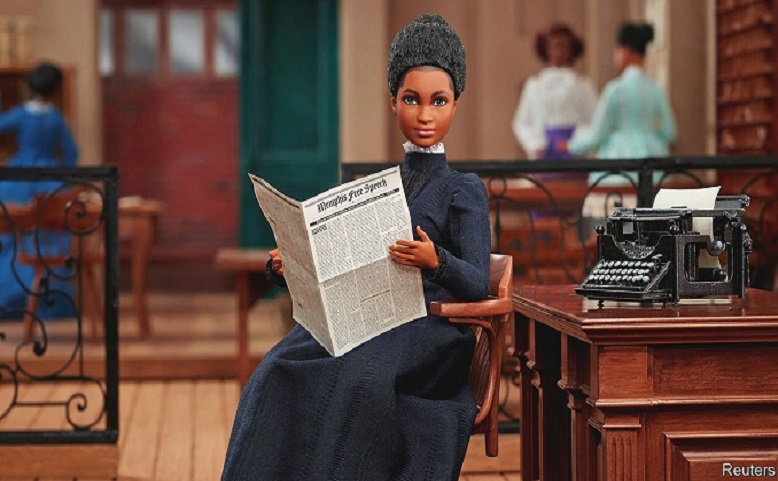
A new Barbie doll commemorates a 19th-century suffragist | The Economist
Did you know that over half a century before Rosa Parks refused to give up her bus seat, Ida B. Wells was removed from a train for refusing to move into a segregated carriage?
Ida Wells, a skilled writer, and journalist was born into slavery in Mississippi in 1862 during the Civil War. She was an activist and researcher who exposed the horrors of lynching and co-founded the National Association for the Advancement of Coloured People (NAACP).
Wells battled sexism and racism across the late 19th and early 20th centuries, founding the National Association of Coloured Women’s Club. She was posthumously awarded a Pulitzer Prize in 2020.
Now the American toy company Mattel is honouring her in a Barbie doll. The doll clutches Memphis Free Speech, the newspaper she co-owned. Other women Mattel is honouring include Sally Ride, an astronaut, and Maya Angelou, the author who became the first black woman to appear on the quarter coin.
“When I see the same enormities practiced upon beings whose complexion and blood claim kindred with my own, I curse the perpetrators and weep over the wretched victims of their rapacity. Indeed, truth and justice demand from me the confession that the Christian slaves among the barbarians of Africa are treated with more humanity than the African slaves among the professing Christians of civilized America; and yet here sensibility bleeds at every pore for the wretches whom fate has doomed to slavery.” Such testimony would seem to furnish” ― Ida B. Wells-Barnett, Slave Narrative Six Pack 4 – The History of Mary Prince, William W. Brown, White Slavery, The Freedmen’s Book, Lucretia Mott and Lynch Law
LAGOS – Real estate giant and Chairman of Property World African Network (PWAN Group), Dr. Augustine Onwumere, has advised property investors to leave no stone unturned until they have procured requisite title documents for their landed properties.
According to Dr. Onwumere, possession of title documents issued by relevant government agencies is the only way a property owner can enjoy the full benefits of owning a property.
The real estate guru gave the counsel, at the unveiling of PWAN Land Acquisition and Title Procurement Ltd, by PWAN MAX Property and Business Solutions, a member of the PWAN GROUP, in Lagos recently. He said: “As a real estate marketing, investment, management, and Development Company with over ten years of robust corporate experience, we have come to realise that property investors need to be educated on the need to own government recognised titles documents.
“We also understand that a lot of people do not enjoy the full benefits of owning a property. For instance, many do not know that they can avoid unnecessary disputes, enjoy zero interference from customary landowners, and use title documents as collateral to secure loans.
A title document makes it possible for a property owner to enjoy value appreciation, facilitates easy transfer of title, ensure property security, and easy access to government compensations when necessary.”
He also pointed out that a land title is a legal document that serves as evidence or proof of land ownership. “One does not fully own land until a title is registered with the government. Invest smartly, procure your land title document and secure your land,” Dr. Onwumere further advised.
The company’s Business Development Executive (Title), Engr. Charles Ofoegbu, however, assured prospective property investors that PWAN Title Procurement Ltd was set up to help interested investors procure title documents.
“We are here to tell you that registering your land titles shouldn’t be a big deal. Our mission is to make the process easy and affordable. And our overriding goal is to promote and give the best value to our clients at all times,” Engineer Ofoegbu added.
Dr. Onwumere noted that the land use act of 1978 abolished the previously existing land tenure systems and replaced them with a uniform land administration system across the country.
He identified four stages of land titles under the act as follows: Excision, which he said is the process whereby the government releases a portion of land that is considered free to the host community. “Excision properly published in government gazette is a good document to ascertain that a portion of land is not under acquisition,” he explained.
The next level, he said is Gazette; an official record book that spells out details of an expanse of land excised and given back to the community. The excision document is usually taken to the Surveyor General’s office for publication in the gazette.
“Certificate of Occupancy, popularly known as C of O, is an official land document given by the state or federal government, which leases land to individual owners for a period of ninety-nine (99) years. It is one of the most popular property documents or titles in Nigeria.
“Then there is the Governor’s Consent. Where a person with C of O decides to sell land to another person, the government’s consent must be obtained before that transaction can be valid. This process continues every time the property changes hand.
“The entire process could take a rigorous period of up to six months to be perfected. Hence, I advise interested property owners to feel free to approach PWAN Land Acquisition and Title Procurement Ltd, for easy and seamless title procurement,” Dr. Onwmere said.
When General Ibrahim Badamasi Babangida [IBB] became Nigeria’s President and Head of State on 27th August 1985, a group of his friends came together under the Chairmanship of Chief (Dr.) Ernest Shonekan to offer advice or counsel on a range of issues then bedevilling the Nigerian economy and society.
Chief Maan Lababidi – Chairman, Crown Flour Mills Limited
Captain Wole Buknor – Nigerian Navy
Chief Joe Obuseh – Nigerian Security Organisation.
The ninth member was a Brigadier in the Nigerian Army. He later became the Chief of Army Staff and subsequently National Security Adviser.
We provided selfless advice across a broad range of issues – deficit in Public Trust; the floundering economy; the lingering/festering political crisis; the crumbling financial system; simmering ethnic/religious rivalries; and safety of lives and property as well as health; education and infrastructural challenges. We urged the government to fix the four oil refineries and launch mass transit in Lagos, Kano, Port Harcourt and Abuja. We were also concerned about the jobless and the homeless. Hence, we pushed for agriculture as the salvation. The message we consistently delivered was that the liberalisation of the economy and the empowerment of the private sector were of paramount importance and compelling urgency. Additionally, we championed the cause of Small and Medium-sized enterprises [SME’s] as the backbone of the economy.
Nobody was paid for his / her services regardless of the long hours (sometimes stretching late into the night).
It was a period of glorious service to our beloved nation and all of us (without exception) foreclosed on political appointments – as Ministers, Ambassadors, Chairmen of juicy government parastatals etc or financial rewards such as oil blocks, banking licences; import licences; allocation of foreign exchange; contract award etc. We served because we were called to serve at a time when the nation was in peril. Hence, we strove to reconnect our beloved nation, Nigeria with civilization. We derived inspiration from the stirring command of the old National Anthem:
“Though tribe and tongue may differ…………..”
Our Mission was to galvanize entrepreneurship as the counterforce to our pathetic dependence on oil. Our nation’s mono-economy was clearly unsustainable.
For me, it was quite a revelation when late Senator Onyeabo Obi repeatedly alleged that I had been promoting IBB as the next Head of State through “The Gold Medal Lectures”. Furthermore, Colonel DotunGbadebo (now His Royal Highness Oba Oba Adedotun Aremu Gbadebo, Okukenu IV, Alake of Egbaland) who had served as Principal Staff Officer to Major-General TundeIdiagbon, Chief of Staff, Supreme Headquarters confirmed recently without mincing words that had the Babangida coup d’etat failed, I would have been roped in !!
The gospel truth is that the Gold Medal Lectures were meant to bring both government officials and the captains of Industry and Commerce together to deliberate on economic and financial matters. Period.
However, to further compound matters, shortly before the coup d’etat I was the Guest Speaker at the Chief of Army Staff Conference in Minna, Niger State at the invitation of then Major-General Babangida, Chief of Army Staff. Colonel David Mark, Governor of Niger State was the Chief Host with late Brigadier-General Anthony Ukpo as the Master of Ceremonies. The only other civilians who attended were Chief M.K.O. Abiola and Professor IsawaElaigwu of the Nigerian Defence Academy, Kaduna. I had no inkling that a coup was in the offing. Maybe Chief Abiola and/or Professor Elaigwu were in the know. !! It turned out that the conference was only a smokescreen or decoy.
It was when then Brigadier Joshua Dongoyarofollowed by GeneralSaniAbachaannounced IBB as the new Head of State – at Bonny Camp Military Cantonment, Victoria Island that I recognised the faces that were prominent around the new Commander-In-Chief, General Ibrahim Babangida. They were all there in Minna – Colonel RajiRasaki;Major Abdulmumuni Aminu, General Sani Abacha, Brigadier Aliyu Mohammed (head of military intelligence), Navy Commander Murtala Nyako, Lt-Col Ahmed Abdullahi (Minister of Communications), Lt-Col Tanko Ayuba (commanding officer – Nigerian army signal corps), Lt-Col John Shagaya (commanding officer – 9th mechanised brigade, Ikeja), Brigadier-General Anthony Ukpo, Major Abubakar Umar (Administrator of the Federal Housing Authority).
That was when the penny dropped. In the course of delivering my lecture, I had placed myself in mortal danger. Major-General Ibrahim Babangida was 44 years old and I was approaching my 42nd birthday.
The Almighty has been uncommonly faithful.
Chief (Dr.) Shonekan demonstrated outstanding leadership which left no room for conflict of interest; for reputational damage or doubtful integrity. We played no part in his emergence as the Chairman ofthe Transition Committee or Head of the Interim Government; or the events that ensued thereafter. Now that the Chief has departed, may his soul find peace in the bosom of the Almighty who we beseech to grant Chief (Mrs) Margaret Shonekan and the family the fortitude to bear the painful loss of their beloved patriarch.
I am inexplicably happy that a delegation of Haitians are reportedly in Enugu at the moment to trace their Igbo roots.
I have read somewhere that many Haitians have Igbo roots and that nowhere is Igbo culture deeply embedded in all of South America as in Haiti. I also read about the Igbo presence in Jamaica. In fact, a certain Jamaican lady in Awka once told me that the first time she saw me, she stiffled a scream. I am a spitting image of her father back in Jamaica🤣. She said it took her a while to believe that I was not her father.
I think I am fascinated by the decision of the Haitians to look into the dark tunnel of painful history. I think we should reciprocate this gesture by establishing robust cultural ties with Haiti and Jamaica. Some years ago, Chinua Achebe delivered a lecture to mark the 200 years anniversary of the end of the Trans Atlantic Slave Trade in Jamaica. It was historic. It was a great beginning that was never sustained.
This is not one of those ideas where everyone waits hands akimbo for the government. Igbo cultural groups like Ohaneze, Aka Ikenga and Mkpoko Igbo can lead this initiative.
Umu nnem, nno nu o! May the spirits of our ancestors give you the light you seek.
To investigate the working conditions of Nigerians employed at Chinese-run quarries in the Obafemi-Owode area of Ogun state, SODIQ OJUROUNGBE disguised as an agent to get into the premises, where he uncovered anomalies, ill-treatment and flagrant disregard for labour laws.
Jacob Adeoti, who has worked at Ding Xing Quarry since 2016, once had a finger chopped off by a machine. In spite of his condition, he couldn’t leave the job due to the uncertainty of getting another one. He has since accepted his fate even though he does not earn up to the N30, 000 minimum wage.
Adeoti, a bricklayer and father of two, was paid N600 daily at the quarry between 2016 and 2020, after which his pay was increased by N100. Although his remuneration is significantly low, 30-year-old Adeoti cannot return to his hometown in Ilara in the Yewa area of Ogun because making meagre daily money is better than sitting idly at home for weeks without getting a bricklaying job.
Jacob Adeoti resting after a hard day’s work.
Like Adeoti, several casual workers employed at Chinese quarries in the state are subjected to inhumane conditions, with some getting disabled as a result of accidents that happen while on duty — and they are ultimately left to their fate.Advertisement
‘WORKING IN HELL’
Workers at Ding Xing, Xiyuan Quarry and A & B Quarry grapple with issues of poor welfare, poor remuneration, and lack of personal protective equipment (PPE).
Eight out of 10 workers interviewed at the quarries say they are not provided with the necessary safety kits to protect them from possible accidents during working hours.
A worker at Ding Xing Quarry, who identified himself as Solomon, said efforts have been made to implore the company to provide PPEs for them but the request is always ignored.
“I have been working in the quarry for two years. We are not being treated well at all. We are treated like slaves,” he said.
“We work under dangerous circumstances; there are no provisions of personal protective equipment such as helmets, face masks, boots, and reflective jackets. We have many people that have lost their limbs, legs in the process of working at the company. There are no PPEs to protect us from danger.”
Solomon lamented that the employers “don’t have regard for us and they don’t care if we die or not”.
DEATH, ACCIDENTS AT THE QUARRIES
A worker identified as Femi was said to have died after an accident took place at Xiyuan quarry in Kobape on October 3, 2020.Advertisement
Femi, riding a motorcycle, was returning from the residential area of the quarry where he had gone to drop off one of the Chinese operators. Unable to see clearly due to the haze of dust, he collided with an oncoming truck.
Picture of Femi taken after the accident
A worker who spoke on the condition of anonymity said Femi sustained an injury on his head and gave up the ghost before getting to the hospital.
“Femi will still be alive if only there were PPEs here, he hit his head on the ground and that would not have happened if he was putting on a helmet,” he said.
Olamide Babatunde, a former worker at Ding Xing, lost a leg and “his manhood” while handling one of the machines at the quarry in July 2020.Advertisement
For five months, he was bedridden, and although the company paid his medical bills, no form of assistance has been provided for Babatunde since he left the hospital, despite working with the company for about five years.
Babatunde was involved in an accident that not only resulted in the loss of a limb but also rendered him impotent.
“I was in the hospital for almost five months and they visited me just once. Apart from the hospital bills they settled, I have not heard from them again. Whenever we go there, they keep posting that they will settle me soon. I have lost everything as I cannot impregnate any lady because I lost my manhood to the accident, according to the doctors,” he said.Advertisement
SLEEPING LIKE A ‘RAT’
Although many of the quarry companies provide accommodation for workers, the rooms were found to be overcrowded and in bad shape. At Ding Xing, some workers sleep on the floor while others construct makeshift beds out of cartons placed on a wooden base.
The experience at Xiyuan Quarry is reportedly worse, with some workers disclosing that they kill snakes inside their rooms almost every week. One of the workers said due to the open ceiling and bad doors of the rooms, snakes easily gain access.
“The rooms here are the worst, I am not sure a dead man can sleep here peacefully without complaining,” he said.
“About two days ago, I killed a snake inside my room. We sleep on a bare floor, no ceiling, no good doors. The state of the rooms here are the worst and it is just unfortunate that we have no choice.”
Front view of workers quarters at Ding Xing.
Many workers who spoke with this reporter were employed on casual contracts, which implies that they are not entitled to any other benefit apart from their wages which range between N600 and N900.
Despite working in harsh conditions, the workers said the Chinese operators do not give a second chance to any Nigerian worker who errs on the job.
Workers who may also want to protest or those seen as “activists” are immediately fired. A worker explained that anybody who tries to agitate for better working conditions is immediately sacked.
“They don’t tolerate any act of disobedience, if they know I am giving you information about this place, they will sack me immediately,” the worker said on the condition of anonymity.
“No matter what you do for them, no matter how many years you have spent with them, they will never give you a second chance, if you go against the rules, they will fire you.”
LAWYER QUIT DUE TO ‘INJUSTICE’
Section 12 of the labour act (2004) demands that an employer takes responsibility for personal injuries sustained by its workers while on the job.
Apart from the fact that the conditions of workers at the quarries are in violation of the labour laws, it was also discovered that hazard allowances are not paid to them.
Inside a room at Xiyuan Quarry.
Habeeb Whyte said he had to step down as a lawyer to some of the Chinese companies as his “mind could not take being on the side of injustice”.
After several futile attempts by Whyte to ensure the Chinese operators improve the welfare of workers, the lawyer said he quit.
Entrance of A & B Quarry.
“I was a counsel for them. I really consulted for them. It is like somebody asking me questions like how do we do it, and any other thing. I told them the way and manner to follow and what to do,” he said.
“But because they know that people like me will not bend to their illegality, so these companies went to obtain some license through the backdoor because they know that in Nigeria, anything can happen.”
After dumping the Chinese operators, the legal practitioner switched to the other side; he became an advocate of some workers seeking to get justice in their fight for better conditions.
“When I saw the letter of appointment of a client I intended to handle, I was even the one that advised him not to take legal action against them,” he said.
“The condition is just too stringent and so many of those workers don’t look at it before they sign it. They don’t read the terms and conditions of the work very well before signing.
“Imagine in a letter of agreement, the employer said he can send a worker away at any time without prior notice and you as a worker agree to that.”
EFFORTS OF LABOUR UNIONS
The Ogun state chapter of the Nigeria Union of Mine Workers (NUMW) has, more than once, engaged quarry companies to provide PPEs and good conditions for workers, but their engagements were only met with empty promises.
Tunde Shoneye, spokesperson of NUMW, alleged that the Chinese operators have Nigerian collaborators who advise them not to do things the right way.
“We have been on the issues of PPE provision for these workers for more than two years,” he said.
“We have been negotiating with the quarry management, that they should provide PPE for the workers… but they are not ready to do it.
Inside the room at Xiyuan Quarry.
“In any decent work, safety is foremost and if anybody would want to do anything at all without considering safety, such a person is writing to death.”
On remuneration, the NUMW spokesperson said the union had signed a memorandum of understanding with the companies in a bid to obtain better welfare packages for the workers.
Emmanuel Bankole, the Nigeria Labour Congress (NLC) chairman in the state, spoke of the efforts made to get the Chinese operators to do the needful.
“Because of the way Nigerians are treated, we have had cause to take about two to three of them up at certain times. I think about two or three lives have been lost through negligence because there was no PPE,” he said.
“It is a pity we have not been receiving cooperation from the mine officers at the federal ministry of mines in the state. We have to take them to the commissioner for trade and investment in the state and the woman really berated and condemned their attitude and warned them seriously. So, we are not folding our arms, but you know, we act on information, when we get one, we pick it up.”
Efforts to get Kikelomo Alonge, the commissioner for trade and investment, to speak on the development proved futile while Waheed Odusile, commissioner for information, said he did not have the right answers to the questions.
“I have not been able to get the right answers to your questions, you will need to hold on,” he said.
Twice, the reporter visited the Ogun state office of the federal ministry of mines but was told that “the official to speak on the matter was not around”.
This is a special investigative project by Cable Newspaper Journalism Foundation (CNJF) in partnership with TheCable, supported by the MacArthur Foundation. Published materials are not views of the MacArthur Foundation.
Pubs, popularly called beer parlour, is a thriving business in Nigeria which attracts patronage from a huge number of clients on a daily basis.
A trip to some beer parlours in Lagos by the News Agency of Nigeria (NAN) on Thursday revealed that men are the major customers compared with women.
Research has also shown that most men who do white collar jobs dominate the beer parlours.
However, some of their opinions are far away from the thinking of what most men go there to do.
Most women think probably it is where their husbands take girlfriends to for relaxation and fun.
Some others who usually visit joints after work told NAN that the purpose of doing so was to relax and get relieved of tension.
Mr Saulam Ola, who usually visits a beer parlour in Ikorodu area of Lagos, said that he visits there to cool off from work stress before going home to face another family stress.
“I prefer to stop over at beer parlour so that my wife and children would have slept before I get home.
“Whenever I get home on time my family issues will be giving me stress. So, I prefer to stay out late in beer parlour,’’ he said.
Another business man, Mr Thomas Ojo, told NAN that he visits beer parlour to probably mingle with the right people to discuss the happenings both at home and abroad.
“I usually go there to mix up with people of different calibre and status in order to know the happenings around me.
“We discuss politics to catch up with the happenings in the country, so that we get the update of issues.”
“If I decide to go home straight, there may be no light or probably my generator might be faulty and I won’t be able to listen to news,” Ojo said.
Also, Mr John Taofeek, said that drinking beer makes him forget his problems because it provides him happiness.
“I will rather go to beer parlour to drink before going home so that I can forget my problems; beer gives me happiness, especially the ones with alcohol.
“Ordinarily, if I go home straight I will be thinking of bad things,” Taofeek said.
According to Emma Noel, a businessman, going to beer parlour is because of his love for beer and nothing else.
“I don’t have issues at home, but the truth is that I must branch at a beer parlour to drink and have fun,’’ Noel said.
Mr Aliu Jimoh, an artisan, said he prefers to stop over at beer parlour before going home because he does not have a peaceful home.
“I stop at beer parlours to avoid troubles at home. My wife is the nagging type who picks up quarrel with me at any given time.
“I do not always want to go home early so that there won’t be issues; I always drink beer to stupor in order not to listen to her nagging,’’ he said.
Mr Moses Matthew said he stops at beer parlours to drink before going home to avoid paying more bills at home.
“When I get home early my children will bring unnecessary bills on my table, even my wife will be telling me of the “aso-ebi” she wants to buy.
“I go to beer parlour to drink in order to get home late and by the time they wake in the morning I would have gone out.
Our site uses cookies. By clicking “Accept All Cookies”, you direct Law and Society Magazine to store cookies on your device and disclose information in accordance with our Cookie Statement: cookie policyACCEPTREJECT
Privacy & Cookies Policy
Privacy Overview
This website uses cookies to improve your experience while you navigate through the website. Out of these cookies, the cookies that are categorized as necessary are stored on your browser as they are essential for the working of basic functionalities of the website. We also use third-party cookies that help us analyze and understand how you use this website. These cookies will be stored in your browser only with your consent. You also have the option to opt-out of these cookies. But opting out of some of these cookies may have an effect on your browsing experience.
Necessary cookies are absolutely essential for the website to function properly. This category only includes cookies that ensures basic functionalities and security features of the website. These cookies do not store any personal information.
Any cookies that may not be particularly necessary for the website to function and is used specifically to collect user personal data via analytics, ads, other embedded contents are termed as non-necessary cookies. It is mandatory to procure user consent prior to running these cookies on your website.