Days ago, an Upper Area Court in Gwagwalada, Abuja, sentenced a 19-year-old student, Hillary Yunana, to four months imprisonment for stealing noodles from a shop. Charged with housebreaking, and theft, the judge, Sani Umar, sentenced Yunana after he pleaded guilty to stealing seven packets of spaghetti, five packets of Indomie noodles, and a cash sum of N10, 000, all valued at N13, 000.
The prosecuting counsel, Abdullahi Tanko, told the court that Yunana contravened the provisions of Sections 346 and 287 of the Penal Code when he broke and entered the shop belonging to Gift Ugochukwu, of the same address on March 4, 2022.
Conversely, in the case between the Economic and Financial Crimes Commission, EFCC and a former Caretaker Chairman of the Ogori/Mangogo Local Government Area of Kogi State, Gabriel Daudu, who was accused of laundering N1.4bn belonging to the state, for instance, bagged two years in jail after Justice Inyang Ekwo at the end of a six-year trial pronounced him guilty on 77 out of the 208 counts.
The cumulative amount laundered in the proven 77 counts was determined by the judge to be N98m. As punishment for his offence, Justice Ekwo sentenced Daudu to two years imprisonment on each of the 77 counts, which added up to 154 years imprisonment. However, since the judge said the sentences would run concurrently, Daudu was actually sentenced to only two years in jail. In the meantime ordinary Nigerians are either frustrated by crime and insecurity or frustrated into crime by harsh economic realities, leading to the congestion of prisons.
Stories of how the rich in Nigeria get a slap on the wrist over mindboggling theft of public funds abound. Alluding to this assertion, rights activist, Femi Falana, SAN, at a public event once condemned the Nigerian bar, the bench the criminal justice system for working in favour of the rich as against poor Nigerians. Falana who accused the anti-graft agencies in the country as being part of the problem stated that “By virtue of section 17 (2) (a) of the Constitution of Nigeria 1999 (as amended), every citizen shall have equality of rights, obligations, and opportunities before the law.
“But in practice, the rich and poor defendants are not treated equally by Nigerian courts. Apart from the fact that rich litigants have the means to hire the services of the best lawyers in any area of the law, the courts are manned by judges who are not neutral in the class struggle being waged daily by the Nigerian people.”
A 25 July 2020 Editorial by Viewers Corner News puts it this way: “The children of those you victimised because they have no bargaining power to fight their cases would not let you have peace as long as you favour only those with bargaining power. [Most] politicians in Nigeria who stole billions of Naira thereby crippling the economy of the country (Nigeria) were given lesser sentences which involve an option of a fine. Most of those corrupt politicians prefer the option of a fine method than going to prison which they paid instantly after a guilty verdict has been pronounced on them but those who stole little were given longer jail terms without any option of fine. …[Their] actions, stealing billions of Naira is the reason Nigeria is almost grounded… In some countries of the world, embezzling such a huge amount of money attracts a death sentence…”
It is interesting to note that while prisons are shutting down across Europe, Nigeria’s Federal Government is set to launch six modern custodial facilities in the six geo-political zones in the country. The Minister of Interior, Rauf Aregbesola, stated this while inspecting the on-going Model Maximum Security Custodial facility project, Janguza, Kumbotso Local Government Area of Kano State. Mr. Aregbesola said the project was part of programmes initiated by President Muhammadu Buhari to reform the correctional service.
Netherland for instance has closed many of its prisons. The drop in the country’s crime rate in part explains why the Netherlands’ prisons are emptying. A 2016 government study on capacity also noted that a focus on sentencing, with both an increase in shorter sentences and examining how crimes impact society, have helped reduce the prison population, says Wiebe Alkema, spokesperson at the Ministry of Justice and Security. The Netherlands now has just 61 prisoners per 100,000 people in the general population, ranking among the lowest in Europe.
Dutch criminology researchers for years have pointed to the effectiveness of alternative sentencing. In 2013, Hilde Wermink, assistant professor of criminology at Leiden University, and colleagues concluded in their research that imprisonment is not an effective way to reduce crime, adding that longer prison sentences, in particular, are not leading to lower crime rates.
They observed that both community service and electronic monitoring yield better results. Although the latter is sometimes seen as a softer punishment, Wermink and colleagues found it actually decreases re-offending rates. A 2015 study compared detainees in Belgium with sentences of between six months and three years and found that the subjects who completed their sentence at home wearing detectable ankle bracelets were less likely to re-offend than peers who had completed their sentence behind bars.
Similarly, Norway is said to have moved away from a punitive “lock-up” approach and sharply cut reoffending rates. The borgenproject.org reports that since the 1990s, Norway’s prison system has evolved into spaces that represent comfort, healing, and inclusivity. “Changing its approach and attitudes towards prisoners, Norway is moulding high-functioning members of society. In return, former prisoners are gaining the necessary skills in order to contribute to Norway’s economy.
“As of 2014, Norway’s incarceration rate was at only 75 per 100,000 people. In addition, since developing its new prison system in the 1990s, its recidivism rate has decreased from around 60-70% to only 20% in recent years. The main reason for these statistics is due to a focus on “restorative justice,” an approach that identifies prisons in the same category as rehabilitation facilities. Rather than focusing on the punishment and mistreatment of its prisoners, Norway has the primary goal of reintegrating its prisoners as stable contributors to communities.”
John Mrabure, an Acting Comptroller-General of the Nigeria Correctional Service (NCS), at an event last year said the overcrowding Correctional Centres remain a major problem confronting the service. Speaking at an event organised by Prisoners Rehabilitation and Welfare Action (PRAWA) in Abuja, Mrabure said staff of the service are not acquainted with the full provisions of the NCS Act 2019, which provides for non-custodial sentencing. He added that its personnel requires training to grasp the full potential of the law. Non-custodial sentence is a punishment given by a court of competent jurisdiction that does not involve a prison term. Likewise, Tunde Oladipo, Deputy Comptroller-General of Corrections/Non-Custodial Directorate, who also spoke at the event, blamed the directorate’s inability to fully implement the non-custodial sentencing on the paucity of funds. He asked stakeholders to assist the directorate with funding to enable the department to carry out its mandate.
A couple of weeks ago, the Chief Judge of Katsina State, Hon. Justice Musa Danladi Abubakar revealed that 80% of the inmates in Katsina State’s Correctional Centres are mostly those awaiting trials since 2016. He said this is due to the non-performance of the justice ministry as well as an inadequate number of legal personnel from the ministry to handle cases. Justice Abubakar, who made the above disclosure in his office in Katsina while receiving the newly appointed Katsina State Commissioner of Police, Idris Dabban, and his team, further blamed the State’s Ministry of Justice and its personnel, whom he said are mainly politicians who pay lesser attention to judicial duties.
He said, “If the Attorney-General is there all the time, the OC Legal will have his work cut out. Unfortunately, some technicalities that often emanate from the Justice Ministry often take over and cause delays. The Commissioner of Police, the Director of Public Prosecution, and the Attorney-General ought to sit down regularly to iron out pending issues.”
And so while countries in the West are striving to embrace global best practices, shutting down prisons, reforming and rehabilitating their citizens, Nigeria is still struggling to understand the value of human lives.
As InterSociety calls for independent audit of Obiano’s Government
“Peter Obi Government left total cash deposits of N75B, borrowed debts of N12.2B, and investments worth over N27B in eighteen quoted companies. The Obi Government also cleared over 95% of the inherited retirees and active workforce benefits amounting to over N35B.” – InterSociety
No slap known to man has so reverberated across the nations like this one.
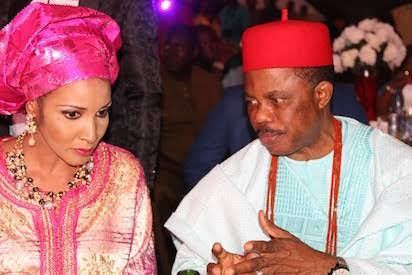
But, as former Governor Willie Obiano was battling emotions following the slap dealt his wife Mrs. Ebelechukwu Obiano by Nigeria’s former Ambassador to Spain and widow of the late Chukwuemeka Odumegwu Ojukwu, Bianca, at the swearing-in of Prof. Charles Soludo in Awka, as Governor of Anambra state, further heartbreak befell him when officers of the Economic and Financial Crimes Commission, EFCC arrested him at the Lagos International Airport, on his way out of the country.
While the EFCC sources claim, Chief Obiano was arrested for misappropriating N5bn Sure-P and N37 billion Security Vote funds, which was withdrawn in cash, the International Society for Civil Liberties and Rule of Law (InterSociety) has called for an independent audit of his Government over claims that under his administration, “N1.61trillion was generated and lavishly spent, N140B borrowed and owed, 1trillion lost to criminal state agents and their revenue collectors in criminal toll collections,” as well as “tens (if not hundreds) of billions of naira contract debts and retirees unpaid emoluments…”
InterSociety in a statement sighted by Law & Society Magazine made weighty allegations. A part of the statement signed by its Board Chair, Emeka Umeagbalasi, Head, Democracy and Governance Chinwe Umeche, Head, Civil Liberties and Rule of Law Obianuju Igboeli, and Head, Campaign and Publicity Chidimma Udegbunam reads:
N1.61Trillion Generated And Lavishly Spent Under Obiano In Eight Years:
The major working documents in this special report are the budgets of the Government of Anambra State under Obiano since Sept 2014 when a Supplementary Budget of N13.8B was approved and spent. It is elementary knowledge that through budgeting, most of the Government’s expected revenues and expenditures for each fiscal year are captured. The funding of budget under Obiano majorly came from federal allocations, internally generated revenues, borrowings, and ‘Capital Receipts’ (foreign and local grants, other FAAC transfers, counter-part funds, aids, and concessionary funds, etc). Budget spending is traditionally divided into ‘capital expenditures and recurrent expenditures and the latter are further divided into ‘personnel and over-heads expenditures’. Through the use of supplementary budgets, increases or decreases in capital and recurrent expenditures are captured. For instance, the Anambra State’s budget of N137.1B for the year 2020 was later reduced or cut down to N114.9B through a Supplementary Budget. In Sept 2014 under Obiano, the State budget was further increased with a supplementary budget of N13.8B.
Therefore, under Obiano in Sept 2014, a supplementary budget of N13.8B was passed and spent and in the past eight years of his out-gone Government or between March 2014 and March 2022, a total of N1.118trillion was budgeted and lavishly spent including the supplementary budget of N13.8B in Sept 2014 and main budgets of N164.4B in 2015, N101.4B in 2016, N115.5B in 2017, N166.9B in 2018, N157.1B in 2019, N114.9 in 2020 (cut down from N137.1B), N143.7B in 2021 and N141.9B in 2022.
Anambra State under Obiano also inherited total cash savings of N75B from former Gov Peter Obi who inherited total cash deposits of N13.5B in March 2006 from former court ousted Gov Chris Ngige. The inherited N75B cash deposits had included: N48.6B local cash deposits in 12 local banks and N26.5B or $156M dollar deposits in three banks (Fidelity, Diamond and Access).
The cash of N48.6B was evidentially deposited in 12 banks as follows: (1) Access Bank N1.82B, (2) Diamond Bank N15.8B, (3) Enterprises Bank N2.68B, (4) First Bank N2.15B, (5) Fidelity Bank N21B, (6) First City Monument Bank N892M, (7) Keystone Bank N1.14B, (8) Skye Bank N172M, (9) Sterling Bank N606M, (10) United Bank for Africa N1.31B, (11) Unity Bank N309M and (12) Zenith Bank N642M. Out of N2.15B deposited in the First Bank, N1.8B was deducted months after the Obi’s exit following a Garnishee order secured from a High Court of Justice by the aggrieved workers of the State Water Corporation as a result of their disagreements with the Obi Government over the workers’ unpaid remunerations.
Anambra State under Obiano also incurred total debts of N120B-N140B-comprising foreign debts of $111m or N47B (at official exchange rate of N416 per $US) and domestic debts of N65B-N85B including loans borrowed for “budget support, infrastructural development, and bailouts” owed to Federal Government of Nigeria.
It is also on record that the total debts accrued to the State under former Gov. Peter Obi, according to the Debt Management Office Report of 30th June 2014 were N12.2B comprising local debts of N9B and foreign debts of $45m or N3.2B at the then official exchange rate of N195 per $US. The 21 Local Government Areas in the State had also between March 2014 and March 2022 received not less than N300B from the Federation Account. As at January 2019, a monthly average of N3.5B was allocated to the 21 Local Government Areas in the State while the State received N4.4B. Apart from running the State Local Government System with appointed transition committees since Ngige and Peter Obi’s eras, the out-gone Government of Obiano had also relied on Section 162 of the Constitution (State-Local Government Joint Account) to corner and spend a substantial part of the LGA Federal Allocations which never reflected in the State’s budgets since Sept 2014.
In all, the out-gone Government of William Obiano had between 31st March 2014 and 16th March 2022 received and lavishly spent over N1.61trillion or over $4billion (at N416 per $US) and they included cumulative budgets of N1.118trillion, inherited cash deposits of N75B, borrowed loans of N120B-N140B and Local Government funds of N300B.
What Ngige And Obi Left
While former court ousted Gov. Chris Ngige left the State in March 2006 with cash deposits of N13.5B, borrowed loans of over N40B and contractual obligations of over N35B as well as unpaid retirees and active workforce social benefits amounting to N35B majorly inherited from 1992 and afterward; the former Peter Obi Government left total cash deposits of N75B, borrowed debts of N12.2B and investments worth over N27B in eighteen quoted companies. The Obi Government also cleared over 95% of the inherited retirees and active workforce benefits amounting to over N35B. In the area of contractual obligations, all completed projects including road construction and rehabilitation were fully paid for and ongoing others with their saved and paid mobilization funds left for the then-incoming Obiano Government. Workers’ remunerations were not only fully paid but also savings were made to take care of others in coming months.
N1Triilion Lost To Revenue Criminals Under Obiano In Eight Years
Not less than N1trillion was lost to criminal State agents and their revenue collectors. In other words, Anambra State under Obiano lost a total of not less than N1trillion to revenue criminals and touts clandestinely raised by criminal Government appointees and lawmakers. Under Obiano, only N240B was statutorily collected in eight years as IGRs (internally generated revenues)-as against N1.24trillion that ought to have been collected and channeled into State coffers. The N240B amounted to a yearly average of N30B while the N1.24trillion that ought to have been generated for the State amounted to a yearly average of N150B. In other words, out of the average of N150B IGR that supposed to have been collected and paid into State coffers on yearly basis since March 2014, only N30B was paid yearly and N120B per year was lost to revenue criminals who diverted and pocketed them. Anambra State is presently conservatively measured to have enough potential or capacity to generate one-third of Lagos State IGR-which generates N40B-N45B monthly or N450B-N500B yearly.
Revenue criminality and criminalization in Anambra State under Obiano was rampaging, riotous, and bloody, and in the end, 80% of same disappeared into private pockets leading to springing up in choice locations of privately acquired state-of-art building complexes including shopping malls, industries, hostels, hotels, palatial mansions, petrol and gas stations and so on. The State under Obiano recorded ‘over-taxation’, ‘extra-taxation’, and ‘taxation duplicity’ with nothing governmentally and developmentally to show for it.
Billions Of Naira Contract Debts & Unpaid Workforce Emoluments Undisclosed: Government debts are divided into ‘statutory and non-statutory debts’. While statutory debts include borrowed local and foreign loans, non-statutory debts are debts owed to contractors, especially for completed and certified projects as well as others involving “percentage completion” such as the percentage of awarded contracts completed before abandonment. Other non-statutory Government debts are ‘judgment debts’ or court-ordered payment of debts arising from executed and completed projects.
The rest are debts accruing from active and retired workers’ unpaid social benefits such as allowances, gratuities, and other emoluments. Therefore, in the case of the out-gone Obiano Government, there are publicly undisclosed debts (non-statutory debts) associated with the above mentioned, most likely running into tens, if not hundreds of billions of naira. For instance, it is an undeniable fact that billions of naira (in tens or hundreds) are owed to contractors that handled several road projects and those under “percentage completion” before their abandonment.
The above position of Intersociety excludes the contractors handling the ongoing road (if any) and other critical infrastructural projects. It is also a fact that billions of naira are owed to active and retired workers at the State and Local Government levels in the State. This is with particular reference to arrears associated with their numerous leave and promotion allowances and the retirees’ gratuities mounting in the State under Obiano since 2017. Most, if not all the recently appointed Permanent Secretaries have also reportedly not been motorized.
Independent Audit Of The Out-Gone Obiano Government Required:
It is therefore our informed advice to new Gov Soludo to independently audit the out-gone Government of William Obiano so as to be on the safe side and let Anambra People know what he truly inherited and the level of rot therein. The findings of the independent audit must include: how much cash deposits were left, how much is being owed to contractors for completed projects and those under percentage completion before abandonment, and how much is the contract value for ongoing projects in critical infrastructures (if any).
Others are: how much is the judgment debts incurred under Obiano, how much foreign debts is the State presently owing, how much local debts are owed, how much are other debts such as budget and infrastructural support and bailout loans owed to Federal Government, how much retirees’ benefits is owed at the State and Local Government levels, how much emoluments is owed to active workforce at the State and Local Government levels. The independent audit under demand shall also contain the general state of infrastructural and social development under the out-gone Obiano Government.
Safety Of Anambra’s Solid And Liquid Investments
The People of Anambra State have remained in the dark under the out-gone Obiano Government concerning the safety of the State investments valued at over N27B principally secured under the Obi Government. Till date, the fate of the multibillion naira investments is undisclosed and unknown. The State’s multibillion naira investments in 18 quoted companies and institutions within and outside the State as at 2015 are:
(a) Nigerian Independent Power Project (NIPP)-N9B, (b) Orient Petroleum PLC-N4B, (c) Onitsha Hotel-N1B, (d) Agulu Lake Hotel-N1B, (e) Awka Shopping Mall-N900M, (f) Nnewi Shopping Mall-N600M, (g) Onitsha Shopping Mall (Shoprite)-N1B, (h) INTAFAT Beverages or Hero Breweries, Onitsha (now International Breweries in Ogun State), (N3.5B +$10M), (i) Onitsha Business Park 1 & 2-N600M, (j) Anambra State Independent Power Generating Company Ltd-N250M, (k) E-Force Ltd-N126M, (l) Emenite Ltd-N750M, (m) Quoted Investment Portfolio-350M, (n) NSIA-Anambra State Contribution (State +LGA)-N1.5B, (o) Anambra State Investment with Bank of Industry to support SMEs in the State-N500M, (p) Investment with Bank of Industry to support Micro Credit Bank in Anambra State-N500M, (q) Investment with Bank of Agric to support Anambra Farmers- N480M and (r) Commercial Agric Scheme-N1B; all totalingN27B.
Under Obiano, Attracted Critical Foreign Investments Flipped Off
Under Obiano’s watch in August 2018, the State lost one of its hard-fought and attracted multibillion-dollar foreign investments-INTAFAT Beverages-brewers of ‘Hero Beer’ and its associates. The giant brewery, now called ‘International Breweries’, had flipped off in August 2018 and moved to Ogun State where its owners built a world-class plant worth over $300M or N90B which instantly attracted thousands of graduates and tens of thousands of unskilled employees. Today, its Onitsha Plant has become ‘a sales depot’. Three times the out-gone Governor was approached for a commensurable parcel of land and State support and three times he responded to them in strange and unfriendly language forcing them to look elsewhere. Also almost at the same period, the Golden Oil Industry, a thriving Indian Company in Ogbaru, flipped off the State and settled industrially in Enugu State.
N101B Lost Under Obiano To Police, Military And Paramilitary Roadblocks And Bail Fees
By Intersociety’s documented evidence, between August 2015 and Oct 2019 (50 months), N33B was lost to police roadblock extortion involving 250 roadblocks (August 2015 to August 2016, 500 roadblocks from August 2016 to August 2017, and 800 roadblocks from August 2017 to Oct 2019), totaling N33B at an average of N40, 000 per day/per police roadblock.
An estimated total of N10B was also lost to police custodial bail fees through their personnel and heads. From Nov 2019 to March 2020, N4.8B involving police roadblock extortion and N2B custodial bail fees were lost involving 800 police roadblocks at N40, 000 per day/per police roadblock. From March to June 2020 during COVID-19 lockdowns, N1.1B was lost to police roadblock and from July 2020 to Dec 2020, money lost to police roadblock crashed down to N2.88B from supposedly N5.76B. This was due to attacks on police personnel mounting roadblocks which forced many of them off the road. Money lost to police custodial bail fees during the period was about N1B. From Jan 2021 to 17th March 2022, a period of almost 15 months, the number of police roadblocks in Anambra State drastically went down to 100 or less from supposedly 800-resulting in only N1.74B being lost to police roadblock and about N1B lost to their custodial bail fees.
The Anambra State Command of the Nigeria Police Force also partook in the N1.4B lost to security forces in the State during COVID-19 security lockdowns. The above brings the total money lost to police bribery and corruption under Obiano in Anambra State to N59.B.
In the area of the Nigerian Military, there are a national average of 50 military roadblocks in Anambra State mounted by Naval and Army personnel, out of which each was found to have pocketed an average of N100, 000 per day between August 2015 and Dec 2020. The Uga Junction Naval checkpoint is the ‘most lucrative’ in the State-collecting and pocketing not less than N300, 000 per day from tipper Lorries, sand excavators, motor park touts, revenue collectors, ware conveying vehicles, commercial passenger tricycles, SHUTTLE buses, L300 Buses, roadside hawkers and so on.
Therefore, N7.5B was lost to 50 military roadblocks in the State from August 2015 to Oct 2019, and from Nov 2019 to March 2020, N750M was lost to them. During COVID-19 security lockdowns between March and June 2020, the military partook in robbing the State citizens of N1.4B, and from June to Dec 2020, N960M was lost to the military. From Jan 2021 to 17th March 2022, the money extorted daily by each of the 50 military roadblocks in Anambra State increased to N150, 000 per day, translating to N3.3B in approximately 15 months.
Gov Obiano’s era was also a harvest of extortion and sundry corruption by various paramilitary agencies including personnel of the Nigerian Customs, Federal Road Safety Corps, Nigerian Security and Civil Defense Corps, and the National Drugs Law Enforcement Agency-leading to loss of not less than N30B since April 2014. That is to say that under the past eight years of Obiano Government or March 2014 to March 2022, Anambra State lost N59B to police bribery and corruption; N12.5B to the military, and N30B to paramilitary agencies- totaling N101B since April 2014 and August 2015 respectively.
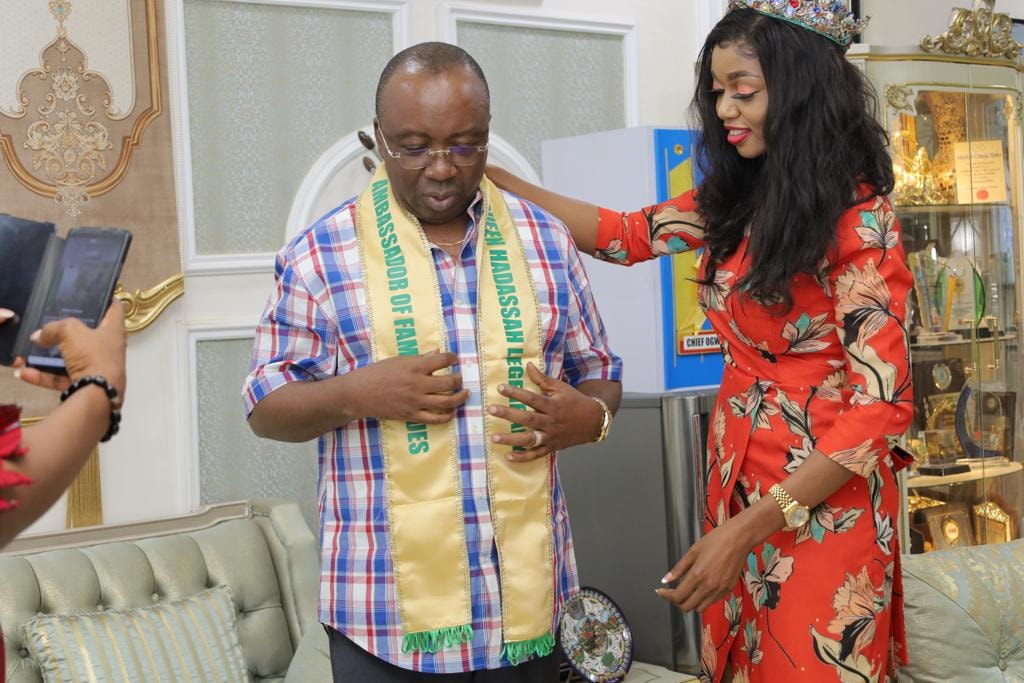
Earlier this week, Chief Ogwu James Onoja, SAN, FCArb was presented with an International Award of recognition as the Ambassador of Family Values in appreciation of his longstanding sponsorship and significant commitment to the Big Family Pageant Africa & Children Climate Action Project.
The presentation was made by HRM Queen Hadassah Ibinyingi Alaputa, MS. World, United Nations.
Persons Below 21 Years Cannot Be Registered Advertising Practitioner In Nigeria. DAILY LAW TIPS by Onyekachi Umah,Esq. (Tip 187)
“Any Person Less Than 21 Years Old Cannot Be A Registered Advertising Practitioner In Nigeria”
Apart from educational qualification and good character, a person intending to be registered as an associate member of Advertising Profession by the Advertising Practitioners Council of Nigeria must be 21 years old and above.
My authority is section 12(2)(d) of Advertising Practitioners (Registration, etc) Act.
The name habeas corpus conjures one of the writs and it is one of the oldest and most celebrated writs and safeguard to liberty of the subjects. It was in use beyond the Magna Carta Constitutional and Administrative Law by de Smith 44th ed p 461. Habeas corpus is a Latin phrase which means in English “you have the body” Black’s Law Dictionary p. 38. Habeas corpus has nothing to do with the guilt of the prisoner or a claim that a criminal charge against an accused person has not been proved Willie Lester vs Peyton 29 F.S. 636.
The primary function of habeas corpus is “the primary function of the writ is to release from unlawful imprisonment” Black’s Law Dictionary p.709. In a petition for habeas corpus, the function of the court is to look into the fact whether an applicant got a fair trial and not a review of questions of law used by a court during trial James Walker vs Bishop 259 F.S. 767.
There are many types of habeas corpus, one of the most popular is habeas corpus ad subjiciendum which is used to secure the release of an applicant from unlawful or illegal detention A.G. Federation vs Usman Abubakar 2008 16 NWLR (Pt 135).
In a day to use in courts, a reference to habeas corpus without more is a reference to this specie of habeas corpusU.S. vs Todd S.C. 54.
Another popular specie of the writ is habeas corpus ad testificandum which is a specie of habeas inherent in all courts and is used to bring into court a person detained to enable him to testify in a matter U.S. vs Ras Gaha 1962, 205 F. S.949 where it was held as “The purpose of this writ is to bring into court one who is confined order that he may testify in a cause. The power to issue such a writ inherent in the court. The court has the jurisdiction to issue the writ extraterritorially to the warder of the federal prison in another jurisdiction in a proper cause.” However, in Weldon vs Neal 1884 – 5 QB D 471, the reverse was held as follows: The court lacks jurisdiction to issue habeas corpus to a person who is in custody for the purpose to enable him to argue the matter before a court.”
Habeas corpus is not an appeal against a valid sentence of a court Exparte Corke 1954 2 All E.R. 440 where it was held “it is well settled that persons serving sentences passed on them by a competent court of summary jurisdiction should understand that habeas corpus is not a means of appeal.” In Tukur Gwaram vs S. P. Kano NLHC 17 at 18, it was held in a clear language as follows: “The court does not grant a writ of habeas corpus to persons who are in execution, that is to say; a person serving sentences passed by the court of competent jurisdiction.” When a prisoner was sentenced by a law which did not exist at the time of the commission of crime habeas corpus will issue Mccoy vs Mccauley 20 F.S. 200. When a regulation upon which a detaining authority is ultra vires a main law habeas corpus will issue Weekes vs Motano 1972 19 WLR 425.
When a prisoner has completed his prison sentence but is still being detained habeas corpus will issue Re William Oswald Featherstone 1953 37 Cr AP. R 16 at 147 where it was held “The court does not grant and cannot grant writs of habeas corpus to persons, who are in execution, that is to say, the person who is in execution… the prisoner was being held after the terms of the sentence passed on him had expired.” When a court lacks jurisdiction habeas corpus will issue upon the illegal conviction. In Gwaram vs S.P. Kano supra it was held as follows: “if a court is not a court of competent jurisdiction, the conviction is illegal and so is any sentence which follows the conviction, and in such a case writ of habeas corpus will issue”.
Habeas corpus deals with the grounds upon which a prisoner was detained, it is not an acquittal granted by court Oloyede vs GOC 2nd Division N. A.NLHC 275, where it was held as “A release on habeas corpus is not an acquittal of the applicant for habeas corpus the court does not go into the merits so far as the offence is concerned” Habeas corpus deals only with the legality or illegality of the detention of an applicant Asikhai vs IGP NLHC 149 at 151 where it was held clearly as “The whole purpose of habeas corpus, however, is to determine whether or not the gaoler can produce legal authority for the detention.”
Habeas corpus is never granted unless and until an arguable case had been established Hobhouse 1820 3B and Ald 420. Whenever documents used in detaining an applicant are defective, bad, ambiguous, insufficient the detention is defective and habeas corpus will issue Onwudiwe vs COP NLHC 71, where it was held “As the return is bad, ambiguous and insufficient, the court shall order for the immediate release of the applicant.”
Habeas corpus will not issue where an applicant is detained or kept in safe custody of the realm in a war Exparte Kuechermeister 1946 2 All E.R. 4345 where it was clearly stated as “Habeas corpus does not lie against the crown at the instance of an enemy alien for the safety of the realm in time of war by an order of the executive government acting within the discretionary authority on behalf of the King and therefore the court had no power to grant a writ.”
The national security of a state takes precedence over the liberty of individuals during war or national emergency as such habeas corpus will not issue Agbaje vs COP Western State NLHC 36 at 38 where it was held “where the liberty of the citizen comes into conflict with the safety and corporate existence of the state, the liberty of the person has given way to the latter salus populi suprema lex especially during times of war or national emergency.” A clearer language was used by the court in Okeowo vs IGP NLHC 181 at 182 as “it is definite that when a country is at war the liberty of the citizen must be curtailed in one way or the other for the common good of every citizen and safety of the country.”
When a person has been released on habeas corpus such a person can no longer be arrested on the same grounds or reasons as the former accusation Kazeem vs IGP NLHC 1 where it was held “A person discharged from illegal custody on a habeas corpus is free once and for all and cannot be rearrested or detained on the same ground.”
Habeas corpus cannot be issued against parents unless such a parent detains a child against an order of a court Ekine vs Fabia NLHC 130 where it was held “An order for writ of habeas corpus cannot be made against a parent unless he detained his child in defiance of a court order.” A father who took his child from a mother has not committed any crime so habeas corpus will not be issued against the father Ahize vs Ahize NLHC 2.
A person who applies for habeas corpus must have a right which is personal to him Calcutta Gas vs State of West Bengal (India) 1962 49 S.C. (Vol.2) 1044. A person who is detained has a fundamental right to be informed of the reasons why is being detained, failure to observe this procedure is fatal to the arrest, and habeas corpus will issue Onwudiwe vs COP NLHC 71. Habeas corpus will be refused an applicant where there is an alternative remedy which is adequate Ahize vs Ahize supra.
A respondent in a habeas corpus proceedings has the burden to prove that an arrest or detention of an applicant is legal Emerson vs IGP NLHC 266 where it was held “The burden of providing the lawful justification rests on the respondent and not on the applicant. It is the detaining person or authority who knows the reason for the detention of an applicant, hence the burden of proving lawful justification for the arrest lies on him. See also Kwahaja vs Secretary of State for Home Department 1948 A.C. 74. It is the executive who must prove that condition precedent was performed Greene vs Secretary for Home Affairs 1942 A.C. 284 where it was held “…The onus was on the executive to negative the challenge and proof beyond reasonable doubt that the condition precedent had been performance.” Habeas corpus remains a safety valve for those detained illegally or unlawfully.
Hon. Justice Usman Bukar Bwala J.P., retired from the High Court of Justice, Maiduguri, Borno State.
Yantaba & Ors. v. Governor of Katsina State & Ors. [2022] 1 NWLR (Pt. 1811) 259
On 9 September 2014, Chairmen and Councilors of the 34 Local Government Councils in Katsina State assumed office. On 10 July 2015, the Governor of the State issued a notice published in the Gazette dissolving all the 34 Local Government Councils in the State. This was based on the report of the Committee set up by the Katsina State House of Assembly which found all the Chairmen and Councilors liable for illegal diversion of funds totalling about 7 Billion Naira.
The Governor acted pursuant to its “powers” to dissolve Local Government Council(s) as stipulated under Section 81(a) of the Local Government Law of Katsina State 2000 (as amended).
The Chairmen and Councilors challenged the dissolution up to the Supreme Court and succeeded. On 7 May 2021, the apex Court held that by virtue of Section 7(1) of the Nigerian Constitution (as amended), the system of Local Government under the Constitution is guaranteed and that Section 81(a) of the Local Government Law of Katsina State is unconstitutional and consequently invalid.
At pages 338-339 of the report, Okoro, JSC sent a strong message to the Federal, State and Local Governments:
It is clear as noon day that all tiers of Government in this country, i.e., Federal, State and Local Government do have issues bordering on corruption by certain officials of these tiers of Government. I am yet to see the Federal Government being dissolved simply because an official or more have embezzled money or misbehaved in certain other way. I have also not seen a State Government being dissolved in like fashion. The question is, why is the Local Government always dissolved at the slightest provocation? The simple answer is that it is a political weapon against rival political parties because more often than not, it is an incumbent political party that dissolves a Local Government which is manned by a rival political party. This is unhealthy and for the sake of generations yet unborn, must be put to rest forthwith…
Of course, his Lordship did not leave anyone to wonder whether the issue of the alleged embezzlement of funds by the Chairmen and Councilors in Katsina State at the time was inconsequential. Rather, the Learned Jurist explained the solution thus:
Where a Local Government misbehaves or embezzels money or is involved in any fraudulent activities, the solution is not to dissolve the entire Government. There are agencies of Government e.g. the Police, EFCC, ICPC and others which can be invited to investigate the matter and where anybody is found culpable, should be sanctioned in line with available laws governing the matter. The dissolution of Local Governments based purely on political considerations must stop. Henceforth, no Local Government shall be dissolved based on unconstitutional laws made by State Houses of Assembly. I need not say more on this.
Stephen is a lawyer with expertise in Commercial Dispute Resolution and Technology Law practice. He is a Partner at Infusion Lawyers. He has successfully argued cases from the High Courts of various jurisdictions to the Appellate Courts on behalf of financial institutions, other corporate bodies, and multinationals. He has worked with a number of startup tech companies. He tweets @siazubuike.
The Nigerian Communications Commission Act (NCCA) was passed to protect the rights and interests of service providers and consumers within Nigeria. The NCCA created the Nigerian Communications Commission (NCC) as a regulatory agency with the mandate to protect and promote the interests of consumers against unfair practices including but not limited to matters relating to tariffs and charges for and the availability and quality of communications service, equipment and facilities.
The NCC issued the Consumer Code Practice Regulations containing extensive provisions for complaint handling processes and procedure, where consumers who are dissatisfied/aggrieved with services provided by a service provider (licensee) can register their complaints. In addition, there are also provisions for escalation to the NCC where the service provider fails to address the written complaint of a customer. In effect, a customer is expected to first of all resort to a domestic resolution of the complaint through the mechanism of the NCC before approaching the courts.
Even when the dispute is taken to court by the consumer, supplying evidence in proof of the allegations is paramount. In other words, it is not enough to merely show evidence of complaints lodged. More so, any random claim for monetary compensation without concrete proof would be roundly refused. This was the situation in a recently decided case of Obe v. MTN Nigeria Communications Ltd. [2021] 18 NWLR (Pt. 1809) 415 where a customer of MTN claimed a whopping sum of 100 Million Naira as damages from MTN. A brief account of the story is narrated below.
Obe v. MTN
Mr. Alechenu Ad’Obe Obe was a post-paid customer of MTN with a credit limit of N140,605.39. He lodged complaints with MTN about the alleged disruption or blocking of his mobile line. He eventually filed an action in court claiming 100 Million Naira as damages for the alleged losses he suffered. According to him, he lost over 2,000 contacts which he built in almost a decade; loss of contact with his family and colleagues both in Nigeria and in the UK (because the line was his only means of communication); loss of business, arising from his inability to reach or be reached by his professional business and family associates which he built as Special Adviser to the President since 1999. He also claimed that MTN did considerable damage and incalculable harm to his family, business, and official life as a result of the disruption of his line.
Mr. Obe’s case failed at the trial Court, the Court of Appeal, and the Supreme Court. He was left in the cold to rue his attempt to make a windfall from the telecom giant without any legal basis. At page 444 of the report, Oseji, JSC was emphatic:
…The Appellant [Mr. Alechenu Ad’Obe Obe] did not adduce any evidence to prove the fact that his line was actually disrupted or blocked by the Respondent [MTN]. No call logs were produced to show the absence of use of his number during the period he complained about, neither did he show that any notice to produce same was served on the Respondent. The Appellant’s complaint that he could not use his roaming facility while abroad was not also supported by any evidence in proof thereof by way of flight tickets or his international passport. There was no iota of evidence in proof of his allegation that the Respondent did considerable and incalculable harm to his family, business, and official life as a result of the disruption of his telephone line. No single witness was called to testify on the efforts made in reaching the Appellant either for business, family or official transactions and which failed efforts caused any damage to the Appellant, either financially or emotionally. The same goes for the 2,000 phone contacts he alleged to have lost because of the disruption or blocking of his line.
In his opinion, Abubakar, JSC stated (at page 459):
Where Appellant’s claim in an action is adjudged to be a sham and firmly rooted in a calculated design to embark on gold-digging, such claim must be dismissed with speed.
Accordingly, the Supreme Court had no difficulty in unanimously dismissing the Appellant’s appeal with speed.
Stephen is a lawyer with expertise in Commercial Dispute Resolution and Technology Law practice. He is a Partner at Infusion Lawyers. He has successfully argued cases from the High Courts of various jurisdictions to the Appellate Courts on behalf of financial institutions, other corporate bodies, and multinationals. He has worked with a number of startup tech companies. He tweets @siazubuike.
Sexual advances
Photo Credit: Attorney at Law Magazine
“It takes 20 years to build a reputation and five minutes to ruin it. If you think about that, you’ll do things differently”, said Warren Buffett. Well for shaming caution and delving into sexual misconduct, a UK-based solicitor has been fined £20,000 by a tribunal.
Victor Nwosu a solicitor for 17 years and principal partner of a law firm asked the interviewee whether she had a boyfriend and repeatedly told her how beautiful she was.
Nwosu was said to have also repeatedly remarked to the lady, who was interviewing for a paralegal role, about her looks and said words to the effect of ‘mmm, I like what I see’ when she turned around to hang her jacket up. The woman reported being ‘horrified’ by the interview and said she felt ‘like a piece of meat’.
Nwosu denied any misconduct and accused the woman of lying, but the Solicitors Disciplinary Tribunal said the language used could only be considered to have sexual connotations. When he offered her the job, he stated that she would have to wear skirts and high-heeled shoes and said that he would ‘only employ beautiful women’.
Nwosu’s lawyer had pointed to references which attested to the fact that he was not a ‘sexual predator’, to which the tribunal responded: ‘The tribunal was not required to determine whether [Nwosu] was a sexual predator, it was required to determine whether the comments he made and the questions he posed to [the interviewee] during a job interview were sexually motivated and/or for sexual gratification. The tribunal determined that they were.’
The woman had been interviewed for a position at Nwosu’s northwest London practice Dylan Conrad Kreolle Solicitors in 2018, following a recommendation from someone already working at the firm.
After he arrived late for the interview, he subsequently left the room for around 10 minutes, during which the woman sent messages to friends that she ‘felt scared’ and that Nwosu had ‘repeatedly’ told her how beautiful she was. She later reported feeling ‘uncomfortable’ and ‘objectified’ after being asked to move her chair towards his so she could see his desktop computer. He leant forward in his chair and said: ‘you’re very pretty, you’re very beautiful’. He then asked if she had a boyfriend and explained he needed ‘to know everything about a person who comes to work at the firm’.
She later turned down the job, explaining to Nwosu this was ‘in no small part due to the unprofessional conduct displayed throughout the interview’, and reported the matter to the SRA.
In cross-examination, Nwosu’s representative suggested she was not telling the truth, she had misunderstood what had taken place during the interview and she was motivated by other matters. It was put to her that she had a ‘proper interest’ in the physical and sexual abuse of women and that given her experience and tenacity she ‘would not have tolerated it’ if Nwosu had acted in the way that was alleged. She rejected that suggestion and stated she was scared and shocked during the interview.
In his evidence, Nwosu said his ‘I like what I see’ comment was in relation to the woman’s CV and submitted the allegations were malicious due to her being upset at the salary offered.
The tribunal said it was ‘deeply concerned’ at the comments and questions asked by Nwosu and concluded his conduct was a ‘grave departure’ from that expected of a solicitor. He was fined £20,000 and ordered to pay £23,500 costs.
You would think he’s an evangelist trying to convert a congregation as his ringing voice reverberated around the auditorium. “The Rule of Law is the Rule of God! The Rule of Law is the Rule of God”, he cried; pounding the rostrum for emphasis.
Chief Kanu Agabi, SAN
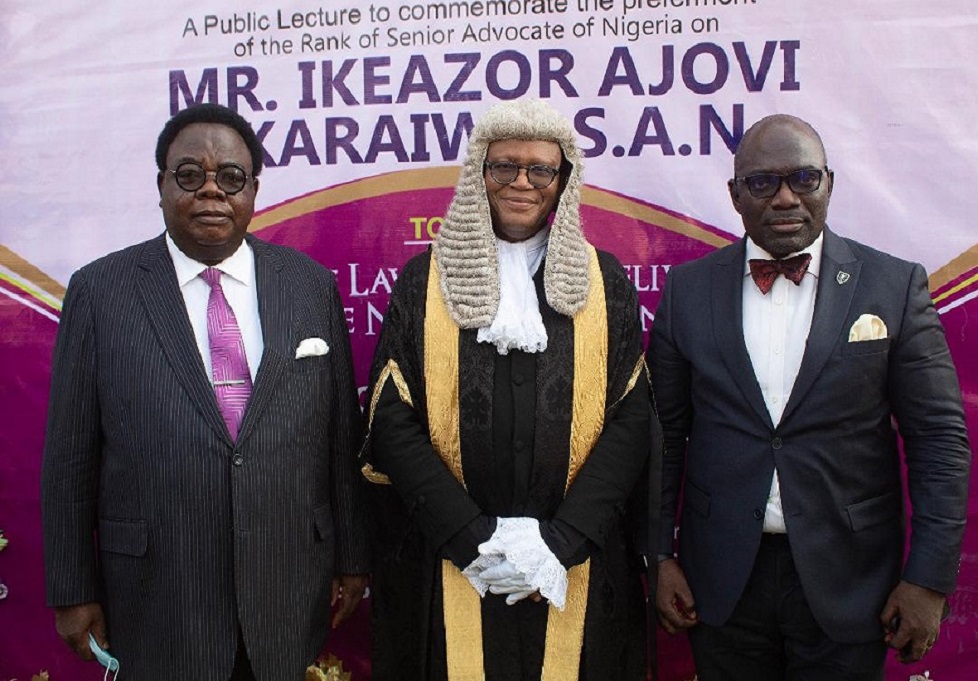
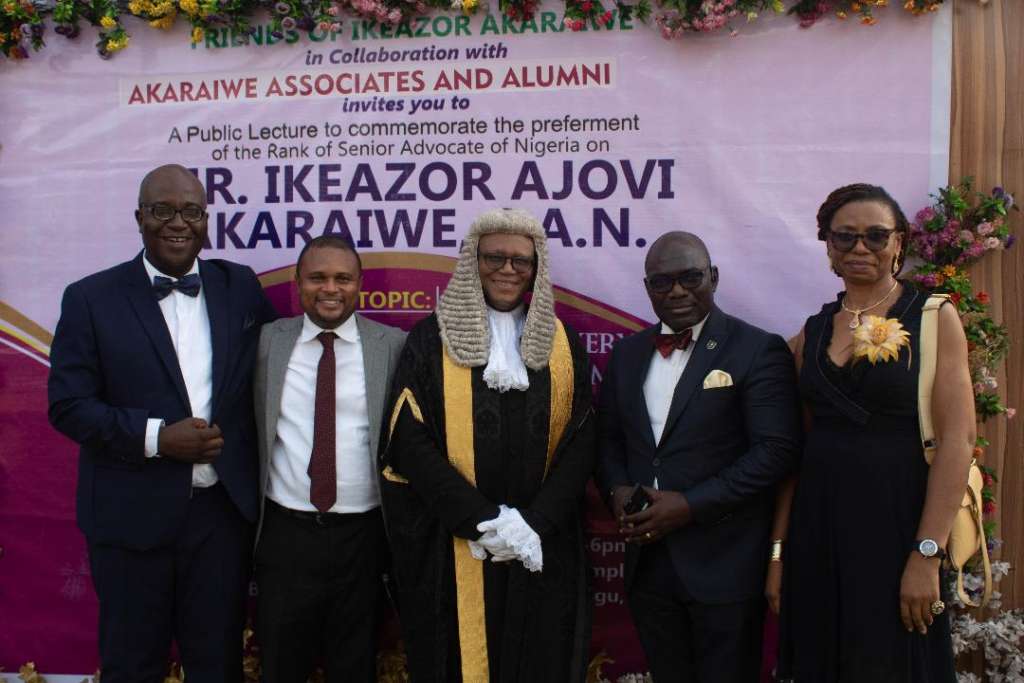
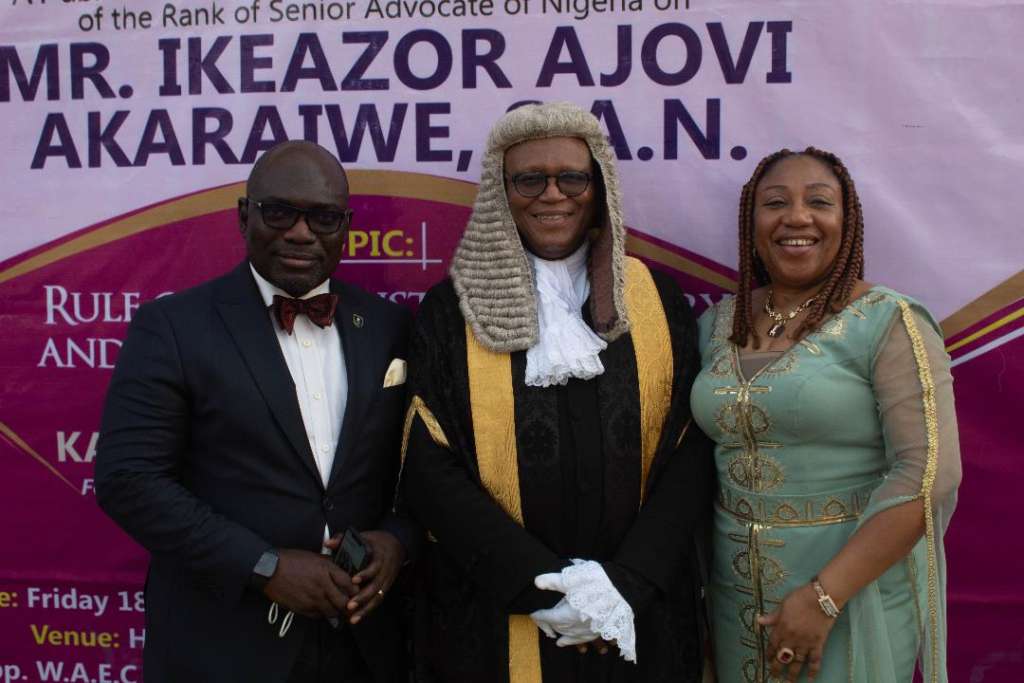
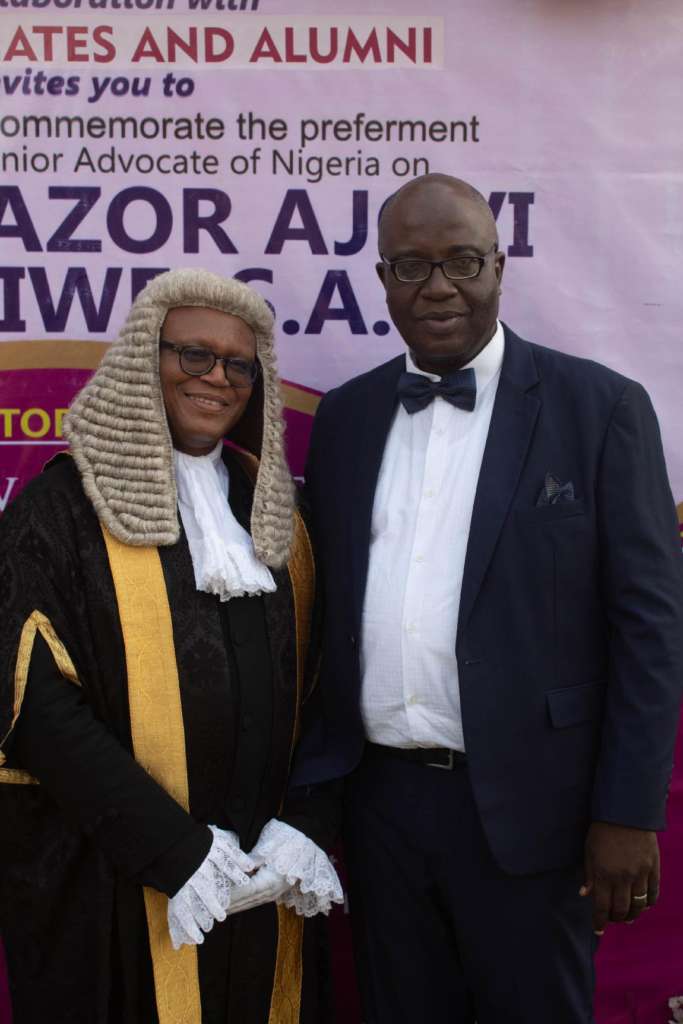
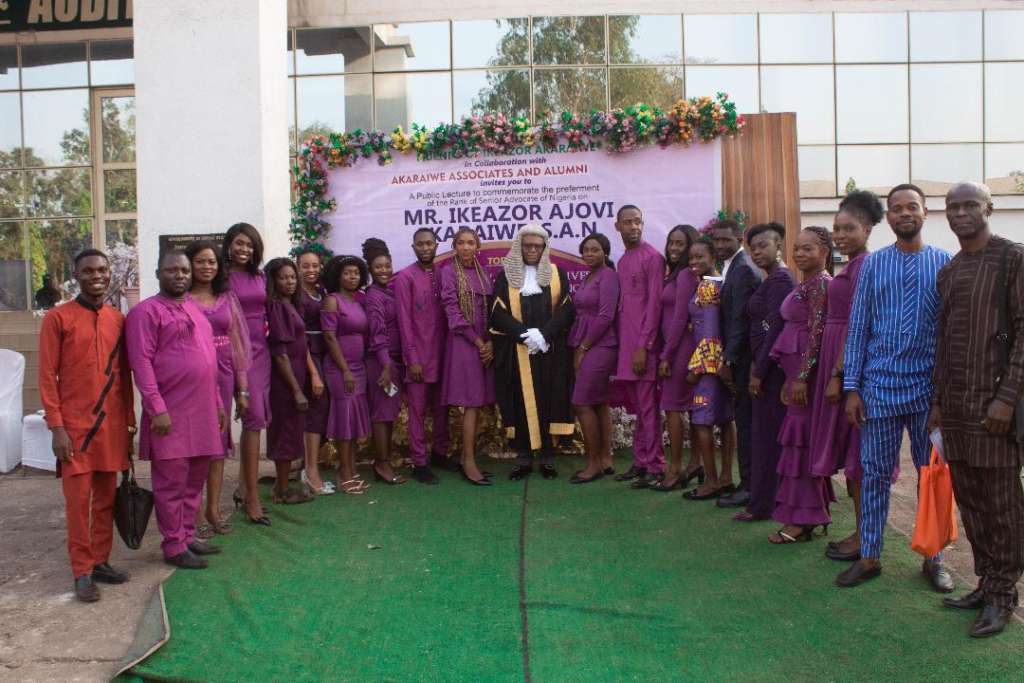
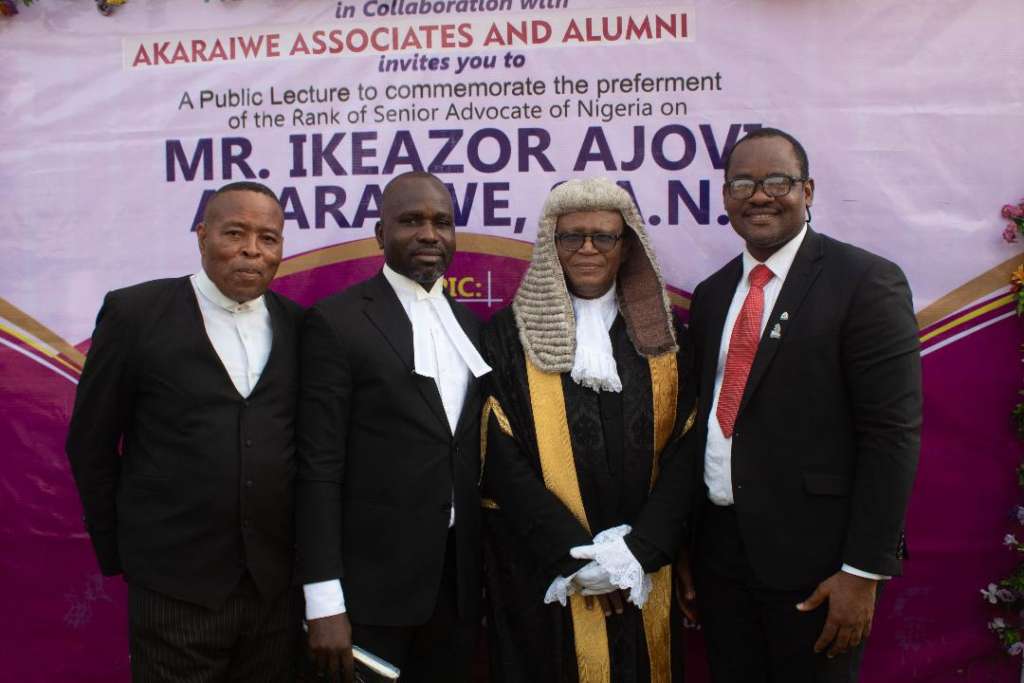
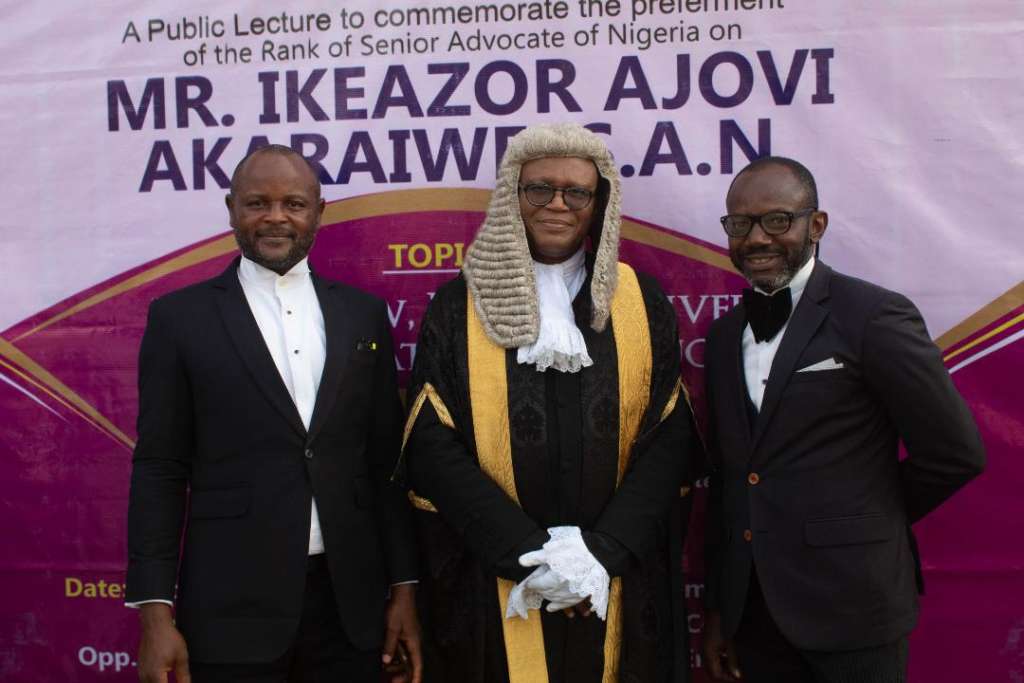
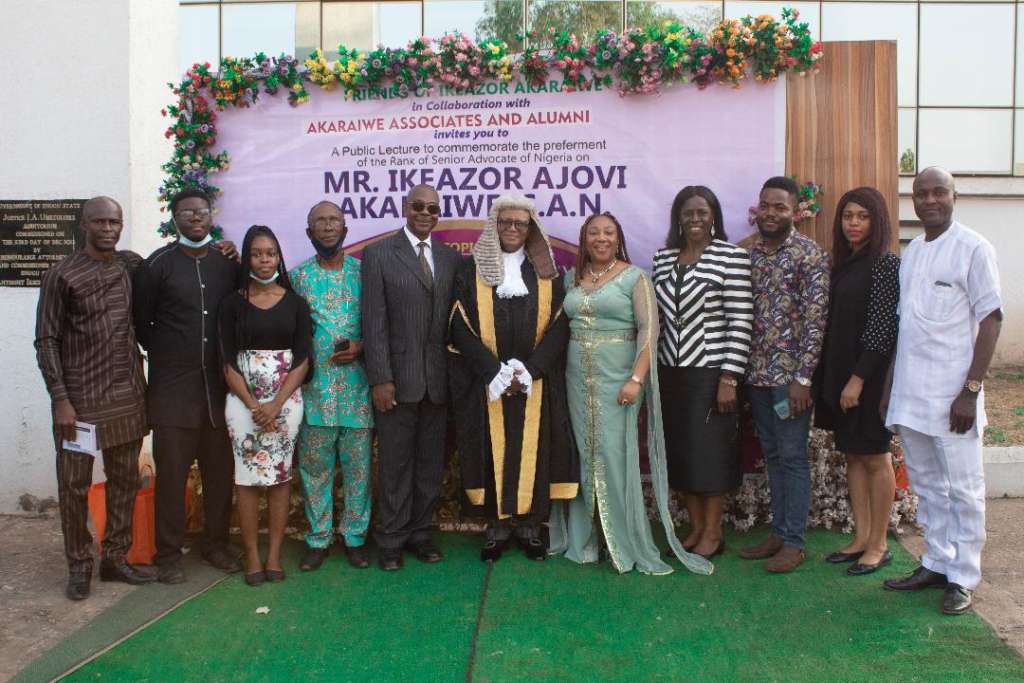
That was the position of Chief Kanu Agabi, SAN, Guest Lecturer at the inaugural public lecture held in commemoration of the preferment of the rank of Senior Advocate of Nigeria, on Mr. Ikeazor Ajovi Akaraiwe, SAN. With true evangelical zeal, this minister of the law, Chief Agabi, SAN drew a nexus between the Rule of Law and the Rule of God. He noted that when Nigerians begin to implement the rule of God by exhibiting the right attitude beginning with appointing competent persons into positions of authority, the country will be on its way to national development and economic recovery.
Akaraiwe, SAN and Chief Kanu Agabi, SAN
Undoubtedly, the concept of Rule of Law has been subject to disagreements and heated debates over the years, but at this public lecture titled: ‘Rule of Law, Justice Delivery and National Economy”, stakeholders in the legal profession upped the conversation notches higher with suggestions and recommendations to the effect that Nigeria’s journey to recovery is dependent on the premium placed on education, security, enabling environment, the appointment of competent persons and many more.
Although the subject was exhaustively debated in Hon. Justice Innocent Azubike Umezulike Auditorium at the High Court Premises in Enugu, what remains to be seen is how these well-thought-out ideas and suggestions would translate into actions that could bring transformation and reformation in Nigeria.
Commending Akaraiwe, SAN for initiating the public lecture, Chairman of the occasion, Hon. Justice Centus C. Nweze, JSC remarked that the rule of law is the driving force for economic growth in any society. He also noted that the economic and overall development of countries with scant regard for the rule law always remains abysmally low.
Hon. Justice C.C. Nweze, JSC
In his contribution, Hon. Justice Peter Affen, JCA disclosed that two the crucial indices in development are— Rule of law and a good school system. Justice Affen who revealed that Education is a powerful driver of development and one of the strongest instruments for reducing poverty maintained that the rule of law and development in society work together. He equally added that the “indices of a strong economy is not ‘rule by law’ but rule of law.”
Hon. Justice Peter Affen, JCA
For Hon. Justice Nnamdi Dimgba, Ph.D. a definite strategy for Foreign Direct Investment, FDI as a component of economic growth strategy must be put in place. Corroborating Justice Dimgba’s position, Andrew Skipper in an article published 30 September 2019 in Vanguard Newspapers, posited that: “The strength of the Rule of Law in a country ranks among the top three considerations when multinationals make decisions about where to locate foreign direct investment – above considerations such as the cost of doing business and access to national and regional markets.”
Hon. Justice Nnamdi O. Dimgba, Ph.D. (Havard)
That said, with lawlessness and insecurity diverting resources and reducing the ability of Nigerians to plan for the future, it goes without saying the negative consequences of these issues along with poor economic policies have adversely affected FDI. No foreign investor will venture into an unstable economy. Unquestionably, wherever investors observe or experience Rule of Law challenges like political instability, arbitrary or discriminatory treatment, they are likely to decline or withdraw investment.
Hon. Justice Raymond Ozoemena, Chief Judge of Enugu L-R: Chairman of the occasion, Nweze, JSC, the honouree, Dr. Nkiru Akaraiwe, and Hon Justice Reuben Onuorah, High Court of Enugu State
On her part, Hon. Hon. Justice Chinyere Ani, Ph.D. raised a number of posers. “Can we say we have equality before the law? Do we truly have judicial independence? How democratic are our elections? How do the people, even the lawmakers, people that make the law get in? What about the delay in justice delivery? When judgments are delivered, has justice been served? Are the persons who instituted the actions alive to see it?
Hon. Justice Chinyere Ani, Ph.D.
“Can we say that if one goes to court he or she will get justice on time? How does the ordinary man view rule of law? Do they believe they can get justice from the courts? How do we deal with overflowing dockets and very few judges handling so many cases? What about the disobedience of court orders by ordinary citizens? It’s not only government officials that disobey orders of court. This does not seem like the rule of God…”
Chief Mrs. Justina Offiah, SAN
Chief Mrs. Justina Offiah, SAN expressed concern that people often overlook things as basic as jumping queues, disobeying traffic rules, driving in opposite directions, and eventually obstructing traffic flow as trivial. The Senior Advocate insisted that taking account of these seemingly ordinary matters by simply doing the right thing is the way towards enthroning the rule of law. “We are quick to point fingers to our leaders but we are all accountable. Followers are also complicit. If we know there are sanctions and enforcement, there will be accountability. Corruption has eaten deep into every sector of society but we have to hold ourselves accountable,” she said.
L-R:Dr.Ode Eyeoyibo, Lagos-based Lawyer and Pastor, Charles Okeibunor, Lagos Lawyer and Counsellor, Akaraiwe, SAN, Affen, JCA, and Lillian Okenwa, Editor-in-Chief Law & Society MagazineProf. Richard Achara
While Prof. Richard Achara worried that people are no longer sure of what to expect from the courts, the Honouree, stressed: “The judicial policy should ensure that when judges’ dockets begin to go beyond 50 cases in a year, new judges are appointed. I still cannot get over the 60 court complex we saw in Vancouver, Canada in 2010, when some of us took a break from the 2010 IBA Conference to visit their courts. We wondered if the 60 court complex was for the entire Province of British Columbia, and the court administrator said ‘no, Victoria City, the capital next door had a similar court complex!’ Directly opposite this court complex was a similar-sized magistrates’ court complex.”
All said, a strong legal system is crucial for economic growth.
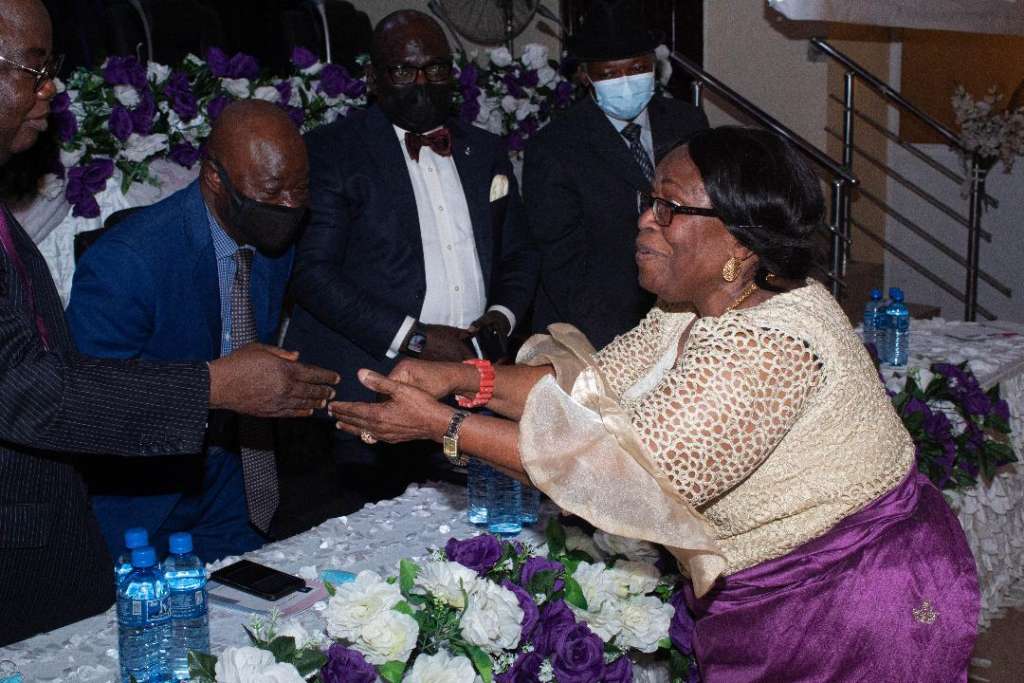
Madam Elizabeth Akaraiwe, M.Ed [Child Psychology – Harvard] greeting guestsAffen, JCA, Honouree, and Dr. Nkiru AkaraiweHon. Justice Anthony Onovo, High Court of Enugu State
Hon. Justice Afam Nwobodo, High Court of Enugu State
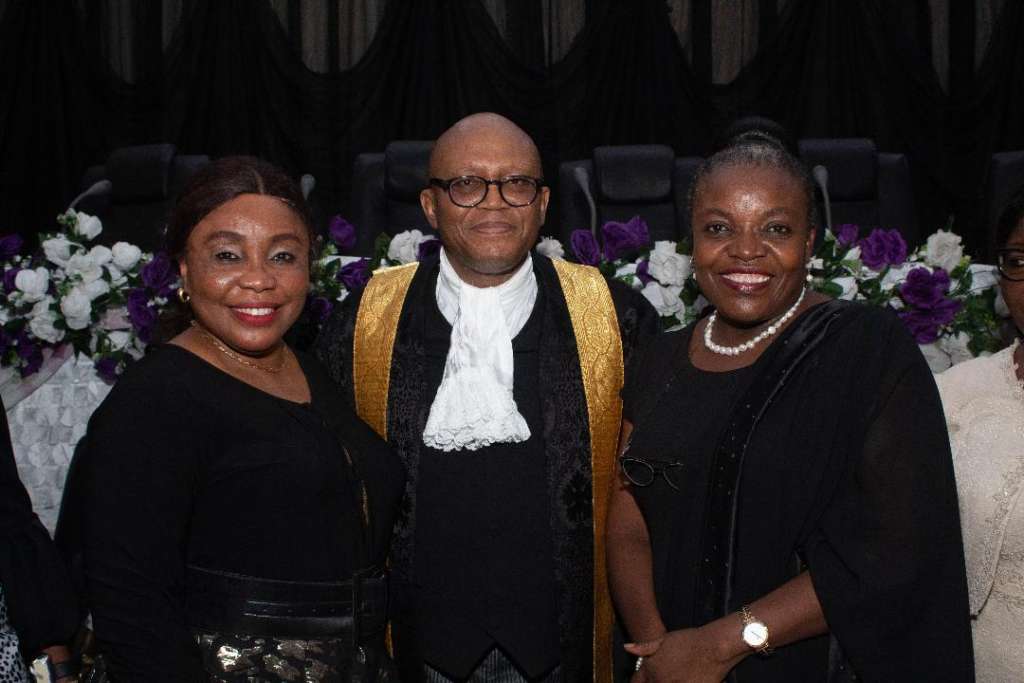
Left: Hon. Justice Lynda Okibe, Right: Hon. Justice Ngozika Oji (both representing the University of Nigeria Class of ‘84 & Law School Class of ‘85)R-L: Dr. Somso Kizor-Akaraiwe (1st child), Madam Rose Scott (Aunty), Dr. Nkiru (wife), Akaraiwe, Madam Elizabeth Akaraiwe (mother), Chidi (daughter in law) & Ijeoma (son)With Dr. Ode EyeoyiboL-R: Mrs. Nonye Chijioke-Agbo, DCR, High Court of Enugu State and a Chief Magistrate
Jude Ezegwui, Chair, NBA Enugu branch congratulating the honouree
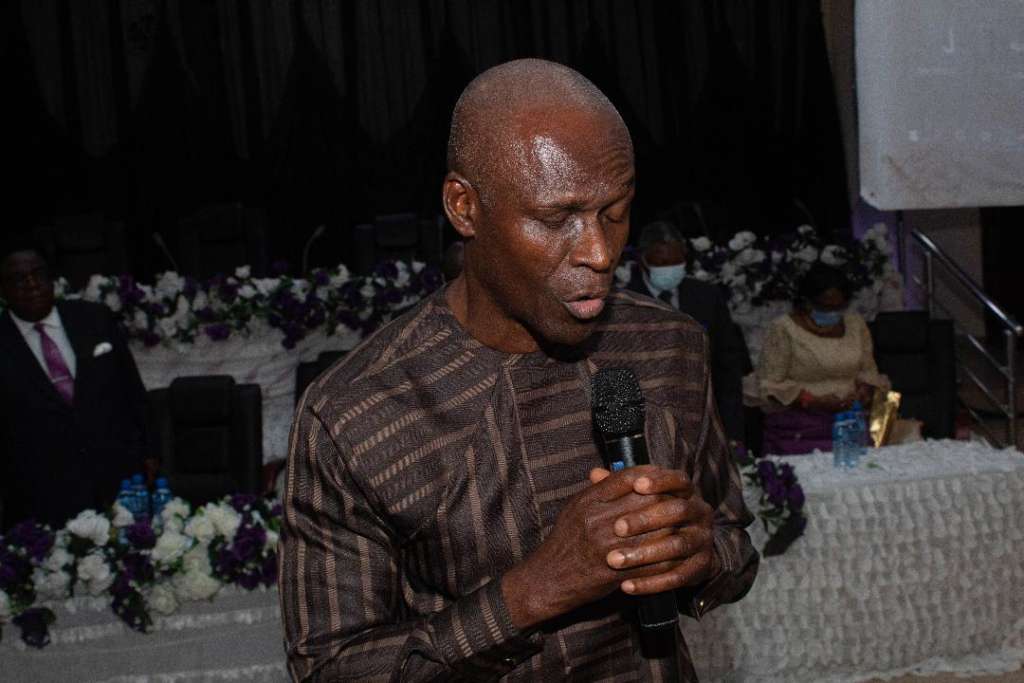
R-L: Charles Okeibunor, Mrs. Omar Nzekwue and Mrs. Chisom Okafor, DCR, Anambra State High CourtMrs Nnenna Uko, former Chair, NBA EnuguAlumni- Akaraiwe & AssociatesPrince Okenwa, Former Legal Adviser, NBA Enugu Branch – Master of CeremoniesLawyers and Paralegals at Akaraiwe & AssociatesLAWSA, University of NigeriaR-L: Jude Ezegwui (Chairman, NBA Enugu), Honouree, Fabian Nnamani (former Social Secretary, NBA Enugu), and CNN Nwagbara (former Vice-Chair, NBA Enugu).Members of the NBA EnuguRight: Chidi Ujoatumba, Left: Onyekachi Ede (Financial Secretary, NBA Enugu)Members of Young Lawyers Forum, YLF, EnuguChristian House Fellowship, EnuguChinedu Ucheagwu, language editor, Court of Appeal Reports, saying the closing prayers
Parallel structure is “a similarity of structure in a pair or series of words, phrases, and thoughts.” Gerald Lebovits.
A parallel construction “is a phrase or clause that grammatically mirrors a neighboring phrase or clause.” Bryan A Garner.
Parallelism contributes to elegance in prose. It boosts rhythm.
Here are samples of parallel sentences and passages:
“But, in a larger sense, we cannot dedicate—we cannot consecrate—we cannot hallow—this ground.” Abraham Lincoln.
“and that government of the people, by the people, and for the people, shall not perish from the earth.” Abraham Lincoln.
“We will not tire, we will not falter, and we will not fail.” George W. Bush.
“I came, I saw, I conquered.” Julius Caesar.
“It was the best of times, it was the worst of times, it was the age of wisdom, it was the age of foolishness, it was the epoch of belief, it was the epoch of incredulity, it was the season of Light, it was the season of Darkness, it was the spring of hope, it was the winter of despair, we had everything before us, we had nothing before us.” Charles Dickens
“We shall fight on the beaches, we shall fight on the landing grounds, we shall fight in the fields and in the streets, we shall fight in the hills; we shall never surrender.” Winston Churchill.
“When people make mistakes, they generally do one of three things in response to them: They resolve to never make another mistake, which is impossible. They allow their mistake to make them into cowards, which is foolish. Or they make up their minds to learn from their mistake and apply the lesson to their lives, which is profitable.” John C. Maxwell.
“My main aim in this book is to help make joy your constant companion. To make that happen, this book offers not a sermon, but a science; not a teaching, but a technology; not a precept, but a path. It is now time to start exploring that science, working the technology, walking the path.” Sadhguru Jaggi Vasudev.
“The law of the LORD is perfect, converting the soul: the testimony of the LORD is sure, making wise the simple. The statutes of the LORD are right, rejoicing the heart: the commandment of the LORD is pure, enlightening the eyes. The fear of the LORD is clean, enduring forever: the judgments of the LORD are true and righteous altogether.” Psalm 19: 7–9.
Our site uses cookies. By clicking “Accept All Cookies”, you direct Law and Society Magazine to store cookies on your device and disclose information in accordance with our Cookie Statement: cookie policyACCEPTREJECT
Privacy & Cookies Policy
Privacy Overview
This website uses cookies to improve your experience while you navigate through the website. Out of these cookies, the cookies that are categorized as necessary are stored on your browser as they are essential for the working of basic functionalities of the website. We also use third-party cookies that help us analyze and understand how you use this website. These cookies will be stored in your browser only with your consent. You also have the option to opt-out of these cookies. But opting out of some of these cookies may have an effect on your browsing experience.
Necessary cookies are absolutely essential for the website to function properly. This category only includes cookies that ensures basic functionalities and security features of the website. These cookies do not store any personal information.
Any cookies that may not be particularly necessary for the website to function and is used specifically to collect user personal data via analytics, ads, other embedded contents are termed as non-necessary cookies. It is mandatory to procure user consent prior to running these cookies on your website.