Home Blog Page 851

Nullification of Section 84(12)of the Electoral Act 2022

The Federal High Court Judgement Nullifying Section 84(12) of the Electoral Act 2022 is Bad in Law, May not Survive Appeal. 

Manfred Ekpe, Esq.

I have read the enrolment order of the Federal High Court sitting in Umuahia, Abia State in the case of Barr. Nduka Edede vs the AGF in suit No. FHC/UM/CS/26/2022 dated   nullifying section 84(12) of the new Electoral Act 2022 and mandating the Attorney General of the Federation (AGF ) to delete the impugned section off the Act.  First of all, I wonder why the court did not suo motu order the National Assembly who made that law to be joined as an interested party to the suit. The AGF ought not to have been  allowed to proceed as the sole defendant but whereas he ought only to have been a nominal defendant. To my mind, the court ought to have taken judicial notice of the fact that the AGF had advised President Muhammadu Buhari that the impugned section 84(12) of the Act is illegal. The same AGF having already formed that opinion and taken that stand should  not be expected to defend the suit properly or at all. To justify this fear the counsel representing the AGF reportedly  celebrated the judgment saying it was in tandem with the AGF’s position. I am of the opinion that there were two plaintiffs in this suit on both sides, one acting as defendant. 

The Federal High Court Civil Procedure Rules empowers the court to join a party to a suit were the court feels that such joinder would best serve the interest of justice. The National Assembly ought to have been joined. 

Going forward,  the impugned section 84(12) stipulates that political appointees who wish to stand for party primaries or to be delegates in party primaries or conventions shall resign 180 days before such primary, convention or election. Against this provision one Barr. Nduka Edede (hereinafter, plaintiff) approached the federal high court sitting in Umuahia for constitutional interpretation whether the said statutory provision is in contravention of, and inconsistent with  sections 66(1)(f), 107(1)(f), 137(1)(g), 182(1)(g)  of the constitution of Nigeria 1999(as amended) (Hereinafter, the constitution). 

The listed constitutional provisions provide that a person shall not be qualified to stand for an election as member of National Assembly and State Houses of Assembly, as President and vice president, and as governor and deputy governor if, being a “public servant”,  he has not resigned from service at least 30 days to election day.  This provision is clearly only applicable to aspirants who is a public servant.

The learned trial judge, His Lordship Evelyn Anyadike held in the affirmative to this issues raised by the plaintiff  on grounds that section 84(12) deprives, limits, abrogates,  disenfranchises and disqualifies  public servants of their constitutional rights to vote and be voted for,  in that, the constitution has already provided a 30 day’s requirement for resignation before election day,  and that the Electoral Act being subordinate to the constitution can not extend that period. 

With respect, I cannot agree with His Lordship’s  decision My reasons are as set out in the below legal analysis, but briefly that the constitution only requires “public servants” to resign 30 days to election but not “public officers.” Under our law, there is distinction between public servant and public officer. 

Section 66(1)(f), 107(1)(f), 137(1)(g), 182(1)(g) of the constitution requires “public servants,” that is to say;  people employed in the civil service of the federation (federal civil service) or people employed in the civil service of the state (state civil service) to resign at least 30 days to an election in which they are contesting. Therefore any person not a civil servant is not required by law to resign 30 days before standing for an election or at all. The practice of resignation by political appointees (who are not civil servants) 30 days to election in which they contested since 1999 has always  been  mistake. It is this gap that was realized by the National Assembly and section 84(12) of the Electoral Act was enacted to fill the gap. 

WHO IS A PUBLIC SERVANT AND WHO IS A PUBLIC OFFICER?

Public Officer is defined in   Part II of the Fifth Schedule to the constitution in paragraphs 1 — 16 thereof, which definition include president, vice president, governor, deputy governor, ministers, commissioners and appointed supervisors of local government departments, members of statutory boards such as NDDC etc. Hence public officers are politicians  either elected or appointed into public office. 

On the other hand, a public servant is defined in section 318 (1) of the constitution as persons employed in the civil service of the federation or civil service of the state, and by extension, public servants means those in the employment of the federal and state civil service.  Public servants are civil servants who are permanently employed by the state and whose service is regulated by the Civil Service Commission. It does not require legal knowledge to know that political appointees such as ministers, Commissioners, SAs, PAs etc are not civil servants. This position of the law has severally been stressed by the courts. In the case of ADAMU V. TAKORI & ORS (2009) LPELR- 3593 (CA) PAGES 15-16 PARAGRAPH D-A,  Lordship PER JEGA  had this to say:  “the determining factor in determining a public servant is the mode of his appointment and by virtue of section 318(1) of the 1999 Constitution public service of a state means the service of the state in any capacity in respect of the Government of the state and the Governor, Deputy Governor, the speaker and other political office holders are not in public service within the meaning of Section 318(1) of the 1999 Constitution.”

Further to sum up a clear distinction in the above Statutory and judicial authorities; a public officer is an officer elected or appointed into office while a public servant is employed by the government in the civil service.

See also Dada V. Adeyeye (2005) 6 NWLR (Pt. 920) 1 At 19;  Asogwa V. Chukwu (2003) 4 NWLR (Pt. 811) 540; Ojonye V. Onu & ORS (2018) LPELR-44223). where the superior courts have held that political appointees are not public or civil  servants. The learned trial judge of the FHC Umuahia is bound by these precedents and was in error to have deviated from them.

In the case at hand, sections 66(1)(f), 107(1)(f), 137(1)(g), 182(1)(g) of the constitution relied upon by the learned trial judge to strike down section 84(12) of the Electoral Act  stipulates that a person shall not be qualified to stand for an election as member of the National Assembly, State Houses of Assembly, president vice president, governor or deputy governor(in that order), if he is a person employed in the public service of the Federation or public service of the state and has not resigned, withdrawn or retired from such employment 30 days before the date of election. The constitutional provision clearly talks about public service not public office. 

On the other hand, section 84 (12) of the Electoral Act says that any public officer (of the political appointee class) (not public servants), shall resign 180 days to the day of a party primary or convention in which he intends to stand as aspirant or delegate. The constitution has not made provision for the resignation of public officers or political appointees for election purposes. There was a lacunae in the law where political appointees were not required to resign before an election in which they stood to contest, though the 30 day’s prior resignation had always been observed by political appointees by mistake for years. What the National Assembly did was to fill this gap  by enacting the contentious section 84(12) of the Electoral Act giving them 180 days to resign, understandably,  so that their influence would have faded before inter-party and general elections given the nasty experiences of their arrogance, rights violations and suppression of ordinary citizens by influence of their offices and overbearing influence thus depriving those without such influence of a level playing ground. 

The fact that political appointees have been resigning in the past 24 years 30 days before an election day in which they stand as candidates did not ripen this practice as law. It is trite that no matter how long an illegal practice lasts, it can not  become law. See  Barr. Faith Okafor v. AG of Lagos State (2016)LCN/9050(CA) where the court of appeal  held that restriction of movement during the monthly environmental sanitation in Lagos state is illegal and cannot be law simply because it has been observed for over 30 years  since 1985. 

DOES THE ATTORNEY GENERAL HAVE POWER TO REPEAL THE PROVISION OF AN ENACTMENT?

His Lordship gave an Order to the  AGF to delete section 84(12) from the Electoral Act. In simple language the court appeared to have ordered the AGF to amend an Act of the National Assembly. To my mind what the trial court has ordered the AGF to do is ultra vires or above the powers of the AGF’s office. It is the duty of the legislature, not executive to amend enactment. With respect it appears the trial court has given an order against the established legal principle that the law does not act in  vain.  I think the court ought to have ordered the National Assembly to expunge or delete that provision from the Act not the AGF. Understandably, since the National Assembly was not a party to the suit, the court could not have made an order to a non party. That is the more reason the National Assembly ought to have been joined as a co-defendant. However,  non joinder of the National Assembly does to confer legislative power on the Executive through the Attorney General. I think this court order contravenes section 4(1) of the constitution. 

DOES THE COURT HAVE POWER TO NULLIFY AN ILLEGAL LAW ENACTED BY THE LEGISLATURE?

The answer is yes. The doctrine of checks and balances, which has been incorporated in the constitution confers powers on the court of law to nullify any law enacted by the legislature or regulations made by the executive which is unconstitutional. The legislature is bound to amend the law expunging the nullified provision. 

It is very unfortunate that a member of the National Assembly from Benue State is reported to have  said that the  court has no power to nullify an Act of the National Assembly thus misleading members of the public. 

The legal effect of a law nullified by the court of competent jurisdiction is that such law becomes inoperative and ceases to exist whether or not the legislature expunges it from the statute books. An instance is the 1985 case of Arthur Nwankwo v The State (1985) 6 NCLR 288, where the court of appeal nullified section 51 of the Criminal Code Act which established the offense of sedition. Till date that section is still in the Criminal Code but no longer recognized as law or operative. No person has since 1984 been tried in Nigeria for the offense of sedition. 

I belief on appeal, the decision of Hon. Justice Evelyn Anyadike will be set aside. 

Comments on the Legislative Drafting implications of the recent judgment of the Federal High Court, Umuahia

By Tonye Clinton Jaja

On Friday 18th March 2022, it was reported that :

“A Federal High Court in Umuahia Friday nullified the controversial Section 84(12) of the Amended Electoral Act and ordered the Attorney General of the Federation (AGF) “to delete it forthwith”, saying that it is unconstitutional, illegal, null and void.”

Assuming (though not conceding that) the judge was right and correct in stating that section 84(12) of the Electoral (Amendment) Act, 2022 ought to be deleted because of its alleged violation of the provisions of the 1999 Constitution of the Federal Republic of Nigeria (as altered).

This is in accordance with section 1(3) of the said constitution which states that any provision(s) of any other legislation that is in conflict with the provisions of the 1999 Nigerian Constitution will be declared illegal.

The “blue pencil rule” is often applied by judges and the courts to delete any provisions of any legislation that are in conflict with the 1999 Nigerian Constitution.

However, the latter part of the judgment wherein the judge directed the Attorney-General of the Federation raises the question: “does the 1999 Nigerian Constitution empower the Attorney-General of the Federation to undertake deletion of existing legislation? Isn’t that the exclusive responsibility of the National Assembly?”

I beg to disagree with some lawyers that have suggested that the pronouncement of the Federal High Court is sufficient and doesn’t require any further input by the National Assembly.

First of all, it is trite law that judges are not permitted to engage in Legislative activity whether to enact or repeal laws no matter how ambiguous the provisions of such a law may appear.

 At best they can pronounce that a particular provision is inconsistent with the 1999 CFRN.

After the pronouncement by the court/judge, it is the duty of the legislature to then, repeal those provisions within such a Legislation. This is because nothing is implied, it has to be explicit.

Furthermore, going by the judgment in the case of Agbakoba vs. Attorney-General of the Federation (2010), the process of enactment or repeal of any provisions of any legislation is not complete if only the President or the National Assembly exclusively acts upon it without passing it on to the other organ of government. In that case, it was held that the assent or signature of the President of the Federal Republic of Nigeria is a required aspect for the enactment of legislation (the amendment/alteration of the 1999 CFRN).

Logically, it follows that only the National Assembly can present a new Electoral Amendment Bill without section 84(12) to the President for assent.

Let me provide a classic example of the reason why it is the exclusive responsibility of the National Assembly to enact a law to give effect to the judgment of the Federal High Court to delete section 84(12) of the Electoral Amendment Act, 2022.

It is not the duty of the Attorney-General of the Federation.

In the year 2004, the former Attorney-General of the Federation constituted a Law Revision Committee to review the Laws of the Federation, 1990 Edition.

 They completed their task and paid LEXIS NEXIS to print copies of the new laws which they named Laws of the Federation, 2004 Edition.

However, those laws were rejected.

It was only after the National Assembly enacted a legislation-Revised Edition (Laws of the Federation), 2007 that gave legal effect to the LFN 2004 Edition before they became legally useful and could be cited in courts of law.

Dr. Tonye Clinton Jaja is the Secretary of the Association of Legislative Drafting and Advocacy Practitioners-ALDRAP

‘When will our National Greed Collapse?’

A great deal of political doublespeak has been going on about our national grid, the network of power stations, power-lines and electricity infrastructure that allows electricity to be generated, transported and used across the country. In Nigeria, we are condemned to a national grid system in which generating stations and major consumer centres are integrated as employed by the national electric power authority in generating and distributing electricity in the country. In simple terms, power grid is a network of electrical transmission lines connecting a number of generating stations to loads over a wide area. The national power system has been unbundled and most of the power systems are mainly in the hands of not-so-organised private sector. Gas turbines constitute more than half of the generating sets.

My people, it is a time to talk about how ‘national greed’has crippled our national grid and one major consequence remains a migration from darkness to darkness unless we (the people) are determined to use the 2023 recruitment opportunity to (s)elect leaders who are ready to develop a creed and culture for national development. And here is why: The recent collapse of the national grid has since raised more concerns about the trajectory of the country’s power sector and, by extension, the survival of businesses.

Ordinarily, this should engage the attention of all our local, sub-national and national leaders, especially in the executive and legislative arms. But this is not the case because of this malaise called ‘national greed’ that we are not linking to the national grid collapse.

On February 14, 2022, the national electricity grid suffered a system collapse and caused power outages nationwide. Nigerians have been experiencing power cuts for weeks amid a surge in fuel and diesel prices.The situation is taking a significant toll on businesses.

Regrettably, our leaders who have been bogged down by the power that ‘national greed’ can give have been speaking in tongues about the roots of the rampaging and debilitating energy crisis in Africa’s most significant nation. Even the Transmission Company of Nigeria (TCN), a very, very federal agency blamed the abysmal power supply experienced nationwide on low power generation by the generation companies (GenCos). But the electricity generating company blamed a more than one trillion worth of federal government debt on the collapse. What else other than ‘national greed’ would have prevented the same federal powers in Abuja from paying their debt they have budgeted for?

Nigeria’s national grid is known for experiencing disruptions. It collapsed in February, May, July, and August 2021. There have been reliable reports that the grid experienced 206 collapses between 2010 and 2019. A breakdown of the data showed that Nigeria witnessed 146 total collapses of the national grid and 73 partial collapses within the period. According to Nigerian Electricity System Operator (NESO), a total system collapse means total blackout nationwide, while partial system collapse is a failure of a section of the grid.

The end product of both system failures is that it leads to poor or erratic power supply, negatively affecting other performance of businesses and causing economic woes for citizens. These collapses occur frequently and the consequences can lead to security breaches as risk analysts have been saying, yet a leadership nurtured by the power of ‘national greed’ that drives politics, economics, epidemics and leadership recruitment can’t be bothered even by the national security implications of an energy crisis.
Abubakar Aliyu, minister of power, held an emergency meeting with stakeholders in the power sector. The meeting had in attendance delegation from power generation companies, Transmission Company of Nigeria (TCN), Nigerian Bulk Electricity Trading (NBET), Niger Delta Power Holding Company (NDPHC), Nigerian National Petroleum Company Limited (NNPC), Shell, and other stakeholders in the power value chain.
“This meeting was summoned to address the current electricity situation in the country which we are not happy about,” the minister said. “We must find a solution so that Nigerians will have electricity. I want us to have the patience to talk to each other, not blaming each other.” He also cited the vandalism of pipelines, disputes around the availability of gas as well as payment for gas contracts between gas companies and GenCos.
He clarified the issue of the quantity of generated electricity in the country, insisting that Nigeria had a capacity of 8,000 megawatts. Aliyu reiterated that the current power crisis was not only due to the drop in the level of water.
“The more reason we’re facing this situation now is as a result of the shortage of gas and some of the generators have to go to maintenance. “It’s scheduled maintenance and it’s supposed to be scheduled outage, but we’ve not envisaged that we’ll have issues around vandalization of pipelines which the NNPC has addressed as you can see evidently everywhere, aviation fuel and queue for petrol in the filling stations. “It’s a combination of many factors that compounded the problem we’re having on the grid. The generators cannot supply because of lack of gas.”

Behold, from the stale responses and crisis meetings of the authorities to the emergency of the collapse of national grid, which has complicated a not so-unexpected energy crisis, we don’t require any oracle to tell us that what ‘national greed’ has destroyed, only a new set of leaders with a classic creed can resolve. I mean that only a collapse of local, sub-national and national greed can resolve Nigeria’s multifaceted challenges.

You can see from the explanation of the executive officers of our brand new oil corporation, now limited by shares (the sole importer of petroleum products) to the big shots in the powerful power ministry that there is no glimmer of hope that our perennial energy palaver will end soon.

Let’s not get it twisted, unless there is a collapse, yes collapse of this public enemy number one, called ‘national greed’, we will not be able to sing any redemption songs in the energy sector comprising electricity and oil and gas resources. It is bad enough for our country that now about 23 years of unbroken democratisation and politicking (29 May, 1999-29 May 2022) couldn’t lead to revival of our oil refineries. What is worse, our power (electricity) sector too hasn’t raised what Ngugi wa Thiong’o calls, “Hope of a better tomorrow as the only comfort you can give to a weeping child”.

So, instead of praying for restructuring and revival of our accident-prone national grid, we should pray fervently for the collapse of national greed at all levels of leadership and followership here.

I have looked again into the seeds of time and found that nations that have taken care of national greed have had to begin with a national creed. And ‘America, their America’ as the iconic J.P Clark calls them, is a classic example of what we need to study about how a national development has to begin with a creed, which sadly we do not have beyond our not-so enlightened self(ish) interest, which is the root of all greed.

Greed is an uncontrolled longing for increase in the acquisition or use of material gain; or social value, such as status, or power. Greed has been identified as undesirable throughout known human history because it creates behaviour-conflict between personal and social goals… An example of greed is when you are obsessed with getting more and more money. A selfish or excessive desire for more than is needed or deserved, especially of money, wealth, food, or other possessions. It sometimes drives inordinate ambition and so that is where we find people’s greed for power.

This is the cause of near absence of common good in Nigeria. Most people who seek power in Nigeria are driven by this uncontrolled longing for increase in the acquisition or use of material gain, or social value or power, not for the purpose of service delivery or public good. The powers, I mean the business elite that acquired the electricity power stations from former President Goodluck Jonathan were largely driven by this same common disease called ‘national greed’, because they were just obsessed with getting more and more money than is needed or deserved. They artfully bamboozled the nation for what they thought were lucrative power stations. They didn’t intend to invest more to get our national grid working. They were supported and shielded by the very federally greedy power elite in Jonathan’s government.

I mean it is ‘national greed’ that could drive a power cabal to rush to London to hold a political party strategy meeting with a country’ s leader who was resting from medical examination in a foreign land when the country’s collapsed national grid had compounded a critical fuel crisis. Why didn’t the same Nigeria’s leader receive the petroleum resources and power ministers in the same vein because there was an energy fire on the mountain?

The ‘national greed’ in all of them is the reason our electricity national grid will continue to collapse. So, until the ‘national greed’ in all of the business and power elite in Nigeria is made to collapse through a national creed and revolutionary movement to make the world’s most populous black nation an entrepreneurial nation, we will continue to read from the book of lamentation called constant collapse of national grid. Oh yes, it is the ‘national greed’ of our leaders and their business elite collaborators that should be made to collapse, lest we should be the last as the legendary Kwesi Brew warns.

***Let’s continue this discussion point next week on how we can develop a national creed to deal a blow on this enemy called national greed, whose effects continue to destroy our national grid for development.

Watch video: Despite humiliation by security officials at NASS, Nigerian Women refuse to give up

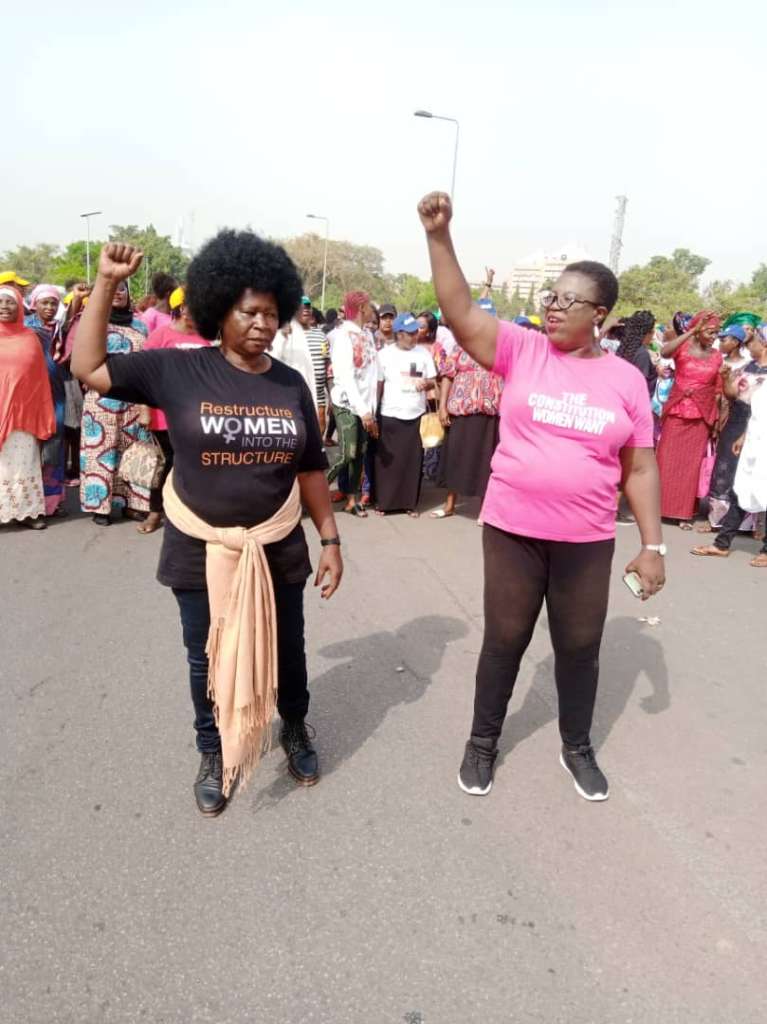
Abiola Akiode-Afo;abi leading Womanifesto and others

By Lillian Okenwa

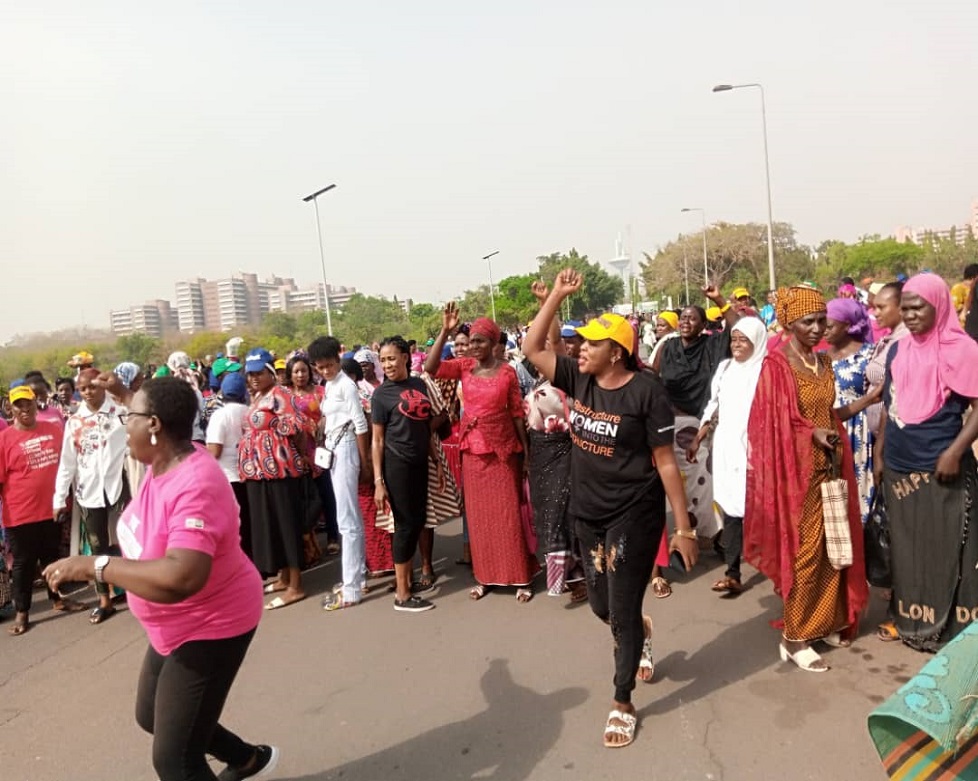
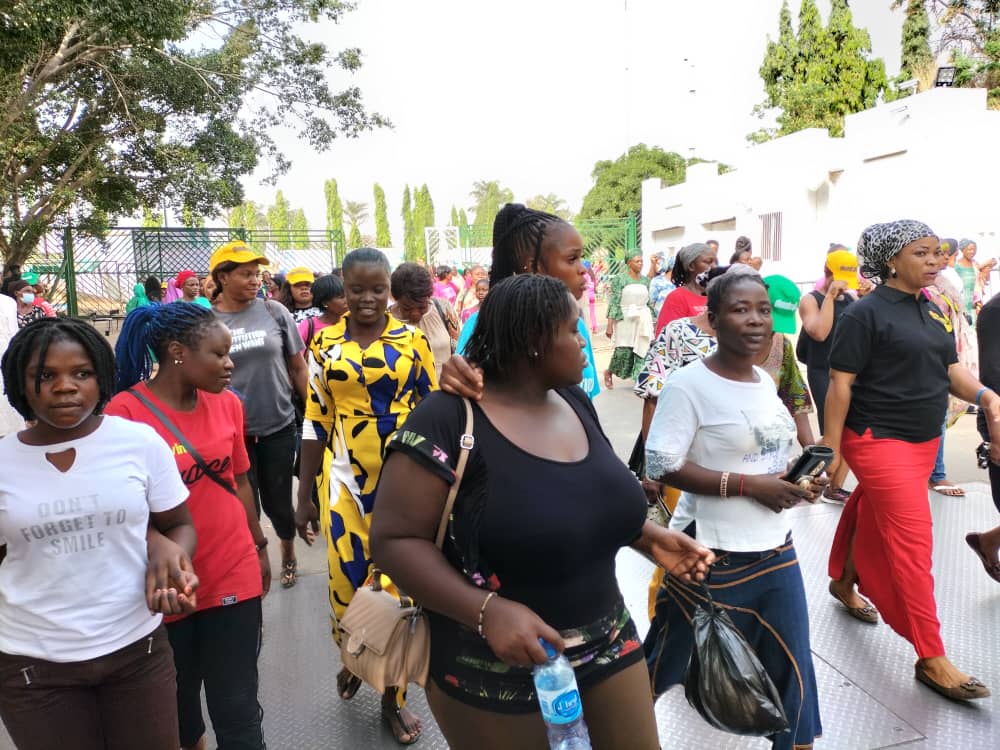
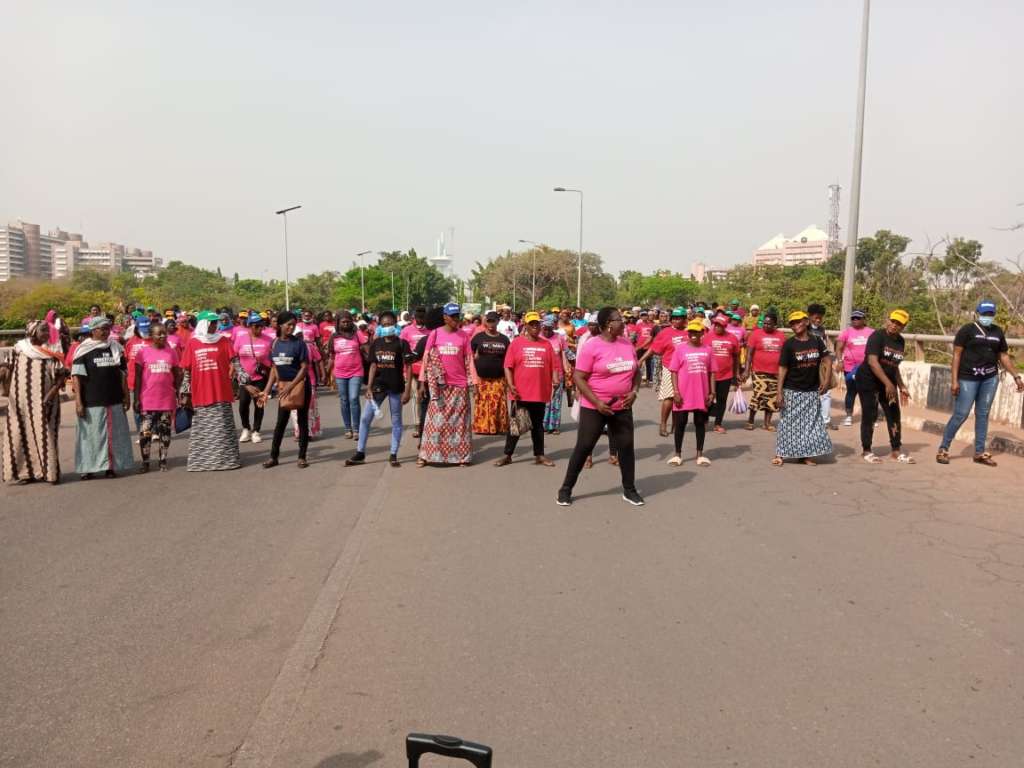
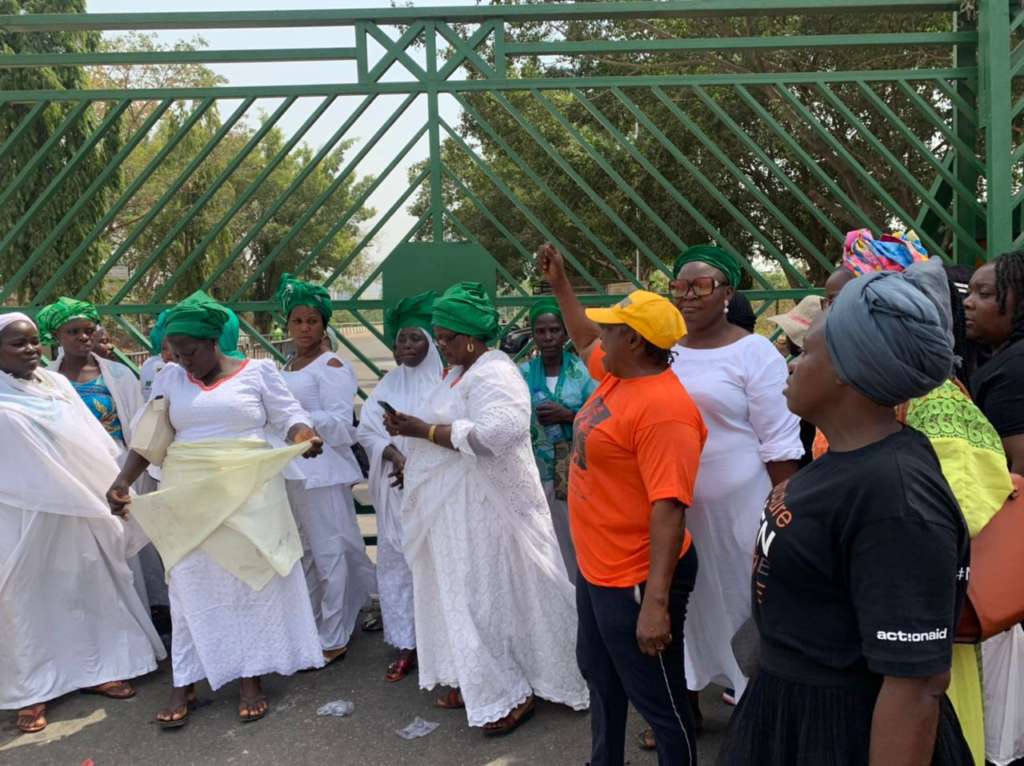
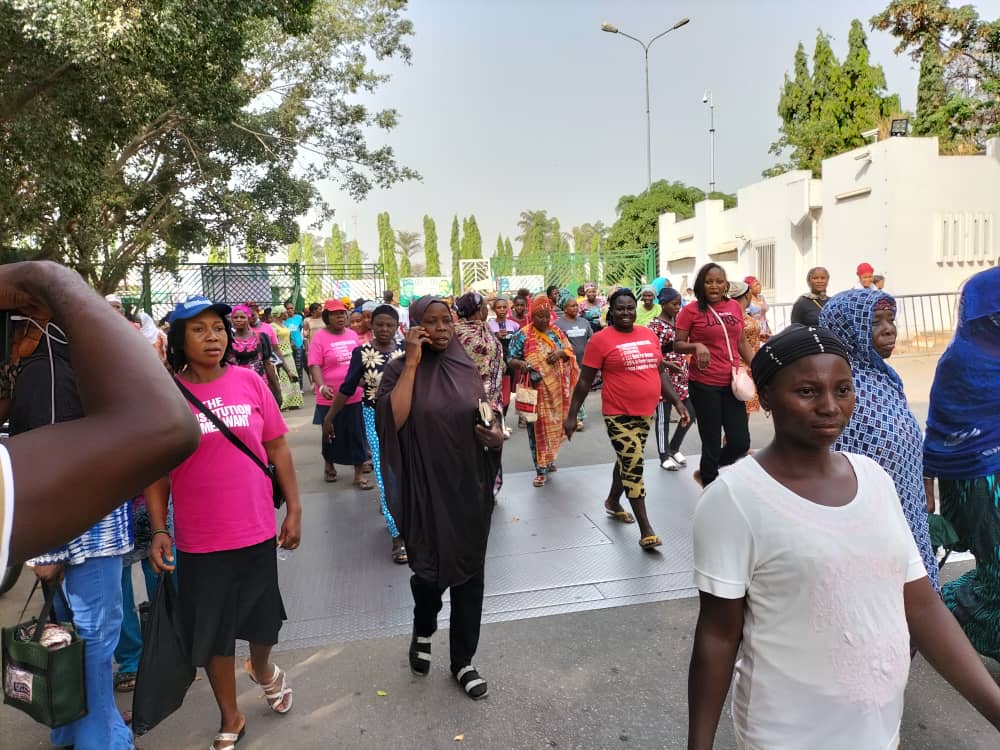
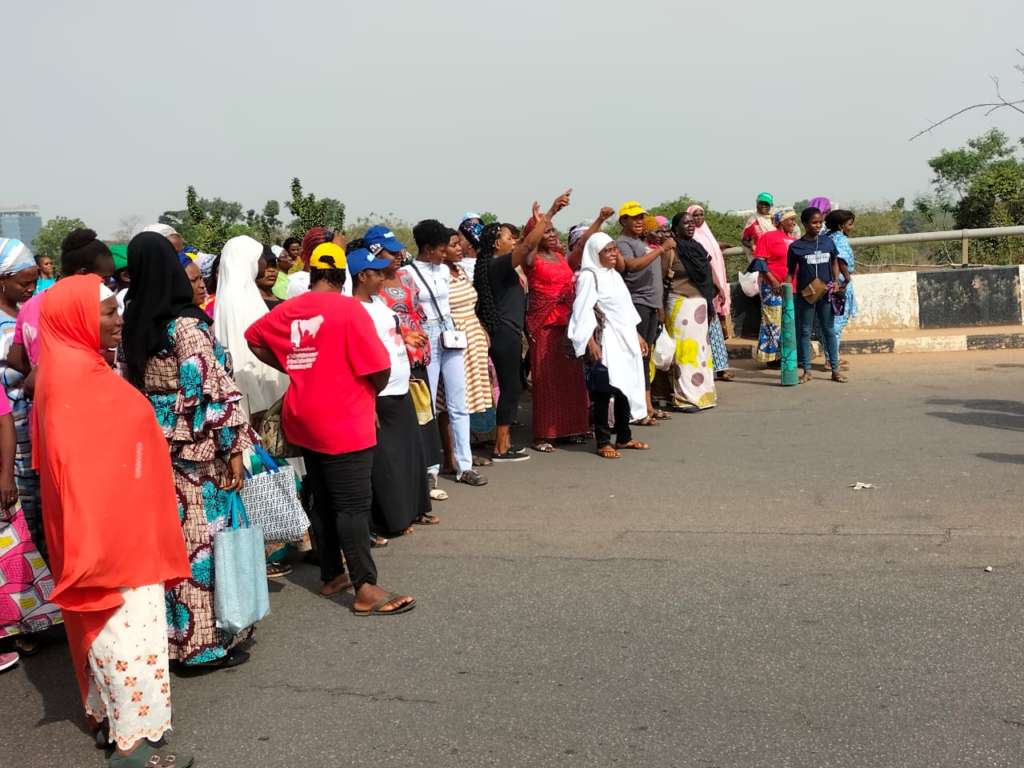
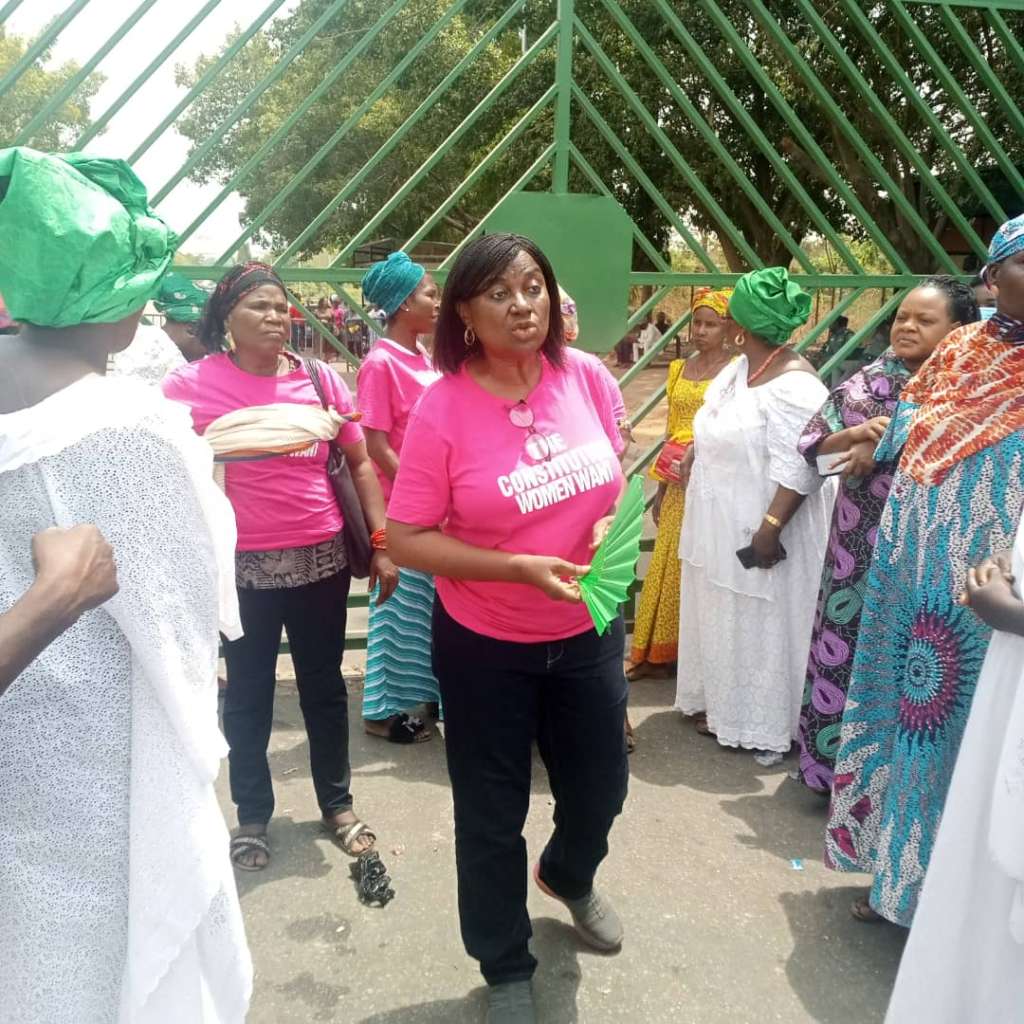
The protests of Nigerian women groups at the National Assembly took an ugly turn on Tuesday when security operatives prevented the women who had entered the premises from going outside the gate to buy either water or food.

Video: Nigerian women prevented from leaving premises of the National Assembly to buy food

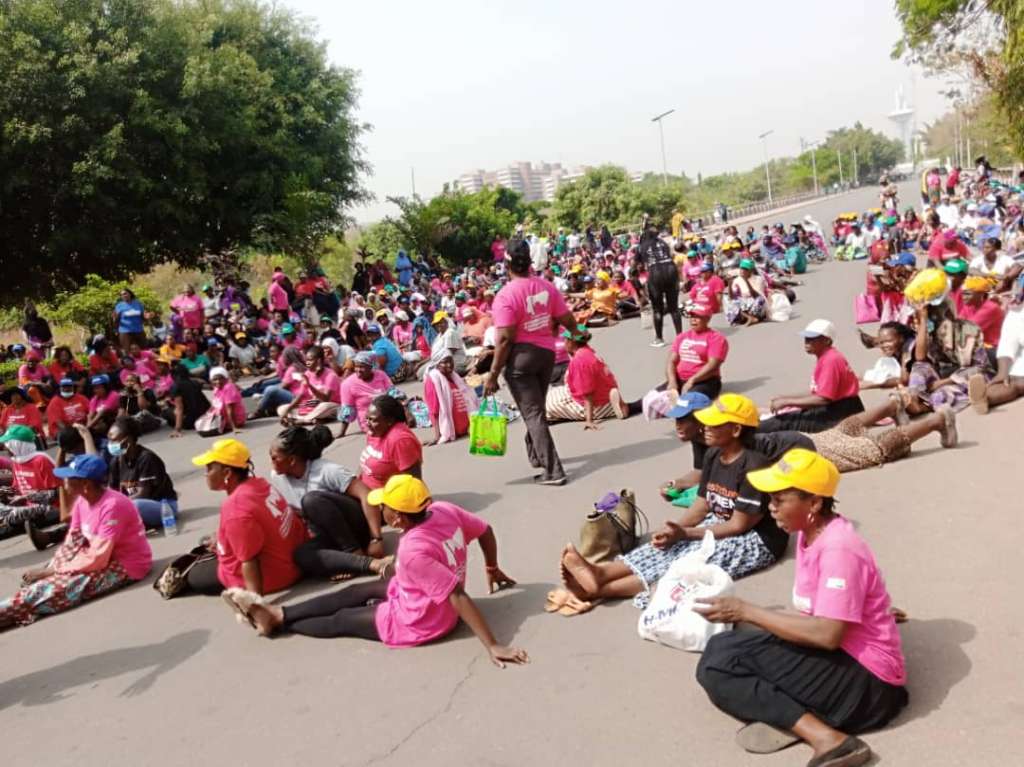
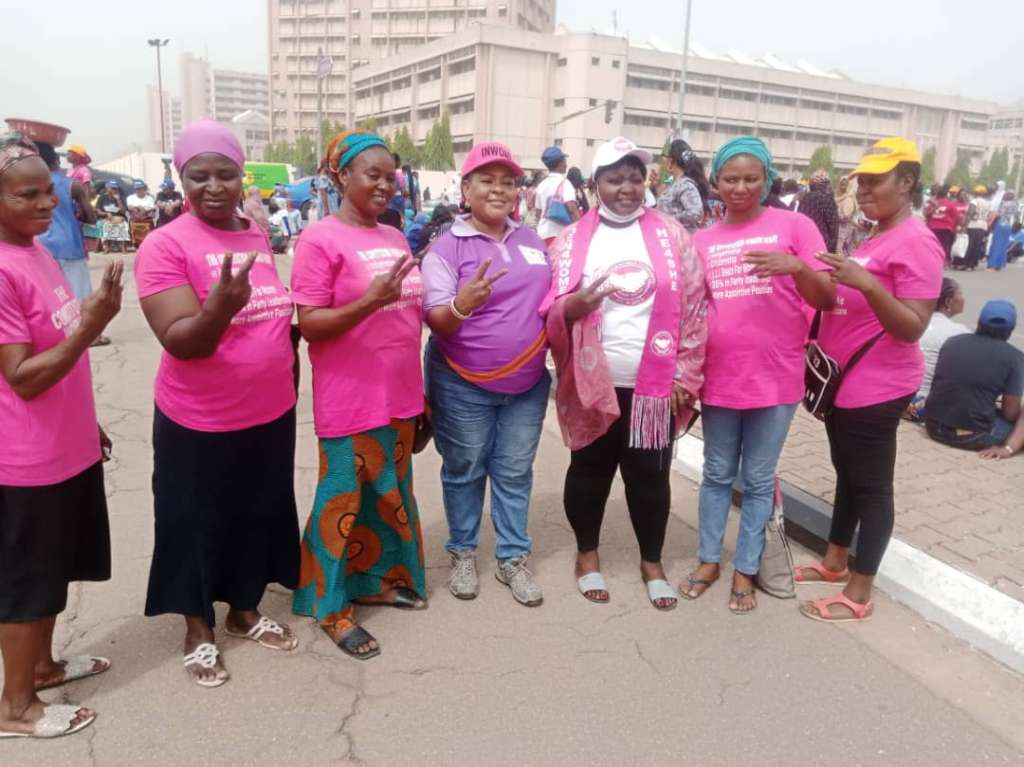
Tuesday marked Day 10 of the Protest demanding that all 5 gender bills must be reconsidered!!!

Marching to the National Assembly

The women are protesting lawmakers’ rejection of all women-related bills including the one seeking to give at least ten slots to women as ministers and commissioners in the federal and state governments failed at the upper legislative chamber.

We are shall not give up.

On the morning of 2 March 2022, various women groups led by Feminists Womanifesto, gathered at the three-arm zone Abuja and marched to the National Assembly gate chanting songs of solidarity against the move by the lawmakers.

Here we are here

Strangely when some of the women who had gained access into the National Assembly grounds on Tuesday attempted to pass through the gate to go and buy food and drinks, they were prevented by security operatives

We can do better mobilising fellow women for you.

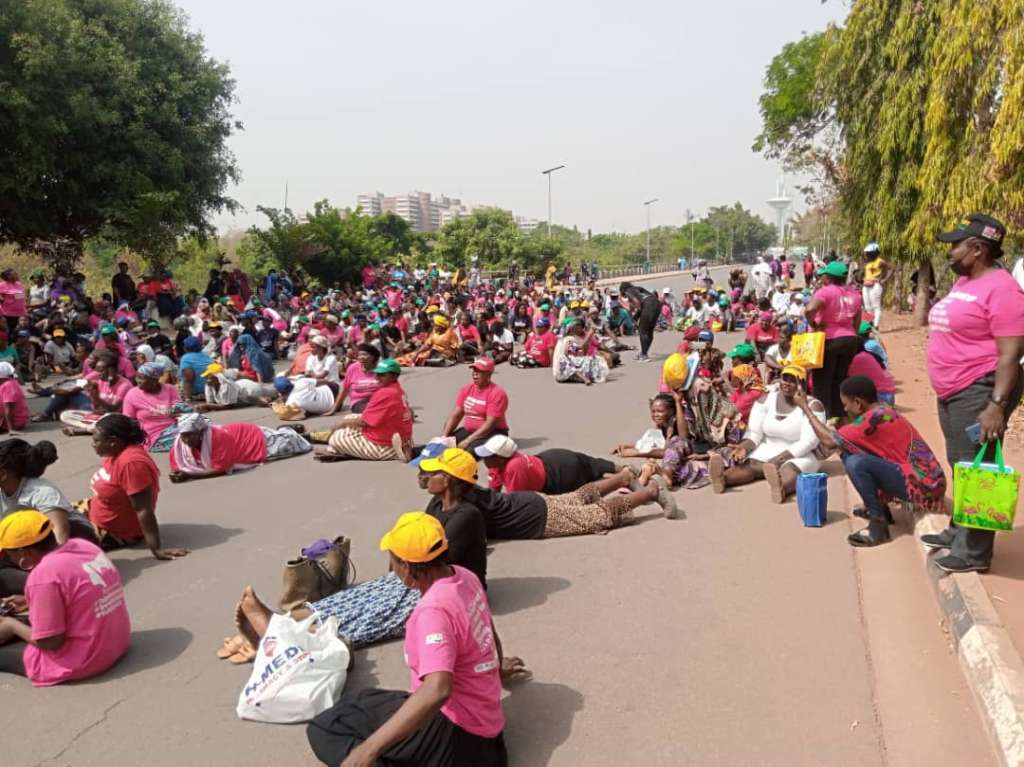
In the past 10 days, over 1,000 women occupied the National Assembly each day with more and more career women stopping by after work.

We are one

During one of the many workshops used to educate and foster engagement on the issue, Womanifesto representatives led by Dr. Abiola Akiyode-Afolabi made a presentation on the #NigerianWomenOccupyNASS Campaign at a UN Women meeting with other embassies and development partners in attendance. At the meeting, the representative of the Speaker of the House of Representatives appealed to the women to call off the protest which has interfered with their activities.

We are in this together

Young feminist advocates also engaged on Twitter/Instagram to provide information online on the protest and call on more people to join. The protest hashtag trended throughout the week reaching 17.4 million accounts on Twitter.

We demand a change
We insist on our rights
Women’s rights are human rights.
And yes, women’s rights are human rights
Abiodun Essiet one of the many women who clean up at the close of each day said: “I am glad for the opportunity to clean up after the 10th day of the occupied NASS protest with other great personalities. The struggle continues. Ubuntu!”

Criminal Suspects Must Be Tried In Accordance With Known Law

Criminal Suspects Must Be Tried In Accordance With Known Law And Not Culture/Religion/Dictates of any Group or Person. 

By Onyekachi Umah, Esq

Suspects of crime are assumed innocent and can only be tried in accordance with known laws and not according to any religion, culture, will of any group, cult or association or dictates of any person, politician, king or clergy.
In Abuja, Federal Capital Territory of Nigeria suspects are to be tried according to the Administration of Criminal Justice Act. The ACT is also used to try federal criminal cases in Federal High Courts located in any part of Nigeria.

My authorities are section 36 of the Constitution of the Federal Republic of Nigeria, 1999 and section 8 (4) Administration of Criminal Justice Act,2015.

We’re Protesting Brazen Legalisation Of Gender Inequality –Ikoku

Founder, Emerge Women and Chair, Womanifesto Media & Communications, Mary Ikoku, spoke with TOYIN ADEBAYO, on the ongoing protest by women over the outcome of the recent Constitution Review exercise at the National Assembly. Excerpts:

 “We are protesting because the gender bills were rejected by the National Assembly. Don’t get me wrong. Generally speaking, I’ll say that the fact that out of the 68 bills treated, majority of them passed was a good thing and commendable but out of the 19 that failed, it was very disappointing to learn that 5 of the bills that focused on women or gender-related all roundly failed. And that’s why we think there is a deliberate act by the men of the 9th Assembly not to pass those bills, especially when you look at how they moved bill number 68 which was originally part of bill number 45. Bill number 68 was removed from bill number 45 and made 68 to ensure that when one is passed, the other doesn’t get passed alongside, and we are talking about bills on affirmative actions in the appointment of Ministers and Commissioners which the House of Reps Approved by increasing the mere 10% to 20% but it failed woefully at the Senate, anyway. So, at the end of the day, not a single gender-related bill scaled through. 

“We are talking about Special Seats for Women, Expansion of the scope of citizenship by registration so that it can accommodate Nigerian women who are married to foreign spouses, we are talking about 35% affirmative action in party leadership, we are talking about Indigeneity rights, we are talking about affirmative actions in the appointments of ministers and commissioners. 

“When you look at those bills, it bothers on the 50% of the Nigerian population. Women make up more than 50% of this population. Truth is, if these legislators had consulted widely with their constituencies, they would have known that these are very popular bills not to mess with. They would have known that those bills were what Nigerian women want and, in making laws, it has to be inclusive, it must include the male and female gender, and you cannot just make a law that totally excludes the gender that make up more than 50% of your population.

“How do we intend to develop? How do we intend to deepen our democracy, how do we intend to ensure a sustainable development when gender is one of the clear indices for measuring that. It is therefore not surprising why this country is lagging behind in Africa and the committee of nations. We lag behind other countries in Africa. We don’t even need to step beyond the African Continent to see Progressive Constitutions. Look at Rwanda, Kenya, Tanzania, Senegal and other African countries doing great in terms of inclusiveness and proportional representation. Nigeria is still lagging behind yet we are the giant of Africa. What kind of giant is this, a sleeping giant or what?

“These are gender related bills which women in Nigeria have worked hard to create space for women in political participation, give citizenship rights for foreign spouses of Nigerian Women, Indigeneity right for women who married outside their original place of birth et al

“We have 109 senators and 360 house of representatives members making a total 469 out of this numbers only 29 are women. Because we have low women representation in the national assembly leadership, the male dominated legislator rejected our bills to close up the gender gap.

“The bills were rejected with so much impunity like the women of this country does not matter. That is why women comprised of your mothers, wives, sisters, and daughters have converged in our numbers, hurt, and indeed alarmed over the refusal of the National Assembly to vote in support of alterations to accommodate gender bills within the ongoing Constitutional amendment process.

“We are protesting because National Assembly members declined their vested responsibility to recalibrate the brazen imbalance in the governance of our country. This in turn will reinforced the major barriers in the path to addressing age-long discrimination against women’s representation and participation in governance. It also affirmed the reasons for the stunted development of our country, while assenting to a continuation of the cycle of discrimination, abuse, and cultural bias against your very own, your female relatives gathered here. about:blank about:blank

“History is replete with the excellent examples of women imperative as vanguards of homes, and nation building, all of which cannot be eliminated or understated. Gender inclusion has witnessed unprecedented results in international development especially in the political, economic and social spheres, with women as the drivers of innovative change, hence Nigerian women cannot continue to be left behind in the scheme of global political reawakening. We state unequivocally that the denial of the five Gender related Bills amounts to a declaration of war on Nigerian women by the National Assembly”, she added. 

“We recognize the reconsideration of the following bills by the House of Representatives: Bill to expand the scope of citizenship by registration; Bill to provide affirmative action for women in political party administration; Bill to provide criteria for qualification to become an indigene of a State in Nigeria but it is not enough, we request urgent re-convening, reconsideration, and immediate passage of the all women/gender-related bills by the National Assembly. 

“Nigerian Women urge the National Assembly and State Assemblies to take heed, respond with courage and stand with women, uphold truth, justice, equity and democracy. As a mark of transparency, we call to question the voting pattern of the National Assembly members on this important matter for accountability. It is our right to hold our representatives accountable. Anything less is unacceptable and we will continue to protest until our demands are met.

“They will be no nation without women.”

Stealing food is not a crime in Italy, but don’t try it in Nigeria

un to ramp up food aid Photo credit: Land Portal

By Lillian Okenwa

“A couple of years ago, the Supreme Court of Nigeria upheld the death sentence passed on a man for stealing crayfish. The contention was that he was armed when caught stealing the crayfish. Why he went into crayfish theft is one story that may never be known.”

“In Nigeria, the scale of economic inequality has reached extreme levels, and it finds expression in the daily struggles of the majority of the population in the face of accumulation of obscene amounts of wealth by a small number of individuals. While more than 112 million people were living in poverty in 2010, the richest 4 Nigerian men will take 42 years to spend all of their wealth at 1 million per day…

“Poverty in Nigeria is particularly outrageous because it has been growing in the context of an expanding economy where the benefits have been reaped by a minority of people, and have bypassed the majority of the population… Poverty and inequality in Nigeria are not due to lack of resources, but to the ill-use, misallocation, and misappropriation of such resources. At the root, there is a culture of corruption and rent-seeking combined with a political elite out of touch with the daily struggles of average Nigerians…

“The tax system is largely regressive: the burden of taxation mostly falls on poorer companies and individuals. On one side, big multinationals receive questionable tax waivers and tax holidays and utilise loopholes in tax laws to shift huge profits generated in the country to low tax jurisdictions. In some cases, these tax waivers have been captured by the economic and political elite and used expressly to garner political patronage. It has been estimated that every year Nigeria loses $2.9 billion of potential revenues to questionable tax incentives. This is equal to about 13 three times the country’s total health budget in 2015…” In this 2017 report titled: “Inequality in Nigeria: Exploring the drivers”, Oxfam captures the Nigerian situation.

This grim report is in addition to a justice system skewed in favour of the rich. The result? Distrust of the state, and poverty that has sown violence. And more results? Overflowing prisons or correctional centres as they are now called in Nigeria. A couple of years ago, the Supreme Court of Nigeria upheld a judgment challenging the death sentence passed on a man for stealing crayfish. The contention was that he was armed when caught stealing the crayfish. Why he went into crayfish theft is one story that may never be known. Last year, two teenagers who had been forgotten in prison for stealing eye drops to save their father who was going blind finally regained freedom. But for the intervention of Tope Temokun Chambers that secured their release, they would have been among the statistics of awaiting trial. Thankfully they have since reunited with their sick father who is now blind at Ikole in Ekiti State.

Not long ago, an Indian male minor from a poor family, who became a thief in order to buy food and medicine for his mother, was given ration, cloth, and other essentials by a local court and allowed to walk free. While passing the ‘unique’ verdict, the judge said that he was giving the boy a chance to improve. Narendra Rao confessed to his crime before the court and said that he decided to steal things as his mother was sick and they had no food. “Police caught me as I was running from the crime spot after stealing. Locals gathered in the area to beat me up. I was thrashed by them and then the police took me to jail. Later when I was produced in court, the judge understood my condition and realized why I got involved in stealing. My mother was sick and we had no food. I wanted to feed her.”

And while spaghetti and noodles thieves are being jailed in Nigeria, the Italian Supreme Court of Cassation rejected a conviction held against a poor man for stealing food, citing the Italian legal doctrine ‘Ad impossibilia nemo tenetur’ (‘No one is expected to do the impossible’). Drawing comparisons to Les Misérables, it was a historic ruling that demonstrated the court’s empathy and understanding of the underlying social conditions that prompted the theft in the first place. Poverty and homelessness in Italy are high at the moment, and with little economic growth, the future looks bleak.

Back in 2011, wrote Livia Hengel in The Culture Trip, “Roman Ostriakov, a homeless man from Ukraine living in Genova, was convicted for theft after he stole cheese and sausages amounting to €4 from a supermarket. A customer had seen Ostriakov put two pieces of cheese and a packet of sausages in his pocket and only pay for breadsticks at the cashier. He was subsequently sentenced to six months in jail and a €100 fine in 2015. The case went through three rulings in court before it was rejected in May 2016 in a historic ruling citing that the ‘right to survival prevails over property.’ It cited the importance of maintaining a shared humanity and that no one should be allowed to starve in a civilized society.

“It should be noted that the poverty rate in Italy, 6.1% in 2015, is at a 10-year high and that the country faces high levels of unemployment, low wages, and economic stagnation. There are believed to be over 50,000 homeless people living in the country, the majority of the men who lost their job due to a divorce, and a slight majority of immigrants versus Italians (60% vs 40%). Homelessness in Europe as a whole has increased by about 45% since the economic crisis in 2008, but the number has tripled in Italy alone. There are a number of canteens in the major cities such as Rome and Milan, but there is little hope for the reintegration of homeless people into society if the economy does not pick up soon.

“Aware of the broader conditions under which Ostriakov stole the food, the court decreed it was not a crime. ‘The condition of the defendant and the circumstances in which the seizure of merchandise took place prove that he took possession of that small amount of food in the face of an immediate and essential need for nourishment, acting therefore in a state of necessity,’ wrote the court.”

A large part of this report was obtained from the article, In Italy, Food Theft Is Not A Crime If You’re Poor And Hungry” published by The Culture Trip on https://theculturetrip.com/europe/italy/articles/in-italy-food-theft-is-not-a-crime-if-youre-poor-and-hungry/

The Federal High Court Judgement on the provision of the Electoral Act: An Antithesis…

By C. I. Daniels

AG has no statutory powers to delete a provision of an Act of the National Assembly. The gazettes are the Act of the legislative arm of Government and in their production by the executive arm the AG can not delete nor add any provision once signed into law by the Governor or President as the case may be. The President had directed the national assembly to work its review and went on and signed the electoral Act into law. That remains the law until it is amended in plenary. The court can declare without more that a provision in another valid law of national assembly is inconsistent, and void to the extent of its inconsistency with the provisions of the constitution of 1999 as amended. Nothing more. The Court may direct INEC to discountenance that provision as inapplicable for the time being till the national assembly amends the offending provision. That will be law until a superior Court declares otherwise and INEC is bound on notice to obey. To direct the AGF to delete a provision of an Act of Parliament is a relief strange to law. Second point is that the constitution actually provides 30 days to Election, is Primary election not Election covered by the electoral law to which the 30days relates. It should therefore be seen that the electoral Act merely amplifies the 30days to ‘election’ and not a breach. Where is the inconsistent any way. The constitution specified 30 days to Election not Elections. Primary election holds in May and that is the election within the contemplation of the constitution and the Electoral Act,and not general elections per se where only voting takes place after the candidates have emerged. Its in primary election that aspirants buy forms to run for an elective position requiring public servant who wish to vie for elective positions to resign 30days to election. That election under reference is the primary election and not the general election(s). This decision with due respect appears hasty and tailored to down play the necessity to the strengthening of best practice towards fair elections and public servants integrity not to be partisan while they midwife any election. Political appointees ought to resign prior to the election which starts in May 2022 by INEC timetable. My thesis is that the Electoral Law provision in question, which is the subject matter of the FHC judgment with utmost respect, as i believe in my view is not inconsistent with the provisions of 1999 constitution as amended. It is a good law made to address the obvious lapses inherent in the disobedience of that constitutional provision on the resignation of political appointees by 30 days to Election. The interpretation of the Electoral Act provision to mean only general elections is on a mischief rule. The ordinary meaning of that constitutional provision of 30days to election is the primary election. The electoral law provision is not in conflict after all with the provisions of the constitution, applying the golden rule in legal interpretation of statutes. This is yet another ambush to INEC strategic planning to conduct peaceful, credible and fair elections in Nigeria.

Chief C.U. Daniels, LLM, BL.

When Courts Of Law Become Political S*x Workers

By Chidi Anselm Odinkalu

Gladys Ukeje was the daughter of Lazarus Ogbonnaya Ukeje, who died in Lagos, the commercial capital of Nigeria, in December 1981. He left behind property but did not make a will. In June 1982, Lagos State granted his wife Lois and son, Enyinnaya, the right to administer and share the estate to the exclusion of Gladys. She sued them on 22 February 1982 before the High Court of Lagos. Nearly nine years later, on 10 January 1992, the High Court of Lagos delivered judgment in favour of Gladys. Lois and Enyinnaya appealed to the Court of Appeal and from there to the Supreme Court in Abuja where, in April 2014, the case was finally decided in favour of Gladys. It took her 31 years of litigation and nearly 33 years since the death of her dad to get Nigeria’s courts to affirm her right as a woman to inherit in equality with the rest of her family.

Caroline Mgbafor Mojekwu, another widow from south-east Nigeria, spent 38 years of litigation in different courts in the country from 1959 before she got the Court of Appeal in April 1997 to affirm her right to inherit the property left by her deceased husband, which a male in-law had sought to dis-inherit her of.

The year after the Supreme Court decided the case of Gladys Ukeje, Nigeria conducted a presidential election, in which, for the first time in its history, an opposition candidate beat a ruling party through the ballot box. The new president, Muhammadu Buhari, a soldier, and former coup plotter, campaigned on the alluring promise of ending corruption. In the same cycle, Bukola Saraki, whose father, Olusola, was Majority Leader in the Senate overthrown by Major-General Buhari in 1983, emerged in somewhat controversial circumstances, as the President of the Senate but without the nod of the new president. An uncivil war ensued between Buhari and Saraki in which the former’s “fight” against corruption became a convenient instrument.

In September 2015, the Economic and Financial Crimes Commission (EFCC), arraigned Bukola Saraki before the Code of Conduct Tribunal on charges connected with asset declaration compliance. His objection to the proceedings failed and he appealed to the Court of Appeal, which equally dismissed his appeal on the penultimate day of October 2015. Five days later, Saraki took his case to the Supreme Court, whose final judgment in the case came down at the beginning of February 2016.

Gladys Ukeje, who spent 31 years in the same courts to get what rightfully belonged to her would have been impressed by alacrity with which Nigerian courts discovered the facility of speedy dispensation of the law in Saraki’s case. It had taken a mere five months to get from the first instance decision through the Court of Appeal up to the Supreme Court.

This speed may have been perplexing but then this was a criminal case, and the courts were supposedly doing a commendable job of complying with the constitutional standard of disposing of such cases “within a reasonable time.” Racing through the entire court system in five months was the judicial equivalent of justice on Speed (no pun).

Nigerian courts are nothing if not consistent in this kind of magic. Between August and December 2021, the case concerning the removal of the former Chairman of the Peoples’ Democratic Party, PDP, Uche Secondus, raced through the High Court of Rivers State and the Court of Appeal to a final decision before the Supreme Court in a mere four months.

While many senior public officers in Nigeria worried about the COVID-19 Pandemic for much of 2020, Dave Umahi, governor of Ebonyi State in south-east Nigeria was inexplicably preoccupied with his political future. At the onset of another wave of the pandemic, in November 2020, he dumped the PDP on whose platform her was resoundingly elected to a second term in 2019 and joined the ruling All Progressives Congress (APC). One year later, the PDP decided to drag him to court, claiming that by decamping to a party different from the one on whose platform he was elected, Umahi had forfeited his office. Umahi filed his response objecting to the case in November 2021. On 8 March 2022, the Court delivered its judgment. It took all of four months to decide the case from filing to judgment.

Those who find this impressive have not yet experienced any courts within the precincts of Abia State. On 25 February, Muhammadu Buhari assented to the new Electoral Act, 2022, but took objection to Section 84(12) in the new Act, asking the National Assembly to re-consider it. Two weeks later, on 9 March, the National Assembly declined Buhari’s request. On 18 March, Justice Evelyn Anyadike of the Federal High Court in Umuahia, capital of Abia State, announced a judgment granting Buhari’s request and ordering the Attorney-General of the Federation “to forthwith delete the said Subsection 12 of Section 84 from the body of the Electoral Act, 2022.”

Even before the court order could have been served on him, Attorney-General of the Federation, Abubakar Malami, a Senior Advocate of Nigeria (SAN) and supposed defendant in the suit exultantly announced that “[t]he judgment of the court will be recognised by the government printers in printing the Electoral Act. The Act will be gazetted factoring the effect of the judgment into consideration and deleting the constitutionally offensive provision accordingly.”

In the three weeks since the Act was signed into law, the claim had been filed, served, responded to, briefs had been exchanged and argued and judgment considered, written, and delivered and executed. It does her injustice to describe this Justice Evelyn Anyadike as a marvel of judicial miracle and wonder.

Gladys Ukeje and Cordelia Mgbafor Mojekwu were two women of less than relatively modest means. Anonymous as they were, Nigerian courts – the “lost hope of the common man” – showed no haste or seriousness in attending to them. Having granted them access, the courts strung them along interminably to the point of enabling their impoverishment.

By contrast Saraki, Secondus, and Umahi are among the movers and shakers of Nigeria. Their cases concerned the settlement of partisan disputes among powerful men. In their favour, Nigeria’s Chief Justice confessed at the end of 2021 that he had created a special category of “political cases” and, presumably, a high speed judicial track for them.

Lawyers who do public or constitutional law as well as political scientists will be familiar with the doctrine of “political questions” in judicial adjudication. It is a doctrine of avoidance by which courts are reluctant to embrace cases that offer “the potentiality of embarrassment from multifarious pronouncements by various departments on one question.” These are precisely the cases that the Nigerian courts now encourage the courts not merely to take but to prioritise.

These courts can only do that at the expense of ordinary citizens whose cases gather dust in the dockets of inattention. This Nigerian variant on political questions inverts the meaning of the doctrine, corrupting it to the point of making it a philosophy of judicial transaction. Not to put too fine a spin on it, the Nigerian doctrine of political questions guarantees unto political harlotry benediction from its judicial co-travelers. It has turned Nigeria’s courts into political sex workers.

The consequences are stark. Disputes involving ordinary citizens who pack no political or financial punch vegetate interminably in the courts. Politicians are unwilling to invest in reforming the judicial or legal process. They know they can always shunt the queue of its dysfunctions and, if everything fails, they can finagle their political way through judicial harlotry. In return, candidates importune the politicians for judicial appointment in the knowledge that they do so for explicit or implicit quid pro quo.

Nigeria’s courts are, therefore, brimming with party political cases that have no place in court except because of the license granted by Nigeria’s unique inversion of the political questions doctrine. The ruling APC alone has over 208 court cases pending in connection with its lack of internal democracy. At this rate, the courts can ill afford to do much else.

The courts are now the place where the politicians go to launder their dirty business, with full guarantee of judicial absolution. It hardly occurs to those who run them that if they required the politicians to join the queue of judicial delay which they visit habitually on citizens, they could more easily reduce the overload of cases, govern their dockets, compel the politicians to take the legal system seriously and restore the credibility of Nigeria’s judges and courts.

A lawyer and a teacher, Odinkalu can be reached at [email protected]

Public Servants or Political Appointees: Who is required to resign 30 days before Election?

The most important judicial pronouncement recorded on 18 March 2022 that affects the political landscape in Nigeria is that of the Federal High Court, Umuahia Division, which struck down the provisions of Section 84 (12) of the Electoral Act 2022 on the ground of its unconstitutionality.
In the next few days it is believed more facts will emerge on the Umuahia case. Who are the parties in the case? The Attorney-General of the Federation is reported to be the defendant and the AGF office was represented by counsel. The House of Representatives has indicated it was not aware of the action and was not served with the court processes in the matter. It will be interesting to know when the action was instituted. Nigerians will also be interested in knowing the details of the prayers sought by the party who instituted the action. It is apparent that there was no real contest as the counsel for the defendant, the Attorney-General of the Federation, agreed with the plaintiff and it will be interesting to read how the learned trial judge analysed the arguments presented by the parties. The position of the Attorney-General of the Federation that Section 84 (12) of the Electoral Act is unconstitutional has been in the public domain since the President signed the Electoral Bill 2022 into law.

Section 84 (12) of the Electoral Act 2022 provides as follows:
No political appointee at any level shall be a voting delegate or be voted for at the Convention or Congress of any political party for the purpose of the nomination of candidates for any election.

The above provisions have been interpreted to suggest that political appointees must resign their political appointments 30 days before the conduct of party primaries to be eligible to participate as a voting delegate or an aspirant. The basis for this interpretation is difficult to fathom.
The ground for invalidating S. 84 (12) Electoral Act 2022 is that the provision is in conflict with the provisions of the Constitution of the Federal Republic of Nigeria 1999 which disqualify “a person who is employed in the public service of the Federation or of any State and has not resigned, withdrawn or retired from such employment thirty days before the date of the election”. (Sections 66(1)(f), 107 (1)(f); 137 (1)(g) and 182(1)(g).
The critical question is whether the definition to be assigned to “a person employed in the public service” or public servant for short is broad enough to accommodate “political appointee” used in the Electoral Act. It would appear the FHC Umuahia Division took the position that a political appointee is a public servant. The contrary view that a political appointee is not a public servant will put a question mark on the decision of the Federal High Court, Umuahia Division.

A cursory look at the definitions of “public service of the Federation” and “public service of a State in section 318 reveals that political office holders appear to be outside the purview of the public service. The provisions requiring the disengagement of public servant from service by resignation, withdrawal of service, or retirement, it is argued, cannot be extended to persons who are not part of the public service.
The case of Nwosu v. Imo State Environmental Sanitation Agency touches on the constitutional definition of public service.
It may be argued that the definition of public service in Section 318 of the 1999 Nigerian Constitution is not exhaustive on account of the use of the words “includes service as” and that political office holders may be accommodated under the introductory phrase “the service of the Federation in any capacity in respect of the Government of the Federation” or “the service of the State in any capacity in respect of the Government of the State”. It is contended that this interpretation will be stretching the express words of the Constitution beyond their natural scope.

We need to juxtapose the words “public servant” and “public officer”. Public officer is defined in paragraph 19 of Part I of the Code of Conduct for Public Officers (Fifth Schedule to the Constitution) to mean “a person holding any of the offices specified in Part II of this Schedule”. Political office holders including Ministers, Commissioners, Chairmen and members of governing bodies of statutory corporations and companies where governments have controlling interests clearly fall within the scope of public officers as well as public servants. Most political appointees will fall within the scope of public officers and not public servants.
Political appointee is a unique lexicon and is not coterminous with the expressions public servant and public officer. The Electoral Act refrains from using the expression “public officers” as elected officers are also public officers.

The efforts of the National Assembly to deepen internal democracy within political parties are commendable but one may argue that it should be the business of a party’s Constitution to prescribe the qualifications to be satisfied by a party delegate or an aspirant. In other words, the National Assembly has no business dictating to a political party who should be a voting delegate or a contestant at its Convention or Congress. This provision undermines the powers of a political party to regulate itself.

However, striking down Section 84 (12) of the Electoral Act cannot be founded on the basis of S. 66 (1) (f) of the 1999 Nigerian Constitution and its kindred provisions.

A sound basis for invalidating S. 84 (12) is that it infringes a citizen’s right to the full enjoyment of the right to freedom of association (S. 40 CFRN 1999) read together with the right to freedom of thought, conscience and religion (S. 38 CFRN 1999) and the right to freedom from discrimination. The belief in political participation through membership of a political party is worthy of protection. A law that seeks to exclude citizens from a free exercise of this right without good reasons cannot be said to be justifiable in a democratic society. Political Appointees belong to a political community among politicians and ought not to be subjected to disabilities or restrictions to which other members of their political parties are not made subject.
A political appointee should not be prevented from discharging his or her duty to make positive and useful contribution to the advancement, progress and well-being of the Nigerian community to the fullest extent possible (S. 24 (d) CFRN)

The rationale for the constitutional provisions on resignation, withdrawal of service or retirement of public servants is not difficult to guess. A candidate is expected to devote time to canvassing for votes and a public servant will be distracted if he still remains in service when he should be on the campaign field. Section 66 (1)(f) of the 1999 Constitution and kindred provisions are inserted to insulate the public service from party politics.
To the proponents of S. 84 (12) of the Electoral Act 2022, the provisions are meant to guarantee a level-playing field among aspirants, promote public decency and prevent the obnoxious use of government resources to promote the political interests of some aspirants. One may however ask whether the above are relevant when a political appointee is merely a voting delegate and not an aspirant to warrant his or her exclusion from party Convention or Congress. Elected personnel including legislators are not precluded from participating as voting delegates and aspirants. A legislator is not precluded from being an aspirant at the primary election or a candidate for an executive position at the general election even if he is a presiding officer of a legislative house. The argument that the legislator has a mandate to serve for a fixed term overlooks the fact that he is a privileged aspirant during party primaries.
The controversies about Section 84 (12) of the Electoral Act are rife among ruling parties especially the All Progressives Congress (APC) which controls the Federal Government of Nigeria. Only ruling parties at national and state levels parade political appointees and the National Assembly should while making a law as important as the electoral law de-emphasise issues that affect only ruling parties. The electoral law is a law meant for all Nigerians and all political parties whether those in government or out of government.

The ratio of the Federal High Court appears weak but the conclusion is sound for other reasons as argued above from a constitutional perspective. The National Assembly should realise its power to make law is not absolute; it is guarded by the express or implied limits imposed by the Constitution to safeguard democratic principles.

First posted on Ibadan Bar Connect on 18 March 2022

TIPS