Home Blog Page 846

Still on the Chrisland sex scandal: Is there a mental health crisis among our kids?

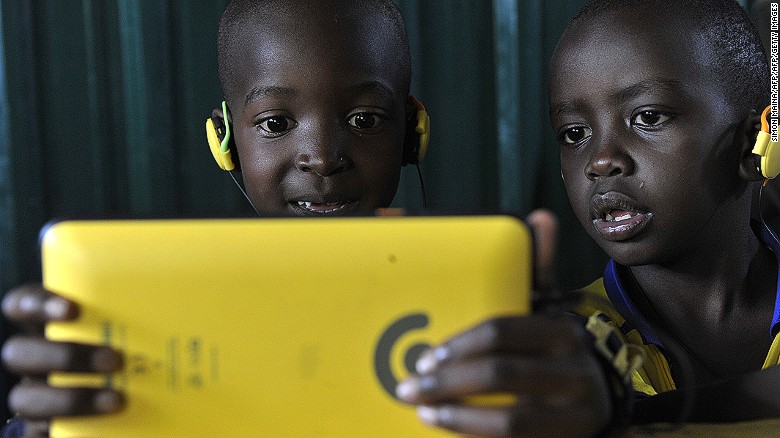
160112175043-kenya-tech-startup-internet-innovation-brck-exlarge-169 Photo Credit: CNN

By Lillian Okenwa

Easy access to online pornography and the potential harm of consistent exposure raise concerns about children’s health and well-being, said an American Bar Association (ABA) newsletter. Then forensic paediatrician and faculty member at the University of North Carolina School of Medicine, Dr. Sharon Cooper, added that “imagery definitely affects children.” She maintains that pornography normalizes sexual harm by portraying a lack of emotional relationship between consensual partners, unprotected sexual contact, and, in some instances, violence and rape.

Founder of Internet Safety Magazine, Rotimi Onadipe insists that social media addiction is a psychological condition that makes a user spend so much time on social media to the extent that it affects other aspects of his/her life. He notes that it is as serious as other common behavioural addictions people often seek therapy to address.

The story of the Chrisland School sex scandal is one which will be told and retold in time to come but let’s pause for a moment and reflect on the thoughts shared by veteran journalist Azubuike Ishiekwene and Peyi Soyinka-Airewele, Professor of African and Comparative/International Politics at Ithaca College, New York.

Ishiekwene in a recent article: Chrisland’s Dubai Five And Our Digital Footprints, said:  “It’s simply an invitation to be a little less sanctimonious, a call to put aside the heart-breaking foolishness of the Dubai Five, and to reflect for a moment, on what might have been only, say, 40 years ago. If our parents had the benefit of smartphones to scrutinise and monitor us at school and play, would they have seen something dramatically different in our secret lives from what we see in the Dubai Five today?”
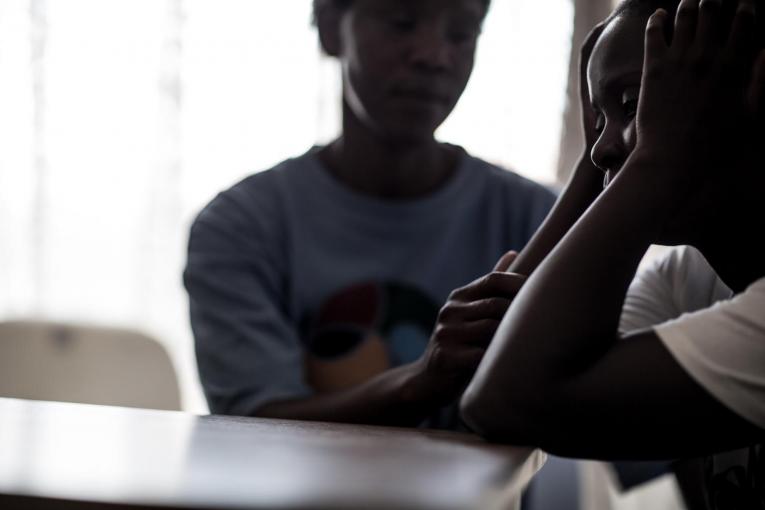
Photo Credit: UNICEF

And for Peyi Soyinka-Airewele: “It is just heartbreaking that these kids are literally babies floundering in a world that has commodified their sexuality in ways that are so pervasive it is virtually impossible for parents or institutions to grasp the enormity of the crisis and the sense of impossibility of resistance.

“There is the present pressure to focus on misconduct and inappropriate behaviour only. But we do our kids a disservice if we ignore the political economies of sexualisation that glamorize and monetize children’s (girls and boys) bodies and reach out on channels that have swept through schools in Nigeria as well as elsewhere in the world – and tragically, most parents and children’s advocates are not even aware of them.

“The trend is growing like a virus and kids as young as eight have been recruited by peers in school, and elsewhere, groomed, and are able to participate in these spaces, a world where mom and dad and teachers do not belong. Yet they lack the ability to grasp that they are again bodies in a market controlled by others.

Peyibomi Soyinka-Airewele

“But the outcomes are devastating. In the US, the national survey repeated every decade on incoming college students had an astronomical hike of almost 20% from the previous decade on clinical depression among students coming in from high school. Another national student survey indicated that 82% said they were dealing with anxiety; 68% with social isolation and loneliness; 63% with depression, and so on. And a terrifying one in five (19%) of students surveyed said they had contemplated suicide.

“I chair the human rights commission in this county (Tompkins County Human Rights Commission) and over the past two months have spoken in several schools- elementary, middle, and high. I believe there will be an implosion if we don’t act. But we are struggling with how to act. Let’s be candid, it’s not an easy battle.

Photo Credit: Imperial College London

“In one school at which we gave four workshops, there is a decompression room where young children can run to let outrage, pain, and depression. It’s just a regular school, not a special needs school. The crisis is beyond belief. A student told me she lets out the pain of rape endured at a children’s camp through isolation from her body. She sleeps with anyone, across gender constructs, at any time, in a futile effort to displace or retract the significance of the horror she endured. She is one of the most beautiful caring young person I know. Her PTSD was untreated.

“Another student is asking for arbitration of coercive sex against a partner. I’m not sure what the ruling will be. She repeatedly gave in to his emotional coercion because she feels unloved and sex is how she, as a black girl, in a white fantasy world, is trying to cope. Her parents worry that she will go through the proceedings only to feel more guilt about being a ‘willing’ victim.

“I am quite sure Nigeria is seeing a similar spike among our young folks, but we do not have great national stats on the mental health crisis among our kids. We are literally sitting on a powder keg. We accept and embrace our insidious capitalist empires but cannot see how they trade in a malignant logic of being, of tradable value that is so overwhelming, it literally takes both adults and children captive.

“The tragedy is that the ugly social media spectacle and sharing of those videos is not the first point of theft from the kids. The children were already losing their right to have a joyful childhood of bonding, creativity, social affirmation from peers, of confidence in themselves, understanding how their bodies work, how to make choices that strengthen and protect them, how to understand the dangers of being filmed, of trust in adults, of self-esteem, privacy in intimacy, of understanding there could be a world in which ‘likes’ are not about predators enjoying watching a 10-year-old having sex with another kid, etc.

“Small steps – Can we appeal, insist, demand, that the government repeatedly issue statements on radio, TV, social, and all news media reminding adults and youth that child porn is a crime and anyone found sharing it on their websites or via social media would be punished to the fullest extent of the law? Aargh!!”

Nonetheless, one cannot help but ask again, who did this great evil to the Chrisland girl? Who introduced her to it? Devastating gender-based violence (GBV) was meted out on that girl at the age only the abuser and the ‘god’ he or she calls upon know. What is now evident is the aftermath of an abused mind and body at work and someone is responsible. Something violent happened to that girl at a very delicate age and someone close to her is responsible. Who is that person? How many other kids have fallen prey to this predator? Beyond looking at the symptoms which everyone is outraged about, it’s important to find out what really happened to that girl and who did it. A predator might be on the loose and we’re busy tearing down his or her creation. That girl needs deep and urgent help but the person who introduced and did this to her must be brought to book.


Former Supreme Court’s Chris Unigwe buries wife

By Lillian Okenwa

For many years, Chris Unigwe was almost a fixture at every major Supreme Court event. Until his exit in 2018, every swearing-in photo from Senior Advocates of Nigeria to High Court judges, Court of Appeal, and Supreme Court Justices had him standing in the background.

Unigwe during a swearing-in ceremony at the Supreme Court

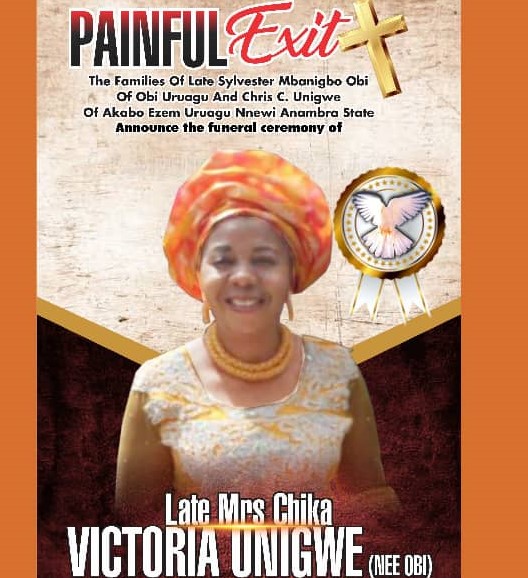
Sadly, after 35 years of marriage, Unigwe lost his wife Mrs. Chika Victoria Unigwe on 2 February 2022. Chika Unigwe was a Mathematics graduate of the University of Port Harcourt. She was buried on 19 April 2022.

Chris Unigwe who retired as Director of Planning, Research, and Statistics on 16 April 2016 but was reappointed by the Federal Judicial Service Commission on a two years contract service wedded Chika on 30 September 1987.

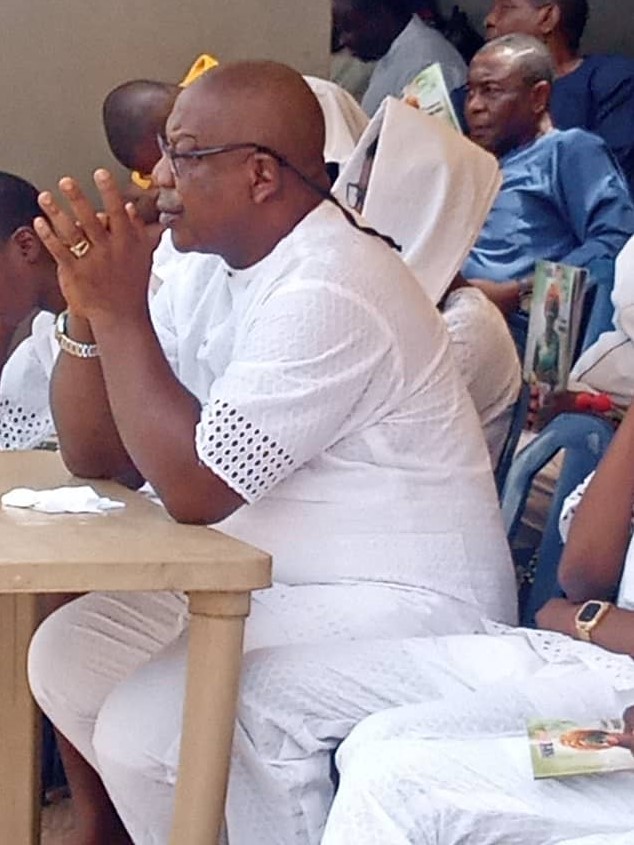
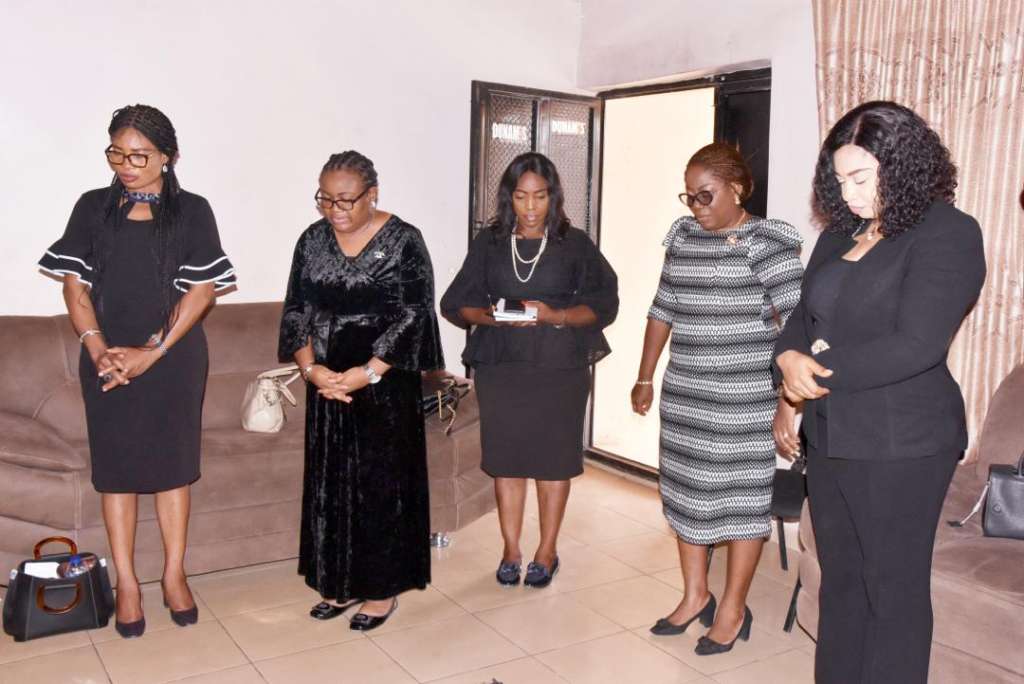
Friends Condole Chris Unigwe

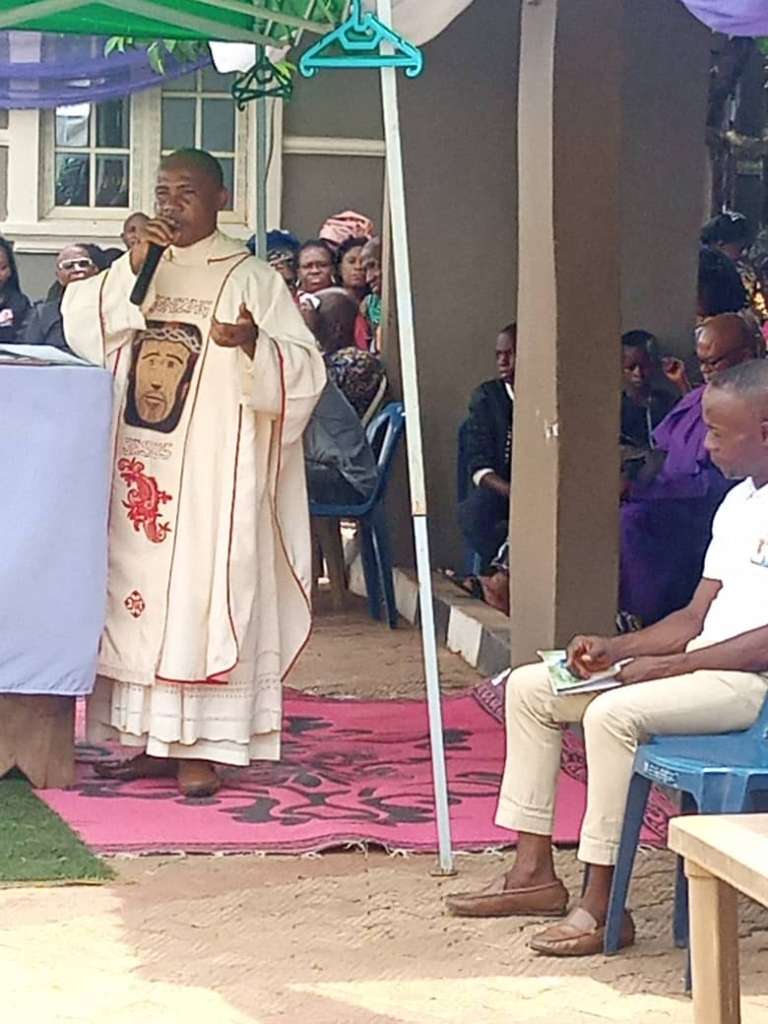
As the priest delivered his homilies that gloomy morning, different thoughts whirled around his mind.

The priest conducting the funeral mass in his country home
At the funeral mass

Staring at the white casket, overwhelmed by grief and a deep sense of loss while the requiem mass progressed, all that played around his distressed mind was: “I miss you every second of every minute, every minute of every hour, every hour of every day.”  And though his children have not come to terms with the passing of their mother, their thoughts were in synch with the unknown author who wrote: “Once upon a memory, someone wiped away a tear, held me close and loved me, Thank you, dear [mum].”

Surrogacy : Why there should be laws Regulating Surrogacy Contracts in Nigeria

Surrogacy : Why there should be laws Regulating Surrogacy Contracts in Nigeria.

By Barr. Nneoma Grace Ogbah

Surrogacy is an arrangement, often supported by an agreement, whereby a woman ( the surrogate mother) agrees to bear a child or children for another person(s), who are unable to have children themselves and who will become the child’s parent(s) after the birth. Sometimes, these surrogate mothers are paid to carry out this act after a legal agreement has been duly executed.

While a number of countries have regulated this practice, Nigeria is yet to put laws in place to this effect. The call for appropriate laws to be put in place in surrogacy contracts is to protect all the parties involved in case of contingencies.

The term “surrogate” originated from a Latin word “surrogatus”, which means a substitute or person appointed to act in the place of another. Most countries recognize surrogacy contracts and have made provisions for such contracts in their state laws. For instance, some states in the United States have developed certain statutes which tend to regulate surrogacy. In these states, before a surrogacy agreement can be executed, it must be shown that:

  1. The intended parents are legally married and are above the age of 18years and that the surrogate mother is also up to 18years of age or above.
  2. The intended mother cannot physically gestate a pregnancy to term, and that such gestation will cause a risk to her health and to the health of her foetus.

These statutes further allows the surrogate to rescind the agreement to relinquish parental rights within 7days of the child’s birth ( in some places, within 72hours after he birth of the child ).

In the United Kingdom, surrogacy is not recognized. The Surrogate Amendment Act of 1985 banned surrogate arrangements. Section 33 of the Human Fertilisation and Embryology Act is of the effect that a surrogate remains the legal mother of any child birthed in such circumstance. The surrogate mother maintains legal ownership of the child even in cases of gestational surrogacy unless a parental order or adoption is made. According to the Act, “ A woman who is carrying or has carried a child as a result of the placing in her of an embryo or of sperm and egg and no other woman is to be treated as the mother of the child”.

There are basically 2types of surrogacy namely:

  1. Traditional surrogacy
  2. Gestational surrogacy
  3. Traditional Surrogacy:

Here, there is an artificial insemination of the sperm of the intended father into the surrogate. By this act, the surrogate mother is genetically related to the child.

  1. Gestational Surrogacy:

Under this type of surrogacy, what happens is that the egg of the intending mother is fertilized with the sperm of the intending father and then implanted into the surrogate mother. By this, the baby is not genetically related to the surrogate mother.

Surrogacy contracts just like every other kind of agreement consists of an agreement between 3 or more individuals, ( usually the surrogate, and the the intending couple). There is evidence of an offer, acceptance and consideration. Since there are legal back ups for our everyday contract, why should we not have laws regulating surrogacy contracts?

In Nigeria, there are no laws in place to regulate surrogacy. Most artificial reproductive clinics in Nigeria conduct artificial reproduction in Nigeria, while relying on the Human Fertilisation and Embryology Authority Guidelines of the United Kingdom.

It is also pertinent to point out that the Nigerian Law Reform Commission provides that any child born to a woman as a result of artificial insemination or implantation of an embryo in the body of a woman while she is in marriage must be regarded as a child of the husband, and that where a child is born under the surrogacy agreement, the commissioning parents should formally adopt the child, even if the child is the biological of the commissioning parents. This is aimed at preventing the surrogate mother from returning to claim the child.

Again, is it not worrisome that Section 10(1)(a)(b)(c) of the National Health Act of 2014 prohibits assisted reproductive technology practices and sub section (2) of the above Act renders any of such act an offence punishable with 5 years imprisonment with no option of fine yet our Nigerian doctors, including the ones working at the National hospital conduct artificial reproduction in Nigerian hospitals and clinics and do not face the law, neither are they penalized?

In conclusion, it is my humble opinion that surrogacy being a fast growing area in medical sciences across the globe requires laws to regulate its practice. These laws should be able to provide for the legality or otherwise of surrogacy, right of recission or waiver by the surrogate mother before the child is birthed, age limit for a surrogate mother, to avoid child abuse, as well as the age limit and requirements for a person(s) to qualify as a commissioning/ intending parent, and also provide a sort of protection for parties going into a surrogacy agreement.

There is a very important need for the amendment of the National Health Act of 2014 which tends to prohibit assisted reproductive technology practices in Nigeria and even provided for penalties to defaulting persons. There is also a need for legal backing on surrogacy so as to provide answers to paternity and maternity issues. Therefore, the Nigerian government should look into this.

Surrogacy : Why there should be laws Regulating Surrogacy Contracts in Nigeria

Barr. Nneoma Grace Ogbah

Legal officer, DITOIL Energy ltd.

Credit:SabiLaw

Phone no:    08119690931, 08106472510

Email:[email protected]

Is your discharge normal?

By Dr. Njideka Kalu

Vaginal Discharge Colours | What do they mean? | What is Normal and Abnormal Vaginal Discharge?

The Country that Lost its Testicles

By Chidi Anselm Odinkalu

In the currency of public policy and political communication in Nigeria, one word occupies the Platinum standard all by itself – “virile”. No major speech by a Nigerian ruler is complete without it.

Soon after assuming office in his first term, Nigeria’s President, Major-General Muhammadu Buhari, proudly informed the European Parliament that his ambition was to have Nigeria “be counted among the most stable, strong and virile democracies in Africa.” His European audience must have been forgiven for wondering why this African president appeared to be distracted by an anatomical part closely associated with change.

Buhari’s Vice-President, Yemi Osinbajo, a law professor, desires to see Nigeria build “a virile sanitation economy.” Another of Buhari’s would-be successors and current governor of Ekiti State, Kayode Fayemi, aspires to “rebuild a strong, united and virile nation”, suggesting, unlike Buhari, that stable and strong doesn’t necessarily virile make.

Nigeria’s rulers are not the only people detained by aspirations to virility. It is, indeed, the mission of every sector in the country. Nigeria’s media has, for instance, been described, as “the biggest and most virile press community in Africa.” Broadcasters in the country aspire to be “virile”, ostensible to ensure that they inseminate the public with a rich dose of information. In one of the more unsettling turns of the word, the country apparently even seeks to establish a “virile chemical industry”. Hopefully, this has nothing to do with whether or not Nigerian men habitually need chemical assistance to achieve virility.

          No one has been able to fully explain when Nigeria’s fixation with virility began. I have tried unsuccessfully to search for it in the lexicon of the early rulers of post-colonial Nigeria. They were all men but, discountenancing the assertion by Cameroon’s Achille Mbembe that “post-colony is a world of anxious virility”, their language did not appear to be much beholden to the testicularities of virility.

That appears to have changed after the soldiers took over power in 1966. In announcing the creation of 12 States on 27 May 1967, Nigeria’s second military ruler, Yakubu Gowon, then a Major-General and dashing model of virility in the army, declared the desire of the country under his leadership to “march manfully together to alter the course of this nation once again for all.” This was an early indication of how the military was about to vigorously impregnate power and the public space in Nigeria with martial masculinity.

Gowon’s usurpers would take this a notch higher. When he announced the takeover of government on 29 July 1975, Gowon’s successor both as Head Boy of Barewa College and as military Head of State, the very masculine General Murtala Mohammed, declared in his inaugural broadcast that he was inspired by his desire “to build a strong, united and virile nation.”

Shehu Shagari, the ascetic civilian who succeeded the military as president in 1979, did not exactly campaign on his claims to virility.

By contrast, in announcing his first coming as Nigeria’s military Head of State on 1 January 1984, Muhammadu Buhari, then a Major-General, teased the country with the prospect of “building a virile and viable economy.”

This narrative of virility is not merely a statement of future aspiration; it is also used to explain the under-development of Africa. Addressing the world in New York at the end of 1990, Nigeria’s then ruler and Buhari’s military successor, Ibrahim Babangida, an army General, argued that “before the coming of the slave trade and the capture of ‘young, virile Africans’ who would have helped build the continent, Africa and Europe were almost equal in levels of development.”

By the time military rule officially ended in 1999, the civilians had become somewhat converted to the rampantly reproductive vocabulary of the soldiers. While the return to civil rule civilianized the soldiers, therefore, the civilian politicians who arguably felt diminished in their manhood in comparison to the soldiers, decided to upgrade by enhancing the masculinity of their repertoire of military metaphors.

Thus, we are told that the political trajectory of leading presidential aspirant and former Lagos State Governor, Bola Ahmed Tinubu, is “driven by the need to build a virile opposition.” His acolyte and former Secretary to the Government of the Federation, Babachir David Lawal, has made a preoccupation of the task of “building a cohesive and virile political party.” In Nigeria’s leading oil-producing state, Rivers, Dakuku Peterside of the All Progressives Congress (APC) promises to “provide a virile opposition.” Not to be outdone, we are told that the ambition of former Vice-President, Atiku Abubakar, for the presidency on the platform of the Peoples Democratic Party (PDP) “holds prospect (sic) for a united and virile Nigeria.”

In an acknowledgment of the narrative force of testicular power in Nigeria’s political imagination, Festus Adedayo has taken to addressing senior executive office holders by the appellation “sexellencies”.

The appeal of virility reflects more than merely the masculinization of power and its insecurities. If the reproductive role is seen as guaranteeing sustenance of the race, virility underpins this role. It is also a uniquely male fixation in much the same way that fertility applies to the female of the species. It is not at all an accident, therefore, that the resort to virility as the cure-all metaphor for Nigeria’s public life and aspirations associated with nation-building coincided with the abduction of the country by the masculine vocation of the military.

The physical representation of virility in popular imagination is found in the testicles, a set of two nuts contained in a sack tucked into a usually concealed part of the male anatomy. In addition to masculine strength, this metaphor contains and conveys a potent subliminality about the pervasively penetrating potentialities of political power.

In wider imagination, of course, a promise to reduce a male figure to something less than a man is usually conveyed in the form of a threat to their testicles or to the sack that envelopes them. It’s called castration. When a man suffers this fate, whether surgically or chemically, his virility suffers irreparable decapitation. So, as a physical representation, Nigeria’s preoccupation with virility finds residence fittingly in the testicles.

The discursive tendency to clothe the Nigerian sovereign in the garments of manhood is rather unfortunate at this time for, in the face of existential threats, the country appears to have found a most inauspicious time to lose its sovereign testicles. Far from conveying strength, Nigeria’s narrative of sovereign virility right now is very much a tale of masculinity decapitated.

 A galloping population may be proof of literal virility but an inability to feed, clothe or educate its youth or provide them with pathways to gainful employment suggests virility misplaced.

Beset on all sides by an invasion of murderous terrorists – foreign and local – Nigeria’s security services and political leadership appear to be short of both ideas for a fightback or reassurance in rallying the country. A country that scorns its best, leaving her to slow, painful death in the face of terror or, which abandons a talented singer to death in violent installments at the hands of a murderous husband, can hardly lay claims to virility or masculinity.

Surely, a country whose rulers lack the testicular fortitude to protect its best and most vulnerable cannot claim or aspire to be mistaken for virile.

When they should be doing their best to lead the country against a toxic mix of bandits, arms, drugs and terrorism which endanger the country, Nigeria’s politicians are instead embarked on a misbegotten electoral rat-race in a country in which many communities have been sacked by terror and a lot more live under terminal uncertainties inflicted by a leadership that long ago lost its manhood.

When General Gowon asked the country to “march manfully together” 55 years ago, Nigeria’s current ruler, Muhammadu Buhari, was an established officer in the Nigerian Army. On the day Murtala Mohammed promised to build a virile country eight years later, he also announced Buhari as one of his principal acolytes in that task in the capacity of military governor of what was then the largest state in Nigeria.

As happy an exponent of the narrative of a virile polity himself as any that has existed, Muhammadu Buhari would go on to rule Nigeria not once but twice. The one certainty about Nigeria’s 2023 elections is that whoever is declared Buhari’s successor will be a fully paid-up apostle of the political metaphor of virility. The other certainty is that they will be taking over from a soldier who will best be remembered as the ruler under whom the country found a way to lose its sovereign testicles.

If there is any silver lining in this story, it is the hope that a country shorn of its manhood in this way may yet see a compelling need to invent a more inclusive narrative for its national project.

A lawyer and a teacher, Odinkalu can be reached at [email protected]

GBV is a scourge – FIDA, Akaraiwe, Alakija, others

Violence-pix. Photo Credit: The Guardian Nigeria

By Lillian Okenwa

The children from GBV homes become future perpetrators that would likely become spouses to children that have never experienced GBV and thus create a new circle of victims. So we are all involved and to save the next generation we must treat this as an emergency.” – Jude Ifesemen

Domestic violence is a scourge that must be fought with the last drop of our blood,” began Ikeazor Akaraiwe, Senior Advocate of Nigeria as he expressed pain and anger over the tragic death of Gospel singer, Osinachi Nwachukwu, following alleged physical and emotional abuse from her husband, Peter Nwachukwu.

Indeed the rash of domestic violence in Nigeria leading to the death of partners has reached an alarming rate, and Singer Osinachi’s death has again brought it closer. In this article, Akaraiwe, SAN, billionaire businesswoman Folorunsho Alakija and other Nigerians bared their minds about this troubling issue.

Akaraiwe, SAN

“If you don’t want your partner again, for God’s sake, separate, BUT do not hit him or her. I hate to draw attention to myself but this is my 32nd year of marriage. I have never hit my wife and vice-versa. Not because we are perfect. Far from it, but because we understand it to be a no-no; and responsible for the so-many maladjusted children we see today,” said Ikeazor Akaraiwe.

Charles Okeibunor, lawyer, conflict resolution, and management enthusiast began with the question — “Why did I Get Married?”

FIDA Abuja paid a condolence visit to the late singer’s family

“There is a popular film by Tyler Perry with the above title.  Its sequel is ‘Why did I get married too? The various individuals corroborating the pains of Osinachukwu in her marriage is truly disturbing. In fact, all forms of abuse (physical and mental) attacked the root of the union. If they start to hit you, curse you or do things they know to mentally torture you, it is time to re-evaluate the purpose of the union. Ultimately the purpose is that two are better than one, so if both of you are not better together, something is wrong and has gone mortally wrong that needs to be addressed as an emergency.

“Marriage is a CONTRACT. As a relationship management enthusiast, there is no relationship on earth without the presence of gain and pain. But any relationship where the persistent pain outweighs the ultimate gain is a relationship that will destroy one or both parties eventually.

“A few years ago, a man stabbed his banker wife 21 times. Today his wife is gone, he is on death row and their daughter is orphaned. Shortly after that is the sad case of two married lawyers in Lekki. After seasons of squabble, the lawyer wife stabbed her husband to death, cut off his privates, and put it in his palm, she is cooling off in Kirikiri, while the man who was to take up an international job before the unfortunate incident is 6ft below. All to what end?

Chairperson FIDA Abuja, Chibuzor Nwosu signing the condolence register

“In my opinion, if they stayed because of the shame of a failed marriage, then those who are living now should realise that the true shame is not separation/divorce, the true shame is when you fail to fulfill your purpose in life, which results from a sudden painful partner induced death.”

Jude Ifesemen, Lawyer, author, and coordinator, of Heart of Soji Initiative, shared his views. “Scientists all over the world are searching for answers and solutions for ailments and diseases like Aids, Covid19, cancer, etc. Unfortunately, there are worse things plaguing our generation that no research seems to be focused on for a cure. Gender-based violence is worse than cancer or the Covid 19 pandemic. It destroys not just the direct victims but the watching children and the society.

“Worse is there is no antidote or vaccine against GBV especially when the victim either struck by Stockholm syndrome or any other personal reason refuses to leave. No matter how much we talk, hold seminars and workshops or cry and shout about the gender-based violence in our society, unless the victim is empowered enough to take action to say no, to step away from the situation, there is nothing a third party can really do. This is because any interference from a third party can be termed Trespass. The case of Entik v. Carrington defined Trespass as ‘any invasion of privacy no matter how minute.’ Thus, there have been cases where the victim called the police against the interfering party.

L-R Francesca Akaniro-Opara, Vice-Chairperson FIDA Abuja, Chair, Chibuzor Nwosu, Welfare Secretary, Ifeoluwa Johnson, Vice-Chair NBA Abuja (Unity Bar) Chioma Onyenucheya-Uko and Treasurer, Wendy Kuku

“No one protects a GBV perpetrator more than the victim.  We have heard and read cases in developed economies like the USA where rather than file a report over domestic abuse for disturbances reported by neighbours, the victims would be swearing that they fell down the stairs for being clumsy on their own. Gender-based violence is a disease that no scientist to my knowledge is currently searching for a cure for. We may enact laws and legislations to protect victims but all that would be futile if the victims do not themselves rise to save themselves. The pertinent question and should be an area of research is —why do victims endure these abuses?

“One thing we must all agree about is that we are all affected by GBV directly or indirectly. The children from GBV homes become future perpetrators that would likely become spouses to children that have never experienced GBV and thus create a new circle of victims. So we are all involved and to save the next generation we must treat this as an emergency. The world must declare it a pandemic worse than the Covid 19 pandemic and save the generations yet unborn.

L-R Francesca Akaniro-Opara, Vice-Chairperson FIDA Abuja and Chair, Chibuzor Nwosu

“Some activists have opined that a possible solution is the empowerment of women, especially in their finances but without giving any global statistics. From my personal observations, most female victims of GBV, are even the breadwinners of their homes. Take the Osinachi case, for instance, she was the artist and from the stories circulating, she was the main source of income for the family. She was the husband’s cash cow, and he milked her dry to her death. So financial empowerment may not readily be the answer though, everyone should be independent financially.

“We have seen cases of female Judges and female boxers being victims of GBV, thus it is not weakness that makes them victims. We must as a matter of urgency redefine what is important in society and raise the next generation accordingly.”

Likewise, billionaire businesswoman, Apostle Folorunsho Alakija, noted that many husbands have abused the word ‘submission’ in Ephesians 5:22 and used it to control their wives. According to Mrs. Alakija, these men have chosen to ignore verses 21 and 25 which command couples to “submit to one another” and husbands “to love their wives just as Christ loved the Church.”

Folorunsho Alakija

 “We find that husbands don’t want to concern themselves with verse 21 which says submit to one another but they chose to camp with wife submit to your husbands. But they didn’t go further down to go and read verses 25 and 26 which tell husbands more about what they are supposed to do. You find that Verse 21 was shorter but many have chosen to ignore it. There have been many arguments for and against, many controversies about this word submission. Many have twisted it to suit what they desire. Many husbands have used it as a control measure. That’s not what it is meant for. In fact, it is for unity and not for control.” 

 Writing further on her Facebook wall, Alakija said: “Submission in marriages has always been a controversial topic, but what does it really mean? As a Christian wife, it is your God-given duty to submit to and obey your husband as both of you submit to one another and Christ. While there are many references in the Bible about how a woman should behave in marriage, there are also scriptures that guide men on how they ought to treat their wives.

“Often overlooked, however, is that men are equally obliged to love, nourish and cherish their wives. Christian husbands should not abuse their authority. Let the word of God in Ephesians 5:21-25 guide you in leading a peaceful marriage.”

Port Harcourt lawyer, Alozie Echeonwu put it this way: “Domestic abuse is a power game. It could be directed towards elders, spouses, siblings, children, or domestic servants. Judges, Professors, local and foreign Royals, Governors, senior and junior lawyers, medical doctors, pastors, and imams, abuse their spouses and household members… It will stop if we truly love one another in the household as we love ourselves.”

To sum up, Emmanuel O. Fashakin, Attorney at Law and Medical Director gave this advice: “I think people need to give the other a little bit of allowance in marriage. Marriage does not mean enslavement. You must let people be. Let everything they do in furtherance of the union be voluntary and cheerful, not out of compulsion. I encourage the wife to be herself. Whatever she gives I take. Complaints only cause more unhappiness. 80% of the wife is better than 0% in divorce. Her parents did not get 100%, why should you? Even God does not insist on 100% of us. He allows us to consult snakes and eat whatever fruit we want.”

An ode to Osinachi by Ode Eyeoyibo

Our Sister is dead.

Our hearts grieve.

We are broken.

She was killed.

She stayed too long in the wrong place;

With the wrong person.

She took the counsel of her own fears.

She died; was killed; we grieve.

But this is what we must remember;

What we choose to remember- she loved God.

Her heart was broken by the things that broke the heart of God.

She sang her pain, her hurt, her grief, her love for God.

We heard her.

We were broken with her.

We cried with her even when we did not understand the language-

Not just the Igbo language but also the language of her pain.

In our tears we found healing.

We worshiped God and we were encountered.

That’s what we remember- she was Theophilia, a worshipper, a praiser, a thanker.

She must get justice.

We must learn lessons.

Her memory is blessed.

But this is what we must remember;

What we choose to remember!

Dr. Ode Eyeoyibo is a Lagos-based Lawyer and Pastor

Men gang-rape, kill, eat lizard

Most recent cases of sexual abuse against animals include a man raping and killing a pregnant goat in southern India, and a 60-year-old man raping a female stray dog last year.”

Just when you think you’ve heard the worst, a most bizarre shows up. Pray what manner of pleasure were four men who raped a monitor lizard seeking?

They first gang-raped, then killed, and eventually ate the protected monitor lizard. Wonders you’d say.

Forest officials in India are still investigating four men who gang-raped, killed, cooked, and ate a monitor lizard in one of India’s most protected forest reserves. It was the only monitor lizard in the park.  

The incident took place on March 29 at the Sahyadri Tiger Reserve, in the western Indian state of Maharashtra. The forest’s camera traps, meant for tracking tigers, caught the accused men trespassing the reserve’s Chandoli National Park. Forest officials arrested the men between April 1 and 5, and found photos and videos on their phones of them gang-raping the monitor lizard, and then killing and eating it. 

“I have never seen a crime like this before,” division forest officer Vishal Mali told VICE World News. “The men are in their 20s and 30s, and they appear to have done it for fun. There was no religious or black magic agenda.” 

The men were identified as Sandeep Pawar, Mangesh Kamtekar, Akshay Kamtekar and Ramesh Ghag, all locals. They are charged under India’s Wildlife (Protection) Act 1972. A local court granted them bail last week. 

The men were identified as Sandeep Pawar, Mangesh Kamtekar, Akshay Kamtekar and Ramesh Ghag, all locals. They are charged under India’s Wildlife (Protection) Act 1972. A local court granted them bail last week. India’s monitor lizards are endangered and are a protected species by law. Violators may be punished with a seven-year jail term. A report by wildlife advocacy groups recorded 82 cases of sexual abuse against animals in India between 2010 and 2020. This was out of a total of 500,000 cases of animal-related crimes that include torture and killings. 

Most recent cases of sexual abuse against animals include a man raping and killing a pregnant goat in southern India, and a 60-year-old man raping a female stray dog last year. 

While the suspects are out on bail, Mali said the photos and videos of the incident have been sent to a forensic lab to build evidence for the case. Forest officials are also seeking legal advice on charging the accused under a law that criminalises unnatural sex between humans and animals. “Not only is this cruel, but there is a risk of zoonotic diseases from this kind of case. There are concerns of men carrying STDs and other infections from their act,” Mali said.

The Sahyadri Tiger Reserve, which is spread across over 1,166 square kilometres (116,600 hectares), is governed by the Indian government and encompasses three national parks. The Chandoli National Park is spread across over 300 square kilometres (30,000 hectares) and has wildlife ranging from tigers and panthers to reptiles such as monitor lizards and geckos. There is no official census of animals in the park, but Mali said it has 30 animals per square feet

India’s monitor lizard population is steadily declining because of poaching. Eating monitor lizard meat is common across South Asia, Southeast Asia, Australia, and Africa. Reports of the reptiles being hunted for their meat are common in India even though it’s illegal. In 2016, an Indian forest official was arrested after serving monitor lizard meat at a party. Monitor lizards are also hunted to make traditional medicine. Mali said that manually surveilling over 1,000 square kilometres of reserve area is challenging for forest guards, but there are plans of deploying a new special protection force. “We will get a team of 100 people who will guard the premises more efficiently,” he said.

Credit: VICE World News

Why Some Evil Men Will Not Die No Matter How Hard You Pray How Long You Fast And How Real Your Faith

By J.B. Dauda

Some people are simply too evil to be permitted to die naturally. So God will keep them alive to “enjoy” the 7 last plagues. Only the 7 last plagues will satisfy God’s vengeance against this special class of people. So He comforts Himself and watches them as they heap evil upon evil, waiting with divine patience until that day when His mercy will be withdrawn from the earth.

There is evidence in the Bible that righteous men will be taken away (allowed to die) before the time of trouble. But, of course, none but Bible students and children of God will understand the logic of God in this.

Isaiah 57:1
The righteous perisheth, and no man layeth it to heart: and merciful men are taken away, none considering that the righteous is taken away from the evil to come.

The ultimate “evil to come” according to Bible prophecy, is the time of trouble and it will climax with the 7 last plagues. You probably have heard of the event referred to as the “7 last plagues” before.

The logic of Isaiah 57:1 is that, while merciful/righteous men will be allowed to die (taken away) evil men will not be allowed to die so that they can benefit from this special time of trouble.

But what type of evil people will be privileged to enjoy the 7 last plagues?

We get a clue about their spiritual condition from Revelation 22:11

Revelation 22:11
He that is unjust, let him be unjust still: and he which is filthy, let him be filthy still: and he that is righteous, let him be righteous still: and he that is holy, let him be holy still.

Just before Jesus Christ comes again, He makes a declaration that separates humanity into 2 classes. Class 2 cannot fall into sin anymore. They have been deemed righteous and holy and are commanded (by divine power) to remain in their state of righteousness and holiness.

How about those in the first group?

We see something strange in the words of Jesus Christ to this group. They are told to remain filthy and remain unjust.

What?

God is telling sinners not to bother to repent but to continue in their sin?

All through the Bible, we see God pleading with the sinner to repent and one of the most passionate pleas is found in the Book of Ezekiel.

Ezekiel 33:11,14,16
[11]Say unto them, As I live, saith the Lord GOD, I have no pleasure in the death of the wicked; but that the wicked turn from his way and live: turn ye, turn ye from your evil ways; for why will ye die, O house of Israel?
[14]Again, when I say unto the wicked, Thou shalt surely die; if he turn from his sin, and do that which is lawful and right;
[16]None of his sins that he hath committed shall be mentioned unto him: he hath done that which is lawful and right; he shall surely live.

In the above verses, we behold the amazing grace and mercy of God. Can you imagine that last statement in verse 16?

[16]None of his sins that he hath committed shall be mentioned unto him: he hath done that which is lawful and right; he shall surely live.

What does it mean to you that none of your sins that you have committed shall ever be mentioned unto you forever?

But when we get to Revelation 22:11, something has changed. It is actually the end of human probation but that is not our focus for today. The sequence of last day events is that trouble will be imminent, but that trouble will be delayed (long enough to allow for the sealing of the saints that will be alive when Jesus Christ appears in the air; Revelation 7:1-3). Then, after these saints are sealed, the time of trouble is unleashed and it climaxes with the 7 last plagues, followed by the appearance of Jesus Christ and the harvest of the church. This harvest, which some people refer to as the “rapture” begins with those that had died and ends with those that are alive — those whose sealing delayed the onset of the time of trouble.

If you have no idea what the 7 last plagues are, endeavour to read about them in chapter 16 of the Book of Revelation.

Please note that these plagues are meant to mirror what happened to the children of Israel in Egypt. Beginning from the 4th of the 10 plagues in Egypt (that is, the 7 last plagues in Egypt) God told Moses that He was going to make a distinction between the children of Israel and the Egyptians; Exodus 8:22-23. In practical terms, what God said to Moses was that, while destructive locusts or flies or lice were going to wreck havoc in the land of Egypt, He will miraculously prevent these disasters from affecting the land of Goshen, even though the land of Goshen was right inside Egypt.

The saints that are sealed are sealed so that, although they will be alive to witness the 7 last plagues, they will not be affected by it.

Psalms 91:8
Only with thine eyes shalt thou behold and see the reward of the wicked.

The eyes are for seeing and it is only the eyes of the sealed saints that will participate in the 7 last plagues. They will see what God will do but will not be part of the punishment.

The people that suffer the 7 last plagues have rejected God to the extent of sinning against the Holy Spirit. The voice of the Spirit of God (which convicts and strives with the spirit of man) has been shut off in their hearts and repentance for them is no longer possible.

Genesis 6:3
And the LORD said, My spirit shall not always strive with man . . .

When God talks like this, it is because He is about to withdraw His Spirit. And when the Holy Spirit is withdrawn, men can no longer repent.

This is why, in spite of the extreme physical and mental punishment inflicted by the 7 last plagues, the sufferers are unable to repent. Rather than repent, they insult God in a manner that is heartbreaking to read.

Revelation 16:21
And there fell upon men a great hail out of heaven, every stone about the weight of a talent: and men blasphemed God because of the plague of the hail; for the plague thereof was exceeding great.

These people are not yet in hell but their rebellion is complete — already equivalent to that of Satan. They will surely end up in hell fire and die the second death — from which there will be be no resurrection. But, during the 7 last plagues, they are suffering plagues no other group has suffered before — yet they do not care. This is proof that, whenever you feel sorry for your sins, it is actually the Holy Spirit of God at work in you. Unfortunately, when that voice of the Spirit ceases, men become exactly like Satan — fit only to be completely destroyed with eternal fire, like Sodom and Gomorrah were completely destroyed with eternal fire: Jude 7.

Comfort, comfort, child of God.

Your Father is way wiser and more of an avenger than you can ever imagine. Just trust and obey. Continue to love those that hate you and pray for those who despitefully use you and persecute you. God has everything covered. And His day draws nearer with every passing hour.

Matthew 5:44-45
But I say unto you, Love your enemies, bless them that curse you, do good to them that hate you, and pray for them which despitefully use you, and persecute you;
That ye may be the children of your Father which is in heaven: for he maketh his sun to rise on the evil and on the good, and sendeth rain on the just and on the unjust.

So fret not, dear child of God. Don’t be dismayed by the “long life” of the enemies of God. Some of them have been marked to undergo the 7 last plagues.

Psalms 37:1,7,9
[1](A Psalm of David.) Fret not thyself because of evildoers, neither be thou envious against the workers of iniquity.
[7]Rest in the LORD, and wait patiently for him: fret not thyself because of him who prospereth in his way, because of the man who bringeth wicked devices to pass.
[9]For evildoers shall be cut off: but those that wait upon the LORD, they shall inherit the earth.

As a matter of fact, it will be a good idea for you to read the whole of Psalm 37.

May God have mercy on all of us.

The Curse of an Incapable State

BY Chidi Anselm Odinkalu

Nigeria’s response to the onset of murderous mass violence has evolved through phases of co-optation, brutal reprisal, appeasement, and state incapacity. The two options that have never quite been attempted with conviction are effective accountability and civic inclusion. Through phases of anti-terrorism, counter-terrorism and, now, interminable and metastasizing counter-insurgencies, the country has found itself mired in chronic mass violence as the only language of political dialogue. With many reluctant to acknowledge how the country quite ended up in this denouement, it is important to look back briefly in order to look forward.
Outlawry in post-colonial Nigeria has a long and tawdry history. Stephen Ellis, who spent a lifetime researching and analyzing this in some detail, recounted in his final book, This Present Darkness: A History of Organised Crime in Nigeria, when the spike started: “shortly before the civil war, when government broke down in some parts of the Western Region and there was a blurred line between political violence, crime, and organized insurgency.” Many would argue that Nigeria has been one long insurgency since then in what has been – on close inspection – a long war against the logical consequences of chronic leadership failure.
The post-war continuation of the error that we can shoot our way out of this failure of both leadership and national inclusion can be traced back to the public executions by firing squad of armed robbers, which began at the former Bar Beach in Lagos on 26 April, 1971. The spike in armed robbery in Nigeria coincided with the mismanagement by the Yakubu Gowon regime of demobilization in the aftermath of the Nigerian Civil War. With neither preparation for post-military life nor skills to survive in the rough and tumble of civilian existence after the war, the tens of thousands of hurriedly demobilized men found alternative uses for their arms and skills, often not in the most civil way possible. Public execution did not end armed robbery. If anything, violent robbery escalated in both frequency and brutality.
The onset of presidential politics in 1979 did not just make civilians of soldiers, it also made civilians of armed robbers, who provided the violent brawn to complement the political brains of politicians in savage electoral brigandage. The numbers confectioned by this criminal tag-team, as acknowledged by the Bolarinwa Babalakin Judicial Commission of Inquiry into the Federal Electoral Commission (FEDECO), often received judicial benediction from election tribunals. Senior Police officers, including former Inspector-General of Police, Sunday Adewusi and former Police Commissioner in the old Anambra State, Bishop Eyitene, both now sadly late, compiled infamous records of electoral joint enterprise with these merchants of violence.
With the return of the military to government in 1983, we had a gradual escalation of violence to the point where, by the mid-1990s, the regime of General Abacha fully deployed criminal gangs and networks against peaceful civic advocacy in the Niger Delta. In institutions of tertiary education, vice-chancellors in various universities and rectors of polytechnics did the same. By the time the country returned to civil rule in 1999, the politicians were happy to resume their marriage with violence and its unlicensed suppliers. This time, as former senator, Shehu Sani, recalls in the title of his book, in addition to using them to rig elections, they were also freely deployed as tools of political assassination.
When the police liquidated a little known Islamic Cleric, Mohammed Yusuf, and hundreds of his followers in Maiduguri, north-east Nigeria, in July 2009, they did not realise how swiftly or steeply the violence would switch gears. Law enforcement, hitherto used to deniable means of committing such atrocities, had become fully converted to the methods of outlawry. The blowback ended any pretence to a law enforcement response to Nigeria’s violence and launched the country into an interminable season of mass atrocities.
In 2011, President Goodluck Jonathan, embattled in the north-east, invited a blue-ribbon panel to help the country understand the issues and think through its options. To lead this task, he tapped Gaji Galtimari, a former public administrator and diplomat and leader of the Borno Elders Forum, who died in 2019. When it reported at the end of 2011, the Galtimari Committee “traced the origins of private militias in Borno State, of which Boko Haram in particular is an offshoot, to politicians who set them up in the run up to the 2003 general elections. The militias were armed and used extensively as political thugs. After the elections and having achieved their primary purpose, the politicians left the militias to their fate since they could not continue keeping them employed. With no visible means of sustenance, some of the militias gravitated towards religious extremism, the type offered by Mohammed Yusuf.”
The Galtimari Report recommended that the government should “beam their searchlight on some politicians who sponsored, funded and used the militia groups that later metamorphosed into Boko Haram and bring them to justice.” In its White Paper issued in May 2012 on the report, the Federal Government accepted this recommendation and directed the National Security Adviser to co-ordinate compliance. One decade later, nothing has come of this recommendation.
Instead, what followed has been a descent into sovereign abdication followed by capitulation. Three years later, in 2015, the crisis in north-east Nigeria had become a source of earnings not merely for elements in the security services but also for mercenaries imported by government and paid with public funds. This, notwithstanding that Nigeria was one of the prime movers behind the Convention for the Elimination of Mercenarism in Africa adopted in 1977, which criminalises mercenarism and renders liable to punishment all persons involved in it.
As candidate in 2015, Muhammadu Buhari cashed in on this and promised to provide the kind of leadership to end it. Far from keeping his word, Buhari doubled down on the abdication, and scaled it up to capitulation before replacing it with bare-faced coddling of terror and insurgents. This appears to have led the rest of the country to the conclusion that insurgency was the only path to dialogue. So, from the north-east, mass violence has been replaced by an epidemic of mass atrocity and from the north-east, the sites of these atrocities under him have spread to all of the country.
As The New Humanitarian memorably reported around the time of the Galtimari Whitepaper, the conclusion was inescapable that “Nigeria’s criminal justice system has failed under the strain, with security force abuses not being investigated and those responsible for Boko Haram attacks not being prosecuted.” One decade later, the situation is inestimably worse, not better.
In what looks like an ultimately doomed effort to divert attention from capitulation to mass atrocity this past week, the Chief Judge of Nigeria’s Federal High Court issued new rules directing that all terrorism trials “shall be held in camera.” This is a breathtaking assertion by one judicial officer of power to re-write with administrative ink the clear provisions of the constitution and of international treaties on human rights to which Nigeria is party. Section 36(4) of that constitution requires that every accused person is “entitled to a fair hearing in public” and the only person or authority who can order trials in camera under section 36(4)(a) is “the court or tribunal” before whom the accused is charged.
Indeed, in its 2017 Report, the Justice Biobele Georgewill Presidential Investigation Panel on the Compliance with Human Rights Obligations and Rules of Engagement by the Nigerian Armed Forces, insisted in a recommendation accepted by the Federal Government that “an arrest under the Terrorism Prevention Act 2015 as amended or any other Acts of Parliament, must be followed by expeditious prosecution within a reasonable time before a court of competent jurisdiction as prescribed by the provisions of Chapter IV of the Constitution of Nigeria 1999 as amended.” As important as his office is, the Chief Judge of the Federal High Court lacks powers to blithely amend the constitution or so cavalierly expropriate rights granted by it.

This mis-step by the Chief Judge of the Federal High Court is the latest in a series of symbolic acknowledgements of the far reaching collapse of state capacity to guarantee that most basic affirmation in section 14(2)(b) of the 1999 Constitution that “the security and welfare of the people shall be the primary purpose of government.” By the beginning of this century, the police and security agencies in Nigeria had come to adopt the methods of the people whom they were supposed to hold accountable. Two decades later, the courts appear keen converts to outlawry in a pretence to fight outlaws. The politicians and their families had for long lived by the mantra that all is fair in the rat race to power. With all of Nigeria’s rulers so committed to denuding it of legitimacy, is it little wonder that the curse of state incapacity in Nigeria is delivering that which communism failed to deliver – a proletarian Nirvana – in which all are joined by the assurance of painful death in mass atrocity or decapitation following mass abduction? 2023 will be interesting.

•A lawyer and a teacher, Odinkalu can be reached at [email protected]

TIPS