Home Blog Page 824

Do we have Judicial Governors or Legislative Governors?

By Chinua Asuzu

Do we have Judicial Governors or Legislative Governors? Why do you call your governor an “Executive Governor”? Is there any doubt that state governors belong in the executive branch of government? The Constitution says “governor”, with no intrusive adjective. Follow suit.

In a hyphenated name, both elements are capitalized. It’s Karibi-Whyte, NOT Karibi-whyte.

In its nominal usage (use as a noun), loot is a mass noun, not a count noun. Hence it has no plural form. Neither you nor the EFCC can recover “loots.” No matter how much or from how many sources, it’s loot.

Begin your application emails or letters with You, Your, or [the name of the firm], rather than I. They want to hear about themselves first. Say, Your law firm has distinguished itself in the Nigerian legal-services marketplace by … or Aluko & Oyebode is a leading commercial law firm with expertise in…

Then segue into your own strengths and show how they would fit into the firm’s business. Say boldly, and show, that you’d be a useful addition to the firm. Match your skill set with the firm’s likely staffing needs.

Forget I hereby apply. Without the ubiquitous, if not iniquitous, word hereby, nobody would think you meant “thereby”. Research the firm on- and offline. Your laudatory introductory paragraph must ring true. Borrow ideas and words from the firm’s mission and vision statements, and from their website generally. Tug at their heart. Address their self-image. But don’t be obsequious or unctuous.

 In its usual sense of “a place, meeting, or medium where ideas and views on a particular issue can be exchanged” the noun forum takes the plural form forums, not “fora.” Fora works when referring to the ancient Roman “square or marketplace used for judicial and other business.” If you live to 144 years, you may never need the word fora. Some descriptivist linguists still use fora, and you’ll find it in some dictionaries. The trend, however, is that nouns of non-English origin, once fully anglicized, should be pluralized like English nouns.

Please don’t say severally when you mean several times. They don’t mean the same thing.

In oral presentations, any protocols or introductory remarks that last longer than 30 seconds signal underdevelopment and poverty of thought. In writing, protocols going beyond two lines are symptomatic of underdevelopment and mental poverty.

“All protocols observed” is nonsensical.

“I stand on existing protocols” is inane.

Just say “Good afternoon, everyone” and proceed to the substance of the presentation. Stop wasting national time.

Acknowledging absent functionaries “ably represented by …” is foolish. Name the person actually present. You may then add that he or she represents so-and-so.

IT’S “STEER CLEAR OF”, not “STAY CLEAR OF.”

The phrase “stay clear of” is unidiomatic and lacks collocation. The correct admonition is “steer clear of”. It means to take care to avoid or stay away from something or someone undesirable or harmful. The etymology is maritime.

A or An?

Use the indefinite article a before nouns beginning with a consonant sound, not necessarily a consonant spelling: a European, a happy day, a historic event, a horrendous error, a uniform code, a university professor, a US diplomat, a usurper, and a yacht. Use the indefinite article an before nouns beginning with a vowel sound, not necessarily a vowel spelling: an honor, an NBA function, an owl, an SAN (when you sound each letter separately as opposed to treating the initialism as an acronym or a word), and an X-ray report.

Finally…

“[P]assion for legal practice should manifest itself … in ethical advocacy: advocacy firmly rooted in the observance of the rules of professional conduct.” Chima Centus Nweze, JSC, PhD, ‘Redefining Advocacy in Contemporary Legal Practice: A Judicial Perspective’ (NIALS, 2009), 39.

#2023 Elections have consequences! 

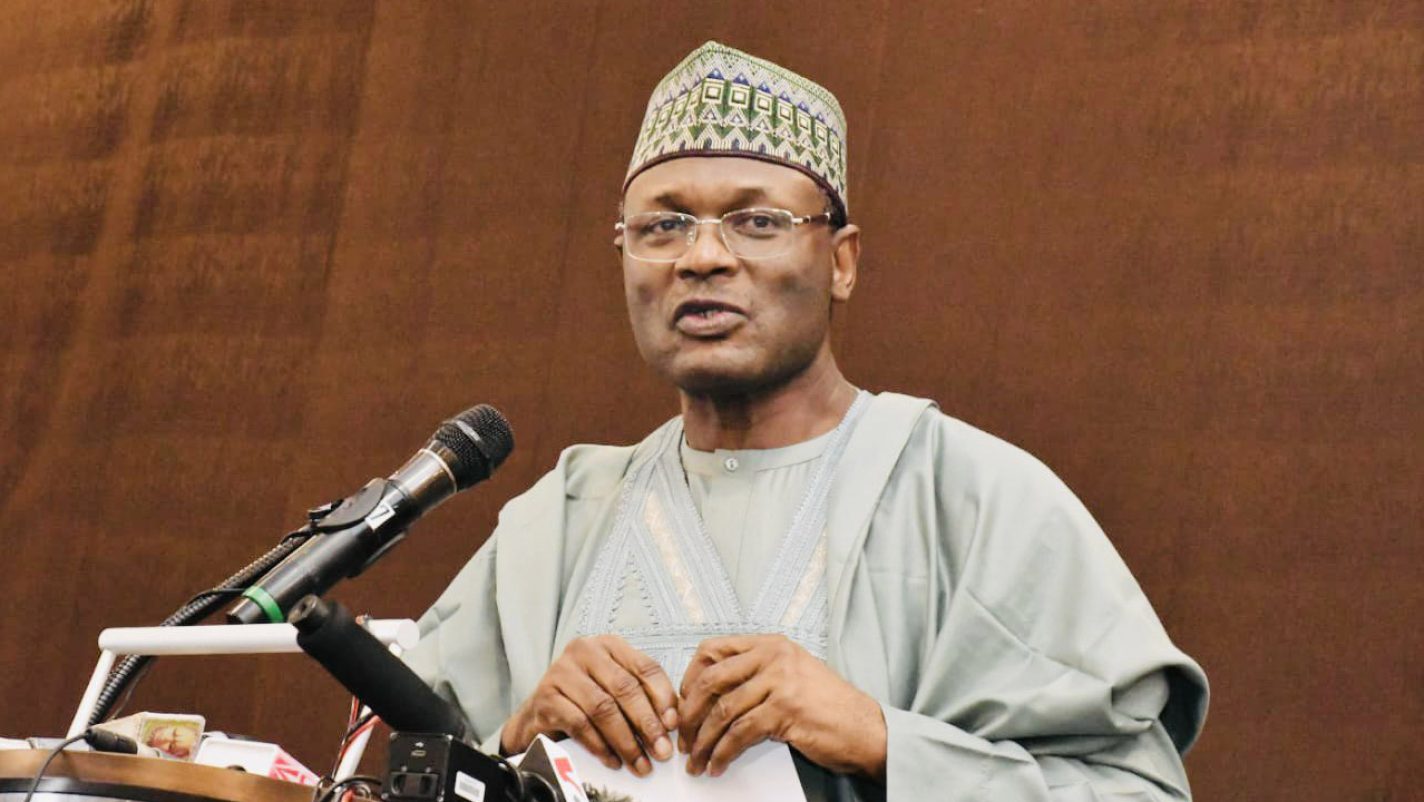
Chairman, Independent National Electoral Commission (INEC), Prof. Mahmood Yakubu
Photo/twitter/inecnigeria

By Martins Oloja

‘I would like to remind the black ministry and indeed all the black people that God is not in the habit of coming down from heaven to solve people’s problems on earth.’ (Steve Biko)

I would like to borrow from the brilliance of Steve Biko, one of the original heroes of black consciousness and South African anti-apartheid activist to advise all of us the oppressed people in Nigeria that lamentation over the broken walls of the country and incredible cluelessness of the ruling class and desperation of the scoundrels who are campaigning to succeed the outgoing mediocrities in power isn’t a strategy, after all. Yes, lamentation isn’t a strategy.

And so I would like to remind all the good people of Nigeria who would like to see a better Nigeria after May 29, 2023, that the same God Steve Biko was referring to isn’t in the habit of coming down from heaven to solve people’s election problems on earth. This means that we can read God’s mind through His words that He has lifted above His name. He has revealed to us that He is not deceived, whatever a man sows he shall reap. He has also revealed to us that only good trees can produce good fruits. Besides, He has warned us clearly that we cannot continue in sin so that grace may abound. He says He forbids that and so we can’t take His grace for granted. Here is the thing, all concerned Nigerians should note that the 2023 elections have consequences upon consequences. It is indeed a period of consequences. The elections will determine whether we should continue to with our failing country or we should continue with nation-building. The election management agency, INEC again assured the aristocracy of the Nigerian media at the weekend that we should expect electoral justice in 2023. This is a credible promise as the electoral umpire has demonstrated through recent staggered elections that INEC can indeed organise a remarkably free and fair election. All that is needful at the moment is how to organise ourselves to defeat the retrogressive forces that are desperate to continue our downward trend. We need to stop the desperate executive bandits and monsters who want to continue looting for themselves and their families. The 2023 elections are consequential. The young and the old should organise instead of agonising.    The reasons are not too far to seek. There is a sense for instance in which we can claim to Nigeria as I was saying here: “Nigeria, We Fail Thee”! We are supposed to proclaim, “Nigeria We Hail Thee” as the old anthem suggests. But even in this season of sycophancy, there is nothing concrete to hail Nigeria about. There is no doubt that the angry young ones who will have access to the citizen journals on digital platforms today will repeat an earlier title by Toyin Dawodu (2014)“Nigeria, We Hate Thee”. October 1, 2022, which is staring us in the face, should be a day to celebrate our great country really. But it will soon turn out also as a day of reflections on the 62 years that the locusts have greedily eaten. It is also a day that is suitable for the locusts to know that because they have eaten our tomorrow for their today, we should tell them that we are now aware. The 2023 elections will be a veritable opportunity to demonstrate that the people can change and shape their destinies.

Besides, we need to counsel the young ones to organise instead of agonising about the locusts. Just the way they organised the very significant #EndSARS 2020. We should trumpet it to them again that lamentation in the social media is also not a strategy. They need to migrate from that sweet nothing called rhetoric to action spots where we should embrace that weapon called execution – the discipline of getting things done. And so, it is time to save up to buy more ‘insecticides of mass destruction to deal with the rampaging locusts that always eat up our national assets, our virtues. Finally, it is time to share some pieces of information to the young ones about the power of skills acquisition and research at such a time like this. And the purpose-driven research is about one thing; the 2023 general elections. You may be wondering why I am raising enthusiasm in the 2023 elections again. I have been reflecting on a 2009 statement by the U.S first African American President, Barack Obama that, “elections have consequences”.

On January 23, 2009, President Obama said, “Elections have consequences, and at the end of the day, I won”. That was when President Obama was snapping at the Republicans after his election in 2009 when he didn’t have to worry about compromise when his Democratic Party had majority control of both the House and the Senate. So, the same Obama proceeded to introduce radical measures including the ObamaCare, among others. And in 2014, the voters noticed and voted in record numbers against Democrats in Congress. It was then recorded of the Hurricane Obama, “You said it, Mr President: Elections have consequences. Because you lost in 2014, Republicans can now reject your lame-duck Supreme Court nomination. And should…” It came to pass then that when the Democrats were in the minority, and the Republican were trying to stall the confirmation of Neil Gorsuch to the Supreme Court, even as President Obama told the Senate Republicans to go nuclear if necessary, they reminded the President about the power in his words that, “elections have consequences”. Again, finally, in 2016, the words came back to Obama as an outgoing President when he was campaigning to get Hillary Clinton to succeed him as a Democratic Party candidate.

Mrs Clinton didn’t eventually win and the world again saw the power in those words, “elections have consequences”. Hurricane Donald Trump came, saw and redefined ‘the West’ and Tweeted on end ‘America’s awesome exceptionalism’. These have been the consequences of elections even in America, their America as the legendary J.P Clark calls them in a book title.

Those words have had some impact on me in recent months as I reflect on how the Nigeria’s power elite, nurtured by the Federal Republic of the Nigerian Army (according to General Chris Ali) have failed Nigeria, the world’s most populous black nation. I feel the young ones who desire real change for development should take the slogan to all the nooks and crannies of this country that: “We have been naïve. We did not know what General IBB and his men knew in 1993 when they cancelled the people’s wishes expressed in the 1993 general and presidential elections. We fought him and ran away. He too ran away to Minna, the capital of Niger State on 26 August 1993. And democracy was scotched just as the self-styled Prince of the Niger killed the consequences (dividends) of our elections. Even after the sudden deaths of the symbol of democracy and the June 12 elections in 1993, Chief M.K.O Abiola and the usurper-in-chief of the people’s mandate, General Sani Abacha, the same military cabal still imposed one of their own, General Olusegun Obasanjo as President in 1999. We all felt the consequences of his election and re-election in 1999 and 2003-2007. As we dozed off in 2007, the artful soldiers again imposed a candidate they knew was not healthy on the nation. And while men were deep in their slumber, the sick candidate too resisted all moves to get him a strong running mate. We all saw the consequences of the election of the unprepared one, President Goodluck Jonathan in 2011-2015 after completing the truncated tenure of his principal from 2010 to 2011. Behold, the consequences of the 2011-2015 elections paved the way for the 2015 election upset we all celebrated: that indeed a man of integrity whose body language alone could literally improve electricity and indeed the economy had been elected. Haven’t we seen the consequences of the 2015 elections. The administration produced by the 2015 election has been battling with a two-point agenda namely, “fighting insecurity and corruption”. As it has been noted here several times, the president may have recorded some plaudits in a section of the media on the two-point agenda in recent weeks, but they cannot be recorded as quite significant, in this connection. Corruption seems to have technically knocked out the ‘New- Sheriff-in Town’ Malam Garba Shehu introduced to us in 2015.

Specifically, insecurity and corruption are still waxing stronger as headaches for all governments in the country. Are there any institutions of governance or social services that the nation can be proud of – from education, healthcare, power/energy sector, roads construction and maintenance to aviation? These are consequences of elections from just 1999- to 2022/23.

We have read enough about the patriotism of the founding fathers who built this nation and obtained independence for us. Today we should talk to those who have pulled down the house and failed Nigeria. Now, under the watch of today’s leaders, we do not write about Nigeria or the Federal and State Governments anymore. We now write about the presidency or president Obasanjo/Yar’Adua, Jonathan or Buhari or Governor this or that or governor this-or that administration. There is no Nigeria or federal government to attribute anything to. We give all the glory to mere men in power. President this or governor that has approved road repairs from one town to the other: no reference to the federal or state governments anymore in our media language.

As I once asked here, where indeed did the rains start beating us? On October 1, 1960, Sir Abubakar Tafawa Balewa,

Nigeria’s first Prime Minister who opened the first chapter in the history of Nigeria on Independence Day had noted among others in his address titled, I Dedicate Myself To The service of My Country: “…At this time when our constitutional development entered upon its final phase, the emphasis was largely upon self-government: We the elected representatives of the people of Nigeria, concentrated on proving that we were fully capable of managing our affairs both internally and as a nation, However, we were not to be allowed the selfish luxury of focusing our interest on our own homes…”

When shall we get leaders who will today dedicate themselves to the service of this country? In the country today, our leaders who failed to develop our roads and transportation infrastructure loot out treasuries to buy private jets to fly over the bad roads. Our leaders who failed the nation by refusing to equip public schools retired home to establish good private schools and universities that children of the real people cannot attend. Nigeria is poor, down and almost out but its rulers always have enough war chest to run for public offices at any time. They complain as candidates that Nigeria cannot make it unless the public oil company, the Nigerian National Petroleum Corporation (NNPC) is reorganised or even privatised. But when they get to the same office they accused of corrupting the operations of NNPC, they sabotage the reform of the same oil corporation. Where will the redemption song come when the legislature the organic law gives the power to oversee the public purse becomes the ‘legislooter’?

Threatening Labour with violence

By Sonnie Ekwowusi

Last Wednesday some hired political thugs, hoodlums and hooligans threatened the Labour party in Lagos to stop conducting a rally tagged: #Obidattti23 Forward Ever Rally” scheduled to hold in Lagos on October 1 2022. Also last Saturday another set of hired thugs, hooligans, hoodlums and policemen were sent to disrupt the peaceful one-million-march movement organized in Ebonyi State by the Labour Party supporters in Ebonyi State. All these travesties of democracy are happening at the threshold of the commencement of political campaigns that would usher in the 2023 elections, and, also around the time that the test polls conducted by Dr. Ngozi Okonjo-Iweala’s NOI Polls Limited and Tedo N. A Peterside Foundation reveal that the Presidential candidate of Labour party Peter Obi towers above the duo of Alhaji Atiku Abubarkar and Asiwaju Bola Ahmed Tinubu.

Without holding brief for the Labour party or its Presidential candidate Peter Obi, the aforesaid threat, aggression, hooliganism and violence meted out against the Labour in both Lagos and Ebonyi States, is, to say the least, a big set-back for Nigerian democracy. Why should a political party descend to the barbaric low level of threatening another political party to refrain from carrying out their political campaign? Democracy is a learning process but I seriously doubt whether our Nigerian politicians are really and truly learning the lessons of democracy. I had thought that the Nigerian democracy had outgrown the weaponization of threats, intimidations and violence in cowing down political opponents or in disrupting their political activities. It is obvious that I was mistaken. Impelled by an inordinate thirst for power, pomp, property, quick money, some dirty politicians are still using threats, intimidations and violence in their bid to grab political power. Machiavellianism still reigns supreme in our national politics, otherwise why should a political party issue a threat to stop another political party from holding its political rally? If the man with a cheap appetite is so desperate to become the next President of Nigeria he should roll out his manifesto and engage the electorate in a robust political discourse instead of hiring political thugs, hooligans and never-do-wells to threaten the Labour Party to stop its political activities in Lagos.

Labour must not succumb to their threat, violence, aggression and hooliganism. Rather it should simply ignore them and work harder to coast to victory in the 2023 general elections. I have perused the scrap contained in the writ issued against Labour in Lagos State by the hoodlums, and, I would advise the party to ignore the scrap. First, the makers of that scrap are hired young hoodlums and never-do-wells. Besides, the court does not act in vain. No court makes an order that cannot be obeyed. No judge makes a court order to take away the inalienable rights of an innocent citizen or to prevent the citizen from exercising his or her constitutional right to freedom of expression, freedom of movement, freedom of association and freedom of thought, conscience and religion as enshrined in our 1999 Constitution. No judge can make an order contrary to the current Election Act to empower hooligans to continue to indulge in their illegality, hooliganism, and violence in our national politics. Therefore the threat issued against Labour in Lagos is a violation of the Electoral Act. It is illegal and unconstitutional. Ditto for the disruption of the political rally organized by Labour in Ebonyi State. Look, you cannot stop anybody from exercising his or her God-given freedom. You cannot force a voter to vote for you in 2023. I am disappointed with the dirty politicians hiring thugs to intimidate and harass their political opponents. Instead of concentrating on winning the confidence of the electorate to vote for them in 2023 despite their monumental failure in the last seven and half years they are busy issuing threats and unleashing violence against Labour because they are afraid that Labour might win the Presidential election next year.

As I earlier said, I am not a member of the Labour party neither am I a card-carrying member of any political party for that matter. But I must call evil by its name. I cannot say that evil is good. The violence unleashed on Labour in Lagos and Ebonyi States is illegal and antithetical to the tenets of democracy and by extension human civilization. Note that this is not the first time political thugs have been hired to issue threats and unleashed violence against perceived political opponents in Lagos State. I remember that during the last general elections in Lagos State hired political thugs were seen gallivanting about intimidating potential voters to refrain from voting for candidates of their choice or else they would be driven out of Lagos. One man even went to the ridiculous extent of threatening to throw some people into the Lagos Lagoon. Apart from threat and intimidation, they have formed the habit of sending their political things to remove, or yank off or destroy the hoisted campaign banners or billboards of other political parties. There is one thing I cannot still fathom: the gullibility of the governed. Aside from the leadership crisis, the next crisis undoing Nigeria is the followership crisis. When will Lagosians and the people of the South-West understand that the politician with a cheap appetite is merely exploiting them for his own benefit?. When will they understand that the man does not put food for them on their respective tables? At times I wonder whether this man has cast a kind of spell on the people which blinds them to follow him. What does it profit a man or woman to vote for the politician with a cheap appetite only for him or her to thereafter continue walking the streets battered and hungry?.

This is sad. I tell friends that violence has never been used to solve the problems of mankind. If violence is useful in the settlement of human disputes Russia would have won the Russia-Ukraine war a long time ago. Violence begets violence in the same way injustice begets injustice. Violence is a recipe for anarchy. Ours is a multi-party and multi-religious system. Therefore it makes no sense for one political party to choose to become a nuisance to other political parties or disrupt their political activities. Life is live and let live. No man is a single verse. Nobody can live alone in this passing world. Man is a social animal. We are members of the same human family. We need one another in our socialization and even political processes even though our tribe, tongue and religion may differ. By using threats and violence to disrupt the political activities of Labour the politicians sponsoring these hooligans are conveying the impression that they are incapable of winning an election except through violence, rigging, gerrymandering and election manipulation.

The current Electoral Act punishes electoral threat and electoral violence. For instance, sections 116 and 128 of the Act stipulate that anybody or group persons disrupting a political meeting or gathering or anybody directly or indirectly, by his or herself or by another person on his or her behalf, makes use of or threatens to make use of any force, violence against any political candidates or political party commits an offence and is liable on conviction to a fine or imprisonment or both. Therefore Labour is advised to lodge a petition with the law enforcement agents to arrest the Lagos hoodlums and their sponsors threatening to stop the rally of the Labour Party on October 1 2022. The party is also advised to petition the law enforcement agents to arrest the hooligans who disrupted the Labour activity in Ebonyi State last Saturday. Certainly the arrest and prosecution of these hoodlums and their sponsors would serve as a deterrent to other hoodlums and party stalwarts planning to commit the same crime.

Legitimate competition to win power is not synonymous with deployment of thugs to intimidate and harass political opponents. If political competitiveness is allowed to degenerate into violence the negative fallout of it might spell doom for our country. This is why the Federal government must warn all political parties to desist from wielding violence against their political opponents. INEC, federal government and the police must ensure that the Lagos hooligans and thugs do not make good their threat against Labour. Nobody has the monopoly of violence. If the Lagos hooligans proceed to disrupt Labour rally on October 1 2022 and Labour tries to repel the attack in self-defence, a breakdown in public peace might occur resulting in the killing and injury of many people. This is why the law enforcement agents must intervene now to arrest the hired Lagos hooligans and thugs threatening to stop the Labour rally on October 1 2022.

As fragmented and pluralistic as our political culture is it justifies our faith in a common creed-belief in human freedom even though some politicians have shown an inclination to think otherwise despite what freedom means for modern society. We still hold this truth bequeathed to us by our nationalists and freedom fighters: freedom is our greatest achievement, and our greatest bequest to posterity. Therefore all hands must be on deck to denounce hooliganism and violence that violate freedom in our national politics. In his book, Spirit of Liberty, Learned Hand, writes, inter alia, “Liberty lies in the hearts of men and women: when it dies there, no constitution, no law, no court can save it; no constitution, no law, no court can even do much to help it.

Can Nigeria’s INEC Organise a Credible National Election?

By Chidi Anselm Odinkalu

“Indeed, it can be claimed with a large measure of truth, that rigging of elections has become part of our political culture.” Report of the Judicial Commission of Inquiry into the Affairs of the Federal Electoral Commission (FEDECO), 1979-1983, Main Report, Paragraph 10:10 (1986)

The electoral landslide of President Shehu Shagari’s National Party of Nigeria (NPN) 1983 unfolded in installments over different sites of improbable magic across Nigeria. This did not occur in one day. It involved the manipulation of the entire value chain of election administration over the cycle of four years from 1979 to 1983. It was both willful and methodical.

After squeaking through a very tight field in 1979 with a mere 36% of the votes and not a small helping hand from the judicial arithmetic of the Supreme Court, the NPN in power set about ensuring that they were not left in 1983 to the mercies of any judges. For the party, this meant they had to find a way to wrestle some significant territory off of the hands of Obafemi Awolowo and the UPN in south-west Nigeria. If they did not have living voters, then they had to invent voters by some means.

In places like Oranmiyan North 1 Constituency then in Oyo State but now in Osun, they found just the perfect site for this project. This was the state where Awolowo left arguably the greatest physical monument to his political vision in what was then known as the University of Ife (now Obafemi Awolowo University). In 1979, the register of voters in this constituency had 48,216 persons. Four years later, in 1983, the number of registered voters in the same constituency had skyrocketed to 214,500, an increase of 444.87% at an average annual rate of growth of more than 111%.

According to the 1986 Report of the Judicial Commission of Inquiry into the Affairs of the Federal Electoral Commission (FEDECO), 1979-1983, chaired by former Supreme Court Justice, Bolarinwa Babalakin (himself also from Osun State), the reason for this was “Mr. Stephen Ajibade, FEDECO Administrative Secretary.” Mr. Ajibade contrived to impregnate the register with the names of ghosts none of whom came from the constituency, most of whom probably did not exist, but most of whom were recorded as having “voted” in the constituency during the 1983 elections. These ghosts contributed to unseating the UPN and handing the rich harvest of votes in Oyo State to the NPN.

The moral of this tale is not merely, as the Babalakin Commission report said, that election rigging is part of Nigeria’s political culture. It is also that the Independent National Electoral Commission (INEC) as the current successor to FEDECO is now called, enables that culture. As the 2023 elections approach, senior officials of the INEC who appear to have graduated from the Stephen Ajibade school of electoral administration, have dusted up their routines.

Let’s take voter registration in Omuma Ward in Oru East Local Government Area (LGA) of Imo State in south-east Nigeria for example. This happens to be the home of Hope Uzodinma, the man whom the Supreme Court of Nigeria installed as the winner in January 2020 of the March 2019 ballot in which he came fourth. In 2015, this ward had a mere 6,500 voters. Since 2019, it has become the epicentre of ongoing violence in the state, leading to an untold exodus of people from the locality.

Yet, over this period, the number of registered voters in the constituency rose with the alacrity of Ijebu Garri to over 46,000, a factor of over 700% or an average annual rate of increase of more than 100%. Under any circumstance, this kind of trend would task credulity to breaking point. For INEC, it’s par for the course.

The details of some of the new additions to the register of voters in Omuma Ward of Oru East bear telling.

Among the newly registered voters added since Hope Uzodinma was installed as Governor of Imo State is Adesanya Nash, who was born in 122 years ago in 1900. He registered at the Central School, Omuma II.

Mr. Nash is only two years older than two persons, both identified as “Chimzuruoke Daves O” and supposedly male but with female passport pictures. Both were registered in Umuhu Primary School, II. One is fair complexioned while the other one of much darker hue. Whether or not they are extra-terrestrial transvestites is not clear. What is clear is that the records say that they are 120 years old, having been born in 1902.

This register is an incredible peek into the healing capabilities of Heaven and the Hereafter.

Also registered in Umuhu Primary School II is 108-year-old Chidiebube Ozi, who was born in 1914, the same year in which Frederick Lugard worked his magic to invent an amalgamated Nigeria. From his passport, Chidiebube looks like a specimen preparing for the athletic exertions of the Qatar World Cup.

Not for any of these the corpulence of their brother in the Governor’s Office in Owerri or the physiological creases from the consequences of Buhari’s “Change”.

It bears recounting that Nigeria is a country whose citizens in the diaspora do not have a right to vote. It is also a country in which there are no 123-year-old new voters. But, while Nigeria’s citizens in the diaspora cannot vote, it seems that those who have gone to Heaven, at least in Hope Uzodinma’s village in Omuma, Imo State, can.

The response of INEC to this entire saga has been nothing short of a scandal. On 15 September, Festus Okoye, the INEC National Commissioner responsible for Information and Voter Education, issued a statement in which he appeared to suggest that the problem was with putting these facts in the public domain and not with the fact that INEC staff without whom this could not have happened are still in service.

Commissioner Okoye claimed that the Commission “is conducting a comprehensive Automated Biometric Identification System (ABIS) cleanup of the registration data by scrutinizing every record”, pointing out that “after the ABIS and clean up, the Commission shall appoint a period of seven days during which the register will be published for scrutiny by the public for objections and complaints.”

Three things are evidently missing from this release. One, Commissioner Okoye did not say how long the “cleanup” of the register would take or when it would end. Two, he did not say what degree of accuracy the processes of the ABIS enjoy. Third, this release did not say what consequences would follow if it were to be found that staff of INEC had in fact been complicit in manipulating or inflating register of voters in any place through facilitating clear breaches of what Mr. Okoye called INEC’s “business rules.”

The Commissioner did not forget to disclose that 3,316 “ineligible registrants” have so far been invalidated in Hope Uzodinma’s Oru East LGA. Two metrics will put this number in context.

First, INEC’s breakdown shows that it found 7,145 of 16,511 new entries from Imo State’s ineligible. This means that Hope Uzodinma’s Oru East alone supplied 46.41% of Imo State’s ghost voters. For context, Imo State has 27 LGAs and 305 electoral wards.

Second, if the number of “ineligible registrants” from Hope Uzodinma’s Oru East were to be applied as a constant across the 774 LGAs in Nigeria, it would yield 2,566,584 ghost voters. That is a mere 5,175 less than the margin of 2,571,759 with which Muhammadu Buhari beat President Goodluck Jonathan in 2015. In other words, even the numbers so far discovered as ineligible by INEC could easily determine the outcome of any election. It, therefore, warrants serious action against the perpetrators.

It should be evident to INEC and its leadership that the staff who enabled this kind of rigging of the register of voters will happily enable worse in an election. If the Commission is interested in a credible poll, surely, claiming that it is engaged in Spring Cleaning the register in the rainy season is not good enough. It should say how these ineligible people got there and what will happen to those who perpetrated this. Until INEC is willing to contemplate this, it must remain in doubt whether the Commission under current leadership is fit for purpose.

A lawyer and a teacher, Odinkalu can be reached at [email protected]

Has anyone ever come to your office seeking a will and testament?

By Chinua Asuzu

Judge Mark P. Painter queries probate lawyers, “Has any one ever come to your office seeking a will and testament? Are they two things? And did they then say, ‘I would like to give the rest of my estate to my spouse, the residue to my daughter, and the remainder to my son’? Would that be possible? Of course not—they are the same thing, so why do we use three words?”

Mark P. Painter, ‘Writing Smaller,’ Michigan Bar Journal (Oct. 2010), 54.

Abbreviations versus Acronyms

An abbreviation is “the shortened form of a written word or phrase used in place of the whole.” (Merriam-Webster).

AMCON, AU, UK, and USA are abbreviations for Asset Management Corporation of Nigeria, African Union, United Kingdom, and United States of America, respectively.

An acronym is an abbreviation pronounceable as a word, typically formed from the first letters of each (main) word in a phrase.

All acronyms are abbreviations, but not all abbreviations are acronyms.

Some acronyms evolve into words, no longer merely pronounceable as words.

AMCON is an acronym because you can say it as a word (without mentioning the component letters).

AU, UK, and USA are not acronyms—you have to say each letter.

Merriam-Webster erroneously lists FBI as an acronym; it’s not.

CEO, the abbreviation for Chief Executive Officer, is not an acronym—it’s not pronounceable as a word: you have to say each letter.

Sonar is the acronym for “sound navigation and ranging”.

Since they are pronounceable as words and formed from the first letters of the constitutive words, AIDS and NATO are acronyms (for Acquired Immune Deficiency Syndrome and North Atlantic Treaty Organization).

Since they are not pronounceable as words (you have to say each individual letter), AU, DNA, NYPD, RNA, and UN are not acronyms—they are abbreviations and initialisms for African Union, deoxyribonucleic acid, New York Police Department, ribonucleic acid, and United Nations.

Laser is the acronym for “Light Amplification by Stimulated Emission of Radiation”, but the prepositions by and of have been excused from contributing their initial letters to the acronym.

Acronyms do not take full stops. Write AIDS not A.I.D.S. Strictly, abbreviations that are not acronyms need full stops, but you can dispense with full stops when writing well-known abbreviations with all-caps. So write AU instead of A.U., though both are correct. Prefer NWLR to N.W.L.R. for Nigerian Weekly Law Reports. USA is better than U.S.A for United States of America.

To pluralize an abbreviation or acronym, don’t add an apostrophe before the s.

Wrong: 15 NGO’s were invited to bid for the rural health fund.

Correct: 15 NGOs were invited to bid for the rural health fund

Write Dr, Mr, and Mrs without full stops. The v in case names should not take a full stop: Stabilini Visinoni v Federal Board of Inland Revenue. And it’s v, not vs.

Chinua Asuzu, Learned Writing (Partridge, 2019), 626–627.

Note that:

“The above subject refers” and similar otiose phrasings are leprous legalese. Uninstall that pseudo-sentence from all your correspondence IMMEDIATELY and PERMANENTLY. It’s perfectly USELESS. Which other subject could the email or letter be about than the one described in the heading?

Also:

There’s no such hour as 12 am or 12 pm. Those times don’t exist on any clock. So never use those expressions.

A.m. means ante meridiem, which means “before noon”; p.m. means post meridiem, which means “after noon.”

After 11 am, the next hour is noon or midday, which you can express as midday, noon, 12midday, or 12noon.

After 11 pm, the next hour is midnight, expressed as midnight or 12midnight.

There are certain moments in life that will always remain with you By Yvonne Enwerem

Yvonne Enwerem and mum, Chief (Mrs.) Vivienne Enwerem, Esq.

Born in the UK to proud Nigerian parents, I was raised predominantly in Nigeria and only returned to the UK for tertiary education.

Upon completing my BSc at Newcastle University, I returned to Nigeria for NYSC. At the same time, I launched my first Company Levin Consulting & Events with my best friend Judith; after that, I started work at Konga Online Shopping as the Business Manager for the Northern Region.

I learnt a great deal whilst in this position for three years and decided to nourish my calling for business further.

In my pursuit for greater heights, I decided it was finally time to achieve my Masters’ degree. Little did I know that as God has always guided me, this would be the degree that brought soo much additional pride and achievements for me and my family. So, I embarked on the journey and prepared for the next stage of my life.

I was ecstatic to be accepted into one of the best Business Schools in the World, IFM (Institut de Finance et Management) in Geneva – Switzerland no less, the centre of Global diplomacy and finance.

There are certain moments in life that will always remain with you. The moment I phoned my mum to inform her that I had been chosen to give the commencement speech at graduation and confirmed that I actually came first, scoring the highest in the Master’s set with 14 courses completed in 9 months all with distinction, even I was in disbelief…

Achievements can seem like an uphill task in any case and more so when your parents have set the bar quite high. But everyone has their own race to run, their own path to follow.

So, I continue to follow my path to wherever it may lead with God as my guide and my ever-loving parents as inspiration.

Time may seem relative and success may come with several failures, but FOCUS is something that should never shift no matter what comes.

My overall goal in life has always been quite simple: Use the opportunities afforded me to improve human life in Nigeria and beyond.

In one way or another, with as much help as I can muster from everyone and my self-determination, I hope to achieve this goal.

Yvonne Enwerem is Business Management Specialist

As Former ICC Indictee, William Ruto, Becomes President

By Chidi Anselm Odinkalu

On 5 September, 2022, Kenya’s Supreme Court sitting as the final and sole judicial arbiter of presidential election disputes in the country, certified the election of incumbent Deputy President, William Samoei Ruto, as the lawful winner of the presidential election conducted the previous month on 8th August.

When he is sworn in on 13 September, Ruto will become the fifth president of Independent Kenya, the second ethnic Kalenjin after the late Daniel Arap Moi to hold the office. He will also be the second former indictee of the International Criminal Court (ICC) to be installed in the position in succession to his current boss, Uhuru Kenyatta, both tried unsuccessfully by the court in connection with the post-election violence (PEV) that followed Kenya’s 2007 presidential elections.

            Ruto’s journey from ICC indictee and out-of-favour Deputy President to the presidency is a testament to the ruthlessness of his political talents. The improbable story of how a man with a record of over “30-year involvement in the good, the bad, and the ugly of Kenya’s politics, still managed to spin a winning legend of ‘hustler vs. dynasty’” will be studied by students of political branding and communications for a long time.

            Kenya’s election was not the only significant presidential contest in Africa this year. Two weeks after that event, on 24 August, Angolans also went to the polls to elect a president. At the end of balloting, the ruling Peoples’ Movement for the Liberation of Angola (MPLA), Party of General Joao Lourenco, the incumbent president, was announced winner, polling 51% of the vote to 44% by the opposition National Union for the Total Independence of Angola (UNITA). Three days after Kenya’s Supreme Court affirmed the results in Nairobi, Angola’s Constitutional Court similarly rejected UNITA’s challenge to the outcome of the presidential election, and certified the election of the incumbent as duly returned.

The election in Kenya was, however, the most consequential ballot on the continent this year for many reasons. Kenya is a regional anchor in East Africa, with considerable strategic and diplomatic heft beyond the region. It is closely involved in seeking and bringing stability to a fragile region. Kenya’s model of constitutional reforms in the aftermath of the2007-2008 PEV is also an inspiration beyond its borders.

The outcome was close. Raila Odinga, the leader of the Azimio Coalition, whom Ruto beat to the prize, lost with a mere 233,211 votes out of 14,212,995 cast but could have sent the election into a run-off or second round with just 70,000 votes, to deny Ruto the constitutional threshold of 50%+1.

Beyond these numbers, however, the outcome in Kenya is also another significant chapter in how the ICC has become a factor – acknowledged or not – in African politics. When he attended the inauguration of President Uhuru Kenyatta in 2013 (with Ruto as Deputy President), Uganda’s President Yoweri Museveni famously declaimed against un-named Western powers whom he said were  “now using it [the ICC] to install leaders of their choice in Africa and eliminate the ones they do not like.” At the time, Uhuru and Ruto faced ICC pending processes in connection with the PEV.

In 2015, the case against Kenyatta collapsed, leading to his discharge and paving the way for his re-election as president two years later. In the trial of Ruto “16 of the 42 prosecution witnesses stopped co-operating with the court and refused to testify because of threats, intimidation, and fear of reprisals. Several other witnesses admitted during their testimonies to have told lies to the prosecutors in return for money.” The case was frustrated by witness tampering and intimidation. The court could not acquit Ruto nor could it find him guilty.

If the trial was an effort master-minded by anyone to dim their political prospects, the opposite seems to have occurred. Far from bearing out President Museveni’s thesis, the trial of Uhuru Kenyatta and William Ruto appeared to have injected Steroids into their political careers.

But Kenya is not the only place where the ICC was accused of international insertion into domestic politics under the guise of prosecutorial action for accountability. When the ICC’s appeals chamber acquitted former DRC Vice-President, Jean-Pierre Bemba, of all charges in 2018, it was said that the judgment was “a political decision aimed at threatening the acting DRC President, Joseph Désiré Kabila, who is not in a hurry to organise free and fair elections and leave power.” One commentator queried: “Could the ICC have been manipulated by those who uphold prescriptive democratic ideals and who have the necessary power to impose ‘democracy’ in developing countries? The possible manipulation of the ICC could have led to Bemba’s freedom.”

Following the indictment of Sudan’s former President, Omar Al-Bashir by the same court in 2009, another observer described an “imbroglio of political and justice considerations”, in which, it seems the politics always wins out. In Sudan, some would argue, the ICC did not have a realistic means to bring Bashir to trial but used the indictment as strategic leverage on such other issues as the independence of South Sudan and support for international terrorism.

The absence of a smoking gun to anchor these claims has not necessarily stopped them from flourishing. What cannot be disputed is the fact that the footprint of the ICC in Africa has had far reaching political consequences in a continent in which the court has not always been remarkable for its political acuity or sense of timing.

            The impact of the ICC in Kenya will be a matter of considerable speculation well into the foreseeable future. The background does bear a brief reprise.

On 27 December, 2007, Kenyans went to the polls to elect a president. Three days later, on 30 December, the Electoral Commission of Kenya (ECK), in the middle of the night, announced President Mwai Kibaki of the Party of National Unity (PNU) as duly elected with 46.42% of the votes, ahead of Raila Odinga, of the Orange Democratic Movement (ODM) to whom it gave 44.07%. He was hurriedly sworn in. Meanwhile, in the parliamentary vote which took place with the presidential ballot, the ODM won 99 of the 208 seats on offer with 30.83% of the votes, beating out the PNU slate, which ended up with 43 seats from 20.89% of the votes cast.

Thereafter, as reported by the New York Times the following day, “[i]t took all of about 15 minutes…. for the country to explode.”

            According to an initial assessmentissued by the Office of the High Commissioner for Human Rights at the United Nations following a mission in February 2008, “more than 1,200 Kenyans were reported killed, thousands more injured, over 300,000 people displaced and around 42,000 houses and many businesses were looted or destroyed. A significant number of cases of sexual violence were also reported.”

It took a plurinational mediation led by former United Nations Secretary-General, Kofi Anan, to stem the violence.

            The power-sharing government instituted at the end of the mediation under the National Accord and Reconciliation Act established a hybrid international judicial commission of inquiry into the violence. The three-person commission headed by Philip Waki, a judge of Kenya’s Court of Appeal made two important findings. First, it found that “armed militias, most of whom developed as a result of the 1990s ethnic clashes, were never de-mobilized [and] led to the ease with which political and business leaders reactivated them for the 2007 post-election violence.” Second, it concluded that the PEV was “a result of planning and organization in other areas, often with the involvement of politicians and business leaders.” Instead of paying a price, it seems those “politicians and business leaders” flourished.

            Some people will argue that the outcome of the ICC process in Kenya has been salutary. For proof, they may call attention to the fact that as close as this 2022 ballot was, there was no violence. That is one way of looking at it. It has taught the voters to avoid dying for politicians. They have nowhere to run to or hide.

It is well possible that the would-be president who has prevailed over every prosecutor and politician arrayed against him will, in office, overcome his provenance and plunder greatness from the jaws of infamy. That would be an ending fit for a Hollywood script.

A lawyer and a teacher, Odinkalu can be reached at [email protected]

Who Must Pay Annual Development Levy?

Annual Development Levy is among the many levies and taxes that Nigerians are expected to pay. However, there are persons exempted from paying Annual Development Levies. Who are the exempted person? Why are they exempted? When are they exempted? How (long) are they exempted? All these are discussed in this this video.

Credit: Sabilaw

Water Resources Bill: The Silence Of Our Traditional Rulers No Longer Golden

By Chief Malcolm Emokiniovo Omirhobo

I have taken pains to profile the traditional rulers in Nigeria particularly those in the South South , South East , South West and North Central Zones of Nigeria affected by the water resources bill and I discover that they are all well lettered . By my findings they all can read and write and are well exposed in life . From my findings , it is safe to say that our traditional rulers are literate enough to know what the devious and devilish water resources is all about.

Our traditional rulers cannot feign ignorance of the fact that the said evil bill has once again been introduced on the floor of the 9th Assembly after its rejection by the 8th Assembly .

Our traditional rulers cannot claim not to understand that if the bill is passed into law their people will loss the right to their land , ground and surface water to the federal government of Nigeria.

Our traditional rulers cannot say that they are not aware that if the bill goes through it will be mandatory for their people to obtain a license before using water that will then be considered public asset for domestic, social or commercial purposes from the federal government in Abuja.

Our traditional rulers cannot play the ostrich to the fact that once the satanic bill is passed into law their fertile land and water will be handed over to foreign fulani herdsmen for habitation just like they are currently forcefully and illegally occupying all the federal government of Nigeria forest reserves nation wide .

As Custodians of our history , identity , tradition, customs , culture and heritage our traditional rulers must in unism and unequivocally condemn the water resources bill.

At this junction our traditional rulers must speak out as their silence over the water resources bill at this point in time is no longer golden. If truly that they represents their people and are on the side of their people they must fight against the enslavement , subjugation and repression of their people which the bill is bound to occasion on their people.

Prevention they say is better than cure .

Complaint by the Nigerian Bar Association against a lawyer before the LPDC cannot be withdrawn

By Stephen Azubuike

NBA v. Henkyaa [2016] 11 (Pt. 1522) 164 at 173-174, paras. G-C, per Daudu, SAN:

“Dealing with the purported withdrawal of the complaint, we reaffirm our position that applying to withdraw a petition at this stage is akin to bolting the stable gates after the horse has escaped. This is because the petition has undergone a process recognised and prescribed by the Legal Practitioners Disciplinary Committee Rules, 2006 in that it has been investigated and a complaint by a professional body drafted therefrom. Thus, the petition is no longer before us but the complaint by the NBA. The NBA knows too well that once a complaint is filed on behalf of the profession it cannot be withdrawn except in very clear exceptional circumstances such as the death of the respondent or the disclosure of new facts that render the complaint academic, irrelevant or unlawful. None of those circumstances are available here and we cannot consider the said purported withdrawal of the petition as extenuating circumstances in this matter.”

Blogger’s Note:

In the above case, the Respondent (a legal practitioner) sealed off a certain premises occupied by Midag Hotels Nig. Ltd without a proper order of court. He did this on behalf of his client, Benue State Government, who had instructed him to take over and manage all her properties in Lagos including the subject property.

In reaction, Midag Hotels caused a petition to be written by its solicitors to the Nigerian Bar Association (NBA) challenging the act of the Respondent. The NBA considered the petition and the accompanying documents including photos of the Respondent sealing off the premises and concluded that a prima facie case was disclosed in the petition. Consequently, the NBA filed a Complaint at the Legal Practitioners Disciplinary Committee of the Body of Benchers (LPDC). During the pendency of the Complaint before the LPDC, the petitioner sought to withdraw the petition. However, the LPDC would have none of that. In delivering the Direction of the Committee, Daudu, SAN found that the Respondent was in flagrant breach of the Rules of Professional Conduct, 2007 and that unfortunately, the Complaint cannot be withdrawn. The Respondent was suspended from legal practice for 12 months in consideration of his admission of his wrongful act and plea for leniency.

NB: It appears that if any withdrawal of a petition is intended, perhaps it must be attempted before the NBA files a formal complaint before the LPDC.

The rationale for the above position of the LPDC is not far-fetched. The legal profession is a noble one and the ethical standards are extremely high. In the case of Ativie v. Kabelmetal (Nig.) Ltd. [2008] 10 NWLR (Pt. 1095) 399 at 425, para. G, Onnoghen, JSC (now CJN) held: “The standard of legal practice in this country is very high and counsel are advised to either retain it at that high level or raise it higher, they are definitely not to lower it under any guise.”

The article Complaint by the Nigerian Bar Association against a lawyer before the LPDC cannot be withdrawn written by Stephen Azubuike was first published on 13 March 2017 by https://stephenlegal.ng/complaints-by-the-nigerian-bar-association-against-a-lawyer-before-the-lpdc-cannot-be-withdrawn/

TIPS