Home Blog Page 821

FG Should not twist the judgment of Court of Appeal on Nnamdi Kanu

By Femi Falana, SAN

In the case of Nnamdi Kanu v Federal Government of Nigeria, the Federal High Court had upheld the preliminary objection of the defence team led by Chief Mike Ozekhome SAN and dismissed  8 out of the 15-count charge against the defendant. (See: _”UPDATED: Court strikes out eight of 15 charges against IPOB leader Nnamdi Kanu (Full List)”  (8 April 2022: Premium Times)

In its judgment delivered yesterday the Court of Appeal dismissed the remaining 7-count charge and discharged Mr. Kanu on the main ground that his rendition in Kenya had rendered the entire proceedings in the Federal High Court illegal under the Nigerian Constitution and under international law. Consequently, the Court of Appeal ordered Mr. Kanu’s immediate and unconditional release from the custody of the State Security Service.

Therefore, the claim of the Federal Government that there are some pending charges against Mr. Kanu in the Federal High Court is a contemptuous mockery of the Court of Appeal whose judgment is binding on all authorities and persons in Nigeria by virtue of section 287 of the 1999  Constitution of the Republic.

FEMI FALANA, SAN

(14 October 2022)

CJN commits to upholding best practices in Nigeria’s judiciary, says politicians should allow judiciary to function

  • Says Nigeria’s problems call for sincere and honest interventions of judicial officers
  • Law teacher tells CJN to hold judiciary leaders and members responsible for rot in the judiciary

Chief Justice Olukayode Ariwoola has reassured Nigerians of his commitment to his judicial oath and to upholding the best standards in Nigeria’s judiciary.

Hon. Justice Ariwoola who was sworn in by President Muhammadu Buhari at the presidential villa on 12 October as the substantive Chief Justice of Nigeria, CJN, also appealed to politicians to allow the judiciary to function properly as the 2023 elections draw nearer.

Commending his appointment, Chief Yomi Alliyu SAN, who expressed confidence that Justice Ariwoola would discharge his duties equitably noted that: “For the second time in half a decade we have justices from the private bar, the last being my lord Hon. Justice Onnoghen.”

Addressing State House Correspondents after the ceremony, the CJN said: “I give all the glory to God and I believe the Lord that has taken me this far, will continue to support me to do the best for Nigerians and as I said on the 27th of June when I was sworn-in in an acting capacity, I shall not let Nigerians down because with the support of my brother justices. Like you can see all of them are here with me, as they were when I was sworn-in in acting capacity, with their support, we shall not fail Nigerians. We shall make progress and advance the judiciary of Nigeria to benefit, not only the common man, all men, and women.”

On the 2023 elections Ariwoola said: “Politicians should allow the judiciary to function. Law is not static and that’s why you have seen that the National Assembly continued to amend the laws and it is the laws that the courts apply to the facts available. We shall continue to do justice if only Nigerians will allow us to perform and function without any pressure.”

He further gave insight into some reforms at the apex court. “We are computerising the Supreme Court already, and all other courts of records. So, the delay in filing cases will become a thing of the past. We’re creating e-filing, we are creating e-diary so that lawyers can stay in the comfort of their chambers and contact the court, address the court by zoom. Computerization is already taking place, not only in the Supreme Court, the Court of Appeal, and other courts of record in Nigeria.”

In another development, the CJN, while swearing in Justice Stanley Adekunle Lawal as the newly appointed Acting President of the Customary Court of Appeal of the Federal Capital Territory in Abuja noted that the myriad of problems plaguing the country call for sincere and honest interventions of judicial officers.

“We hear of corruptions of various forms, killings, kidnappings, armed robbery, banditry and all forms of terrorism against the state and individual citizens”, The CJN said.

Ariwoola who pointed out that most often, these cases find their way to the court for the right and proper adjudication and charged Justice Lawal to adhere strictly to the code of conduct for judicial officers in carrying out his duties.

He added that the oath of office taken by Justice Lawal, “was a mandatory exercise required to align the conscience of our Judicial Officers with good conduct, fear of God and the Constitution of the Federal Republic of Nigeria to which we have all solemnly sworn to uphold under any condition.”

Justice Ariwoolaa charged the newly appointed Acting President of the Customary Court of Appeal to represent the interest and crystalize the image of the Nigerian Judiciary by doing justice to all matters that come before him.

“A lure with unmerited material possessions will not only weaken your reputation but equally impair your sense of judgment. That is not my wish for your Lordship anyway. However, you should always be very careful and vigilant too. In everything you do in the course of adjudicating, you must consult your God, the Constitution and your conscience.

“Always have at the back of your mind, as I believe you had always, that at every point of your life, someone somewhere is right behind you and taking note of all your conduct.

“We often hear of all manners of underhand dealings by some judicial officers, especially at the lowest rung of the ladder. I will like your Lordship to remember that destiny has placed this enormous responsibility on your shoulders to lead your brother Judges and the entire staff of the Customary Court of Appeal of the Federal Capital Territory”.

He told Justice Lawal not to fail or falter, as Nigeria is earnestly and passionately looking for a crop of judicial officers who will be role models that can confidently hoist the banner of honesty, integrity, and uprightness.

“You must endeavour to prove your adjudicatory and administrative ingenuity to earn a lasting reputation in the annals of the Nigerian Judiciary”, he said.

But reacting to the CJN’s call for politicians to stop interfering with the work of judges, Law Teacher at the Nigerian Law School, Lagos, Sylvester Udemezue said “the call is first and foremost for the judiciary. Members of the judiciary are first among the major reasons the judiciary doesn’t work.

“If judges decide that the judiciary will work, the judiciary would start working. Blaming others for the judiciary’s self-imposed wahala is play-to-the-gallery, with due respect to you, my Lord the respected CJN.

“Put your house in order; get your men to sit up. Anyone who is not ready for the job should quit. Hold judiciary leaders and members responsible for much of the rot in the judiciary. Leave politicians alone; if you don’t welcome ‘pressure’ from politicians, politicians won’t put ‘pressure’ on you.

“For God’s sake, when shall our judges and courts realize they’re the greatest obstacle to the effective administration of justice in Nigeria? Until they realize this, things won’t change!”

Nnamdi Kanu, the Court, and the Justice Minister

By Lillian Okenwa

Notwithstanding the jubilation which greeted the Court of Appeal’s decision on Thursday to discharge the leader of the Indigenous People of Biafra (IPOB), Nnamdi Kanu of the treasonable felony and terrorism charges for which he has been standing trial, he still might have a long walk before attaining freedom.

Amidst the euphoria that met the judgment, the Attorney-General of the Federation and Minister of Justice, Abubakar Malami, has said the Court only discharged and did not acquit him. Malami in a statement signed by his spokesperson, Dr. Umar Jibril Gwandu, Mr. Malami disclosed that “appropriate legal options before the authorities will be exploited and communicated accordingly to the public…” and that “other issues that predate rendition on the basis of which Kanu jumped bail remain valid issues for judicial determination.”

An acquittal is a verdict by the judge that the accused is not guilty of the offence he is charged with, while discharge means releasing a person from custody or allegation due to insufficient grounds to proceed with the case.

Kanu was re-arraigned on an amended 15-count charge bordering on treasonable felony preferred against him by the federal government. On 8 April however, the court struck out eight of the 15 counts charge.

Consequently, Kanu, through his team of lawyers led by Chief Mike Ozekhome, SAN filed an appeal marked CA/ABJ/CR/625/2022, praying the court to quash the remaining seven counts for being devoid of merit. The Appeal Court was also asked to order the immediate release of Kanu should the charges be quashed.

Moving the application on September 13, Ozekhome insisted that his client was forcefully abducted from Kenya and illegally brought back to the country. He further argued that under the “doctrine of specialty” as provided for in section 15 of the Extradition Act, the federal government ought to have proceeded to try Kanu on the initial five-count charge on which he was re-arraigned before he fled the country.

Ozekhome contended that Kenya, being the country from where Kanu was arrested and extraordinarily renditioned to Nigeria, should have authorised his extradition and the new charges he is facing. Counsel to the federal government, David Kaswe, counsel to the federal government, however, asked the court to dismiss the appeal for want of merit.

In an undivided decision, the Court’s panel of three justices, held that Kanu’s unlawful and forceful renditioning from Kenya to Nigeria to stand trial was illegal and an infringement of his fundamental rights.

The court further held that the Nigerian government breached all local and international laws in the forceful rendition of Kanu to Nigeria thereby making the terrorism charges against him incompetent and unlawful.

Hon. Justice Adedotun Adefope-Okijie in the lead judgment voided and set aside the seven charges against Kanu adding that Nigeria’s failure to follow due process in Kanu’s Extradition was fatal to the charges against him.

Listing conditions of the Organisation of Africa Unity (OAU), which a state must meet before extradition takes place to include a formal application for extradition to the host country, permission from the court, and a statement of the alleged offences in connection with the extradition request amongst others, Justice Adefope-Okijie held that the requirements were intended to safeguard people from being extradited without full conviction of alleged committal of an offence and not for any other purpose.

Federal government’s action according to the appellate court, “tainted the entire proceedings” it initiated against Kanu and amounted to “an abuse of criminal prosecution in general… The court will never shy away from calling the executive to order when it tilts towards executive recklessness.” 

Kanu’s trial began after he was abducted from Kenya by federal government agencies in July 2020.

The federal government filed 15 charges against him, including terrorism and treasonable felony. The charges were later amended and slashed down to 7 as the trial commenced.

But Kanu had faulted the order that he should respond to seven out of the 15 count terrorism charge against him and approached the Appeal Court. to set aside the order.

Arguing the appeal Ozekhome, SAN told the court that Kanu was first arraigned on December 23, 2015, and granted bail on April 25, 2017.

He explained further that, agents of the federal government launched a military operation, code-named “Operation Python Dance” at the appellant’s hometown in September 2017, which forced him to escape the country, to Israel and later London.

He recalled that on June 27, 2021, the federal government forcefully arrested Kanu in Kenya and renditioned him back to Nigeria in “a cruelest and inhuman manner. On 29 June 2021, the appellant was taken to court by the federal government, where he was re-arraigned.

“Following the appellant’s preliminary objection to the 15-count charge preferred against him by the federal government, the trial judge, Justice Nyako of the Federal High Court Abuja, on April 8, 2022, struck out eight counts.

“Our humble submission is that the remaining seven counts ought not to be retained by the trial court because, before the time Kanu was renditioned to Nigeria from Kenya, he was facing a five-count charge…”

Flashback

Until 2009 when he started Radio Biafra which was broadcast from London, Kanu was a relatively obscure figure.

In October 2015, soon after arriving in Nigeria for a visit, he was arrested in his Lagos hotel and was charged with “criminal conspiracy, intimidation, and membership of an illegal organisation” – charges that could amount to treason.

With the arrest, groups of IPOB supporters gathered in protest around Nigeria and the movement gained momentum.

Putting his separatist ambitions aside, human rights groups and some senior politicians have been calling for Kanu’s release, arguing that his many months of detention without trial was unlawful.

He was eventually granted bail. The IPOB leader was banned from public speaking, granting interviews, or being in a group of more than 10 people. As a condition of that bail, Kanu had to bring a prominent Igbo leader, a wealthy resident of Abuja, and a senior Nigerian Jewish leader to provide 100m naira each as surety to the court.

On 10 September 2017 gun wielding soldiers during Python Dance II invaded Kanu’s country home at Afaraukwu in Ibeku  Umuahia, Abia state, and reportedly started shooting. About 15 persons allegedly died and 30 others were injured. The soldiers were said to have arrived in five Hilux vans. After the invasion, the IPOB leader’s parents’ whereabouts remained unknown until Kanu announced the passing of his mother, Sally, in a German hospital in August 2019.

When Kanu’s father, Eze Israel Kanu, died in December 2019,  it was speculated that the shock and grief he suffered on account of the invasion of his residence by the military in Umuahia in September 2017 might have contributed to his death. On the morning of 12 October 2020, the Nigerian Army again invaded Kanu’s village.

Kanu was then accused of jumping bail but his counsel, Aloy Ejimakor, insists otherwise. Ejimakor who noted that Kanu, guided by the law of self-preservation, did the right thing by moving away from the environment where attacks were directed at him said:

“He never jumped bail. He was on bail and bond – subsisting, extant and valid as of 10th September to 14th September 2017 when the ill-fated military attacks were launched against him, and unjustifiably so. Anybody who really remembers the magnitude of that attack would believe it was directed primarily at the extra-judicial elimination of Mazi Nnamdi Kanu. So, on the issue of jumping bail, there is no law that requires you to sit like a log of wood while someone levels lethal attacks on you; and when the attacks came from the complainant itself, that is from the Federal Republic of Nigeria, it makes it worse.”

Sequel to his disappearance after the invasion, Kanu was declared wanted by the Federal Government. On 19 June 2021 Nnamdi Kanu was apprehended in Kenya and subsequently brought back to Nigeria.

After the extradition, IPOB announced that it will be enforcing a lockdown every Monday in the southeast until Kanu is released. The declaration which took effect on Monday, 9 August 2021 has grossly battered the economy of the southeast.  

Worse still, the sit-at-home has been taken over by unknown gunmen who shoot anyone that dares to come out on a Monday. IPOB has since denied complicity asserting it would never support the destruction of business and lives in the southeast.

Many south Easterners have died from hunger and poverty occasioned by the sit-at-home and at the hands of unknown gunmen. Strangely governors of the South East have been unable to reign in the unknown gunmen.

Reactions

Reacting to the Justice Minister’s statement, Legal Practitioner and a former prosecutor in the District of Columbia and member of the Maryland bar, Chief Chukwuma Odelugo said: “The prosecutor represents the interest of the public at large, which is different from representing an individual.

“The interest of the public and the duty of the prosecutor is to keep the public safe. For the most part, the public isn’t made safe by locking up the one-time offender, whose sole crime is already done. The public is made safe by putting away career criminals, and repeat offenders.

“This is why when a court orders a release, we would release immediately, within 24 hours. Our theory is that we were confident that if you repeat, we could and would pick you up and charge you again. And the dismissed charges will be considered in your next bail application. When this happens, the government would release and look good to the public. The government doesn’t want to look petty, vindictive, or personal in any criminal prosecution. It undermines public confidence in the criminal justice system as a whole.

“An appeal is also risky for the FG. If they lose, it will cement this new jurisprudence. Courts will now be required to examine the circumstances of every arrest or detention in Nigeria.

“A good prosecutor’s office would move carefully and wait for a perfect case to use to challenge this apparent new jurisprudence.”

Day of the Girl Child: FIDA Abuja and Gwagwalada sensitize school children and community women

In days to come, the school children and Staff members of Local Education Authority Primary School  (LEA) Jahi, a suburb in Abuja will still be talking about the sensitization visit to their school by members of the International Federation of Women Lawyers (FIDA) Nigeria, Abuja Branch.

To commemorate the Day of the Girl Child which is celebrated the world over on the 11th of October, the branch led by its Chairperson, Ms. Chibuzo M. Nwosu, took its campaign to the school.

The Assistant Head Teacher, Mrs. Hauwa Mohammed Bature who received the team expressed her excitement over the choice of their school for the visit.

Assistant Head Teacher, Mrs. Hauwa Mohammed Bature speaking

While introducing the mandate of FIDA, the Chairperson intimated the female pupils on their right to education and protection from all forms of sexual abuse with reference to key provisions of the Child Rights Act 2003.

Ms. Chibuzo M. Nwosu and a pupil

Also, FIDA Abuja Publicity Secretary, Olosen Victoria Ibiezugbe, who urged the pupils to aspire for greatness charged the girls to be self-aware and swiftly report any form of molestation or abuse to their parents or school authority.

Bringing the exercise to an end, Ms. Nwosu advised the girls to take their education seriously and report any act of molestation or sexual abuse to the school authority. The Assistant Head Teacher appreciated FIDA for the enlightenment, adding that she equally learnt a lot owing to the day’s encounter with FIDA.

Likewise, the branch in collaboration with the Gwagwalada branch of FIDA marked the Day at the Palace of the Aguma of Gwagwalada, H.R.H. Alhaji Muhammad Magaji.

The event was attended by the wife of the Aguma of Gwagwalada Hajiya Fatima Magaji, women in the community, members of the two branches led by the Chairperson FIDA Abuja Chibuzo M Nwosu and the Vice Chairperson of FIDA Gwagwalada, Dr. Joy Mgbeokwere.

FIDA Abuja Chair making a presentation to the wife of the Aguma of Gwagwalada Hajiya Fatima Magaji

Introducing the mandate of FIDA, Vice Chairperson FIDA Gwagwalada, Dr. Joy Mgbeokwere, told the women about the need to educate the girl child, shun child marriage/betrothal, female genital mutilation and other forms of sexual abuse with the Vice Chairperson of FIDA Abuja, Francisca Akaniro Opara interpreting the message in Hausa language.

L-R Vice Chair Vice FIDA Abuja, and Vice FIDA Gwagwalada

She further urged the women to pay close attention to their female children in order to check untoward behaviours and signs of sexual abuse in their wards.

To wrap up the event, both branches made donations of bags of grain and other essentials to the women.

The Propriety Of An Unsigned Writ Of Summons By Counsel – By Amauche Onyedum-Anya

Introduction:
It has become traditional for Counsel to sign a writ even when no provision is made under the rules of court or practice direction to sign a writ by Counsel. This act of inevitably signing a writ of summons was influenced by Order 3 Rule 12(3) of the Federal High Court Rules 2019 and Order 2 Rule 5 of the FCT High Court(Civil Procedure) Rules 2018, which reflects in the Civil Procedure rules of other States in Nigeria and under different provisions. This provision especially as embedded in Order 3 Rule 12(3) of the Federal High Court Rules 2019, applies to Originating Process not a Writ of Summons.

This then takes us to the difference between the Writ of Summons and originating process. Simplicita, while a Writ of Summons is one of the components for commencing an action in a civil proceeding as shown in Order 3 Rule 1 of the Federal High Court Civil Procedure Rules, 2019, an Originating Process is a series of a Writ of Summons and all the accompanying processes enumerated in Order 3 Rule 3(3) (a-f) of the Federal High Court Civil Procedure Rules, 2019.

The concordant expose of Order 3 Rules 4 and 12(3) of the Federal High Court Rules 2019, as well asAppendix 6, Form 1 on the General Form of writ of summons, evidenced that the draftsmen of the Rules of Court had the intent for the Registrar to sign the writ of summons, while the legal practitioner or the Plaintiff signs the accompanying Originating Processes in Order 3 Rule 3(3) (a-f) of the Federal High Court Civil Procedure Rules, 2019. It is for this reason that the said Form 1, has no provision for a contraption, rather what suffices are the name of legal practitioner or Plaintiff, the name of his law firm, his address and party he represents.

This therefore depicts that an unsigned Writ of Summons by Counsel of the Plaintiff, is still valid, having met the form so provided and duly signed and dated by the Registrar. This locus is buttressed in the unreported case of IGWEAJAH PIUS OGBONNIA VS. ZOTMANN MINING LIMITED & 3 0RS, in Suit No: FHC/ABJ/CS/320/2021, on the ruling delivered on the 27th of September,2022, at the Federal High Court 5, Abuja before Hon. Justice Inyang Ekwo.

To further dice up this nutty issue, recourse is made by extension on what amounts to signature. Must there be a contraption for a Writ of Summons to be validated? We answer in the negative while relying on the case of AIYEDUN v. REGISTRAR, UPPER AREA COURT ILORIN & ORS (2016) LPELR-41186(CA), on determining the acceptable manner of signing legal process(es) by Legal Practitioners. The Appeal Court held thus:

“It is important to point out that a process prepared and filed in a Court of law by a Legal Practitioner must be signed by the Legal Practitioner. And by the provisions of Federal High Court (Civil Procedure) RULES 2000, an originating Court process must be signed by the legal Practitioner or by a Plaintiff if he sues by himself. See ORDER 3, RULE 12 (3) THEREOF. By the wordings it is mandatory and not discretionary. The question in this circumstance of the Case is what suffices as signature? HOWEVER, in the REGISTERED TRUSTEE OF APOSTOLIC CHURCH, LAGOS AREA. v. RAHAMAN AKINDELE (1967) NMLR 263 in which, following the success of objection to the Application of the Appellants for registration as owners of some land, the firm of Solicitors of J.A. Cole & Cole filed a Notice of Appeal at the High Court, Lagos against the Ruling. In signing the Notice of Appeal, learned Counsel used his name in which he was called to Bar and enrolled at the Supreme Court i.e. “J. A. Cole”. After the hearing of the Appeal the trial Judge drew his attention to the fact that ORDER 3. RULE 2 OF THE HIGH COURT OF LAGOS (APPEALS) RULES had not been complied with because the firm of J.A. Cole & Cole is not a legal Practitioner under the Legal Practitioner Act 1962 and consequently dismissed the Appeal. Upon appeal to the Supreme Court, the Court allowed the Appeal holding at P.265 Inter-alia as follows: “The notice filed in this Case was given in the prescribed form. It stated the name and address of the legal Practitioner representing the Appellants as “Messrs. J.A. Cole and Cole. 14/16 Abibu Oki Street Lagos” and was signed, J. A. Cole For J. A. Cole & Cole” The Court went and held that, Mr. J. A. Cole. is admitted a duly registered Legal Practitioner and entitled to practice as such under the Legal Practitioners Act, 1962. He has no partner in his practice. …. in signing the notice of appeal, Mr. Cole used his own name that is to say, the name in which he registered as a legal Practitioner. We hold that on any interpretation of the Rules; that was a sufficient compliance with them. ……………..” The above decision clearly states that a process prepared and filed in a Court of Law by a legal Practitioner must be signed by the Legal Practitioner and that; “It is sufficient signature if the Legal Practitioner simply writes his own name over and above the name of his firm in which he carries out his practice.” In the instance, the name of ‘Chief Henry Akunebu’ had been written, and written on top of the name of his firm in which he carries his practice as follows:- “CHIEF HENRY AKUNEBU PP. AKUNEBU, AKUNEBU & CO. 69 EBITU UKIWE STREET, JABI-ABUJA” Applying the principles of law stated in the case of R.T.A.C. v. RAHAMAN AKINDELE (Supra), I hold that since the originating motion in dispute had the name of “Chief Henry Akunebu” written on it and the name was written on top of Chief Henry Akunebu Akunebu & Co., because he is a legal Practitioner registered to practice law in the Roll at the Supreme Court, that suffices as signature. See the case of OKAFOR & ORS v. NWEKE & 4 ORS. (2007) 10 NWLR (Pt. 1043) 521.” Per MOHAMMED LADAN TSAMIYA, JCA (Pp 10 – 13 Paras F – D) underline supplied for emphasis

This was further established in the recent case of SKYPOWER EXPRESS AIRWAYS LTD v. UBA, PLC & ANOR (2022) LPELR-56590(SC) on how court process(es) are to be signed; effect of signing Court process(es) without the name of counsel. The Court held thus:

“In SLB Consortium Ltd. v. NNPC, (supra) this Court, per Rhodes-Vivour, JSC underscored the importance of the way counsel chooses to sign a Court process and how all processes to be filed in Court shall be signed by Counsel. His Lordship explained that:- “Once it cannot be said who signed a process, it is incurably bad, and rules of Court that seem to provide a remedy are of no use as a rule cannot override the Law (i.e. the Legal Practitioners Act). All processes filed in Court are to be signed as follows:- First, the signature of counsel, which may be any contraption. Secondly, the name of Counsel clearly written. Thirdly, who counsel represents. Fourthly, name and address of Legal Firm.” This position was restated by the Learned Law lord in the case of Nigerian Army v. Samuel (2013) 14 NWLR (pt. 1375) 446 at 485 to settle the appropriate manner, way or mode for proper and valid signing of all Court processes by Counsel representing parties recognised by the law. Any Court process not signed by a legal practitioner representing a party as specifically stated and in the specified manner, is not a Court process signed in accordance with or recognised by law since it will not be a process signed by an identifiable person who could be attributed the competence to sign same. The undeniable fact in the case of the Appellant in this appeal is that both the writ of summons at page 2 and the statement of claim at pages 4 – 11 of vol. 2 of the Record of Appeal, which clearly and expressly, though mutedly, speak for themselves, are signed by way of a contraption as a signature, over, for and in the name of the law firm of “J. Odion Esezobo & Co.” The contraption or signature is not/does not represent the name of any identifiable person. In his brief of argument, the learned counsel for the appellant has strenuously contended that the signature is the name of counsel for the plaintiff and it is not just a contraption. However, an objective look at the signature shows not even a semblance of a specific and identifiable name, which by the prescription of the Court in SLB Consortium Ltd. v. NNPC and Nigerian Army v. Samuel (above, supra) is required to be “clearly written” in addition to any contraption which may be inscribed or appended as a signature of counsel to the processes. On the two (2) processes, only a signature appears and was inscribed without any name specifically, distinctly and clearly written so as to identify the person who made the contraption of the signature thereon. The signature was inscribed or appended, as a contraption, over or on top of the name of the Law Firm of “J. Odion Esezobo & Co.” clearly indicating and showing that they were both signed on behalf of and in the name of the said law firm, as counsel for the plaintiff. In the words of Mukhtar, JSC (later CJN) in SLB Consortium Ltd v. NNPC (supra):- “It is instructive to note here that the requirement for the name of the Legal Practitioner to be given, is necessary and important. The emphasis here is on the name together with the signature.” Rhodes-Viviour, JSC, concluded that:- “A signature without the name is incurably bad. ” In the foregoing premises, the facts of the appellant’s case on the competence of the initiating processes filed at the trial Court are substantially similar, even the same, as those considered and decided upon by this Court in the cases of Okafor v. Nweke, SLB Consortium Ltd. v. NNPC and FBN, Plc v. Maiwada referred to and relied on by the lower Court to hold that the said processes for being signed in the name of Law Firm, are incurably bad and incompetent and the action for not being initiated in line with due process of the law, was incompetent and liable to be struck out. Perhaps, I should state that since the two (2) processes in the Appellant’s case have been demonstrated to have been signed in the name of a law firm and not by a Legal Practitioner known to law, the issue of the provisions of the trial Court’s Rules as to who has the duty to issue and “sign” or “endorse” a writ of summons is non-sequitur in the determination of the competence of the processes in question. The case of Hamzat v. Sanni (supra) therefore becomes irrelevant in the circumstances.” Per MOHAMMED LAWAL GARBA, JSC (Pp 15 – 18 Paras B – E) underline supplied for emphasis

Consequently, it remains undoubted that the person who issued the Writ of Summons presented to the Registrar is a legal practitioner whose name is on the Roll at the Supreme Court. The purport of the provisions in the Legal Practitioners Act is to ensure that it was done by a legal Practitioner. This is as stated in the case of OWNERS OF THE MT “MARIGOLD” v. NNPC & ANOR (2022) LPELR-56858(SC) on the effect of a court process signed by an unidentifiable person, where the Apex Court held:

“I have also noticed that the Notice of Appeal was in fact signed by proxy; by way of a contraption of a signature, for the person whose name was set out clearly. The name of the person who inscribed or appended the contraption of the signature on behalf of and for the person whose name was set out is not stated or written in order to be identified for the purpose of determining whether he is a legal practitioner known to law by virtue of the provisions of Sections 2 (1) and 24 of the Legal Practitioners Act (LPA) and so competent to sign the Notice of Appeal, as an initiating process in this Court. The law is that once it is not certain and clear as to the actual person who signed a process to be filed in Court by clear indication of the name, the process is incurably incompetent. See SLB consortium Ltd. v. NNPC (2011) 9 NWLR (pt. 1352) 317, Nigerian Army v. Samuel (2013) 14 NWLR (pt. 1375) 446 at 485, Okarika v. Samuel (2013) 7 NWELR (pc. 1352) 19.” Per MOHAMMED LAWAL GARBA, JSC (Pp 19 – 20 Paras E – C) underline supplied for emphasis

Thus, it is the name of the legal practitioner, not the contraption nor the name of the law firm that is important. Also in the case of BANK OF INDUSTRY LTD v. AWOJUGBAGBE LIGHT INDUSTRIES LTD (2018) LPELR-43812(SC), the Apex Court held:

“…How was the Notice of Appeal in the Court of Appeal signed? It was signed as follows: Oluwole Aluko & Co. Appellant’s Solicitor 189B Adekume Fajuyi Road, Adamasingba, Ibadan. What is wrong with the above? Sections 2(1) and 24 of the Legal Practitioners Act makes it abundantly clear that a legal practitioner means a person entitled to practice as a Barrister and Solicitor, and such a person is entitled to practice as a Barrister and Solicitor if his name is on the roll. So only a person with his professional name is entitled to practice law in Nigeria and this does not include a legal firm. On no account should the name of a firm be used interchangeably with the name of a practitioner. The former has some corporate connotation while the letter has none. It follows that where Court processes are issued in the name of a legal firm such processes are fundamentally defective and remain incompetent, null and void. In SLB Consortium Ltd v. NNPC (2011) 4 SC (Pt.i) p.86. I said: “All processes filed in Court are to be signed as follows: First, the signature of counsel, which may be any contraption. Secondly, the name of counsel clearly written. Thirdly, who counsel represents. Fourthly, name and address of legal firm.” It would have been sufficient and very much in order if Mr. Oluwole Aluko had simply written or stamped his name on top of Oluwole Aluko & Co, because Mr. Oluwole Aluko is a legal practitioner registered to practice law in the Roll at the Supreme Court, but certainly not Oluwole Aluko & Co. …” Per OLABODE RHODES-VIVOUR, JSC (Pp 8 – 12 Paras C – B). Underlines, ours for emphasis.

THE USE OF THE WORD “MAY”

The Apex Court held in the above referred SLB Consortium Ltd v. NNPC that “…the signature of counsel, “may” be any contraption”. It is trite that the use of the word “may” shows that it is not mandatory, that it is optional. This is as stated in the case of WILSON & ORS v. OKEKE (2010)

LPELR-4536(CA) where the Court held thus: “The word “May” is defined in Black’s Law Dictionary sixth Edition as follows: “In construction of statutes and presumably also in construction of Federal Rules, word may as opposed to shall is indicative of discretion or choice between two or more alternatives, but context in which the word appears must be the controlling factor.” Per ABUBAKAR ABDULKADIR JEGA, JCA (Pp 14 – 14 Paras A – B)

The Apex Court, seeing that no provision was made for signature in Order 3 Rule 4 and Form 1 of the Federal High Court Rules, as well as the information that the name of an identifiable legal practitioner can suffice for signature in the interest of justice, used the word “may” in its ordinary meaning. It also follows that because it is in its ordinary form, the meaning which is in a discretionary form, shall suffice wholly. The position in WILSON & ORS v. OKEKE (supra) was reiterated in the case of ORAKUL RESOURCES LTD & ANOR v. NCC & ORS (2022) LPELR-56602(SC) which held thus:

“…Madarikan, JSC, described the word “may” used in a statute in the case of Mokelu v. Fed. Comm. For Works & Housing (1976) 3 SC, 60, thus:- “May” is an enabling or permissive word. In that sense, it imposes or gives a discretion any or enabling power. But where the object of the power is to effectuate a legal right, “may” has been construed as compulsory or as imposing an obligatory duty.” Per MOHAMMED LAWAL GARBA, JSC (Pp 34 – 35 Paras B – C)

The provision where the word “may” was used in SLB Consortium Ltd v. NNPC (supra) is not one that effectuates a legal right which is a claim recognized and delimited by law for the purpose of securing it.This further explains why the Apex Court held in BANK OF INDUSTRY LTD v. AWOJUGBAGBE LIGHT INDUSTRIES LTD (2018) LPELR-43812(SC)thus:

“…That it would have been sufficient and very much in order if Mr. Oluwole Aluko had simply written or stamped his name on top of Oluwole Aluko & Co, because Mr. Oluwole Aluko is a legal practitioner registered to practice law in the Roll at the Supreme Court, but certainly not Oluwole Aluko & Co.”

CONCLUSION

Having traversed the above stated gen, it is hereby stated that the traditional signing of a writ of summonsby contraption is not mandatory. A writ of summons remains valid provided it was signed by a legal practitioner whose name is on the roll. It will sufficiently be a signature where the process has a contraption and the name of the legal practitioner or the name of the legal practitioner alone

Meet 21 Nigerian lawyers who made the National Honours list

By Lillian Okenwa

  1. Rt. Hon. Yakubu Dogara, CFR

Former Speaker of the House of Representatives of Nigeria, Yakubu Dogara was born on 26 December 1967. Called to the bar in 1993, he went into private legal practice until 2005 when he was appointed Special Assistant to the Minister of State for Transport. He was in this position until 2006, when he contested to represent the Bogoro/Dass/Tafawa-Balewa constituency at the Federal House of Representatives.

2. Chief Oluwole Olanipekun, SAN, OFR, CFR

The current Chairman of the Nigerian Body of Benchers, Chief Wole Olanipekun, SAN, was born on 18 November 1951.  An indigene of Ekiti State, he was called to the bar in July 1976 and attained the rank of Senior Advocate of Nigeria in July 1991, the same year he was appointed as Attorney General and Commissioner for Justice of Ondo State. In 2002, he was elected President of the Nigerian Bar Association. In 2003 he was appointed Vice President of the Pan African Lawyers Union. In January 2007, he became a Life bencher. Olanipekun was Pro-Chancellor and Chairman of Governing Council of the University of Ibadan between 2004 and 2006. He is the Principal Partner of Wole Olanipekun and Co, a leading law firm in Nigeria with headquarters in Lagos State, Nigeria, a branch in Abuja, and a presence in all the states in Nigeria.

3. Arakunrin Oluwarotimi Akerodolu, SAN, CON

The incumbent governor of Ondo State Oluwarotimi Odunayo Akeredolu SAN was born on 21 July 1956. Aketi as he is fondly called was admitted into the Nigerian bar in 1978. He was appointed Attorney General of Ondo State from 1997 to 1999 and in 1998, he became a Senior Advocate of Nigeria. Akeredolu was Chairman of the Legal Aid Council, from 2005–2006 and became president of the Nigerian Bar Association in 2008.  Akerodolu who doubles as the chairman of Southwest Governors Forum was also a Managing Partner at the law firm of Olujinmi & Akeredolu, which he co-founded with Chief Akin Olujinmi, a former Attorney General and Minister for Justice of Nigeria.

4. Raji Fashola, SAN, CON

Mr. Babatunde Raji Fashola, SAN, two times governor of Lagos State (29 May 2007 to 29 May 2015) was born on 28 June 1963. Presently serving as the Federal Minister of Works and Housing of Nigeria, he is the second law graduate from the University of Benin and the first member of the Nigerian Law School graduating class of 1988 to be preferred with the rank of Senior Advocate of Nigeria.

5. Abubakar Malami, SAN, CON

The Minister for Justice and Attorney-General of the Federation, Abubakar Malami, SAN was born in Birnin Kebbi, the capital of Kebbi State on 17 April 1967. A graduate of Usmanu Danfodiyo University, Sokoto, he was called to the bar in 1992 and served in various capacities including being a state counsel and magistrate in Kebbi State, Nigeria. Malami was elevated to the rank of Senior Advocate of Nigeria in 2008.

6. OCJ Okocha, SAN, MFR, OFR

Chief Onueze Chukwujinka Joe Okocha, was born on 29 June 1953. He was a former Body of Benchers, Chair, former Chairman of the Council of Legal Education, former President of the Nigerian Bar Association, and a former Attorney-General and Commissioner for Justice of Rivers State, he obtained his LLB in 1977 from the University of Ife, Ile-Ife (now the Obafemi Awolowo University, Ile-Ife), and the University College London (UCL) of the University of London, where he obtained his LLM in 1980. He was called to the Nigerian Bar in 1978, became a Notary Public of Nigeria in 1989, and was conferred with the rank of Senior Advocate of Nigeria (SAN) in 1995.

7. Prof Itse Sagay, SAN, OFR

Distinguished scholar, teacher, and author of many books including: “A Legacy for posterity: The Work of the Supreme Court, 1980-88” and “The Nigerian Law of Contract”, over one hundred and fifty articles as well as conference papers and reviews, Prof. Itsejuwa Esanjumi Sagay an indigene of Delta state was born 20 December 1940 in Ibadan, Oyo State. Called to the Bar in 1966, he is the founding Dean, Faculty of Law, University of Benin. In 2015, President Muhammadu Buhari appointed him as Chairman of the Presidential Advisory Committee on Corruption.

8. Chief Emeka Ngige, SAN, OFR

The chairman of the Council of Legal Education, Chief Emeka Ngige was called to the Nigerian Bar in 1985 and attained the rank of Senior Advocate of Nigeria in August 2002. He was among the pioneer prosecutors engaged by the Federal Government in the Failed Banks Tribunal (FBT) established in 1994. Ngige’s tenure as Chairman, Council of Legal Education, brought significant changes in the infrastructural development of the school in all six campuses across the country. His tenure also witnessed the construction of the state-of-the-art Port Harcourt Campus of the NLS by the Rivers State Government.

9. Chief Mike Mamman Osuman, SAN, OFR

Mamman Mike Osuman was born on 6 June 1947 in Benue State. He graduated from Ahmadu Bello University in 1973. While in academia, he became a Senior Law Lecturer in three Universities during which period he was a Dean of the Faculty of Law. Osuman has during his long carrier served as Chairman and Member of Federal and State Government Judicial Tribunals / Commissions of Inquiry amongst many others.

10.  High Chief Dr Mike Agbedor Abu Ozekhome, SAN, CON

A motivational speaker, prolific writer, and public affairs analyst, Mike Ozekhome was born on 15 October 15, 1957, in Edo State, He was admitted to the Nigerian Bar in July 1981 and became a Senior Advocate of Nigeria in 2010. Ozekhome in 1987 co-founded the Civil Liberties Organization, CLO, the first human rights organisation in Nigeria. In 1998, he co-founded the Joint Action Committee of Nigeria, JACON, with the late Chief Gani Fawehinmi, who was chairman. Mike Ozekhome has received over 300 awards and honours, both locally and internationally.

11. Prof Fabian Ajogwu, SAN, OFR

Fabian Ikenna Ajogwu was born 23 June 1970. An accomplished author, Ajogwu who took Silk at the age of 39 has written several books including: ‘The Law & Practice of Private Equity’; ‘Ship Acquisition & Finance: Law & Practice’; ‘Corporate Governance & Group Dynamics’; ‘Corporate Governance in Nigeria: Law and Practice’ and many more. He assisted in drafting Nigeria’s pioneer Code of Corporate Governance for the Securities and Exchange Commission in 2003. In 2005, he founded the Society for Corporate Governance Nigeria (SCGN).

12. Kehinde Aina, OFR

Kehinde Aina, a Sir Alexander Darnley Award nominee redefined the practice of law in Nigeria with notable changes in justice administration when he founded The Lagos Multi-Door Courthouse, the first connected ADR Centre in Africa. Thereafter, he saw its replication in almost twenty state courts and established the Court of Appeal Mediation Centre and the Supreme Court Mediation Centre in Nigeria. Lead partner in one of Africa’s leading law firms, Aina Blankson, Aina is known for his professionalism, competence, and visionary leadership.

13. Dr. Muiz Adeyemi Banire, SAN, OON

Former National Legal Adviser of the All Progressives Congress (APC) and a former chairman of the Asset Management Corporation of Nigeria, Dr. Muiz Banire was born on 6 October 1966 in Lagos.  He was called to the bar in 1989. He was a Senior Lecturer of Law at the University of Lagos from 1991 to 2010 lecturing in Private and Property Law. Banire was elevated to the rank of Senior Advocate of Nigeria in 2015 and thereafter became a Bencher. In 2017 he was appointed to be a member of the National Judicial Council.

14. Prof Maxwell Gidado, SAN, OON

Prof. Maxwell Gidado, a former member of the Senate of the University of Maiduguri and an ex-Attorney General and Commissioner for Justice in Adamawa State was born on 11 February 1960. The one-time Dean of, the Faculty of Law at Nasarawa State University, Keffi was called to the bar in 1984. He is presently Chief of Staff to the Governor of Adamawa State Prof. Gidado has written many books among which is —“Petroleum Development Contracts with Multinational Oil Firms: The Nigerian Experience.”

15. Anthony Okechukwu Ojukwu, SAN, OFR

Tony Ojukwu, the Executive Secretary of the National Human Rights Commission, NHRC was called to the bar in 1986. A dogged rights activist, he was in 2001, appointed as Special Assistant to the former Executive Secretary of the Commission, Dr. Bukhari Bello. Later he was nominated and appointed as the Executive Secretary of the National Human Rights Commission by President Muhammadu Buhari in December 2021. Ojukwu is the first staff of the National Human Rights Commission who rose to become the Executive Secretary of the Commission. He is also the first Executive Secretary of the Commission to become a Senior Advocate of Nigeria, SAN while in office.

16. Prof Bolaji Olufunmileyi Owasanoye, SAN, OFR

Bolaji Owasanoye, the Chairman of the Independent Corrupt Practices and other Related Offences Commission, ICPC, was born in 1963. He graduated from the University of Ife, now Obafemi Awolowo University, Ife, in 1984 and was called to the Nigerian Bar in 1985. Owasanoye started his career as an assistant lecturer at the University of Lagos. In August 2015, he was appointed as the Executive Secretary of the Presidential Advisory Committee Against Corruption (PACAC) before being appointed to the ICPC.

17. Y. C. Maikyau, SAN, OON

Yakubu Chonoko Maikyau, the 31st president of the Nigerian Bar Association, NBA was born on February 6, 1965. Popularly known as Y. C., the Kebbi state-born lawyer with over 32 years of experience in dispute resolution, especially litigation and arbitration was conferred with the rank of Senior Advocate of Nigeria in 2011. Maikyau was a counsel in the Human Rights Investigation Commission of Nigeria – the Oputa Panel, set up by President Olusegun Obasanjo in 1999 as the country returned to democratic rule. The Commission was set up to investigate human rights violations during the military regime. Part of his manifesto while running for Bar President is the implementation of a standard minimum remuneration of one hundred thousand Naira for young lawyers in Nigeria. He said that the amount would be shared on a sixty-forty basis between law firms and the NBA.

18. Senator Bamidele Opeyemi, CON

Michael Opeyemi Bamidele popularly known as MOB was born on 29 July 1963 at Iyin Ekiti, in Ekiti State. He first obtained a bachelor’s degree in religious studies at Obafemi Awolowo University and later went to the University of Benin where he received a bachelor’s degree in law in 1990. He was called to the bar in 1992. Led by Chief Godwin Olusegun Kolawole Ajayi, he was one of the defence counsel to Chief Moshood Abiola during his treason trial.

19. Adeola Rahman Ipaye

Adeola Rahman Ipaye, born on 8 June 1963 was called to the Nigerian bar in 1989. After a first degree (B.A. Hons) in History (1984), Ipaye obtained both bachelor’s and master’s degrees in Law, all from the University of Lagos, Akoka. A former Sub-Dean of the Faculty of Law, University of Lagos, he later was appointed Special Assistant to the Governor of Lagos State Bola Tinubu on Legal Affairs and in 2003, worked with the then Attorney General and Commissioner for Justice, Professor Yemi Osinbajo, SAN. Thereafter, he became an Attorney General and Commissioner for Justice in Lagos State, among other political posts. On 3 September 2015, President Muhammadu Buhari appointed him as Deputy Chief of Staff, in which capacity he serves as Chief of Staff to the Vice President, Professor Yemi Osinbajo, SAN.

20. Senator Ita Solomon Enang, OFR

Ita Enang, born 23 August 1962 is the Senior Special Assistant, SSA to President Muhammadu Buhari on Niger Delta Affairs. The Akwa Ibom State-born Senator previously served as Senior Special Assistant to President Muhammadu Buhari on National Assembly Matters (Senate) from 27 August 2015 to 29 May 2019. He was admitted to study Law at the University of Calabar in 1980 and was called to the Nigerian Bar in 1985.

21. Prof Folarin Shyllon, MON

The late Prof. Folarin Shyllon, founding Dean of the Faculty of Law, University of Ibadan was born on 23 July 1940. Under him, the faculty comprised of nondescript pieces of real estate at the colo-rectal end of the university had just three largely ramshackle, disused bungalows. Shyllon who had his legal education at Kings College, University of London, from where he also graduated with a Master of Laws in law in 1967 reportedly challenged the staid mindsets that dominated legal education in Nigeria during his time at the Faculty of Law in Ibadan. As a friend of UNESCO, Professor Shyllon contributed immensely to every stage of the life of the UNESCO 1970 Convention on the Means of Prohibiting and Preventing the Illicit Import, Export, and Transfer of Ownership of Cultural Property.

CSOs push for domestication of FoI Act in states

Years after the Freedom of Information (FOI) Act was passed in Nigeria, many states are yet to domesticate it or create comparative and parallel mechanisms that serve to promote transparency and accountability in government.

Days ago, a Civil Society Organisation, Connected Development, CODE, called for the domestication of the Freedom of Information Act, FOIA, in states to enhance development.

The call was made by Kingsley Agu, Programmes Manager, CODE, at a two-day training for government officials, CSOs and other stakeholders in Calabar, Cross River State.

On March 27 2018 the Akure Division, the Court of Appeal held that Nigerian states have no powers to reject requests filed under the FoI. The Court also held that the requests for information, especially around public expenditure, under the FoI, are made in public interest and should be honoured by all states.

Agu during the event said: ”We are concentrating on the FOIA in order to expand the civic space by ensuring that people had access to information to engender development.

”The FOIA was one of the greatest instrument necessary to access information and supersedes any other law that hinders access to information.

“To have active citizens, people need to know what government is all about, areas they should participate for development, this cannot be achieved if they can’t access information from the government.

“One of the major challenges we have faced using the FOIA despite its passage into law nationally in 2011 is that of domestication in states.

“There is also the issue of lack of awareness among government officials, as many don’t know what the FOIA entails and the power it has given to the citizens to access information from government.”

While commending Delta for domesticating the law in 2017, Mr. Agu called on other states to follow suit adding that whether it was domesticated in a state or not everyone ought to respond to FOIA requests.

Likewise, the Attorney General of Cross River State, Tanko Ashang who took part in the training disclosed that at the end of the training, he would go back to strategize on how to facilitate the domestication of the FOIA in his state.

Ashang who was represented by Kanu Ubio, Director, of Planning Research and Statistics, Ministry of Justice, stated that immediately after the law was passed in the state they would ensure that it was properly implemented and enforced.

Also speaking, Aniefiok Dennis, Chairman of the Akwa Ibom House Committee on Information said the bill to domesticate the FOIA has been submitted to the house but would undergo necessary corrections peculiar to the state.

Rex Anighoro Senior Special Adviser, SSA, to the governor of Delta on Civic Engagement and Civil Society said more awareness was needed to enable all Nigerians to understand the FOIA.

“Government exists for the people and if the office of the citizens must be supreme, the process of engagement between both parties needs to be deepened and synergies created,” he maintained.

NAN had earlier reported that on Nov. 1, 2014, a Federal High Court in Lagos, presided over by Justice Okon Abang, ruled that the Act was not binding on the 36 states of the federation.

Abang’s ruling, however, contradicted the judgment of an Ibadan High Court sitting headed by Justice S.A. Akinteye.

The Ibadan High Court ruled in 2013, held that the application of the FoI Act was for the entire federation, therefore, “does not need to be domesticated by any state before taking effect in all states across the federation.”

While judging a suit filed by Legal Defence and Assistance Project Limited/GTE against some states of the federation over their refusal to provide some information requested under the FoI Act, Justice Abang ruled that the 36 states of the federation could not be made to provide any information based on the Act.

He asserted that the FoI Act, being an enactment of the National Assembly, was only binding on the federal government and its agencies.

Upholding that the FoI Act was neither a residual law nor was it on the concurrent list of the 1999 Constitution (as amended), His Lordship ruled that if it was the intention that the FoI Act should be binding on states, the houses of assembly of each of the 36 states of the federation should have been carried along in the process of the enactment of the law.

Justice Abang maintained that the houses of assembly of the states of the federation were empowered by the Constitution to make laws for their respective states, and not the other way round.

The Attorney General and Commissioners for Finance of Lagos, Imo, Rivers, Abia, Akwa Ibom, and Delta States were sued by the applicant over their refusal to provide information requested under the FOI Act.

The applicant had written the states requesting for information on the bonds they raised in the Capital Market.

FG has no money for university lecturers but idle refineries workers earn N136b amid $3b upgrade cost

By Lillian Okenwa

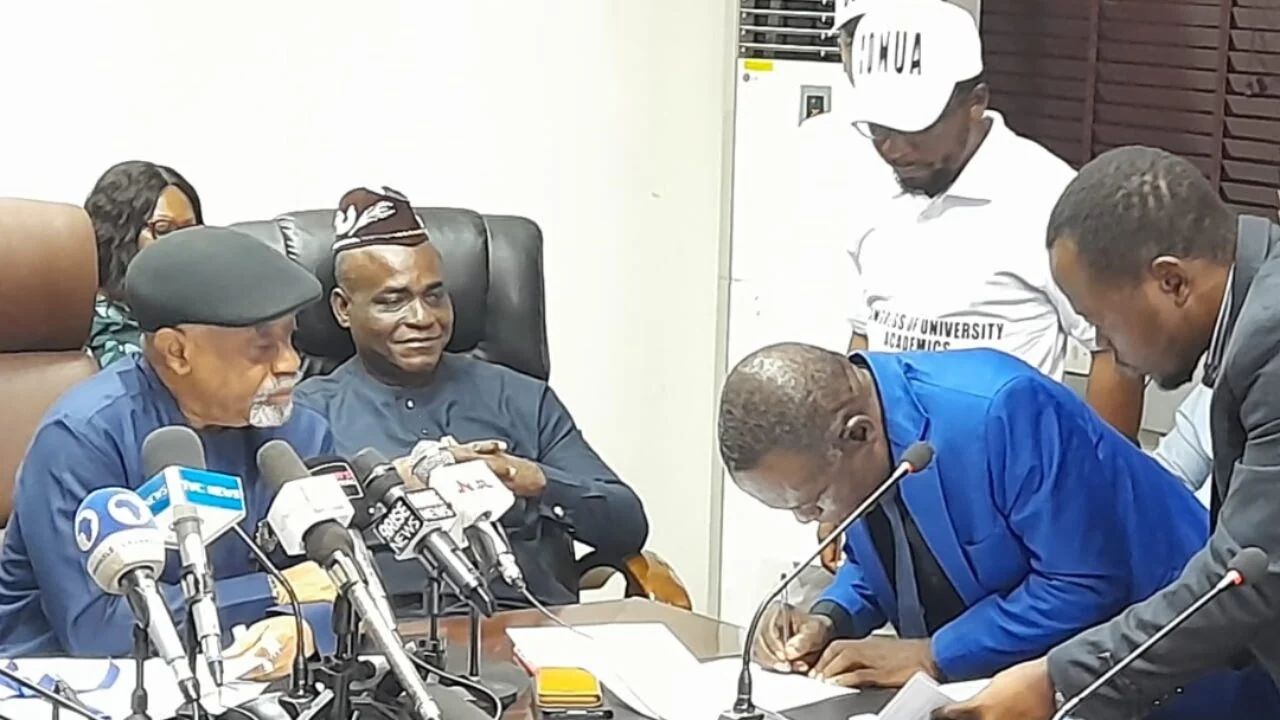
On Tuesday 4 October, the federal government formally recognised Congress of Nigerian University Academics (CONUA) with Dr Chris Ngige, Minister of Labour and Employment, presenting the union with a certificate of registration in Abuja.

In 2018, CONUA had disagreements with the Academic Staff Union of Universities (ASUU) and went its way.

CONUA’s registration is believed to be the government’s strategy to weaken ASUU’s influence amid its lingering strike and the move has since sparked heated reactions from stakeholders in the education sector. The registration came weeks after the government threatened to withdraw ASUU’s registration licence for allegedly not submitting its audited financial returns for over five years. Rights lawyer and senior advocate of Nigeria (SAN) Femi Falana, has said the registration of the CONUA) by the federal government is illegal.

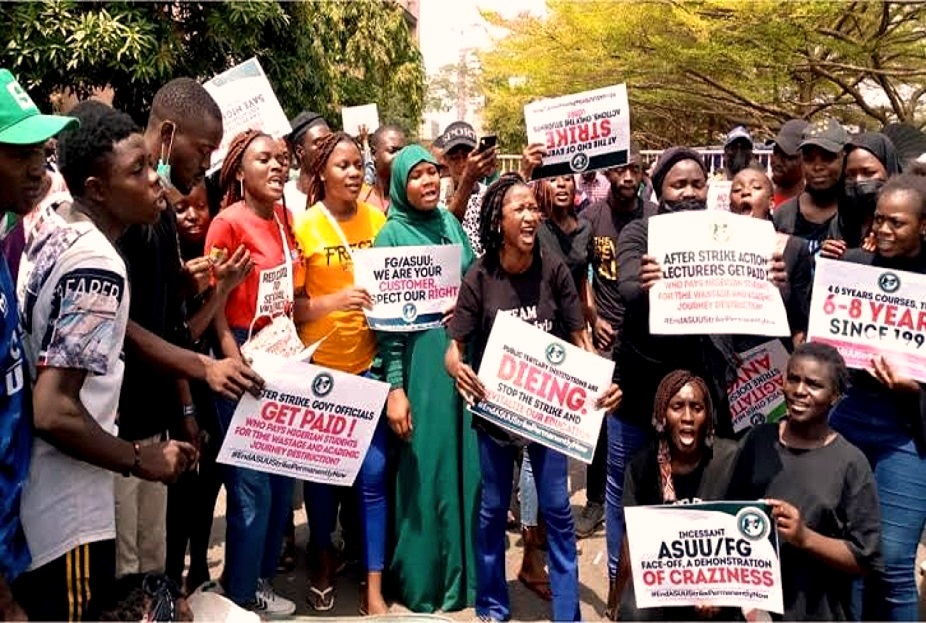
ASUU has been on strike since February 14 to press home the demand for improved funding for universities, and a review of salaries for lecturers, among other issues. Several meetings between representatives of the union and the government to address the strike did not yield results.

Nigerian Students Photo Credit: Unique Info

On September 21, the National Industrial Court of Nigeria (NICN) ordered ASUU to call off its nationwide strike but the union went on appeal. However, the Appeal Court has ordered the striking lecturers to obey the ruling of the National Industrial Court and return to the classroom effective from October 7, 2022.

Earlier, President Muhammadu Buhari directed the Minister of Education, Adamu Adamu, to “solve” the ASUU crisis within two weeks. When the period expired, Adamu denied being given an ultimatum and asked university students to “sue” their lecturers over the seven-month-old strike. Thereafter, the Federal Government, through the Ministry of Labour and Employment, dragged ASUU before the NICN.

On its part notable social advocacy group, the Social and Economic Rights and Accountability Project, SERAP, along with undergraduates sued President Buhari, asking the court to “declare unlawful the refusal by the Federal Government to meet ASUU’s demands, which has occasioned the prolonged strike action and violated the students’ right to quality education.”

Here are some of ASSU’s demands:

1. Funding for the revitalisation of public universities. The Federal Government, in its agreement entered with the union in 2009 and 2013, agreed to inject a total of N1.3 trillion into public universities in six tranches, starting from 2013. Only N200 billion has been released since 2013.

2. Payment of earned academic allowances (EEA). The Federal Government had in 2019 agreed to pay lecturers EAA, but failed to implement it. The government finally agreed to pay the first tranche of the backlog of allowances in November 2019 and the second instalment by August 2020, but nothing was paid. In 2020, the Federal Government agreed to pay N40 billion. It also said it has released N22.127 billion earned allowances of both academic and non-academic workers of universities to 38 universities.

3. Reconstitution of the FGN/ASUU 2009 Renegotiation Committee. The Federal Government agreed to renegotiate the 2009 agreement to review the university’s conditions of service, funding, university autonomy and academic freedom. The conditions of service included a separate salary structure for university lectures to be known as ‘Consolidated University Academic Salary Structure’. Thirteen years later, the government inaugurated a seven-man committee to renegotiate the 2019 agreement, led by Nimi Briggs.

Ngige has since announced that the government does not have the money to pay ASUU what they are demanding which amounts to about N1.3trn.  This is even as The Guardian Newspaper of 25 August 2022 reported that “Idle refineries workers earn N136b amid $3b upgrade cost.”  Kingsley Jeremiah of The Guardian Newspaper reported thus:

“Despite being shut down, there are indications that the Nigerian National Petroleum Company Limited (NNPC) may have left over N136 billion as operational deficits across its three refineries in Kaduna, Port Harcourt and Warri. This is as concerns over delivery timeline and violations of local content law dog ongoing rehabilitation of the refineries.

“Recall that NNPC had shut down the 445,000-capacity refineries for over two years, yet kept the over 1,701 staff at the facilities, as it rehabilitates the Port Harcourt refinery for $1.5 billion and those of Warri and Kaduna for $1.4 billion.

Kaduna Refinery

“In August 2020, the total losses incurred by the refineries was N7,088 billion, it was N7,043 billion in September of the same year before moving to N5,489 billion in October. In November 2020, it went up to N5,995 billion and went further up to N8,279 billion in December that year.

“In January 2021, the operational deficit was N5,371 billion, February recorded an N6,879 billion loss, N3,866 billion in March, N3,544 billion in April, and N5,243 billion in May, N4,014 billion in June, N3,752 billion in July and N3,819 billion in August 2021.

“On average, NNPC spends, plus or minus, N68 billion in paying salaries and other expenses at the moribund refineries, yearly. In the last two years, the losses have amounted to an average of N136 billion.”

In a letter addressed to the Secretary to the Government of the Federal Republic of Nigeria, Ministers of Education and Labour and Productivity,  Chairman Senate Committee on Education (Tertiary Institution), other top government functionaries, Committee of Pro Chancellors of State-Owned Universities (COPSU) and President, National Association of Nigerian Students (NANS), a former Attorney-General of Imo State and The Rapporteur, Victims of Persecution, a nonprofit organization, Chukwuma-Machukwu Ume, SAN, expressed concern that: “With the interest of the children of the ruling class taken care of, the need to ensure that our educational system is brought to a good standard is relegated to the background.”

Machukwu-Ume, SAN

Ume who condemned what he termed: “The Government’s lazy & inordinate consumption quests thus rendering Nigeria a mere veritable market for other economies,” made searing revelations.

“In 2021, the Country spent about N102 billion monthly on fuel import subsidy. In the 2022 Budget, Nigerian Federal Government earmarked about N4 trillion for refined fuel import subsidy for the year. This is by a country that is almost the 6th largest producer of crude oil in the World. Singapore has no iota of crude oil deposit but it has over Forty (40) functional petroleum refineries. We need not say more on this.

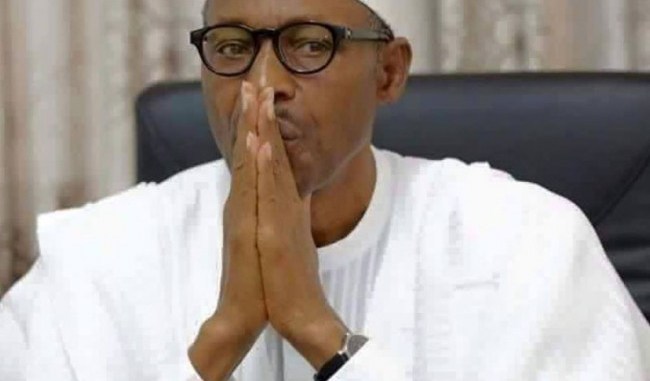
President Buhari

“Today, it is not far from the truth to say that virtually all segments of the Nigerian units; Government, Ministries, Parastatals, business corporations, companies of various sizes, artisans, and families are running on generators and generating plants. In fact, in the said 2022 Federal Government Budget, N104 Billion is for generators and fuel/gas in Government Ministries and Agencies.

How much does it cost to build a refinery? How much is ASUU asking for? How did Singapore do the magic of building over Forty (40) refineries?

“For years now, the percentage of funds allocated to the Educational Sector from the Nation’s Annual Budget is very poor and certainly below the standard recommended by UNESCO (26% Yearly Budget to be allocated to Educational Sector). Herein are random samples:

YEAR         ANNUAL BUDGET      ALLOCATED            PERCENTAGE (%)

2009           N3.049 trillion                 N221.19 billion               7.25  

2012            N4.877 trillion                 N400.15 billion            8.20

2013            N4.987 trillion                 N426.53 billion                8.55

2018            N8.612 trillion                 N605.23 billion                7.03

2021            N13.08 trillion                 N742.5 billion                  5.06

2022           N17.13 trillion                 N923.79 billion                5.04

Indeed, the above is not a good omen. Suffice it to say that the most direct way to stunt the growth of any society is to blur the educational system. Is Nigeria substituting education with violence? Soon there could be more guns in Nigeria than books and more kidnapping bushes than libraries.”

3-year-old Siyama died after brutal rape by 40 years old man

  •  “He will kill me with scissors!” – She cried on her deathbed.

Shock, horror, and numbing pain still grip the heart when the memory of the beautiful  5-year-old, Hanifa Abubakar is evoked. On Saturday 4 December 2021 Hanifa was abducted at Kawaji, in Nasarawa Local Government Area of Kano state by her school teacher, Abdulmalik Mohammed Tanko who later murdered her despite collecting a part of the N6m ransom he demanded.

Days ago Siyama, a 3-year-old girl died four days after she was raped by a 40-year-old man named Idi. Idi lives at Lungun Alhaji Halliru in Gama, Nassarawa Local Government Area of Kano State.

About a week ago, Siyama was reportedly lured by Idi, who called her to his room, gave her some sweets, and sexually assaulted her. He also threatened the little girl that if she told her father, he would kill her with scissors and also tell his cat to eat her up, (knowing fully well that the little girl was afraid of cats).

After she returned home and was about to have her bath, blood was seen coming out of her body when her clothes were taken off. When asked what happened to her, she said; “It was Idi. He took off my pants, did something to me and gave me sweets, and said if I told my father, I will die. Ummah, please don’t tell Abba.”  She then described how he put a pair of scissors on her neck and said he would cut her with it if she told her father.

Siyama was then rushed to the hospital, where the doctors confirmed ‘Penetration’. Idi was eventually arrested and taken to the state CID.

While giving a statement, and as Idi was brought out with handcuffs, the little girl saw him, panicked, and screamed: “Umma, he said he would kill me with scissors, why did you tell Abba? He will tell the cat to eat me.”

Following the encounter, Siyama developed a high fever, and the next day, she died repeating “he will kill me with scissors.”

Siyama died on Thursday, 29 September 2022 at about 4 o’clock in the evening.

Re: Rivers State Government orders Celestine Omehia to refund monies he had collected from Rivers State coffers as salaries and allowances

By Sylvester Udemezue

In my humble opinion, Governor Nyesome Wike of Rivers State is doing fantastically well in governance, especially with respect to delivering dividends of democracy in terms of infrastructure and basic amenities, improving the security of lives and properties, and the living conditions of the people and residents of Rivers State.

Governor Wike is a performing Governor properly so called; a visit to Rivers State will convince you. He has made Rivers enviable. No wonder he has and has continued to enjoy, the massive support of his people.

However, … why would Nyesome Wike, a lawyer, support a directive to an ex-Governor of Rivers State, to refund the money the ex-Governor had earned as salaries and allowances while he held sway as Governor (even if you say he was only a DE FACTO Governor)?

▪️Does the Rivers State Government not understand the legal implications of the maxim horror vacui, (commonly stated as “nature abhors a vacuum”)?

▪️Did Celestine Omehia not work as the Governor of Rivers State for about one year?

▪️Was the installation and subsequent removal of Celestine Omehia as the Governor of Rivers State, due to any fault of Mr. Omehia himself?

▪️If you ask Mr. Omehia to return his salaries and allowances for the period, how would he be paid for the work he did legitimately?

▪️By the way, by deleting his name as an ex-Governor of Rivers State for the period, would you also nullify, reverse, erase, and destroy all the contracts he awarded during the period, all the papers he signed, all the roads, houses, infrastructure he built, all the judges he appointed, all the workers he employed, the food he ate as governor, the fuel he bought, and every single step he took then, legitimately, as the then (even if de facto) Governor of Rivers State, until the Supreme Court sacked him?

▪️ Even the Supreme Court in Amaechi`s case had wisely refrained from issuing any further consequential order to compel then ousted Governor Celestine Omehia to refund salaries and allowances he had earned within the short period he was in office, even though the court had agreed, and rightly so, that Mr. Omehia was only an impostor who was unlawfully occupying a position rightfully belonging to Hon Amaechi. The Supreme had thus allowed Mr. Omehia to go home with his earned emoluments as a reward for the work he must have done while in office as Governor. This is the right and sensible thing to do.

Gentlemen and ladies, let’s endeavour to take care of rule of law, so that rule of law will take care of our society. Faithfulness to rule of law is an essential path to progress and sanity and stability for our country.

Here is a March 14, 2017 article I wrote on this subject.

Understanding the impropriety of compelling a deposed officeholder to refund his earned emoluments: An inquest into the decision in Bassey Etim versus Senator Bassey Albert Akpan – By Sylvester C. Udemezue

Breaking news in Nigeria`s news media[ii] on 27 February 2017 came under the caption, “Court sacks Senator Bassey Akpan, orders refund of salary allowances received.” Several media houses carried the news report that a Federal High Court sitting in Uyo, Akwa Ibom State, Nigeria, had on the same day ordered the senator representing Akwa-Ibom North-East Senatorial Zone in the upper chambers of Nigeria`s National Assembly, Senator Bassey Akpan, to vacate his seat immediately.

The court presided over by Justice Fatun Riman also made the following additional orders – (a) the Independent National Electoral Commission (INEC) should immediately withdraw the Certificate of Return INEC had earlier issued to Senator Akpan; (b) INEC should issue a new Certificate of Return to the plaintiff in the case, Mr. Bassey Etim; (c) the President of the Senate of the National Assembly should swear-in Mr. Bassey Etim as the senator representing Akwa-Ibom North-East Zone in the National Assembly; and (d) Senator Bassey Akpan must within 90 days from the date of the judgment refund to the Federal Government of Nigeria all the salaries and allowances he (Senator Akpan) had received since he was sworn in as a Senator in the current dispensation.

Mr. Bassey Etim (as the plaintiff in that case) had approached the Court[iii] after the 2015 general elections alleging that Senator Akpan did not contest the PDP primary election as a senatorial candidate into the Akwa-Ibom North-East senatorial district. The Court agreed with Mr. Bassey Etim`s arguments, declaring that Senator Akpan was not duly elected in the primary election of the People’s Democratic Party held on December 7, 2014, and as such was not eligible to continue to occupy the district`s seat in the Red Chamber.[iv]

Ordinarily, it is left for Nigeria`s appellate courts to look further into the matter with a view to affirming or setting aside the judgment of the court in the matter, that is, if the matter goes on appeal. I am thus not concerned in this humble analysis with the Federal High Court order nullifying the primary election that had produced Senator Bassey Akpan as the senatorial Candidate of the Peoples` Democratic Party (PDP) neither am I bothered by the other consequential orders, instructing the INEC to issue a Certificate of Return to Mr. Bassey Etim and directing the Senate President to swear him in as the Senator representing the affected district, in place of the incumbent Senator, Bassey Albert Akpan.

What evokes or provokes a cause for urgent concern in my mind is the further decree of His Lordship, the presiding Judge, additionally directing Senator Bassey Akpan to within 90 days from the date of the judgment, refund to the Federal Government of Nigeria all the salaries and allowances he (Senator Akpan) had received since he was sworn in as a Senator in the current dispensation.” It is the legality and justness of this particular order, and nothing more, that I propose to critically, but humbly, examine with a view to ascertaining whether or not there exist any foundations, legal or otherwise, upon which such order could rest for validity in a country founded on, and governed by, rule of law and fairness.

There is no doubt that some schools of thought would applaud this particular order as a sort of “victory for democracy and rule of law,” while some others would readily agree that such was necessary to serve as a deterrent to future (primary or general) election riggers.

Indeed, a very close friend of mine wasted no time in praising what he described as the courage of the presiding judge in having upheld the rule of law and in disapproving fraud and unjust enrichment. According to my said friend, since the court had found that the sacked Senator (Bassey Akpan) was “illegally” occupying a senatorial seat in the Red Chamber, and as such did not deserve any salaries and allowances he had received in that capacity, it was only apposite to compel him to make a recompense in regard to such “illegal” emoluments, especially as he had “rigged” the elections in his own favour.

The emoluments, my friend further argues, represents benefit of his fraudulent and corrupts acts. Some other persons might no doubt have several other bases for arguing in favour of a refund of what in their view are unmerited salaries and allowances. But there is one other side of the coin the various lines of argument have failed to address, and to which my humble attention now turns.

An easier way to approach this matter is first, to ascertain all probable questions thrown up by what I have chosen to humbly identify and refer to as the “refund order” (that is, the court order directing Senator AKpan to refund his emoluments). Such questions include, but may not be limited to: (1) to what extent does the refund order take into account the universally acclaimed Latin maxim, horror vacui,” commonly stated in the English Language as “Nature abhors a vacuum?”  

(2) Is this refund order not unfair to Hon Senator Bassey Akpan himself? Is it not tantamount to punishing Senator Akpan for the wrongs perpetrated by PDP and or INEC? (3) Has the court not acted outside its powers in issuing such a refund order? (4) How does the refund order impact on the constitutional rights of the people of Akwa-Ibom North-East Senatorial District to be represented in the Red Chamber for a period of FOUR years?

On the first challenge, it was the ancient philosopher, Aristotle, that once declared that “Nature abhors a vacuum.” Aristotle`s conclusion was based on his observation that nature requires every space to be filled with something, even if that something is colorless, odorless air. In physics, this is known as “horror vacui.” It is a postulate that nature contains no vacuums because the denser surrounding material continuum would immediately fill the rarity of an incipient void. This theory was later criticized by the atomism of Epicurus and Lucretius. Another vicious opposition to Aristotle`s theory came from the Hero of Alexandria who challenged the theory in the first century CE, by attempting to create an artificial vacuum, but this failed.[v] 

Just as it is in the law of nature, so also it is and ought to be in positive laws,[vi] it is humbly submitted. Thus, the mere fact that Senator Akpan`s victory is voided does not, and should not, render invalid or ineffective all and any actions taken by him within the period he held sway as the senator representing his constituency. It is true, in law, that when a thing is quashed or voided by a court of law, the effect is that the same is deemed to never have existed in the very first place. However, where a person`s occupation of an office is voided on grounds of illegality or non-compliance with the law, the invalidation order does not, and ought to not, affect actions already taken by the affected office-holder prior to the voiding of his occupation of the office, neither should it affect any benefits or rewards he had received as a result of his occupation of the office and discharge of the tasks and duties of the office.

The same should hold true for the invalidation of the electoral victory of Senator Bassey Akpan in both the party primaries held by the PDP for the Akwa-Ibom north-east senatorial district and the April 2015 general elections. Thus, in the case of Balonwu v Gov. of Anambra State,[vii] the Supreme Court emphasized that all actions already taken in Anambra State by the then Governor Chris Ngige within the almost three years he was in power were valid notwithstanding the subsequent annulment of his election by the Nigerian Court of Appeal.

This supports the principle stated above that nature abhors a vacuum; if the period after the annulment and all actions taken within the period should be adversely affected, then it would necessarily follow that the affected State had no Governor within that period, which would create a vacuum, and consequently throw the State into inconceivable turmoil. Similarly, if, following the cancellation of his occupation of the senate seat, Senator Akpan is made to refund all his earned remunerations on the basis only that all his actions in that capacity were illegal, void and amount to nothing, it then follows that Senator Akpan would be taken to never have represented that zone in the upper legislative chamber, with the added result that the people of Akwa-Ibom North-East senatorial zone did not have any representative in the National assembly during the period June 2015 to February 2017 – the same period Senator Bassey Akpan had held sway as their Distinguished Senator. I respectfully hold the view that this position is not, and cannot, be true as the same amounts to attempting to deny the obvious, which, more often than not, is an exercise in futility.

Throughout history, and in all aspects of law, the rule has been that where a leader, manager or other office holder is made or ordered to vacate his office, for whatever reasons, the period such a leader or manager has spent in office prior to the annulment order is usually not adversely affected by such non-confirmation of his appointment nor by cancellation of his appointment, selection or election. Examples abound to buttress this position! For purposes of Corporate Governance, as an example, section 256 (1) of the Companies & Allied Matters Act (CAMA), 1990[viii] (as amended) provides that a person disqualified under section 254 of CAMA is not qualified to be a Director. Section 254 (1) (a)[ix] is concerned with a person who has been convicted by a High Court of any offence in connection with the promotion, formation or management of a company. 

Then, section 257, dealing with vacation of office of a director, stipulates that where a person who has already been appointed a director thereafter becomes disqualified or prohibited from being, or continuing in office as, a director by reason of any such order made pursuant to section 254 (say, he is convicted of any offence in connection with fraud he may have committed in relation to the management, promotion or formation of a company) such a person shall immediately cease to hold office as a director. Interestingly and in recognition that “nature abhors a vacuum,” there is no provision in the CAMA that in any such instance, where a director who has held office or has been in office for some time before being removed or terminated (on account of his conviction for fraud), the affected director shall refund or be made to refund all or any part of the salaries and allowances he was paid while in office, that is, prior to his vacating his office.

Similarly, where a person earlier appointed as a director by the Board of Directors of a Company to fill a vacancy in the office of director is thereafter removed from office by the general meeting of the company, the same person shall immediately cease to hold such office, but removal in such a case, on whatever grounds, shall not and does not affect any previous acts of such a director, neither would such removal adversely affect any salaries and allowances earned by him prior to his removal[x]. It is submitted that the same ought to have applied in the present case involving Senator Bassey Akpan.

Indeed, it makes a mockery of the entire spirit of justice to direct a legislator whose election is voided on whatever ground to refund all his earned emoluments. If this is allowed to stand, it then means that where for instance a public office-holder who has been in office, say for ten years, is later discovered to not be qualified for appointment to such an office and is accordingly removed from such office, then following the nullification of his appointment, he would be directed to refund to his employers all salaries and allowances he has earned within the ten years held the office. In a similar vein, a university lecturer who is removed from his position on grounds of non-qualification would be asked to return to the University all of his remunerations for the period. If this be the case, the question may be raised, what about all the “work” such former officer-holder (lecturer, legislator, clerk, or whoever) had done while in occupation of such office? What about the effort, energy and time he had invested in promoting and supporting his employers, prior to his removal?  To what extent is this fair and reasonable on such former employee?

Still on the hypothetical example of the sacked lecturer who is asked to refund his wages and allowances, would his employers (the university), in a reciprocal manner, “refund” or return to the affected Lecturer all the “knowledge,” “ideas,”etc., the Lecturer has imparted into the heads and brains of his students over the years, while he was still in such office, albeit illegally? What happens to the certificates already awarded to his students on accounts of the lecturer`s teaching and assessment of the students; would his former students be compelled to return their certificates and relinquish the knowledge in their heads to the Lecturer, since such knowledge, the examinations questions set and the assessments done by the affected Lecturer were all illegally done, based on the argument that the lecturer was illegally occupying his office?

What is more? Assuming the President of the Senate of the Federation is removed from office after two years in office and, as in the case of Senator Bassey Albert Akpan, is additionally ordered to refund all his earned salaries and allowances, the query is, if he is made to refund his salaries because perhaps “he did not deserve them in the first instance,” who then would be said or recorded in the history books as the President of the Senate for the affected two years? Would asking him to return his pay not foist an impossible confusion-laden situation; would it then not follow that all the Bills and resolutions passed and any other actions taken by the Senate during the period that the deposed Senate President was in office as such would have to be, consequently, rendered void and of no effect, following which even all the annual and or supplementary appropriation Bills or budgets passed and implemented during the material period would also be taken to have been illegally passed and implemented?

Accordingly, as an after-effect, all projects executed from the illegally passed budget, and all monies disbursed therefrom would have to be reversed, cancelled and restored and refunded to the affected government`s treasuries. Even road projects already awarded and executed with monies from the illegally passed budget would have to be reversed, and the coal-tar would be excavated while the contractor must return the exact sum of money he received from the government on account of such project. Easier said than done! How possible would all these be, because one cannot order me to refund the wages I have collected for work I have done, and yet not also order a reversal of the services I have rendered? The Latin maxim, which Herbert Broom has describe as a “fundamental legal principle” is ‘lex non cogit ad impossibilia.[xi] This principle has been translated variously as “the law must not be interpreted to command the doing of what is practically impossible,” “the law does not compel the doing of impossibilities,”[xii] “the law requires nothing impossible,”[xiii] or “the law does not compel a person to do that which he or she cannot possibly perform.”[xiv]

Accordingly, if we agree that Senator Bassey Albert Akpan`s name must be recorded as having occupied that office for the affected period, and that he had (diligently and faithfully) discharged the powers and functions of that office, even though, he was later found to be not qualified, then, for his having occupied the office and for the work he had done in that capacity, he is no doubt entitled to keep his earned wages. This is the only reasonable thing to do. To argue or hold otherwise is to stand justice and law in on their heads and interpret both upside-down! This is exactly what the learned trial judge (Hon Justice Fatum Riman) of the Federal High Court, Uyo, Akwa-Ibom State, Nigeria, has done in Senator Bassey Albert Akpan`s case, and to that extent, with utmost respect to the learned judge, the judgment is highly condemnable, because whenever the question is asked as to who was the Chairman of the Senate Committee on Gas from 2015 to early 2017, and as to who represented the Akwa-Ibom State North-East senatorial district in the Nigerian Senate, only the name Bassey Albert Akpan would be mentioned.

Interestingly, the Constitution of the Federal Republic of Nigeria, 1999 (as amended) expressly provides that[xv] “a member of the Senate shall receive such salary and other allowances as the Revenue Mobilization Allocation and Fiscal Commission may determine.” Neither the Constitution nor any other law authorizes, under any circumstance, a refund of salaries already collected, not even where the affected senator is later removed from office. The Court in the present case knew all these and nevertheless went ahead and asked Senator Akpan to refund all his earned salaries and entitlements. What the court has thus done, and which is most unfortunate, is, perhaps having acknowledged in one breath that a particular senator represented a certain constituency for about two years in the upper legislative chamber before being kicked out, to proceed in another breath, to deny such a former senator the right to keep his emoluments during the period. I most respectfully disagree this reasoning of the court, and so should every reasonable mind

Furthermore, is the refund order not tantamount to punishing Senator Akpan for the wrongs perpetrated by PDP and or INEC? Senator Bassey Akpan was only a candidate in the general elections held for the Akwa-Ibom North-East senatorial district in April 2015. The independent National Electoral Commission (INEC) had declared Senator Bassey Akpan winner of the said elections and consequently issued him the official Certificate of Return, following which the Senate President had sworn him in as the Senator representing the Akwa-Ibom North-East Senatorial District in the Red Chamber. First, if the Court found the primary election that had produced Seantor Bassey Akpan as the candidate of the People`s Democratic Party (PDP) as faulty, for whatever reasons, was it or would it not be sufficient for His Lordship of the Federal High Court, Uyo Divison, to have simply set aside the affected primaries and also reprimanded the PDP for its having submitted Senator Akpan`s name, instead of that of Mr. Bassey Edet, as the candidate of the PDP?

What exactly is the justification for the refund order? Would Senator Akpan have participated in the general elections as a candidate if the PDP had not submitted his name? Would he have been sworn in as a Senator had INEC not declared him winner of the election? Would he ever have acted in the capacity of a senator had he not been sworn in by the Senate President? Is Senator Bassey Albert Akpan the owner, controller or director of the PDP, the INEC or the Senate? Were these three bodies that had facilitated his ascendance to the position of a Senator not independent bodies and free from Senator Bassey Akpan`s control and influence? It is therefore respectfully suggested that, based on the aforesaid, the maxim that “one should not be permitted to benefit from one`s own wrong” does not apply in this instance. Also, not applicable, for the same reasons, is the principle that “one should not be allowed to use the provisions of a statute as an engine of fraud.” Finally on this point, the Electoral Act, 2010 (as amended) is crystal clear on the only order or orders a court of law should make in such scenario: “if the tribunal or the court as the case may be determines that a candidate who was returned as elected was not validly elected on any ground, the tribunal or court shall nullify the election.”[xvi] 

Following directly from the aforesaid is a further question as to whether the order directing the sacked legislator to refund his earned benefits is not ultra vires the powers of the Court.  Rightly or wrongly, the court annulled Senator Bassey Akpan`s nomination, ordered a withdrawal of his certificate of return and commanded the issuance of a new Certificate to his rival, the plaintiff in the case under review, Mr. Bassey Edet, and also directed INEC to swear in Mr. Edet as a Senator, in place of Bassey Akpan. Were these not sufficient remedies in the circumstances of the case? Was the refund order among the Plaintiff`s claims in the suit? So far, there has been no reported proof that such was one of the prayers or claims of the Plaintiff/Claimant in that case. One then wonders in what way such a strange order does contribute to meeting the justice of this matter or in assuaging the feeling of Mr. Bassey Edet? Has the court of law not turned itself into a Father Christmas, dishing and doling out unexpected relief and handing out orders in the form of unsolicited gifts? That a court cannot give or award in a suit before it that which is not specifically claimed by any party to the suit is already settled in law. In AMAECHI v. INEC,[xvii] the Supreme Court of Nigeria (per Oguntade, JSC) declared that “The fundamental duty of the court is to expound the law and not to expand it. It must decide what the law IS and not what it MIGHT be.” Similarly, in Ogunsola v. Ibiyemi,[xviii] the Court of Appeal (per Fabiyi, JCA) held that a judge has no power to award that which was not claimed by a party. This is because he is not a Father Christmas. And the court is not a charitable organization. In Etim Ekpeyong v. Effiong Nyong,[xix] the Supreme Court stated thus:

“The court is without the power to award to a claimant that which he did not claim. A court        of law may award less and not more than what the parties have claimed. A fortiori, the court should never award that which was never claimed or pleaded by either party. It should always be borne in mind that a court of law is not a charitable institution. Its duty in civil cases is to render unto everyone according to his proven claim.”

Speaking at the valedictory court session held in honour of a retiring Justice of the Supreme Court, Justice Muhammad Muntaka-Coomassie, at the Supreme Court complex on 10 February 2016, the then Chief Justice of Nigeria, Hon Justice Mahmood Mohammed made the following observations:[xx]

“The Nigerian Judiciary, though constantly striving to redress wrongs and tilt the balance of that which is right, has recently had to face the backlash of misguided opinions fashioned without due consideration of the law and rationale for the system of government that we operate.  The Judiciary is duty bound to act in accordance with the dictates of the law as it stands and not as critics would like it to be. In this sense, naïve idealism is but a pale imitation of legal certainty…’’

It is no longer in question that a court of law has no power to turn itself into a father Christmas. Nonetheless, there is a related issue which I believe deserves some examination, here, and it is this: to what extent is the court striped of powers to make unsolicited orders? I think for purposes of giving a just answer to this question, some look at the Supreme Court judgement in the case of CHIBUIKE AMAECHI v. INEC[xxi] is useful. In that case, while offering reasons for its earlier judgement (given on 25/10/2007, the apex court in the lead judgment/reason delivered by Oguntade, JSC (on 18/01/2008), stated thus:

“This court and indeed all courts in Nigeria have a duty which flows from a power granted by the constitution of Nigeria to ensure that citizens of Nigeria, high and low get the justice which their case deserves. The powers of the court are derived from the constitution not at the sufferance or generosity of any other arm of the Government of Nigeria. The judiciary like all citizens of this Country cannot be a passive on-looker when any person attempts to subvert the administration of justice and will not hesitate to use the powers available to it to do justice in the cases before it. Section 6(6) (a) of the 1999 Constitution provides:  ‘(6) The judicial powers vested in accordance with the foregoing provisions of this section –  (a)    shall extend, notwithstanding anything contrary in this Constitution to all inherent powers and sanctions of a court of law.’ And Section 22 of the Supreme Court Act provides: ‘The Supreme Court may, from time to time, make any order necessary for determining the real question in controversy in the appeal, and may amend any defect or error in the record of appeal, … and may make an interim order or grant any injunction which the court below is authorized to make or grant … or may give such other directions as to the manner in which the court below shall deal with the case in accordance with the powers of that court.’

In view of the above provisions, there can be no doubt that there is a plenitude of power available to this Court to do which the justice of the case deserves. It enables a court to grant consequential reliefs in the interest of justice even where such have not been specifically claimed. Having held as I did that the name of Amaechi was not substituted as provided by law, the consequence is that he was the candidate of the P.D.P. for whom the party campaigned in the April 2007 elections not Omehia and since P.D.P. was declared to have won the said elections, Amaechi must be deemed the candidate that won the election for the P.D.P.  In the eyes of the law, Omehia was never a candidate in the election much less the winner.  It is for this reason that 1 on 25/10/2007 allowed Amaechi’s appeal and dismissed the cross-appeals. I accordingly declared Amaechi the person entitled to be the Governor of Rivers State. I did not nullify the election of 14/04/2007 as I never had cause to do so for the reasons earlier given in this judgment”

It is clear from Amaechi v. INEC that a court is permitted for certain purposes, to grant certain consequential order or orders, even though such order or orders are unsought. However, it is submitted that, flowing directly from the same decision, three conditions precedents must be confirmed to exist before a court can consider whether or not to exercise its inherent powers in this respect:

  1. such consequential order must flow directly and equitably from the facts and reliefs in the substantive case;
  2. such order must be targeted at realising or accomplishing the justice and justness of the case at hand; the order must be a consequential relief made in the best interest of justice, notwithstanding that such have not been specifically claimed. The order must be strictly and solely for purposes of ensuring that interested litigants get the justice which their case deserves; the scenario must be such that to do otherwise would permit or promote rather than avoid injustice; and
  3. the circumstances in which the unsought order is proposed to be made must be extremely exceptional. It is not as a matter of the rule.

 These conditions ought to necessarily co-exist in order to justify such sweeping departure from the time-honored rule. Thus, where the three conditions are, or any one of them is, absent, the court would be in error to make any order or grant any relief save that which is specifically sought by litigants. In his supporting judgment (reasons for his earlier judgment) in the same Amaechi v. INEC, KATSINA-ALU, JSC has this to say:

“This case is not an election matter. It is clearly a pre-election matter. The court was called upon to decide who of the two candidates was PDP’s nominated candidate for the April election. As I have already held it is the Appellant that was the PDP’ s candidate for the Governorship election. As for the order that I ought to make, I must say that this court has wide jurisdiction to make consequential orders and to grant reliefs which the circumstances and justice of a case dictate. On the principle of Ubi jus ibi remedium if the court is satisfied that a person has suffered a legal injury, it will surely provide a remedy irrespective of the fact that no remedy is provided either at common law or by statute.”[xxii]

In Amaechi`s case, the supreme court, having decided that (1) indictment of any person by a Panel or Tribunal of inquiry amounts to a mere “allegation” and does not, without more, translate to conviction so as to warrant his disqualification as a candidate in an election; (2) that PDP`s substitution of Omehia for Amaechi as the party`s governorship candidate for the 2007 gubernatorial elections in Rivers State was void and of no effect; and (3) that, consequently, that Hon Chibuike Amaechi remained in the eyes of the law PDP`s candidate for that election, such that it was Amaechi, and not Omehia, that was voted into the office on the date of the election, the apex Court was then faced with the very difficult task of how to ensure that Hon Amaechi reaped the fruits of this victory, since Omehia had already been declared winner of the elections and duly sworn-in as, and was already discharging the duties of, the Governor of the State. Besides, there was no relief (in the Plaintiff`s originating processes) specifically praying the court to remove the then sitting Governor Omehia and declare Amaechi the Governor. There could not have been any such relief since the suit had begun before the date of the election itself.

The appellant counsel had thus prayed the apex court to (by way of a consequential order, in the interest of justice) go ahead and sack Governor Omehia and declare Amaechi the lawful Governor of Rivers State, even though such relief was not specifically sought by the appellant. In response, the respondents (INEC, Omehia and PDP) urged the court to reject this oral prayer by the appellant, on two grounds: (1) the court is not a father Christmas, and as such must not grant unsolicited reliefs, and (2) Governor Omehia was protected (from civil suits) by the immunity provisions in section 308 of the Constitution of the Federal Republic of Nigeria, 1999. In its ruling, the apex court reasoned thus (per Katsina-Alu, JSC):

“Section 308 of the 1999 Constitution is not meant to deny a citizen of this country his right of access to the court. It is a provision put in place to enable a Governor, while in office, to conduct the affairs of governance free from hindrance, embarrassment and the difficulty which may arise if he is being constantly pursued and harassed with court processes of a civil or criminal nature while in office. It is a provision designed to protect the dignity of the office. However, the proviso under section 308 ensures that the period when a governor enjoys immunity shall not be taken into account in computing the time limit for initiating an action under the Statute of limitation. Section 308 cannot be relied upon where the nature of the suit is such that the res in dispute will be destroyed permanently with the effluxion of time.

To hold that section 308 can be invoked in a matter relating to the eligibility for a political office where the tenure of such office has been set out in the Constitution will translate into denying to a plaintiff his right of access to the court. It is only in a case where a deferment of plaintiff’s right of action is not likely to destroy the res in the suit that section 308 can be invoked. In this case, to ask Amaechi to wait till the end of Omehia’s tenure of office as Governor before pursuing his suit is to destroy forever his right of action.”

Furthermore, the court (per Musdapher, JSC[xxiii]) declared:

“Section 308 of the 1999 Constitution does not protect a governor from legal proceedings in a matter of his election per se or in a matter connected with the election even when he,as a contestant has been declared duly elected or returned as governor. Election petitions and election related proceedings are special proceedings divorced and separated from civil or criminal proceedings within the intendment and context of section 308 of the Constitution. The processes leading to the election are not only justiciable at the instance of any party aggrieved in the process but the immunity under section 308 of the Constitution cannot avail a governor since the immunity is not within the contemplation of such proceedings. [Onitiri v. Benson (1960) SCNLR 314; Oyekan v.Akinjide (1965) 381.]” Per Musdapher, JSC

It is my humble opinion that the consequential order the Supreme Court made in Amaechi`s case is clearly justified and justifiable, strictly for purposes of attaining the justice of the case. Had the court acted otherwise, Hon Amaechi`s victory would have been a mere pyrrhic victory, being absolutely nugatory and of no use whatsoever since there was no way he could reap the benefits of his so-called success. But for that very consequential order, then, Amaechi`s success in court would have been akin to a mere paper tiger — seemingly powerful, yet too weak to be of any assistance to the triumphant party!

On the other hand, one may ask, by way of an analogy, which justice was His Lordship, the trial judge, trying to aid in the present case of Edet v. Akpan when the court ordered the defendant, Senator Bassey Akpan, to refund his salaries? How does the refund order in the circumstances promote justice? What pains or injustice would Mr. Bassey Edet, the plaintiff, have suffered had the court refrained from making such a frivolous refund order? How would not making such order detract from Mr. Edet`s victory in the case? In my opinion, there was nothing that rendered the refund order absolutely necessary in this case. If anything, the order only undermined the justice of the case, since justice itself is a two-way sword, a double-edged swordWhile adding nothing to help the case of Mr. Edet, the refund order did everything to foist brash but needless injustice on Senator Bassey Akpan, by denying him the wages of his labour for the almost two years he has been in office as the Senator representing the Akwa-Ibom North-East Senatorial Zone in Akwa-Ibom State. The order runs against section 70 of the Nigerian Costitution[xxiv]

Conversely, the Supreme Court in Amaechi`s case had wisely refrained from issuing any further consequential order to compel then ousted Governor Celestine Omehia to refund salaries and allowances he had earned within the short period he was in office, even though the court had agreed, and rightly so, that Mr. Omehia was only an impostor who was unlawfully occupying a position rightfully belonging to Hon Amaechi. The Supreme had thus allowed Mr. Omehia to go home with his earned emoluments as just reward for the work he must have done while in office as Governor. This is the right and sensible thing to do! As Hon Justice Benjamin Cardoso once said,[xxv] “justice, though due to the complainant or claimant and the society, is due also to the defendant. The concept of fairness cannot be strained till it is narrowed down to a filament; we are to keep our balance true.” And in the words of C.M Myers“if we wish to maintain our quality of life, it is important to not only to maintain the rule of law but also to apply it with respectfulness and compassion.[xxvi] Justice cannot be for one side alone, but must be for both.

In conclusion, not only that the refund order is unfair to Senator Bassey Akpan; it also is a gross abnormality which was most uncalled-for in the circumstances. The order is an undefended and inexcusable violation of the constitutionally guaranteed and indisputable right of people of the Akwa-Ibom North-East Senatorial District who are entitled to be represented in the Red Chamber by one of their own, for a period of FOUR years, in any dispensation, and whom Senator Akpan had represented in the National Assembly for almost two years.[xxvii] Ordering the deposed senator to refund all his salaries is tantamount to an indirect denial of the fact that Senator Akpan did actually represent his people for the period in question.

It is therefore obvious, from this, and other discussions above that the refund order has set a dangerous precedent, which our appellate courts need to urgently dethrone in the best interest of continued good-health of our legal system and judicature the principal aim of which is to, not only do justice, but to also ensure that justice is seen at all times to be done in a most evenhanded and rational manner? The English locus classicusR v Sussex Justices, Ex parte McCarthy[xxviii] is a leading case on impartiality and recusal of judges. The case is especially famous for its precedence in establishing the principle that the mere appearance of bias is sufficient to overturn a judicial decision. But of special note is the aphorism the court in that case brought into common parlance: “Not only must Justice be done; it must also be seen to be done.” The Nigerian Supreme Court has since adopted this dictum and has insisted that such must be observed in all processes of adjudication in the country.

The case of Aroyewun v. Osolani[xxix] is a classic example in this respect. Nothing can better or more reasonable because as the ancient Greek philosopher and writer, Epicurus, once declared that, “just as nothing is straighter than that which is straight, so also is nothing juster than that which is just.”[xxx] Potter Stewart,[xxxi] American Judge and Associate Justice of the United States Supreme Court,[xxxii] summed it all up in his legendary and immutable pronouncement: “fairness is what justice really is.”[xxxiii]

https://legalresearchersnigeria.wordpress.com/2017/03/14/understanding-the-impropriety-of-compelling-a-deposed-office-holder-to-refund-his-earned-emoluments-an-inquest-into-the-decision-in-bassey-etim-versus-senator-bassey-albert-akpan-by-sylvester-c-ude/)

ENDNOTES

[i] Sylvester C. Udemezue (UDEMS) is a Lawyer and Lecturer at Nigerian Law School, Victoria Island,  Lagos, Nigeria; [email protected] +234 (0) 802 136 5545, http://www.udemsyl.worpress.com/

[ii] See http://dailypost.ng/2017/02/27/court-sacks-senator-akpan-bassey-orders-refund-salaries-received/.

[iii] Under section 31 (5) and (6) of the Electoral Act, 2010 (as amended), if a court determines that the nomination (or submission of the name) of a candidate by a political does not comply with the Act, the court shall issue an order disqualifying the candidate from contesting the election.

[iv] See http://punchng.com/court-sacks-sen-bassey-akpan-orders-refund-of-salary/

[v] See https://en.wikipedia.org/wiki/Horror_vacui_(physics)

[vi] The term “positive law” is has been defined to mean statutory man-made law, as opposed to “natural law,” which is purportedly based on universally accepted moral principles, ‘God’s law,’ and/or derived from nature and reason. The term “positive law” was first used by Thomas Hobbes in Leviathan (1651). See  http://dictionary.law.com/Default.aspx?selected=1552. In the strictest sense, “positive law” is law made by human beings, that is, “Law actually and specifically enacted or adopted by proper authority for the government of an organized jural society. See http://www.positivelaw.com/?page_id=20.

[vii]  (2009) 18 NWLR (PT 1172) 13 SC

[viii] Cap C20, Laws of the Federation of Nigeria, 2004.

[ix] Ibid

[x] See CAMA, section 249

[xi] See http://www.duhaime.org/LegalDictionary/L/LexNonCogitAdImpossibilia.aspx

[xii] Per Justice Owens in Hughey v. JMS Development CorporationCourt of Appeals for the Eleventh Circuit, Case No. 94-402 docket://gov.uscourts.ca11.94-8402, or 78 F. 3d 1523 (1996)

[xiii] Ibid

[xiv] Per Hon Justice Frankel of the British Columbia Court of Appeal in 2008 BCSC 369 or 2010 BCCA 347.

[xv] Section 70

[xvi] The Electoral Act, 2010 (as amended), section 140 (1).

[xvii] 2008, 5 NWLR, (Part 1080), 227 at 437

[xviii] (2008) 41 WRN, 96 at 113 lines 15-20. See also Egonu v. Egonu (1978) NSCC 575; (1978) 11-12 S.C. 111,  113, Babatunde Ajayi v. Texaco (Nig.) Ltd. (1978) 9-10 S.C.1; (1987) 3 NWLR (Pt. 62) 577 at 27, Etim Ekpenyong v. Inyang Nyong (2003) 51 WRN 44; (1975) 2 S.C. 71 at 80.”

[xix] (1975) 2 SC, 65; see also Agu v. Odofin (1992) 3 SCNJ; AG, Cross River State v. AG, Federation (2005) All NLR 144

[xx] Reported in https://guardian.ng/features/law/supreme-courts-judgments-follow-law-not-sentiments/

[xxi] supra

[xxii] See http://www.nigeria-law.org/LawReporting/2008/January%202008/18th%20January%202008/Rt.%20Hon.%20Rotimi% 20Chibuike%20Amaechi%20v%20Independent%20National%20Electoral%20Commission%20&%20Ors.htm
[xxiii] supra, at page 343

[xxiv] already cited

[xxv] in Snyder v. Massachusetts, 291 U.S. 97, 122 (1934)

[xxvi] See http://blogs.timesofisrael.com/the-rule-of-law-is-a-double-edged-sword/

[xxvii] under Chapter V Part I of the Constitution of the Federal republic of Nigeria, 1999 (as amended)

[xxviii] [1924] 1 KB 256; [1923] All ER Rep 233

[xxix] (1985) 2 NSCC 827

[xxx] accessed ahttp://www.notable-quotes.com/e/epictetus_quotes.html

[xxxi] January 23, 1915 to December 7, 1985

[xxxii] 1958-1981

[xxxiii] accessed at http://thinkexist.com/quotes/like/fairness_is_what_justice_really_is/218156/

TIPS