#SomberTuesday! The new year is only three days old. Most of us are making resolutions on doing better, engaging in all kinds of aspirational contortions that should transform our lives if we persevere and do the hard work of actualizing them. We also hope for grace (undeserved favor) that produces the transformative miracle with scant effort on our part. The extravagant claims and promises made by candidates for political office and their proxies are similar in many respects. It is doubtful that many are interested in being held accountable by citizens.
Once they secure access to the seats of power, they quickly forget/become distracted/submit to the flattery of sycophants who assure them that they’re God’s gift to Nigeria, regardless of any evidence that they are doing anything worthy of note. Yet, the imperative that our dear country becomes a true democracy remains an urgent matter. We need political, economic, and social transformation. The masses remain burdened by great economic, political, and social adversity. Nonetheless, they need to organize and get more involved in politics through civic engagement.
They must vote, but what is required goes beyond voting. Constant vigilance and demands that political leaders fulfill their obligations must become part of our ecosystem. Civil society organizations must also continue to demand accountability from elected officials. But such demands should be better organized, coordinated, and tenacious, with a long-term scenario, rather than sporadic action as the preferred strategy. Elected officials should be serious about actualizing the claims made in their platforms. We live in a competitive world. If Nigeria is not to be left behind, it should have all citizens embrace an “all hands on deck” approach to contributing toward reaching the nation’s full potential. State and society must confront our explosions of insecurity, inequality, unemployment, and underemployment, with a determination to end the dismal phenomena.
The #EndSARS protests remain on my mind. Nigerian youths demanded good governance, an end to impunity, violence, and police brutality. Brutal suppression was the state response. Yet, many Nigerians continue to long for the deepening of democracy. The economy is in precipitous decline. Insecurity is routine and catastrophic. Families face the demand for ransom of their loved ones in isolation. Most experience tremendous trauma and financial devastation. Internally displaced Nigerians continue to suffer from the enduring ramifications of catastrophic, unprecedented floods.
The litany of woes are numerous. Yet, we must applaud our tendency as a people to be optimistic. Hope is indeed the weapon of the powerless. But still, two years and counting, #Nigeria must never forget the massacre of peacefully demonstrating #EndSARS protesters at #LekkiTollGate and other locations. We should collectively say: #NigerianWomenArise #EndPoliceBrutalityinNigeriaNOW #EndSars #EndSWAT #EndImpunity
I am quite the broken record on this repetition of Howard Zinn’s statement, and its applicability to Nigeria’s situation: “Civil disobedience, that’s not our problem. Our problem is that people are obedient all over the world in the face of poverty and starvation and stupidity, and war, and cruelty. Our problem is that people are obedient while the jails are full of petty thieves, and all the while, the grand thieves are running the country. That’s our problem.” Let the kleptocrats give back our stolen wealth so that we can fix our infrastructure, schools, hospitals, and also offer worthwhile social protection to our people.
Let the masses enjoy the full benefits of citizenship in Nigeria. Let the leaders and political class repent and build peace with justice. This is no time for politics as usual. The people elected should be those trusted to bring justice, equity and human security to the entire country, not expedient, unethical and egocentric individuals determined to dominate for self aggrandizement or sectional gain. We don’t need oligarchs’ continued domination. We also need a government that puts the interests of majority of citizens first.
What was meant to be a pleasure outing with the wife of a man of God turned sour as a notable herbalist reportedly slumped and died at a hotel in Ikere Ekiti in Ikere Local Government Area of Ekiti State after an alleged sex romp.
It was gathered that the victim identified as Fadayomi Kehinde, popularly known as Ejiogbe died after a marathon sexual intercourse with his female partner at a hotel in Ikere Ekiti on Monday, January 2, 2023.
An inside source told Newsflash Nigeria that the woman is a wife of a pastor in the white garment church in the community. It was also gathered that the lady might have been spiritually laced with Thunderbolt “Magun” which led to the native doctor’s death.
Among the Yorubas of Western Nigeria, the strange tradition of Magun means “do not climb”. It is done to restrict either man or woman from sexual promiscuity. Parents also place magun on their daughters to keep them from being promiscuous and punish anyone who rapes them, or it could be done by in-laws, lovers, spouses to keep husbands or wives from being unfaithful. The magun is usually laid without consent
When the man collapsed, the lady raised an alarm. The manager of the hotel and some herbalist’s aides raced to the scene and immediately rushed the man to a nearby hospital.
It was, however, gathered that the man died on getting to the hospital.
The woman has been arrested by the police while her husband’s church has been destroyed by fans of the herbalist.
Court orders man to sleep with 3 women to test virility
Meanwhile, a Zambian court has told a man named Kenford Sililo, who is 27 years old, to sleep with 3 women to find out if his ex-girlfriend put a spell on him.
He took his ex-girlfriend Maria to court and said that she was the reason he couldn’t get an erection.
The Livingstone Local Court told a 27-year-old man to try sleeping with three different women to find out if his ex-girlfriend put a spell on him to make him unable to get or keep an erection.
Kenford Sililo took his ex-girlfriend Maria Simoono, who is 27 and from B39 in Malota Township, to court to get his erection back.
The court also told Sililo of C36 to use condoms while he tries to figure out if there is a problem with his manhood. Sililo told the judge that he wanted Simoono to break the spell that kept him from having an erection.
The court was told that Sililo and Simoono started dating in July 2022 and broke up in October 2022, three months later.
He said that he stopped getting erections after they broke up. “After the relationship ended, I stopped being a man. All I can tell is that my back is very hot.
Also, one Blessing Mormah told an Igando Customary Court in Lagos Nigeria to dissolve her marriage due to her husband’s alleged sexual incompetence. Mormah, a beautician, asked the court to end her 25-year-old marriage, alleging her husband’s manhood is malfunctioning and that she was forced into the marriage.
“My father forced me to love him… We always quarrel, we fight too often, and anytime we fight he will tell me to leave his house…I am fed up with this lifestyle so I moved out eventually. Also, his manhood is not working and he has refused to take drugs.
“He always said nothing was wrong with him. Ok, if nothing is wrong, then perform your duty but he cannot.”
It was Audrey Hepburn who once said: “Nothing is impossible, the word itself says ‘I’m possible’!” And that is the story of Inyene Dominic Akpan, a young Nigerian man who beat all the odds to become a Barrister and Solicitor of the Supreme Court of Nigeria. A
Iyene lost his mum when he was four years old. His father died when he was five. By the time he turned 10, he lost one of his arms. In spite of the odds stacked against him, he went on to study law and eventually got called to the Nigerian bar on Tuesday, 6 December last year.
Sharing his joy on his Facebook, Inyene Dominic Akpan, wrote, “I DARED TO BE, TODAY I AM. Mine’s a story of grace and absolute self-determination. From losing; My mum at age 4, My dad at age 5, and My upper right limb at age 10. To becoming the first Barrister and Solicitor of the Supreme Court of Nigeria in my family. It’s been GOD, my FAMILY, and FRIENDS, and someday soon, I hope to share my story. But before then, permit me to reintroduce myself, I am I. D. AKPAN ESQ .”
A few years ago, Adesola Ajayi shared a similar story during a thanksgiving service at Praise Arena-Kingdom Light Christian Centre. The visually impaired Attorney was one of the beneficiaries of the church’s scholarship programme for the vulnerable and less privileged. Ajayi, one of the five students under the educational support programme for the physically challenged and vulnerable students of the church recounted how he lost his sight. “When l left Lagos to my hometown in Ijebu-Ife in 1996, I was sighted. But l became blind within three days in Ijebu-Ife after experiencing pain in my eyes. That led to a dramatic change in his life.” Ajayi recalled that when he became blind, adjusting to his new condition made life unbearable but he managed to remain hopeful and optimistic.
His turning point came when he met Pastor Jummy Adetoyese-Olagunju, the Senior Pastor of the church narrated how he met Pastor Jummy Adetoyese-Olagunju, Senior Pastor of the church. “The radio was my companion”, he recalled. “I heard him preach on his regular Kingdom Life Family programme on Eko FM and I called his number and narrated my story to him. He requested to see me and he came to my rescue at a crucial time in my life. Pastor Olagunju paid my way through primary and secondary school and supported me greatly during my Law School programme in a way that amazed me.
“I was in Primary six when my eyes went bad and it was very difficult for me to cope in school and I had to seek help and help came. God gave me divine wisdom when initially, reading with braille proved difficult but today all is history.”
Ajayi said he read Law because: “l want to be a voice for the voiceless, defenceless and the vulnerable people in the society. There are millions of visually impaired persons in Nigeria who need support and policy framework that would include them in governance. I have discovered that across all sector of our national life which include: transportation, housing, environment, education; visually impaired persons go through harrowing experiences that need urgent attention.”
Likewise, a former street beggar, Mr. Abdulsalam Idowu, achieved his life ambition of starting a law practice in Nigeria. A former street beggar, Idowu depended on alms to fund his primary and secondary education.
When Idowu lost his mother at about age three, got crippled by a disease he caught thereafter, and stuck with a father and relatives who had no interest in his future, he started begging at age eight in Erin Ile, Kwara State, to see himself through his primary and secondary school education.
In spite of it all, he got admitted to study Political Science at the University of Lagos, and while he while in his final year, he secured admission to study Law. According to Idowu: “I was not satisfied when they gave me admission to study Political Science because I have always wanted to be a lawyer. So, I struggled to get admission to study Law. I got the admission when I was in my final year, writing my final project for the Political Science degree.”
It was a long journey to success for Idowu. “Sometime in 1987. I was about eight years old in a public kindergarten school. All my mates were promoted to primary one but I was not promoted. I asked why because I attended classes and sat for exams. I was then told that I was not a registered pupil but they only allowed me to attend classes and take exams.
“That day I felt very sad and on getting home I called everybody, including my father and aged paternal grandmother, whom I was staying with because I was very angry. I told them that I wanted to be registered in school but they said there was no money and that there was no way I could cope in school because of my condition. But I insisted that they must register me and that they should not bother about paying my fees.
“They registered me and as soon as they did, I took to the street begging for alms to meet some financial demands that came up. When I gained admission in 1993, I could not afford N520 school fees but I had been hearing the story of Lagos State that one could make money in Lagos State. So, one day while begging in Offa, Kwara State, I decided to join a train to Lagos, believing that, perhaps I could make money to pay for the fees, buy a uniform and get my locker. When the train go to Ido terminus in Lagos, I started begging. I stayed with some people under the bridge and I was begging in some areas including Idumota.”
Idowu said he kept travelling to and from Lagos to raise money which he used to offset his fees untill he got to the final class when he was supposed to write his O’Level West African Senior Secondary Certificate Examinations. Unable to raise money for his O’Level exams, he relocated to Lagos, made enough money through begging to sit for the exams, and passed after two attempts. Subsequently, he gained admission to UNILAG with the intention of financing himself through begging. He had just N39,000 as savings when he gained admission. But he exhausted the money on completing first-semester registration. Favour located him when some compassionate Nigerians and organisations elected to sponsor him after reading his story in The PUNCH.
Speaking with a PUNCH correspondent, Idowu attributed the inspiration which drove him to bag two degrees as “God’s miracle”. “I thank God because if not for Him and those He used to come to my aid, I can be nowhere now.”
He said his immediate plan was to get a job in a law firm.
“I wish to set up my law firm later and in the nearest future I want to become a judge,” Idowu said.
He thanked The PUNCH and other Nigerians, such as a judge of the Federal High Court, Justice Rita Ofili-Ajumogobia, Alhaja Osonaike, Alhaja Fowosere, Alhaja S.O Yusuf, Mrs. Comfort Obi and wife of the then Senate President, Mrs. Toyin Bukola- Saraki, for helping him to achieve his life ambition.
He also thanked those he referred to as “responsible fathers” such as Mr. Peace Emokaro, Pastor Adewuyi, Alhaji Olajobi, Prof. Oye Ibidapo-Obe, Prof. Tolu Odugbemi and the late Prof. Tokunbo Sofoluwe for the support he got from them.
Many officers of the Nigeria Police Force have brought sorrows of inestimable magnitude to many families. The killing of a lawyer, Bolanle Raheem, in Lagos on Christmas day, 25 December 2022, is one of such heartbreaking stories. From the reports, we learnt that the deceased lawyer was an expectant mother, after many years of waiting.
The President of Nigeria, President Muhammadu Buhari, as well as the Executive Governor of Lagos State, Babajide Sanwo-Olu and the Lagos Commissioner of Police, Abiodun Alabi, have all assured the family of the deceased lawyer that justice will be timely done. Also, the Nigerian Bar Association has demanded full investigation and indicated interest to be part of the case.
More questions for alleged killer cop
The alleged killer cop, ASP Dambri Vandi, is said to have put in over 30 years in the service of the Nigeria Police Force. Thus, beyond the investigation and prosecution of the alleged killer cop, the Inspector General of Police is called upon to thoroughly investigate the activities of Dambri Vandi. There is the possibility that an officer facing this kind of murder charge would have been involved in several other criminal atrocities in his years in service.
What level of ‘youthful exuberance’ would make an officer of over 30 years experience lose control of himself and the gun in his possession until it led to a rush of blood from the heart of a noble lady?
The officer should be made to make full disclosure of all he might know. He should reveal other officers (especially from that Ajiwe Police Station) possibly involved in other crimes against innocent citizens. Recently, the alleged killing of one Gafaru Buraimoh by officer(s) of Ajiwe Police State made headlines.
Incidents such as the one involving the deceased Bolanle account for the reasons Nigerians embarked on the famous #EndSARS protest. But there are strong indications that the Nigeria Police is yet to fully learn any lesson.
The intimidation, harassment, embarrassment, extortion, killing and gross violation of the human rights of citizens seem not to have any ending time in sight. Many of these officers abuse the rights of citizens with impunity. They can be safely described as the Enemy who came only to steal, kill and destroy. In the Nigerian Law reports and media, we find a litany of cases involving police officers convicted for various violent crimes committed against innocent citizens whom they are employed to protect. In the police, formation are many officers who lack the fear of God and who do not command the moral code needed in a decent society. We have officers who are mentally deranged and operate under the influence of alcohol, drugs, and dangerous substances. But are allowed to wield live ammunition. Ironically, these officers employed for internal security are security threats themselves.
The Federal Government must move to sanitise the Nigeria Police Force. There must be grave consequences for crimes and inappropriate behaviour by officers. Police officers must be held accountable, always. There must be an end to police brutality and wanton impunity.
Many Nigerians have died in the hands of police officers. Sadly, the Late Bolanle Raheem has made the list in the most agonising manner. The grave consequences of the dastardly acts of our police officers are affecting our unborn children. The foetus in the womb of the Late Bolanle has been made to feel the wickedness associated with the police. The damage done is irreparable.
Conclusion
Let the law take its course, and swiftly too. The Government is urged to take reasonable steps to compensate the family of the deceased lawyer, and may all broken hearts find closure. No amount of compensation can bring Bolanle back, but compensation is an ointment for consolation.
The demand for compensation is not so much of a plea but a matter of legal right. We must note that while the alleged killer cop, ASP Dambri Vandi, may face criminal prosecution, he and the office of the Inspector General of Police may be held responsible in a separate fundamental rights action to be instituted by the family of the deceased lawyer. In the case of Mrs. Precious Omonyahuy & Ors. v. Inspector General of Police & Ors. (2015) LPELR-25581(CA), it was held that the constitutional right to life of a deceased person can be enforced by his/her dependants. The Court of Appeal expressly held that:
The fact that there is possibility of prosecution for a case of murder does not deny an aggrieved applicant the constitutionally guaranteed right to enforce his right.
With the death of Pope Emeritus Benedict XVI, we have lost a priest, theologian, bishop, cardinal, and pope who saw himself as “a humble labourer in the Lord’s vineyard.” Along with our grief, it is natural for us to thank God for his life and teachings. The discretion and sobriety with which the German pontiff lived since 2013, in an attitude of prayer, were his last lesson.
Since I first met him personally in 1986, when I began to collaborate with the Congregation for the Doctrine of the Faith as a consultor, I was struck by his readiness to listen to everyone. I had the opportunity to be alone with him on many occasions for questions related to the Congregation and other matters. In those encounters, he was never the one to end the conversation or to point out that he had other issues to attend to. It was edifying to see his consideration for others’ opinions, even when they differed from his. Contrary opinions could be put to him with ease; they did not bother him, even when they came from someone younger or with less training or experience. The truth was what really mattered to him, so he took his episcopal motto from some words of St. John: Cooperatores veritatis (3 Jn 8).
His love for the Church and the Pope was exemplary, going beyond sentiment. I remember, for example, when Msgr. Lefebvre accepted what was proposed to him and shortly after backed out. Witnessing this, Cardinal Ratzinger was moved to exclaim sorrowfully: “How can they not realise that without the Pope, they are nothing!”
His humility and love for the Lord made him capable of responding with a “yes” to what the Lord and the Church asked of him. It is well-known that he presented his resignation to St. John Paul II on several occasions so that he could be replaced by someone younger, with more physical vitality. When the Pope asked him to remain in office, Cardinal Ratzinger did so without hesitation.
Shortly after his election to the See of Peter, he said that when St. John Paul II died, he thought he would be able to retire to his native Germany and devote himself to prayer and study. But the Lord had other plans, and he had to hear the words of John 21 applied to himself: “Amen, I say to you, when you were younger, you used to dress yourself and go where you wanted; but when you grow old, you will stretch out your hands, and someone else will dress you and lead you where you do not want to go.” In the same way, he knew how to step aside when, in the presence of God, he saw that he could no longer adequately exercise the demanding responsibilities that come with the mission of the successor of Peter. Like everyone, I received the news of his resignation with a mixture of sorrow and affection for this great successor of St. Peter. In recent months, his physical strength visibly waned, but his mental lucidity, serenity of spirit, simplicity, and kindness did not.
Knowing how to disappear, serving the Church with silent prayer, was the characteristic note of the years following his resignation. I was able to visit him on a few occasions in his residence in the Vatican Gardens: he was noticeably interested in others and centred in prayer. As he said himself, he felt like a pilgrim on his way to the Father’s house, to the embrace of Christ, who was the object of his love and his long years of study.
In the nearly eight years of his pontificate, Benedict XVI left us a great spiritual and doctrinal heritage in the encyclicals Deus caritas est, Spe salvi, Caritas in veritate, along with many apostolic exhortations and homilies. The magisterium of his Wednesday audiences — like those related to the Church, the Apostles and Fathers of the Church, and the cycle of audiences on prayer, which form a beautiful and profound treatise on dialogue with God — is enormously rich.
His whole life could be summarized in one beautiful phrase he pronounced at the Mass at the beginning of his Petrine ministry: “There is nothing more beautiful than allowing oneself to be touched by the Gospel, by Christ.” For him, happiness “has a name, it has a face: that of Jesus of Nazareth, hidden in the Eucharist.”
Benedict XVI steered the boat of the Church on the sea of history with his eyes fixed on Jesus Christ, on “days of sun and of light winds, days when the catch was abundant; there were also moments when the waters were rough and the winds against us, as throughout the Church’s history, and the Lord seemed to be sleeping.” But he knew that the boat belonged to Christ.
Benedict XVI has been one of those “lights close by—people who shine with his light and so guide us along our way,” as he so beautifully described in the encyclical Spe Salvi. His work in the vineyard of the Church will have earned him the loving words of Christ: “Come, good and faithful servant, share your master’s joy.”
Msgr. Fernando Ocáriz is the Prelate of Opus Dei, an institution of the Catholic Church
Being a church leader, part of Elder Phiri’s task is to provide spiritual guidance, practical support, and comfort to people in times of hardship. That might have been his intention when he paid a visit to his wife’s best friend whose husband is serving time in jail.
Sadly, Elder Richard Phiri, an elder of a Pentecostal church in Chipangali, Eastern Province, Zambia has not only been disgraced but also cooling off in jail after he was caught pants down at the woman’s house. Whether he is in the same jail as the lady’s husband has not been established.
The Zambia Observer reports that the church senior district pastor, Reuben Shonga, confirmed receiving a report of adultery involving the church elder. However, he said he was yet to meet with the parties involved.
Phiri, of Madzi-a Tuwa Resettlement Scheme, was caught having sex with his wife’s best friend, Patricia Mbewe, who is also a church member. Her husband is serving an 11-month jail sentence at Namuseche Correctional Facility in Chipata.
According to his friend, Wonani Mumba, who witnessed the church elder apprehended, Phiri was caught pants down at the woman’s house.
Some time ago in Maiduguri, Borno State of Nigeria, a 35-year-old man identified merely as Mohammad was apprehended after he was caught having sex with his childhood friend’s wife new wife in the Maduganari area of Maiduguri.
Treacherous Mohammad was arrested by the Civilian Joint Task Force, JTF for allegedly having sex with his best friend’s new wife shortly after the couple got married, according to reports.
28 years old newly married Bakolo Abdullahi, had returned home at about 9 pm on that momentous day only to be welcomed by the sight of his childhood friend in bed with his wife. Abdullahi said his wife tried to prevent him from entering the room, but he forced his way in and met the shock of his life.
“I hit him on the face and shouted for help, but he ran away leaving his shoes before help came. The following morning, I traced him to a bus stop at Bulunkutu, where he was trying to board a vehicle. I asked him to follow me to my house to take his shoes, but he refused. We started wrestling until officials of the road transport union separated us and took us to the Civilian JTF office close to the place.
“The Civilian JTF took us to Bulunkutu Police Station, from where they referred us to Metro Police Station. After obtaining our statements, the police at Metro referred us to the hospital, where doctors confirmed that though he had affair with my wife, he did not infect her with any sexual disease,” Abdullahi narrated.
Mohammed however, blamed the devil for pushing him into the act.
Similarly, one Abayomi Orioye urged an Ijanikin Customary Court, Lagos, to dissolve his marriage to Elizabeth Orioye having caught his wife in bed with his best friend. And to add salt to injury, the incident occurred in their matrimonial home.
Orioye told the court that he was going on a tour on that day but had to return home unexpectedly and caught his wife having sex with his best friend. Soon after, his wife became pregnant and gave birth to a boy that does not look like him.
Mrs. Orioye however, pleaded with the court not to dissolve the marriage as she still loved her husband. She also appealed to the court to help her beg her husband as, according to her, she was ashamed of her actions.
Ileka finished high school the youngest member of his graduating set and one of the brightest. He attended an international school in Lagos, where the fees were out of the reach of all but the children of the most comfortable in Nigeria. He desired to pursue a career in a rarefied field of engineering, which could only be fulfilled outside the country. So, the month after he finished high school in 2019, Ileka was off to England where, at the end of a few weeks of vacation, he ended up in a public (private) school not far from Heathrow Airport for his Advanced Levels. In 2021, he began a three-year course in Engineering in England.
Two months after the onset of Ileka’s sojourn in the university, doctors in Lagos diagnosed his 86-year-old grandfather with a terminal condition. Ileka’s grandfather took his undergraduate qualifications at Oxford University before graduating with a doctorate degree in the humanities from the University of London just as Nigeria gained Independence. Putting his love of country ahead of a promising career as an international public servant, Ileka’s grand-dad returned to Nigeria where he helped craft official policy at the highest levels, while also working as an academic, consultant, and a trusted adviser to investors and multinationals.
By the time he received the diagnosis in 2021, Ileka’s grand-dad had long become disillusioned with the trajectory of the country. A proud community leader, his country home had recently been attacked by political thugs who claimed that he had mentored a much detested politician in his home state. Painfully, Ileka’s granddad decided that he would live out his last days in England. With the help of his children, he relocated to London to be hospitalized.
The consultant at the head of the team to care for Ileka’s grand-dad in England turned out to be not just from Nigeria but from a neighbouring Local Government Area in his home state. The son of a primary school teacher, the consultant left Nigeria in 1997 as a junior doctor with his salary arrears of 15 months unpaid. He worked for three years as a driver and security guard to finance his equivalency certifications as a medical doctor in England. Even more than the medical team, the nursing team that looked after Ileka’s granddad was also made up of mostly Nigerians and some Ghanaians. Even the cleaning of the hospital was outsourced to a company run by Nigerians.
This story of Ileka, his granddad, the medical doctor, the nurses, and the cleaners have only been adapted for the names. Every other element in this story is very real. It embodies only partly the complexity of a phenomenon known to Nigerians as “Japa”.
Derived from the Yoruba word for escape or running away, Japa has evolved into both a verb and an institutional noun with different meanings for different people. It is the subject of street wisdom and of ante-room banter. Singer, Naira Marley, has celebrated Japa in a popular single in which he describes it as “the act of escaping or avoiding something, especially by way of trickery (or Yoruba demon wits).”
A Nigerian tweep pursues this theme of wit when he frames Japa as “a word that describes the entrepreneurial spirit of Nigerians who desire to export their talents, skills, products, etc, including themselves, to the world.” The presidency trivializes the issue, claiming, falsely, that Nigerians have always desired to Japa.
Japa is not just the verb for leaving (the country) under certain conditions, it is also a collective noun for a concatenation of the consequences of malgovernance that forces aspirational and productive people, mostly professionals, to quit the country. So, Ileka may not ordinarily be spoken about in terms of Japa unlike the doctors, nurses, or cleaners from Nigeria who looked after his grand-dad.
Yet, while all of them may not be involved in Japa as a verb, they are all victims of the phenomenon that makes Japa into a noun. Chris Ayokwu speaks of these as including “youth unemployment, stagflation, insecurity, institutionalised corruption, and leadership deficit (which) have all conspired to create a dystopian maelstrom of sorts, a rapacious vortex into which young dreams are sucked and meaning is blanched from existence.… there is absolutely nothing that inspires hope wherever one turns.”
Japa is thus what happens when government becomes a relay race between a succession of dream killers. The Europeans tend to see it as economic migration or as applicable to people who leave the country under economic duress. But not everyone who leaves the country necessarily does Japa. From the USA, former president of the Inter-American Commission of Human Rights, Professor Tom Farer, uses the expression, “migrants” for “all persons from the Global South seeking to enter the rich liberal capitalist states or, having already entered, who remain without a valid visa.”
In many ways, the Euro-Americans default to the notion of “economic migration” to describe the push factors implicated in Japa does injustice to the subject matter and to its inherently complex character. For every push factor in places like Nigeria, there are pull factors from the countries of the Global North.
People like David Livingstone, Henry Morton Stanley, and Mungo Park malingered and rampaged all over Africa in the age of Queen Victoria claiming to “discover” communities and landmarks long inhabited by settled populations. Today, despite harder borders everywhere, folks from the Global South are paying back under equally trying conditions. The comparisons are impressive.
When Livingstone and his generation of prejudiced predators were doing their thing, they claimed a civilizational calling. Today, the young people from the Global South doing the same equally lay claim to existential missions that are no less compelling. From providing ample reproductive indulgences to redress negative population growth in places like Italy; to reversing skill deficits in places like the United Kingdom; or a mix of both as in Canada; many of the exponents of Japa today are able to marry their search for a future with the desire to fulfill a larger purpose.
Take the United Kingdom, for instance: as the consequences of Brexit have become stark, the UK has in the past year begun to look to the Commonwealth, including Nigeria, for such basic skills as truck drivers and teachers. Despite COVID-19 or because of it, in three years between 2019 to 2022, Nigeria exported nearly 4,500 nurses to the United Kingdom. Over a six-month period alone in 2022, this export of Nigerian nurses to the UK rose by over 25%. This does not include Nigerian professionals originally trained in other disciplines who retrained in the United Kingdom in order to become nurses. Despite negative reputations for crime, Nigeria is even busy exporting priests and pastors to the countries who claim to have first brought Christianity to its people.
For the host countries in the Global North, they get the benefit of an educated workforce on the cheap. For those who choose to partake in Japa, it is an opportunity to explore a world bereft of the man-made stratifications and glass ceilings that define being Nigerian. The opportunity cost for many is the initial artisanalisation of otherwise highly skilled professionals. It can come with additional costs in terms of dignity, mental health, overall well-being or, in some cases, even life. It is a chance they are willing to take; the price paid by successive generations for congenital failures of national leadership.
As Nigeria prepares for a seminal vote in 2023, one surprise is that Japa is not getting more attention as a political issue. A country being emptied of its most talented has to worry for its long-term sustainability. Politicians can work to diminish the appeal of Japa as a verb by addressing those things that give resonance to the noun. For young people, in particular, one question may be important: what would you think of a politician who promises to make the country too attractive for Japa?
A lawyer and a teacher, Odinkalu can be reached at [email protected]
Barry (not real name) disappeared from our practice two years ago, and nobody could reach him to schedule his physicals. He suddenly reappeared a few months ago, and when I asked him about it yesterday, he was all smiles and joking about it: “I went back to prison, mein!” From the look on his face, you would think he just said that he was just coming back from Disneyland, in Orlando, Florida. “So what landed you in prison?”, I asked him finally. He was quite open about his past.
“I used to deal in drugs. Those days I would come from New Jersey every day, buy drugs, bag them, and go back to New Jersey to sell them. It was quite easy. I made two to three grand every day”. “Why did you have to come all the way to New York to buy drugs?” I asked him. “They didn’t have good dealers up there in Jersey”, Barry replied. “It was much cheaper in New York, and you make good profit. I got caught and I was sent to prison.” “Did you rat on your dealers?” I asked. “No, hell no. I didn’t rat on no dealers.”
“And then I robbed banks”. “You robbed banks?”, I asked him incredulously. “Yeah, I robbed banks!” he said cheerfully, laughing all the time. “I robbed Banco Popular in Downtown Brooklyn”. “How did you do that?” “I had a fake gun under my belt (he flipped his shirt to show his thick leather belt), I showed it to the teller and she gave me money.” “So how much money did you make from that job?” “Oh, I made good. That was over twenty years ago. I got over $5000 and made a clean getaway”. “The next day, I came back and robbed the bank directly opposite, and that was my undoing.” “So how did it happen?|, I egged him on.
“I went back the next day and robbed that bank, got lots of money. Unfortunately, I got careless and the security cameras got a good look on my face. Two days later, I was walking down the street and passed a parked dark car. The occupants looked at me and started the car and made a U-turn to follow me. I sensed trouble and broke into a run, running as fast as I could. Soon I was surrounded by about five cops with guns drawn yelling: “get on the ground, put your hands up where we can see them, etc.” I got caught. The Judge gave me 15 years.” “Why didn’t you go far away from New York after the robberies?”, I asked him after his wild narration. “I wouldn’t have made it out — they had my pictures everywhere from the surveillance cameras.”
“So what was your latest offense that landed you in prison?”, I finally returned to where we started. “Oh, I got caught with a bag of marijuana. They would have let me go if I didn’t have my record. The Judge offered me a program to keep me out of prison, but I said nah, let me go do my time. If you go on the program and you make a little slip, you start all over. It never ends. When you go to prison, you do the time, that’s it, you’re done.”
I stared at him in disbelief. Disbelief that someone would actually prefer to go to prison than be in a rehab program in the community to get clean. What a wild world we live in!
Emmanuel O. Fashakin, M.D., FMCS(Nig), FWACS, FRCS(Ed), FAAFP, Esq. Attorney at Law & Medical Director, Abbydek Family Medical Practice, P.C. Web address: http://www.abbydek.com Cell phone: +1-347-217-6175 “Primum non nocere”
That was the opening of the track in honour of Nigeria’s first notorious land grabber, contained in the Volume 19 work of Baba Legba released in 1974.
As you go from Iyana Ipaja to Egbeda in Alimosho, Lagos State, Raji Oba Street is to your left. It is one of the most popular streets in the area. It is the street that hosts the imposing complex of Bishop David Oyedepo’s Winner Chapel. There is a branch of Diamond Bank close to Moshalasi Bus Stop that leads to the street. It is a street that you can’t miss. Ha! You know the street? I told you it’s a street you can’t miss.
However in the 1970s when this true-life story began, there was no Raji Oba Street. There was no Winner Chapel building. There was no Diamond Bank. In fact, almost all of what is now one of the most densely populated areas in Lagos State was a forest. Except for some rural settlements scattered here and there, the entire Alimosho was a village.
So who was Raji Oba? Why was the street named after him? Is there a story behind the naming of the street after him? What happened that fateful night in 1975? You know you cannot make eba without garri? To tell you the story of Raji Oba, I must tell you the story of Ejigbadero.
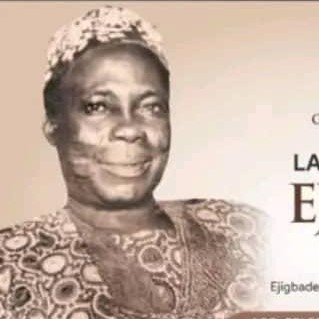
Raji Oba’s story is Ejigbadero’s story. Ejigbade’s story is Raji Oba’s story. It was a story that shook the entire Lagos State to its foundation. My uncle who was then a young surveyor told me that for years, some people were scared of going to the area once it was nightfall. Today, Onigegewura brings you the story of Kiniun Baba Moradewun! Lion of Mushin! Jimoh Ishola Adeyemi! Ejigbadero! Gbadero! The Chairman!
Jimoh Ishola was arguably one of the famous people in Lagos of 1960s and 1970s. He was rich. He was streetwise. He was known. He was connected. He was the darling of musicians of the day. One of the surest ways to launch a musical career then was to sing about Ejigbadero. Yusuf Olatunji (Baba Legba) devoted substantial part of his Volume 19 to sing his praises. Baba Commander, Ebenezer Obey and his Inter Reformers Band, celebrated him in his 1974 album.
If Nigeria was not under military rule in 1970s, Jimoh Ishola could have contested and won an elective political position. He was that famous. Though Ejigbadero was not born in Lagos, he became the unofficial Lord Mayor of Lagos metropolis. Jimoh hailed from Oja-Oba Quarters in Ibadan. He came to Lagos with his uncle. After a short stay in the city, he moved from an apprentice to being a company owner.
When he incorporated his company, Jimsol Nigeria Limited, a nail manufacturing concern at Matori, Mushin, which he co-owned with his friend, Fatai Areago, he was not satisfied with just being called the Managing Director and therefore styled himself: The Chairman!
Beyond nail manufacturing, Ejigbadero had over time acquired a reputation as a dealer in landed properties. He also provided security services over land. Where it concerned land, Ejigbadero was known to the police and familiar to the judges.
In 1975, Ejigbadero went with his boys to clear a large expanse of land in Alimosho Village. The land was full of cocoa and kolanut trees. When the villagers saw their economic trees going down, they challenged him and his boys. ‘The Chairman’ informed the villagers that he had purchased the land. “You lied,” the villagers told Ejigbadero and would not allow him and his boys continue work on their land. The Boys looked at their boss who leaned calmly on his walking stick. They were waiting for signal to strike. Once Ejigbadero stepped on any land, the land must become his. Instead of Jimoh Ishola to raise the walking stick to signal action, he turned back. The Boys followed him disappointedly.
The villagers jeered and booed after them. A few refused to join in the booing. They knew better that the retreat of Ejigbadero was not a surrender. They knew he would be back. Ejigbadero was not the one to run away from a fight.
They remember what happened to Okuwobi in 1962. Ejigbadero had informed his boys that he was looking for a buyer for one of his properties. He promised them generous commission. The boys went to town. Okuwobi indicated interest in the building. It was a building under construction. Okuwobi paid part of the agreed purchase price. It was agreed that the balance would be paid upon completion.
Okuwobi collected receipt and began to dream of becoming a landlord in Lagos. He was considering whether to paint the house blue or grey. Or green, or cream. He finally decided on white. He had heard that the official residence of the American president was White House. It was then that a friend told him that the house, his house, had been sold to someone else. Okuwobi didn’t know whether he walked or flew to Mushin. He shouted. He threatened. Ejigbadero was unmoved. Okuwobi reported to the police. He was advised to go to court. He spent more than 10 years in court.
The villagers knew that they must act fast if they didn’t want to spend 10 years in court. At the time, the nearest police post was at Agege. They therefore went to Agege Police Station to make a formal report of malicious damages to their farmlands against Ejigbadero. As they were writing their statements, ‘The Chairman’ himself appeared with his boys. He had come to lodge a report of trespass against the villagers. The police were confused. They attempted a peaceful settlement to no avail. Ejigbadero wanted his land and so were the villagers.
Raji Oba was one of the villagers. He was as brave as he was vocal. He was not afraid of Ejigbadero and he told him to his face. Even when Ejigbadero threatened to kill him, the threat was met with a sneer. “Igbá ni won n pa, enikan kii pa àwo.”
Police or no police, Ejigbadero was not the one to keep away from land troubles.
Raji Oba had finished work on the farm for the day. He was almost at home when he was informed that ‘The Chairman’ was around with his thugs who he usually described as his workers. Raji turned back. “Ma fi oko mi se ona, ojo kan ni a n dekun re.” Raji was determined that he was going to stop the land grabber that day. He was followed by some of the villagers who had also heard the news. They met Ejigbadero on the land. His boys were cutting cocoa trees with ruthless determination. Kolanut trees were not being spared either. Raji Oba flared up. A big fight erupted. Ejigbadero stood like a rock. He was commanding his boys to give it to the villagers like an army general. In the free-for-all that followed, Ejigbadero saw his chance as Raji Oba moved close to him. In a moment he had stabbed him. Raji didn’t see the dagger, but he felt blood flowing from his eyebrow. It was clear that Jimoh Ishola was aiming for his eye. Raji Oba was rushed to the hospital and from there to the police station. They made a report of criminal assault and attempted murder against Ejigbadero; but nothing happened afterwards.
Back at his base in Mushin, Ejigbadero was not pleased with the stiff resistance he was confronted with in Alimosho. The villagers must be subdued. He had planned how to subdue them. After all, ‘ibeji kii se akopa aje’. Killing twins is not a new thing to a witch. But he had not expected the stiff opposition he met in Alimosho. He knew the cause of the problem. It was Raji Oba. What type of Oba was he that he would stop Ejigbadero, Kiniun Baba Moradewun?
“Baba Fatai, your food is ready.” Ejigbadero looked up. It was his youngest wife, Ramota. Though he was not particularly hungry, he didn’t want to displease the pregnant woman. He told her to bring the food. At the sight of the expectant mother, an idea started to form in his mind. He smiled. Ramota thought her husband was enjoying the meal. She was pleased.
It was in the month of August 1975 that Lagos social circle heard the news it had been waiting. Ramota, Ejigbadero’s wife had put to bed. Socialites knew what to expect. It was going to be a grand occasion. It was going to be an assemblage of Lagos who’s who. It was going to be the party of the century. And it was a Friday! TGIF!
True to expectation, Ejigbadero didn’t spare any expenses for the naming ceremony. Food was in excess. Wines replaced water. Musicians were competing with themselves on the bandstand. The blind requested to be led to the occasion. The lame crawled. Ejigbadero and his four wives were dressed in a manner befitting a king and his Oloris. They were a spectacle to behold.
Back in Alimosho. Sabitu, Raji Oba’s wife, was returning from the market when she saw Ejigbadero and his boys. A woman was in their midst. She was shocked to see ‘The Chairman.’ They had heard in the village that one of his wives had delivered a baby and that the day was the naming ceremony. She quickened her pace home. She needed to warn her husband of the presence of Eji in the village. It was already dusk but the moon had appeared. She met her husband reclining in front of their house. She informed her husband that Ejigbadero was in the village.
Raji Oba was also surprised. He had heard that Ejigbadero was holding a lavish party that day in Mushin. So what was he doing in the village? And why did he choose to come to the village at dusk.
She had hardly finished speaking when she heard an explosion. GBOAH! Raji Oba fell from his seat with a thud! Sabitu jumped in alarm! Raji had been shot in the head. The wounded man began to groan in pain. Blood was oozing from the wound. Sabitu turned to the direction where the sound of the explosion had come from. Smoke from gunpowder was drifting up to the clear moonlight sky. She saw seven people running away towards a nearby bush. She distinctly recognized Ejigbadero. He was wearing a short sleeve shirt and trousers. He was holding a gun. He was at the rear of the fleeing people. Her temporary shock over, Sabitu shouted at the retreating figures: “Ejigbadero mo ri e o! Ara Abule! Ejigbadero ti pa mi loko o!”
Back in Mushin, the naming party was in full swing! Ejigbadero was moving from table to table, exchanging banters with his friends and well-wishers. Remember I told you that Ejigbadero was well connected in the society. His guests that night included magistrates, lawyers, police officers and leading journalists of the day. Camera bulbs were flashing as Ejigbadero posed for photographs with his guests. It was a party that Mushin would remember for a long time.
Police officers in Agege were already familiar with Alimosho villagers. There was hardly a week that they would not come to the station to report one incident or another. On the evening of August 22, 1975, the police officers on duty heard the crowd from a distance. Alimosho people have come again! What has happened again? The officers wondered.
“Ejigbadero ti pa Raji o!”
The officers knew that Yoruba language was full of hyperbolic expressions. A mere tap on the cheek could lead to a shout of ‘Mo ku o! O ti pa mi o!” They were however shocked when they realized that Raji had actually been killed. This was not a case of Mo gbe! Mo ku! Mo daran! The villagers were unanimous that it was Ejigbadero that killed Raji.
Ejigbadero was in company of late party guests in his house when the police came. He was informed that his attention was needed at their station. He was wanted in connection with the murder of Raji Oba. Ejigbadero’s visitors did not allow him to speak before they jumped to his defence! “When? Where? Ejigbadero who did not step out of this Mushin throughout yesterday!”
The Lion of Mushin was confident of himself. His defence was as solid as a rock. His alibi was incontrovertible. He had judges, lawyers, police officers and journalists as his witnesses. What more could he want? He retained Chief Sobo Sowemimo, a highly experienced advocate, as his counsel. His case was good. He knew. On the other side was the Lagos State Director of Public Prosecution, Mr. Omotunde Ilori.
As the prosecution began its case, Ejigbadero was becoming rather impatient. He knew the trial was going to be a waste of his time. Mr. Ilori called Sabitu Oba to the witness box. She narrated the event of the day. Ishola was smiling throughout her testimony. Who would believe the testimony of a village woman?
Mr. Ilori then called Nimota Kelani, Sabitu’s neighbour. Nimota’s evidence was straightforward. She informed the court that on hearing the alarm raised by Sabitu to the effect that Ejigbadero had killed Raji Oba, she dashed out of her house. She also saw Ejigbadero running away towards the bush. She saw him clearly in the moonlight. She also called on the accused telling him that she saw him and reminded him that he had kept his promise to kill Raji.
Rafiu Latifu was another witness called by the learned DPP. Latifu testified that on the evening of August 22, he was returning to the village when he saw a white Peugot 504 station wagon parked by the side of a mosque a distance of two minutes to the house of Raji Oba. He also saw Ejigbadero and six other persons, one of whom was a woman, run out of a nearby bush towards the parked car.
On arrival at the premises of Raji Oba he met people who told him that Ejigbadero had killed the deceased, who was still lying on the ground and bleeding from the head. Latifu then told the people that he had seen Ejigbadero and six other persons running out of the bush but did not know at the time that he had already killed Raji.
It was at this point that Ejigbadero began to doubt his defence. Awodi oke ko mo pe ara ile n wo ohun. Like the hawk he had assumed that he was invisible to the people below. If he had known how diligent the DPP, Mr. Omotunde Ilori was, perhaps he would not have been too confident with his alibi. Ha! You don’t know ‘alibi’? It’s a Latin word. It means ‘elsewhere’. It is a piece of evidence that one was elsewhere when an act, typically a criminal one, is alleged to have taken place. I hope you are following me.
There was a policeman who was riding a bike that night who also recognized him. Remember I told you that Ejigbadero was as popular as Iya Agba’s aso onisuga. Aso onisuga was very common in the 60s and 70s. The design on it was in the shape of a cube. Just like a cube of sugar, hence the name. Ilori found the police officer. Ilori also found two women who saw Ejigbadero when they were coming from the farm with firewood on their head. Immediately they saw him, they ran into the bush.
Ejigbadero’s defence was straightforward. He was in Mushin on August 22. He didn’t step out of his house. He had witnesses who were eminent people in the society. He called Bashiru Ajape, a police officer; Jacob Oyelakin, a Manager with Leventis Motors; and Emmanuel George, a lawyer. They all testified that they were with Baba Gani at his baby’s naming ceremony that day. The court considered the evidence of these eminent personalities and found each of them to be ‘miserably untruthful in the evidence they gave’.
Tried as much as he could, Gbadero could not disprove the testimonies of the prosecution witnesses. The best cross-examination failed to crack the witnesses. They were all adamant. It was Ejigbadero that they saw that night. It was Ejigbadero that killed Raji Oba.
The trial judge took his time to review the case for the prosecution as well as the case for the defence. A life was at stake and mistake must not be made. The judge found the evidence of a security guard in the employment of Ejigbadero helpful. Kehinde Yekinni was the security guard employed to guard Ishola’s factory. He testified that Ejigbadero came to the factory in the evening and later left for Alimosho with Modina, Osadebey, Isiaka, Bakare, Wahab Oduntan, and Lukman. The group later returned to meet him at the factory around 9pm. On their return, Ejigbadero drew out a gun from underneath his trousers and told Kehinde that he (Ishola) had killed the man that Kehinde refused to kill.
In the end, the judge found that Mr. Ilori had proved the case for prosecution beyond reasonable doubt. Jimoh Ishola was found guilty on the two counts: conspiracy to murder and murder.
He was sentenced to death. As the trial judge, My Lord Justice Ishola Oluwa, pronounced the sentence of death on him, Ejigbadero turned to his counsel and in his Ibadan accent asked, turning his nose to indicate His Lordship: “Emi ni n wi?” What was the Judge saying?
Jimoh Ishola appealed the judgment to the then Federal Court of Appeal. My Lords: Mamman Nasir, Adetunji Ogunkeye and Ijoma Aseme considered his appeal. His appeal in respect of Count One (conspiracy to murder) was allowed, meaning he was not guilty of that charge. His appeal in respect of the second count failed and the appellate court affirmed his conviction.
This time around, Ejigbadero did not bother to ask his counsel what their Lordships were saying. He had spent enough time in court to know the meaning of ‘Appeal is hereby dismissed.’
Off to the Supreme Court. His case was the 7th case filed in the Supreme Court in 1977. On Thursday, October 26, 1978, a panel of the Supreme Court comprising My Lords: Alexander, Fatai-Williams, Irikefe, Bello and Idigbe affirmed his conviction and dismissed his appeal.
In 1979, four years after the gruesome murder of Raji Oba, Jimoh Ishola, alias Ejigbadero, alias the Chairman, alias Kininun Baba Moradewun paid the supreme price.
What a price to pay for a piece of land!
I thank you for your time.
P.S. Strangely Ejigbaderotoday has a bus stop and a street named after him in Lagos.
Our site uses cookies. By clicking “Accept All Cookies”, you direct Law and Society Magazine to store cookies on your device and disclose information in accordance with our Cookie Statement: cookie policyACCEPTREJECT
Privacy & Cookies Policy
Privacy Overview
This website uses cookies to improve your experience while you navigate through the website. Out of these cookies, the cookies that are categorized as necessary are stored on your browser as they are essential for the working of basic functionalities of the website. We also use third-party cookies that help us analyze and understand how you use this website. These cookies will be stored in your browser only with your consent. You also have the option to opt-out of these cookies. But opting out of some of these cookies may have an effect on your browsing experience.
Necessary cookies are absolutely essential for the website to function properly. This category only includes cookies that ensures basic functionalities and security features of the website. These cookies do not store any personal information.
Any cookies that may not be particularly necessary for the website to function and is used specifically to collect user personal data via analytics, ads, other embedded contents are termed as non-necessary cookies. It is mandatory to procure user consent prior to running these cookies on your website.