Home Blog Page 799

Enugu Rangers International and the Allure of Soft Power

By Chidi Anselm Odinkalu

“It was as if the football club wanted to regain through football what the Igbo ‘lost’ during the war.” – Segun Odegbami, MON

Nearly every Nigerian who was alive then remembers where they were at the end of 1976 when Alyufusalam Rocks met Enugu Rangers International in the finals of what was then known as the Challenge (Football Association) Cup. With a history going back to the Governor’s Cup, the first finals of which took place on 7 November 1945, the Challenge Cup was the premier knock-out competition in Nigerian football. Although strictly inferior to the football league, the win-or-go-home traditions of the Challenge Cup captured public imagination in a way that the league did not.

The teams involved embodied the hopes not merely of players but, even more, of the parts of Nigeria from where they came. Writing on the contagion effect of the nation-wide passion for the Challenge Cup in his History of Football in Nigeria, Wiebe Boer observes that “there is hardly a man, woman or child in the whole country who has not been, in some way or another, connected with the magic of the ‘silver pot.’”

With their base in Ilorin, Kwara State, until then not exactly a byword for soccer excellence in the country, the Rocks were a new phenomenon in Nigerian football. They had momentum on their side having eliminated more established names on their way to the finals. Rangers went into the finals with low morale having just lost in the semi-finals of the African Cup of Champion Clubs competition to Algeria’s Moloudia Chalia.

As Nigeria sundered into war in 1967, the Challenge Cup took a back seat. Until then, no team had managed to establish sustained dominance over the football scene in the country. All that was to change after the war with the emergence of a new phenomenon, until then unknown in Nigerian football.

Five days after the end of the Civil War, around 20 January 1970, two young men separately walked into the office in Enugu of Jerry Enyeazu, the Germany-trained graduate in physical and health education who would emerge after the war as the leading sports administrator of his generation in the region. They were Godwin Achebe and Dominic Nwobodo. Achebe and Nwobodo were survivors from a talented bunch of young footballers and athletes lost to the war. That meeting inspired the idea of a football club, about the only enterprise left to a region whose journey of recovery looked impossible.

Towards the end of the war, as the Biafran side was depleted in both morale and materiel and began to consider options for mobile warfare, Timothy Onwuatuegwu, a Major in the Biafran Army, assembled a collection of young men who were supposed to undertake operations behind enemy defences. Initially known as the “Strike” or “S Force”, survivors from this squad formed the core of what became the Rangers International. The team made Enugu its home in the capital of the then East Central State, becoming known as “Enugu Rangers International” with the pay-off line was “never say die!”

Four months after their formation, on 30 May 1970, Enugu Rangers played their first match. On that date three years earlier, then Military Governor of the Eastern Region, Emeka Odumegwu-Ojukwu, a Lieutenant-Colonel in the Nigerian Army, had proclaimed Biafra into being. Military Head of State, Yakubu Gowon took notice and so did Ukpabi Asika, then the Governor in Enugu. Jerry Enyeazu managed to avoid a charge of treason on the accusation that he had organized the match to mark the anniversary of Biafra. He explained it as a coincidence. Into these trying circumstances, Enugu Rangers was born.

Within three years, the Club was a mainstay of the Nigeria’s gold-winning team in the football event at the All Africa Games in 1973. In 1974, the Club won the Challenge Cup. They retained it in 1975. This was the context going into the finals in 1976. If Rangers won, they would achieve the unprecedented feat of winning the cup thrice in a row and for keeps.

In those days, Nigeria had an energetic football ecosystem. Introduced into the country by European missionaries, football had arrested the passions of the country by the time Nigeria gained Independence in 1960. Dr. Boer credits it with “a huge impact on creating community spirit and interaction across the length and breadth” of Nigeria. The 1960 edition of the Challenge Cup drew 80 teams from all over the country, each channeling the hopes of their communities.

Teams carried their origins with pride. Mighty Jets of Jos; Raccah Rovers of Kano; Niger Tornadoes of Minna; Stationery Stores of Lagos; Sharks of Port Harcourt; Bendel Insurance of Benin; IICC Shooting Stars of Ibadan; Calabar Rovers; Spartans of Owerri; Enyimba of Aba; Vasco da Gama of Enugu.

Companies invested in football teams to uplift their host communities and offer young men redemption. The Defence Industries Corporation inspired the DIC Bees of Kaduna where the company was based. Benue Cement Company gave birth to BCC Lions of Gboko. The New Nigeria Bank sired an eponymous football club in Benin offering fierce competition to Bendel Insurance. African Continental Bank, originally founded by Nigeria’s first president, Nnamdi Azikiwe, himself an accomplished sportsman, equally funded an eponymous football club at its headquarters in Lagos. Moshood Abiola, the leading businessman of his day, founded Abiola Babes in his hometown, Abeokuta.

Enugu Rangers was different, however. They represented the hopes of a people in search of dignity. They travelled across the country carrying the hopes of recovering Igbo communities who unleashed songs in praise and thanksgiving for the club’s accomplishments. They also had a unique brand-builder in Ernest Okonkwo, then the leading sports journalist and football commentator in the Federal Radio Corporation of Nigeria (FRCN), who made urban legends of the exploits of the club and its leading players, ensuring that they were etched in the consciousness of the country.

Okonkwo was the commentator on that day in 1976 when Rangers International became the first team to win the Challenge Cup thrice by a two-goal margin, conceding none. The following year, the team won the African Cup Winners Cup, beating IICC Shooting Stars in the semi-finals. Seven years after the war, a team of young men whose future was at best uncertain were at the seat of power in Lagos to present their African diadem to the country led by the man who ended the war. It was a script that the authors of “no victor; no vanquished” could not have imagined.

In 1979, Jim Nwobodo, the teacher-turned-impresario parlayed his credentials as Chairman of Enugu Rangers into a successful run as Governor of Anambra State. He would later testify that “Rangers FC was the key tool in the final process of our people’s rehabilitation, reconstruction, and return to Nigeria.” Ugochukwu Ekemezie, who studied the club in a dissertation at the University of Windsor in Canada in 2022, agreed.

In 1980, Nigeria’s Green Eagles became kings of African football with a backbone from the Rangers International and IICC. To crown it all, the songs that serenaded the Green Eagles on their way to victory were nearly all originally coined in support of the Rangers on their march to football conquest of the country. Nigeria had willingly learnt to commit them to heart and sing them too in Igbo.

Where the violence of the war had failed, the soft power of the indomitable spirit of the Rangers International had persuaded Nigeria into a love affair with their origins.

Today, that spirit of constructive competition between communities on the back of which the legend of Enugu Rangers International was forged lies in ruins. Companies and ambitious men willing to invest in the healing power of sports have been replaced mostly by buccaneers. Instead of devastated young men being channeled into the glory of sports excellence or communities into reconstruction, we have now accomplished young men addicted to destruction and communities living in devastation. Remarkably, Rangers International still exists and many of those men who inspired a people and a country nearly half a century ago continue to “never say die!”

A lawyer & a teacher, Odinkalu can be reached at [email protected]

The outrageously callous killing of a nine-year-old and more

By Lillian Okenwa

“The weakest ones are the wickedest cruel
When the strongest ones in gentleness rule!”
― Ana Claudia Antunes, The Witches Of Avignon

“One of the common failings among honorable people is a failure to appreciate how thoroughly dishonorable some other people can be, and how dangerous it is to trust them,” said Thomas Sowell the  American political thinker.  That perhaps was the error of judgment made by James Achipi Korshima of Vandekiya local government area of Benue when he sent his nine-year-old daughter, Precious Korshima to live with one Mrs. Ujunwa Ugwuoke in Enugu.

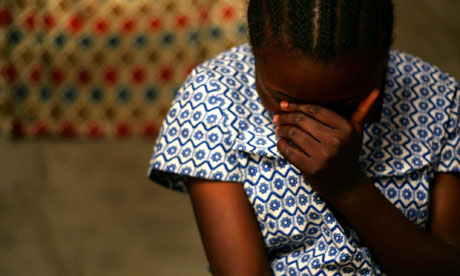
Sometime in December 2022 little Precious died under very bizarre circumstances that is currently being unraveled by security operatives. Her family is still stunned.  Ujunwa Ugwuoke of Fidelity Estate, Okpara Avenue, Enugu, under whose care Precious was, allegedly whipped the little girl to death. Precious was her maid.

The police disclosed that when Precious passed out on account of the excessive violence allegedly meted out on her by her mistress Mrs. Ugwuoke, the older woman took the child’s lifeless body to the University of Nigeria Teaching Hospital (UNTH) at Ituku-Ozalla near Enugu city for medicals.

The doctors on duty confirmed Precious dead on arrival. When that happened, Ugwoke according to the police swiftly took the body and dumped it in a refuse site along Ugbo-Nwagidi Village Road, Enugwueze Uno-Ituku community in Awgu Local Government Area.

The Police also revealed that Ujunwa Ugwoke ran away to Abakaliki in Ebonyi State, from where she sent a false alarm claiming that the deceased, her little child, and herself, were kidnapped and taken to an unknown destination, on 9th November 2022, while on their way back home from Independence Layout, Enugu, where she had gone to refill her Gas Cylinder.

The suspect while at Abakaliki, claimed that the kidnappers demanded a ransom of twenty million naira (N20,000,000.00) for each of them. However, she reappeared on 16th November 2022, claiming that the kidnappers spared her and her child but shot Precious dead.

The case has been transferred to the Homicide Section of the State CID Enugu from the New Haven Police Division, where it was previously reported as a case of kidnap upon her confessional statement. Ugwoke has since been arraigned in the Enugu North Magistrate Court and remanded in the Enugu Maximum Correctional Centre. The police has equally been ordered to transfer the case file to the office of the Attorney General for Advice.

James Achipi Korshima, the 37-year-old father of the late Precious, told a human rights organisation, Civil Rights Realisation and Advancement Network (CRRAN) how his suspicions were raised about his daughter’s death and sought justice to be done about her death. 

The Port Harcourt resident said his daughter was murdered. “Sometime in March 2022”, he told CRRAN, “a businesswoman, Mrs. Nelly Okoroafor, who lives here in Port Harcourt approached me and pleaded with me to release my little daughter, Miss Precious Korshima who was nine years old to be trained in school through her friend in Enugu,  (Mrs. Ujunwa Ugwuoke).  She told me that it would be her own little way of helping Precious since I am just an upcoming artiste and to also help Mrs. Ugwuoke look after her newborn baby.

“I released my little daughter to Mrs. Okoroafor and subsequently she was sent to Mrs. Ugwuoke who lives in Fidelity Estate, Enugu.  She was living with her until November 10, 2022, when I received a strange phone call from an unknown number.  The caller claimed that they kidnapped Mrs. Ugwuoke, her baby, and Precious, my daughter, and demanded a ransom of N20 million.

“I pleaded with the alleged kidnappers that my little daughter was only a house help and that I had no means of raising such an amount of money.  I also appealed to the alleged kidnapper that I would get in touch with the family of Mrs Ugwuoke. Like I promised, I got in touch with Mrs Ugwuoke’s family and the husband who lives abroad.  To my greatest surprise, they all feigned ignorance of the alleged kidnap.”

According to Korshima, Mrs Ugwuoke and her own daughter in a bizarre turn of events were allegedly released from the kidnappers’ den and his little Precious was alleged to have been murdered.  At that point Korshima said he immediately reported to the New Haven Police Station in Enugu. The DPO of the station later told him that the matter had been transferred to the Anti-kidnapping Squad Unit of Enugu State Police Command.

“It was after some days at the anti-kidnapping base that Mrs Ugwuoke admitted that she beat Precious to death and dumped the corpse off at the Port Harcourt Expressway immediately after the military check point just after UNTH,” Korshima recounted.

The grieving father said the police told him that when they got to the place were Precious’ body was dumped, they learnt that the Igwe of the community gave an order directing the youth to burn the decomposing body because of the offensive smell. 

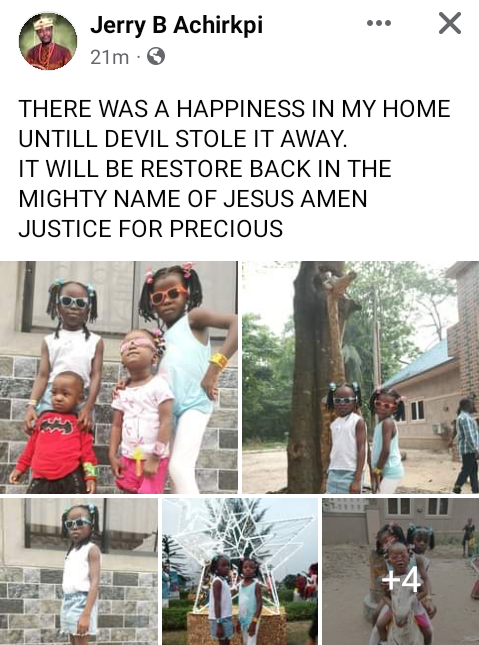
A Tuesday January 31 post on Mr Korshima’s facebook wall reads: “There was happiness in my home until the Devil stole it away. It will be restored back in the mighty name of Jesus. Amen. Justice for precious.”

Another bizarre incident took place in Benue State where a 40-year-old housewife, Charity Upev, and her son, Tertsea, allegedly beat an in-law to death over meat. Mother and son have been remanded in a custodial centre in Benue State

Sequel to the death Fanen, the police charged Charity and her son with criminal conspiracy and culpable homicide. The prosecuting counsel, Inspector Jonah Uletu, told the court that on 24 January, the Divisional Police Officer of E Division Police Station, Makurdi, received information that Charity and her son beat up Fanen, her in-law living with them. The prosecutor said Charity claimed that her in-law stole meat from her pot of soup.

Fanen, the police said became unconscious on account of the beating and was rushed to a hospital. He died while receiving treatment.

Then in Germany, a woman actually found her lookalike on Instagram, killed her, and faked her own death.

The alleged perpetrator identified only as 23-year-old Sharaban K. killed beauty blogger Khadidja O., also 23, in Ingolstadt, Germany last August, according to investigators. Khadidja O. was brutally stabbed more than 50 times, with her body left on the back seat of Sharaban K’s Mercedes. Sharaban K. and an accomplice identified as her boyfriend Sheqir K. then went into hiding.

When the body was found, police traced the car’s registration to Sharaban K.’s family. Given that the corpse had been disfigured, investigators assumed that she was the victim. However, a subsequent autopsy report uncovered that the actual victim was Khadidja O., prompting an investigation into the bizarre case dubbed the doppelganger murder by German media.

The police have charged Sharaban K. with murder. Prosecutors say she searched Instagram in a bid to find a victim who matched her physical appearance. Attorney General Veronika Grieser told local publication, Bild: “It has been confirmed that the accused had contacted several women via Instagram before the act who seemed to look similar to her. It can be assumed that the suspect wanted to go into hiding, due to internal disputes with her family, and fake her own death.”

According to investigators, Sharaban K. connected with beauty blogger Khadidja O. via Instagram sometime last summer, sending her messages about cosmetics. She reportedly enticed the victim into meeting up by offering her a set of beauty products.

On the day of the crime, Sharaban K. told her parents that she was going to visit her ex-husband in Munich. Instead, she and her boyfriend Sheqir K. allegedly picked up Khadidja O. in a Mercedes.

At some point, investigators believe they turned off into a forest where Khadidja O. was stabbed more than 50 times. The injuries to her face were so severe that she was rendered unrecognizable.

Sharaban K. and Sheqir K. then allegedly parked the Mercedes in a place where it would be easily discoverable, leaving the body in the backseat.

When police learned that the victim was not Sharaban K. as initially suspected they were baffled. They subsequently looked into her social media correspondences and discovered that she had connected with multiple look-a-likes. They formed the theory that she had murdered one of the women in a wild bid to fake her own death. Sharaban K. was subsequently tracked down, officially charged with murder, and faces life in prison if found guilty of the gruesome crime. Sheqir K. has also been charged as an accomplice and is similarly facing jail time.

Murja Kunya: What exactly is that TikToker doing in prison?

By Lillian Okenwa

So, a popular 24 years old Kano TikTok skit maker, Murja Kunya has been sent to prison; but for what exactly?

Last Saturday, she was arrested while booking hotel rooms for guests who had come from far and near for her much-publicised birthday party in Kano. Murja was arrested by the Kano State Police Command.

She has been accused of singing immoral songs, dancing to immoral songs, and insulting people on social media. A Shariah Court sitting at Filin Hockey in the Kano metropolis has now ordered Murja’s remand in prison custody.

A Sharia Court in Bichi, Kano state in September 2022, wrote to the Kano State Commissioner of Police to arrest and investigate Miss Kunya alongside other TikTokers for corrupting the morals of the society. She was reportedly arraigned on Thursday on charges that border on defamation of character, vulgarity, public nuisance, and breach of public peace.

And so, our prisons continue to swell with struggling and very ordinary people. People who in most cases are venting their anger over the mismanagement of our common patrimony in different ways.

In the same Kano, Sani Rimo a senior official with the Kano State Hisbah Board caught with a married woman in a hotel. SaharaReporters first broke the news about how the commander of the Islamic police was arrested in a hotel in the Sabon Gari area of the city. Rimo was said to be in charge of arresting beggars and prostitutes in the Kano metro area.

Hisbah officers regularly arrest unmarried people caught in hotels, presumably for sexual activities, as part of their enforcement of the Sharia. They are also notorious for destroying truckloads of alcoholic drinks.

After the arrest, a deputy Hisbah commander was said to have gone to the police station to bail the arrested officer. And following the publicity the incident generated, the Commander was fired and that was all. His deed was not considered immoral enough to attract harsher punishment. So much for a leader of a group that is high on moral policing! It wasn’t a jailable offence or perhaps jails are not meant for people at his level.

In this same Kano, a governor of the state was captured on video collecting bribe from a contractor and hiding the dollars in the most undignifying manner. Two similar videos released by the Editor-In-Chief of Daily Nigerian, Jaafar Jaafar, showed the governor collecting bribes in dollars and stuffing the wads of money in his white “babariga” (a large robe worn by Nigerians mostly from Northern Nigeria).

The video showed the Governor darting his eyes, perhaps towards the door every now and then to ensure nobody was coming in. It also showed the happy governor packing the money into a paper bag under his table just as the names of contractors, the contracts, and those who have either paid or were yet to pay up their bribes to him were mentioned in the video.

The governor denied the videos, saying they were photoshopped. Then he frustrated a probe of the scandal by the state assembly by securing a court injunction to halt the inquiry.

Not quite a month after the video went viral, the governor sued Jaafar and Daily Nigerian for defamation at the Kano High Court and demanded N3 billion as damages. Eventually, he withdrew the matter from court with no reason adduced. Daily Trust reported that the court fined him N800,000 for the action.

Just when people thought the withdrawal of the matter from court would bring relief to Jaafar, the governor moved all the way from Kano to a High Court of the Federal Capital Territory, Abuja where he requested N5billion as damages for alleged defamation.

In April 2021 the journalist eventually fled to the United Kingdom with his family over alleged threats to his life.

On account of this, The Cable in an Editorial of 8 August 2021 wrote “Despite persistent calls by authentic advocates of good governance for a conducive atmosphere for a thriving democracy and freedom in Nigeria, the reactionary wing of the ruling class and its agents are not giving any chance for that to happen. The more they are caught red-handed—with self-incriminating evidence—and exposed in the very act of a crime, the more they grow the liver to deflect and seek revenge.”

This is a country where a maximum prison was attacked without the minutest resistance. Terrorists and hardened criminals were freed. No arrest so far has been made. A whole train conveying nearly a thousand passengers was bombed by suspected terrorists. Many died. Most of them, men, women, and children spent over 180 days in captivity, exposed to the elements and harshest conditions. None of the perpetrators have been arrested till date.

Top public servants and politicians loot the treasury dry and either get light sentences after plea bargaining to go and enjoy their loot or they walk free.

Today, as Nigerian groan over the redesigned naira notes, fighting and queuing at banks and ATM machines to withdraw their hard-earned money, POS operators who have little cash to dispense to desperate Nigerians have become the new criminals. They are hunted down and arrested around Abuja like criminals. Meanwhile, the big men whose videos are trending online where they are spraying the new notes at parties are untouched. Who dares to confront, let alone apprehend them? It is common knowledge that some big men already have billions of naira worth redesigned notes which they are charging some percentages for in exchange for the old notes.

These things are known but they are the untouchables. Nobody arrests or punishes a big man in Nigeria. Only the poor, young, and defenceless suffer. If you are in doubt, ask the #EndSARS protesters.

But again, I ask, what exactly is that young lady doing in prison? Ok, Correctional Centre. What is she being corrected for?

Onoja, SAN set to commission Bar and Bench International Institute for Arbitration

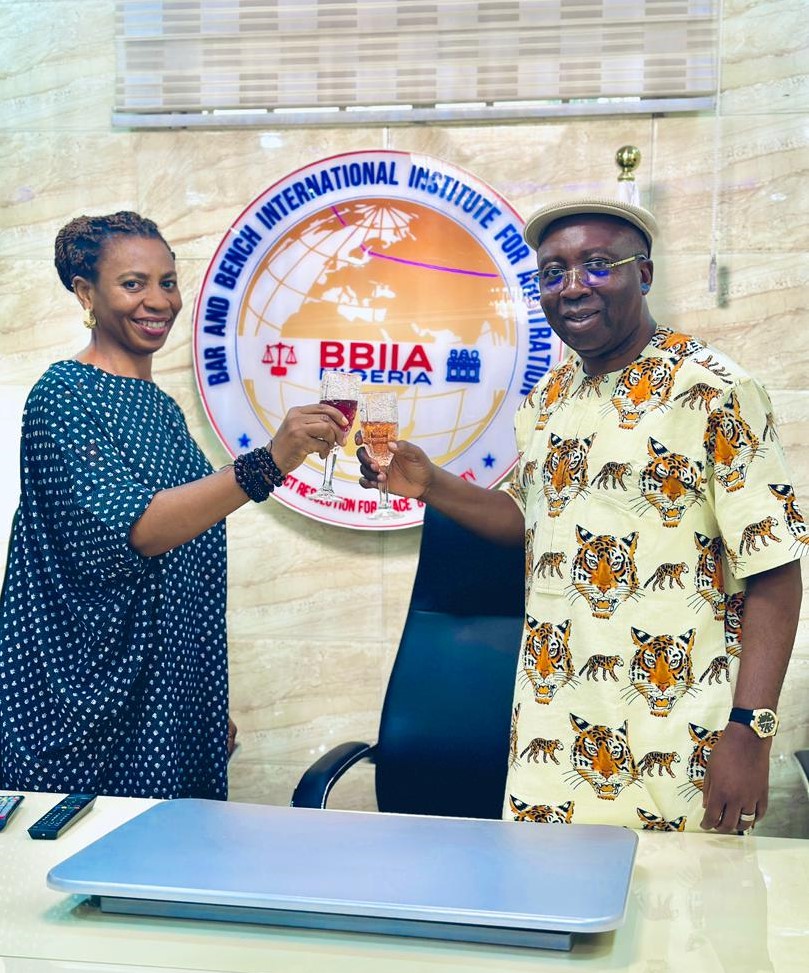
Senior Advocate of Nigeria, Chief Ogwu James Onoja, PhD., has announced plans to commission the state-of-the-art Bar and Bench International Institute for Arbitration (BBIIA) LTD/GTE in Abuja.

Onoja who spoke with Law & Society Magazine on Wednesday in Abuja disclosed that having received the certificate of incorporation from the Corporate Affairs Commission (CAC) everything is now set for the Centre to launch.

Although the certificate of incorporation sighted by Law & Society was dated 1st of February 2023, Onoja who disclosed that the Centre boasts of top-notch arbitrators further revealed that though it took nearly a year for the registration to pull through, the wait was worth it, as the interval afforded him and his team time to equip the Centre adequately.

In April 2022 Chief Onoja unveiled the multi-million naira university printing press at Nasarawa State University, Keffi. Having sunk over N450,000,000 (Four Hundred and fifty million naira) into the purchase of machines and construction of the building housing the printing press, the Senior Advocate said it was part of his contribution to boosting the university community’s fortunes.

Onoja is an author of many law books including the recently published —Fundamental Rights (Enforcement Procedure) Rules, 2009: Practice, Forms And Precedents Vol. 1 And 2.

Below are photos of the Bar and Bench House crew celebrating ahead of the launch.

Pauline Tallen recommends capital punishment for rape as courts step up life sentences for perpetrators

By Lillian Okenwa

The impact of sexual abuse on victims, particularly young people’s psychological and physical health is hugely devastating. This is particularly given that the formative period is when they should be developing and refining positive intimacy skills in close relationships.

Also, there’s no gainsaying that abuse which occurs over time is more harmful. Sadly, this is the case for many abused minors, because the child is living with the fear and worry about being abused instead of being able to put the experience behind them. Again, when children believe that it is their fault, that they are ruined, or that no one can be trusted, they are more likely to be seriously affected.

Outraged by the innocence-snatching scourge, Ogechi Abu, a past Vice Chairperson of the Nigerian Bar Association Abuja Branch (Unity Bar) said: “The surge in underage rape is nothing short of an abomination and glaring evidence of moral/social depravity and legal inefficiency in the country.”

Thankfully the courts in Nigeria have risen to the occasion. Unlike in the past when rapists get a few years jail sentence, judges now hand down severe sentences to sexual offenders. But, Nigeria’s Minister of Women Affairs, Pauline Tallen, maintains that capital punishment is the only deterrent for perpetrators of rape. Tallen in a forum at Abuja said only capital punishment and other forms of punishment commensurate with the inhuman crime of rape would act as a deterrent to rape.

Some days ago, an Ekiti State High Court, in Ado Ekiti sentenced two persons to life imprisonment for the offence of rape. The defendants, Salau Adams (21) and Odeleye Tobi (21) were arraigned before Justice Olalekan Olatawura on 13th May, 2022 for raping a 14-year-old minor.

The victim said in her statement to the Police said, I know Adams and Tobi in the street. On that day, I was hawking fried meat. They called me and bought meat worth N100 each. They pretended to bring out money but instead, Adams brought out a black handkerchief. I decided to leave and report them to my mother. When I turned, Tobi held and carried me from the back while Adams covered my mouth with the black handkerchief. I was carried to a nearby bush behind their house. Adams first forcefully had sex with me and Tobi also did the same. Thereafter, they ran away. I went back home crying, with blood stains on my cloth. I narrated what happened to my mother. Other neighbours followed my mother to their house but they were not at home. The matter was reported at the Police station and they were later arrested. I was still a virgin when they raped me, she concluded. 

Although the defendants who spoke through their counsel, O.G. Abiola pleaded with the court to tamper justice with mercy, claiming that they are young and can still be useful to society, Justice Olalekan Olatawura in his verdict held that the crime of rape and defilement of children in the jurisdiction is fast assuming a frightening dimension.

“It is the duty of the court to send the right signal to would-be rapists. The only way to discourage this dastardly and bestial act would be, to punish those found guilty severely. I, therefore, hold that the prosecution has proved beyond reasonable doubt that the defendants had sexual intercourse with the victim and was not consensual. From the proven facts, it can be inferred and I so do that the defendants conspired to commit the offence of rape. Consequently, the two defendants are hereby sentenced to life imprisonment.”

Last month Justice Abiola Soladoye of an Ikeja Sexual Offences and Domestic Violence Court, convicted and sentenced a 27-year-old electrician, Olamide Ayodele, to life imprisonment for defiling the eight-year-old daughter of his benefactor.

Justice Soladoye held that the court found the evidence of the prosecution witnesses believable and consistent. “The defendant is immoral, a mega liar, ungrateful, unkind, ruthless and rash in his conduct considering the survivor’s father picked him from the streets and treated him like one of his children.

“The court particularly noted that the attempts of the defence to pin the offence on the survivor’s brother were unsuccessful. The attempt of the defence to also mislead the court by stating that the evidence of the survivor’s brother was expunged when in fact it was not. This was a complete misrepresentation of the records of the court.

“Lastly, the evidence of the defendant was wrought with lies and unreliable as he desperately sought to distance himself from the alleged offence.”

Last year Her lordship sentenced Alfa Abdulsalam Salaudeen to life imprisonment and ordered his name to be registered in the Sex Offenders Register. Prior to his conviction, the 43-year-old Islamic cleric was arrested in Igando, Lagos State, for raping his five-year-old Arabic schoolgirl.

Initially, he denied the allegation but owned up to the crime when confronted with video evidence of him defiling the child by penetrating her anus and private parts. Meanwhile, Salaudeen, who is married with five children and well-respected in the community, blamed the crime on the handiwork of his enemies who he said had cast a spell on him.

Likewise, Justice Soladoye convicted and sentenced a technician, Efe Akioya to life imprisonment for defiling his neighbour’s five-year-old girl in his room at Meiran Road, Opposite Omoroga Market, Lagos.

UK Surgeons fix 169 fractured male organs in 12 months as Penis injury during sex rise

These are not very good times for a lot of men in the United Kingdom with many scheduling urgent visits to the doctor as their male organs are facing very grave challenges.

Indeed, official NHS figures indicate that the number of people who have experienced penis injury during sex in the United Kingdom is swelling.

As a matter of fact, Surgeons in the United Kingdom have reportedly repaired 169 fractured manhoods in the 12 months to April 2022 — up 46 on the year before.

The Scottish Sun reports that experts wager it may show that more men are using Viagra to make a stand.

As it turned out, most of the procedures involve men in their 30s, although two in their 70s had breaks last year. The repair involves cutting into the penis to stitch the tear.

A London-based consultant urologist Gordon Muir disclosed that breaks occur during sex when the willy comes out and gets bent on the way back in — usually when the woman is on top.

He said: “Most men feel a pop or crack and lose their erection.

There’s usually bruising. The penis can look like an aubergine — that spongy purple eggplant.

“If untreated, erectile dysfunction or scarring can cause serious long-term problems.”

A Liverpool resident, Rob Andrews, 32 snapped his member during a Viagra-fuelled romp with partner Isabella Woolf.

She said: “I jumped on top of him and heard a crack.

“At the hospital, X-rays confirmed a penis break. Fortunately, it’s recovered!” (Scottish Sun)

Tales my patients told me: Every person has a breaking point!

By Emmanuel Fashakin

Carmona (not real name) started bringing her boys to our Richmond Hill location since 2003. Alex, then 4, had severe developmental delay and he was referred for Early Intervention program and he attended a special school. Alex required a lot of work and parental attention, but Carmona was undaunted. Carmona would bring Alex and his brothers, Roland, then 2, and Manuel then 1 to the office unfailingly for their well-child assessments and immunizations. Carmona was a very good mother, and often was the first person in line as the office opens in the mornings, whenever any of the children had any childhood illnesses.

Over the course of couple of years, it was a big blow when we found out that not only Alex, but his two brothers also had developmental delays. The brothers’ developmental delay problems were not as profound as Alex’s, but both children also required early intervention and special programs. Carmona soldiered on over the years, never wavering, and was always there for all the children’s scheduled and emergency visits. To the outside observer, Carmona’s home was happy and stable.

The first inclination I had of something being wrong with the family was in January 2013, when Carmona’s husband came to the office and asked me to write him an IRS (Internal Revenue Service) letter, to enable him to claim the three boys in his taxes. I asked him about Carmona and the children, and he informed me that they were at home. I informed him that since I didn’t know him, and since Carmona had been the one bringing the children for their physicals for the prior ten years, I would not issue any letters without Carmona’s consent. I am well aware of non-custodial parents trying to play a fast one to get tax letters from the children’s doctors, even though they were not involved in the care of the children. But what happened next took me aback completely.

Carmona’s husband called her, that the Doctor refused to issue the letters, and Carmona, who lived just a few blocks away, came charging into the office. In all ten years I had known Carmona, I had never seen her talk so rudely. She told me that it was none of my business that her husband, and not her, was getting the IRS letters. I tried to explain that I was trying to protect her interest by insisting that she gave her consent, or that the three children be physically present with the father, as evidence of custody, before I issued the letters since the husband never came to the office with them. Carmona just brushed aside my explanations and stormed out of the office the same way she came. I was really baffled by the experience.

A few months after this incident, the children were in the office for their scheduled physicals, but they were brought by their paternal grandmother. “Where is Carmona?”, I asked the children. “She left for another man”, the children said together. “She did what?” I asked incredulously. “She has left us”, they calmly explained. Since then, grandma has been bringing the children to the office, and I have not seen Carmona again. In February 2016, Grandma came to get tax papers to file as custodian of the children. She explained that she now has custody of the children and she is planning to adopt them. I don’t know what became of Daddy: I never asked.

In January 2017, I saw Alex for a well visit for the first time that year. Alex is a grown boy of 17 now, still rather slow, but getting by. He wanted medical certification that he is fit to work. Alex wants to do some odd jobs. It’s been four years since I last saw Carmona, so I asked Alex: “Do you hear from mommy?” Did you see Mommy?” “Did Mommy visit you”? “Did Mommy call you?” Alex answered “no” to all my questions. Alex said that Carmona lives just a few blocks away but she has never come to see them. He said Carmona got a girl for the new man in her life. I asked Alex whether he had seen his baby sister. “No” was the reply. Would he like to see his baby sister?, I persisted. Alex said “No!” rather emphatically.

I have often thought about Carmona and her boys these past four years. There were many times I had been mad at her conduct: how on earth could a mother abandon her three boys, for whom she had labored for ten long years, just like that, without looking back? But then I remember my own marital travails, how I had been tempted to just pack it in and give in, and how I had told myself that I would continue fighting: “I will not stop, I will not falter; I will not beat myself. If you want to get me down, you have to do it yourself.” By my experience, I learned that every person, no matter how strong, has a breaking point. Our prayers are that, whatever experiences we are going through, we should pray that the Lord will send us relief before we reach our breaking point. Ironically, the children are doing just fine after Carmona quit on them. Alex was in high school, and yes, Alex, ever slow Alex, is getting a job!

My dilemma about Carmona is reflected in the title of this “Tales”. The former title I chose was TALES MY PATIENTS TOLD ME: “A very unusual mother” but midway into the story, I decided to change it to “Every person has a breaking point”. This was the situation when I started this story in 2017. I had attributed Carmona’s decision to leave her matrimonial home to the developmental and intellectual disabilities of her children. I was wrong.

In 2019, grandma brought the children to the office for the annual physical examinations, and I brought up the subject of Carmona again. I asked grandma: “what happened to Carmona? Why did she leave and abandoned the three children? I thought she was a good mother?” So grandma told me a part of the story I never knew because the children never told me that.

Grandma said that in 2013, she went out of the house one day, and returned early unexpectedly. She said that the family shared their rented three-bedroom apartment with an unrelated man, so they could be able to afford the rent. Grandma said that as soon as she opened the front door, she saw Carmona run out of the room of the subtenant half-naked! It was obvious that Carmona and the subtenant were having sexual affairs.

The incident led to a big fight between grandma and her son on one hand, and the subtenant and Carmona on the other. The tenant soon packed his things and moved to another house a few blocks away. It turned out that Carmona had become pregnant for the tenant, and she moved in with him. Carmona had my deepest sympathy at the beginning, but after hearing this part of the story, I was very disappointed at Carmona. But there is yet another twist to this long winding story.

In October 2022, Alex, now 22 and a lot more mature, came to see me in the office. Naturally, the conversation drifted to his family, I was curious to learn about any developments in the family. The first bombshell: their father is dead! What? What happened? Alex said that their father was an alcoholic and he never took care of himself. He died of liver cirrhosis. What about Carmona? Yes, she came back and she is now able to visit them after their father died.

The story became a lot more understandable after hearing of the alcoholism of Alex’s father. The few times I met him, he appeared impaired. I had thought he had some intellectual disability which ran in his three boys, he had a grin on his face even when saying something sad and serious, and it appeared that nothing bothered him. That he didn’t care. I felt sorry for him. Now it is obvious that alcoholism was probably a very significant factor.

Now everything makes sense. Alcoholism would explain why they didn’t have enough money to pay their rent and had to take a subtenant into their marital home, to share everything (sadly including Carmona!), why Carmona got into sexual encounters with the tenant, either for money or lack of tender care. It also explains why the father appeared impaired every time I saw him, and why grandma had to adopt the children — they had no functioning father!

Our story has turned full circle. Carmona appeared good, bad, and then excused. Carmona indeed had a breaking point, but her disabled children did not cause it. Alcohol, the traditional scourge of mankind, took the lion share of the blame.

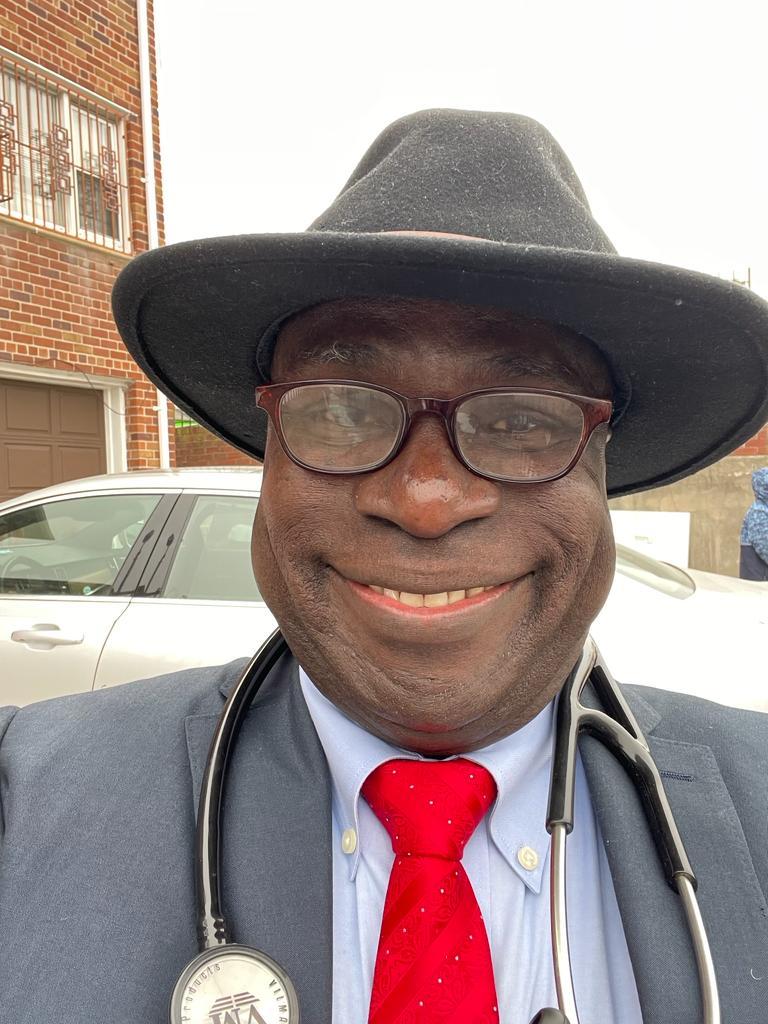
Emmanuel O. Fashakin, M.D., FMCS(Nig), FWACS, FRCS(Ed), FAAFP, Esq.
Attorney at Law & Medical Director,
Abbydek Family Medical Practice, P.C.
Web address:
http://www.abbydek.com
Cell phone: +1-347-217-6175
“Primum non nocere”

Alleviating poverty and human misery

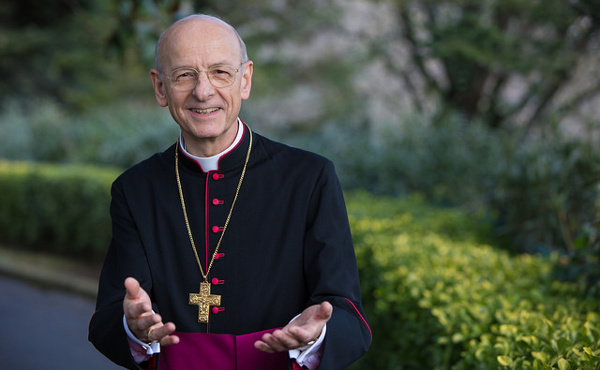
By Fernando Ocáriz,

On the tenth anniversary of Harambee, a social initiative for alleviating poverty and human misery, Bishop Javier Echevarría gave a conference on The Christian Heart, Motor of Social Development.  In light of the social doctrine of the Church and the message of St. Josemaría, Bishop Javier reminded us that the dialogue between Jesus and a doctor of the Law expresses the inseparability of love for God and love for others: “when a doctor of the Law asked him which was the first commandment, the Lord did not limit himself to indicating that love of God is the first and greatest commandment. He included the need to love one’s neighbour in the first commandment (cf. Mt 22:35-39).”

It is important to keep the relational dimension of the person in mind. Benedict XVI, in the encyclical Caritas in veritate, affirms that, “as a spiritual being, the human creature is defined through interpersonal relations. The more authentically he or she lives these relations, the more his or her own personal identity matures.” This reality “requires a deeper critical evaluation of the category of relation” so that “man’s transcendent dignity [can be] properly understood.”

There are many professionals dedicated to caring for and dignifying people, especially the most in need. You know from experience that, although institutions and structures are necessary, to achieve true integral development we need encounters between persons, to create contexts and conditions within which development can take place, to give the person the opportunity to perfect him or herself in all his or her dimensions. As disciples of Jesus Christ, we are called by a new title — “Christian” — to care for people, to care for the world.

What do we see in the world? Together with new possibilities for human development due to advances in healthcare, technology, communications and so many inspiring examples, we see injustices and wounds from which humanity bleeds. “In today’s world, poverty presents many faces: sick and elderly people treated with indifference, the lone­li­ness felt by many abandoned people, the drama of refugees, and the destitution in which a large part of mankind lives, often as a result of injustices that cry out to Heaven.”. As I said in 2017, “we cannot be indifferent to any of these things”; we are all called to exercise ‘the creativity of charity’ in order to bring the balm of God’s tenderness to all our brothers and sisters who are in need.”

When human beings ignore or neglect their condition as children of God, all their relationships are affected: with themselves, with others, and with creation. As Pope Francis has said, interdependence becomes dependence: “we lose this harmony of interdependence and solidarity.” We are jointly responsible for taking care of the world, establishing relationships founded in charity, justice, and respect, especially overcoming the disease of indifference. St. John Paul II wrote: “Yes, every man is his ‘brother’s keeper,’ because God entrusts us to one another.”. Some many social initiatives for assisting the poor began under St. Josemaría’s inspiration. And many people today, moved by the same inspiration, work in organisations of different types and focuses because you felt impelled to “do something,” not to sit still with your arms crossed.

It is at the heart of the spirit of Opus Dei to turn ordinary realities into a place of encounter with God and service to others; it is the aspiration of mature people, professionally competent and sensitive to others, seeking to make the world a more just and fraternal place. “Passionately loving the world” means knowing it, caring for it, and serving it.

St. Josemaría summarised the approach to social needs in a letter published in the 1950s: “Christians cannot be individualists who forget about the needs of others. Nor can Christians live selfishly and turn their backs on the world; they are essentially social, responsible members of Christ’s Mystical Body.”

Hand in hand with the founder of Opus Dei, I will focus on four dimensions for assisting others: spiritual, professional, personal and collective. First, the spiritual dimension. It might seem utopian to think that we are capable of doing something to alleviate the suffering of humanity. However, we know that it is Jesus who bears the burden of human pain. The wounds in his side, on his hands, and on his feet are reminders of the wounds of the world. And Jesus has told us: “Whatever you did for one of these, you did for me.”. The path of identification with Christ transforms the human heart and opens it to charity. Union with the Lord, in the sacraments and in prayer, leads us to discover our neighbour and his needs and to pay less attention to ourselves. Charity changes our gaze. “The charity of Christ is not merely a benevolent sentiment for our neighbour; it is not limited to a penchant for philanthropy. Poured out in our soul by God, charity transforms from within our mind and will. It provides the supernatural foundation for friendship and the joy of doing what is right.” Some time ago, in a letter, I invited people to ask the Lord to enlarge our hearts, to give us a heart that fits Him “so that there enter into it all the needs, pains and sufferings of the men and women of our time, especially the weakest.” A prayerful heart, in the middle of the world, supports and accompanies others in their needs.

Identification with Jesus opens us to others’ needs. At the same time, contact with those in need leads us to Jesus. For this reason, St. Josemaría wrote: “A friend of ours used to say: ‘The poor are my best spiritual book and the main motive of my prayers. It pains me to see them, and in each one of them, Christ. And because it hurts, I realise I love him and love them.’”. Jesus had a predilection for the poor and suffering, but he also wanted to suffer need and to be a victim himself. In the suffering, we glimpse Jesus who speaks to us, as Pope Francis reminded us: “The poor, always and everywhere, evangelise us, because they enable us to discover in new ways the true face of the Father.” From the time of the early Church, it has been understood that the Gospel message is based on concern for the poor and that it is a recognizable sign of Christian identity and an element in its credibility.

Second: professional dimension. We wish to place Christ at the heart of all human activities, sanctifying professional work and the Christian’s ordinary duties. This mission is carried out in the street, in society, especially through work. St. Josemaría reminds us of “the value of their ordinary work, which can be a highly effective means of loving and serving God and others, be it brilliant or lowly from a human point of view.” And he invites everyone “to work in the way they personally see fit to eliminate intolerance and to make society more just.”

For those who wish to follow Christ, all work is an opportunity to serve others, especially the most in need. There are professions in which this social impact is more immediate or evident, as in your case, working in organisations focused on improving the living conditions of disadvantaged people or groups. But this dimension of service is not just for some; it must be present in any honest work. From the time when St. Josemaría began to spread his message, he used to say that, to sanctify the world, it was not necessary to change one’s place, profession, or environment. It is a matter of changing oneself, whatever the place.

Charity and justice converge in the Christian ideal of work. Far from the logic of “success,” service to others is the best criterion for a Christian’s work performance. Satisfying the demands of justice in professional work is a lofty and ambitious goal; fulfilling one’s own obligations is not always easy, and charity always goes further, asking each person to generously go out of him or herself for others.

In the parable of the Good Samaritan, the innkeeper remains in the background: all we are told is that he acted professionally. His conduct reminds us that the exercise of any professional task gives us an opportunity to serve those in need. At times, the temptation to “take refuge in work” could appear, in the sense of not discovering work’s transformative social dimension, conforming ourselves to a false spiritualism. Sanctified work is always a lever for the transformation of the world, and the usual means by which the changes that dignify people’s lives are brought about, so that charity and justice truly permeate all relationships. The work thus accomplished will be able to contribute to purifying the structures of sin, making them into structures within which integral human development is really possible.

Faith helps us to conserve our confidence in the future. As St. Josemaría assured us, “our apostolic work will contribute to peace, to the collaboration of people with each other, to justice, to avoiding war, to avoiding isolation, to avoiding both national and personal selfishness. It will do so because everyone will realize that they are part of the whole great human family, which is directed by God’s will towards perfection. In this way we will help remove the all too common anxiety and fear of a future marked by fratricidal resentments. In addition, we will strengthen in souls and in society peace and harmony: tolerance, understanding, mutual relations, love.”

Third: the personal dimension. The message of Opus Dei urges us to strive for the transformation of the world through work. This also includes having compassion, like the Samaritan, as a requirement of love, which brings the law (“what is required”) to its fullness. Love makes our freedom ever more willing and ready to do good. St. Josemaría wrote, in a letter dated 1942: “The generalization of social remedies for the plagues of suffering or destitution — which make it possible to achieve humanitarian results today that could not have been dreamed of in other times — will never be able to supplant the efficacious tenderness, both human and supernatural, of immediate, personal contact with our neighbour; with this poor person in a neighbourhood nearby, with this sick person living in pain in an immense hospital […].”. We have before us a vast panorama in the family and in society, and a person with a large heart will try earnestly to care for his elderly parents, to give alms, to take an interest in his neighbours’ problems, to pray for a friend overwhelmed with worry, to visit a sick relative in the hospital or at home, to stop and talk to a person he sees regularly who is living on the street, to listen patiently, etcetera, etcetera.

It is not normally a matter of adding new tasks to the ones we already perform; it is rather a matter of trying to manifest, from our own identity, Christ’s love for others. The question of charity is not only about what I have to do but, first, who I am for the other and who the other is for me.

In this daily cultivation of solidarity, we find ourselves with others, and so others’ needs also become a place of encounter between people of good will, Christians or non-Christians alike, united before situations of poverty and injustice. This dialogue with necessity and vulnerability will surely bear fruit in greater sensitivity and a life of prayer close to the reality around us. We will be prepared to make decisions of greater personal austerity, avoiding consumerism, the lure of novelty, luxury… and we will know how to renounce unnecessary goods that, in our professional situation, we could perhaps afford. We will thus be receptive to personal change, to opening our ears to the Holy Spirit and listening to what he tells us through poverty.

Christ’s relationship with those in need is one-on-one. Certainly, collective works are necessary, but charity is personal because our relationship with God is personal. In a mature Christian, the unfolding of the works of mercy lived personally happens organically, like a tree that, as it grows, bears more fruit and shade. From this perspective, one can also perceive the complementarity that exists between the various manifestations of the personal apostolate and generosity with the needy.

St. Josemaría described the social transcendence of personal charity in the middle of the world, referring to the example of the faithful of the early Church. “This is how the first Christians acted. They did not have, due to their supernatural vocation, social or human programs to complete; but they were imbued with a spirit, a conception of life and of the world, that could not fail to have consequences in the society in which they lived.”

Fourth: the collective dimension: I do not want to stop expressing gratitude for the good you do through the initiatives inspired by St. Josemaría, and for those of you who, also inspired by him, work in different organisations that provide direct service to those most in need. I think of that young priest taking care of the poor and the sick in Madrid in the 1930s. The “stone fallen into the lake” has come a long way. Although we are aware of our limitations, we thank God and ask for his help to improve and continue. Collective works keep Christian social sensitivity alive and are a civil and public expression of mercy. As the Compendium of the Social Doctrine of the Church says, “in so many aspects the neighbour to be loved is found ‘in society’” and “to love him on the social level means, depending on the situations, to make use of social mediations to improve his life or to remove social factors that cause his indigence. It is undoubtedly an act of love, the work of mercy by which one responds here and now to a real and impelling need of one’s neighbour, but it is an equally indispensable act of love to strive to organize and structure society so that one’s neighbour will not find himself in poverty, above all when this becomes a situation within which an immense number of people and entire populations must struggle, and when it takes on the proportions of a true worldwide social issue.”

I would like to conclude with more powerful and stimulating words from St. Josemaría: “A man or a society that does not react to suffering and injustice and makes no effort to alleviate them is still distant from the love of Christ’s heart. While Christians enjoy the fullest freedom in finding and applying various solutions to these problems, they should be united in having one and the same desire to serve mankind. Otherwise their Christianity will not be the word and life of Jesus; it will be a fraud, a deception of God and man”.

Monsignor Ocáriz is the Prelate of Opus Dei, an institution of the Catholic Church

Nigeria exists in a world that waits for no nation to get its act together, Somber Tuesday series by Mojúbàolú Olufúnké Okome

#SomberTuesday! The first month of the new year has ended. The elections are almost upon us. Candidates and their proxies make extravagant declarations about their plans to transform Nigeria into a veritable heaven on earth. History shows that these promises may never be fulfilled. Many are even forgotten almost as soon as they are uttered. Our politicians are not famous for being dedicated to fulfilling promises once they become incumbents. They are not even available to the electorate that’s responsible for bringing them into office.

The electorate also must recognize their importance in the political system as civic actors who consistently demand accountability from those they elected. Politicians should embrace public service as a calling that requires sacrificial leadership instead of privileged monopolization of the resources meant for all. Not only must promises be kept, but serious attention must be paid to building a nation where all Nigerians have the opportunity to live to their full potential. Nigeria needs genuine democracy.

We deserve political, economic, and social transformation. Frederick Douglass is right. Power is never conceded without a demand. The masses must demand that their needs are prioritized. In the constant struggle for resources, the masses have to engage in politics as civic actors. They should vote. They should also be involved in the political system throughout the electoral cycle. This means deep involvement, concentrating on the issues, as well as finding and proposing solutions. Civil society should tenaciously insist on accountable government.

Nigeria must create pro-poor coalitions with a long-term outlook and commitment to transforming Nigeria into a great nation. Insecurity should not be normalized. Besides the huge and escalating financial cost, it has become a thriving business for those who derive monetary gains and employment opportunities from the trauma inflicted on fellow citizens. Families of the abducted/kidnapped face the challenges in isolation. Many take huge loans to pay ransoms to kidnappers. Victims, survivors as well as their friends and family also deal with the trauma without any structured psychosocial support.

Internally displaced Nigerians who are victims and survivors of environmental devastation, and manifold conflicts, (from insurgencies to herder-farmer disputes, and ethno-religious struggles) languish in camps that don’t meet their basic human needs, or they depend on the kindness of friends and strangers. It is fortunate that Nigerians are very optimistic people. We must combine our hopefulness with determination to transform our nation in the interest of all our people, and for the benefit of future generations. By doing their jobs with excellence, elected officials can bring the giant of Africa to life. For this to happen, we must create institutions that are fit for purpose and excellent infrastructure.

Nigeria exists in a world that waits for no nation to get its act together. If we want to thrive, we must plan, coordinate, prioritize, and work to rescue our country from the morass of mediocrity. We must be tenacious and unflagging in our determination to create the Nigeria we want. Insecurity, inequality, unemployment, and underemployment, lack of human security and other challenges must end. The EndSARS protesters called on us to recognize that for democracy to thrive, we need good governance, an end to police brutality, impunity, and violence. They were brutally attacked by state security forces. Two years on, #Nigeria must remember a democratic government does not massacre peacefully demonstrating protesters. The #EndSARS protesters at #LekkiTollGate and other locations stood up to be counted. Now it’s time that #NigerianWomenArise #EndPoliceBrutalityinNigeriaNOW #EndSars #EndSWAT #EndImpunity 

Now for my broken record repetition of Howard Zinn’s words to underline their importance to Nigerian politics: “Civil disobedience, that’s not our problem. Our problem is that people are obedient all over the world in the face of poverty and starvation and stupidity, and war, and cruelty. Our problem is that people are obedient while the jails are full of petty thieves, and all the while, the grand thieves are running the country. That’s our problem.”

Let the kleptocrats give back our stolen wealth so that we can fix our infrastructure, schools, hospitals, and also offer worthwhile social protection to our people.

Let the masses enjoy the full benefits of citizenship in Nigeria. Let the leaders and political class repent and build peace with justice. This is no time for politics as usual. The people elected should be those trusted to bring justice, equity and human security to the entire country, not expedient, unethical, and egocentric individuals determined to dominate for self-aggrandizement or sectional gain. We don’t need oligarchs’ continued domination. We also need a government that puts the interests of majority of citizens first.

Prof. Mojúbàolú Olufúnké Okome is a professor of political science at Brooklyn College in New York.

Discarded, thrown into a refuse bin at birth, he rose to become a top Nigerian journalist

By Lillian Okenwa

His story sounds like Tales by Moonlight. If Aunty Nkem of then Children’s TV show ‘Tales by Moonlight’, or Jimi Solanke of ‘Story Land’ fame, were to have recounted this story, many would have excitedly lapped up their thrilling and animatedly delivered fiction. But as James Hardly Chase would say, This is for Real!

At the time of his delivery at Igbotu town in Ese-Odo local government area of Ondo State, there was no maternity home or any medical facility to attend to the expectant mother and so she laboured for eight days. Traditional birth attendants, Christian, and Muslim clerics were contacted to at least, save the mother’s life. It was a life-threatening labour. Eventually, everybody gave up on both mother and baby.

She finally gave birth on November 23, 1959, but the baby did not cry. He was as lifeless as ever and everyone became convinced it was a stillbirth. So much for eight days of labour! Left with no other option, one of the many attendants placed him in a basket, took him to a refuse dump, and deposited him there. That was when the miracle began.

Twenty minutes after he had been deposited into the waste bin, an old woman identified as Iya Pupa arrived on the scene. On inquiring about the baby, she was told it was a stillbirth and had been discarded in a refuse bin. Iya insisted on being taken to the refuse dump where the ‘corpse’ was deposited. At the time they got there, an army of ants and other insects had covered and begun feasting on the body.

However, the very observant Iya Pupa, noticed that the boy was breathing faintly and proceeded to lift him up. Then she felt the warmth of his body. Promptly, she sent for sand and a certain herb from a nearby stream which she used to scrub the baby’s body. indeed Gbenga Onayiga is a survivour.

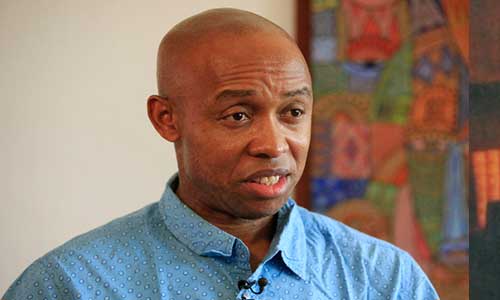
A retired Director of the Federal Radio Corporation of Nigeria (FRCN), Otunba Gbenga Onayiga who never ceases to be thankful for every moment is now 63 years old. The former Vice President of the Nigeria Union of Journalists (NUJ) spent 34 years in journalism. In 1996, he was the Chief Press Secretary to the Minister of Petroleum Resources.

“I am a child of glory and destiny”, he says.  “I found favour in God and men. My bosses and colleagues took interest in me and they encouraged me, notwithstanding the challenges I encountered along the way. Indeed, I have told some friends that I will like to remain a journalist if I happen to come to the world again.”

Onayiga now a grandfather is a graduate of the Nigerian Institute of Journalism (NIJ), Lagos, and holds a Bachelor’s degree in Journalism. He also holds a Degree in Political Science from the University of Abuja.

The veteran journalist has equally attended courses in Journalism and Public Relations at reputable institutions in the United Kingdom and in the United States.

TIPS