Home Blog Page 800

Stop staring in the rear-view mirror

By Afam Osigwe

“A wise lawyer who wants to be successful in the business or practice of law people must admit his/her shortcomings. He/she should not be afraid to say, ‘I don’t know. I need to know. I need help. I cannot do it alone etc.’  You should not be afraid or detest the need to learn. Always make out time to improve yourself. Continually develop yourself. Avoid being complacent or thinking there is no further to learn. You will be shocked at how much you do not know.”

Reckoning with the past in order to build a better future, purely emphasises the importance of the past in planning for the future. Past, present, and future are encompassed in the concept of time. In math, time can be defined as an ongoing and continuous sequence of events that occur in succession, from past through the present, and to the future. Time is therefore “a measure of non-stop, consistent change in our surroundings, usually from a specific viewpoint”. Thus, our present used to be the future, while the past used to be the present. The future can only be actualised in the present.

According to Prof Ian Thompson “In our everyday and common-sense understanding of time, the future is different from the past in a number of ways: (1) we have memory of the past but not of the future, (2) we think we can change the future, but not the past, (3) we feel that in the present we are performing new actions that add to the past but not to the future, and (4) the future contains possibilities in a way that the past does not”.

Life can only be understood backwards; but it must be lived forwards.

In a paper I presented at the tenth-year anniversary of the NBA Gwagwalada Branch I quoted Soren Kierkegaard who said that “Life can only be understood backwards; but it must be lived forwards.” With respect to each individual lawyer, the past, obviously, is the person’s background, experiences, and history. It encapsulates one’s journey to the present: where one is coming from, one’s travails, setbacks, failures, disappointments, hopes, triumphs, and celebrations. Some of the issues that may have shaped each person’s history may not always be pleasant or worthy of remembrance or celebration. Some may indeed have been traumatic, yet one dares to plan, dream and hope for a better and glorious future.

Indeed, as Israelmore Ayivor once said “Leaders build the future with clays of the past. Every good moment gives them ideas; every bad moment gives them lessons.” This shows the foresight and initiative of the organisers of this event who in recognition of the role young lawyers have to play in the future development of the legal profession have made an excellent decision with today’s topic: Legal profession: reckoning with the past for a better future. You no doubt have a mind to build a glorious future with the clays of the past. Thus, you have chosen not to be fixated with the past in building a better but to reckon with it (the past). In other words, you are very mindful that in building a better future you include the past in your consideration or planning.

At every point you plan for the future, you must always remind yourself of the wise saying that “you cannot move forward if you are staring in the rear-view mirror”. While not suggesting that we must forget the past, it simply means that the past is gone. You cannot keep your gaze on the past. You must take account of the past in working to overcome the challenges, failures, obstacles, etc one may have experienced. Thus, lessons learnt from our past, strengthen us to achieve more in the present.

The past should not be an excuse not to plan or move forward, nor should it be a restraint. The past has happened and cannot be undone. According to Dr. Luke Iorio, “Decisions and actions that have already occurred are gone. Finished. Never to be experienced again. We can revel in the glow of our achievements or wallow in our perceived misgivings, but they are now, for all intent and purposes, simply a memory. Essentially, nothing ever truly happens “in the future.” Our deeds and actions only occur in the present”.

To properly address this topic, it is important to understand it topic requires a journey down the memory lane of the legal profession, during which we evaluate how far we have come, recognise the tremendous growth of the bar, and definitely appreciate every effort that has been geared towards the positive development of the bar. Beyond the positives, we also have to identify our flaws, failures, and instances where we just need to do a little more or act better to get the desired result. As soon as we are able to identify the positives and negatives, in our quest for a better future, we get to build on it and learn from the positives, while the lessons from the negatives will serve as a guide. We can take an affirmative action towards securing a better future for the Bar.

In an attempt to travel down the memory lane of the legal profession, and evaluate how far we have come, the following metrics come to mind:

i. Training and development of Lawyers

ii. Administration of justice

iii. The role of the Bar in national development

iv. The adoption of ICT and modern technology

v. The Social economic welfare of the Bar etc

The Legal Practitioner

This discussion will be meaningless to us as lawyers if we fail to understand how we can use of our legal training to build a better future. Lawyers like priests are ‘called”. Lawyers are called to the Bar. At a time of economic recession, the way out is the entrepreneurial revolution. It may well be that a well-reasoned discourse of the topic will make the difference in whether many of us are able to ‘survive’ the present economic situation and also build our practice to an enviable position or build a greater future wherever and in whatever lawful venture we find ourselves. Any lawyer who fails to realise the importance of his training will be left behind.

Bellas & Wachowski observed that the rest of the world is preparing to move ahead with or without us. According to them “The marketplace has already recognized the legal practice as a business and is proceeding accordingly. In fact, the entire legal field is viewed by many Venture Capitalists as fertile grounds for investment opportunities, but not necessarily by investing in law firms. Instead, Venture Capitalists (who are not interested in whether or not they are part of a profession but are interested in making money) are throwing hundreds of millions of dollars at legal technology startups. The commoditization of the practice is already well underway. If you are curious about the inevitable outcome of this juggernaut, ask your doctor how his life has changed. In this rapidly evolving environment, I hope we can agree that simply doing a great job for your existing clients is not going to be enough. If you expect to compete with the legal services companies that are growing under your nose, it’s time to get in the game as a business manager. And there are plenty of resources available”.

Change is inevitable and may happen very fast

This century there will be more focus on technology, modernisation, new ways of doing things, emotional intelligence, client/customer focus, and the ability to flex and adapt to the raft of technological changes that will come while government departments, firms, legal practitioners, etc explore various platforms to meet the new demands of their employers, clients, etc. We will also see more departments, ministries, law firms, employers, employees, etc endorse flexible working arrangements and work/life balance which is good news for future lawyers who will hopefully be able to balance their home life with work in a way that the legal industry has rarely seen.

Life and in particular legal practice have indeed changed from what they used to be. In the 80s, Ferris Bueller said, “Life moves pretty fast….” What would he say now? Mark A. Cohen highlights how much legal services industry has changed when he said that, “Life is moving very fast, propelled by the speed and breadth of change. Legal industry change is generally viewed through the narrow lens of the profession. Lawyers have long controlled all facets of the industry—education, training, delivery of self-proclaimed “legal services,” the judicial process, and regulation. They have also scripted the industry narrative. That’s changing—business is recasting the culture, mindset, role, remit, and purpose of the legal function. Lawyers are a segment of an increasingly diverse, tech-enabled, data-backed, fit-for-customer/business purpose legal function”.

Change is therefore inevitable. In reckoning with the past we must therefore ensure we focus on how to meet new challenges and be better equipped to offer our services to the fast-changing needs of clients and society. In whatever way we carry on the practice of law, we must look at things the right way. We should always endeavour to do justice and serve clients when they come to us. Sure, we deserve to be well paid for the services we render to them as well as the value we obtain for them when we help them resolve such disputes or minister to their needs. “But if we can serve them well, we are satisfying our own professional calling. And—simply being blunt—most of those that have problems now that require a lawyer will have problems later that require a lawyer. Serve the client well and he very well may be back when you can resolve the dispute quickly. Law firm managers must be smart businesspeople. But we always need to keep in mind that we are more than that. We’re lawyers, too, and need to act like lawyers every day ”. The above statement is equally true of lawyers who are in various forms of salaried employment.

Some of the challenges of the 21st century are

a. Conflict and war.

b. Poverty

c. Corruption

d. Climate change and environmental challenges

e. Socio-economic challenges

f. Increasing inequality of wealth and income.

g. Emptiness of vision and foresight.

h. Identities and changing norms in society. …

i. Changing economic powers

j. Technological disruption

k. Civic disaffection.

l. Globalisation

These challenges will no doubt affect the ability of legal practitioners to effectively render services. The legal profession cannot pretend to be insulated from challenges. It is a good time not only to look at the challenges of practicing our profession in whatever way we have chosen but also to ask ourselves whether our practice of law is done with a right business mindset. Some particular tests faced by lawyers in the 21st century include: poor remuneration, high expectation of the society, lack of skills in information technology, insufficient job opportunities, nature of legal practice in Nigeria, lack of personal motivation, lack of adequate entrepreneurial skills, inflexible work environment, location, poor labour practices, etc

Like other human beings lawyers hate changing the way they do things. Very few people like change, some tolerate it and must fight to stop it. The lawyer will need to learn to adapt, envisage and even engineer some change in this dispensation if we must stay relevant. We have to study, take courses, travel and interact, be open-minded and learn, unlearn and reinvent ourselves to fit into the new world. The court processes need to be digitalized’, The Covid-19 lockdown showed us how greatly inadequate the current system of doing things is in event of another pandemic. Covid-19 will always be a reminder of how small and very connected the world really is.

Nothing ever truly happens in the future

Everything happens in the present. Whatever plans you make for the future can only be achieved in the present. We transit from the future to the past through the present. Every plan, dream, and hope we have about the future is only achieved in the present. The past may provide you with a guide and experiences of how to achieve your plans in the present. To achieve your plans for the future in the present, you must admit any shortcomings and constantly strive to improve yourselves.

A wise lawyer who wants to be successful in the business or practice of law people must admit his/her shortcomings. He/she should not be afraid to say, “I don’t know. I need to know. I need help. I cannot do it alone etc” You should not be afraid or detest the need to learn. Always make out time to improve yourself. Continually develop yourself. Avoid being complacent or thinking there is no further to learn. You will be shocked at how much you do not know. You will be surprised at the changes and innovations that have been introduced in the law as well as areas of practice.

As Gerber wrote: “Contrary to popular belief, my experience has shown me that the people who are exceptionally good in business aren’t so because of what they know but because of their insatiable need to know more.”

To be good at this business of law, we must admit that we don’t know everything and to be not only okay with it, but embrace the unknowingness. What are the important elements for people who start a business based on the skills they do best, such as practicing law? I will extensively share Janice Brown’s view as contained in the article under reference.

Vision/Goals: Having a vision for your business and managing your resources to meet that vision is paramount. It means writing your vision down. It means determining who your firm serves. It means deciding what kind of employee will fit that vision and deciding what makes an ideal client. It means asking questions such as, where do you see yourself in a year? In two? In five? How do you keep current? How much money do you want to earn? Do you have a budget to help your firm meet your vision? What services do you provide? Should you update your services? Should you eliminate services? How do you market your business? Does your website represent your firm?

Organization And Management; Sometimes those of us in the law profession can be our own worst enemy when it comes to handling our own legal affairs. Who is your accountant? Do you need to file a trademark? Who are your employees? How are they being paid? Are you paying them in compliance with the law? Do you have pertinent policies and procedures in place? Your administration reflects the tools and people you have in place to effectuate your management vision and plan. They require constant attention.

Finances: Profitability is the ultimate goal of any successful business, and how to earn that profit takes some planning. How much do you want to make and why? How much do you want to invest? Where should you invest in your practice? How much do you want to save? How often do you pay your bills? How do you ensure the sustainability? Are you current? Do people owe you money? Should you hire an accountant to make sure your bills are paid on time?

Marketing: Marketing or advertisement is entirely forbidden by the Rules of Professional Conduct. Rule 39 RPC forbids advertisement through circulars, handbills, advertisement, through touts or by personal communication or interview; furnishing, permitting, or inspiring newspaper, radio, or television comments in relation to his practice of the law; procuring his photograph to be published in connection with the matter in which he has been or is engaged, or concerning the manner of their conduct, the magnitude of the interest involved or the importance of the lawyer’s position; permitting or inspiring sound recording in relation to his practice of law; or such similar self-aggrandisement.

The Rule does not however preclude a lawyer from publishing in a reputable law list or Law Directory, a brief biographical or informative data of himself, including all or any of the following matters his name or names of his professional association; his address, telephone number, telex number, e-mail address, etc; the school, colleges, or other institutions attended with dates of graduation, degree, and other educational or academic qualifications or distinctions; date and place of birth and admission to practice law; any public or quasi-public office, post of honour, legal authority, etc; (f) any legal teaching position ; (g) any national Honours ; membership and office in the Bar Association and duties thereon; and any position held in legal scientific societies.

You can write letters which include your firm profile to banks, corporations, companies, etc for enlistment as external solicitors as such marketing creates the customer expectation for your business. Marketing can come in many forms, including volunteer work in the community or legal aid. You can promote your brand through your website, a newsletter, legal articles, paper presentations, workshops, seminars, etc. Embrace technology.

Sales: Janice Brown, notes that sales and marketing are not the same thing. We should not confuse the two. She states that “Marketing is a subset of sales. Sales require the client to trust you, understand your service (or your brand) and have a need for your services. When need, brand, and trust come together—you get paying customers. But you need to define what kind of customer you want by defining the right client. When I started my law practice, I said I wanted clients, but I did not specify the type of client. Now, I do. I want clients who appreciate my firm’s services and who pay in a timely manner. That small change in focus has done wonders for my bottom line. As a side note, as lawyers, we are required to have engagement letters when we are retained. This must be mandatory. No executed engagement letter, no services”.

Production: If you do not produce, you do not get paid. And when you first launch your business, you need to produce if you want to build your reputation. How much you want to produce needs to be determined at the outset.

Quality Control: We need to constantly ask clients how we are doing. How can we improve? How can we become better at our work? As human beings, we often learn from our mistakes. When those breakdowns occur, clarify why they happened and what you will do differently so it doesn’t happen again. The old adage “stuff happens” is not in the language of successful folks”.

To successfully run a practice like a business, one must be an entrepreneur who acts ethically at all times and refuse to allow the urge to run a profitable practice to enmesh him or her in unethical conduct.

Preparing for the Future

“Most people talk; we do things. They plan; we achieve. They hesitate; we move ahead. We are living proof that when human beings have the courage and commitment to transform a dream into reality, there is nothing that can stop them .”

Many of us are content to do the same thing over and over again whether or not we get the desired result. Yet some of us are afraid of moving out of our comfort zone. Many persons are contented to leave things where they are. If conceivably, they fail and become unsuccessful, they blame it on evil persons or malevolent forces. Of course, it is not their fault. It must have come from their village or their enemies. According to John C. Maxwell, unsuccessful persons are burdened by learning and prefer to walk down familiar paths. He further stated that their distaste for learning stunts their growth and limits their influence. These persons do not plan, they live for the day, they do not improve themselves, they have a disdain for advice, are sometimes set in their ways, spend all they earn, hate exploring new opportunities or venturing into uncharted territories.

To prepare for the future, you must dream creatively of what you want to achieve, what you want to do, what you want to be and where you want to be. According to Norman Vincent Peale, the use of the word ‘dream’ “is not the reference to those shadowy images that flicker through our minds when we are asleep. No, dreams I’m writing about are the indistinct hopes, the far-off visions, the first faint stirrings of the imagination that comes when we are in the earliest stages of planning something worthwhile”.

Continuing, he stated that “there’s a wonderful thing about such dreams. In some uncanny ways that no one fully understands they seem to contain the seeds of their own fulfilment. If you dream something long enough and hard enough, a door seems to open and through that door come mighty forces that will guide and support you in your efforts to make the dream come through”.

To prepare for the future, we must identify our goals (dreams) and make plans on how to achieve these dreams. We must not overlook opportunities. As William Shakespeare, said, “There is a tide in the affairs of men, which taken at the flood, leads on to fortune. Omitted, all the voyage of their life is bound in shallows and in miseries. On such a full sea are we now afloat. And we must take the current when it serves, or lose our ventures”.

It is reported that the founder of Dubai, Sheikh Rashid, was once asked about the future of his country and he replied, “My grandfather rode a camel, my father rode a camel, I ride a Mercedes, my son rides a Land Rover, and my grandson is going to ride a Land Rover…but my great-grandson is going to have to ride a camel again.” Why is that, he was asked. And his reply was, “Hard times create strong men, strong men create easy times. Easy times create weak men, weak men create difficult times. Many will not understand it, but you have to raise warriors, not parasites.”

A similar quote “tough times create strong men, strong men create easy times” can be found in the 2016 post-apocalyptic novel “Those Who Remain”, by G. Michael Hopf. The quote reads: “Hard times create strong men, strong men create good times, good times create weak men and weak men create hard times.”

It is a historical reality that all great empires, the Persians, the Trojans, the Egyptians, the Greeks, the Romans, and in later years, the British all rose and perished within 240 years. They were not conquered by external enemies; they rotted from within. A good example of how a system will rot within can be illustrated with water intrusion which can ruin a house. Sometimes, water seepage arising from poor plumbing or faulty construction can allow water to seep into a home. Mold will begin to develop, almost from day one. It will be impossible to see immediately, but it is there. Building experts, blame the problems on rushed work, poor workmanship, under-trained workers, low-quality materials, and little to no oversight by the construction company management.

Therefore in trying to avoid, going back to riding a camel and ensuring that water intrusion does not damage our home, we have to plough everything we have and more into planning and development. I will therefore suggest these tips on to prepare for the future:

Be confident

Be open to feedbacks from your colleagues and superiors

Upgrade your existing knowledge from time to time

If there is a way to do it better, find it.

Be open to challenges. Do not be afraid to take risks in life

Master the skill of time management.

Learn to work as a team player.

Develop a positive attitude

Keep searching until you find what you want.

Trust is earned when actions meet words.

Slow down so you can speed up (Festina lente – “make haste slowly”, sometimes rendered in English as “more haste, less speed).

Conclusion

It would be important for legal practitioners who have not made the commitment to run and or manage it as one, to do so today. We may hate the idea of developing a business plan/concept, but we should realize that making a strategic plan allows a lawyer or the firm to plan for the future. Let us, therefore, make sure that expectations are reasonable. No matter how well intended, if they are unreasonable, expectations will not be met

Thanks for listening

Mazi Afam Osigwe, SAN

January 26, 2023

Read the full text here.

AFAM-OSIGWE-LECTURE

Seven habits/attributes of a successful/effective lawyer in Nigeria

“You can’t go it alone if you want to establish a fruitful and fulfilling career as a lawyer. Instead, staying connected to a robust network of your peers and definitely, your seniors will help you have an edge in the field. Your network can give you advice, direct you to helpful resources, and even help you land new clients. Almost anyone you meet can be a possible connection.” – Kayode Ajulo

By Kayode Ajulo
I don’t know if this truth is popular or not, but I know it for a fact, through diligent studying, careful observation, and detailed experience that you can’t go it alone if you want to establish a fruitful and fulfilling career as a lawyer.
Instead, staying connected to a robust network of your peers and definitely your seniors will help you have an edge in the field. Your network can give you advice, direct you to helpful resources, and even help you land new clients.
Almost anyone you meet can be a possible connection.
I am humbled and momentously surprised to have been bestowed the honour of delivering this speech at this august gathering. It is not an honour I take very lightly.
The topic I have been assigned to discuss is “the Seven Habits of a Successful Lawyer”. A topic which in itself presupposes that the person chosen to deliver it, is a successful lawyer! It is however my humble opinion that there are in this venerable body, in this esteemed company, many eminent lawyers and jurists who are much more qualified than my humble self, Kayode Ajulo, to mount this rostrum to do justice to this topic.
I am more than humbled by this honour and in accepting it, I stand upon the great and noble shoulders of those eminent men and I can only hope that by the time we are done, those solid and powerful shoulders upon which I stand would not have carried me in vain.
Let me quickly recognise those great and successful giants of our trade that the Akure Bar has been blessed with; Ifedayo Adedipe, SAN, Eyitayo Jegede, SAN, Olagoke Fakunle, SAN, Niyi Adegbonmire, SAN, Dr. Olatunji Abayomi, I.O.A Olorunfemi, Banjo Aiyenakin, and many others whose indulgence I crave to proceed.
Again, since the leadership of the Akure Bar has insisted that I present this speech, I crave the indulgence of all who is present to only listen to the message and discountenance any perceived inadequacies of the messenger.
As a lawyer, whenever one is privileged to deliver a speech, it is expected that one would speak from the position of knowledge and authority. And how does a lawyer get this knowledge and authority? It is usually from books. For example, if one is going to talk about Evidence, it is expected that one should read the Evidence Act, legislations, court decisions and books from great jurists who have espoused knowledge in the course over the years.
However, because of the peculiarity of this topic there would be no need to research on any statute or laws as all that needs be said must be from one’s experience gathered over the course of one’s practice as well as the examples laid by legal giants over the years. (Now you would understand my insistence that my noble seniors are much more qualified than myself!)
For the above reason, our authority therefore would be to a larger extent the styles and practice of the illustrious names I have earlier mentioned and many others. To fully and adequately deal with this topic therefore, it would make sense and would probably be downright unforgivable if one fails to mention the heroes past of this noble profession of ours; titans who achieved great success like FRA Williams, SAN, Richard Akinjide, SAN, G.O.K Ajayi, SAN, Ibrahim Abdulahi, SAN, Philip Umeadi, SAN, Okeaya-Inneh, SAN, Ajibola Ige, SAN, Bankole Aluko, SAN, Chike Chigbue, SAN, Gani Fawehinmi, SAN, Miskom Pueppet and a host of others, all of blessed memory.
Likewise, there are heroes present like Folake Sholanke, SAN, Afe Babalola, SAN, Ebun Sofunde, SAN, Gboyega Awomolo, SAN, Ebun Shofunde, SAN, Wole Olanipekun, SAN, Adegboyega Awomolo, SAN, J. B. Daudu, SAN, Lateef Fagbemi, SAN, Kanu Agabi, SAN, Oluwarotimi Akeredolu, J. K. Gadzama, SAN, E. C. Ukala, SAN, Yunus Ustaz Usman, SAN, Adetokunbo Kayode, SAN, Adeniyi Akintola, SAN, D. D. Dodo, SAN, Prof. Yemi Osinbajo, SAN, Wale Babalakin, SAN, Emeka Ngige, SAN, K. T. Turaki, SAN, Chris Uche, SAN, Ajibola Aribisala, SAN, P. N. Ikwueto, SAN, Ifedayo Adedipe, SAN, Dr. Onyechi Ikpeazu, SAN, Mike Ozekhome, SAN, SAM Ologunorisa, SAN, J. S. Okutepa, SAN, Dayo Akinlaja, SAN, Prof Akinseye-George, SAN, Mahmud Magaji, SAN, Femi Falana, SAN, Olumuyiwa Akinboro, SAN, Dame Priscilla Kuye, Dr. Olatunji Abayomi etc. These eminent personalities are those whose lifestyles and work ethics one should study if one is to become an effective lawyer.
Without sounding immodest, I must give myself a pass mark because of all these great names I have reeled out; I have made it a point to have good relationships with many of them either directly or indirectly. Some of them are my direct mentors, while some are indirect mentors because even from a distance at times, I have taken pains to watch and learn from them. I am also fortunate to have started my practice at the Federal Ministry of Justice which indisputably is the largest law office in the whole of Africa whereat I was quite lucky to have interacted with the best lawyers, which has aided my training in the profession.
My brief is to interrogate the station of a lawyer, and with respect, not just any lawyer but a successful lawyer and the habits that characterize the life of such a lawyer, The Cambridge Dictionary defines “habits” as something that one does often and regularly, sometimes, something done so routinely that it even borders on the unconscious.
Let me state at this juncture that the legal profession is one of the most prestigious professions in the world and although in the strict sense of the word, practicing Law encapsulates more than just litigation, as it expands to cover areas such as Corporate & Commercial, Oil & Gas, Investment & Finance, Real Estates and the likes. However for the purpose of this presentation, the focal point must be in tandem with the general circumstance of Akure Bar, the legal practice that involves litigation and Court proceedings.
With your kind permission, I would like to rephrase our topic of discussion and say that we should not be talking about being a successful lawyer, but rather an effective lawyer because an effective lawyer will, in due course, be a successful one.
Success is quite relative. And success is not a destination; it is a journey, a process. What one lawyer considers as success might be radically different from what another considers as success. For example, the idea of success to Eyitayo Jegede, SAN might be when he becomes Governor of Ondo State, while to another lawyer, it might be attaining the rank of a Senior Advocate of Nigeria.
It is therefore best to talk about an effective lawyer, because effectiveness will keep you focused on characters required for utmost and quality productivity. And, to be effective is to be successful in producing a desired or intended result.
Becoming an effective lawyer in the profession may be quite an uphill task. It takes only a person who knows the secrets, qualities and skills required of a lawyer to become effective. The skills a lawyer needs for an ideal career are things he must be deliberate and intentional in working upon and diligently develop over time. As they say, practice makes perfect, and dedication makes dreams come true.
In my limited and humble experience, below are seven highly recommended habits a lawyer must possess if he aspires to be an effective attorney. I have however not listed them in any particular order of importance, as they are all important for an effective legal career.
GOOD COMMUNICATION;
Theo Gold, an author said “Communication is your ticket to success if you pay attention and learn to do it effectively.” He further added that, “communication is one of the major keys to success. When one is able to communicate their position, their plan or their ideas effectively, one is able to achieve much more.”
I am sure we have all heard the popular saying that “language is the major tool of a lawyer”. There is no gainsaying that an ability to communicate clearly and unambiguously is a must-have skill for every lawyer. And this vital skill can be developed by engaging in public speaking.
A renowned Human Rights Activist and learned Silk is an example of a great orator with the ability to argue convincingly in the courtroom, even when he has a seemingly bad case. Frankly speaking, the way you communicate as a lawyer will go a long way to tell what you are capable of doing.
Additionally, in this era of front loading processes, lawyers must also be able to write clearly, persuasively and concisely, as they must produce a variety of legal arguments backed by legal documents. To be able to analyse what clients tell them or follow a complex testimony, a lawyer must possess good listening skills.
A lawyer will also have to convey important ideas in a variety of environments and settings, such as: private conversations, informal emails, phone calls, conference meetings, etc. This makes communication skill one of the most important habits a lawyer must cultivate if he really desires to get to the top of the legal profession.
Therefore, whatever means you have chosen to communicate, as a lawyer who wants to be successful, you must do it effectively.
DILIGENCE AND PERSEVERANCE;
“Diligence is the mother of good fortune, and idleness, its opposite, never brought a man to the goal of any of his best wishes.” “He who labors diligently need never despair; for all things are accomplished by diligence and labor.”
Therefore, another non-negotiable quality of an effective lawyer is diligence. Diligence is the combination of hard work and consistency. To become an effective lawyer, you must not lack this quality because it takes time for a young lawyer to be noticed. An Indian Judge said that “the success of a lawyer depends upon himself”. And, just as Walter Elliot put it, and as similar to success “Perseverance is not a long race; it is many short races one after the other.”
Even studying to become a lawyer takes a great deal of perseverance and commitment – and that’s before you even start work.
When working on a case, you must be diligent and have the perseverance to complete a quality work, necessary to drive the case to a successful finish. Chief Afe Babalola, SAN, comes to mind when talking about a diligent lawyer who spends enough time on a legal problem until he finds a convincing solution.
This is not a profession for lazy people who wants to win without putting in the required works. Even the Good Book says “Seeth thou a man diligent in his ways, he shall dine with kings and not mean men”! What more can one add?
ANALYTICAL THINKING
Allow me to read this words of an educator, Neil Postman, to you on analytical thinking. He was, though, taking to readers but this cannot be truer for lawyers because it is what an effective lawyer should be.
“To engage the written word means to follow a line of thought, which requires considerable powers of classifying, inference-making and reasoning. It means to uncover lies, confusions, and overgeneralizations, to detect abuses of logic and common sense. It also means to weigh ideas, to compare and contrast assertions, to connect one generalization to another. To accomplish this, one must achieve a certain distance from the words themselves, which is, in fact, encouraged by the isolated and impersonal text. That is why a good reader does not cheer an apt sentence or pause to applaud even an inspired paragraph. Analytic thought is too busy for that, and too detached.”
This is simply to tell you that an effective lawyer cannot be lazy with his mind because the fate of many individuals (life and death, win or loss) depends on his thoughts. To win as a lawyer, your analytical skills must be top notch.
Reading large amounts of information, absorbing facts and figures, analysing material and distilling it into something manageable is a feature of an effective law career. Being able to identify what is relevant out of a mass of information and explain it clearly and concisely is vital.
At times, there will be more than one reasonable conclusion or more than one precedent applicable to resolving a situation. An effective lawyer must therefore have the evaluative skills in order to choose which is the most suitable. This skill can be honed by taking large documents or long news articles and making bullet points of the most important themes.
CLEAR SENSE OF JUDGEMENT;
To become a successful lawyer, the habit of drawing reasonable, logical conclusions or assumptions from limited information is essential. You must also be able to consider these judgments critically, so that you can anticipate potential areas of weakness in your argument that must be fortified against.
Similarly, you must be able to spot points of weakness in an opposition’s argument. Decisiveness is also a part of judgment. There will be a lot of important judgment calls to make and little time for sitting on the fence.
This is the point where the emphasis on the analytical skills comes in. It is where your must be able to combine clear, undiluted and and deep instinct with relevant knowledge and experience to form opinions and make convincing decisions. You must be able to deploy this at an unconscious level to produce an insight or recognize a pattern that others overlook.
And let me state that what can guide you here is the value you are set to give and the goal you are set to achieve. Once you keep these two in mind, your sense of reasonable judgement will come to life.
RESEARCH ;
Two things that I love most about research are captured in the followings quotes.
“Research is formalized curiosity, it is poking and prying with a purpose.” says Zora Neale Hurston.
And according to Albert Szent-Gyorgyi, “Research is to see what everybody else has seen, and to think what nobody else has thought.”
Diligent and efficient researches also play a huge role in a lawyer’s day-to-day job. This gives an inkling to whatever situation a lawyer finds himself and also helps to activate other necessary requirements to deploy when faced with a situation. Research is unavoidably important especially when doing the background work on a case, drafting legal documents and advising clients on complicated issues.
In the same vein, being able to research quickly and effectively is essential to understanding your clients, their needs, and to preparing legal strategies. In fact, what differentiates a good lawyer from a bad lawyer is the level of research they put into their work.
PRO-PEOPLE;
I don’t know if this truth is popular or not, but I know it for a fact, through diligent studying, careful observation and detailed experience that you can’t go it alone if you want to establish a fruitful and fulfilling career as a lawyer.
Instead, staying connected to a robust network of your peers and definitely your seniors will help you have an edge in the field. Your network can give you advice, direct you to helpful resources, and even help you land new clients.
Almost anyone you meet can be a possible connection. From your law school classmates to your former clients, every professional you interact with can potentially provide insights, resources, and opportunities that could make a substantial difference in your career.
Law is not an abstract practice. Irrelevant of how well someone does academically, at the end of the day lawyers work with people, on behalf of people, and the decisions that are made affect people’s lives. They must be personable, persuasive and able to read others. In doing this, a lawyer in this present time must be conversant with the use of technology, particularly the social media as an effective tool for great networking.
CREATIVITY;
In one of my researches on the importance of being a creative lawyer, I read this statement and I found it appropriate to introduce this last habit I want to share.
“Law isn’t always seen through a creative lens, especially when compared to more artistic sectors. It’s often perceived as rigid, academic, and perhaps a little dry. Law may be built on precedent, but the profession is ripe for change and is ready for an injection of all-important creativity.”
Sincerely, many people may think that the legal profession provides little outlet for an individual’s creative talent but this isn’t the case. No matter what aspect of the legal profession you choose, you will frequently have to think outside the box to get the job done.
The very top lawyers are not only logical and analytical, but they display a great deal of creativity in problem-solving. The best solution is not always the most obvious and in order to outmanoeuvre your challenger. It is often necessary to think outside the box.
In actual fact, creativity is highly sought after by clients, even if it remains somewhat unacknowledged by most within this legal profession.
Who is then being creative if not a lawyer, who can read a sentence and interpret it in many parts to give various logically convincing conclusions?
Effective lawyers understand the importance of flexibility and creativity. Innovation is vital when developing effective solutions, but it also allows you to serve your clients better by discovering cost-effective and efficient processes.
CONCLUSION;
The great scientist, Sir Isaac Newton, said that “If I have seen further, it is by standing on the shoulders of giants.” Again, I implore any one that aspires to be an effective lawyer to study the lives of great lawyers not only in Akure Bar, but across the country. Listen to them. Read their books. And when the knowledge gleaned from studying their lives is combined with the seven habits enumerated above, such lawyer is on his way to becoming an effective lawyer.
Above all of these above mentioned habits, there is a G-Factor that I have observed working for every effective lawyer, even for these great ones I mentioned in this lecture.
Irrespective of your religion or belief, there should be an acknowledgement of a supreme being that has your back because there are many who have mastered the above stated habits as part of their daily living for decades but still struggle to call themselves successful.
Though, there is public acknowledgment of this notion in Islam, Christiandom and African Traditional Beliefs, I can bet that it does get to a point that even an atheist, in the corner of his heart, strongly desires to experience the guidance of a dimension that is higher than what he knows when his personal ability fails. That is nothing but a humble acknowledgement of a higher level-The God factor.
This I recommend highly to you as you sing the popular Yoruba gospel song to the Supreme One with me. He is the X-factor of my existence, my G-factor of whom I can say that if you walk with Him in faith, the world will hear the best of you:
“Gbemi Soke, gbemi dide
Fami lọwọ soke, ki n ga jù ayé lọ
Ògo ayé mi, jẹ kó yọ jáde
Fami lọwọ soke,
má ma jẹ kó pẹ”
Thank you for listening.

26th January, 2023.
DR. OLUKAYODE AJULO, FCIArb [UK] CASTLE OF LAW, NIGERIA.
+234 (0) 803 315 4349
[email protected]
www.castleoflaw.com
*A Capacity Building Lecture delivered at Monthly General Meeting of Nigeria Bar Association, Akure Branch on Thursday, 26th January, 2023.

The President we all need(5)

By Sonnie Ekwowusi

Nearly 645 people lost their lives in diverse circumstances across Kaduna State in the first six months of 2022. Speaking under the aegis of Southern Kaduna Peoples Union (SOKAPU), the then acting President of SOKAPU Awemi Dio Maisamari stated that the terrorists had not only captured and occupied Kaduna State but had been “running the government’ in the State since 2019. He lamented that most rural communities and villages in Kaduna State especially in Chikun, Kajuru, Kachia, Zangon Kataf, Kauru, Lere, Birnin Gwari, and Giwa Local Councils had not only been deserted but occupied by the religious terrorists.

The Catholic Church tearfully will not forget the year 2022 in a hurry. In 2022 alone, 39 Catholic Priests were murdered and 30 abducted in Nigeria by terrorists. However, Sahara Reporters reports that 145 Catholic priests were killed in 2022. Only God knows the number of Catholic Priests who would be murdered in 2023. Already one Catholic Priest has been murdered on January 15, 2023. In fact, on January 14, 2023, Fr. Michael Olofinlade, a Catholic priest in Omu Ekiti, Oye Local Government, Ekiti State was kidnapped.

On May 12, 2022, Deborah Samuel Yakubu, a second-year Christian college student at Shehu Shagari College of Education in Sokoto (SSCOE), was stoned to death and set on fire in a barbaric manner by some fanatical Muslim students of the same SSCOE for allegedly insulting Prophet Mohammed (Peace be on him). The murder was facilitated by the Sokoto State Chief Imam and Islamic scholars, despite condemnation from the Sultan of Sokoto and calls for justice from members of the public. Neither Tinubu nor Shettima condemned the murder. Abubakar Atiku initially condemned the murder on Twitter but later deleted the tweet obviously owing to the fear of losing Northern Muslim votes in the upcoming presidential election. Atiku’s ambition to become president is seen as prioritized over the value of human life. As far as Atiku is concerned, his vaulting ambition to become President takes precedence over the preciousness of human life. If there is anything that would make Atiku lose many votes on February 25, 2023, it is putting his ambition to become President over and above the sanctity and inviolability of human life.

On June 5, 2022, the Islamic State in West Africa Province (ISWAP), a splinter group of Boko Haram, carried out a planned terrorist attack on St. Francis Xavier Catholic Church in Owo, Ondo State, Nigeria, killing about 50 worshippers and injuring many more. Shettima did not condemn the attack. On January 7, 2013, over 22 passengers, including some Nigerian Railway Corporation employees, were abducted from Igueben Train Station in Edo Central, Edo State, by kidnappers. On January 15, 2023, Rev. Fr. Isaac Achi, who had survived three previous terrorist attacks, was killed when terrorists set his house on fire ostensibly owing to their inability to gain entrance into the house. Shortly after the murder of Fr. Achi some terrorists abducted Mr. Kefa Ishaya, a Catechist of St. Monica Catholic Church, Ikuru-Pari, in Chawai Chiefdom, Kauru Local government Council, Kaduna State. The terrorists actually came to kidnap Fr. Joseph Shekari but when they could not find the priest because he had traveled, they now descended on the poor Catchiest and kidnapped him. It will be recalled that Fr. Shekari was first abducted by the terrorists in February 2022. The terrorists even killed his cook in that operation. But Fr. Shekari later regained his freedom after a day in captivity, of course, upon the payment of ransom. But in January 2023 the same terrorists or another set of terrorists came looking for the same Fr. Shekari but fortunately, the poor priest had travelled living behind his Catechist whom the terrorists abducted.

I have written the foregoing not to scare you or create false fear, but to bring attention to the waste of human lives in Nigeria over the past seven and a half years. You have the right to express yourself and vote for whoever you choose in the 2023 elections. However, I advise you to not make the same mistakes as in 2014 and 2019, which could harm your future and that of your children and grandchildren. To be forewarned is to be forearmed. Don’t trade your birthright for temporary gains. Allowing strangers and terrorists to control your ancestral land is foolish. It doesn’t make sense toying with your existence. So, I ask, do you want Boko Haram, jihadist terrorists, kidnappers, and bandits to continue killing innocent Nigerians? If not, why would you consider voting for a sponsor of terrorism who plans to complete the Islamization of Nigeria?

In an online video which has been watched by many Nigerians, Gen. T. Y Danjuma (rtd) said: “Every one of us must rise up, the Army forces are not neutral, they collude with the armed bandits that kill people, that kill Nigerians, they facilitate their movements, they cover them. If you are depending on the Armed Forces to stop the killings you will all die one by one”. So, be informed and cautious when voting, as supporting a candidate with ties to terrorism is illegal and can result in severe consequences. You must rise up against the saboteurs. Stand up and be counted. Don’t vote for a terrorist on February 25, 2023. I tell friends that the Nigerian people are the architects of their own destruction. You might argue that greedy politicians in Nigeria are weaponizing poverty and religion for political gain. But the first instinct of humans is self-preservation. There comes a time in the life of an oppressed people when they should reject all sweeteners offered to buy them over and focus solely on self-preservation.

The time is now. It’s time to reclaim our freedom from political oppression of the past. Consider this: you are suffering, Tinubu isn’t putting food on your table. He’s been busy acquiring wealth through illicit means for himself and his family. Your family is suffering, but Tinubu’s and Shettima’s families are not. Shettima doesn’t even know you exist, let alone help with paying for your children’s education. Despite this, you still plan to vote for Tinubu/Shettima on February 25, 2013. That’s your political choice and I won’t question it, but don’t come to me tomorrow complaining about hunger and politicians stealing money. If you do, I’ll simply ask you to leave, as you are the creator of your own problems.

Court orders immediate reinstatement of illegally sacked Immigration officer to Deputy Comptroller-General

It appears to be a season of reinstatements as Daniel Makolo an officer of the Nigeria Immigration Service (NIS) joined the list of long-dismissed government officials whose reinstalment has been ordered by court.

Though he was fired on 25 April 2018, the dismissal was backdated to 2017 when he was suspended. Whether the NIS, will comply with the orders of court is a different matter. Last year the Army said it will not obey a judgment of the Appeal Court to reinstate a dismissed colonel.

In 2022, the National Judicial Council (NJC) reinstated Hon. Justice Rita Ofili-Ajumogobia as a judge of the Federal High Court. On 7 November 2018 and based on the recommendation of the council, President Muhammadu Buhari dismissed Justice Ofili-Ajumogobia. The reinstatement, however, came on account of a court judgment that quashed a 15-count money laundering charge the Economic and Financial Crimes Commission, EFCC, preferred against her.

Days ago, Honourable Justice Gladys K. who was compulsorily retired on 27 February 2014, was restored back to office. The reinstatement was contained in a circular issued by the Chief Judge of the Federal High Court, Honourable Justice J. T. Tshoho dated 27th January 2023. The Court of Appeal had since Court 25 February 2022 voided her compulsory retirement.

The National Industrial Court of Nigeria, Abuja which barely a week ago ordered the reinstatement of Daniel Makolo deprecated the Nigeria Immigration Service (NIS), on whose watch its ex-Comptroller General Mohammed Babandede “lawlessly…suspended and later dismissed the officer without just cause.”

Premium Times reported that delivering judgement in the suit filed by Makolo to challenge his dismissal, Hon. Justice Edith Agbakoba described the action of Mr. Babandede who retired in September 2021 as lawless and illegal.

Makolo a Chief Superintendent of Immigration (CSI) at the time was suspended on 7 November 2017 for querying the legality of some policy decisions by the Mr. Babandede-led NIS. Prior to his suspension, he was excluded from participating in promotion examinations for years. His salary was also stopped from the time of his suspension.

He was eventually dismissed through a 25 April 2018 letter, which was backdated to take effect from the time of his suspension in 2017. According to Premium Times, the NIS anchored his dismissal on allegations of insubordination and making false claims against a government official.

Premium Times reported that in a series of actions he filed to get justice, alleging that he was never accorded any form of fair hearing or subjected to investigations on any of the allegations levelled against him, Mr. Makolo added that the failure of the authorities to investigate or hear from him before his dismissal in a malicious manner violated natural justice, the provisions of the Nigerian constitution and the public service rules.

In the suit marked NICN/ABJ/337/2020, Makolo sued the Minister of Interior in his capacity as the Chairman of the Civil Defence, Correctional, Fire and Immigration Services Board (CDFIPSB), CDFIPSB, the CG-NIS, NIS, the Head of Service of the Federation and the Attorney General of the Federation (AGF).

In her judgment, Justice Agbakoba, expressed displeasure with the NIS for going ahead to suspend Makolo in violation of the court’s order directing parties to maintain status quo.

Her lordship equally held that the NIS acted unlawfully by suspending Makolo because he sued the organization and that the NIS failed to comply with the relevant provisions of the Public Service Rules in the way they went about dismissing him.

She pointed out that Makolo’s employment with the NIS was with statutory flavour and that the issues of discipline and termination of such employment must always be in line with the provisions of the law.

Agbakoba, among others, ordered the claimant’s reinstatement within 30 days from 24 January 2023, being the day the judgement was delivered.

The judge further made an order “reinstating the claimant to the employment of the defendants without loss of rank, position or privileges as his contemporaries still in the defendant’s service are now Deputy Comptroller-Generals of the 4th defendants (NIS).”

She made another order “directing the defendants to forthwith pay the claimant all his outstanding salaries, emoluments, allowances and other entitlements due to him from November 7th, 2017 when his salary was stopped unlawfully, till when the claimant is fully reinstated to the employment of the 4th defendant without loss of rank, position and privileges as his contemporaries still in the service of the defendants.”

In a September 2021 article published by Law & Society Magazine, Makolo observed that Babandede’s tenure means different thing to a whole lot of people, with divergent opinions. Below are his words.

“You will recall that on assumption of duties, Babandede rubbished all his predecessors, claiming that he met nothing on ground, that nothing was handed over to him, and that none of his predecessors did anything tangible, he claimed that there was so much corruption in NIS. Everybody was corrupt except Babandede. He said there was so much demoralization in the Service. These are all the things he said in his first interview with PREMIUM TIMES.

“Now you and I know better concerning who is deceiving who, and the big question is: what has Babandede bequeath to the Nigeria Immigration Service as he bows out? Nothing except corruption-ridden service. How much was being paid for passport before his appointment, and how much is it now.? We all know that it has jumped up by over 100 percent.

“The level of corruption has risen rapidly under Babandede administration at NIS. What is the morale of officers under his watch.? Passport racketeering under Babandede’s administration has taken a frightening dimension, as at the time he took over Nigeria passport was just about N15,000, but today it has jumped up to about N50,000 depending on the corrupt officer you are dealing with. Members of the public can attest to all these corrupt practices under Babandede.

“Babandede has done nothing to improve border patrol.  Meanwhile, officers were being transferred indiscriminately without paying their transfer allowance. Promotion of officers has been so lopsided under Babandede that lots of officers who had not attended promotion interviews were being moved to their next rank. Take a look at the porosity of the Nigerian borders with its attendant influx of bandits from other countries, especially our neighbouring countries.

“Has Babandede been able to do anything? In spite of huge billions of naira said to have been expended in the procurement of border management equipment, has anything changed, it’s not the duty of soldiers to guard our borders it’s essentially the responsibility of the Nigeria Immigration Service, and this has failed under the leadership of Babandede at NIS. A chunk of NIS revenue under Babandede was being diverted into private business accounts, and most of the jobs meant for NIS were given to private business concerns that have their interest.

“75% of revenue under the leadership of Babandede at NIS went into private accounts, and I’m saying this with all sense of responsibility. Babandede administration at NIS should be probed.”


The Last Christmas: The Strange Case of A Kannywood Actress by Onigegewura – Part 2

Officers and men of Nigerian Police began their investigation into the mysterious disappearance of Auwalu. They left no stone unturned in their efforts to unravel the mystery of how a grown-up adult could have suddenly disappeared on Christmas Day.

The DPO was a very diligent lady. She reviewed the report of the preliminary investigation. She saw some holes in the claims of the movie star. She therefore decided to visit the Dam to confirm or disprove the facts as narrated by Rabi Cecilia. On December 28, the DPO along with her officers and some relations of Auwalu went to Tiga Dam. Auwalu was nowhere to be found.

The police were however undaunted. They went to work. They spread out across Kano metropolis. Of course you know that komi ya ke chikkin dan kaza, shafu ya deddi da sanninshi. [There is no secret inside a chicken that the hawk does not know.] They soon located one Yahya Usman. He was the one that Rabi sold Auwalu’s television and VCD to for N8,000 and N4,000 respectively. They also found one Halima who bought Auwalu’s Nokia phone for N1,000. Finally the police found Adebayo Abdulkarim who she had given Auwalu’s car stereo and two speakers.

Confronted with these fresh facts, Rabi broke down in tears. She confessed that she had pushed the unfortunate young man into the river. The DPO and her officers again took her to Tiga. At the dam side, Rabi showed them the spot where she pushed the deceased into the water. The investigating police officers also saw coal and other traces of the fire she made on Christmas Day.

With these new revelations, the police began a detailed search of the water and the surrounding areas. Finally the search paid off. About a kilometre away from the point where he was pushed into the water, Auwalu was found.

Or rather, his body was found. It was in an advanced state of decomposition.

The police went back the following day with officers from the Fire Service and a medical doctor from Aminu Kano Teaching Hospital as well as members of Auwalu’s family. The body was brought out by Fire Service officers. Police photographers went to work. They took photographs of the body from different angles. In some of the shots, Rabi was seen pointing at her now deceased boyfriend.

With investigations completed, Rabi Ismail aka Rabi Cecilia, the movie superstar was arraigned before His Lordship Justice Haliru and charged with the offence of culpable homicide. When the charge was read to her, she was asked to make her plea. She responded: “I understand the charge. I am not guilty.”

The prosecution knew that the case was indeed a very difficult one. To secure a conviction, three things had to be proved beyond reasonable doubt. It must be proved that Auwalu had died. It must also be proved that Auwalu’s death was caused by Rabi Ismail, alias Rabi Cecilia, the movie star. Finally, the prosecution must prove that the act or omission of Rabi which caused Auwalu’s death was intentional with knowledge that death or grievous bodily harm was its probable consequence.

The challenge confronting the prosecution was the fact that there was no eyewitness account of Auwalu’s last hours on earth. The evidence was therefore circumstantial.

At the trial, the prosecution called 9 witnesses in support of its case. Umma Ibrahim, Auwalu’s sister, was the first witness. Ado Muhammad, the taxi driver was also called. Sergeant David Watsav, an investigator with CID, also testified for the prosecution. He was the officer that found the decomposing body in the water. Yahaya Usman who bought Auwalu’s properties from Rabi was also brought to court as witness for the prosecution.

I hope you recall that Rabi made two statements to the police. In the first, it was her case that one Ibrahim assisted her to carry Auwalu to an abandoned house. In the second, she admitted pushing Auwalu into the water.

At the trial, Rabi changed her previous statements. She was the only witness for herself. She called no other person to testify in her defence. According to her, when Ado, the taxi driver, dropped them at the Tiga Dam side and drove away in annoyance, she and Auwalu (who was now unconscious) decided to trek back to the main road.

She claimed that they came across a motorcyclist and pleaded with him to “carry them to the Highway but the cyclist insisted on carrying only one of them.” It was decided that the cyclist would take her first and come back for Auwalu. She claimed that when they got to the junction, the cyclist refused to go back to pick Auwalu. She had no choice but to proceed to Kano, leaving Auwalu to his fate.

The trial Judge, His Lordship Justice Haliru considered the evidence adduced by both the prosecution and the defence, as well as the address of their respective counsel. On December 5, 2004 – 20 days short of the second anniversary of Auwalu’s death – Justice Haliru found Rabi Ismail who was also known as Rabi Cecilia guilty of murder. She was therefore convicted accordingly. She was sentenced to death by hanging.

Immediately the judgment was pronounced, Rabi’s family members who were in court broke down in tears. Rabi herself was however unmoved. According to an eyewitness account, Rabi scolded her younger sister who was weeping profusely as she was being led away.

On January 17, 2005, Rabi appealed against the judgment of the High Court of Kano. The appeal was filed at the Kaduna Division of the Court of Appeal. Amongst other grounds, she contested the judgment on the ground that the learned trial judge erred in law by holding that the case against her was not that of drugging but of drowning Auwalu.

At the appeal court, Rabi was represented by N. O. Ishola who led four other lawyers. Alhaji Aliyu Umar, the Attorney General of Kano State led S. B. Namallam, the DPP; Y. A. Adamu, the Assistant DPP; and M. B. Dan’azumi, a Senior State Counsel for the respondent.

Rabi’s counsel submitted powerfully that the trial judge made a new case for the prosecution when the facts adduced were against the weight of evidence at the trial. On the other hand, the Attorney General forcefully argued that all the learned trial judge did was to analyse the evidence of the prosecution upon which it reached its conclusion.

The Court of Appeal listened to both the Appellant and the Respondent. In the lead judgment delivered by His Lordship Ba’aba, JCA, the appellate court held that:

“No cogent reason has been shown for me to interfere with the judgment of the learned trial judge who painstakingly reviewed the evidence adduced before him and in my opinion resolved the issues raised properly in accordance with the law. In the final analysis, I hold that there is no merit whatsoever in this appeal and I, therefore, dismiss the appeal for lacking in merit.”

My Lords Honourable Justice Olukayode Ariwoola and John Inyang Okoro who sat with His Lordship also agreed with the lead judgment. The unanimous panel dismissed Rabi Ismail’s appeal. With the dismissal of her appeal, Rabi Cecilia moved a step closer to the gallows.

Off to the Supreme Court. At the apex Court, Rabi was represented by Tawo E. Tawo who led N. E. O. Ngele and Miss E. M. Igbokwe. Again, Alhaji Aliyu Umar, the Kano State Attorney General led a host of learned counsel from the State Ministry of Justice to appear for the Respondent.

The only issue the Supreme Court was called upon to resolve was whether from the totality of the evidence adduced, the prosecution had proved its case against Rabi beyond reasonable doubt.

At the end of the hearing, all the five Honourable Justices [Aloma Mariam Mukhtar, Francis Tabai, Ibrahim Muhammad, John Fabiyi, and Bode Rhodes-Vivour] who heard the appeal affirmed the concurrent decisions of the two lower courts and dismissed the appeal for lack of merit.

That was the end of the case but not the end of the story.

Following the dismissal of her appeal by the Supreme Court on July 8, 2011, Rabi Ismail (Prison Number K/22c) was moved from Kaduna Central Prison to Hadejia Prisons in Jigawa State to await her date with the hangman. It was at Hadejia Prisons that the unthinkable happened five months after her final appeal was dismissed.

On December 16, 2011, Rabi Ismail mysteriously disappeared from the prison! Some said she escaped, others argued that she disappeared.

Her escape/disappearance was mysterious indeed. According to reports, Rabi did not break the prison walls; neither did she dig a tunnel out of the prison cells. She was there one day and the next day she was no longer there. Just like that! Yes, just like that! Her escape was discovered when a prison warden went round on the morning of December 16 for the usual roll call.

Prison authorities believed that the convicted murderer was aided by insiders. This was confirmed by the Jigawa State Comptroller of Prison who revealed that when he was told of her escape without breaking the wall or digging an underground tunnel, he concluded that the prisoner must have been aided internally.

According to the comptroller: “I just told the officer in charge of the prison that it is a clear inside plot because there was no way the actress could have escaped from Hadejia prison without the help of an insider.” The six prison wardens on duty when it was discovered that she went missing were immediately summoned for interrogation.

It was assumed that she would soon be found on account of her being a famous figure as well as the notoriety of her case. The prison authorities were soon joined by sister law enforcement agencies in their manhunt (or womanhunt, if you like) for the escaped prisoner. They spread out their dragnet across the country.

Well, the first year rolled by without Rabi or her shadow being sighted anywhere. It was as if she had simply disappeared into thin air. The second and third years followed in quick succession. There was no Rabi Ismail anywhere in sight.

When the fourth year came to an end without any news about Rabi, it appeared that the sultry actress would never be found. Slowly, the fifth anniversary of her escape came and went. Her file continued to gather dust.

Would Rabi ever be found?

What Rabi however did not know was that Law and History have something in common. History and Law do not forget. A criminal will forever be haunted.

Finally in 2017, six years after her dramatic escape from Jigawa, the long arms of the law caught up with Rabi Ismail. She was captured by officers of the Department of State Security while attempting to escape from the country. According to reports, the convicted murderer was caught along Lagos-Benin border. Her final destination was not known but it was certain that the road where she was caught was not the route to either Kano or Jigawa.

You want to know where Rabi is at the moment? Onigegewura knows but he won’t tell you…

Credits: Onigegewura blogspot

The Last Christmas: The Strange Case of A Kannywood Actress by Onigegewura

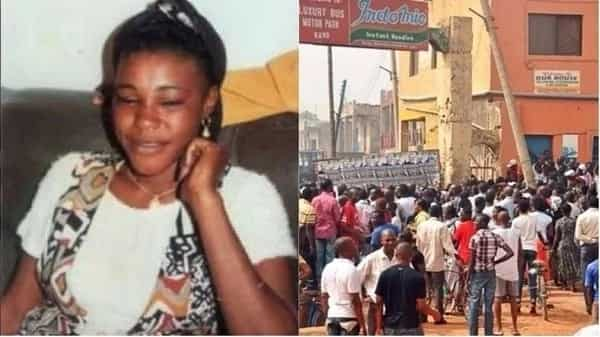
Rabi Ismail was used to being the centre of attention. This is only natural as Rabi was a movie star. It is doubtful if there is anyone who is familiar with the Hausa movie industry, popularly called Kannywood, who does not know Rabi Ismail. She was famed for both her acting prowess and her alluring figure. Her stardom was however not limited to Kano where she was based. She was as popular in Abuja as she was known in Lagos and Enugu.

On this fateful day, as she descended from the Black Maria, she was once again the cynosure of all eyes. Camera flashlights were popping as journalists and cameramen struggled to take the perfect shot. It was everything Rabi was used to. She could as well have been on the red carpet. But this time around the delectable actress was not on a movie set. Instead of a director and a producer, she was being chaperoned towards the courtroom by prison warders and police officers.

Some passers-by who saw the screen goddess being led to the court thought it was a scene from another movie project. Rabi Ismail, also known as Rabi Cecilia, was indeed a screen goddess in her own right. She had earned her stripes by featuring in popular Kannywood movies like Mankisa, Aya, and Tsumagiya, amongst other flicks. There was no doubt that she was destined for the top of the acting profession. Some of her fans were even thinking that she would soon leave Kano for Hollywood. Well, that was until that fateful Christmas day in 2002.

What could have turned the movie star into an accused? Or could it be part of a movie script? Or perhaps it was a publicity stunt for her new movie project? These and more were the questions on people’s lips when they heard the incredible news of her arrest. For answers to these questions, let us follow Onigegewura to the Emirate of Kano for a true story that is stranger than fiction.

Umma Ibrahim woke up very early on Christmas day. She had hardly slept a wink. Her brother whom she stayed with had not returned home the previous night. Following her separation from her husband two years earlier, she had been staying with Auwalu Ibrahim, her half brother. She had made several attempts to get across to Auwalu on his Nokia phone without success. What could have happened to him? She was worried. Unknown to Umma, Auwalu had spent the night at Farm Centre police station where he was detained overnight for a traffic related offence.

Ado Muhammad was a taxi driver in Kano metropolis. As he drove along Zoo Road on Christmas day looking for a fare, his eyes caught sight of a familiar figure standing by the side of the road. The figure looked very familiar. He was wondering where he knew the woman when he realized that she was flagging his taxi. The woman was no other than Rabi Cecilia, the popular actress. I have told you that Rabi was not an unknown commodity in Kano. Where could she be going this early? Ado wondered as he parked beside her.

Rabi wanted to hire his services for the day. After minutes of bargaining, it was agreed that she would pay him N250 per hour. Their first point of call was Farm Centre Police Station. Rabi went inside the station. Of course, the police officers on duty knew the popular artiste. What they didn’t know was that Auwalu who was detained for traffic related offence was her boyfriend. She filled the relevant forms and Auwalu was released to her.

Perhaps if Auwalu had known what fate had in store for him, he would have preferred to remain in the custody of the police. But you know that me rabon duka bai jin bari [the person who is destined to be beaten will never accept reconciliation in a fight]. From the police station, the lovers went to Auwalu’s friend’s house and from there to Auwalu’s house.

Umma was more than excited to see her brother. She had spent the day waiting anxiously for his return. Auwalu explained to his sister how he had been detained overnight at the police station. She wanted him to eat but Auwalu told her that he was going out and would soon be back to take his bath and eat. He changed his cloth and quickly dashed out. It must be true that fura da zai (za ya) zubar ba shi tara’n guribi [A pot of fura that is destined to fall will not stay in the hole hollowed out for it.]

Rabi was waiting for Auwalu in the taxi cab she had chartered for the day. The lovers decided to have a picnic at the scenic Tiga Dam. The Dam had been constructed between 1971 and 1974. It is a major reservoir on Kano River, the main tributary of River Hadejia. Ado was not very familiar with the route but as he was eager to earn his fare, he told the lovebirds that he would ask for direction. In 2002, N250 was a princely sum. He must have made a mental calculation of how much he was going to make if his service was retained for at least six hours.

They soon arrived at Tiga, but the dam was still some distance away. Rabi got down from the cab and asked for directions to the dam. The people she asked offered to lead them down to the dam. They soon located the Tiga Dam. It was a sight to behold with cascading water forming frothing foam. Ado parked his cab beside a tree and watched as the two lovers dashed off for a swim.

Ado however noticed one thing. Auwalu was not particularly excited about the swim. He looked tired and withdrawn. He soon stopped swimming and came out of the water. Rabi would have none of it. She pushed her lover back into the water. Auwalu struggled a bit and managed to crawl to the bank of the river. Again, Rabi pushed him back into the foaming waters of Kano River.

Despite his weakened state, Auwalu found his way back to the bank. Even to Ado who was watching from the safety of his cab, it was apparent that Auwalu was cold. He was trembling all over and Ado clearly heard him telling Rabi that he was feeling cold. Rabi gathered some twigs and made a small fire to warm him. Ado assumed that it must be the lovers’ idea off a movie. It was a bit weird, but he must earn his fare.

He however realized that something sinister was about to happen when Rabi approached him and asked for his help to leave the shivering Auwalu at the riverside. Ado refused. According to him: “I told her how could that be when we went there together.”

Rabi was undaunted. She asked Ado to help her with battery acid. Having realized that her intentions were less than noble, Ado refused. She then asked for petrol. The taxi driver knew that she had no engine with her that required fuel. He didn’t want to assume that she wanted to burn the hapless and helpless young man who was now shivering uncontrollably. On the other hand, he thought it could be a plan between them to burn him and steal his precious cab. He was not comfortable with either option and he refused her request.

Seeing that Ado was not going to aid her plan, whatever it was, she asked him to take them back to Kano metropolis. On the way to Kano, Ado stopped to buy fuel for his taxi. He was hardly back in the cab when Rabi asked for fuel again. Fuel? Ado had forgotten totally about her request for petrol. It was at that point he became afraid for his dear life and his precious cab. He however managed to refuse the request.

That was when Rabi played the ace she had up her sleeves. She told the taxi driver to take them back to the dam as she had forgotten her bag. Realising that it would amount to a breach of contract not to take her and having not been paid for the charter, Ado had no choice but to turn the car towards Tiga. All these while, Auwalu was almost unconscious and was lying at the back of the car. It was clear that the Eclair’s chocolate sweet given to him by Rabi was drugged.

Back at the dam, Ado expected the actress to go and look for her handbag which she claimed she had forgotten. He was surprised when Rabi asked him to assist her to bring down the barely conscious Auwalu. Immediately Auwalu was safely out of the cab, Ado made a quick U-turn and fled! He didn’t stop to pick any fare on the way. He was thanking his lucky star for his narrow escape. Although he couldn’t place his finger on it, he knew instinctively that Rabi’s intention towards Auwalu or himself was not pure.

For the second straight night, Umma Ibrahim spent a sleepless night waiting for her brother. She could not believe that Auwalu had failed to return home again. Where could he have gone to? His phone had not been going through. She prayed that he had not been arrested for another traffic related offence.

Umma was not the only one who had a sleepless night. Ado, the taxi driver, was also not able to sleep. He wondered whether it was all a dream. The movie star, the young man at the police station, the dam, the fuel station, the forgotten handbag, back at the dam, the shivering young man, and the narrow escape. But it could not have been a dream. It was all too vivid.

After the day’s adventure, he decided to clean his car. That was when he discovered the woman’s handbag!

At the sight of the bag, his heart skipped a beat.

The lady had claimed that she left the bag at the dam. That was why she asked him to return to Tiga. So, if the bag had been in the car all along, why had she lied? What was her purpose for asking him to take them back to the dam?

Then he remembered something more important than the bag. He had not been paid for the charter. He estimated that he was with them for eight hours. At the rate of N250 per hour, they were owing him N2,000. Although he didn’t know where the Kannywood artiste lived, he could still remember the house where the man went to change his cloth at Gyadi-Gyadi. He made up his mind to go there early on Boxing Day to collect his fare and return the bag.

Ado arrived at Auwalu’s residence early on the morning of December 26. He did not go there alone. Having regard to his experience the previous day, he asked a couple of his friends to accompany him. As he was parking his cab, he was surprised to see Rabi also arriving on a motorcycle. He handed over the bag to her and she quickly examined the contents and certified that everything was intact.

Ado then asked for his fare. To this, Rabi responded that Auwalu would pay him. Ado was not going to have any of that. It was Rabi who engaged his services and it was Rabi that must pay him. He insisted on being taken to wherever Auwalu was so that he could get his money. At this point, Umma, who knew Rabi as her brother’s girlfriend, told them that Auwalu had not come home to sleep.

Again, Ado insisted that Rabi must take him to Auwalu. Instead of taking him to where Auwalu was, Rabi took him to a house along Dan Kura Road, off Zoo Road where she gave him the sum of N2,000. Ado collected his money and sped off. He must have been thanking God for his second escape. He hoped that would be the last he would be seeing of the actress. Alas! He hoped in vain.

Umma was about to settle down to her morning chores when Rabi returned, this time alone. Umma was eager to find out whether she had brought news about her brother. Rabi told her that her brother was hale and hearty but that he was busy at a film location. He had sent her to bring his Video CD and Television set. To confirm that she had truly been sent by Auwalu, she showed Umma his I. D. card, vehicle particulars and the key to his room. Umma was convinced and she allowed her to take away the items.

Some hours later, Umma was shocked to see Rabi again, the third time that day. Rabi told her that Auwalu had asked her to bring him his CD recorder. This time, Umma refused. She insisted on being taken to wherever her brother was. Rabi pacified the distraught and obviously suspicious woman by telling her that she would “see the film director to allow Auwalu to come back home as his family were worried.” She left without being allowed to take the CD recorder.

Umma waited in vain for her brother to come back home as promised by Rabi. If she saw anyone that evening, it was certainly not her brother. To her everything was like a dream. If Auwalu was indeed at a location as claimed by Rabi, he would have at least called to inform her. She wondered why a film director would detain an adult without allowing him to call his family members.

When Ado left Rabi on December 26, he had hoped that he had heard the last of the strange couple. Do you recall that when Rabi and Auwalu left the police station on December 25, Onigegewura told you that they first went to Auwalu’s friend’s house. What Onigegewura did not tell you was the friend’s name. And you didn’t even bother ask. No wahala, I will tell you. Aminu Ahmed was the friend’s name.

Two days later, Ado was driving his cab along Dankura Road when he saw Aminu Ahmed. His curiosity got the better part of him. He had been wondering what fate befell Auwalu after he left them at the dam. He therefore waved at Aminu who recognized him immediately. Aminu was pleased to see him and pleaded with him to follow him to Auwalu’s relatives who had not seen him since the day he was released on bail by the police. That was how the family got to know the role Rabi played in their son’s disappearance.

They all trooped to the Sabon Gari Division where a case of abduction was lodged against Rabi Ismail. The police swung into action and promptly Rabi was arrested. She was asked to assist them to find the missing actor. At the police station, she claimed that on getting back to Kano on Christmas day, she told one Ibrahim Shuru that she had left Auwalu in the bush and that the two of them went back and met Auwalu. According to her, Ibrahim carried Auwalu to an abandoned building and left him sleeping in the inner room of the house.

Following this information, Supol Adekoya, the DCP, went with some police officers and searched every room in the house.

Auwalu was nowhere to be found.

So, where was Auwalu?…

Let’s stop here for today.

The story continues tomorrow…

Credits onigegewura.blogspot

Why Philanthropy Stops at Building a Courthouse

By Chidi Anselm Odinkalu

“Nothing is to be done which creates even a suspicion that there has been an improper interference with the course of justice.” Lord Hewart, 9 Nov 1923 in R v. Sussex Justices, [1924] 1 KB 256

Something extraordinary happened in Ikere-Ekiti in Ekiti State, southwest Nigeria, on 19 January 2023. On that day, the governor of the state, Abiodun Oyebanji, received and commissioned a new courthouse built by a senior lawyer, Chief Oluwole Oladapo Olanipekun. Luminaries from various walks such as politics, faith, business, and the professions graced the event. Thisday newspaper led in describing the project as an act of “selfless philanthropy”. Governor Oyebanji himself invited the state’s “indigenes all over the world to emulate this act of generous giving back.”

Chief Olanipekun, who built the courthouse, is a proud son of Ikere, where the new courthouse is located. His credentials in the universe of Nigerian philanthropy are not in dispute. He is a benefactor of leading universities in the country, including the Universities of Ibadan and Lagos, as well as the Ajayi Crowther University. He gave generously to alleviate suffering during the worst months of the COVID-19 pandemic. For decades, Chief Olanipekun has run a scholarship scheme to support the tuition and stipends of indigent students in various levels of education in Nigeria up to graduate studies as well as vocational studies in the Nigerian Law School. With some justification, philanthropy has been described as his way of life.

Chief Olanipekun is arguably the most successful Nigerian lawyer of his generation. He runs one of the biggest law firms in the country and is the lawyer of choice to presidents, politicians, and profitable companies. He became a Senior Advocate of Nigeria (SAN) in 1991 before being elected President of the Nigerian Bar Association (NBA), eleven years later. He has served as Pro-Chancellor and Chair of Governing Council of several universities around the country. He also now leads the Body of Benchers, the statutory body responsible for admitting new lawyers into the legal profession. He is himself a father of two SANs.

The construction of this courthouse was not done in secret. As Chief Olanipekun made plain at the commissioning ceremony, the project “was initiated with the consent and permission of the Honourable Chief Judge of Ekiti State, who also approved and modified the drawings appropriately.”

This is where the problems begin: what exactly was the Chief Judge thinking of when he gave consent for a lawyer in active private practice to build and “donate” a courthouse to the judiciary? Despite everything that can be said in favour of well-appointed courthouses, the idea of any person building and “donating” one to the judiciary anywhere is so staggering in its implications that it must be rejected out of hand as a model for addressing the manifest challenges of Nigeria’s judicial system.  Of the many reasons that can be adduced for this, five stand out.

Let us begin with the most basic. Courthouses go to the very essence of statehood. The state exists for the well-being of all who live within it. To protect them, it enjoys certain basic monopolies. One is a presumptive monopoly on the legitimate use of violence; the other is a monopoly of legitimate adjudication. The latter monopoly in fact precedes the former. If the state dispenses justice credibly, it diminishes the likelihood that grievances can boil over into violence. This is why the monopoly over legitimate adjudication is not one to be trifled with.

Second, the credibility of judicial function and public trust in its institutions is a high constitutional value dependent (in the words of Nigeria’s constitution) on public perceptions of the “independence and impartiality” of the courts. If one man builds a courthouse in a state from which he comes and in which he owns property, business, it is difficult to see how any decisions issued in that courthouse can be free from the whiff of partiality. Even people who come from his village and whose cases have to be decided in that court will never be free of the perception that their cases may have been decided in a particular way because the courthouse was built by their famous son. Judges who sit in such courts could live under a perpetual cloud. No matter how hard they try to be fair, firm, and just, their decisions will never be impartial enough.

Third, a lawyer in active practice cannot be allowed to build or donate a courthouse for obvious reasons: such a project can never be free of perceptions of professional influence peddling. This particular donation could soon prove to be more expensive than it is worth. In time, it will become grounds for appeal against decisions of judges who sit in it, exposing them to innuendoes and denuding them of the intangible assets of trust and confidence on which the judicial function is anchored.

Fourth, this idea of donation of courthouses invites the classic slippery slope. Let us begin from the premise that this donation is motivated by the purest of intentions. Not every person who may choose hereafter to invest in this model of “philanthropy” can be credited with the same purity of purpose. If one man can build and donate a courthouse, then every big man who has stolen money will sooner or later adopt that same model as their own down payment on impunity. In no time, courthouses around the country could become annexed into private estates of questionable provenance and their preoccupation will not be justice administration but decision-making as to who gets shafted both in reality and in the public perception.

Above all, it is impossible for this kind of project to avoid a violation of the constitutional rules of fair hearing and the Judicial Code of Conduct. Rule 1(4) of the Code precludes every judge from “contacts that may lead people to speculate that there is a special relationship between him and someone whom the Judge may be tempted to favour in some way in the course of his judicial duties.” How does a judge who sits in a court built by one man avoid the impression that he or she has a special relationship with the “owner” of the court?

It is not in doubt that Nigeria’s judicial system has far-reaching problems of both capital and recurrent kinds. The state may well be unable to fully pay for all that the courts need. If private contributions are needed, one response could be to adopt the model of the security trust fund established by many states to address insecurity and policing. A parallel for the judiciary could take the form of an Administration of Justice Trust Fund under suitable statutory guarantees.

The only question that remains is what to do with this ‘donation’ already made in Ekiti State. It would be proper to extend appreciation to the donor for his high sense of public duty. However, the facility can be repurposed for other uses – such as a public library – which will not impinge on public perceptions of the administration of justice. The public interest in a justice system that works for everyone demands no less.

It should be clear that this is not something that any state should have entertained or allowed. This kind of project guarantees an impression of improper interference in the administration of justice. This deserves the attention of the NBA, the Chief Justice of Nigeria, and the National Judicial Council to ensure that this first will also be the last and the only instance of this kind of “donation” anywhere in Nigeria.

Odinkalu teaches at the Fletcher School of Law and Diplomacy

Can BVAS be trusted in the forthcoming elections?

As controversy continues to trail the efficacy of the Bimodal Voter Accreditation System (BVAS) following the judgement of the Osun State Election Petition Tribunal which declared the election of Ademola Adeleke illegal, the Independent Electoral Commission (INEC) insists there is no going back on the conduct of mock accreditations based on the use of BVAS machines across the country.

After the elections in 2022, The Human & Environmental Development Agenda (HEDA Resource Centre) tackled the INEC over the Certified True Copies (CTC) reports of the BVAS for the Osun governorship election. HEDA posed questions over the apparent variance in the copies given to the All Progressives Congress (APC) and the Peoples Democratic Party (PDP).

In August 2022, HEDA in a statement said: “On July 18, 2022, two days after a governorship election was conducted in Osun State, the APC candidate and Governor Adegboyega Oyetola reportedly applied for the Certified True Copies (CTC) of the BVAS Report for the election. The world had commended the conduct of the election on the basis of the Bimodal Voter Accreditation System, BVAS).

“INEC was on record to have after the statutory payments were made on July 29, 2022, issued the CTC of the BVAS Report to APC and Oyetola. APC and Oyetola served INEC their Petition challenging results in 749 polling units on the account of suspected over-voting they believed took place in those polling units.

“INEC is alleged to, having discovered the palpable inconsistencies between figures recorded as accredited votes on the EC8A (result sheet) and the BVAS Report, tampered with the contents of the original BVAS report to protect the mandate awarded to Ademola Adeleke and PDP, at the expense of credible election, by issuing a fresh CTC to the defendants, claiming the CTC earlier issued to APC and Oyetola was incomplete and unsynchronised.

“Considering the Ekiti and Osun elections were conducted and declared on the basis of BVAS, How possible and plausible is it for INEC to have declared a winner from an unsynchronized BVAS? Considering the BVAS report issued was more than 10 days after the Osun election.

“As an Organisation committed to fight against corruption; financial and electoral, HEDA is concerned about this development. The Organisation observed the Osun election and engaged the process in collaboration with anti corruption agencies to campaign vote buying.

“Noting this particular serious inconsistency and those associated with the senatorial tickets attempts by the current Senate President in Yobe and Former Governor Godswill Akpabio in Akwa Ibom, INEC is charged to do better and remain consistent for a credible, free, fair and popular election in 2023.

“Furthermore, the anti-corruption agencies are further charged to vigorously monitor officials of the Commission to avoid inducement and compromise of the 2023 elections.”

“The BVAS device is gradually unveiling its monstrosity”, said Sunny-Gabriel Odey Esq. “It is inexplicable for the manual accreditation details in the Form EC8A series to be at variance with the digital entries in the bi-modal device. The discrepancy can only have emanated from the mischievous manipulation of the machine. So, who wins elections will depend on what happens in the inner recesses of INEC ICT room. The fact that two separate reports were generated by the same officials in Osun State confirms the ease with which the electronic device can be manipulated. I’ve read the minority decision of Justice Ogbuli also, and I’m glad that there’s still hope in the horizon. His judgment is more logical and cannot be classified in the category of ‘black market’ judgment as alluded to by some analysts.”

To P. D. Pius, Esq, an Abuja lawyer: “What is worrisome about the case and I see real danger for 2023 elections is the credibility of INEC to handle the BVAS machine report of accredited voters. In this case, INEC certified 3 different and inconsistent reports of BVAS machine accreditation thus:
1. Exhibit BVR relied upon by the Petitioners
2. Exhibit R. BVR relied upon by the Respondents and
3. Exhibit RWC relied upon by Justice B. A. Ogbuli who delivered the dissenting judgment.

All the 3 exhibits contain different reports of the actual number of accredited voters as purportedly recorded by BVAS for the Osun Governorship election of 16th July 2022. All the 3 reports have inconsistent figures with each other. All the 3 were certified by INEC as correct. Just imagine 

Anyway, the majority judgment relied on the report BVR to nullify the votes of Adeleke in 744 polling units. This report was generated earlier and almost immediately after the election on 27th July 2023 about 11 days after the election. The Tribunal found this closer to the truth.

R. BVR was issued by INEC on 22nd August 2022 over one month after the election and when the case was already in Court. This was the report of accreditation relied upon by the Respondents.

The last report, RWC was also gotten about 2 months after the election.

The facts of this case make nonsense of the assurance by INEC that the record of accredited voters by BVAS machine will be available and complete in real-time on the exact day of the election. There will be nothing credible about 2023 elections if the total number of accredited voters by BVAS machine will not be complete on the day of election and we have to wait for a whole 2 months or more before there will be “synchronization” with the back-end server. Synchronization and back end server will be most invoked in 2023 election petitions. Better get your legal team ready 

As a matter of fact, the mere issuance of 3 different reports of accredited voters by BVAS machine which are inconsistent with each other has completely eroded confidence reposed on INEC to conduct free, fair, and credible elections. This single fact is sufficient in my view to ask for the immediate resignation of INEC Chairman.

Little Wonder the Tribunal found the subsequent two reports to amount to tampering with official documents.

Whether the Tribunal is right or wrong, the mere existence of 3 different report of accreditation by BVAS machine calls for mass resignation of INEC officials. The Chairman should lead by example on this.

Note: Above is my personal opinion and is not an analysis of the merit or otherwise of the case on appeal. Consult an Election Law Expert on that. No free lunch even in Freetown.”

A post making being circulated on social media titled “The ABC of Osun Case for Laymen!” gave some more insight.

“Let me just explain what happened to you in the simplest of ways.

1) The BVAS is truly a game changer and should ordinarily be above manipulation.

2) The BVAS ascertains or validates voters’ identity, and it is mandatory prior to voting. Every voter must be BVASed before they are issued with a ballot to vote. In short, BVAS accredits voters.

3) After elections, the results are then collated and entered manually on INEC form EC8As. However, the number of voters on INEC Form EC8A must never exceed the number of accredited voters on BVAS. That’s over-voting and automatic cancellation under the EA 2022.

4) When a winner was declared by INEC in Osun elections, it was assumed by all that the BVAS and Form EC8As tallied. It was thought that Adeleke won and Oyetola lost.

5) APC applied for the BVAS report and Form EC8AS to file their petition days after the winner was declared.

6) APC in preparing their Petition found discrepancies between BVAS report and FORM EC8As in over 700 polling units. The votes recorded on Form EC8As literally exceeded what the BVAS accredited. There was over-voting by people who must have literally bypassed the BVAS either for not having PVCs or other dubious reasons.

7) Once INEC, PDP, and the Governor were served with the APC Petition, they all filed their responses and INEC added/pleaded another entirely different BVAS report, which INEC now DUBIOUSLY called a  “SYNCHRONISED BVAS Report.”

7) So, there were two BVAS reports before the Tribunal. The one issued to APC before they filled their petition and the one issued to self by INEC during the pendency of the petition.

8) At the Tribunal, each party strove hard to prove which BVAS was credible and which was not. The Tribunal then had to decide that….

Now, you please be the judge. Which of the two conflicting BVAS does your conscience, if functional, say is credible? The first one that was used to declare a winner on the elections day or the other “SYNCHRONISED BVAS” issued to self and pleaded by INEC almost 30 days after a winner was already declared and during the pendency of the Petition of the APC???

What does your functional conscience say?

I think INEC National should be grateful to APC/Oyetola/Osun for helping them expose the manipulation that dubious politicians can subject the BVAS to.

Plus, voters must now know that bypassing the BVAS is not helpful. Everyone must be accredited by the BVAS to be eligible to vote.”

Not Yet Hamba Kahle, Thulani

By Chidi Anselm Odinkalu

On 18 March 2014, Mpendulo Simelane, a judge of the High Court of eSwatini – the country formerly known as Swaziland – convicted Thulani Maseko and Bheki Makhubu of criminal contempt, sentencing them to 18 months in prison. Bheki, a journalist, worked as editor of The Nation, the leading news magazine in the country. At the time, Thulani led the Lawyers for Human Rights, eSwatini’s leading non-governmental organization. Both had in separate articles criticized then Chief Justice, Michael Ramodibedi, for various acts of abuse of power.

Thulani did in fact publicly call for the Chief Justice to step down. His position would later be vindicated when Ramodibedi suffered the unique distinction of being forced to relinquish two high judicial positions in one year. In 2014, he resigned as president of the Court of Appeal of Lesotho where he faced judicial impeachment. Back home in Swaziland, in June 2015, King Mswati III fired him from the office of Chief Justice of eSwatini.

Invited to speak for himself from the dock before the court sentenced him, Thulani, who was assassinated on 21 January 2023 while relaxing with his family in his home near Mbabane, capital of eSwatini, outlined his mission and worldview succinctly: “We deny that the call for a constitutional monarchy is a call to overthrow the monarch in Swaziland. We are calling for a system of government where democratic governance can and will co-exist with a monarchy whose powers are properly limited by law … so that nobody is above the law, but the law, is the ruler…”

Following their conviction, Amnesty International adopted both men as prisoners of conscience. 14 months later, on 30 June 2015, the Supreme Court of eSwatini set aside the convictions.

When the King changed the name of the country at a whim to mark his 50th birthday in 2018, Thulani disagreed and sued to challenge it. It was an extraordinary act of courage in a country where powers over life and death reside in a rampantly over-sexed King Mswati III, whose harem includes at least 15 wives.

Born on 1 March 1971, Thulani qualified as a lawyer in eSwatini in 1997. He undertook graduate studies in human rights law, receiving advanced degrees from universities in Pretoria, South Africa and Washington DC, United States of America. Seven years into a professional life dedicated to fighting for human rights, he founded eSwatini’s Lawyers for Human Rights.

In my own occasional scrapes with made-in-Nigeria tin-gods, Thulani was always a source of both inspiration and committed solidarity.

The cause of creating a more accountable country would increasingly draw Thulani into the vocation of advocacy for democracy and constitutional reform in eSwatini. Upon stepping down from the leadership of the organization in 2018, he became the leader of the Multi-Stakeholder Forum, a coalition of civic organisations for constitutional reform in eSwatini.

In July 2021, King Mswati met the peaceful advocacy led by Thulani and the Forum with cowardly brutality, leading to the killing of scores and the disappearance and torture of many more.

On Saturday, 21 January, the king warned pro-democracy advocates not to “cry when mercenaries deal with you.” Hours later, unknown marksmen, escorted by a convoy of King Mswati’s Police officers, shot and killed Thulani in his house.

On 25 January, Namibia’s President Hage Geingob on behalf of the Southern African Development Community (SADC), publicly asked the authorities in eSwatini to ensure Thulani’s killing be “swiftly, transparently, and comprehensively investigated, and that any and all persons suspected of committing this heinous crime are brought to justice.” In a break with precedent, the African Union joined the SADC’s call for a “full and transparent” investigation into what it described as the “brutal killing” of Thulani. Both the SADC and the AU must go further and insist on an independent investigation.

Thulani Maseko was the outstanding lawyer of his generation. His crime was to believe that his beloved eSwatini, Africa’s last absolute monarchy, could be and deserved to be better. He believed that this cause was best served by reforming the country into a constitutional monarchy and he forged a formidable coalition to advance this goal. For this, he has given his life. His killers and those who procured them believe they can decapitate the movement he led. In this circumstance, it is not right to say Hamba Kahle. Instead, his soul will haunt his killers and his legacy will continue to inspire the living.

Odinkalu teaches at the Fletcher School of Law and Diplomacy at Tufts University, Massachusetts.

2023 Elections: Use your numeric strength to vote the right people into office, FIDA Abuja to Nigerian women

L-R: Dooshima Abege (Assistant Publicity Secretary), Lady Ngozi Agubalu, Mojirayo Ogunlana-Nkanga (General Secretary), Chibuzo M Nwosu (Chair), Francisca Akaniro-Opara (Vice Chairperson), Olosen Victoria Ibiezugbe (Publicity Secretary), and Dr. Anne Mpama

With less than a month to Nigeria’s general elections, the International Federation of Women Lawyers, FIDA Nigeria, Abuja branch has made a call urging Nigerian women to use their numeric strength to vote the right people into office, while asking Nigerians to shun any form of abuse or violence before, during, and after the elections,

FIDA Abuja led by Chairperson Chibuzo M Nwosu made the calls during their advocacy campaign at Piwoyi Community, a suburb of Abuja. The group through the campaign sought to awaken the political consciousness of rural women with a focus on their role in the coming elections.

FIDA Abuja in a statement signed by the Publicity Secretary, Olosen Victoria Ibiezugbe said Ms. Nwosu at the occasion equally educated the women on key provisions of the VAPP Act 2015 particularly on the roles women play in nation-building.

Nwosu according to the statement gave the women pointers on how they could actively participate in the scheme of things which include asking leaders in their community pertinent questions, mobilizing support for female aspirants while urging the women in the community to get their Permanent Voters’ Card and utilize the numeric strength to vote the right people into office.

Using Sections 23, 24 and 26 of the VAPP Act as a point of reference, the Abuja FIDA Chair also iterated the need to frown at any form of abuse or violence before, during and after the elections

Present at the palace was Samuel Bako (Acting Palace Chief), Nuhu Dogo (Waziri of Piwoyi Palace), Abilah Boyedo (Sartin Noma) and Elisha Shekwagu (Secretary to the Palace).

The participants raised questions surrounding the rights of widows over their late husbands’ money; the legality of reporting one’s recalcitrant child’s drug abuse to the authority; the propriety of arresting women for indecent exposure, and the Chairperson took time to answer them.

The FIDA team which had Francisca Akaniro-Opara (Vice Chairperson), Mojirayo Ogunlana-Nkanga (General Secretary), Dooshima Abege (Assistant Publicity Secretary), Lady Ngozi Agubalu and Dr. Anne Mpama in attendance presented copies of the VAPP Act and FIDA flyers to the community.

Here are photos of the event.

L-R: Dooshima Abege (Assistant Publicity Secretary), Dr. Anne Mpama, Lady Ngozi Agubalu, Chibuzo M Nwosu (Chair)
L-R: Mojirayo Ogunlana-Nkanga (General Secretary), Chibuzo M Nwosu (Chair), Francisca Akaniro-Opara (Vice Chairperson)
L-R: Dooshima Abege (Assistant Publicity Secretary), Lady Ngozi Agubalu, Mojirayo Ogunlana-Nkanga (General Secretary), Chibuzo M Nwosu (Chair), Francisca Akaniro-Opara (Vice Chairperson), Olosen Victoria Ibiezugbe (Publicity Secretary), and Dr. Anne Mpama

TIPS