Home Blog Page 797

Supreme Hooliganism?

By Chidi Anselm Odinkalu

In June 2020, Malawians took to the streets and the judges joined to resist the attempt by President Peter Mutharika to fire Chief Justice Andrew Nyirenda in order to enable him rig a presidential re-run. The people trusted the Chief Justice more than the president, so they got rid of the president in order to keep the Chief Justice. One month later, in Mali, an uprising began when an unpopular ruling party used the Constitutional Court to rob the opposition of its victories, eventually leading to the dissolution of the court and a military coup.

Judicial immersion in political disputes is hazardous and judges called upon to do it have a clear choice to either resist importunations that compromise their authority or canoodle with the politicians at the risk of irremediable damage to judicial office. Nigeria’s Supreme Court appears to have made its choice and the consequences are unflattering.

At the beginning of 2019, President Muhammadu Buhari procured the termination of a Chief Justice of Nigeria in a manner that manifestly flouted the constitution. A public long inured to the machinations of a judiciary many of whose senior members appeared to treat their judicial oaths with levity chose not to take notice.

This denouement was long in the making. On 18 January 2008, Nigeria’s Supreme Court installed Chibuike Rotimi Amaechi as Governor of Rivers State in Nigeria’s Niger Delta. Mr. Amaechi scored 6,527 out of 6,577 votes cast in the primaries organized by the then-ruling Peoples’ Democratic Party (PDP) ahead of the governorship election on 14 April 2007. The party hierarchy duly forwarded his name to the Independent National Electoral Commission (INEC) as its candidate.

However, on 2 February 2007, the party withdrew Mr. Amaechi’s name and asked INEC, then chaired by an alchemist called Maurice Iwu, to substitute in his stead one Celestine Omehia who did not participate in the primaries. Mr. Amaechi sued to challenge the substitution but while the case was pending, the party dismissed him from the PDP; INEC then organized the elections, declaring Mr. Omehia the validly elected governor of Rivers State.

In a judgment of unprecedented audacity, the Supreme Court on 25 October 2007, sacked Omehia, affirming Amaechi as the winner in which he did not campaign. In reasons issued on 18 January 2008, Adesola Oguntade, the Supreme Court Justice who delivered the lead judgment with which all six other justices on the panel concurred, said: “the sum total of the recent decisions of this court is that the court must move away from the era when adjudicatory power of the court was hindered by a constraining adherence to technicalities. This often results in the loser in a civil case taking home all the laurels while the supposed winner goes home in a worse situation than he approached the court.”

Olayiwola Aderemi, another Justice on the panel, added: “The judgments of this court must not be final only in name, but must be seen to be really final in the sense that they have legal bite that makes the judgments truly conclusive. All issues that will make its judgments reasonable and conclusive must be clearly addressed by the Supreme Court. This court has a standing and rigid invitation to do substantial justice to all matters brought before it. Justice to be dispensed by this court must not be allowed to be inhibited by any paraphernalia of technicalities.”

Whether the Supreme Court has any memory of having issued these is now questionable. On 13 January, 2020, the Court issued a decision by which it declared as winner, the man who came fourth in the 2019 election for Governor of Imo State. To arrive at that wonderment, the court relied solely on the evidence of a manifestly crooked deputy commissioner of police with a wizard’s calling in conjuring up votes from ghosts. Invited to review an evidently perverse outcome the following month, a majority of the court framed the question as a challenge to their existence, making avoidable fetish out of an outcome that brought the court to manifest disrepute.

One Justice, Chima Nweze, from Enugu State (not far from Imo State, the theatre of this judicial magic), dissented, warning with remarkable prescience that the judgment “will sooner or later haunt our electoral jurisprudence.” The judgment accomplished more, however; Imo State promptly descended into anarchy under the rule of a Governor voted for exclusively by Supreme Court Justices none of whom will ever live near Imo State.

The Supreme Court appears not to have taken any notice though. In Yobe North Senatorial Zone, in north-east Nigeria, Bashir Sheriff Machina emerged in May 2022 as the candidate of the ruling All Progressives Congress (APC) to fly its flag in the contest to represent the constituency in the Senate in the 2023 general election in primaries monitored by INEC. That seat also happens to be occupied by the current Senate President, Ahmed Lawan, who has been in the National Assembly since 1999. In June 2022, Dr. Lawan sought and lost the ticket of the party for the presidency. INEC did not monitor any other APC primary for the Senate in Yobe North, so no other person could have emerged validly besides Machina.

Yet, on 6 February 2023, the Supreme Court ruled that Ahmed Lawan, who did not participate in the only valid primary, was the APC’s candidate for the Yobe North Senate seat. Conveniently disregarding its own decision 15 years earlier requiring the court “to do substantial justice to all matters brought before it”, a three-person majority hinged its decision on the jaw-dropping premise that the lower courts lacked jurisdiction to question bare-faced robbery perpetrated against the winner because an originating summons was the wrong form of action by which to commence the proceedings. Chima Nweze, who dissented when the case affected his people in south-east Nigeria wrote the lead judgment this time while Adamu Jauro, the Supreme Court Justice from Gombe which borders Yobe State in north-east Nigeria, dissented.

Machina sued by originating summons because a Practice Direction by the Chief Judge of the Federal High Court in July 2022 required that. If he failed to comply, the Court would have declined his case. The Supreme Court punished him for complying with the rules of court applicable when he sued. To achieve that, a five-person panel of the court effectively overruled long-established precedent which only a seven-person panel can.

A friend described the court’s reasoning as “agricultural jurisprudence”; and another complained that it felt like “a scene of profound judicial hooliganism.” “Supreme Court Machinates Machina” was how one newspaper described it. In a 2009 book, Obi Nwabueze, law professor and Senior Advocate of Nigeria (SAN), accused the Supreme Court of having played a “discreditable part” in denuding the courts and governance in Nigeria, citing the court’s chronic failure “to appreciate that the question of who should rule Nigeria is not one to be decided by a perverse and narrow legalism, by the technicalities of the rules of evidence, practice, and procedure and by considerations of expediency.”

Not done, on 8 February, the Supreme Court issued an exparte order in an original jurisdiction suit initiated by three states concerning the implementation of Central Bank of Nigeria (CBN) policy. The claimants deliberately failed to join the CBN because they knew that if they did, the court would decline the case in its original jurisdiction.

Much of what issues from the Supreme Court these days in these matters of high political salience cannot be explained logically. To many, the Court has become a danger to the rule of law as no one can sensibly advise anyone based on predictions of what a responsible court would do.

15 years ago, Olayiwola Aderemi, sitting as a Justice of Nigeria’s Supreme Court, warned that “democratic government and society as a whole can only function fairly and properly within a framework of laws, justly, fearlessly and fairly administered by men and women who have no obligation save to justice itself…. it does not, of course, mean that judges are licensed to do exactly as they like; quite the opposite. They must allow themselves to be guided by well-tested principles so fashioned that lead to justice.” Could the Supreme Court be hard at work to ensure democratic government and society as a whole don’t function?

A lawyer & a teacher, Odinkalu can be reached at [email protected]

Recognizance versus Reconnaissance

By Chinua Asuzu

Generally, a _recognizance _is a bond to the court or tribunal, whereby the recognizor undertakes to abide by some specified condition (for example, to appear for his trial, attend court when required, pay a debt, keep the peace, etc.)

More particularly, a recognizance is synonymous with a bail bond—it secures the return to court of a defendant in a criminal trial.

A reconnaissance, on the other hand, is a (law-enforcement, military, or security) intelligence-gathering examination, exercise, mission, or survey over (criminal, enemy, rival, or terrorist) activities, locations, or operations. The corresponding verb is reconnoiter.

Chinua Asuzu, Learned Writing (Partridge, 2019), 683.

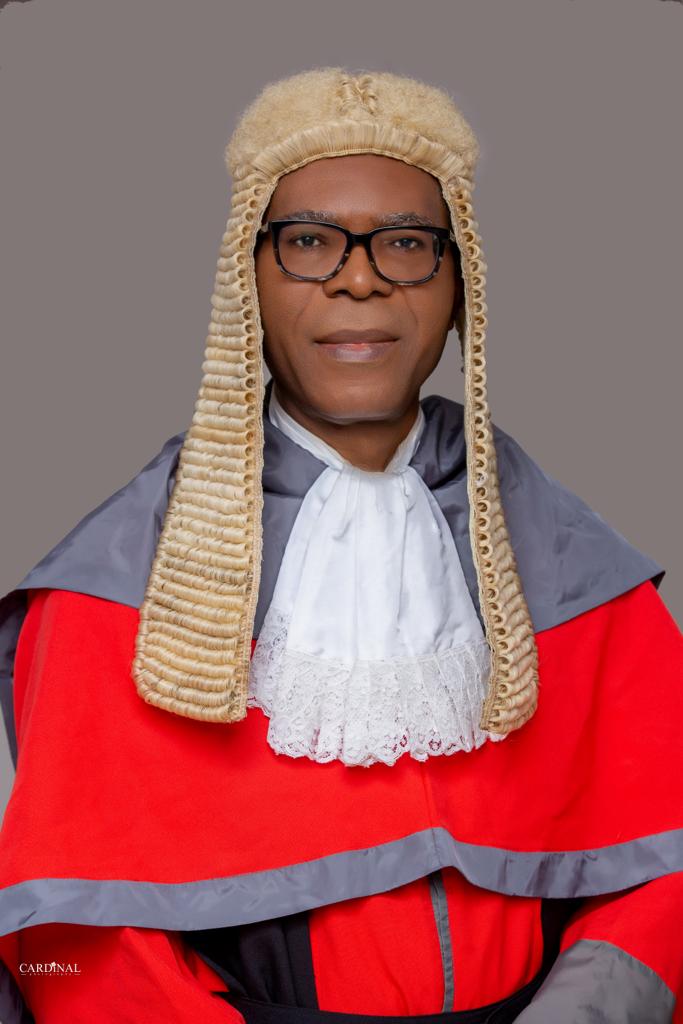
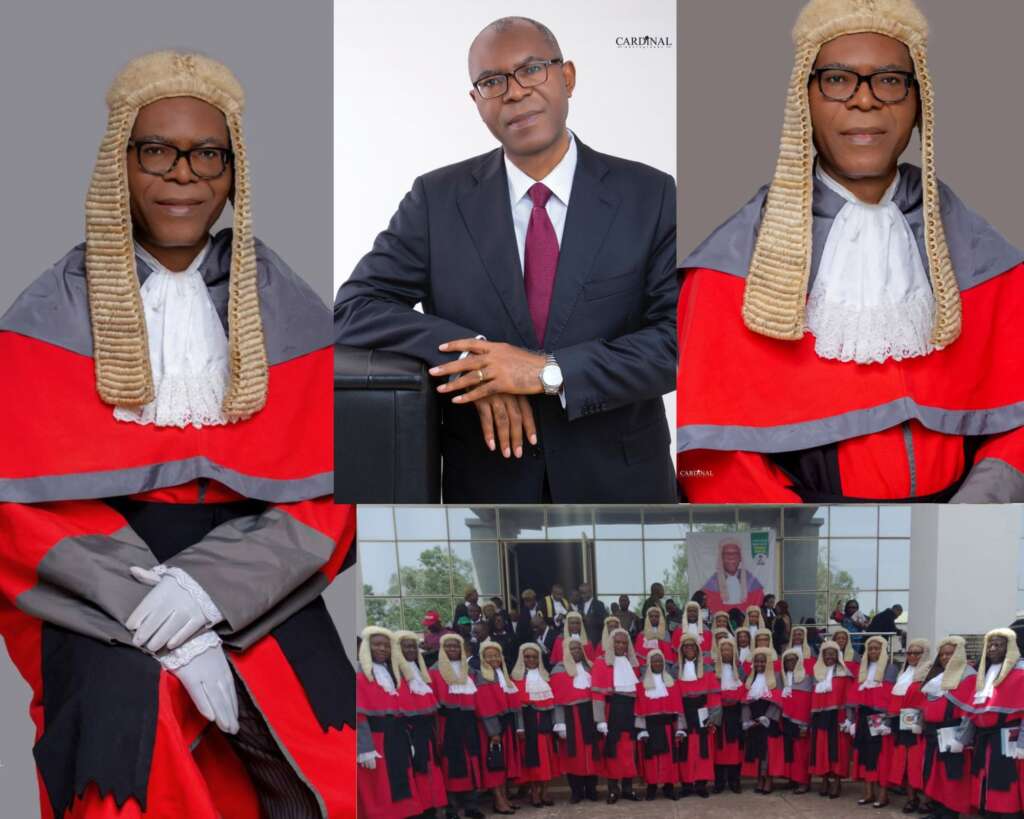
Justice Agbakoba’s comportment, Nnamani, JSC’s mentoring inspired me to study law – Justice Afam Nwobodo

By Lillian Okenwa

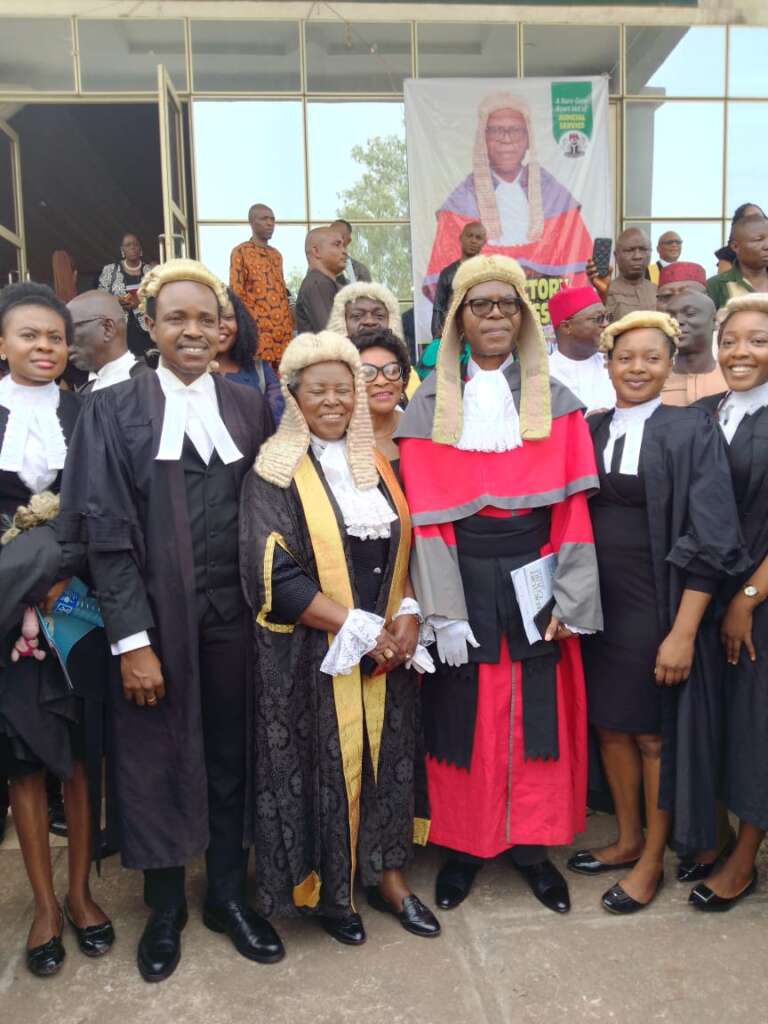
After 40 years in the legal practice, of which 21 was spent on the bench, Hon. Justice Afamefuna Anthony Nwobodo bowed out of Enugu State judiciary on 3 February 2023.

Nwobodo who honed his legal skills in the law firm of Bola Ajibola & Co. at Igbosere Road, Lagos, is a recipient of several awards including Judge of the Year for three consecutive years (2008, 2009, and 2010) from the Nigerian Bar Association, Enugu branch. Nicknamed ‘9’Oclock Judge’ by staff members and lawyers at Enugu Ezike High Court, Nwobodo also described as one who brought integrity, dignity, and courage to the bench tells the story of great men who inspired him to attain great heights.

With wife, Dr. Ifeoma Nwobodo

“I have been blessed and opportune to have been mentored and taught by so many great men. My meeting with Barrister Godfrey Ubaka Agbakoba in 1968, first sowed the seed of interest in becoming a lawyer. The way he comported himself caught my attention and admiration. He was later elevated to the High Court Bench of East Central State. I remain grateful for the path he showed me.

“When I expressed my interest to study law, my father introduced me to his childhood friend, Dr. Augustine Nnamani who took me under his wing. I recall vividly, my very first visit to a courtroom, while still in secondary school. He took me to the Enugu High Court to observe Court Proceedings. I was enthralled. Dr. Augustine Nnamani later became a renowned Justice of the Supreme Court. Honourable Justice Nnamani did so much to mentor and encourage me, and his words of advice spurred me on the right path in my legal and judicial career. He continued to teach and mentor me until his sudden and untimely death in 1990. May his generous soul continue to rest in peace, Amen.

With Chief Justina Offiah, SAN and others

“I am also grateful to Hon. Justice Alfred Obi – Okoye the former Chief Judge of Plateau State. He was there for me guiding and encouraging me all through my years at the University of Jos. I am grateful to you.

“My deep gratitude also goes to His Excellency, Judge Bola Ajibola for the opportunity to practice in his Chambers. The experience I got while working in his chambers and the cases I was exposed to helped shape my legal mind a great deal.  Your Excellency, I thank you for your kindness toward me throughout my time with you. I am indeed grateful.

“I cannot forget Mr. Namseh Eno, my senior friend and teacher at Bola Ajibola & Co. who was always ready to listen and guide me. He taught me so much about legal practice during our stay at Bola Ajibola & Co. Mr. Eno always excelled in whatever he did. He excelled in legal practice and the games of hockey and cricket. He was the only man who has captained two national teams in Nigeria, the National Hockey, and the National Cricket teams.  I cherish the memories of being a pupil under your tutelage.

“With a deep sense of gratitude for the sacrifice, my parents Deacon Fidelis and Deaconess Rosemary Nwobodo made for me to get a good education, particularly a legal education. I thank them for inculcating in me the fear of God and a sense of worth above material possessions…”

Justice Nwobodo, a fellow of both the Chartered Institute of Arbitrators (CIArb) and Institute of Chartered Mediators and Conciliators (ICMC) said he will now do a lot of reading from the many books he acquired over the years and explore law from the side of Alternative Dispute Resolution (ADR).

Osun Election: Failure of 3rd member to agree with either side and in writing rendered judgment a nullity – PDP

The Peoples Democratic Party (PDP) has asked the Court of Appeal to nullify the judgment of the Osun State Election Tribunal alleging that it was rendered in gross violation of the provision of Section 294(1) & (2) of the Constitution of the Federal Republic of Nigeria, 1999.

PDP in the 43 grounds of appeal filed at the Court of Appeal Akure Division said the 3rd member of the Tribunal never expressed any opinion for either side in the open court or in writing.

It was the party’s contention that “only upon the release of the judgment that the name of the 3rd member appeared as having signed alongside the No. 1, the Chairman without expressing her opinion in writing.”

PDP then insists that “failure of the 3rd member to openly concur on either side and in writing rendered the judgment a nullity.”

The opposition party through its legal team led by Dr. Alex A. Izinyon, SAN, N. O.O. Oke, SAN, A.K. Ajibade, SAN, O.M. Atoyebi, SAN and a host of others said the Chairman and member of the Tribunal erred in law when they introduced an extraneous issue to the Judgment which shows a real likelihood of bias which caused miscarriage of Justice.

Below are some of the particulars of error pointed out by the PDP.

“The expression of the lyrics: ‘go, lo, lo, lo, lo” and “Buga Won’ with specific reference to the 4th Respondent is a real likelihood of bias that the 4th Respondent is not fit to occupy the exalted position of the Governorship seat of Osun State.

“Making ‘go, lo, lo, lo, lo’ and ‘Buga Won’ lyrics a conclusion of their Judgment and immediately thereafter making the pronouncement removing the 4th Respondent from the office shows that the learned Chairman and member disregarded all the defences of the 4th Respondent and the Appellant to the petition to be inconsequential and irrelevant.

“The lyrics and the staccato of ‘go, lo, lo, lo, lo’ and ‘Buga Won’ and the reference to the musician Kizz Daniel manifest a preconceived notion by the learned Chairman and the member against the 4th Respondent.

“The said lyrics as used by the learned Chairman and the member is an open condemnation of the personality of the 4th Respondent.

“The lyrics operated in the mind of the learned Chairman and the member of the learned Tribunal which led to the rejection of the 4th Respondent and Appellant defences as unacceptable.

“The 4th Respondent never danced before the learned tribunal to warrant such conclusion and inferences. The real likelihood as shown above led to miscarriage of Justice.

“The 1stand 2nd Respondents allegation is that there was non-use of the BVAs machines for accreditation of votes at the 749 polling units across the ten (10) Local Government Areas.

“The 1stand 2nd Respondents alleged that as a result of the said non-use of the BVAs machines for accreditation at the said 749 polling units, there was over voting at the said polling units as the number of accredited voters as recorded on the Form EC8A does not tally with the number of voters accredited with the BVAs machines.

“In the final address of counsel to the 1stand 2nd Respondents they made a summersault and stated that they are abandoning their pleading in respect of five (5) unspecified polling units, and that their final address will be predicated on 744 polling units which were also unspecified.

“There was no amendment to the petition as they went to trial with the petition as originally filed.

“There was no specific pleading by which the five (5) polling units abandoned vide the written address can be identified; and the 744 polling units purportedly relied upon at the final address stage were appropriately identified.

“The 1stand 2nd Respondents did not also lead evidence in line with any specific 744 polling units at the trial.

“The learned tribunal’s finding that the 1stand 2nd Respondents established that over voting took place in 744 polling units is not supported by the pleadings or evidence of the 1st and 2nd Respondents.

“There was no credible evidence led by the 1st and 2nd Respondents to establish the allegation that invalid votes were relied upon in the results declared at the election and the return of the 4th Respondent.

“There were no invalid votes in the scores returned for the 1st and 4th Respondent respectively at the election.

“The learned tribunal had no duty to deduct any vote from the scores or votes returned at the election as it did in its judgment.

“The holding of the learned tribunal that the 1st Respondent scored the majority of lawful votes at the election is not supported by the evidence on record. 

“The learned tribunal wrongly relied on the various tables produced by the 1st and 2nd Respondents’ counsel in their written address.

“The said tables were not borne out of the 1st and 2nd Respondents evidence or demonstrated in open court.

“It was grave miscarriage of justice for the learned tribunal to rely on the untested tables in their findings.

“The learned tribunal failed to be guided by the margin of lead principle under the Electoral Act, 2022, and Exhibits 1 and 2 Manual after relying on the 1st and 2nd Respondents tables before declaring the 1st Respondent as the winner of the said election.

“The utterances as bias against the Appellant are replete in the judgment.

“At page 26 of the Judgment while reviewing the fact of the petition, the learned tribunal made finding on BVA machine only on 1st and 2nd Respondents’ submission without considering all arguments by Respondents.

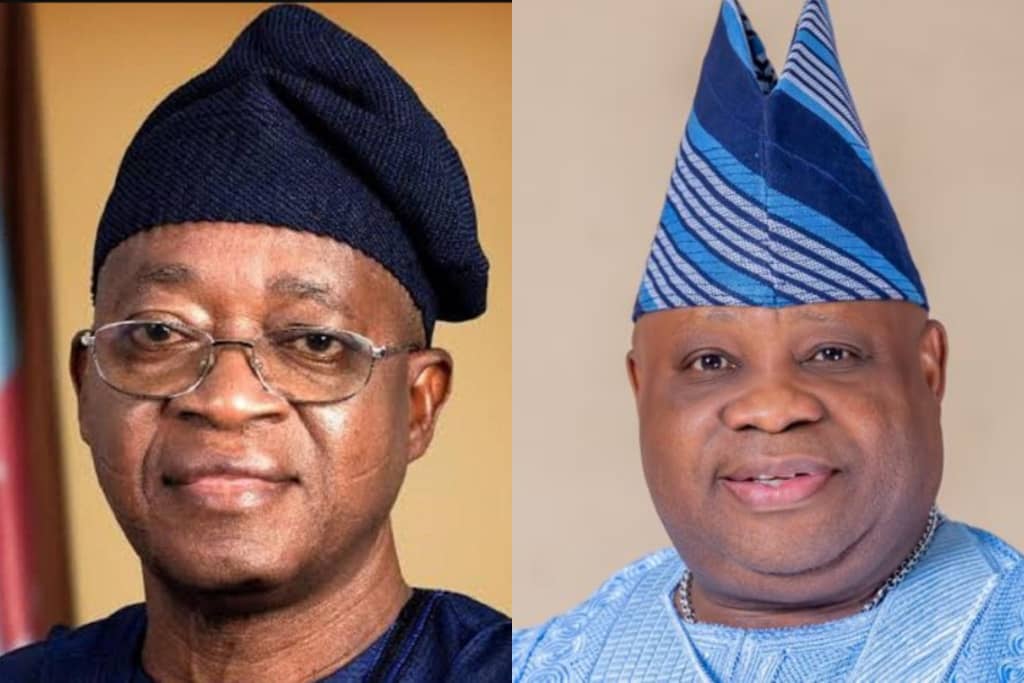
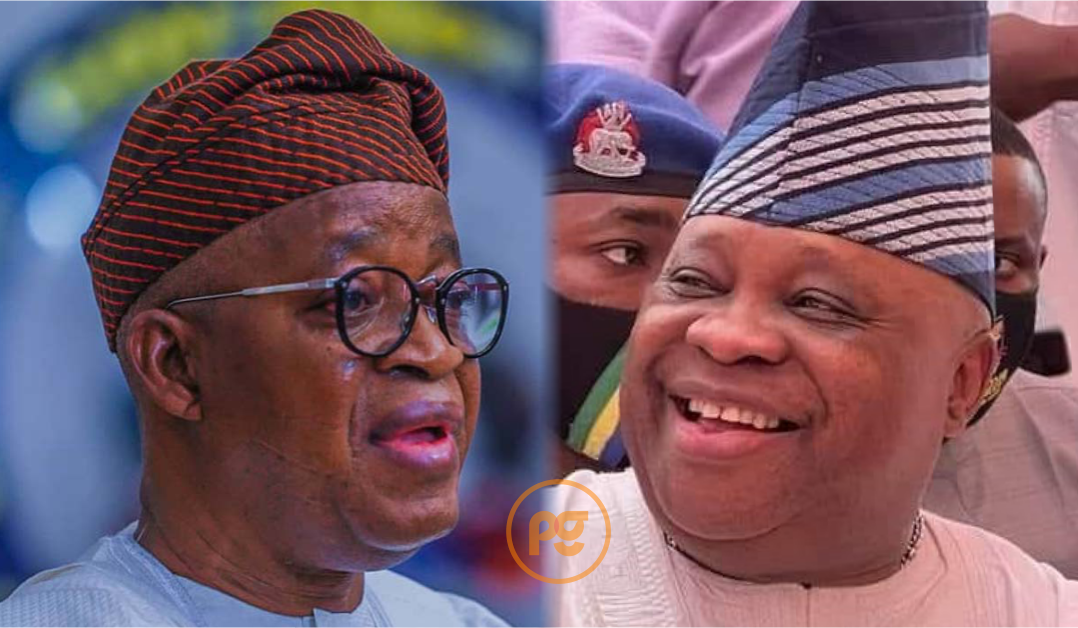
Defendants in the appeal are Adegboyega Isiaka Oyetola, 1st defendant, All Progressives Congress (APC)2nd defendant, Independent National Electoral Commission (INEC) 3rd defendant and Governor Adeleke Ademola Jackson Nurudeen, 4th defendant.

Naira Swap: Any order against FG is not enforceable on CBN, the President cannot even remove CBN Governor – Akaraiwe, SAN

By Ikeazor Akaraiwe, SAN

1: Let me weigh in, in layman’s language, so that all members of this platform, lawyers or not, may understand and follow: It is an interim order, to last until February 15, when the substantive arguments will be heard.

2: As provided by the Constitution, the Supreme Court does not have original jurisdiction to hear cases unless they are brought by

A. State Govt (s) against other State Govt (s); or

B. State Govts against the FG as in this case or vice versa; or

C. Between the National Assembly and the President;

D. Between the National Assembly and any State House of Assembly, or

E. the National Assembly and a State of the Federation.

3: Original jurisdiction means for the Supreme Court to hear the suit as if it is a court of first instance (that is, as if the Supreme Court were a high court). This is permitted in the Constitution.

4. Kaduna and Kogi State governments brought this suit, thus invoking the original jurisdiction of the apex court. The court granted them an interim order of injunction as we are all aware. INTERIM ORDER of INJUNCTION means that the order we last for a specific period, in this case until the 15th February.

5: However, on the 15th of this month, it is my guess that arguments on whether the Supreme Court has jurisdiction or not to hear this suit in its original jurisdiction (as if it is a court of first instance) are likely to be taken before delving into the substantive issues.

6: I do not have the full facts so I would not know whether the Supreme Court will accept or decline jurisdiction. The full facts are before the court and not before me.

7: But there has been much contention over whether the order made is binding or not on the Central Bank, not being a party to the proceedings. Many lawyers, notably Femi Falana SAN, JS Okutepa SAN and others have made useful contributions in this regard.

8: I lean towards the argument of CBN not having been made a party but there is considerable merit in the argument that Central Bank, being an agency of the Federal Government is bound by the court order, which has the Attorney -General of the Federation as a party.

9: It seems to me as if the strategy of the State Governments who brought this suit in not making Central Bank a party was to avoid the suit commencing at the Federal High Court because suits in which the original jurisdiction of the Supreme Court is invoked can only have the parties envisaged by the Constitution as stated in paragraph two of this note.

10: It has been my respectful view that any order against the FG is not enforceable on the Central Bank because the Central Bank Act gives the apex bank complete independence.

11: The president cannot even remove the Governor of the Bank. Only the National Assembly can upon the recommendation of the President. Remember Sanusi Lamido? Jonathan could not remove him.

12: So, my view is that an order directed against the FG cannot be enforced against the Central Bank if Central Bank is not a party to the suit. And if you make Central Bank a party as in the instant case, the Supreme Court loses jurisdiction. And if you do not make the Central Bank a party as the plaintiffs have deliberately done (so as to invoke the court’s original jurisdiction), any order made by the Supreme Court would be in futility as the apex bank is not bound to obey.

13: But of course, the Central Bank may obey an order made against the FG in which it was not a party, given the synergistic and symbiotic relationship between departments and agencies of the same government. But a strong-willed Central Bank governor may not obey.

I think it will be more of synergy than command, if that department was not made a party to the suit.

14: Paraphrasing JS Okutepa SAN, in the case of A.G Lagos State v AG Federation (2014) 9 NWLR (Pt. 1412) 217 which was a dispute relating to the operation of an agency of the Federal Government, the Federal Inland Revenue Service (FIRS), against an agency of Lagos State Government, which the FG contended accrued to it, the SC held that its original jurisdiction cannot be so egregiously invoked when the dispute is not between the Federation as an entity against a State or between a State against another or others or the National Assembly and the President; the National Assembly and any State House of Assembly, and the National Assembly and a State of the Federation.

Thank you.

The Naira Redesign and Swap Hullabaloo: Why I think the Supreme Court of Nigeria lacks original jurisdiction

By Sylvester Udemezue

For the avoidance of doubts, this commentary is strictly a LEGAL OPINION having nothing whatsoever to do with the activities of Nigerian politicians and their supporters and acolytes even as the 2023 general elections are just a fortnight away from today. I have earlier offered my humble, disinterested opinion on the Naira Redesign and Daily Cash Withdrawal Limit policies of the Central Bank of Nigeria. See:  “Re: “Give Me 7 Days To Resolve Cash Crunch, President Muhammadu Buhari Begs Nigerians”  by Sylvester Udemezue (4 February 2024, ThenigeriaLawyer)

Issues relating to whether or not a court of law has jurisdiction are fundamental and lack of jurisdiction is fatal. See OTUKPO v. JOHN (2000) 8 NWLR (669) 507; BRONIK MOTORS v. WEMA BANK (1983)6 S.C. 158; see also OMOKHAFE v. Military Administrator (2005) 2 MJSC 173. In the Supreme Court case of MADUKOLU v. NKEMDILIM (1962) 1 ALL NLR 589, the Supreme Court provided the following guide for determining whether a court has jurisdiction. Hon Justice Vahe Bairamian (FJ) while delivering the lead judgment in that case stated as follows: “Put briefly, a court is competent when: (1) the court is properly constituted as regards numbers and qualifications of the members of the bench, and no member is disqualified for one reason or another; and (2) the subject matter of the case is within its jurisdiction, and there is no feature in the case which prevents the court from exercising its jurisdiction: and (3) the case comes before the court initiated by due process of law, and upon fulfilment of any condition precedent to the exercise of jurisdiction. Any defect in competence is fatal, for the proceedings are a nullity however well conducted and decided: the defect is extrinsic to the adjudication.” (See: http://www.nigerialaw.org/LawReporting/1962/Gabriel%20Madukolu%20&%20Ors%20v%20Johnson%20Nkemdilim.htm)

Now, in October 2022, the Central Bank of Nigeria rolled out the Naira Redesign and Daily Cash Withdrawal Limit policies, announcing 31 January 2023 as the deadline for use of old Naira Notes (N1,000, N500, and N200 notes) in Nigeria. The deadline was however later extended to 10 February 2023.  Meanwhile, Kaduna, Zamfara, and Kogi States filed a case at the Supreme Court of Nigeria, against the Attorney-General of the Federation, challenging the polices and asking the Supreme Court to restrain the federal government from enforcing the 10 February 2023 deadline on Naira swap. The Supreme Court has granted an ex parte order directing that the new naira notes and the old ones should continue to coexist until 15 February 2023 when the Motion on Notice in the case would be heard. My worry is, does the Supreme Court of Nigeria have jurisdiction in this matter? I respectfully answer the question in the negative, with due respect, for the following reasons:

1️⃣. The Naira Redesign and Daily Cash Withdrawal Limit policies are policies of the Central Bank of Nigeria. Only the Federal High Court has jurisdiction in disputes arising from or related to Central Bank policies and anything having to do with the Naira as the Legal Tender in Nigeria.  Section 251(1)(d) Constitution of the Federal Republic of Nigeria, 1999 provides: “Notwithstanding anything to the contained in this Constitution and in addition to such other jurisdiction as may be conferred upon it by an Act of the National Assembly, the Federal High Court shall have and exercise jurisdiction to the exclusion of any other court in civil causes and matters — connected with or pertaining to banking, banks, other financial institutions, including any action between one bank and another, any action by or against the Central Bank of Nigeria arising from banking, foreign exchange, coinage, LEGAL TENDER , bills of exchange, letters of credit, promissory notes and other fiscal measures…”. Thus, it is submitted that the proper court to have filed the case is the Federal High Court and not the Supreme Court. Besides,  it’s submitted, the proper party  to sue is the CBN and the proper court to file the case is the Federal High Court.

2️⃣.Section 232 (1)(a) of the Constitution, 1999,  provides that “The Supreme Court shall, to the exclusion of any other Court, have original jurisdiction in any dispute between the Federation and a State or between States if and in so far as that dispute involves any question (whether of law or fact) on which the existence or extent of a legal right depends.”  In line with this section, there must be  a live dispute between the Federation and a State or between two States,  before the original jurisdiction of the Supreme Court can be activated. It’s submitted that in the present scenario, there is no dispute between the Federation and any of Kaduna/Zamfara/Kogi States over the Naira Redesign and Daily Cash Withdrawal Limit policies. These policies are policies of the Central Bank; the Supreme Court in its original jurisdiction has no business with the case. And if any State in Nigeria has any problems with the deadline fixed by the CBN, the state is free to drag the CBN before the Federal High Court. After all, the CBN is not immune from Civil actions; section 1(2) of the CBN Act provides that the CBN may sue or be sued. In my opinion, one major problem is that it appears some people are used to confusing the term FEDERATION with FEDERAL GOVERNMENT or the office of the President. In AG KANO V. AG FEDERATION (2007) 3 SC (PT 1) the Supreme Court explained that ‘The word “Federation” in section 232 of the 1999 Constitution bears the same meaning as “Federal Republic of Nigeria” or “Federation of Nigeria”. The plaintiff’s claim did not accuse the Federation of Nigeria or the Federal Republic of Nigeria of taking any action against the Hisbah Law of Kano State or the operation of the Hisbah Corps in Kano State; or of arresting and detaining commanders of the Hisbah Corps in Kano State. There was no dispute between Kano State in its status as a component unit of the Federation and the unit of the Federation itself’. Per Mohammed, JSC at 38

With due respect to the AG’s of Kaduna State, et al, the Attorney-General of the Federation is the proper Defendant or plaintiff only in suits against or by the Federation; a quarrel over the action of the CBN in respect of the LEGAL TENDER does not qualify as or translate to a dispute between a state and the Federation as provided for in section 232(1) of the Constitution, to justify the filing of the case at the Supreme Court. In the same A.G. Kano State v A.G. Federation (supra), the Attorney-General of Kano State had dragged the AG of the Federation to the Supreme Court over an action taken by the Inspector-General of Police, and Mahmud Mohammed, JSC (as he then was) held, while dealing with the … provisions of Section 232(1) in the lead judgment that: “Any complaints against the Government of the Federation or any person who exercises power or authority on its behalf like the Inspector-General of Police as asserted by the learned senior for the plaintiff in his address before this Court, are completely outside the jurisdiction of this Court.” Continuing, the apex court said: “The statement of claim disclosed a dispute between the Government of Kano State and its agencies and the Government of the Federation through the Inspector-General of Police and Minister of Information, exercising their power or authority on behalf of the government of the Federation. The venue for settlement of such disputes (i.e. against Inspector-General of Police and Minister of Information), was in the various courts of first instance whose jurisdictions were clearly outlined in the same 1999 Constitution – and not the Supreme Court”. Per Mohammed, JSC at 38.

 Also, in the case of BHS INTL LTD v. AG LAGOS & ORS (2016) LPELR-40084, the Court discussed (set out) the Conditions that must exist before the ORIGINAL JURISDICTION of the Supreme Court can  be invoked. The Court States:

“Section 232 (1) of the Constitution are concisely and precisely in the following terms: “The Supreme Court shall, to the exclusion of any other Court, have original jurisdiction in any dispute between the Federation and a State or between States if and in so far as that dispute involves any question (whether of law or fact) on which the existence or extent of a legal right depends.” I must state that these provisions, in addition to being concise and precise, are plain, clear and unambiguous in words, context and purport. That is the verdict of the apex Court, per Onnoghen, JSC in the lead judgment in the case of A.G. Abia State v. A.G. Federation (supra) also reported in (2007) 2 SC, 146, when he stated that: “The provisions of Section 232(1) of the 1999 Constitution, which confers original jurisdiction on this Court, is very clear and unambiguous. It is clear from the above that for the original jurisdiction of this Court to be invoked in a civil action; (a) the action must be between the Federation and the State(s) or between States, and there must be a dispute between the Federation and a State or States; (b) the dispute must involve a question of law or fact or both; and (c) the dispute must pertain to the existence or extent of a legal right.” The erudity and proficient Lawlord did not stop there, but defined what a “dispute” is in the context of the provisions when he said: “It has been held by this Court vide Belgore, JSC (as he then was) in A.G. of the Federation v A.G. of Abia State (2001) 11 NWLR (PT.725) 689 at 737, inter alia, that the term dispute as used in Section 232(1) of the 1999 Constitution”…, involves acts of argument, controversy, debate, claims as to rights whether in law or facts, verying opinion, whether passive or violent of any disagreement that can lead to public anxiety or disquiet” Then in the case of A.G. Kano State v A.G. Federation (2007) 3 SC (PT 1) 59, Mahmud Mohammed, JSC (as he then was) had held, while dealing with the same provisions of Section 232(1) in the lead judgment that:”Any complaints against the Government of the Federation or any person who exercises power or authority on its behalf like the Inspector-General of Police as asserted by the learned senior for the plaintiff in his address before this Court, are completely outside the jurisdiction of this Court.”His lordship had expatiated the above position when he said; “However, quite contrary to the requirements of Sections 232(1) of the 1999 Constitution, the dispute disclosed in the plaintiff’s statement of claim is a dispute between the Government of Kano State and its agencies and the Government of the Federal and its agencies, particularly the police and the Federal Ministry of Information through the Inspector General of Police and the Minister of Information in their capacities as persons exercising power or authority on behalf of the Government of the Federation …. certainly if the plaintiff has any dispute with the Inspector General of Police and the Minister of Information for their respective roles in the various declarations they made on the Hisbah Laws, the operation of the Hisbah Corps and the arrest and detention of the officials of the Hisbah Corps, the propervenue for the settlement of such dispute does not lie in invoking the original jurisdiction of this Court. The venue for the settlement of such dispute lies elsewhere in various Courts of first instance whose original jurisdictions are clearly outlined in the same 1999 Constitution”The clear principle laid down in the above authorities is that the original jurisdiction of the apex Court under Section 232(1) cannot be invoked over a dispute in respect of the acts or performance of the duties of the Federal Govt through or by its agencies, which are legal entities that can sue or be sued, since they are not the Federation or a State in the Federation.” Per MOHAMMED LAWAL GARBA, JCA (Pp 27 – 30 Paras B – D).

3️⃣. Another question is whether the ex parte order made by the Supreme Court of Nigeria is binding on the Central Bank of Nigeria or on any of the Commercial Banks in Nigeria in view of the fact that neither the Central Bank nor the Commercial Banks are a party to the case at the Supreme Court?

It is a settled principle of law that an order of court binds only parties to the case before the court. It’s a principle of joinder of parties. Thus, if a person is not joined that person is deemed to not be a party to the case and is therefore not bound by any order made in the case or the outcome of the case. See BABATOLA V ALADEJANA (2001) 6 SC 124. Section 1(3) or the Central Bank Act, 2007 provides that the Central Bank of Nigeria “is an independent body in the discharge of its functions”.  Further,

Section  17 of the CBN Act provides that “The Bank shall have the sole right of issuing currency notes and coins throughout Nigeria and neither the Federal Government nor any State Government, Local Government other person or authority shall issue currency notes, bank notes or coins or any documents or token payable to bearer on demand being document or token which are likely to pass as legal tender”. Section 19(1) (b) provides that “The currency notes and coins issued by the Bank shall be of such forms and designs and bear such devices as shall be approved by the President on the recommendation of the Board”.  Section  20(1) of the CBN Act provides that “The currency notes issued by the Bank shall be the legal tender in Nigeria at their face value for the payment of any amount”. Section  20(3) of the CBN Act provides that “….the bank shall have power, if so directed by the President and after giving reasonable notice in that behalf, to call in any of its notes or coins on payment of the face value thereof and any note or coins with respect to which a notice has been given under this subsection shall, on the expiration of the notice, cease to be the legal tender, but subject to section 22 of this Act, shall be redeemed by the Bank upon demand”. From the above it appears that the CBN has the responsibility and power to issue a legal Tender for Nigeria and to redesign any denomination of the legal Tender. Also, fixing of deadline for cessation of validity of the old Naira notes are issues falling within the sole powers of the CBN under the President’s directive pursuant to Sections 19(1)(b) and 20(3) of the CBN Act. Accordingly, I am surprised that anyone who has a complaint or grievance in respect of either the redesign of the legal tender by the CBN could commence such a case at the Supreme Court. Section 25(1)(d) of the Constitution doesn’t mince words that every dispute arising from or related to the Legal Tender, including naira redesign and phasing out, must be commenced at the Federal High Court.  Besides, the CBN is a necessary party to such a suit. Further, the declaration of the Supreme Court in AG KANO V AG FEDERATION (supra) leaves no one in doubt: the Hon AGF has no business whatsoever with the suit. And to this end, two major suggestions are made:

🅰. While the CBN is a necessary party to the suit, actions cannot be commenced or maintained against the CBN at the Supreme Court of Nigeria in its original jurisdiction. Perhaps, this is why the Plaintiffs carefully avoided joining the CBN, an essential party to the suit. But then in leaving the CBN out, the Plaintiffs still fell into a grave error of dragging to the supreme court, a suit legally suitable  for only the Federal High Court. In AG Kano v AG FEDERATION (supra), the Supreme Court clarified that “The relief claimed by the plaintiff was against the Inspector-General of Police who was not subject to the original jurisdiction of the Supreme Court. The jurisdiction of that Court could not be invoked in the absence of a justiciable dispute between the parties and where the defendant was not the Federal Republic of Nigeria”. Per Mohammed, JSC at 38. A combined reading of sections 17 to 20 of the CBN Act appears to suggest that the job of Naira Redesign, and fixing a deadline when old Naira notes would cease to be legal tender, is the business of the CBN, even if the deadline is fixed BY THE CBN under a directive of the President of the Federal Republic of Nigeria. CBN is accordingly a necessary party to any dispute arising from any such issues.

🅱. Aside from the CBN which is an essential party to the suit, the only other person who may be properly joined to the suit is the President of the Federal Republic of Nigeria, considering his role as set out in section 20(3) of the CBN Act (supra). Luckily, the office of the president is a Corporation Sole capable of suing and being sued in its official capacity in a Court of law, subject to section 308 of the Constitution. Section 308(2) provides: “The provisions of subsection (1) of this section shall not apply to civil proceedings against a person to whom this section applies in his official capacity or to civil or criminal proceedings in which such a person is only a nominal party”.

There appears to be no provision in any extant law in Nigeria authorising or permitting any State in Nigeria to commence any action against the President of the Federal Republic of Nigeria at the Supreme Court. Actions against the office of the president may only be commenced at the Supreme Court by the National Assembly of the Federal Republic of Nigeria by virtue of section 1 of the Supreme Court (Additional Original Jurisdiction) Act, 2002, made pursuant to the Constitution, which creates three additional instances in which an action may be commenced at the Supreme Court in its original jurisdiction: (i) dispute between the National Assembly and the President of the Federal Republic of Nigeria; (ii) dispute between the National Assembly and a State; and (iii) dispute between the National Assembly and a State House of Assembly in Nigeria. In view of the aforesaid, the only forum at which an action may be maintained against the President of Nigeria in his official capacity is at the Federal High Court, the NICN or a State High Court, dependent on the circumstances. Thus, with regard to the present scenario, if Kaduna State et al have any grievance against Mr President in respect of his role in CBN’s redesignation or swap of the legal tender (the naira), the proper forum is the Federal High Court and not the Supreme Court. Interestingly, in their bid to institute the case at the Supreme Court, the plaintiffs (Kaduna, Zamfara and Kogi States) carefully excluded the President and instead went for the Hon AGF. Unfortunately for them, while a state is entitled to invoke the original jurisdiction of the Supreme Court against the AGF, there is a mandatory condition precedent to a State dragging the Hon AGF before the Supreme Court: there must be a live dispute between the affected State and the  Federation. In my opinion, if any dispute or grievance exists at all in the present scenario, it is an alleged grievance by Kaduna, Zamfara and Kogi States against the CBN in respect of the latter’s Redesign of the legal tender (pursuant to Section 19(1)(b) CBN Act) or in respect of the CBN fixing of a deadline (February 10, 2023) beyond which the old Naira notes would cease to be legal tender (pursuant to Section 20(3) CBN Act).

It appears that from whatever standpoint one looks at this matter, one would hardly deny that the current scenario revolves around Naira as Nigeria’s legal tender; thus any dispute arising therefrom is fitting but only for the Federal High Court pursuant to Section 251(1)(d) of the Constitution. Happily, Kaduna, Zamfara and Kogi States have the opportunity of validly maintaining an action against the principal actor in this scenario (the Central Bank of Nigeria), and (even if the Plaintiffs decide to join him) the President of the Federal Republic of Nigeria, at the Federal High Court, for purposes of ventilating their grievances, whatever their grievances are.  In other words, it’s not as if the Plaintiffs in this scenario were/are legally hamstrung or otherwise frustrated regarding finding the appropriate forum for ventilating their grievances. It is just that, as it appears, they chose to avoid the Federal High Court which is the court with exclusive original jurisdiction by virtue of section 251(1)(d) of the Constitution, and also completely left out the CBN which is the principal actor in this scenario looking at sections 17, 18, 19 and 20 of the CBN Act.

One more interesting thing to note, especially with respect to the present scenario is that the plaintiffs appear to have completely also forgotten that section 251(1) of the Constitution is superior to any and all other provisions of the Constitution of the Federal Republic of Nigeria even in the case of conflict (save where the constitution itself otherwise expressly provides). Section 251(1)(d) of the Constitution begins with the expression “Notwithstanding anything to the contrary in this Constitution….” thus asserting its superiority over all other sections of the Constitution in respect of any dispute regarding or arising from anything revolving around the Naira as Nigeria’s legal tender. Finally, the plaintiffs completely forgot the legal implications of failure to join the necessary parties to a civil action such as this one.

Now, a respected learned friend has suggested that  “… federal government is giving directives every now and then on this naira issue. With that, it cannot be limited to s. 251 alone anymore. The three states are in order for maintaining an action against the conduit or remote behind Emefiele”.  My humble response to this view is that the Inspector-General of Police, the Chief of Defence Staff, the Chief Of Army Staff, the Chief of Naval Staff, the Nigerian Immigration, the Civil Defense Corps, the NYSC and countless other institutions are  Federal agencies and institutions who/which from time to time, in the course of performance of their constitutional/lawful duties and responsibilities, also take “directives’ from the President. In 2017, the Nigerian Army on the directives of the President of the Federal Republic of Nigeria launched Operation Python Dance in Southeast Nigeria; Operation Crocodile Smiles in South-south and Southwest. Recently, the Nigerian Military launched “Exercise Still Water” in Lagos pursuant to which the soldiers have been raiding notorious spots in Lagos with a view to routing out hoodlums and other social miscreants. See: “Army Arrests 116 Suspects In Ongoing Lagos Operation” (Daily Post; 31 January 2023). Now, is my learned friend saying that, say with respect to the last example (Exercise Still Water), if Lagos State feels aggrieved by the action taken by any of the military (in arresting these suspected miscreants) pursuant to Operating Exercise Still Water, the Lagos State, instead of dragging the Nigerian Military before the Federal High Court, would be legally right to sue the Attorney-General at the Supreme Court over the activities of the Nigerian Military during Exercise Still Water? In view of the supreme court decision in AG KANO V AG FEDERATION (supra), would the Nigerian Supreme Court have jurisdiction in such a matter? If we agree that the Nigerian Supreme Court wouldn’t have jurisdiction thereon, how does my learned friend think that the apex court could have jurisdiction over a dispute arising from actions of the CBN pursuant to its powers under the CBN Act, simply because the law says CBN should act under the President’s directive in some cases? Recall the facts of AG KANO V AG FEDERATION (supra): Kano State Attorney-General had dragged the Federation (through the Hon AGF) to the Supreme Court over Kano State’s displeasure with an action taken by the Inspector-General of Police in Kano State Hisbah Corps and the Supreme held it had NO ORIGINAL jurisdiction in the matter. Now, if as rightly held by the Supreme Court, a State cannot sue the AGF/the Federation at the Supreme Court over the actions of the NIGERIAN military or Police (even if these institutions in taking such actions, acted on the President’s directive), how would anyone suggest that a State could sue the Federation (through the Hon AGF) at the Supreme Court in respect of an action taken by the CBN, an institution expressly declared by the CBN Act to be an independent institution? And who tells my learned friend that the jurisdiction the Supreme Court lacks in this case could be donated to it by Kaduna State et al pretending to sue the Federation (through the Attorney-General of the Federation) over a matter in which the Hon AGF is not legally a proper party? And finally, to think of the present scenario which revolves wholly around the legal tender in respect of which section 251(1) (d) has expressly said that only the Federal High Court could have jurisdiction to the exclusion of all other courts in Nigeria, two important questions immediately arise here:)

(A). Can a State in Nigeria maintain a civil action against the CBN at the Federal High Court over the Naira Redesign, Daily Cash Withdrawal Limit or in respect of the deadline set by the CBN for old Naira notes to cease to be legal tender? Answer is yes. See s. 251(1)(d).

(B).  Can a State maintain a civil action at the Federal High Court against the President of Nigeria in his official capacity over the deadline set by the CBN pursuant to the President’s directive in line with section 20(2) of the CBN Act? Answer is yes, from all I’ve explained with relevant legal authorities, above.

One then wonders why the plaintiffs proceeded to a court without jurisdiction as against the Court that has jurisdiction and which even affords the plaintiffs the opportunity of joining all necessary parties [(1) the CBN, and probably (2) the President] so that the matter and all issues surrounding it could be exhaustively and justly determined with finality? This is a question for the plaintiffs to answer.

CONCLUSION

Without prejudice to whatever their Lordships of the Supreme Court may choose to decide in the present case, (because their decision is supreme/final), I respectfully submit, based on the above provisions, explanations and the reasons I have given, that the Supreme Court of Nigeria does not have ORIGINAL jurisdiction to hear or entertain the suits filed at the Supreme Court by Kaduna, Zamfara, Kogi and any other State or States over the Naira Redesign and Daily Cash Withdrawal Limit policies recently announced by the CBN or in respect of the deadline of 10 February set by the Central Bank of Nigeria pursuant to Section 20(3) of the CBN Act, 2007 for old Naira notes to cease to be legal tender in Nigeria. It’s respectfully further submitted that except where otherwise expressly stated in the Constitution, section 251(1)(d) (which confers exclusive jurisdiction on the Federal High Court in all and any matters relating to the Naira as the Legal Tender of Nigeria) is superior to all other sections of the Constitution, including section 232 which provides for the original jurisdiction of the Supreme Court, although there appears to be no conflict between section 251(1)(d) and section 232 of the Constitution.

Well, for the avoidance of doubts, I repeat that mine is a mere opinion, respectfully and disinterestedly offered, without prejudice to the wisdom of the Supreme Court of Nigeria, which has the final say in this matter. The Supreme Court is a court of law, possessing appellate, original and supervisory jurisdictions. It has also been described as a court of policy. I respect their Lordships; and we are bound by their decisions. The ball is now in their lordships’ court, to do justice to this scenario case, according to law. I hope and pray that the apex Court would live up to the reasonable expectations of all right-thinking members of the watching public. While we await the decision of the Court on this matter, it is important to respectfully urge all parties and stakeholders, including the CBN, to endeavour to respect the rule of law and due process by conducting themselves responsibly and honorably pending the decision of the Supreme Court one way or the other. To this end, I humbly recall the following cases and declarations:

(1)  In WHYTE V KWANDE (APPEAL NO.CA/PH/161/99), a judgment delivered on January 4, 2007 by the Court of Appeal, Port-Harcourt division, His Lordship, IBRAHIM MOHAMMED MUSA SAULAWA, JCA said: “I should have thought that fairness, even handedness and above all respect for rule of law would characterize the behaviour and standards of such men who found themselves in public offices”

(2). In AMAECHI V. INEC & 2 ors (2008) 1 SCNJ 1; (2008) 5 NWLR (Pt. 1080) 227, the Supreme Court of Nigeria (per PIUS OLAYIWOLA ADEREMI, JSC) in clear terms voiced its anger against lawlessness of any kind:

“The decision to substitute Celestine Omehia for Rotimi Chibuike Amaechi by the 3rd Respondent (P.D.P) during the period of pending gubernatorial election represents a display of very grave display of political rascality and an irresponsible and wanton disrespect for rule of law. No responsible person or group of persons who parade themselves as having respect for rule of law and due process, can be credited with such a dastardly act. The 1st Respondent, by acceding to the request of the 3rd Respondent for the substitution, has painted a picture of itself as a spineless body whose pre-occupation is dissemination of injustice. It (1st Respondent) has forgotten or it has thrown into the winds the position carved for it by the Constitution of the land -An unbiased umpire. Finally, on this point, I wish to say that in all countries of the world which operate under the rule of law, politics are always adapted to the laws of the land and not the laws to politics. Let our political operators allow this time-honoured principle to sink well into their heads and hearts.”

(3). In MILITARY GOVERNOR OF LAGOS STATE VS. OJUKWU (2001) FWLR (Part 50) 1779 at 1802 & 1799, the Supreme court stressed that “the Nigerian Constitution is founded on the rule of law, the primary meaning of which is that everything must be done according to law. Nigeria, being one of the countries in the world which profess loudly to follow the rule of law, there is no room for the rule of self help by force to operate.”

May God help Nigeria!

Respectfully,

Sylvester Udemezue (Udems)

08109024556.

[email protected].

(10 February 2023)

INEC to Appeal Court — Tribunal descended into the arena and showed bias

Although counsel to former Osun State Governor, Gboyega Oyetola, Oloruntomiloba Olagunju told Channels Television that the ‘Buga Won’ comment made by the Election Petitions Tribunal was done in passing, arguments for and against have been unrelenting.

In his article X-Raying The “BUGA” Controversy…”, Abdulrasheed Ibrahim, esq. had this to say: “We can go on and on to cite severally beautiful passages from the judgments of our great jurists to further buttress the point that when a judge is writing his judgments he is at liberty to go on voyage of discovery of words, phrases, proverbs and other idiomatic expressions by employing them in his judgment without such discretion being questioned. If one may ask again: If the “Buga” referred in the Tribunal’s Judgment is condemnable, will those flying that argument also condemn the well-respected Bishop Matthew Hassan Kukah for recently dancing to “Buga music” at his 70th Birthday Ceremony ?”

Likewise, another lawyer, Tope Ajayi in his writeup, Governor Adeleke, ‘buga won’ and the Osun election tribunal, asked: “How does the anecdotal reference in the well-reasoned judgment of the election petition tribunal that Governor Ademola Adeleke “can’t go lo lo lo” to “Buga won” and frolic on fraudulent result invalidate the tribunal’s judgement?”

But a Senior Advocate of Nigeria, Abdul Balogun, described the expression as unnecessary. According to learned silk: “The expression has no place in law and therefore, shouldn’t have been used. There are other serious expression that should have been used by the tribunal to drive home their point, not lo lo lo lo BUGA.”

Some lawyers even suggested that the statement was deliberately used to demean and disparage Adeleke who is notable for his love for dancing. Governor Adeleke and the PDP on their part have raised 74 grounds for their appeal against the tribunal judgement that switched his election to former Governor Oyetola.

All said the Independent National Electoral Commission (INEC) has finally joined the fray. Part of INEC’s 44 grounds of appeal which urged the appellate court to set aside the judgement of the Tribunal dwelt on the ‘Buga’ controversy. It is the electoral body’s contention that the Tribunal descended into arena and showed bias.

Ground Forty of the appeal reads:

“The lower Tribunal in its judgment erred in law when it descended into the arena and showed bias against the 2nd and 3rd Respondents when it held and Justice T. A. KUME demonstrated in the Tribunal while delivering judgment that the 2nd Respondent cannot

“go lo lolo lo” and

“Buga won” as the elected Governor of Osun state in the election conducted on 16 day of Julv, 2022.”

Particulars Of Error

i. The said expression by the Lower Tribunal constitutes a descend unto the arena of dispute between the parties.

in. The said expression by the Lower Tribunal in its Judgment indicates strong likelihood of bias against the 3rd and 4th Respondents.

The said expression by the lower Tribunal in its Judgment cast aspersion on the credibility of the judgment.

iv. Justice T. A. Kume went beyond the expression; while delivering the judgment, he demonstrated the “buga sign” instead of “dance steps”.

v. The chairman of the Tribunal ought not conduct himself in such manner

Understanding AMCON: What Does it Mean for Me?

The Asset Management Corporation of Nigeria (AMCON) was established by an Act of the National Assembly on July 19th, 2010, primarily to resolve the nation’s banking sector crisis and restore stability to its economy. It purports to do so by purchasing Non-Performing Loans from eligible financial institutions and effectively managing or disposing of them. However, the issue arises from the fact that the Act grants notably wide and novel powers in its bid to achieve its objects. This consequently results in significant legal implications on the key players involved, particularly legal practitioners, the judiciary, eligible financial institutions and even debtors. Additionally, the AMCON Practice Directions 2013, by providing for updated terminology and special debt recovery procedures, ensures that court proceedings are concluded as speedily and efficiently as possible. This article seeks to discuss the effect of these laws on different classes of affected persons and furthermore, to investigate the constitutionality of some of their provisions.

The AMCON Practice Directions 2013 have introduced several novel procedures that affect the legal practitioners engaged in AMCON matters and the Judges presiding over them. In particular, Part V provides that all proceedings initiated by an AMCON claim should hold every working day of the week with the aim of concluding the trial and final addresses within 3 months from the date the claim was started. This is in contrast with the average litigation process that stretches over months and sometimes even years before judgment is delivered. However, AMCON being a time-bound institution cannot enjoy the luxury of overextended adjournments and hence, requires an urgent approach.

Furthermore, the Practice Directions minimize the significance of technical irregularities. Formal defects that ordinarily may be cause for a suit to be thrown out, may, upon direction and at the discretion of the Judge, be amended and regularized [1]. In a similar manner, a claim filed in the wrong jurisdiction is not immediately invalidated and the presiding Judge may choose to proceed with the matter regardless [2]. The court may even validate substituted service done without appropriate permission [3] and proof of service may also not be necessary in particular circumstances. For example, if the party or counsel to be served admits to service or appears in court in response to the served document and is in possession of it, the requirement to file an affidavit, certificate or statement as to service may be negated[4]. All these special procedures are set in place to ensure justice is attained in a timely fashion. Hence, it is imperative that lawyers and judges alike work diligently and cohesively, through active case management or otherwise, to achieve this fundamental objective.

However, of great pertinence to all parties involved is a powerful tool provided under Part 13 of the AMCON Practice Directions 2013. This part permits interim orders to be granted at any time before proceedings have even been initiated and even after judgment. This is particularly significant regarding the powers granted under Sections 49 and 50 of the AMCON Act that provide for orders for possession of property and for freezing of bank accounts respectively to be granted against the debtor.

49. 

  1. Where the Corporation has reasonable cause to believe that a debtor or debtor company is the    bona fide owner of any movable or immovable property, it may apply to the Court by motion ex-parte for an order granting possession of the property to the Corporation
  2. The Corporation shall serve a certified true copy of the order of the Court issued pursuant to subsection (1) of this section on the debtor or debtor company.
  3. The Corporation shall commence debt recovery action against the debtor or debtor company in respect of whose property an order subsists pursuant to subsection (1) of this section within 14 days from the date of the order, failing which the order shall lapse. 

50. 

  1. Where the Corporation has reasonable cause to believe that a debtor or debtor company has funds in any account with any eligible financial institution, it may apply to the Court by motion ex-parte for an order freezing the debtor or debtor company’s account. 
  2. The Corporation shall commence debt recovery action against a debtor or debtor company whose account has been frozen by a Court Order issued under subsection (1) of this section within 14 days from the date of the order, failing which the order shall lapse.

From the above sections, it is clear that the sole prerequisite for these orders is that there should be reasonable cause to believe the debtor or debtor’s company is the bona fide owner of any property or funds in any bank account. The implication is that once a debt is acquired from an eligible financial institution, AMCON may obtain such court orders without notice of the suit even being served on the obligor and possibly without any prior attempts at negotiation. Additionally, these Orders would be enforceable throughout the duration of the suit if AMCON commences debt recovery action within 14 days from the date the Order was issued.

Regarding this situation, one might rightly argue that the abrupt possession of property and/or bank funds work against Section 44 of the Constitution of the Federal Republic of Nigeria 1999 (CFRN) that guarantees a citizen’s right to moveable and immoveable property. Although Section 44 (2) provides a range of exceptions to this right, including financial obligations arising out of contracts, the Civil Procedure Rules of each state have laid down well-established methods of enforcing such agreements while also seeking to protect the rights of the obligor as much as possible. For example, under Order 7 Rule 2 of the Abuja Civil Procedure Rules 2004, a motion ex parte shall be supported by an affidavit stating sufficient grounds why delay in granting the Order sought would entail irreparable damage or serious mischief to the party moving. This provision is essential because it serves as a measure to ensure that appropriate caution is taken before the obligor’s rights are abrogated.

Furthermore, the Abuja Civil Procedure Rules make provision for the party affected by the Order to apply to the court to vary or discharge it within 7 days of service of the Order and even without any such application, the Order will naturally lapse after 14 days. Likewise, by virtue of Order 26 Rule 12(2) of the Federal High Court (Civil Procedure) Rules, 2009 an order made on motion ex parte will automatically lapse after 14 days. Hence, for the Order to last the duration of the suit, the application must be brought by motion on notice and this, thereby, gives the affected party an opportunity to be heard. Unfortunately, there are no similar provisions in the AMCON Practice Directions 2013 and for the entirety of the suit, the obligor may also be denied his right of being heard before a Court of Law. This appears to be in contravention to Section 36 (1) CFRN that guarantees a person is properly heard before a decision affecting him/her is made.

Conversely, it may be argued that this abrogation of rights is for a brief period of approximately three (3) months and not a final decision. However, does the short duration of the suit justify the deprival of interests guarded by the Constitution? In the case of 7up Bottling Company Ltd. vs. Abiola & Sons Ltd, Uwais JSC stated that there are certain steps that are only ancillary to the substantive case such as interim and interlocutory injunctions. These orders to be made by the Court, unlike final decisions, are temporary in nature so they do not determine the civil rights and obligations of the parties in the proceedings as envisaged by the Constitution (Pg. 280). This decision was upheld in Esai Dangabar vs Federal Republic of Nigeria where the Court held that the grant of an ex parte application was not in breach of the fundamental right to a fair hearing. In this case, the interim attachment of assets was held to be simply for its preservation pending the final determination of the case where the final decision on the confiscation or acquittal of the properties as the case may be will be made. Hence, according to Nigerian case law, as publicly controversial as the provisions of the AMCON Act may be, it may still be within the confines of the CFRN. Consequently, debtor or debtor companies and their legal representatives are advised to resolve their debts through negotiations before such drastic actions are initiated against them.

Nonetheless, however, the extent of the broad powers granted to AMCON may be observed even further under Section 48 of the AMCON Act:

48.   

  1. The Corporation shall have power to act as, or appoint a receiver for, a debtor company whose assets have been charged, mortgaged, pledged as security for an eligible bank asset acquired by the Corporation.
  2. A receiver under this Act shall have power to:
    (a) realize the assets of the debtor company;
    (b) enforce the individual liability of the shareholders and directors of the debtor company; and
    (c) manage the affairs of the company

This ability to act as or appoint a receiver for such a debtor company without any reference to the Court is generally viewed as problematic and may raise similar issues of breach of constitutional rights. Albeit Section 392 of the Companies and Allied Matters Act (CAMA) 1990 provides that the appointment of such a receiver should be notified to the Corporate Affairs Commission (CAC), this does little to secure the interests of the debtor company. As it is an appointment done outside the court, the AMCON Practice Directions 2013 also doesn’t provide any clarification on the procedure to be utilized for this appointment, the criteria for appointment or how/if the debtor company will be notified. Although the urgency of AMCON necessitates such drastic actions, it is also apparent that this is power is readily available to it once the assets of the obligor company have been charged as security for a loan. Hence, debtor companies should take heed and try to settle any outstanding debts as quickly as possible.

On the other hand, as an eligible financial institution selling bank assets to AMCON, there are also certain noteworthy obligations and implications that arise from such a sale. By Section 34 of the AMCON Act, all the rights, powers and obligations accruing to the eligible financial institutions as creditors to the debtors automatically cease once acquired by AMCON and are, thence, vested in the Corporation. Also, upon request from the Corporation, such institutions are required to give the necessary assistance in legal proceedings involving bank assets acquired from them. This may take the form of making available vital documents or witnesses that could help their case [5]. These steps are paramount for the Corporation to achieve its objects of effectively disposing of its acquired assets. 

Moreover, however, the AMCON Act contains safety provisions against any liability that may be incidentally acquired along with the bank asset. Eligible financial institutions are required to enter into a purchase agreement with AMCON that indemnifies the Corporation against any loss that may be suffered by it if the collateral is invalid or unenforceable [6]. AMCON may equally direct that it be indemnified against any loss resulting from any error, omission or mis-statement in any information or certificate provided to the Corporation [7]. Furthermore, the financial institutions are solely liable for any damages sought by the debtor arising from the failure to disclose any obligation that the financial institution made in favour of the debtor or failure to record any note particularizing the consideration already paid by the debtor [8]. Therefore, from the above provisions, it is apparent that eligible financial institutions selling off their bank assets enter into a continuing relationship with AMCON until those bank assets are adequately disposed of. In order to reduce their liability, it is imperative for these financial institutions to conduct their affairs with their debtors and with AMCON diligently and in good faith.

In conclusion, the AMCON Act and the AMCON Practice Directions have introduced several novel provisions that affect the way debtors, financial institutions, their lawyers and judges interact with each other in the enforcement of debts. While the fundamental aim of the Practice Directions is the speedy dispensation of justice, we have investigated how their execution simultaneously borderlines the infringement of certain constitutional rights. In a similar manner, the primary objective of the AMCON Act is to assist eligible financial institutions in the effective disposal of its bank assets. However, the Act opens up various new avenues of liability for these financial institutions. Hence, it is important for all parties concerned to fully acquaint themselves with these new provisions so as to place themselves in the best position when dealing with AMCON.

This article was originally published on https://www.michaelmaschambers.com/insight-page.php?i=6&a=understanding-amcon-what-does-it-mean-for-me

REFERENCE LIST:

  • Asset Management Corporation of Nigeria Act, 2010
  • Asset Management Corporation of Nigeria Practice Directions, 2013
  • Companies and Allied Matters Act, 1990
  • Constitution of the Federal Republic of Nigeria, 1999
  • Esai Dangabar vs Federal Republic of Nigeria (2012) LPELR-1973 (CA)
  • Federal High Court (Civil Procedure) Rules, 2009
  • High Court of the Federal Capital Territory, Abuja Civil Procedure Rules, 2004
  • 7up Bottling Company Limited & Ors vs. Abiola & Sons Bottling Company Limited (1994) LPELR-14099 (CA)
  • [1] AMCON Practice Directions, Part 7
  • [2] AMCON Practice Directions, Part 6.2
  • [3] AMCON Practice Directions, Part 3.2 (5)
  • [4] AMCON Practice Directions, Part 8.12
  • [5] AMCON Act, s.38
  • [6] AMCON Act, s.32
  • [7] AMCON Act, s.44 (a)
  • [8] AMCON Act, s.42

How possessed fathers defiled their nine-month-old and 11-year-old daughters

Nigerians in recent years have been inundated with strange tales of fathers who have become sexual predators to their daughters.

What makes these spine-chilling tales even more bewildering is that Nigerians are huge on tradition, culture, and religion.

One such disgusting case which left jaws dropping was the case of a father who defiled his nine-month-old baby that was left in his care. And wait for it — he blamed the devil.

Mrs. Nwandu a resident of Ejigbo area in Lagos, left her baby in the care of her husband to get some foodstuff at the market.

She had barely left the house when the baby started howling. A concerned neighbor who was washing clothes behind their window, peeped through the Nwandu’s window to find out why the little girl was crying. To her shock, the baby was being sexually molested by her 45—year-old father.

Unable to conceal what she witnessed, the neighbor told Mrs. Nwandu on her arrival to change her baby’s diapers. When she did, soaked with blood.

At the police station, Mr. Nwandu blamed his indulgence on the devil.

On Thursday, 32-year-old Kareem Sarafa was remanded in custody for allegedly defiling his 11-year-old daughter.

Prosecuting counsel Ayo Olurotimi who said the offence is contrary to the provisions of Section 34 (1) and punishable under Section 34 (2) of the Oyo State Child Rights Law, 2006, told a Family Court in Iyaganku, Ibadan, that the defilement occurred at Ile-Ejo Idi-Osun, Papa area, Ibadan, where the man lived with his family in December 2022.

Following a question on jurisdiction however, the Chief Magistrate, Mrs. P. O. Adetuyibi, did not take Sarafa’s plea but ordered that he should be remanded in Abolongo Correctional facility, Oyo.

Chief Magistrate Adetuyibi further held that he will be remanded pending legal advice from the Oyo State Directorate of Public Prosecution (DPP).

The matter has been adjourned to April 27, for mention.

Also, a Chief Magistrates’ Court in Ikorodu, Lagos ordered the remand of 43-year-old Bakare Joseph, in Kirikiri Correctional Centre for allegedly defiling a 15-year-old girl.

The minor’s parents who reported the case at the police station said Joseph lured the girl to his room and defiled her.

Prosecuting counsel, Mrs. Olawunmi Osibanjo told the court that Joseph committed the offence on January 23, at No 7, Igbo Oluwo Street, Agric in Ikorodu in contravention of Section 137 of the Criminal Law of Lagos State, 2015.

But Chief Magistrate, Mrs. A.O Olateru-Olagbegi did not take Bakare Joseph’s plea. She adjourned the case to March 2 and ordered that the case file be sent to the Director of Public Prosecutions (DPP) for advice.

Similarly, a medical doctor, Mrs. Aniekan Makanjuola, on Thursday told an Ikeja Sexual Offences and Domestic Violence and Sexual Court how one Idowu Omashegbe, reportedly raped a 20-year-old woman in an uncompleted building.

Dr. Makanjuola, a staff of Women at Risk International Foundation, (WARIF), said the survivor presented herself at the centre on March 16, 2020, for medical examination.

According to Makanjuola, the survivor gave a history of how the defendant and others still at large allegedly dragged her to an uncompleted building, robbed her of a phone, and forcefully had sexual intercourse with her.

The witness was led in evidence by the state counsel, Ms. Inumidun Solarin.

“The survivor said eight days before she came to WARIF, she and her friends were returning from an outing when she overheard some boys shouting ‘thief’ and they hid in a house.

“She said after the boys left, they came out but unknown to them, another group of armed boys accosted them and collected their phones.

“The survivor said the boys also collected a phone from her belonging to another person, and she begged them to return the phone but the boys insisted she must follow them before they could give her the phone.

“She said when they got to a location, the boys told her they would only give her the phone if they had sex with her and she said out of fear, she agreed and each of the boys took turns to have sex with her.”

The witness further told the court that the survivor said two of the boys that raped her, allegedly gave her a chase after she had boarded a tricycle and dragged her into an uncompleted building.

“She said the two boys came on a bike and blocked the tricycle, ordered her out of it, took her to an uncompleted building, and had sexual intercourse with her.

“She said they also locked her up in the building after collecting her phone.

“The survivor said she was able to come out of the building and met some officers whom she reported the incident to, and they followed her back to the building where one of the boys was apprehended,” the doctor said.

According to the witness, the medical examination conducted on the survivor showed blunt penetration of the vagina. Under cross-examination, Dr. Makanjuola said the survivor did not mention the names of the boys and that her medical examination was based on what she saw.

Justice Ramon Oshodi adjourned the case until May 5 for the continuation of trial. (NAN)

Tales My Patients Told Me: The sad travails of Carmen

By Emmanuel Fashakin

This story was originally set in January 2016. Carmen, then 43, came to the office few days earlier at 12 noon. Surprisingly, Carmen’s name did not appear on the appointment list for the day. So, one hour later, with Carmen still sitting in the corner in the waiting room and watching TV, I became curious and asked her what she was doing in the office. “Oh, I am waiting for my daughter Diana coming from school who has an appointment with you; I got a ride, and that’s why I came in early.” I saw that Diana’s appointment was not until 2.30 p.m. Isn’t it too early to arrive for an appointment scheduled for two and one half later? I would later understand the reason behind Carmen’s apprehension.

Diana, 17, was ushered in to see me at around 2.45 p.m. after she left school. I have known the family for over ten years at that time, when they enrolled soon after we opened our Hollis branch in 2005. I have watched Diana, and her sister and brother grow up over the years. The family have had a lot of troubles in the past four years, starting with the arrest of their father, an illegal alien.

Their father, Manuel, had slipped into the United States 18 years earlier from Guatemala and hooked up with Carmen. They have three children together, two girls and a boy. The family was happy and everything was fine until a fateful night in the Winter of 2012.

Manuel went out partying with friends, and while the party was still going on, Manuel got exhausted and sleepy and went to take a nap in the car. To keep himself warm, he left the engine running, and the car heater on, which was his undoing. As he was snoring happily, knocks on the window woke him up. A command of “Registration and license, please”, and a quick breath-analyzer test was all it took for the police to haul him to jail for operating a motor vehicle while under the influence of alcohol. In jail, while waiting to be arraigned, they found that he was an illegal alien, and that compounded his woes; he was handed over to the Feds. He was soon transferred out of New York State to Federal Penitentiary in Pennsylvania. It was the beginning of the woes for the family.

Jose, then only 16, the only male in the family broke his right femur while playing football. The alignment of the bones were bad and he needed an operative reduction and internal fixation of the fracture. The girls became frequently sick from asthma attacks. Carmen remained steadfast and held the family together; she would make the long trip to Pennsylvania whenever she could. She arranged legal representation for her husband. On the advice of the attorney, she came to me for a letter to the Judge handling the case showing all the problems with the children and how her husband should be allowed to stay in the country on compassionate grounds. The case dragged on for three years, but at last in 2015, she came to the office wearing a grim look. Her husband had called from jail saying that he had heard that he had exhausted all his options and an order had been given for his deportation, which could happen at any time. Then all went eerily quiet.

Her sister in law called them from Guatemala four days later: Manuel is home in Guatemala! Manuel said that at about 11 p.m. on the day after his call home, they were bundled into buses and taken to the airport. First, there was a stop in a Texan airport, then the deportees were sorted out and taken to their respective countries. They were just dumped in their own countries at the airport. Manuel said that he was dirty and unkempt, and didn’t want his people, who had seen him depart for the United States with much hope and promise almost two decades earlier, to see him in such shape. He called a friend who picked him up and allowed him to clean himself and refresh before he went home. Even then, his people were shocked to see him looking so gaunt and emaciated, the result of over three years of depressing incarceration in Federal prison. Manuel promised to sneak back into the United States as soon as he got himself back together. That was back in 2015.

Now Diana and Carmen were sitting apprehensively in my office. Three months earlier, my office did a comprehensive medical check up for Diana, including screening for gonorrhea and chlamydia which is mandated by the City for all women between the ages of 16 and 24. Since that test, my office had called Diana several times to discuss her result, and she had not showed up. As I reviewed the lab results, my jaw dropped when I saw: “Chlamydia = POSITIVE.” I asked Carmen to please excuse us while I discussed with Diana privately. State Law accords underage people the right of privacy in issues relating to sex, pregnancy and abortion so that they would be free to tell the truth.

“You had sex”, I declared matter-of-factly. “Only once”, she confessed immediately. “He infected you with Chlamydia”, I informed her. She burst out crying. I encouraged her to tell her mom, and after some reluctance, she agreed. We ushered in Carmen to join the sobbing party.

“I knew that boy was up to no good”, Carmen declared. “Thank God you are not seeing him again, You must never talk to him again”, she commanded Diana. I told them both that they must still contact the boy to get himself treated so that he would stop infecting the other girls. “Undiagnosed chlamydia infection is one of the commonest causes of infertility in females from blocked Fallopian tubes”, I warned them, please make sure the boy gets treated. It was at this time that Carmen told me the bombshell: Manuel is not coming back to the US! Manuel was calling from Guatemala virtually everyday at the beginning, then his calls became infrequent. Then his sister called Carmen that Manuel has another woman already. Manuel then called and confirmed that he wasn’t coming back and that Carmen should inform the children. Carmen said she insisted that he inform the children himself.

A few days later, Manuel called the children and said “bye-bye”, that he wasn’t coming back. I felt really sorry for Carmen who had worked so hard to keep the family together, she was sad, lonely and broke. At Christmas I asked her for her plans and the children. “No plans, Doctor, we have no money”. I reached into my pocket and gave her a $100 bill. She burst into tears.

Carmen’s travail were not over. In her loneliness she started dating a younger man. One thing led to another. Carmen got pregnant. Sadly, the baby boy had developmental delay. Carmen and her two daughters took care of him. The only bright spot was Jose. He got a job, got married and got a son of his own. Carmen’s new boyfriend eloped soon after the boy was born. Poor Carmen. Some people cannot simply catch a break in life.

Emmanuel O. Fashakin, M.D., FMCS(Nig), FWACS, FRCS(Ed), FAAFP, Esq.
Attorney at Law & Medical Director,
Abbydek Family Medical Practice, P.C.
Web address:
http://www.abbydek.com
Cell phone: +1-347-217-6175
“Primum non nocere”

TIPS