Home Blog Page 784

FIDA Nigeria calls for establishment of Electoral Offences Commission

By Lillian Okenwa

The failure of law enforcement agencies and the Independent National Electoral Commission (INEC) to bring purveyors of electoral malpractices and violence to justice has continued to generate discussions on how not to conduct elections.

The height of electoral offences witnessed in the 2023 general elections and during past election years in Nigeria appear to reflect the failure of government and its institutions to ensure free, fair and transparent polls, as well as bring offenders and their malevolent sponsors to justice.

Following the undesirable incidences witnessed during the last elections, the International Federation of Women Lawyers, FIDA Nigeria has called on the Independent National Electoral Commission (INEC), to establish an Electoral Offences Commission.

 The Commission according to FIDA should facilitate the prosecution of electoral offenders observed to have committed all forms of electoral offences in contravention of the Electoral Act 2022 (as amended) which will serve as a deterrent to other intending offenders.

The group also advised INEC to institutionalize a multi-stakeholder approach towards encouraging the participation of more female electorates and citizens, in general, to exercise their franchise at subsequent elections.

FIDA also recommended the cleaning up of the voter’s register by the electoral umpire to enable the country to have an accurate number of truly registered voters.

Likewise, they urged security agencies to continually adhere to the principles of impartiality and neutrality toward securing the polls which will help in mitigating electoral violence especially those perpetuated against women in elections.

FIDA equally urged elected leaders across the country to be magnanimous in victory and improve the participation of women at all levels of governance.

Country Vice President/National President, Mrs Amina Agbaje who made this call on behalf of FIDA Nigeria, also commended eligible voters and all women that participated actively in the process for their commitment and belief in the electoral system.

When ethnic or religious prejudices are weaponised for political purposes, we are confronted with a lethal potentially destructive situation – VP Osinbajo

By Lillian Okenwa

Although the National Chairman of All Progressives Congress, Senator Abdullahi Adamu, announced that the conduct of the 25 February Presidential and National Assembly poll was “free and fair” but not “perfect,” with the Minister of Information and Culture, Lai Mohammed, asserting that President Muhammadu Buhari, has delivered on his pledge to leave behind a legacy of free, fair and credible elections through the conduct of 2023 polls,  international observer groups condemned what they described as widespread irregularities, manipulations of results and lack of transparency by the Independent National Electoral Commission (INEC) which according to them created confusion and eroded voters’ trust in the process.

Also, Civil society organisations (CSOs) criticised the suppression, intimidation, violence, and ethnic profiling of voters during the 18 March gubernatorial and House of Assembly elections across the country, particularly in Lagos where ethnic slurs and divisive remarks were the order of the day.  

In the run-up to the Lagos guber poll, chairman of the Lagos State Parks Management Committee,  Musiliu “MC Oluomo” Akinsanya, threatened Igbos who would not vote for APC to stay away from voting. In a crude enforcement of MC Oluomo’s threat, thugs ran riot across the street of Lagos, barring and assaulting any voter who cannot confirm their loyalty to APC.

And notwithstanding that the Government of the United Kingdom along with others condemned the ethnic profiling and disenfranchisement of Igbos in Lagos during the governorship election of March 18, Nigeria’s Works and Housing Minister, Babatunde Raji Fashola, SAN, said people must learn to accept the new reality of divisive politics. arguing that identity politics is now a global trend.

Speaking on a Sunday night TV show, Fashola, said: “There is identity politics all over the world. So people vote and are impacted in making choices by so many items of stimulus. It may be my identity, it may be my faith… So many things influence the voter. So you can’t wish those things away… One incident of violence in election in my country does not cover us in glory…  they are too insignificant compared to what we have seen in elections in the past.”

However, Vice President Yemi Osinbajo Osinbajo, SAN has cautioned that Nigeria’s leadership elites, in their contest for power, must not toy with prejudices that alienate or divide any section of the country.

Osinbajo in a paper he delivered at the National Institute of Policy and Strategic Studies, NIPSS, Kuru, on 17th April 2023 titled ‘Leaders don’t have the luxury of toying with prejudice in a contest for power, it’s a threat to our democracy, Osinbajo warns,’ made some key points.

  1. “These elections witnessed the exploitation by political actors of the fears and anxieties of people about so-called outsiders. Any attempts to deny people the right to vote in any locality on the basis that they do not belong in that place is condemnable in the strongest possible terms”
  2. “When ethnic or religious prejudices are weaponised for political purposes, we are confronted with a lethal potentially destructive situation”
  3.  “The most prosperous places are countries that have learned to harness diversity while building ever more inclusive institutions “
  4.  “Discrimination against people on the basis of their identity is explicitly condemned by most legal codes, including our own Constitution”
  5. “But there is still a tension that exists between this new Nigeria and the old Nigeria as understood by a generation that is much more accustomed to political mobilization on the basis of identity.”
  6.  “But we must ennoble and validate the Nigeria that our young people are consciously or unconsciously building. This is the future we want”
  7.  “Let us never forget that although we may speak different languages, belong to different tribes and profess diverse creeds; we are bound, above all else, by the language of a shared hope, by our common humanity as Nigerians, and a supreme faith in the possibility of our country”
  8. “If we are truly committed to economic growth, then we must also be committed to creating inclusive communities and strengthening social cohesion. Put another way, the only thing that grows in a climate of tribal hatred is poverty. This is why justice, healing, and a stronger commitment to the ideals of integration are so important.”
  9. “Where the forces of primordial division and polarization are harnessed for the sake of electoral gain, the venom of such devices remains and continues to poison communal relations, setting neighbour against neighbour. We have witnessed the catastrophic consequences of the political weaponization of prejudice in places such as Rwanda”

Why the 10th NASS leadership must be gender neutral

Ene Oshaba writes on the benefits political parties should consider with regard to the gender clause in the 10th National Assembly (NASS)

Synopsis

Over the year, Nigeria has recorded low representation of women in both elective and appointive positions. Yet, the few elected ones hardly occupy positions where they could address societal issues from a more balanced view and with a gender perspective.

It is on account of this that both state and non-state actors make concerted efforts to increase the level of women’s participation in politics in line with the 35% Affirmative Action.

One such effort is the National Gender Policy (NGP) which also recommended 35% affirmative action. NGP was put in place to increase women’s representation in parliament and other elective and appointive positions generally to encourage inclusive governance.

However, women are still marginalized in positions due to patriarchy aided by socio-cultural, traditional, and religious norms. 

Statistics of women’s representation in 24 years

Available statistics show that the national average of women’s political participation in Nigeria has remained 6.7 percent in elective and appointive positions, which is far below the Global Average of 22.5 percent, Africa Regional Average of 23.4 percent, and West African Sub Regional Average of 15 percent.

The gender imbalance in the membership of the National Assembly has persisted since 1999 when only sixteen (16) women were elected to the National Assembly with thirteen (13) in the House of Representatives and three (3) in the Senate. 

The total number increased to 25 in 2003 with twenty-one (21) in the House and four (4) in the Senate. The highest number of women ever to be elected to the National Assembly is thirty (36) in 2007 with twenty-seven (27) in the House and nine (9) in the Senate. Since then, there has been a steady decline to thirty-two (32) in 2011, twenty-two (22) in 2015, and eleven (11) in 2019.

A report titled “Monitoring participation of women in politics in Nigeria” by the United Nations (UN) Statistics Division noted that ‘despite all efforts put in place, the 35% affirmation remained a mirage.

Six administrations between 1999 and 2023

 President Obasanjo occupied the office of president between 1999 and 2007, President Umaru Musa Yar’Adua (2007-2010), President Goodluck Jonathan (2010-2011; 2011-2015) and President Muhammadu Buhari (at present). 

The position of vice president in Nigeria followed the same trend as that of the president. Four males have dominated the seat since the return of democracy in 1999.

The Senate and House of Representative

Since the return of democracy in 1999, the Senate has been dominated by males. In 1999 there were only 3 women out of the 109 members representing 2.8 percent of the members of the Senate.

In 2007 the number increased to 8 (7.3 percent). However, there was a decrease from 8 women members in 2007 to 7 in 2011 which is 6.4 percent, and 8 (7.3 percent) in 2015.

In 1999, the number of women in the House of Representatives was 12 out of 360 members which were about 3.3 percent. But increased to 21 (5.8 percent) in 2003. It was 26 (7.2 percent) in 2011, and in 2015 the number of women in the House of Representatives decreased to 19 (5.3 percent) out of 360 members. 

This situation has grossly affected growth and development in many areas, given the fact that over 50% of the nation’s human resource in women is neglected in leadership positions, depriving the country of their contributions.

Incoming 10th Assembly

The clamour for the leadership of the 10th National Assembly including the House of Representatives and the Senate is currently ongoing with no woman in the picture. Even when capable hands abound, most political parties do not consider having women in the driver’s seat important.

Last week, the Senate Spokesperson, Ajibola Bashiru, disclosed that the ruling All Progressives Congress (APC) leadership and lawmakers will consider many variables to arrive at electing presiding officers for the 10th National Assembly.

Bashiru who revealed this in Abuja on Channels’ TV Sunrise Daily noted the variables which the leadership of both the Senate and the House of Reps will consider, regrettably, gender is not being considered.

“The leadership of the party, as well as the members of the 10th Assembly, will have to look at so many variables such as religion, geo-political zone, amongst others.”

It then brings to memory that after twenty-four years of uninterrupted democratic governance (1999-2023), aside from the brief interval Patricia Olubunmi Foluke Etteh served as the speaker of the House of Representatives (June to October 2007) Nigeria is yet to produce any female at the leadership of NASS. They were not even considered for the position of deputy. Also, in all 36 states, no governor is female. Adamawa state where a woman is running for governor is still highly contested.

Organizations like BAOBAB for Women’s Human Rights deemed it necessary to profile women in the 10th NASS and sub-national levels with tested and trusted track records for leadership positions. 

Other women’s organizations such as the Women in Politics Forum (WiPF) have also called on political parties to consider gender variables when choosing the leadership of the 10th NASS because women would better push forward societal issues as they affect women and men differently.

“As preparations are being made to inaugurate the 10th National Assembly, we call on political parties with elected members in the parliament, to uphold the provisions of the National gender policy and be intentionally gender inclusive, mainstreaming and considering gender as a necessary factor when zoning Principal offices in the National Assembly.

“We are particularly interested in the House of Representatives election for principal office where we have female members as some of the high-ranking officers in the house with some returning for the 4th time,” said the WiPF National President Ebere Ifendu.

“It will therefore be completely disregarding to Nigerian women if, with the calibre and ranking of female parliamentarians in the House of Representatives, no female member ranks among the principal officers of the House of Representatives in the 10th National Assembly,” she added.

Call to the incoming administration

As it is tradition, on May 29th a new administration would be sworn into office and appointments of the NASS leadership will commence.

The National Assembly leadership is crucial to the achievement of rights of women especially those contained in treaties and laws that Nigeria has committed and signed into such as the Maputo Protocol, the Violence Against Persons Prohibition (VAPP) Child Rights Act (CRA), 35% Affirmative Action and others yet to be made law like the Gender and Equal Opportunities (GEO)Bill, most especially the five Gender Bills still under consideration of the 9th Assembly.

The Executive Director of Baobab for Women’s Human Rights Ms. Bunmi Dipo-Salami, is calling for an inclusive process that will elect both women and men into leadership positions.

For many years back the Senate President and Deputy, the Speaker and Deputy Speaker, and Majority Leader positions are all male-dominated, we are expecting a change from the norm this time around with the new incoming administration.

“Tinubu’s leadership style particularly has a record of inclusiveness and Nigerian women are expecting to see this manifest at the national level, especially at the NASS leadership levels,” she said.

Quotable Quotes: Public statements by INEC and its Chairman before the 2023 elections on mandatory e-transmission of results from polling units

By Sylvester Udemezue

MEMORY VERSES:
(A). “It is more proper that law should govern than any one of the citizens: upon the same principle, if it is advantageous to place the supreme power in some particular persons, they should be appointed to be only guardians and the servants of the laws”. [Aristotle, Politics 3.16]

(B). “…that the world may know, that so far as we approve of monarchy, that in America the law is king. For as in absolute governments the King is law, so in free countries, the law ought to be King; and there ought to be no other.”_ @Thomas Paine (in his famous book, COMMON SENSE)

INEC’S QUOTABLE QUOTES ON E-TRANSMISSION OF RESULTS ON ELECTION DAY

(1). In a Press Release titled “ELECTRONIC TRANSMISSION & COLLATION OF RESULTS” which comes under the general heading “2023 General Election Updates” and published by INEC on its own website (see: <https://main.inecnigeria.org/?page_id=11312), the INEC wrote as follows: _

”One of the most progressive provisions of the Electoral Act 2022 is the provision for result management from the Polling Units (PUs) to various levels of collation and declaration of winners. The process, as provided by the Act, is basically still manual…. However, the law also provides for electronic transmission of results. In the event of dispute arising in the course of collation, the electronically-transmitted result shall be used to resolve it. These are clearly provided for in Sec. 60 of the Act which deals with the counting of votes, their entry into specific forms endorsed by INEC officials and candidates/polling agents and their transfer to collation centres. Furthermore, Sec. 64 (4), (5) and (6) of the Act provides for the recording and transmission of accreditation data and election results directly from the PUs using the Smart Card Reader or any other electronic device determined by the Commission…*the law provides for a dual mode. The *FIRST MODE is the 4-step manual procedure at PUs involving: (1) Counting of ballot papers; (2) Recording of results on specific form (EC8A); (3). Endorsement of EC8A by candidates/polling agents; and (4) physical delivery to collation centres. The second mode entails a 2-step electronic procedure from PUs involving: (a) Recording of accreditation data; and (b) Direct transmission of results… After an election and the completion of results management procedure at the PU, the The Presiding Officer should take the following action (i).Transmit a clear image of EC8A for purposes of collation. This goes to the IReV; and (ii). Deliver by hand, the hard copy of EC8A and the BVAS to the Registration Area (RA) Collation Officer. 2.The Collation Officer, with the support of the RATECH, should have access to IReV. The result held temporarily as part of IReV and the number of accredited voters in the BVAs should be compared with what is recorded in the manually-delivered result to effect collation (Sec. 64[4] and [5] of the Electoral Act 2022). The IReV result or the scanned image of the EC8A from the BVAS should also be used in case any issue arises during collation and there is need to resolve any dispute regarding the results (Sec. 64[6]), following the procedure provided in the clause 93(a) of the Commission’s Regulations and Guidelines for elections, 2022. 3.The same scenario should be implemented from one level of collation to a higher one until the result is declared and a return is made 4. This approach integrates the IReV images into the collation process to satisfy the electronic (direct) transmission of results”.)

(2). On February 07, 2023, on its verified Twitter handle, INEC wrote as follows:

“The Chairman of the Commission…expressed satisfaction with the optimal performance of the BVAS in all the States of the Federation. The use of the BVAS for voter verification and authentication is a mandatory provision of section 47(2) of the Electoral Act and every registered voter must undergo the process of accreditation. The Commission will also upload polling unit-level results (Form EC8A) and the accreditation data to the INEC Result Viewing Portal. This is also a mandatory provision of sections 50, 60, and 64 of the Electoral Act 2022. For the 2023 general elections, the Commission will recruit 707,384 Presiding Officers and Assistant Presiding Officers, about 17,685 Supervisory Presiding Officers, 9,620 Collation/Returning Officers as well as 530,538 PU Security Officials, making a total of 1,265,227” [See https://twitter.com/inecnigeria/status/1622829482540146688?lang=en].

(3). In response to an allegation in early November 2022, made publicly, that INEC was conspiring with some people to jettison the e-transmission of election results in real-time, INEC had immediately come out to publicly debunk the allegation, assuring Nigerians that all results of the 25 February 2023 elections, must be e-transmitted direct from the polling units to the iReV, on the election day. (See: ”2023: INEC Denies Plan To Jettison Electronic Results Transmission”] The statement issued by its spokesman, Festus Okoye, on 11 November 2022, read as follows:

“Our attention has been drawn to reports in a section of the media of alleged plans by the Commission to rig the 2023 General Election by abandoning the direct and real-time electronic upload of polling unit results to the INEC Result Viewing (IReV) portal by the Registration Area Technical Support Staff (RATECHSS). The claim is patently false. The Commission has repeatedly reassured Nigerians that it will transmit results directly from the polling units as we witnessed in Ekiti and Osun State Governorship elections and 103 more constituencies where off-cycle Governorship/FCT Area Council elections and bye-elections were held since August 2020. The results can still be viewed on the portal. The IReV is one of the innovations introduced by the Commission to ensure the integrity and credibility of election results in Nigeria. It is therefore inconceivable that the Commission will turn around and undermine its own innovations.” [See: https://thewillnews.com/2023-inec-denies-plan-to-jettison-electronic-results-transmission/]

(4). On October 26, 2022, during INEC’s quarterly meeting with political parties for the year 2022, in Abuja, the INEC Chairman, Mahmood Yakubu declared:

“…let me once again reassure Nigerians that there is no going back on the deployment of the Bimodal Voter Accreditation System (BVAS) for voter accreditation. There is no going back on the transmission of results to the INEC Result Viewing Portal (IReV) in real-time on Election Day. There will be no Incident Form that enables ineligible persons to vote using other people’s Permanent Voters Cards (PVCs) during elections. We are committed to ensuring that the 2023 General Election is transparent and credible, reflecting the will of the Nigerian people.” [See: _”2023: No Going Back On Electronic Transmission Of Results, INEC Reassures”; Channels TV]

(5). Speaking at a meeting with leaders of foreign election observers on 22 February 2023, The Chairman of the Independent National Electoral Commission, Prof. Mahmood Yakubu explained the mode of transmission chosen by INEC pursuant to sections 50(1)&(60(5) of the Electoral Act 2022, which mandated e-transmission but permits INEC to determine mode of transmission. The INEC Chairman told them that while RAW ELECTION FIGURES will not be transmitted electronically to avoid, what the presiding officers were required to do was to use the BVAS to snap the election results on the results sheet from each polling unit, and upload them on INEC Result Viewing Portal for Nigerians to see. Hear the INEC Chairman, speaking:

_”The BVAS confirms that the cards issued by the commission and presented by the voter is genuine and the voter is authenticated using the fingerprint and where it failed, the facial. Where both fail, the voter can’t vote. That is a matter of law. After the process is completed at the polling unit, the image of the polling unit result will be taken by the BVAS and uploaded into what we call the INEC Result Viewing Portal where citizens can see polling unit level results as the processes are completed at polling unit level. The difference between what Kenya did in 2015 and what we are doing is that we are not transmitting raw figures for collation. In fact, the law does not allow for electronic collation of results. So, we don’t transmit raw figures because raw figures transmitted online are more susceptible to hacking while images of a document are not susceptible to hacking. Like every new technology, initially, it will present its own challenges. In the last elections in Osun and Ekiti, the BVAS performed well. But this is the first time that we are deploying the machine for national election, we conducted a mock accreditation exercise and the exercise had some issues we have addressed.So, we are confident that on Saturday, the machines will work and perform optimally.”
See: “HOW ELECTION FIGURES WILL BE TRANSMITTED —INEC” [The Punch; 22 February 2023; https://www.google.com/amp/s/punchng.com/how-election-figures-will-be-transmitted-inec/%3famp].

(6). This article on INEC’s main website, and published before the 2023 Elections, makes an interesting reading on position of the Electoral Act 2022 on mandatory e-transmission of election results direct from the polling units on election day:
Is Electronic Transmission of Election Results a Game Changer?
(https://main.inecnigeria.org/wp-content/uploads/2023/02/ERAD-Report-on-electronic-transmission-of-results-in-the-2022-Ekiti-and-Osun-governorship-election_2-1.pdf)
The introduction and conclusion read.

Introduction:

_”In 2020, the Independent National Electoral Commission (INEC) established a result viewing portal (IReV) to provide the public access to Polling Unit election results as soon as they are finished. This relative real-time publishing of election results was part of the Commission’s commitment to transparency in result management, which for many years has been of primary concern to election stakeholders. IReV involves scanning or photographing Polling Unit result sheets (Form EC 8A) once they are completed and verified, and subsequently uploading the pictures to a dedicated backend server. At the frontend, the portal allows members of the public to create personal accounts and log-in details with which they can gain access to all uploaded results stored as PDF files. The introduction of IReV has increased public confidence in results management.
At the same time, it offers wide-ranging opportunities for public information based on data directly sourced from the portal Introduction and backed by in-depth analysis. The real-time publishing of polling unitlevel results and transmission of results using the IReV demonstrates INEC’s
commitment to transparency in results management. The Electoral Act 2022 confers legality on electronic accreditation of voters and electronic transmission of results. The Act also mandates INEC to maintain and update, on a continuous basis, a register of election results to be known as the National Electronic Register of Election Results. The electronic register is a distinct database or repository of polling unit results, including collated election results for each election conducted by the Commission across the Federation. The legitimacy of electoral outcomes has greatly improved due to the new provisions in the Electoral Act 2022….”

CONCLUSION:
“The introduction of the IReV into the framework for election results management has transformed public perception of the accuracy and credibility of election results. It has boosted the transparency of elections by ensuring voters have access to polling unit results at the close of polls. It is an undisputed fact that granting public access to polling unit level results in near real-time is gradually sanitizing the results collation process. Uploading results on the portal deter collation officers and politicians from altering or mutilating election results at different collation levels. This oversight mechanism introduced by INEC and legalized by the Electoral Act 2022 is one of the most significant innovations and reform to Nigeria’s electoral process. Therefore, improving the efficiency of the IReV to sustain public confidence in the results management process is critical for the successful conduct of the 2023 elections….”

NOTE:
All these were before the 25 February 2023 Presidential Election in Nigeria. There are many other instances of INEC’s public declaration to electronically transmit results DIRECT FROM THE POLLING UNITS on election day, so that (1). The public could view the results and (2). So that collation and returning officers could use the electronically transmitted results to (a) verify manually-collated results as well as (b) resolve any disputed results during the collation process.

What is Electronic Transmission of Election Results? And What MANNER or type of mode of transmission did INEC promise, before the 2023 Elections?

MODES/TYPES OF ELECTRONIC TRANSMISSION OF RESULTS ON ELECTION DAY:

◾(A). There is e-transmission of RAW results. This is the manner/mode of transmission adopted by Kenya.

◾(B) There is the realtime, on-the-go transmission of votes/voting (otherwise called “electronic voting”). This is the manner/mode of electronic transmission which has been adopted by the Nigerian Bar Association (NBA).

◾(C). There is a third mode: ELECTRONICALLY TRANSMITTING DIRECT FROM THE POLLING UNITS TO THE INTERNET, A SCANNED COPY OF THE POLLING UNIT RESULT SHEET (DULY SIGNED BY THE POLLING UNIT OFFICER, PARTY AGENTS AND THE POLICE): This method goes this way: upon completion of voting at the polling unit, and recoding of the results in the Result Sheet provided by the Electoral Commission, and signing/endorsement of the Result Sheet by relevant persons (the Polling Unit Officer, Party agents and the Police), an electronic device (BVAS, card reader or whatever called) would be used to scan/snap the original result sheet, and then from the polling unit (I mean, before leaving the polling unit) and to transfer/upload/transmit/send the scan copy/picture/photo (of the Result sheet, as duly signed) to the INEC server, portal or IReV. This is the mode/manner of electronic transmission chosen by INEC for Nigeria. And this is the type of electronic transmission of results INEC publicly promised before the 2023 Elections in Nigeria, as shown above. The Polling Unit Result is called Form EC8A.

CONCLUSION:

I just hope there is no lawyer joining in making any argument, that “INEC did not , prior to the 2023 Elections, publicly promise to electronically transmit results DIRECT from the polling units to the internet, on election day.” By the way, as I have asked, does INEC have a choice or discretion to decide whether or not to e-transmit election results direct from the polling units on election day? Answer is no. In my opinion, electronic Transmission of polling unit results on election day is made mandatory by the Electoral Act 2022. INEC had even expressly admitted and acknowledged this in the several public statements issued by it and its chairman before the elections. There are also videos of INEC Chairman and the INEC spokesperson and commissioners openly admitting that there was no going back on electronic transmission of results from the polling units on election day as required by the Electoral Act, 2022. Besides, section 47, 50(2), 60(5), and 64(4)-(8) of the Act makes electronic transmission mandatory, but leaves INEC to choose the mode or manner of transmission. As I have recalled above, INEC had in its Regulations and Guidelines for Conduct of Elections 2022, chosen the 3rd mode (e-transmission of scanned copy of the polling unit results Sheet: Form EC8A) as opposed to e-transmission of RAW results or e-voting; thus INEC is bound by it.

At this point, please permit me to quote extensively/elaborately from a commentary titled “THE LAWYER`S PLACE IN MISMANAGEMENT OF MEDIA MISINFORMATION IN DEMOCRATIC NIGERIA” (By Sylvester C. Udemezue and published on November 5, 2016 @ legalresearchersnigeria):
“Canons of Legal Ethics, approved by the Canadian Bar Association, states in its preamble that “the lawyer is more than a mere citizen. He is a minister of justice, … and a member of an ancient, honourable and learned profession.” Lawyers, by the very special nature of their calling, have a responsibility to educate the public on the core demands of “due process,” and “rule of law.” Rule 1 of the Nigeria’s Rules of Professional Conduct for Legal Practitioners (RPC), 2007 imposes on every Legal Practitioner in Nigeria a perpetual duty “to uphold and observe the rule of law,” and to “promote and foster the cause of justice.” Also, in Rule 15, RPC, a lawyer is barred from asserting any position when he knows or ought reasonably to know is a false statement “OF LAW OR FACT.”

Honestly, I think much of the challenges some Legal Practitioners in Nigeria encounter in this respect have more to do with their difficulty in being able to draw a clear line being between their duties as lawyers in society and their responsibilities to their clients or to political, social, religious or ethnic organisations or other interest groups to which they belong or whose interests they represent. Some Legal Practitioners easily overlook the fact that, irrespective of their political leanings or cultural, ethnic, religious or social predilections, they have a primary responsibility as lawyers to uphold the truth, promote the rule of law, and desist from rumor-mongering or propagation of propaganda. This duty is overriding and far supplants the lawyer`s duty to his clients as well as his desire to protect or advance the any provincial interests he represents. It could therefore be concluded that promoting the truth, justice, due process and rule of law, is the most obvious and fundamental role for lawyers in a democracy, though this duty is not necessarily such a simple one. OKECHUKWU OKO has given an eye-opening account of how crucial, yet difficult, this role is in a fragile democracy such as Nigeria. In the introduction to his essay, “Lawyers in Fragile Democracies and the Challenges of Democratic Consolidation: The Nigerian Experience,” he succinctly describes it in the following words:

“Because of their status, special skills, and training, lawyers have the opportunity and indeed the obligation to help attain the nation’s political imperative of consolidating democracy. Unlike their colleagues in stable democracies, however, African lawyers face a phalanx of harsh realities and pragmatic constraints that severely limit their ability to deepen democracy, or even perform their traditional functions. Africa’s distinctive problems include political instability, social disequilibrium, insecurity, corruption, ineffective and inefficient public institutions, and a lack of a democratic culture. (see Okechukwu OKO, in 77 FORDHAM L. REV. 1295, 1295-96 (2009)).

Worthy of mention, at this juncture, is Mahatma Gandhis shining example of what the role of lawyer should be in society. On page 4 of the book, THE LAW & THE LAWYERS (by M.K Gandhi), it is reported thus about Mahatma Gandhis love of truth and justice:

“If there was one characteristic more than another that stamped Gandhi as a man amongst men, it was his extraordinary love of truth. The Mahatma was an ardent and inveterate votary of truth. Truth, like nonviolence, was the first article of his faith and the last article of his creed. It was therefore no wonder that in his practice of the law, he maintained the highest traditions of the profession and did not swerve by a hair’s breadth from the path of rectitude and integrity. He was always valiant for truth, bold in asserting it in scorn of all consequence, and never sold the truth to serve the interests of his clients. He never forgot “that if he was the advocate of an individual, and retained and remunerated, often inadequately, for his valuable services, yet he had a prior and perpetual retainer on behalf of truth and justice.” It may truly be said of him that he practiced law without compromising truth.”.

As affirmed by Mr. Justice Crampton in R. v. O’Connell et al. (1844), 7 I.L.R. 261 at 313, he (the lawyer) “will ever bear in mind that if he be the Advocate of an individual, and retained and remunerated (often inadequately) for his valuable services, yet he has prior and perpetual retainer on behalf of truth and justice; and there is no Crown or other license which in any case, or for any party or purpose, can discharge him from that primary and paramount retainer.” Likewise, in an article titled, “Role of Lawyer in the Society: A Critical Analysis,” and published in The Clarion: A Multidisciplinary International Journal, Volume I, Number I, February (2012) pp. 148-52, the author, Balin Hazarika, has this to add about the proper role of lawyers in a democratic society:

“It is possible to have different views of what a lawyer does. Some may say that a lawyer is a business person, not unlike the barber, the doctor or the shop owner, providing a service to paying customers. Others will see a more public-abiding role for the lawyer, providing a service to paying clients but also maintaining an eye on the public interest, justice, and fairness of society. This difference in view will account for differing opinions about what a lawyer should do in a morally difficult position. In democratic societies, lawyers surely fill an important role that no other professional fills: the lawyer is the guardian of the rule of law, the ideal that all people stand equally before the law and neither expect nor receive special treatment from it. In emerging democracies, this role is especially important for lawyers, who have the potential to become the great levelers between the powerful and the less so. A lawyer’s function therefore lays on him a variety of legal and moral obligations toward:…the public for whom the existence of a free and independent profession itself is an essential means of safeguarding human rights in face of the power of the state and other interests in society.”
May God help Nigeria, guide Nigerian lawyers. Amen.
Respectfully submitted,
Sylvester Udemezue (Udems)
08109024556.
[email protected].

What type of son are you raising?

By Funke Egbemode

I knew she was home. She was peeping through the window blinds in their bedroom upstairs. She knew I knew and she still didnt let me in. My own daughter-in-law, in my own sons house? I didnt know whether to cry in shame or scream in anger. I had never felt that diminished in my 58 years on earth. Even their gateman couldnt look at me. He ran back to his room as soon as he told me Madam no dey house. I stood there like a beggar in a home where I once issued instructions and did whatever pleased me. Tears streamed down my face until I eventually found the strength to order Bolt to take me back home.

Janets tears were bound to stream down her cheeks. She should have known the days of pain lay ahead. She did what she should not have done while she left undone what she should have. So, before you start raining curses on Mimi, her daughter-in-law, who locked her out of their home, you should be calming down, hear the full story and learn the lessons therein. Not that I agree with Mimi’s disrespectful action but today’s children are not as accommodating as their mothers, least of all their grandmothers. They are reading different books and running their marriages using these sets of operating manuals that are difficult to understand.

Okay, here’s the point and the story. Janet raised a spoilt son. She spoilt Ben. Maybe because he is her only son as if spoiling an only son would make him become two sons. Many of us are guilty of the same offence too. Ben got whatever he liked and wanted. His sisters did the cooking and laundry. That also happens to the best mothers, right? But Janet ought to have noticed that Ben was lazy in more ways than one. She ought not to have paid for the special centre for Ben to write his UTME or enroll him in an out-of-town secondary school to re-sit his O’levels. Perhaps, if Janet had watched her son closely, she would have noticed that he was one laid-back overgrown boy who felt the universe owed him and must pay. Maybe she felt he would grow out of it and catch up with his peers who were pulling up themselves by their bootstraps. Days turned into months and years and Janet continued to make excuses for her over-parenting excesses. She took his job application letters to her friends and contacts. She called in favours for Ben and somehow, they all yielded results. Ben got a good job, all right but rising through the ranks was hard because he had to do it himself, alone, without Mummy Dearest.

Ben and Mimi met, fell in love and married. As usual, Bens parents proudly picked the wedding bills. Then came the morning after. As we have established, a wedding ceremony does not make a marriage. One is a party, the other is a lifetime commitment. Ben was used to a life where the women in his life; mother, sisters, girlfriends, pick his bills and pick after him. He simply, as a married man, passed on the responsibility to his wife. He wasnt used to sharing his money or paying for much. He lived at home until about six months to his wedding. So, now, it is strange to him that a housekeeping allowance is a monthly must and it does not exclude other expenses around the house. He did the right thing for a couple of months and bolted, mentally. He started dodging the duties of the man of the house. Soon, his wife was buying food items, fuel for the generator, and paying their domestic staff. Two children came in quick succession, increasing the burden on Mimi.

What Ben lacked in financial commitment he made up for in the bedroom. Never laid back in his conjugal duties, he did all his good deeds in-between his wife’s legs. Perhaps, the efficacy of Ben’s third leg at night was what kept Mimi mild and pliable during the day. Women, tend to forgive most of the sins of a man who knows how to deploy his staff of office. But even then, there is a limit to how deep a staff of office can dig.

A man who leaves his bills to be picked by his woman will soon have his trousers replaced with a wrapper. Such was the case of Ben and Mimi. The agreed monthly allowance soon dwindled and eventually stopped. Like a good wife, Mimi filled the gap and bought the groceries. Ben stopped coming through with the salaries of the maid and the gateman. Like a well-brought up girl, Mimi stepped in. When estate dues became an embarrassment, she also paid them every month. Ben always had an excuse, a joke about how Mimi is a help-meet, according to the Bible. It was when the rent became an issue that Mimi knew she was in trouble. The poor girl had to quickly apply for a loan to save her family from getting thrown out in the streets.

Here’s her story.

“Maybe because I was picking virtually all the bills in the house, Ben felt he could spend his own money on designer watches and shoes. We were both holding down good jobs but I was doing all the heavy lifting. It was scary but who should I have told, my mum, my friends, or his mum who kept on throwing her weight around a house she didn’t know how I maintained? I prayed for strength but I buckled under the strain when my mother-in-law added her own load to the ones I was already carrying. First, it was her little niece she wanted us to enrol in a private school. Then, her nephew was about to lose his admission because his parents couldn’t pay. And then she raided my store on each visit! I bought most of the food items in the house on credit from the company’s cooperative shop. I took a salary advance to pay the rent in two installments. I was always broke even on payday. But on the day that I locked Mama out, I had just bought food items and provisions for the children on credit again and she would have taken a chunk of them. I was desperate and angry and I did not want to join the ranks of nagging wives. I simply told Musa to tell her I was not at home. I am just tired of being both husband and wife and worrying about all the bills.”

So, dear mummy, are you proud of the sons you raised? Are your daughters-in-law proud of the man you handed over to them? Is your boy a testimony of good parenting or he is the poster boy for bad behaviour? He may not be slapping his wife around physically but if he leaves all or most of the family bills to his wife, it is still some kind of abuse. If your son’s wife can’t fix her nails or make her hair because she is conserving money to buy fuel for her car and to pay for the noodles, beverages, and bag of rice she bought on credit, you should cover your face with both hands. If your son is making money but prioritises his designer wears and hanging out with his friends over and above his children’s school fees, you did a poor job. A wife is a help-meet, not a beast of burden. She is somebody’s daughter and you should expect that the hand you deal your daughter-in-law is the hand they will deal your daughter in her home. It is called the law of harvest.

If a man is old enough to be called a husband, he should know the title comes with responsibilities. It is not an honorary one. A man who wants to share all the bills in equal halves with his wife should also know that there will be consequences. The Yorubas call such arrangements oko-gbegba-ngbagbon, translated literally my wife, carry the calabash, Ill carry the basket. A man who uses that operating manual when he can afford to carry three-quarters of the responsibility will soon unleash that side of a woman that can stay hidden forever when the man plays the man.

The lesson in this homily? Raise your sons to be heads of their homes. Raise future husbands that you and God will be proud of. Teach them everything from cooking to family planning although Im the first to admit that boys sometimes conveniently forget how to cook when they have sisters. But whatever you teach them comes handy when they are stranded and alone in the kitchen and tired of eating noodles. Let’s teach our sons how to be kings in their homes because there’s more to a man being on top of his game than his being on top of his woman.

Looting in the name of life pension for Governors: Delta State as a case study

By Kunle Edun

The provisions of Sections 3(2), 6(1), Table “C” of Schedule 1 of the Delta State Governor and Deputy Governor Pension Rights and Other Benefits (Amendment Law) 2019, is a gross abuse of power of both the Legislature and the Executive (who worked in cahoot with each other) to pass the law. Most of the States in Nigeria are equally guilty of this legislative looting. Part 3 of Schedule 2 to the Law provides for the following life benefit for past Governors and Deputy Governors of Delta State, including any former Speaker of the Delta State House of Assembly who either by design or accident acted as Acting Governor, even for one day, to wit: 

  1. An officer not below Grade Level 12 shall be the Administrative Officer.
  • A personal Secretary not below Grade Level 09 who shall be selected by the former Acting Governor and paid by the State Government.
  • Two armed policemen.
  • One State Services Officer to be attached for life and paid by the Department of State Services.
  • One vehicle to be provided by the State Government and replaced every four years, with a driver to be selected by the former Acting Governor but paid by the State Government.
  • Free medical treatment within Nigeria for the former Acting Governor and his immediate family (number not limited and most likely A-class hospital).
  • Treatment abroad for former acting Governor and his immediate family, where necessary at the State Government’s expense.
  • A well-furnished and equipped office in any location of his choice in the State.
  • One direct telephone line provided at the expense of the State Government.
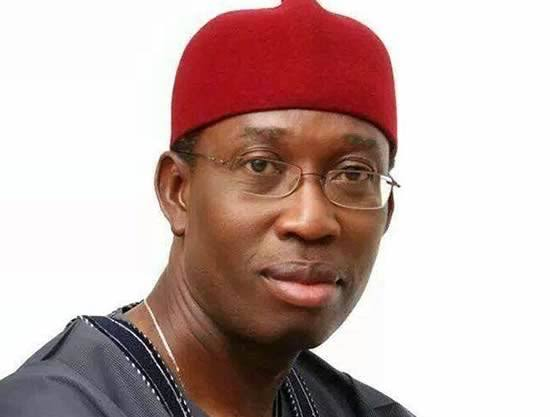
Governor Ifeanyi Okowa of Delta State

These lifetime benefits are separate from the huge monetized pensions and gratuities which are mostly 200% of their remunerations and allowances. It is very visible to all that Sections 3(2), 6(1), Table “C” of Schedule 1, and Part 3 of Schedule 2 of the Delta State Governor and Deputy Governor Pension Rights and Other Benefits (Amendment Law) 2019 were made in gross violation of the salient provisions of the Constitution of the Federal Republic of Nigeria, 1999, Cap C23, LFN,2004 (hereinafter called “the Constitution”) and other enabling laws passed by the National Assembly relating to the working conditions of a Governor and Deputy Governor. Section 1(3) of the CFRN provides that “If any other law is inconsistent with provisions of the Constitution, this Constitution shall prevail, and that other law shall to the extent of the inconsistency be void”

Deputy Governor Kingsley Otuaro of Delta state

Section 124 of the Constitution of the Federal Republic of Nigeria is the only legal authority that authorized the provision of gratuity and pension for Governors and Deputy Governors and has therefore covered the field in this area to the exclusion of any other provision that a State law may make which may conflict with the Constitutional provision. In the case of A.G. Abia v A.G.Fed (20020 6 NWLR (Pt.763) 264 held (per Kutiji, JSC) the Supreme Court re-emphasized the superiority of the Constitution when it held that“..the Constitution is the mirror upon which our actions or the actions of the National Assembly or any other public institution must be assessed. All actions must reflect the Constitution or else they will be considered as a nullity. That being the case, we have to look and see if the said Constitution has made provisions on a particular subject matter then, no other body can enlarge, alter and curtail the provisions of the Constitution”.

Now, let us do real business. Section 124 (1, 3, 4 & 5) of the Constitution (Remuneration, etc., of the Governor and certain other officers) provides

124(1) —There shall be paid to the holders of the offices mentioned in this section such remuneration and salaries as may be prescribed by a House of Assembly, but not exceeding the amount as shall have been determined by the Revenue Mobilization Allocation and Fiscal Commission.

124(3) —-The remuneration and salaries payable to the holders of the said offices and their conditions of service, other than allowances, shall not be altered to their disadvantage after their appointment.

124(4)—-The offices aforesaid are the offices of Governor, Deputy Governor, Auditor General for a State and the Chairman and members of the following bodies, that is to say, the State Civil Service Commission, the  State Independent Electoral Commission, and the State Judicial Service Commission.

124(5)—–Provisions may be made by a law of a House of Assembly for the grant of a pension or gratuity to or in respect of a person who had held office as Governor or Deputy Governor and was not removed from office as a result of impeachment, and any pension granted by virtue of any provision made in pursuance of this subsection shall be a charge upon the Consolidated Revenue Fund of the State.

The National Salaries, Incomes and Wages Commission Act, Cap N72, LFN, 2004 with a Long Title providing that it is “An Act to establish the National Salaries, Incomes and Wages Commission to, among other things, advise the Federal and State Government on national income policy”. Section 3(p) of the said Act (functions of the Commission) gives it the responsibility to “examine the current rate of retirement benefit and recommend appropriate mechanisms for periodic review of retirement benefits

The Revenue Mobilization, Allocation, and Fiscal Commission Act, Cap R7, LFN,2004 is the only body that is constitutionally empowered to determine the remuneration appropriate to the occupants of the offices of the Governor and Deputy Governor of a State, and this is amply supported by section 6 (d) of the Act (Powers of the Commission) which states one of its function to be the power to “determine the remuneration appropriate to the holders of the offices as specified in Parts A and B of the First Schedule to this Act”. In the First Schedule, one of the offices mentioned is the office of the Governor of a State. The powers of the Commission is better appreciated and seen in Part 1 of the Third Schedule to the Constitution Paragraph 32(d) thereof, which states, inter alia, the power to “Determine the remuneration appropriate for political office holders, including the President, Vice President, Governors, Deputy Governors, Ministers, Commissioners, Special Advisers, Legislators and the holders of offices mentioned in sections 84 and 124 of this Constitution”

A collective reading of the foregoing provisions of the Acts cited would confirm the obvious: that on matters relating to the post “retirement” benefits of a Governor or a Deputy Governor of a State, the Constitution and Acts aforementioned are the only laws that can govern/regulate same, save as to the pension of a Governor or a Deputy Governor, which the House of Assembly of a State can pass a law in respect thereof. Section 124 (5) of the Constitution only gives the House of Assembly of a State the power to pass a Law for the grant of a pension or gratuity to a person who has held the office of a Governor or Deputy Governor and completed his term, not both pension and gratuity. Therefore, the enabling Law for the grant of a pension or gratuity or “retirement” benefits to a Governor or Deputy Governor is the Constitution, particularly section 124 thereof, and the Revenue Mobilization, Allocation, and Fiscal Commission Act. So, in this respect the Delta State Government exceeded its constitutional limit when it acted on the purported Delta State Governor and Deputy Governor Pension Rights and Other Benefits (Amendment Law), to pay past Governors of the State including Chief James Ibori, Dr. Emmanuel Uduaghan, and soon, Dr. Ifeanyi Okowa, retirement largesse to the detriment of the people of Delta State; as the entire gamut of the Delta State Governor pension law is materially inconsistent with the provisions of section 124 of the Constitution, and therefore null, ineffectual and void.

Moreso, there is nowhere in the entire gamut of Section 124 of the Constitution or any other Act of the National Assembly where an “Acting Governor” is included in the class of Governors and Deputy Governors who can be entitled to pension or gratuity after leaving office. In fact, Section 124 of the Constitution is very clear that the occupants of the aforesaid offices must have served their full term of 4 years to be entitled to such benefits. Section 3(2) of the Delta State Governor and Deputy Governor Pension Rights and Other Benefits (Amendment Law) 2019 provides that “A person who discharged the functions of Governor or Deputy Governor as Acting Governor and having not been impeached from office shall on leaving office be entitled to pension for life in addition to other benefits as stipulated in Schedule 1 Table C and Schedule 2 Part 3 to this Law”.

It is my humble opinion that the entire provisions of Sections 3(2), 6(1), Table “C” of Schedule 1, and Part 3 of Schedule 2 of the Delta State Governor and Deputy Governor Pension Rights and Other Benefits (Amendment Law) 2019 are fundamentally and grossly in conflict with the provisions of Section 124 of the Constitution. The fons et origo in the Nigerian legal system is the Nigerian Constitution. The supremacy of the Constitution is not in doubt on matters that it has expressly provided for. Section 1(1) of the Constitution which states that “This Constitution is supreme and its provisions shall have binding force on all authorities and persons throughout the Federal Republic of Nigeria.”

On the need for public officials and institutions to preserve and advance the cause of RULE OF LAW as was emphasized in the case of GOVERNOR OF EBONYI STATE & ORS V. HON. JUSTICEISUAMA (2003) FWLR [PT. 169] 1210 @ 1227-1228, the Court of Appeal while stressing the need for public officials to obey rules of law held that: “Obedience to the rule of law by all citizens but more particularly those who publicly took oath of office to protect and preserve the constitution is a desideratum to good governance and respect for the rule of law. In a democratic society, this is meant to be a norm; it is an apostasy for government to ignore the provisions of the law and the necessary rules made to regulate matters”.

The Delta State Governor and Deputy Governor Pension Rights and Other Benefits (Amendment Law) 2019” is a perpetual enslavement of the people of Delta State who have been made to suffer the consequences of bad governance and mismanagement of the public resources. It is a fact that even a Judge that serves the State for 20 years before retirement is paid peanuts. Retired civil servants are practically begging for their accumulated pensions to be paid. Some have died without ever receiving their pension and gratuity. The most insincere aspect of the anti-people law is that Section 5 of the Principal Law makes the payment of the pension and gratuity of the former Governors and Deputy Governor mandatory as a first-line charge on the revenue of the State, by providing that the “Accountant-General may when authorized, to do so by the testimonial of completion of tenure stated in section 2 of this Law, pay out of the Consolidated Revenue Fund of the State such amount of money as stipulated in the first and second schedule of the Law and in such manner as prescribed by the Law”.

The said Section 5 of the Law did not envisage a situation where an Acting Governor (a former Speaker) would be paid because it made mention of a “testimonial of completion of tenure” as Governor for 4 years, which he never possessed. We, therefore, submit that making the “pension” of an Acting Governor (who is a former Speaker of the State House) chargeable on the Delta State’s Consolidated Revenue Fund is unconstitutional and highly morally reprehensible, being inconsistent with the strict provision of section 124 of the Constitution.

The reality of this thievery and inglorious provisions would be more appreciated if Delta State were to have 5 former Acting Governors still living; the cost of their pension, gratuity, and items stated in the schedule would not be less than N1,000,000,000.00 (One Billion Naira) every year. It is a fact that the over-monetization of political offices in Nigeria accounts for the desperation by politicians to win elections by all means. The purported Delta State Governor and Deputy Governor Pension Rights and Other Benefits (Amendment Law) 2019 is a BIG THUMBS DOWN for the State government in a State where basic amenities are lacking and many companies have folded up as a result of lack of conducive business environment and infrastructural facilities but the politicians in power seem indifferent as long as they take care of themselves. 

Notable Warri butcher stabs wife death after squabble about upkeep money

Ladidi Sabo

Officers of Delta State Police Command have arrested a well-known butcher in the state for reportedly stabbing his wife to death.

The butcher who purportedly practiced his art on his wife allegedly committed the crime in Warri, Delta State on Thursday evening of 13 April 13.  The suspect is currently in police custody

According to Police report, when the suspect returned home from Igbudu market where he operates as a butcher, he attempted to get hot water for a shower but his wife allegedly asked him not to touch the water stressing that he neither provides money for upkeep nor refills the cooking gas.

He was said to have ignored her and proceeded to the kitchen to fetch the hot water. Piqued by his demeanor, the deceased was said to have grabbed a knife but her husband overpowered and stabbed her several times until she collapsed. It was at that point, that he hurried her to a private hospital where she died.

On seeing the grievous harm done to her mother, their daughter who witnessed the entire sad incident dashed to the Police Station and reported the matter. He was immediately arrested.

In January, the Government of Anambra State said it has begun an investigation into the death of Ogochukwu Anene, allegedly killed by her husband, Wilson Uwadiegwu, over a loaf of bread.

News Agency of Nigeria (NAN) reported that a clip that was trending on social media claimed the victim, popularly known as Ada Awka, was beaten to death by her husband over a loaf of bread.

Anambra State Commissioner for Women and Social Welfare, Ify Obinabo said the State Government was collaborating with the Enugu State Government in the investigation to get justice for the deceased.

“Since the deceased is from Anambra, the state government will not keep quiet over the unfortunate incident, but will make sure that thorough investigation is carried out and concluded in record time,” she said.

Mrs. Obinabo urged women in abusive marriages to always speak out and seek help instead of dying in silence. The victim’s mother, Mrs. Anene, who alleged that her daughter was killed by her husband, said the suspect “fled immediately after carrying out the act.”  She called on the state government to come to their aid and give her daughter justice.

Mrs. Anene said: “Ogochukwu was beaten by her husband because she ate the loaf of bread he bought for the kids. When the children wanted to eat, he became furious about why they would ask him about the bread and pounced on her with a mirror and other objects which left her in a bad condition.

“Few days after the beating, my daughter was hospitalised at Niger Foundation in Enugu where they said she suffered internal bleeding as a result of an injury sustained during the beating.

“The doctors confirmed this after a series of scans were carried out and referred us to Enugu State University Teaching Hospital (UNTH), Ituku-Ozalla. While all these were happening, the husband was nowhere to be found.”

Again, Mrs. Anene disclosed that the investigating police officer is mounting pressure on the family to “drop the case.” The victim’s family is yet to be informed about the autopsy result, she noted.

In their article, Nigeria: 2022 – Year of Deadly Violence Against Women and the Need to Draw the Line, Tunde Oguntola and Royal Ibeh wrote that “in Nigeria, women and girls are subjected to multiple forms of violence in the home ranging from deprivation, starvation hitting, suffocating, burning, acid baths, poisoning, neglect, lack of care, verbal insults, degrading comments, torture and intimidation, female genital mutilation, child marriage, child abuse, denial, neglect, deprivation, and abandonment.

“While the real number of women who have died arising from domestic violence remains largely unknown, it is important to note that there are also cases of men who have lost their lives after domestic squabbles with their spouses, like Biliyaminu Bello who was stabbed to death by his wife, Mariam Sanda. However, evidence abounds that predominantly, women are largely impacted by domestic violence.

In Nigeria, the owners of the killers are back with impunity

By Chidi Anselm Odinkalu

Mbabai, the village where Tarnongo Mike Utsaha was buried on 1 April 2023, used to be part of the municipality of Makurdi, the capital of Benue State. It only became part of Guma Local Government Area in Benue North-West in 1987. The current governor of Benue State, Samuel Ortom, also comes from Guma.

The LGA derives its name from River Guma, which empties into the River Benue, part of a network of freshwater sources that have historically defined that part of Nigeria as the nation’s food basket. With arable land drained by an abundance of freshwater sources on the foothills of the rainy season, this is a neighborhood that should ordinarily bustle at this time of year.

The journey into Guma with Mike’s remains revealed the opposite. Mbabai and its neighboring villages had long been drained of life by mass atrocity. Mourners to the funeral needed the forceful presence of massive deployment of hundreds of well-armed soldiers along the route and in surrounding bushes to reassure them about their safety.

The compound in which the burial itself took place was nearly desolate. A capacious country home belonging to Mike’s dad, a retired judge, had been burnt twice over in attacks reportedly perpetrated, the villagers said, by armed herders. All the mourners could do was linger in the village long enough for the body to be laid into the ground before everyone scampered, grateful that there were no atrocity incidents.

As the mourners left, it was impossible not to ask how the people of Guma, nearly all of whom cannot afford what it takes to secure the kind of martial deployment that accompanied Mike’s cortege, bury their dead. It did not take long to find out.

Mgban is a village also in Guma, not too far from Mbabai. Like Mbabai, Mgban has also been decimated by regular attacks from armed herders. Most of the village lives in internal displacement. By an arrangement involving the state government and the Benue State Emergency Management Authority, the Benue State Police Command deployed several police officers every evening to guard the Local Government Education Authority (LGEA) Primary School in Mgban, so that those left in the community can go there to sleep at night.

That was until one week after the burial of Mike Utsaha. Shortly before mid-night around Good Friday, according to survivors, the police officers deployed around the LGEA Primary School in Mgban all entered their vehicles and left the premises without warning. The villagers already at the school to pass the night had no place else to hide.

Moments after the police retreated, armed attackers arrived, making a game of every person in sight, mostly the aged, women, and children. The initial casualty count was over 43 killed by sunrise.  By the end of the morning after the massacre, another 45 had also been evacuated to nearby hospitals in critical conditions. The dead got a quick and perfunctory mass burial.

Less than 36 hours before the Mgban Massacre, on Wednesday, also in the Christian Holy Week, another attack on mourners in Umogidi in Entekpa-Adoka District of Otukpo LGA reportedly killed at least 52 persons. Another mass burial was all that they could get.

48 hours before the massacre in Umogidi, a similar attack liquidated at least 47 unarmed persons in Ikobi village in Apa LGA, including the local chief.

Amidst this orgy of massacres, Benue State Governor, Samuel Ortom, who has since lost the ability to safely visit his village in Guma, traveled to Port Harcourt, Rivers State, around 6 April, reportedly to attend the commissioning of projects by his counterpart in Kaduna State, Nasi El-Rufai, both of them as guests of Rivers State Governor, Nyesom Wike. It was a characteristically thoughtless journey by a man who had long ago lost any sense of what a governor exists to do.

The symbolism of the encounter in Rivers State between the governors of Benue and Kaduna States, once implacable political foes, was not lost on many. In Port Harcourt, they could have been mistaken for a compatibly contented political pairing. Less than two years ago, in May 2021, they were at each other’s throats exchanging choice epithets with the abandon of drunken sailors in a bar-room brawl.

Between them, these two men have presided over arguably two of the worst records of mass atrocity in Nigeria in the past eight years. In 80 days in the first quarter of 2023, Kaduna State reported at least 125 killed and 60 abducted. Those who specialize in tracking these incidents would swear that these numbers massage the reality. Over five days in the first week of April 2023, Benue State lost at least 134 persons in a killing spree. In the period since the end of the presidential election in February, over 400 have reportedly been massacred in Benue State alone.

The timing of these massacres is significant. On 8 April 2023, Daily Times reported that “[p]alpable fear pervades the entire horizon as renewed incidents of banditry, kidnappings, killings take centre-stage after a ‘cease-fire’ noticed in Nigeria ahead of the general elections in February and March.”

The previous day had witnessed the high-profile abduction of a law professor and former Deputy Governor of Nasarawa State near the Federal Capital Territory, Onje Gye-Wado. The newspaper also recounted a staggering rise after the vote of mass abductions of children as well as massacres in many states around the country including Benue, Edo, Imo, Kaduna, Kano, Nasarawa, Lagos, Zamfara, among others.

Confronted with this trend, President Muhammadu Buhari, whose primary job is to guarantee the safety and security of all these people, had a statement issued in his name calling for “an end to extreme violence.” It was disconcerting to see the president mistake himself for a non-governmental organization and reduced to condemning violence and calling for something to be done about it as if he had forgotten that it was his place surely to do that something. The statement also seemed to imply that violence was alright if it was not considered “extreme”, but provided no criteria with reference to which to determine what extreme violence means. It was a very odd kind of thing for a president to say. But this Nigerian president has built his brand around toxic awkwardness.

Then, three days after issuing this statement, entirely in keeping with his habit of disregard for Nigerians over the past eight years, the president sauntered off to Saudi Arabia on 11 April for a nine-day long jaunt. What he went there to do was unclear, a fact not much helped by the desperate effort by his team of media handlers who were busy spreading false information about the trip.

While Buhari remained in Saudi Arabia, Samuel Ortom quickly announced the demobilization of the Benue State Livestock Guards, the militia group established to enforce the state’s anti-open grazing law. Many people read this to mean a suspension of the law itself. The Governor begged to differ, claiming that the law still remained very much in force without explaining who will now help him to enforce it.

Those who wonder how these killings have lasted and deepened in intensity for as long as they have need not worry anymore.  With a law without enforcers and a state rapidly turning into a cemetery, Benue State’s Governor Ortom probably knows one or two things most others may be unable to voice. First, the owners of the atrocity killings in Nigeria are back after the business of election rigging. Second, it is not difficult to know who they are.

When the Catholic Bishop of Sokoto, Matthew Hassan Kukah, spoke in his Easter Message about the urgent mission of helping Nigeria “recover from the feeling of collective rape by those who imported the men of darkness that destroyed our country”, he knew what he was talking about.

A lawyer and a teacher, Odinkalu can be reached at [email protected]

Election-related appeals are time-bound, NJC must ensure vacancies in Supreme Court and Court of Appeal are urgently filled

By Femi Falana

Election petitions have adverse effects on all superior courts of record in Nigeria. It has been confirmed that no fewer than 257 judges have been deployed for election petitions across the country. The judges are going to be preoccupied with election petitions for 180 days or 6 months. Very soon, more judges will be appointed as tribunal members after the governorship elections in Bayelsa, Kogi, and Imo States. The implication is that the other cases being handled by the affected judges will be adjourned until the next legal year.

The Federal High Court was saddled with the responsibility of attending to pre-election matters to the detriment of other cases including criminal ones and fundamental right applications since pre-election cases are time barred. I was made to understand that about 1,800 pre-election cases were filed in the registries of the various judicial divisions of the Federal High Court.

Meanwhile, the Court of Appeal has just concluded about 600 appeals arising from pre-election cases in the Federal High Court. Apart from the several presidential election petitions pending in the Court of Appeal, very soon, appeals from the Election Petition Tribunals in the 36 States will congest the docket of the Court of Appeal.

Of course, the Supreme Court,  has concluded over 120 appeals pertaining to pre-election matters. The apex court will soon commence hearing appeals from the Court in respect of the various presidential election petitions and governorship election petitions in all the 36 States of the Federation. The pressure is going to weigh heavily on the apex court because it has only 12 Justices. Again, all other civil and criminal appeals will have to give way to election related appeals.

The Court of Appeal is currently constituted by 77 Justices instead of 90 Justices. From the information at my disposal, not less than 3 Justices of the Court of Appeal are going to retire during the current legal year. In order to address the shortage of Justices in the Court, the bill to increase the number of the Justices from 90 to 110 ought to be speedily passed by both chambers of the National Assembly. In view of the fact that the election related appeals are also time bound, the National Judicial Council should ensure that the vacancies in the Supreme Court and the Court of Appeal are urgently filled in the interest of the nation’s justice sector. All stakeholders hold it a duty to ensure that enough Justices are appointed to man the appellate courts.

However, it is high time the Nigerian Bar Association led the struggle for credible elections in the country. I mean credible local government elections, pre-election and general elections. If fair and free elections are conducted by the Independent National Electoral Commission and state independent electoral commissions, the number of election petitions will be substantially reduce. The NBA should also campaign for the prosecution of electoral offenders including party leaders who impose candidates in breach of the Electoral Act. The full weight of the law should be made to descend on the few anti democratic forces that subject our country to ridicule, from time to time.

Lawyers insist the challenges of Nigeria’s Judiciary require a multilayered strategy

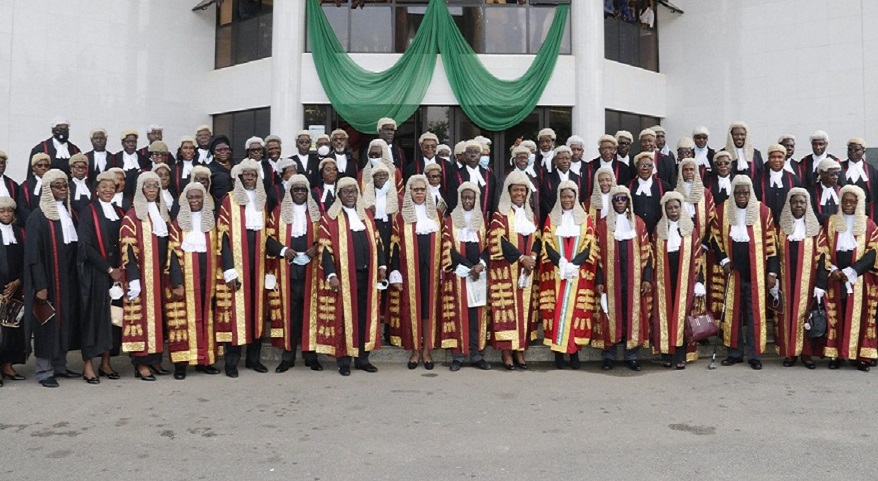
Nigerian Justices Photo Credit: DNL Legal and Style

By Lillian Okenwa

Senior lawyers have expressed discontent over how election petitions cripple the courts in an election year. However, they all agree that the challenges facing Nigeria’s Judiciary are complex and require a multilayered strategy.

Mrs. Funke Adekoya, SAN had noted that: “Presently ordinary litigants whose taxes fund our court system are treated as “inferior” to the election litigants who can well afford to pay the costs of special judges to be recruited only for election petitions.”

Femi Falana, SAN held that “if fair and free elections are conducted by the Independent National Electoral Commission and state independent electoral commissions, the number of election petitions will be substantially reduced,” and Kunle Edu, Esq. maintains that “ No sane country shuts down its judiciary because of election cases,

Other lawyers have also weighed in, presenting suggestions that could ameliorate the troubles of Nigeria’s judicial sector.

Olajide Abiodun Esq posited that “aside from the suggestions already mentioned, there are other solutions that can be considered to address the issues facing the judiciary in this country.” 

Increase funding for the Judiciary: The Constitution already provides for the financial autonomy of the Judiciary, but in reality, the Judiciary still depends on the Executive arm for funding. This creates a situation where the Judiciary is at the mercy of the Executive, and its operations are hampered due to insufficient funding. Increasing the budgetary allocation to the Judiciary will ensure that it has the resources it needs to operate independently and efficiently.

Implement technology-based solutions: Technology can be leveraged to reduce the workload of the Judiciary and make its processes more efficient. For example, electronic filing of court documents can reduce the time and cost associated with manual filing, and video conferencing can be used for remote hearings, thereby reducing the need for physical presence in court.

Address corruption in the Judiciary: Corruption is a major problem in the Judiciary, and it undermines the credibility of the system. Efforts should be made to identify and prosecute corrupt judges and court officials, and steps should be taken to prevent corruption from occurring in the first place.

Improve the recruitment and training of judges: The recruitment process for judges should be transparent and merit-based, and candidates should undergo rigorous training to ensure that they are equipped with the knowledge and skills needed to perform their duties effectively. This will help to ensure that the Judiciary is staffed by competent and impartial judges who can dispense justice fairly and efficiently.

Reduce the workload of the Judiciary: The Constitution prescribes time limits for the hearing of pre and post-election cases, but these time limits can be revised to reduce the workload of the Judiciary. For example, the time limit for filing election petitions can be shortened, and alternative dispute resolution mechanisms can be encouraged to reduce the number of cases that go to court.

In summary, the issues facing the Judiciary are complex and require a multifaceted approach to address. By implementing some or all of the solutions mentioned above, it is possible to improve the efficiency and effectiveness of the Judiciary and ensure that justice is served for all Nigerians.

Another lawyer, V.C Mba had this to say:

“In addition, and without prejudice to the measures adumbrated by @Kunle Edun Esq and O Abiodun Esq, I think it’s even more important to create courts of appeals and supreme courts for the states where most matters emanating from each state would be resolved, while only constitutional matters and matters between the states and federal government and or their agencies go to the federal supreme court, for goodness sake this is supposed to be a federal paradigm of political arrangement.

During the shameful and painful naira redesign fiasco, one of the justices of the supreme court had by way of an obiter decried the situation which has made it possible that all manners of ordinary husband and wife quarrel, landlord slaps his tenant, two factions of motor park touts fights over the control of the collection of tickets from commercial vehicle operators all other inanities end up in the all overcrowded dockets of the supreme court, but no one listened.

I think in addition to and without prejudice to the measures adumbrated and articulated, it’s even more important to create states appellate courts where all cases other than constitutional matters and or matters between the federating subnational units and or their agencies are resolved so that the federal supreme court may concentrate on the real issues, check out other federations and you cannot but agree with me that we’ve got it all wrong.

Above all, can’t we organize and conduct unimpeachable elections adjudged credible, free, and fair enough that even the losers would see no need to go to court? It’s because our elections are not elections properly so-called that warrants a situation where every election is contested and challenged in court, we need to build a robust institutional framework that would make our mostly useless elections tribunals unnecessary.

TIPS