Home Blog Page 766

How ‘OBIdients’ are redefining politics in Nigeria — Lawyer 

By Israel Arogbonlo

“The OBIdients have even gone as far as detailing the day-to-day activities in court…” – Juliet Ikhayere 

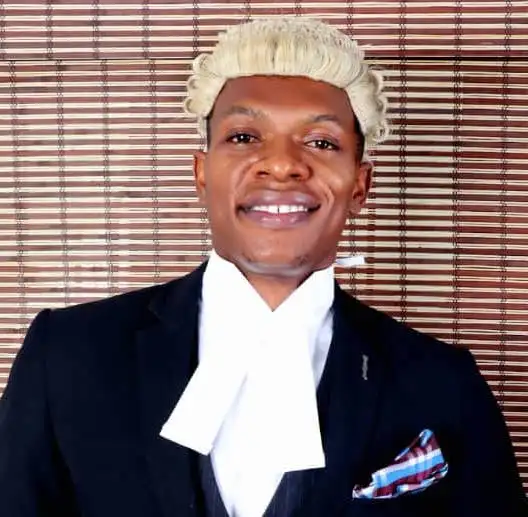
In this interview, one of the House of Representatives candidates of the African Democratic Congress (ADC), in th, Barr. Juliet Ikhayere gave an insight into the role of the OBIdient Movement in redefining Nigeria’s political landscape, especially with the ongoing Presidential Election Petition Court (PEPC) proceedings.

What’s your take on the role of Nigerians, especially OBIdients in holding Nigerian judiciary to account?

I think it is the most motivating thing to experience, especially as a young politician. To see that, the young, middle-aged and old are taking time to observe the court process and fixating their minds on the outcome of the judicial process. It is indeed a new dawn with such progress having been experienced since the commencement of the 2023 Presidential Electoral Tribunal. The OBIdients have even gone as far as detailing the day-to-day activities in court. I must say, I am super excited and my sincere wish is for same gesture to be extended to other tribunal matters in respective jurisdictions. All eyes must be on all aspects of the electoral tribunal. Justice once served will be to the returned winner, the electorate and the state. We need to embrace wholesome watch and effective participation. 

Do you think Obi’s truck-full of evidence is enough to reclaim his mandate?

Hopefully, Justice will take its course. I believe so

Considering the time allotted to Obi’s case, Is there any possibility for the court to examine all LP witnesses before the elapse of the case? 

It is understood that the number of witnesses to be called are to be settled during the pre-trial conference and I believe that the legal team must have reconciled these process and hopefully, it will be adhered to by the court.

Are there any legal implication should the INEC chairman continue to ignore court anytime he is being summoned?

Ignoring the court won’t stop the justices from deciding facts before it. Where onus is on a party to defend a claim, he ought to do so, or else his or her silence will be taken for affirmation.

What is your advice for Nigerians who still have little or no hope in the judiciary?

My honest advice for Nigerians is not to lose hope in one of the most important arms of government. As this journey to greatness is one that will involve each and everyone of us, non-participation/ observation of the activities of the state leads to tyranny. It then gives the power of the people to the government which should be the other way round. No matter what happens, Democracy is the only way for humans to live and enjoy the benefits of a state governed by a few. We must stay committed to it else we lose.

Credits: The Tribune

Police investigate how man connived with evil spirits to kill lover

The Delta State Police Command is currently investigating the role of an evil spirit in the murder of Felicia Akpomeria by the former Vice Chairman of Okolor Inland community, Udu Local Government Area, Delta State, Austin Ejovwo.

However, the former Local Government Area number two boss has been apprehended, for murdering his lover, Felicia although he insists it was precipitated by an evil spirit.

Meanwhile, the Delta State Police Public Relations Officer, DSP Bright Edafe has said the suspect will soon be charged to court.

Information from family sources revealed that Ejovwo escaped to Ologbo bush to meet a relative after committing the crime.

Felicia was found dead with matchet cuts last Friday in her lover’s bedroom in the pool of her own blood.

Felicia’s relative, Godwin Laya revealed that: “He admitted the killing of my sister, Felicia, he said it was something that enter his eyes to kill her. He accused his mother of bewitching him.

“I think the killer is diverting attention from his real motives for killing our sister. He did acknowledge at Ovwian Police Division where he was first detained that he was owing our sister.

“For us, he wasn’t pushed by any spirit. We hear he had committed an earlier murder. He belongs to the occultic. He either killed our sister for rituals or he killed her to evade refund of the money he was owing her.

“He ran to his sister’s place where they produce palm oil and with his behaviour, the sister wanted to bring him back to the village before she was called from the village that her brother killed a woman.

“It was his sister that took him to Ovwain police station after she was informed. If they had called us before taking him to the police station, if he was brought to us, we would have retaliated our sister’s death because we are angry.

“The government should ensure that justice is served on the suspect.

“The man is a suspected ritualist, because our sister was found near a shrine inside the house, though I was not allowed to see the corpse of my sister at the mortuary by the police.”

Over the years, people have blamed satan and his evil spirits for crimes. Whether he and his goons are involved in this matter remains to be seen.

Did Amazon dupe millions into enrolling in Prime? US regulator insists in lawsuit

Billionaire American entrepreneur Jeff Bezos who uses the words “Obsession and passion” to describe his drive has been accused by the Federal Trade Commission of using his firm in  ‘manipulative and deceptive user-interface designs to trick consumers.’

In a suit that has attracted global attention, the United States Federal Trade Commission has instituted an action against  Amazon for what it called a years-long effort to enroll consumers without consent into its paid subscription program, Amazon Prime, and making it hard for them to cancel.

The FTC, the US agency charged with consumer protection, filed a federal lawsuit in Seattle, where Amazon is headquartered, alleging that the tech behemoth “ knowingly duped millions of consumers into unknowingly enrolling in Amazon Prime” through a secret project internally called “Iliad”.

Senate Committee on Health, Education, Labor, and Pensions hearing to examine the American youth mental health crisis, focusing on causes and solutions, Washington, District of Columbia, USA – 08 Jun 2023<br>Mandatory Credit: Photo by Shutterstock (13955615g) United States Senator Bernie Sanders (Independent of Vermont), Chair, US Senate Committee Health, Education, Labor &amp; Pensions (HELP) presides over a Senate Committee on Health, Education, Labor, and Pensions hearing to examine the American youth mental health crisis, focusing on causes and solutions, in the Dirksen Senate Office Building in Washington, DC,. Senate Committee on Health, Education, Labor, and Pensions hearing to examine the American youth mental health crisis, focusing on causes and solutions, Washington, District of Columbia, USA – 08 Jun 2023

The lawsuit marks the first time the agency has brought Amazon to court since its chair, Lina Khan, took the helm in 2021. Khan, a former antitrust scholar, has been widely expected to take a harder line on tech firms that have for years enjoyed unabated growth and little regulation.

In its complaint, the FTC said Amazon used “manipulative, coercive or deceptive user-interface designs known as ‘dark patterns’ to trick consumers into enrolling in automatically renewing Prime subscriptions”.

It said the option to purchase items on Amazon without subscribing to Prime was more difficult in many cases. It also said that consumers were sometimes presented with a button to complete their transactions – which did not clearly state it would also enroll them into Prime.

Company leaders slowed or rejected changes that made canceling the subscription easier, the complaint said. It argued those patterns were in violation of the FTC Act and another law called the Restore Online Shoppers’ Confidence Act.

The FTC said that “one of Amazon’s primary business goals – and the primary business goal of Prime – is increasing subscriber numbers”. Antitrust advocates and big tech watchdogs applauded the move and called for more action against the e-commerce giant.

“Amazon’s monopoly over online shopping has resulted in a race to the bottom for the rest of us – violating our privacy, scamming us into keeping Prime memberships, and blocking us from even seeing the best available products,” said Kyle Morse, deputy executive director of the Tech Oversight Project, a non-profit watchdog organization. “Jeff Bezos and Amazon represent the very worst of big tech, and their contempt for their customers is glaringly obvious in how they conduct business.”

Launched in 2005, Prime has more than 200 million members worldwide who pay $139 a year, or $14.99 a month, for faster shipping and other perks, such as free delivery, returns and the streaming service Prime Video. In the first three months of this year, Amazon reported it made $9.6bn from subscription, a 17% jump from the same period last year.

In a news release announcing the lawsuit, the FTC said that although its complaint is significantly redacted, it contained “a number of allegations” that back up its accusations against Amazon. It also accused the company of attempting to hinder the agency’s investigation into Prime, which began in 2021, in several instances.

“Amazon tricked and trapped people into recurring subscriptions without their consent, not only frustrating users but also costing them significant money,” said Khan in a prepared statement. “These manipulative tactics harm consumers and law-abiding businesses alike.”

The tech giant has faced other lawsuits accusing its Prime cancelation process of being too complicated. Under scrutiny from the agency, the company in March provided consumers with instructions on how to cancel their Prime memberships in a blogpost.

In a statement, Amazon disputed the FTC’s claims and said that the agency announced the lawsuit without notifying the company first. Spokesperson Heather Layman said it was typical to have a dialog with commissioners before a lawsuit is filed and that the “absence of that normal course engagement is extremely disappointing”.

“The truth is that customers love Prime and by design we make it clear and simple for customers to both sign up for or cancel their Prime membership,” she said. “As with all our products and services, we continually listen to customer feedback and look for ways to improve the customer experience and we look forward to the facts becoming clear as this case plays out.”

Amazon has faced heightened regulatory scrutiny in recent years as it moved to expand its e-commerce dominance and dip its toes into other markets, including groceries and healthcare.

The lawsuit follows another Amazon-related win by the FTC just a few weeks ago. Earlier this month, Amazon agreed to pay a $25m civil penalty to settle allegations it violated a child privacy law for storing kids’ voice and location data recorded by its popular Alexa voice assistant. It also agreed to pay $5.8m in customer refunds for alleged privacy violations involving its doorbell camera Ring.

Credits: https://incafrica.com/library/john-brandon-jeff-bezos-used-only-9-words-to-perfectly-describe-entrepreneurial-success

Nigerian Law School at 60: Isa Chiroma, SAN revving up the stakes

By Lillian Okenwa

When the Nigerian Law School commenced operations on 2nd January 1963 to provide practical training for aspiring Legal Practitioners in Nigeria, there were only eight students: Sylvanus Ayere Ajuyah, J. S. Anyanwu, S. O. Chinke, I. A. Damiebi, O. C. Obi, N. N. Onuoha, I. O. Sonoiki, and N. N. Wachukwu.

In recent times, the Body of Benchers admits over 9,000 law graduates into the Nigerian Bar on a yearly basis and Nigeria has over 200,000 lawyers. The Supreme Court records indicate that the total number of legal practitioners increased from 120,006 in 2017 to 190,000 in 2019, representing an annual growth rate of 32 percent.

As the Nigerian Law School gears up to mark its 60th anniversary later this year, the impact of its Director-General, Prof. Isa Hayatu Chiroma SAN cannot be overstated. From a block Campus at 213A, Igbosere Road, Lagos to a seven-Campus Institution spread across the country with a yearly intake of well over 6,000, the role of Prof. Chiroma who began to steer the affairs of the School from October 2017 is evident in the institution’s recent trajectory.

Chiroma, a fellow of the Chartered Institute of Arbitrators (UK), the Law School chief executive is always quick to attribute the school’s feat in sustaining unbroken academic sessions in its 60-year history, to “the insistence of the Council of Legal Education on the good character of the students as a condition for both admission into the Law School and recommendation for Call to the Bar.”

Reeling out the milestones achieved by the School, the DG during a call to Bar ceremony once noted: “It is also significant to note that a large number of members of other tiers of government in the country are products of the school. The school has also contributed to the training of the legal manpower for our sister African countries like the Republic of the Gambia, the Republic of Sierra Leone, and the Republic of Cameroun. A number of countries from East and West Africa have visited the Law school to solicit information and assistance on the establishment and development of the Law School in their various countries… [A]t the last Call ceremony the Nigerian Law School received a high-powered delegation from the Law Development Centre, Uganda, who were in Nigeria on benchmarking and working visit to the Nigerian Law School and more of such collaborations have continued to come.

“Products of the School have a commanding presence in other spheres of public and private sector such as the Ex-Military, Police, Customs, Immigration, the Oil and Gas sector, Banking and Finance, Insurance and the Corporate world in general, Professors/lecturers in the Universities and other tertiary institutions. Some of these products have achieved profound feat of getting to the top of their career nationally and across borders.”


On 10 December 2021, ex-President Muhammadu Buhari reappointed the Senior Advocate of Nigeria as DG for another term of four years. When the news was broken to members of the Council of Legal Education (CLE), its Chairman, Chief Emeka Ngige (SAN) urged him to use his second tenure to consolidate his achievements and take the Nigerian Law School to the next level of development.

Then on Saturday 4th of February, 2023 Chiroma literally added more feathers to his cap with his turbaning as the Chiroma of Mubi, Adamawa state. The event was attended by a cross-section of dignitaries from all works of life and especially the legal profession.

Isa Hayatu Chiroma was born on 13th April 1963 in Mubi, Mubi North Local Government of Adamawa State. He attended Mubi I Primary School from 1970-1976, Government Secondary School /Government Technical School, Mubi from 1976-1981. He holds LL.B. (Hons.) Degree, Second Class (Upper) from University of Maiduguri (1986), LL.M. (1991), and Ph.D. in Law (2005) from the University of Jos.

During his one-year mandatory National Youth Service, he served with the defunct Directorate of Investigation and Intelligence (DII), Alagbon Close, Ikoyi, Lagos.

He was called to the Nigerian Bar in March 1988; joined the Faculty of Law, University of Maiduguri same year as Assistant Lecturer, and rose to the rank of a Professor of Law in 2005. He was at various times Head of the Department of Shari’ah, Public Law, Deputy Dean, Dean of Law, and Director of Consultancy Services Centre, University of Maiduguri. He was the founder and coordinator, Clinical Legal Education Programme, a member of the University Senate and various standing and ad hoc committees at various times. While at the University, he taught Constitutional Law, Administrative Law, Islamic Jurisprudence, and Islamic Family Law at the undergraduate level. He also taught Human Rights, Environmental Law and Policy, and Humanitarian Law at the postgraduate level. He has supervised a substantial number of Masters and Ph.D. candidates. His research interest includes Human Rights, Humanitarian Law, Environmental Law and Policy, Access to Justice, Ethics in the teaching and practice of Law, and Law and Development.

Chiroma is a member of many professional bodies including the Nigerian Bar Association, International Bar Association, African Law Association of Germany, Society for Corporate Governance, Global Alliance for Justice Education (GAJE), Nigerian Institute of Mediators and Conciliators, Fellow of the Institute Management Consultants and Fellow of the Chartered Institute of Arbitrators. He is also a Notary Public.

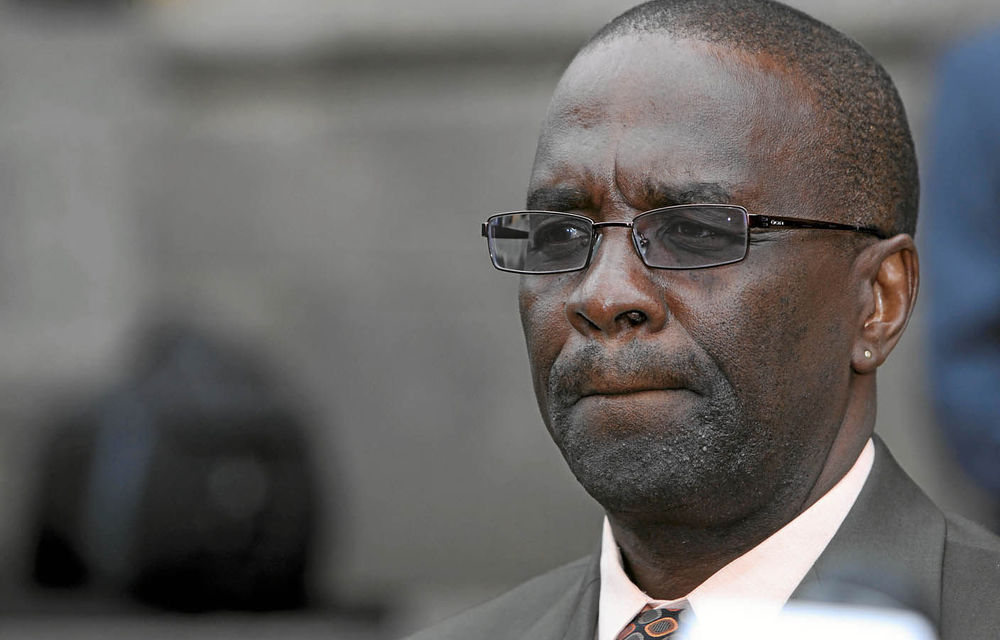
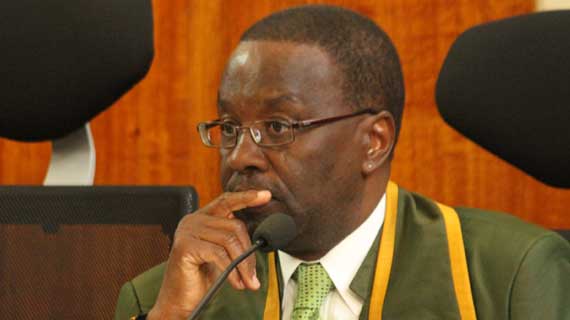
Fit and Proper? Meet Kenya’s immediate past Chief Justice who wears a stud in the ear

By Lillian Okenwa

In Nigeria, conversations around being fit and proper in terms of dressing particularly when senior lawyers are speaking about juniors outstrip discussions about ethics and living by example. In 2011 during his tenure, the now ex-Chief Justice Willy Mutunga announced on Facebook and Twitter that Kenya’s judiciary will entertain a new dress code that will allow judges and lawyers to wear studs or even dreadlocks. This surely is capable of giving conservatives in Nigeria a double heart attack.

Responding to queries on social media about the proposed dress code, the Chief Justice disclosed that “the Judges of the Supreme Court have agreed that we have no issues with anyone appearing before the Supreme Court, wearing their studs. Our position is that as long as officers of the court – both lawyers and judges can appear smart, a stud – or indeed dreadlocks – should not hinder the administration of justice.”

In a 23 November 2012 article titled: Weary Kenyans pin hope on hip judge, Mail & Guardian wrote about the swank Kenya’s immediate past Chief Justice who wears a stud in his left ear.

I

Don’t look what is on Willy Mutunga’s ear but rather what is between his ears.” That was the pithy comment of one Kenyan blogger when controversy erupted over the appointment of a chief justice with a penchant for ear studs.

Mutunga is a tad revolutionary by Kenyan standards, not only because of his sartorial tastes, but because he is a former human rights activist who was hired to clean up Kenya’s justice system. Activism and earrings spell trouble for an entrenched elite in a socially conservative country where the phrase “why hire a lawyer when you can buy a judge?” is a sardonic reminder that corruption runs deep.

Yet to millions of Kenyans Mutunga represents a possibility that the stranglehold of state corruption and impunity can be broken – a possibility, not a certainty.

In his wood-panelled office in what was until recently the high court, Mutunga is remarkably approachable. The trappings of high office are still evident: the paintings on the walls, the security detail at the door and the entourage of fawning lawyers outside, eager for a discreet word. But there is an air of informality about him. He answers his own emails, keeps to our agreed schedule and offers me his personal copy of Kenya’s new Constitution. I suspect he has probably memorised most of it by now.

As Kenya heads for fresh elections in less than five months’ time, Mutunga confided that he was having sleepless nights. As chief justice, his job will be to swear in the next Kenyan president. Last time round it was like a shotgun wedding: a rushed, hastily convened ceremony – characterised by diplomatic absences and empty seats – to confirm Mwai Kibaki’s second term – an election that many believe was rigged.

Election disputes should, in theory, be handled by the supreme court, but after the previous poll, amid claims by Kibaki’s opponents that the election had been “stolen”, the politicians took their fight to the streets. “If we can’t arbitrate next year, then that will be the end of the institution, I think,” was the sober warning from Kenya’s most senior judge. “We can’t have the judiciary rejected again and really survive.”

Ruffling feathers
But the legal landscape has changed. In 2010 Kenyans approved a new Constitution – the first since independence in 1963. It brought with it the promise of devolution of power, a bill of rights, gender equality and, crucially, reform of the judiciary – effectively forcing sitting judges to reapply for their old jobs. So in May 2011, in a nationally televised broadcast, Mutunga was interviewed for the top legal job. He impressed and he was hired. Kenyans watched open-mouthed as this “neoliberal”, earring-wearing academic-turned-activist was given his robes and sent off to shake up the establishment.

A year later he has already made inroads fighting impunity in the judiciary. The country’s deputy chief justice, Nancy Baraza, resigned a few months ago after allegations that she threatened a security guard with a gun. Mutunga has promised that more heads will roll. Among them will be “backroom staff” – key recipients of bribes in the legal system. But he is coming up against “resistance from very powerful forces”.

This one-time detainee under former president Daniel arap Moi, who spent time in exile in Canada, is ­ruffling feathers. “Kenyans have basically said that the status quo is unacceptable,” he said, adding that the new Constitution is not about “overthrowing it but mitigating it”.

But, with the ink barely dry, Mutunga points out concerted attempts to “sabotage” new legal freedoms that have taken a half-century to secure. Sacked lawyers are seeking to get their jobs back and senior police officials are clamouring for court orders to exempt them from giving evidence to the International Criminal Court, which is investigating alleged crimes against humanity following Kenya’s elections in 2007. Those elections brought what was once considered a regional safe haven to the brink of civil war. About 1200 people were killed and half a million left homeless during violence that exposed fragile ethnic tensions.

In a country in which 46% of the 41million population live in poverty and a handful of politically connected families own a sizeable proportion of the land, Mutunga knows that a lot is at stake in the next election. Historical injustices have not been addressed and two presidential hopefuls face the prospect of jail if the International Criminal Court can prove its case. The critics accuse him of being “inexperienced” in practising law and display a prurient interest in his marital affairs, but he is an outsider who has been brought in to spearhead the reform agenda and he shows no signs of shying away from that.

So, has Kenya learnt lessons from its recent past? For the chief justice, the jury is still out. On the face of it Kenya is co-operating with the International Criminal Court, which is investigating “war crimes” allegedly perpetrated by four senior figures – two former ministers, a radio DJ and a former head of the civil service. But the reality is very different. Mutunga recently met the court’s chief prosecutor, Fatou Bensouda, who publicly complained that she was struggling to obtain key documents and evidence from the Kenyan authorities.

Ethnic suspicions
Although Bensouda has recited the mantra that it is a judicial investigation and not a political witch-hunt, Mutunga said the argument cut little ice in Kenya. “There is a very thin line between police, justice and law in Kenya. The court is being used by some politicians to whip up ethnic suspicions in Kenya. What the Kenyans don’t realise is that the court is not a foreign court, it is a Kenyan one; the Constitution says it is part of our legal system.”

But perceptions are everything. “If this election is not free and fair and we get into trouble, people are going to say that the International Criminal Court was the main culprit,” he said.

The shooting dead of dozens of young police recruits less than a fortnight ago in the remote and arid northern Samburu region and the recent massacre of civilians in the southeast of the country are stark reminders of simmering tension. Although on the face of it these were local disputes, most people are able to read the political signs. Historically, local rivalries have been manipulated at election time.

Kenya may have moved mountains to secure a new “basic law”, emboldening a population to demand more accountability from its leaders, but it is the police that worries Mutunga the most. “There is an assembly line for the administration of justice and police reforms are as critical for me as judicial reforms,” he said. Yet Kenya enters the next elections with the same police force it had during the previous poll – albeit led by a new police commissioner.

Stories are now swirling around the Kenyan media about links between the police and illegal militias and gangs that are allied to rival political parties contesting the upcoming elections. At this stage the claims are hard to prove, yet there is a palpable sense of nervousness.

Mutunga recounted how, in August, he attended a meeting at which the Kenyan president vowed to disarm and disband the militias. “The issue for me is: Who is going to do that? Everybody knows there are links between these militias and the police.”

There is little evidence that much has changed in the investigative arm of the “assembly line”. Vigilante groups and the police are among those being investigated by the International Criminal Court. What is frighteningly different this time is that more people have guns, assisted by the spillover of weapons from neighbouring Somalia and South Sudan. “Too many arms in the wrong hands in this country worries me [and] that nothing has been done.”

Despite the government’s insistence that elections will be peaceful as voter registration gets under way this week, many Kenyans, like the chief justice, are yet to be convinced.

A larger part of this article was originally published on https://mg.co.za/article/2012-11-23-00-weary-kenyans-pin-hope-on-hip-judge/

How Justice Binta Nyako emerged President International Association of Women Judges

By Lillian Okenwa

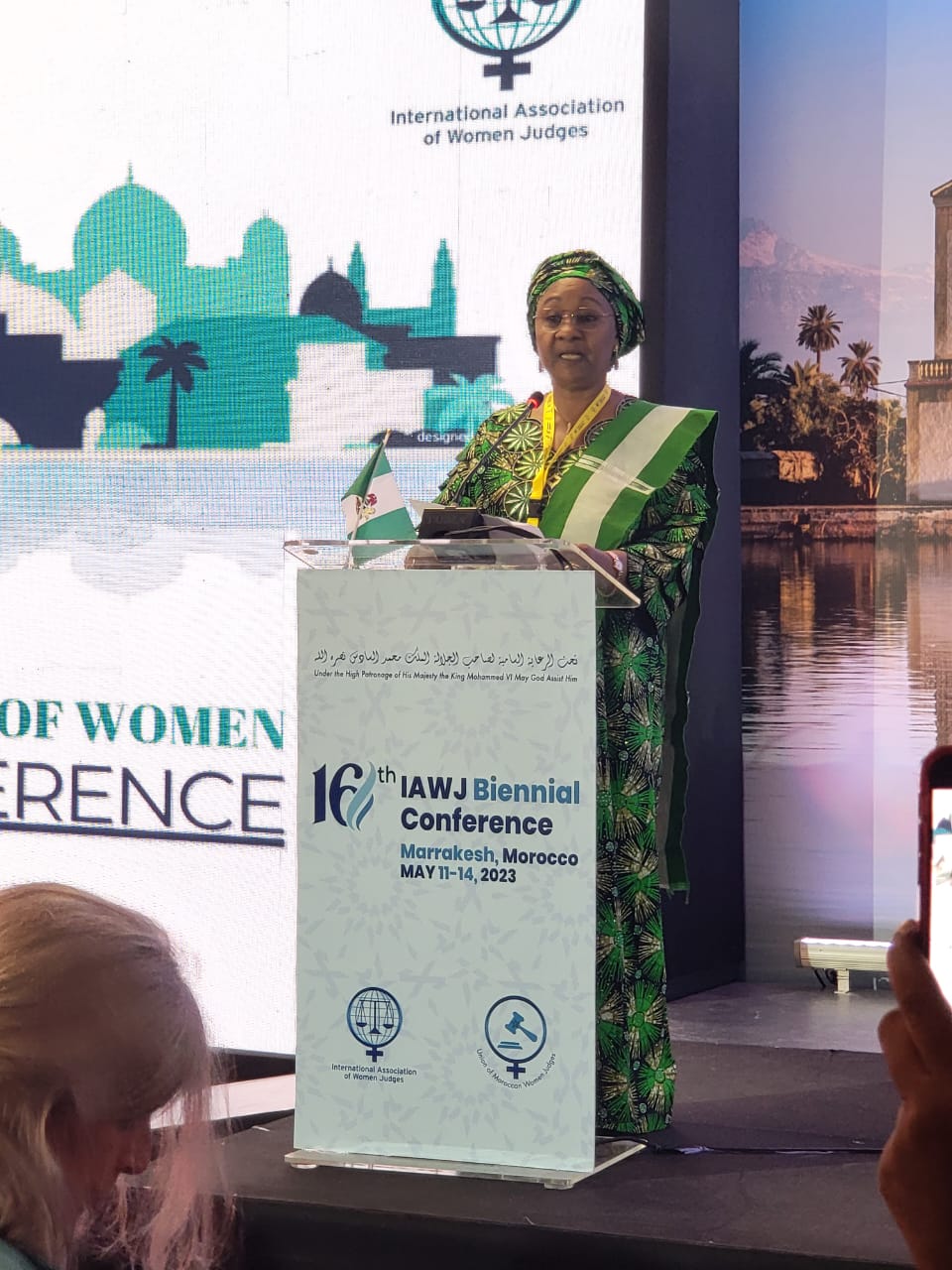
On 14th May 2023 in the presence of 1200 female judges from all over the world, at Marrakesh, Morocco, Hon. Justice Binta Fatima Nyako received a unique birthday package with her inauguration, as the President, International Association of Women Judges (IAWJ). Justice Nyako who has been a judge of Nigeria’s Federal High Court for 23 years was elected unopposed. Her tenure will run from 2023 to 2025.

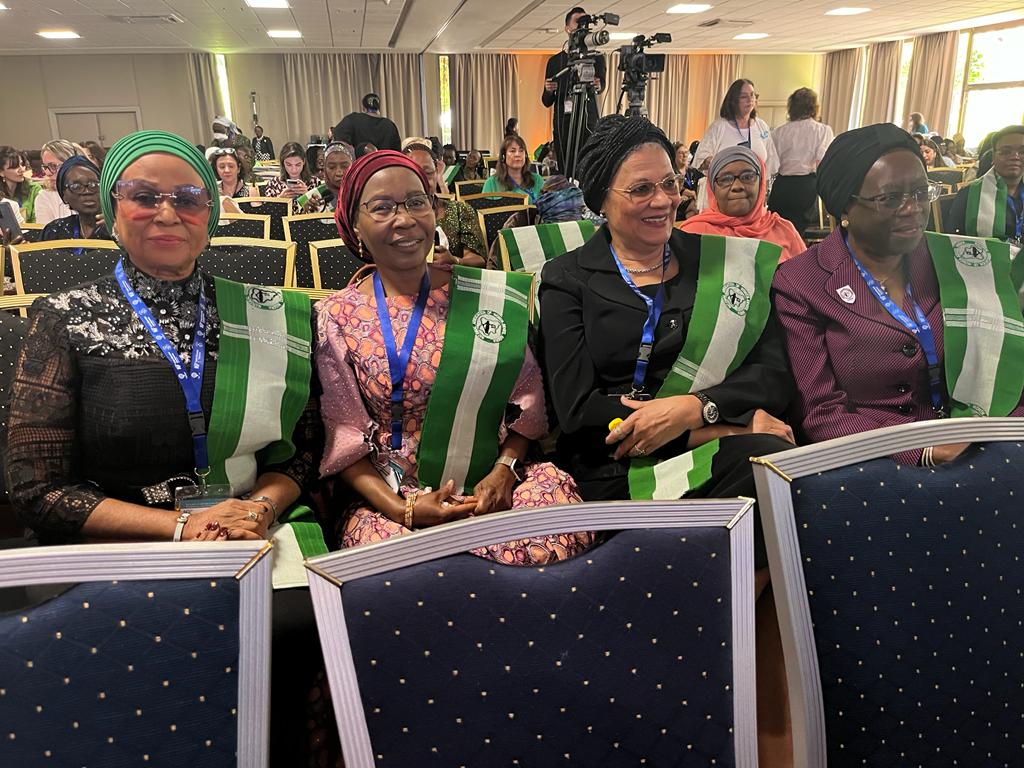
L-R: Hon. Justices Chinwe Iyizoba, JCA (rtd.), Helen Ogunwumiju, JSC, Kudirat Kekere-Ekun, JSC, Binta Nyako, J, Amina Augie, JSC, Uwani Musa Abba Aji, JSC, Chidiebere Uwa, JCA and Jummai Sankey, JCA

Born on May 14, 1959, in Remawa Local Government, Katsina State, Binta Nyako, is the first indigenous female from Katsina to study law. Her first choice was anthropology. Not because she knew what it implied; she was fascinated by the sound of the name. Law was the second choice and that was what Ahmadu Bello University (ABU) Zaria opted to offer her.

But in the family, they thought she was a natural lawyer. The story is told of when as a little girl an uncle who was serving tea to all the little children in the morning forgot to put milk in her tea. “I didn’t know how to tell him that he forgot to put milk in my own tea so I announced that hmmm my tea is the sweetest. My uncle turned, looked at me, and said, ‘How come your tea is the sweetest?’ And I answered, ‘Because you forgot to put milk in my tea.’  He now said, ‘This one is a lawyer.’ Rather than get upset, I used my head and ended up with more milk than everyone.”

In her inaugural address, Justice Nyako who is the first Muslim IAWJ President promised to get other countries to join the association. She told Law & Society Magazine how she plans to do it.

“A lot of countries have reservations about what we’re all about so we’re trying to let them know we’re not political; that we don’t have any religious backing or ideology we’re trying to push. We are just trying to bring together women of like minds to learn from one another. A lot of countries in Asia particularly India and other neigbouring countries have individual members but that is different from chapters. We want to invite as many countries as possible to join and form chapters so they can be represented as a country. Before we left Marrakesh, I was approached by representatives of two countries to enlighten them on how to go about setting up chapters in their countries.

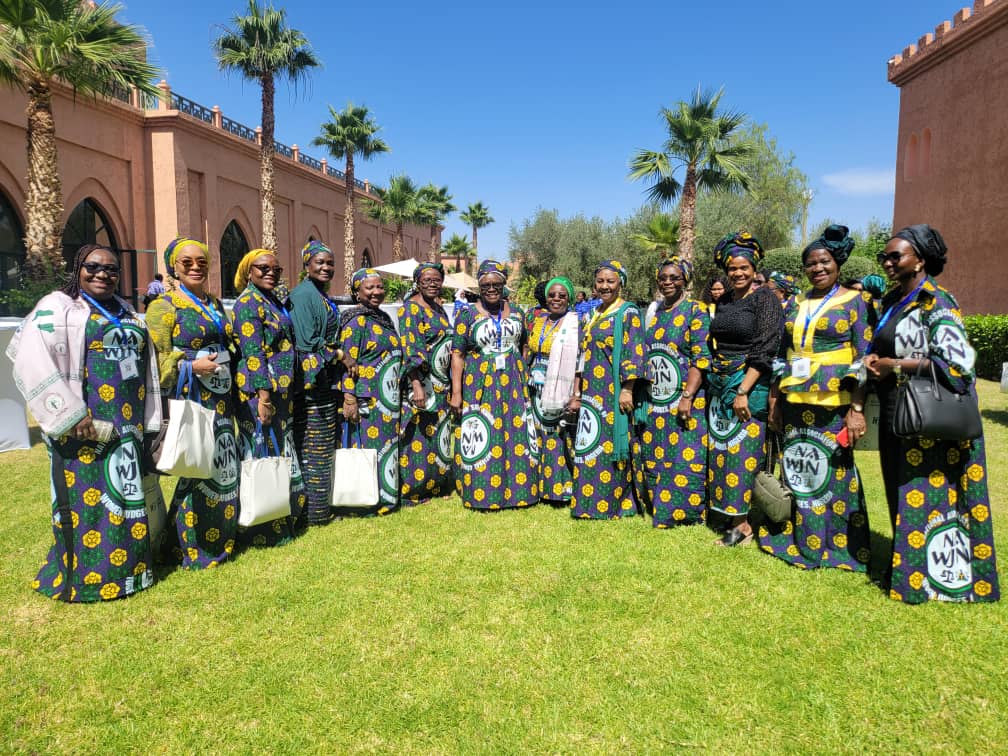
The Nigerian delegation

“You will be surprised to learn that when panelists were telling their stories in one of the sessions I chaired at the conference, you’ll think they are talking about Nigerian issues. Everyone has the same problem even if you have a different way of presenting it. So, if you have an opportunity to interact and also learn, you go for it. We have countries in the Arab Muslim world including the UAE and African countries in the MENA region that are predominantly like Arabs. They don’t understand what the association is all about. The last but one president who is from the United States, was the image maker. The last is from New Zealand. I’m from Nigeria. And I’m coming in as the first Muslim president of the association so they can now appreciate that there’s nothing to it. We hope to use that kind of sentiment to win them over.”

The IAWJ was founded in 1991 by Arline Pacht an American jurist in her basement. Hon. Justice Roseline Ukeje, the first female Chief Judge of the Federal High Court was a founding member. Within that inception stage, Hon. Justice Constance Momoh, a former Chief Judge of Edo State, and then the Hon. Justice Alooma Maryam Mukhtar, the first female Chief Justice of Nigeria became part of the founding members. Judge Pacht envisaged forming an association of dynamic women to help mentor women judges, the girl child, and more.

L-R: Hon. Justices Chinwe Iyizoba, JCA (rtd.), Uwani Musa Abba Aji, JSC, Amina Augie, JSC and Kudirat Kekere-Ekun, JSC

Information obtained from the IAWJ website indicates that the association is essentially geared towards promoting and empowering “women judges who can help uproot gender bias, end discriminatory laws, advance gender-responsive courts, and promote human rights for all.”

Speaking further with Law & Society, Nyako recounts her journey to the world stage and becoming the head of this prestigious association that brings together women judges from all levels of the judiciary worldwide.

“At some point, I became the International Director for the Nigerian chapter, (National Association of Women Judges, Nigeria (NAWJN)). Justice Rosaline Bozimo was National Chair at the time and I was on the board as International Director meaning I’m the liaison between the local and the international chapters. Then there was a vacancy at the international level for African Regional Director. Every region in the world has two reps. We use the same UN system that divides the world into five regions. The Africa regional group elected me as one of the two to represent Africa.

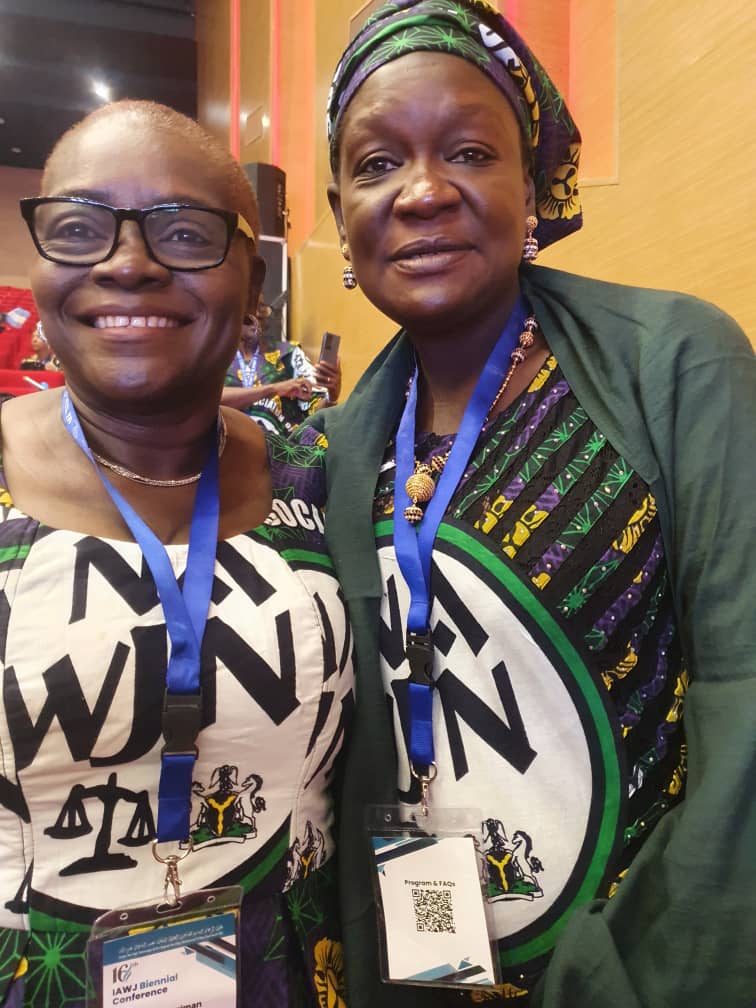
Hon. Justices Roli Harriman of Delta State High Court and Aisha Ali Borno State High Court

“It was a term of two years. When it was time for the second term at the conference which was held in Arusha, Tanzania, I was not on the Nigerian delegation but the African regional contingent elected me in absentia for a second term making it four years on the international board. Afterward, I was elected again to be the board’s first Vice President. I did two terms. and I was unopposed in all these. Subsequently, I became president-elect in 2021. What happens is that we elect our president two years ahead. I was not interested in any position having just come out of covid and isolation but nobody vied for the position.

“When I got in touch with the board asking why nobody has indicated an interest in the opening, they said Binta we’re expecting you to take over. You have been one of the longest-serving members of the board. You know all the workings and programmes we have implemented so you’re the most natural person to take over. At the last conference at Marrakesh on 14th May, I automatically took over as president.

“After being Regional Director, I got to know a lot of women judges from around the world. One of the conditions for being an international officer is to attend all the board meetings and international conferences. I have attended many of these in so many countries. In the Nigerian Chapter, we have eight elective positions. What we did to have an even representation of the county in the Nigerian chapter is split the position between North and South. Four positions to the north and four to the south. The following election they switched. When we went to South Korea for one of our conferences, we had many Courts of Appeal and Supreme Court Justices in attendance. On our way back to the hotel, Justices Clara Ogunbiyi, Bozimo, and Zainab Bulkachuwa who were in that bus commented on how I interacted with the international delegates.

“They then suggested that since an election is coming up in Nigeria, I take up the presidency so as to refocus the Nigeria chapter towards the international forum. I objected but they insisted and when it was time for the local chapter conference and election I was elected as president. I ended up serving for three years instead of the normal two. It turned out that during my tenure, I made so much contact with other African countries. Also, a regional conference was going to hold and all the African judges seemed to wager for it to hold in Nigeria. On account of this it was suggested that since I have interacted more with these judges, I should be the one to host the conference. My tenure was going to expire before the conference so it was extended for me to host it. Instead of serving from 2010 to 2012, I served till 2013. And although it was an Africa regional conference we had representatives from the US, Argentina, India, and others. It was held in Abuja. It was very successful.”

Congratulations to Hon.Justice Binta Nyako, the new president of the International Association of Women Judges.

PS. Her speech is about five after the dancing. Forward to about 5 minutes into the video:
https://youtu.be/GS27DgHA138

Another monetary policy that smacks of 1980s SAP, Somber Tuesday series by Mojúbàolú Olufúnké Okome

SomberTuesday! The new President is appointing staffers at a pace much faster than his immediate predecessor (https://www.channelstv.com/2023/06/19/full-list-president-tinubu-appoints-new-service-chiefs-names-ribadu-nsa/ )

From looking at the lineup announced thus far, it’s clear that the 35% threshold for women’s political participation has not been met. When this issue is raised, people tend to say that such appointments should not be about mere representation but about having the requisite skills/qualifications to do the job. Given the concern for merit that such responses imply, it’s amazing that hardly anyone questions the men appointed on similar grounds that demand merit. It’s just assumed that the men are qualified. In any case, Nigeria has a tremendous challenge when it comes to equity for women. Is there a political will to address the problem?

We have now heard from Justice Zainab Bulkachuwa, whose husband, Senator Adamu Bulkachuwa, claimed that he helped out his fellow legislators to sway the Justice to favor them in her rulings, saying among other things… “And I must thank particularly, my wife, whose freedom and independence I encroached upon while she was in office, and she has been very tolerant and accepted my encroachment, and extended her help to my colleagues…” Justice Zainab Bulkachuwa, the past President of the Federal Court of Appeals has now spoken out to defend her record. (https://dailytrust.com/i-never-compromised-my-office-justice-bulkachuwa-breaks-silence/ ) She denied subverting judicial integrity and the rule of law: “My attention has been drawn to the trending video of what was said by my husband Senator Adamu M. Bulkachuwa. I want to state categorically that I never at any time compromised my oath of office to favour any party who appeared before me throughout my judicial career spanning 40 years of service to my country.

“My decisions were always based on the facts, the law and in accordance with my conscience and oath of office.

“Also, as President of the Court of Appeal, my fellow justices of the court can attest to the fact that I never interfered with the independence of any of the justices of the court in the discharge of their judicial functions.” Her husband has also now “walked back” his claims, translated from Hausa in the news report thus: “Well, I was not even allowed to finish, I just started with some words like thanking her, saying she was patient with me as she was a legal practitioner and I am a politician.

“I wanted to elaborate on the specific nature of the help she provided, as there exists a wide range of support that professionals in various fields, such as legal practitioners, doctors, or engineers, can offer in their respective roles.

“Note that this assistance does not involve any illegal or unethical activities. In my personal relationship with her, I have never imposed upon her professional autonomy or attempted to influence her judgment in handling cases or running her office. Such matters are not even discussed in our home.” It would take naivete of the highest order to believe anything we are hearing post facto. I believe both the Senator and Justice have a case to answer, and that this matter is too important to be settled through pronouncements in the media. The case also speaks volumes about our democracy in Nigeria. Separation of powers and judicial independence should be sacrosanct in any worthwhile democracy. There should also be respect for and strict adherence to the rule of law. Without these, we are just playacting because our institutions are weak, ineffectual, and compromised. Nigerians also should realize that the electorate has a responsibility to vote for people who understand their duties, primary of which is respect for the rule of law and diligently representing those who voted for them.

Although Godwin Emefiele was suspended as the Governor of the Central Bank, and he’s now being interrogated by DSS or EFCC (who knows?), as I also said weeks ago, “we are still living with the effects of the currency change and the lack of physical naira it produced continues to make life unbearable for most Nigerians”. The decision to keep the old naira in circulation has eased some of the difficulties for ordinary people, but problems persist. You can’t go to an ATM and withdraw money.

The normalization of insecurity is terrifying. We wait anxiously for the current administration to live up to its promise and curtail it. This does not prevent or ease the deep financial and psychological trauma imposed on victims, survivors, and their families. It is great that the current administration has promised to end insecurity (https://editor.guardian.ng/news/tinubu-directs-military-to-turn-tide-of-insecurity-in-nigeria/). The firing/sacking of the service chiefs is meant to be a response to the insecurity problem, but Nigerians are yet to see the results of these measures and feel their positive impact.

As the meteorological experts warn of impending floods this year, what has happened to past victims and survivors of natural disasters, ethno-religious conflict, and insurgencies? Among them are the internally displaced who have been traumatized materially, psychologically, and existentially. What corrective measures are taken to meet their needs and make them whole? NEMA and the various SEMAs are also unfit for purpose. They must be rigorously overhauled to make them perform the functions for which they were created.

There’s a new Education Act. I doubt that we understand what kind of Pandora’s box we are trying to open with it.

Since we are fond of drawing analogies based on what’s perceived to have worked elsewhere, I’ll reproduce here what I said to friends about the student loan issue. The student loan problem in the US is serious enough that the Biden administration initiated a loan forgiveness scheme (https://www.chamberofcommerce.org/student-loan-statistics/) that is being subjected to partisan pressure from the Republicans, and may ultimately be suspended ad infinitum. Also, higher education remains highly subsidized in the US. Subsidies just to students were high http://(https://www.statista.com/statistics/235334/student-grants-in-the-us/). There’re also subsidies to universities. This is just the Biden administration’s subsidy for historically Black colleges (https://www.whitehouse.gov/briefing-room/statements-releases/2022/03/07/fact-sheet-department-of-education-announces-state-by-state-american-rescue-plan-funding-for-colleges-and-universities/). The US government has also historically subsidized research and development (https://www.aaas.org/programs/r-d-budget-and-policy/rd-colleges-and-universities). There’s more evidence of subsidies but the information provided gives you an idea.

Why go the route of student loans in Nigeria, a country where we have rampant unemployment and underemployment plus multidimensional poverty afflicting 133 million people? Why embrace a clearly neoliberal solution for the serious problem of access to education?

There’s as well, a new foreign exchange policy. This is another neoliberal strategy that reminds me of the initiation of SAP in the 1980s when the exchange rate was allowed to float. Instead of eventually leading to both lowered exchange rates, harmonization of all exchange rates, and ultimately, economic growth, nothing that was promised was delivered. Therefore, judging from past experience, as I also said to colleagues, things might get much worse before they ever get better, if at all. The prospects for better results are impeded by our not producing enough exports, our import dependency, and our lack of preparedness to manufacture what we consume.

Nigeria is saddled with weak political institutions, too many millions of out of schoolchildren, teeming populations of unemployed, and underemployed youths, and millions of overworked, underpaid workers. Add these gargantuan problems to infrastructure decay and poor policy implementation, it becomes necessary to worry about how Nigeria could reach its full potential anytime soon.

Among the institutions needing thorough overhaul is INEC, whose performance in the last elections was sub-optimal. Just as the Bulkachuwa case makes one question the integrity of the legislature and judiciary, INEC’s lack of fitness for purpose compromised electoral integrity. As I said in an earlier piece, “honest assessment would indicate that there were troubling electoral malpractices, pockets of violence, and voters not being able to vote because INEC had logistical and technical problems. The Bivalent Voter Accreditation System (BIVAS) machines malfunctioned in some polling units”. There were also cases of vote-buying (despite the currency scarcity), voter intimidation, and voter suppression.

I said the following shortly before the elections: “Where is the free and fair elections that Nigerians expect and deserve? What does this situation portend for our fledgling efforts at democratization? Will those who win these elections and those scheduled for March 11 (voting for state governors and local government councilors) do anything they have pledged, promised, and sworn to do to meet the needs of Nigerians? The majority—poor masses, youths, and women, as well as people living with disabilities and ethnic minorities, will bear the brunt of the failures. So will the system that we said we want—democracy”.

EndSARS youth protesters voted in large numbers in the 2023 elections. This was an expression of confidence that it is possible to accomplish good governance, end police brutality, extortion, impunity, economic inequality, marginalization, and political violence, as well as the targeting of youths and other minorities.

Instead of allowing peaceful protests as expected in a democracy, the Nigerian state responded with violence and brutal suppression. Like the youths, most Nigerian voters want to enjoy the dividends of democracy, including a serious commitment by politicians to democratic principles. We need a well-managed economy that can deliver the benefits of economic growth not only to the minority rich but to the majority, the multidimensional poor. We need personal and human security, and the ability to meet basic needs for the majority, not only the minority.

Two years on, and amid the ongoing elections, #Nigeria should remember the great contradiction presented towards democracy by the massacre of peacefully demonstrating youths at #LekkiTollGate & other locations and resolve never to do anything like that again. #NigerianWomenArise #EndPoliceBrutalityinNigeriaNOW #EndSars #EndSWAT #EndImpunity.

Nigerians should consider this statement by Howard Zinn as relevant to building a democratic political system: “Civil disobedience, that’s not our problem. Our problem is that people are obedient all over the world in the face of poverty and starvation and stupidity, and war, and cruelty. Our problem is that people are obedient while the jails are full of petty thieves, and all the while, the grand thieves are running the country. That’s our problem.”

I will now repeat my weekly exhortation:

Let the kleptocrats give back our stolen wealth so that we can fix our infrastructure, schools, hospitals, and also offer worthwhile social protection to our people. Let the masses enjoy the full benefits of citizenship in Nigeria. Let the leaders and political class repent and build peace with justice. This is no time for politics as usual. The people elected should be those trusted to bring justice, equity and human security to the entire country, not expedient, unethical, and egocentric individuals determined to dominate for self aggrandizement or sectional gain. We don’t need oligarchs’ continued domination. We also need a government that puts the interests of majority of citizens first.
https://youtu.be/5iTC215xpX8

Prof. Mojúbàolú Olufúnké Okome is a professor of political science at Brooklyn College in New York.

Bulkachuwa, the judiciary and the limits of parliamentary privilege

By Raymond Nkannebe

Not a few Nigerians were scandalized when last week, Senator Muhammad Adamu Bulkachuwa — the former Senator representing Bauchi North Senatorial District threw caution to the wind and uttered the most bizarre and atrocious of statements that are bound to push the limits of parliamentary privilege; at least in a well-organized democracy.

At the valedictory session held in honour of the 9th Senate, Senator Bulkachuwa while rendering his valedictory remarks unwittingly threw his wife and the Nigerian judiciary under the bus, in a moment of verbal incontinence. It would take the awkward intervention of former Senate President Ahmed Lawan to save the day. But by the time he did, the deed had been done.

In the unmistaken words of Senator Bulkachuwa, “I look at faces in this chamber who have come to me and sought my help when my wife was the President of the Court of Appeal and I am sure….And I must thank particularly my wife, whose freedom and independence I encroached upon while she was in office, and she has been very tolerant and accepted my encroachment, and extended her help to my colleagues”.

Until her retirement in March 2020, Justice Zainab Adamu Bulkachuwa was the President of the Nigerian Court of Appeal – a highly influential judicial office which has direct prerogative in the empanelling of Election Petition Tribunals at the end of every round of elections in Nigeria.

Senator Bulkachuwa’s timely ‘confessional statement’ has once again brought in sharp focus the age-long disputations about the independence of the judiciary. Coming at a time when many Nigerians are looking up to that critical institution vis-à-vis- how it handles the hundreds of litigations on the back of the recently concluded but highly controversial 2023 general elections, not a few hopes would have been dashed by those who expected nothing but absolute justice in the determination of these cases, particularly those at the Presidential Election Petition Court.

As expected, Senator Bulkachuwa has since enlisted in his own defence. In an interview with the BBC Hausa Service, he claims that his remarks were construed out of context and that he was not given the opportunity to put his thoughts in proper perspective before he was caught short by the former senate president.

But that line of defence is not persuasive enough. It is what is called an afterthought at law. If anything, the surrounding evidence from our socio-cultural experience flattens Senator Bulkachuwa’s well-rehearsed defence. Not when he spoke with so much clarity that no one could suggest that his words were taken out of context.

As a matter of fact, the comments attributed to a very Senior Lawyer and former President of the Nigerian Bar Association – Mr. Olisa Agbakoba SAN makes the issue even more complicated. In a statement last Tuesday, Agbakoba indicated that his law firm had represented one Usman Tuggar – an APC Senatorial Candidate in relation to disputed elections between him and Senator Bulkachuwa for the Bauch North Senatorial District – a case presided over by Hon. Justice Bulkachuwa, and that they lost in three courts. Indeed, it is against this backdrop that he makes a case for the immediate arrest of the Senator.

To its credit, the Nigerian Bar Association (NBA) has also weighed into the matter. In a statement signed by its President – Yakubu Chonoko Maikyau, SAN on June 14, 2023, the NBA condemned the comments attributed to the Senator which it said is “capable of undermining the independence of the judiciary and the impartiality of the judicial process”.

I am also aware that the NBA has since petitioned the Inspector General of Police and the Independent Corrupt Practices and Other Related Offences Commission (ICPC) for the immediate investigation of the Senator.

It remains to be seen however what becomes of those steps which for now are at best symbolic. Assuming law enforcements rise up to the occasion however, it will be interesting to see whether those comments attributed to the Senator are not saved by parliamentary immunity under Section 1 of the Legislative Houses (Powers and Privileges) Act which protects lawmakers from civil or criminal liability in respect of words spoken or written at the plenary session or at Committee proceedings of a Legislative House.

That being said, it is quite worrying that as of the time of this writing, the National Judicial Council (NJC) headed by the Chief Justice of Nigeria has not considered the matter serious enough to make its position known. At the 102nd meeting of the Council which was held last week, it somehow managed to rise from the meeting without as much as discussing the issue. To many observers of the Nigerian state, this is the first indication that the matter would be sooner than later, swept under the proverbial carpet.

Justice Bulkachuwa has also been forced to come out of retirement to plead her defence. In a statement on 17th June 2023, she repudiated the interpretation of judicial compromise on her part saying “such was from the truth”. “I want to categorically state that I never at any time compromised my oath of office to favour any party who appeared before me throughout my judicial, career spanning 40 years of service to my country”, she claims.

Whilst no one may know with any degree of certainty where the truth lies in all of these, it is good that the retired justice has come out in the open to set the records straight; at least from her own perspective. Whether she is believable is a different kettle of fish entirely which is subject to the court of public opinion.

But the ugly fallout from this embarrassing episode is the continuously declining public confidence in the Nigerian judiciary. A recent survey by Anvarie Tech and ResearcherNG and Bincika Insights reported that a staggering 71% of Nigerians lack trust in the judiciary.

Comments such as those attributed to Senator Bulkachuwa do not help in improving the numbers. If anything, they justify the public disavowal of the judiciary which has not been helped by highly controversial judgments that defy logic and stand the law on its head such as those that returned Senators Ahmed Lawan and Godswill Akpabio to the 10th National Assembly.

A lawyer and public interest analyst, Raymond is of Ken Ahia SAN & Associates. My Twitter handle: @raymondnkannebe

Intimate Affairs: My wife’s son is not mine, by Funke Egbemode

Tina’s marriage to Otunba was the envy of their circles, social and political. In church, she was a reference point on what a good wife should be. She dressed elegantly always without exposing any part of her body believed to be the exclusive preserve of her husband. She was respectful and respected. Otunba was a loving and doting husband and father. For a busy powerful and wealthy Yoruba man, he made uncommon time for his family. They went on holidays together. He attended social functions with his wife. He even made church vigils occasionally with his family. So, when Tina started coming to church alone, it was not long before people started reading meanings into the development.

When Otunba started arriving parties with his friends, not his wife, the low-tone gossips started getting bolder.

Then Otunba stopped attending church altogether.

‘He’s a politician and businessman, maybe he has joined a cult’

‘Or he is taking a new wife.’

‘Why would he take a new wife? Madam Tina is a beautiful and dutiful wife.’

‘What if he wants more children?’

“Why? He already has four.’

‘Maybe he wants more sons. Tina has three girls and only a boy.’

A lot of people made Tina’s business theirs, out of envy, if you ask me. But I did not become worried until Otunba did not travel for summer or Christmas with his family. He travelled at least three times last year, alone, yes, to the best of my knowledge. What is worse, Tina and the children did not travel at all. She is also losing weight and that elegant luster. Her face is drawn and the pretend smile and cheerfulness slip very often. She started spending more time in her supermarket and at home. Indeed, one can safely say she was withdrawing from society.

Otunba eventually opened up. And don’t ask me why and how I got him to talk. That is a book waiting to be written or a movie waiting for Netflix soon. But Otunba’s story was a sad, shocking one.

‘Tiwalade is not my son!’ He simply blurted it, with all the pain he could push into the short sentence.

How? Tiwalade, the only son, the heir, the handsome calm brilliant Daddy’s right-hand man. Why? How did he know? While all that ran around my brain, I kept my trembling lips sealed. A DNA test required to process Tiwalade’s admission to a college abroad was what took the lid off Tina’s deepest and darkest secret, ruining a once loving home and beautiful marriage. But how come Tina is still living under Otunba’s roof and bearing his name? Otunba’s explanation of his silent but deadly anger is even more shocking than the whole bizarre episode.

‘How I escaped a cardiac arrest or stroke is still a miracle.’ He narrated his discovery.  ‘I was numb for days. It is still a nightmare I wish to wake up from. I mean, look at the boy, does he look like he’s not my son? I have loved him long before he was born. After three daughters, I was beside myself with joy when the scan revealed that we were finally expecting a boy. And when they handed him to me, I shed tears of joy and told him, as if he could hear me, I will love and protect him with everything until I close my eyes in death. I prayed for him from the depth of my heart, only to discover years later he is someone else’s son, that another man saw my wife’s nakedness long enough, intimately enough, to impregnate her. But how was I going to throw out the boy into the street and tell him his mother was a lying, cheating, deadly daughter of Satan? How would the girls cope if I threw out their mother? How would I explain it to the world?

‘I decided it was unfair to punish the boy for a sin two Judas Iscariots committed. I decided to keep my promise to the little boy the nurse handed over to me 15 years ago. I promised to protect him and that is what I will do until I die. As for Tina, I will punish her for the rest of my life. I have stopped eating her food or sharing her bed. She can greet me but I do not have to respond. She has lost all perks and privileges of being my wife. We will keep up the front as much as possible for the public but she is no longer my wife. She is nothing more than my children’s nanny from the day I got that DNA result. She knows all the sides of me that others do not know or see. She knows better than to cross the new lines. She will not leave this house or remarry. If she does, the consequences will be dire.’

One night, one stolen afternoon, a few bites of the forbidden fruit is all it takes to ruin a good thing. I am still sad for Tina, Otunba and all the children. It’s sad to watch all the love and warmth that once was in that home disappear in a whiff of unfaithful smoke. What made Tina go swim in another man’s waters? Why do married women go for walks bare-footed on foreign soil? Who goes sky-diving without helmet? In simple terms, why should a woman fertile have unprotected sex with a man who is not her husband? Not that I endorse wives having sex with other men but their husbands , at all, but if you must go swim in another pool, is the smart thing not to wear swimsuit, at least? These women who leave evidence, lasting undeniable evidence all over their marriages, what do we call them, careless, foolish, naïve, mean or what? They break hearts, homes, ruin futures. It’s sad and unfair to all concerned. I know women who had been caught with their fingers in the cookie jars all have one explanation or excuses for this grievous sin. The lamest of them all being ‘ the devil pushed me or the devil used me’. Oh well, we never get a chance to hear the devil’s side of the story, so that’s that.

But no excuse is good enough for the mess created each time a woman ‘mistakenly’ donates one man’s child to another. The innocent child, the product of the wrong dive in the wrong pool, suffers. The woman may have ‘done it’ only once (and once is all it takes, anyway) but she suffers the consequences for the rest of her life. The man hardly ever recovers.

The real cousins of Delilah and titled Mrs Lucifer are the ones who marry one man and all the children belong to their lovers. What kind of women are those ones? Do they intentionally set out to slowly kill their husbands or what? How do they sleep at night? What do they feel each time their husbands hold lavish christening ceremonies for babies fathered by other men? The day I read the story of a celebrated sportsman from a neighbouring country whose wife generously gave three children that were not his, I felt like putting a hole in the woman’s head. Really, there should be a limit to stupid adventures.

Men are fragile, very fragile. Forget all the brave front they put up. Discovering that one of the children is not his is enough to send a man over the edge. He could go into depression, turn to the bottle or drugs or unleash his venom on every woman who crosses his path. When it comes to emotional strength and wherewithal, men are at the bottom of the food chain. Poor folks, those ones. A woman can move on with her life, career, hold on to her marriage even after her husband has impregnated his secretary or the neighbour’s daughter. Women, we are built to last. Men, they just fall apart once you touch their thing. I’m not by any means saying infidelity by men is better than infidelity by women. A cheater is a cheater and all cheaters are liable to ruin lives. Just that women handle it better.

In all, this Luciferic trend of finding Okon’s children in Ojo’s homestead should be condemned. Women, all women of good conscience must speak up against it. Women must guide against it. If you are married, please let your pool be available only to and for the owner of the pool. Fine mama, if you are still in your child-bearing years, do not take any foolish risk. Forget science and all that talk about the sperm’s inability to live beyond 72 hours. Some men look all urbane and meek but they fire mean bullets. The kind of bullets that would shake a womb and dislodge all installed contraceptive gadgets. Err on the side of caution by ensuring all bullets fired are friendly fire, home-based ones that you can explain even if Oga insists he has hung his boots. Do not, I repeat, do not leave yourself unprotected in enemy territory. And if by any chance you find yourself in a bad spot, you may follow a certain journalism rule: when in doubt, leave out. Please do not ask me to explain further.

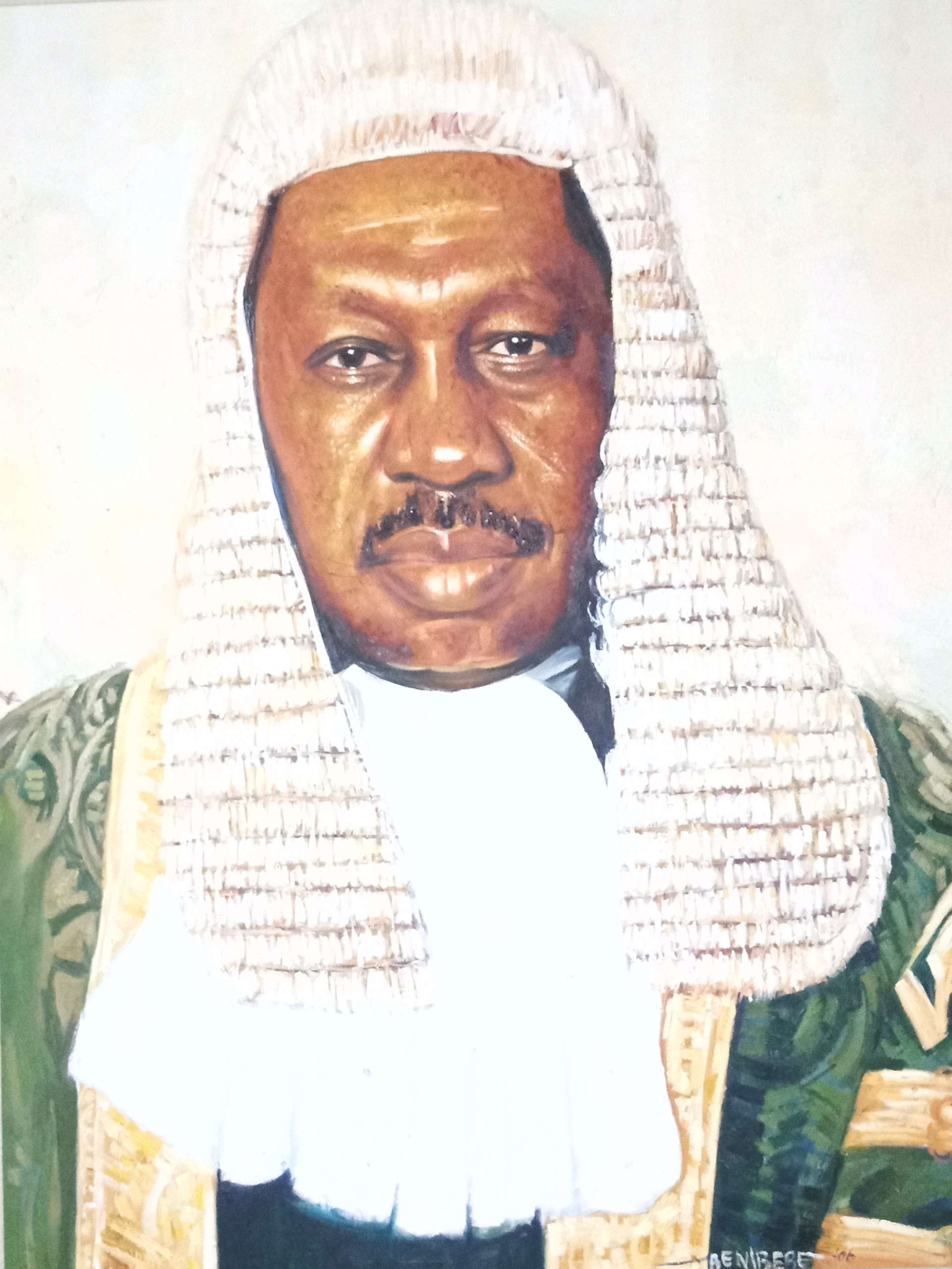
Uwais at 87: A Time to honour; implement his Electoral Reform Report

By Lillian Okenwa

“The Nigerian federal government in 2007, under President Umaru Musa Yar’adua led government constituted an electoral reform committee spearheaded by the former Chief justice of Nigeria, Muhammadu Uwais”, began CLEEN Foundation, a civil society organisation in its 24 May, 2019 piece: Revisiting Justice Uwais’s Electoral Reform Report .”

Continuing, the group in its treatise said: “Members of the Uwais committee composed of a highly intellectual and erudite class including the best brains from the academic, Civil Society Organizations, professional groups & the public service. As attested, it was as a result of the thoroughness and comprehensiveness of the outcome (the report) that Yar’adua’s administration accepted over 90% of its recommendations and took immediate steps to implement some of them. The Uwais committee in its report actually covered the field, recommending precise measures that would improve the electoral process and environment; strengthen the legal frameworks and enhance the independence of the electoral body.

“The Committee has also made recommendations to improve the performance of various institutions and stakeholders in the electoral process. These include the Legislature, Judiciary, Executive, Political Parties, Security Agencies, Civil Society Organisations, Media and Nigerian citizens. The Committee has found that election mindsets are one of the critical elements that determine the success of electoral practices, and the election mindsets of Nigerians are not only largely negative; they are also largely irrational. Appropriate recommendations have therefore been made to change the election mindsets of Nigerians in order to minimize the spate of violence and rigging in elections and build lasting democratic institutions and culture.”

Again, Vanguard Newspaper in its Editorial of 31 March 2023 titled: Need to revisit Uwais Report brought the issue to the fore. Excerpts.

“… After about one year of painstaking collation of the views of well-meaning Nigerians, the Uwais Report recommended ways of ensuring that the independence of the Independent National Electoral Commission, INEC, went beyond mere flat or fraudulent rhetoric. 

“One of the avant-garde ideas the Uwais Panel introduced was the suggestion that the managers of the electoral umpire, INEC, should not be appointed by the President. A player should not appoint the referee in a game. It would surely tamper with the “independence” of the INEC. 

“The Panel called for the National Judicial Council, NJC, which is made up of Supreme Court Justices, to shortlist names of people of proven integrity from the open society to the National Assembly for selection and approval. The president’s only role would be to swear in whoever is appointed. Also, the Commission was to enjoy financial autonomy.

“Unfortunately, Yar’Adua’s Federal Executive Council, FEC, on March 9, 2009, rejected this recommendation, insisting that the president must appoint the Chief Electoral Officer and other board members. They thus torpedoed noble efforts to stop a sitting president and ruling party from paying the piper and dictating the tune for the INEC. 

“That left the ball in the president’s court. President Goodluck Jonathan opted to appoint a popular choice – Professor Attahiru Jega in June 2010. But when Muhammadu Buhari took over, he threw caution to the winds. He first appointed a member of his family, Hajiya Amina Zakari, as Acting INEC Chairman before transferring the role to Professor Mahmood Yakubu. APC chieftain, Chief Rotimi Amaechi, recently disclosed that Yakubu was recommended to Buhari by one of the party’s leaders. After a brief sunshine with Jega in charge, we are “back to Egypt”, where a ruling party and its president are empowered to perpetuate themselves in power by appointing compromised INEC chiefs. 

“The just-concluded election failed woefully despite the massive deployment of technology and adequate funding. The same technologies that worked like magic in off-cycle elections flopped when they were needed most, largely because of human factors: corruption, greed and lack of patriotism.

“Our electoral history has shown that the character of the person who leads the electoral commission matters a lot. Professor Humphrey Nwosu and Prof. Jega demonstrated this satisfactorily. We must hand over the appointment of the Electoral Umpire Chairman and Board to the Judiciary for the National Assembly’s approval, as recommended by the Uwais Commission.

“We must restore the people’s confidence in our elections.”

As Nigeria continues to struggle with conducting credible elections, one cannot help but imagine that on the day Justice Uwais’ maker calls him home, tributes upon tributes will pour in. Politicians will outdo themselves, crooning his praises to the high heavens. Everybody will speak about his immense contribution to nation-building. It will be a carnival. But why not celebrate him in his lifetime? What greater honour could Nigeria give this great man than implement the recommendations of his commission which has been adjudged as one that will set Nigeria on the path to recovery, albeit electorally?

Born on 12 June 1936, a day now known as Democracy Day in Nigeria, Justice M.L. Uwais’ desire for electoral reform may be synonymous with his famous Commission but there is more. In the appeal INEC .v. Balarabe Musa, the Supreme Court under his watch as Chief Justice opened the political space, allowing for the registration of more political parties in Nigeria. Section 80 (1)(c) of Electoral Act 2001 mandated new political associations seeking registration to secure at least 15 percent of local council seats in two-thirds of the 36 states of the federation and the FCT before they could be registered as political parties. But the apex court held it was unconstitutional and promptly repealed the 2001 Act.

This is wishing His Lordship a very happy 87th birthday and good health.

Watch a video documentary of His Lordship @ 85.

https://youtu.be/MXEK4HTkuKs

TIPS