Home Blog Page 767

The Reign of Pillow-Talk Law

By Chidi Anselm Odinkalu

“Our politicians are no longer content with hiring Senior Advocates of Nigeria (SANs), they also have their own judges.” Olusegun Adeniyi, When Judges Imperil Democracy, (4 Jan. 2018)

When he announced himself to the world on 1 January 1984 as military Head of State and leader of the military coup that had just overthrown Alhaji Shehu Shagari, Nigeria’s then-elected president, Muhammadu Buhari, a Major-General, cited as the reason for the coup the fact that the politicians had chosen to “circumvent most of the checks and balances in the constitution”, complaining that “the premium on political power became so exceedingly high that political contestants regarded victory at elections as a matter of life and death struggle and were determined to capture and retain power by all means.”

To unravel how the electoral process was derailed, General Buhari empanelled a judicial commission of inquiry into the Federal Electoral Commission, (FEDECO), as Nigeria’s electoral umpire was then known. Bolarinwa Babalakin, a judge who served with considerable distinction at the highest levels of Nigeria’s courts, chaired the inquiry, which outlasted the Buhari regime and reported in November 1986 to Buhari’s nemesis, Ibrahim Babangida.

In addition to the presidential election, seven governorship contests out of 19 also ended up before the election petition tribunals in 1983. What transpired thereafter in the election petitions received considerable attention in the report of the Babalakin Commission of Inquiry. The report observed that “of all the elections ever held in this country, none put the judiciary as much on trial as the 1983 elections.”  The outcomes were a source of considerable “shock and dismay” to the public, many of whom took the view that “the verdicts in a number of instances constituted a rape of democracy perpetrated through the law courts. Allegations of corruption were freely made.” In many cases, tribunals invented unfathomable technicalities to justify the unjustifiable.  

Lawyers will claim that the ways of the law are too abstruse for the unlearned. This patronizing defensiveness, however, is no excuse or justification for habituating the public to a diet of judicial scandal. Anyway, the voices of complaint have long ceased to be confined to the presumptively unlearned. Even the most eminent among the learned have since raised the decibels of consternation at the happenings in Nigeria’s law courts.

Looking back at judicial roles in the 2003 and 2007 elections, Obi Nwabueze, Nigeria’s best-known professor of public law and currently the country’s most senior living Senior Advocate of Nigeria (SAN), accused the Supreme Court of playing a “discreditable part” in manufacturing a jurisprudence of electoral impunity, lamenting the failure by the “Court to appreciate that the question of who should rule Nigeria is not one to be decided by a perverse and narrow legalism, by the technicalities of the rules of evidence, practice, and procedure and by considerations of expediency.”

Nigeria’s vocation of the law fashions itself after the idea that the law is what the judges decide. But what this means is that the vocation of judging is an extraordinary public trust that should be reserved only for persons of manifest integrity and learning.

This used to be the case in Nigeria at least as a matter of practice. The quality of the Nigerian judiciary used to be the envy of the Commonwealth and beyond. The country exported judicial expertise around Africa and the Commonwealth.

However, Nigeria’s constitution contains a perilous omission: it does not require appointees to judicial office of a court of record to be persons of integrity. The only mandatory requirement in the constitution is merely that candidates for judicial office should have attained a minimum number of years as lawyers. There are no personal, professional, or civic integrity standards. In the absence of such requirements, the judiciary has become a billboard for advertising some of the worst attributes of the Nigerian condition. Judging in Nigeria is now like a family heirloom that children inherit from their parents or a sexually transmitted condition that spouses inseminate one another with.

In hindsight, the situation reported by the Babalakin Commission in 1986 now reads very much like choir practice. Even then, standards existed. When he was nominated to sit on the Supreme Court panel in the Anambra State governorship election petition in 1983, Anthony Aniagolu, then a Justice of the Supreme Court, recused himself. He knew one of the parties in the case too well.

Two decades after the Babalakin report, over 86% of the offices contested in the 2007 elections ended up before the election petition tribunals. It was a development that led the Economist to label Nigeria as a “democracy by court order.”

With elections reduced to a rat race for judicial votes, Nigeria’s judges retrenched citizens from their perch as the source of legitimacy for political power, and the politicians discovered that while it remains useful to rent a lawyer, it is infinitely better to own a judge or more. As a consequence, the effective venue of judicial decision-making relocated from the courtroom to the kitchen table and to pillow talk.

Last week, out-going Senator, Adamu Bulkachuwa, whose wife, Zainab, is the penultimate President of Nigeria’s Court of Appeal, took the opportunity of his valedictory remarks in the upper chamber to thank his “wife, whose freedom and independence [he] encroached upon while (she) was in office, and she has been very tolerant and accepted my encroachment and extended her help to my colleagues.”

The import of Adamu Bulkachuwa’s diction and words was clear. Premium Times remarked in response that “compromise of court decisions is generally believed to be a recurrent happening in Nigeria, but confession to it by actors is rare.”

By 2019, the Court of Appeal had no recollection of the example laid by Anthony Aniagolu in 1983. Zainab Bulkachuwa, then the President of the Court of Appeal, insisted on sitting on the presidential election petition tribunal despite the fact that her husband, the afore-named Adamu, was himself elected to the senate on the same party as the president whose election was in dispute. Her son, Aliyu, had also sought the office of state governor on the platform of the same party.

The Court of Appeal dismissed the application requesting her to recuse herself from the proceedings, claiming that “enough materials have not been placed” before it to show a likelihood of bias on her part. According to the court, “the fact that she is the mother and wife of the APC members is not enough to require that she recuse herself.” This ruling did not pretend to be interested in passing the smell test and the court knew it. In the end, public opinion forced Zainab Bulkachuwa from the proceedings but the damage had been done.

In an interview she granted on her retirement from the judiciary the following year, Zainab Bulkachuwa claimed rather incredulously that “when that issue of the presidential election petition panel came up, I have even forgotten that my husband is a politician.” She had also asserted in another offering that “politics is a no-go area in the house.” Now we know that Chez Bulkachuwa was the place where pillow-talk settled who won and lost elections.

Adamu Bulkachuwa found himself in a unique position of enjoying spousal privilege and parliamentary privilege on the wings of vicarious judicial privilege. A devout Muslim, he appeared to have been inexplicably overwhelmed by an urge to do something that comes naturally only to Christians of the Roman Catholic persuasion: confession. He alone can say whether his confession was penitential or hubristic.

Unlike Adamu Bulkachuwa, however, the National Judicial Council (NJC), which met 48 hours after the confession broke, could see no evil or hear any. Instead, the president of the Nigerian Bar Association (NBA) decided to gratify the eloquent complicity of the NJC with a statement that was both bizarre and gratuitous.

The only statement that has come out of the NJC meeting instead was about the allocation of high judicial appointments. Not for the first time, the list featured some prominent nominees defined by credentialled propinquities, confirming the notion that pillow-talk and kitchen-table are currently the ascendant sources of law in Nigeria, if not supreme. Sadly, this does injustice to the diminishing cast of honest judges in the country. They still exist and the NJC could do more to stand up for them.

A lawyer and a teacher, Odinkalu can be reached at [email protected]

57-year-old woman earns twenty-nine years jail term for defiling 8-year-old boy

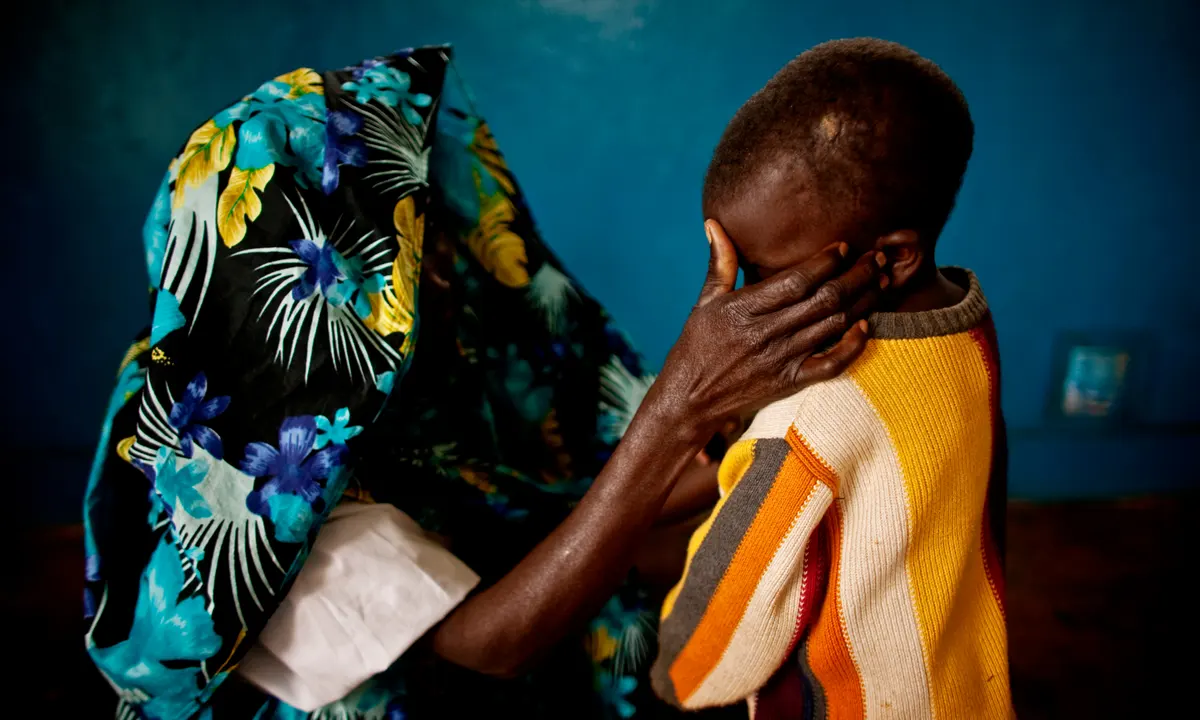
For sexually molesting an eight-year-old boy, a middle-aged woman, Desderia Mbwelwa, has earned herself twenty-nine years in jail.

A Tanzanian court found the 57-year-old Mbwelwa guilty last Friday for not only raping the boy but allegedly infecting him with a sexually transmitted disease.

According to reports, the lady found the boy herding cattle in one of the villages in the southern district of Iringa. After discovering he was alone, she sexually assaulted him under a tree.

Five witnesses including a doctor who examined the boy, confirmed that the boy sustained injuries and contracted sexual infections due to contamination in his genital area.

Mbwelwa’s lawyer, Frank Mwela, said they will appeal the judgment arguing that the lady has not been tested to confirm if she has sexual infections.

A cursory appraisal of laws governing legislative houses in Nigeria

By Douglas Ogbankwa Esq.

The House of Assembly of a State or the National Assembly in Nigeria is a Creation of the Constitution of the Federal Republic of Nigeria, 1999 (As Amended). We shall be however be using the House of Assembly as a case study.

Section 90 of the Constitution of the Federal Republic of Nigeria, 1999 (As Amended), States thus:

There shall be a House of Assembly for each of the States of the Federation

In the same vein, the composition of the House of Assembly is also a Creation of the Constitution. Section 91 of the Constitution of the Federal Republic of Nigeria, 1990 (As Amended) States that:

Subject to the provisions of this Constitution, a House of Assembly of a State shall consist of three or four times the number of seats which that State has in the House of Representatives divided in a way to reflect, as far as possible nearly equal population,provided that a House of Assembly of a State shall consist of not less than twenty-four and not more than forty members. While the Procedure to be adopted in the House is a Creation of the Standing Rules of the House.

A cursory appraisal of these Sections depicts the compellability and preemptory obligation which these Sections provides that can not be derogated from in any way whatsoever. This is because of the use of word “Shall”, in indicating the Membership of the House. It has been held in a plethora of cases that the word Shall places an obligatory burden on persons to do a thing the same way it has been stated and no other way. The word “Shall”, is a command that elicits compulsion and nothing else. For the proposition above, I commend to you the case of PDP v. Taiwo Ors. (2004) 8 NWLR (pt. 876)656

This Provision is clear and ambiguous and any House of Assembly in Nigeria operating outside this Constitutional Threshold is on a voyage of illegality and all actions taken by it are Illegal ab initio until it is duly ratified by a properly constituted House of Assembly. Therefore, no House of Assembly can validly be constituted with less than twenty four (24) members.

It used to be the Law until, 2017, that a House of Assembly can only suspend a Member based on the Law Guiding the House. For Example in Edo State according to Section 31(2) of the Legislative Houses (Powers and Privileges), Law of Bendel State, Applicable to Edo State, states, if I may paraphrase that a suspension shall not exceed the end of the next legislative, after the said suspension. This case was well expoused in the Zakawanu Garuba’s case at the National Industrial Court, where presiding judge stated thus:

In  my humble view, it is in the affirmative to the effect that indeed the House of Assembly has the power rightly to suspend a member of the House from the sitting of the House, but then such power has been circumscribed by the said law that gave it such power. Thus while the House of Assembly can suspend a member such suspension is limited to what has been provided in the proviso to the said Section 31(2) of the Legislative Houses (Powers and Privileges) Law of Bendel State, applicable to Edo State and this is clearly stated in the provision to “the last day of the meeting next following that in which the order is passed, or of the session in which the order is passed, whichever shall first occur.”

The defendants’ counsel had argued that the suspension was for an indefinite period and therefore continued to subsist until it was resolved by the House of Assembly, the 1st Defendant, on 20/12/2010 to lift same. The point here is the inability of the learned counsel to point to any provisions of any law that justified the taking of the step by the 1st Defendant in suspending the claimant indefinitely or lifting same when it deemed fit. The 1st Defendant is bound by the provisions of the law and its actions too must be guided and justified on the basis of the law. Here the decision of my learned brother, Bello, J of the High Court of the Federal Capital Territory, Abuja cited and relied upon by the learned claimant’s counsel in the case of Hon. Dino Melaye & 4 Ors Vs. The Speaker, House of Representatives & 2 Ors unreported Suit No: FHC/ABJ/CS/480/2010, in which the court held that the House of Representatives had no power to suspend the plaintiffs for more than 14 days in line with the provisions of Order X Rule 5 (4) of the Rules of the House is very relevant to the point in issue.

The said decision is of strong persuasive authority to which I entirely agree that a legislative House cannot be said to possess the power to act in breach of its powers and resorting to its whims and caprices by shoving aside the clear and unambiguous provisions of the law in the name of punishing any person whether its member or not. Furthermore, there is evidence before the court that the Claimant was suspended by the 1st Defendant on 22/2/2010 and also that the 1st Defendant after the suspension sat on 24/2/2010. See the votes and proceedings of the 1st Defendant of 22/2/2010, Exhibit “A” and that of 24/2/2010, Exhibit “B”.

Thus there is no dispute as to whether or not the 1st Defendant sat on the 24/2/2010 after the suspension of the Claimant. Also the session of the House in which the claimant was suspended commenced on the 5/6/2009 and ended on the 4/6/2011; See paragraph 12 of the Claimant’s Statement on Oath. These pieces of evidence all go to show that the claimant’s suspension should have elapsed by force of law in accordance with the provisions of Section 31(2) of the Legislative Houses (Powers and Privileges) Law of defunct Bendel State, applicable to Edo State on the 24th day of February, 2010 which was the legislative day next after the suspension and came first before the expiration of the legislative session which came later on 4/6/2010 and I so hold. Thus the 1st issue is hereby resolved in favour of the claimant.

On the second issue, which is whether or not the Defendants prevented the claimant from sitting in the House after the 24/2/2010, the date on which his suspension elapsed by force of law, the Claimant stated in his evidence on oath that he was prevented from entering the premises of the 1st Defendant and that on the only day, he gained entry onto the Chamber of the 1st Defendant he was ordered to be removed from the said Chamber. See paragraph 13 of the written statement on oath of CW1 and his evidence under cross-examination. However, the Defendant’s witness DW1 gave evidence that the Claimant was allowed to enter the premises of the 1st Defendant following his suspension. DW1 further stated under cross-examination by the claimant’s counsel that after the lifting of the suspension by the 1st defendant on 20/12/10 conditions were placed on the claimant before he could resume sitting and that he did not meet those conditions. I have carefully considered the evidence of the witnesses for the claimant and the defendants on the issue of the prevention of the claimant from gaining entry into and participating in the proceedings of the 1st defendant; and also of the defendants that the claimant refused to resume sitting after the lifting of the suspension.

I believe the evidence of the claimant that on 13th April, 2010 he went into the Chambers of the 1st Defendant but was ordered removed by the 1st Defendant, ostensibly on the ground that the claimant was still under suspension. I also do not believe the evidence of the defendants on this because putting the said evidence on the scale of justice, it is more likely to tilt in favour of the claimant since the 1st Defendant, in this case, acted on the belief that the Claimant was rightly on suspension up until the 20th of December, 2010, a position which this court has held not to be the case as the said suspension lapsed by operation of law on 24th day of February, 2010. Thus the Claimant was unlawfully prevented from sitting after his suspension had lapsed by operation of law on 24th of April, 2010 and I so find and hold.

However this is no longer the Law as the Law now is that a House of Assembly cannot suspend a Member of the House as doing so will deny his constituents representation as enshrined in the Constitution of the Federal Republic of Nigeria, 1999 (As Amended). Again, the relationship between a Member of the House and the House is not that of a Master-Servant Relationship, instead, the Member is a representative of his people whose Membership of the House is guaranteed by the Constitution and no other person or persons.

This was the position of the Court of Appeal in the case of:

SPEAKER BAUCHI STATE HOUSE OF ASSEMBLY v HON. RIFKATU SAMSON DANNA (2017) 49 W.R.N

This case above is the locus classicus decided by the Court of Appeal on the issue of suspension of a Nember of a House of Assembly. The following are the facts of the case:

The Respondent in this case was a member of the Bauchi State House of Assembly and she was indefinitely suspended. She filed a Suit at the Bauchi State High Court questioning the Resolution of the House. Judgment was delivered in her favor, the House appealed the issue to the Court of Appeal and the Court of Appeal reaffirmed the decision of the High Court.

The court of Appeal states that the lawmaker, not being an employee of the House can neither be suspended nor withheld of his entitlements i.e salary and other allowances. The court while making a decision on the provision of section 111 CFRN 1999 states: “The fixing of salaries and wages of the respondent lies within the province of the Revenue Mobilization Allocation and Fiscal Commission under section 111 of the constitution, certainly not the 1st and 2nd appellants. The 1st and 2nd appellants have no right to interfere with the salaries and allowances of the respondent serving as a member of Bauchi State House of Assembly. No Rules or Standing Order of Bauchi State House of Assembly can derogate these rights and privileges conferred on an elected member of the House of Assembly…” The Court further had this to say about the illegality of the suspension:” Any member of the Bagoro constituency could have timeously challenged the indefinite suspension of their choice representative in the Bauchi State House of Assembly on the grounds that their accrued rights had been violated or breached by the appellants. The conduct of the appellants is the tyranny of the majority against an elected minority of the Bauchi State House of Assembly”.

The position above are the Laws on the twin issue that are subject of this exposition. The fact that some Houses of Assembly are engaging in naked illegality does not obviate from the sanctity of the position of the Law which grinds slowly but surely. It is therefore my humble contention that it is an utter illegality for any House of Assembly to be constituted with less than twenty four (24) members and the indefinite suspension of a member (s) of the House of Assembly is a gross violation of exant laws of the land and the constitution of the Federal Republic of Nigeria. It is important we are follow the law on issues to build systems. If you protected the rule of law while in office, the rule of law will protect you, while you are out of office.

Douglas Ogbankwa Esq., a former  Publicity Secretary of the Nigerian Bar Association, Benin Branch, and the President of National Movement for the Actualization of Good Governance is a Nigerian Legal Practitioner, Writer, and Policy Analyst. He can be reached on [email protected].

How neighbour trapped mother and daughters in Nottingham flat fire

A mother and her two young daughters were murdered by a neighbour who set their flat on fire over a row about rubbish bags being left behind their building, a court has heard.

The prosecution said the defendant, Jamie Barrow, “walked casually away” despite screams being heard from inside the flat.

Nottingham crown court was told Barrow, 31, poured petrol through the letterbox of Fatoumatta Hydara’s first-floor property in the early hours of 20 November last year, before setting it alight and staying while the blaze took hold. He denies three counts of murder.

Hydara, 28, died two days after the incident. Her daughters Fatimah Drammeh, three, and Naeemah Drammeh, one, were both killed in the fire in Fairisle Close in Clifton, Nottingham.

Jurors were told Barrow had raised a “grievance” with the local authority around a month before the blaze, but the prosecutor, Simon Ash KC, said it was not accepted that Hydara had been leaving rubbish in the alleyway.

Opening the case to a packed public gallery on Monday, Ash said the defendant had admitted starting the fire but denied murder.

He said: “He killed a woman called Fatoumatta Hydara, and he killed her two daughters Fatimah Drammeh and Naeemah Drammeh. The defendant killed them by setting fire to their flat in the early hours of the morning on 20 November last year.”

Ash said Hydara and her two children were asleep in the flat when the fire was started. “He poured petrol through their letterbox and he set it alight. The defendant knew that the front door was the only way in and out of the flat. He knew that there would be no way for them to escape.”

Ash told the jury that Barrow stayed as the blaze took hold and that a fire alarm sounded after it started.

He said: “Shortly after [the alarm], Mrs Hydara or one of the children started screaming. The defendant did nothing to help them. He didn’t call the fire service or alert anyone to what was happening. About five minutes later, he walked casually away, leaving Mrs Hydara and Fatimah and Naeemah trapped in the burning flat.

“All three of them died as a result of the fire.”

Ash said that before setting the flat alight, Barrow had walked past the property while a light was on inside as he was on his way to buy some beer. “There would have been some light coming from her flat and the light would have been further indication to the defendant that Hydara and the children were in the flat at the time.”

Barrow also denies arson being reckless as to whether life was endangered.

The trial continues.

The Guardian Uk

Federal High Court Awka sits on appeal against own judgment

A Federal High Court in Awka, Anambra State capital city may have taken legal jurisprudence to an ultra-innovative level when it sat on appeal against its own judgment and proceeded to set it aside.

The court on Thursday 15 June in the matter between Okechukwu Nwafor and President Federal Republic of Nigeria & 3 Ors held: “Judgment of this Court delivered on the 19th day of May 2023 is hereby set aside for non-service of  Originating Processes on the 2nd Defendant/Applicant…”

Expressing outrage at the judgment, one-time Chairman of the National Human Rights Commission, Prof. Chidi Anselm Odinalu said: “Please, how does a court sit on appeal on its own judgment to set it aside? What is going on with these SANs doing these dreadful things with judges?!”

The order reads:

UPON THIS MOTION ON NOTICE dated 25th day of May, 2023 and filed 31st day of May, 2023, coming up before the honourable Court this 14th day of June, 2023 for hearing, praying for the following Orders:

  1. AN ORDER OF THIS HONOURABLE COURT setting aside the Judgment of this Honourable Court delivered by His Lordship Hon. Justice F. O. Riman in Suit No: FHC/AWK/CS/58/2023 on the 19th day of May, 2023, for non-service of the Originating Processes on the Defendant/Applicant.

2.      AN ORDER of THIS HONOURABLE COURT setting aside the Judgment of this Honourable Court delivered by His Lordship, Hon. Justice F. O. Riman in Suit No: FHC/AWK/CS/58/2023 on the 19th day of May, 2023, the subject matter of the suit and the issues raised therein having been determined by this Honourable Court in Suit No: FHC/ABJ/CS/3 1/ 2023 by Hon. 3ustice J. K. Omotosho.

3.      AND FOR SUCH ORDERS OR FURTHER ORDER(S) as this Honourable Court may deem fit to make in the circumstances of this case.

UPON READING the Affidavit in support deposed to by one CSP, Larval A. Halliru, Adult, Male, Muslim, Nigerian Citizen of IGP Secretariat, Nigeria Police Force, Force Headquarters, Shehu Shagari Way, Abuja, filed at the Court’s Registry along with three (3) Exhibits and a written address of Counsel.

After hearing Ibrahim Igris (sic) SAN and with Abdullahi Abdulhakeem Ago, learned counsel for the Defendant/ Applicant move in terms of the motion paper…

IT IS HEREBY ORDERED AS FOLLOWS:

1. The Judgment of this Court delivered on the 19th day of May 2023 is hereby set aside for non-service of  Originating Processes on the 2nd Defendant/Applicant…

Find the original order here.

Order-IGP-Awka

US Govt. accuse Nigerian courts, immigration officials of collusion with human traffickers

The United States government has alleged that human traffickers in Nigeria act with impunity because they are backed by powerful persons in Nigeria’s judiciary and immigration.

A special report by Peoples Gazette noted that this is the conclusion of the United States government in its latest report titled ‘2023 Trafficking in Persons Report: Nigeria’.

“The government of Nigeria does not fully meet the minimum standards for the elimination of trafficking but is making significant efforts to do so…Corruption remained a significant concern in the judiciary and immigration services, and it contributed to impunity for traffickers…,” the latest U.S. trafficking report stated.

The U.S. government noted that corruption and complicity continued to contribute to impunity for trafficking offences in Nigeria despite the government’s efforts to improve law enforcement.

The report, which the U.S. Department of State released on Thursday, stated that while the Nigerian government demonstrated overall increased efforts to combat trafficking compared to the previous reporting period, it failed to fully meet the minimum standards for trafficking elimination in the country.

The report also stated that corruption remained a major issue in the judicial and immigration agencies, contributing to traffickers’ impunity and accused the Nigerian government of failing to investigate or prosecute any members of the Civilian Joint Task Force (CJTF) for prior forced recruitment or use of child soldiers; potential sex trafficking in government-run IDP camps continued.

“Corruption and official complicity in trafficking crimes remained significant concerns, inhibiting law enforcement action and perpetuating impunity for trafficking crimes,” stated the report. “The government reported investigating two officials for involvement in trafficking crimes – a member of the National Immigration Service and a member of the Nigerian Security and Civil Defence Corps.” 

It added, “The government reported one investigation of sexual exploitation by a government official initiated during the previous reporting period was settled out of court, and two other investigations initiated in the previous reporting period against members of the CJTF for alleged sex trafficking of IDPs are awaiting trial.” 

The U.S. government also mentioned that the lack of proper training of some local judges, compared to the federal and state judges, contributed to the corruption and misapplication of relevant trafficking laws.

It said the local judges did not have the prerequisite knowledge of anti-trafficking law, which hindered the government’s ability to hold traffickers accountable.

“Local judges did not have the same standardised training requirements as federal and state judges, which contributed to corruption and misapplication of the law. Some judges were unfamiliar with the anti-trafficking law, which hindered the government’s ability to hold traffickers accountable,” the report explained, stressing that “despite numerous previous allegations, the government did not report investigating any CJTF members for child soldiering recruitment or use.”

In highlighting the country’s achievements, the report stated that the Nigerian government initiated investigations into 1,242 cases, including 511 sex trafficking cases, 282 labour trafficking cases, and 449 cases of unspecified forms of trafficking; initiated prosecutions of 78 suspects, including 67 suspects for sex trafficking and 11 suspects for labour trafficking, and continued prosecuting 35 suspects for unspecified forms of trafficking “from previous reporting periods.”

The U.S. Department of State further revealed that Nigeria convicted 97 individuals, 50 for sex trafficking, six for labour trafficking, and 41 for unspecified forms of trafficking.

“This compared with convicting 13 individuals in the previous reporting period. Of those convicted, 94 were convicted under the 2015 TIPLEAA and three were convicted under violence against persons laws,” it noted.

The report made recommendations to the Nigerian government to strengthen its resolve and system to tackle trafficking and corruption, urging it to hold complicit officials as well as individuals affiliated with the government – including security officials and CJTF members – criminally accountable for trafficking offences, including for the sex trafficking of IDPs and past forced recruitment or use of child soldiers.

The report also recommended strengthening “efforts to identify trafficking victims among vulnerable groups, such as children in religious schools, IDPs, returning migrants, and children in domestic service,” including facilitating “training for local, state, and federal judges on human trafficking and the 2015 anti-trafficking law, specifically the provision prohibiting the issuance of fines in lieu of imprisonment in collaboration with international partners.”

Originally published by Peoples Gazette on June 16, 2023

Lawyers with Disabilities condemn gruesome murder of Aisha Aminu

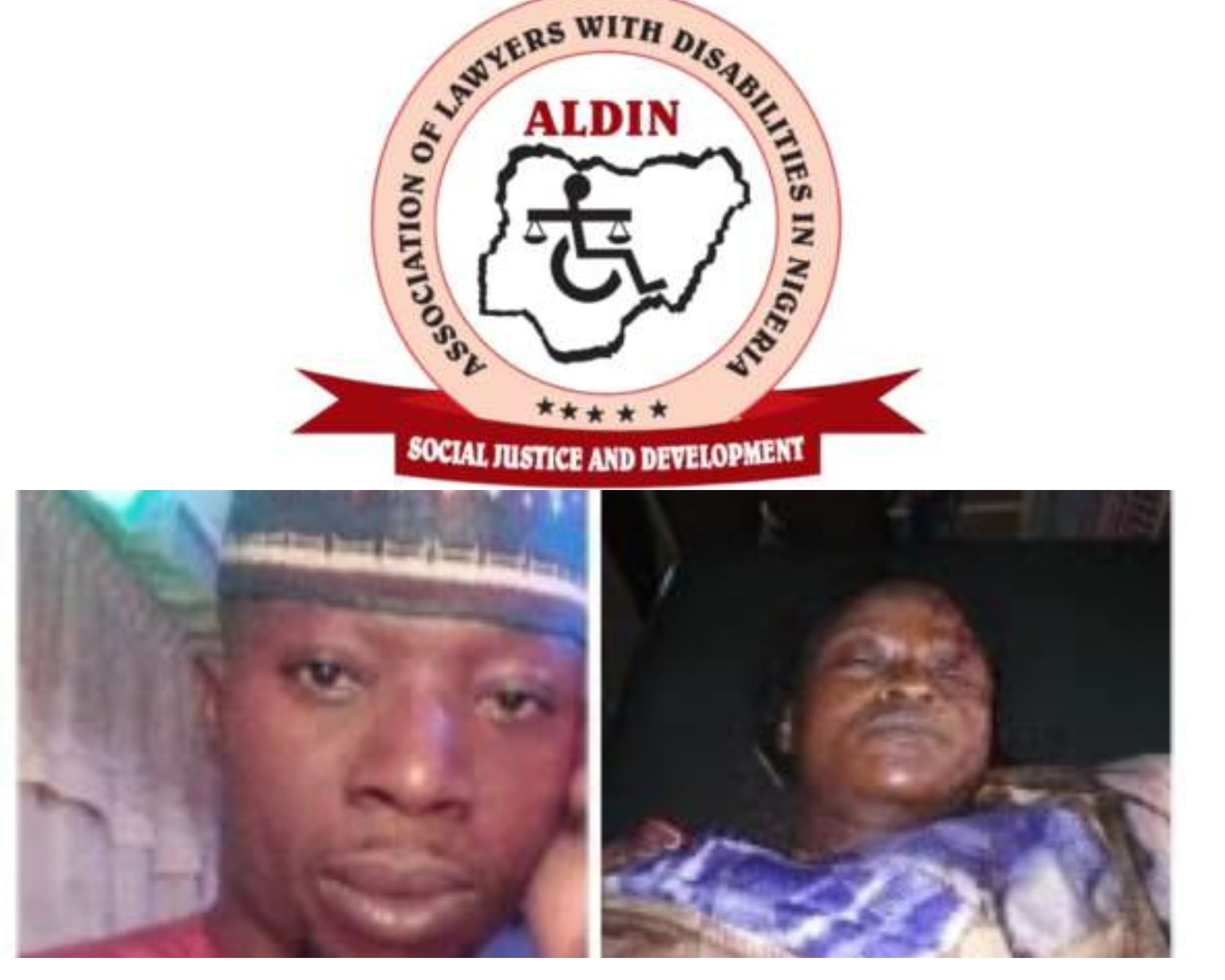
The Association of Lawyers with Disabilities in Nigeria (ALDIN) has expressed outrage over the murder of Aisha Aminu, a 30-year-old physically challenged woman, allegedly murdered by her boyfriend on Wednesday in Obehira Okene Local Government Area of Kogi State.

A statement signed by the group’s Director of Media and Publicity, Justice Christopher, Esq. reads:

“The Association of Lawyers with Disabilities in Nigeria (ALDIN) expresses its unequivocal outrage at the brutal and gruesome murder of Aisha Aminu, a Physically Challenged Woman and a loving mother of three, whose life was snuffed out of her in the most inhumane and barbaric manner on the 7th of June 2023, at about 6 AM in her shop located in Obehira Okene LGA, Kogi State.

The widely reported (but yet to be officially confirmed) news suggests that Aisha was ferociously attacked by her 44-year-old boyfriend, identified as Siyaka Mohammed. The savage assailant forcibly dragged her from the inner chambers of her shop and mercilessly stabbed her multiple times until she succumbed to her injuries. “We condemn in the strongest possible terms this vicious attack on a physically challenged and vulnerable member of the society,” said Ikem U. Uchegbulam Esq, the National President of ALDIN. “Attacks on Persons with Disabilities and the vulnerable are reprehensible, condemnable, and unacceptable under any circumstances”, he added.

The association is deeply concerned about this heinous act as it is not only a case of domestic violence as widely claimed and or reported in some quarters but also constitutes a pattern of Disability hate crime which must as a matter of urgency be nipped in the bud. ALDIN observed that due to the prejudice, malicious stereotype,s and the fact that the society has failed and is continuously failing Persons with Disabilities, some Persons with Disabilities in their desperation for friendship have befriended people who have not only exploited them but have also robbed, attacked and killed them – so-called ‘mate crimes’, a recognized subset of hate crime

The association Commiserates with the family, particularly her children and the Disability community on the tragic event. While restating its commitment to pursuing the case to its logical conclusion and ensuring that Justice is served. To this end, we call on the security agencies to step up to their responsibilities of not just solving murders and other crimes but the prevention of these heinous crimes.

ALDIN further urges members of the public to be vigilant and always intervene and protect Persons with Disabilities and vulnerable members of the society.

May the good Lord grant us His comfort and in this time of grief, Amen.

Signed
Justice Christopher
Director of Media and Publicity
ALDIN National

Terror Funding: All eyes on South Africa

AFP reports that South Africa has never been touched by Islamist attacks. Its three-decade-old democracy is solid, and its financial system is respected. Yet experts say the continent’s most industrialised nation is now a nerve centre for jihadist financing in Africa.

“South Africa is open hunting ground,” Pretoria-based counter-terrorism expert Jasmine Opperman told AFP.

According to the Agency news, Islamist financiers gather money in the country and transfer it into “the hands of terrorism,” she said, adding it was internationally recognised “that we are now a hub”.

It’s a stark indictment for a country that, apart from the odd alerts issued by the US embassy, hardly registers on the radar of extremist activities worldwide.

Yet Opperman’s assessment is widely shared by analysts across Africa, Europe and the United States.

Red flags were first raised last year when the US government levied sanctions on several South Africans it accused of belonging to an Islamic State (IS) cell.

The group facilitated the transfer of money to IS branches across Africa, according to Washington.

It “provided technical, financial, or material support to the terrorist group,” the US treasury said in November.

Complacency

Some analysts have suggested that jihadist financing flourished because South African authorities grew complacent at the lack of visible Islamist activity.

“I don’t think South Africa realised it. It was the Americans who said, ‘something not okay is going on in your country,'” Hans-Jakob Schindler, director of the Counter-Extremism Project think-tank, told AFP.

“The entire government is now put to task,” he said.

One of the clearest signs something was amiss came in March this year when the Paris-based Financial Action Task Force (FATF), a global illicit cash flow watchdog that aims to tackle money laundering and terrorist financing, placed South Africa on its “grey list” over gaps in monitoring and stemming illegal financial activities.

A cocktail of conditions, including a functional financial system, liberties, porous borders, corruption and criminality have made South Africa fertile ground for Islamists to raise funds, experts say.

A lot of the money comes from organised crime syndicates which raise funds through drugs and precious minerals trafficking as well as kidnapping for ransom.

Extortion, with the use of fake Tinder profiles to lure victims, is also widespread.

‘Organised crime is rife’

Kidnapping cases doubled to 4,000 between July and September last year, compared to the previous quarter, police statistics show.

“Organised crime itself is rife,” in South Africa, said Opperman.

To avoid detection, the money is then transferred to Islamist cells across the continent in small remittances that don’t raise eyebrows.

Some 6.3 billion rand ($342 million) was wired from South Africa to Kenya, Somalia, Nigeria and Bangladesh through mobile money transfer using nearly 57,000 unregistered phone SIM cards between 2020 and 2021, according to an investigation by a South African weekly newspaper, the Sunday Times.

The hawala system, an informal method of payment based on trust that is far more difficult to trace than bank transfers, is also used to siphon money away.

Some money sent abroad is genuinely aimed at supporting family, and it’s unclear just how much jihadists raise.

But experts believe they are awash with cash, likely making “more money than they need,” Schindler said.

IS internal documents seen by experts show that of the money raised on the continent, the IS in Somalia keeps 50 percent while 25 percent is split between cells in Mozambique and the Democratic Republic of Congo, with the balance going to IS central.

‘Waiting for proof’

One of the suspects listed by the United States as an IS cell leader is Durban-based Farhad Hoomer, 47.

He was sanctioned last year for “playing an increasingly central role in facilitating the transfer of funds from the top of the ISIS hierarchy to branches across Africa”.

Hoomer denied being an IS cell leader, telling AFP by phone from Durban that he “was surprised” by the sanctioning. “I’m waiting for the proof. It’s one year waiting for the proof,” he said.

Hoomer was arrested by South African police in 2018 for allegedly planning to deploy improvised incendiary devices near mosques and retail shops. Authorities brought dozens of charges against him, which were however later dropped.

Tore Hamming, a fellow at the International Centre for the Study of Radicalisation, told AFP those involved in jihadist financing were “pretty well-known extremist figures from South Africa who have been active in the extremist milieu for a good number of years.”

The jihadists capitalise on “open financial structures”, he added.

Martin Ewi, a regional organised crime observatory coordinator with the Pretoria-based Institute for Security Studies, said a number of individuals were currently being investigated, with detectives “digging” up cases as far back as 2017.

“Terrorists have exploited the country’s democratic nature… to use it as a hub for mobilising financing” and other resources, Ewi told AFP.

In a recent note the US-based intelligence and security think-tank Soufan Center concluded that South Africa has “emerged as a financial hub for ISIS in Africa”, using another name for IS.

– ‘Increase of funds’

Cells based in the country are backing the “operational work” of IS “more widely”, said the Soufan Center.

These revelations come as the continent is increasingly becoming a favoured sanctuary for the jihadist group after the 2019 loss of the “caliphate” following US-led international counter-offensives in both Iraq and Syria.

IS has seen its most striking rise recently across Africa, with a presence in the Sahel region, through to Lake Chad, all the way to the DR Congo, Mozambique and Somalia.

“In the last five years, Africa itself has become more and more important for ISIS,” said Schindler.

But South Africa’s role in international terrorism dates back more than a decade, according to Ryan Cummings, analyst with the Cape Town based Signal Risk security advisory firm.

It has been a “perceived financial hub for extremist groups for quite a while,” he said citing intelligence evidence that suggested Somalia’s Al-Qaeda-linked Al-Shabaab used South Africa to move funds after the 2013 attack on the Westgate mall in Kenya’s capital.

There are reports of “an increase of funds… flowing from South Africa” to Mozambique, and the IS affiliate in the DR Congo, said Cummings.

Laws to bolster fight

South Africa is now boosting efforts to get off the FATF grey list.

Several pieces of legislation have been rushed through parliament in recent months, notably one on anti-money laundering and combating terrorism financing.

On May 19, security minister Khumbudzo Ntshavheni told lawmakers that her office, along with other agencies, will “continue to develop and implement… measures to ensure that South Africa’s territory is not used to plan, facilitate or carry out acts of terrorism and acquire, move, store and use funds in support of terrorism”.

This article was first published on 13 June 16, 2023 by AFP. https://amp.france24.com/en/live-news/20230613-south-africa-in-the-spotlight-over-terror-funding

Physically Challenged Lawmaker, emerges Adamawa state assembly Speaker

Rt. Hon Bathiya Wesley, a Physical Challenged Lawmaker representing Hong Constituency, has emerged as the Speaker of the 8th Assembly of Adamawa State.

Bathiya won the keenly contested election after consulting critical stakeholders and lobbying his fellow lawmakers.

Immediately after his swearing-in, Bathiya revealed that he is a child of Destiny and has never regarded himself as a physically challenged that cannot contribute meaningfully to the development of Adamawa State.

Disability according to him, is a mindset syndrome, and if one sees oneself as one, they remain like that until they die without impacting their world.

Bathiya thanked the Governor of Adamawa State, Rt Hon Ahmadu Umaru Fintiri, for allowing fair play to all to contest and appreciated his colleagues for allowing him to serve them.

He promised to work with them in an open-door policy and be fair to all of them by carrying them along in whatever issues regarding the leadership of the House.

Some of the State’s lawmakers claim that Bathiya’s emergence as the Speaker of Adamawa State Assembly is a testament to their state’s commitment to inclusiveness and the recognition of the abilities of all its citizens, regardless of physical challenges. “As he assumes the mantle of leadership, we wish him well in his new role and urge him to be a beacon of hope for all people living with disabilities.”

Ondo man docked for paying prostitutes with fraudulent alert

A man in Ondo state, Oluwafemi Damilola, has been arraigned before a Chief Magistrate Court in the state for allegedly defrauding four prostitutes of N45,000.

The victims said Damilola patronised them for sex but that he paid them by generating a fake alert after offering him their services,

 Damilola was arrested and subsequently charged to court on two counts bordering on fraud after the case was reported to the police.

The police prosecutor, Akano Moremi, said the defendant committed the offence in October 2022 in the Sabo area of Ondo town.

The charge read, ”That you, Oluwafemi Damilola, sometime in October 2022, at Sabo Road, Ondo, in the Ondo Magisterial District, did conduct yourself in a manner likely to cause the breach of peace by fraudulently having carnal knowledge of the victims.

“That you, Oluwafemi Damilola, on the same date, time and place in the aforementioned magisterial district, did indecently assault the female victims by fraudulently and unlawfully having carnal knowledge of them with the pretence of sending them the sum of N45,000 which you failed to do so but willingly send them a fake alert with the aim of defrauding them sexually and thereby committed an offence contrary to and punishable under Sections 249 and 360 of the Criminal Code Cap 37 Volume 1 Law of Ondo State of Nigeria, 2006.”

The prosecutor also told the court that five witnesses would be invited to testify in the case and applied for a date to enable him to study the case file.

However, the defendant’s counsel, S. A. Iluyemi, said there was already a move for settlement going on between both parties.

He prayed the court to release the defendant to him and promised that the defendant would pay the complainants’ money before the next date of adjournment.

The Chief Magistrate, Charity Adeyanju, granted the application made by the defendant’s counsel and ordered that the money be paid to the complainants before the next date of adjournment.

TIPS