Home Blog Page 63

2027: Why Ezekiel Aremu Adewole (FCA) stands out for Ayedaade State Constituency in Osun State

As political conversations gradually intensify ahead of 2027 State Assembly seat in Ayedaade Constituency of Osun State, questions about experience, leadership capacity, and effective representation are returning to the centre of public debate. Within this emerging discourse, the remarkable public service record of Hon. Ezekiel Aremu Adewole (FCA) remarkably stands out as a significant reference point.

Across decades of meritorious and illustrious service, Adewole has built a career that spans banking, taxation, lecturing, auditing, grassroots governance, and institutional engagements, to mention a few. These combinations, many observers and political pundits believe, reflect the type of leadership profile increasingly required for effective representation in Ayedaade State Constituency.

Meanwhile, as Osun State is also preparing for the August 15, 2026 governorship election in the state, Adewole has become unrepentant in deepening his commitment, support and loyalty for the All Progressives Congress (APC) candidate, Asiwaju Munirudeen Bola Oyebamiji (AMBO) even as he is mobilizing youths, market women, union leaders and various professional bodies to allow AMBO record landslide victory and restore back the destiny, glory and prosperity of the principled people of Osun State.

Adewole is truly prepared and deserves the State Assembly seat due to his sheer dignity, integrity, competence, and extensive experience in politics, leadership, education, and other professional calling. He possesses the ability to lead and implement effective and quality representation at the parliament and policies, bills, and other legislative activities that can promote the interest of Ayedaade Constituency and Osun State as well

As a proven technocrat with class and finesse, Adewole is the Managing Partner of Adewole Aremu & Co (Chartered Accountants).

He started his elementary education at St. Richard’s Primary School, Oloba, Gbongan, and attended Iwo Road Community High School (now Olufi High School), Gbongan for his Secondary School Education. He later attended Nigeria College of Education (NCE) Ila-Orangun, where he graduated in 1992.

Ezekiel Adewole has both B.Sc (Hons) and a Master’s degree in Accounting from Lagos State University (LASU) and also holds Master’s degree in Business Administration from Obafemi Awolowo University (OAU) Ile-Ife. His PhD thesis is currently under review for the viva exam.

He is a Fellow of Institute of Chartered Accountant of Nigeria (ICAN), Associate Member of Chartered Institute of Taxation of Nigeria (CITN) and Fellow of Institute of Investment Professionals with over thirty years of experience within the commercial banking sector and professional services firms. A career that included multiple assignments with increasing responsibilities and during this time, he served as a Risk Analyst and Team Lead in Audit and Control Functions. He has handled several trainings as facilitator including induction course for newly recruited staff.

Ezekiel is currently a tax consultant, and to his credit, he has been an adjunct lecturer in some Universities in Nigeria as well as the defunct Lagos State Polytechnic, Isolo for more than a decade. He is also a member of other Academic and professional Associations in the country with sterling distinctions and laurels.

Good leaders and, of course, patriotic Nigerians are meant to be open-minded. They would not claim to have all the answers. They seek the thoughts and views of others and support those ideas that are better than their own.

Genuine leaders realize that other people have convictions just as they do. They are willing to hear all sides before guiding the group to decide which way seem best. Without mincing words or any unnecessary display of semantics, Hon. Ezekiel Aremu Adewole belongs to this class of leadership, he is absolutely irrepressible. This is mainly due to his absolute faith in the Almighty God and also as a consequence of his very deep religious convictions right from the cradle.

He is indeed a man of faith, and he can certainly hold his own and perhaps even outshine some of the brightest and best in the world’s political stage today. The new Nigeria will certainly need such a man, and of course, the Ayedaade constituency would be proud of having such class and quality within its ranks in the scheme of things.

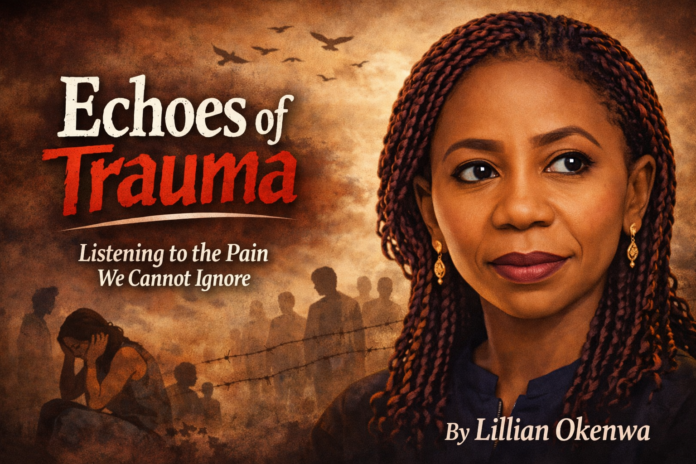
Echoes of Trauma: When silence becomes complicity, By Lillian Okenwa

Photo Credit: Beyond the Classroom Foundation

As International Women’s Month draws to a close, Nigeria and its women are once again in the headlines—for all the wrong reasons.

At the very start of the month, even as the world marked International Women’s Day, the dominant images from Nigeria were not of celebration, but of anguish—women in captivity, families torn apart by terrorists, communities living under constant threat and dread.

That reality has not changed. The abductions continue. The killings persist. And for those who return, there is no structured trauma care, no psychological support, no healing framework—only silence, confusion, and unprocessed pain.

Read Also: Echoes of Trauma: A nation in survival mode

It raises a troubling question: Why do we allow crises to spiral into catastrophe before acting?

Even as that question remains unanswered, now, layered atop this already fragile national psyche is yet another wound—one that cuts deep into the dignity of women.

Videos that surfaced in the days following March 19, 2026, from the Oruamudhu quarter of Ozoro in Isoko North Local Government Area, of Delta State, showed disturbing scenes: women chased, grabbed, stripped, and assaulted in the name or under the cover of tradition.

The festival, identified as the Alue-Do fertility festival, has since been described by locals as having been hijacked by criminal elements. Yet, troubling questions persist.

What unfolded during that festival is not merely another news cycle; it is a stark reminder of how deeply entrenched disregard for women remains in certain spaces.

Why was there no formal announcement this year, as tradition demands?

Was the silence accidental, or deliberate?

In a society where shame often silences survivors, how do we identify those affected? How do we ensure they receive medical care, psychological support, and justice?

Trauma care remains largely absent in our systems. But beyond that absence lies a more fundamental truth: some things should never happen.

That a festival associated even remotely with the violation of women could exist in 2026 is difficult to comprehend. That members of a community could inflict such humiliation and violence on women, mothers, daughters, sisters, aunts, defies both logic and humanity.

Every man, after all, came through a woman.

What we seem to be losing is the essence of our shared humanity—the philosophy captured in Ubuntu: “I am because you are.” Our existence is bound together. Our dignity is shared. To violate one is to diminish all.

The Delta State Government has condemned the incident, with the Commissioner for Information describing it as barbaric and unacceptable. The police have also downplayed reports of rape, citing a lack of formal complaints.

But this raises another uncomfortable question. How often do women come forward to report sexual violations? And when they do, are they heard?

Too often, they are not.

The reluctance to report is not born of apathy, but of experience. Experience of dismissal. Of delay. Of doubt.

This reality was captured poignantly by FIDA Nigeria in part of its International Women’s Day message:

“A woman walks into a police station to report abuse and is told to return later. A girl gathers the courage to speak and is advised to remain silent. A survivor enters a courtroom carrying both trauma and hope, uncertain which one will leave with her.”

These are not isolated experiences. They are patterns.

And patterns, when ignored, become systems.

What happened in Ozoro must not be explained away or minimized. It is violence. It is a violation. And it demands more than statements. It demands accountability.

The perpetrators must be identified and prosecuted.

Survivors must be supported with dignity, urgency, and care.

And perhaps most importantly, the culture of silence must be broken.

Because when silence persists, it does more than conceal pain. It enables it.

And when silence becomes the norm, complicity is not far behind.

Until we learn to hear the pain we silence, the echoes will never fade, and neither will the wounds.

A lawyer and equity advocate, Lillian can be reached at [email protected]

Pregnancy, Drugs, Death: NYSC staff docked in fatal abortion allegation

A staff member of the National Youth Service Corps (NYSC), Abbas Olalekan, has been arraigned before a Chief Magistrates’ Court in Ogun State over allegations that he conspired to procure an abortion that resulted in the death of a serving corps member, Victoria Ariyo.

Olalekan, 43, was docked on Monday on a two-count charge bordering on conspiracy and unlawful attempt to procure abortion by supplying drugs.

Prosecuting counsel, Inspector Lawrence Olu-Balogun, told the court that the alleged offences occurred between January and March in the Ikereku area of Laderin, Abeokuta.

According to the prosecution, the defendant conspired with other individuals, currently at large, to carry out the illegal act.

He further alleged that Olalekan, who was said to have been in a relationship with the deceased, impregnated her and subsequently attempted to terminate the pregnancy by providing abortion drugs.

The prosecution maintained that the substances administered to Ariyo ultimately led to her death.

The offences, the court heard, contravene Sections 516 and 230 of the Criminal Code Laws of Ogun State, 2006.

Olalekan pleaded not guilty to the charges.

His counsel, Bunmi Adelabu, urged the court to grant bail on liberal terms, arguing that the charge did not explicitly establish that the defendant caused the death of the deceased.

Citing constitutional provisions on presumption of innocence, the defence insisted that the allegations should be tested during trial.

In her ruling, Magistrate A. K. Araba granted the defendant bail in the sum of ₦500,000, with two sureties in like sum.

The court stipulated that one surety must be a relative, while the other must be gainfully employed. Both are required to provide a utility bill, swear to an affidavit of means, submit six passport photographs, and present evidence of 2026 tax payment to the Ogun State Government.

Pending the fulfillment of these conditions, the defendant was ordered remanded at the Ibara Correctional Centre.

The case has been adjourned until April 14, 2026, for further hearing.

Peter Mbah clinches ‘Best South-East Governor’ title as reforms draw national attention

Enugu State Governor Peter Ndubuisi Mbah has been named the Best South-East Governor of the Year 2025 by the Hall of Igbo Achievers Foundation (HIAF), in what organizers describe as a recognition of his administration’s performance across key sectors.

The award, the first of its kind by the foundation, was announced in a statement issued by its Chief Executive Officer, Nze Sam Nwanze and Mike Ubani, the Executive Director of the Foundation and Executive Editor of the Igbo Book of Records, following the recommendation of a seven-member selection committee.

Selection Process and Criteria

The committee, chaired by Emmanuel Olisa Chukwuma, evaluated governors in Nigeria’s South-East region based on their impact in critical areas including education, healthcare, transportation, infrastructure development, and security.

According to the foundation, Governor Mbah stood out for what it described as “exceptional performance” and a development-driven leadership style.

Focus on Education and Infrastructure

Particular emphasis was placed on Mbah’s education reforms, especially his administration’s flagship initiative to build Smart Green Schools across all 260 electoral wards in the state.

The project, part of his “Tomorrow Is Here” agenda, has been backed by increased budgetary allocations to the education sector, signalling what the selection committee called a “strategic investment in the future.”

The foundation also cited improvements in road infrastructure, urban and rural connectivity, and transportation systems, including both land and air, as key factors in its decision.

Governor Reacts

In a personally signed acknowledgment letter, Mbah expressed gratitude for the recognition, describing it as both an honour and a responsibility.

“This prestigious recognition goes beyond me as an individual; it belongs to my entire team working tirelessly to reposition our state for sustainable growth and development,” he said.

Award Ceremony Details

The award is scheduled to be formally presented on April 16, 2026, at the International Conference Centre Enugu, where dignitaries from across the region are expected to attend.

The event will also feature the conferment of the first edition of the organisation’s “Great Igbo Achievers With Integrity and Excellence Awards,” to 21 distinguished Igbo sons and daughters, which include the Chairman of Enugu State Council of Traditional Rulers, His Royal Majesty Igwe Samuel Asadu, Professor Ume Okafor, the Chief Medical Director (CMD) of the Enugu State Teaching Hospital, Nsukka.

Promoting Igbo Heritage

The Hall of Igbo Achievers Foundation said the initiative is part of its broader mission to promote Igbo heritage, culture, and excellence by identifying and celebrating individuals who have made significant contributions in their respective fields.

The event will also include the public presentation of the second edition of the Igbo Book of Records and the Igbo Digest Newspaper.

Nigeria unveils small claims arbitration to fast-track justice for millions

  • The Most Impactful Provision of National Arbitration and ADR policy 2024

By Arbiter Akintoye Sowemimo

The Federal Government has formally recognized Small Claims Arbitration as a key mechanism for improving access to justice under the National Arbitration and Alternative Dispute Resolution (ADR) Policy (2024–2028).

The policy, officially gazetted in October 2024, marks a significant shift in Nigeria’s dispute resolution landscape, establishing small claims arbitration not merely as a private initiative but as a government-backed framework designed to deliver faster and more affordable justice.

Policy Framework

Under the new policy, the government provides a structured framework for:

  • Fast-track arbitration for small claims
  • Integration into court-annexed ADR systems, including Multi-Door Courthouses

At the heart of the reform is the introduction of simplified arbitration procedures for disputes involving:

  • Debt recovery of up to ₦5 million
  • Breach of contract
  • Landlord and tenant matters
  • Consumer rights issues

1. It directly serves ordinary Nigerians
The vast majority of Nigerians are not multinational corporations or high-net-worth individuals. They are traders, tenants, small business owners, and consumers who face everyday disputes — unpaid debts, landlord harassment, faulty goods — but have no practical access to justice.

2. It addresses the courts’ backlog problem
Nigerian courts are severely congested. A small trader waiting years for a ₦200,000 debt recovery case to be heard in court effectively gets no justice at all. Simplified arbitration offers a faster, cheaper, and accessible alternative.

3. It protects tenants and landlords equally
Landlord-tenant disputes are among the most common legal conflicts affecting Nigerian households, particularly in urban areas like Lagos, Abuja, and Port Harcourt. This provision gives both parties an affordable resolution mechanism.

4. It empowers consumers
With rising costs of living, consumer rights disputes — defective products, poor services, fraud — are increasingly common. Most Nigerians never pursue these claims because the cost of litigation far exceeds the value of the claim. Small claims arbitration removes that barrier.

5. It has a multiplier economic effect
When small businesses can recover debts quickly and cheaply, they stay solvent, keep employees, and continue operating. This has a cascading positive effect on local economies and livelihoods.

The 60-day court enforcement timeline and the appeals provisions are significant for practitioners, but small claims arbitration is the provision that reaches into the daily lives of the most Nigerians — the market woman, the tenant, the small contractor — and gives them something they have rarely had: accessible, affordable justice.

Arbiter Akintoye Sowemimo
[email protected]
March 2026

1976 AFCON Row: Guinea denies ever contesting Morocco’s historic win

The Guinean Football Federation has denied reports claiming it filed an appeal with the Confederation of African Football to challenge Morocco’s 1976 Africa Cup of Nations victory.

The clarification follows viral claims suggesting that Guinea had demanded the 1976 AFCON trophy be awarded to it, citing a reported walkout by Morocco during the final match of the tournament.

The rumours emerged after CAF’s Appeals Board reportedly stripped Senegal of the 2025 AFCON title and awarded it to Morocco.

The ruling allegedly found Senegal in violation of Articles 82 and 84 of the AFCON regulations after several players walked off the pitch to protest a referee’s decision, fueling reports in some quarters linking Guinea to past competitions.

Read Also: Morocco’s Hakimi and Nigerian politicians, By Lasisi Olagunju

Reacting in a statement issued on Sunday, the FGF described the reports as “inaccurate” and “without official basis.”

“In recent days, information circulating on various media, particularly social networks, has falsely suggested that Guinea had taken steps to contest the result of the match between the Syli National and Morocco during this competition,” the statement read.

“The Guinean Football Federation wishes to clarify, in a spirit of responsibility and reconciliation, that this information is inaccurate and has no official basis,” it added.

The federation also provided context on the 1976 AFCON final round.

The Guinea-Morocco match was played on March 14, 1976, in Addis Ababa, under Zambian referee Nyirenda Chayu.

Guinea opened the scoring in the 33rd minute through Chérif Souleymane, before Morocco equalised in the 86th minute via Ahmed Makrouh, known as “Baba.”

The tournament format differed from the current structure.

Eight teams participated, split into two groups of four.

The top two teams from each group advanced to a final round played in a round-robin format, with the team earning the most points crowned champions.
Morocco, Nigeria, Egypt, and Guinea progressed to the final round.

By the final game, only Morocco and Guinea remained in contention for the title.

Guinea needed a win to claim the trophy, while a draw was sufficient for Morocco. Makrouh’s late equaliser secured a 1-1 draw, handing Morocco its first AFCON title.

Meanwhile, PUNCH Online had reported that CAF has officially updated its records to recognise Morocco as the champions of the 2025 Africa Cup of Nations, with Senegal listed as runners-up.

This is as the Senegalese Football Federation confirmed it filed an urgent appeal against the CAF Appeals Board verdict before the Court of Arbitration for Sport.

However, in a dramatic development, Morocco national team captain Achraf Hakimi publicly rejected the 2025 Africa Cup of Nations (AFCON) title awarded to his team, stating that he and his teammates did not earn the trophy on the pitch. 

Colonial Courtroom Drama: 1900 Nigerian case that redefined marriage, religion, and inheritance

Law Reports: A Selection of Cases Decided in the Supreme Court of Nigeria · Volume 1 · 1915

Judgment delivered on September 28, 1900

Asiata (by her next friend, Asatu Onikepe) v. Cessario Goncallo

Many years ago, Alli Elese, a Yoruba man, was taken to Brazil as a slave. While there, he married Selia, an African freedwoman. Their union was solemnized first under Mohammedan rites and later in a Christian church. Selia adopted her husband’s Brazilian surname, Marques, and the marriage produced two daughters, who remained in Brazil.

Subsequently, Alli Elese returned to Lagos with Selia. During her lifetime, and after the enactment of the Marriage Ordinance of 1884, he contracted another marriage, this time with Asatu, in accordance with Mohammedan rites. That union produced a daughter, Asiata, the plaintiff in this case.

The central issue before the court was whether this second marriage to Asatu was legally valid.

In the lower court, reliance was placed on Cole v. Cole, leading to the conclusion that the second marriage was invalid. However, the court clarified that Cole v. Cole addressed the distribution of property following Christian marriage, not the validity of subsequent marriages under different legal systems.

There was no dispute that the Christian marriage between Alli and Selia was valid under Brazilian law, and that it carried with it the legal expectation of monogamy. Under such a system, Alli could not have taken another wife while Selia remained alive. This restriction would also apply in other Christian jurisdictions.

However, the court emphasized a crucial distinction: Lagos, at the time, operated under native law and custom, including Mohammedan law, which permitted polygamy. Such unions, while unrecognized in Christian countries, were valid and widely accepted locally.

The court found that Alli Elese was a bona fide Mohammedan and therefore legally entitled, under Mohammedan law, to marry multiple wives.

In considering whether his prior Christian marriage invalidated his later Mohammedan marriage, the court reasoned that it did not. Drawing a comparative example, the judge questioned whether a marriage conducted under Christian rites in one jurisdiction would invalidate a lawful polygamous marriage in another where such unions are permitted. The answer, he suggested, was no.

The circumstances of the case were also significant: Alli and Selia had been taken as slaves to a Christian country against their will, and their initial observance of Mohammedan rites suggested they did not wholly abandon their original customs.

For the purposes of this case, the court held that Lagos should be treated as a Mohammedan jurisdiction. Applying Mohammedan law, the court concluded that the marriage to Asatu was valid, and that Asiata, as the child of that union, was legitimate and entitled to inheritance rights.

A further argument was raised: that Selia, having entered a Christian marriage implying monogamy, and her children should not suffer from Alli’s subsequent marriages. However, the court found that Selia’s conduct undermined this claim. She had participated in a Mohammedan marriage ceremony before the Christian one, raised no objection to subsequent marriages, and, after Alli’s death, acknowledged the legitimacy of his other children by involving them in property transactions.

This, the court held, demonstrated that she did not regard her marriage as strictly monogamous.

It was therefore accepted that, under Mohammedan law, all children were entitled to inherit equally. Asiata was thus deemed a co-heir alongside her half-sisters.

A procedural issue remained: whether Asiata could pursue the claim without joining her sisters. To resolve this, the court allowed an amendment to the claim, enabling her to sue in a representative capacity on behalf of all lawful children of Alli Elese.

With that amendment, the court reversed the earlier judgment and ruled in Favour of the plaintiff in her representative capacity. However, it ordered that she bear the costs both in the appellate court and the court below.

— Speed, Acting Chief Justice

Editor’s Note

Sir Edwin Arney Speed was a British colonial official who served as the first Chief Justice of Nigeria from 1914 to 1918. Following the amalgamation of the Northern and Southern Nigeria Protectorates in 1914, Sir Edwin Speed was appointed to lead the newly combined judiciary.

Soludo appoints Chiamaka Nnake as  first female SSG of Anambra State

Anambra State Governor, Prof. Chukwuma Soludo, has approved the appointment of Mrs Chiamaka Nnake as the new Secretary to the State Government (SSG), making her the first woman to occupy the position since the state’s creation.

Nnake, 39, succeeds Prof. Solo Chukwulobelu, who served from the inception of the Soludo administration. Her appointment marks the first political appointment since the governor commenced his second term.

A native of Nawfia in Njikoka Local Government Area, Nnake is a finance and public sector professional with over 13 years of experience in finance, strategy development, and economic planning.

Prior to her appointment, she served as Commissioner for Budget and Economic Planning and Chairman of Solution Fun City Limited, where she led resource mobilisation, planning, and allocation to drive socio-economic development in the state.

She has also held key leadership roles across several state agencies, including the Anambra State Investment Promotion and Protection Agency, the Internal Revenue Service Board, and the Small Business Agency.

As the state’s Reform Champion for Ease of Doing Business and focal point for Social Investment Programmes, she played a central role in advancing reforms and promoting inclusive growth. She also serves as Nigeria Chairperson for the Human Capital Opportunities for Prosperity and Equity (HOPE) Programme.

Before joining public service, Nnake was a Senior Strategy Consultant at PricewaterhouseCoopers Nigeria, where she led over 30 client engagements across local and international markets, covering sectors such as financial services, government, and agriculture. She received the firm’s CEO Award in 2021 in recognition of her performance.

During her time at PwC, she contributed to the development of Anambra Vision 2070, a 50-year development blueprint, and provided technical support for the Combined Transition Plan, a key component of the current administration’s strategy.

Earlier in her career, she worked as a Business Analyst at IHS Towers and as an Equity Research Analyst at Meristem Securities Limited, covering publicly listed pharmaceutical and consumer goods firms.

Nnake holds a Master of Business Administration from Lagos Business School, where she earned Beta Gamma Sigma lifetime recognition for academic excellence. She graduated with First-Class Honours in Accounting from Benson Idahosa University.

She is a Fellow of the Association of Chartered Certified Accountants, a member of its National Advisory Committee, and has passed Level I of the Chartered Financial Analyst (CFA) programme. She has also completed executive training at Harvard Kennedy School and is currently pursuing a PhD in Public Policy.

Bandit leader brags, ‘No school, but we’re AK-47 masters’

A suspected bandit leader has publicly announced that, despite lacking formal education, members of his group are highly skilled in handling weapons, particularly the AK-47 rifle.

The statement was made during a gathering in Dutsenma Local Government Area of Katsina State.

In a video obtained by TheStar, the armed group leader, flanked by his followers, displayed a rifle while addressing the crowd, which cheered in response.

“We did not go to school and we are not educated, but even without schooling, we know how to operate an AK-47,” he said.

“Raising his weapon, he added, “While you gather books on your shelves, we have gathered AK-47 rifles.”

The bandit kingpin also criticized authorities for failing to honor agreements reached in prior dialogue efforts.

“If we make promises to you, we try to fulfil them. We expect you to do the same. This is one of our major concerns,” he stated.

He alleged that many of his group members are currently detained in several states, including Katsina, Kano, and even Abuja, with some not released despite ongoing negotiations.

“There is no state without our people in detention. Many of our men and women have been arrested, but when we ask for their release, nothing happens. These are our complaints to the Nigerian leaders,” he said.

The leader accused government representatives of engaging in dialogue without following through on agreements.

“Your leaders come to meet us and we agree on certain issues, but once they leave, they go back and sit comfortably in their ACs without fulfilling those promises,” he remarked, prompting laughter from the crowd.

He warned that continued neglect could lead fighters to withdraw from dialogue entirely.

“All the people you see here may disappear into the forest for months if we are not invited again for discussions. You may only find small children left behind,” he said.

Despite the criticism, the bandit leader expressed willingness to participate in future talks if prior agreements are respected.

“If you release our people, even if you call us to Katsina, we will come. We are not afraid to go anywhere, but we fear unfulfilled promises,” he concluded.

The Conclave

Evidence Scandal Erupts: Federal High Court orders investigation into ‘deleted WhatsApp chats, bribery claim in ₦10bn fraud trial

A high-profile ₦10 billion fraud trial took a dramatic turn on Thursday after a Federal High Court judge ordered an investigation into alleged tampering with key evidence, including the deletion of WhatsApp messages from a device submitted in court.

Justice James Kolawole Omotosho directed the Nigeria Police Force and the Department of State Services (DSS) to probe the court’s registrar, Nasiru Onimisi Zubairu, alongside a defendant in the case, Daudu Sulaiman, over the alleged interference with exhibits.

The exhibits—mobile devices and digital records—were tendered by the Economic and Financial Crimes Commission (EFCC) as part of its case against Ali Bello, Chief of Staff to the Governor of Kogi State.

Confession in Open Court

The order followed a startling disclosure by the judge that the court registrar had privately confessed to him that Sulaiman allegedly approached him to alter evidence.

According to Justice Omotosho, the registrar admitted that he was asked to delete specific WhatsApp messages from a phone already admitted as an exhibit before the court.

“I have to disclose it… We have zero tolerance for this kind of conduct,” the judge said, emphasizing the court’s policy of transparency and early disclosure.

In a rare move, the judge played the registrar’s confession in open court and directed him to recount the incident publicly.

Taking the stand, Zubairu told the court he was promised a house in exchange for deleting certain messages.

“I was asked to delete some WhatsApp messages in the exhibit, with a promise that I would be given a house,” he said, citing personal accommodation challenges as a factor.

Missing Messages Raise Red Flags

An EFCC investigating officer, Mohammed Audu Abubakar, revealed that several messages originally extracted from the device were no longer present.

The deleted chats, spanning 2020 to 2022, reportedly included conversations referencing large cash movements, with entries such as:

  • “Hudu will bring it now”
  • “Hudu is bringing ₦100 million”
  • “₦60m is on transit”
  • “Hudu is on his way to Abuja with ₦30m”

The court was told that some of the missing messages also referenced individuals linked to the Kogi State Government, with noticeable gaps in chat records between key dates.

Abubakar stated that the messages were intact during the investigation phase but had since been erased from the device submitted as evidence.

Prosecution Demands Action

Reacting to the revelation, Director of Public Prosecution of the Federation, Rotimi Oyedepo (SAN), described the situation as deeply troubling and indicative of possible deliberate interference.

He urged the court to order an immediate probe, calling it an “urgent and irresistible suspicion” of evidence tampering.

The prosecution also applied for the revocation of the defendant’s bail and requested a forensic examination of the device to determine the full extent of the deletions.

Defence Urges Caution

Defence counsel expressed shock at the allegations but appealed to the court to allow due process, urging that conclusions should await the outcome of the investigation.

Court Orders Probe

In his ruling, Justice Omotosho directed both the police and the DSS to conduct a thorough investigation and report back to the court.

The case was adjourned to February 9, 2026, for continuation.

Wider Implications

The development has raised fresh concerns about the integrity of judicial processes in high-stakes corruption cases, particularly those involving digital evidence.

Legal analysts say the outcome of the probe could have far-reaching implications, not only for the ongoing trial but also for public confidence in the handling of sensitive exhibits within Nigeria’s judicial system.

TIPS