Home Blog Page 611

Merchandising The Gospel

By Richard Odusanya

Let’s start with the warning messages from Pastor Tayo Ajibade (Ph.D Theology) who teaches Systematic Theology at The Gamaliel Seminary, Maryland, USA. Pst Ajibade eloquently posited: “I think men of God in this dispensation should tread softly. The 21 Century Church is on trial. Instead of preaching Christ and Christ crucified, we tell our own fabricated stories just to give the impression that the man of God has power: high-sounding, spurious, and fictitious testimonies, and then we drag God into our ego-driven braggadocio. 

Pastor T A, also talked about Pastors, lies, and phantom prophecies in an article published by Nigerian Tribune. Laced with precise lucidity, mostly the modern-day so-called “men of god” possessed by unbridled self-promotions, avarice, and the kind of rascality displayed on the pulpits during and after the 2023 general elections in Nigeria is a pointer to the facts of the matter. For example, there is no place in the Gospel records where the anger of Jesus Christ is more evident than in his dealings with religious leaders who were fleecing people in the name of God.

Pst Ajibade continued: “Lies like this don’t help Christianity. First, they turn sensible people away from the faith and secondly, they undermine our spirituality and make us look like circus clowns before the very people we’re called to save. Then, those lies don’t help our relationship with God either. They reduce our worth before Him and show us as undeserving servants. Ministers of God should be able to differentiate between the holy and the common.” 

Flowing from the above, the word merchandising simply means the act of business of trading. It is to carry on commerce and to promote something as if for sale. When we talk about merchandising the gospel, therefore, we mean preaching the gospel with the intent of material gain. This practice has been on for ages past but seems to be assuming alarming proportions these days. Today, it is now commonplace to see all sorts of things being done under the guise of ministry. The underlying motive is the quest for material gain and fame.

Furthermore, on two occasions Jesus cast out of the temple those who were bilking the common folk under the guise of spirituality (see John 13-22, and Matthew 21:12-17; Mark 11:15-19; Luke 19:45-48). Two classes of “church crooks” received his wrath: those who bought and sold sacrificial animals and those who exchanged Greek and Roman coinage (with their idol images) into currency acceptable in the temple—with extravagant fees charged for the services. William Barclay observed that it “was a rampant and shameless injustice—and what was worse, it was being done in the name of religion.”

Sadly, the acquisition of extravagant wealth under the guise of “ministering” on behalf of Christ has become a smear upon the “Christian” image in this nation. It is one thing to receive a reasonable level of support for work done; it is entirely another matter when men (and women) make “merchandise” of people (2 Peter 2:3), or, as the New American Standard Bible renders it, they “exploit” you. Noted scholar D. Edmond Hiebert once observed that such charlatans are not concerned for the welfare of the sheep; rather, they aim to shear them of their wool! 

Quite sad, such individuals suppose that “godliness is a way of gain” (1 Timothy 6:3). Unfortunately, there are those who use the “gospel” as a way of lining their own pockets. Likewise, the phrase “merchandising the gospel” can be interpreted in two ways: religion as being the agent, or religion as being the object of the process of transformation. In some cases, religion can indeed be both the subject and the object. Religion is currently being deployed most shamelessly by the elites to gain an unmerited advantage. Sadly, this is not just about politicians anymore. 

For example, the average Nigerian tends to see everything through the lens of religion (It takes nothing to join the crowd. It takes everything to stand alone). The pulpit’s malfeasance characterized by inordinate ambition and the display of rascality was noticeable in the just concluded 2023 general elections in Nigeria. Essentially, it was the height of merchandising of the gospel in strange dimensions. The shenanigans started way back in the 2014-15 general elections, when a sitting President was openly endorsed by the “gatekeepers of heaven” It was the beginning of religious politics (Christians versus Muslims), leading to the well-known scam packaged as a messiah in the 2023 general elections.

I’m not even suggesting that people who believe in religion are weak-minded or anything like that – essentially, religion is a man-made thing. It had little to do with the existence of God. It is a social phenomenon that occurs when people collectively try to organize personal experiences of faith and spirituality. It has some positive social cohesive aspects, but since it’s a social phenomenon it always devolves into dealing with power among humans. 

And, since it deals with a thing that cannot be proven right or wrong but still deals with ideas very important to humans, it always establishes a fundamental misconception in societal epistemology, which causes societies to focus on the wrong things, on harmful things, on irrational deductions that glorify temporal power, obedience to an unquestionable authority and mitigation of harm not against period but against imagined characteristics of God.

In conclusion, based on the things I observed and experienced over time, merchandising of the gospel is real. Statistically, I would not call religion a comfort mechanism. I’d call it a coping mechanism, and then refer the captives to a psychologist who might be able to point them toward some reality-based relief.

Finally, I need to be clear; nothing should be accepted blindly everything should be accepted with care and caution. Succinctly put, it  has become necessary and important to avoid a repeat of the “Jonestown Massacre” which occurred on November 18, 1978, when more than 900 members of an American cult called the Peoples Temple died in a mass suicide-murder under the direction of their leader Jim Jones (1931-78). It took place at the so-called Jonestown settlement in the South American nation of Guyana.

Richard Odusanya

[email protected]

23 inmates earn university degrees at Enugu Custodial Centre

Twenty-three inmates of the Enugu Custodial Centre bagged Masters, first degree, and Post Graduate Diploma from the National Open University of Nigeria (NOUN) on Saturday.

Five of them bagged the Master’s degrees, 17 bagged their first degrees, and one got a Post-Graduate Diploma.

The 23 are products of NOUN’s study centre at the custodial facility that completed their various courses within four or five years.

State Coordinator of NOUN, Nigerian Correctional Service, Mrs Jennifer Nwonyi, presented the degrees and diploma to the graduates at a virtual convocation held at the Enugu Custodial Centre.

She noted that the graduates had defied all odds to attain great heights.

“I am overwhelmed with joy that God granted these students the grace to successfully complete their studies to become graduates of NOUN.

“Thank God that these graduates overcame the psychological challenge of attending to rigours of years of study while being held at the custodial centre.

“I say congratulations to our graduates and wish them great advancements as we have prepared them to face and overcome future challenges when they leave the custodial centre,’’ Nwonyi said.

Speaking at the ceremony, Mr Sunday Oyakhire, Deputy Controller of Corrections in charge of Enugu Maximum Custodial Centre, thanked NOUN for organising the courses and for providing facilitators.

In his remarks, Mr Arinzechukwu Onovo, the correctional centre’s Desk Officer for  NOUN programmes, encouraged the graduates to continue to search for knowledge, saying: “it is the key to unlock many potentials.’’

“We had a greater number of graduates of NOUN courses this year than we had last year.

“We will continue to encourage more inmates to take advantage of free educational reformation available at the correctional facility in partnership with NOUN,’’ Onovo said.

After waiting eight years, woman loses pregnancy in “one chance” robbery attack

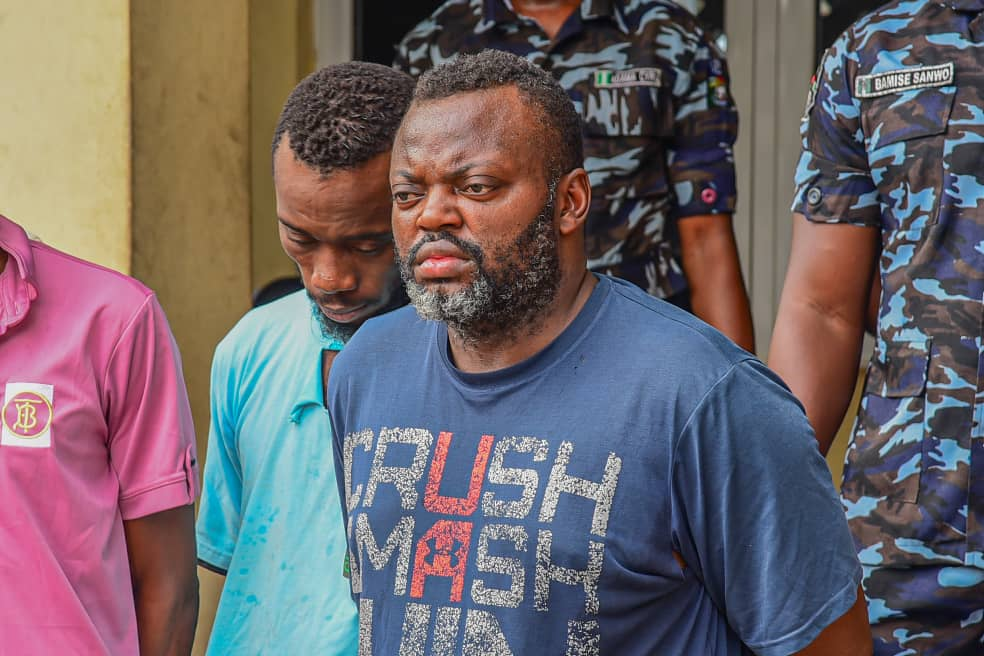
The alleged 'one chance' kingpin'

An Abuja based woman on Sunday lost her pregnancy after being physically attacked with a spanner by a “one chance” armed robber.

The Force Public Relations Officer, Olumuyiwa Adejobi has however disclosed that the leader of the“one chance” robbery gang has been arrested.

He made the disclosure on his X account on Sunday.

Adejobi wrote, “This is a ring leader of one chance robbery gang in Abuja. He used this wheel spanner to beat a pregnant woman (one chance victim) until she had a miscarriage. The woman had been waiting for a child for more than eight years.

“This is wickedness. Anyway, he’s having a trial in the court and has been arrested for the same offence again.”

In October 2023, the Minister of the Federal Capital Territory (FCT), Nyesom Wike, set up a joint task force to tackle the menace of ‘one-chance’ robbers in the nation’s capital.

The task force was to comprise all security agencies in the territory.

The then Commissioner of Police, FCT Command, Haruna Garba, disclosed this on Friday, October 13, 2023, after a Security Council meeting with the FCT minister.

Garba said the FCT Security Council meeting, chaired by the Minister of FCT, Nyesom Wike, discussed ways to eradicate criminal elements in the FCT, stop cross-border crimes and curb the menace of one chance.

“Consequently, it was resolved to set up a joint taskforce of all security agencies on the menace of one-chance. “Also, a joint task force on cross-border crimes to tackle the issue of armed robbers, kidnappers and all forms of crimes in the FCT will be set up.

“These two security operations have commenced in earnest. We wish to assure residents of our resolve to curb all forms of criminalities in the territory”, Garba stated.

The police chief, who was joined by Olusola Odumosu, the FCT Commandant of the Nigeria Security and Civil Defence Corps (NSCDC), as well as senior defence and intelligence officers, said that security agents frequently raided mechanic shops in the city based on intelligence. 

“What we are doing is to raid and remove the chaff from the grains so that residents can sleep with their two eyes closed”, he added.

Nigerians pay for darkness as national grid collapses five more times in 2024

With the fifth collapse in 2024 of the nation’s power grid which occurred in the early hours of Monday, April 15, 2024, Nigerians will again continue to pay for darkness.

In the fourth quarter of 2023, unmetered electricity customers in the Nigerian electricity supply industry, NESI, decreased from 6 million in Q3 to 5.83 million; an indication that most Nigerians are unmetred.

Curiously, these unmetred Nigerians will receive monthly electricity bills for power they have not consumed or get disconnected from power supply on refusing to pay.

Data obtained from the Nigerian System Operator’s portal (niggrid.org), between 2:00 am till the time of filing this report, the grid recorded an unprecedented zero Megawatts (MW) at the time and is currently generating a meagre 52.3MW around 7:10 am the same day.

The consequences of this blackout were felt nationwide, as electricity distribution companies (DisCos) struggled to cope with the sudden and prolonged outage.

Many parts of the country have been plunged into darkness for over five hours as the grid is yet to come into full recovery.

This collapse marks the fifth grid disturbance in 2024, adding to challenges that have long plagued Nigeria’s power sector.

In a year already marred by disruptions, this latest incident stands out as the most severe, exacerbating the ongoing struggles consumers and industry stakeholders face.

Despite the widespread impact of the blackout, neither the Transmission Company of Nigeria (TCN) nor the DisCos have yet to issue an official statement regarding the cause and resolution of the crisis.

As of the time this report was filed, the TCN had not stated to confirm the occurrence, leaving the public and stakeholders in the dark about the source and resolution of the newest crisis.

Monday Lines: For Yoruba Muslims and Pentecostals

By Lasisi Olagunju

The audience at the 1903 (third year) lecture of the Royal African Society in London listened with rapt attention as African nationalist, Dr. Edward Blyden, took them back to antiquity when “the most enlightened nations of Greece, Asia, and Egypt” held the opinion that “God revealed himself only in Africa.” Great men of that period, including Alexander the Great, rushed to the great oracle of Africa to drop offerings and “learn the will of God.” A few centuries after that epoch, Blyden lamented, Africa, the “first home of God” where He “buried His great truths” had travelled full circle and had come to be identified by the ‘civilised’ world of the 19th century as “the last home of the devil.”

“Now, things have so changed that it is the opinion of some that God is everywhere except in Africa,” Blyden agonized in the lecture which was on ‘West Africa before Europe.’ He went on to predict that “Africa’s turn will be sure to come again” when it would reclaim its place as the “refuge for seers who see and for prophets who prophesy.” Blyden said when that time would have come, an utterly materialized and exhausted Europe would go back to Africa to learn about God. The lecture is in the July 1903 edition of the Journal of the Royal African Society, Volume 2.

Just a hundred years after that lecture, the Blyden prophecy has come true. We’ve reclaimed our place as “the first home of God”. Nigeria, which houses the highest percentage of Africa’s population, qualifies to be celebrated as the global “refuge for seers who see and for prophets who prophesy.” Across faiths, we incubate and hatch men of God and gods of men – in their thousands. We speak and act for God here without counting the costs.

There is something cool about setting precedents. The immediate past Oyo State Governor, the late Abiola Ajimobi, won a second term election in 2015 and pronounced himself Koseleri (it-has-never-happened-before). Nigerians enjoyed an unprecedented three-day leave from work last week. In some places, the holiday lasted the whole of the week. The abstinence from work was the country’s way of celebrating Muslims’ 30 days of total abstinence from day-time meals – and from all sins. Allowing one abstinence to provoke another abstinence made all of us pious and sinless. It was surreal. The holiday should have endured till eternity.

While the holiday lasted, some friends shared their sallah experiences with me. They thought another koseleri was happening in Yorubaland: their pentecostal Christian neighbours refused to eat their food. “They said it was sin to share in our feast,” one of them said, sadly. “That was not who we are”, another added. I told them it is not really a new strain in Yoruba Christianity. I have RCCG and Deeper Life friends who celebrate and dine with me during Ileya. I also have RCCG and Deeper Life friends in whose mouths our good old eran Ileya (sallah ram meat) has lost its holiness. The twists started before the close of the last century when pentecostal Christianity came in costumes of fundamentalism.

Can the Yoruba Christian really avoid sharing things Islamic? If you are a pentecostal Yoruba Christian and you will see it as a sin to celebrate the next Sallah with me, what you will need to throw away will be more than my food. You will stop praying entirely in Yoruba because almost all the key words in the established Christian payers are taken from Arabic/Islamic texts. You will stop calling prayer ‘adura’ because it is from the Muslim ‘Du’a’. You will stop using the word ‘aanu’ (mercy) because the word is rooted in an Arabic word. A new word has to be coined for alafia (peace, wellbeing) because its root is also Arabic. Sermon will stop being called ‘iwaasu’ because it is from the Arabic ‘wa’z’. You will, furthermore, need to change your wardrobe and come up with new designs beyond what you call Yoruba dresses.

British Africanist J.D.Y. Peel’s ‘Christianity, Islam and Orisa Religion’ published in 2016 addresses some of these on pages 162 and 163. It says the agbada dress which you proudly assert as yours is a donation from Islam, perhaps from persons more northerly than northern Nigerians. Anglican missionary, Henry Townsend, in 1847 saw agbada’s acceptance and growing popularity and wrote that the “Mohammedan costume is become very fashionable with the young and gay” and “is by no means put on as a religious peculiarity.” If you read David Heathcote’s ‘The Embroidery of Hausa Dress (1977), cited by R.O.R. Kalilu’ (1997), you will have a clue that the embroidery (jakan) on your agbada “developed from Mali (and) is associated with Quranic scholars and teachers.” You must have heard the saying: Ise agbada kii se Imale (poverty of lack of agbada does not afflict a Muslim). I heard that from the genius of Yoruba Sakara music, Yusuf Olatunji.

There is no escaping the oneness of the world. Do the anti-Muslim pentecostal realize that Bible chapters and verses are numbered in Arabic numerals 1,2,3 etc. The word, ‘Algebra’ is from the Arabic al-jabr. Indeed, the whole “method of equation solving” in Mathematics is from Arabic.

When we speak about what Lord Lugard did with Southern and Northern Nigeria in 1914, we use the word ‘amalgamation.’ Scholars have agreed that ‘amalgamate’ descends from the Arabic al-malghama which means what ‘amalgam’ means.

In your everyday lives, you can’t escape words that have Arabic ancestors. The ‘sugar’ in your tea is from the Arabic word ‘sukkar’; cotton is from ‘qutum’, your overcoat got its ‘jumper’ name from the Arab’s ‘juppa.’ We can go on and on and conclude that it is pointless and fruitless for my Yoruba pentecostal friends to seek to run away from dining with Muslims and their Islam.

Now, the insular Christian has ideological bedmates in Yoruba Islam. There is this Imam in Ogbomoso shown online last week emitting fire and pronouncing everyone outside Islam as hell-bound. His voice was divisively loud and his penal tongue baleful. I listened to him and wondered where he was coming from. I once discussed clerics like this with the late Alaafin of Oyo, Oba Lamidi Adeyemi. “Taa lo ko won ni kewu (who taught them Quran/Arabic?)” was the oba’s rhetorical response to our worries. True, we should ask questions of competence when we hear such papal pronouncement from supposedly learned people. What he said was not what my Mallam taught me in Madrasha. If God had willed, He would have made all of humanity to belong to one nation (see Quran 5:48; see Quran 42:8); and one religious community (Quran 16:93). But, in His wisdom, God didn’t; instead, “to every people”, he sent “an apostle” (Quran 10:47). The Yoruba forbid saying or hearing what that Imam said about other religions. It is unYoruba to speak the language of perdition – they say man is not God.

It is in the character of the Yoruba to celebrate persons who speak with decorum. The highly regarded, thoughtful Chief Imam of Offa, Alhaji Muhyiddin Husayn, was at a Laylatul Qadr event in Ogbomoso a few days to last week’s sallah. His sermon at the programme was a tour de force on how to have a calm sea of peace. I heard him warn against unguarded utterances. He told the Chief Imam of Ogbomoso to win acceptability with character and close his running tap of hot words: “It is when you stop uttering words that words will stop uttering themselves,” he told the Imam. He added that bad words can’t win wars: “if you’ve seen war before, you will fear war” and “war knows no friend.” He cited examples with his own ascendancy experience. “The years I spent warding off attacks were enough as a man’s full tenure,” he said. But, he added, you would win if your tongue is bridled, if you do right and respect elders and pay hate with love. “One can gain an office with force”, he counseled, “but it takes patience and wisdom to sit there in peace.” Words, they say, draw kola nut from the pocket and can also draw sword from the pouch. The consequence of not listening to reason is having one’s milk spilt and the mug broken.

Ask master-potters if refiring can make whole again a broken pot. It is there in the experience of our fathers that a pot once broken, cannot be mended. There are several lethal pronouncements in Yoruba history with the pot metaphor at the centre. That is why we emphasize peace and unity in all our affairs.

The story of Islam and the Yoruba is the story of how leaf becomes soap. Scholars from the earliest of times have always marveled at how the Yoruba seamlessly combine opposition and accommodation when it comes to religion and religious matters. Fundamentalist Christianity and radical Islam have neither comfortable bed nor cushion seat to relax and flourish in Yorubaland. And they won’t tomorrow. There is no family without both Muslim and Christian wings. In books and arts, we encounter moderation and cross-religious handshakes that emphasize the Yoruba moderation in matters of faith.

I read Gbadebo Gbadamosi’s ‘Odu Imale: Islam in Ifa Divination and the Case of Predestined Muslims’ published in the Journal of the Historical Society of Nigeria, June 1977. In it, I encountered discussions on Ifa verses which tell us of Yoruba Muslim clerics, “their dress, travels, and the patronage which they enjoy from the people.” Ifa speaks of “Babamale ‘Bewu gereje/ti yio fi gbogbo aye se ofe je (the Muslim man/ who wears voluminous garment/ who will have the whole world as free bounty).” I read Razaq Kalilu’s ‘Bearded Figure with Leather Sandals: Islam, Historical Cognition And the Visual Arts of The Yoruba’ ((1997). Here, the author asks the reader to note earlier works which suggest that Sango, the third Alaafin of Oyo, was “favorably disposed to Muslims” to the extent that he got an oriki: “Ogbori odo s’aluwala ‘male (He that sits on a mortar to perform ablution like the Muslim.”

Whether Christian, Muslim or nothing, humanity is one – or supposed to be one. One hundred and fifty nine years ago, Harvard-trained American scientist, Pliny Earle Chase (1820-1886), sought to use similar words and word-sounds found in Yoruba and other ‘world’ languages to prove what he called the “universal brotherhood” of man. In a 39-page seminal article published in an 1865 edition of the ‘Transactions of the American Philosophical Society,’ Chase did a painstaking comparison of some Yoruba words and word sounds with some others found in Arabic, Latin, Greek, English, Hebrew, Chinese, German, Coptic, Gothic, French, Dutch, Egyptian, Italian, Finnish, etc languages. He examined similarities in sound and meaning of prefixes, suffixes and midfixes found common across Yoruba and those other languages. He, in particular, draws our attention to what he calls “the marvelous grammatical affinity that exists between the Yoruba, Egyptian, and Coptic Languages.” Copiously using T.J. Bowen’s ‘Grammar and Dictionary of the Yoruba Language’, he argues that it could not have been mere fortuitous occurrence of coincidences that “auro” (owuro)- morning/dawn in Yoruba is “aurora” (dawn) in Latin, just as “awari” (search) in Yoruba shares sound and meaning with the English word “aware”. He writes that there is “oro” (wealth) in Yoruba just as its Latin sound-mate, “aurum”, means gold. Chase notes with considerable interest that the word ‘duro’ means “to stay” (or stand firm) in Yoruba, and ‘duro’ in Latin means hard, harden, toughen, become stern. Incidentally, I also found that there is a similar Hebrew word, ‘dura’ which, among others, means ‘endurance.’ Chase’s conclusion is that humanity is one vindicating the Biblical assertion that “God hath made of one blood all nations of men to dwell on all the face of the earth” (Acts, 17:26).

The world lounges under a fatal canopy. You should be following the escalated bloodshed in the Middle East. The standards and the double standard. It may still get worse. Just as it is in Shakespeare’s Julius Caesar, carrion birds are hooting at noon; ravens, crows and kites are flying above the “sickly” world. But, what we need is love to defeat war. And, we will have this if we are able to take care of the devil in race and religion. It is difficult. Daniel Defoe, in his ‘The True-Born Englishman’ (1701) writes that “Whenever God erects a house of prayer,/ The Devil always builds a chapel there; /And ’twill be found, upon examination (that) / The latter has the largest congregation.”

Bobrisky and the ‘injustice’ of that 6-month sentence

By Moses Okezie-Okafor, Esq.

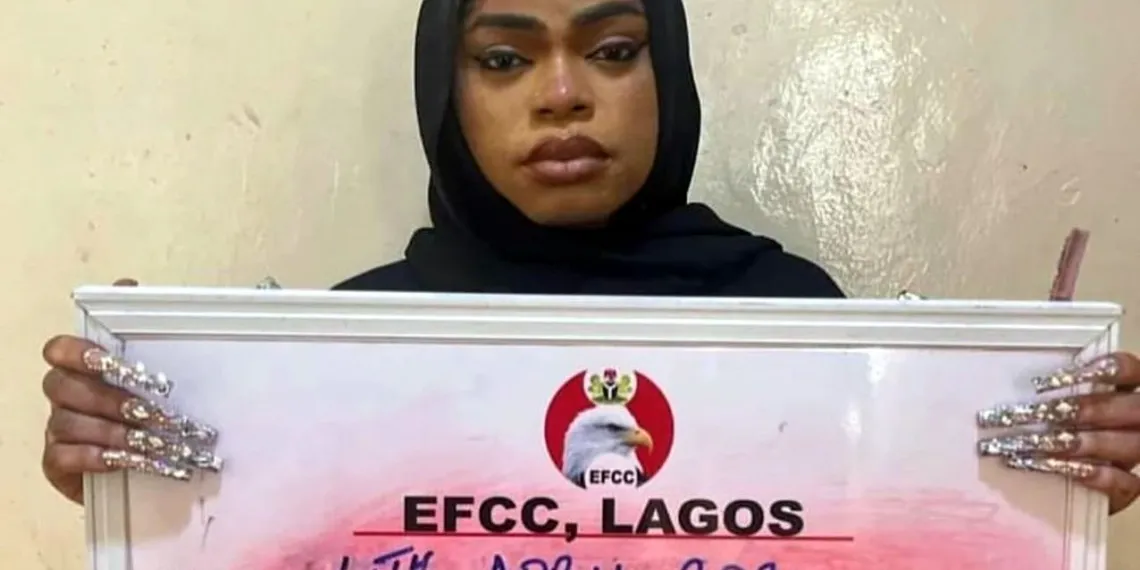
I may not like the lifestyle that Okuneye Idris Olanrewaju, aka Bobrisky, a wealthy Lagos socialite notorious for his cross-dressing ways, has chosen, but it does not change the fact that I believe there was a miscarriage of justice against him in the critical aspects of his trial and sentencing for abuse and mutilation of Naira notes. In particular, I believe the guilty plea that nailed him left much to be desired in terms of practice and procedure relating to plea bargains, especially the benefits to the accused person enjoined under Nigerian law.

I do not want to believe that his lawyers counseled or allowed him to enter a guilty plea without first sitting down with the prosecution to secure easier terms for him, ie, a plea bargain which in my opinion should not involve spending another moment in custody beyond what he had already spent between his arrest and trial. If however they did counsel or allow him to condemn himself gratuitously, all I can say out of professional courtesy is that they did not do well.

I once wrote: ‘A plea of guilty must be a quid pro quo in which both the state and the accused person trade favours, with each getting something valuable in return. Typically, the pay-off is an open and shut (easy) case for the state and reduced charge or punishment for the accused. A plea bargain is not a lazy lawyer’s cop-out from the rigours of a full trial or a ‘generous’ lawyer’s gift to the state to obviate the rigours or costs of a full trial. So, a lawyer should not advise a client to enter a guilty plea in a criminal trial without ensuring that there is equal or greater benefit for his client, particularly in form of reduced or suspended sentencing.’

In the light of my foregoing argument, I have to ask, what was in this guilty plea for Bobrisky? What did he get in return for accepting an offer of a plea bargain from the state to drop his right to a full trial which, given his substantial means, social status and admittedly powerful network, could have ended in a stalemate sooner or later?

The dubious privilege of being Nigeria’s poster boy for jail-time without option of a fine in Naira abuse cases?

I believe it to be the position of Nigerian law that a guilty plea should only be advised when it presents advantages for both the state and the accused, with the latter receiving a reduction in punishment. In the case of Bobrisky, who was given a 6-month custodial sentence for naira abuse, it is arguable that he was not advised of all choices available to him under the Administration of Criminal Justice Act (ACJA), 2015.

Under Section 494 of the Act, a plea bargain is a collaborative process in criminal proceedings between the defense team and the prosecution to negotiate a mutually agreeable resolution of the case. This may involve the defendant pleading to a lesser offense than originally charged in the complaint or information, along with meeting other conditions set by the prosecution (including fines, community service, etc) in exchange for a reduced sentence compared to what would be imposed for the initial charge, subject to the Court’s approval.

In other words, the ACJA grants the prosecution the authority to engage in plea bargaining with the defendant, provided the victim consents, either during or after the prosecution’s evidence presentation but before the defense presents its evidence. This legal provision facilitates the expeditious delivery of justice and prevents the wastage of time and resources that a trial would entail.

Considering the nature of Bobrisky’s offence in this instance, that is, spraying of the Naira, I do not doubt that if such a ‘collaborative process’ happened and he was offered all the options at his disposal in a plea bargain, it is more than likely that with proper legal advise and representation a more favorable outcome, like an option of fine or jail limited to time already served could potentially have been negotiated.

I am therefore irked by the decision to advise a guilty plea without securing equal or greater benefit for the client. This nagging irksomeness may be peculiar to me, but it does seem justified in the light of the sentence which the court was forced to impose having been confronted with a fait accompli in the form of a guilty plea simplicita – and with no other resort except the bared fangs of the law, no consent or bargain arrangement between parties and a discretion circumscribed by the mandate to act judicially and judiciously.

It would raise concerns about potential incompetence or professional malpractice that should concern all of us in the legal profession. This is because lawyers have a duty to protect their clients’ rights and advocate for the best possible outcome every time. Failing to do so can negatively impact the client, and while I am not positive that this is the case in Bobrisky’s case, I am concerned at the lack of evidence that it is not. It is therefore essential for lawyers to thoroughly analyze the evidence, the law, and their client’s goals before recommending a guilty plea.

While not wielding Idris Okuneye’s cross-dresser’s lifestyle as a mitigating factor, I am forced to note that he suffers more than the average risk of sexual assault, or at least assaults on his dignity, in custody – even if it be from mere heckling and suggestive threats from other prisoners. The Correctional Services has admitted as much when it put out a press statement trying to reassure concerned Nigerians that they will go the extra mile to safeguard him from such assaults.

The ACJA is a paradigm shift from punishment as the main goal of criminal justice in Nigeria to restorative justice. It has essential features which direct all stakeholders to pay serious attention to the needs of the society, the victims of crime, vulnerable persons and human dignity in general. In fact, the overall tone of the Act puts human dignity in the fore, from the adoption of the word ‘defendant’ instead of ‘accused’, to its provision for humane treatment during arrest, to its numerous provisions for speedy trial, to suspended sentencing, community service, parole, compensation to victims of crime and so on. Sections 8(1), 314, 319, 460(1) and (2) and 468 of the Administration of Criminal Justice Act, 2015 and numerous others all indicate so.

So, when I look at how the ACJA’s emphases has redirected the focus of criminal justice administration in the country and juxtapose same with the processes and outcomes in Bobrisky’s case, I am left wondering who is more vulnerable in a male prison right now than Bobrisky, and whose human dignity, not to mention mental health, is more endangered at this moment and for the next 6 months than he. Morality aside, does an unsentimental examination of his case raise the question, HAS JUSTICE FAILED YET ANOTHER NIGERIAN?

VIDEO: Lawyer insists CIA did not rescue Chibok girls, dares Nigerian government to publish expense on girls in US

By Emmanuel Ogebe

“Is CIA saying they asked the Chibok girls to follow them back but they refused to be rescued?” International Human rights lawyer Ogebe knocks U.S claim it rescued 30 Chibok girls and dares the Nigerian government to publish expenditures on Chibok girls he brought to America in this explosive 10th anniversary interview of the world’s longest running mass abduction. The lawyer offered to publish his expenditure on the girls in America who the government forcefully took over if they would saying they misspent millions of Nigeria’s scarce resources.

Video https://m.youtube.com/watch?v=ozw8MnALLh4

TRANSCRIPT :

CHIBOK GIRLS’ ABDUCTION_ REFLECTING ON THE IMPACT AND PROGRESS AFTER A DECADE

LN Broadcaster: Ten years have passed since the horrifying abduction of 276 school girls from the government’s girls’ secondary school in Chibok, Northern Nigeria by the terrorist group Boko Haram. This tragic event sparked global outrage and brought attention to the plight of the victims and the broader issue of terrorism in Nigeria.

As this solemn anniversary is marked, it is essential to reflect on the impact of the Chibok abduction and assess the progress made in addressing the underlying issues that led to it. 

A speech by President Buhari: We shall redouble efforts to ensure that we fulfill our pledge of bringing the remaining girls back home. Already, the credible first step has been taken and government will sustain the effort until all the remaining girls return safely. These 21 girls will be given adequate and comprehensive medical, nutritional, and psychological care and support. 

LN Broadcaster: The Chibok abduction had profound and far-reaching consequences, both nationally and internationally. It highlighted the vulnerability of school children in conflict zones and exposed the brutality of Boko Haram’s insurgency.

The hashtag “Bring Back Our Girls” campaign galvanized global support for the victims and their families. But despite widespread condemnation, many of the girls remain missing to this day. 

Speech by one of bring back our girls member: On one hand, hope has been rekindled, because you saw them, we’ve seen 15 girls, they’re looking well. We don’t know what they’ve gone through, but at least they’re alive and they’re looking well, so we’re happy about that. Their parents have identified them, and so hope has been rekindled, but at the same time the heartbreak has come again, and unfortunately the parents whose children were not there are devastated. All the parents in Chibok today, they’re at the school, they’re having a program to mark today and to demand and pressure the government and beg the government to do whatever it can to bring their children back.

LN Broadcaster: The psychological trauma inflicted on the survivors and their communities continues to reverberate. Underscoring the urgent need for comprehensive support and rehabilitation efforts. Despite efforts made by Nigeria Security Forces over the years, the challenge of schools being a soft target for terrorists, persist.

The latest been the school abduction of more than 200 school children in Kuriga of Kaduna State. On today’s episode of The Agenda, we wade into the controversies and allegations surrounding the Chibok school mass kidnapping to set the record straight 10 years after with many still in captivity.

Henry Williams (LN News Presenter)Well, thank you for joining us on another edition of the program. And yes, we will be taking a look at the Chibok school abduction, reflecting on the impact and progress after a decade. My name is Henry Williams. Welcome to The Agenda. And on today’s program, we’re taking a look at some of our talking points on the program.

We’re revolving around the politics behind kidnappings. We also will be looking at impact of abduction on victims. as well as advocacy for victims of kidnapping. Well, there is so much to unpack on today’s edition of the program. As we mark 10 years since the Chibok school kidnapping that took place in April, 2014.

Our guest is Emmanuel Ogebe. He’s human rights activist, and he will be joining us from Washington DC in the United States of America. 

Well, getting to know who this gentleman isEmmanuel Ogebe Esquire is a prominent U.S based international human rights lawyer in Washington, was exiled to America after abduction and torture by late dictator, Sani Abacha, for protesting the assassination of pro-democracy icon Kudirat Abiola over the Nigerian 1993 election.

Now in Diaspora, advocating in multiple continents, including Europe, North America, Asia, Africa, Australia, and the Middle East. He plays a role in shaping U.S he played a role in shaping U.S Congressional and foreign policy in Nigeria’s quest for a stable democracy. His dogged defense of a Nigerian citizen trafficked abroad and sentenced to death.

Pro bono for 15 years led to victory at Indonesia’s Supreme Court, which freed him in December 2023. And with that just in a nutshell of what this gentleman is all about, I’d like to welcome Barrister Emmanuel Ogebe to The Agenda. 

Barrister Emmanuel Ogebe:Hey, thank you very much Henry. It’s always a pleasure to be with you.

Henry Williams (LN Presenter)Great to have you Barrister and such on a fateful day like this, marking 10 years since the kidnap of Chibok school girls took place here in Northern parts of Nigeria and April exactly looking at the situation, there are events that have taken place today in respect of, you know, what happened on that fateful day. Talking about this let me. Take us to that event by the Murtala Mohamed Foundation. I do believe you were part of that conversation today.

Barrister Emmanuel Ogebe: No, I wasn’t part of any conversation today. As you know I’m in Washington DC and it’s morning right here now. So whatever events you were referring to may have been In Nigeria where it’s evening. 

Henry Williams (LN Presenter):Alright, let’s quickly take a look at the timeline before we delve into these issues that you are seeking to unravel before us.

You are pain by some narratives that you want to set straight. Let’s look at the timeline of the Chibok School kidnapping in 2014 276 Doctor Chibok School Girls. With that 57 escaped shortly after the abduction. And then in 2018, Salome Koju, she was rescued on January the 4th.

Moving on, we had 276, okay, still talking about the abduction of the girls. In 2017, Rakiya Gali Abubakar she was released 82 released after negotiations on the 6th of May and in 2016 Amina Ali. was released on May 17th and after negotiations 21 girls were also released on October the 13th.

Maryam Ali was released on November the 15th. So, I’m trying to take us on a journey here. And so far, we’ve had 185 Chibok [girls returned, and 91 still missing. 

Well, can you confirm that Barrister Ogebe?

Barrister Emmanuel OgebeLet me clarify for you here. Some of what you said was slightly inaccurate. The first girls to escaped within 24 to 48 hours of the abductions. Those were 57 girls. 

Now, the first girl to escape after that, where it was actually Amina Ali who escaped in May, 2016. So that was two years after the abduction. And then the next girls who were released were actually released by negotiations, prisoner exchange, and ransom. As I stated, the article, which I released last week, and those were 21 girls.

And then after that Maryam Ali escaped also in 2016. So that is the proper sequence of the first few escapees and those released.

Henry Williams (LN Presenter): Oh, okay. Was released in 2016. Maryam Ali Miyanga…..Okay.

Alright. You have given the proper narrative there. Can you confirm in 2022 about 1,2,3,4,5,6 over 10 of those girls were still released?

Barrister Emmanuel Ogebe: Well, in 2022. I’m not sure the actual number that emerged in 2022. But again, there was no release. There has been no release. Since 2017, the last release of Chibok Girls was in 2017. There have been only two releases of Chibok girls in the history of Nigeria. The first release is the one I refer to you now in 2016, 21 Chibok girls were released under a prisoner swap and ransom arrangement where 21 were released, and then the second batch of 82 were released in 2017.

That’s it. In 2022, about two or three girls escaped and were recovered by the Nigerian military. In 2023 again another two or three girls were similarly recovered by the Nigerian military. 

Henry Williams (LN Presenter): All right. Barrister Ogebe you were part of the hashtag BBOG movement and you have made some assertions, the claiming that the United States did not, the American government did not, how do I put it now?Said free these girls. It was the Nigerian government. You were very pained by the narrative brought by the book Sisterhood theSecret History of Women at the CIA by Lisa Mundy. And you really want to set the record straight on the narrative that she brought about, talking about the CIA being instrumental to the release of these girls.

Can you share your thoughts with us on this?

Barrister Emmanuel Ogebe:Yeah. So let me be very clear. I’m a human rights lawyer. I have been for over 30 years. You know I have fought military misrule in Nigeria. I have fought military democratic misrule in Nigeria consistently for that entire period of time. America has been an ally in some of the struggles, to enthrone democracy in Nigeria.

America has been helpful in providing me political asylum when my own country imprisoned and tortured me, you know, so it is very sad for me to see a situation where America is lying about rescuing Chibok girls. Which they did not do. I was very shocked when a dear friend and colleague, an American law professor drew my attention to a publication that claimed that the CIA rescued that 30 Chibok girls, a book that was released just a few months ago, which you just referenced the secret history of women in CIA.

And when I read it. It was just full of falsehoods. Nothing like that has happened. And what that tells me is this, is another example of white appropriation. I don’t know what it is about this Chibok story that people are just crawling out of the woodwork, trying to claim what is not theirs. The fact of the matter Is that when it comes to the release of those 103 girls, there are three heroes who were responsible, who were the remote catalysts for the freedom of those 103 girls. As I said in my article One was the media and especially CNN. How did that happen? CNN leaked the proof of life video of the chibok girls that Boko Haram had given to the Buhari regime and asked them to pay ransom and release prisoners, so that the girls would be released and Buhari refused to watch the video and refused to act on it since 2016 that he didn’t want to be emotionally disturbed. So, he refused to watch it. So, CNN obtained it and released the video to the public. And when the entire world saw the children begging for their lives for the first time since 2014, he touched a nerve. I was in Abuja at the time and I was with the parents of the children who were shown on the video and the whole world saw it. And so there was an outcry and pressure were mounted on Buhari to do something about children. That was one factor. 

The second factor was the appearance of Amina Ali. After two years in the forest, Amina escaped and came out with her baby. And when her baby was seen and everybody saw that these girls were still alive and one of them was able to come out again, the world was touch. It went around the world. 

I remember waking up that morning my phone rang a journalist from London called me. Can I confirm that A Chibok girl just came out from a captivity? I woke up, I called my contacts in Nigeria fortunately, I was in touch with Amina’s family and all of that and they confirmed to me that it was Amina So it had it a reverberateeffect around the world. So that put pressure. 

And then thirdly, the global bring back our girl’scampaign in the United States Congress. Myself, the speaker of the house, Nancy Pelosi congressman Frederica Wilson, congresswoman, Sheila Jackson Lee you know so many people came together to mount pressure. These were the factors that forced Buhari to take it seriously and bring these girls back.

So for the CIA to now come and claim that they organized an operation and rescued 30 girls is false. It was 21 girls that Buhari paid for their rescue. 

HENRY: Why do you think the CIA would want to change the narrative, 

Barrister Ogebe:

That is what we’re talking about. Anything that you see, there’s a saying that success has many fathers and failure is an orphan.

You know, look at some of the efforts we did, you know, like I took Chibok girls to America and put them in schools. People who didn’t do that, who had no vision now began to compete against me. Now went to go and carry the girls out to one and claim credits for what they didn’t do. This is the kind of world in which we are.

Henry Williams (LN Presenter) Barrister, let’s talk about that aspect. There is another side, some people are alluding to that the hashtag BBOG was somewhat of a cash cow for some NGOs to actually make money from international donors. What’s your position on that? 

Barrister Emmanuel Ogebe: I don’t know how it was a cash cow to make money for international donors. Because what I can tell you is this, the international community contributed millions of dollars to Nigeria to make schools safe. And from that time till now, schools have not been made safe in Nigeria. I can tell you that I sponsored Chibok girls to the United States. Who are not being taken care of by the Nigerian government and guess what? Up till now, as I’m speaking to you, those that the Nigerian government took over, if you hear how much they have spent on them, millions, you cannot see a commensurate graduation and qualification compared to those who millions were not spent on.

Henry Williams (LN Presenter): That’s really sad because in your reports, you also cited that the rights groups and stakeholders are criticized in Nigerian government for the treatment of the freed girls were held in Abuja were not allowed to see their parents as well. Can you share more about that?

Barrister Emmanuel Ogebe:You see, it’s a very sad situation. You see when Amina Ali came out back from captivity, she was held incomunicado in the villa and in other locations for a long time. And it was so bad, they were bringing a malam to come and instruct her in religious studies. And at a point she had to protest and say, “I was a Christian when I was abducted, I have escaped, Why are you forcing me? and bringing me an instructor in Islam. I’m supposed to be free now. Let me go back to my religion”. So that was a problem. The government was trying to force her into the religion that the terrorists had forced her into. Then, you know, of course the issue of releasing her to her family, they did not do that.

As you saw in the article. Now, when the other 21 girls came back, the same thing, they kept them in Abuja for a long time, didn’t allow them to go to their village. In fact, one of the girls who came back attempted suicide while in the custody of the Nigerian government. Attempted suicide. So, the question arose, why would a girl who was in the forest with Boko and didn’t attempt suicide now is freed and is in Abuja now want to commit suicide under the Nigerian government that tells you that conditions under the Nigerian government were worse than conditions under Boko Haram in the forest.

Now, let me even go a step further. One of the Chibok girls who was taking from my sponsorship here in the U.S she was living in a $2 million house here in America. Yeah. The Nigerian government took her and put her in an apartment in the Bronx Ghetto in New York.Sometime later, I heard that she attempted suicide. So anything that the Nigerian government involves itself in, is bad for whoever is under it. If you look at the Nigerian country now, it is bad for whoever is under it. That is why people are fleeing. And that is exactly what happened to them. 

Henry Williams (LN Presenter: A very serious allegations Barrister Ogebe, did you bring these things up before now? And exactly can you, based on your submissions, could we allude to the sense that these girls the way they were treated and the approach of the seemingly nonchalant approach to the kidnap was because they were not Muslims?

Barrister Emmanuel Ogebe: The facts of the matter are very clear, Chibok, or called Chibok is the most Christian local government in the whole of Borno states.

Henry Williams (LN Presenter): And we can’t hear you clearly. Your audio seems to be muffled.

Barrister Emmanuel Ogebe:I said Chibok is the most Christian local government in the whole of Borno states and so 90% of the girls that were abducted were Christians. Over 276 girls were taken away and as we speak, over 90 of those girls are still not back till today,10 years later. 

All right, let us look at Dabchi. Dabchi was predominantly Muslim girls that were taken. Only one was Christian. After one month, all the girls came back, only one girl didn’t come back and the only one girl that didn’t come back was Leah, the Christian. How can you say that it is not a factor of religion?

Henry Williams (LN Presenter): That’s really sad Barrister Ogebe, now looking at all these allegations right now. What can we learn from what has happened in 2014? Do you think government has taken steps? You talked about the issues of the Safe School Initiative, which was actually brought up by Gordon Brown, if I’m correct, spearheaded by him through the U.N to ensure that these schools are safer, children can go to schools. Do you think government has actually responded to the insecurity concerning the schools?

Barrister Emmanuel Ogebe: Well, from my recollection, a minimum of about $44 million was contributed by, I believe it was Japan, Canada, and several countries. $44 million was contributed for safe schools’ initiative. As at one to two years ago, it was reported that Nigerian schools are still less than 50 percent safe. So it is clear. And when it comes to mass school abductions, Nigeria is still the school mass abductions’ capital of the world. Last month, in the first week of March, over 200 school students were abducted from one school in one day. Since Chibok, there have been nothing less than half a dozen mass school abductions, equivalent to what happened in Chibok. So, the situation in Nigeria has deteriorated. It hasn’t improved.

So there’s nothing to be happy or proud about whether we have learned any lessons. 

Henry Williams (LN Presenter): Are you aware of the status of Chibok right now, especially the schools? Because when this incident happened, the schools were burnt down. And total facility was destroyed. Are you aware if government has replaced those structures, if those facilities have been replaced?

Barrister Emmanuel Ogebe: Well, there was a lot of controversy because the federal government gave the Nigerian army, I believe it was the call engineers or so. I Don’t know if it was N2.5 billion to rebuild the school and they were supposed to. rebuild the school and then there was a tug of war because Borno State wanted to rebuild the school.

You see, at a point it became over who will get the contract, who will do this, who will do that. There was a lot of infighting and which delayed it for years. But my understanding is that it has now been rebuilt. But I don’t know the condition and status of the school. But I can tell you that we were on a fact-finding mission to Dapchi, Leah’s school on the sixth anniversary of her abduction in February. And the school is abandoned. Leah’s school is abandoned and animals have taken over. There are no classes going on nothing.

Henry Williams (LN Presenter): Okay. Let’s take some sound bites from five years. You know, after the kidnap from activists who took to the streets to protest for the return of these girls, let’s hear their words and see as find out if anything has changed since then.

Cry For Lack Of Education From Chibok Parents 

Parent 1: All we need is for our children, our people to continue to further their education. But for now, two years, no school, no learning, no work. 

Parent 2: We have been begging government to open even a secondary school, government secondary school for boys. Up to now, nothing. Only this female school. And the female school now, where is it?

And really Boko Haram has achieved their aim. They’re saying that they don’t want the Western education.

Parent 3: You know, we are redundant. We are abandoned by the government, in fact. We are very sorry to mention. Because since this thing happens, we have a lot of children living at home without doing anything. And we are very, we are poor enough. No road, no market, no water supply, no electricity. 

Parent 4: When I see my daughter coming back to me, I will feel such joy. joy in my heart. All the sickness and other things will disappear and I will be very happy in my life. 

Parent 5It is exactly five years today. We know Nigerian government has tried, soldier too, they have tried. But up to now, we are still looking for 112 girls in the hand of captors Of which we as a parent, we want God intervention.

Henry Williams (LN Presenter):All right. And that brings back some memories. Parents at that time, you know, asking government bring back their girls, bring back their children. And right now, it’s only about, about 90 over 90 are still in captivity. Barrister Ogebe, do you think the parents have given up on these children?

Apparently, it’s it looks like a lost cause. Who do they turn to? How do they get redress in all of this? It seems they’ve been forgotten and left behind.

Barrister Emmanuel Ogebe:You know, it’s a very sad situation indeed. I Never forget, you know, one of the Chibok girls, one of the 10 Chibok girls I brought to America. She phoned me from school one day and she said, uncle, my auntie called me and she said, that is there anybody who is still talking about our missing daughters in America? And I told her, I said that uncle Emmanuel is the only one who is still talking. And she said, tell him to please remember to talk about my daughter. And so I asked her to give me the auntie’s number and I have been in touch with the auntie, you know, and you know, I tried to continue to speak up. But sadly, sadly, the sad thing is that in Nigeria, people don’t understand how to separate human rights from politics. You don’t know how to separate wrong from rights.

Any human being born of a woman should understand the importance of trying to recover a child for his parents. It’s not an APC issue. It’s not a PDP issue. It is a humanity issue. It is a kingdom issue. So long as you were created in the image of God, you should see divinity in trying to restore a child to his parents.

How the Buhari administration decided that this was a basis for attacking people who spoke out that they should help bring the children back is another issue altogether. True. The Jonathan administration felt that it was an attack on the administration. What they did not attack with violence. What they did was, you know, with propaganda, they shared money to lobbies.They paid lobbies in America a million dollars to fight us. But when Buhari regime came in, they came in with military intelligence, military operations, NSA. They were fighting us with death, real death. I had to sue them in court. They wanted to, they said they would revoke my Nigerian passport. The Nigerian ambassador in Washington wrote a memo to revoke my Nigerian passport. I had to report them to the U.S government because it was a crime. So, that was how bad it was. And so, we were the ones who were giving hope to the parents because we kept speaking and encouraging them. But the fights became too much and some of them succumbed. A lot of them died. From my understanding, over 25 parents died.

One of the girls who came back last year, when she came back two weeks after her father died. So, her father did not leave to see the return of his daughter two weeks later. But I will tell you this, the mere fact that three girls came back nine years after tells you that there is hope that even where the government failed to rescue them, the girls are rescuing themselves. I must say we have to give some credit to the Nigerian military because it is their operations, that are creating the enabling environment. To help these girls come out. One of my happiest days was recently when I was in Nigeria, I think it was last year. I was watching TV and I saw the first lady Remi Tinubu on TV hugging a Chibok girl who had just escaped. You know, it really touched me because it wasn’t over politicized like the Buhari era, you know? She hugged her, welcomed her, and spoke kindly to her. You know, so I think that there is hope that with the proper, you know military action and the girls continuing to escape by themselves that we will get more and more of the girls back. But let me be clear as I said in my article just released yesterday part two of my article 10 reasons why the U.S did not rescue the Chibok girls. 

Henry Williams (LN Presenter): We’ll take a quick break. When we come back, we want you to give us those 10 reasons. And before we begin to talk about the impact on the victims, and as you have given some light of hope that it’s possible that these girls can still return, we’d like to see how possible that is.

Stay with us.

Stay up to date with LN 24/7. LN 24/7. With news, politics, business, sports, and more on LN 24/7. Where the story goes. 

Henry Williams (LN Presenter): Great to have you back. You’re still watching The Agenda. And yeah, we’ve been reflecting on the moments, the emotions surrounding the Chibok school kidnap 10 years after today, when 276 girls of Chibok school were taken away until date, about 91 are still in captivity. My guest, Emmanuel Ogebe, a human rights lawyer, Yeah, it’s been a very, very much involved in the seeing the return of these girls. Right from the moment these things happened, he’s been in the thick of things and shares with us and clarifying some of the narratives, you know giving us the right record of what actually happened. Well, Barrister, thank you for sharing more insights on this. And you, especially, were pained when the U.S the book Sisterhood was giving the wrong narrative. And you have ten reasons to actually assert that account was totally wrong. Can you quickly share those ten reasons that you have to share with us before we, we move into other things? 

Barrister Emmanuel Ogebe:Well, you know, there are so many of them you know, I don’t know that I can go into all of them offhand.

But you know, let me start with the one that pained me the most, which was you know, why don’t you, if you have it in front of you, number 10, if you don’t mind reading it. Since I don’t have it in front of me.

Henry Williams (LN Presenter): I actually don’t have it here, but I know I thought you would have it being the writer.

Barrister Emmanuel Ogebe: Alright Yeah, let me just say briefly so reason number 10 was the book claims that according to the CIA they wanted to recover all of the girls, but according to them some of the girls didn’t want to come back because they didn’t want to leave their babies behind. And so they just brought you know 30 of them. And then they brought one or two of them in trickles later. And so, what I am saying is the CIA trying to tell us that they went to Sambisa Forest, they captured, or they gathered all the Chibok girls and they saw, yeah, we are here to carry people back home.

And so they say, ah! no ooo. I can’t leave my baby behind ooo… So, I’m not coming. And then he says, okay, all right. Since you’re not coming, all right. We’re only going to carry 30 of you. The 30 of you come let’s go. Does that make sense? That doesn’t make sense in any world because the CIA cannot do that to its own American citizens, because they understand the concept of Stockholm syndrome, which is that somebody who has been in captivity for so long would have now developed a mental condition of empathizing with their captors as a coping mechanism, they’re not thinking straight. So,you will rescue them and bring them out to a normal environment where they now normalize and can think and function properly for themselves These girls who are taken as teenagers and have been subject to abuse, you mean that they were in a right-thinking state atthat point?

That, that is totally not feasible. It makes no sense. 

Henry Williams (LN Presenter): Barrister Ogebe, can you wade into, can you wade into this for me? I’d like you to, you know, share your thoughts on this very critical issue. It’s been a very sort of huge debate. The issue of amnesty for those who perpetrated these crimes against children like this, And the impact it will have on the victims, like you said, Amina’s mother, still having faith in the Nigerian government. How will this affect those who have been adversely affected by these kidnappings, where the children have been taken away from them? And the government now giving amnesty to over 200 repentants, as it says, Boko Haram terrorists. 

Barrister Emmanuel Ogebe: You see what we have in Nigeria is not amnesty. We have impunity and any system where there’s impunity is not a system where anybody can do and undo without consequence.

There is no rule of law. That is not a civilization. The wives of Boko Haram terrorists, they are living on where they are kept. Is more luxurious than the IDP camps of They operated dollars and euros, whereas in IDP camps, the women have to perform sex acts just to get basic amenities from camp officials. These are all documented things that are going on. In fact, women in IDP camps were so deprived that they went out in search of what to eat, and hundreds of them were abducted. On the first week of March by Boko Haram. So, what has happened in Nigeria is that aggressors have been so pampered and victims have been so deprived that it is now what we’re teaching our city.

A distorted value system that it is better to be an aggressor than to be a victim that it is a crime and it is an honor to be an aggressor. So, I was very sad when I saw that one of the terrorists who abducted the Chibok girls was given a light prison sentence. And I said to myself, what kind of justice is this?

The girls are not back. And yet this man has been given a sentence. He will serve and he might even be released early under amnestyand he will go and the parents are still there. They will never see this, their daughters. And this one has gone Scot free. And that is not justice. You cannot create a society based on such a distorted value system.

Henry Williams (LN Presenter): I’d like to ask you two questions in one here, sir. Do you think that religion has played a critical role in what has happened here? And you think that this was part of the grand plan talking about removing president. Goodluck Jonathan, from power. Do you think this was, you know, politically motivated at the beginning?

Barrister Emmanuel Ogebe: I mean, you know, religion has always been a factor. There’s no two ways about it. You can imagine that when Jonathan lost power, [00:45:00] there’s a phone recording of how Shetima, who presided over the state of Borno when the abductions occurred, despite the warnings that were given him by Jonathan’s administration, was congratulating and celebrating the fact that the president of his own party had been defeated by the opposition. It is there and it is known. So,these factors are all part of the reality of what is going on in northern Nigeria, you see, and it cannot be discounted, you know. So anyway, that’s the short answer to that. It has always been there. I don’t know when we will come out of it.

And let’s on forget that I won’t even go into that, but let me add another reason why from the 10 reasons why I said the CIA did not, rescue the Chibok girls. Reason number one was that CIA report in that book said that the book, the school was a Christian boarding school. You and I know that it was not a Christian boarding school.It was a government girls’ secondary school. 

How could the CIA be so daft? as to call a government girls secondary school a Christian boarding school. That’s not possible. That tells you that they just manufactured a story to give themselves, you know, what the Nigerians called clout. That’s not true. It didn’t happen.

Another reason 

Henry Williams (LN Presenter): Our time is going, let’s talk about advocacy. How do we prevent this from happening again? How do we stop this? How do we bring this to the world to see what is happening here to prevent? Apparently, it doesn’t seem like the stop gaps that have been put in place like the safe school initiative are being implemented.

So, how do we bring this to a stop? You have alluded to religious tilts in this matter, especially citing the recent kidnap of over 200 school girls, I think on the 7th of March abducted from the northwestern town of Kuriga in Chikun local government area, and you said because they were predominantly Muslim, all those girls were, some were returned.

Now, how do we stop this and see that things are dealt with on a level playing field?

Barrrister Emmanuel Ogebe: Well, you know, to be frank you see, we have to reverse the incentive structure of kidnapping for so long as we incentivize kidnapping and we do not provide consequences for kidnapping. It will flourish in our society. There’s a reason why the U S does not negotiate with terrorists when it comes to kidnapping, because it then becomes a cottage industry, which is what has happened in Nigeria.

Everybody now wants to be a kidnapper. That’s why, you know, the Fulani’s have found out that it is more profitable to kidnap an infidel than to follow cows in the bush. So, this is a better business model for them. So, we have to implement our laws and make it unprofitable and unsustainable to kidnap.

We have to fortify our schools. We have to as far as possible, you know, end the boarding school system as far as possible. There’s no need to create soft targets of our children. The era when we needed boarding schools is over. It was in the olden days when schools were far and in between. Now, schools are all over the place. We do not need to put our children in harm’s way. So, these are some of the few things that need to be done. 

Henry Williams (LN Presenter): Alright. I’d like us to take a soundbite from one of our security analysts who’s also in the United States. I think Texas to be precise. He did make some submissions on this issue. But I want to take from Dr Roy. And hear his thoughts before we come back and round it off.  

Dr Roy (Security expert): 10 years after the Chibok kidnapping, almost a hundred still missing. What have we learned? We have not learned anything. One of the reasons why we have not learned anything is that the security architecture, which we always use as a big word, you know, it connotes a change in office and the office holders are recruited by the t hen persons in power.

So definitely everybody recruits those that will be loyal and pay allegiance to them. So, who will you serve, if not your master that brought you into office and you gather all your boys under you, so, the IG will only serve the person that is in power, the chief of army staff, chief of defense, all the service chiefs, the NSA, the honorable minister of defense, they are all brought into power not by the culture of the organization they belong to like the army where I come from. It has a culture, you know, it’s a succession plan. The Navy, the Air Force, the police, they all have succession plans by their instigated authority. But I mean, the politicians took over and once you come, you dump everything, you follow the script of the current government, you know, and that is where we are.

We can trace people. We can trace data. We can, sorry, but we can’t apply the results of our intelligence gathering and intelligence job. We have great police officers. We have great intelligence here. We have great military officers, but they are cut short by the government of the day.

Henry Williams (LN Presenter): Well, there you have it Dr Roy sharing his thoughts. As we go Barrister Ogebe, what would you want to leave with our viewers right now, as we mark 10 years from the Chibok school girl kidnapping? 

Barrister Emmanuel Ogebe:Well, I would certainly want to ask the new administration to redouble efforts, to make a commitment to recover these girls.

At least, you know, Senator Remi said that a girl was recovered under the administration, and I hope that they will make an effort to recover more. The fact that they got back some students in Kaduna is a good sign. But I also want to use the opportunity to throw a challenge to the Nigerian government.

I want them to show the money that they spent on the girls in America, the dollars they spent from the Nigerian economy. I will show the dollars that I spent. From the US economy. Let them show Nigerians the dollars they spend from the Nigerian economy on those girls I asked them to publicly show it.

Let us, let’s compare receipts let Nigeria see the millions of dollars they spent and let them show what I spent. Thank you!

Henry Williams (LN Presenter):Thank you Barrister for sharing your thoughts. It’s been great having you. Look forward to more experiences with you on these issues. Well, that’s where we will draw the curtain.

As we commemorate the 10th anniversary of the Chibok school mass kidnapping, we must reaffirm our commitment to justice. accountability and solidarity with the victims and their families. Now, while progress has been made, much work remains to be done to ensure that such atrocities are never repeated.

Like my guests have said, it is imperative. The Nigerian government in collaboration with its partners redoubles its effort to combat terrorism. Promote peace and reconciliation and address the root causes of conflict and insecurity. Only then can we honor the memory of the Chibok of girls and build more secure and prosperous future for all Nigerians. And as I always say, only Nigerians can build Nigeria. 

Well, thank you for staying with us on today’s edition of the program. My name is Henry Williams. The conversation continues on all our platforms, including X, YouTube, Facebook, and what have you. Thanks for staying with us and see you same time on this station.

Bye for now. Stay up to date with LN 24/7. LN 24/7. With news, politics, business, sports and more on LN 24 7. Where the story goes, we go.

Broadcast on April 11, 2024

BBC report paints distressing picture of languishing escaped Chibok girls, as rehabilitated captors fare better

A number of the Chibok girls that escaped from Boko Haram captivity have not stopped crying out over poor treatment they are getting in the hands of government, noting with heavy hearts that they were better of in Boko Haram captivity.

An incisive report done by the BBC has found out that while the girls are badly neglected, some of their captors, who submitted to a government amnesty programme are well taken care of.

The lamentations of the girls, now grown women and mothers to children sired by insurgents, comes as the Christian Association of Nigeria (CAN), on Saturday urged government to ensure that those still in captivity return home. About 91 are still with their captors.

In a statement  by its National Director for Education, Youth and Women Development, Rev. Ozumba Nicodemus on Saturday in Abuja, CAN said: “The trauma experienced by the remaining 276 abducted girls from Nigeria is unimaginable

“The pain and anguish felt by their parents, who have endured sleepless nights filled with hopelessness, are deeply felt by CAN.

“We cannot remain silent while their children remain in captivity, yearning for freedom and reunion with their families….

“It is our duty as a nation to ensure their safe return, and to bring an end to the anguish and suffering endured by these innocent young girls and their families.

“We call on the government to mobilise all available resources, engage relevant security agencies, and collaborate with international partners to secure the release of the remaining Chibok girls.”

CAN also urged the international community, humanitarian organisations, and well-meaning individuals to join hands in advocating for the release of the Chibok girls. Almost all the girls abducted a decade ago are Christians.

Said the umbrella body of Christians in the country: “Together, we can amplify our voices and exert greater pressure on the abductors to bring an end to this prolonged ordeal.

“CAN remains resolute in its commitment to seeking justice and ensuring the safe return of the Chibok girls.

“We will continue to engage with relevant stakeholders and utilise all available avenues to shed light on their plight and secure their release.

“We urge all Nigerians to stand united, to lend their voices and to demand immediate action from the government.

“Let us show our unwavering support for the families of the Chibok girls and demonstrate our collective determination to bring them back home.”

Please find below the BBC report:

Chibok girls feel let down 10 years after Nigeria kidnapping

By Yemisi Adegoke,BBC News, northern Nigeria

BBC/Simpa SamsonAmina Ali became the first Chibok girl to escape prolonged captivity in 2016

We had to meet Lisu in secret as she says the local Nigerian authorities are trying to prevent her from talking to journalists.

She was one of the 276 girls abducted from their school in the town of Chibok exactly a decade ago – a kidnapping that shocked the world and sparked a global campaign to #BringBackOurGirls, which included former US First Lady Michelle Obama.

More than 180 have either since escaped or been freed, including Lisu, who gave birth to two children while she was a hostage of the militant Islamist group Boko Haram, living in a hideout in the Sambisa forest.

After escaping, Lisu – which is not her real name – went through the government rehabilitation programme, before being placed in group accommodation with other escapees.

“I do regret coming back,” she says, shuffling in her seat.

Not exactly the message the authorities want coming out.

The Borno state government has denied limiting the former captives’ freedom of speech.

Lisu feels the way she is now treated is worse than what she lived through before.

“Sometimes I cry when I remember. I ask myself: ‘Why did I even leave Sambisa to come back to Nigeria, only to come and face such degrading treatment, being insulted almost daily?’ I never experienced such heartache while I was in Sambisa.”

Lisu says she is barely surviving under state care; basic provisions like food and soap are not enough, her movements are closely watched and restricted by security guards and she has been subjected to verbal abuse from staff at the group home.

“They yell at us all the time, I am deeply unhappy,” she says.

“I had more freedom at the Boko Haram camp than I do here.”

This is a characterisation that the Borno state government said it did not recognise. In a statement to the BBC, it said there were no restrictions on the movements of the young women in its care except when there were issues of their personal safety. The authorities said they were also providing enough food and nutrition for the former captives and their children.

Though the experiences of those who fled or were freed are varied, and they are all at different stages of rehabilitation, a theme that promises made to them over the years had been broken emerged from those we spoke to.

She too is dissatisfied with her treatment.

The last time she saw the sprawling school campus that now stands in front of her, it was on fire – that was the night of 14 April, 2014.

“Wow, this school still exists,” she says softly, gazing at the newly renovated, cream-coloured buildings. “After all that happened to us, it’s still here.”

“We used to sit under that tree,” she continues, pointing at a towering, barren tree in the corner of the compound.

She looks around, noting all the changes.

BBC/Simpa SamsonAmina has ambitions to be a journalist and help tell the story of the Chibok girls

The grass is overgrown, the tiles on the walkways are new. The rust-coloured main gate has been moved and the dormitories do not exist any more. When the grounds were rebuilt, it reopened as a day school in 2021.

While the cosmetic changes to the school are significant, outside the gates little has changed in Chibok.

Insecurity is still rife. Boko Haram gunmen continue to attack the area, the latest assault late last year.

The poorly maintained roads are dotted with checkpoints and there is a heavy military presence in the town. Mobile communication is patchy, a telecom mast lies on its side next to the road, probably felled by militants, a local colleague says.

Then there are the emotional scars.

Amina spent two years as a hostage in Sambisa.

Like many of the captives, she was forced to “marry” a militant and convert to Islam.

There was a routine to life in the forest; cooking, cleaning, learning the Quran, but Amina never gave up hope that one day she would escape.

“I just thought even if I spend 10 years [as a hostage], one day I will escape,” she says.

And one day she did.

It took weeks of trekking through thick bush in sweltering temperatures, little food and with her two-month-old baby strapped to her back, but she made it.

But more than 90 girls are still missing.

Her friend Helen Nglada is one of them.

Amina and Helen were classmates. They were both singers in the church band that Helen led.

After the kidnap, the two grew close in Sambisa forest, spending as much time as they could together. The last conversation Amina had with Helen was about Chibok and how much they wished they could go back there.

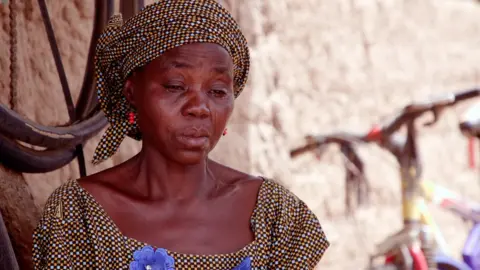
BBC/Simpa Samson Woman looking downBBC/Simpa SamsonFor Helen’s mother, Saratu, meeting Amina brings back painful memories
The agony caused by Helen’s continued absence is etched on the faces of her parents, Saratu and Ibrahim, who are sitting outside their modest home, a short distance from the school.

Her mother tightly grips two photographs of Helen and her sister. The girls are wearing matching outfits, headscarves and serious expressions.

“I just wish I got my friend back,” Amina says, “so we can share the happiness with her.”

Saratu struggles to contain her emotions.

“Any time you come to the house and I see you, my mind goes back to my daughter,” she says to Amina.

She breaks down into floods of tears and Amina places a hand on her shoulder to comfort her.

“I just want our [state] governor to do something and rescue our children,” Ibrahim says quietly. “He should put in more effort to rescue the other children.”

Amina’s escape in 2016 was accompanied by huge fanfare and relief.

After being debriefed by the military, she met government officials including then President Muhammadu Buhari, who said the course of her life would change for the better.

“[The president said] he’s going to take care of us and send us to school and even our children too,” Amina recalls.

“Because it’s not our fault to find ourselves in that situation and the children too, they don’t know anything. They’re innocent. So he’s going to take care of them.”

AFP Nigerian President Mohammadu Buhari (C) flanked by Borno state governor Kashim Shettima (L) and Chief of Staff for the Kaduna State Governor Hadiza Bala Usman (R) carries Amina Ali's four-month-old baby on her arrival at the presidency in Abuja, on May 19, 2016AFP: When she escaped from Boko Haram in 2016, Amina (L) and her baby met then President Muhammadu Buhari along with then Governor Kashim Shettima of Borno State
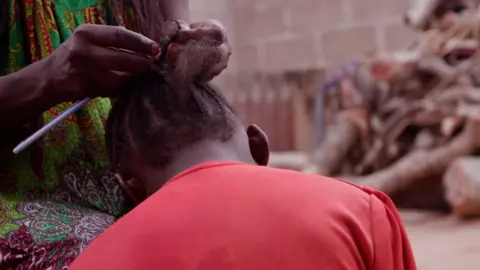
Life today does not look like what was promised.

Amina now lives in Yola, about five hours away from Chibok by road, and shares a small room with her daughter. They share an outdoor bathroom with a neighbour and she cooks on firewood outside.

Money is tight.

She receives 20,000 naira ($15; £12) a month to cover everyday expenses but nothing for her daughter’s education, despite the government’s promises. She pays that bill herself with the little money she makes from farming.

“It’s hard for me to look after my daughter,” she says. “What can I do? I have to do it because I don’t have anyone.”

BBC/Simpa Samson Young girl having her hair braided.BBC/Simpa SamsonAmina struggles with the money she has to bring up her daughter who was born in a Boko Haram camp
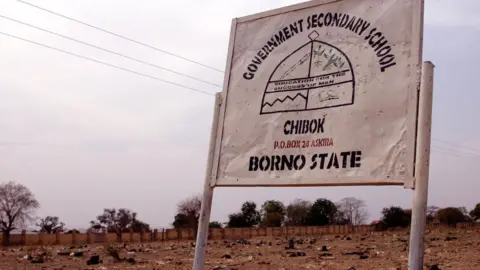
Amina is balancing raising her daughter while studying at the American University of Nigeria (AUN), a private and elite institution.

AUN is the only option Amina and the other Chibok girls were given to resume their studies, but many of them have struggled to keep up and some have dropped out.

“We didn’t choose AUN because we know the school standards are difficult for us, we girls come from poor backgrounds,” she says. “The former minister forced us to come to this school.”

The girls said they would have liked more autonomy in choosing where they could study and wonder if some of the government’s money spent covering the AUN’s high fees could have been better spent directly supporting them.

Amina has attended AUN since 2017, but is not close to graduating. Only one of the former captives has graduated.

Nigeria’s Women’s Affairs Minister Uju Kennedy-Ohanenye says the government has been paying AUN roughly $350,000 a year for the Chibok girls and their education over the last six years.

It is an arrangement she says will be reviewed.

“I’m not paying nobody that kind of money. Even if they put it on the budget, I will not release the money,” she says.

“The girls should be considered first and foremost. School is important, first and foremost. But you don’t go to school on an empty stomach.”

Rakiya Gali is another Chibok girl – she escaped from Boko Haram in 2017. She was a student at AUN briefly, but dropped out due to poor health.

Rakiya says she does not receive any financial support and like Amina pays for her son’s education with the money she makes from farming, despite promises from the government.

“The government has been unfair to us,” she says in an impassioned voice. “They knew that we went into [Sambisa forest] and came back with children. If they cannot help us, then who will help us?”

In addition to the financial burden, Rakiya lives in fear, as her town is still being attacked by Boko Haram. She says militants recently burned down her son’s school.

“Whenever I hear any sound, I think it is a gunshot,” she says.

BBC/Simpa Samson Chibok school sign

Rakiya desperately wants to move forward with her life and secure the best possible education for her son, but the lack of support makes things feel impossible.

So much so, she believes the Chibok girls who remain hostages would stay with Boko Haram if they could see how she and those who escaped are living outside the camp.

“When [the girls] return [they] will come join us in this situation,” she says.

“I would say it is better to stay [in Sambisa forest] with the child and the father will provide support, rather than going through this trouble.”

The conditions she describes are a far cry from those of one of their former captors.

Muhammad Alli, a former Boko Haram fighter who was involved in the Chibok kidnapping, is now living in Maiduguri with his family – including eight children.

He was part of the militant group for 13 years and rose to the rank of commander, even forcefully “marrying” one of the Chibok girls.

“At the time I married them, I did not feel any guilt,” he says. “But when I decided to surrender, I started to realise how awful they must have felt being forced to do these things.”

Like thousands of other fighters, Muhammad was granted amnesty and completed the state government rehabilitation programme. He has a farm, but also works with the military to help rescue abducted girls.

BBC/Simpa SamsonMuhammad Alli is now helping the authorities tackle other hostage situations

Last year he was part of a group that rescued some of the same people he had helped kidnap.

“They were in a terrible state when we found them,” he says. “I cried at the sight of them.”

The amnesty programme is not without controversy, with some saying that former militants like Mohammad should serve jail time and be held accountable for their numerous crimes.

“All I can say in that regard is to ask for forgiveness,” Mohammed counters. “I am remorseful, I am looking for ways to quench the fire we started, and I do this with the men whom I surrendered with. We are doing our best to weaken the effects of insurgency.”

But the insurgency rages on, and kidnapping for ransom has become even more widespread in Nigeria.

While reporting this story there were three separate kidnappings in north-eastern Nigeria, one of these attacks was on a school and was the largest of its kind since 2021.

Mohammad says that the “success” of the Chibok kidnappings has encouraged these types of attacks.

“We realised that the event shook the entire nation and Africa as a whole,” he says. “And the core mission of Boko Haram for [group leader] Abubakar Shekau was to ensure our activities attracted attention.

“He also got money off some of these actions, which helped pay for transport and food, and that’s why they continued the abductions.”

Gen Christopher Gwabin Musa, Nigeria’s defence chief, has acknowledged the “enormous” challenges facing the military, calling the current state of insecurity in the country a “rude shock”, but is confident the tide is turning.

As for the 91 Chibok girls still being held captive, Gen Musa says the military has not given up hope that they will be rescued.

Despite her satisfaction with her current situation, Amina is hopeful too.

She hopes to become a journalist one day, to be a voice for victims of kidnapping, to be a leader. She also hopes her daughter will finish her education and have a bright, safe future.

Most of all, she hopes her classmates will one day be freed.

“The only thing I need the government to do is to release some of my sisters that are still in captivity. I have that hope,” she says.

“Because when they are still alive [there’s hope] they will come back one day.”

Watch Yemisi’s full report on the BBC Africa YouTube channel

Naira Abuse(Video): All animals are equal but Governor Bago of Niger is higher

The hypocrisy of the Nigerian state actors, this time the he Economic and Financial Crimes Commission (EFCC) has again been brought to light by the Kaduna-based social activist and whistleblower, Malam Mahdi Shehu.

In a tweet on his X handle, the activist posted a video of Mohammed Umar Bago, Governor of Niger State throwing money to citizens from a moving vehicle.

Below are his tweets.

NIGER STATE GOVERNOR ABUSING AND MUTILATING NAIRA NOTES: WHERE IS EFCC? : WHERE ARE THE ISLAMIC INJUNCTIONS DEALING WITH RESPECT FOR HUMAN DIGNITY? I draw the Governors attention to: Ayah al-Isra` (Children of Israel, The Israelites) Surah 17:70. ” Indeed, We have honoured the children of Adam, carried them on land and sea, granted them good and lawful provisions, and privileged them far above many of Our creatures.”

The Governor of Niger State is seen in the video below, throwing money while in a moving vehicle in a town called Kagara. This is the height of immaturity and abuse of human dignity. In decent societies, the governor would have resigned immediately for this Sallah celebration recklessness and ignorance. There are more dignified ways of celebrating Sallah and showing gratitude to God. Throwing money to poor people is not one of them. Efcc will simply look away because the governor is said to enjoy …..to enjoy an ill conceived immunity.

Rotimi Sankore, 6 June 1968 – 12 April 2024

By Chidi Anselm Odinkalu

On 26 December, 1991, Algerians voted in the first round of parliamentary elections. Over 40 parties fielded candidates. As returns started coming through, it became clear the country was in the throes of a political earthquake. The Islamic Salvation Front (FIS) took 189 of the 231 seats decided in the first round of elections for the 430-seat parliament, trouncing the ruling National Liberation Front (FLN), which only got 15 seats. FIS candidates were in the lead in 140 of the 199 districts left to be decided in the 2nd round, all but guaranteeing that the party would “attain a two-thirds majority, the amount needed to ratify constitutional amendments.” On 11 January 1992, the Algerian military forced the resignation of the President Chadli Benjedid, before cancelling the election.

The following year, Nigeria was due to go to a much-delayed election to choose a successor to its military ruler. With a pervasive commitment to native exceptionalism, however, no one thought it could happen in Nigeria and, despite the events in Algeria the previous year, there was no plan for an annulment scenario.

When on 22 June 1993, Ibrahim Babangida, the Army General who had ruled Nigeria since 27 August 1985, announced the annulment of the presidential election of 12 June 1993, he induced shock around the country to the point of inaction. Alao Aka Basorun, leading lawyer and 14th President of the Nigerian Bar Association (NBA), telegraphed popular skepticism about Babangida’s intentions, accusing him repeatedly of harbouring “a hidden agenda” but not even Aka had foreseen an annulment.

As the Babangida transition program grew more interminable, civic groups interested in policing it agreed to coalesce into the Campaign for Democracy (CD). At the time of the annulment, it was led by Beko Ransome-Kuti, a medical doctor and younger brother to Afrobeat musician, Fela Anikulapo-Kuti.

Without a plan, the leadership of the CD was initially unsure how to respond. At the emergency strategy meetings called by Beko in his Imaria Street home in Anthony Village, Lagos, there was clear ambivalence as to how to respond to the annulment. Amidst the confusion, there was one exceptional young man who came prepared with clarity and rigour about how to respond.

Rotimi Sankore, who has died at 55 of complications from cancer, was the clear intellectual and strategic leader of the argument that won through into the nation-wide shutdown that followed the annulment of the June 12 elections in 1993, ultimately forcing Ibrahim Babangida to “step aside” from power in August of the same year into infamy.

Born as Rotimi Johnson on 6 June, 1968, he was the son of Jimi Johnson, a pioneer in Nigeria’s art and theatre, and one of the stars of The Village Headmaster. Among his early mentors, Rotimi counted Wole Soyinka, who was a close friend of the family as well as Soyinka’s cousin, Fela.

Rotimi was a precocious polymath from an early age. It was close to impossible to find a subject under the sun on which he was not reasonably informed. He could easily have been home-schooled but, Nigeria being what it is, he reluctantly got persuaded that it was useful to own a university degree. In reality, the degree certificate needed him more than he needed it.

A graduate of Communications Studies and Language Arts, Rotimi spent his undergraduate days at the University of Ibadan (UI), where his extraordinary breath of networks and insight became a huge resource to the student movement. While embedded in the leadership of the student movement at UI, Rotimi was also a stringer and writer for the Guardian newspaper in Lagos.

Recognizing him as the Svengali to a student union government whom they thought implacable, the UI authorities expelled Rotimi in 1990. Following legal assistance in which Olisa Agbakoba and the Civil Liberties Organization (CLO) were instrumental, he eventually graduated with the help of a court order which nullified the expulsion.

Rotimi was a versatile thinker who prospered in every genre of journalism. Until the period immediately following the arrival of the regime of General Sani Abacha, he worked with or wrote for The News and Tempo weekly magazines; as well as with The Guardian. In London, he wrote for The Guardian, Index on Censorship, and The Journalist. Among other titles, Rotimi also wrote for the Mail & Guardian in South Africa, the Global New African magazine, and New African Woman.

After the crisis of the June 12 Annulment, Rotimi masterminded several civic and advocacy start-ups, including the Journalists for Democratic Rights (JODER) and later CREDO, an organization that advocated around Africa for the protection of free expression and associated political rights. In exile to the United Kingdom, Rotimi became a member of the executive council of the National Union of Journalists (NUJ), eventually going on to lead its Black Members Council as the Chair.

He became the pioneer editor the Belgium-based International Federation of Journalists (IFJ) website for African journalists reporting on public accountability, corruption, democracy and rights related issues. At the turn of the Millennium, Rotimi founded the Africa Human & Social Development Information (AfriDevInfo), which pioneered the use of data and statistics for journalism and policy advocacy during the Millennium Development Goals (MDGs).

Rotimi was also a broadcast journalist. Until his passing, he led the Editorial Board of the Nigeria Info Radio Group, part of the AIM Media Group with 13 Stations in Lagos, Abuja, Kano, Port Harcourt and Onitsha (incorporating Nigeria Info FM, WaZoBia FM, Cool FM and Arewa Radio Stations). In this role, he also contributed to programme development on the sister television station WaZoBia TV. At his death, Rotimi was Executive Director of the Africa Centre for Development Journalism. His weekly current affairs programme, Public Square, was the flagship on NigeriaInfo FM 99.3 and drew the highest ratings in the country among its genre.

Rotimi was a pioneer in data journalism as a tool also for policy education and was especially passionate about access to public health information and to education for under-served and excluded communities, particularly girls. In pursuit of these concerns, he regularly advised many international institutions, including the United Nations Fund for Population Activities (UNFPA); the UNAIDS; World Health Organization, (WHO); the Geneva-based Global Partnership for Maternal, Newborn and Child Health; the Africa Development Bank (ADB); and the African Union Commission in Addis Ababa.

Contemporaneously with his journalistic undertakings, Rotimi invested considerable energy in fostering the advancement of solidarity with women’s groups. He was an early inspiration for the creation of Women’s Rights Project (WRP) at the CLO and became a founding member of one of Nigeria’s leading women’s rights organizations, the Women Advocates Research & Documentation Centre (WARDC).

Beyond Nigeria, Rotimi was instrumental in the development and adoption of the Gender Protocol of the Southern African Development Community (SADC). He was also a major actor in advocacy for the ratification of the African Union’s own Protocol on the human rights of women in Africa.

In an intrepid career, Rotimi excelled as a journalist and advocate for the public good, an enterprise to which his life was dedicated. It was fitting that his own battle with mortality would inspire his terminal piece of earthly advocacy.

In late 2022, Rotimi was diagnosed with what was supposed to be Malaria which proved to stubbornly resilient. Following bouts of unsuccessful therapy, he asked for a full health check. The results returned at the beginning of 2023 querying cancer. Further tests provided confirmation of the dreaded “C”, indicating extensive metastasis. A grim prognosis gave him weeks to live at best but Rotimi beat that by over one year during which he deployed his considerable reach and expertise to comforting people affected by Cancer.

Confronted with the reality of his own mortality, Rotimi chose to meet it with a determined sense of humour until the end and with eternal optimism. In conversation in the last week of his life, he was resolute: “my brother, we cannot let the bad guys have it all their way.”

Rotimi Sankore is survived by a daughter, his mother, and a brother.

A lawyer and a teacher, Odinkalu can be reached at [email protected]

TIPS