Home Blog Page 608

Top congressional advocate of Chibok girls Rep Frederica Wilson urged to visit Nigeria, engage with FG to rescue girls 

Rights lawyer Emmanuel Ogebe has written the foremost United States Congresswoman Frederica Wilson urging her to visit Nigeria and engage the Federal Government to bring back the remaining girls.

On Wednesday another abducted Chibok schoolgirl, Lydia Simon, was rescued by troops of Operation Desert Sanity III under the North-East Operation Hadin Kai (OPHK).

She was rescued along with her three children by the troops of 82 Division Task Force Battalion in Gwoza LGA of Borno State on Wednesday, April 17, 2024, exactly 10 years after she was kidnapped by Boko Haram terrorists alongside over 200 schoolgirls from Government Secondary School, Chibok, Borno State on April 14, 2014.

Ogebe’s letter reads:

Dear Congresswoman Frederica Wilson,

On this 10th anniversary of the Chibok abductions, I want to thank and appreciate for your unmatched constancy and consistency which earned you a mention in yesterday’s UK Guardian Newspaper. 

I also want to inform you of the joyous news of the return of yet another abducted Chibok girl, the first after 10 years, two days – Lydia Simon. It is likely that the flurry of remembrances by activists the past 96 hours in their honor prompted her epic flight to freedom. 

Lydia’s return lowers the number of missing girls, by some accounts, from 91 to 90. Unfortunately, there is a disturbing disparity of a dozen girls between those claimed still missing by activists compared to those claimed missing by the military. This is unspeakably unacceptable. The unknown whereabouts of the missing girls after a decade is unconscionable but the uncertainty of the location of 12 “rescued” girls is reprehensible. This is why I welcome your congressional resolution on the Chibok anniversary per the media:

While extolling the survivors of violence in northern Nigeria for mustering courage to tell their stories “at great personal risk”, they enjoined the Nigerian government to cooperate with “regional partners and the international community” to defeat Boko Haram and other terror groups.

In its third demand, the congress also urged the Nigerian government to:

  1. prioritise the recovery of women and girls who have been abducted and enslaved by Boko Haram.”
  2. work to determine the whereabouts of the thousands of missing people in Nigeria and provide a full accounting of the number of missing girls;
  3. undertake concrete efforts to reduce the stigmatisation and marginalisation of those abducted by Boko Haram and provide counselling and support.
  4. to allow women and girls to be reunited with their families whenever appropriate and
  5. accept international assistance in a timely manner when offered.

In addition, the U.S. House said it encourages “continued efforts by the U.S. Government to defeat Boko Haram and related terrorist groups through development and security partnerships with Nigeria and other regional partners.”

The congress also called on the U.S. Department of State and the Department of Defence to “rapidly implement the 5-year regional strategy required under Public Law 114–266 to address the grievous threat posed by Boko Haram and other violent extremist organisations.” 

Lastly, it requests that the U.S. Department of State “track and report the number of missing persons kidnapped by Boko Haram and include such information in its annual Trafficking in Persons Report

Congresswoman Wilson, consistent with the above, I wish to urge that you: 

1. Request a review from the State Department, and the Department of Defense on how effective the US role has been in the tracking and recovering of the girls pursuant to the multiple 5-year regional strategies, partnerships, multidisciplinary task force, fusion center and whole of government actions especially in light of recent reports of a CIA recovery of 30 Chibok schoolgirls in the book The Sisterhood: The Secret History of Women at the CIA” by Liza Mundy

2. Request the Nigerian government to ensure full family reunification for returned girls rather than the worrisome enforced seclusion they currently experience in government custody 

3. Request the U.S. government to review the Chibok girls in America some of whom were targeted by Buhari’s military operatives and silenced from public speaking thereby curtailing their freedoms even here in America 

4. Visit Nigeria to raise the importance of a full and final rescue off all the girls for the new administration with your fellow female parliamentarian Nigeria’s First Lady Remi Tinubu as a potential transatlantic liberation partner.

Regards,

Emmanuel Ogebe

Special Counsel

Justice for Jos Project

Seeking to end impunity in the Nigerian Genocide

Justice must be rooted in truth and not fantasy and arid legal technicalities

By J.S. Okutepa

Not too long ago, seventeen senior advocates of Nigeria, SANs, of Kogi State extraction wrote and protested to NJC and the Hon Chief Judge of Kogi State about the appointments of additional judges for Kogi State.

The protest was based on the lopsided proposals to appoint some persons as additional judicial officers for the state and the lack of infrastructures to accommodate such appointments given the terrible unhygienic judicial environments that judges in the state are currently subjected to.

Given our vintage positions and the privilege we enjoyed under the law, we had thought that we would at least be heard by the relevant authorities and a reply done to our protest letter. Nothing of such was done.

We then thought and reasonably too that there were justifiable causes to complain, and in the process we decided to approach the court where we felt we can be given level playing ground of hearing that would be just and fair. Seven of us sued. I was among the seven eminent senior advocates of Nigeria that went to court.

That is the case of YUNUS USTAZ USMAN, SAN & 6 ORS vs NATIONAL JUDICIAL COUNCIL & 3 ORS suit No FHC/ ABJ/ CS/ 05/2024. It was filed on 8th of January 2024. On the 18th of April 2024, the Federal High Court sitting in Abuja delivered a judgment in that case in which that court found no merits in the case and dismissed it.

Before judgment, the court formulated two issues for determination.These are: Whether the court has jurisdiction to determine the suit filed by the plaintiffs and whether the plaintiffs are entitled to the reliefs sought. These said issues were resolved against the Plaintiffs in favour of the Defendants on the grounds of lack of locus standi.

It was the view of the court that as plaintiffs, we failed to demonstrate infringement of our rights by the Defendants, and the suit was dismissed on this ground. The court held further that the plaintiffs’ failure to establish interest rendered the suit academic.

The court then held that by the failure to establish locus standi, the plaintiffs were deemed to be busybodies, resulting in dismissal of the matter.

The court went further to hold that assuming we the Plaintiffs had Locus standi, our reliefs were dismissed on the grounds of failure to exhaust administrative remedies of doctrines of rightness and exhaustion.The Plaintiffs it held did not pursue administrative remedies, rendering the suit unripe for adjudication for what the court called failure to give NBA due notice.

The court further held that there were procedural omissions: The plaintiffs, according to court, neglected essential procedural steps outlined under the Constitution of the Federal Republic of Nigeria as amended. The court also held that by virtue of section 271 of the 1999 constitution of Federal Republic of Nigeria as amended, the first defendant has discretion in judges’ appointments. Consequently, the suit was dismissed accordingly for having no leg to stand.

The court also expunged the DVD video, and photos tendered through my humble self for having not been tendered by the maker and that it amounts to documentary hearsay, amongst other reasons. The dismissal of this case is as unfortunate and unfair as the fact that the court closed its eyes to obvious truth on the arid legal technicalities in sabotage of a just cause.

I have always wondered the sense of justice we see in our courts. Justice must be rooted in truth and not fantasy and arid legal technicalities that fail to see truth where truth is visible. The photos and videos I attached to my affidavit were downloaded from the Internet. There was a certificate of compliance. The court watched and viewed these videos and saw the horrible state of dilapidation of the courts in Kogi State. The court did not hide its lamentations on the state of the courts in Kogi State on the day it watched these videos in open court.

The way courts decide cases and have the mind to close eyes to obvious truth before them in abuse of the sacred duties bestowed on them by law makes me wonder why they do so. It appears the courts appear ready to do the bidding of the system and pandered to the dictate of unjust system to the prejudices of the progress of the judiciary and appointing process.
I have come to think that as a system, some of courts enjoyed the rotten processes in judicial appointments.

Anyone who labours to ensure that the right things are done are branded as busy bodies and persons with no interest in the matter. Nigeria is ours to make or destroy by the kind of justice system we operate.The kind of appointments we make to the bench have ripple and multiple effects on the justice we get and the morals we boosted.

When the system and power that be decided to recommend appointments to the bench based on persons who may be and who appear morally and intellectually inept and those who know somebody and connected to power that be and not based on moral uprightness and intellectually sound knowledge of the law, those who have reasons to approach the courts should not be turned away on arid legal technicalities of Locus Standi.

By this decision, the judiciary and those who are responsible for appointments have wittingly and / or unwittingly laid and solidified the foundation for destruction of the judiciary.

To describe seven eminent Senior Advocates of Nigeria who raised genuine and real concerns about the rotteness of the infrastructures of Kogi judiciary and the breaches of the Nigerian constitution in the processes for the proposed appointments of judicial officers in that state as busybodies is uncharitable and laughable to say the least. It is an abuse of judicial knowledge and language.

But let it be known that when slaves are comfortable in their slavery they see every effort at giving them freedom as obstacles. For me, posterity will decide tomorrow who has destroyed justice and the judiciary in Nigeria. No legal practitioner is a medlesome interloper in the affairs of justice and administration of justice, including appointments to the bench.

The bar fights for the welfare and interests of the legal profession and to hold any members of the noble profession as being a busybody in the affiairs of justice is to say the least sad and unfortunate generalization of the phrase busybody.

For me and the rest of us, we are not busybodies. We are reasonable legal practitioners with sincere concerns for the welfare and interests of judiciary and judicial officers, both serving, retiring, retired and those yet to be appointed. The suit we filed was in furtherance of our concerns for the good of the judiciary and our fidelity to the oaths we took both when we became lawyers and as senior Advocates of Nigeria.

We sworn to defend and uphold the constitution of the Federal Republic of Nigeria. To describe the suit filed by seven eminent silks in furtherance of the oaths we took as been suit filed by busybodies is not only sad, it is unfortunately uncomplimentary and uncharitable. It’s sad, to say the least. We leave the rest for posterity to judge. That is my stand on this matter and I wish the judiciary well in Nigeria.

Man murders wife for biting his finger in the heat of a passionate session

A Brazilian man turned himself in to the police after he said he murdered his wife because she bit his finger while having sex. 

Marcos Paulino told the São Paulo Civil Police that his wife, Tatiéle de Cássia, 38, bit one of his fingers on his left hand when they were having a passionate session.

He said he was upset so he waited until she fell asleep and attacked her with a kitchen knife at their home in the municipality of Caconde. 

Man stabs wife to death after she bit his finger during a passionate s*x session

“After she changed (her clothes) and went back to bed and slept, he stabbed her in the neck and chest, killing her,” Civil Police chief João Delfino told Brazilian news outlet G1.

Paulino fled the home and was in hiding in the countryside region near Caconde before he returned Monday, April 15, and turned himself in to a local Military Police station. 

Authorities went to the couple’s home and found de Cássia’s body “with holes in the chest and neck, caused by a knife,” said São Paulo Secretariat of Public Security said in a statement. 

Man stabs wife to death after she bit his finger during a passionate s*x session

Paulino killer told investigators that he had “used cocaine” before killing de Cássia, Delfino said in an interview with EPTV.

The couple started dating in October 2023 and moved in together in January. 

Man stabs wife to death after she bit his finger during a passionate s*x session

Paulino is facing a femicide charge and faces up to 12 to 30 years in prison if convicted. 

Deploying the law to attain national stability and development, NBA Abuja gears up for Law Week 2024

The Nigerian Bar Association (NBA) Abuja, Unity Bar has announced that from 6th to 12th May, 2024 the Nigerian legal community will feel the impact of its world class the Law Week.

The Chairman Body of Benchers (BoB), Asiwaju Adegboyega Solomon Awomolo, SAN will deliver the Key Note Address in the upcoming event.

Chairman of the branch, Afam Okeke in a statement said Law Week is an annual event where the Branch x-rays the state of the nation and contributes its quota to the national discourse as well as proffer suggestions on the way forward.

JIS and COMIS: What Lagos State Judiciary E-Filing system is not

By Bayo Akinlade Esq

As far back as 2012 I have engaged with the Lagos State Judiciary on the issue of e-filing

What I find the most offensive is the deceit in promoting the e-filing system as an efficient and corrupt free mechanism.

Recently I had to physically go to the magistrate court to find out the status of a file.

My client had been served with a court process and I needed to find out the court that the matter was to be heard.

To my surprise I was informed that the case was not on the registry record even though it was filed online through COMIS.

I discovered that the process was not in the registry’s record because the Lawyer who filed it was required to physically come to court to ” Open a File ” …. How ridiculous is that!

I don’t have to say much about the JIS because as far as I am concerned it is a complete failure.

I started practice in 2001 and I recall that you could file a process and get a suit number and the court within 2 days.

In Ogun State today you can file a process and get a suit number on the same day but with our e-filing system in Lagos it may take weeks and even months to get the process finalized and you will still visit the registry for one thing or the other.

In the genZ parlance our e-filing system will be called a SCAM.

What is the solution to this problem because it is obvious that the existence of the challenges we face in this e-filing regime benefits a few people.

Unless the Judiciary is willing to be transparent and the Bar is ready to be vigilant we will never move forward in this profession.

I can only say that our justice system is quickly becoming relevant for only a skit … At least let’s get entertained by it’s gross inefficiency.

Finding self-worth

By Bob and Debby Gass

‘He will give you everything you need.’ Matthew 6:33 NLT

When you read God’s Word, you discover how He feels about you. As a result, your memories begin to heal, your self-worth is restored, and you stop trading with a devalued self-image . When that happens, you no longer believe that ‘anybody’s company is preferable to my own’. In a survey of supposedly happy couples, over 50 per cent said they wouldn’t marry the same person again. Why? Because the answer to loneliness isn’t people; it’s purpose!

The apostle John was a prisoner on the Isle of Patmos when God showed him the glories of heaven and he wrote the book of Revelation. Paul was alone in a Roman dungeon when he wrote half the New Testament. God did some of His best work when He was alone with no one to applaud Him, so he praised Himself, saying, ‘It [is] very good’ (Genesis 1:31 KJV).

Can you do that? It’s nice when others speak well of you, but when you can speak well of yourself, it reflects your opinion of yourself – and that’s the one you live with every day. Three cheers for those whose departure taught us how to be alone and enjoy it! Somewhere beyond loneliness, there is a contentment born of necessity.

When your options close in the natural realm, you find doors opening to you in the spiritual realm. So, work on deepening your relationship with God. As you do, you will find joy, and you will also develop qualities that make you attractive to the right people. It’s why Jesus said that when you ‘seek the Kingdom of God above all else, and live righteously…he will give you everything you need’ – including self-worth.

Judges 19-21, John 8:1-27

Depraved carpenter earns life jail for defiling primary 6 pupil

For having unlawful sexual intercourse with his neighbour’s daughter, a 12-year-old primary pupil, Tayo Akinboyewa, a 26-year-old carpente has been sentenced to life imprisonment by an Ikeja Sexual Offences and Domestic Violence Court.

The News Agency of Nigeria (NAN) reports that Justice Rahman Oshodi held that the prosecution proved the charge of defilement against the carpenter.

Justice Oshodi said he was satisfied that the prosecutrix (survivor)’s testimony that Akinboyewa had sexual intercourse with her was corroborated by the medical report (exhibit h-h2)

According to His Lordship, there was abundant evidence that the defendant had sexual intercourse with the prosecutrix, who, to his knowledge, was a child and the prosecutrix gave a direct eyewitness account.

He said the defendant confessed in exhibit G that he had sexual intercourse with the prosecutrix twice.

He added that the medical report and the defendant’s confessional statement corroborated the prosecutrix’s.

Oshodi said the evidence and testimony of the prosecutrix’s mother and the Investigative Police Officer linked the defendant to the crime.

His Lordship eventually rejected the defendant’s evidence and used his confessional statement.

“The prosecutrix in her evidence said the defendant, whom both stayed on the same street in Oshodi, came to her house to borrow fetcher to draw water in her house and in the process, used the rope of the fetcher to draw her closer and forcefully had sex with her in the backyard.

“She narrated that the first occasion was in December 2020, while the second time was in January 2021, when he came to her mother’s shop near the canal and had sex with her.

“Outside the defendant’s confessional statement, I have looked for other credible evidence that the  defendant had sex with her.

“He used to fetch water from the prosecutrix’s house, he used to borrow fetcher and also visit her mother’s shop near the canal,” he said.

The judge further said that the defendant’s confessional statement satisfied all the legal requirements of a confessional statement.

He described the statement as a direct, positive and unequivocal narration of the events that took place straight from the horse’s mouth.

Oshodi said he accepted the defendant’s confession that he had sexual intercourse with the prosecutrix twice.

He, however, said that it would not be in society’s interest to allow a man who had confessed to his crime to walk out of the court as a free man simply because he had a change of mind.

He said: “I am satisfied that the prosecution has established defilement beyond reasonable doubt and I resolved the issue for determination in favour of the prosecution and against the defendant.

“Therefore, considering all the evidence presented in the case, I hereby find the defendant guilty and convict him under section 137 of the Crim Law (supra).

“Your actions were a gross violation of the victim’s innocence, dignity and bodily integrity.

“You took advantage of your status as a neighbour and the victim’s young age to sexually abuse her for your gratification, with no regard for the trauma and harm inflicted upon her.”

The judge reteirated that children deserved to be protected, nurtured and not exploited in such a vile manner.

The judge said he had considered the seriousness of his offence, the victim’s age, the breach of trust and the physical and psychological impact on the victim.

“I have also considered that you initially confessed to your crimes, though you initially pleaded not guilty, necessitating a full trial, which lasted about two years.

“Even though your counsel asked for mercy, you showed no remorse and offered no words of consolation for the victim and her family.

“The law prescribes a severe punishment for the defilement of a child to reflect society’s hatred for such conduct and to protect vulnerable children,” Oshodi said.

The judge said he saw no reason to depart from the statutory requirement of life imprisonment.

“The depravity of your acts warrants a lengthy prison sentence both to punish you and to send a strong deterrent message that sexual abuse of children will not be tolerated.

“Therefore, I sentence you to life imprisonment, you will be registered as a sex offender and while in incarceration, I urge you to reflect deeply on your actions and strive for redemption.

“The victim and her family will have to live with the impact of your crimes.

“I hope this sentence provides them some justice and closure, knowing the perpetrator is being held accountable.”

The state counsel led by Mr Babajide Boye, had called three witnesses, while the defendant testified as sole witness.

The prosecution submitted that the convict committed the offence sometimes in May  2021 on Titilayo Street, Oshodi, Lagos.

NAN

Yahaya Bello, EFCC & Rule of Law

By Pelumi Olajengbesi Olajengbesi

The Economic and Financial Crimes Commission (EFCC) stands as a cornerstone in upholding the rule of law and combating economic and financial crimes in Nigeria. Its unwavering commitment to investigating and prosecuting offenders has earned it commendation, fostering transparency and accountability in governance, even though there cannot be an institution without a challenge.

Despite facing institutional challenges, the EFCC’s track record of success has solidified its reputation as a formidable government agency, instilling a sense of propriety and caution among those in positions of political and economic influence.

However, recent events have generated concerns about the agency’s capability to function above interference, particularly in light of perceived political interference in its operations. A notable example is the recent stand-off between EFCC personnel and the immediate former Governor of Kogi State, Yahaya Bello, highlighting the roles played by the Nigeria Police, the Court, and his successor, which underscores this concern.

The recent decision of the Kogi State High Court, purportedly restraining the EFCC from taking action against the former governor came as a rude shock, sparking widespread debate and scrutiny of the Nigerian legal system. Many citizens perceive this as an instance where certain individuals are seemingly placed above the rule of law, fueling media arguments and public discourse.

While awaiting access to the Certified True Copy of the judgment for clarity, it’s crucial to affirm the EFCC’s statutory authority, akin to other law enforcement agencies, to investigate and prosecute individuals suspected of committing offenses. Sections 6 and 7 of the EFCC Establishment Act unequivocally empower the Commission, with constitutional backing that cannot be overridden by the courts.

The Supreme Court in the case of Dr. Joseph Nwobike SAN v. The Federal Republic of Nigeria held thus: “Having regard to sections 6, 7, 14-18 of the EFCC Establishment Act, particularly 6(b), 7(1)(a), 2(f), 13(2), the EFCC has powers to investigate, enforce, and prosecute offenders for any offense, whether under the Act or any statute, insofar as the offense relates to the Commission of economic and financial crimes.”

Similarly, in the case of Ewulo v. EFCC & ors., the Court of Appeals held as follows: “It is no longer in doubt that agencies vested with statutory powers to investigate crimes cannot be restrained or arm-twisted by litigation to prevent them from exercising their statutory powers. Once there is semblance of legal justification in the exercise of statutory powers, the courts must refrain from making orders that have the consequence of stupifying the proper exercise of statutory powers.”

From the above, it is clear beyond a doubt that the Commission cannot be restrained from carrying out its constitutional responsibilities. Any attempts by an individual or group to use the instrumentality of the law to obstruct, delay, and/or circumvent the Commission’s constitutional responsibilities are therefore unlawful.

While respecting citizens’ constitutional rights is crucial, courts lack the authority to impede law enforcement agencies from executing their duties, regardless of the individual’s status. Upholding the rule of law necessitates ensuring equal accountability and justice for all, without exceptions or undue influence.

Olajengbesi Esq, Legal is Managing Partner at Law Corridor, Abuja

Has Gov. Ododo abused the Code of Conduct for Public Officers by obstructing and screening an offence in the FCT?

By Lillian Okenwa

On Wednesday when operatives of the Economic and Financial Crimes Commission (EFCC) besieged the Abuja home of Yahaya Adoza Bello, the embattled ex-governor of Kogi state Abuja to arrest him over allegations of financial crimes, the Kogi State Governor, Usman Ododo, was on hand to rescue him.

At the end of it all, the security cordon around the former governor’s residence in Abuja was breached by Ododo who ensured that the Bello was spirited away in his official vehicle. Ododo owes his current status as the Governor of Kogi state to the strings-pulling of his predecessor, Bello.

Although Section 308 of the 1999 Constitution states that no civil or criminal proceedings can be instituted against the president, vice-president, governor or deputy governor and they can’t be arrested or imprisoned or a process of any court requiring or compelling their appearance can be issued against them, the provisions of the Fifth Schedule of the Constitution raises some posers.

(1)  A public officer shall not put himself in a position where his personal interest conflicts with his duties and responsibilities.

9. A public officer shall not do or direct to be done, in abuse of his office, any arbitrary act prejudicial to the rights of any other person knowing that such act is unlawful or contrary to any government policy.

18. (1) Where the Code of Conduct Tribunal finds a public officer guilty of contravention of any of the provisions of this Code it shall impose upon that officer any of the punishments specified under sub-paragraph (2) of this paragraph and such other punishment as may be prescribed by the National Assembly.

(2) The punishment which the Code of Conduct Tribunal may impose shall include any of the following –

(a) vacation of office or seat in any legislative house, as the case may be;

In the light of the provisions above, can Section 308 still avail the governor?

As a sequel to the Wednesday drama,

  1. Can a Governor of a State plead his immunity for an offence committed outside the of his State?
  2. Can Alhaji Ododo be prosecuted for the crimes of obstruction and screening of an offence committed in Wuse, FCT?
  3. Was the Federal High Court warrant of arrest of Yahaya Bello, issued after the Kogi State High Court order that Yahaya Bello must not be arrested by EFCC, except upon order of of a law court, in conflict with the earlier Kogi State High Court order?

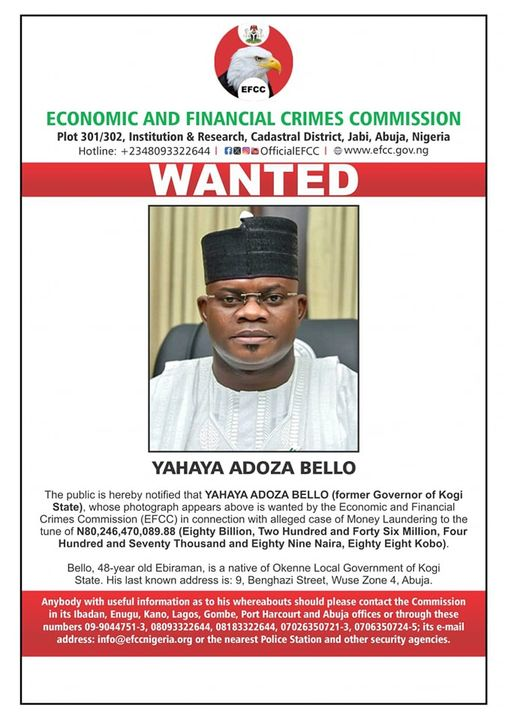
The EFFC has now declared Bello, wanted for offences relating to economic and financial crimes. This was contained in a notice posted on the commission’s official Facebook page on Thursday.

The notice read, “The public is hereby notified that Yahaya Adoza Bello (former Governor of Kogi State), whose photograph appears above is wanted by the Economic and Financial Crimes Commission in connection with alleged case of Money Laundering to the tune of N80,246,470,089.88

“Bello, a 48-year-old Ebira man, is a native of Okenne Local Government of Kogi State.

“His last known address is: 9, Benghazi Street, Wuse Zone 4, Abuja.”

The notice asked anybody with useful information about the former governor’s whereabouts to contact any of the commission’s offices across the country.

The anti-graft commission had earlier stated that it would, on Thursday (today), arraign the former governor before a Federal High Court sitting in Abuja.

This was after the EFCC was granted a warrant of arrest by the Federal High Court in Abuja to apprehend the former governor.

The agency’s team of lawyers, led by Kemi Pinheiro, SAN, during the proceedings on Thursday, said that EFCC operatives were prepared to carry out the arrest warrant for the former governor, even if it requires the use of force.

“We have to arraign him in court even if we have to use the military. Immunity is only attached to a person and not the building.

“The law allows to break down walls to arrest an evading defendant. Section 284 says all persons are to obey the service of charge,” Pinheiro stated.

At Bello’s Abuja residence, on Wednesday, a group of armed men, identified as “Special Forces,” along with officers from the Nigeria Police Force, intervened to prevent the EFCC operatives from apprehending him.

PUNCH Online reports that the current governor of Kogi State, Usman Ododo, intervened to prevent the arrest of the former governor of the state by EFCC operatives.

Ododo’s team escorted Bello out of the location in the governor’s vehicle.

Bello and three other suspects, Ali Bello, Dauda Suliman, and Abdulsalam Hudu, will be arraigned before Justice Emeka Nwite.

They face 19 counts related to money laundering to the tune of N80,246,470,088.88.

Title: Rights of asylum seekers

By Nneamaka Onyema

Asylum seekers are individuals fleeing persecution, violence, or other forms of serious harm in their home countries. They are protected by various legal instruments at both international and national levels. These instruments ensure their rights are respected and provide a framework for their protection. Let’s delve into some of the most significant legal instruments:

*1951 Refugee Convention and its 1967 Protocol: These are the cornerstone legal instruments governing the protection of refugees. The Convention defines who is a refugee and outlines the rights of individuals granted refugee status. It prohibits the expulsion or forced return of refugees to situations where their life or freedom would be at risk.

*Universal Declaration of Human Rights (UDHR): While not specifically focused on asylum seekers, the UDHR provides a broad framework for the protection of human rights, including the right to seek asylum from persecution. Article 14 states that “everyone has the right to seek and to enjoy in other countries asylum from persecution.”

*Convention Against Torture (CAT): This convention prohibits the torture and cruel, inhuman, or degrading treatment or punishment of individuals. It prohibits the return of individuals to countries where there are substantial grounds for believing they would be subjected to torture.

*European Convention on Human Rights (ECHR): This instrument, enforced by the European Court of Human Rights, protects fundamental rights and freedoms within the jurisdiction of the Council of Europe’s member states. It includes provisions relevant to asylum seekers, such as the right to liberty and security (Article 5) and the prohibition of torture and inhuman or degrading treatment (Article 3).

*Convention Relating to the Status of Refugees in Africa: Adopted in 1969, this regional instrument provides additional protection for refugees in Africa. It reflects the principles of the 1951 Refugee Convention and addresses the specific challenges faced by refugees on the African continent.

*National Legislation and Policies: Many countries have their own asylum laws and policies that are designed to implement international obligations and provide additional protection for asylum seekers. These laws vary from country to country but often include provisions for the recognition of refugee status, access to legal representation, and protection against refoulement (the return of individuals to countries where they would face persecution).

Additionally, there are various non-governmental organizations (NGOs) and advocacy groups dedicated to protecting the rights of asylum seekers. These organizations often play a crucial role in monitoring compliance with international and national legal instruments, providing legal assistance to asylum seekers, and advocating for policy changes to improve protection mechanisms.

In conclusion, while legal instruments provide essential protections for asylum seekers, ensuring effective implementation and enforcement of these instruments remains a challenge. Continued advocacy, collaboration between governments and civil society organizations, and a commitment to upholding human rights principles are essential for safeguarding the rights of asylum seekers worldwide.

ONYEMA, Nneamaka Esq
Legal Practitioner|Chartered Mediator and Conciliator|Child’s Rights Advocate

TIPS