Home Blog Page 607

EFCC, Yahaya Bello and the Law 

By onikepo braithwaite

The World is a Stage, and We are all Actors” As You Like It, William Shakespeare 

Presently, Governor Ahmed Ododo and Yahaya Bello are making Nigeria look like a movie set crime scene – going to Yahaya Bello’s Abuja residence to smuggle him out and flee from the EFCC! A tremendously huge responsibility, lies on the shoulders of President Bola Ahmed Tinubu and his administration, to raise the bar in governance.

As far as the Fourth Republic is concerned, the truth of the matter is that, right from the time President Umaru Yar’Adua became incapacitated as a result of ill-health and unknown people took over the reins of government, the downward trend in the quality of officials/government agencies intensified. Institutions have progressively weakened, and unfortunately, most fell to almost Ground Zero by the time we had completed the eight long years of the Buhari administration. Of course, the deterioration in the quality of civil/public servants and politicians, hasn’t helped matters. 

Runaway and Escapee Public Officials 

Have we already forgotten “Mainagate”? The scandal involving the former Chairman of the Pension Reform Task Team, Abdulrasheed Maina, who was not only reinstated to the Ministry of Interior, but was promoted from Assistant Director to Director, when all the while he had been declared wanted by Nigerian law enforcement for money laundering to the tune of N2 billion?

He escaped from the country, returned and resumed work secretly. A well-known flight risk, Maina was granted bail. Of course, Maina fled to Chad or wherever he was eventually apprehended, and brought back to face prosecution. See the case of Suleman & Anor v COP Plateau State (2008) LPELR-3126(SC) per Niki Tobi, JSC on the principles guiding the grant of bail. 

Neither have we forgotten Senator Dino Melaye, who recently released a music video to celebrate the travails of Yahaya Bello, when he himself jumped out of a moving Police vehicle to avoid being taken to Lokoja to answer questions concerning a murder case, and on another occasion, also barricaded himself in his house for a week or more, to avoid arrest concerning a case that involved the shooting of a Policeman. 

Governor Ododo and his Predecessor, Yahaya Bello: Aiding and Abetting 

So, should anyone really be shocked that we have sunk to the level where we have Governors who also behave like common criminals? It’s not only about them looting the treasury of their States while doing little or nothing there (which Nigerians can see from their gross non-performance), and the corruption cases levelled against many of them. 

Take Governor Ahmed Usman Ododo of Kogi State for example, he and Yahaya Bello are simply following laid down precedent of public officials running away from justice, similar to what I have outlined above. Aside from the fact that former Governor Yahaya Bello is no longer covered by Section 308 of the 1999 Constitution of the Federal Republic of Nigeria (as amended in 2023)(the Constitution) which grants immunity from suit and legal process to the President, Vice President, Governors and Deputy Governors, the immunity cannot also be extended by Governor Ododo to cover Yahaya Bello, like two people sharing an umbrella in the rain.

Just a few months into office, Governor Ododo has started to abuse his office by committing crimes like obstruction of justice – see Section 145 of the Criminal Code Act 2004 (CCA); possibly aiding and abetting a crime, that is, assisting Yahaya Bello to escape from the EFCC – see Section 7 of the CCA & Section 85 of the Penal Code Act 2004 (PCA), to mention but a few. Additionally, Section 38(2) of the Economic and Financial Crimes (Establishment) Act 2004 (EFCC Act) makes it an offence for anyone to wilfully obstruct the EFCC from going about its lawful duties as provided by the EFCC Act. Conviction for this offence, attracts up to five years imprisonment

Ododo’s actions are truly shameful, and they paint Nigeria in a negative light – a serving Governor, blatantly assisting a fugitive (Yahaya Bello has been declared wanted by the EFCC). This is yet another litmus test for the Tinubu administration in how this matter will be handled, as the world is watching whether it will be business as usual or whether there is a new dawn under the Tinubu administration. 

It is therefore, encouraging that, unlike former Attorney-General of the Federation (AGF), Abubakar Malami, SAN and then Minister of Interior, Abdulrahman Dambazau, who were fingered in the reinstatement and promotion of Maina, instead of handing him over to the EFCC for prosecution, the current AGF, Prince Lateef Fagbemi, SAN, issued a statement last week, condemning what he described as Yahaya Bello’s “flight from law”. It’s also rather amusing that Yahaya Bello aka “I know too much”, who was once so mouthy and a law unto himself while he was in office, seems to have swiftly transformed from a white lion that he is alleged to have considered himself to be, into a mouse running away from a cat!

It appears that whether the position of the law in England, that is, “knowledge of the criminal purpose coupled with voluntary assistance” being enough to incur liability in aiding the commission of an offence – see the case of National Coal Board v Gamble (1959) 1 Q.B.11, or the Nigerian position which imposes liability when the secondary participant acts for the purposes of enabling or facilitating the commission of the offence (see Sections 7(b) & 83(c) of the CCA & PCA respectively), Governor Ododo’s actions seem to fit like a glove into the English and Nigerian positions of aiding and abetting, as the whole of Nigeria including him, are aware that the EFCC is looking for Yahaya Bello in connection with the alleged misappropriation of an amount in excess of N80 billion, and he was required to report to the law enforcement agency.

Kogi State High Court: Forum Shopping

Why did Yahaya Bello proceed to the Kogi State High Court (KHC) to procure an order to restrain the EFCC from arresting him, if not because of forum shopping in a favourable store? Is he relying on Section 46(1) of the Constitution that allows a person who alleges that his Chapter IV constitutional rights have been or are likely to be contravened in any State to apply to that State High Court for redress? In my humble opinion, Section 251(1) of the Constitution overrides Section 46(1) when the the one who allegedly breaches those rights is a government agency, as it provides inter alia that “Notwithstanding anything to the contrary contained in this Constitution….the Federal High Court shall have and exercise jurisdiction ‘to the exclusion of any other court’ in civil causes and maters…..”.

Therefore, by virtue of Section 251(1)(r) of the Constitution, the Federal High Court (FHC) appears to be the court conferred with the jurisdiction to hear any matter concerned with inter alia, seeking an injunction affecting the validity of any executive or administrative action or decision of the Federal Government or any of its agencies, and not the State High Court. See the cases of Gabriel Madukolu & Ors v Johnson Nkemdilim 1962 2 SCNLR 341 per Vahe Robert Bairamian, JSC; NPA v Panalpina World Transport & Ors (1973) LPELR-2032 (SC) per George Baptist Ayodola Coker, JSC on the effect of lack of jurisdiction resulting in a nullity in the proceedings conducted without it.

However, I am aware of the decision in EFCC v REINL (2020) LPELR-49387(SC) per Kudirat Motonmori Olatokunbo Kekere-Ekun, JSC, that in a matter involving an agency like the EFCC, as long as the claim for enforcement of rights is the main and not ancillary claim in the suit, the FHC and State High Court, in that particular case, the FCT High Court, have concurrent jurisdiction to hear it.

Yahaya Bello’s KHC case is not at all on all fours with EFCC v REINL (Supra) in which the Respondent in that case contended that he was unlawfully detained without being informed in writing of his alleged offence, and without being charged before a court of competent jurisdiction.

In Yahaya Bello’s case nothing of the sort happened; he has since been charged before a court of competent jurisdiction, and does not appear to have any rights to enforce, but, on the contrary, appears to be seeking to use Section 46(1) of the Constitution or the KHC as some sort of preemptive shield to avoid facing the law.

We have all heard the talk of Yahaya Bello not being properly invited to the EFCC. How do you personally invite a person who has become evasive, and turned themselves into the ‘Elusive Pimpernel’? I’m sure that was why the EFCC was constrained to declare Yahaya Bello wanted; a sort of substituted service of the invitation to report.

Interim Order

Again, it is hard to understand the rationale behind obtaining an interim order preventing the EFCC from arresting, harassing or detaining not only Yahaya Bello, his former appointees, staff and family members, pending the hearing of a substantial motion to enforce his rights.

I’m wondering which rights that would be. Section 35(1) of the Constitution  guarantees every individual’s right to liberty except in certain circumstances, including when there’s reasonable suspicion that the individual has committed a criminal offence – Section 35 (1)(c) of the Constitution allows Yahaya Bello to be arrested or deprived of his liberty by the EFCC, in accordance with a procedure permitted by the law.

This new fashion of obtaining a court order to prevent arrest and detention/prosecution  based on nothing but the desire to escape justice is bizarre and untenable.

We are no longer in a military dispensation where it may have been necessary to obtain such orders to prevent arbitrary arrest by government agencies for no reason, or reasons as flimsy as calling for the military to give way to democracy which would put such a freedom fighter on a collision course with the dictatorship. Section 3 of the Administration of Criminal Justice Act 2015 (ACJA) also allows the arrest and investigation of a suspect, alleged to have committed a crime. 

Partiality & Compromise in Law Enforcement 

If those who went to arrest Yahaya Bello were committed to their task, or his security details were in the least bit interested in upholding the law, he would have been arrested. It also shows a clear lack of coordination, between law enforcement agencies. In 2022, when Senator Rochas Okorocha took refuge in his house in Abuja, refusing to turn himself in to the EFCC, they laid siege on his house for over six hours, and eventually arrested him. 

Conclusion

It is trite that all court orders should be obeyed; but, it is also trite that the order of a court of coordinate jurisdiction like the KHC cannot affect the proceedings at the FHC, since they are courts of coordinate jurisdiction – one is not higher than the other. See the case of Orji Uzor Kalu v FRN & Ors (2016) LPELR-40108 (SC) per Sulaiman Galadima, JSC.

Be that as it may, assuming without conceding that the KHC Interim Order was binding on the FHC, I read somewhere that the said Order elapsed last week (possibly the day the EFCC laid siege to his house in Abuja), as the KHC was said to have ruled on the substantive matter that same day, granting leave to the EFCC to proceed against Yahaya Bello, provided that leave to do so was first sought and obtained from the FHC.

The EFCC appears to have done so. Whatever rights Yahaya Bello seeks to enforce, they cannot stop the EFCC from charging him to court. The EFCC must then prove their case beyond reasonable doubt, to secure a conviction.

Financial offences are bailable anyway, so why doesn’t Yahaya Bello man up like Ayodele Fayose, the former Governor of Ekiti State, who happily presented himself to the EFCC complete with his “EFCC, I am here” tee shirt; turn himself in. If he is detained, his Lawyer can apply to the court for bail since charges have already been filed against him.

He’s already setting himself up to look like a flight risk, with this behaviour. See the case of Suleman & Anor v COP Plateau State (Supra). Above all, Nigerians expect the EFCC to operate within the ambits of the law; upholding the rule of law, is part of that litmus test for the Tinubu administration.


Eberechi Nyesom Wike nominated for Appeal Court bench as Ariwoola approves 22 new judges

The Chief Justice of Nigeria, Hon. Justice Kayode Ariwoola has approved the nomination of Hon. Justice Eberechi Suzette Wike, wife of FCT minister Nyesom Wike to the Court of Appeal.

Out of the 89 judges nominated for promotion following the retirement of some senior jurists, 22 judges were selected to fill available positions.

Chief Justice Ariwoola has sent the name of Justice Eberechi Wike, a judge of the High Court of Rivers State along with 21 others on the priority list to President Tinubu for appointment. The document, which Mr Ariwoola signed on April 2, 2024, was marked FJSC/01/2024.

A fresh list obtained by The Gazette titled ‘Appointment of 22 justices to the Court of Appeal’ showed the new jurists were appointed from the pool of states and Federal High Court judges from all six geopolitical zones.

Justices Polycarp Tema Kwahar (Benue), Ruqayat Ayoola (Kogi), Eneche Eleojo (Kogi), Asmara Akanbi Yusuf (Kwara), Abdullahi Muhammad Liman (Nasarawa) and Abdu Dogo (FCT) were appointed North-Central.

Only Justice Fadahu Umaru, a Borno state indigene, was appointed from the North East.

For the North-West, approved justices are Ishaq Mohammed Sani (Kaduna), Zainab Bage Abubakar (Kebbi) and Abdulaziz M. Ankara (Zamfara).

Newly recommended judges from the South-East include Nnamdi Okwy Dimgba, (Abia) Victoria Toochukwu Nwoye (Anambra), Henry Aja-Onu Njoku (Ebonyi), Donatus Uwaezuoke Okorowo (Enugu) and Ngozika N Okaisabor (Imo).

For the South-South region, Justices Ntong Festus Ntong (Akwa-Ibom), Nehizena Idemudia Afolabi (Edo) and Ms Nyesom-Wike (Rivers) were recommended for promotion.

While justices Lateef Babajide Lawal-Akapo (Lagos), Abiodun Azeem Akinyemi (Ogun), Oyewumi Oyejoju Oyebiola (Oyo) and Bayo Ademola Taiwo (Oyo) were named for elevation in the South-West region.

Credits: Peoples Gazette

Bobrisky’s masque, Yahaya Bello’s boa, By Lasisi Olagunju


“When you reach home, tell my mother, Say it was a boa that his son transformed into
And never returned home.”
The actor comes on the stage singing and dancing, his troupe festive around him. He invokes his powers and turns into this and that. Everything he fancies, he becomes.
Then he goes back to man.
The world applauds him.
The man becomes a roof-climbing, banana-eating monkey.
The applaud gets louder.
He turns to a woman – like Bobrisky- complete with all the charm of the seductress; he beckons on men who could dare but none comes forward. He gets no suitor. Then, his drummers warn him: Ilè nsú / T’óbá burú tan/ Ìwo nìkan ní ó kù (it is getting dark; you will be alone if things get bad).

If you are warned, listen to what the world is saying. In his ‘The Poetry of the Yoruba Masque Theatre’, Professor J.A. Adedeji (1978) says better what the bata drums say: “Don’t be careless, evening is approaching/ Aiyelabola; If the worst comes/ You will be left alone to your devices.” The tragedy of man, of all of us, is that we always deny the advent of dusk. The masked one hears the beats and ignores the beats. He takes one more step and turns to a boa – and darkness descends on his performance.

The boa-man struggles with himself. He tries every trick in his bag of charms. He chants every incantation in his pouch; he bellows every shout. He draws blank; nothing works again for the influencer. The world has hacked into the actor’s act; life’s principal coders have changed his password. The boa cannot shed the snake skin and adorn the human costume he came with. Aiyelabola will die a boa.His troupe sings his dirge; his audience his elegy: “Aiyelabola d’ere, o b’ere lo.”Defeated, Adedeji writes, the boa sings:“When you reach home, tell my mother, Say it was a boa that his son transformed into and never returned home.”

Tell the world, Aiyelabola d’ere, o ti b’ere lo.When the ‘world’ is involved in someone’s case, what is customarily ignored, attracts global opprobrium; even the ordinarily routine becomes problematic, song becomes abuse, and the key that used to open doors stops working. One day, we will know why the young man called Bobrisky was suddenly taken too seriously by drama-loving Nigeria.The pioneer of Yoruba waka music, Batile Alake, invokes chants in her evergreen songs. In a particular album, she sings about entering the farm through the furrow and escaping the whips of the farm owner by not stepping on his (yam) heaps – poro ni mo gbà/ kí olóko má nà mí/ mo ti dá ebeè kojá. In another song, Batile sings about the unusual and the attention which bigness attracts: “B’érin bá w’ojà á j’ogún àpéjowò omo aráyé (when ponderous elephant saunters into the market square, he inherits the world as his audience).” It is possible that Bobrisky, the actor, got that sense from the quaint world of the spirit of money and fame. On social media and in the social sphere, he was/is news – bad and good news – many times not exactly good. But he enjoyed it and sought to live it in defiance of whatever his world thought. He saw the world as a festival of sort and dressed himself up for it in coarse cottons of disgusting shock. Listening to strange beats, the man danced his way into the moral marketplace as a woman and stepped on the toes of his world.

For breaking a pot of water, the child who repeatedly spilt drums of palm oil without consequences was docked in a court in Lagos some days ago. Bobrisky is in jail for doing what Duro Ladipo calls “ritual theatre”, that which many do impulsively as a cultural practice – spraying money at social parties. In the times of our fathers, ‘spraying’ was not the word; money meant for the forehead never touched the ground. If it did, it was a taboo broken. But, today, àkàrà has become bones in the mouth of the toothless. Money-miss road nouveau riche dudes dance on a canvass of cash to proclaim their success. What autumn does to leafy trees is what they do with the naira. They carpet the ground with careless currency notes, plod rough-shod and record their misbehaviour for us to sorrow about. They incite the poor to query the poverty in their destiny.

I read a piece on “Ritual Killing, 419, and Fast Wealth in Southeastern Nigeria” published in the ‘American Ethnologist’ of November 2001. The author, Daniel Jordan Smith, marvels at what we do here with paper money on foreheads at social parties. He explores the drama of our doing it, how we do it and why we do it: “The act of spraying itself has become a performance, and those who do the spraying are often drawing public attention to themselves as much as to those they are supporting. In the act of spraying, the dance of the sprayer is watched and admired, but most importantly, the quantity and denomination of the bills pasted to the foreheads of the sprayee is closely monitored. People who spray large sums of money are roundly applauded by the crowd…” The paradox (and the lesson) here is what Smith admits: “such ostentation is resented even as it is admired.”

Singer Portable’s ‘brother’ who claims ‘sisterhood’ is a goat immolated to make other goats stop misbehaving. Won pa iji han iji. But, he is just an actor, a masquerader monetizing his mime of our unserious world. And we are really unserious. Of all the inmates in our house of sin; of all the sicknesses in our sick body, Bobrisky is what takes our precious time and judgment. Locking him up is our loss. A perfect Aristotelian tragic protagonist, he will be in solitary misery for six months at our expense. Everyone thinks he deserves to be where he is. Even those of us who accept that he is just an alárìnjó (itinerant, walk-and-dance masquerade) insist that his choice of style is dirty. But there is neither disgust nor ugliness in drama. It is either a tragedy or a comedy or the concoction in the middle. Everything is about costuming and packaging and marketing. If my good old literature teacher, Professor Oyin Ogunba (God bless his soul), were around and he watched this spectacle, he would describe the man as drama. Read Ogunba in Oyekan Owomoyela’s ‘Give me Drama Or…’ I did. “A masked figure at a festival,” Ogunba argues, “whether he dances or speaks or does neither, has, by his mere appearance, created a situation of potential dramatic value.” The jailed young man has the mask; he has the chant; he has the gait, the dance. He has the drama and an excitable audience. His face and costume are just life-mimicry gone awry. He shouldn’t have suffered an overkill.

In the grove of life’s principals, there are many masks of varying potency. It appears that Bobrisky entered the grove without paying his dues. It is ìbà that saves goat from being tied down as sacrificial lamb. He didn’t do that and lost control of his panel. There is no system the world cannot hack into; the principalities of this plane are code-crackers. They reduced the cross-dresser to a helpless influencer who could not influence the winds from blowing him into jail. It happened to Aiyelabola, the powerful masque-actor who turned himself into a boa for effect but could not go back to the human he was.The world overtook Bobrisky and locked him up. He thought he could recreate himself to a woman and be crowned queen of the covens. He didn’t learn from Aiyelabola who moved from man to boa and slithered off forever as boa. May we not step on the eye of the earth.Bobrisky is a metaphor for the hypocrisy of this society of masked men and specialists. He is also a metaphor for self-violation. In court, he disowned his feminine costume and pronounced himself man. He is, in significant ways, a metaphor for a politician called Yahaya Bello. What happened to the cross-dresser is exactly what is happening to the former Kogi State governor. He is being asked by his troupe mates – the igneous caste of his cast – to come out and account for his years in power. There is a big lesson here: An Egungun that is conscious of life out of the mask will behave well, will limit his performance to dance and songs; will carry no whips, and will whip not the helpless

Andu is the name of one Egúngún (eégún) in a Yoruba town which enjoys the throne with the king. Ulli Beier in his ‘The Egungun Cult Among the Yoruba’ (Presence Africaine, 1958: 34) says “Andu enjoys great power and privileges. He may, for example, sit on the king’s throne when the king is not present.” What do you think would happen if this Egungun extends his privileges and starts contesting the stool with the king, the Timi of Ede? The storm and the drama that we saw around Bello last week were what normally happens to temporary men who think themselves permanent. When ‘big’ men eat food meant for the gods and step on sacred toes and the world takes note, they are condemned to run kitikiti katakata as Bello did last week. The consequence he suffers is the fate of the bird called agbe: his feathers got dyed in indigo. The aluko bird was not created henna, his colour was made so by an angry world. When the world felt offended enough by the egret’s unacceptable ways, it dipped the bird in a pot of snow-white chalk. The world is sufficiently angry with the actor called Yahaya Bello; it is cooking a pot of bile for him to feast on.One Muslim cleric waxed a record in the 1970s with a line that made a lot of sense. I can’t remember the cleric’s name but I can’t forget that he sings about the powerful who think themselves faster than life. But, he says, the world is not that cheap; it storms their sail and sinks their ship. “Won ro pe won le aye won ba/ Aye o je bee/aye da won nu.” The Titanic, its competent crew and its arrogant builders come to mind here.My people would look at Yahaya Bello and see the opposite of careful chameleon who walks gingerly through life. Chameleon is asked why his feet rarely touch the ground. He says it is in deference to the earth; he says the ground must not cave in under his weight. “This world (aye) is a dangerous and difficult place; it is full of negative forces that hinder, even destroy, one’s life.” Benjamin C. Ray was of the University of Virginia, Charlottesville, United States, when in 1993 he wrote the above quote in a research article on ‘Aladura Christianity: A Yoruba Religion’. The quote, peeled from Ray’s 27-page piece on ‘aye’ and its forces, summarizes what I am saying here about moderation, about doing right and stepping away from wrong even if you have the grit of a lion. Ray is not alone. Professor Karin Barber’s scholarship is on Yoruba’s ways and means. Her mental visage on man and precarious power, published in a journal called ‘Africa’ in 1981, sees the solitary worldly ‘man’ who is “picking his way …between a variety of forces, some benign, some hostile, many ambivalent.”

Did Shakespeare not say justice whirlswhirls in equal measure? Today’s eegun, our ensemble of powers and principalities, can also learn from the fate of Bello, a whitened lion in flight. Their own festival of immunity will end one day, and the children of the grove will no longer have free balls of bean cakes. Listen.

The antidote to darkness is light. If you don’t want to die a boa, don’t live a boa. What is happening to Bello tells even deities that they are not immune from (and to) the ravages of an incensed world. When the forces of life face and fight a rogue masquerade, they tear off his mask and call women to come and watch. And, of course, an Egungun dies the day he is paraded naked before a coven of weird beings who piss from behind.

Yahaya Bello and a complicit judiciary

By Chidi Anselm Odinkalu

Josiah Majebi is the fifth Chief Judge of Kogi State (in north-central Nigeria) in four years and the fourth to exist almost entirely in the pocket of the state governor. He has been in office as substantive Chief Judge since the beginning of February 2023, having acted in that role since 26 June 2022 when his predecessor, Richard Olorunfemi, retired. Henry Olusiyi served in that office for just under seven months from the end of June 2020 until January 2021. Sunday Otuh, who succeeded him, spent eight months in office before retiring in September 2021.

The last Chief Judge of Kogi State who attempted to hold that office with dignity and independence, Nasir Ajanah, paid with his life, un-mourned and exiled from the state. He was the second Chief Judge of the State to be politically lynched by the government of Kogi State in one decade.

At the beginning of April 2008, the Kogi State House of Assembly, defying an order of the state High Court, adopted a resolution asking the State Governor to remove long-serving Chief Judge of the State, Umaru Eri. On that basis, then acting governor, Clarence Olafemi, promptly announced the sack of the Chief Judge on 2 April 2008 and designated another judge, Sam Ota, to act in his place.

In his defence, Umaru Eri claimed that his crime was that he had declined the request of the politicians to act as go-between in bribing the election petition tribunal on behalf of the then state governor whose election was in dispute. On 16 May, 2008, Alaba Ajileye, a judge of the High Court of Kogi State, reversed the sack and reinstated Umaru Eri.

11 years later, on 18 June 2019, Alaba Ajileye presided again in deciding a case that seemed uncannily to reprise issues in his earlier decision. As with the 2008 decision, the claimant in 2019 was another Chief Judge of Kogi State, Nasir Ajanah with his Chief Registrar, Yahya Adamu. The defendants included the Kogi State House of Assembly, its Speaker, and the State Governor, Yahaya Bello.

At the directive of Governor Yahaya Bello, the Secretary to the Government of Kogi State wrote on 14 November, 2018 to Chief Judge Nasir Ajanah, asking him to provide “the payroll of judicial staff for the ongoing pay parade of civil servants in the state.” At the time, the Governor was a defendant in the court of the Chief Judge, so the Chief Registrar responded to the letter and explained that the judiciary was a self-accounting and co-equal branch of government supervised by the state Judicial Service Commission.

An affronted Governor Yahaya Bello wrote under his own name to Walter Onnoghen, then Chief Justice of Nigeria and Chair of the National Judicial Council (NJC), asking the NJC to find the Chief Judge guilty of misconduct and requiring that he “step aside and (an) Acting Chief Judge allowed to take his place.”

While his petition was still waiting for the attention of the NJC, Yahaya Bello resorted to political self-help. He referred the perceived effrontery of Nasir Ajannah to the State House of Assembly, which promptly constituted an investigation committee. The Chief Judge sued. While his suit was pending, on 2 April 2019, the State House of Assembly adopted a resolution asking Yahaya Bello to remove the Chief Judge and also requiring disciplinary action against the Chief Registrar. On 18 June 2019, Alaba Ajileye sitting as the High Court of Kogi State in Kotonkarfe, determined that the Kogi State House of Assembly and the Governor acted unlawfully in seeking to remove the Chief Judge.

The reaction of the governor was bestial. He first went after Alaba Ajileye, a man of courage and learning whose judicial record was unblemished. With a doctorate degree in law, Alaba Ajileye was an expert in the rarefied subject of digital evidence. Following this judgment, however, Yahaya Bello’s government made it known that they could no longer guarantee his safety. Yet, when he was put forward for elevation to the Court of Appeal, the same Kogi State government actively blocked it. A man who would easily have adorned the Supreme Court with distinction, Alaba Ajileye retired from the High Court in February 2023 and has since then forged a career as a scholar and academic.

Turning to the State Chief Judge, meanwhile, Yahaya Bello made life unbearable for Nasir Ajannah. He began by banishing the man from official state functions. When Chief Judge Ajannah attended the swearing in of the new Grand Khadi of Kogi State on 21 May 2020, the Chief Security Officer to Yahaya Bello informed him that “the governor gave a directive that he should not be allowed to attend the function.”

In the middle of the COVID-19 pandemic, Governor Yahaya Bello made Nasir Ajannah persona non-grata in the state. As a result, he was forced into internal displacement in Abuja, where his personal arrangements were worse than transitory. While in hiding in Abuja, Nasir Ajannah contracted COVID and died in isolation in Gwagwalada in the Federal Capital Territory on 28 June 2020. His death went unacknowledged and even the institutions of the judiciary were reluctant to mourn his passing.

The men who followed Nasir Ajannah in the office of Chief Judge of Kogi State learnt to stoke the vanities of Yahaya Bello and avoid his anger. Ahead of his departure from office at the end of eight years as governor of Kogi State in January 2024, Josiah Majebi as Chief Judge and Chair of the Kogi State Judicial Service Commission, prepared a list of candidates for nomination as judges of the High Court of Kogi State. At the top of the list was a wife to Yahaya Bello the basis of whose claim to the nomination was the dutiful fulfilment of the duties of connubium in Yahaya Bello’s bedroom. For the Chief Judge, it was also proof that he had truly abjured any pretensions to a mind of his own.

Alarmed at what they saw as perversion of the system of judicial appointments, a group of seven Senior Advocates of Nigeria (SANs) from the State wrote to Josiah Majebi to dissuade him from this course of action. In January 2024, they sued challenging his judicial nominations. Pending the outcome, the NJC suspended the process of appointment to the Kogi State judiciary. On 18 April 2024, James Omotoso, a judge of the Federal High Court in Abuja many of whose judgments usually have something of a smell problem about them, implausibly ruled that these SANs had no legitimate interest in the process of appointment of judges in their state and that, in any case, the discretion of the NJC in appointment of judges was effectively not open to review.

It was the day after Yahaya Bello’s chosen successor and blood relative, Usman Ododo, chose to turn his predecessor into a fugitive from legal process and two days after Mr. Ododo opened his case in the petition questioning the lawfulness of his election as governor of Kogi State. As a bungling Economic and Financial Crimes Commission (EFCC) waited to arrest Yahaya Bello in Abuja, one I.A. Jamil, a judge of the High Court of Kogi State, issued an order claiming to restrain the Commission from doing its job.

According to the order of the judge, the case which was filed over two months earlier on 8 February, was hurriedly assigned while the siege was on going in Abuja, argued, heard and decided and the judge quickly signed the order and handed it to Governor Ododo to take with him to Abuja from where he spirited his cousin away from legal process in a blaze of gunfire. The court was almost assuredly disingenuous about the date of filing. In all likelihood, the case was filed same day on 17 April and then back-dated.

The EFCC now claims it has declared Yahaya Bello a fugitive but the real question will be how a compromised and complicit judicial leadership will now treat the nomination of his unqualified wife as a judge and the petition against the declaration of his violent cousin as governor of Kogi State. The judges who currently control Nigeria’s criminal politics now must show how much they owe Yahaya Bello.

A lawyer and a teacher, Odinkalu can be reached at [email protected]

Video: How Turkish Airlines made a Nigerian woman in her monthly period spend 22 hours in airport!

How are these bilateral air service agreements prepared?

Who sold Nigerians out?

Her narrative, however, tallied with what many others have complained about Turkish Airlines and other international carriers in the past.

Narrating her story, the Nigerian woman said: “So, this is one of those times where travel is not all fun and games. I am at Istanbul right now. And I have a 22 hours layover here in Istanbul. Now before this ticket was booked, it was clearly stated on their website that Nigeria is listed among the countries that get hotel accommodation, if passengers have a 21-hour layover. So you get an option of a hotel or you get an option of a tour package, a free tour package, both sponsored by Turkish Airlines. I got here today and went to the help desk and they say because of my nationality, my Nigerian passport basically, I don’t have access to going into Istanbul.

“For me, it would have to be a consulate visa, not a visa that you can get here at the airport or anything like that. Now, none of this was stated on their website for stopovers. I showed up here this morning and in not so many words, they told me there is absolutely nothing they can do about it. My passport is Nigerian. Oh, they offered me a meal ticket. And that is pretty much the best they can do. A meal ticket and then I have to sit here and wait for 21 hours at the airport. This makes me feel really bad. The staff here are just doing their job, basically. “What they were told is what they are doing. How did we get here? Like, how did we get here? Where our passport is at the point where other people gain free access, free stuff, they get a free hotel, free everything and then my Nigeria passport basically keeps me sitting in the airport for 21 hours. Who are the people in charge of negotiating these things? Is there any government agency in Nigeria who is in charge of making sure that Nigerians are not marginalised like this when they are traveling? Like who are we supposed to talk to in Nigeria? Who is supposed to speak to Turkish Airlines to say if you keep in the airport for 21 hours, what provisions have you made for them?”

She emphasised that there is a hotel at the airport, which if the airline did not want passengers that have Nigerian passport to go to town, they can keep them in the hotels at the airport, but the airline disdainfully refused to accommodate her because she has a Nigerian passport.

“As a matter of fact, this airport has a hotel in it, but Turkish Airlines has no provision to keep Nigerian citizens in the hotel here. However, for any other person, I mean other nationalities, they get to go to a hotel for free or they get a tour package for free. Who is in charge of negotiating these deals? I will ask again. Why are we being sold tickets without an option? Like, how did we get here? I have spoken all the words I possibly can. I have said everything that is necessary to be said here, but it will seem their hands are tied. And right now, they are trying to see if there is a possibility of taking me to the business class lounge, and that is the very best they can do for me today. Where did we go wrong? These are one of the times that I feel really sad to be Nigerian and really, really sad that I do have a Nigerian passport. If this is the last thing I do on earth, I would get another passport because this is the most unpleasant experience ever. And the only reason I am going through this is because I am Nigerian with a Nigerian passport.

“This has to stop. I just came off a trip from my 70th country, and you would imagine that having traveled so much, you know, things would get easier. Well, somet

sometimes it does not, and these are one of the sad realities of holding a Nigerian passport. This really made me feel bad in so many ways. I mean, that feeling of, it is like a stepchild that is not wanted basically. That is how I feel right now because I mean, while I was here trying to state my case and argue my case in any way possible, other people were coming and they were getting hotel reservations or tour packages very easily. But then because of my passport, and I am not here saying the law should change because of me because I am traveling, all of a sudden the law should change. But who is negotiating how we are treated when we have to wait for 21 hours? Who is talking about it? Is there any organisation at all in charge of this?” the Nigerian woman asked.

This incidence is similar to what happened some years ago  when an Indian National accused Turkish Airline of discriminating against him because he was travelling to Nigeria and because of his nationality.

The passenger who narrated his experience in an audio recording shared via messaging app, WhatsApp, claimed he was a Business Class passenger on board a Turkish Airline flight from Istanbul, Turkey, to Nigeria.

The passenger, who claimed the event happened on Thursday, August 17, 2017, explained that he had an eight-hour layover before his flight to Nigeria so he decided to use one of the sleeping suites reserved for Business Class to rest while waiting for his flight.

But he was shocked when an employee of the airline told him he could not use the sleeping suite due to his nationality and the destination he was headed.

 “I’m sitting in Turkish Airline Business Class Lounge I have a layover here from 10:30 am to 6: 30 pm, that is over 8 hours. So, I went to see if there is a place where I could sleep,” he said.

“I go to the desk on the wall and there is a notice saying: “Only for Business Class passengers”. I said fantastic, I’m a Business Class Passenger. And it said it for people who have layover of six hours and more and I said fantastic, I satisfied that also. I have a layover of six hours and more.

“I said to the lady who is there at the desk: Please, can I sleep? Where is the suit, where can I go and have some rest? She said No sir, where are you coming from? I said Mumbai, India and I am going to Nigeria.

“She said but then you can’t sleep. I said why not? She said that’s the rule. I said what rule?”

He said the lady at the desk told him that the airline has a policy that only allowed Business Class passengers who are nationals of mainly Western countries or passengers travelling to Western countries to use the sleeping suites.

“She showed me a list of countries. You have to be coming from them or going to them only then that Turkish Airline recognises that you need sleep.,” the passenger recounted.

“So, if you don’t go to those countries and you don’t come from those countries, and of course all European countries are part of that Washington, is part of that New York is part of that, and so on. Other than that, if you come from India and so forth and basically a non-white country it is assumed that you don’t need sleep.

“So here I’m sitting, even though I’m a Business Class passenger on Turkish Airline, Even though I have a long layover, I’m not allowed to sleep in the sleeping suite of the business class lounge. According to me; because I’m not white. According to their rules because I’m from India and I’m going to Nigeria.

“I think this is something that should be brought to the notice of the highest authorities. Including the president and including the head of the Turkish Airline to say that on what basis do you discriminate on your customers and between your Business Class passengers,” he said.

This is a matter, which many believed that the Nigerian government should strongly look into.

This report is mostly from ThisDay

Intimate Affairs: Assisted fatherhood

By Funke Egbemode

If there is a marital sin any wife is adjudged guilty of even before she makes her case, it is the one where she passes off another man’s child as her husband’s. Nobody really cares why any woman should or would do it. She’s just guilty, should be sentenced and there should be no room for appeal. 

As much as I plead the case of women, even I won’t take  that brief. I think it is taking biological advantage of a man, a husband who trusts you. 

I think it is also foolish to think wishing a problem away will actually make it go away. And who really gets away with tempting fate that way, anyway? Singing while sitting on a keg of gunpowder is extreme foolishness. 

I think swapping babies, paternity swap, whatever tag we choose for it is a sin of extreme infidelity and I hear it is becoming rampant. Indeed, a marriage counsellor told me that with the kind of stories she hears, there are more guilty women than there are innocent ones these days. Damning, damnable.

A friend even stretched it further by saying he thinks many first-borns have swapped paternity. Of course, I told him to cover his mouth or I’d cover it for him. But then would covering his mouth stem this epidemic that is spreading for all kinds of reasons? Yes, one gets to hear really weird stories that make it unreasonable to ignore this mean trend.

According to my friend, when a young woman is dating two men and sleeping with both without protection, chances of her handing over Oba goddess’ child to Osun goddess is high. Here is how:

Double-dealing girl, let’s call her Tito, has two boyfriends, one of whom she hopes to promote to husband in no distant future. Of course, she loves one more than the other and really wishes he’s the one who’ll pop the question. He’s sexy, fair, fine and fun to be with. The second guy is solid, well-built in every way but he’s not really the one Tito would prefer as husband. She continues to sleep with both. The solid guy gets more serious, the fun, sexy one just wants more fun, No commitment. Then she misses her period. She knows the fun guy is responsible but he’d told her several times that he had no intention of settling down in marriage anytime soon and no girl, nothing, would change his plans. So Tito counted her teeth with her tongue and did the needful paternity swap. She ‘gifted’ one man’s seed to another and with a smile, she walked down the aisle in a frothy white dress and took her vows before men and God.

How do such women feel, every morning, everyday especially the first time they see the swapped baby’s birth certificate? Do their hearts thud in their chests when the deceived daddy carries the baby for the first time and says welcome son or welcome my daughter. What kind of tensed life is that, living in fear of the truth coming out one day? And those truths often come out, though many women have not been found out. Yet.

There are also those women who think in their infinite wisdom that paternity swap is doing their husbands a favour. They do it to rescue their husbands’ manhood. You are lost, right? Here is how that one works.

A couple discovers in the course of their search for a child that the ‘culprit’ is the man. He is long and strong but he fires only blank bullets. His fine and fertile wife, however, does not want to leave him to his fate. Women are mushy-mushy like that, many times thinking with their hearts instead of their heads. So, she embarks on a rescue mission but instead of going to a sperm bank and doing the legit thing, she goes to the sperm black market. She sleeps with a stranger, gets pregnant (of course, it is called timed sex) and the couple has a son or daughter nine months later. The only snag is sperm procured from black market almost always ensures the couple do not live happily long after procurement. The man may become resentful. The woman may become arrogant. She may start to threaten to take her son away.

‘You should be grateful to me.’

‘Keep behaving like that and you’d never see this boy again.’

And he, all resentful will retort;

‘You can take your bastard out of my house. I don’t even know where you brought him from.’

‘I will not die just because I don’t have a child’

The sperm black market option is the most dangerous one for a waiting couple. It is extreme foolishness for a woman to opt for black market sperm just to save her husband’s face. Even if they swear an oath in the deadliest shrine in the land, their flesh will creep in regularly to remind them of what they did. Oaths do not stop people from being unhappy, do they? And whose child then will the procured sperm child be if things fall apart?

Now, let’s look at a case of accidental paternity swap. Sodiq and Tokunbo got married at a quiet but classy wedding. They were the ideal couple, successful and decent. Until the devil introduced the no-child clause into their marriage. The tension and pressure was gradual but it soon came from everywhere. Everybody was asking questions at the same time and as usual, furtive accusing fingers were being pointed at Tokunbo. You know how it is; if a marriage is childless, lynch the woman. But in this case Sodiq was not just the prime suspect, he was the only suspect. Unproductive firing. When Sodiq finally accepted, he would not be able to ever fertilise Tokunbo’s eggs no matter how many hours he put on the job, he went all macho about it.

‘No, I won’t go to sperm bank and bring another man’s child into my home’

‘And no, I won’t adopt. What will everybody say, think of me? How will I face my mother, your  mother, my friends?

What followed, for Tokunbo, was beyond trauma. Her husband was uncooperative. Both parents were running up and down her house proffering solutions that were everything from outlandish to outright bizarre but she stood solid with her husband. She resolved that whatever she was going to do, exposing Sodiq’s status would not be an option. However, the tension and pressure turned to heat, unbearable heat which became scorching heat when her best friend, a doctor, the only one she’d always confided in warned her about biological clock and ageing eggs. She cried herself to sleep almost every night. She worked late so she could sleep. And then her mother-in-law (why does it always have to be a mother-in-law and not father-in-law?) told her to ‘shift’ so her son could get her grandchildren from another woman. Sodiq’s sister urged her on too.

What? Tokunbo felt like shaking the old woman until she stroked out. To avoid committing murder, she decided to attend a professional conference she had earlier decided against.

Of course, half the time, Tokunbo’s head was somewhere else. Mama’s words kept reverberating in her head. She was staring into her coffee cup when someone tapped her and asked if the coffee cup had turned into a crystal ball. Zak, shortened from Razak, still as handsome as ever, the man who made her a woman many years ago, stood there, his disarming smile as potent as ever. Tokunbo broke down and spilled the beans. She was vulnerable and exhausted from holding it all in. She just wept and wept. Zak consoled her, innocently at first, and then things got out of hand. Old flame sparked into a ball of fiery passion. Tokunbo did her best to resist. It was just not her day of strength. It was not planned and so nobody used protection. Both Tokunbo and Zak regretted it as soon as it was over. But what was done was done.

Tokunbo found out she was pregnant four weeks later. Bitter-sweet news. News she could not share with Sodiq or even Zak. This was her business; she moved out while Sodiq was away on business, and asked for transfer to another branch.

Everybody thought Tokunbo had bowed to pressure and took mama’s advice to ‘shift’. Let’s not go into details of the search for Tokunbo and move straight to three years later when Sodiq’s sister saw Tokunbo entering a crèche with a set of twins in Calabar. Yes, Calabar and yes, Tokunbo had a set of twins from that chance encounter with Zak. One quickie and two babies. Sodiq’s sister quickly called her brother. They calculated the age of the twins and concluded that Tokunbo ran away with Sodiq’s babies.

Noise, accusations, tears, curses followed. Sodiq who had remarried without a child still, jumped at the chance to be called ‘ Baba ibeji’ ( father of twins) and joined the furore. Until Tokunbo said,

‘Fine, let’s do a DNA.’

‘Yes,’ Sodiq’s family chorused.

‘No,’ Sodiq said.

He knew the scores.

Nothing is cut-and-dried when it comes to matters of the heart. It is easier to judge why women do what they do. The shoes of childlessness are better understood by those who have worn them. Still, I think handing over the fruits of the labour of one man to another unsuspecting man is sad and bad.

Abia businessman shot dead by Police corporal

A police corporal, Obagi Njok, who allegedly shot a businessman, Emmanuel Okocha dead on Friday for refusing to offer him a bribe has been arrested.

Residents of the Abiriba community in the Ohafia Local Government Area, alleged that officers from the Rapid Response Squad of the Nigeria Police Force, shot Okocha dead along MCC Abayi-Aba because he refused to bribe them.

Confirming the incident, Police Public Relations Officer, Maureen Chinaka, in a statement said Corporal Njok who fired the shot, was attached to the Abayi Police Division.

According to Chinaka: “The officer has been apprehended, and necessary disciplinary procedures have been initiated.

“Appropriate disciplinary actions and sanctions will be effected soonest, and he will face the full course of appropriate administrative and legal consequences.

“In this regard, representatives of the bereaved family and stakeholders will be carried along as the proceedings progress.

“The Abia State Police Command states that the incident is unfortunate and regrettable. The command uses this medium to publicly commiserate with the deceased’s family, friends, and well-wishers.

“The Abia State Police Command remains steadfast in upholding professionalism and the rule of law.

“We unequivocally condemn any act of misconduct, unprofessionalism, and indiscipline among our officers”.

Guinness World Records: Tunde Onakoya, sets new chess world record

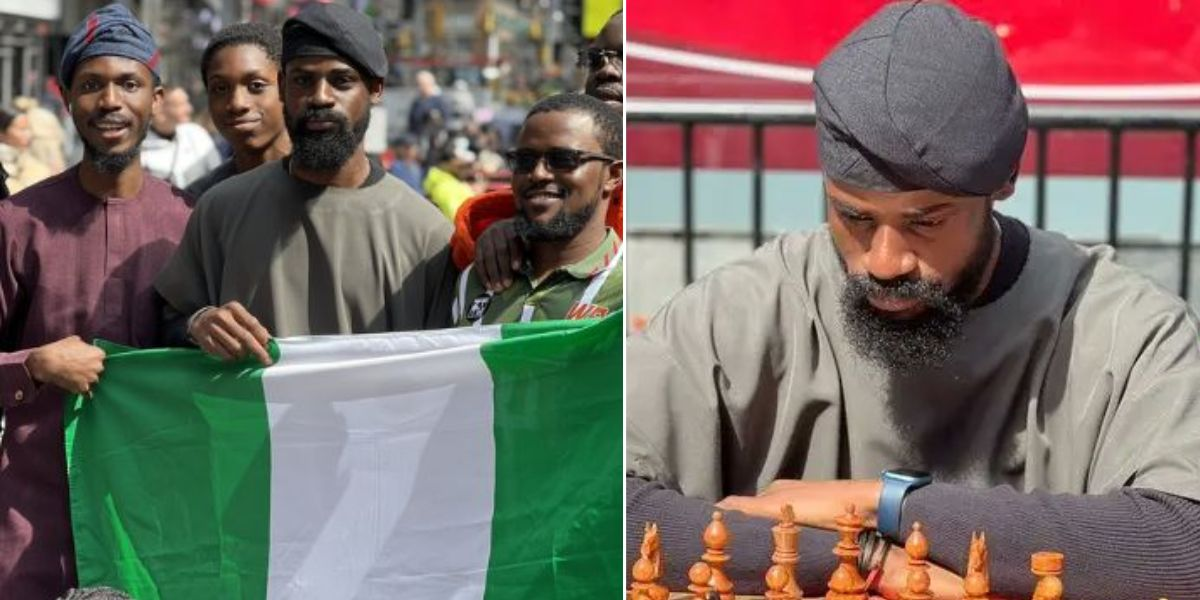
In a remarkable display of endurance and skill, Nigerian chess master, Tunde Onakoya, has shattered the world record for the longest chess marathon.

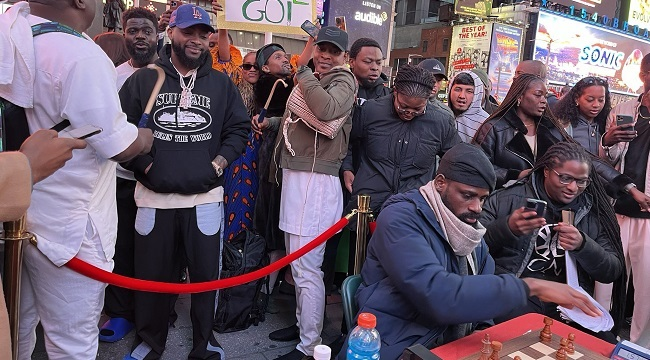
The event took place under the vibrant lights of Times Square in New York, where Onakoya played chess continuously for 58 hours. This feat surpassed the previous record of 56 hours, nine minutes, and 37 seconds set by Norwegian duo Hallvard Haug Flatebø and Sjur Ferkingstad in 2018.

The marathon was not just a test of stamina but also a charitable effort. Onakoya aimed to raise $1 million for his initiative, Chess in Slums Africa. The funds are intended to support chess education and enrich the lives of millions of children facing poverty.

“This initiative will help us distribute one million chess sets to underserved communities by 2030,” Onakoya said, reflecting on his dual role as a board member of the US non-profit ‘The Gift of Chess’.

Support poured in both locally and internationally. In Times Square, hundreds from New York’s Nigerian community, including Afrobeats star Davido, rallied to support Onakoya, energising him with music and traditional Nigerian dishes like jollof rice.

Meanwhile, the event was streamed live on Twitch, where viewers from Nigeria and around the world watched and cheered him on. Enthusiastic messages flooded the streaming platform, with one viewer writing, “Thank you for daring to dream and showing us the levels to which we can all take our brain power to! Well done Tunde! I’m going to pick up my chess board back haha.”

Leadership

State of the Judiciary: Stop extending honorific recognition to people who have chosen to sacrifice it— Odinkalu

  • Video

Foremost rights advocate and law teacher, Chidi Anselm Odinkalu has called on Nigerians to demand accountability for the malfeasance of the judiciary.

Speaking in a YouTube interview with Atlanta Discuss Channel hosted by Ade Balogun, Odinkalu said this demand for accountability should not be left in the hands of lawyers as they are self-interested in perpetuating their ascendancy.

Admonishing Nigerians to “stop extending honorific recognition and respect to people who have chosen to sacrifice it,” the Professor of Law remarked that when judges deviate from their constitutional duties, when they defile or defy their oath of office “they lose their right to our respect.”

The ex-Chair of the National Human Rights Commission added: “It’s difficult for me to address a man who collects bribe as my Lord…”

Watch the video interview below.

TIPS