Home Blog Page 590

Female prisoners in Nigeria rise by 4.82%

The National Bureau of Statistics (NBS) has revealed that the percentage of women admitted into the Nigerian Correctional Centres in 2022 increased by 4.82%.

According to the NBS’ Statistical Report on Women and Men in Nigeria 2022 released in Abuja on Wednesday, the percentage of females admitted into the Nigerian correctional centre in 2020 stood at 4.90%, then dropped to 4.48% in 2021 and increased to 4.82% in 2022.

It also showed that in 2020, 2021, and 2022, male inmates accounted for 95.10, 95.52, and 95.18% respectively. The report further indicated that stealing was the most prevalent offence committed by both men and women.

It also showed that in 2020 the number of men convicted of stealing stood at 40,555, which declined in 2021 to 31,921 and increased to 44,477 in 2022.

The report further revealed that: “Similarly, the number of women admitted to prison for stealing in 2020 was 1,981, which decreased in both 2021 and 2022 to 1,320 and 1,272 respectively.”

The report also indicated that while there was a decline in the crime of bank fraud in the period under review, in 2020, the number of persons arrested was 22 males and four females, whereas the number of persons convicted was eight males and two females.

“This decreased in 2021 as there was no person either arrested or convicted, while in 2022 there was an increase in the number of persons arrested.

“In 2022, three males and four females were arrested while the number of persons convicted was two males and one female.”

Again, the report pointed out that male suspects accounted for 90% of all the suspects arrested for drug-related offences in Nigeria between 2020 and 2022, while the female suspects arrested ranged from 7.35 and 7.62%.

It was also disclosed that the percentage of females trafficked for forced labour was 64.87% in 2020, 59.93% in 2021, and 59.14% in 2022.

Moreover, there was an indication that the percentage of women aged 15 to 49 who had experienced physical violence since age 15 increased from 27.80% in 2013 to 31% in 2018.

The report also showed that 8.20% of females aged 0 to 14 had been circumcised in Nigeria in 2021. The NBS said that from 2020 to 2022, the percentage of females aged 26 to 35 trafficked was 87.86%, 91.08%, and 71.09% respectively.

“In 2019, all victims trafficked for prostitution were females (100%), however, it was 97.82%, 99.72%, and 99.55% in 2020, 2021, and 2022 respectively.”

The Statistician-General of the Federation, Adeyemi Adeniran, said the statistical report analysed the status of women and men across Nigeria from 2020 to 2022 using statistics from agencies at the federal and state levels.

Adeniran said that the report covers six key economic policy domains, which included Population, Health, Education, Employment, Power and Decision-Making in Governance, and Violence Against Women and Crime.

“It benchmarks gender equality across these critical areas annually to measure progress, by compiling and analysing comprehensive national statistics disaggregated by sex.

“The report aims to support policies and programmes enhancing equal rights, responsibilities, and opportunities for women and men in Nigeria, using data from relevant agencies at Federal, State, and Local Government levels”, he added.

NAN

“It’s a slap on the wrist” — Odinkalu on NJC’s sanction against 3 judges

Law teacher and an ex- Chair of the National Human Rights Commission (NHRC) Prof. Chidi Anselm Odinkalu has described the recent sanction meted out to three judges High Court judges by the National Judicial Council (NJC) as “slap on the wrist.”

The rights lawyer who remarked that the mode of discipline deployed by the NJC against the judges has added to the credibility question of the judiciary pointed out it has indeed destroyed the system of discipline and accountability in the judiciary.

Speaking in an interview on Channels TV programme: “Politics Today,” monitored by the News Agency of Nigeria (NAN) in Abuja, Odinkalu alleged that the NJC, under the chairmanship of the Chief Justice of Nigeria (CJN), Justice Olukayode Ariwoola, “has destroyed its credibility.

The NJC, at its 105th meeting dated May 16 but made available to newsmen on Monday, issued warning letters to three judges and barred two of them from elevation to higher bench for a period.

Justice Inyang Ekwo of a Federal High Court (FHC), Abuja was barred from being elevated to a higher Bench for a period of two years “for abuse of discretionary power of a judge by wrongly granting an ex-parte order in suit number: FHC/ABJ/C/626/2023 Juliet Ebere Nwadi Gbaka & 2 Ors V Seplat Energy Plc & 12 Ors.”

Justice G. B. Brikins-Okolosi of Delta State High Court was also barred from being elevated to a higher Bench for a period of three years “for failure to deliver judgement within the stipulated period in Joseph Anene Okafor Vs Skye Bank, suit number: A/94/2010 after parties had filed and adopted their final written addresses.”

However, the NJC cautioned Justice Amina Shehu of Yobe State High Court for issuing a writ of possession conferring title on the defendant in suit number: YBS/HC/NNR/1cv/2020 when there was no subsisting judgement of any court to enable His Lordship issue the writ.”

A thoroughly piqued Odinkalu in the interview in the interview said:

“One of the so-called disciplinary measures announced by the NJC last Friday was against a judge of the Yobe State High Court who issued a warrant of possession without an underlined judgment.

“That really is burglary; it is at the minimum, a theft. So a judge decides to issue a warrant to collect somebody else’s property with no judgment underlying it.

“That is a crime! Do you know what the NJC did? They said ‘they are going to write a love letter to this woman to warn her not to do it again.’

“If you did that kind of thing (pointing to the journalist), you would be in jail, either as a pretrial detainee or a convict,” he said.

Noting that the NJC merely gave “a slap on the wrist,” Odinkalu said notwithstanding that the judge was found to have done this, the NJC resolved to write to caution her.

Citing another instance, he said: “Another of the cases they announced was a judge in Delta State who wasted seven years after address without issuing a judgment.

“They also said they were going to issue a warning and he will not be promoted for another three years.”

According to Odinkalu, that is destroying the system of discipline and accountability in the judiciary.

“You cannot tell me and you cannot tell any reasonable Nigerian that a judge who abuses their power for the purpose of stealing other people’s property under colouration of the rule of law, manifestly, should be written and be cautioned.

“The person does not have any business being a judge, but because this chief justice has wasted the authority of the judiciary, he cannot run a disciplinary system that works. That is the problem.

“So all of those announcements on discipline they made last Friday, absolutely made my point that this current chief justice lacks the authority to say anything credible on discipline and accountability in the judiciary,” he concluded.

The human rights activist, who condemned the recommendation of Ariwoola’s family members as judges in the latest list of 86 judicial officers, advised President Bola Tinubu not to single out judges for salary increase.

He said increasing the salaries of judges without commensurate increases in the judiciary workers’ salaries would be counter-productive because the output of judges depends on the wellbeing of the judiciary staff members.

“You cannot just single out judges because they are not the only people in the system.

“Singling out judges will ensure that this will not be sustainable,” he said.

Is paternity fraud actionable in law?

By M.O.Idam

The ever-increasing rate at which men are defrauded with fake paternity by either their lawful wives or partners in coitus has become a serious cause for concern.

Unfortunately, various gender based vices are overreached with publicity whereas paternity fraud is seldomly talked about even though it is one of the biggest, if not the biggest, matrimonial malpractice known to mankind.

In a nutshell, paternity fraud is described as an act of deceitfully leading a male spouse or male sexual partner by his female counterpart to assume or believe that he is the biological father of a child which in real sense does not belong to him.

Recent findings on social media, reveal that one out of every four tested men turned out not to be the biological father of their child(ren). Sadly, Nigeria is ranked as the second highest.

Curiously, the Matrimonial Causes Act (MCA) and the Matrimonial Causes Rules (MCR), which are the leading legal framework for matrimonial causes in Nigeria, failed to make provisions for such matrimonial wrongs. Whether it was an innocent omission or a deliberate exclusion borne out of the genuine desire not to rock the “sacred” institution of marriage remains doubtful. Similarly, the Criminal Code is also vacant on the issues. Nevertheless, Sections 387 and 388 of the Penal Code Act provides for imprisonment for two years and/or with a fine for adultery. But also remains copiously silent on the issue of “having a child outside wedlock and deceitfuly or fraudulently leading a spouse to believe that such child was his.”

The Court of Equity does not make a practice to suffer a wrong to be without a remedy. Therefore, it is my considered view that whereas the criminal laws in Nigeria do not consider paternity fraud as an offence, victims who are jilted by their partners, reserves a right of action in damages under the civil laws. Afterall, where there is a wrong, there is a remedy (“Ubi Jus Ibi Remedium”). Under this circumstances, remedies are usually a monetary compensations. A partner who was mislead to believe that he owns the paternity of a child and who relied on such impression to train and raise the child may recover as damages in a civil court, every financial loss and psychological pain incurred as a result of such deceit.

While it is agreed that punishment is not one of the weapons available for a civil court. Nevertheless, there are instances where damages may be used as punishment for a civil wrong. In Rookes Vs. Bernard (1964) AC 1129. Here, Lord Delvin while condemning the act of a Union who ensured that it’s member was sacked by his employer for disagreeing with it, embarked on a protest against the member’s employer which eventually saw him sacked, held that in punishing the act that, where a conduct is not Criminal, an award of punitive damages would serve a useful purpose in vindicating the strength of the law and providing a practical justification for admitting into the civil law a principle which ought logically to belong to the criminal law.

Therefore, a Court called upon to decide matters bordering on injuries incurred as a result of deceit in paternity, would always weigh the extent of the damages or injury suffered by the Claimant and the compensation which would be adequate to assuage the pain inflicted by the act of the Defendant. In most cases, exemplary and punitive damages are also awarded outside special damages just to inflict economic pain on the Defendant in order to send a message of deterrence to others to refrain from actions that would put a party in the position of the Claimant. In Philip Moris USA Vs. Williams 549 US 346 (2007) Here, the court held that punitive damages must be reasonably connected with the injury suffered by the Plaintiff. This Principle is in tandem with the judicial authorities in Nigeria regarding damages. See Iloabachie Vs. Iloabachie (2000) 5 NWLR (Pt. 656 )178 CA @222 Para. C. Here, the Court of Appeal held that where no loss was incurred from a wrong or the wrong is excused under a legal defence, the Claimant is not entitled to damages.

Nonetheless, except for special damages, award of damages in any claim is at the discretion of the court which must considerably flow from the injury suffered by the claimant. Please see GTB PLC v. OBOSI MICROFINANCE BANK LTD (2018) LPELR 44518 (CA).G.K.F. INVESTMENT NIGERIA LIMITED v. NIGERIA TELECOMMUNICATIONS PLC (2009)13 NWLR (Pt. 1164) 376.

CONCLUSION

Victims of paternity fraud are not helpless except they choose to. While gender-based violence of any kind must be discouraged, paternity fraud should not be treated as an orphan. By this piece, I recommend a special legislation to be passed by the National Assembly purposely to address issues of paternity fraud and matters associated to it, in order to curb the social vice which is gradually gaining acceptance in Nigerian society.

M.O.Idam, Esq.
[email protected]

Is the Chief Justice of Nigeria right to argue that the judiciary should not be bothered about public opinion?

By J. S. Okutepa, SAN

For quite sometime now, the Hon Chief Justice of Nigeria, Hon Justice Olukayode Ariwoola, GCON has at every opportunity in public functions argued and made conclusions that the judiciary in Nigeria should not be bothered and influenced by public opinion in judgments.

I have had anxious moments in understanding his lordship on this point. The Nigerian judiciary is set up to serve the public.The consumers of justice in Nigeria are the Nigerian public. The Nigerian populace are the stakeholders in the administration of Justice. They are partners in ensuring that judgments and judicial institutions are responsible and respected.

With profound respect to his lordship, I do not agree with his position that public opinions should not matter to the judiciary in judicial decisions. Public opinions should, and it must matter to the judiciary in judicial determinations. It will be a grave tragedy to ignore and underrate public opinion in this 21st century.

The reason for disagreeing with the views of his lordship is not too difficult to comprehend. It must be understood that the judiciary plays a vital role in upholding the rule of law and ensuring that justice is served. That been the case, it is my first humble view and submission that when courts ignore public opinion, the judiciary risks undermining the very foundation of the justice system.

Secondly, public opinion serves as a vital feedback mechanism, providing insights into the perceived fairness and effectiveness of the justice system. Ignoring public opinion can have far-reaching consequences, thus eroding trust and confidence in the legal system. After all, justice is rooted in confidence, and confidence is destroyed when the public begins to think that the judiciary is compromised.

Thirdly, when courts disregard public opinion, they create a perception that the justice system is out of touch with the people it serves. This can lead to a decline in trust and confidence in the legal system, causing individuals to question the impartiality and fairness of the judiciary. As trust erodes, the public may become less likely to cooperate with the justice system, leading to decreased reporting of crimes, reduced witness testimony, and lower conviction rates.

Fourthly, ignoring public opinion can create a perception that the justice system is not responsive to the needs and concerns of the people, particularly in electoral jurisprudence where the people are equally interested in the outcome of litigation.This can lead to increased feelings of injustice, resentment, and anger among the public.
When the justice system is seen as unresponsive, individuals may take matters into their own hands, leading to vigilantism and extrajudicial punishments.

The fifth reason is that the judiciary’s legitimacy is rooted in its ability to reflect the values and principles of the society it serves. When courts ignore public opinion, they risk appearing out of touch and disconnected from the society the judiciary is meant to serve. This can lead to decreased legitimacy, undermining the authority and credibility of the judiciary as it appears to be the perception of the public in Nigeria.

The sixth reason is that ignoring public opinion can also influence judicial decision-making, leading to a disconnect between legal precedents and social values. Judges may become isolated from the concerns and needs of the society, making decisions that are not in line with societal expectations. This can result in miscarriage of justice, further eroding trust, and confidence in the legal system.

In my view and with profound respect, ignoring public opinion in administering justice can have severe consequences, including erosion of trust and confidence, increased perception of injustice, decreased legitimacy, and impaired judicial decision-making. It is crucial for the judiciary to engage with public opinion, acknowledging the concerns and values of the society it serves. By doing so, the justice system can maintain its legitimacy, ensure fairness and impartiality, and uphold the rule of law.

To think that public opinion does not matter in judicial administration and decisions of the judiciary is with respect engaging in conduct that may be inimical to the very survival of justice system and effective justice administration that serve the best interest of the people.

This Judiciary Has Irredeemablly Failed: It has lost the moral high ground to dispense justice

By Sonnie Ekwowusi

I don’t know whether it is only in the court case in which I am counsel that the failure of the Nigerian judiciary manifests itself most eloquently.

I am in court in Abuja at the moment. I flew into Abuja yesterday. My matter was scheduled for trial. 10 am is the time. As usual,the court Registrar has most casually announced to all the lawyers present in court that the court would not sit because the judge was attending a Seminar at Sheraton. Consequently we are taking dates now.

My matter has been pending in the court for gargantuan 14 years. Trial had been completed. We got to the stage of addressing the court when the judge, who was hardly sitting, suddenly announced her retirement.

So the matter started de novo. And this new judge presiding over the matter is behaving exactly the same way the previous judge was behaving.

He is erratic. Insultive.He hardly sits. Five times I had flown into Abuja only to be told the court was not sitting. Prior to leaving Lagos yesterday I called the Registrar and he assured me the court would sit. Now, look at me, frustrated and tired. I have incurred an air ticket and hotel accommodation bills. I have incurred risks flying to Abuja. I have wasted two or three days for nothing.

Apart from this particular case, two weeks ago I was at the Federal Court Abuja. And we were told that the court was not sitting for no reason. That was the three consecutive times that the judge had not sat on the case. Three days ago I was at the Lagos High Court. The lady judge was the loquacious kind. She spent the whole morning talking and bashing lawyers. No electricity supply in court. We were sweating profusely. The judge herself was also sweating. I got up and humbly and respectfully pleaded with her to allow us to remove the wig and gown to receive some fresh air. She turned down my request. So, I sat down sweating and sweating. Other lawyers in court were suffering too. I left the court by 2 pm. My matter was just for mention.

We are counsel in one matter at the Federal High Court, Lagos. For three years the judge in that court has not sat.

A few years ago I appeared at the Justice Oyekan-Abdullahi’s court at Ikeja, Lagos. Midway in my submission before her, she got up, left the exalted Bench precinct and entered the Bar and started accusing finger at me. I was astounded. I packed my books and walked out against her. Prior to her sitting, the lawyer on the other side had warned me that Oyekan-Abdullahi’s was his court and that he would show me pepper in the court. I thought he was joking. And he ended up showing me pepper. Anyway, I later appealed the useless judgement in that matter and the Court of Appeal reversed it.

I can go on and on narrating the tragedy of the Nigerian judiciary.

Why am I recounting my harrowing and frustrating experience this morning? To encourage you not to give up the fight. I myself am not giving up the fight.

What I am saying is not new to you. I know you have experienced the worst travesties. I know that you know that the Nigerian judiciary is rotten inside out. I know that for decades you have been loathing and fighting the same failed judiciary.

But my friend, we cannot give up the fight. We cannot flee. Those who have fled are cowards. But you and I are not cowards. We are optimistic that some day the light will shine in the direction of the Nigerian judiciary and it would stand on its feet.

Today in Abuja I am having a crucial meeting on how to redeem the Nigerian judiciary. Tall order ? Waste of my time? Heating my head against the wall? No. Not at all. Look, hope remains our greatest asset. We cannot flee. We cannot keep quiet. We must continue to do our best even when our best seems inutile and ineffective. This is the way

Sonnie Ekwowusi

Ibukun lost 3 years of his life awaiting trial in prison to prove he wasn’t a criminal

By Samson Toromade

Pulse.ng Interview

When police officers arrested Ibukun Ajigbotesho inside his aunt’s apartment in January 2020, he was confident he would be back home for dinner because he had done nothing wrong.

The 27-year-old ended up inside a courtroom where his three-year hell in Nigeria’s criminal justice system took a surprising turn.

Data compiled by the Nigerian Correctional Service (NCS) shows that 69% of inmates in prisons across the country are awaiting trial, praying for the chance to prove their innocence — many times for minor crimes or alleged crimes police officers are unable to prove in court.

Ibukun was one of them, and this is his story.

I’m an Ijebu boy but was born in Ibadan where my parents worked. I spent my school holidays at my aunt’s place in Lagos. After I returned to Ibadan one time, I told my mother I was no longer interested in going to school and wanted to move to Lagos full-time. I was 19 years old. It’s not like my mother couldn’t send me to school, but I told her I was no longer interested even though she didn’t like it. There was a spirit that just told me to stop.

I learnt picture framing. I was a trainee for two years before I abandoned it. I was like 15 years old.

My friend once came home with a picture frame and put his mother’s picture inside it. I loved it and asked him to take me to his boss so I could train with him too. I eventually made my own picture frame and put my mother’s picture inside to hang on the wall. My mother was proud of me and I loved it.

But she later expressed concern the equipment needed to set up after freedom was expensive and was scared she could not afford them. That was the day I stopped caring about it.

When I moved in with my aunt, I started working at a garage around Oworonshoki. My job was to collect money from drivers at the park. I went on to become a conductor, but it felt too rough for me so I went back to collecting money from drivers and retiring home in the evening.

I delivered ₦‎5,000 to my boss every day. Anything else I made over that was mine. If a driver came to the garage and took a full busload of people, I took the fare for one person. So if he was collecting ₦‎500 for one passenger and took a full load from the park, I’d collect ₦‎500 from him. But if it’s less, my charge went lower.

It wasn’t always turning a steady profit, but I wasn’t begging anyone for money. I gathered enough money to move out of my aunt’s house and got my own place with some of my friends in the same line of work.

It was a Sunday. I was supposed to go to work, but it was raining and I was tired, so I stayed at my aunt’s place. I was washing my clothes when my cousin ran inside to say police officers were around. People had been fighting in the area and they were investigating. The police officers were led by Brother Sunday who had arrested me before.

Yes. He arrested me three times in the past for smoking weed, but I would pay a bail of ₦‎10,500 and go back home. He knew the job I did, and that I smoked weed, but he also knew I wasn’t a cultist or troublemaker. Cultists weren’t strangers to the area and whenever they fought we’d have to run home from the bus stop.

My cousin came running inside to alert me because he knew I could be caught with weed, but I wasn’t smoking that morning, so there was nothing for them to find on me. When they came in, they searched me and handcuffed me immediately. When I asked Brother Sunday what I did, he slapped me and told me to move. My aunt changed it for him.

One of the officers was already tearing up my aunt’s apartment looking for anything. They found my friend sleeping in my aunt’s room, his name is also Sunday, and they handcuffed him. When we got to the station, they called us cultists and said my job was a cover. They said I roll with bad boys at night to do all sorts of things.

They even accused my aunt of storing guns for us and arrested her too. I was shocked because this officer knew us well and had been to my aunt’s house to arrest me twice before. He insisted that’s where we kept our guns, but they found nothing. They refused to grant us bail, but my aunt got out very soon.

Sunday and I spent three days at the police station before they took us to the SARS office. There was another person in custody there I recognised from the neighbourhood, we called him Swagger — everyone thought he was a cultist, and even I feared him.

They asked him if we knew each other and we said we lived in the same area. But when they asked him if we were also cultists, he said no, that we only worked at the bus stop. The officers didn’t listen.

They made us write statements, and then they locked us in the cell for two weeks. The next time they let us out was to go to court — Court 18, I can’t forget.

They charged Sunday and I with cultism, conspiracy and stealing three motorcycles. The judge kept reading the case file and asked the investigating police officer (IPO) for the complainants, and he said he would produce them during the next hearing. That was the last time I ever saw him.

The judge just set our bail at ₦‎100k and two sureties each. Sunday got out before me. My mother was working on getting the bail money and settling the sureties but then my father died. That messed things up.

The judge remanded me at the Kirikiri Medium Security Correctional Centre. I first landed in what we call a welcome cell where new inmates stayed for the first two or three days. The room is a bit spacious, but there were like 25 people in my set and the only beds were for old inmates who lived there. When they hold you in the welcome cell, it gives warders time to take your records, pictures and everything before going to the general cell.

When I was processed to my general cell, there were about 95 of us with only 14 bed spaces in the room. I had been in police cells before but prison was a whole different world. Everything changed for me.

I drank the water there and things were crawling out of my skin — the same thing happened if you ate the beans. You can have stuff like maggots coming out of your ass. Some people would sit with only one side of their ass. If you sit for too long, the seat may get wet with liquid coming out of you.

So there’s a place called Jankara — it’s for people with no money or connection in prison. They’re the ones who sleep in the general area and are packed together like sardines. People who have money get certain privileges like sleeping on the bed or in a corner — which is on the floor in the space between bunk beds, so you can sleep on your back instead of on the side like in Jankara.

When I got in, the Marshall said I should plan well. He was also an awaiting-trial inmate but he’d been there longer than anyone in the cell and was the number one whom the warders allowed to control the place.

I called one of my bros outside and he sent the Marshall ₦‎5k. He became very nice to me and cooked me okro soup and eba. It was the nicest thing I’d had since I was arrested — I was very thankful.

There’s a cell officer who knocks a tin on the ground — we call the tin the key. Once he knocks it on the ground, and says, “Silent hour,” everyone must shut up. There’s a law there and whoever speaks has jammed it. The punishment is usually to pack shit.

There’s a soakaway behind the cell and the top is open all the time, and whoever commits an offence is taken there to relieve the soakaway. They give you two kegs to pack from the soakaway and dispose in a nearby river. That’s the punishment you usually get for most offences. Whatever Marshall says is final, so everyone respects himself.

I slept in Jankara that night o — my money only covered food. The next morning, the Marshall called me to his barracks, a corner at the back of the cell with a curtain that makes it look like his own room. You have to jam your legs on the ground three times before you enter.

He gave me a phone to call my family, but the person I called said he didn’t have money. He said, “Aren’t you in prison? What do you need money for?” But trust me you need money in prison to plan well. If you don’t plan well, you won’t chop pepper.

The person said I should call him back on Saturday, and that was four days away. The Marshall asked me to make another call, but that was the only number I knew offhand. He was angry and called Mopol 2 to take me to the back to pack shit. Pack shit ke?

Luckily for me, I knew guys who were already in prison, and one of them knew a Marshall in another cell who came to beg for me, but I already carried off like three kegs of shit.

I figured out quickly that if you respect yourself, you won’t have a problem. Any time they announce the silent hour, I’m very obedient. It’s usually highly charged as we’re all packed together and breathing on each other’s necks.

The silent hour is called locking the state and can last as long as two hours. You can’t even whisper or the Marshall will punish you. The cell officers just want to show you they’re in charge. The Marshall noticed I was a calm dude and made me an officer after one year in the cell, which we call a state. I became Mopol 2.

The Marshall is the Head of State, followed by the Inspector General (IG), the Adviser, the Chief Judge, and the Commissioner of Health, who’s the guy you go to when you’re sick so he can connect you to the prison hospital. The GOC controls the state and is the one in charge of the key to lock the state.

Mopol 1 is the enforcer who mounts the state and watches for anyone who jams the law — he’s like the one writing the noisemakers’ list. Mopol 1 is senior to Mopol 2 but they do the same thing. The only others left are OC Lavatory and Police Lavatory who are in charge of toilet affairs, including monitoring people who pack shit.

I finally left Jankara and got a corner where I could now sleep on my back. As an officer, I had more freedom when the state was locked down — I could even whisper. I was also the one who caught offenders, so you’re lucky if you’re my guy because I can look the other way.

Ibukun was in court a total of 16 times in three years, but the court only sat four times

I immediately noticed the food was messing with me, but I had to eat it because I didn’t have options. After a while, I started trying to game the system, so whenever I got beans in the morning, I would wait until evening when there was garri to mix them up.

Some people love the beans and would save and gather rations to put in the pot to add pepper, maggi and oil and reheat it. The prison’s food doesn’t have any of these things, even the stew that comes with white rice is basically water.

I wasn’t looking for trouble with anyone o. If you fought, you’d pack shit together. The normal thing if someone gives you word is to report to a cell officer and the issue would be settled.

It’s easy to offend someone in prison. You can step on someone’s slippers and he’ll accuse you of stepping on his leg and seriously square with you. But once you understand he’s just irritated by everything else, just apologise and move on.

If you fight, everyone would gather around you but warders hate any gatherings and would come running to see what was going on. If you fight in the yard, they’ll move you to isolation cells. If the fight happens inside the cell, the Marshall is the one who will punish you — pack shit.

When the COVID-19 thing started, they locked us all in our cells for one month — none of the awaiting-trial inmates could go anywhere. Only convicted prisoners were allowed to roam and people who had money before the lockdown usually sent them to help buy things for us — sometimes they ran away with your money. Everyone had to eat the prison’s food because we could not go anywhere, even the Marshall ate the ration.

Before prison, I only went to church once a year for crossover service on December 31. But you see when I went to prison, I understood it’s important to serve God. I went to church every Sunday, and I was even an usher. Church services started at 9 am but pastors would come to the cells to get church workers like me out early for service.

Going to church also meant getting good food to eat, because RCCG people brought takeaway packs for their outreach programme every Sunday. Some people only went to church for the food.

I went to court a total of 16 times, but we only sat four times. The IPO and complainant didn’t show up for the second hearing so we got an adjournment. Sunday got out on bail after that second one and would come to court from home.

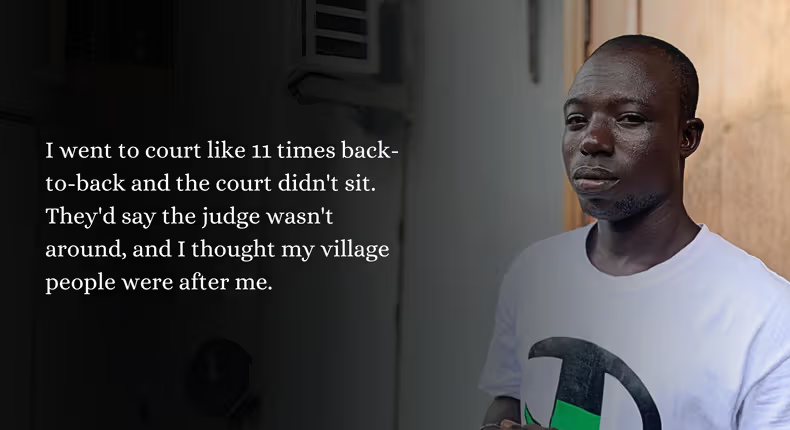
I went to court like 11 times back-to-back and the court didn’t sit. They’d say the judge wasn’t around, and I thought my village people were after me.

I used to look at Sunday and wonder why I couldn’t be out free too, but he was nice to me — he could bring me a shirt, trousers, or even footwear. I figured that’s how God wanted it.

On my 14th appearance in court, the judge didn’t come, again. While waiting in the prison van to return, a lawyer came to meet another cellmate whose case she was handling. He said she was a human rights lawyer with Headfort Foundation so I asked him if she could help with my case. I explained my situation to her and she gave me her card.

When the court doesn’t sit, there’s no adjournment date, but the warders will get one the next time they’re in court without you. When I got my next date, I called her, but the judge didn’t come, again. I wanted to curse him. I also didn’t see the lawyer in court that day.

The next time I came, a lawyer came up to me from nowhere. I’d never met her in my life but she said I was the one she was waiting for. She didn’t have time to say much else. By the way, this was the day I got out — I wasn’t expecting it.

Yes. I went into the courtroom and saw the judge — I was happy. When he asked who would represent me, this lawyer I didn’t know approached the bench and started talking on my behalf. I didn’t understand the English they were speaking.

The judge was writing in his note for a long time and then started reading everything he wrote. I didn’t know what he was talking about with all the English but I understood “discharged” when he said it and the lawyer smiled at me. After three years. I was so happy.

I went to my aunt’s place in Ogudu, different from the other one in whose house I was arrested. It was around 2 pm and she was surprised because she wasn’t expecting me. She even asked me if I escaped from prison.

She served me amala and egusi but I didn’t want to rush it because it was outside food and I didn’t want it to mess with my system. I only ate a small portion just to ease myself into it.

Man, after my meal, I just sat down and started hearing cars with their loud horns passing by, it was unbelievable. Prisoners are very happy to go to court for their cases because it is their only chance to see the outside world. You’d think they were going home, but they’re just happy to be out. Some people can be in prison for nine years without seeing outside even though they’re awaiting trial.

I still couldn’t believe I was free so I went to sleep and woke like 6 pm. Cells are locked by 5 pm, so if I was still in prison, I would be in a room with dozens of other men. I sat outside in the breeze watching people go and come, it still felt like a dream. I went back to sleep again just to be sure and when I came out later I could see the sky. It was mad.

My behaviour changed o. I used to be rash and hot-tempered — like a tout, a hard guy, not anymore. I don’t smoke weed anymore since I came back, I’m not lying. If I smoke now, I may get on the police radar again, and I don’t want that. I don’t fight or make trouble with anyone. When I went back to my old bus stop, my chairmen were very welcoming and would give me handouts. Eventually, I stopped working there and moved to a bus stop in Ogudu. This meant I hardly saw my old mates anymore unless they came to my new side. We just do, “How far? How far?” and keep it moving because I don’t want any more problems.

If I see something else to do, I’ll leave it. When I first got out, there was nothing to do and I hate to beg. So I said let me continue with it like this. Maybe if I find something else.

That has crossed my mind, especially every time I see a picture frame. But if I go back to completing my training now, I won’t have the time to hustle for the money to survive at the same time. I can’t start begging anyone for money for my upkeep. The equipment is still expensive too.

Judges should be a bit more sensitive. How can you not show up on a date you adjourned a case, not once but many times? It feels like you’re just making people suffer.

Prison is only for suffering. The government should only take convicts there — people you know for certain are guilty. Even he’ll understand he’s suffering for what he did. Prison is not a place for someone to be. Even for the people who are rich in there and can afford an easier life, there’s still nothing like freedom.

The series continues tomorrow. Jonah talks about spending an extra four years in prison because someone neglected to process his release order. He kept awaiting a trial he was already discharged and acquitted.

This interview was originally conducted and published by Pulse.ng on 21 May, 2024.

Police officers seized Segun’s motorcycle — then sent him to prison for 6 years

Pulse.ng Interview

By Samson Toromade

Just hours before Segun Esan’s wife gave birth to their third child in 2017, police officers seized the painter’s okada while he was riding it home late at night.

His attempt to immediately retrieve the motorcycle and his work tools at the police station was a mistake — it was his last night of freedom for the next six years.

Data compiled by the Nigerian Correctional Service (NCS) shows that 69% of people in prisons across the country are awaiting trial, praying for the chance to prove their innocence — many times for minor crimes or alleged crimes police officers are unable to prove in court.

Segun was one of them. This is his story.

I stopped going to school when I was in primary five because my parents couldn’t afford to send me there. I just floated around for some years until my brother started taking me out on his house painting jobs. Instead of playing football around the neighbourhood, he would take me on painting jobs in Lekki, Ajah, everywhere.

When I was 19 and my brother left Lagos, I became a spray painter apprentice because I liked it. I signed up for two years but my boss extended it for five more years, even though I was good at the job. I kept begging him for freedom but he wanted to keep using me. He eventually granted me freedom, but I wasn’t yet stable enough to be on my own, so he used me as his joinman — whenever he got a job, he would ask me to do it with him for a cut.

I used to have a babe who was into me but wasn’t ready for anything serious. You know men are greedy, so I started seeing another babe who I was sleeping with on the side. That’s how I got my first kid. Her family wouldn’t allow us to get married properly, but we were living together and ended up with two more children.

When she got pregnant, they sent her out, and her mother wanted to know me. I was still squatting with my mother but was ready to rent my own place. I was mostly doing joinman with my boss so I could gather enough money to find my spot. I was also doing other jobs because there’s nothing I can’t do — rubber tiles, wallpaper, wall design, screeding, anything.

I found a mechanic workshop with a panel beater, but no spray painter. I negotiated an arrangement with the panel beater so I could set up shop there as soon as I got enough money. I even already bought some equipment before I ran into trouble.

In 2017, I was painting a house in Ago but I finished late. I tied my bag of equipment to my motorcycle and left there around 9 pm to return and finish the work the next day.

Around that time, Governor Akinwunmi Ambode had asked police officers to arrest motorcyclists working past 10 pm. This was not a problem for me because I wasn’t using my okada for commercial purposes, I only bought it so I could beat traffic and move around easily for my job. But there was a woman that night who wanted to go to Ikotun roundabout. It was easy money, so I took her.

As she got down and was about to pay me, a tricycle jammed me from behind and I fell to the ground. Police officers were inside and immediately seized my motorcycle.

I asked them to take me to their station so I could bail it there, but they abandoned me by the road. When I eventually caught up to them at the station, an officer said they planned to destroy the okada at Alausa.

I kept begging them to collect ₦10k to release it but when a team of officers came back to the station from night patrol, one of them pushed me inside saying it was too late for me to go home.

I didn’t plan to leave there that night without my bike. They took me to the back of the station where I found many people — men and women who were outside late.

By morning, SARS arrived and started asking questions. People who had bail money were released, but they took the rest of us to Alausa and suddenly journalists mobbed us and asked questions I didn’t understand, shoving mics in our faces to answer them.

I told them all I did was try to bail my bike, but the police officers wouldn’t allow us to talk. From there, they moved us to Federal SARS — I didn’t even know anything they called SARS at the time.

The next morning, they took me to the theatre where they tortured people. They asked what I was doing at the time they arrested me and gave me a pen and paper to write a statement.

I told them I couldn’t read or write, but I made it clear that I wasn’t arrested, and it was my bike I wanted to retrieve. I wasn’t caught with anything, and even told them to check my tool bag strapped to the motorcycle. An officer wrote my statement for me and then asked me to remove my shirt, which confused me. He started slapping me when I didn’t obey quickly. They brought one guy and asked him if he knew me but he said he’d never seen me before. The officer said we were arrested together but that wasn’t true.

I later found out the boy was an agbero who was dumped in prison because he refused to give police officers a cut of his street earnings. So they decided to punish him.

They hung me to the roof and tortured me to confess things I didn’t do. I was screaming so much that OC SARS came one time to complain that I was disturbing a meeting upstairs.

There was a point it was so unbearable I started confessing that I was a thief and an officer was writing it down. When they let me down, after hanging me for five hours, they said I should stand up but I couldn’t, and they laughed at me.

I was there for three months and two weeks before the OC SARS came to complain that the cell was too crowded. The next day, they took some of us to the Ikeja court and I started seeing things I’d never seen in my life.

When the judge saw my case file, he said there was nothing to it and asked for the investigating police officer (IPO) who reported that I committed a robbery with someone I had never met in my life. When he asked for the complainant, the IPO said he already called him and would soon come to court. The judge remanded my case mate and me in prison while that was sorted.

My wife raised an alarm after I didn’t return home and everyone started panicking. They couldn’t reach me at first but, eventually, one of the SARS guys picked up their call to my phone. My sister came and said my wife gave birth to our third baby the night I was arrested.

When my family members wanted to bail me out, SARS asked them for ₦350k. They started gathering money from everywhere and even loaned from LAPO and gave the whole thing to the IPO. Then the IPO said the money was for OC SARS and he wanted another ₦300k for himself, but we were too poor for that. That’s how I landed in court.

In Kirikiri Maximum Prison. I arrived at a welcome cell where new inmates were placed for the first month. There were more than 30 people in that room. It was very tiny with no breathing space. Some people slept while standing or on their sides, packed next to each other like sardines. I later moved to a proper cell.

That’s when the real suffering began. There were 104 people inside the cell for awaiting-trial inmates, but only like five bunk beds with 10 spaces. You could pay to sleep in those beds or pay for a corner, which is the space on the floor between the bunk beds — like 10 people can sleep there on their backs. Whoever can’t afford to pay sleeps in Jankara, where people sleep on their sides and are packed together. They’ll tell you to plan well, so you can get the spaces.

There was no money to do that. When I entered, the cell’s number one — we call him Marshall — called me to say that without planning well, I would sleep in the general area, pack shit, and fetch water. I did all those things because I had no money. I packed shit many times from the soakaway, cut weed, and cleaned gutters. It was hard labour. I tried to make money by working around the place. Like when they brought Evans the billionaire kidnapper to prison.

I helped him paint his cell, you know that’s my work. When he came, he said he didn’t like how the cell looked and tidied it up. He bought paint and I painted it. If people like him also needed someone to cook for him, I did it. I just needed to make enough money to get a corner or bed space.

It took me four years. I paid ₦30k — it’s usually ₦50k, but I got a discount because I’d been there for a long time. You can keep the bed until you leave prison, but you can lose it if you cause trouble, like being in a fight.

I didn’t look for trouble, so no one troubled me. But people were always frustrated so there was always trouble around the corner. If you step on someone who hasn’t eaten for one week, it could escalate quickly. That was the source of most of the fights in prison.

Let’s not even talk about the food in prison. The garri is black and has many stones, and the beans are horrible, you’ll see cockroaches, houseflies, and big stones inside. They even added Largactil to the beans — it’s medication you give mental illness patients to calm them down and they wanted us to be calm. You can sleep in the same place you eat that beans because of the drug.

There was garri, and also ishapa soup. It’s like grounded soya beans that look like egusi, with onions and large bitter leaf slices, but no salt or palm oil. It was very bitter, but we got it with eba every day.

We got rice for breakfast on certain days, but the stew is basically water. If you gave it to a dog, it wouldn’t eat, but hunger would make you eat anything.

The cells opened at 8 am and closed at 5 pm. You could go anywhere and mix with convicts in the prison, work, or go to school but if I went to school, there was no time to hustle for money and food.

I didn’t like going to church in prison, especially because the pastors must have done something to end up in there. I preferred to speak to my God inside my cell where we used to have daily devotions. I can only pray before a pastor I know is clean, or who I don’t know anything about his dirty dealings.

When I eventually left prison and heard about who and who had died, I knew God kept me in prison for a reason. While inside, my prayer was for God to bring me a helper. The lawyer we hired took ₦350k and stopped coming to court. Once he did that, there was no hope for me anymore but God. Lawyer Akeem — we’re yet to repay the LAPO loan till now.

It was my wife. She told her pastor about my case, and the pastor contacted the Headfort Foundation about it. A lawyer came to the prison to ask many questions, and that’s when my case started moving again.

We went to court for five years before the IPO finally brought the complainant to testify. The witness said he clearly remembered the people who robbed him, but said it wasn’t me or my case mate — he’d never seen us ever before.

There was a time the IPO said he recovered a gun from me, but couldn’t produce it. When the court adjourned to give him time to produce the gun, he came back months later to say the person in charge of the evidence store travelled out with the key — the judge was so angry.

After the witness testimony, we got an adjournment that took another year before we could return to court. That’s when my lawyer applied for a dismissal of the case.

I didn’t even know the judge dismissed my case — you know they speak too much English. After he announced his ruling, I went and sat back in the dock. It was someone who told me they were letting me go. I said, “They set me free?” That’s when I started jumping for joy.

Segun is still trying to piece his life back together since he regained his freedom [Ejiro Eyanohonre]

Segun is still trying to piece his life back together since he regained his freedom [Ejiro Eyanohonre]

Before prison, if you slapped me once, I’d slap you 20 times. But I used to tell myself in prison that I’d start turning the other cheek and that’s what I’m doing.

Since I came back, someone has slapped my face. He spat in my direction and I cautioned him for not saying sorry. He slapped me and wanted to rough me up, but I started begging him because I don’t want anything to take me back to prison.

Whenever I see two people fighting now, I laugh, because they don’t know how much trouble they can get in. You can slap someone and end up in prison for years.

I have lost a lot. If I had been free since 2017, I know what I would have achieved with the work of my hands. Whenever I go out now, my mother chases me around with phone calls to be sure there is no trouble.

I’m still not fully aware of my freedom so much that if I get a phone call now, I’d run to a corner and start whispering on the call so a warder doesn’t catch me with the phone.

I’m no longer with my wife. She came to me three years into my stay in prison to complain there was a problem with her stomach. You understand women can do this when they’ve not had sex for a while. I told her to find a man to be sleeping with until I got out because I understood her situation. If the case was reversed, I would be having sex with another woman. My only condition was that she shouldn’t get pregnant for another man.

When I returned and wanted to talk about our relationship, she said I should go see her family but nothing came of it. She lives with another man now with my children but I see them whenever I want to.

My children used to be sharp, but they haven’t been the same since I got out. My firstborn used to correct my English before, but now he only laughs at my mistakes but can’t tell me the correct version. I think it’s his school. It’s painful because my father was unable to send me to school, and I don’t want the same thing for my children. I want to be able to send them to a better school.

The one person I blame is the judge. I know someone whom she gave a one-year adjournment. There was one time she gave me a four-month adjournment and didn’t even come to court on the new date. My life was wasting away in prison and she couldn’t show up for a date she set.

The judges should be able to apply discretion to cases leading nowhere for years — even if it’s to give them bail. They’re just dumping people in prison for no reason. Lives are at stake.

For the continuation of the series tomorrow, Ibukun talks about how he spent nearly three years in prison after he was arrested during a raid that had nothing to do with him.

This interview was originally conducted and published by Pulse.ng on 20 May, 2024.

Working with the police killed my lofty vision and budding activism

By Olanlokun Omolodun, Esq

I remember when I graduated in ‘92 and Gani was my role model and I swore I would become a human rights advocate like him. It is amazing how much a 4-year LL.B course opens one’s eyes to citizens’ rights and the amount of wrongs and injustices we overlook due to ignorance, begging, societal pressure, etc.

When I was posted to Port Harcourt for Youth Service at the Ndele campus of the college of education I saw it as an opportunity to serve Nigerians and help change our country for the best. My old man was a litigator and assured me that after service he would get me suitable pupillage with a firm of SANs but I told him I would not need it as I was determined to make it on my own.

So, bristling with legal principles and with the mindset to fight for the oppressed at every opportunity to occasion legal engineering, I went for service and my place of primary assignment was the prisons office or HQ on Ikwerre Road. I reported to the office and one officer told me to enter into an arrangement where I could sign away my monthly allowance in exchange for someone signing my monthly clearance notices and forwarding them to NYSC so I could return to Lagos to return for discharge but I refused and said I was there to serve my fatherland. There was dead quiet in the open plan office as everyone paused to look at the idealistic fool who just spoke.

So I was detailed to the Rumuokoro police station to oversee removal of detainees to the prison on Aggrey Road. It was a rude introduction to detention facilities in our police stations. They never did anything in a hurry even with relatives of detainees and their lawyers pleading for the release and seeking to prove wrongful detention.

Then the holding cells were the sorriest sights I ever saw when they needed to corral detainees for Black Maria evacuation. Approaching the cell, one was literally hit by a wall of stench of human bodily waste, unwashed nearly naked bodies with almost everyone clinging to the cell bars. It was a most dejecting experience. Nobody did more to knock the budding activism to engineer legal revolution in Nigeria more than watching how policemen work and treat ordinary citizens. Their insensitivity to human suffering is so baked in as to almost be part of their DNA.

From the prison it was too late to return to the office so I went back to the flat I was sharing with other ‘corpers’ and the first thing they said was I smelt terribly. Even after having a bath I still could taste the stench of the police station in my mouth and it killed my appetite. It was our Ikwerre landlord who suggested they ‘take the Lagos boy out and give him pepper-soup so he can regain appetite’ that saved me that night.

The police assignment was, with hindsight, probably deliberate because the next day at the office I noticed that no one spoke to me and I just went to write up my report of the previous day. All the while I was looking around for the guy who made me the offer to sign away my ‘allawee’ to see if I could get redeployed to a private law firm. When he eventually showed up around noon and saw me he bellowed ‘corper Gani how was yesterday’?’ I took him aside and whispered that I wanted to redeploy to a law firm. But he laughed and turned around to announce to the entire office that ‘our Gani say him wan redeploy say him nor wan fight for the masses and his fatherland again.’ The entire office exploded into laughter as I slinked back into my seat.

I eventually got a Law firm which also handled criminal briefs and quickly learned that any assignment to any police station to secure release of any detained person or property was a whole day affair which seldom yielded desired results.

Meanwhile, in litigation there, one got per diem fees of N2k for each file one appeared in, so 3 files daily for at least 3 times weekly was a great week for this rookie associate in the mid-90’s. Upon my relocation to Lagos in 2001, litigation was more dynamic and financially rewarding and made me look back on those days when I thought I could be a people’s advocate in the mold of Gani.

Watching the police work effectively killed that vision for me.

Olanlokun Omolodun, Esq. lives and practices in Lagos.

400L student arrested for raping schoolmate

A 400 level student of the Nasarawa State University, Keffi(NSUK), Gabriel David, has been arrested by the police for allegedly raping a 100 level female student of the same institution.

The Police Public Relations Officer in Nasarawa State, DSP Ramhan Nansel made this known on Saturday to journalists in Lafia.

According to Nansel, the suspect was arrested by police operatives attached to the Agwan Lambu Division close to the university in the Keffi Local Government Area of the state for allegedly raping the 100 level student on May 9, 2024.

“Preliminary investigation revealed that the suspect travelled to the village where he and the victim come from. So the victim’s parents gave the suspect some foodstuff to give to the victim since they are schooling in the same school.

“When he brought the food items, he called the victim to come over to his place of residence to collect the foodstuff sent by her parents.

“On her arrival, he lured the victim into his room and had unlawful carnal knowledge of the victim,” he said.

The police spokesperson further explained that upon his arrest, the suspect was immediately transferred to the State Criminal Investigation Department in Lafia, where he confessed to committing the crime.

“He will be arraigned upon the conclusion of investigation into the matter,” he added.

The Conclave

Teacher remanded for allegedly defiling seven-year-old girl

A Chief Magistrates’ Court in Jimeta Yola, on Friday ordered the remand of a 37-year old teacher, Adamu Ayuba for allegedly defiling a seven-year-old girl in school.

The police charged Ayuba of Rawani of Jambutu, Yola, with defilement contrary to section 211 of penal code law of Adamawa state.

He pleaded not guilty to the charge.

Chief Magistrate, Musa Adamu, adjourned the matter until May 29, for further investigation into the matter by the police.

“This case has been adjourned until May 29, to enable the police finish their investigation and to forward the case file to the Department of Public Prosecution (DPP)for legal advice,” the Chief Magistrate said.

Earlier, the prosecution counsel, ASP Ezra Bulus told the court that the complainant Fatima Isah, mother of the minor, reported the matter at the police station on May 2, at about 6p.m.

Bulus alleged that the complainant’s daughter, a student of Anur Modern Academy Yola, returned from school on April 29 and complained of severe pain in her private part.

The counsel informed the court that the alleged offense is criminal in nature which requires legal advice and prayed the court to adjourn the matter until May 29.

He stated that the offence contravened the provisions of Section 211 of the Penal Code law of Adamawa 2018

NAN

TIPS