This piece was inspired by a story told by the old man of an honourable member while I served briefly at the National Assembly. His choices of words were really what got me thinking. I must confess I was eavesdropping but, trust me, I got the intimate lessons in the intimate gist.
According to Hon. Gbenga (I am not saying more than that), a man, whatever the age, is like a petrol attendant holding a nozzle.
He dispenses fuel to all and any car that comes to his pump. He is there, ever ready, like Eveready battery. His tank is always full and his nozzle always in a giving mode. He is simply at your service 24/7 nationwide, sometimes worldwide. Yeah, his workplace is called a service station.
So, if this ‘petrol attendant’ fills a particular tank of a car, what happens to the petrol is the car’s headache. This attendant has an underground tank that is inexhaustible and will continue to be on duty, irrespective of what his last ‘service’ is doing to the last recipient. Are you getting confused? Do not be. Will break it all down later. Now, if the petrol attendant dispenses any impurity into the car, any and all wise cars must know how to protect their engines. That is why all cars must use Grade A fuel filter. However, in case of accidental discharge of impurities, all cars must have fuel treatment on board. When you have both in place, you’ve got comprehensive insurance.
Only those who do not value their engines take third party policies. Every smart operator knows that the recommended insurance package is the comprehensive one. What if you have third-party insurance? It is risky. Not advisable. But it is not the end of the world. Impurities, such as water sometimes find their way into fuel tanks once in a while. The smart thing is to get rid of it quick. No slow motion. Park and fix it immediately. What are you holding family meetings over? It is your car, your tank. You cannot afford any illegal occupant or adulterated fuel. Yeah, men dispense adulterated fuel and don’t we know what havoc adulterated fuel cause! But some cars have in-built gadgets that detect impurities. Such cars backfire immediately they sense evil drops in their tanks.
Now the explanation.
This principle of the petrol attendant and his nozzle perfectly describes men and their operations. It is a foregone conclusion that there is no killing the beetle when it comes to the hours of duty of the petrol attendant. Men’s retirement age varies and while there is still breath in a man, he will fill the tank of any car. Sometimes the car is so young and fragile you wonder if the nozzle will not break the chassis. Sometimes the car is so old you wonder if it has a tank that can take the nozzle. But the nozzle is always on duty and the beat must go on. That is why a 50-year-old can marry or date a 16-year-old. And because the nozzle draws from an inexhaustible underground tank, it is predisposed to different degrees of trouble. Sometimes when a man has filled a tank and moved-on to other cars, the tank comes back, pregnant, and asking for benefits of her new status. That pendulum can swing any way but it will not stop the nozzle from doing more refills. In fact, it would insist on topping the already full tank that is making trouble.
Now to the backfiring car, a woman’s insurance policy against a rampaging hot nozzle has to be a comprehensive one and since she owns the tank as well as the production line, she must keep a close watch on the kind of petrol she gets. Since men have learnt to shoot without missing, women must learn to fly without perching. At the risk of sounding like a broken-down engine, sorry, record, all girls, old and young must take care of their engines and production lines. Yes, when you get pregnant is your decision. And if you don’t insist on protection, who can you blame if you end up with adulterated fuel?
That last part reminds me of a friend’s experience and how we members of the Girls Club reacted to her predicament. Bimbo was looking ‘one-kin’. She was sniffling, had pimples and dozed off like every 30 minutes. I asked if she was sure she had not swallowed ‘adulterated something’ the wrong way. She burst into tears. Geez, Bimbo pregnant? How did she allow that to happen? Her husband was fond of telling anybody who cared to listen that he had hung his boots. I did not believe his ‘okoro’ lines though. With three daughters, you cannot trust an Igbo man giving you a retirement line. Bimbo must have fallen for his line and let down her guard. Okoro boy just pulled out the nozzle and filled her tank to over flowing. Dumb, dumb, dumb.
Every smart girl, especially every wife, must know how to cover her flanks, take care of herself. Buy yourself a comprehensive insurance girl, and pay the premium yourself. It is your life, your tank. Don’t be fooled by your husband’s hung boots assurances. Don’t be taken in by your boyfriend’s ‘don’t you trust me’ talk. A man will say anything under pressure.
But what you do with your tank and whatever is deposited there is your responsibility. Do not let any nozzle cramp your style or reduce your value on the Intimate Stock Exchange.
Funke Egbemode was managing director/editor-in-chief of New Telegraph Newspaper, president of the Nigerian Guild of Editors and commissioner for information in Osun State. Email:[email protected].
In talks with other countries, states for another beachfront hub
Sequel to the demolition of its properties valued at about N42 billion, the Landmark Beach group is seeking compensation from the Federal Government.
Revealing that the demolished structures included essential buildings and infrastructure, the management of Landmark Group said the demolition of their properties resulted in nearly a 50% revenue loss adding that they are actively pursuing appropriate compensation to rebuild and sustain the livelihoods of thousands affected.
The demolition, which began on April 29, 2024, was due to Landmark Beach Resort’s encroachment on the Lagos-Calabar Coastal Highway Right-of-Way.
Despite the federal government disbursing N2.75 billion as initial compensation to affected property owners, the group’s management said they have yet to receive any compensation.
Landmark Resort management highlighted the lack of consultation regarding the coastal highway’s alignment and the Environmental Impact Assessment’s impact.
They emphasize the need for government compensation to restart operations and support small businesses dependent on the resort.
Expressing deep disappointment over the demolition of its resort, a well-known tourism hub in Lagos, the group said they are in talks with three West African countries and two Nigerian states to develop another beachfront tourism in their locations.
In a press release on Thursday, the Landmark Group acknowledged the government’s right to exercise “Eminent Domain” for public benefit, understanding the importance of coastal road development. However, the company lamented the loss of a vital tourism platform that supported thousands of families and over 50 small businesses.
“Whilst we accept the concept of the Government’s “Eminent Domain” rights for the greater public good and understand the immense value of a coastal road, as the first major development and pioneer business operating on the Water Corporation Road for almost 18 years, it is heart wrenching to see the destruction of our worldclass tourism platform that represented the hopes, dreams and aspirations of thousands of families and over 50 micro and small beach businesses,” the statement said.
The group said despite hopes that their significant socio-economic contributions might influence a different outcome, the demolition proceeded. The company has pledged to rebuild, promising a new, larger, and enhanced entertainment, leisure, and tourism ecosystem.
By Professor Mike A. A. Ozekhome, SAN, CON, OFR, FCIArb, LL.M, Ph.D, LL.D, D.Litt, D.Sc, DA, DHL
Introduction
Few days ago, the Court of Appeal held a capacity building workshop for Justices of the Court of Appeal and members of Election Petition Tribunals nation-wide. No doubt, the Nigerian Judiciary is a major player in holding any credible elections, being the third arm of government that resolves disputes and interprets the law. My Ozekpedia (modeled after Wikipedia, Legalpedia, Encyclopedia, Europedia, Glottopedia, Physiopedia, etc) once described the Judiciary’s recent role in election matters as “Judocracy – form of government where presidents, governors, Senators, House of Representatives members, House of Assembly members, chairmen of local government, Councilors, etc., are incubated, midwifed and delivered in the hallowed courts of law rather than through the ballot box” (See https://www.premiumtimesng.com/opinion/603439-how-buharocracy-put-nigeria-in-throes-by-mike-ozekhome.html?tztc=1, June 9, 2023;https://independent.ng/2023-pept-pronouncement-a-judocracy-against-nigerians-ozekhome/, September 7, 2023).
Objectives Of The Workshop
To attain pure and undiluted justice, there is the urgent need to take a second hard look at the Constitution and statutory provisions dealing with elections and electoral disputes in Nigeria. To inquire into building capacity for Judges via training on election-related matters and improve mechanisms for case management, the Policy and Legal Advocacy Centre (PLAC) headed by ace rights activist, Clement Nwankwo (we were in the trenches together in the 80s and 90s), in collaboration with the International Foundation for Electoral System (IFES) and the Court of Appeal, organized the capacity-building programme to support and strengthen the work and role of the Judiciary as it relates to election matters generally. The workshop aimed at promoting judicial excellence, electoral integrity and democratic governance.
At the workshop, the intermediate court’s jurists discussed and made many far-reaching and salutary recommendations that will go a long way in sanitizing and deodorizing our warped electoral process, after INEC had woefully failed in its duty to carry out free, fair, credible and transparent elections. The learned jurists should know better because they constituted the pivot and linchpin of adjudication during the 2023 electoral disputes era. Many judgements were applauded; but some were met with public anger, outcry and ruckus as a result of the perceived injustice and unfairness midwifed by such judgements.
The workshop which targeted Justices of the Court of Appeal and Judges/Members of the Election Petition Tribunal provided an avenue to build their skills on effective resolution of election disputes ahead of the upcoming 2027 General Elections, and to correct past errors. Also considering a new legal framework for elections in place, the Justices/Judges were trained on the application of the new Electoral Act, 2022, as well as on Practice and Procedure in Election Petition Tribunals.
The Recommendations And My Humble Perspectives
I agree with many of the recommendations arrive at during the workshop as they aim to enhance the efficiency, fairness and transparency of the present warped electoral process which I had spoken so often about. (See https://newtelegraph.com/2023-general-elections-and-a-fractionalised-electoral-process-part-4/, July 10, 2022;https://www.tvcnews.tv/2017/03/nba-ozekhome-disagree-on-election-reform/, March 31, 2017). However, I hold a differing opinion on some of the recommendations. For example, the recommendation that the Court of Appeal should be the final arbiter in governorship election disputes cannot be supported having regard to the sensitive nature of the gubernatorial seat. I will explain anon. Following are my humble thoughts on each point of the recommendations:
1. Electoral Disputes Should Be Decided Before Swearing-In
I completely agree with this salutary and commendable recommendation. Ensuring that all post-election disputes are resolved before the winners take office would promote stability and ensure legitimacy in governance. It would also prevent situations where elected officials face multiple legal challenges and hurdles during their embryonic stages in office. These are invariably disruptive and serve as a major distraction to elected persons who bellyache as to whether or not they would eventually sail through. They lose concentration thereby and focus more on their court battles, all to the detriment of governance.
2. All Pre- And Post-Election Disputes Should Not Terminate At The Court Of Appeal:
While expediting the resolution process is important, I humbly suggest that governorship and Senatorial election matters should undergo an additional layer of scrutiny by the Supreme Court, the final court of the land. Given the significant impact of governorship and Senatorial elections on the various States and Senatorial zones in Nigeria, it is crucial for the highest court of the land to provide a final, definitive ruling on such matters, to ensure comprehensive justice and avoid premature stultification of litigation.
This my humble opinion is particularly relevant in the light of the recent 2023 elections, specifically the Plateau State Election Petitions, where the Court of Appeal invalidated the victories of more than 23 lawmakers from Plateau State, elected under the People’s Democratic Party (PDP). I had critiqued this. (See https://independent.ng/ozekhome-enumerates-reasons-acourt-should-have-reviewed-plateau-legislators-judgment/, March 2, 2024; https://dailypost.ng/2024/01/17/ozekhome-supreme-court-judgement-plateau-lawmakers-dilemma-reignites-calls-for-electoral-act-amendment/, January 17, 2024; https://www.thisdaylive.com/index.php/2024/01/13/your-judgments-on-kano-plateau-zamfara-perverse-supreme-court-blasts-acourts-election-panels/, January 13, 2024). The nullifications were based on alleged irregularities in the nomination and sponsorship processes of the candidates by their political party (the PDP), which was said to “have no structures” (whatever that meant). These decisions were perceived as unjust and legally untenable by both legal pundits and political observers for several reasons. Firstly, the Court of Appeal’s judgements appeared to have arbitrarily overturned settled judicial precedents regarding who has the locus standi to challenge alleged irregularities in a candidate’s emergence at a party’s primaries. Secondly, there was significant debate over whether such complaints could be cognized by an Election Petition Tribunal, given its narrow jurisdiction under Sections 285 (1) and (2) of the 1999 Constitution, as amended, especially as they are pre-election matters.
Thirdly and more importantly, these decisions were seen as unjust and unfair because the Court of Appeal served as the final court in these matters, leaving the candidates without the opportunity to further appeal to the Supreme Court in their search for justice. The electors and voters’ preferences were jettisoned and substituted by the Court’s own preference. The votes were counted quite alright and the Legislators won. Oxymoronically, the same votes did not count; so the Legislators lost. It amounted to judicial disenfranchisement. This situation underscores the need for both governorship and senatorial election disputes to reach the Supreme Court, to ensure fairness and uphold democratic principles.
To prevent frivolous appeals and crowding of the apex court’s docket (the understandable fear of many), while maintaining the right to approach the Supreme Court review, a heavy non-refundable pre-filing deposit fee of 10 million Naira should be imposed on the Appellants. This measure would deter and heavily minimize, if not completely halt frivolous appeals and ensure that only serious constitutional cases get to the highest court. This balances the need for thorough judicial scrutiny with the necessity to streamline the legal process.
3. ADR Mechanism For Pre-Election Matters
This is a positive and commendable recommendation by the Workshop. Applying Alternative Dispute Resolution for pre-election matters as opposed to adversarial court litigation would help resolve disputes more quickly and amicably, thereby reducing the burden on the courts. This will foster a collaborative approach to resolving electoral conflicts.
4. Amendment Of The Constitution To Ensure Disqualification Of A Deputy Does Not Affect The Governor:
It is important to ensure that the candidacy of a governor is not unduly affected by issues relating to the deputy governorship candidate. I believe that this amendment would provide clarity and stability in the electoral process. An ugly scenario that played out in the 2019 governorship election in Bayelsa State must be avoided. David Lyon of the APC had been declared governor-elect. He won square. He celebrated. He was live on television practising how to take the salute on a mounted daise for his inauguration the following day when news filtered in that a 5-man panel of the apex court had sacked him. His offence was that his Deputy, Biobarakuma Degi-Eremienyo, had presented false information to INEC in aid of his qualification as Lyon’s running mate. Thus, Degi’s sin was visited on an innocent Lyon whose own qualification was unquestionable. In my humble opinion, the judgement may have been based on technical law, devoid of justice.
5. Incorporating Paragraph 25 (2) Of The First Schedule To The Electoral Act Into The Constitution:
This ensures continuity in the hearing of election petitions even if the original presiding officer is unable to continue. It is a practical and necessary amendment to prevent delays and future challenges to the validity of judgements emanating from such tribunals.
6. Amendments To Section 285(7) & (12) Regarding The Timeline For Appeals:
Clarifying the timeline for when the 60-dayperiod for appeals begins is crucial for ensuring timely justice. I believe that Section 285(7) & (12) of the Constitution should be amended to specify that the countdown starts “from the date an appeal is entered in the Court of Appeal or the Supreme Court.” This adjustment would streamline the process, providing a clear and unambiguous timeframe. It ensures that all parties involved have adequate time to present their arguments and that the courts can deliver their judgments efficiently and timeously. Remember that the Supreme Court has laid it down in Maku & Anor v. Sule & Ors (2019) LPELR-58513 (SC) that the requirement to file a petition within 21 days, relying on section 285 (5) of the 1999 Constitution, was a constitutional requirement and that the time frame was “just like the Rock of Gibralta or Mount Zion” which cannot be moved. Timeline in electoral matters, come nearer home, are like the Olumo Rock of Abeokuta and Zuma Rock of Abuja that cannot be moved.
7. Reviewing The State Of The Law On The Transmission Of Results:
Revisiting and reviewing the laws on result transmission is crucial to prevent controversies such as we witnessed during the 2023 elections that put Nigerians on tension and tentacles as to whether or not there were “glitches” or breaks in transmission. Ensuring clear, transparent and reliable procedures for transmitting results will enhance the credibility of the electoral process. The difference between “transmit” and “transfer” and how they are exercised should be clearly defined and demarcated.
8. Allowing Subpoenaed Witnesses To Give Evidence:
This amendment would ensure that relevant testimonies are not excluded simply because they are not frontloaded with the petition itself, thereby supporting a thorough and fair examination of the facts in election disputes. How does a Petitioner frontload documents denied him by INEC even after a court or tribunal had granted permission for inspection and use of such electoral materials? What happens even if INEC releases them? The current position in law is that such evidence, having not been frontloaded, goes to no issue. This ugly spectre should be removed.
9. Deletion Of Section 137 Of The Electoral Act, 2022:
Section 137 has not effectively altered the burden and standard of proof as defined in Sections 131-136 of the Evidence Act. The Evidence Act remains what it is – the law governing all evidential matters in any proceedings whether criminal, civil or electoral. Consequently, it is sensible to delete section 137 of the Electoral Act, so as to prevent confusion and maintain consistency with the established provisions of the Evidence Act of 2011 (now amended). This would ensure clarity in Electoral proceedings and uphold the integrity of the evidentiary standards already in place.
10. Increasing The Number Of Justices In The Supreme Court And Court Of Appeal:
Increasing the number of Judges on the bench is a necessary step to making justice more accessible, and managing the workload more effectively. This measure would ensure timely resolution of cases by allowing more hands on deck to address the large backlog. By adding more judges, the judiciary can handle the volume of cases more efficiently, reducing delays and improving overall judicial performance. This improvement is crucial for maintaining public confidence in the legal system and ensuring that justice is delivered promptly.
Conclusion
In conclusion, while I support most of the recommendations arrived at during the Court of Appeal’s workshop, I firmly believe that governorship and senatorial election disputes should ultimately be reviewed by the Supreme Court, to ensure thorough and final adjudication. This would uphold the integrity of the electoral process and enhance public confidence in the judicial system.
The beautiful city of Brescia is located in Lombardy, Northern Italy and with a population of 195,000 it is the second-largest city in the region after Milan. It has a long and important history — the Ligures were there, followed by the Gauls, the Romans, various barbarian invaders, and then the Lombards, the Venetians and others. Brescia’s antiquity can be felt in every corner of the old town.
In the coming weeks, I’ll be taking you on an excursion around Italy beginning with Brescia.
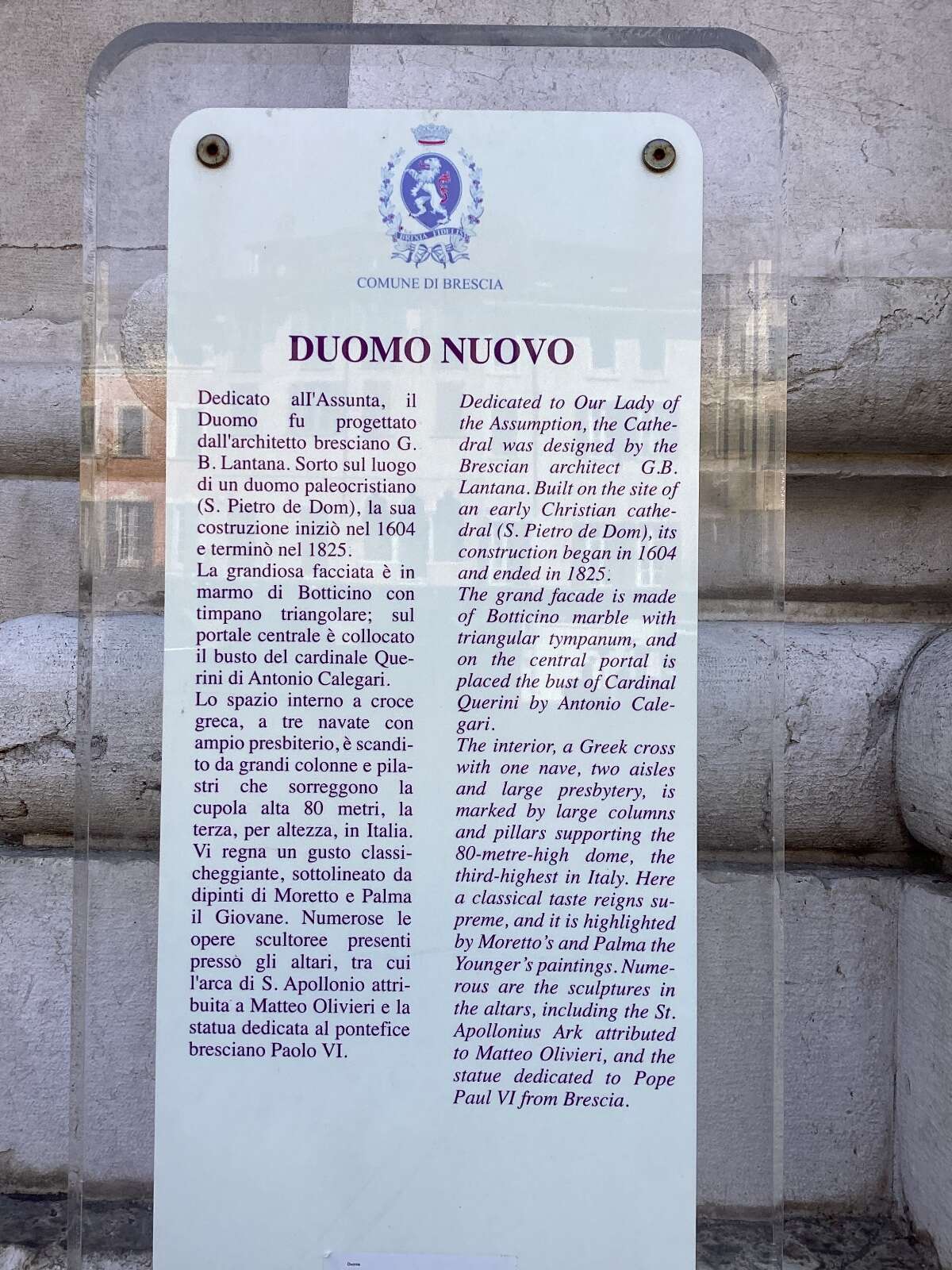
Construction at the The Duomo Nuovo (New Cathedral), the largest Catholic church in Brescia, Italy began in 1604, got interrupted during a season of plague around 1630 and was eventually completed in 1825.
This is the Duomo Nuovo (Cathedral) with the tower bell by the side, You can see Pizza shops and cafes around it. Photo by Valentine AlliA plaque on the wall of Duomo NuovoPhoto by Valentine AlliThis is a walk way between Piazza Duomo(Cathedral) and Piazza Della Vittoria. Brescia’s Piazza della Vittoria is one of the most significant examples of architecture from the fascist period and the post-WWII period. Built between 1927 and 1932 by architect and town planner Marcello Piacentini.Photo by Valentine AlliPiazza della VittoriaPhoto by Valentine AlliMarket day on a Saturday at Piazza Della Loggia Photo by Valentine AlliLocal musicians entertaining at the marketPhoto by Valentine AlliLocal musicians entertaining at the marketPhoto by Valentine AlliMarket day on a Saturday at Piazza Della LoggiaPhoto by Valentine AlliMarket day on a Saturday at Piazza Della LoggiaPhoto by Valentine Alli
The lively atmosphere of picturesque Brescia is enhanced by its bustling piazzas, lively markets, and cozy cafes where locals gather to socialize and enjoy a cappuccino leisurely.
Also the cost of groceries at local markets is extremely budget-friendly. There you will meet farmers and artisans and even buy directly from them.
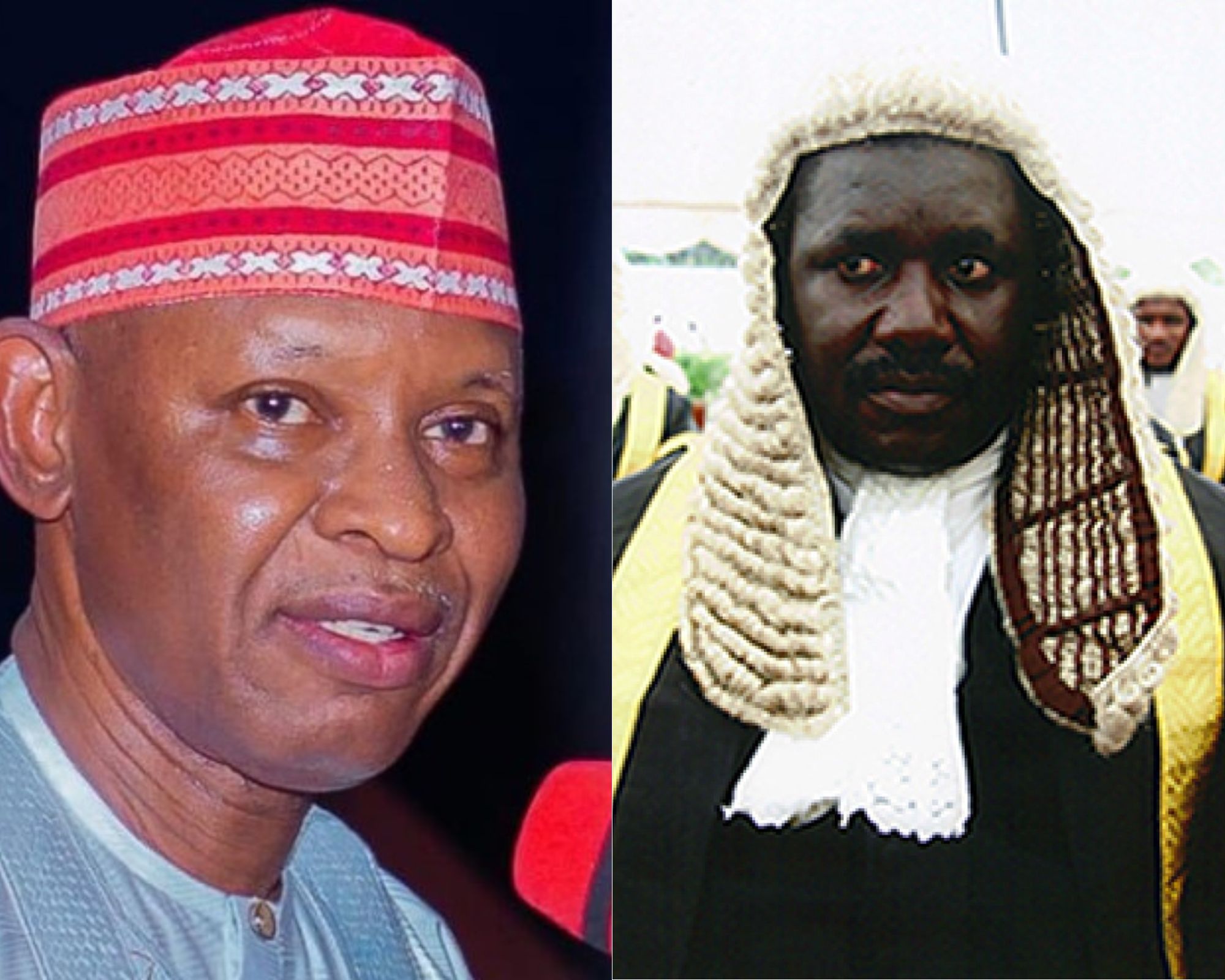
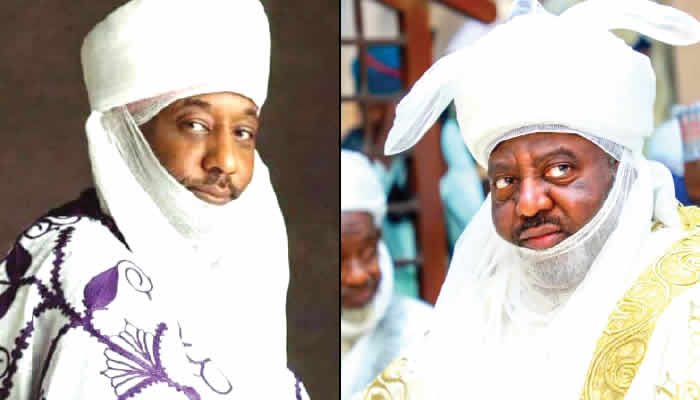
The governor of Kano State Abba Kabir Yusuf, on Friday alleged that Justice Mohammed Liman of a Federal High Court Kano made the order stopping the reinstatement of Sanusi Lamido as the 16th Emir of Kano from the United States.
Governor Yusuf has said he will report the judge to the Nigeria Governors’ Forum.
Justice Liman had granted the order in an application filed by the Sarkin Dawaki Babba of the Kano Emirate, Aminu Babba Dan Agundi, to stop the Kano State Government from enforcing the Kano State Emirate Council Repeal Law which dethroned all five Emirs in the state.
However, Yusuf, while reacting to the court order after issuing the reinstatement letter to Lamido at Africa House, Kano State Government House, said, “The person that issued the court order was in America but he is ordering us to stop what we are doing. This issue of abuse I must present it before the Governor’s Forum so that we can tackle it accordingly.
“We are agents of following due process, that’s why we did what we did openly before everybody. Those that are meant to maintain that rule of law remains must follow that also.”
Legal practitioners have questioned the jurisdiction the Federal High Court has over Kano State Emirate tussle and/or Kano State legislative matter.
A lawyer who elected to speak under anonymity sent a message to Law & Society saying: “This is nonsense. It’s an act of judicial recklessness and impunity. The authorities are clear. Merely including Inspector General of Police, Nigerian Security and Civil Defence Corps, and DSS as parties in the suit does not vest jurisdiction of such matters on the Federal High Court.”
Law teacher Sylvester Udemezue in an article published by Law & Society said: “Chieftaincy disputes are clearly outside of it, every lawyer ought reasonably to know. Filing the suit at the Federal High Court is a form of disloyalty to the extant law, which is forbidden by RULE 15(3)(a), which provides that “a lawyer must not give service to the client which the lawyer knows or ought reasonably to know is capable of causing disloyalty to the law or bringing disrespect to the holder of any public office”. Also, by virtue of RULE 15(1)(a)&(b), a lawyer ought to keep strictly within the law notwithstanding any contrary instructions by his client and must use his best endeavours to prevent his client from causing a breach of the law”. Finally, RULE 15(3)(b)&(c), RPC provides that ‘a lawyer shall not file a suit or knowingly advance a Claim that is unwarranted under existing law’…”
Henry Okonkwo an 8-year-old pupil of the Landmark International School, Mgbakwu in Awka North Local Government Area of Anambra State, who was reportedly beaten to coma by a teacher has passed on.
The little boy reportedly died in the early hours of Wednesday.
A report by The PUNCH had said that a 30-year-old teacher at the school, Faith Nwonye, was arrested for allegedly beating the eight-year-old pupil into coma, on Monday.
Nwoye had earlier been invited by the Commissioner for Education, Prof. Ngozi Chuma-Udeh, to explain what led to the brutalisation of the child on Monday, May 20, 2024.
Chuma-Udeh had expressed sadness over the development, lamenting that the chances of the victim’s survival currently in admission to a hospital are 20 per cent, according to the medical doctor.
She said the school was running illegally describing the development as a crime running an illegal school in the state as well as beating a child, the commissioner warned that perpetrators were doing so at their peril.
The teacher was invited alongside the school’s Proprietor in which the incident happened, Mrs Promise Ilo.
The development led to the temporary shutting down of the school while an investigation was said to have begun.
The teacher who admitted flogging the child, however, stated that the flogging was not as severe as the picture was painted.
The matter was handed over to the police for investigation, while the child was in the intensive care unit of the hospital, from where he later gave up the ghost in the early hours of Wednesday.
Taking to her verified Facebook wall on Thursday, the commissioner lamented the death of the boy, saying he was a boy like any other, with hopes and aspirations.
She wrote, “He was a boy like any other, with hopes and aspirations. He went to school for a better future but met a gruesome death at the hands of the people who were supposed to help him achieve his life ambition.
“A quack teacher in an illegal school bludgeoned him to death. We mourn a life nipped in the bud! We mourn Henry Chukwuemeka Okonkwo! We mourn and we seek justice.”
The Enugu State Police Command has clarified the arrest of the Publisher and Editor-in-Chief of the Globalupfront Newspaper (Online), Madu Onuorah at his Abuja home dismissing claims of abduction.
According to DSP Daniel Ndukwe, Public Relations Officer of the Enugu State Command, Onuorah was apprehended in Abuja with the assistance from the Ebonyi State Command after he failed to respond to formal invitations.
Although Mr. Onuorah has been released on bail by police authorities, ActionAid Nigeria condemned his arrest and detention asserting: “It is deeply troubling that the police, who are entrusted with the duty to protect and uphold the law, are increasingly becoming instruments of intimidation and oppression against the media. This pattern of harassing, arresting, and detaining journalists must stop immediately.”
Continuing, Andrew Mamedu, Country Director of ActionAid Nigeria, stated on Thursday: “The Inspector General of Police must be aware that the actions of the policemen are now unbecoming and unacceptable. The sight of ten fully armed policemen storming Mr. Madu Onuorah’s home, arresting him in front of his distraught family, and then denying him access to communication and legal representation is both alarming and unacceptable. Such behaviour is reminiscent of authoritarian regimes and has no place in a democratic society.
“The ongoing crackdown on the press is an affront to democratic principles and undermines the media’s critical role in holding power accountable.”
According to the Enugu State Command Spokesman, the arrest was prompted by a petition to the Commissioner of Police, Enugu State Command, alleging that Onuorah had published a defamatory content about a US-based Reverend Sister.
Commissioner of Police Kanayo Uzuegbu has reportedly ordered a comprehensive and professional investigation to ensure justice was served.
The Enugu State Police Command has also called for patience from the Nigerian Union of Journalists (NUJ) and Onuorah’s associates, assuring them that the matter would be handled appropriately.
After demolitions that affected beachfront of private businesses, including the $200 million Landmark Beach Resort, a popular tourist destination, the government is now considering alternative routes to ensure the continuation of the Lagos-Calabar Coastal Highway.
At the conclusion of the 3rd Stakeholders Meeting in Lagos, the Federal Government of Nigeria announced its decision to discontinue with the proposed Lagos-Calabar Coastal Highway realignment.
The Minister of Works, Dave Umahi, who confirmed that the proposed diversion would no longer occur due to the submarine cables along the coastline also announced that the Environmental Impact Assessment (EIA) would not be available for now, citing Section 15 (b) of the Freedom of Information Act to support the government’s decision to withhold certain information from the press and public.
The Section Umahi cited is the exception of third-party information, which allows government institutions to deny journalists or the public access to information.
Umahi also announced that the Environmental Impact Assessment (EIA) would not be available for now, citing Section 15 (b) of the Freedom of Information Act (FOI) to support the government’s decision to withhold certain information from the press and public.
The Section Umahi cited is the exception of third-party information, which allows government institutions to deny journalists or the public access to information.
Section 15 (b) FOI Act prescribes that: “Where the public institution considers that the application should be denied, the institution shall give written notice to the applicant that access to all or part of the information will not be granted, stating reasons for the denial, and the section of this Act under which the denial is made.”
Meanwhile, the announcement comes after the telecommunication companies warned the government of the possibility of network outage in the country if the diversion is not reconsidered.
The government has since decided not to proceed with the diversion, which would affect connectivity to the internet in the country and lead to the demolition of ancestral homes in the Okun-Ajah community.
In a video posted by journalist Laila Johnson-Salami, members of the Okun-Ajah community were seen praising the Tinubu-led administration for its decision not to use the route.
The Lagos state government had earlier claimed that Landmark Beach Resort obstructs the proposed path of a 700-kilometer coastal road connecting the state with Calabar.
The property owner, Paul Onwuanibe, 58, told CNN that he received a notice in late March to leave his multimillion-dollar beach resort because it was going to be demolished in seven days.
According to Onwuanibe, the Landmark property, which is valued at more than $200 million, is home to over 80 businesses and directly supports over 4,000 jobs. The corporation also states that it pays more over N2 billion in taxes annually.
Considered one of Nigeria’s premier tourist destinations, the beach resort welcomed over a million domestic and international guests in the previous year.
Onwuanibe clarified that he bought the land in 2007, long before the plans for the coastal highway were developed, and that he was left feeling conflicted when the demolition notice was received, which is also why he filed for compensation.
Kabiru Musa, a businessman who was brought before an Upper Shari’a Court, Tudun Wada, Kaduna state by his wife , Murja Abdullahi has denied making three divorce pronouncements on her.
Musa denied the divorce, saying he was not in his right mind after two of the couple ‘s neighbours testified that they heard him make the pronouncement.
One of the witnesses, Hauwa Umar, a housewife said that the couple was arguing in the compound when the husband made the three divorce pronouncements.
Earlier, the complainant had brought the matter to court for divorce confirmation.
The Judge, Malam Iliyasu Umar adjourned the matter until May 26 for ruling.
A breaking news carried by The Nation Newspapers on 23 May 2024 under the head, “KANO GOVERNOR REINSTATES SANUSI AS EMIR” had it that “Kano State Governor, Abba Yusuf, on Thursday, May 23, reinstated former governor of the Central Bank of Nigeria (CBN), Lamido Sanusi as the 14th Emir of Kano. Sanusi was dethroned by the Abdullahi Ganduje-led administration that created an additional four emirates. Yusuf on Thursday dethroned Alh. Aminu Ado Bayero and four other first-class emirs in the state. He gave the sacked monarchs 48 hours to hand over to the deputy governor and vacate the palaces. Governor Yusuf announced this after signing the proposed Kano State Emirate Council Law 2024 passed by the Kano State House of Assembly into law”.
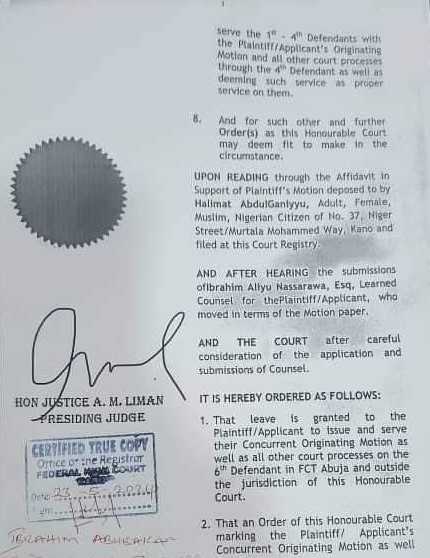
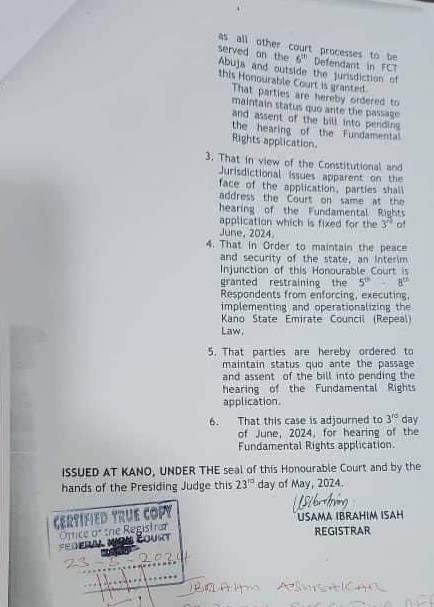
The same report had appeared in several other newspapers, including Punch, TheSun, Guardian, Vanguard, Daily Trust,, Leadership, etc on the same 23 May 2024. However, at about 01.52am on 24 May 2024, another breaking news published by dockaysworld.com.ng under the head, “COURT STOPS KANO GOVERNMENT FROM REINSTATING SANUSI” emerged with the following report: ‘A Federal High Court sitting in Abuja has granted an ex-parte order stopping the Kano State Government from reinstating Emir Muhammadu Sanusi II. According to DAILY NIGERIAN, Justice Liman gave the order on Thursday night despite the fact that he is reportedly in the US. The case was filed by a traditional title holder, the Sarkin Dawaki Babba, Aminu Babba-Dan’Agundi.
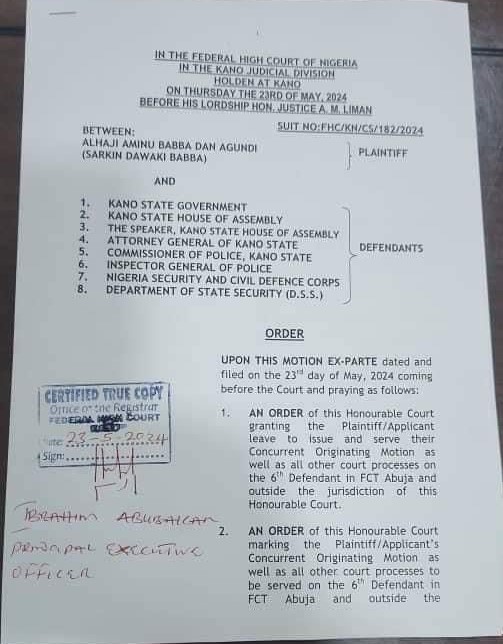
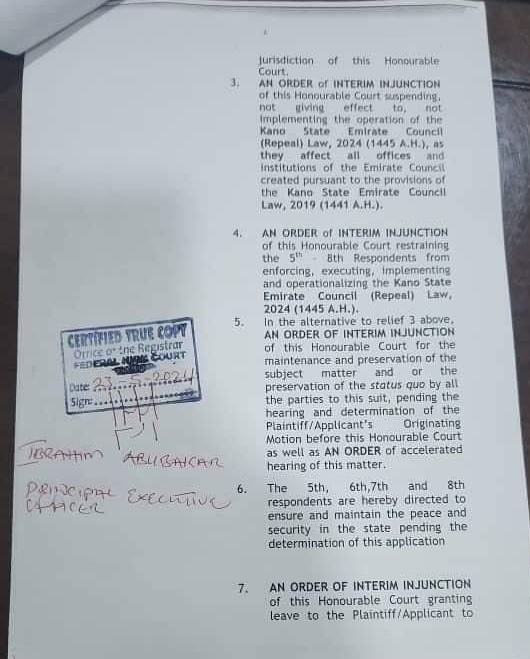
Granting the order, the judge granted leave to the Plaintiff/Applicant to issue and serve their Concurrent Originating Motion as well as all other court processes on the 6th Defendant (IGP) in FCT Abuja and outside the jurisdiction of the Honourable Court. “That parties are hereby ordered to maintain status quo ante the passage the and assent of the bill into pending hearing of the Fundamental Rights application. “That In view of the Constitutional and Jurisdictional Issues apparent on the face of the application, parties shall address the Court on same at the hearing of the Fundamental Rights application which is fixed for the 3rd of June, 2024. “That in order to maintain the peace and security of the state, an Interim Injunction of this Honourable Court is granted restraining the Respondents from enforcing, executing, implementing and operationalizing the Kano State Emirate Law Council (Repeal) Law.
“That parties are hereby ordered to maintain status quo ante the passage and assent of the bill into pending the hearing of the Fundamental Rights application. The judge therefore adjourned the case is adjourned to 3rd day of June, 2024 for hearing of the Fundamental Rights application.’ The Suit No of the case is: FHC/KN/CS/182/2024 (ALHAJI AMINU BABBA DAN AGUNDI V. KANO STATE GOVERNMENT & 7 ORS).
QUESTIONS ARISING AND MY HUMBLE OBSERVATIONS
(1). Is this lawsuit not an abuse of the process of Court, considering that the subject matter is a chieftaincy dispute over which the Federal High Court does not, under any circumstances, have jurisdiction?
(2) . If issue one is answered in the affirmative, does it not amount to professional misconduct for lawyers to have filed this case in the Federal High Court, considering the subject matter and the cause of action as reported?
(3). Is the presiding judge judge not equally guilty of unprofessionalism in having granted this application after having raised issues of jurisdiction, without resolving the jurisdictional issues raised?
(4). Was/Is this matter properly brought under the Fundamental Rights (Enforcement Procedure) Rules, 2009?
(5). If the report that the order from the Federal High Court was granted in the night of 23 May 2024 is anything to go by, then the question arises as to whether an injunction can stop/restrain a completed act, considering that as of the time the Federal High Court made the said interim restraining order, Governor Yusuf had already signed the Bill into law as a well as reinstated Emir Sanusi Lamido? Is the restraining order not a sort of medicine after death?
MY OBSERVATIONS ON THE ISSUES
(1). ISSUE ONE: On whether this lawsuit is not an abuse of the process of Court, considering that the subject matter is a chieftaincy dispute over which the Federal High Court does not, under any circumstances, have jurisdiction, it is respectfully submitted that the suit is most likely an abuse of the process of Court by the Plaintiff. In my humble opinion, the Federal High Court does not seem to have jurisdiction in the matter; there is hardly any way one would frame the relief to succeed in bringing the suit within the jurisdictional competence of the Federal High Court of Nigeria. It’s a chieftaincy dispute, pure and simple, over which the Federal High Court is incompetent to adjudicate.
(2). ISSUE TWO: On whether it does not amount to professional misconduct for the Plaintiff’s lawyers to have filed this case in the Federal High Court, considering the subject matter and the cause of action as reported, I respectfully submit that the lawyers who filed the case may be considered to have committed an act of professional misconduct in view of the provisions of Rule 15 of the Rules of Professional Conduct (RPC), 2023. What’s the business of the Federal High Court in a chieftaincy dispute in Kano State? The lawyers knew/know or ought to know that under the Constitution the jurisdiction of the Federal High Court is both EXCLUSIVE (meaning that it doesn’t share its jurisdiction with any other Court) and LIMITED, meaning that the Federal High Court is competent to hear ONLY disputes arising from or connected to the matters/items expressly listed in SECTION 251(1) OF THE CONSTITUTION OF THE FEDERAL REPUBLIC OF NIGERIA, 1999.
Chieftaincy disputes are clearly outside of it, every lawyer ought reasonably to know. Filing the suit at the Federal High Court is a form of disloyalty to the extant law, which is forbidden by RULE 15(3)(a), which provides that “a lawyer must not give service to the client which the lawyer knows or ought reasonably to know is capable of causing disloyalty to the law or bringing disrespect to the holder of any public office”. Also, by virtue of RULE 15(1)(a)&(b), a lawyer ought to keep strictly within the law notwithstanding any contrary instructions by his client and must use his best endeavours to prevent his client from causing a breach of the law”. Finally, RULE 15(3)(b)&(c), RPC provides that “a lawyer shall not file a suit or knowingly advance a Claim that is unwarranted under existing law”.
In my opinion, the lawyers who filed the case at the FHC could be caught under the web of Rule 15 (1),(2)&(3) of the RPC, and as such may be qualified as candidates for professional legal disciplinary processes pursuant to Rule 74(1) RPC, 2023 which provides: “A lawyer who acts in contravention of the provisions of Chapter 1 of these Rules or fails to perform any of the duties imposed by that Chapter, commits professional misconduct and is liable to punishment as provided in the Legal Practitioners Act”. Types of professional misconduct in the legal profession and punishment for professional misconduct are provided for under SECTIONS 12 AND 13 OF THE LEGAL PRACTITIONERS ACT, CAP L11, LDN, 2004
(3). ISSUE THREE: On whether the presiding judge was not equally guilty of unprofessionalism in having granted this application after having raised issues of jurisdiction, and without resolving the jurisdictional issues raised, I respectful submit that the action of the presiding judge who reportedly made this order (that is, if the order was really made), may be viewed as a display of unprofessionalism and may also be seen to amount to a breach of the Code of Conduct for Judicial Officers. Rule 1(1.2) &(1.3) of the REVISED CODE OF CONDUCT FOR JUDICIAL OFFICERS OF THE FEDERAL REPUBLIC OF NIGERIA provides that “1.2.
A Judge shall avoid impropriety and the appearance of impropriety in all of the Judge’s activities both in his professional and private life. 1.3 A Judicial Officer should respect and comply with the laws of the land and should conduct himself at all times in a manner that promotes public confidence in the integrity and impartiality of the Judiciary”. Paragraphs 1 and 2 of the Code dealing with APPLICATION OF THE CODE provides that “The Code applies to all categories of Judicial Officers throughout the Federation as defined in this Code. 2. Violation of any of the Rules contained in this Code shall constitute judicial misconduct and or, misbehavior and shall attract disciplinary action”
The judge in present case is quoted to have started by observing during the proceedings, that “…In view of the Constitutional and Jurisdictional Issues apparent on the face of the application, parties shall address the Court on same at the hearing of the Fundamental ights application which is fixed for the 3rd of June, 2024.” After this, the judge still, reportedly, went ahead to grant the injunctive orders sought by the Plaintiff/Applicant. It is my humble view that since the judge had found/agreed that the application raised Constitutional and especially JURISDICTIONAL issues (Thank God the judge had SUO MOTU raised the issue of jurisdiction, which is commendable), the judge ought to have waited to resolve the JURISDICTIONAL ISSUES before proceeding to grant such ex parte orders or any other at all in the lawsuit? With which jurisdiction did the judge grant the orders reportedly sought? Can a Court make any order when it has no jurisdiction? The law is (I respectfully submit) that where issues of jurisdiction are raised, the Court shall FIRST OF ALL settle them before going into the matter proper. See OMOKHAFE V. MILITARY ADMINISTRATOR, EDO STATE (2005) 2 MJSC, 173 at 176.
Thus my lord, the Hon Justice Liman should have proceeded to resolve the jurisdictional issues before assuming jurisdiction on the matter. With due respect to the judge, granting an order of interim injunction when your jurisdiction is in issue is tantamount to assuming jurisdiction in the case, I respectfully submit. A court of law can sit over and entertain a case before it but only when it has jurisdiction over the matter. See BRONIK MOTORS V. WEMA BANK (1983) 6 SC, 158. Jurisdiction is fundamental in any proceeding and lack of it is fatal to such proceedings . See OTUKPO V. JOHN (2000) 8 NWLR (pt 669) 507 at 524. In SANUSI V. AYOOLA (1992) 9 NWLR (pt 265) 275, Ogwuegbu, JSC, held that where there is any defect in competence of a court to adjudicate on a matter, such defect is fatal and the proceedings a nullity, however well conducted and decided they may be. It is immaterial however sympathetic the cause or application may seem.
At this juncture, let’s draw an analogy from how Hon Justice Inyang Ekwo of the Federal High Court had handled a lawsuit wherein an applicant sought an interim restraining order in circumstances similar to the present scenario. Madam Aisha Binani (Governorship candidate of the APC in 2023 in Adamawa State) and the APC had in a Motion Ex Parte marked FHC/ABJ/CS/510/2023, sued the Independent National Electoral Commission, the Peoples Democratic Party and its candidate, Governor Fintiri, as 1st, 2nd and 3rd respondents respectively. However, when the Motion Ex Parte came up before the Federal High Court in Abuja, on 08 April 2023, the presiding Judge, Hon Justice Inyang Ekwo, refused to hear the ex-parte motion citing issues of jurisdiction. About what had transpired in the Court in that case, the Punch Newspapers reported:
‘Federal High Court, Abuja, on Tuesday, refused to hear an ex-parte motion filed by the All Progressives Congress candidate in the Adamawa governorship election, Senator Aisha Ahmed, popularly called Binani. Justice Inyang Ekwo, instead, ordered the APC candidate’s counsel, Mohammed Sheriff, to address the court on the issue of jurisdiction…. The judge said though he was ready to hear Sheriff, the lawyer must address the court on issue of jurisdiction before he proceeded. “I am ready too but you have to address me on jurisdiction,” he said. Justice Ekwo, who ordered Sheriff to address him on whether the court had the jurisdiction to hear the matter, held that the application would be taken together with the issue of jurisdiction on the next adjourned date. He, consequently, adjourned the matter until April 26 for hearing of the motion and an address on jurisdiction’. (See: “ADAMAWA POLL: COURT REFUSES TO HEAR BINANI’S MOTION OVER JURISDICTION”; Punch.com, 18 April 2023). I submit that this is the proper procedure, and Hon Justice Liman should have, in the present case, adopted a similar approach.
(4). ISSUE FOUR: On whether this matter was/is properly brought under the Fundamental Rights (Enforcement Procedure) Rules, 2009, I hold the respectful view that it is obvious that this was a dispute over the chieftaincy stool of the Emir of Kano. In my opinion, couching the relief to try to create an impression of Fundamental Rights enforcement where none exists, is an unnecessary gimmick to deceive. The Federal High still does not have jurisdiction because the application is not an application for fundamental right enforcement properly so-called. Else, either of the Federal High Court or the State High could have had jurisdiction, because in all cases of fundamental rights enforcement outside those arising from or bothering on employer-employee, labour and trade unions relations, both the Federal High Court and the State High Court have concurrent jurisdiction if the suit is filed under the FREP RULES, 2009. See GRACE JACK v UNIVERSITY OF AGRICULTURE MAKURDI (SC.262/2000) [2004] NGSC 10 (30 January 2004); FUTMINA V OLUTAYO(2017) LPELR-43827(SC), (2017); & EFCC V WOLFANG REINL (2020) LPELR-49387(SC) (2020).
Merely bringing an application under FREP (Fundamental Rights Enforcement Procedure Rules, 2009) does not automatically, place it under the FREP Rules. A consideration of the subject matter of the dispute and the cause of action, is necessary in determining whether or not it is a FREP application properly so-called. See: TUKUR V. GOVT OF GONGOLA STATE (1989) 4 NWLR (pt 117) 517; EGBUONU V. BRTC (1997) 12 NWLR (pt 531) 29. In MADUKOLU VS NKEMDILIM (1962) 1 All NLR 589, the Supreme Court held that for a Court to have or assume jurisdiction in any particular case, the Court must ensure that the subject matter of the case is within the Court’s jurisdiction and there must not be any feature in the case which prevents the court from exercising jurisdiction. Further, it must be noted that by virtue of PARAGRAPH 3(A)&(B) OF THE PREAMBLE TO THE FREP RULES, 2009, only the following rights are capable of enforcement under the FREP Rules, 2009: (A). Rights guaranteed under chapter 4 of 1999 constitution; (B). Rights guaranteed under the African Charter on Human & Peoples Rights (ratification & Enforcement) Act, LFN, 2004; and (C). Rights guaranteed under any United Nations Charter on Human rights.
Accordingly, where the right the APPLICANT seeks to enforce falls outside rights contained in Chapter 4 of 1999 Constitution, or in the African Charter on Human & Peoples Rights (ratification & Enforcement) Act, LFN, 2004, or in the Universal Declaration of Human Rights, or in any other United Nations Charter on Human rights, the law is that Court doesn’t have and would not exercise jurisdiction; the matter must be struck out for being incompetent. See ORDER IX, RULE 1(II) OF THE FREP RULES, 2009. See also SECTION 46(1), CONSTITUTION OF THE FEDERAL REPUBLIC OF NIGERIA, 1999. See THE DIRECTOR GENERAL, STATE SECURITY SERVICE V. DIM CHUKWUEMEKA ODUMEGWU OJUKWU & 2 ORS (2006) JELR 54114 (CA). However, under such circumstances, if the Federal High Court ultimately determines/finds that it does not have jurisdiction but that it is the High Court, in this case, the High Court of Kano State (or another court) that has jurisdiction, the Federal High Court has power, instead of striking out the matter, to transfer the same to the relevant/appropriate Court that has jurisdiction. See SECTION 22(2) OF THE FEDERAL HIGH COURT ACT (NIGERIA), which provides that “No cause or matter shall be struck out by the Court merely on the ground that such cause or matter was taken in the Court instead of the High Court of a State or of the Federal Capital Territory, Abuja in which it ought to have been brought, and the Judge of the Court before whom such cause or matter is brought may cause such cause or matter to be transferred to the appropriate High Court of a State or of the Federal Capital Territory, Abuja in accordance with Rules of Court to be made under section 44 of this Act”
(5). ISSUE FOUR: Meanwhile, assuming (but not conceding) that the present matter could by any stretch of the imagination be brought under the FREP Rules, then I still submit that the Federal High Court does/would not have jurisdiction at all. This is because the deposed Emir of Kano was appointed by the Kano State Governor therefore could be said to be an employee of the Governor of Kano State. The law is that where allegations of breach of fundamental rights arise or are raised from or in relation to employment or labour/industrial, master-servant relations, or trade unionism, the National Industrial Court has EXCLUSIVE JURISDICTION. See SECTION 254C (1)(D), OF THE CONSTITUION OF THE FEDERAL REPUBLIC OF NIGERIA,1999.
(6). ISSUE FIVE: On whether an injunction can stop/restrain a completed act, considering that as of the time the Federal High Court made the said interim restraining order, Governor Yusuf had already reportedly signed the Bill into law as a well as reinstated Emir Sanusi Lamido. My opinion is this, that if the reinstatement of Emir Lamido Sanusi had already been carried out before the interim order by Hon Justice Liman of the Federal High Court was (later) made, one wonders which action the said order was/is now targeting to stop/restrain. In an unreported Appeal No: FCA/M6/82 (DAVID DADA & ANOR FOR THEMSELVES AND OTHER MEMBERS OF MALAOYE (ADEITAN) AND OLUGBOGBO RULING HOUSES OF ADA V. CHAIRMAN OF IFEKODUN LOCAL GOVERNMENT CHIEFTAINCY COMMITTEE & ORS), the Court of Appeal had held that “When a Court is asked to restrain a party from doing an act pending the decision in a matter before it, but the act has been done, no order to restrain will be made. The reason is simple as it is clear. What is sought to be prevented has in fact happened”.
Also, in the case of JOHN HOLT NIGERIA AND CAMEROONS v. HOLT AFRICAN WORKERS UNION OF NIGERIA AND CAMEROONS (1963) 1 ALL NLR 385 @390, the Supreme Court held that an interlocutory injunction is not a remedy for an act which has already been carried out. See also AJEWOLE V ADETIMO (1989) 3PLR/1966/19(SC) (APPEAL NO: SC/3289). Accordingly, it appears to be well settled that an interim or interlocutory injunction cannot be granted where there is nothing to restrain. Thus, it’s submitted that generally, no pre-trial injunction, be it ex-parte, interim or interlocutory, can be issued to restrain any completed act. I respectfully disagree with the reasons given by my Lord, Hon Justice Liman for breaking/flouting this principle of law by granting an injunction to restrain a reinstatement that had already happened or that had already been fully carried out by the Governor of Kano State.
Since the act of the reinstatement had been carried out, from that point onwards, talks about restraining injunctions were foreclosed. What any aggrieved person or persons should be talking about was/is to file an action seeking to set aside or to nullify the act (of reinstatement) already done — well, that is, if such aggrieved person or persons have good legal grounds to believe the act (of reinstatement) being complained against, was not validly or was not properly carried out. With due respect, the Judge in this case (Hon Justice Liman) should not have granted any restraining orders. The proper thing the respected judge should have done was to order the Court processes to be served on the respondents (the respondents to be put on notice) while directing the plaintiff (as was done in the Aisha Binani scenario) to address the Court on the jurisdictional issues already raised.
(To be continued)
Respectfully, Sylvester Udemezue (udems) Proctor, Reality Ministry of Justice (RMJ), 08039136749. [email protected]. (24 May 2024)
Our site uses cookies. By clicking “Accept All Cookies”, you direct Law and Society Magazine to store cookies on your device and disclose information in accordance with our Cookie Statement: cookie policyACCEPTREJECT
Privacy & Cookies Policy
Privacy Overview
This website uses cookies to improve your experience while you navigate through the website. Out of these cookies, the cookies that are categorized as necessary are stored on your browser as they are essential for the working of basic functionalities of the website. We also use third-party cookies that help us analyze and understand how you use this website. These cookies will be stored in your browser only with your consent. You also have the option to opt-out of these cookies. But opting out of some of these cookies may have an effect on your browsing experience.
Necessary cookies are absolutely essential for the website to function properly. This category only includes cookies that ensures basic functionalities and security features of the website. These cookies do not store any personal information.
Any cookies that may not be particularly necessary for the website to function and is used specifically to collect user personal data via analytics, ads, other embedded contents are termed as non-necessary cookies. It is mandatory to procure user consent prior to running these cookies on your website.