A 54-year-old man who held his wife and seven children captive for 20 years has been arrested after one of them managed to escape.
The incident happened in Novo Oriente, Brazil.
The unnamed suspect suspected reportedly raped them before forcing them to have abortions
The seven children are aged between 3 and 22 and investigators say the suspect’s mother-in-law was also sexually abused.
He also drilled holes in the walls of the house so that he could see his daughters getting dressed.
It was only when one of them gave him a sleeping pill so she could escape and report him to the police that he was exposed.
Authorities carried out a month-long investigation before they carried out a raid at the home.
Three foetuses were found buried in the garden and the man’s wife, 40, said she had been held captive since she was 17.
One of the foetuses found buried was eight months old and the wife was reportedly forced to have three abortions by her husband.
Another daughter was forced to endure an unsuccessful abortion of a six-month-old foetus but the baby survived and was rescued by a midwife.
The girl was in poor health at the time but her dad did not let her receive any medical help.
The mum and children have now been moved to another state in Brazil for their protection and the man is being held in preventative custody.
He has been charged with false imprisonment, rape of a vulnerable person, psychological violence, abortion and concealment of a corpse.
Police spokesperson Herika Ribeiro Sena said: “The victim only left home to receive benefits and, many times, was accompanied by him. None of the neighbours knew her, not even relatives had access to her.”
Now there is something every Government since Obasanjo has faced which is the growing cost of governance
The cost of running our democracy is one of the highest in the world gulping trillions of Naira
To service the three arms of Government, the many agencies under the Executives, the state Government and even up to the legislature requires humungous amounts that is serviced mainly by the Oil industry and IGR.
Every Government prior have found a way of servicing this monster.
Some have tried service reforms, others have tried blockages of leakages, yet others have printed money and still others had used the ways and means as its piggy bank. Most have despite these tried to shield the masses thru subsidies abd varying buffers.
This present government has taken the lazy approach – price increase.
From what we have seen so far, they have just allowed an increase in everything to mostly cover their running costs
From my point of view, every Government service have been increased from drivers license, to dues at the ports, to issuing International passports, its as if they see it as the only solution to everything
Withdraw subsidy, free up funds, ramping up price of fuel all in a bid to raise enough money to cover a growing monster which is Government expenditure.
We see spendings on travel and other logistics not easing up despite the announced restrictions in official travels.
We see huge donations by Government and people close to them, we see a Government expenditure in full flight like we are in an era of bouyance
Sacrifices being made by the people to cut their own running costs is not being replicated in governance.
All tiers of governance and its agencies are running expenditures that are off the hook being funded by the growing increases in their services and the almost total withdrawal of subsidies from almost every aspect of governance.
This has drastically reduced purchasing power which has impacted goods and services sold, hitting bottom lines and driving unemployment.
Obviously inflation will go up, damamging replacement cost and excarcebating an already horrendous cost of living and impoverishing the people.
This is driving crime, despondency deepening human misery ratio
Yet, the Government keeps pushing. It keeps increasing. cost of power which is already beyond affordability and yet we hear of an impending increase.
Fuel keeps going up with arguments that we are still buying cheaper fuel than the rest of the world or more recently, that it has nothing to do with them since its tied to international trade.
For the first time, the economic situation has hit the informal sector. The unbanked who formed the bulwark for economic stability.
The unbanked and cash driven retail economy ensured some form of stability cos they were not linked to the system and as such the import driven inflation did not really impact them making them serve as a buffer to the economy.
But as economic headwinds continue and with the aggressive financial inclusion of the last Government they have started being vulnerable to the vagaries of the economy and the errant policies of Government.
Much more importantly , is the fact that they are also being impacted by the effects of the fleeing middle class who have downshifted their economic needs to that of the informal sector thereby putting pressure on prices with an increased demand in those places.
Check out the prices of bread and pure water – informal sector stables. Check out house rents in suburbs, check out land prices in deep rural areas and you will see.
Government has to first remove personal interests in Government policy formulation to begin to tackle the economy
Then like we have all been shouting, it must as a matter if urgency block leakages, fight corruption, reduce cost of governance and free up funds that would now be deployed to buffering strategic areas in the economy.
It has to bring back some form of partial subsidy to hold down cost of power, fuel and things like fertiliser.
It cannot be taking away these subsidies only to be wasting the funds away on large Government spendings with little or no impact on the people
What we are seeing here now is a robbing peter to pay paul type scenario.
The only people who are making any sense of anything now are those in Government and those close to them.
Prices and cost of living can’t keep going one way-up, something has to give and something will give when we hit an economic threshold.
It is absolutely essential that the Rivers State government reclaims this battle, taking their case back to the people’s court, where justice can be genuinely served, starting with the state judges who understand the local context. They should not waste their time on judges like Justice Omotosho, who consistently render rulings outside their jurisdiction, further eroding public trust in the judiciary.
Justice Oyewole and his panel must understand that their actions are under scrutiny; the people are watching, and they will not tolerate a judiciary that prioritizes what many perceive as political manipulation over justice. The integrity of the legal system is at stake, and the people of Rivers State demand accountability and fairness—not the farcical judgments that have become all too common in Abuja.
This writer, a psychologist and not a lawyer, approaches the recent Court of Appeal ruling with an ethical, democratic, and societal perspective, particularly within the framework of Nigeria’s notoriously corrupt judicial system. In a nation where the judiciary is often viewed as compromised, many Nigerians laugh at judicial decisions, especially when high-profile politicians and Senior Advocates of Nigeria (SANs) appear to wield undue influence over the courts. The intersection of political power and legal authority in Nigeria raises grave concerns about judicial integrity, fostering a widespread public perception that court rulings are more susceptible to political manipulation than to the pursuit of truth.
Within this unsettling context, the recent Court of Appeal ruling—affirming Martin Amaewhule as the legitimate Speaker of the Rivers State House of Assembly and nullifying Governor Siminalayi Fubara’s 2024 budget—demands profound scrutiny. Although the decision may appear constitutionally sound, it emerges from a judicial landscape that has long been criticized for politicization. The Nigerian judiciary is perceived by many as functioning not as a neutral institution but as a platform where political elites and legal heavyweights exert influence for personal and party gains.
Democratic Perspectives: Falana and Ajulo’s Critiques:
Femi Falana, SAN, a highly respected human rights lawyer, argues that members of the Rivers State House of Assembly who defected from the People’s Democratic Party (PDP) to the All Progressives Congress (APC) should automatically lose their seats. His position is firmly grounded in the Nigerian Constitution, which explicitly states that lawmakers cannot retain their seats if they switch parties, except in cases of a verified division within their former party. Falana’s use of the term “political prostitution” serves as a stark reminder of the need for integrity in political representation, emphasizing the importance of lawmakers being accountable to the mandate given to them by voters.
Yet, the Court of Appeal’s ruling, particularly under the leadership of Justice Joseph Oyewole, seemingly disregards these fundamental constitutional principles. The three-member panel concluded that Martin Amaewhule and his faction remained legitimate, despite the fact that these lawmakers had publicly declared their defection to the APC—a reality even acknowledged by the national PDP. This glaring contradiction raises serious questions about the logic and foundation of the court’s ruling, especially in light of the clear constitutional guidelines regarding defections and the forfeiture of legislative seats.
In this context, Dr. Kayode Ajulo’s legal action resonates deeply with Falana’s perspective. It centers on the recent controversy surrounding Governor SiminalayiFubara’s 2024 budget. Ajulo argues that the defecting lawmakers, who have ignored the constitutional stipulations regarding their party switch, should not have any say in the legislative process. His lawsuit seeks to prevent Governor Fubara from re-presenting the 2024 budget to the House of Assembly until the matter is resolved. By doing so, Ajulo highlights the critical intersection between legal integrity and state governance, emphasizing that the budget’s presentation and the confirmation of appointed commissioners should be halted pending the hearing and determination of the ongoing suit.
This legal challenge underscores the urgency of upholding constitutional principles vital for maintaining democratic governance in Rivers State and Nigeria at large. By questioning the right of the defectors to participate in legislative processes, Ajulo not only advocates for accountability but also calls into question the legitimacy of a governance structure that allows political maneuvering to undermine the will of the electorate. The panel’s ruling, therefore, not only perpetuates a cycle of impunity but also reveals a troubling disregard for the principles of democracy, leaving the citizens of Rivers State to bear the painful consequences of such political intrigue.
Ethical Oversight in the Appellate Court’s Endorsement of Justice Omotosho’s Controversial Ruling:
Justice James Omotosho of the Federal High Court in Abuja has faced persistent criticism for his politically sensitive rulings. Despite Falana’s and Ajulo’s assertions that these defectors could no longer retain their legislative seats, Justice Omotosho ruled to invalidate Governor Fubara’s N800 billion budget, claiming it was improperly presented to the full House.
The appellate judges’ endorsement of this ruling raises significant concerns about judicial oversight. They seemingly overlooked the fact that the non-defected lawmakers retained their seats and their constitutional right to participate in legislative matters, including the budget. This oversight not only compromises the integrity of the judiciary but also threatens its commitment to democratic principles.
Justice Oyewole’s critique of Governor Fubara is not only misguided; it is an appalling display of judicial ineffectiveness. By referencing a prior Federal High Court order that restrained the governor from engaging with the House, Oyewole condemned Fubara for acting “lawlessly” and treating the court order with “levity and disdain” for presenting the budget to a mere four lawmakers instead of the constitutionally mandated two-thirds. This simplistic view completely disregards the intricate political realities at play, particularly the mass defections that have been extensively reported.
While it is true that the issues of defection were not formally before the panel, it is astonishing that Oyewole and his two colleagues, fully aware of the ongoing legal battles regarding these defections in various courts, would still choose to rule in favor of the Amaewhule-led assembly—an assembly that is legally and politically homeless. To assert that this assembly is legitimate is not only tricky; it is also utterly absurd and reveals a shocking lack of reliable insight and ethical grounding on the part of the panel.
Such an oversight raises concerns about the prioritization of political considerations over justice. This is particularly troubling in light of the Nigerian judiciary’s reputation, which is often questioned due to ethical challenges and perceived lack of integrity. The actions of Oyewole and his colleagues seem to reflect not the pursuit of impartial justice, but a tendency toward decisions that may align with political interests. This situation inevitably leads to public skepticism about whether the legal system truly serves to protect the rights ofAs a psychologist, I must say it’s concerning (and maybe a little baffling) that Justice Oyewole and his two colleagues managed to dodge the glaring issue of defections in Rivers State, despite it not being the main matter before them.
It’s almost as if they were more interested in playing referee in a football match while ignoring the fact that half the players had switched teams! By criticizing Governor Fubara for “lawlessness” while sidestepping the deeper crisis of representation, the ruling raises serious ethical concerns about the judiciary’s role in upholding fairness and democratic values. This oversight not only undermines trust in the legal process but also weakens the judiciary’s responsibility to protect democracy.
As far as the Nigerian constitution is concerned, these defectors are no longer legitimate legislators, so it begs the question—what exactly is there to overlook here?
The political turmoil in Rivers State is quite the spectacle, especially with former Governor Nyesom Wike’s antics. One minute he’s firmly with the PDP, and the next, he’s cozying up to defecting lawmakers who can’t seem to decide if they’re in the PDP or the APC—it’s like they’re playing a game of political hopscotch! Wike is not only battling these defectors but also taking on the recognized legislators under Governor Fubara, another fellow PDP member. Is this man okay, or has he lost the plot in this political drama? It seems to be all about himself! Meanwhile, the National PDP’s rejection of these flip-flopping legislators raises even more eyebrows about the Court of Appeal’s ruling. With recent appeal decisions making waves, many esteemed lawyers are sharpening their pens, taking aim at the courts, and giving them a good public shaming. Talk about deep divisions in the political landscape—Rivers State is shaping up to be quite the political circus!
How could the appeals panel, led by Justice Oyewole, possibly arrive at this conclusion when the very group it backs can’t even decide which party they belong to? One day they’re APC, and the next, they’re PDP again! Most Nigerian legal experts, including the PDP itself, argue that Amaewhule and his group lost any legitimate claim to represent the party the moment they publicly defected. By upholding their claim, the Court of Appeal has effectively ignored the constitutional provision against defections, further adding to the political chaos in Rivers State.
The Precarious Future of Judicial and Political Integrity
From a psychological perspective, the ramifications of such judicial instability are painfully deep. A society that perceives its legal system as biased and politically compromised develops a pervasive sense of disillusionment and apathy toward civic engagement. The erosion of trust in public institutions, coupled with a detachment from the democratic process, further entrenches a cycle of disenfranchisement. When citizens lose faith in the judiciary, they may resort to extrajudicial means to seek justice, leading to increased societal unrest and a deterioration of public order. The psychological toll is heavy, as individuals internalize feelings of helplessness and frustration, feeling abandoned by the very systems designed to protect their rights.
Moreover, the ethical implications extend beyond the courtroom into the broader societal context. The failure of the judiciary to act as an impartial arbiter undermines the rule of law and diminishes the moral authority of the state. In a democracy, the judiciary is expected to serve as a bulwark against political overreach and to protect the rights of citizens. When this role is compromised, the consequences can be dire, resulting in a society marked by inequity, division, and disillusionment. The people’s faith in justice becomes a distant memory, replaced by a pervasive sense of betrayal.
Rivers State finds itself under siege from all angles—systematically pressed on by the entrenched powers that be, including the judiciary, the police, and even the presidency. This complex assault complicates the efforts of Governor Fubara and his administration as they navigate a landscape where the very institutions meant to protect democracy are wielded as instruments of oppression. Yet, amidst this oppressive atmosphere, there is a glimmer of hope: the unwavering spirit of the people and the enduring power of truth.
For Nigeria to progress, it must prioritize the establishment of an independent judiciary that can withstand political pressures. This necessitates a collective societal commitment to uphold the rule of law and to demand accountability from public officials. Only through concerted efforts can Nigeria hope to rebuild the trust necessary for a thriving democracy and a just society. In this context, the struggle for judicial integrity transcends a mere legal battle; it is a crucial step toward fostering a healthier, more equitable political landscape that aligns with the aspirations of its citizens for a better future.
The so-called “Abuja judge mentality,” epitomized by Justice Oyewole and his panel, stands as a grotesque mockery of judicial integrity. Their dismissive ruling not only strips the Rivers State government, led by the resilient Governor Fubara, of its legitimacy but also reveals a disturbing and alarming disregard for the democratic principles they are sworn to uphold. This ruling does not merely affect the politics of the moment; it strikes at the very heart of justice itself. The Rivers State government has endured relentless abuse and attacks from the entrenched powers; yet, it must rise to this challenge with unwavering determination and fierce resolve. In this uphill battle for justicethe indomitable Rivers people stand united against an oppressive tide that seeks to subvert their voices and erase their rights. Their struggle is not just against the ruling but against an entire system that has shown time and again its willingness to sacrifice integrity for political expedience.
While this matter may eventually reach the Supreme Court—a body itself marred by a history of scandals and ethical compromises—it is crucial that the justices do not succumb to fear, technicalities, or the insidious influences of power. They must look to the spirit and letter of the law, recognizing that the implications of their decisions extend far beyond legal technicalities; they touch the lives of ordinary citizens who seek justice in a system often riddled with corruption and betrayal.
The pressure to conform to political expectations can be overwhelming, but it is essential that the highest court reclaims its role as a defender of the Constitution. Should the highest court falter in its duty and surrender to the shadows, the Rivers people will remain the true victors in this struggle. They will not submit to the rule of man nor the dark machinations of the powerful. Their resilience, rooted in the pursuit of genuine justice and democratic integrity, will outlast the transient whims of those who seek to manipulate the system for their gain. In the end, it is the people who will rise, reminding the judiciary that their mandate is to serve justice, not the interests of the powerful.
It is absolutely essential that the Rivers State government reclaims this battle, taking their case back to the people’s court, where justice can be genuinely served, starting with the state judges who understand the local context. They should not waste their time on judges like Justice Omotosho, who consistently render rulings outside their jurisdiction, further eroding public trust in the judiciary. Justice Oyewole and his panel must understand that their actions are under scrutiny; the people are watching, and they will not tolerate a judiciary that prioritizes what many perceive as political manipulation over justice.
The integrity of the legal system is at stake, and the people of Rivers State demand accountability and fairness—not the farcical judgments that have become all too common in Abuja. Here lies the good news: in the battle for truth and justice, it is ultimately the people who will prevail. Their unwavering spirit and determination to hold their leaders accountable is the lifeblood of democracy. The struggle for judicial and political integrity in Rivers State is not merely an ideal; it is a reflection of a collective desire for a just society, a society where the truth reigns and democracy is fortified. Amid the challenges posed by those in power, the hope for a better future remains firmly anchored in the resolve of the people to fight for what is right.
A story of modern migration has had extraordinary results
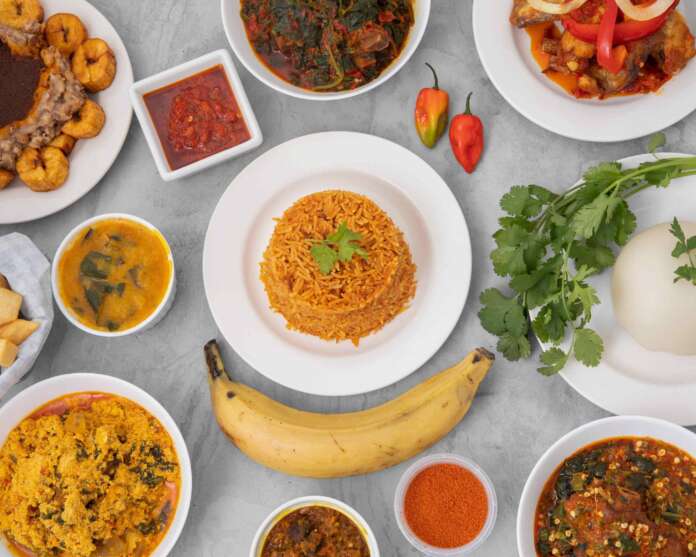
At Akoko, an upscale restaurant in central London, Nigerian staples such as moi-moi, a stodgy bean pudding, and mosa, a savoury doughnut made from overripe plantain, become fine dining. Staff shuttle steaming bowls of jollof rice across the restaurant to clients paying £120 ($160) for a tasting menu, plus another £95 for a wine pairing. (A shorter £55 lunch menu exists for the time-pressed, the tightwads and those husbanding expense accounts.) This year Akoko won its first Michelin star. It was joined by Chishuru, another Nigerian joint. Its owner, Adejoké Bakare, has gone from being a have-a-go chef working out of a temporary spot in Brixton Market in south London to a Michelin-star-winning West End mainstay in barely four years.
What is happening in food is happening elsewhere. From politics to YouTube to sport to music, members of Britain’s Nigerian diaspora have established themselves in the country’s elite. “That beaming West African mothers are now such a regular fixture on award-show red carpets and stages tells its own story,” points out Jimi Famurewa in “Settlers”, a recent memoir-cum-history of black African London. A Nigerian moment has begun.
British-Nigerians are curiously overlooked in the folk tales Britain tells itself about immigration. There is no iconic episode to match the arrival of HMT Empire Windrush, the boat that brought a few hundred people from the West Indies in 1948, points out David Olusoga, a historian (himself a British-Nigerian). They lack the numbers of, say, British-Indians or the geographic spread of Poles. Instead, theirs is a prosaic story of modern migration. Airplanes bearing the parents of future chefs, footballers, politicians and musicians arrived in steady numbers throughout the 1980s and 1990s. The results, however, are extraordinary.
Michelin stars are just the start of it. British-Nigerians have put their stamp on the country’s music scene. Grime, probably the most influential British genre in the past few decades, was shaped by British-Nigerians. Or as Skepta, who won the Mercury Prize, a prestigious award, in 2016, put it: “I’m a badboy from Nigeria/Not St Lucia/Joseph Junior Adenuga/Big lips, African hooter.” Skepta’s brother, JME, is another well-known MC; their sister, Julie, is a prominent DJ. It is not just a family affair. Four of the eight Mercury Prize winners since Skepta have had Nigerian heritage.
Much of their success can be traced to geography. All the recent British-Nigerian Mercury winners were raised in London, which is the heart of the country’s Nigerian population. A home in the British capital is often vital to making it into Britain’s creative elite, whether that is in wealthy Hammersmith or, as in the case of the Adenugas, on a council estate in Tottenham. What is big in London becomes big in Britain. A niche genre like grime can spread from pirate radio to critical acclaim in a few years.
Bukayo Saka, a British-Nigerian who plays football for England and Arsenal, is another London boy made good. Mr Saka is the golden child of a golden generation of England players. No profile is complete without a mention of the fact that Mr Saka achieved four A*s and three As in his gcse exams. Homework was done during the 90-minute drive from West Ealing to Arsenal’s academy ground in Hale End.
That application is a typical British-Nigerian story. For a demonstration, head to any train station in south-east London during term time, says Mr Famurewa. While commuters head into central London, British-Nigerian children in oversize blazers travel often absurd distances in the other direction to outer London boroughs and Kent, which still have selective grammar schools. Not everyone can play for England but anyone can hop on the 7.30am train to Gravesend (providing they have the grades).
An emphasis on education as a path to prosperity is hardly uncommon. What made the Nigerian influx different was that many arrivals were pretty middle-class to begin with. Kemi Badenoch, one of four remaining challengers for the Conservative Party leadership, is a case in point. Her father was a doctor, her mother a professor. In one sense, Ms Badenoch’s rise to the cabinet in the previous government is extraordinary. In another, it is becoming normal: another middle-class British-Nigerian was determined to enter Britain’s elite and succeeded.
Britain’s Nigerian elite proves an often overlooked rule. Ethnic minorities who make it into “Who’s Who”, a guide to the powerful in Britain, are slightly more likely to come from middle-class families (rather than a working-class background) than their white peers, according to “Born to Rule: The Making and Remaking of the British Elite”, a new book. It is those with plenty of privilege who tend to make it to the top. KSI, or Olajide Olatunji to his mother, is Britain’s most influential YouTuber; he boasts 24m subscribers and an empire that ranges from boxing matches to Prime, a sickly drink. KSI started life as a YouTuber as a private-school boy from Watford. When asked once if he felt Nigerian, KSI replied: “If I’m getting my extended family asking for money, I feel pretty Nigerian; when I’m going to a private school, I feel pretty British.” Skim the biography of a prominent British-Nigerian and you will often find the name of a prominent public school.
From Lagos to Latymer Upper Judging a group by the cream of its crop has its limits, just as Michelin-starred restaurants reveal only so much about the dietary habits of a country at large. Last year alone about 141,000 Nigerians arrived in Britain, predominantly to do low-paid jobs in areas such as social care. Their tale will be different. But the story of the British-Nigerian elite is a simple one. They are generally middle-class, always well-educated (often privately) and predominantly from London. Why are there so many British-Nigerians in the British elite? Because, often, they look just like the rest of it. ■
This article appeared in the Britain section of The Economist’s print edition under the headline “The Nigerian moment ”
In 1982, on the foothills of the road to Nigeria’s 1983 general elections, it was quite clear that the ruling National Party of Nigeria (NPN) had no plans to declare a vacancy in any significant political office around the country. Instead, they seemed bent on consolidating power in order to avoid a remake of the judicial nail-biter that yielded the presidency to Shehu Shagari in 1979.
The essential party positions featured a stellar cast. Adisa Akinloye, the party chairman, was a veteran lawyer with political experience predating Nigeria’s independence. The energetic Suleiman Takuma ran the party secretariat and Trade Minister, Umaru Dikko, was the ruthless campaign strategist. The job of guaranteeing the outcome that the party sought to engineer, however, fell on Sunday Adewusi, the then Inspector-General of Police (IGP). The son of parents from Ogbomoso, Adewusi grew up around Keffi in what later became Nasarawa State. He graduated at the top of his cadet set in 1958 and, at 45 in 1981, he was appointed Nigeria’s youngest ever IGP.
As Inspector-General, Sunday Adewusi headed the armed and uniformed wing of the NPN. For the elections, his genius lay in his ability to depute just the right kind of officers to the places where the party needed to manufacture results. Then, as now, the ruling party felt called upon to claim the politically prodigal south-east of Nigeria as part of its realm, irrespective of the will of its people. For this purpose in 1983, the NPN desired to capture old Anambra State which happened also to be the home state of Nnamdi Azikiwe, Nigeria’s first post-colonial Head of State and at the time leader of the NPN’s estranged political partners, the Nigerian Peoples’ Party (NPP).
For the job of softening up Anambra State, Adewusi found just the right man in Bishop Eyitene. The “Bishop” in Eyitene’s name was not an ecclesiastical office nor was it a Pentecostal title. Bishop’s tenure as the Commissioner of Police in Anambra State was an extended bout of political Jiu Jitsu with then state governor, Jim Nwobodo. Their politically irreconcilable co-habitation became the subject of bitter litigation, all designed, it seemed, to open the political flanks of the governor and his party. It worked a treat.
On behalf of Adewusi, Eyitene won litigation before the Court of Appeal asserting the autonomy of the police on questions of personnel postings. For accomplishing his political task with aplomb, Adewusi rewarded Bishop with redeployment to Lagos ahead of the 1983 election. The new team he sent to Anambra State routed Jim Nwobodo and his NPP in the governorship election. It was left to the Supreme Court to certify the beauty of Adewusi’s handiwork and they duly obliged in December 1983 before the military sacked the lot of them.
37 years later, the Supreme Court relied on numbers confectioned by a rogue Commissioner of Police to declare in January 2020 that the man who came fourth in the governorship election in Imo State the previous year was in fact the winner. Today, the judge who rendered that judgment leads Nigeria’s judiciary.
This past week has offered up a rich advertisement of the convenient partnership between judges, the police, and politicians.
In Rivers State, the Inspector-General of Police clearly took sides in the political contest between incumbent governor and his immediate predecessor, who is now the Minister of the Federal Capital Territory and who also desires to be known as the godfather-general of Rivers State. First, he sought to arrest scheduled Local Government elections in the state on the artifice of obeying a court order. The problem is that there were two court orders not one, from what lawyers would call courts of co-ordinate jurisdiction. The High Court of Rivers State in Port Harcourt had mandated that elections occur on 5 October. In requiring the police to withdraw from providing security cover for the vote, the Federal High Court in Abuja effectively ordered that they should not.
Thwarted by what appeared to be a spontaneous civic revolt, election day witnessed uniformed police officers under the command of the IGP going from station to polling unit to cart away ballot boxes and tear down the displayed rolls of voters. The day after voting, supposed winners having been sworn in, the IGP announced the withdrawal of his officers and men from the state. As if on cue, practiced arsonists descended on Local Government secretariats, burning and destroying them one after the other.
In neighbouring Edo State, meanwhile, the IGP’s situational commitment to obeying court orders failed him. Lawyers for the governorship candidate of the Peoples’ Democratic Party, (PDP), Asue Ighodalo, armed with the duly served order of a competent court to inspect election materials found their way into the state headquarters of INEC in Benin first blocked by a wall of uniformed police officers. When the police requested for reinforcement, they were joined not by units of more police assets but by thugs of the ruling party.
The Nigeria Police Force is the oldest institution in the country and also the largest single employer of labour. Its personnel just happen also to be both uniformed and armed. Under the Constitution, the president appoints the man who heads the Police and that appointee is also obliged to take operational orders from the president. Historically, therefore, the position of the IGP has always been fraught and successive incumbents have mostly been prepared – with a few exceptions – to manage this delicate relationship with skill and professionalism acquired through exposure to their predecessors and to high-level leadership training.
Much of this training was missed by the current incumbent, Kayode Egbetokun, while he spent much of his time in the Force as long-term Aide-de-camp (ADC) to the current president. His claim to the job therefore lies in personal fealty his benefactor. For this, he has been handsomely rewarded, first with expedited preferment to a role for which his preparation falls short and, second, with a targeted amendment of the law to extend his tenure in order that he will be around to pre-determine the 2027 elections.
In November 2009, Kayode Fayemi, then an opposition candidate, took temporary leave from the protracted legal tussle over the outcome of the governorship election in Ekiti State in south-west Nigeria two years earlier in which he was involved to travel to New Orleans in Louisiana, in the United States of America, to address the annual conference of the African Studies Association on “Electoral Politics and the Future of Electoral Reform in Nigeria.”
In a deeply thoughtful delivery, Dr. Fayemi feared that “the quest for consolidating our democracy is now in retreat and risks encountering outright reversals.” He explained that there are “five ‘minigods’ that one must pay significant attention to in any attempt to understand the nature of electoral politics in Nigeria”. These include the Independent National Electoral Commission (INEC), “which often acts like a Siamese twin of the ruling party….”; the security agencies – particularly Nigerian Police Force; “thugs and bandits”; the judiciary; the money god.
20 years ago, the late Innocent Chukwuma and I met with Tafa Balogun inside the office now occupied by Dr. Egbetokun to discuss a document he had commissioned from us. After reviewing our recommendations, Tafa looked at us with the full majesty of his corpulent authority and told us that he was inclined not to proceed with our suggestions. Almost wistfully, he added that when it was someone else’s turn, the person could do what they wanted. It is now Dr. Egbetokun’s turn and, as Inspector-General, he has turned Dr. Fayemi’s predictions of electoral dystopia supervised by the troika of the police, bandits, and crooked judges into a manual of policing. It just remains for police officers to be required to sing: “On your mandate we shall stand….!”
A lawyer and a teacher, Odinkalu can be reached at [email protected]
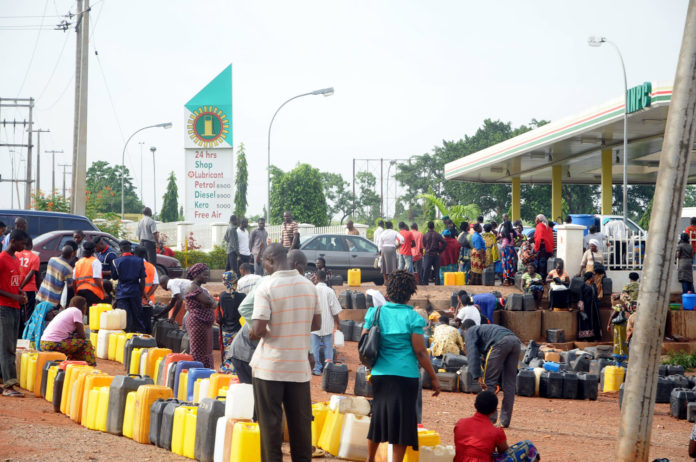
KEROSINE QUEUE/PRESS-2/MY DOCUMENT/MY DOCUMENT/JUNE 09
NIGERIANS STRUGGLING TO BUY KEROSINE AT NNPC MEGA STATION IN ABUJA ON WEDNESDAY (10/6/09). PHOTO; NAN
Dr. Aliyu U. Tilde
Yesterday evening, I listened attentively to a panel of experts and stakeholders on the BBC program Ra’ayi Riga, anchored by Umaima Sani Abdulmumin. The program ended with a big doubt in my mind regarding a matter purported to be a provision of OPEC and crucial to the price of petrol in Nigeria.
Tyranny
I could not fathom how particularly the representatives of NNPC and IPMAN stressed that Nigerians will be at the mercy of two variables: the international market and the price of the US Dollar in Nigeria. They said OPEC agreement compels member countries to sell allocated domestic crude at international rate even if refined locally. One of them even said the Iran-Israel conflict can cause domestic price of petrol in Nigeria to rise.
So we should expect higher fuel prices anytime the rate of the dollar appreciates in Nigeria and also when, for any reason, there is a rise in the cost of crude in the international market. It is the rule, according to them. Our fate, they claim, is sealed, regardless of our OPEC membership and Dangote refinery. Nigerians will no longer have a stable fuel price.
Trust me, in Nigeria, the equation will be simultaneous. At any given moment, a reason will be found to use either or both parameters to increase pump price. The target of government is to extract more revenue from citizens while the businessmen in Dangote, Major Marketers, NNPCL and IPMAN continue to feed their greed for endless profit with our blood.
One would wonder why OPEC would be so oppressive in inflicting such tyranny on the citizens of its members. Senator Ndume, who was in the panel, said if he cannot understand why, how would they expect a commoner sitting under the tree to do so?
The truth
The truth is that there is no provision like that in OPEC agreements. In fact, the very idea of domestic crude quota arose in realization that citizens of member countries may need to enjoy cheaper oil than the international market price. That is why those citizens have been enjoying cheaper fuel for the past five decades in different countries. Many still do. Why not Nigerians?
If you ask ChatGPT whether OPEC agreement compels member countries to sell crude for domestic consumption at international market price only, this is the answer you get:
“OPEC (Organization of the Petroleum Exporting Countries) does not directly compel member countries to sell crude oil for domestic consumption at international market prices. OPEC’s primary role is to coordinate and unify petroleum policies among member countries to stabilize oil markets and secure a steady supply of oil.
“However, OPEC’s production quotas, agreements on output levels, and policies can indirectly influence domestic oil pricing. In practice, many OPEC members choose to sell crude oil domestically at subsidized rates or prices lower than the international market. This decision is made at the discretion of individual member countries, often as part of national energy policies aimed at supporting domestic economies and industries. Nonetheless, these policies may vary from one member country to another depending on domestic priorities and economic strategies.
“There is no formal OPEC rule that requires domestic sales to match international prices, though it can be influenced by international agreements and market pressures.”
The Truth
The truth is that the President and Minister of Petroleum can sell our 445,000 barrels a day to Dangote at even N50,000/barrel after taking into consideration the cost of extraction and OPEC will not raise any eyebrow. Dangote can charge the cost of refining, add his profit and sell to NNPCL and IPMAN at, say, N300/litre. On their part the marketers will add their cost of transportation, storage, profit, etc., and sell it to Nigerians at N400/litre. And—boom—we all will be happy.
It is entirely the discretion of the President and his government. So whoever wants to sell our locally produced fuel by that simultaneous equation is on his own. There is no OPEC in the equation.
The Squeeze
Also, among those who would fight against Nigerians enjoying affordable fuel rates are the IMF, World Bank and the West generally. They want the government to squeeze us the more such that we can service our debts and collect more loans from the Shylock. The age long philosophy is: our poverty, their wealth; our pain, their joy.
Added to these are local liberal economists who believe in high taxation, claiming that the blood money will be used to develop our infrastructure, health, education, etc. It is just the same old bunkum selling since 1986 at the debut of Naira devaluation while our infrastructure, hospitals and schools continue to deteriorate in rebuttal of that thesis.
A Call
I call on the President to consider the low income status of our citizen. Only affordable fuel price will hold together our social fabric, ensure our prosperity and guarantee our security. It is zero subsidy because we are not buying it from anyone. It is our oil.
The President must keep in mind that the IMF and oil magnates are not his partners in 2027. He is on his own. They will be there to outlive him and work with the next President. Let this sink into his psyche. Tam!
Known for his outspokenness on mental health issues (especially men’s) mental health issues, Prince Harry, is currently focused on a very tricky problem: that of social media and its effects on youth.
“In many cases, the smartphone…is stealing young people’s childhood,” he said in a conversation, a video of which was exclusively shared with Fortune this week, with social psychologist Jonathan Haidt, author of The Anxious Generation.
Haidt—whose four foundational smartphone rules have inspired both celebration and pushback—couldn’t agree more, explaining to Harry the premise of his book: that people born after 1995 (Gen Z, roughly) throughout the English-speaking world hit puberty with high rates of anxiety, depression, self-harm, and suicide, which all rose sharply between 2010 and 2012. And that it was no coincidence—but instead a direct result of the smartphone.
“Young people trade in their flip phones for smartphones,” Haidt said about that moment of generational shifting, “and now [have] a front-facing camera, high-speed internet, a million apps that are competing with each other to hook kids’ attention. So, the ‘anxious generation’ is helping us understand the incredible destructive force of this transformation of childhood…and what we can do now to stop that from happening and to help those who already have been through it.”
Haidt and the Duke of Sussex sat down for the intimate discussion (see the full video above) about social media and mental health as part of Harry’s Archewell Foundation 2024 Insight Sessions—public conversations, highlights of which appear in a new Insight Report—about the impact of technology, with the voices of youth front and center.
Here, some of the most powerful takeaways from the spirited conversation.
Parents vs. social media companies
One of Haidt’s biggest worries about the current state of parenting and social media is that “we are overprotecting our children in the real world and underprotecting them online,” he said. “And both of those moves are mistakes. They’re bad for development.” It’s why he advocates for no smartphones before high school, no social media before 16, phone-free schools, and more unsupervised play and childhood independence.
It’s also why, Harry said, “it’s very easy for social media companies to point the finger at parents and say, ‘Well, you know, this is down to you. This is down to your parenting.’”
But that’s an argument that Haidt rejects.
“If there were some parents who were getting this wrong and most parents were getting it right, then I’d be very receptive to that argument,” he said. “But once kids get a phone and social media, the rest of family life turns into a fight over screen time. And this is happening everywhere. This is happening in Silicon Valley, where the parents know what’s going on.”
So why do we give our 10-year-olds smartphones? “The main reason,” Haidt said, “is because everyone else did. We don’t want our daughter to be the only one who’s left out. I’m facing this now with my 14-year-old daughter on Snapchat. So the tech companies put us in a bind, and then they’re trying to blame us for what they did.” It’s why he’s also an advocate of collective action, or parents banding together to agree to delay the purchase of smartphones for their kids.
What about smartphones for safety?
Through his insight sessions, said Harry, he’s spoken with parents who say they give their kids phones at a younger age to keep them safe.
“It’s a double-edged sword,” he said. “They want them to have their phone at school in case of emergency, but once, like any kid, you have your phone, even if you’re told you’re not allowed to download that app, kids have a way of working around it.”
Haidt’s not buying the safety argument, though. “If you want to give your kid a phone, so if anything goes wrong they can call you, great. Give them a phone. Just don’t give them a supercomputer connected to everyone in the world… They don’t need that. The millennials had flip phones. They went through puberty with flip phones to call each other, text each other, meet up. It came out fine.”
Gen Z, on the other hand, “went through puberty with a supercomputer blocking out almost everything else in life,” he said. “Everything goes down: much less time with friends, much less sunlight, very many fewer books, many fewer hobbies. You take almost everything out of childhood. You replace it with this and a bunch of million short videos. It’s not much of a childhood.”
The ‘myth’ of social media as lifeline
Prince Harry then raised the idea of social media having a positive—and even lifesaving—side.
“Social media, we know, to a large extent, is giving an outlet, an added resource, to kids that perhaps don’t feel comfortable coming to us to talk about their issues and their troubles and their worries,” he said. “Kids online will be feeling more connected with complete strangers on social media. So how do you, if you’re a parent, know that your kid is getting good out of social media?”
Haidt said it is “one of Meta’s favorite talking points” that “social media is a lifeline for LGBTQ kids, for kids from marginalized communities. And that’s just not true.”
What is true, he said, “is that the internet was great for them. The internet solved all these problems in the ’90s. If you’re a gay kid, you’re not out to anyone in a rural part of America or England, the internet was amazing. You could find information, you could find people like you, and you could communicate.” But social media, Haidt insisted, has changed all that.
“It’s no longer even about just me connecting to you,” he said. “It’s now about an algorithm-driven news feed that sends content to you. This is not what they need. If you have any special interest, you can find that with Google. You don’t need an algorithm to feed you stuff.
So it’s “a myth,” he said, that Instagram and TikTok are lifelines. “The research, I think, is very clear: When kids have a best friend or especially a small group [of friends], they generally do well. When kids don’t have a close friend or close group, they’re much less likely to do well. When you have 300 connections, you don’t have time for anyone.”
Nobody understands. How could she do it? Why did she do it after all these years? An affair after 25 years of marriage and three grown-up children? What is she still looking for? What has God not blessed her with? Her husband is well- to-do, healthy and the children are doing well. But Madam B did it and it’s done. She’s 52 and is cheating on her husband. It’s hard to understand, I guess, but it happened and somewhere, as you read this, it is probably happening again. Older women stepping out on their spouses. There are researches to even prove that it’s not a Nigerian thing. So, why are grandmas having affairs?
Let’s look at the case that inspired this column today. I must confess, I can’t tell you all the wheres and wheretofore. Just that I get to hear things, all kinds of things but this one I’m sharing.
Madam B and Uncle Akin have been married for 25 years and have three grown-up boys who schooled and are schooling in Canada. Meaning: the nest is empty. It is just the couple and their domestic staff now at home. The problem is that Akin is hardly around. Madam B was once a top executive in a bank but is now retired with plenty of time on her hands. She goes to the gym four times a week, parties at weekend to keep herself busy.
According to her, she goes to those parties just to fill time and space. “The truth is I have been lonely for a long time now. Even when I was in the bank, my husband hardly had time for me. He was either on one long trip or the other or hanging out with his friends. There was always one meeting or the other in Nigeria or abroad. Yes, he picked his bills and we were comfortable but I hardly saw him. As a working woman, my job kept me busy, and tired at the end of the day and at weekends. I coped better then. I knew he had girlfriends too but he kept them away as much as he could, but I knew most of the time, though.
“However, the last three years have been really difficult. I run a consultancy now and rarely go out. Meanwhile, Akin is still as busy as ever. When I complained of his absences and my loneliness, he laughed it off, and told me to go and spend more time with my children. He asked if old women get lonely. But I don’t feel old. In fact, I don’t feel any different from how I felt 10 years ago. I’m also one of these women that reach menopause late. My sexual needs are still there but over and above the needs for sex is the need to be with my husband, spend time with my man. But he was hardly ever here. I eat alone, sleep alone and watch television alone.
“It got so bad I’d started sitting on the balcony and chatting with the gardener while he worked. So, this thing with Daniel just happened. My husband had not made love to me in seven months. When he was home, he was too tired to do more than a kiss and a hug. Dan is a divorcee who used the same gym with me. We were both two lonely people killing time in the gym. He makes me laugh. We share the same taste in novels and entertainment generally. One thing led to the other and we had breakfast together, then dinner, then, we got intimate.
“At first, I was ashamed, so ashamed that I couldn’t go to church the following Sunday. I felt really dirty. It’s the first time in 25 years that another man was seeing my nakedness. I felt guilty but somehow, felt alive, good, like a woman again. It’s been six months now since Daniel and I started this and I must confess that it has been fun. I’ve lost weight and I’m making efforts to keep Dan interested. My husband still comes and goes, thinking, I guess, I’m an old woman who should be worried about her blood pressure, be more concerned about her children’s welfare and not sex. Dan thinks I’m fine old wine to be savored. We’re secret lovers eating the forbidden fruit that for now, is too delicious for me to spit out.’
Madam ‘B’ has not been caught pants-down yet but we can generally declare her guilty. Of what? Infidelity. But what is her husband guilty of or is he clean and innocent? He’s the wronged party who didn’t deserve to be cheated on? No such thing. Let’s be realistic. Uncle Akin left his farm unattended to and now weeds are choking everything he’d planted in 25 years.
Women, including grandmas, do not outgrow attention. It’s the way God created us. Yes, some women have more control on their libido than others. Many can cope with loneliness better than others. But all women are susceptible to temptation. Those juices that ran riot in her veins when you first set her on fire all those years never really dry up. All her hotspots are still hot. She can have them cooling, hibernating for a long time but activation is only a click away. The right finger on the right buttons and voila, the hotspots come alive, all energized and raring to go.
Some women have capacity to resist temptation. Many manage to flee when they see taut muscles and hear mean husky voices. But there are still married women, an appreciable percentage, who think it is easier to fall into temptation than to resist it. Those ones feel first and think later.
Lesson? A woman is a woman forever. There is no retirement age for wanting to be doted on, pampered and fussed over. Maybe at 80, sex is no longer a thing but until she no longer wants it, my man, you’ll do well not to starve her because there is always a willing sexy Daniel not far away.
We all, including grandmas, have needs that don’t just go away because of a few strands of grey hair here and there. According to a new study by the Institute for Family Studies, ‘the older you are, the more likely you are to cheat. 20 per cent of married people over the age of 55 have had extramarital sex while only 14 per cent of those under 55 have cheated. Couples in their 50s and 60s however, were the most likely to cheat.
What is worse? The numbers of older couples cheating on their spouses are on the rise. So, darling friend, this is reality. Not a gladdening one but if you leave your gates wide open, who can you blame if pretty slim girls or virile hunks slide in and melt all over your ice cream?
The Nigerian Bar Association (NBA) condemns the recent increase in the price of Premium Motor Spirit (PMS) by the Nigerian National Petroleum Company Limited (NNPCL) to N1,030 per litre. This sharp rise, announced on Wednesday, further exacerbates the economic hardships faced by Nigerians, particularly those already struggling to make ends meet. Fuel price increases have a cascading effect on virtually every aspect of daily life in Nigeria. The costs of living, transportation, food, and other goods and services which have been on the continuous rise will become even more unaffordable.
On November 4, 2024, the NBA issued a statement strongly opposing the fuel price hike from N617 to N900 per litre. At that time, we highlighted the severe financial strain this imposed on the average Nigerian household, and the latest increase only compounds these difficulties. Such drastic adjustments to fuel prices, with no adequate mitigating measures or economic relief, signal a disturbing trend of disregard for the welfare of the Nigerian populace. The much needed tax breaks and social assistance programs are yet to be implemented. People are groaning and life has become more difficult.
The Nigerian Bar Association is particularly concerned that such decisions continue to be made without transparent consultation or dialogue with relevant stakeholders, including civil society and the private sector. The government’s seeming disregard for the suffering of the people is troubling. Nigerians deserve better— they deserve a government that prioritizes their well-being and takes into account the real-world implications of its policies on the populace.
We therefore call on the government to immediately take steps to reverse this increase and urgently implement measures that cushion the effect of rising fuel prices. This should include investment in local refining capacity, public transportation, reduced taxation of the income of low-income earners, repair of public roads, improved security so farmers can farm and evacuate their farm products, transparent fuel pricing mechanisms, and broader economic policies aimed at reducing poverty and providing sustainable solutions to Nigeria’s energy challenges.
The NBA remains committed to advocating for policies that promote justice, fairness, and equity for all Nigerians. We reiterate our position that the government must prioritize the welfare of the people and ensure that economic policies do not deepen poverty or further marginalize the most vulnerable in society.
Mazi Afam Osigwe, SAN President, Nigerian Bar Association
The torment of incessantly escalating petrol prices and the consequent surge in the cost of everything have plunged Nigerians into a precipitous decline in quality of life. This dire situation is exacerbated by insensitive, almost mocking remarks from those responsible for inflicting this pain.
President Bola Ahmed Tinubu, aptly nicknamed “T-Pain,” recently stated from London that Nigerians would, in the future, appreciate the wisdom of his “reforms.” Such a statement is both callous and mendacious.
It is callous because these “reforms” are literally destroying the livelihoods of millions and causing the deaths of many. What possible benefit could the deceased derive from economic reforms that precipitated their untimely demise?
It is mendacious because, as evidenced by the history of Structural Adjustment Programs (SAP) in Nigeria—and the experiences of other nations implementing similar neoliberal economic reforms—such policies invariably erode the middle class, exacerbate poverty among the lower classes, yet please the markets, thereby benefiting the upper classes.
Almost without exception, neoliberal policies—such as the elimination of subsidies, deregulation, reductions in social spending, and fiscal austerity—exacerbate economic inequality and hinder sustainable development in developing economies. These policies often benefit large corporations and the wealthy, which creates an inequitable concentration of wealth in the hands of a few and widens the chasm between the rich and the poor.
Thus, the deferred benefits for which Tinubu wants Nigerians to endure mass deaths and hopelessness are the opening of Nigerian markets to international competition—which may please global markets but will overwhelm local businesses lacking the resources and technology to compete—and the freeing up of resources to invest in infrastructure.
However, the reality is that contemporary Nigeria is inhospitable to foreign investment due to the absence of security, social, and physical infrastructure, and because Tinubu’s policies have so impoverished the majority that they cannot afford to purchase what foreign businesses produce. This explains the mass exodus of foreign companies since 2023.
Furthermore, given the culture of endemic corruption entrenched within the upper echelons of power, most of the funds saved from subsidy withdrawals, tariff increases, intensified taxation, and cuts in social programs will likely be misappropriated. The government will still resort to borrowing from the World Bank and the IMF to finance its operations.
We are already witnessing this phenomenon. Despite massive inflows of cash into government coffers, no new projects are being constructed or even initiated. In fact, governments at all levels are procrastinating over implementing the ₦70,000 per month minimum wage. State governors convert the excess funds they receive from federal allocations into dollars and stash them away, thereby putting pressure on the naira.
Now, the vast majority of Nigerians have resigned themselves to the fact that death, starvation, and hopelessness are the only certain outcomes of Tinubu’s “reforms” and are seeking a way out. Middle-class citizens are saving up to leave the country, and, for the first time ever, even the majority of northern Nigeria’s middle class is investing in plans to escape from Nigeria.
In response, Senate President Godswill Akpabio declared that Nigerians fleeing the blazing neoliberal hellhole that Tinubu has created are ungrateful and unpatriotic cowards who should be stopped. “I believe people should place love for their country above financial gains. That is why many of us choose to remain here,” he said.
Akpabio and his ilk choose to stay in Nigeria not out of love for the country but because they thrive off it and are insulated from the harm they inflict upon it. The professionals leaving Nigeria in droves are not doing so because they lack love for their country. They love their country; they simply abhor the raging neoliberal inferno it has become. British Somali poet Warsan Shire once pointed out, “No one leaves home unless/home is the mouth of a shark.”
It is insulting to suggest, as Akpabio did, that Nigerian emigrants are motivated by base and unpatriotic motives. Even more insulting is Akpabio’s proposed solution to halt emigration: that dissatisfied Nigerians should reduce the number of cars they own.
At times, one wonders whether Akpabio retains any functioning brain cells.
Meanwhile, Remi Tinubu, Bola Tinubu’s wife, continued this pattern of insulting Nigerians amidst their suffering. On Thursday, she told the Ooni of Ife that her husband is not responsible for Nigeria’s current travails, which contradicts her husband’s own acceptance of responsibility for the hardships Nigerians are enduring—with a promise of an illusory better tomorrow as compensation for the pain he is inflicting.
“We are just 18 months into our administration,” she said. “We are not the cause of the current situation. We are trying to fix it and secure the future.”
She then inverted logic and implied that Nigerians are suffering not because her husband has increased petrol prices more times and at higher rates than any previous president, but because prior presidents did not do what her husband is doing.
“We know that subsidy has been removed, but with God on our side, in the next two years, Nigeria will be greater than this,” she said. “Those who attempted removing subsidies before could not see it through. But with your prayers in the next two years, we will build a nation for the future.”
The rage that overcame me upon reading this is beyond description. Do these insensate individuals utilize their cognitive faculties at all?
I have long harbored a suspicion that the upper echelons of Nigeria’s power structure have been displeased with the emergence of a middle class since 1999. The markers of middle-class status—such as car and home ownership, fine dining, foreign education, and sartorial sophistication—have deprived the upper class of privileges they believed should remain exclusive to them.
In the early 2000s, they used to speak derisively of “Obasanjo drivers”—individuals who could afford to own cars due to minimum wage increase and arrears of the minimum wage during Olusegun Obasanjo’s presidency. It isn’t Obasanjo who gave people cars or created the middle class, of course. By its nature, the practice of democracy creates certain jobs and circulates opportunities that foster the middle class.
Now, Tinubu’s neoliberal policies are eradicating the middle class and plunging the poor into deeper, more excruciating poverty, reminiscent of the days of military dictatorship. I wonder how much longer this can continue. Yet we will be observing from afar, as nothing that is happening now comes as a shock. I forewarned that this would occur even before Tinubu assumed power.
Our site uses cookies. By clicking “Accept All Cookies”, you direct Law and Society Magazine to store cookies on your device and disclose information in accordance with our Cookie Statement: cookie policyACCEPTREJECT
Privacy & Cookies Policy
Privacy Overview
This website uses cookies to improve your experience while you navigate through the website. Out of these cookies, the cookies that are categorized as necessary are stored on your browser as they are essential for the working of basic functionalities of the website. We also use third-party cookies that help us analyze and understand how you use this website. These cookies will be stored in your browser only with your consent. You also have the option to opt-out of these cookies. But opting out of some of these cookies may have an effect on your browsing experience.
Necessary cookies are absolutely essential for the website to function properly. This category only includes cookies that ensures basic functionalities and security features of the website. These cookies do not store any personal information.
Any cookies that may not be particularly necessary for the website to function and is used specifically to collect user personal data via analytics, ads, other embedded contents are termed as non-necessary cookies. It is mandatory to procure user consent prior to running these cookies on your website.