Home Blog Page 484

‘An enemy of the people’

By Lasisi Olagunju

The water is poisoned! The whole of the water system is tainted and absolutely unusable for its purpose,” Thomas Stockmann, medical doctor, accomplished scientist, informs the people around him. He is employed to look after the health of the people and the public baths, the mainstay of his town’s economy. It is in the course of that job that he makes a scientific discovery that the baths are dangerously polluted, and that they spread typhoid. And he says so.

Dr. Thomas Stockmann is the protagonist in Henrik Ibsen’s 1882 play, ‘An Enemy of the People’. We were taught long ago that literature is a reflection of life. We were also taught that literature is the lamp that lights the way of life, past to present – and back to the past. We were taught that drama as a mirror shows us what life truly is. Life itself is a drama, a stage on which we all fret and strut until the light goes out on us. Ibsen’s Thomas Stockmann, public enemy number one, is used here in my celebration of the near end of a particularly dramatic year, our love for false gods and our stoning of the wrong Satan.

I have skimmed through Gabriel Fallon’s ‘Prophecy in the Theatre’ (1956), his quote on drama as a member of the human life – human thought and morality. I have scanned J.C. Kamerbeek’s ‘Prophecy and Tragedy’ (1965), his discussions on dramatic structure and tragic meaning. There is a sense in which the dramatic can be prophetic.

Back to ‘An Enemy of the People’. The drama is in the plot. The setting is a coastal town in southern Norway. Authorities of the town get a hint of Dr Stockmann’s findings on their polluted water. Alarmed and agitated, they meet with him for negotiations. They ask their medical doctor to keep quiet, to shut up. The public must not hear what he is saying. It will create a panic in the town. It will hurt the town and its economy; tourists will stop coming, investors will lose money.

But this doctor is a loud-mouthed stubborn dude. He insists on speaking ‘the truth’. He thinks he has a moral obligation to protect the community from avoidable diseases, from even death.

On more than one occasion, Doctor tells the people that previous unexplained deaths are due to the poisoned water: “Last year, there were people who died from a disease that spread through the town, and I am certain that the cause of it was the poisoned water. I told you then, and I tell you now—this water will kill us all.” His decision to talk, he is certain, is the right course of action. “It is my duty to lay bare the facts in the matter. Every conscientious man must support me in this!”

But the system supports only the “moderate.” Dr Stockmann’s own brother, Peter Stockmann, is the mayor of the town. And it is this brother that openly leads the opposition against this doctor, against his discovery of the pollution and against his audacity to tell.

When the state is on your case, it doesn’t rain; it pours. The press soon shuts out our doctor. His editor friends renege on their promise to publish his findings. They claim they can’t offend their funders. The stubborn medical doctor turns to himself. He resolves to speak directly to the people “in a way that they shall understand” and “drive all the wolves out of the country.” There is a town hall meeting where Stockmann proposes to officially announce his findings: “I am telling you the truth! The entire water system is tainted. People are going to die from this. We must close the baths and have them disinfected. We must stop this typhoid epidemic before it spreads further.”

His brother, the Mayor, hijacks the town hall meeting from him. The Mayor addresses the people. He tells them that his brother’s proposal is injurious to everyone in the town. The repairs he proposes will cost ratepayers “an unnecessary expenditure of some thousand pounds.” From the crowd comes a voice suggesting that the doctor be officially declared a public enemy.

Dr Stockmann watches as the townspeople he is fighting for respond with shouts:

“Yes! Yes! He’s an enemy of the people!”

“He hates his country! He hates his own people!”

“We can’t have someone like him in our town!”

Then a motion follows from someone our medical doctor trusts as his key supporter:

“Dr. Stockmann has shown himself to be an enemy of the people. Therefore, I propose that this gathering officially declares him an enemy of the people.” The vote is by ballot; everyone votes. Dr Stockmann gets one vote – the lone vote comes from a drunk attendee, the village drunkard.

Our man is defeated, but the crowd is not satisfied with what they have done to their doctor.

“Let us go and break his windows! Enemy of the people!” The whole crowd yells.

The consequences are grave. He is dismissed from his job. His daughter loses her teaching job; his landlord ejects him; his little boys suffer bullying in school and are told to excuse classes until further notice. Everyone who should help him avoids him. They say they dare not annoy “the majority” and their “public opinion.”

The play ends without a reprieve for “the enemy of the people.” But the man insists that he is the strongest man and that “the strongest man in the world is he who stands most alone.” I think he is naive. That is not what the world is. The one who stands alone stays alone and lonely and without power. Power resides where people stand. The people stand where power is. That explains, perhaps, why Donald Trump is Time Magazine’s ‘Person of the Year’.

We started 2024 eleven and a half months ago bitterly divided over what was truly evil and what was godly. We are ending the year divided still over who is angel and who is Satan. In the next two weeks, it is almost certain that we will roll over into the new year the raging Dele Farotimi vs Afe Babalola war of ‘justice’. There is also the tug of war over whether the tax reform bills potentially threaten or benefit the poor. In those two cases, we will be made to state who our “enemy” is. Unfolding also is the Kemi Badenoch/Yoruba vs Kashim Shettima/ Northern Nigeria debate. In 2025, Ibsen’s ‘An Enemy of The People’ will be staged across the entirety of our court and political systems. May God keep us alive – and well.


It Happed To Me: How the police arrested my 15-year-old who was making food deliveries and branded him an armed robber

Diary of a Female Engineer

I used to run a kitchen in Yesufu Abiodun, Oniru, where I supplied food to banks and offices in Victoria Island, Lagos. My 15-year-old son often helped with deliveries, as he had just completed his WAEC exams in 2018. On one particular day, we had a delivery close to our house. Since it was nearby, he went without the driver, carrying the food and our POS machine.

Tragically, the Nigerian police abducted him, confiscated his phone, and took him to the anti-cultism unit in Gbagada. We searched everywhere in Victoria Island, unaware that he had been taken so far away. Eventually, they allowed him to call me, and his terrified voice broke me: “Mummy, are you on your way? I’m so scared.”

My husband and I, along with our lawyer, rushed to the station. At the gate, they took our phones, and then I saw my son—half-naked and sitting on the ground with over 100 others outside the station. I collapsed in tears. My husband, who is British, demanded to see the DPO and asked him directly: “What offense are you charging my son with?” The boy hadn’t been allowed to explain himself, yet the food and POS machine were right there at the station. The DPO’s response? “Because he dyed his hair.” That was it. Nothing more.

In the end, we were forced to pay for his release. This incident was a turning point for my husband, who decided that we couldn’t continue living in Nigeria.

What made this even more painful was the nature of our family. My children were homeschooled, had no social circles outside the family, and never went anywhere without us. They were raised in a closely-knit environment. At the time of this ordeal, I was seven months pregnant, and the trauma of the experience caused me to go into premature labor, resulting in an emergency C-section.

My son’s only “crime” was being a hardworking boy, helping with his parents’ legitimate business—a business that provided employment for Nigerians. For my husband, a white British man, to witness such injustice firsthand was a harrowing experience.

Many of us have bitter, painful stories about the Nigerian system. Yet when we speak out and tell the truth, we are accused of defamation or subjected to cyberbullying. It’s truly heartbreaking.
I personally say that Kemi should be left alone, she is saying exactly what she experienced and if I’m asked anywhere in the world the same question, I will narrate my ordeal, so will every member of my family!

Tunde Bakare’s daughter speaks about how she stopped her parents’ marital break up

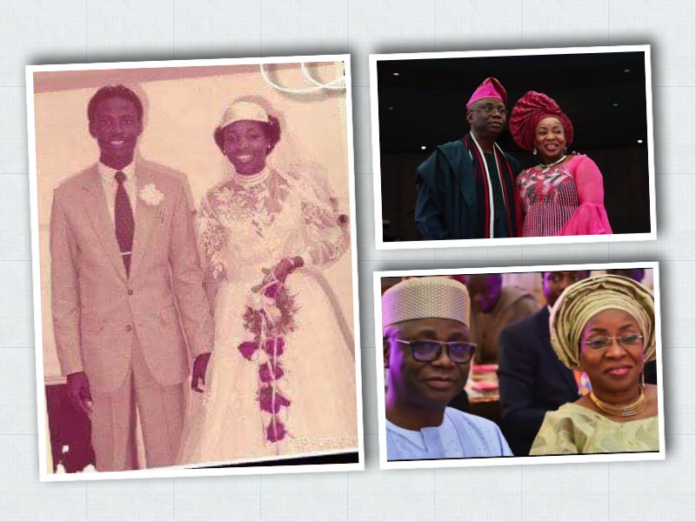
Weeks after celebrating his 70th birthday, Pastor Tunde Bakare and his wife, Olayide, fondly called ‘Authentic Mrs. B’, rolled out the drums to celebrate their 40th wedding anniversary on November 30, 2024. In an atmosphere of love, joy and excitement, the couple was surrounded by their children, grandchildren, family, friends and associates at an event to celebrate the anniversary.

Olubunmi Fabode, the first daughter of the Bakares, described her parents’ union as a battleground against generational curses. Fabode, speaking at the event, recalled a moment from her childhood when her father told her that he and her mother were going their separate ways.

She, however, disclosed that her love for her siblings and her desire to keep them together motivated her to pray for her parents’ reconciliation. The daughter revealed that her parents’ marriage was not without its challenges, given their respective backgrounds. “When I was seven years old, my father came to the room and told me ‘Your mother and I are going our separate ways. I am telling you this so you can decide who you want to live with’,” she said.

“I did not care so much about my mum and dad not living together, but I thought if they were separated, my siblings may choose either of our parents. “And I knew that could not work because I absolutely love my siblings. They are the joy of my life. I knew that something had to happen to interrupt that plan was about to hatch. “My father grew up in a household of 12 wives and 22 children.

His father died when he was three. My mother was born in Leicester. “She was raised by a British foster parent, then her grandmother, and was eventually raised by her father and stepmother. “They each came from brokenness, dysfunction and upheaval. Somehow, they found each other, and they decided to try with nothing, but their faith in God. “And the Bible as a guide to create something new that they had not experienced.” She noted that her parents’ marriage was a battleground against generational curses, where they confronted and overcame the darkness of their past. Fabode praised her parents for creating an atmosphere of love and for being role models.

“Their marriage was not just a union, it was a battleground. A place where generational curses were confronted and wrestled to the ground,” she said. “A dear aunty once told me something that stayed with me. She said the first generation of any marriage that emerges from a broken home always faces an extraordinary battle because the enemy is working to perpetrate darkness from one more generation. “Both of them stood in the gap and said this far and no further.

It is because of this testament that we are celebrating here today. Two people decided they could do something new under God. He was a casual Christian before he became married, but when he saw generational curses, nobody taught him to pray. “It came from inside. My mother, the woman that she is today: resilient, and nurturing, she learnt in this marriage to become that. She didn’t have a model. My father made sure we never lacked anything. My parents created an atmosphere of love.” Bakare married Olayide in 1984 and they have five children together.

PUNCH

Predator who raped mum-of-three till she died of heart attack gets life jail for life

A predator who killed a UK health worker by repeatedly raping her until she had a heart attack has been jailed for life.

Mohamed Iidow, 35, was seen on CCTV prowling Southall Park, west London, looking for a vulnerable woman to attack before approaching Natalie Shotter, who had passed out on one of the benches.


The cameras also captured the depraved abuse that followed as Iidow manoeuvred the 37-year-old mum-of-three’s ‘deeply unconscious’ body to attack her ‘again and again’ for more than 15 minutes.


Natalie’s mum, Dr Cas Shotter Weetman, a NHS cardiology practitioner, said: ‘We need to change our thoughts about how we behave.

‘There are people out there who continue to act in a very deviant and horrendous way and think that they can get away with it.’
 
In a moving victim impact statement, she described the horrific ordeal of having to watch her daughter being raped, adding: ‘No mother should ever have to see that.

‘Hearing medical evidence of how you caused my daughter’s death destroyed my family.

‘I felt such anger my daughter had gone to the park on a night out enjoying herself and was assaulted by a predator.

‘No woman should have to fear going to a park and sitting on a bench- it is disgusting.’

Dr Shotter Weetman described how Natalie had been active in a local theatre group and at the age of 12 she starred on the West End in Les Miserables as the understudy to the actor playing Éponine.


She attended theatre school and had a ‘natural flair’ for singing, acting and comedy and later attended the BRIT School in Croydon.


‘[Natalie] had opportunities to work in theatre and television and loved to sing and would do so everywhere,’ her mother said.

‘Nat worked part time in a restaurant from age of 17 then had two sons who she loved so so much.

‘She worked as a volunteer for the British Heart Foundation and worked for the local Alzheimer’s society in their local forget-me-not memory cafe.

‘She was compassionate and had a good heart.

‘In her last job she worked in clinical administration in a local hospital. She was brilliant at her job and loved by those who worked with her.’ 

On Friday, Judge Richard Marks KC sentenced Iidow to life with a minimum term of 10 years and eight months.

He told Iidow that taking advantage of ‘exceptionally talented’ Ms Shotter when she was vulnerable and unconscious was ‘wicked and utterly reckless’.


During the trial, prosecutor Alison Morgan KC said Ms Shotter had died of a heart attack caused by Iidow raping her ‘again and again’.

Ms Shotter was found dead by a passer-by in the park in the early morning of July 17, 2021. 

Swabs taken from her mouth area matched DNA samples taken from Iidow. He was arrested at his home on August 4, 2021, and claimed in his police interview the sexual activity was consensual.

Dele Farotimi: A martyr for truth and justice, By Rev. Fr. John Odey

To begin with, in his book, Julius Caesar, while dismissing his wife’s fear for his death, the famed English writer, William Shakespeare (1564-1616), made Julius Caesar, the hero of the book, to declare: “Cowards die many times before their deaths. The valiant never taste of death but once.” That was many years ago. And that happened in a very distant part of the world.

Here in this tormented country of ours called Nigeria, sometimes when the Nigeria-Biafra war was raging with all of its ugliness and bestiality, it got to a stage where our own man of literature, the Nobel Laureate, Prof. Wole Soyinka, wrote a book in which he told the world about his frustrations in the face of heart-rending man’s inhumanity to man. He called that book, The Man Died: Prison Notes of Wole Soyinka. In the book he declared: “The man dies in the face of all who keep silent in the face of tyranny.”

These two instances suffice for an illustration of what I want to say about the legal battle currently raging between Goliath Afe Babalola and David Dele Farotimi in the Nigerian legal terrain. In the words of William Shakespeare, Dele Farotimi is a valiant man. He will not be moved. He will not be intimidated. He will not die until his appointed time. The whole world saw him in handcuffs some days back when he appeared in court to face the charges of defamation. The masters who ordered that he should be put in handcuffs can charge him of any fanciful offence they feel can slake their taste for a pound of flesh from him. But the man in Dele Farotimi will never die because is he a terror to tyranny.

The rest of us know that he was chained like a criminal, which he is not, because he refused to keep silent in the face of judicial tyranny. He is being tormented by the powers that be in Nigeria because he is a drum major for truth and justice. He is being made to look like a criminal because he has opened the ears and eyes of ordinary Nigerians to hear and see how naked the kings who have been dancing in the public are. The world is now agog with the odious cankerworm beneath the judicial wig in Nigeria.

Is there somebody who can tell us of any person who stood solidly against injustice that was not at one time or the other chained like a criminal? Being chained like criminals and thrown into jail is often the price that good people have to pay to save their nations and their people. Those who are not very lucky among them pay that price with the lives. Among many others, Dele Giwa and Ken Saro-Wiwa belong to this group. But today, their legacies flourish.

Now, let the truth be told. The handcuffs lifted Farotimi far above the level of those who chained him. He is henceforth as tall as Nelson Mandela in the eyes of 250 million Nigerians. Secondly, the handcuffs assured Nigerians who believe and clamour for justice that Chief Gani Fawehinmi lives on in the person of Dele Farotimi to speak for us, to get battered for us, to go to jail for us, and in the process to keep our hope alive. The handcuffs assured Nigerians that there is still a man who has the courage to call criminality by its ugly name and be ready to face the consequence for our common good.

Dele Farotimi in handcuffs! What a great honour, a crown for the martyr for truth and justice! Believe it or not, in spite of the sufferings involved, I envy Dele Farotimi and not his tormentors. He has proved that he is a man for others, a patriotic Nigerian, a justice crusader and a liberator. Like the biblical Mary, Dele Farotimi has chosen the better part for the sake of Nigerians who are persistently being tormented by those who should protect them from the arrant wickedness and the dehumanizing insensitivity of the criminals who pass for our leaders.

“It is not the duty of the oppressor to free the oppressed. It is the duty of the oppressed to break his chains.” Does the reader perceive any contradiction in this stirring statement made by Farotimi who is currently wearing the chain made for the oppressed? There is no contradiction whatsoever. It is the way it has to be. The masses of the oppressed people known as the hoi-polloi, the wretched of the earth, cannot break their chains. A person like Dele Farotimi is in the position to break the chains for them because he knows what they know and does not lack what they have.

Nobody expects the jobless masses, the homeless masses, the poor okada and keke riders, the silent majority, the scum of the society, the rabble, the have-nots, the under-privileged, the depressed and voiceless class, the street urchins, the hungry people and beggars, who are constantly made to squeak and kowtow in the presence of the police like frightened dogs to break the chain. In the words of Prof. Chinua Achebe, when Farotimi discovered that what has been happening in the judiciary is “too dangerous for silence” he raised an alarm. That alarm reverberating in every nook and cranny of the world today. There is nothing that those who chained him can do about the truth he has spoken. What is written has been written. There is no weapon in the wide world with which to chain the truth he has spoken.

In every age, in every clime, in every country, there must be people who are honest, upright and courageous enough to tell leaders who think they are gods that they are ordinary mortals like everybody else. In the Holy Bible, when some Pharisees advised Jesus to find a place to hide because Herod was determined to kill him, instead of running away, he had the guts to call Herod a fox, after which he assured Herod that he was prepared to surrender to death in order to accomplish his earthly mission (Luke 13:31-33).

When the same Jesus confronted the Pharisees on account of their hypocrisy and outright neglect of justice and love of God, a lawyer there, who felt that his expert knowledge of the law placed him above all rebuke even when he was clearly in the wrong, interjected: “Master, when you speak like this you insult us too.” In reply, Jesus gave it to him directly: “Alas for you lawyers also because you load on men burdens that are unendurable, burdens that you yourselves do not move a finger to lift…Alas for you lawyers who have taken away the key of knowledge! You have not gone in yourselves, and have prevented others going in who wanted to.” (Luke 11:42-52).

You remember that Jesus was eventually killed for being the truth and for standing for truth and for justice. “I am the Way, the Truth and the Life.” (John 14:7). “I was born for this, I came into the world for this: to bear witness to the truth; and all who are on the side of the truth listen to my voice.” (John 18:37). They killed him without knowing that his death was where his definitive power is. Nobody can kill the truth.

So far, and until it is proved that what he wrote in his book, Nigeria And Its Criminal Justice System, is false, what Nigerians who are not versed in the detailed knowledge of the law know as Dele Farotimi’s crime is that he has told the world that the people who are in charge of the justice system in Nigeria are primarily responsible for the total collapse of justice in the country. Anybody who did not know that prior to the 2023 elections was properly educated during and after the elections. The collusion of evil people in politics with evil people in the justice system has reached the stage where one Dele Farotimi is not enough to tackle the rot.

The man, Dele Farotimi, I know is the one I see in the social media platforms and on the Arise Television. His disposition I know is the one I make up in my mind by listening to him talk about Nigeria and Nigerians. I never met him in person. But I pray that I will have the good opportunity of meeting him in person someday. If my conjectured assessment of his disposition is right, I wish to liken him to Henry David Thoreau (1817-1862), an American writer and freedom fighter.

In 1842, when Thoreau refused to pay his Massachusetts poll tax on the grounds that money raised by the tax was used in supporting slavery, he was arrested and jailed for that illegal action. In his famous article, Essay on Civil Disobedience, where he explained what happened and how he felt, he wrote: “Nothing is so much to be feared as fear…The broadest and most prevalent error requires the most disinterested virtue to sustain it…Those who, while they disapprove of the character and measures of a government, yield to it their allegiance and support, are undoubtedly its most conscientious supporters, and so frequently the most serious obstacles to reform.”

He then described how glad he was to suffer for his conviction that it is against the law of God and law of man to enslave fellow human beings. While in the prison he felt that he had more freedom than those who put him there. He wrote: “I did not for a moment feel confined and the walls seemed a great waste of stone and mortar. I felt as if I alone of all my townsmen had paid my tax.” If anyone wonders what would make any normal human being to feel that he is free when he is caged behind bars as a prisoner of conscience, here is Thoreau’s reason: “Under a government which imprisons any unjustly, the true place for a just man is also a prison.”

Dele Farotimi is a just man. Hence he deserved being in prison handcuffed like a criminal. Remember he calls Nigeria an evil forest, which is what evil men in politics have turned our dear country to be. Below are a few of his statements on fear that made me to liken him to Henry David Thoreau. He says:

  1. It is alright to have fears, what is wrong is to receive the fears in one’s spirit, and to then allow these fears to dictate your actions and inactions. When fears stand in the way of your purpose, you must find the grace to discount such fears, except reason advises otherwise.
  2. Fear narrows perspectives and thereby limits your capacity to see your options clearly, enforcing tunnel vision on the afflicted; flight or fight. Look again; those are only two of the several options available to the unafraid. Get rid of you fears, your fears, fear you.”
  3. Tyrants do not scare me, and I am completely unfazed by their kept dogs, be those in uniform or out. Faced by those shorn of fears, they are naught but scarecrows. Men of straw in need of darkness to be men!

Once more, the people who put him in handcuffs can charge him of any offence. But the rest of us know that he was chained like a criminal because he refused to keep silent in the face judicial tyranny. It is unfortunate for his enemies, who are the enemies of ordinary Nigerians that they calculated wrongly by thinking that he would succumb to intimidation. One book written by a simple but an intelligent and upright man has exposed and rattled those who are destroying Nigeria in the name of law. David has once again dealt with Goliath.

If they like, let them keep Dele Farotimi in the prison until he meets his God. Nelson Mandela remained 27 years plus in the prison before they released him. When he came out, the former President of America, Bill Clinton, said about him: “Every time Nelson Mandela works into a room we all feel a little bigger, we all want to stand up, we all want to cheer, because we would like to be him on our best day.” It will be difficult if not impossible for his enemies to ever attain the height to which they have elevated Dele Farotimi.

In conclusion, I am reminded of what an American journalist, Louis Fischer, said about Mahatma Gandhi in his book, Gandhi: His Life and Message for the World. According to him, Gandhi succeeded in his nonviolent war against the British Government because of three main factors. The first is that Gandhi neither cared for sensual pleasures, for comfort, for praise nor for promotion. The second is Gandhi’s indefatigable determination to do what he believed to be right. The third factor is that in spite of the fact that Gandhi was fragile and timid by nature the zeal for a cause dissolved his timidity and loosened his tongue. Consequently, he described Gandhi as a dangerous and uncomfortable person to deal with by any enemy because his body which could always be conquered gave his enemies little purchase over his soul. I just believe that Dele Farotimi is equal to the task. May the God of justice see him through!

Lawyer narrates how she was subjected to a two-year witch hunt for calling the judiciary an old boys’ club

By Jenny Johnston

Old habits die hard. The feminist barrister Dr Charlotte Proudman – a woman so proud to have once been called a Feminazi that she had a coffee mug made with the word emblazoned on it – is telling me how she surprised herself by breaking down and crying during a disciplinary tribunal hearing this week – one that effectively put her in the dock and threatened to end her career.

Although she can’t help but quibble with the language that was used. ‘The papers reported that I ‘wept’,’ she notes. ‘Would anyone say that a man wept?’

Possibly not, but the facts are that she did cry, which is startling given the thick skin she is supposed to have.

‘I’m human,’ she says. ‘The whole process felt overwhelming. The language in the tribunal process is similar to that used in a criminal court. I was the ‘defendant’. If the decision went against me, I would be ‘sentenced’. I am familiar with courtrooms, but I have never been in a situation where I felt on trial, and my steely mask slipped.

‘I started to cry when the clerk read out the charge sheet. It went on for pages. I was accused of breaching this code and breaking that rule, lack of integrity, and recklessly misleading the public. It all sounded so terrible.

‘I sat there thinking ‘I am not this person’. I will say it gave me great insight into just how intimidating and terrifying this process must be for my clients.’

For a barrister to be hauled before a Bar Standards tribunal is a huge thing. ‘Life-changing. Career-ending,’ she agrees. What on earth had she done? What heinous ‘crime’ had she committed? As she says herself, ‘the sanctions I was facing would have been the same had I committed sexual assault’.

Incredibly, the case against Dr Proudman – which hung over her for two and a half years – was brought after a series of online posts in 2022 in which she criticised a judge for his handling of a domestic abuse case.


Had she been found guilty of the accusations, she would have lost her licence to practise for a year and her reputation would have been in tatters


A prolific tweeter, she made public her views about a ‘boys’ club’ attitude – a reference to the fact that the judge involved was a member of the all-male Garrick Club.

And, in her words, the old boys’ club ‘came down hard to deal with me. They moved to silence the woman who spoke out.’

Had she been found guilty of the accusations, she would have lost her licence to practise for a year and her reputation would have been in tatters. She would have also faced a fine of up to £50,000, and been obliged to pay the other side’s costs.

‘Just a few days before the case started they sent me a cost schedule of almost £40,000,’ she reveals, admitting she faced the tribunal panel knowing that she simply could not afford to lose.

‘Most people do not have that sort of money, and without being able to work… How? People go bankrupt over such things. I do not come from a background where it is normal for people to go into a career in the law. I was the second member of my family to go to university.

‘I worked in the Co-op in my small town from 16 until 21. In my darkest hours, when I was lying awake worrying about this tribunal, I worried about ending up back there. There is nothing wrong with working in a supermarket, but I have spent years establishing my career.’

It all began in 2022 after a string of comments she made about Sir Jonathan Cohen’s judgment in a case that she lost. ‘I lost the case. I do not accept the judge’s reasoning,’ she wrote on X. ‘This judgment has echoes of the ‘boys’ club’ which still exists among men in powerful positions’.

Dr Proudman, now one of the most prominent women’s rights lawyers in the country, has always been a divisive figure who has made enemies (of both sexes, she agrees) within the legal profession. But this move against her was extraordinary.

The Bar Standards Board (BSB) alleged Dr Proudman had ‘failed to act with integrity’ and that the posts amounted to professional misconduct. She was also accused of ‘inaccurately reflecting the findings of the judge’, which she vehemently denied.

More breathtaking still was the ‘verdict’, which came on Thursday at the disciplinary panel hearing in Gray’s Inn Square, London.

The case was thrown out, with the panel ruling she had no case to answer, had not breached any code of conduct, and was within her right to express her opinion.

Judge Nicholas Ainley, chairman of the panel, said they found Dr Proudman’s posts did not constitute professional misconduct.

‘We do not consider she has lost the Article 10 protection [which protects freedom of expression] by reason as to what she wrote,’ he told the tribunal. ‘They would not have been pleasant for any judge to read. These remarks may be thought to be hurtful, but they are not gravely damaging to the judiciary.’

To translate: the panel found the complaints against Dr Proudman to be poppycock.

‘I just felt numb when the decision came in,’ she says. ‘It had been this huge thing in my life for two and a half years. I hadn’t been able to sleep, eat properly.

‘I just turned to my partner and gave him a hug, and thanked him for putting up with me, because frankly it has been hellish.’

Dr Proudman speaks to me the day after the decision. She has a slightly sore head because the Champagne was flowing the night before. But her relief is palpable.

‘I can have my life back now,’ she says. The stress had descended immediately after she got wind that the BSB was ‘after’ her. She says she got the heads up from a mentor. ‘I couldn’t actually believe it at first, but he said ‘They want to make an example of you. You are going to be a guinea pig’.

‘What was bizarre was that, on that very same day, I got an email from a lovely woman who contacted me to say she’d had a tattoo done on her arm of the scales of justice, with my name underneath… My whole life was hanging in the balance and there was this woman with my name on her arm.’

Now, she is looking forward to getting on with her job. And taking her own legal action, presumably?

‘I am considering my options,’ she says carefully. ‘But yes, I will be pursuing my costs. This whole thing has been a farce, an attempt to silence me. They wanted to say ‘Shut up’. They wanted to stop me even using the term ‘old boys’ club’. I won’t, because it still exists. Of course it does.’

And to her detractors who say she brought this on herself by being just too outspoken?

‘That smacks of ‘she deserves it’ or ‘she was asking for it’, which is the sort of thing we see so often in rape trials,’ she says.

Now free to let rip about the entire ‘witch hunt’, Dr Proudman seizes the opportunity.

‘The case against me should never have been brought. The hell they put me through, and all because I expressed a perfectly valid opinion,’ she says.

‘At the same time, the BSB have not taken action against other, male, barristers who have critcised judges, calling them stupid. Nor have they stepped in to support me or impose sanctions on those fellow barristers who have attacked me online.

‘I have been called a ‘c***’ and ‘mentally ill’. And yet the full forces were marshalled against me when I dared to mention a boys’ club? It’s a clear case of sexism and double standards.’

She argues the BSB is ‘unfit for purpose’, and has offered to help it mend its ways, as long as a few heads roll. ‘To do my job I need to be part of the Establishment. I need to work within it,’ she says, though the irony of remaining in a legal system she believes to be sexist is not lost on her.

Nor is the fact that in the time it took for this case to be heard, it has been all-change at the Garrick Club, which in May voted to allow women to join for the first time in its 193-year existence.

In July, actresses Dame Judi Dench and Dame Sian Phillips became the first women members, their positions bestowed on them as ‘honorary’ members.

General membership is still by invitation, but Dr Proudman has made it clear she would be happy to join her learned colleagues at the bar (the one serving drinks).

Pushing the boundaries as ever, she cheekily posted a picture of herself on social media wearing a Garrick Club tie, saying she was ready when they were. She may yet have some wait.

This article I was subjected to a two-year witch hunt – and faced ruin – for daring to call the judiciary an old boys’ club: Barrister who was proud to be called a ‘Feminazi’ tells of her torment after winning dramatic legal case was originally published by the MailOnline on Sunday, 15th December 2024.

Tinubu’s Taxing Times

By Chidi Anselm Odinkalu

A mere four years after emerging from a civil war, in 1974, Nigeria was at the beginning of an oil boom. Then, as today, the country was in the middle of a debate about fiscal federalism and revenue allocation. Unlike today, however, there were significant differences: the country was under military rule and the men leading the debate were all soldiers. In the fifty years since then, the structure of this debate and the geo-political symmetries that define it have evolved only a little.

The immediate spark for the debate fifty years ago was the publication of the statutory allocations to the twelve states of the federation then for the fiscal year 1974-75. With a population of 2.5 million, Mid-West State received 139.9 million Naira or 23.7% of the allocation. Rivers State, whose population was 1.5 million, received 101.1 million Naira.

Isawa Elaigwu, semi-official biographer of Yakubu Gowon, the army general who was Nigeria’s military head of state at the time observed about this that “while both Rivers and Midwestern States, comprising 7.3% (4 million) of the country’s total population, shared between themselves 40.83% (N241.00 million) of the total allocation to the states, the ten other states which accounted for 92.7% (51.6 million) of the country’s population, shared among themselves 59.17% (349.2m) of the statutory allocation.”

Usman Faruk, the Commissioner of Police who governed the North-Western State was unhappy with the dissension over the sharing of the allocation because, he said, all of them in the Supreme Military Council then agreed it. Joseph Gomwalk, another Commissioner of Police and then military governor of Gowon’s own Benue-Plateau State; and Jacob Esuene, who governed the South-Eastern State called for a more objective system of revenue allocation. If they knew what such a system looked like, they didn’t say. Kwara’s military governor, David Bamigboye as well as General Abba Kyari of the North-East went on record to call for a review of the allocation formula. For their part, Oluwole Rotimi and Mobolaji Johnson, military governors respectively of the Western and Lagos States advocated for “a revenue allocation formula that would guarantee responsible and stable government for Nigeria.”

Nigeria’s search for a workable federalism in many ways can be reduced to the search for precisely such a formula. It has proved elusive. If anything, it may have got even more so. In the 36 years between 1946 and 1980, spanning the colonial and post-colonial periods and including  military as well as elected civilian regimes, the country burnt through the reports of at least eight blue ribbon panels on the question of fiscal federalism.

On the eve of independence in 1958, the report of Raisman Commission recommended the creation of a Distributable Pool Account (DPA) into which was to be paid 30% of revenue from mineral rents and royalties and from import duties. The regions retained 50% of the revenue from mineral rents and royalties from their region while the central government took 20%. 70% of the revenue from import duties went to the central government.

Six years later and four years after independence, the Binns Fiscal Commission increased the DPA share of the income from import duties from 30 to 35% at the expense of the share of the central government. Importantly, the report set its face against the principle of derivation, replacing it with that it called the principle of “financial comparability.” On this basis, it recommended the sharing of the DPA receipts as follows: Northern Region 42%; Eastern Region 30%; Western Region 20%; and Mid-Western Region 8%. Lagos was then the federal capital. Up to this point, the fiscal balance largely favoured the regions who contributed resources to the central government.

  In 1968, Nigeria’s post-colonial crisis of state legitimacy had already exploded into a year-old civil war. Under pressure from both the economic costs of the war as well as its structural antecedents, Yakubu Gowon, the war-time Supreme Commander (as he was then known), called upon Chief I.O Dina, a former history lecturer at the University College Ibadan, to lead what the regime called an Interim Revenue Allocation Review Committee.

The legacy of the Dina Committee recommendations was very far reaching and suited the regimental mood of the military. The Committee addressed frontally the issue of taxation and public goods. It recommended a centralization of taxation as well as the harmonization of the produce marketing boards which were until then mostly regional. The Dina Committee also recommended a centralization of the funding of higher education and the replacement of the DPA with what it called a State Joint Account. Additionally, the committee recommended that states should retain 100% of rent from onshore extractive operations on the basis of derivation and also receive another 10% of royalties revenue as derivation.

Even in the midst of an existential conflict at the time, the fuss that followed in the wake of the Dina Committee report was deafening. Officially, the Federal Military Government rejected the Dina Committee Report. In reality, Isawa Elaigwu recalls that “….Gowon did not raise dust over the issue but quietly implemented most aspect of this report through the back door at the appropriate time.” The result is that the Dina Committee Report has been quite influential in shaping Nigeria’s version of federalism.

Gowon enjoyed three advantages at the time in his handling of the unitarising tendencies that underpinned the recommendations of the Dina Committee. First, the civil war was an extenuating circumstance. Second, the regimental traditions of military government limited the degree of elite dissension. Third, as a military ruler, he ultimately did not have to suffer any institutional constraints similar to those imposed by a parliament or its equivalent under elected civil rule.

For the current incumbent fifty years later, a civilian seeking to accomplish what would be the most far-reaching restructuring of Nigeria’s fiscal fundamentals in 110 years, none of these advantages exists and he suffers many more debilitations besides.

By some coincidence, in the year that Gowon constituted the Dina Committee, the celebrated Kenya political scientist, Ali Mazrui, explained the challenges of structural stability in post-colonial African states in terms of two underlying crises of state legitimacy and of regime legitimacy.

Fiscal reform on the ambition evinced by the proposals now under consideration in Nigeria assumes the existence of a capable state which enjoys affinity among citizens, an overwhelming percentage of whom should be documented. None of these can be taken for granted in Nigeria. The evidence from across the fields of financial inclusion, electoral participation, and taxation suggests that the proportion of documented Nigerians does not exceed 40%. It will take more than a few convenient ebullitions to address this.

Any government will be challenged in addressing it. An administration that suffers from manifest issues of legitimacy lacks the currency to trade with in this situation. The crisis that afflicts the current proposals is that of a government unwilling to put in the work required to redress deficits of state and governmental legitimacy around the country. To address what is evidently a political problem, the government has chosen instead to escape into self-inflicted technocratic gobbledygook.

Fiscal governance and reform is not as complex as the administration and its mouthpieces would like to suggest. Taxation is more than mechanical computation. It is the centrepiece of the social compact between a state and its citizens. With considered inadvertence, the administration of Bola Ahmed Tinubu has done itself a world of good by inspiring these increasingly raucous debates about the state of that compact in Nigeria or the lack of it. It will be best served by listening to the debate in humility while it learns.

A lawyer and a teacher, Odinkalu can be reached at [email protected]

[Video]Dele Farotimi & Afe Babalola: All of us should be ashamed of the state of Nigerian criminal law & procedure as displayed in Ekiti State —Prof. Chidi Odinkalu

Irokopost TV’s explosive interview with Prof. Chidi Odinkalu where the Fletcher School of Law professor dissects the case of Afe Babalola and Dele Farotimi beyond what he wrote in his viral essay.

In it, Odinkalu also narrates how former Governor Nasir El-Rufai wanted to abduct him and give him the same treatment Afe Babalola is giving to Dele Farotimi. The former Nigerian Human Rights Commission Chairman challenges the Federal Capital Territory (FCT) Minister Nyesom Wike in a way Mr. Wike may find irresistible.

Odinkalu chastises Dr. Reuben Abati for mistreating his AriseTV colleague, Ojey Okpe, and advises Abati on how to make amends.

He also weighs in on Simon Ekpa and the state of the Biafran Movement, Evangelist Ebuka Obi and his case against Blogger Ijele, and many other issues.

Watch the video below.

Re: Aare Afe Babalola .v. Dele Farotimi: Let the law take its course — Egbe Amofin Oodua

Press Release

The Egbe Amofin Oodua has watched with keen interest the national controversy generated by the publication of a book, “Nigeria and Its Justice Criminal System” by Dele Farotimi and his consequent arrest and arraignment for criminal defamation arising from the complaint by Aare Afe Babalola, SAN and others who feel that certain contents of the book as published are false and had injured their hard-earned reputation in the eyes of right-thinking men in the society.

In the said book, the author, Dele Farotimi, well aware that Aare Afe Babalola, SAN would find some of the contents offensive and injurious to his name and reputation, wrote: “I did not know how long any of us had to live and I did not want to be dealing with the idiotic argument that I could envision, of Afe’s Proteges, arguing that I was slandering the dead if the book was to be published after his dead. He is already well in his 80s – I have offered the opportunity to defend himself.”

The defence envisaged by the author, Dele Farotimi, in the law of the land lies in both criminal and civil actions and nobody can dictate to a man who feels injured on what option to take to protect or defend his reputation and name, as long as the option chosen is within the law of the land.

Aare Afe Babalola, SAN, is no doubt one of the greatest advocates of our time, an accomplished publisher, a renowned philanthropist, a brilliant school administrator, amongst others, has contributed his own quota not only to the development of our legal profession, but in also to our educational system, impacting millions of lives positively. He is therefore entitled to protect and defend his hard earned reputation and career without inhibition, just like Dele Farotimi had exercised his right to freedom of expression in publishing his book.

We call on Nigerians to respect the decision of the man who feels there is injury to his name and reputation to seek redress in court and allow the court to decide all pending cases without distraction. Let the law take its course.

Mogaji Isiaka Abiola Olagunju SAN
CHAIRMAN,

Adetunji Osho
SECRETARY
GOVERNING COUNCIL OF EGBE AMOFIN OODUA

Intimate Affairs: These four men need help

By Funke Egbemode

The Mean Landlord

This is the husband who bullies and threatens his wife with quit notice at every turn. Here are some of his favourite refrains:

“I’ll soon send you back to your parents.”

“Keep talking to me like that and you will be needing another accommodation soon.”

“In my house? Do you want me to kick you out?”

“If you close from work late tomorrow, don’t come back here.”

There are husbands who stop at just the threats. But there are those who go all the way. These are the ones who lock their wives out, throw their wives’ belongings in the rain at every opportunity, after every quarrel.

If you, dear husband, treat your wife like this, any number of things can happen to you, and believe me, the silent treatment is the least of them. Remember, not all wives are brought up to nicely stay on their lane in a bad marriage.

The Unprotective Lover

This one wants to be called “Lord” but can’t protect his clan and family. He just doesn’t know that being called husband goes beyond whisking out your whip and giving your woman the best time in-between the sheets. He’s clueless when it comes to shielding his wife from the elements, and I don’t mean the rain, wind and sun.

Bro, your mother loves you to bits and this is the first time she’s sharing you with another woman, your wife, that is. She will lovingly want to continue to protect her son because that is what she has always done. It’s part of her job description. She will lovingly try to elbow your beautiful wife out of the way, even out of her kitchen. She may even want to continue to shop for you, pick your ties and sit with you for hours after work. She does not hate your wife, she is just being Mummy. But your wife is the Lady of the Manor, this new manor. Not your Mum, not your sisters. Nicely, gently tell your family that your wife is the First Lady. Do not allow her in-laws to frustrate her, talk down on her, make her feel like an alien in her own space. Be the crown that you ought to be. Don’t let her withdraw into her shell. Don’t let her re-channel her love into her job or business. Don’t let her stop being the girl you married. You won’t like the other version of your wife. Protect the version you married, please.

The Financial Bully

This one starves his wife and family of comfort, just to prove that he’s the boss and breadwinner. Every quarrel has financial implications. Heard of a man who went to lock up his wife’s shop and shut down her business because she was beginning to do well and could pick her bills herself. The guy felt he was losing his grip on her. So he shut her business. After all, he set it up. The financial bully if offended meted out such punishment as going to work with the keys of all the cars in the house. His wife must jump “okada” and “Keke Napep”. That’s her punishment for being rude, for talking back, not getting dinner ready on time or allowing the house-help to make his soup.

The “Pagan’ Husband

This one leaves all things spiritual to his wife. All he wants to do is make money and provide comfort for his family. He believes money answers all things. Good guy. Good provider. He’s lucky if his wife is “spiritual” and always around to raise the children the right and godly way. But if the wife is like him, the children are left to societal vagaries and peer pressure. Then he just wakes up one day and finds out that the child he named ‘Samuel’ is now an Atheist. The one he named Kabir has 10 piercings, wears lipstick and hides to eat and smoke during Ramadan. This husband is simply unavailable and his comeuppance, his amen junction is usually very traumatic later in life. Because he throws money at his problems, his wife and children tend to seek comfort far from him, many times in places and people he’d never touch with any kind of pole.

There are many things a man should know before going into marriage. There are many things fathers should teach their sons, little things mothers must impress on their boys. Though they may look little, however, they are lessons that must be learnt because they can make or mar the best of marriages and good intentions.

For instance, the financial bully most likely will find out that his wife, after years of frustration, has built four flats somewhere and has a secret business. The mean landlord may one day kick his wife out and find out she does not come begging with her friends and family. She just moves out and moves on.

So which of these groups do you belong to? Which of these sins are you guilty of?

Egbemode could be reached on [email protected]

TIPS