Home Blog Page 485

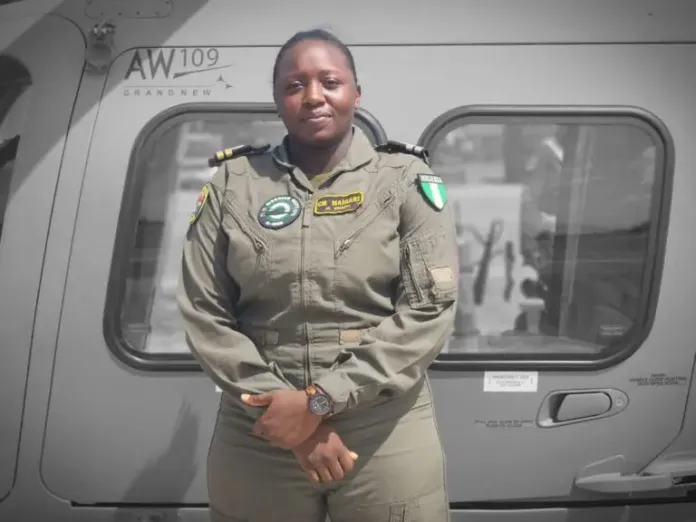
Lt. Changfe Maigari is Nigerian Navy’s first female pilot

History has been made with Lt. Changfe Maigari becoming the first female pilot in the Nigerian Navy (NN) since its inception in 1964.

Born in Kaduna, Maigari, who is married with a daughter, hails from Langtang North Local Government Area of Plateau.

Lt. Changfe Maigar’s remarkable odyssey commenced in 2016 when she graduated from the Nigerian Defence Academy (NDA) and was commissioned as a Sub Lieutenant.

Subsequently, she served aboard the Nigerian Navy Ship Unity.

The News Agency of Nigeria (NAN) reports that Maigari was presented with the ‘Pilot Wing’ award during the 2024 NN Ceremonial Sunset at the Naval Training Command Headquarters (HQ NAVTRAC) in Ebube-Eleme, Rivers, on Friday.

In an interview with NAN on the sidelines of the event, Maigari said that she achieved the milestone after completing her basic pilot training and fulfilling all requirements.

“I grew up in a military environment as my father was an officer in the Nigerian Air Force.

“From an early age, I aspired to become a military pilot and when the opportunity to join the navy arose, I did not hesitate.’’

She recounted how her dream of becoming a naval officer materialised when she was selected among the first group of 20 female regular cadets trained at the NDA.

Maigari said she graduated in 2016 as the Best Graduating Cadet in Academics, earned the Gold Medal Navy award, and in 2019, completed her Sub Lieutenant Technical Course as the overall best.

“There were moments during my training when it seemed I might not succeed in my studies or flight procedures, but I persevered.

“Becoming the first female pilot in the Nigerian Navy feels surreal and a significant milestone, not only for me but for all my female colleagues who can draw inspiration from this achievement

“I also hope my success motivates young civilian girls aspiring to join the military, particularly the Nigerian Navy, to persist because perseverance can overcome any challenge in life,” Maigari advised.

She expressed gratitude to God, her colleagues, and her family for their unwavering support in helping her to achieve the milestone of becoming the first female pilot in the Nigerian Navy.

Presenting the award, the Chief of Naval Staff, Vice Admiral Emmanuel Ogalla, commended Maigari and other award recipients for their exemplary achievements.

He highlighted that the sunset ceremony was a longstanding naval tradition marking the conclusion of the year’s activities.

“It is a moment to reflect on our 2024 accomplishments, strengthen comradeship and honour personnel who distinguished themselves through hard work.’’

The navy chief spoke on the navy’s significant strides in combating oil theft, pipeline vandalism and sea piracy, among other maritime crimes, in 2024.

“In January, the navy launched Operation Delta Sanity which successfully curtailed oil theft and maritime crimes, increasing Nigeria’s daily crude oil production; several oil companies reported achieving a 100 per cent terminal factor.

“Two new naval bases were established in Enugu and Makurdi; the Shagunu outpost was operationalised; we also incorporated a maritime component into Operation Fansar Yamma in the North West.’’

He listed advancements in fleet recapitalisation, including the acquisition of two 32-metre fast patrol boats, an offshore survey vessel, and two helicopters in June.

“In November, three additional helicopters were launched and two 38-metre Sea Eagle fast patrol boats were delivered.

“By January, we expect delivery of three 46-metre fast boats from China, while two 76-metre Offshore Patrol Vessels under construction in Turkey are nearing completion.

“Our indigenous shipbuilding efforts include two 38-metre Seaward Defence Boats, three tugboats and several patrol boats, all scheduled for delivery in 2025,” Ogalla said.

He also noted upgrades to barracks in Lagos, Benue, Enugu and Ogun States, as well as ongoing construction of additional housing for personnel in Navy Towns located in Abuja and Lagos.

Gov. Siminalayi Fubara of Rivers lauded the Nigerian Navy for its efforts in combating oil theft, illegal bunkering and pipeline vandalism.

He acknowledged the immense challenges posed by criminals in sabotaging the nation’s economy through attacks on oil and gas facilities.

“Eliminating these illegal activities in our maritime environment is no small task, especially as 90 per cent of our oil and gas infrastructure is located in the Niger Delta swamps.

“The Rivers Government has always supported and collaborated with the Nigerian Navy and will continue to do so to facilitate its operations in the state.

“As we approach 2025, Nigerians have high expectations and it is vital that we work together to confront and overcome the challenges ahead,” Fubara said.(NAN)

Jubilation in Fubara’s camp as Appeal Court rules against stoppage of federal allocations to Rivers State

  • Federal High Court was misled – Oditah, SAN


Sequel to the Court of Appeal’s judgement on Friday which barred the Central Bank of Nigeria, CBN, from withholding the monthly federal allocations due to Rivers State, there has been jubilation in the camp of Governor Siminalayi Fubara.

The Court sitting in Abuja issued a split ruling on Friday. Two judges ruled in favour of the Rivers State government, while one dissented.

Governor Fubara through his team of lawyers led by Mr. Yusuf Ali, SAN had asked the three-member panel of the appellate court led by Justice Hamma Barka, to set aside a subsisting order of the High Court that compelled CBN to withhold the state’s monthly allocation.

The governor claimed the High Court judgement was given in bad faith.

He had urged the appellate court to allow his appeal marked CA/ABJ/CV/1303/2024, and nullify adverse orders that Justice Joyce Abdulmalik of the Federal High Court made against the state in the judgement she delivered on October 30.

Recall that the federal government backtracked after it first said it would halt the October monthly Federation Account Allocation Committee (FAAC) revenue payment to Rivers State, citing a court order as the reason.

According to Bawa Mokwa, spokesperson for the Office of the Accountant General of the Federation, the decision to stop the payment was in respect of the court order, which barred the Central Bank of Nigeria (CBN) and the federal government from disbursing monthly allocations to the Rivers State government.

The court order was obtained by the factional Rivers State Assembly, led by Martin Amaewhule, who had filed an originating summons against the Rivers State Executive, under the leadership of Simi Fubara.

The Amaewhule faction loyal to former governor and current minister, Nyesom Wike, had alleged that the Rivers State Executive had yet to comply with the order of a Federal High Court directing it to re-present the 2024 appropriation bill to the faction of the Rivers State House of Assembly.

Mokwa emphasised that the Office of the Accountant General of the Federation (OAGF) would respect the court order, following due diligence until a contrary order was issued.

She later cited a subsisting appeal, saying that the allocation could not be stopped.

The FAAC disburses revenue to the three tiers of government, including states, local governments, and the federal government.

In an interview with Arise TV, Senior Advocate of Nigeria, Fidelis Oditah remarked that the Federal High Court was misled on the issue.

“The Federal High Court obviously was misled because the receipt of State allocation is at the heart of the Federation. It’s not a dispute between the lawmakers and the governor. The entitlement to receive FAC monies every month is very central to the federalism we operate. It is not possible for River State to be a federating state and not to receive that money.

“This is very different from the dispute that was had with Governor Tinubu. At that time when Obasanjo seized the local government money, he did not seize the monies of Lagos State, he couldn’t seize the monies but he thought he could seize the monies of the local government. But the Supreme Court in 2004 made it clear that he had no power to do so and that his action was illegal and unconstitutional.

“Of course, there is a difference between OBJ seizing local government funds in Lagos and the Federal High Court purporting to interpret or misinterpret the law. Clearly, the judge did not understand the essence of federalism and had no power to make the order he made because Rivers State cannot be a federating state without being entitled to receive.

“What it does with that money is entirely an internal matter. I see how he qualified the order by saying until there’s a state appropriation law but that’s like placing the cats before the horse.

In the earlier case, it’s a president refusing to release to sign whatever he needed to sign, in this case it’s a court saying the Central Bank should not release. So to that extent, you might draw some artificial distinctions by saying the dispute is always resolved or supposed to be resolved in a constitutional democracy by the courts. But what the court has done is simply a caricature and I think the whole thing is just a theatre of absurdity.”

On the question of there being no proper appropriation law in force in River State since the State Assembly was not properly constituted to make the appropriation law under contention and therefore it is null and void, Oditah said:

“that argument is mistaken there is a clear distinction between the entitlement of a state. The state is not the Governor, the River State is not Fubara, it’s not Wike, it’s more than a geographical area consisting of people who Federated with other 0people from other states. Those are the people who are entitled to the money. The monies do not belong to Fubara, the monies do not belong to the local nor the House of Assembly, so there is no capacity to stop the people of River State from receiving their own share as a federating unit.

“Once that money is received how the money is disbursed is a matter of appropriation law. But that’s why I said that trying to stop it Upstream is trying to place the cat before the horse. The money cannot be stopped, the money does not belong to Fubara, the money belongs to the people of River State that money must come whether or not you can stop Fubara once the money is in River State from misusing it is a dispute between him and the but you cannot stop the people of River State.”

Lagos doctor, Femi Olaleye, freed weeks after Appeal Court nullified his rape conviction

Weeks after the Lagos division of the Court of Appeal nullified his rape conviction, Lagos doctor, Femi Olaleye, has regained his freedom.

Olaleye was arraigned in 2022 by the Lagos State Government at the Sexu@l Offences and Domestic Violence Court, in Ikeja, Lagos and was in October 2023, found guilty of defiling his wife’s 16-year-old niece. The judge held that the prosecution proved the two counts charge of defilement and sexual assault by penetration against Olaleye.

After his conviction in August 2023, his lawyer, Kemi Pinhero, a Senior Advocate of Nigeria (SAN), filed an appeal in November 2023, arguing that there was no direct evidence to confirm the alleged victim’s age.

In a judgement delivered on November 29, 2024, the appeal court held that there was no direct evidence to establish the alleged victim’s age, claiming the prosecution failed to provide documentation proving she was 16 years old at the time of the offence. Read here.

The court then discharged and acquitted Olaleye.

Taking to his Instagram page this afternoon, he shared photos of him leaving the prison on December 3. He wrote;

‘’Freedom is not just a release—it is a rebirth. And on Tuesday, 03/12/24 my new chapter began! @drfemi is back and active!”

Lagos doctor, Femi Olaleye, regains his freedom weeks after Appeal court nullified his r@pe conviction

Read Also: Rape of minor: Enraged Dr Olufemi Olaleye challenges life sentence at Appeal Court

Read Also: Appeal court nullifies rape conviction of Lagos doctor Femi Olaleye

Read Also: Justice Denied: A call to reassess the Appeal Court’s verdict on sexual abuse of a minor, By the Adinya Arise Foundation AAF

AWLA mourns Mufutau Mabokunrinje Adewale Sanni

The African Women Lawyers Association (AWLA) Nigeria expresses its profound condolences to the Nigerian Bar Association, Eti-Osa Branch, on the passing of its pioneer Branch Chairman, Mr. Mufutau Mabokunrinje Adewale Sanni.

Mr. Sanni’s remarkable leadership and dedication laid the foundation for the growth and success of the Eti-Osa Branch, leaving an enduring legacy that will continue to inspire generations within the legal profession. His unwavering commitment to the law and his service to humanity will be deeply missed.

In this moment of loss, we stand in solidarity with the entire Eti-Osa Branch, the Nigerian Bar Association, and the Sanni family. We pray for the strength and fortitude to bear this great loss.

May his soul rest in perfect peace, and may his legacy continue to live on.

Signed:
Dr. Grace Esq.
PRO
 AWLA, Nigeria

Women with disabilities insist on reserved seats for PWDs in National Assembly

Women with disabilities have called on the leadership of the National Assembly to ensure the reservation of seats for Persons with Disabilities (PWDs) in Nigeria’s National Assembly.

The demand was made at the National Convention on the Representation and Inclusion of Persons with Disabilities in the Ongoing Constitutional Reforms.

The event was organized by the Network of Women with Disabilities, supported by UN Women, in collaboration with the National Assembly.

Speaking at the convention, the Speaker of the House of Representatives, Hon. Tajudeen Abbas, represented by the Deputy Speaker, Dr. Benjamin Kalu, underscored the importance of inclusivity in governance. “Disability does not define the ability to lead, create, or inspire. Inclusion is both a necessity and justice,” he stated, reinforcing the commitment of the National Assembly to address the concerns of PWDs.

Lois Auta, the Chief Executive Officer of the Network of Women with Disabilities, presented a comprehensive memorandum on behalf of over 30 million Nigerians with disabilities. The memo, delivered to the Speaker through Dr. Kalu and the Chairman of the Constitutional Review Committee, called for practical measures to ensure disability inclusion. Among the key demands was the reservation of designated seats in the National Assembly for both men and women with disabilities.

The convention, held at the Library Conference Hall within the National Assembly Complex in Abuja, was lauded as a historic milestone. It marked the first time the International Day of Persons with Disabilities was celebrated at the National Assembly and the first occasion where lawmakers directly hosted representatives of disability-focused organizations.

Participants at the event emphasized the symbolic significance of holding the event at such a high level of governance. They argued that it demonstrated a growing recognition of the rights and potential contributions of PWDs in shaping Nigeria’s political and social landscape.

UN Women, a co-organizer of the event, reaffirmed its commitment to advancing gender and disability inclusivity in governance and policy-making. The organization praised the collaborative efforts between lawmakers and advocacy groups, describing them as a pivotal step toward achieving a truly inclusive Nigeria.

The call for reserved seats in the National Assembly for PWDs reflects a broader push for constitutional reforms aimed at reducing systemic barriers and enhancing representation for marginalized groups. Stakeholders expressed hope that the event would inspire more actionable outcomes, ensuring that the voices of PWDs are heard and respected in the highest echelons of decision-making.

As Nigeria continues its journey toward inclusivity, the demands of women with disabilities for designated parliamentary seats serve as a reminder of the need for intentional and sustained efforts to leave no one behind.

Afe Babalola: Of a man and his weakness

By Abimbola Adelakun

Contrary to assertions by some so-called experts who have been prattling all week that Dele Farotimi wrote what he could not logically substantiate in his book Nigeria and its Criminal Justice System, this was a pre-meditated confrontation. Having depleted the legal means to get justice, he wrote to re-litigate the case in the court of public opinion. He seems calculatedly driven by the Yoruba proverb that says no one dies at the same spot they uttered blasphemy. In the time between your speaking and being punished, much can happen to change social dynamics. From the potpourri of events in the past week, Farotimi got what he wanted. One cannot say the same for Afe Babalola who, by now, would have realised that giving a traducer what they want is not the most prudent battle move. My reading is that Farotimi knew Babalola’s peculiar weakness and worked it to advantage. I will get to that momentarily.

The blowback from this case is another instance that hopefully teaches our elites to rein in their tendency to exploit the warped Nigerian justice system that allows criminal defamation as a legal recourse. Criminal defamation might be legal, but it is unjust. It is a law that exists to regulate the differentials of power and access, one of the many ways rich people further privatise public resources. Since lawmakers are too compromised to expunge the law and law enforcers incapable of the reflexivity that will enlighten them on the stupidity of using state resources to fight an individual over another’s integrity, the best we can do for now is pressure the entitled “big man” not to take that path. In a criminal case, the prosecutor investigates to convict. The Nigerian police, perennially short of resources, spares no expense when sent to prosecute criminal defamation on behalf of another narcissist. Why should the state do that on behalf of an ordinary individual? Babalola, especially, is a man of ample resources, who can afford to fight for his reputation on his own dime.

So, on Friday, Babalola’s legal team held a press conference in Ado Ekiti. Among several things, the lead lawyer Owoseni Ajayi said was: “Those pushing Farotimi are not his friends. By the time they led him to the dungeon, he would realise they were deceiving him. Let me advise his family members to apologise to Aare. Aare Babalola is a builder, not interested in destroying Farotimi.” I was intrigued by what he said it takes for them to call off the police hounds. If someone injured your reputation, and that reputation is truly worth the price you placed on it, why would you not be interested in watching them destroyed? Why would Ajayi, so sure of their victory that he boldly asserted that the only possible conclusion to the case is the dungeon, want to settle for the cheap spectacle of Farotimi’s family members with their clasped hands rolling on the floor and begging?

What sealed the picture for me was an article by Kenneth Ikonne where he, like Ajayi, also urged Farotimi to go “beg” Babalola. According to Ikonne, he had won a preliminary objection against Babalola’s suit—which a lawyer is supposed to do, right? —but he was so intimidated by his own victory against the legal giant that he had to go beg Babalola. While Ikonne’s adulating article drips with flattery, it also unwittingly reveals a kabiyesi-complex. It is an attitude that revels in watching other humans’ heads perpetually bowed in servile reverence so they can repay your self-denigration with overwhelming niceness.

Babalola seems like a man who likes to be liked, an attitude is consistently weakening because you must always play nice. Please note that there is a vast difference between being nice because you are a decent human and niceness as manipulation, a means to seduce others into becoming your subject. People of the latter category will take you to the top of the pinnacle, show you the extent of their power and glory, and nicely offer you a portion if only you would bend obsequious knees before them. If you refuse, they will then kick your calves until you fall on your face.

Babalola is so used to a world where junior lawyers who defeat him in court still come to his Ado Ekiti palace to prostrate before him that Farotimi’s boldness to confront him must have been jarring. He resorted to his standard weapons of warfare, but as he must have also found out in the past week, the battle terrain has changed. Even if he wins the case, what will be the social value of a reputation held up by the courts? If Farotimi begs him as his lawyer and others have enjoined, what is done cannot be undone.

However, this goes down, I commend Farotimi’s boldness. We all agree that the Nigerian judiciary is rotten, but the logic of producing rational evidence has made it virtually impossible to progress beyond merely abstract observations. Until we begin to mention names and point accusing fingers at specific people, the issues will remain intractable. Statistically, Nigerian judges and magistrates are the highest receivers of bribes in 2023, beating even the Customs/Immigration! This is according to the NBS. Those who facilitated these transactions are not ghosts. We have all been witnesses to the several instances where retiring judges have severely deplored the rot in the judiciary. It is amusing to see some people pretending Farotimi revealed what they did not already know.

Our society maintains an overly reverential attitude toward people who have money and power, and are elderly. When a person combines all three, we are virtually cowed before their almighty presence. Otherwise, why can we not ask, if defamation is an offence that supposedly lessens someone’s reputational worth, what exactly would constitute it in the case of persons who have practised law in morally decrepit and with progressively weakened institutions like Nigeria for 60-plus years? Which of the atrocities that presently bedevils the country does not have the hands of the so-called learned class in it? This is not to disparage the legal profession or caricature lawyers, but we cannot talk about what is wrong with Nigeria today without the role lawyers have played in vandalising the temple of justice. From the so-called “legal luminaries” who—through endless frivolous election petitions—rendered democracy incoherent to the ones with the “SAN” appendage to their names who fraternise with politicians, they remade the country in their amoral image.

We were all here when a partner in the firm of a high-profile lawyer solicited the client of another, saying their principal’s political influence would “significantly switch things in favour” of the prospective client. While that woman was disowned and eventually debarred, it was a moment of self-revelation as to how the justice system operates. Big names in the legal system do not necessarily correspond with a deep knowledge of the law. It just means they know which judge to buy and which string to pull. We witnessed a lawmaker publicly admitting that his judge’s wife helped his colleagues win their various cases.

In a serious country, every case that a woman adjudicated would have been recalled and scrutinised, but this is Nigeria. Nothing ever happens here. This is the utterly compromised ecosystem in which Babalola has practised law and thrived to the point he built a magnificent university. He was also a lawyer and confidant to former President Olusegun Obasanjo, whose administration reputation was thoroughly corrupt. Nobody, not even the staunchest of his defenders, has said of Farotimi’s allegations that “it cannot possibly be true”.  What they all say is, “It cannot be proven,” and that is telling enough.

Given the contradictions of his profession, Babalola should have been circumspect enough to not jump into a public contest over his reputation. He seems to me like a man who has invested in being nice just so that he would not be remembered as a villain in Nigeria’s story. Now he is no longer the man with the carefully curated legacy who set out to redeem his image but the one who proved his critic right.

Drugged over a 10-year period, her husband got more than 50 men to rape her

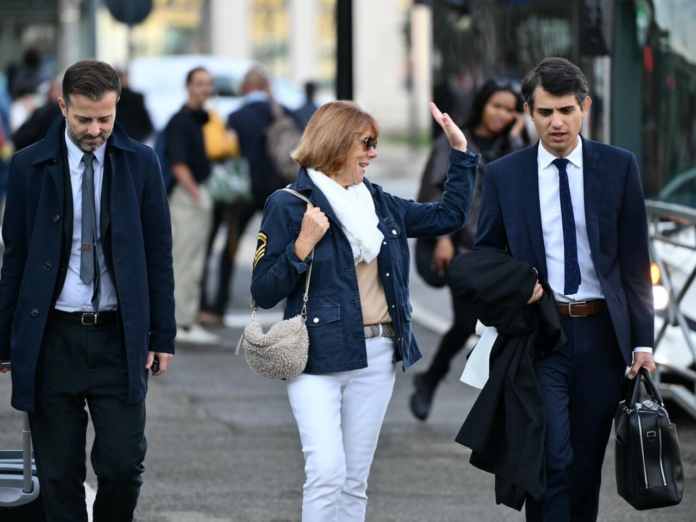
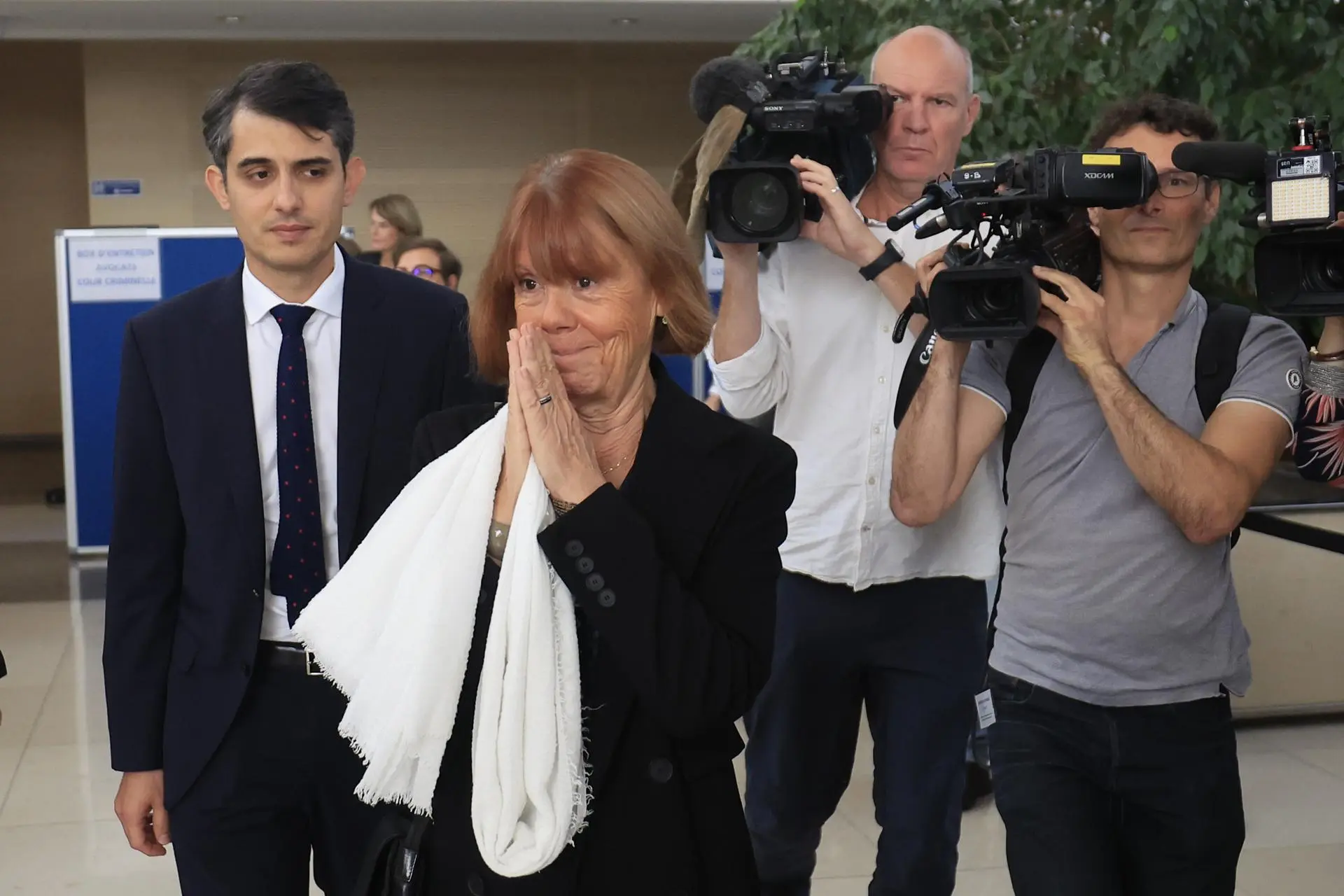
For three and a half months Giselle Pelicot has attended court hearings in Avignon, France against her former husband and 50 other men accused of raping her while she was drugged unconscious. Pelicot’s insistence that the trial be made public to raise awareness of the dangers of the drug used on her and her refusal to be shamed has won her international acclaim.

Her husband orchestrating her sexual abuse by strangers could have broken her. But by standing up to her abusers in court and demanding they be ashamed, France‘s Gisele Pelicot has become a feminist champion.

Three and a half months of sometimes gruelling hearings, including graphic video evidence, are set to culminate when judges hand down sentences by the end of next week.

When the trial of her now ex-husband and 50 other defendants opened in the French city of Avignon in September, journalists saw a woman with short red hair, hiding behind sunglasses.

The main victim in the case that shocked France was a grandmother whose life partner had admitted to drugging her for almost a decade so he and dozens of strangers he recruited online could rape her while unconscious.

But then Gisele Pelicot waived her right to anonymity and demanded the public be allowed access to the trial to raise awareness about drug use to commit abuse.

She won hearts across France and abroad, and triggered a flurry of art in her honour, after she said it was her abusers — not her — who should be ashamed.

“I wanted all women who are rape victims to say to themselves: ‘Mrs Pelicot did it, so we can do it too’,” she told the court in October.

“It’s not us who should feel shame, but them,” she added, referring to perpetrators.

As news of the trial spread, protests erupted across France to show support and fans started cheering her or even greeting her with flowers when she arrived in court.

And over the trial’s course, Gisele Pelicot shed her dark sunglasses.

‘Rape is rape’

As the verdict on December 19 or 20 approaches, the 72-year-old has made it onto the BBC’s 100 Women list for 2024, alongside fellow mass rape survivor and Nobel Prize winner Nadia Murad and Hollywood actor Sharon Stone.

Pelicot in August obtained a divorce from her husband, who has confessed to the abuse after meticulously documenting it with photos and videos.

She has moved away from the southern town of Mazan where, in her own words, her husband Dominique Pelicot treated her like “a piece of meat” or a “rag doll” for years.

She now uses her maiden name, but during the trial has asked the media to use her former name as a married woman — the one passed on to some of her seven grandchildren.

In mid-September, she dropped her usual reserve to talk of her humiliation and her anger towards several lawyers who had made insinuations about her ordeal.

“Rape is rape,” she said.

In October, she said she was “broken” but determined to change society.

She again told the court last month it was time for a “macho, patriarchal” society to shift its attitude towards rape.

She said the marathon hearings were an examination of the “cowardice” of the men who took part in the assaults.

Many had argued they thought they were taking part in a couple’s fantasy after consent by proxy through her husband.

She expressed her anger that none of her abusers alerted the police about the rapes, which occurred between 2011 and 2020.

Several took part in the abuse six times.

Fifty men besides her 72-year-old ex-husband are on trial, including one who did not rape Gisele Pelicot but repeatedly abused his own wife with Dominique Pelicot’s help.

Several of the co-defendants have admitted to rape.

But more than 20 other suspects remain at large as investigators had not managed to identify them before the start of the mass trial.

Memory lapses

The daughter of a member of the military, Gisele Pelicot was born on December 7, 1952 in Germany, returning to France with her family when she was five.

When she was nine, her mother, aged just 35, died of cancer.

Her older brother Michel died of a heart attack aged 43, before her 20th birthday.

She met Dominique Pelicot, her future husband and rapist, in 1971.

She had dreamt of becoming a hairdresser but instead studied to be a typist. After a few years temping, she joined France’s national electricity company EDF, ending her career in a logistics service for its nuclear power plants.

At home, she looked after her three children, and then seven grandchildren.

After she retired, she enjoyed walking and singing in a local choir.

Only when the police caught her husband filming up women’s skirts in a supermarket in 2020 did she find out the true reason behind her troubling memory lapses.

(AFP)

The sad end of the black security guard who sank Nixon

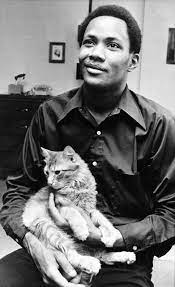
Frank Wills expected another boring and tedious night.

The twenty-four-year-old security guard was making his normal rounds on June 17, 1972. He was usually alone in the office building during his overnight shift. His routine consisted of checking each door in the large complex. The building was considered so safe, Wills only carried a can of mace for personal defense.

He came on duty at midnight and carried out his first check of the offices, starting in the basement and working methodically up to the 11th floor. It was tedious work, trying the handle of each office door to confirm it was properly secured.

It was also a sticky night and, when he had finished his first round, Wills went for an orange juice at the Howard Johnson motel across the road. As he passed by a basement door in the parking garage, he noticed a piece of tape covering the latch. He did not consider this unusual at the time, and removed the gaffer’s tape.

“A lot of times we’d have engineers doing work late at night. They’d place something in the door because they’d be coming right back so I really didn’t pay much attention to it.”

When he came back, he saw the door taped again, making him immediately suspicious. It was time to report a possible burglary.

Frank Wills

“I just got to thinking,” said Wills, “there’s somebody in this building besides me.” So he rushed up to the lobby telephone, called for the services of the Second Precinct Police. Nothing big,” recalled Wills. “That’s the instructions. With just a can of mace, I couldn’t confront a burglar who might have a gun.”

D.C. Metro police officers John Barrett and Paul Leeper arrived in minutes. Wills showed them the door with tape still covering the latch. On their way up to the sixth floor, Wills was notified about another tenant that needed to leave the building. He left to go help.

The officers continued on, and discovered yet more tape on a latch, leading to a sixth floor office. They burst into the room, guns drawn. When Leeper and Barrett shouted for the suspects to put their hands in the air, 10 hands went up — the officers in plainclothes were facing a group of burglars in business suits.

“McCord said to me twice, he said, ‘Are you the police?’ And I thought, ‘Why is he asking such a silly question? Of course we’re the police,’” Leeper said. “I don’t think I’ve ever locked up another burglar that was dressed in a suit and tie and was in middle age.”

Five men were arrested. Bernard L. Barker, Virgilio Gonzalez, Eugenio Martinez, James McCord Jr., and Frank Sturgis were caught with “bugging devices, tear gas pens, many, many rolls of film, locksmith tools, and thousands of dollars in hundred dollar bills consecutively ordered.”

The men were linked to a nefarious group operating as fixers for President Richard Nixon: “The White House Plumbers.” The office they were sent to wiretap, the Democratic National Committee, was the target of Nixon’s reelection campaign. This was the first chain in a series of events that ended with the historic resignation of the president. Nixon, haughty and paranoid, believed that anything was on the table to guarantee him a win in the 1972 election.

Nixon paid a price for his arrogance. For all the meticulous planning of the White House Plumbers, they were foiled by an observant night watchman at the Watergate office complex.

Frank Wills was an immediate celebrity. He received an award from the Democratic National Committee and the prestigious“Martin Luther King” award from the Southern Christian Leadership Conference. The security guard was in great demand for media interviews.

He was even recruited to play himself in the 1976 classic film All the President’s Men. The Watergate owners gave him an “insultingly” low raise, from $80 to $82.50 a week, but he ultimately left due to their “racist disrespect.”

Unfortunately, Wills was not able to parlay his celebrity into steady work. He subsisted on intermittent security work and odd jobs, and spent his remaining years caring for his ailing aunt. He died from an inoperable brain tumor on September 27, 2000 at age 52.

It seemed everybody was able to make a career, a buck or a book out of Watergate, except the man whose sharp eye opened the floodgates of history. Bob Woodward characterized his contribution this way: “He’s the only one in Watergate who did his job perfectly.”

I like Woodward’s description, but here’s the one that gave me chills when I first read it in Wills’s obituary in the New York Times. Democratic congressman James Mann of South Carolina, casting his vote for impeachment, said “If there is no accountability, another president will feel free to do as he chooses.

But the next time there may be no watchman in the night.

Nigeria emerges as one of five countries for the implementation of Women in Leadership in Law (WILIL) project

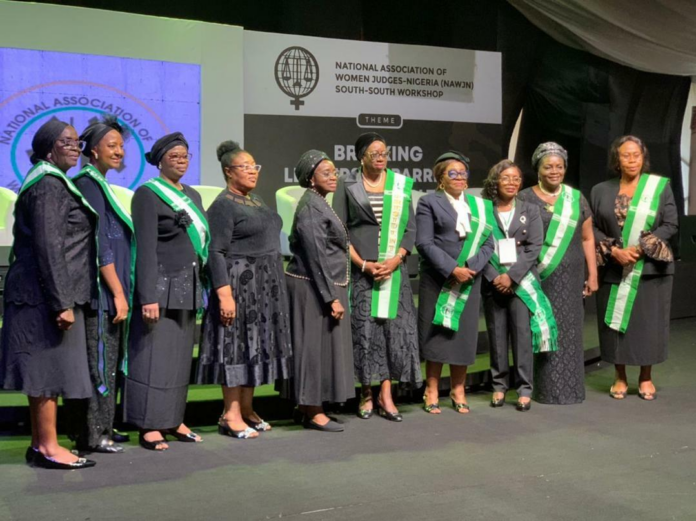
The International Association of Women Judges (IAWJ) in partnership with CO-IMPACT a global philanthropic collaborative fund has selected Nigeria as one of the five countries to develop and implement a multi-year programme to enable, support and promote sustainable leadership pathways for women in the judiciary across the global South.
The Global South is a term that refers to countries in Asia, Africa, Latin America, and Oceania.

The project, Women in Leadership in Law (WILIL) initiative is a three-year programme that endeavours to identify and encourage the removal of barriers and obstacles in the way of women entering, thriving and advancing as leaders in the judiciary in a sustainable manner.
Each of the five countries — Nigeria, South Africa, Kenya, Mexico and the Philippines has its national affiliate to IAWJ and is required to design and work out its modalities for achieving success of the project based on the peculiarities of their individual countries.

Fortunately for Nigeria, the idea of the WILIL project emerged during two interesting tenures. The tenure of Hon. Justice Binta Nyako of the Federal High Court, who was sworn in March 2023 as President of IAWJ and that of the Chief Justice of Nigeria, Hon Justice Kudirat Kekere-Ekun. Hon. Justice Kekere-Ekun is the President of the National Association of Women Judges Nigeria (NAWJN).

To lead the Nigerian team which is still fine-tuning the details of its work in Nigeria are two retired justices of the Court of Appeal — Hon Justice Chinwe Iyizoba JCA (rtd) and Hon. Justice Tani Yusuf Hassan JCA (rtd). They were appointed by NAWJN as judicial coordinators of the project.

Four serving judges including, Hon. Justice Tamunoigoni Susan Oji, Hon Justice Angela Obi Moku, Hon. Justice Binta Mohammed and Hon Justice Mujibat Iyabode Oshodi will serve as technical committee members.

Trainee Herbalist allegedly kills two-month-old son for rituals in Ogun

Officers of the Ogun State Police Command have arrested a trainee herbalist, Ifagbenga Taiwo, over the alleged killing of his 41-day-old son for ritual purposes in the Keesi area of Adatan, Abeokuta.

It was gathered that the incident occurred on Monday, December 9, 2024, after the baby’s mother, Raimat Wasilat, laid him on a bed while washing clothes outside their home.

According to reports, the mother returned inside after washing only to find her son’s lifeless body with a slit throat.

In two videos sighted online, residents of the area narrated how the gruesome incident happened.

The mother’s cry for help alerted neighbours, prompting them to gather at her home.

It was discovered that the suspected assailant had entered through the wooden window, slit the infant’s throat, and left him in a pool of blood.

“I was hearing some noise and we came to this house to check what was happening. It was when we entered the room that we realised someone had entered through the window and slit the throat of the baby,” a neighbour narrated.

“The mother was washing clothes outside at this spot (pointing to the spot) before she went inside and discovered the lifeless body of her son who was just 41 days old.”

Another resident, Mukaila Olaide, identified as the father of the infant’s mother, explained that they were drawn by the noise which prompted them to visit the house and find the slaughtered infant.

“We were sitting some distance away from the house when we heard a noise. It was the noise that led us to rush down to the house only to discover that the boy had been slaughtered,” he said.

“That was all we saw. The police had come to pick up the mother and the husband to the station.”

The spokesperson of the command, Omolola Odutola, who confirmed the incident in an interview with Punch on Tuesday, said the infant’s mother accused her husband of the gruesome murder, prompting the police to arrest him.

“At about 1400hrs, the police received a report from the Iteesi Itoko area in Abeokuta regarding the slaughter of a two-month-old infant, Ifakorede Ajani, inside the room where his mother had placed him on a bed,” the PPRO said.

“The mother, Raimat Wasilat, from Keesi, strongly suspected her husband, Ifagbenga Taiwo, who is training to be a herbalist. She alleges that he intended to use the child’s blood for rituals

“The suspect has been detained, the crime scene was investigated, and the body was transported to the hospital for autopsy

“Investigation is underway to discover the details of this horrific act.”

TIPS