Home Blog Page 479

In Re Kemi Badenoch: Farooq Kperogi, Hope Eghagha, and the perspectives of a sceptic

By V. C. Mba, Esq.

Professors Kperogi and Eghagha are some of the most engaging essayists one may ever encounter; both writers would immediately arrest you with their opening paragraphs and hold you spellbound until the last sentence — grandmasters of the art of writing and excellent polemicists.

Characteristically, their pieces on Ms Kemi Badenoch’s put-down of the Vice President of Nigeria, the country of her birth, did not disappoint, except that none of the excellent essayists and polemicists either has made any attempt to deny the veracity of Ms Kemi Badenoch’s claims, or (where, that is if, there has been any such attempt at all) has failed in disputing any of Kemi Badenoch’s said claims. Their only complaint was that yes, we all know that Nigeria is in a deep mess, but Kemi Badenoch shouldn’t have said so in the market square or (to use Prof Eghagha’s words) should not have pointed a left finger at her roots! And I ask, but why not?

Yes, distinguished Prof Eghagha has copiously cited some undeniably egregious evil immanents in Kemi Badenoch’s newfound country, but has failed to recognize the fact that the various Commissions of Inquiries in that country at least had objectively, independently, dispassionately and empirically carried out their briefs, and had come to a verifiable conclusion on the issue of whether or not the British system was racist — concluding that ‘black and minority ethnic individuals were more likely to be stopped and searched, arrested and imprisoned than their white counterparts’.

Respected Professors Kperogi and Eghagha, while uncharacteristically missing the point — on the incontrovertible and yet-to-be-cncontroverted veracity of Ms Kemi’s allegations against egregious institutional failures in Nigeria — have each gone on a wild-goose-chase regaling themselves with obvious non sequiturs. Example, while positing, albeit without any verifiable and plausible evidence, that the North of Nigeria is the progenitor of the Yoruba of Southwestern Nigeria (according to respected Professor Kperogi) and or that Ms Kemi Badenoch had pointed at her father’s homestead with the left hand (according to Prof Eghagha), both authors have annoyingly failed to say any word to contradict or discredit the veracity of Ms Badenoch’s seemingly unassailable delivery. Does this not mean that Kemi was right?

Notwithstanding Prof Eghagha’s unsuccessful attempt to discredit the UK, it is important to assert that, at least, the institutional framework of the United Kingdom was able to conclude that ‘black and minority ethnic individuals were more likely to be stopped and searched, arrested, and imprisoned than their white counterparts’, unlike their Nigerian counterparts which have consistently and unfortunately proven incapable of any such depth or objectiveness in their investigations, and this is integral to the immanent evils Kemi Badenoch riles against.

In my respectful opinion, Ms Badenoch is right on much of her claims or at least on the frightening apocalyptic insecurity in Northern Nigeria; she’s unimpeachable notwithstanding that the mob and their apologists perhaps feel that Kemi Badenoch shouldn’t have exposed in the open, the depth of decadence in Nigeria, and, again, I ask why not?

With due respect, it’s disgusting that the two distinguished Professors, Kperogi and Eghagha, like some citizens with a voice are calling for Ms Badenoch’s head on a platter, not because of what she said, but unfortunately on account of how, or the forum, she said it! As a piece of counsel to each of Prof Farooq and Prof Eghagha, the very first steps towards self-redemption is the ability to tell oneself the truth.

As bitter as it may be, Kemi Badenoch has told us the truth about ourselves. A reasonable bystander would have thought that instead of all this hypocritical righteous indignation, and our usual play-to-the-gallery, we should rather use the opportunity afforded by Ms Badenoch’s apposite reprimand, to ask ourselves some ontological questions with a view to finding lasting solutions to our problems?

V.C Mba, Esq
(23 December 2024)

National Assembly should repeal criminal libel now, By Tonnie Iredia

The handling of the on-going defamation case between legal giant, Afe Babalola and social activist, Dele Farotimi has provided strong evidence that Nigeria has probably lost its fight against media trial. Many years back, there was the well-articulated viewpoint that because the word “trial” is associated with the process of justice, trial by the media constitutes an undue interference in the process of justice delivery. The argument has since been overtaken by the nature of social media which has made public communication exceedingly rampant, just as lawyers have themselves contributed to the development by engaging in the new wave of minute-by-minute commentary on cases already before a court of justice. Apart from publicity-seeking lawyers, some others with scanty briefs are too anxious to let the public know that they are learned.

Unfortunately, the Nigerian public has not been well served by the trend in which both parties in the case have already found one another guilty. In the process, the parties have also made it easy to identify the bias of each commentator while establishing that Nigerian law was in a state of confusion. The original point made was that Farotimi was smuggled into Ekiti from Lagos for trial because libel had been decriminalized in Lagos state. Another version said Lagos and Edo states were the only two states where libel had been downgraded to civil wrong before it was realized that Ekiti itself had done same in 2021. Those who were thus unable to comprehend why the charge was read in Ekiti were later informed that it was still a crime as a federal offence. So, how can anyone pacify the social media mob with the gossip that a federal crime was being happily prosecuted in Ekiti which had decriminalized same offence in her own territory?

Here, one can say that the irrepressible prolific writer Chidi Odinkalu may have greatly influenced some of the views of the social media activists. Odinkalu had recalled the story of Paul Anyebe a judge in Benue state who was once prosecuted on a-two count charge of attempted murder and illegal possession of firearms. On the latter, he was convicted in the lower courts but freed at the Supreme Court. What the apex court established was that the illegal possession of firearms being a federal offence could only be prosecuted by the Attorney General of the Federation. Expectedly, the public may not have understood why Dele Farotimi was being tried in Ekiti state for criminal libel which is a federal offence. In the circumstance, any person was free to believe that the trial of Farotimi in Ado Ekiti was influenced by some big personality.

The views of a few conservative intellectuals on Babalola’s side did not convince some ‘diehards.’ As one commentator on social media observed, the write-up with the title “Dele Farotimi: When activism is no licence to defame” gave an impression that the accused had already been found guilty hence the conclusion that activism was no licence to defame others. No one could have defamed anybody yet until after judgment. As a matter of fact, with a few people already volunteering to testify in favour of Farotimi, the presumption of guilt is shaken. At the same time, writers on the side of the complainant have spent ample time telling us about the great achievements of Babalola as if the man’s career and feat were in doubt. There is nothing strange about people seeking to bring down a great character because it is only those on top that can be brought down. One commentator was so incensed that he reduced the issue to how African culture expects young people to respect elders.

Those who were unable to immediately comprehend the overwhelming public interest in the matter were wrongly thinking of Babalola and Farotimi. They greatly missed the point because what attracted everyone to the subject was the common public pain of judicial corruption in the country. Nigerians are not pleased with the judiciary. The other day when Chief Justice Kekere-Ekun tried to explain the problem of conflicting judgments, one critic on radio merely reminded listeners that the ugly trend was a recent phenomenon. To be honest, too many inexplicable things have happened in Nigeria of recent; a good example being the case of a governorship election petition in which the oral judgment was the opposite of the certified true copy of the same judgment.

Again, although criminal libel is a written law that can be located and read, it still did not make sense to many people. On the other hand, it is easy to appreciate civil defamation where anyone who was defamed could sue and be compensated for whatever damage was done. It is truly hard to convince people that Farotimi’s alleged defamation against Babalola should be punished as if he defamed every other person whose names he never mentioned in his book. Consequently, social media mob can never understand how the attack on a particular person’s reputation can adversely affect the reputation of another person who was not referred to in the statement that was considered to be defamatory. For as long as it exists, criminal libel will always be perceived more as bad law.

From the above, it is obvious that decriminalizing libel in Nigeria is overdue. It is indeed one of the failings of our National Assembly that obsolete colonial laws of sedition and criminal libel are still in our law books more than half a century after the colonialists who originated them had left Nigeria. The obsolete laws are no doubt an affront on free speech provided for by Section 39 of the Constitution of the Federal Republic 1999 and Article 9 of the African Charter on Human and People’s Rights Act. Each time this argument is presented, it is countered by the purpose of Section 45 of our constitution which recognizes that certain laws are reasonably justifiable in a democracy. Is it justifiably reasonable to take aspects of the law of sedition and incorporate them into the Cybercrimes act to harass citizens? Is it not repugnant to criminalize libel and equate an attack on a person’s reputation to an attack on government and the entire society?

To make matters worse, the procedure attached to criminal libel can hardly meet the course of justice making it clearly undesirable. What usually happens is that when a person files a petition, accusing someone of making a false or damaging statement against him or her, the accused is usually brutalized even before the case is determined or indeed before getting to the point of saying anything. In the case of Farotimi for example, he was placed on handcuffs, denied bail and imprisoned for no less than two weeks without any opportunity to even show that he can prove the truth of his allegation. Yet, the law accepts truth as an absolute defence. Such a procedure can only be forcefully justified in a dictatorship and not a democracy.

Since we are no longer under colonial or military rule, it is important to repeal criminal libel so that a party that can win a case at the end is not first brutalized before the case starts just as the loser’s sanction comes only after conviction. Nigeria would certainly be better off if sufficient attention is paid to law reforms. One of the advantages of such is that it produces a uniform system of laws and justice delivery. The situation of a few states decriminalizing libel while the federal system remains stagnant is ill advisable. Besides, it is not in the interest of the nation to focus on yearly review of Electoral Act while obsolete colonial laws remain in our books.

We have had ample time to change the situation. As far back as 1985 when former governor Jim Nwobodo sued one writer, Arthur Nwankwo over an article he wrote criticising the governor, Hon Justice Olatawura JCA made the following profound statements: “we are no longer the illiterates or the mob society our colonial masters had in mind when certain laws were promulgated. Let us not diminish from the freedom gained from our colonial masters by resorting to laws enacted by them to suit their purpose.” Instead, let us enjoy the freedom of democracy that at the same time abhors reckless statements that can hurt the reputation that some citizens have built over the years.

Shock as 28-year-old dad beheads one-year-old son

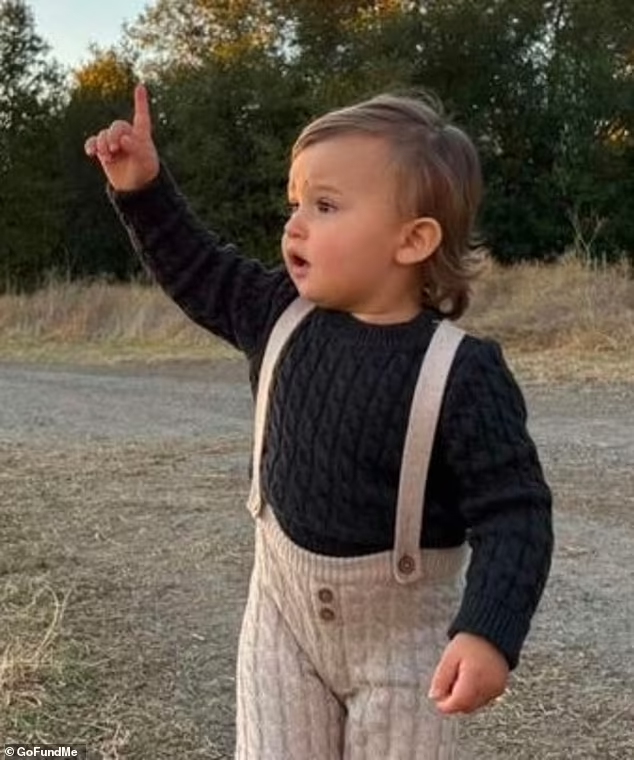
A 28-year-old father has been arrested for beheading his one-year-old son in a shocking crime in California, United States.

Andrey Demskiy was cuffed and charged by the Sacramento County Sheriff’s Office (SCSO) Friday – following what relatives called ‘a devastating chain of events.’

After being called to a home along Versailles Way and Lamure Court around 4:15 am, investigators from the sheriff’s office who said Demskiy was accused by his wife of assaulting her and her mother, described the crime scene as one of the worst they had ever seen.

The cops explained that responding to a call of a domestic disturbance between Demskiy and the boy’s mother, the suspect at first would not let them in.

The SCSO said in a press release shared on Facebook on Friday, December 20, that Andrey Demskiy was arrested around 4:15 a.m. local time that morning following a 911 call about a “family disturbance.”

After Demskiy “refused to answer the door and surrender peacefully,” authorities learned that a toddler was alone in the residence with the man. They wrote that the father had “possibly injured the child after throwing him.” SCSO deputies then “forced entered” the home, they said.

Once inside, police discovered the “uncooperative” and “physically resistive” Demskiy, as well as the severed head of a child in a bedroom. The Sheriff’s Child Abuse Bureau Detectives, as well as crime scene investigators, then arrived at the scene.

According to authorities, Demskiy used a knife to “behead and murder” the one-year-old child.

“Detectives arrested and booked him into the Sacramento County Main Jail, where he remains in custody ineligible for bail,” the SCSO wrote.

According to his jail records, Demskiy has been charged with three felonies: assault by means of force likely to produce great bodily injury, corporal injury to a spouse of a cohabitant and murder. His next court appearance is scheduled for 24 December.

Per NBC affiliate KCRA, the child has since been identified by the Sacramento County Coroner’s Office as Micha Demskiy. Loved ones have also identified the child via a GoFundMe campaign, which has since doubled its $25,000 goal with over $57,000 in donations to support the boy’s family as of Sunday, 22 December. The fundraiser identified the child’s mother as Angelina Demskiy.

The Sacramento County Coroner’s Office did not immediately respond to PEOPLE’s request for confirmation on 22 December.

Amid Demskiy’s arrest, his mother-in-law was “transported to the hospital by ambulance for her injuries, which were not life-threatening,” per the SCSO.

Amar Gandhi, a spokesperson for the SCSO, told KCRA that the alleged beheading was “one of the most horrific things” he’s learned of. He added that authorities were “visibly shaken.”

“For this family who has got to pick up the pieces and go on — I mean, their world is shattered,” Gandhi said.

WKYC reported that a memorial has since been made outside of the child’s home, featuring flowers, teddy bears and candles.

Gandhi told the outlet that he “cannot think of a worse call in 20 years” and that authorities will have the case “in their hearts and minds for the rest of their careers and beyond.”

The GoFundMe campaign, organized by Lilli Eirikh, said that Micah died following a “devastating chain of events.”

“The sweet little boy was a kind and joyful soul, loving all people and especially dogs,” she wrote. “His kind heart and beautiful smile warmed the hearts of everyone he came in contact with. He loved his family and especially his mama. He loved being with family, going to the park, and singing hymns with his family.”

“If you have it on your heart to help our family in this difficult time, please keep us in your prayers,” Eirikh continued. “If you’re able to help financially, may God bless you threefold. If you are not able to help financially, please pray for the Demskiy and Vinnikov families!”

Credits: People.com

Evil mum and dad jailed for leaving ’emaciated’ 3-year-old boy in urine-soaked conservatory with only pet food to eat

‘If either of you treated a dog like that, you would be going to prison’.

This was what a horrified judge told a monstrous mother and father as he jailed them for neglecting a three-year-old boy so badly a doctor said he looked like he’d been kept in a ‘concentration camp’.

The couple from Nottingham, who cannot be named for legal reasons, were found to have habitually left the young boy alone in the conservatory away from their other children with only a pet lizard and rabbit to keep him company.

He was so starved he tried to eat pet food.

But the most chilling detail of this case is the sickening reason for the ill-treatment found in text messages between the parents.

Click here to read the complete story.

Desperate crowds and foods of death

By Lasisi Olagunju

I died one bright day in 1969 — yes, died; crushed by a motorcyclist. It happened on Ileya Day (Eid el Kabir) in my hometown. I did not know, and still do not know, how it happened. All I know is that I was following my father to the Eid praying ground in the morning, then I followed a crowd of other children to cross the road to the other side,…then I woke up in the afternoon, medics all over me, stitching and cleaning. Where I was turned out to be the Baptist Welfare Centre in neighbouring Iree town.

A day that was supposed to be a day of feast almost turned grim in our home. For parents of the children who died last Wednesday in Ibadan, and families who lost loved ones on Saturday in Abuja and Okija, Anambra State, this Christmas and the New Year are certain days of mourning. May God comfort them.

The dead got eaten while looking for what to eat. I pray that the bereaved be healed of their mortal wounds. They do not have my parents’ luck: I came back from the dead, head heavily sutured. The children who went to Basorun in Ibadan on Wednesday last week didn’t come back; they won’t be back, forever. Every Eid el Kabir reminds me of my own aborted (abortive) death. For the Ibadan, Abuja and Okija families, every year end henceforth will come with spectral, ghostly memories. What happened is an evergreen tragedy, monumental in all ways.

When a similar crowd crush killed 183 children in a hall in Sunderland, United Kingdom, on 16 June, 1883, one of the survivors contrasted the mood in his family with the atmosphere in unfortunate homes in that city: “In our house there was joy and thanksgiving, and one old neighbour laid his hand on my head and told me that my death had not yet been decreed. But in many homes, there was misery and desolation, many a heart was stricken with woe, and many a mother as she bent in sorrow over a loved one so strangely still (said that) indeed, the ways of God are not as our ways.” William Codling, who managed to escape the horrid incident with his sister, wrote the above in December 1894 (eleven years after the tragedy).

Death existed to kill the aged, but today, it is murdering the young, north, east and west. Why? Fuji music philosopher, Saheed Osupa, asks the same question in a song: “Ikú np’àgbà/ èwo ni t’omodé?/ Ilé ayé mà wá di rúdurùdu.” The world is spoilt. In his ‘Yoruba Responses to The Fear of Death’ (1960), Peter Morton-Williams describes death of the young among the Yoruba as “horrifying, an unnatural calamity.” It is true that what we call àìgboràn- headstrong foolhardiness – sometimes kills, but it is also true that the will of the enemy kills more. The enemy in the context of this death discourse is the Nigerian state. Mass misery was the enemy that processed the disasters of last week.

Hunger is a very jealous tenant; it habours no neighbour – not the fear of death, not of death itself. If the hungry feared death, they would know that an uncontrolled crowd is a barrel bomb that kills without borders. Hunger was the devil in the fatal gatherings of Ibadan, Abuja and Okija. I blame the lords of the land. On their watch, everyone begs, or rummages the trash can or joins deadly food rallies for IDP rations. Those are the options. The other available option is suicide – and many pursue life today in ways that suggest they do not mind dying as an escape route.

In 1883, what was promised the kids of Sunderland were toys and “the greatest treat for children ever given.” In Ibadan last Wednesday, what the children were promised was N5,000 for the first 5,000 of them that showed up. Some mothers heard that and put one plus one together: Two kids meant N10,000; three kids, N15,000. They did the maths and thought it was right to gather and rush their entire kids into that ground of death in search of hope. Many got there as early as 5 am – five hours before the event was due to start; some mothers reportedly even slept overnight there with their kids to beat the queue. Some more desperate ones threw their kids across the fence into the already choked and charged school compound, the event venue. It was like feeding their future to the demon of misery. Mr. Oriyomi Hamzat, whose Agidigbo FM radio station partnered with the organizers, says in a trending audio clip: “I saw how people were falling on one another. As I was rescuing those that fell, more people were rushing and stepping on those that were on the ground because of small gifts. I pity that woman, and I pity myself. I will never do this again.”

In Okija, Anambra State, the promise was rice; in Abuja, it was imprecise ‘palliative.’ The Ibadan, Abuja and Okija gesture of magnanimity unfortunately turned to foods of death; a pledged gift of chickens took whole bulls from many families. In ‘The Gift, and Death, of Blackness,’ Joseph Winters of Duke University, North Carolina, United States, writes about what he calls “the gift of death.” Some gifts become poisonous when wrongly given; they kill. We have become so depraved that we volubly advertise philanthropy. Gordon B. Hancock, in a June 1926 Social Forces article, writes on “the evils which inhere in excessive advertising.” He asks one troubling question: “Is the unlimited sway of advertising compatible with society’s highest good?” Whoever is probing last week’s serial disasters should seek an answer to that question. An effusive promise of gifts on a popular radio station roused several thousands of hungry children and adults to the Ibadan funfair of death. Similarly hyped promises of gifts poured over two thousand school children into Victoria Hall in Sunderland in 1883 – 141 years ago. William Codling, who was quoted above, narrated how the Sunderland disaster happened: “It began something in this wise: A man delivered a handful of bills outside the school doors on the Friday night setting forth the entertainment in glowing terms and we were all wild to go.” And they went. As it turned out, no one left that venue, and all the Nigerian venues of last week, with what was promised. Instead, death, which was not promised, was the harvest. In the UK experience, a whole class of 30 Sunday School children were among those picked up dead from the stampede. In Ibadan, some mothers reportedly lost all they had to the tragedy.

Hunger, or even fear of hunger, push people to plunge into deadly irrationality. On Thursday, 24 October, 1918, eleven women, four children and a police officer died in a stampede at a market in Cairo, Egypt, simply because they feared they wouldn’t get enough cereals to buy. They were not looking for freebies; they died because they scrambled to buy what was scarce.

“In the aftermath of tragedies,” writes Ellen Walker in a November, 2022 article, “it’s easy to focus on the assignation of blame. But how well do we understand the causes of crushing crowds?” The piece is on ‘Death by Crowding.’ All probes and available literature on crowd accidents abroad blame the same issues: poor and “inadequate planning, excited crowd, lack of crowd management and a flaw or hazard in a facility” (J. F. Dickie, 1995: 318). We have those factors here compounded viciously by unremitting hunger courtesy of bumbling governance, and a colada of existential concerns.

Grim and tragic as last week was, will it be the last? We pray it is so, but it may not be unless we check the causes and yank off the throttle, drivers of such tragedies. In ‘The Life of Reason’, Spanish American philosopher, George Santayana, warns that: “Those who cannot remember the past are condemned to repeat it.”

A passage in J. F. Dickie’s ‘Major Crowd Catastrophes’ published in 1995 suggests exactly that. Dickie writes about the Sunderland disaster of 1883 with 183 fatalities, the London crowd crush of 1943 with 173 fatalities; Bolton of 1946 with 33 fatalities; Glasgow of 1971 with 66 fatalities and Sheffield of 1989 with 96 fatalities. He then sculptures those crowd-crushing disasters into a dizzying revolving door of calamities. Because man does not learn from his bad experiences, they come in repeated times like Wole Soyinka’s Abiku. Dickie notes that “the Ibrox stand incident of 1902 in Glasgow reoccurred at Bastia in 1992 where the potential for an enormous tragedy existed. The crushing accident at Bolton in 1946 has a striking similarity with the Hillsborough disaster. The Sunderland catastrophe of 1883 is similar to the Bethnal Green incident of 1943 which repeated itself on a smaller scale in New York in 1992.”

We have them in Nigeria here too. I quote a BBC report of the Ibadan stampede and its predecessors: “Nigeria is grappling with its worst economic crisis in a generation, which explains why more than 10,000 people reportedly turned up for the event. There have been several similar incidents this year. In March, two female students were crushed to death at the Nasarawa State University, Keffi, near the capital Abuja, when a rice distribution programme by the state governor caused a crowd surge. At least 23 people were injured. Three days later in the northern state of Bauchi, at least seven people died in another crush when a philanthropist and businessman was giving handouts of 5,000 naira. Earlier in February, five people were reported killed in Lagos when the Nigerian Customs Service auctioned seized bags of rice. A crowd surge for bags of rice being auctioned for about $7:00 led to the trampling to death of five people with dozens more injured.” The BBC did that recap on Wednesday, four days before the twin tragedies in Abuja in the north and Okija in the east – a perfect completion of the usual pan-Nigerian triangle of evil.

I spend some of my valuable time watching power and its drama. This past week, I bit my lips watching the indiscretion of the president’s men organizing a voluptuous boat regatta for him in Lagos in spite of the Ibadan disaster. I shook my head at the politics of a last-minute cancellation of that boat regatta not because of Ibadan but because of similar disasters in the north and in the east. The president and his Lagos men were almost echoing Shakespeare’s Julius Caesar: “What touches us ourselves shall be last served.”

The president has been busy with statements after statements mourning the dead. He needs to do more than issuing condolence messages. PR stunts of cancellation of a boat regatta won’t turn back hungry crowds from journeys of death. The president should convince himself that his policies are not life-friendly; they kill the poor and impoverish the rich. I hope he knows this and believes this and makes amends.

Defenders of power would point at pre-May 2023 crowd-crush disasters in this country. They would say they happened before this regime; they would cite the several deadly stampedes outside Nigeria across decades and centuries. The Muslim among them would cite Quran 63:11: “Never will Allah delay a soul when its time has come.” The Christian among them would quote the Bible, Ecclesiastes 1:9: “There is no new thing under the sun.” Yes, a stampede in a Chicago theatre in 1903 killed 602; another in a Moscow stadium in 1982 killed 340. A stampede in Mecca in 1990 killed 1,425; many more follow-up crowd crush disasters in Saudi Arabia claimed hundreds of lives. Further down history in 1863, a Church stampede in Santiago, Chile, killed 2,000 persons. Regime backers here will use these figures to scent the arse of their palace. They won’t think of one distinguishing fact: in all those places, the disasters were not because the people were starving and dying. Even the Egypt food scarcity that birthed the disaster of 1918 was not because government was unfeeling; it was because a world war was ongoing. Here, there is no war, yet people are dying in droves as if there is a war here.

Kings and presidents should pause their greed, rethink their policies and create some space for the people. They can remain big without being “superfluous and lust-dieted.” They can let “distribution undo excess” so that “each man (will) have enough.” The words in quote here are from Shakespeare’s King Lear. And, ‘enough’ in every culture here means life’s basics: food, shelter, clothing and hope of advancement. It is only when the “houseless heads and unfed sides”, when the “poor naked wretches” are weaned of their want that the country can have peace and stop crying over spilt milk of fatal stampedes. In whatever remedial steps we may take, I see a need for urgency. We need to act fast, otherwise – and this is my conclusion here – the next stampede may not spare the elite.


Kidnappers’ trillion-naira paradise

By Punch Editorial Board

The new National Bureau of Statistics report that Nigerians paid a whopping N2.23 trillion ransom to secure the release of their kidnapped relatives between May 2023 and April 2024 is proof that kidnappers and other violent non-state actors have found Nigeria a fertile ground to operate. This is alarming.

This a staggering sum. Among the 36 states, it is only the budget of Lagos that is double the sum. In the 2025 federal budget, health received an allocation of N2.4 trillion.

Since Mohammed Yusuf assembled the bloodthirsty Boko Haram group in 2002, neither his death in 2009 nor the internal dispute resulting in the breakaway of the Islamic State’s West Africa Province has tamed the terrorists’ lust for blood and wanton destruction of property.

In 2015, Transparency International estimated Boko Haram’s membership at 15,000. Other non-state actors like Ansaru and bandits have entered the fray, causing immense havoc.

Lakurawa, which was a wolf in sheep’s clothing for years among some communities in the North-West, showed its true colours.

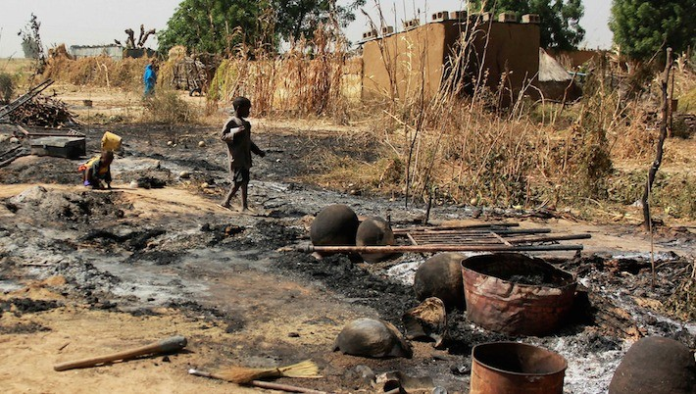
In November when the insurgents killed 15 persons in a village in Kebbi State. They reign as judges, police, and tax collectors. They find Nigeria a good ground to proliferate.

Non-state actors have killed hundreds of thousands of people, displaced millions, forced trillions of naira out of their victims, and razed countless properties.

Nigeria rates an alarming 8.7 points on the Global Terrorism Index, which measures the direct and indirect impact of terrorism, especially in lives lost, injuries, damaged properties, and psychological aftereffects. The index is calculated from zero (no terrorism impact) to 10 (highest terrorism impact). This shows that Nigeria’s terrorism impact is high. It needs to change.

An estimated 51.89 million crime incidents were recorded across the country over the 12 months, per the NBS Crime Experience and Security Perception Survey report, released on December 17.

The North-West recorded 14.4 million cases, the highest, followed by the North-Central with 8.88 million, and the South-East with 6.18 million.

Many homes were broken into and robbed but that pales in significance compared to the spread and depth of kidnapping for ransom that has spawned a stunning N2.23 trillion kidnap economy.

Nigerian households coughed up that huge sum to secure the release of their loved ones at a time when the country is reeling under harsh government policies.

The inflation rate is 34.60 per cent and food prices are beyond the reach of most Nigerians.

Sixty-five per cent of the affected families were forced to pay N2.23 trillion. The average ransom was N2.67 million. This is too much of a burden for a struggling populace.

It is difficult to ignore the growing kidnap economy. Some people render various services to the kidnappers, from arms to information, food, and water supply, to fuel and financial services. Without this ecosystem, the kidnappers will be out of business.

The self-styled Department of State Services should dismantle it. The country has not invested enough in the police. The officers remain poorly housed, miserably kitted, and woefully remunerated. The morale of the average police officer is low. This encourages them to resort to dishonest acts to survive. They could also do with more training and retraining.

Between 2020 and 2024, N9.17 trillion was allocated to seven security units. These are the Army, Air Force, Navy, police, Defence Headquarters, Nigeria Security and Civil Defence Corps, and Ministry of Defence.

The NBS statistics show the alarming growth and atrocities of non-state actors and the huge financial burden they put on suffering Nigerians.

The government must do more to secure the citizens. A lot needs to change.

According to the NBS report, armed robbers and kidnappers attacked the rural dwellers more than they did their counterparts in towns and cities.

This is due to vast ungoverned spaces, especially in the North. There are too many communities without police or any government presence. There should be more government presence to thin down those ungoverned spaces.

The country is grossly underpoliced. There are about 370,000 police officers assigned to secure over 230 million Nigerians.

This is an invitation to disaster. It falls short of the UN recommendation of 1:450 (police-to-citizen ratio).

Worse, two-thirds of the officers are illegally attached to VIPs.

A former state governor once lamented that less than 30 police officials were securing his state capital. Criminals exploit these gaps.

In 2018, pirates sacked one police station serving 71 rural communities and took away the only rifle at the station.

Every Inspector-General of Police promises to withdraw police officials attached to VIPs and bring them back into regular policing duties upon assuming duties. It is lip service.

Rather, more are redeployed to guard all manner of VIPs, unionists and musicians who have practically privatised the police and taken them away from policing the communities.

The NBS report says only about 36.3 per cent of those robbed, and about the same percentage of relatives of those kidnapped reported the attacks to the police. This is not right but it is understandable.

Most Nigerians do not report crimes because they do not trust the police. They have more confidence in the vigilantes and accuse the police of demanding gratification and turning citizens’ reports against them.

Even when the police respond to crime reports, they do so late and pick up innocent people long after the criminals have disappeared. This should stop.

According to studies, if the police respond in less than five minutes of a crime, there is a 60 per cent probability of making a genuine arrest. When it exceeds five minutes, the chance of an arrest drops to about 20 per cent.

In the United States, the average police response time to 911 calls is five minutes. In Australia, it is between seven and eight minutes. This is also generally true of Europe. It is the reason crimes are solved faster in those places. The police must redress this to regain the people’s confidence. It helps in fighting crime.

The government must stop cattle herding forthwith. Many heinous crimes are committed by terrorists pretending to be cattle herders.

Arms influx into the country must be halted and culprits brought to justice. The porous borders must be tightened.

An Enduring Legacy: Rev. Umah Ukpai’s life of faith, service, compassion

By Ishola Balogun

As family, friends, followers, and well-wishers prepare to celebrate the 80th birthday of Rev. Umah Ukpai on January 7, 2025, it is fitting to reflect on the extraordinary life and ministry of this remarkable man. Born in Asaga, Ohafia, Abia State, Nigeria, Rev. Ukpai has emerged as a spiritual leader of exceptional wisdom and compassion, leaving an indelible mark on the world.

His Early life and calling were marked by challenges that instilled in him a deep understanding of human suffering. These experiences, far from hindering him, became the bedrock of his compassionate ministry, fostering a profound empathy that informs his work to this day. His determined pursuit of education, culminating in his graduation from a renowned School of Theology in New York, equipped him with both spiritual insight and academic rigour, preparing him for the divine call that would shape his destiny.

Ministry and impact

Rev. Ukpai’s life-altering encounter with Christ ignited a fervent passion for evangelism, which blossomed into a global mission. He founded the Umah Ukpai Evangelistic Association (UUEA), a ministry dedicated to winning souls for Christ and empowering believers to live victorious lives. His mass crusades, revival meetings, and teaching seminars have reached millions, marked by miraculous healings, deliverance, and the restoration of hope.

Holistic approach to ministry

Rev. Ukpai’s vision extends far beyond the spiritual realm. He recognizes the interconnectedness of spiritual and physical well-being, advocating for a holistic approach to ministry that addresses the multifaceted needs of individuals and communities. This philosophy is reflected in his numerous initiatives, including:

Education: The Uma Ukpai School of Theology, Joseph Business College, and Ukpai Polytechnic, which provide quality education and scholarships to countless students.

Healthcare

King of Kings Specialist Hospital: A haven for healthcare was established in 1999, the King of Kings Specialist Hospital has been providing 24-hour services in various areas, including internal medicine, general surgery, ophthalmology, laboratory, radiology, and obstetrics and gynecology. The hospital’s serene environment and dedicated staff, including consultant ophthalmologists, optometrists, medical officers, pharmacists, laboratory scientists, and nurses, ensure that patients receive the best possible care.

Uma Ukpai Eye Center of Excellence The Uma Ukpai Eye Center, established in 2016, is a purpose-built facility designed to serve rural communities in six local government areas across three neighboring states. The center offers clinical, surgical, and optical services, with a focus on delivering quality, accessible, and affordable eye care. The center’s infrastructure is equipped to provide phacoemulsification cataract surgery services, also known as “laser cataract surgery,” making it one of the few centers in Nigeria located in a rural area to offer this service. As at the last count recently, it has carried out no fewer than 529 successful eye surgeries since inception. In 2024 alone, 39 was recorded as at early this month.

Poverty Alleviation: Programs that support widows, orphans, and vulnerable populations through scholarships, financial aid, and mentorship.

Dynamic preaching and authorship

Rev. Ukpai’s ministry is characterized by his dynamic preaching style, effectively conveying deep biblical knowledge with practical applications for everyday life. His annual events, such as the “Healing Week” and “Faith Clinic,” have become spiritual landmarks, fostering a culture of prayer and faith. His authored works, including “The Secret of Winning Life’s Battles” and “Faith to Change Your World,” continue to inspire and guide seekers worldwide.

Impact and Recognition

Rev. Ukpai’s impact transcends denominational boundaries, fostering unity and collaboration within the Christian community. He serves as a unifying figure, consistently advocating for love, reconciliation, and forgiveness while boldly addressing societal ills such as corruption and injustice. His legacy extends to the countless lives he has touched—those who have found hope, healing, and a renewed relationship with Christ through his ministry.

As we celebrate the 80th birthday of Rev. Umah Ukpai, we are reminded of the power of a life lived in selfless service to God and humanity. His enduring legacy serves as a testament to the transformative potential of faith, compassion, and service. May his life and ministry continue to inspire generations to come, reminding us that true greatness lies in selfless service and unwavering devotion to the Kingdom of God.

Salome Hephzibah Waziri becomes first female Engineering Geology Professor in West Africa

Salome Hephzibah Waziri, a lecturer at the Federal University of Technology (FUT) Minna in Niger State, Nigeria, has made history by becoming the first female Engineering Geology Professor in West Africa.

In an exclusive interview with Thediscovererng.com Professor Waziri expressed her excitement and gratitude to God for this remarkable achievement.

“I am celebrating God’s goodness and mercy that have made me a professor and the first female professor in Engineering Geology in Nigeria and West Africa,” she said.

When asked how she felt about this historic achievement, Professor Waziri humbly attributed it to God’s grace and favour.

“I feel humble before God, and at the same time, I feel great that God has chosen me for this honour,” she said.

As a trailblazer in her field, Professor Waziri offered inspiring words to women and girls around the world.

“To parents, I urge you to believe in your girl child and provide her with access to education,” she said. “To girls and women, I say that you are created in God’s image, and therefore, you have no limitations or weaknesses. You are meant to excel and make a positive impact on society.”

Looking ahead to the next five years, Professor Waziri expressed her commitment to continuing her life’s work under God’s guidance.

“In the next five years, I expect God to continue leading me, and my light will shine brighter to impact a greater population,” she said.

To girls and young women, Professor Waziri offered sage advice:

“Focus on your goals, don’t depend on men, and surround yourself with people who share your vision and values,” she said.

With her historic achievement, Professor Salome Hephzibah Waziri has paved the way for future generations of women in STEM fields, inspiring them to pursue their dreams and make a lasting impact on the world.

Credits: The Discover Nigeria

Young man convicted for fowl theft in Osun tells the story of his frame-up

The young man at the centre of the Osun chicken theft death sentence scandal, Segun Olowookere, has shared his harrowing experience of arrest, detention, frame-up, and conviction.

Olowookere, arrested in 2010 at the age of 17 that the complainant in his case was a family member.

The incident that altered his life occurred in November 2010 when he was detained alongside another suspect, Sunday Morakinyo, in Oyan, Odo-Otin Local Government Area of Osun State.

The pair were accused of robbing a policeman attached to the Divisional Police Headquarters in Okuku, Tope Balogun, of two fowls and eggs.

Additional allegations stated that they conspired to rob Oguntade Faramade of fowls and eggs worth N20,000, stole two mobile phones from Balogun Taye, and attempted to rob Alhaja Umani Oyewo.

The charge sheet also detailed an alleged robbery involving Elizabeth Dare, who was reportedly robbed of a gallon of vegetable oil by individuals armed with cutlasses and a Dane gun.

Both Olowookere and Morakinyo pleaded not guilty to the charges when arraigned on January 30, 2013, before Justice Jide Falola at the Osun State High Court in Ikirun.

However, Olowookere was said to have made a confessional statement to the police, admitting to the crime.

Recounting his journey to death row, Olowookere explained how the police arrested him after they came looking for him at his father’s shop.

“I was at my father’s shop in Oyan after returning from school. My dad and I were discussing my university admission and suddenly, we heard gunshots, and everybody ran away except my dad and a few others,” Olowookere said in an interview with PUNCH.

He continued, “My father was taken to a police van where there were some children. I was peeping out and could hear and see what was going on. The police asked my dad where I was, and he asked them what my offence was. When they couldn’t give him a satisfactory response, my father shouted at the top of his voice that I should run away because the police wanted to arrest me.

“But I was wondering what my offence was. So, I came out and went to meet them. I was detained at the police post in Oyan and was taken to Okuku Divisional Police Headquarters the following day. I met the children who were in the police van when they came for me sitting on the ground and eating rice.”

At the station, Olowookere said he was accused of being the gang leader of a group of children, aged 12 and 13, who allegedly stole the fowls and eggs.

Despite his denial, he claimed he was tortured to force a confession.

“I met Sunday Morakinyo at the station, and he told the police that he didn’t know me nor had anything to do with me. I don’t even know where he was arrested. All the children were released but Morakinyo and I were not,” he said.

“We were seriously tortured from the first day I got to the Okuku Police Station under the supervision of the DPO. The children who allegedly committed the crime were not beaten. He repeatedly asked me to admit and confess to a crime I didn’t commit.”

Olowookere revealed that the police had initially agreed to release him on bail if his father paid N30,000, but his father could only raise N20,000, which the police rejected.

“My dad left the station to look for the money. But before he returned the following day, we had been moved to the SARS office in Osogbo. The cutlasses that were given to me and Morakinyo to cut the grass were presented to SARS as exhibits and they were told we were armed robbers,” he explained.

After 17 days in SARS custody, Olowookere and Morakinyo were arraigned before a magistrate’s court on robbery charges and later transferred to the High Court, where they were sentenced to death.

Reflecting on his ordeal, Olowookere maintained his innocence and decried the injustices that led to his conviction.

Nigeria’s Hostages in Law

By Chidi Anselm Odinkalu

In 1991, Nigeria was in the full throes of the interminable transition to civil rule programme of General Ibrahim Babangida. The effort by the regime in 1991 to relocate their terminal date from 1992 to 1993 coincided with a planned meeting in Ibadan, south-west Nigeria, of the leadership of the National Association of Nigerian Students (NANS).

At the time, the security agencies had secreted on major campuses around the country assets masquerading as students. University of Ibadan was no exception. The unsuspecting NANS leadership were taken by surprise when the SSS swooped on their meeting, abducted their entire lot and dumped them at the Kirikiri Maximum Security Prison in Lagos with notice to no one. The abductees included then President of the NANS, Mahmud Aminu; their Svengali, Bamidele Aturu, as well as other notables in the movement such as Naseer Kura and Funso Omogbehin.

To make the grab look lawful, the regime issued a back-dated order for their detention under the State Security (Detention of Persons) Decree No. 2 of 1984 effectively making them hostages in law. On a routine professional visit to the Kirikiri Prisons in 1991 to see some other detainees, the then Officer in Charge (O/C) of Records at the facility pulled me aside and whispered about the presence in the prison of the leadership of the NANS. Until then, nearly 10 days after they went missing, no one knew where they were. If Mungo Park had made the journey, the history books would probably have recorded that he “discovered” the then leadership of the NANS in Kirikiri Prisons.

The lead lawyer for such matters then was Kanmi Isola-Osobu, a brilliant Life Bencher who was also lawyer to Fela Anikulapo Kuti. Kanmi’s office was opposite Adekunle Police Station in Yaba, Lagos; beside Dr. Tunji Otegbeye’s hospital. There were no cellular phones. I visited Kanmi’s office on a Monday afternoon to brief him about the students in the hope that he could lead the legal proceedings on their behalf. He was busy. With a familiar glint lighting up his face, Kanmi later informed me that he had been busy lubricating the struggle.

The case went before Nureini Abiodun Kessington, whose court at the time had a deserved reputation as the graveyard of bloated professional egos. With subversive invention, Kessington promptly ended the abduction of the student leaders and ensured that they were released with no substantial interruption to their academic careers or lives thereafter.

Those of us who became active against military rule then were inspired largely by two things. One was the hope that the end of military rule would see the end of such practice; the other was the dutiful resistance of some courageous judges like Kessington. In hindsight we may have been naïve about the nature of power and about the resilience of its methods. A quarter of a century after the end of military rule, the practice continues to prosper. To make matters worse, courageous judges appear to have become extinct.

First, the politicians discovered they could emulate the soldiers. In January 2017, Audu Maikori had been a lawyer for nearly sixteen years. He was a leader in entertainment law in Nigeria and president and Chief Executive Officer of a thriving start-up in the sector known as Chocolate City Group, with interests in radio, television, events, movies, and music. A son of Southern Kaduna, Audu was also a powerful voice and amplifier for the sufferings of the people under the predatory rulership of then Governor of Kaduna State, Nasir el-Rufai.

On or around 17 February 2017, police officers from the Kaduna State Command of the Nigeria Police Force abducted Audu from Lagos and embarked on a cross-country dash with him; first to Abuja where he was detained in the police cell in Asokoro. The following day they ferried him to Kaduna for further detention. After two days of detention, the police in Kaduna granted him bail.

It was in Kaduna that Audu discovered that his abduction was in connection with a post on his Twitter feed about the crisis in Southern Kaduna. A fortnight after Audu’s release on bail, then governor of Kaduna State, Nasir el-Rufai while headlining the Social Media Week in Lagos on 4 March, promised that he was “trying to link the dates of [Audu’s tweets] to attacks that may have happened the next day on Fulanis and if we are able to establish that causation,…. we know what it means.” Under his orders, the police snatched Audu again and this time detained him in nasty conditions in the State Anti-Robbery Squad (SARS). He had become a hostage in law.

Audu subsequently sued el-Rufai and the Police. On 27 October 2017, John Tsoho, then a judge of the Federal High Court, issued a judgment invalidating Audu’s abduction from Lagos. The judge held that “a warrant of arrest issued by a Magistrate in Kaduna was not valid for execution in Laos, except and until endorsed by a court in Lagos. Not even a warrant issued by a State High Court can be validly executed in another State without endorsement by a competent court within the State where it is to be executed.” He awarded N40 million in damages against Governor el-Rufai. After the Court of Appeal reaffirmed the essence of the judgment by the Federal High Court, el-Rufai appealed to the Supreme Court to assert his right to abduct Nigerian citizens at will and hold them as his own hostages in law.

Two years later, judges and magistrates invented jurisprudence to ground the practice of hostage-taking through law. Unlike in Audu’s case, the police officers who abducted Steven Kefason from Port Harcourt on the orders of Nasir el-Rufai in May 2019  could not even be bothered with a warrant. After snatching Steven, they secreted him in a cell in Mini Koro, Rivers State overnight before ferrying him by road in a brutal ride to Kaduna. Over three days, they denied him food, access to communication or personal sanitation.

In Kaduna, Steven was interrogated in equally brutal conditions under the personal supervision of the Governor’s legal adviser. The reason for the abduction – it turned out – was a tweet by Steven around 20 April 2019 in which he said that “while over 12k Kajuru IDPs are living in a terrible condition, their LG Chairman, Cafra Caino, was hosting his old school mates to a birthday party at Kajuru Castle….” The facts were not in dispute but el-Rufai nevertheless instructed the abduction of Steven on charges of incitement and injurious falsehood. One month after Steven’s initial abduction, the Magistrate in Kaduna denied him bail on 20 June 2019 because, according to the Magistrate, “while on bail, [he] further made social media posts further insulting the person of the Governor and that of the Chairman of Kaduna and Kajuru LGAs respectively.”

On 27 February 2020, Peter Mallong, a judge of the Federal High Court in Kaduna, denied Steven’s request for judicial review of his abduction and the decision of the Magistrate claiming, in an extraordinary travesty of jurisprudence that he was bound by the decision of the Magistrate to deny bail because the issues were the same and the parties were largely the same. Following his abduction, Steven suffered as hostage in law for over six months with no redress and came close to losing his life. The injustice of the judgment cried out to the Heavens for redress.

In July 2023, Peter Mallong died at 60.

Those who wonder how the country ended up with the utterly shameful charade being orchestrated in a squalid courtroom in Ekiti in the case of Dele Farotimi have Peter Mallong to thank for having written the manual on judicial enablement of the practice of rendering citizens into hostages in law. This narrative has wider ramifications.

A lawyer and a teacher, Odinkalu can be reached at [email protected]

TIPS