Home Blog Page 421

Tinubu’s Taxing Times

By Chidi Anselm Odinkalu

A mere four years after emerging from a civil war, in 1974, Nigeria was at the beginning of an oil boom. Then, as today, the country was in the middle of a debate about fiscal federalism and revenue allocation. Unlike today, however, there were significant differences: the country was under military rule and the men leading the debate were all soldiers. In the fifty years since then, the structure of this debate and the geo-political symmetries that define it have evolved only a little.

The immediate spark for the debate fifty years ago was the publication of the statutory allocations to the twelve states of the federation then for the fiscal year 1974-75. With a population of 2.5 million, Mid-West State received 139.9 million Naira or 23.7% of the allocation. Rivers State, whose population was 1.5 million, received 101.1 million Naira.

Isawa Elaigwu, semi-official biographer of Yakubu Gowon, the army general who was Nigeria’s military head of state at the time observed about this that “while both Rivers and Midwestern States, comprising 7.3% (4 million) of the country’s total population, shared between themselves 40.83% (N241.00 million) of the total allocation to the states, the ten other states which accounted for 92.7% (51.6 million) of the country’s population, shared among themselves 59.17% (349.2m) of the statutory allocation.”

Usman Faruk, the Commissioner of Police who governed the North-Western State was unhappy with the dissension over the sharing of the allocation because, he said, all of them in the Supreme Military Council then agreed it. Joseph Gomwalk, another Commissioner of Police and then military governor of Gowon’s own Benue-Plateau State; and Jacob Esuene, who governed the South-Eastern State called for a more objective system of revenue allocation. If they knew what such a system looked like, they didn’t say. Kwara’s military governor, David Bamigboye as well as General Abba Kyari of the North-East went on record to call for a review of the allocation formula. For their part, Oluwole Rotimi and Mobolaji Johnson, military governors respectively of the Western and Lagos States advocated for “a revenue allocation formula that would guarantee responsible and stable government for Nigeria.”

Nigeria’s search for a workable federalism in many ways can be reduced to the search for precisely such a formula. It has proved elusive. If anything, it may have got even more so. In the 36 years between 1946 and 1980, spanning the colonial and post-colonial periods and including  military as well as elected civilian regimes, the country burnt through the reports of at least eight blue ribbon panels on the question of fiscal federalism.

On the eve of independence in 1958, the report of Raisman Commission recommended the creation of a Distributable Pool Account (DPA) into which was to be paid 30% of revenue from mineral rents and royalties and from import duties. The regions retained 50% of the revenue from mineral rents and royalties from their region while the central government took 20%. 70% of the revenue from import duties went to the central government.

Six years later and four years after independence, the Binns Fiscal Commission increased the DPA share of the income from import duties from 30 to 35% at the expense of the share of the central government. Importantly, the report set its face against the principle of derivation, replacing it with that it called the principle of “financial comparability.” On this basis, it recommended the sharing of the DPA receipts as follows: Northern Region 42%; Eastern Region 30%; Western Region 20%; and Mid-Western Region 8%. Lagos was then the federal capital. Up to this point, the fiscal balance largely favoured the regions who contributed resources to the central government.

  In 1968, Nigeria’s post-colonial crisis of state legitimacy had already exploded into a year-old civil war. Under pressure from both the economic costs of the war as well as its structural antecedents, Yakubu Gowon, the war-time Supreme Commander (as he was then known), called upon Chief I.O Dina, a former history lecturer at the University College Ibadan, to lead what the regime called an Interim Revenue Allocation Review Committee.

The legacy of the Dina Committee recommendations was very far reaching and suited the regimental mood of the military. The Committee addressed frontally the issue of taxation and public goods. It recommended a centralization of taxation as well as the harmonization of the produce marketing boards which were until then mostly regional. The Dina Committee also recommended a centralization of the funding of higher education and the replacement of the DPA with what it called a State Joint Account. Additionally, the committee recommended that states should retain 100% of rent from onshore extractive operations on the basis of derivation and also receive another 10% of royalties revenue as derivation.

Even in the midst of an existential conflict at the time, the fuss that followed in the wake of the Dina Committee report was deafening. Officially, the Federal Military Government rejected the Dina Committee Report. In reality, Isawa Elaigwu recalls that “….Gowon did not raise dust over the issue but quietly implemented most aspect of this report through the back door at the appropriate time.” The result is that the Dina Committee Report has been quite influential in shaping Nigeria’s version of federalism.

Gowon enjoyed three advantages at the time in his handling of the unitarising tendencies that underpinned the recommendations of the Dina Committee. First, the civil war was an extenuating circumstance. Second, the regimental traditions of military government limited the degree of elite dissension. Third, as a military ruler, he ultimately did not have to suffer any institutional constraints similar to those imposed by a parliament or its equivalent under elected civil rule.

For the current incumbent fifty years later, a civilian seeking to accomplish what would be the most far-reaching restructuring of Nigeria’s fiscal fundamentals in 110 years, none of these advantages exists and he suffers many more debilitations besides.

By some coincidence, in the year that Gowon constituted the Dina Committee, the celebrated Kenya political scientist, Ali Mazrui, explained the challenges of structural stability in post-colonial African states in terms of two underlying crises of state legitimacy and of regime legitimacy.

Fiscal reform on the ambition evinced by the proposals now under consideration in Nigeria assumes the existence of a capable state which enjoys affinity among citizens, an overwhelming percentage of whom should be documented. None of these can be taken for granted in Nigeria. The evidence from across the fields of financial inclusion, electoral participation, and taxation suggests that the proportion of documented Nigerians does not exceed 40%. It will take more than a few convenient ebullitions to address this.

Any government will be challenged in addressing it. An administration that suffers from manifest issues of legitimacy lacks the currency to trade with in this situation. The crisis that afflicts the current proposals is that of a government unwilling to put in the work required to redress deficits of state and governmental legitimacy around the country. To address what is evidently a political problem, the government has chosen instead to escape into self-inflicted technocratic gobbledygook.

Fiscal governance and reform is not as complex as the administration and its mouthpieces would like to suggest. Taxation is more than mechanical computation. It is the centrepiece of the social compact between a state and its citizens. With considered inadvertence, the administration of Bola Ahmed Tinubu has done itself a world of good by inspiring these increasingly raucous debates about the state of that compact in Nigeria or the lack of it. It will be best served by listening to the debate in humility while it learns.

A lawyer and a teacher, Odinkalu can be reached at [email protected]

[Video]Dele Farotimi & Afe Babalola: All of us should be ashamed of the state of Nigerian criminal law & procedure as displayed in Ekiti State —Prof. Chidi Odinkalu

Irokopost TV’s explosive interview with Prof. Chidi Odinkalu where the Fletcher School of Law professor dissects the case of Afe Babalola and Dele Farotimi beyond what he wrote in his viral essay.

In it, Odinkalu also narrates how former Governor Nasir El-Rufai wanted to abduct him and give him the same treatment Afe Babalola is giving to Dele Farotimi. The former Nigerian Human Rights Commission Chairman challenges the Federal Capital Territory (FCT) Minister Nyesom Wike in a way Mr. Wike may find irresistible.

Odinkalu chastises Dr. Reuben Abati for mistreating his AriseTV colleague, Ojey Okpe, and advises Abati on how to make amends.

He also weighs in on Simon Ekpa and the state of the Biafran Movement, Evangelist Ebuka Obi and his case against Blogger Ijele, and many other issues.

Watch the video below.

Re: Aare Afe Babalola .v. Dele Farotimi: Let the law take its course — Egbe Amofin Oodua

Press Release

The Egbe Amofin Oodua has watched with keen interest the national controversy generated by the publication of a book, “Nigeria and Its Justice Criminal System” by Dele Farotimi and his consequent arrest and arraignment for criminal defamation arising from the complaint by Aare Afe Babalola, SAN and others who feel that certain contents of the book as published are false and had injured their hard-earned reputation in the eyes of right-thinking men in the society.

In the said book, the author, Dele Farotimi, well aware that Aare Afe Babalola, SAN would find some of the contents offensive and injurious to his name and reputation, wrote: “I did not know how long any of us had to live and I did not want to be dealing with the idiotic argument that I could envision, of Afe’s Proteges, arguing that I was slandering the dead if the book was to be published after his dead. He is already well in his 80s – I have offered the opportunity to defend himself.”

The defence envisaged by the author, Dele Farotimi, in the law of the land lies in both criminal and civil actions and nobody can dictate to a man who feels injured on what option to take to protect or defend his reputation and name, as long as the option chosen is within the law of the land.

Aare Afe Babalola, SAN, is no doubt one of the greatest advocates of our time, an accomplished publisher, a renowned philanthropist, a brilliant school administrator, amongst others, has contributed his own quota not only to the development of our legal profession, but in also to our educational system, impacting millions of lives positively. He is therefore entitled to protect and defend his hard earned reputation and career without inhibition, just like Dele Farotimi had exercised his right to freedom of expression in publishing his book.

We call on Nigerians to respect the decision of the man who feels there is injury to his name and reputation to seek redress in court and allow the court to decide all pending cases without distraction. Let the law take its course.

Mogaji Isiaka Abiola Olagunju SAN
CHAIRMAN,

Adetunji Osho
SECRETARY
GOVERNING COUNCIL OF EGBE AMOFIN OODUA

Intimate Affairs: These four men need help

By Funke Egbemode

The Mean Landlord

This is the husband who bullies and threatens his wife with quit notice at every turn. Here are some of his favourite refrains:

“I’ll soon send you back to your parents.”

“Keep talking to me like that and you will be needing another accommodation soon.”

“In my house? Do you want me to kick you out?”

“If you close from work late tomorrow, don’t come back here.”

There are husbands who stop at just the threats. But there are those who go all the way. These are the ones who lock their wives out, throw their wives’ belongings in the rain at every opportunity, after every quarrel.

If you, dear husband, treat your wife like this, any number of things can happen to you, and believe me, the silent treatment is the least of them. Remember, not all wives are brought up to nicely stay on their lane in a bad marriage.

The Unprotective Lover

This one wants to be called “Lord” but can’t protect his clan and family. He just doesn’t know that being called husband goes beyond whisking out your whip and giving your woman the best time in-between the sheets. He’s clueless when it comes to shielding his wife from the elements, and I don’t mean the rain, wind and sun.

Bro, your mother loves you to bits and this is the first time she’s sharing you with another woman, your wife, that is. She will lovingly want to continue to protect her son because that is what she has always done. It’s part of her job description. She will lovingly try to elbow your beautiful wife out of the way, even out of her kitchen. She may even want to continue to shop for you, pick your ties and sit with you for hours after work. She does not hate your wife, she is just being Mummy. But your wife is the Lady of the Manor, this new manor. Not your Mum, not your sisters. Nicely, gently tell your family that your wife is the First Lady. Do not allow her in-laws to frustrate her, talk down on her, make her feel like an alien in her own space. Be the crown that you ought to be. Don’t let her withdraw into her shell. Don’t let her re-channel her love into her job or business. Don’t let her stop being the girl you married. You won’t like the other version of your wife. Protect the version you married, please.

The Financial Bully

This one starves his wife and family of comfort, just to prove that he’s the boss and breadwinner. Every quarrel has financial implications. Heard of a man who went to lock up his wife’s shop and shut down her business because she was beginning to do well and could pick her bills herself. The guy felt he was losing his grip on her. So he shut her business. After all, he set it up. The financial bully if offended meted out such punishment as going to work with the keys of all the cars in the house. His wife must jump “okada” and “Keke Napep”. That’s her punishment for being rude, for talking back, not getting dinner ready on time or allowing the house-help to make his soup.

The “Pagan’ Husband

This one leaves all things spiritual to his wife. All he wants to do is make money and provide comfort for his family. He believes money answers all things. Good guy. Good provider. He’s lucky if his wife is “spiritual” and always around to raise the children the right and godly way. But if the wife is like him, the children are left to societal vagaries and peer pressure. Then he just wakes up one day and finds out that the child he named ‘Samuel’ is now an Atheist. The one he named Kabir has 10 piercings, wears lipstick and hides to eat and smoke during Ramadan. This husband is simply unavailable and his comeuppance, his amen junction is usually very traumatic later in life. Because he throws money at his problems, his wife and children tend to seek comfort far from him, many times in places and people he’d never touch with any kind of pole.

There are many things a man should know before going into marriage. There are many things fathers should teach their sons, little things mothers must impress on their boys. Though they may look little, however, they are lessons that must be learnt because they can make or mar the best of marriages and good intentions.

For instance, the financial bully most likely will find out that his wife, after years of frustration, has built four flats somewhere and has a secret business. The mean landlord may one day kick his wife out and find out she does not come begging with her friends and family. She just moves out and moves on.

So which of these groups do you belong to? Which of these sins are you guilty of?

Egbemode could be reached on [email protected]

Lt. Changfe Maigari is Nigerian Navy’s first female pilot

History has been made with Lt. Changfe Maigari becoming the first female pilot in the Nigerian Navy (NN) since its inception in 1964.

Born in Kaduna, Maigari, who is married with a daughter, hails from Langtang North Local Government Area of Plateau.

Lt. Changfe Maigar’s remarkable odyssey commenced in 2016 when she graduated from the Nigerian Defence Academy (NDA) and was commissioned as a Sub Lieutenant.

Subsequently, she served aboard the Nigerian Navy Ship Unity.

The News Agency of Nigeria (NAN) reports that Maigari was presented with the ‘Pilot Wing’ award during the 2024 NN Ceremonial Sunset at the Naval Training Command Headquarters (HQ NAVTRAC) in Ebube-Eleme, Rivers, on Friday.

In an interview with NAN on the sidelines of the event, Maigari said that she achieved the milestone after completing her basic pilot training and fulfilling all requirements.

“I grew up in a military environment as my father was an officer in the Nigerian Air Force.

“From an early age, I aspired to become a military pilot and when the opportunity to join the navy arose, I did not hesitate.’’

She recounted how her dream of becoming a naval officer materialised when she was selected among the first group of 20 female regular cadets trained at the NDA.

Maigari said she graduated in 2016 as the Best Graduating Cadet in Academics, earned the Gold Medal Navy award, and in 2019, completed her Sub Lieutenant Technical Course as the overall best.

“There were moments during my training when it seemed I might not succeed in my studies or flight procedures, but I persevered.

“Becoming the first female pilot in the Nigerian Navy feels surreal and a significant milestone, not only for me but for all my female colleagues who can draw inspiration from this achievement

“I also hope my success motivates young civilian girls aspiring to join the military, particularly the Nigerian Navy, to persist because perseverance can overcome any challenge in life,” Maigari advised.

She expressed gratitude to God, her colleagues, and her family for their unwavering support in helping her to achieve the milestone of becoming the first female pilot in the Nigerian Navy.

Presenting the award, the Chief of Naval Staff, Vice Admiral Emmanuel Ogalla, commended Maigari and other award recipients for their exemplary achievements.

He highlighted that the sunset ceremony was a longstanding naval tradition marking the conclusion of the year’s activities.

“It is a moment to reflect on our 2024 accomplishments, strengthen comradeship and honour personnel who distinguished themselves through hard work.’’

The navy chief spoke on the navy’s significant strides in combating oil theft, pipeline vandalism and sea piracy, among other maritime crimes, in 2024.

“In January, the navy launched Operation Delta Sanity which successfully curtailed oil theft and maritime crimes, increasing Nigeria’s daily crude oil production; several oil companies reported achieving a 100 per cent terminal factor.

“Two new naval bases were established in Enugu and Makurdi; the Shagunu outpost was operationalised; we also incorporated a maritime component into Operation Fansar Yamma in the North West.’’

He listed advancements in fleet recapitalisation, including the acquisition of two 32-metre fast patrol boats, an offshore survey vessel, and two helicopters in June.

“In November, three additional helicopters were launched and two 38-metre Sea Eagle fast patrol boats were delivered.

“By January, we expect delivery of three 46-metre fast boats from China, while two 76-metre Offshore Patrol Vessels under construction in Turkey are nearing completion.

“Our indigenous shipbuilding efforts include two 38-metre Seaward Defence Boats, three tugboats and several patrol boats, all scheduled for delivery in 2025,” Ogalla said.

He also noted upgrades to barracks in Lagos, Benue, Enugu and Ogun States, as well as ongoing construction of additional housing for personnel in Navy Towns located in Abuja and Lagos.

Gov. Siminalayi Fubara of Rivers lauded the Nigerian Navy for its efforts in combating oil theft, illegal bunkering and pipeline vandalism.

He acknowledged the immense challenges posed by criminals in sabotaging the nation’s economy through attacks on oil and gas facilities.

“Eliminating these illegal activities in our maritime environment is no small task, especially as 90 per cent of our oil and gas infrastructure is located in the Niger Delta swamps.

“The Rivers Government has always supported and collaborated with the Nigerian Navy and will continue to do so to facilitate its operations in the state.

“As we approach 2025, Nigerians have high expectations and it is vital that we work together to confront and overcome the challenges ahead,” Fubara said.(NAN)

Jubilation in Fubara’s camp as Appeal Court rules against stoppage of federal allocations to Rivers State

  • Federal High Court was misled – Oditah, SAN


Sequel to the Court of Appeal’s judgement on Friday which barred the Central Bank of Nigeria, CBN, from withholding the monthly federal allocations due to Rivers State, there has been jubilation in the camp of Governor Siminalayi Fubara.

The Court sitting in Abuja issued a split ruling on Friday. Two judges ruled in favour of the Rivers State government, while one dissented.

Governor Fubara through his team of lawyers led by Mr. Yusuf Ali, SAN had asked the three-member panel of the appellate court led by Justice Hamma Barka, to set aside a subsisting order of the High Court that compelled CBN to withhold the state’s monthly allocation.

The governor claimed the High Court judgement was given in bad faith.

He had urged the appellate court to allow his appeal marked CA/ABJ/CV/1303/2024, and nullify adverse orders that Justice Joyce Abdulmalik of the Federal High Court made against the state in the judgement she delivered on October 30.

Recall that the federal government backtracked after it first said it would halt the October monthly Federation Account Allocation Committee (FAAC) revenue payment to Rivers State, citing a court order as the reason.

According to Bawa Mokwa, spokesperson for the Office of the Accountant General of the Federation, the decision to stop the payment was in respect of the court order, which barred the Central Bank of Nigeria (CBN) and the federal government from disbursing monthly allocations to the Rivers State government.

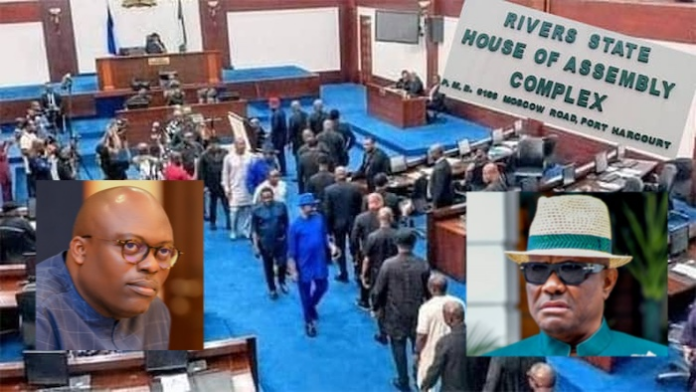
The court order was obtained by the factional Rivers State Assembly, led by Martin Amaewhule, who had filed an originating summons against the Rivers State Executive, under the leadership of Simi Fubara.

The Amaewhule faction loyal to former governor and current minister, Nyesom Wike, had alleged that the Rivers State Executive had yet to comply with the order of a Federal High Court directing it to re-present the 2024 appropriation bill to the faction of the Rivers State House of Assembly.

Mokwa emphasised that the Office of the Accountant General of the Federation (OAGF) would respect the court order, following due diligence until a contrary order was issued.

She later cited a subsisting appeal, saying that the allocation could not be stopped.

The FAAC disburses revenue to the three tiers of government, including states, local governments, and the federal government.

In an interview with Arise TV, Senior Advocate of Nigeria, Fidelis Oditah remarked that the Federal High Court was misled on the issue.

“The Federal High Court obviously was misled because the receipt of State allocation is at the heart of the Federation. It’s not a dispute between the lawmakers and the governor. The entitlement to receive FAC monies every month is very central to the federalism we operate. It is not possible for River State to be a federating state and not to receive that money.

“This is very different from the dispute that was had with Governor Tinubu. At that time when Obasanjo seized the local government money, he did not seize the monies of Lagos State, he couldn’t seize the monies but he thought he could seize the monies of the local government. But the Supreme Court in 2004 made it clear that he had no power to do so and that his action was illegal and unconstitutional.

“Of course, there is a difference between OBJ seizing local government funds in Lagos and the Federal High Court purporting to interpret or misinterpret the law. Clearly, the judge did not understand the essence of federalism and had no power to make the order he made because Rivers State cannot be a federating state without being entitled to receive.

“What it does with that money is entirely an internal matter. I see how he qualified the order by saying until there’s a state appropriation law but that’s like placing the cats before the horse.

In the earlier case, it’s a president refusing to release to sign whatever he needed to sign, in this case it’s a court saying the Central Bank should not release. So to that extent, you might draw some artificial distinctions by saying the dispute is always resolved or supposed to be resolved in a constitutional democracy by the courts. But what the court has done is simply a caricature and I think the whole thing is just a theatre of absurdity.”

On the question of there being no proper appropriation law in force in River State since the State Assembly was not properly constituted to make the appropriation law under contention and therefore it is null and void, Oditah said:

“that argument is mistaken there is a clear distinction between the entitlement of a state. The state is not the Governor, the River State is not Fubara, it’s not Wike, it’s more than a geographical area consisting of people who Federated with other 0people from other states. Those are the people who are entitled to the money. The monies do not belong to Fubara, the monies do not belong to the local nor the House of Assembly, so there is no capacity to stop the people of River State from receiving their own share as a federating unit.

“Once that money is received how the money is disbursed is a matter of appropriation law. But that’s why I said that trying to stop it Upstream is trying to place the cat before the horse. The money cannot be stopped, the money does not belong to Fubara, the money belongs to the people of River State that money must come whether or not you can stop Fubara once the money is in River State from misusing it is a dispute between him and the but you cannot stop the people of River State.”

Lagos doctor, Femi Olaleye, freed weeks after Appeal Court nullified his rape conviction

Weeks after the Lagos division of the Court of Appeal nullified his rape conviction, Lagos doctor, Femi Olaleye, has regained his freedom.

Olaleye was arraigned in 2022 by the Lagos State Government at the Sexu@l Offences and Domestic Violence Court, in Ikeja, Lagos and was in October 2023, found guilty of defiling his wife’s 16-year-old niece. The judge held that the prosecution proved the two counts charge of defilement and sexual assault by penetration against Olaleye.

After his conviction in August 2023, his lawyer, Kemi Pinhero, a Senior Advocate of Nigeria (SAN), filed an appeal in November 2023, arguing that there was no direct evidence to confirm the alleged victim’s age.

In a judgement delivered on November 29, 2024, the appeal court held that there was no direct evidence to establish the alleged victim’s age, claiming the prosecution failed to provide documentation proving she was 16 years old at the time of the offence. Read here.

The court then discharged and acquitted Olaleye.

Taking to his Instagram page this afternoon, he shared photos of him leaving the prison on December 3. He wrote;

‘’Freedom is not just a release—it is a rebirth. And on Tuesday, 03/12/24 my new chapter began! @drfemi is back and active!”

Lagos doctor, Femi Olaleye, regains his freedom weeks after Appeal court nullified his r@pe conviction

Read Also: Rape of minor: Enraged Dr Olufemi Olaleye challenges life sentence at Appeal Court

Read Also: Appeal court nullifies rape conviction of Lagos doctor Femi Olaleye

Read Also: Justice Denied: A call to reassess the Appeal Court’s verdict on sexual abuse of a minor, By the Adinya Arise Foundation AAF

AWLA mourns Mufutau Mabokunrinje Adewale Sanni

The African Women Lawyers Association (AWLA) Nigeria expresses its profound condolences to the Nigerian Bar Association, Eti-Osa Branch, on the passing of its pioneer Branch Chairman, Mr. Mufutau Mabokunrinje Adewale Sanni.

Mr. Sanni’s remarkable leadership and dedication laid the foundation for the growth and success of the Eti-Osa Branch, leaving an enduring legacy that will continue to inspire generations within the legal profession. His unwavering commitment to the law and his service to humanity will be deeply missed.

In this moment of loss, we stand in solidarity with the entire Eti-Osa Branch, the Nigerian Bar Association, and the Sanni family. We pray for the strength and fortitude to bear this great loss.

May his soul rest in perfect peace, and may his legacy continue to live on.

Signed:
Dr. Grace Esq.
PRO
 AWLA, Nigeria

Women with disabilities insist on reserved seats for PWDs in National Assembly

Women with disabilities have called on the leadership of the National Assembly to ensure the reservation of seats for Persons with Disabilities (PWDs) in Nigeria’s National Assembly.

The demand was made at the National Convention on the Representation and Inclusion of Persons with Disabilities in the Ongoing Constitutional Reforms.

The event was organized by the Network of Women with Disabilities, supported by UN Women, in collaboration with the National Assembly.

Speaking at the convention, the Speaker of the House of Representatives, Hon. Tajudeen Abbas, represented by the Deputy Speaker, Dr. Benjamin Kalu, underscored the importance of inclusivity in governance. “Disability does not define the ability to lead, create, or inspire. Inclusion is both a necessity and justice,” he stated, reinforcing the commitment of the National Assembly to address the concerns of PWDs.

Lois Auta, the Chief Executive Officer of the Network of Women with Disabilities, presented a comprehensive memorandum on behalf of over 30 million Nigerians with disabilities. The memo, delivered to the Speaker through Dr. Kalu and the Chairman of the Constitutional Review Committee, called for practical measures to ensure disability inclusion. Among the key demands was the reservation of designated seats in the National Assembly for both men and women with disabilities.

The convention, held at the Library Conference Hall within the National Assembly Complex in Abuja, was lauded as a historic milestone. It marked the first time the International Day of Persons with Disabilities was celebrated at the National Assembly and the first occasion where lawmakers directly hosted representatives of disability-focused organizations.

Participants at the event emphasized the symbolic significance of holding the event at such a high level of governance. They argued that it demonstrated a growing recognition of the rights and potential contributions of PWDs in shaping Nigeria’s political and social landscape.

UN Women, a co-organizer of the event, reaffirmed its commitment to advancing gender and disability inclusivity in governance and policy-making. The organization praised the collaborative efforts between lawmakers and advocacy groups, describing them as a pivotal step toward achieving a truly inclusive Nigeria.

The call for reserved seats in the National Assembly for PWDs reflects a broader push for constitutional reforms aimed at reducing systemic barriers and enhancing representation for marginalized groups. Stakeholders expressed hope that the event would inspire more actionable outcomes, ensuring that the voices of PWDs are heard and respected in the highest echelons of decision-making.

As Nigeria continues its journey toward inclusivity, the demands of women with disabilities for designated parliamentary seats serve as a reminder of the need for intentional and sustained efforts to leave no one behind.

Afe Babalola: Of a man and his weakness

By Abimbola Adelakun

Contrary to assertions by some so-called experts who have been prattling all week that Dele Farotimi wrote what he could not logically substantiate in his book Nigeria and its Criminal Justice System, this was a pre-meditated confrontation. Having depleted the legal means to get justice, he wrote to re-litigate the case in the court of public opinion. He seems calculatedly driven by the Yoruba proverb that says no one dies at the same spot they uttered blasphemy. In the time between your speaking and being punished, much can happen to change social dynamics. From the potpourri of events in the past week, Farotimi got what he wanted. One cannot say the same for Afe Babalola who, by now, would have realised that giving a traducer what they want is not the most prudent battle move. My reading is that Farotimi knew Babalola’s peculiar weakness and worked it to advantage. I will get to that momentarily.

The blowback from this case is another instance that hopefully teaches our elites to rein in their tendency to exploit the warped Nigerian justice system that allows criminal defamation as a legal recourse. Criminal defamation might be legal, but it is unjust. It is a law that exists to regulate the differentials of power and access, one of the many ways rich people further privatise public resources. Since lawmakers are too compromised to expunge the law and law enforcers incapable of the reflexivity that will enlighten them on the stupidity of using state resources to fight an individual over another’s integrity, the best we can do for now is pressure the entitled “big man” not to take that path. In a criminal case, the prosecutor investigates to convict. The Nigerian police, perennially short of resources, spares no expense when sent to prosecute criminal defamation on behalf of another narcissist. Why should the state do that on behalf of an ordinary individual? Babalola, especially, is a man of ample resources, who can afford to fight for his reputation on his own dime.

So, on Friday, Babalola’s legal team held a press conference in Ado Ekiti. Among several things, the lead lawyer Owoseni Ajayi said was: “Those pushing Farotimi are not his friends. By the time they led him to the dungeon, he would realise they were deceiving him. Let me advise his family members to apologise to Aare. Aare Babalola is a builder, not interested in destroying Farotimi.” I was intrigued by what he said it takes for them to call off the police hounds. If someone injured your reputation, and that reputation is truly worth the price you placed on it, why would you not be interested in watching them destroyed? Why would Ajayi, so sure of their victory that he boldly asserted that the only possible conclusion to the case is the dungeon, want to settle for the cheap spectacle of Farotimi’s family members with their clasped hands rolling on the floor and begging?

What sealed the picture for me was an article by Kenneth Ikonne where he, like Ajayi, also urged Farotimi to go “beg” Babalola. According to Ikonne, he had won a preliminary objection against Babalola’s suit—which a lawyer is supposed to do, right? —but he was so intimidated by his own victory against the legal giant that he had to go beg Babalola. While Ikonne’s adulating article drips with flattery, it also unwittingly reveals a kabiyesi-complex. It is an attitude that revels in watching other humans’ heads perpetually bowed in servile reverence so they can repay your self-denigration with overwhelming niceness.

Babalola seems like a man who likes to be liked, an attitude is consistently weakening because you must always play nice. Please note that there is a vast difference between being nice because you are a decent human and niceness as manipulation, a means to seduce others into becoming your subject. People of the latter category will take you to the top of the pinnacle, show you the extent of their power and glory, and nicely offer you a portion if only you would bend obsequious knees before them. If you refuse, they will then kick your calves until you fall on your face.

Babalola is so used to a world where junior lawyers who defeat him in court still come to his Ado Ekiti palace to prostrate before him that Farotimi’s boldness to confront him must have been jarring. He resorted to his standard weapons of warfare, but as he must have also found out in the past week, the battle terrain has changed. Even if he wins the case, what will be the social value of a reputation held up by the courts? If Farotimi begs him as his lawyer and others have enjoined, what is done cannot be undone.

However, this goes down, I commend Farotimi’s boldness. We all agree that the Nigerian judiciary is rotten, but the logic of producing rational evidence has made it virtually impossible to progress beyond merely abstract observations. Until we begin to mention names and point accusing fingers at specific people, the issues will remain intractable. Statistically, Nigerian judges and magistrates are the highest receivers of bribes in 2023, beating even the Customs/Immigration! This is according to the NBS. Those who facilitated these transactions are not ghosts. We have all been witnesses to the several instances where retiring judges have severely deplored the rot in the judiciary. It is amusing to see some people pretending Farotimi revealed what they did not already know.

Our society maintains an overly reverential attitude toward people who have money and power, and are elderly. When a person combines all three, we are virtually cowed before their almighty presence. Otherwise, why can we not ask, if defamation is an offence that supposedly lessens someone’s reputational worth, what exactly would constitute it in the case of persons who have practised law in morally decrepit and with progressively weakened institutions like Nigeria for 60-plus years? Which of the atrocities that presently bedevils the country does not have the hands of the so-called learned class in it? This is not to disparage the legal profession or caricature lawyers, but we cannot talk about what is wrong with Nigeria today without the role lawyers have played in vandalising the temple of justice. From the so-called “legal luminaries” who—through endless frivolous election petitions—rendered democracy incoherent to the ones with the “SAN” appendage to their names who fraternise with politicians, they remade the country in their amoral image.

We were all here when a partner in the firm of a high-profile lawyer solicited the client of another, saying their principal’s political influence would “significantly switch things in favour” of the prospective client. While that woman was disowned and eventually debarred, it was a moment of self-revelation as to how the justice system operates. Big names in the legal system do not necessarily correspond with a deep knowledge of the law. It just means they know which judge to buy and which string to pull. We witnessed a lawmaker publicly admitting that his judge’s wife helped his colleagues win their various cases.

In a serious country, every case that a woman adjudicated would have been recalled and scrutinised, but this is Nigeria. Nothing ever happens here. This is the utterly compromised ecosystem in which Babalola has practised law and thrived to the point he built a magnificent university. He was also a lawyer and confidant to former President Olusegun Obasanjo, whose administration reputation was thoroughly corrupt. Nobody, not even the staunchest of his defenders, has said of Farotimi’s allegations that “it cannot possibly be true”.  What they all say is, “It cannot be proven,” and that is telling enough.

Given the contradictions of his profession, Babalola should have been circumspect enough to not jump into a public contest over his reputation. He seems to me like a man who has invested in being nice just so that he would not be remembered as a villain in Nigeria’s story. Now he is no longer the man with the carefully curated legacy who set out to redeem his image but the one who proved his critic right.

TIPS