Home Blog Page 373

Hakeem Baba-Ahmed, the North and our votes

By Suyi Ayodele

”We have released Northern Nigeria from the leading strings of the treasury. The promising and well conducted youth is now on allowance on his own and is about to effect an alliance with a southern lady of means. I have issued the special licence, and Sir Frederick Lugard will perform the ceremony. May the union be fruitful and the couple constant.” That was Lord Lewis Harcourt, British Secretary of State for the Colonies on the decision to amalgamate Northern and Southern Nigeria on January 1, 1914.

Those who created Nigeria clearly made the North the husband and the South, the wife. In Africa, the husband is the head and driver of the home. We see and feel this each time the North has to deal with the South on matters of power and resources.

The latest is the movement towards the 2027 election. Northern leaders are no longer hiding their opposition to the President Bola Ahmed Tinubu government. They say he has not been fair to them. The poor husband is threatening the resourceful wife with sanctions.

A former Tinubu aide, Dr Hakeem Baba-Ahmed, spoke very loud at the weekend. He said nobody would be president in 2027 without the support of the North. He was right. But I will also be right if I say that no one outside the South will be president tomorrow or next year and forever without the support of the South. The poor husband and the rich wife need each other to have a functional home.

What all these means is that the Gídígbo gídígbó!/Hey! (battle cry) for the 2027 presidential election has started. The war drums up North have been rolled out with a full folk ensemble.

The percussion for President Tinubu up North is not melodious! The 2027 election is two long years away, yet there is cause for alarm for Tinubu and his political dynasty. Nobody should feign ignorance; nobody should ignore the pulsating sounds!

There is a counter battle cry that Tinubu needs at this moment. It has smooth, melodious, danceable and assuring lyrics. Tinubu mi má mikàn, a p’agbo yí o ká(2ice)/Gbogbo ènìyàn ún be léhìn re/Tinubu mi má mikàn, a p’agbo yí o ká/ – Tinubu don’t be troubled, we have formed a ring of protection around you/All the people are behind you/Tinubu don’t be troubled, we have formed a ring of protection around you.

But can any man of good conscience join the Tinubu orchestra to sing this song? The unfortunate answer is a resounding NO! When one’s masquerade dances very well at the village square, one is usually proud. But are Tinubu, our masquerade’s steps in accord with the beats from our musical instruments? How I wish the absentee President Tinubu gives one the confidence to approach the village square with our band in support of the man, the North of Baba-Ahmed is preparing for supper in 2027. Pity!

The lead drummer for the North in the impending battle for the soul of Nigeria in 2027 is a known figure, Hakeem Baba-Ahmed, an ex-this and ex-that and a ‘familiar spirit’ in the political configuration of Nigeria and the North in particular. He is a man who thinks his North is the oxygen Nigeria breathes! Who is Hakeem Baba-Ahmed to arrogate to himself the position of the mouthpiece of the North?

When the wrapping leave stays too long with the soap, it becomes soap itself. Those are the words of our elders. They utter the eternal wisdom whenever our sages see a butterfly which thinks itself a bird.

Baba-Ahmed, the son of a cattle merchant migrant from Mauritania is more northerner than an aboriginal northerner. He thinks more for the North than the North thinks for itself. Whenever the levers of power are not in the hands of his supposed kith and kin across the River Niger, the only thing Hakeem sees is the ‘marginalisation’ of the North! He is at it again, singing his song of discord over the weekend.

Speaking in a video interview that went viral over the weekend, Baba-Ahmed intoned that no part of the country could win the 2027 election without the North. “One thing is clear: nobody can become president of Nigeria without northern support”, is the way he put it. He went ahead to announce that “In the next six months, the North will decide where it stands.” Then he warned: “If the rest of the country wants to join us, fine. If not, we will go our own way.”

Hakeem will not hang it there. He must threaten us: “If they plan to rig the election, they should be careful. It won’t be good for Nigeria. The North is watching. Elders, masses, and interest groups will soon say ‘enough is enough.’ The injustice and sidelining must stop.” What are his grouses with the present arrangement? Baba-Ahmed said that the North needed “a government that understands our problems and can address them. After Buhari’s eight years, we became wiser. Now, we are in another government, and we are still crying. Is crying all we know how to do?”

Let us do the arithmetic. Nigeria gained independence in 1960. That was 65 years ago. Of the number, Baba-Ahmed’s North has ruled the country for 48 years. The entire South has just 17 years. By the time Tinubu completes his first term in 2027, the South would have been in the saddle for 19 years out of 67 years of the Nigerian nationhood.

Now tell me, what did the North do with its 48 years in power such that the region is ‘marginalised’ to warrant the colic from Baba-Ahmed? Who should have ‘marginalised’ who between those who have ruled for 48 years and those who have been in power for 19 years? If, in 2027, Baba-Ahmed’s craving is, “We just want a right leader; let him fall from heaven, we just want someone who will solve our problems,”, can we ask him what the leaders from the North did in 48 years to “solve” the North’s “problems”?

We would not argue with the North that every part of the nation needs it to win the presidency. Baba-Ahmed is absolutely correct with that assertion. But it should also not be lost on the northern irredentist that no one from the North can be president of Nigeria without the votes of the people down South. The electoral law says to be elected president, a candidate needs 25 percent of the votes cast in two-third of the states of the Federation (Section 134 (2), 1999 constitution as amended).

There are 36 states in Nigeria. The entire North has 19 states, and the South, 17. Two-third of 36, my Mathematics teachers say is 24. Good! If the entire northern states voted for a northern candidate in 2027, Baba-Ahmed’s candidate would still need five states from the South to win the presidency! If his candidate fails to get that, assuming the South followed Hakeem’s analogy of the North taking its destiny in its hands, what happens? This brings us back to Baba-Ahmed’s threat of “It won’t be good for Nigeria.” Should that happen, what gives?

There are messages for the Hakeem Baba-Ahmeds of this epoch who think the North can end Nigeria in 2027. Nigeria belongs to all of us. That should sink in, deeply too! Nobody is afraid of what happens to Nigeria again. We have gone beyond that era when the refrain: ‘To keep Nigeria one is a task that must be done’, was our unofficial anthem.

Àgunlá, àguntètè means who cares! That is the stage where all the ethnic nationalities that make up the country are now. No ethnic group is happy with our present configuration. Nigeria, to many, is an ‘expired’ entity; a nation that has long passed its nationhood! We are only enduring because our elders counsel that if the hands refuse swinging, we fold them on our heads. So be it with the Nigeria of Baba-Ahmed and his the-country-will-break-up slogan!

In fact, those of us down South will celebrate should the North re-enact its Araba (secession) cry of 1953, when the late nationalist, Chief Anthony Eromosele Enahoro, moved the motion for independence. Baba-Ahmed should be told that a deer with an inguinal hernia is a gain to the hunter (Àgbòrín tó so ìpá, ìfà olóde). Nobody needs the marriage of inconvenience that Nigeria has turned into. Someone should help us tell Baba-Ahmed that whenever the town experiences turmoil, the diviner gains something. We no dey fear again!

Baba-Ahmed said that the North would do it alone in 2027 if the rest of us down South were not ready. Really? So, we should shiver at that? Let us register this, here, again: We (Southerners) shall surely clap for Baba-Ahmed and his ilk if the North can walk the talk and “do it alone in 2027. Like they say in the street: we asked the slave for acrobatic displays, he says the ground is too hard; who wishes him to land and survive in the first instance? Let Hakeem and those he represents give us from the pockets of their sòkòtò (trousers) what we are going to Sokoto to look for. The jollification down South will drown him!

I hate to sound this way. But we need to tell ourselves some painful truths! Who does Baba-Ahmed think is afraid of 2027? Who needs a united Nigeria more, between the North and the South? What gives him this irritating sense of arrogance that the North is the soul of Nigeria? Has Baba-Ahmed ever released the dog and the red monkey to the boxing ring to discover who is covered with blood? If 2027 breaks up Nigeria as he threatened, to whose disadvantage(s) will the polarisation be?

It is okay for Baba-Ahmed’s woodpecker to boast that it would carve stone as a coffin for his father-in-law. The only caution here is that the woodpecker should also not forget the possibility of developing a boil on its beak before its father-in-law’s funeral! 2027 is still far away. Who told Baba-Ahmed what would have been the fate of the nation before then? When a man buys a calabash and identifies it with marks, and the calabash gets lost, our elders say that it is when the owner sees the calabash that he can identify his marks on it? Does Baba-Ahmed understand that?

It is rather unfortunate that Baba-Ahmed is becoming a bad recurrent decimal anytime the issue of the North and South dichotomy is discussed. At his age and clout, he should not be the signpost of everything that is bad from the North. Ordinarily, with all the positions he has occupied in governments at different levels, the old folk should be concerned that he has not been able to change the fortune of the North and its large number of Almajiris on the streets. His blame game is no longer working; nobody fancies that anymore.

Whatever happens to Nigeria either now, before or in 2027, we all shall have our fair share of it. Nobody should threaten anyone! While on the character of Baba-Ahmed on this page on September 28, 2021, in a piece titled: “Between Shehu Sani and Hakeem Baba-Ahmed”, I submitted that Nigeria is like a calabash that is turned face downward. If we have difficulties in opening it, we have the capacity to break it! Baba-Ahmed and his gang don’t have the monopoly of threat. If they throw pebbles at us, we will hurl stones at them!

The views expressed by contributors are strictly personal and not of Law & Society Magazine.

Body Parts, Stealing and Trafficking Scandal – A Nigerian law perspective 

By E. Monjok Agom

Background: The Harvard Morgue Scandal 

Recently in 2025, a chilling international scandal emerged (as widely reported by international news outlets like BBC, CNN) when a former Harvard Medical School morgue manager was accused of orchestrating a clandestine network trafficking human body parts. The manager allegedly stole and sold organs, skin, and bones from cadavers donated for medical research, violating the trust of grieving families and exploiting the dead for profit. This case, though occurring in the U.S., has global resonance, including in Nigeria, where cultural reverence for the dead and gaps in regulatory oversight raise urgent concerns. 

Legal Framework: Nigerian Statutes Governing Human Remains 

Nigeria’s legal system provides a robust, albeit underenforced, framework for protecting human dignity post mortem: 

1. National Health Act (2014): 

section 51–53: Prohibit the removal of tissues or organs without written consent from the deceased (before death) or their next of kin. 

Section 64: Mandates that healthcare facilities handle human remains with “respect and dignity,” emphasising lawful disposal. 

2. Anatomy Act (1933): 

Section 5: Regulates anatomy practices, requiring licences for institutions handling cadavers and criminalising unauthorised dissection. 

3. Criminal Code Act (Southern Nigeria): 

section 287 (stealing) : Human tissues, once lawfully possessed (e.g., in a morgue), qualify as “property” capable of being stolen. 

   – section 309 (Criminal Misappropriation) : Fraudulent conversion of human remains for personal gain attracts up to 7 years’ imprisonment. 

4. Trafficking in Persons (Prohibition) Enforcement and Administration Act (TIPPEA) 2015: 

   – section 23 (p. 15): Explicitly criminalises trafficking in human tissues, punishable by 7 years’ imprisonment. 

5. Penal Code (Northern Nigeria)

 – section 219: Criminalises “indignity to a corpse,” including unlawful dismemberment, with penalties up to 5 years’ imprisonment. 

Case Law: Bridging Precedent and Contemporary Crimes 

While direct Nigerian cases on body trafficking are scarce, courts have addressed analogous issues: 

1. Adewale v. State (2015) LPELR-24718(CA) at p. 12

– The Court of Appeal upheld a theft conviction where a hospital staffer stole medical equipment, affirming that “possession + fraudulent intent” suffices for guilt. This logic applies to morgue staff misappropriating cadavers. 

2. Onyekwere v. State (2018) LPELR-44271(CA) at p. 9

– Emphasised that “dishonest intention” is critical in stealing cases, even for non-traditional “property” like human tissues. 

3. R v. Edgal [1946] 12 WACA 383 at p. 385

– A colonial-era precedent punished improper corpse disposal, underscoring societal disdain for disrespecting the dead. 

4. State v. Okeke (2020) FHC/ABJ/CR/256/2020 (unreported)

– A pending case involving illegal organ harvesting highlights the judiciary’s growing scrutiny of biomedical crimes. 

Organ Donation and Transplantation: A Double-Edged Sword 

Nigeria’s organ donation system, though nascent, is fraught with challenges that inadvertently enable trafficking: 

1. Legal Ambiguities: 

 – The National Health Act 2014 permits organ donation with consent, but lacks clear guidelines on verification processes, creating loopholes for exploitation. 

2. Illegal Harvesting vs. Legitimate Donation

 – In Medical and Dental Council v. Okonkwo (2019) LPELR-48901(SC) at p. 6, the Supreme Court condemned unauthorised organ removal, stressing that “consent must be unequivocal and verifiable.” 

3. Cultural Reluctance

 – Many Nigerians reject organ donation due to beliefs in bodily integrity after death, leading to shortages that fuel black markets. A 2022 study by the Nigerian Medical Association revealed that fewer than 5% of citizens are registered donors. 

4. Transplant Tourism: 

 – Affluent Nigerians often travel abroad for transplants, inadvertently supporting global trafficking networks. The National Health Act 2014 (section 54) restricts commercial organ transplants but lacks enforcement mechanisms. 

Ethical and Cultural Ramifications 

In Nigeria, where ancestral veneration and religious rites (e.g., Christian burials, Islamic janazah) govern death practices, body trafficking is not just a crime- it is a cultural sacrilege. As Justice Chukwudifu Oputa famously declared: “The dead, though silent, are entitled to dignity. To violate their remains is to assault the collective conscience of humanity.” (Ezeuko v. The State [2016] LPELR-40566(SC) at p. 17). 

Key Ethical Concerns: 

Breach of Trust: Morgues and hospitals are custodians, not owners, of cadavers. 

Commercial Exploitation: Reducing human remains to commodities violates Ubuntu principles (“I am because we are”). 

Global Complicity: Nigerian syndicates could exploit weak regulations to trade in illicit tissues, mirroring the Harvard case. 

 Recommendations for Legal Reform 

1. Modernise the Anatomy Act: The 1933 law predates biomedical advancements. A revised version should mandate digital tracking of cadavers and stricter licensing. 

2. Adopt a Human Tissue Bill: Modelled after the UK’s Human Tissue Act 2004, requiring explicit consent for tissue use and establishing a regulatory authority. 

3. Enhance Enforcement: Task the National Agency for the Prohibition of Trafficking in Persons (NAPTIP) with investigating body trafficking under TIPPEA. 

4. Public Awareness: Leverage traditional and religious leaders to educate communities on consent and lawful practices. 

Iconic Quotes for Reflection 

– Chinua Achebe:

– “A man who cannot respect the dead will scarcely honour the living.”

– UNESCO Universal Declaration on Bioethics (2005): “Human dignity, human rights, and fundamental freedoms are to be fully respected in the application of science.(Art. 3,). 

– Justice Niki Tobi (Nigerian Supreme Court): “The law is a moral compass; it must punish those who turn death into commerce.” (FRN v. Osahon [2006] 5 NWLR (Pt. 973) 361 at p. 385). 

Conclusion: A Call to Action 

The Harvard scandal is a wake-up call for Nigeria. While existing laws provide a foundation, enforcement gaps and cultural naivety risk enabling similar crimes. By updating statutes, empowering agencies like NAPTIP, and fostering ethical vigilance, Nigeria can honour its dead and protect the living from the macabre trade in human body parts. As the Igbo proverb goes: “A corpse has no price tag; its value lies in the respect we accord it.” 

E. Monjok Agom

22nd April, 2025

The Supreme Court Judgment of 28th February 2025-For once Wike is correct, For once Falana is wrong, However both Wike and Falana must face the LPDC and Hon. Justice Emmanuel Akomaye Agim JSC must face the NJC (The Dangers of Voice Notes and Voice Votes)

By Dr. Tonye Clinton Jaja

This whole article is inspired by a voice note that I received on my WhatsApp phone number, it is a cautionary tale about the dangers of relaince on voice notes and voice votes which has become our favourite tools to evade responsibility as Nigerians.

Based on my experience, whenever anyone wants to evade responsibility or hide evidence, the said person refuses to commit anything in writing, they prefer to put it in the form of voice notes (or voice votes as per our National Assembly).

This is because they can easily deny their previous statements as voice notes and voice votes are more difficult to ascertain unlike written notes or messages.

A certain Senior Advocate of Nigeria (SAN) phoned me to say that the Supreme Court of Nigeria raised the issue of defection Suo moto in the judgment of 28th February 2025.

It was that phone call and voice note that triggered my suspicions and causes me to read and re-read the entire judgment of 28th February 2025.

The SHOCKING DISCOVERIES THAT I MADE are what I have now reproduced in this article!!!

Let me begin by admitting my conflict of interests and a summary of the reasons why I believe that both Wike and Falana should face a panel of the Legal Practitioners Disciplinary Committee (LPDC).

While Hon. Justice Emmanuel Akomaye Agim JSC should face a panel of the National Judicial Council-NJC.

I am a beneficiary of funding from the administration of His Excellency Nyesom Ezenwo Wike (NEW) during his tenure as Governor of Rivers State. The said funds were utilised by myself and my co-author for publication of a book entitled: “Re-Visiting The Courtroom Trial of King Jaja of Opobo”. However, I have a pathology hatred for Wike’s words and actions that have plunged Rivers State into the current state of emergency!!!

Wike ought to face the LPDC to explain how he came to possess a verbatim (word for word) recital and knowledge of the Supreme Court judgment of 28th February 2015, especially the concurring judgment of Hon. Justice Chioma E. Wosu-Iheme, JSC.

Also, I myself and my NGO (ALDRAP) are both beneficiaries of funding and the goodwill of Femi Falana, SAN since the year 2015 when he first engaged my services to draft a legislative Bill to amend the Offshore Deep Production Sharing Contract Act, 2000.

However, he got it wrong when he alleged that the Supreme Court raised SUO MOTO the issue of defection of the 27 law-makers of the Rivers State House of Assembly.

Hon. Justice Emmanuel Akomaye Agim JSC was a former Chief Justice of The Gambia, a country that I regard as my second home having previously worked as a UNDP funded legal consultant for their Ministry of Justice and later given an appointment as an Associate Professor of Law/Legislative Drafting, at the Faculty of Law, University of The Gambia.

However, Hon. Justice Emmanuel Akomaye Agim, JSC is supposed to face a panel of the National Judicial Council-NJC to explain why in his judgment of 28th February 2025 he refused to comply with the previous supreme court judgments and precedents.

One of such judgments is that as a general rule the courts (laid down through a long line of decided cases such as Samuel Anyanwu vs. Udeh Okoye, Unreported delivered on 21st March 2025) would not interfere with the internal affairs of any political party such as membership.

However, the event that there are allegations of infraction of the Constitution of the Federal Republic of Nigeria, 1999 or manifest injustice or failure to comply with the rule of law, then the courts would interfere.

In this case, at pages 28 and 29 of the said judgment, Hon. Justice Agim, JSC admitted that the counsel to Governor Fubara raised the issue that the defection of the 27 Amawhule legislators of the Rivers State House of Assembly was a violation of Section 109 (g) of the Constitution of the Federal Republic of Nigeria, 1999 as well as constitutes a mischief to the Rule of Law.

In the determination of this particular issue which goes to the membership of political parties, Hon. Justice Agim, JSC failed to apply the Supreme Court precedent as set out in Hon. J. I. Ekpenkhio v. Hon. Matthew Egbadon (1962-2001)1 Legislative Law Reports of Nigeria (LLRN) pages 307 to 336, Jaja said: “The Supreme Court of Nigeria held that the court has a duty to take judicial notice of the record of proceedings of the House of Assembly as stipulated under Section 73 of the Evidence Act.

It is for the foregoing reasons that Hon. Justice Agim, JSC should appear before a panel of the NJC because the judicial Code of Conduct requires that any judge must undertake meticulous research and abide by precedents of superior courts of record.

Additionally, both Hon. Justice Agim, JSC and the Chief Justice of Nigeria (CJN) erred in adjudication of the said case with a panel of five judges of the Supreme Court of Nigeria instead of a panel of seven as is required whenever the issues require adjudication on the provisions of the Nigerian Constitution.

Sometime in March 2025, the Association of Legislative Drafting and Advocacy Practitioners-ALDRAP, had approached the Supreme Court of Nigeria to request a review of the said judgment on these grounds. The formal letter requesting the review was submitted awaiting formal response from the Chief Justice of Nigeria (CJN).

For me to arrive at the above named conclusions, I spent the entire night reading and re-reading the judgment of 28th February 2025.

I am hereunder reproducing the relevant sections of the said judgment, to demonstrate that Femi Falana, SAN was not correct when he stated that the Supreme Court of Nigeria raised the issue of defection SUO MOTO (that is by itself).

Contrary to that assertion, it was raised as an issue arising from the Cross Appeal filed by the lawyer to Governor Fubara.

Below are the excerpts as found at pages 24, 28 and 29 of the judgment of the 28th February 2025 (per Hon. Justice Emmanuel Akomaye Agim, JSC) as follows:

“The unambiguous effect of these two judgments of the Honourable Court is that as at today the 2nd Respondent (Amaewhule) and other members of the Rivers State House of Assembly who allegedly defected are still legitimate members of the Rivers State House of Assembly and empowered to conduct the business of the House of Assembly. I abide by this well reasoned decision of this court…Let me now deal with the question of whether Ss. 102 and 109 (g) of the 1999 Constitution and the Doctrine of necessity give validity to the proceedings of the Rivers State House of Assembly constituted by less than one third of all the members of the Rivers State House of Assembly and the actions of the Government of Rivers State on the basis of such proceedings.

This is the main issue in cross appeal No.SC/CV/1175A/2024 filed by the Governor of Rivers State. Learned SAN for the Cross Appellant argues that the 2nd Respondent (who was the 2nd Plaintiff at the trial court) and 26 others were no longer members of the Rivers State House of Assembly having defected from the political party platform on which they were elected members of the Rivers State House of Assembly thereby actuating the provisions of Section 109(g) of the Constitution of the Federal Republic of Nigeria, 1999, that from the moment the 2nd Cross Respondent and the 26 others moved to become members of another political party, they automaticallyvacated their seats and could under no circumstances be considered as members of the Rivers State House of Assembly, that this must be so to forestall the mischief of the aforesaid provision which is the unsavoury practice of cross-carpeting by politicians without consequences.

For these submissions, he relied on the decisions in Abegunde v. Ondo State House of Assembly (2015) 8 NWLR (Pt. 1461) 314 @ 368-370 paras C-D and Federal Electoral Commission (FEDECO) v. Goni (1983) 2 SCNLR.”

Let me conclude by quoting Femi Falana SAN, regarding why it is important for lawyers to CRITIQUE the judgments of the Supreme Court of Nigeria as follows:

“Legal Right To Criticise
Citing Section 39 of the Nigerian Constitution and Article 9 of the African Charter on Human and Peoples’ Rights, Falana insisted he had a legal right to criticise court judgments….The human rights lawyer said, “I would have ignored the minister’s latest gratuitous attack, but he recently urged the Body of Benchers to sanction lawyers who criticise judgements of Nigerian courts,” Falana continued.

“Unlike Mr Wike, who calls judges names when they disagree with his politics of opportunism, I have always criticised judicial decisions with utmost decorum and in good faith,” he said.

Referencing the landmark case of Adegoke Motors Ltd v Adesanya (1989) 3 NWLR (Pt 109) 250, Falana reminded Wike that even the Supreme Court acknowledges the fallibility of its judgements.

“As Justice Oputa famously stated, ‘We are final not because we are infallible; we are infallible because we are final,’” he noted.

Falana also cited former Chief Justice of Nigeria, Ibrahim Tanko Muhammad, who once encouraged legal practitioners to criticise court decisions constructively to ensure accountability and improve the justice delivery system.”

The views expressed by contributors are strictly personal and not of Law & Society Magazine.

Three landmark cases won by Femi Falana, SAN

By Ade omo Ade

In response to Lere Olayinka, an erstwhile shoemaker from Okemesi Ekiti whose highest academic qualification is a diploma from one backwater institute of journalism in Lagos, I present three landmark cases won by the respected human rights activist, Mr. Femi Falana, SAN.

He has more than these three, but it is deemed sufficient for Lere, whose boss Nyesome Wike, the consumer of 40-year-old whisky, has ZERO experience at trial and appellate courts.

Here we go:

  1. ANPP v IGP IGP v. ANPP [2007] 18 NWLR (Pt. 1066) 457 at 498-499 where the Court of Appeal upheld the sanctity of citizens rights to protest. This case nullified the requirement of police permit as a precondition for holding rallies and professions. 13 years after, the National Assembly codified some aspects of this case law into the Police Act of 2020.
  2. Speaker, Bauchi State House of Assembly v Honourable Honourable Rifkatu Danna (2017) 49 WRN 82. *This case is the locus classicus on suspension of lawmakers in Nigeria. Femi Falana as counsel to the plaintiff (later respondent at the Court of Appeal) convinced the court to set aside the suspension of the state lawmaker. The court held that the relationship between the leadership of the House and Members is not a master-servant relationship. The Court equally held that the decision of the House to withhold the salaries and allowances of the legislator was illegal as she was not an employee but an elected member of the Bauchi State House of Assembly.
  3. Osun State Independent Electoral Commission v Action Congress & Ors (2010) JELR 47597 (SC) Supreme Court • SC.265/2009. The gist of this case was the applicability of the Electoral Act of 2010 to the conduct of Local Government Elections. Mr Femi Falana, Esq (as he then was) was counsel to the plaintiff (later appellant at the Court of Appeal and respondent at the Supreme Court). On December 17, 2010, the Supreme Court upheld Falana’s arguments and set aside the elections of 30 Local Govt Chairmen and 323 Councillors in Osun State.

In closing, I hereby challenge Cobbler Lere Olayinka to tell us his professional accomplishments in the practice of journalism that is devoid of running errands for Oni, Fayose & now, Wike.

Ire oooooo kabiti kanka gbangba rabande.

The views expressed by contributors are strictly personal and not of Law & Society Magazine.
Police narrates how Stepfather impregnated stepdaughter three times, leading to abortions

A Sexual Offences and Domestic Violence Court in Ikeja on Thursday heard how a step-father, Adewunmi Ajayi, reportedly had unlawful sexual intercourse with his underage stepdaughter.

The unlawful sexual assault resulted in multiple pregnancies and abortions.

An Investigating Police Officer, Aderinto Foluke, made this known on Thursday while giving evidence before Justice Abiola Soladoye.

The IPO with AP No. 287997 attached to the Human Rights Unit of the Nigeria Police testified in the ongoing trial of a couple, Mr. Adewunmi, who is married to the survivor’s mother, Idowu Ajayi.

Informing the court about the outcome of the police investigation into the alleged sexual assault, the inspector said, “We concluded that Mr. Adewunmi has been sleeping with the survivors since 2019.”

The prosecution witness, led by State Prosecution Counsel Abibat Ogunwemimo, told the court that the incident was reported to the Adeniji Adele Police Station, Lagos Island, by a teacher who came with a 15-year-old survivor and a referral letter from Alausa.

She further stated that the survivor’s stepfather had been having carnal knowledge with the minor, and in the process, the survivor had two pregnancies, which her mother aborted.

She claimed the survivor also told them she was pregnant by her stepfather for the third time.

She said the survivor said she was afraid, so she confided in her teacher because of her mother, who she claimed would abort the pregnancy again.

The IPO said trouble started for the couple in 2021 when they were arrested by the police.

Following the arrest of the first defendant, Ajayi, his wife, Mrs Idowu Ajayi, the second defendant, went to the police, where they wrote statements.

The prosecution witness equally said, “The survivor also said she did not notice that her stepfather used to put drugs in her tea until the day her sister saw leftover particles in the cup.”

The IPO said the survivor complained to her grandmother, who, in turn, talked to her mother, but that the mother denied it when she was told and took her daughter to the hospital when she complained of stomach pain.

“The girl said she wanted to further her education, that is why she reported to her teacher. We gave her a referral paper, and when the result came, she was pregnant. We found out that the mother had taken her for abortion two times.”

Under cross-examination by the Defence Counsel Emmanuel Uwadoka, the IPO said she investigated the matter.

She, however, said she didn’t visit the crime scene or the hospital.

She maintained that the survivor told the police that something was put in her tea.

She also claimed she spoke with the survivor’s grandmother over the phone during her investigation.

Two statements, a medical referral letter, and a medical result were admitted as exhibits by the court.

Justice Soladoye adjourned the matter till May 28 for a continuation of the trial.

The Conclave

The Trial of Jesus Christ: Divine paradox and judicial reformations for Nigeria’s legal system

By E. Monjok Agom

As Good Friday 2025 was solemnly marked on the 18th day of April, the trial and execution of Jesus Christ stand as history’s most profound paradox – simultaneously the vilest perversion of human justice and the most glorious fulfilment of divine justice. This seminal event presents Nigeria’s judiciary with both a mirror to examine its failings and a model for its redemption.

The Dual Nature of Christ’s Trial

Human Justice Crucified:
The proceedings against Jesus exemplify every corruption of legal systems:

  • Procedural violations: Nighttime hearings contravened Jewish law requiring public trials (Sanhedrin 4:1)
  • Prosecutorial malfeasance: Shifting charges from blasphemy to sedition exposed truth’s irrelevance to conviction
  • Judicial cowardice: Pilate’s verdict (“I find no fault”) while ordering execution revealed spineless complicity

“They band together against the righteous and condemn the innocent to death.” (Psalm 94:21)

Divine Justice Fulfilled:
Yet this travesty achieved heaven’s perfect justice:

  • The sinless Lamb bore humanity’s guilt
  • The eternal Judge submitted to corrupt judgment
  • The Lawgiver satisfied the Law’s demands

“For Christ also suffered once for sins, the righteous for the unrighteous, to bring you to God.” (1 Peter 3:18)

Nigeria’s Judicial Examination

The Passion narrative indicts every legal actor:

To Prosecutors:
The High Priest’s tactics warn against:

  • Prioritizing convictions over truth
  • Political weaponization of charges
  • Eternal consequences of malicious prosecution

To Judges:
Pilate’s example cautions against:

  • Succumbing to political pressure
  • Symbolic gestures replacing moral courage
  • The permanent stain of unjust rulings

To Society:
The Jerusalem mob’s choice of Barabbas reveals:

  • Our preference for violent criminals over peaceful truth-tellers
  • The danger of manipulated public opinion
  • Collective guilt through silent complicity

“Acquitting the guilty and condemning the innocent – the Lord detests them both.” (Proverbs 17:15)

The Easter Verdict on Justice Systems

The empty tomb proclaims three eternal truths:

  1. Earthly Injustice is Provisional
    No corrupt verdict enjoys finality
  2. Divine Justice is Inevitable
    Truth ultimately triumphs over suppression
  3. Judicial Redemption is Possible
    Even the most broken systems can be reformed

“He has shown you, O mortal, what is good. And what does the Lord require? To act justly, love mercy, and walk humbly.” (Micah 6:8)

A Mandate for Nigeria’s Legal Reformation

This holy season demands soul-searching from all legal practitioners:

  • Judges: Will history remember you as modern Pilates or as guardians of justice?
  • Prosecutors: Will you pursue convictions or truth?
  • Defenders: Will you champion unpopular causes as Joseph of Arimathea did?
  • Officers: Will you protect citizens or enable oppression?

The cross stands as both:

  • Eternal indictment of judicial corruption
  • Divine promise of ultimate justice

Let Nigeria’s judiciary (in this context including the Bar), this Good Friday, resolve: Our courts shall become temples of justice rather than instruments of oppression. For as the Scriptures declare: “Righteousness exalts a nation, but sin condemns any people.” (Proverbs 14:34)

The challenge remains: Will Nigeria’s legal system reflect the corrupted justice that crucified Christ, or the perfect justice His resurrection inaugurated? The verdict rests in our hands.

E. Monjok Agom
18th April, 2025
(Good Friday)

The views expressed by contributors are strictly personal and not of Law & Society Magazine.
Mindless horror on the plateau

By Lekan Sote

Concerned people are asking why so much terrorism is going on the Plateau and across the Middle Belt region of Nigeria on such a horrific scale. And the word that keeps going round is that the terrorists are aliens from the Sahel.

Gen. T.Y. Danjuma, Nigeria’s former Chief of Army Staff and Minister of Defence, who confirmed “that most of (the terrorists) are foreigners, (though) there are (local) collaborators”, lamented, “The whole country is overrun.”

The horror of the renegade’s invasion is captured in an amateur, but gory, video that shows people offloading corpses of those they claimed were casualties of recent attacks in Plateau State to the front of a massive white building that they claimed was a government state house.

If those individuals indeed dumped the corpses in front of a state government house, they would have added more numbers to the casualties if the sentries had decided to mow them down for breaching state house security.

But it must be acknowledged that it was a brilliant public relations stunt to draw attention to the helplessness of the people of the Plateau, victims of the reign of terror that has now almost become a regular ritual.

A young female poet laureate, who says she is from the North, but her blood carries many names, recited an indicting dirge on the assault on the lives and lands of the people of the Plateau, which is representational of the Middle Belt region of Nigeria that includes Plateau, Benue, Taraba and Southern Kaduna States.

She wailed, in narrative prose, rather than poetry, “Haven’t we learnt yet, oh my beloved country? Haven’t we seen enough lands dug by shaking hands in fury and fear? And haven’t we carried enough bodies, stiff and silent, wrapped in the weight of injustice?”

From the conniving government and nonchalant Nigerians outside of the Plateau killing field, she asked, “Haven’t we learnt yet, Nigeria, that silence is a co-conspirator, that when the leaders turn away, history sharpens its knife; that when justice is delayed, the earth grows fat with graves; that a country that does not punish its past will live to repeat it in different dialects?

“Haven’t we learnt that violence does not stay contained, and the machete swung today could rest on any door tomorrow? That today’s victim is yesterday’s neighbour, and tomorrow, it could be you, me, or the child who still believes that home is a safe place, that this is still our Nigeria?”

Another female poet lamented in dreadful words, “The food basket of the nation is now the blood basket of the nation. The land, once lush with green, now hush and grim, filled with sullen faces with no hope to survive the day, like arid ground in want of rain.

“Pain is plain. It’s daybreak. Folks are supposed to go on to their farms, but farms are not the safest places to be. It’s nightfall, it’s heartbreak, it’s heartache, over destroyed homes, destroyed crops, slaughtered brethren and bloodshed.

“Motherland is not the safest place to be. Once lively hoes now echo with silence; the land, loud with violence, flooding with the blood of the young and the old alike. Great sons fall like autumn leaves, dead bodies scattered like mustard seeds…

“They say tough times don’t last. Tell that to the people of Guma, who have watched herdsmen turn gunmen. Tell that to the people of Turan, who have been swept from their homes, like brooms to flies, their homes and belongings transformed to bonfires.

“Tell that to the people of Sankerra. Tell that to the people of Logo. Tell that to the people of Kwande, who have had bullets sprayed on them like rainwater, who have been changed to nothing but chickens for slaughter. Tell that to youths who this has caused them their futures.”

But enough of the poetry; the artists’ impression of the unbridled carnage happening on the Plateau of Nigeria, without anyone in government or the security agencies being able to take any tangible steps to contain it.

One real-life story of the pains caused by these invaders on the Plateau is the ridiculous story of Samuel Ortom, who, as the sitting governor of Benue State, was chased, with his security details, by terrorists from his farm.

A recent report from Benue State claims that several communities, like Tombo Mbaya, Buruku Local Government, and Mbachoughu and Mbanyagber, in Tarka Local Government, came under “coordinated assault” by armed herdsmen.

Governor Caleb Muftwang personally reported how terrorists sacked communities in Plateau State. His words: “These communities that have been recently attacked were part of the communities attacked in 2023… The Ruuri community that was first attacked lost about 17 people in 2023…Over 50 persons were killed within one week in attacks on communities that left over 300 houses burnt.”

Governor Muftwang reasons, “If these attacks have been going on for close to 10 years (most of which is under the All Progressives Congress), it tells you that there is a deliberate, conscious attempt to clean out populations.

“As I am talking to you, there are not less than 64 communities that have been taken over by the bandits on the Plateau, between Bokkos, Barkin Ladi and Riyon Local Governments. They have been taken over, renamed, and people living there (now are) conveniently on lands they pushed people away to occupy.”

Why do government and security agencies fail to repel the land grabbers and restore the rightful owners to their ancestral lands? Gen. Danjuma told a home crowd in Taraba State, “The armed forces are either not capable or unwilling to protect us.”

Following is the, albeit one-sided, report of a current victim hiding in the bushes to avoid another attack from terrorists, that Governor Muftwang, like Lai Mohammed, President Muhammadu Buhari’s Minister of Information, called bandits.

“This is reporting from Hurti, on exactly what happened on 2nd April 2025. We were living peacefully with these Fulani herdsmen… At around 3:45pm… we… just began to hear gunshots… We saw that they had surrounded the environment. They were shooting sporadically, shooting at every person…

“But they concentrated more on the men that they wanted to wipe out the community. They kept on telling us that we say we are serving a living God. Where is our God now? They kept on shooting everybody that they found around….

“After the shooting, the next thing is that they started burning houses… They looted all the foodstuffs, our house stuffs…. On Thursday… we were able to recover 32 corpses… We went searching again, and still retrieved another four…. We had a mass burial for the 32 and the four others were buried in different places.

“17 people sustained injuries, and they are currently receiving treatment. One of them, Oji Tobias, has lost his life. I am pleading that all necessary measures should be taken to make sure that this does not recur…. The government should be able to arrest these people and make sure that justice takes its course.”

To resolve this matter, maybe the government should take Gen. Danjuma’s counsel, wherein he said, “As a soldier, my training teaches me that the best defence is attack,” and enlist citizens of the Plateau in something like South-West Nigeria’s “Amotekun”.

The views expressed by contributors are strictly personal and not of Law & Society Magazine.
“The Shameful Role of SOME Lawyers in The Decline of Public Institutions in Nigeria, A Case Study of the National Assembly: “Were lawyers not involved in the prosecution of Jesus Christ in the Sanhedrin for blasphemy? Who sentenced him to death knowing that he is innocent: LAWYERS!”-Mr Aikpokpo-Martins

By Dr. Tonye Clinton Jaja

Before I begin, a note of warning: Not every lawyer at the National Assembly is culpable.

Former Speaker of the House of Representatives, National Assembly, fought for the enactment of the National Assembly Library Trust Fund Act, 2023. The said National Assembly Library building, which he championed, is today a national treasure trove of resource materials for both legislators and researchers in the field of legislative research.

Dr. Yahaya Dan-Zaria, Esq., the Clerk to the House of Representatives, National Assembly, is a skilled and experienced technocrat with a conscience.

Since the year of year of my baptism, I have been a regular reader of the Bible on a daily basis.

Yet it was only on 20th April 2025, that Mr. John Aikpokpo-Martins pointed out something in the Bible that I never realised.

So as not to misquote him, below are his exact words:

“Were lawyers not involved in the prosecution of Jesus Christ in the Sanhedrin for blasphemy? Who sentenced him to death, knowing that he is innocent: LAWYERS!”

Those words hit me like a thunderbolt.

The words were 100% correct. The Sanhedrin was the Supreme Court of the Jews, it was presided over by the very best lawyers and experts in Jewish law.

Yet, it was this same institution of lawyers that laid the false charge of blasphemy upon Jesus Christ, then went the extra mile of fabricating evidence and eyewitnesses to testify against Jesus Christ.

Even when the Roman ruler, Pontius Pilate made a half-hearted attempt to set Jesus Christ free, and save him from execution, by saying:”I have found nothing of guilt in him Jesus Christ”, this institution of lawyers (Sanhedrin) and the mob responded: “am innocent of this man’s blood,” he said. “You bear the responsibility.” 25 All the people answered, “His blood be on us and on our children” (Matthew 27: 24 and 25).

It appears that the majority of the lawyers who are either legislators or legal advisers at the National Assembly are direct descendants of the lawyers of the Sanhedrin that convicted Jesus Christ!!!

The current President of the Senate of the Federal Republic of Nigeria is a lawyer.

The chairman of the Senate Committee on Ethics, Privileges and Public Petitions is a lawyer.

The legal adviser to the President of the Senate, Dr. Monday Ubani SAN is a lawyer.

There are two serving Senators who are Senior Advocates of Nigeria (SANs).

Senators Natasha Akpoti-Uduaghan, Senator Aminu Tambuwal, Senator Ned Nwoko, Senator Seriake Dickson, Senator Simon Lalong are all lawyers (just to mention a few)!!!

Yet, on 6th March 2025, this same Senate violated the judicial Rule of Law by imposing a suspension of six months upon Senator Natasha Akpoti-Uduaghan!!!

Again on 20th March 2025 this same Senate was accused by Senator Aminu Tambuwal of non-compliance with the two-thirds majority votes required to give effect to Section 305 of the Constitution of the Federal Republic of Nigeria, 1999 which is a condition precedent to Proclamation of State of Emergency in Rivers State!!!

The list of infractions of both judicial precepts and actual laws (including their own Senate Standing Orders) by the law-makers of the National Assembly appears to be endless!!!

It appears that they are competing with themselves about how low they can sink in violation of any know laws and get away with their infractions!!!

In the process it is not only the institution of the National Assembly that is being tarnished and destroyed, other public institutions in Nigeria are not spared!!!

For example, an online newspaper has recently reported how the President of the Senate UNJUSTLY interfered with the process of selection of the Vice-Chancellor of one of the federal universities.

The full report can be accessed online at: https://saharareporters.com/2025/03/19/exclusive-outrage-mounts-over-akpabios-alleged-role-appointment-ally-prof-omoregies

The summary is as follows: “One academic staff member, who spoke to SaharaReporters on the condition of anonymity, said, “There is nothing more painful than seeing mediocrity imposed on an academic institution. The appointment process was a sham—the worst in the university’s history. How can someone with no significant administrative experience, who was ranked at the bottom, suddenly become Vice-Chancellor?”

Further investigation by SaharaReporters revealed that Omoregie has been largely absent from the university system for over four years, reportedly working as Akpabio’s personal lawyer in Abuja. Additionally, he is said to be a legal representative of the Oba of Benin in court cases.”

In my response to Mr. Aikpokpo-Martins, I wrote the following:

“Learned Senior,

You are very 100% correct!!!

If lawyers could be culpable of concocting false evidence to justify the execution of the son of God, then there is nothing they can not do!!!

Imagine if the majority of the 200,000 lawyers in Nigeria had unanimously spoken out against the words and actions of Wike, from the get-go, there will have been no State of Emergency in the first place!!!

Here in Lesotho, the entire lawyers as represented by the Law Society of Lesotho spoke up against the Prime Minister’s appointment of a non-qualified lawyer as the Director-General of the Lesotho Economic Offences Commission (their own version of EFCC).

The Prime Minister had to withdraw the appointment!!!”

To conclude, the brief profile of Mr. John Aikpokpo-Martins is reproduced:

“Mr Aikpokpo-Martins, who has made graduated from the Bendel State University, Ekpoma (now the Ambrose Alli University) in 1989, and was called to the Nigerian Bar in 1990. He did his National Youth Service in Rivers State and has been in private legal practice since 1992.

Mr. John Aikpokpo-Martins has served the Nigerian Bar Association in many capacities. He was the Chairman, NBA-Warri Branch, 2014 – 2016; Vice Chairman, Warri Branch, 2010 – 2012. He was elected the 1st Vice President of the Nigerian Bar Association and served from 2020-2022. He was also elected and is the present Chairman of the Nigerian Bar Association Section on Public Interest and Development Law (NBA-SPIDEL). He served also as a member of the Independent Investigative Panel on Human Rights Violations against SARS and other units of the Nigerian Police from 2020 to 2022″.

The views expressed by contributors are strictly personal and not of Law & Society Magazine.
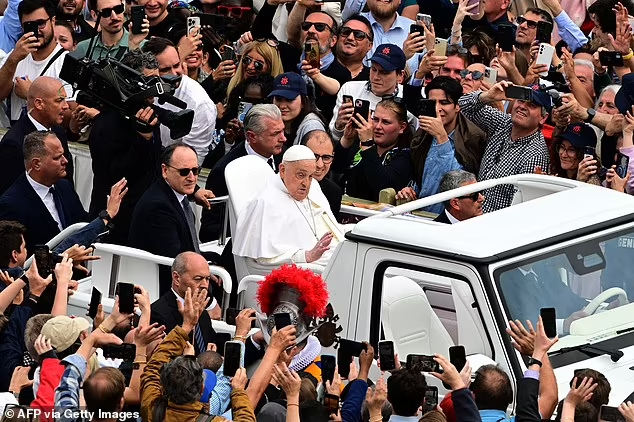
Update! Pope Francis Alters Funeral Tradition: From choice of coffin to burial place and how the ceremony will be different from his predecessors

  • Vatican says Pope Francis died of stroke and heart failure

The death of Pope Francis will mark a significant break from traditional papal funerals, including how he will become the first pontiff to be buried outside of the Vatican in more than a century.

Vatican doctor Andrea Arcangeli, in a death certificate released on Monday, said the 88-year-old pontiff, Pope Francis, died of a stroke and irreversible heart failure.

The certificate, which was published by the Vatican, said the pope had fallen into a coma before his death early on Monday.

Pope Francis died of “cerebral stroke, coma, irreversible cardiocirculatory collapse”, the death certificate said. It added the religious leader died at 7:35 am local (0535 GMT) in his apartment at the Santa Marta residence in the Vatican.

Pope Francis had suffered various ailments during his 12-year papacy, with severe complications in recent weeks following a bout of double pneumonia for which he spent 38 days at Rome’s Gemelli Hospital.

The death certificate added that Francis also suffered from arterial hypertension, multiple bronchiectasis and Type 2 diabetes, ailments which had not been previously disclosed.

There will now be nine days of official mourning, but the historic process of the conclave, where cardinals will gather in the Sistine Chapel at the Vatican to choose who will be the next pope, will not begin for at least 15 days from today.

Although a papal funeral has traditionally been an elaborate affair, Pope Francis made the decision ahead of his death to approve plans to make it less complex.

While previous pontiffs, including the late Pope Benedict, have been buried in the traditional triple coffins made of cypress, lead and oak, Francis instead chose a simple wooden coffin lined with zinc.  

The tradition of the Pope’s body being placed on a catafalque inside St Peter’s Basilica for the world to pay its respects has also been scrapped. 

Francis’ body will instead remain inside the coffin, with the lid removed, with mourners invited to pay their respects.

The Vatican had released Pope Francis’s spiritual testament – a written statement of faith – in which he said he wished to be buried in Rome’s Basilica of Saint Mary Major and not at St Peter’s Basilica in the Vatican, unlike many of his predecessors.

The text specified Pope Francis wanted to be buried “in the ground, without particular decoration” but with the inscription of his papal name in Latin: Franciscus.

“As I sense the approaching twilight of my earthly life, and with firm hope in eternal life, I wish to set out my final wishes solely regarding the place of my burial,” read the testament, which was dated June 29, 2022.

“May the Lord grant a fitting reward to all those who have loved me and who continue to pray for me,” it said.

See Also: How romantic rejection at 12 forged the most controversial Pope of modern times

See Also: Conclave: The Vatican’s secret process for choosing a new pope

Francis will instead be laid to rest in the basilica of Santa Maria Maggiore in Rome’s Esquilino neighbourhood, rather than in the grottoes beneath St Peter’s, which houses the tombs of around 90 popes.

The last Pope to be buried outside St Peter’s was Leo XIII (1878-1903) who was interred in the Basilica of St John Lateran, which is the church for the Bishop of Rome. 

As a result, 22 other Popes are also buried here while another four are also resting at the Basilica of St Lawrence Outside the Walls.

These include Blessed Pius IX (1846-1878), St Zosimus (417-418), St Sixtus III (432-440), St Hilary (461-468) and Damasus II (1037-1048).

Five other Popes are buried at Santa Maria Maggiore and these include Pius V (1566-1572, Sixtus V, (1585-1590), Clement XIII ( 1758-1769), Paul V (1605-1621) and Clement IX (1667-1669). 

Meanwhile, the Basilica of St Paul Outside the Walls houses the tombs of St Felix III (483-492) and John XIII (965-972).

Clement XIV (1769-1774) is buried in the Basilica of the Holy XII Apostles while Benedict XII (1724-1730) rests in the Basilica of Santa Maria Sopra Minerva.

A basilica is a church which has special significance or privileges granted by the Pope – and the Santa Maria Maggiore is one of the four major ones in Rome.

Francis has made more than a hundred visits to the fifth-century basilica, where he would pray in front of a venerated image of the Virgin Mary and baby Jesus.

In his final years, the pontiff appeared to be making plans for his death, consecrating 21 new cardinals, including details for his funeral. 

When announcing plans to simplify his funeral, Francis told Mexican broadcaster N+ in 2023: ‘I’ll launch a new ritual.’

The stripping back of the papal funeral procedure is intended to ’emphasise even more that the Roman Pontiff’s funeral is that of a shepherd and disciple of Christ and not of a powerful man of this world’, according to Monsignor Diego Ravelli, the master of liturgical ceremonies. 

It will come as no surprise to those who have followed Pope Francis’ journey since the start of his papacy in March 2013, when he opted against living in the lavish Apostolic Palace and instead moved into a guest house on the Vatican grounds. 

He sought to project simplicity into the grand role and never took possession of the ornate papal apartments used by his predecessors, saying he preferred to live in a community setting for his ‘psychological health’. 

Pope Francis previously presided the funeral of his predecessor, Pope Benedict XVI, who died in December 2022 after abdicating.

Benedict’s body lay in state in St Peter’s Basilica from January 2 to January 4 2023, with around 195,000 mourners paying their respects. His funeral was attended by around 50,000 people. 

Benedict was among the previous popes to be buried in the traditional triple coffin made of cypress wood, zinc and oak. 

It was was unprecedented in modern times for a living pope to bury his predecessor. 

Announcing Pope Francis’s death today, Camerlengo Cardinal Kevin Farrell said in a statement: ‘At 7.35 this morning, the Bishop of Rome, Francis, returned to the home of the Father.

‘His entire life was dedicated to the service of the Lord and of his Church.

‘He taught us to live the values of the Gospel with faithfulness, courage, and universal love, especially for the poorest and most marginalised.

‘With immense gratitude for his example as a true disciple of the Lord Jesus, we commend the soul of Pope Francis to the infinite, merciful love of God, One and Tribune.’

The Pope emerged from his convalescence on Easter Sunday to bless the thousands of people in St Peter’s Square in Vatican City.

He had recently resumed some official duties during his recovery from pneumonia.

He made his first public appearance since his bout of double pneumonia on April 6, when he appeared in St Peter’s Square in a wheelchair during a special Jubilee Mass for the sick following his discharge from the hospital two weeks previously.

Otu Oka-Iwu (Association of Igbo Lawyers) condemns exclusion of South East from Presidential Committee on National Population and Housing Census

Press Release

EXCLUSION OF THE SOUTH EAST AND SOUTH SOUTH GEOPOLITICAL ZONES FROM THE PRESIDENTIAL COMMITTEE ON THE NATIONAL POPULATION AND HOUSING CENSUS – A DELIBERATE AFFRONT TO JUSTICE, EQUITY, AND NATIONAL COHESION

Otu Oka-Iwu, the apex organization of Igbo lawyers in Nigeria, expresses utter disappointment, deep concern, and unreserved condemnation of the recent composition of the Presidential Committee on the National Population and Housing Census (2025). We are alarmed to observe that the entire South East and South South geopolitical zones/regions that are home to millions of Nigerian citizens have been totally and deliberately excluded from this critical national assignment.

This is not just an omission. This is a clear and calculated act of marginalization, one that reinforces the entrenched and widening pattern of exclusion and systemic discrimination against the Igbo people and our neighbours in the South South region. Out of seven (7) committee members, five are from the South West, and the remaining two are from the North Central and North West. No person from the South East or South South regions that have contributed immensely to the political, economic, and social fabric of this nation is found worthy of inclusion.

This action, under the watch of a government that claims to govern in the interest of all, is not only reprehensible but amounts to a brazen insult to the principles of federal character, equity, inclusion, and justice as enshrined in the Nigerian Constitution.

Let it be stated categorically: a national census is not a technical exercise, it is political, economic, social, and cultural. It determines representation in government, allocation of resources, and the trajectory of development for decades to come. It defines who counts, and who is counted. Excluding an entire people from the committee that will shape and oversee such a process is an unmistakable declaration that we do not matter in the affairs of this country.

Otu Oka-Iwu views this development as a continuation of the subtle but persistent agenda to sideline and silence the South East and South South regions in the governance and policy architecture of Nigeria. It is a sad commentary that in 2025, we must still remind the Nigerian state that this country is not the inheritance of any one region or ethnic group. We cannot, and will not, be spectators in our own country.

We call for the immediate reconstitution of the Presidential Census Committee to reflect the true federal character of Nigeria and to include qualified and capable representatives from the South East and South South zones. Anything short of this is unacceptable, provocative, and a direct invitation to civil disobedience.

We also wish to make it abundantly clear that should this glaring injustice not be urgently addressed, we will not hesitate to mobilize our people across Igbo land and the South South to resist and reject any enumeration or census process carried out under such a flawed and exclusionary framework. We will not allow any group to reduce our people to mere statistics to be used and discarded at will.

The continued undermining of ‘ndi Igbo’ and other marginalized groups in the governance of this country must end. The unity of Nigeria cannot be built on selective inclusion and calculated injustice. There can be no peace where there is no justice.

We call on traditional institutions, political leaders, religious bodies, civil society organizations, and the international community to take notice of this travesty and to join in demanding a reversal of this grievous error.

Nigeria belongs to all of us. The Census must reflect that or it will reflect nothing at all.

Signed:

Mazi Okechukwu Unegbu
President, Otu Oka-Iwu

Chief Ben Ihesiulo
Secretary, Otu Oka-Iwu

TIPS