Home Blog Page 374

A mother’s desperate move to provide for an ailing son

She read the bible out aloud.

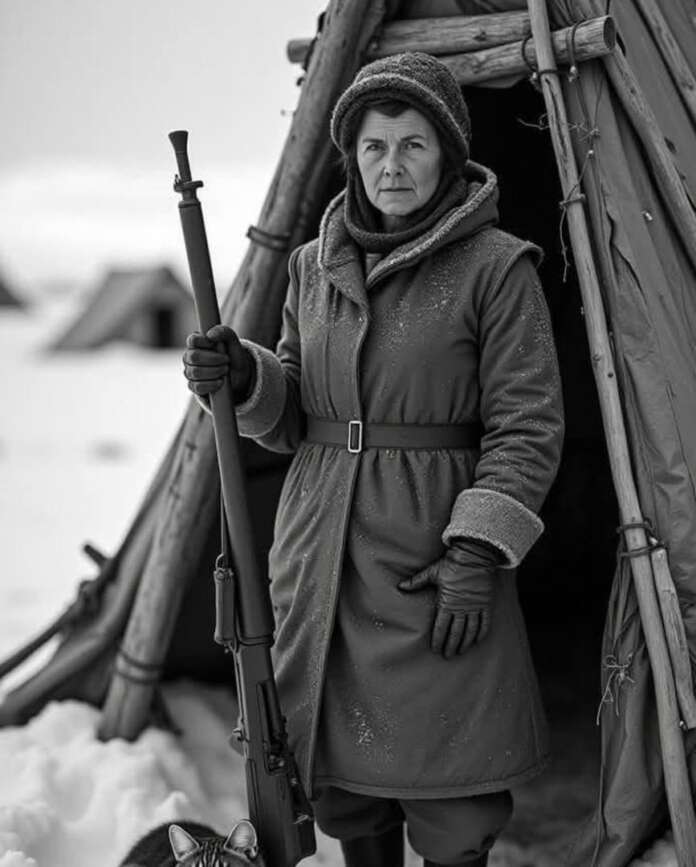
In 1921, Ada Blackjack, a young Inuit mother desperate to provide for her ailing son, joined an Arctic expedition as a seamstress. She wasn’t an explorer, nor a hunter—just a woman trying to earn money.

The mission, led by Vilhjalmur Stefansson, sought to claim Wrangel Island for Canada. Ada was the only woman and the only Inuk among four white male explorers. When supplies ran low, the men set off for help across the ice… and never returned.

Ada was left behind with a dying teammate and a cat named Vic. Soon, it was just her and Vic—alone in subzero wilderness, 700 miles from help. She taught herself to shoot a rifle. She fended off polar bears with a knife. She sewed her own mittens when her fingers froze.

She trapped foxes. Ate seal. Read the Bible aloud. And through it all, Vic curled close to keep her warm.

Two years later, rescuers arrived. She was still alive. Thin. Worn. But unbroken. The world nearly forgot her. The men got the headlines.

But today, we remember Ada Blackjack for what she was: 💪 A survivor. A mother. A fighter. A legend.

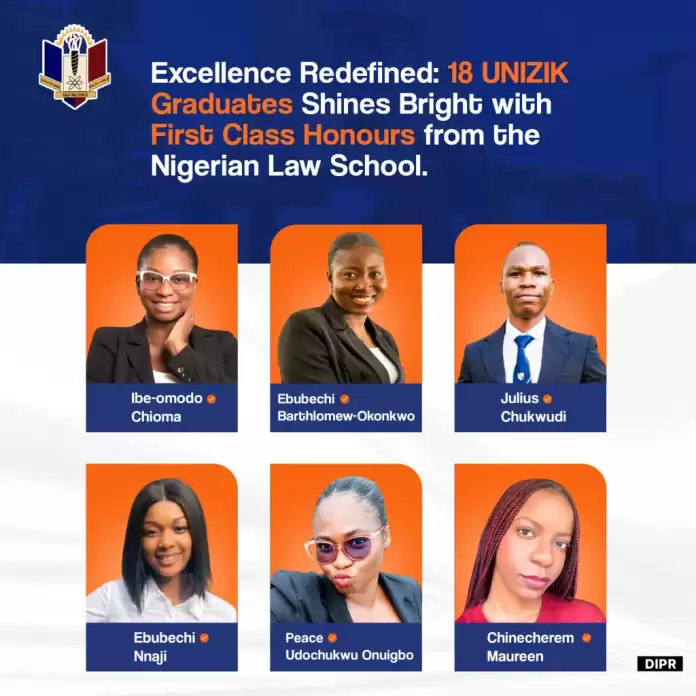
18 UniZik Law graduates make 1st Class at Nigerian Law School

“The recently released results from the Nigerian Law School have once again affirmed the Faculty of Law, Nnamdi Azikiwe University, Awka, as a beacon of academic excellence in legal education in Nigeria”, a statement from the university reveals.

According to the statement, 18 graduates of the institution bagged First Class Honours at the 2025 Bar Finals Examination, the highest in the history of the Faculty, “further showcasing the university’s commitment to nurturing top-tier legal minds.”

The outstanding graduates are:

1. Ibe-Omodo Chioma – Enugu Campus

2. Ebubechi Bartholomew -Okonkwo – Bayelsa Campus

3. Julius Chukwudi – Port Harcourt Campus

4. Ebubechi Ifunanya Nnaji – Port Harcourt Campus

5. Peace Udochukwu Onuigbo – Bayelsa Campus

6. Chinecherem Maureen Anatuanya – Lagos Campus

7. Wisdom Chibuike Oguguo – Port Harcourt

8. Obiajulu Leonard Okoli – Lagos campus

9. Charles Olumba Stella Onyeka – Port Harcourt campus

10. Echefu Stellamaris Uchechukwu – Abuja campus

11. Nwokocha Annastecia Chidinma – Yola campus

12. Obasi Sochima Evangeline – Yola campus

13. Ezeanyaso Tony Chinweitito – Port Harcourt Campus

14. Nwabuzor Chioma Glory – Lagos Campus

15. Amanoh Chisom Goodness – Yola Campus

16. Alagboso Daniel Ifeanyi – Abuja Campus

17. Anene Chinaza Peace –

18. Ifechukwu Praise Mmesoma – Yenagoa Campus

“This impressive achievement reinforces the Faculty of Law’s tradition of excellence and reflects UNIZIK’s unwavering dedication to academic distinction.

“The elated Dean of the Faculty of Law, Professor Felicia Ayaogu, confirmed the news with pride, stating, “This is the true situation. Our students have made us proud, and we give all glory to God Almighty.”

“She credited the remarkable achievement to the dedication of the Faculty’s lecturers, emphasizing that the Faculty of Law has made deliberate efforts to cultivate an environment that fosters effective learning, teaching, and research. Professor Ayaogu also expressed her gratitude to the Acting Vice-Chancellor for his unwavering support to the Faculty.

“Reacting to the news, the Acting Vice-Chancellor, Prof. Joseph I. Ikechebelu, FAMedS, FNAmed, commended the Faculty of Law for its continued stellar performance. He reaffirmed the university’s commitment to supporting all faculties in producing globally competitive graduates who are equipped to provide innovative solutions to global challenges, in line with his BLESSeD Vision for UNIZIK.

“Prof. Ikechebelu also extended heartfelt congratulations to the eighteen high-achieving graduates, assuring them of the university’s continued support as they progress in their professional journeys”, the press release stated.

Days ago, the Council of Legal Education (CLE) approved five new universities to commence law degree programmes, signalling a strategic expansion in access to legal education in Nigeria.

According to a statement from the CLE’s Office of Information and Protocol, the approvals were granted during the council’s second quarterly meeting held on Thursday, April 17, 2025, at the Nigerian Law School Headquarters in Bwari, Abuja, under the chairmanship of Chief Emeka Ngige (SAN).

The newly approved institutions are: Nigerian British University, Asa-Uzuaku, Abia State, Federal University Otuoke, Bayelsa State, Modibbo Adama University, Yola, Prime University, Kuje, Abuja, and Margaret Lawrence University, Abuja.

Each of these institutions has been cleared to admit up to 50 students into their law faculties starting from the 2024/2025 academic session.

The decision followed satisfactory verification visits conducted by the Nigerian Law School team, led by the Director General and Chairman of the Board of Studies, Prof. Isa Hayatu Chiroma, SAN.

Additionally, the council approved an upward review of the University of Nigeria, Nsukka’s law programme admission quota from 220 to 250 students.

The council also announced a high pass rate in the 2024 Bar Final Examinations.

Out of 7,134 candidates who sat for the exams, 260 earned First Class Honours, 1,193 achieved Second Class Upper, 2,638 earned Second Class Lower, 1,595 passed, 327 earned a Conditional Pass, 940 failed, while 181 were absent.

This, according to the council, reflects an overall pass rate of 84 per cent.

It reaffirmed its commitment to advancing legal education and upholding the high standards required in training future legal professionals in Nigeria. 

Domestic Violence: Special Adviser to Delta State Governor on Trade and Export reportedly beaten to death

Chief Shimite Winifred Bello, the Special Adviser to the Delta State Governor on Trade and Export, has reportedly been beaten to death in what is believed to be a case of domestic violence.

The tragic incident reportedly happened on Monday, April 21, 2025, and has since stirred emotions across Delta State and beyond.

While official details remain unclear, several individuals close to her have alleged that her husband was responsible for the attack that led to her death.

Her aide, Tameta Sunday, shared a sorrowful message on social media, blaming her husband for cutting short her life and the plans they had together.

Another social media user, Hon. Oge Okonkwo, also claimed that her husband has been arrested in connection with her death.

These allegations have not yet been confirmed by the police.

Chief Shimite was a respected figure in trade and economic circles.

She served as the Coordinator of the Delta State UNIDO Centre and led the implementation of the Federal Government’s Social Investment Programme in Delta.

Her passion for African culture and tourism was evident in her television documentary, African Pot, which showcased African cuisine and traditions.

She was involved in several international and national projects, including the USAID/NEXTT programme and the Lakaji Trade Corridor.

She also sat on the Board of Directors of the Foundation for Economic Change in Africa (FESECA) and worked as a contributing editor for publications like Daily Trust and Leadership, focusing on travel and tourism.

Her death has sparked conversations about domestic abuse, with many urging women to walk away from violent relationships rather than stay and risk their lives.

Friends, colleagues, and members of the public continue to mourn her, describing her as a woman of great vision and purpose whose life ended too soon.

Dockaysworld.com

Conclave: The Vatican’s secret process for choosing a new pope

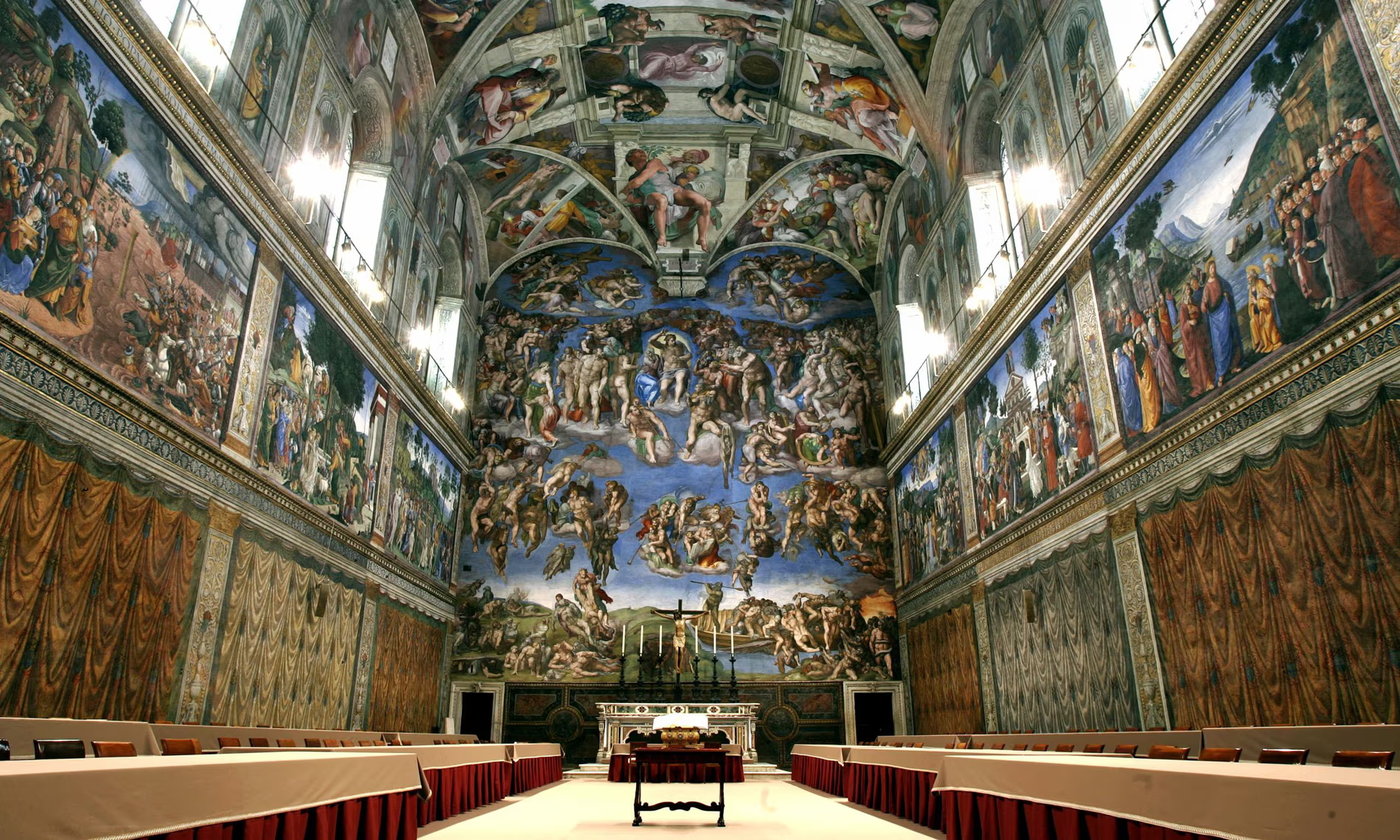
Tables stand under Michelangelo's frescoes in the Sistine Chapel in 2005 before the conclave that followed the death of John Paul II. Photograph: REUTERS

The next pope will be chosen by the College of Cardinals, the Catholic church’s most senior figures appointed by the pontiff, who will make their way to Rome in the next few days for the conclave. The name comes from the Latin cum clave, meaning “with key”, indicating the closed process of electing a pope.

There are more than 220 cardinals from more than 70 countries, but only about 120 are cardinal electors (those over the age of 80 are excluded). Two-thirds of the cardinal electors have been chosen by Francis in the past 10 years and largely reflect his vision of a more inclusive church.

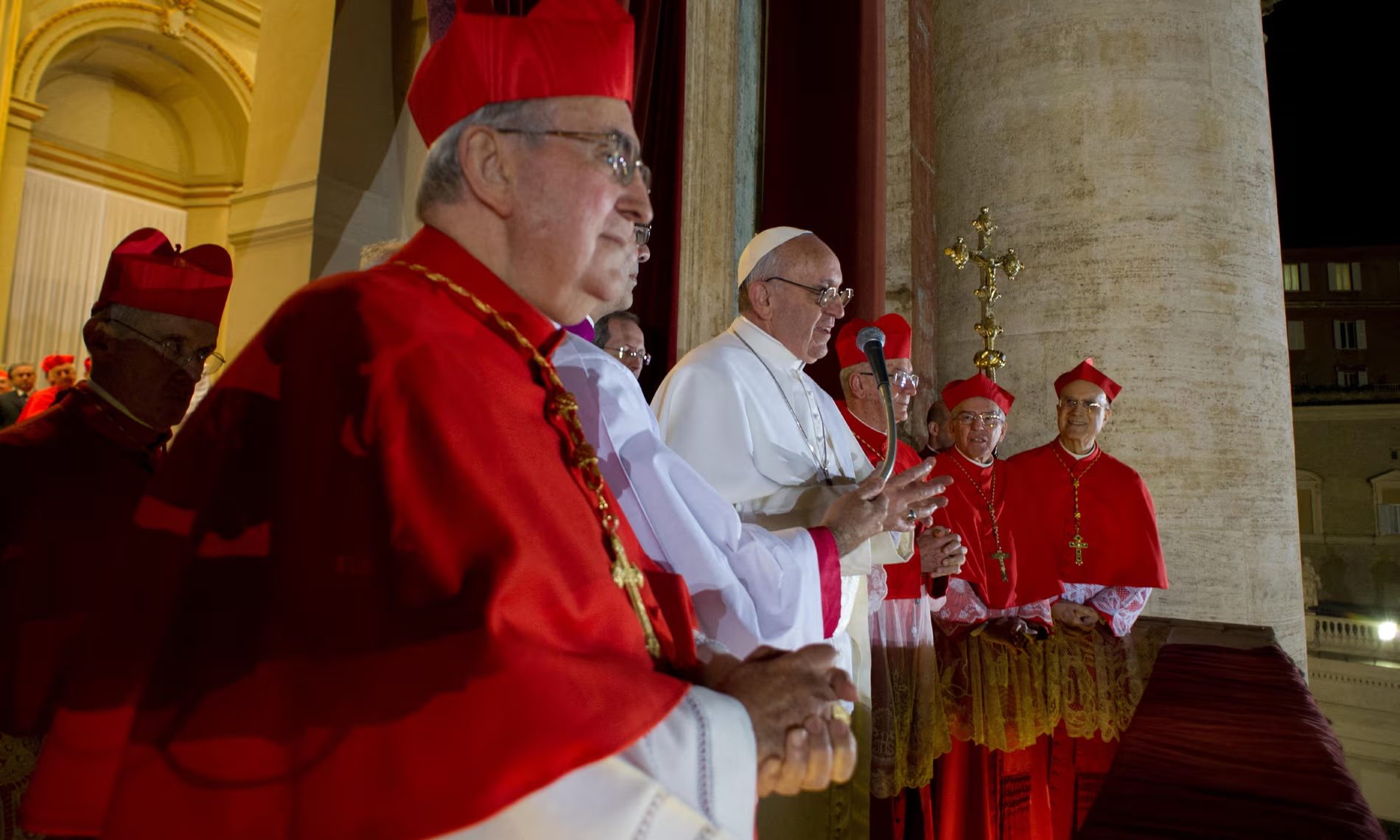
Francis stands on a Vatican balcony in 2013 with the cardinals who elected him pope. Photograph: Vatican Media/Reuters

Once the cardinals are assembled in Rome, usually 15-20 days after the pope’s death, they gather under Michelangelo’s magnificent painted ceiling in the Sistine Chapel to begin their deliberations. After the words extra omnes – everyone out – are declared, referring to all but voting cardinals and a handful of officials and doctors, the doors are locked.

The cardinals swear an oath of absolute secrecy and are permitted no contact with the outside world for the duration of the election process. Their phones are removed, and no newspapers, television, letters or messages are allowed. The chapel is also swept for listening devices before and during the conclave.

The cardinals sleep and eat in a purpose-built hostel, St Martha’s house, near the Sistine Chapel, where Pope Francis has lived for the past 12 years.

The conclave begins with a celebration of mass, after which deliberations and voting begins. Votes are taken each day, morning and afternoon, until a candidate wins a two-thirds majority. There is a day’s break for prayer and reflection after every seven ballots. If there is no conclusive result after 30 ballots, a candidate will be elected on a simple majority. The longest papal conclave in recent history was 1922, when the cardinals took five days to choose their new leader.

Any baptised male can be elected as pope, although a serving cardinal is invariably chosen. Each elector is given a ballot card with the words eligo in summum pontificem (I elect as supreme pontiff) printed at the top. They insert the name of their choice, fold the card and drop it into a chalice.

The ballot is secret, but that does not mean the process is immune from factionalising, intrigue and lobbying.

After each round of voting, the ballot cards are burned. Chemicals are added to make the smoke black or white. Black smoke emerging from the 60ft chimney indicates an inconclusive ballot; white smoke announces to the world that a new pope has been elected.

The successful candidate is asked if he accepts election and, if so, which name he chooses to take as pontiff. The cardinals pledge obedience to the new pope, who is led into the adjacent Room of Tears to be dressed in a white cassock and skull cap, and red slippers. Three sets of vestments in different sizes will have been made by Vatican tailors in advance.

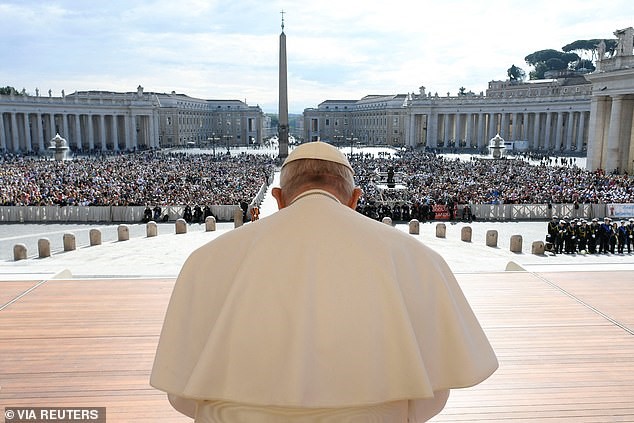
The dean of the cardinals steps on to the main balcony of St Peter’s Basilica, in front of which thousands of Catholic devotees and tourists will be gathered. The dean will declare: “Annuntio vobis gaudium magnum: Habemus papam” – “I announce to you with great joy: We have a pope.”

The Guardian

Quadri Alabi, boy who faced Peter Obi’s convoy narrates how he cleaned faeces everyday in Kirikiri prison

  • Lawyer says over ₦10m raised in 4 days to relocate him

Quadri Alabi, the boy who got attention when he stood in front of Peter Obi’s convoy in Lagos during a presidential campaign tour in the build-up to the 2023 general elections, has said he was made to clean faeces every day while detained in the Kirikiri correctional facility.

Alabi stated this during an interview on Monday on Channels TV which he attended alongside his lawyer, Inibehe Effiong.

“In the place that they put me in Kirikiri they used me like a person that did not have any family. From morning to 6 o’clock, I used to pack shit because I did not have money to give marshal,” he said.

Alabi was arrested and charged in connection with a violent street fight in the Amukoko area of Lagos earlier this year. However, Magistrate Adetola Olorunfemi later freed him following legal advice from the Director of Public Prosecutions (DPP), Dr. Babajide Martins.

The 17-year-old said he was at the entrance of his house when the police arrested him after being led by hoodlums.

“At the station, I was the youngest there. I was locked up with older men. They asked me what I did, and I said nothing. Before the arrest, the area boys had already taken my phone and the money in my pocket,” he said, adding that the hoodlums had been threatening him because they wanted a share of donations he got from the public when his photo from Mr Obi’s campaign tour went viral.

His lawyer Effiong alleged the police claimed Alabi was 18 years old in court documents.

Effiong said: “The police falsely claimed he was 18 in court documents. Why? Because if they had said he was 17, the court would have treated the matter differently—possibly not even remanding him in a regular prison. The magistrate noted this during the hearing but said the only information provided showed him as 18, so she had no reason to question it.”

The lawyer also claimed the Divisional Police Officer (DPO) of Amukoko Division subjected Alabi to an internal police trial, along with Inspector Odigbe Samuel and other officers. He described their actions as part of an “evil, sinister, oppressive, and corrupt scheme” to frame a teenager for armed robbery, instigated by rogue ‘area boys.’

The rights lawyer also revealed that over N10 million has been raised in just four days for the young man.

According to Effiong: “The boy sitting next to me, Quadri Alabi, as you know, went viral in 2023 during one of Peter Obi’s campaign tours. He spontaneously jumped in front of the convoy, raised his hand, and the photo went viral. That moment changed his life. Donations were made, and he gained some popularity.

“Unfortunately, with that fame came harassment. Local area boys began extorting him, saying he hadn’t ‘settled’ them. They even told his mother to buy a cow, cook rice, and throw a feast for the community. When she refused, the threats continued.

“This is actually the second time these same individuals, with support from the Amukoko Police, targeted him. The first time, he was quietly detained. The second time, in January, he was returning home from work when he was arrested by area boys, specifically known as Leggy and Baba Waris, who accused him of ignoring them despite the money he had received from Peter Obi.

“They handed him over to the police, claiming he was involved in a street fight. His mother was told the same. She even confronted one of the area boys, who admitted it was about the money.

“Shockingly, he was detained for a full week before being taken to court on January 27. The DPO, CSP Ismaila Ulaniro, kept him in custody illegally during this period.”

Effiong continued: “They finally took him to the Magistrate Court in Apapa, alongside four adult men he had never met before. The police accused them of armed robbery, said to have occurred on January 22 at 10 p.m. No identification parade was conducted, and there was no evidence linking him to the crime.”

On the issue of age falsification, Effiong said: “The police falsely claimed he was 18 in court documents. Why? Because if they had said he was 17, the court would have treated the matter differently—possibly not even remanding him in a regular prison. The magistrate noted this during the hearing but said the only information provided showed him as 18, so she had no reason to question it.”

Alabi himself recounted the experience: “I was just at the entrance of my house when the police came and arrested me. The area boys pointed me out. At the station, I was the youngest there. I was locked up with older men. They asked me what I did, and I said nothing. Before the arrest, the area boys had already taken my phone and the money in my pocket.”

Regarding the donations, Effiong added: “I can confirm that we’ve raised over N10 million in just four days for Quadri. The goal is to relocate him from Amukoko and to secure a source of income for his mother, who is a petty trader. This shows the strength of the Nigerian spirit.”

A Father to All: A tribute to a humble servant of humanity

By Mabel Adinya Ade

In a time of deep division, noise, and struggle, the world has lost a rare light a Father who lived and served not for titles or wealth, but in total humility and unwavering commitment to the service of humanity.

He took an oath of poverty, and lived it fully not as a symbol, but as a lifestyle of sacrifice, simplicity, and solidarity. He called on all of us to seek not just forgiveness from sin, but a deeper conversion: a transformation of the heart that builds true humanity rooted in love, dignity, and justice.

He was a bridge-builder a tireless voice for peace, reconciliation, and inclusion. He reached across religions, ethnicities, and ideologies with compassion and conviction. He walked among the poor, embraced the marginalized, and kissed the feet of the forgotten. His life was a gospel lived aloud.

In his heart beat a special concern for family , single parents, for the elderly, for migrants struggling to survive harsh journeys in search of better lives. He taught the world that migration is not a crime and that every person regardless of their origin deserves a chance to thrive.

He gave the Earth a voice when few listened. Through Laudato Si’, he reminded humanity that the environment is not just a resource to be exploited, but a sacred home to be nurtured and protected. He called on governments, corporations, and citizens alike to listen to the “cry of the Earth and the cry of the poor.”

He broke boundaries that many feared to touch recognizing the value and leadership of women in the Church. He opened the doors to female clergy, included women in key positions, and consistently sought their advice and perspectives. In doing so, he began to undo centuries of exclusion, setting an example that institutions worldwide must now follow.

Even when his health declined, he remained alert to the cries of the helpless. He carried his pain quietly while carrying the burdens of others with unwavering grace.

To Catholics and non-Catholics alike, he was more than a religious leader he was a moral compass, a father to the world, and a symbol of integrity and spiritual courage.

Today, we grieve. Uncontrollably, deeply. We cry not just because we have lost a beloved shepherd, but because the world desperately needs voices like his, voices that unite, voices that listen, voices that love and advocate.

But even as we mourn, we commit to carry on his legacy: to speak for the voiceless, to embrace the stranger, to fight for the Earth, to include the excluded, and to love without limit.

May God grant him eternal rest.
May perpetual light shine upon him.
May he rest in perfect peace. Amen.

Pope Francis: A bridge builder of mercy and peace

By Sonnie Ekwowusi

Pope Francis was, by all standards, a Pope of mercy. Following the teaching of Jesus Christ—exemplified in His eating and drinking with sinners—and in line with Jesus’ dictum, “I have not come to call the righteous but sinners” (Matthew 9:13), Pope Francis, since the beginning of his pontificate, has always opened his arms to welcome and receive sinners and all who sought his company, even to the misunderstanding of some.

Like Jesus Christ, Pope Francis understood that his mission was not to condemn or judge others, but rather to reach out and save others, especially those abandoned in the periphery. I remember that when the Nigerian Catholic lawyers visited the Vatican some years ago, Pope Francis told them and others that, beyond operating in parishes, they should go into the world and bear witness for Christ.

In 2015, Pope Francis declared an Extraordinary Jubilee Year of Mercy, calling on people to embrace God’s mercy and be more merciful toward others. He has consistently reached out to marginalized groups—such as refugees, the poor, the vulnerable, prisoners, and people with disabilities. He has emphasized that the Church should focus on those on the periphery of society rather than the powerful or elite. This is seen as an act of mercy, as he believes the Church’s mission is to heal and support the suffering.

Pope Francis’ message of mercy, love, forgiveness, a non-judgmental stance, and compassion for sinners underscores the importance of humility, the recognition of one’s own sinfulness, and the need for God’s grace and mercy.

Amid high-level terrorism, suicide bombings, wars, rumors of a Third World War, and human tragedies afflicting humanity and threatening international peace, several Popes have constructed an ethical framework for human solidarity in finding solutions to the absence of peace in the world.

For example, shortly after the First World War in 1919, President Woodrow Wilson was received at the Vatican by Pope Benedict XV to foster peace in the world. President Eisenhower visited Pope John XXIII in Rome to discuss world peace. In his epic Encyclical Pacem in Terris, Pope John XXIII established four pillars upon which peace should be built.

Remember President Bush’s meeting with Pope Emeritus Benedict XVI to promote peace in the world? With 104 trips outside Italy (including 16 trips to the African continent), St. John Paul II the Great was outstanding for his tenacity in promoting peace, tolerance, commitment to social justice, respect for human dignity, and inter-religious dialogue.

On October 6, 1979, President Jimmy Carter had the pleasure of hosting the first White House visit by a Pope when St. John Paul II visited the United States, advocating for peace in the world. In fact, St. John Paul II acted directly as an intermediary in the promotion of justice and peace in countries where peace was threatened.

Recall that on December 15, 1982, St. John Paul II had

an audience with Yasser Arafat on the peaceful settlement of the Palestinian question. Not to mention his famous meeting with King Hassan II on August 19, 1995, which was attended by well over 80,000 youths, or his visits to Ghana, Kenya, Senegal, Cameroon, and Nigeria.

In fact, his visit to Nigeria during the reign of dictator Sani Abacha remains indelibly engraved in the minds of many Nigerians—if not for anything else, for the fact that the Pope called for peace in Nigeria.

Therefore, following in the footsteps of his predecessors in the Papacy, Pope Francis had throughout his Papacy doggedly committed himself to the promotion of international peace throughout the duration of his pontificate. He has advocated for the abolition of nuclear weapons, stressing that their existence is an “immoral” threat to humanity. He has urged world leaders to invest in peace rather than in arms, warning against the destructive power of modern weaponry. Pope Francis has also been a vocal critic of the arms trade, which he believes fuels conflicts around the world.

Lest we forget, Pope Francis played a key role in the peace process between the Colombian government and the Revolutionary Armed Forces of Colombia (FARC). In 2017, he met with both sides in an effort to broker reconciliation and peace after years of violent conflict. Pope Francis has consistently advocated for peace in the Middle East, emphasizing that the spilling of human blood in Gaza is a slur on our human existence. He has called for a two-state solution, stressing the rights of both the Israeli and Palestinian peoples to live in peace and security.

On June 8, 2014, Pope Francis hosted Israeli President Shimon Peres, Palestinian President Mahmoud Abbas, and Ecumenical Patriarch Bartholomaios in the Vatican Gardens to explore new ways of building peace in Jerusalem and reconciling seemingly irreconcilable foes.

At that historic meeting, the participants acknowledged that despite the failure of previous efforts by world leaders to resolve the Israeli-Palestinian and broader Middle East crises, renewed and greater efforts must be made to broker peace in the region.

In his address, Pope Francis—whom President Peres described as “a bridge builder of brotherhood and peace”—stated that while human ingenuity is essential in resolving the Middle East crisis, peacemakers must also begin to rely on the help of God. He stressed the urgency of the moment, noting that children weary and worn out by the conflict are now pleading with leaders “to tear down the walls of enmity and to set out on the path of dialogue and peace, so that love and friendship will prevail.”

In his emotional and poetic response, President Peres said, “The tears of mothers over their children are still etched in our hearts. We must put an end to the cries, to the violence, to the conflict. We all need peace—peace between equals. Your invitation to us to join you in this momentous ceremony to call for peace, here in the Vatican Garden, in the presence of Jewish, Christian, Muslim, and Druze leaders, graciously reflects your vision of the aspiration we all share.”

Pained by the seemingly unending war and the continued spilling of human blood in South Sudan, Pope Francis, in 2019, organized a retreat for South Sudanese leaders and their warring opposition groups at the Vatican. It was a two-day retreat—what Cardinal Parolin called a “spiritual, ecumenical, and diplomatic” initiative.

Among the preachers at the retreat were Archbishop John Baptist Odama of Gulu, Uganda, and Nigerian Jesuit priest Father Agbonkhianmeghe Orobator. Other notable attendees included the spiritual leader of the Anglican Communion worldwide, Archbishop Justin Welby, members of the South Sudan Council of Churches, and other Catholic and Presbyterian church leaders from across Africa.

At the end of the retreat, Pope Francis addressed the attendees in Italian, saying: “There will be struggles and disagreements among you, but keep them within you—inside the office, so to speak. But in front of the people, hold hands, united. So, as simple citizens, you will become fathers of the nation… I am asking you as a brother to stay in peace. I am asking you with my heart: let us go forward. There will be many problems, but they will not overcome us. Resolve your problems.”

Therefore, following in the footsteps of his predecessors in the Papacy, Pope Francis has doggedly committed himself to the promotion of international peace throughout the duration of his papacy. He has advocated for the abolition of nuclear weapons, stressing that their existence is an “immoral” threat to humanity. He has urged world leaders to invest in peace rather than arms, warning against the destructive power of modern weaponry. He has also been a vocal critic of the arms trade, which he believes fuels conflicts around the world.

Lest we forget, Pope Francis played a key role in the peace process between the Colombian government and the Revolutionary Armed Forces of Colombia (FARC). In 2017, he met with both parties in an effort to broker reconciliation and peace after years of violent conflict. He has consistently advocated for peace in the Middle East, emphasizing that the spilling of human blood in Gaza is a stain on our shared humanity. He has called for a two-state solution, upholding the rights of both Israelis and Palestinians to live in peace and security.

On June 8, 2014, Pope Francis hosted Israeli President Shimon Peres, Palestinian President Mahmoud Abbas, and Ecumenical Patriarch Bartholomaios in the Vatican Gardens to explore new avenues for peace in Jerusalem and reconciliation between seemingly irreconcilable foes. During this historic meeting, the leaders agreed that although previous efforts to resolve the Israeli-Palestinian and broader Middle East crises had borne little fruit, renewed and intensified efforts were necessary.

In his address, Pope Francis—described by President Peres as “a bridge builder of brotherhood and peace”—stated that in addition to human effort, peacemakers must rely on divine assistance. He underscored the urgency of resolving the crisis, noting that children, weary and worn out by prolonged conflict, are now pleading with leaders “to tear down the walls of enmity and to set out on the path of dialogue and peace, so that love and friendship will prevail.”

In his emotional and poetic response, President Peres said, “The tears of mothers over their children are still etched in our hearts. We must put an end to the cries, the violence, the conflict. We all need peace—peace between equals. Your invitation to us to join you in this momentous ceremony to call for peace, here in the Vatican Garden, in the presence of Jewish, Christian, Muslim, and Druze leaders, graciously reflects your vision of the aspiration we all share.”

Pained by the seemingly unending war and bloodshed in South Sudan, Pope Francis, in 2019, organized a retreat for South Sudanese leaders, including members of the opposition and rebel groups, at the Vatican. This two-day retreat—described by Cardinal Parolin as a “spiritual, ecumenical, and diplomatic” initiative—was attended by various Christian leaders, including Archbishop John Baptist Odama of Gulu, Uganda, Nigerian Jesuit priest Father Agbonkhianmeghe Orobator, Anglican Archbishop Justin Welby, and members of the South Sudan Council of Churches.

At the close of the retreat, Pope Francis addressed the leaders in Italian: “There will be struggles and disagreements among you, but keep them within you—inside the office, so to speak. In front of the people, hold hands, united. As simple citizens, you will become fathers of the nation… I am asking you as a brother to stay in peace. I am asking you with my heart: let us go forward. There will be many problems, but they will not overcome us. Resolve your problems.”

Thereafter, Pope Francis did something dramatic. Clad in his white cassock and zucchetto, he stooped low—flattening himself on the ground—and kissed the feet of the South Sudanese leaders and their opponents.

Though they were wearing shoes, the Pope humbly kissed their dusty footwear. With this profound gesture, he appealed to them to lay down their arms and allow peace to reign in South Sudan. Many visitors and onlookers were deeply moved by the Pope’s extraordinary humility.

It is clear that if mankind is to pursue peace, now more than ever, we must rediscover the path that leads to genuine reconciliation, concord, and unity. It is not enough to wax philosophical on the vexing matter of global peace. World leaders must identify common values as the foundation for a new international order grounded in justice, service, mutual respect, and human dignity.

For peace to reign in the world, warring factions must learn to forgive one another. Peace begins in the heart. As Josemaría Escrivá wrote, “It is useless to call for external calm if there is no calm in men’s consciences.”

Therefore, peace is born from a purified heart. It is nurtured in sacrifice. It is sustained by justice.

Building on the Church’s ecumenical dialogue with Muslims, Pope Francis established strong relations with Muslim leaders. A milestone was his 2019 visit to the United Arab Emirates, where he signed the Document on Human Fraternity with the Grand Imam of Al-Azhar. The document emphasized cooperation between Christians and Muslims to foster peace, tolerance, and mutual respect.

Age upon age, wrote Emmet John Hughes on October 20, 1958, the city of Rome “has affected the destiny and trial of the Church in profound and ever new ways. No matter who sits on the throne of St. Peter in Rome,” continued Hughes, “he can know but one heritage, one purpose and, in G.K. Chesterton’s words, ‘one scheme…bestriding lands and ages with gigantic arches, and carrying everywhere the high river of baptism upon an aqueduct of Rome.’”

These prophetic words find fulfillment in Pope Francis’ recent declaration, Dignitas Infinita (“Infinite Dignity”), released on April 8, 2024. This 20-page document unequivocally denounces, among other things, LGBT ideology, surrogacy, and gender ideology as grave violations of human dignity and transgressions against God’s teaching and divine plan for humanity. Citing the prophet Isaiah—”Woe to those who call evil good and good evil, who put darkness for light and light for darkness”—Dignitas Infinita bluntly criticizes these practices. It affirms the Church’s longstanding position that the human person is a unity of body and soul, and that “the dignity of the body cannot be considered inferior to that of the person as such.”

This reiterates the Church’s established doctrine, previously outlined in the 2008 document Dignitas Personae and in Donum Vitae some twenty years prior, which condemned artificial reproduction, surrogacy, and experimentation on human embryos as violations of human dignity and offenses against God.

In an age when many define their worth by the size of their cars, houses, or wealth, Pope Francis’ austere lifestyle and detachment from materialism are striking. He has deliberately renounced the comfort and luxury often associated with high office, modeling his life on Jesus Christ, who said: “If any man wishes to come after me, let him deny himself, and take up his cross daily and follow me. For he who would save his life will lose it; but he who loses his life for my sake will save it. For what does it profit a man, if he gains the whole world, but ruins or loses his soul?”

During his visit to America, Pope Francis famously chose to ride in a modest black Fiat 500L, rather than a limousine. Flanked by other vehicles, his humble choice of transportation stood as a powerful symbol of simplicity and servant leadership—one that, to many, was deeply edifying.

In Washington D.C., Pope Francis made a clear and compelling case for American founding principles as understood and exemplified by President Abraham Lincoln, civil rights icon Martin Luther King Jr., Catholic Worker Movement founder Dorothy Day, and Cistercian monk Thomas Merton. He presented these figures as enduring sources of hope and as bulwarks of American democracy.

Addressing a joint session of the American Congress (Pope Francis is the first pope ever to address a joint session of the U.S. Congress), he reminded the senators and representatives that politics is not the first thing; rather, politics is an expression of the deeper values within humanity. Therefore, politics should not be perceived as a mere instrument for promoting secular progressivism at the expense of the lofty values that reside in the human heart.

But the crowning moment of Pope Francis’ visit to America, in my humble view, was his speech at the General Assembly of the United Nations. The Pope began by reflecting on the lofty ideals that led to the founding of the United Nations as the successor to the League of Nations. He praised the great achievements of the UN, as it turned 70, in promoting peace, human fraternity, and the advancement of human rights.

However, he expressed regret that the misuse of political power and environmental degradation has left many people marginalized. As a solution, Pope Francis advocated for inclusive politics and responsible environmental stewardship that benefits all—economically, socially, politically, and spiritually. He emphasized that integral human development is rooted in three material and spiritual goods: housing; dignified and properly remunerated employment; adequate food and drinking water; religious freedom; and, more broadly, spiritual freedom and education.

“These pillars of integral human development have a common foundation,” said Pope Francis, “which is the right to life and, more generally, what we could call the right to the existence of human nature itself.”

I believe Pope Francis will also be most remembered as a Pope of hope. He has proclaimed the year 2025 as a Jubilee Year—a special holy year of grace and pilgrimage in the Church—with the theme “Pilgrims of Hope.” This Jubilee is officially titled Spes Non Confundit (Hope Does Not Disappoint). Its theme is a profound reminder that all of us on earth are wayfarers and pilgrims journeying toward a definitive Home.

Pope Francis passed away in April, during the Octave of Easter, probably the time he wanted to died Yesterday, it was very difficult for him to perform the Urbi et Orbi blessing at St. Peter’s Basilica. I watched him—tired and barely able to lift his hands. It is noteworthy that St. Pope John Paul II also died in April, around the Easter season.

In the death of Pope Francis, the world has lost not just a peacemaker and a bridge builder, but a spiritual father—a universal shepherd who was always ready to provide his flock with their due of spiritual nourishment at the opportune time.

Sonnie Ekwowusi is a Member of the Editorial Board of The Guardian Newspaper

How romantic rejection at 12 forged the most controversial Pope of modern times

By Daniel Johnson

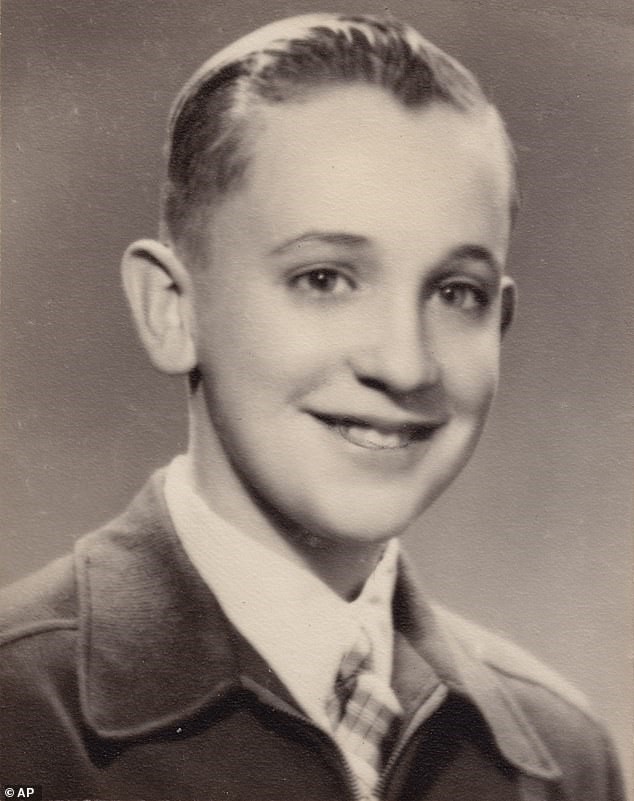
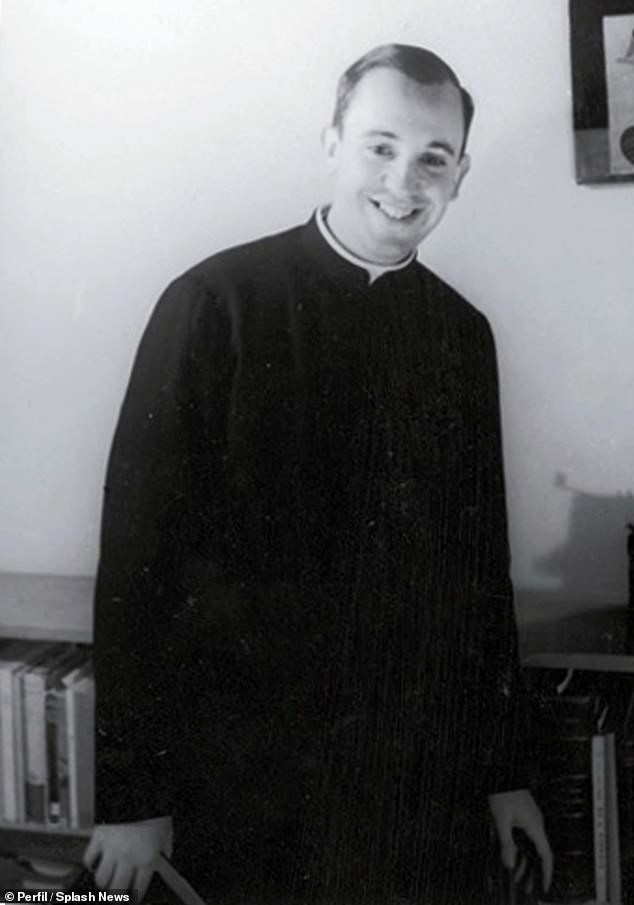
When Jorge Mario Bergoglio was 12, he developed a crush on a girl called Amalia. Both sets of parents disapproved of their children forming an attachment so young but Jorge went ahead and proposed marriage anyway, according to Amalia.

She recalled with a laugh: ‘He said that if I didn’t say yes, he would have to become a priest. Fortunately for him I said no.’

It must count as one of the most momentous rejections in history, as Bergoglio not only went on to be ordained but rose to become head of the Roman Catholic church.

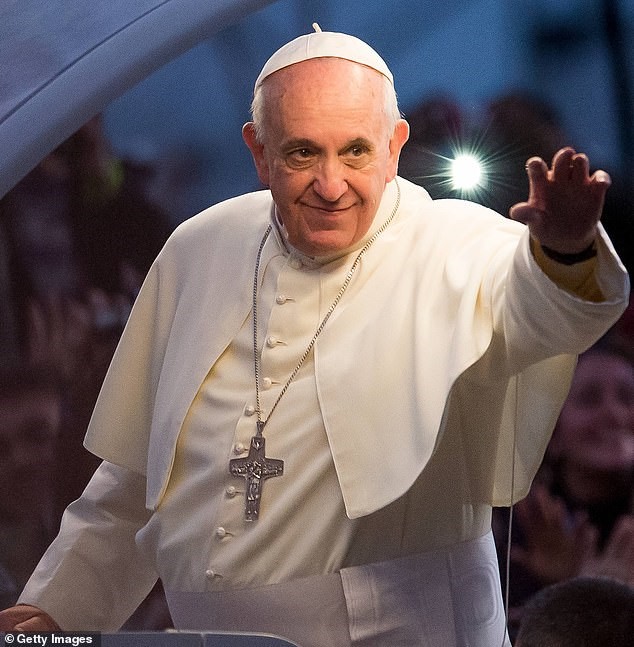
Pope Francis, who has died aged 88, was the first non-European to be elected to his office in 13 centuries.

A Jesuit from Argentina, Francis was also the most liberal, the most political and the most controversial of modern popes.

His informality, simplicity and charm won him many admirers.

His 12 years as Supreme Pontiff were marred by bitter divisions over doctrine between liberals and traditionalists.

The Pope sparked pandemonium by issuing a document advocating a relaxation of the Church’s ban on the sacrament of Communion for divorced and civilly remarried couples. Four leading cardinals publicly dissented and the issue continues to divide Catholics.

When Bergoglio became Archbishop of Buenos Aires in 1997, he placed great emphasis on evangelism and poverty relief in the city’s most deprived barrios (neighbourhoods), acquiring the nickname ‘the Slum Bishop’.

As pope he also broke with the politically conservative stance of his two predecessors, John Paul II and Benedict XVI, siding with the Left across a range of issues and proved more ready to compromise with authoritarian regimes.

In 2022, Francis courted controversy by refusing to explicitly condemn Russia after the invasion of Ukraine. Instead, the Vatican has maintained dialogue with the pro-Putin Russian Orthodox Church.

His conciliatory attitude to China, meanwhile, led to accusations that he had abandoned the underground Church there to persecution by the communist authorities.

Perhaps his most distinctive achievement was to shift the attention of the world’s 1.3 billion Catholics away from issues of personal morality, such as birth control and abortion, towards threats to the environment and the plight of the poor.

Having adopted the name of St Francis of Assisi, famous for his humility and love of animals, this ‘ecological Pope’ never ceased to remind humanity of its duty to preserve God’s creation.

Born in 1936, the future Pope grew up in a large family of middle-class Italian immigrants living in a suburb of Buenos Aires. His parents had left Mussolini’s fascist Italy before his birth, for political rather than economic reasons.

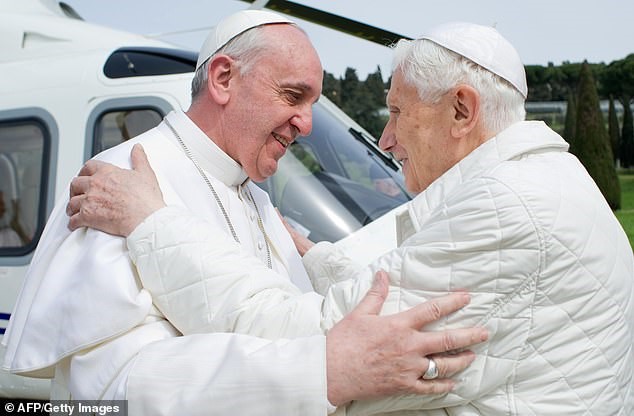
Pope emeritus Benedict XVI greets his successor, Pope Francis, upon his arrival at the heliport in Castel Gandolfo, the Pontiff’s summer residence outside Rome

The young Jorge was not always wedded to the priesthood. As a young man, he once worked as a bouncer at a night club and was, reputedly, an enthusiastic dancer of the tango.

He went on to train as a chemical technician and, in 1958, at the age of 21, he had most of one lung removed after a serious bout of pneumonia. Despite periodic respiratory infections, plus colon and heart conditions in later years, Bergoglio was able to live a normal life.

Later that same year he did find his vocation: after going to confession, he was inspired by the priest to take the cloth. While a seminarian, he fell in love with another young woman and briefly considered dropping out but, in the end, persevered with his studies.

Once he became a Jesuit, Bergoglio rose rapidly in the Order to become a professor of theology and later the Jesuits’ provincial-general in Argentina from 1973-79.

In 2001, he was given the cardinal’s hat by John Paul II. By then he was already emerging as the best hope of the liberals within the Church elite to reverse the conservative restoration inaugurated by the Polish Pope.

When John Paul died in 2005, the conclave was divided between two rival candidates: Joseph Ratzinger, the late Pope’s right hand man and dean of the College of Cardinals, and Bergoglio, who attracted strong support from liberals and the southern hemisphere.

Ratzinger’s election as Benedict XVI was a triumph for traditionalists, but Bergoglio bided his time. Eight years later, in 2013, Benedict suddenly announced his resignation — the first pope to have done so in five centuries.

This was Bergoglio’s chance, despite his fragile health. By now 76, the Cardinal Archbishop of Buenos Aires soon emerged as the clear favourite. His election was greeted with joy by Catholics in the developing world, although, given his parents’ roots, Italians saw him as one of their own, after 35 years under first a Pole and then a German.

Francis became the first Pope for more than a century to live outside the papal apartment in the Apostolic Palace, choosing to reside in the Vatican guest house.

His predecessor, Benedict, now Pope Emeritus, lived nearby. Their relations were described as friendly, but tensions remained. Benedict continued to publish books and articles while conservative Catholics rallied around him.

For his part, Francis kept up a punishing schedule of foreign visits until the Covid pandemic forced him to remain isolated in the Vatican. Having put on weight after an operation for diverticulitis – inflammation of the large intestine – the increasingly sedentary Pope became reliant on a wheelchair.

His loss of mobility became evident at the funeral of Benedict in January 2023, when Francis presided over the Requiem Mass from his cathedra (episcopal throne) and blessed the departing coffin from his wheelchair.

Finally, his failing lungs caught up with him and he was admitted to the hospital on Valentine’s Day to be treated for bronchitis – especially dangerous given his existing respiratory ailments. He was later diagnosed with double pneumonia, and his condition was later described as critical.

As his condition worsened, there were rumours that the Swiss Guard had started funeral rehearsals. And today came the news that the Catholic faithful had dreaded for so long.

This article was originally published by Daily Mail online newspaper on 21 April 2025

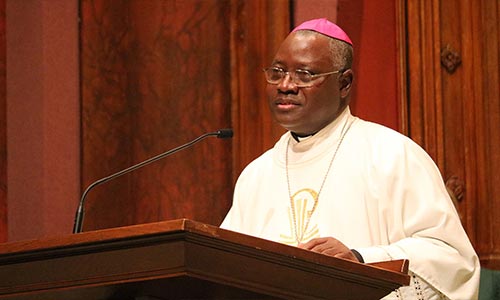
Nigerians are bleeding, hungry, unsafe, disillusioned, Says Kaigama in Easter Message

The Catholic Archbishop of Abuja Diocese, Most Rev Ignatius Kaigama has called on the Federal Government to address the challenges of insecurity, revive the economy, and restore the dignity of human lives because Nigeria is bleeding, people are hungry, unsafe and disillusioned.

According to him, as a people, the citizens must rise above despair, division, and violence and commit themselves to peace, justice, and truth.

“Our country is bleeding – our people are hungry, unsafe, and disillusioned. It is therefore imperative that politicians in government focus more on addressing the real challenges before us: ending insecurity, reviving the economy, and restoring the dignity of Nigerian lives”, he said

While describing the political tensions and institutional breakdown that led to the declaration of a state of emergency in Rivers State as “deeply troubling”, the cleric said that although government intervention in moments of crisis is sometimes necessary to restore order and protect democratic institutions, the government must be cautious in its reactions and avoid actions that could further polarize an already tense environment.

Kaigama said these in his Easter Message titled, “The Light Shines in the Darkness, and the Darkness Cannot Overcome It”, taken from John 1:5 and sent to Arise News in Abuja.

He said Easter is not just a Christian ritual—but a powerful reminder that light always follows darkness, and life prevails over death.

Kaigama said, “Yet, even as we celebrate, our hearts are heavy with grief and concern over the senseless bloodshed and insecurity that continue to plague our land.
We mourn the tragic and reckless killing of innocent travellers in Uromi, Edo State—lives cut short without reason or mercy.

“We grieve the repeated violence and massacres in Bokkos and Bassa Local Government Areas of Plateau State, where entire communities are being decimated. These attacks have left families shattered and dreams destroyed, and they underscore the urgent need for a sincere and coordinated response to insecurity across Nigeria.
We are also alarmed by the continual hunger and economic hardship gripping our people. Families struggle daily to put food on the table, and children go to bed hungry in a nation so richly blessed.

“The desperation in the land is palpable, and it calls for immediate action from all levels of government, faith-based institutions, and citizens. As Jesus fed the multitudes with compassion, so must we work together to ensure that no Nigerian goes hungry in the midst of plenty.

“Equally distressing is the increasing trend of kidnapping and targeted attacks on clergy, especially priests who dedicate their lives to serving others. These brutal acts not only rob families of their loved ones but also strike at the heart of our moral and spiritual fabric. Every priest kidnapped or murdered is a blow to the conscience of our nation.

“In addition, the recent political tensions and institutional breakdown that led to the declaration of a state of emergency in Rivers State are deeply troubling. While government intervention in moments of crisis is sometimes necessary to restore order and protect democratic institutions, we must be cautious in our reactions and avoid actions that could further polarize an already tense environment.

“Let this moment serve as a call to all stakeholders – political leaders, traditional authorities, civil society, and citizens – to embrace dialogue over division. No democracy can thrive without the culture of give and take, live and let live.
Power, like life, is transient. Therefore, we must strive to build bridges and not burn them, to prioritize the welfare of the people over personal or party interests. Let us resist the temptation of inflammatory rhetoric and embrace peace, understanding, and mutual respect as the pathway to lasting stability.

“We must also be deeply concerned about the rising tide of acrimonious political rhetoric that is spreading across the nation. Words are powerful, and when used carelessly, they can inflame tensions and deepen our divisions. This is not yet the time for political campaigns or endless jostling for power.
Let us demand accountability and protection for every Nigerian, regardless of tribe, faith, or region.

He said since leadership is a sacred responsibility, not a contest of noise, Nigerian leaders should “prioritize governance over politics, solutions over slogans, and unity over personal ambition. Nigeria needs healing, not hostility.”

Kaigama said that in the face of the darkness that seems to surround Nigeria and envelop her lands, “we must not lose hope” as Easter teaches that even the tomb cannot hold back the power of resurrection.

“As a people, we must rise above despair, division, and violence. Let us commit ourselves to peace, justice, and truth. Let us demand accountability and protection for every Nigerian, regardless of tribe, faith, or region.

“This Easter, may the risen Christ ignite in us the courage to speak up against evil, the strength to support one another, and the wisdom to build a Nigeria where dignity and life are sacred once again. Let our celebration not just be of Christ’s resurrection, but of the renewal of our national spirit. May God bless Nigeria, and may peace reign in our hearts and across our land”, the cleric emphasized.

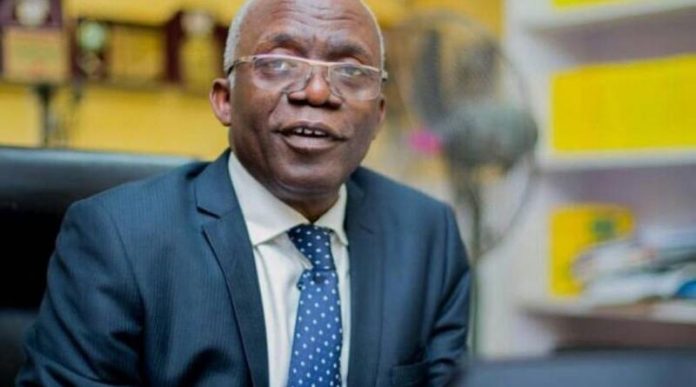
Falana to Wike, “You are the only Life Bencher in Nigeria who has never handled a case in any trial or appellate court”

Leading-edge rights lawyer, Femi Falana, SAN, has replied to the recent attack against him by the Minister of the Federal Capital Territory, FCT, Nyesom Wike.

Falana, in response to Wike’s recent media attack, where the Minister said the senior lawyer was being economical with the truth about a Supreme Court judgment on the defection of 27 lawmakers from the Peoples Democratic Party, PDP, to the All Progressives Congress, APC, described the former Rivers State Governor as “the only Life Bencher in Nigeria who has never handled a case in any trial or appellate court.”

During the interview, Wike taunted Falana, saying he lost the case and labelled him “a television lawyer.”

Dismissing Wike’s claims, the Senior Advocate in a statement titled: “I Did Not Lie Against the Supreme Court of Nigeria,” Falana dismissed Wike’s claims, stating, “It is no crime for a lawyer to lose a case in court. Only a corrupt lawyer wins all cases in all courts.

Falana said he felt compelled to respond to Wike through a rebuttal after the Minister’s renewed outburst during his recent media briefing.

He added that contrary to Wike’s claims, there is video and affidavit evidence confirming the lawmakers’ defection to the APC.

“It is public knowledge that Mr. Wike celebrated the Supreme Court judgment with a thanksgiving service. Yet, he attacks me for commenting on the same ruling,” Falana said.

He challenged Wike to report him to the Legal Practitioners Disciplinary Committee if he believed there was any professional misconduct.

“Unlike Mr. Wike, who insults judges when rulings don’t align with his politics, I’ve always critiqued court decisions with respect and good faith,” Falana asserted.

He also pointed to legal precedents and past statements by respected jurists, including the late Justice Oputa and former Chief Justice Tanko Muhammad, who welcomed critical engagement from the bar.

Falana warned that the recent Supreme Court position on defection— requiring the production of a political party’s register, could embolden “unpatriotic politicians” and encourage “political prostitution.”

“In the interest of political stability and national morality, I urge the Supreme Court to continue to uphold its earlier positions in cases like Attorney-General of the Federation v. Abubakar and Dapialong v. Dariye,” he added.

The senior lawyer added that the Minister’s attack had failed in its “desperate bid to incite the Justices of the Supreme Court.”

Falana said that Wike must be stopped from parading himself as the unsolicited defender of the judiciary in Nigeria.

TIPS