Home Blog Page 371

A Rejoinder To John E., Oshodi: A case study of Tinubu as an unrepentant recidivist-from one borderline infraction to another (From the 1993 FBI Drug Case, to Chicago Certificate to more legal and ethical infractions)

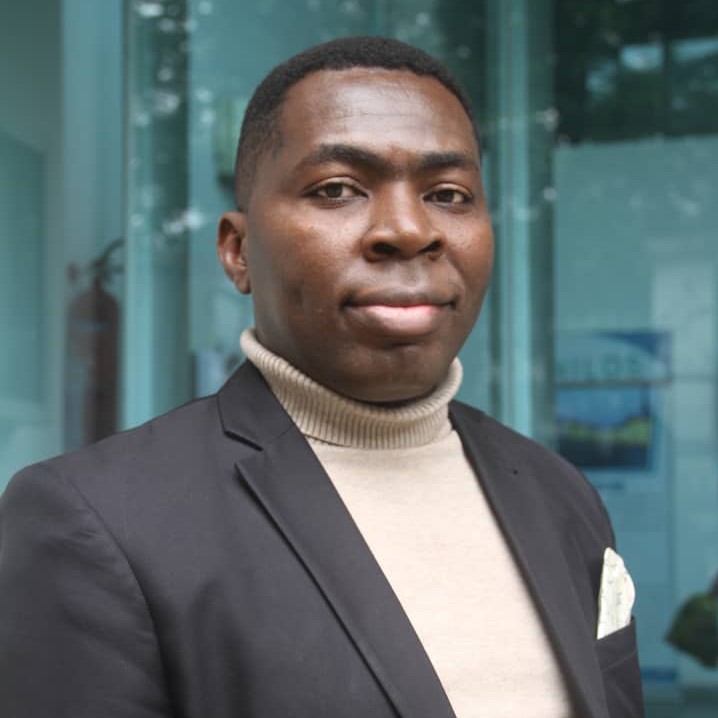
By Dr. Tonye Clinton Jaja

Prof. John E. Oshodi is a professional psychologist and prolific writer, and commentator on Nigerian affairs.

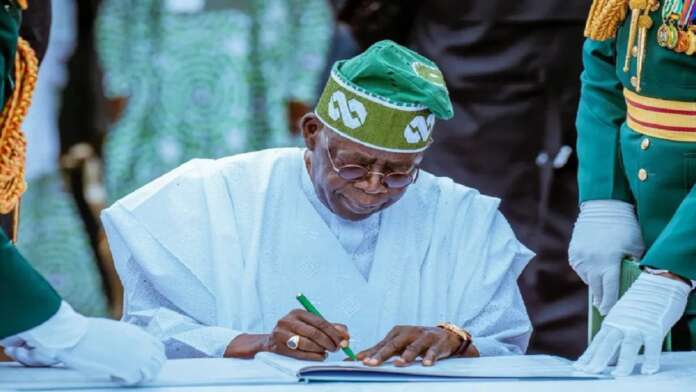
In an article dated 13th April 2025, he made reference to a psychologist’s term “trauma looping” as the reason why Nigerians have refused to forgive President Bola Ahmed Tinubu (PBAT) for things/crimes/indiscretions that happened over thirty years ago. According to him, some former Presidents of the United States of America (USA) had committed illegalities in the past which did not inhibit their performance during their tenures. He gave the examples of President Barack Obama who admitted the he previously experimented with cocaine and President Bill Clinton who committed perjury and illicit sexual affairs,just to mention a few.

However, the difference between these former Presidents of the USA and PBAT is that these former Presidents were one-time and one-off offenders.

Whereas since the year 1993 when the last drug and money laundering case of PBAT that was handled by the Federal Bureau of Investigation (FBI), PBAT has proved to be a repeat offender that is caught up in a cycle of recividism.

Recidivism is defined as “a tendency to relapse into a previous condition or mode of behavior
especially: relapse into criminal behavior”.

Let me provide some examples of both illegal and ethical infractions committed by PBAT since his assumption of office in the year 2023, they are as follows:

  1. Assenting to Bills (such as the Bill for increasing the retirement age of judges to seventy-five years) that were enacted by the 9th Assembly of the National Assembly which was dissolved on 29th May 2023, whereas PBAT is constitutionally permitted to only assent to Bills enacted by the 10th Assembly which came into existence in June 2023;
  2. Illegally assenting to a Bill for extension of the tenure of the Inspector-General of Police (IGP), without alteration of the Constitution of the Federal Republic of Nigeria, 1999;
  3. Illegal assent to the Bill for Re-Introduction of the old Nigerian National anthem, a Bill that never underwent public hearing in the year 2024;
  4. Obtaining humuguous amounts of foreign loans and expending such loans without prior consent of the National Assembly; and
  5. Proclamation of a State of Emergency in Rivers State without waiting for the actual occurrence of the pre-requisite circumstances as prescribed under Section 305 of the Nigerian Constitution.

The above list is not exhaustive.

It just provides evidence that PBAT (unlike the former and current Presidents of the USA, who were one-time offenders) is an unrepentant person caught up in the rapture of recidivism.

The only difference between his 1993 crimes and the ones he is committing now is that this time around he has the backing of the National Assembly, the Attorney-General of the Federation (AGF) and others who provide legal backing to make such infractions appear legitimate!!!

The views expressed by contributors are strictly personal and not of Law & Society Magazine.

During His Vacation in Britain and France Tinubu Has Perfected the Art of Gunboat Diplomacy: First Meeting With Governor Fubara, Then Gradually PDP Governors are Switching to APC (How Gunboat Diplomacy Dethroned King Jaja)

By Dr. Tonye Clinton Jaja

It was reported that President Bola Ahmed Tinubu (PBAT) spent a combined total of about nineteen (19) days on a working vacation between the United Kingdom and France!!!

While PBAT was in those two colonial master countries (France and the United Kingdom), it appears that he took his time to read a lot about the methods that France and Britain applied in their conquest and domination of pre-colonial African nations.

It appears that PBAT really read and grasped the method known as “gunboat diplomacy”.

The only problem is that PBAT is applying a method that the inventors themselves have long since abandoned during the 1960s when the colonial masters granted independence to Nigeria and other African countries.

In other words, instead of making progress, PBAT is driving Nigeria into retrogression.

Retrogression is defined as: “the process of returning to an earlier state, typically a worse one.
“a retrogression to 19th-century attitudes”.

The method that PBAT and the National Assembly applied in the Proclamation of State of Emergency in Rivers State can be defined as a form of gunboat diplomacy.

It was a blatant show of force, a disguised threat to other Governors especially those in the Opposition, People’s Democratic Party (PDP), that a similar State of Emergency could be proclaimed in their States regardless of whether the ACTUAL EXISTENCE of the pre-requisite circumstances for invocation of Section 305 of the Constitution of the Federal Republic of Nigeria, 1999.

The expression “gunboat diplomacy” is an oxymoron of sorts.

An oxymoron is defined as “a figure of speech in which apparently contradictory terms appear in conjunction (side by side in the same sentence).

The phrase “gunboat Diplomacy” is an oxymoron considering that on the one hand “gunboat” is an instrument of threat, war and destruction. Whereas “diplomacy” refers to a congenial approach of discussion and amicable resolution of issues between parties.

In other words, “gunboat diplomacy” is a method wherein a gunboat is stationed and pointed at one of the parties (just like holding a gun to the head) and telling the threatened person to sign his or her signature in agreement to the terms of an otherwise diplomatic discussion.

This is exactly how King Jaja of Opobo was dethroned and sent on exile by the officials of the British Empire in the year 1887.

He was lured to a meeting aboard HMS GOSHAWK for a supposed peaceful meeting to seek an amicable resolution of issues (diplomacy).

However as soon as King Jaja of Opobo stepped into the said ship, which was also gunboat, the guns/cannons of the said shop and others were pointed towards the Kingdom of Opobo, King Jaja of Opobo was given an ultimatum, either he agrees to be kidnapped and taken to Accra, Ghana for trial or the gunboats would destroy the Kingdom of Opobo. King Jaja chose to save the beloved Kingdom of Opobo which he started building in the year 1870.

PBAT is applying the same method of gunboat diplomacy in his interaction with Governor Fubara.

There is no level playing field between himself and Governor Fubara.

Before the alleged meeting with Governor Fubara in the United Kingdom, PBAT had installed his “gunboat” on the ground in Rivers State in the person of the Sole Administrator.

So whatever looks of a peaceful meeting pretending to employ diplomacy is only a ruse.

Below is a detailed description of gunboat diplomacy as follows:

“Gunboat diplomacy is the pursuit of foreign policy objectives with the aid of conspicuous displays of naval power, implying or constituting a direct threat of warfare should terms not be agreeable to the superior force.

The term “gunboat diplomacy” comes from the nineteenth-century period of imperialism, when Western powers – from Europe and the United States – would intimidate other, less powerful entities into granting concessions through a demonstration of Western superior military capabilities, usually represented by their naval assets. A coastal country negotiating with a Western power would notice that a warship or fleet of ships had appeared off its coast.

The mere sight of such power almost always had a considerable effect, and it was rarely necessary for such boats to use other measures, such as demonstrations of firepower.

Diplomat and naval thinker James Cable spelled out the nature of gunboat diplomacy in a series of works published between 1971 and 1993. In these, he defined the phenomenon as “the use or threat of limited naval force, otherwise than as an act of war, in order to secure advantage or to avert loss, either in the furtherance of an international dispute or else against foreign nationals within the territory or the jurisdiction of their own state.

King Jaja of Opobo was a significant figure in the history of the Niger Delta, and his story is intertwined with the practice of “gunboat diplomacy” used by Great Britain during the 19th century. This involved using naval power to exert pressure and achieve political and economic objectives, often without resorting to direct military conflict.

Gunboat diplomacy, as exemplified in the case of King Jaja, was a tool of imperialism employed by European powers to assert dominance and control over weaker regions. In the Niger Delta, British naval power was used to intimidate and eventually remove King Jaja from power, leading to his exile.

Here’s a more detailed look at how gunboat diplomacy impacted King Jaja :

The context:
King Jaja rose to power in Opobo, a trading center in the Niger Delta, and established a thriving palm oil trade. This successful enterprise, however, led to conflict with British traders who sought to control the trade routes.

The use of force :
The British, using naval power, pressured King Jaja to sign treaties that would allow them greater control over trade and resources in the region.

The arrest and exile :
King Jaja was lured onto a British warship under false pretenses, arrested, and tried for treaty violations. He was subsequently exiled to the Caribbean, effectively ending his rule and paving the way for British control over the Niger Delta.

The broader implications :
The King Jaja affair highlighted the use of gunboat diplomacy and other forms of coercion by the British in their efforts to establish and maintain control over the Niger Delta.”

The views expressed by contributors are strictly personal and not of Law & Society Magazine.

Police on Land Matters: Illegal arrests and detention of artisans and church members working on land belonging to a church

By Bayo Akinlade, Esq

In a recent development, Policemen from FCID Alagbon, led by A.I.G. Margaret Ochalla,
are again connected to being used by individuals to resolve disputes over land. What is upsetting here is that this dispute is already before the courts!

Why is it too hard for the police to stay out of land disputes? Why can’t the police simply obey the laws? What is the AIG’s personal interest in this land?

It is becoming intolerable for law abiding citizens to continue to accept the excesses of BAD policemen and corrupt Police leadership in this country.

Duty Solicitors Network was just made aware of an incident involving a church whose workers were arrested by the Nigeria police.

A complaint addressed to the Assistant Inspector-General of Police by the church is as follows:

The Nigeria Police Force Criminal Investigation Dept. (FCID) Annex Alagbon Close, Ikoyi, Lagos

Dear Madam,
RE: SUIT NO. LD/5321LM/2025 RICHARD DOSU ADELU & ORS VS MAKUACHUKWU CHUKWUJAMA AND CHIEF JOHN OGUNYEMI IN THE MATTER OF ASSAULT OF PERSONS, DAMAGE TO PROPERTY AND USE OF FORCE/SELF-HELP IN ATTEMPT TO ILLEGALLY TAKE OVER PROPERTY AT NO. 12, OYE BALOGUN STREET, OFF FREEDOM WAY, ITEDO, LEKKI, LAGOS – CONTEMPT OF COURT.

The above subject matter Suit and our letters dated 7th March, 2025 and 14th March, 2025 in respect of the above Suit refers.

We remain Solicitors to Richard D. Adelu, Eunice A. Adelu and Babatunde Aina of Celestial Church of Christ, Zion Parish , off Freedom Way, Itedo, Lekki, Beneficial Owners and Occupiers of the above mentioned property on whose instructions we communicate the following.

On behalf of our Clients, we write to complain of the unlawful arrest and detention of members and workmen (16 in total) at the Church property upon your direction which unfortunate event took place on Thursday 17th April, 2025.

This was in disregard of the Order of Court of 4th April, 2025 served on MR. MAKUACHUKWU CHUKWUJAMA AND CHIEF JOHN OGUNYEMI and delivered to you on 14th April, 2025 through Force Headquarters Annex, Kam Salem House, where you began to handle the matter.

We recall that before then we had also delivered Court processes to you on 7th March, 2025 to show that the property in question was the subject matter of litigation by which our Clients had sought pre-emptive orders of injunction from the Court.

By Ruling of the Court on Friday 4th April 2025, honourable Justice O.O. Ogunjobi of the High Court of Lagos State granted our Clients 3 pre-emptive injunctions among which was an injunction restraining MR. MAKUACHUKWU CHUKWUJAMA AND CHIEF JOHN OGUNYEMI from trespassing, threatening or disturbing our Clients’ peaceful enjoyment of their property, either by themselves or through the use of third parties.

That meant that the Respondents, either directly or indirectly through use of third parties, including law enforcement agents are forbidden to threaten or disturb our Clients’ peaceful enjoyment of their property, which includes working on their land.

However, the 1st Respondent illegally attempted to circumvent the Court Order by further complaining to police through a third party (Elegushi family) through whom he claims title. This was in disobedience of the Order of Court since the Order restrains the Respondents, by themselves, agents or other persons acting on their behalf.

To be clear, a complaint to the Police by the Elegushi family for the benefit of their purported purchaser, MAKUACHUKWU CHUKWUJAMA, was an act done on behalf of the 1st Respondent, MAKUACHUKWU CHUKWUJAMA and therefore in clear breach of the Order of Court. Such an attempt to circumvent a Court Order on behalf of the 1st Respondent in order to disrupt our Client’s peaceful enjoyment of their property was in contempt of Court and the Police lack jurisdiction to entertain it.

Consequently, the arrest of the 16 men from our Client’s property and the seizing of artisan/work implements was unlawful, in contempt of Court and lacking in jurisdiction.

The petition surreptitiously lodged by a Mr. Adedeji of the Elegushi family at the instance of the 1st Respondent amounted to giving false information to the Police. The Petitioner alleged that our Clients brought armed men to work on their own land within their own fenced compound in disobedience of a Court order which he claimed restrained all parties from working on the land. This was false. None of the 16 persons arrested was armed and upon enquiry by the Solicitor who attended FCID Alagbon to represent the men, no Court order was presented by the Police. Until such Court order is produced, it will appear that the Police invaded our Clients’ property to arrest members and workmen on the basis of unverified and false information given to the police.

Following the unlawful arrests of members and workmen on 17th April, 2025 and seizing of their artisan tools, Church Chairman, Mr. Babatunde Aina, was served with a letter of invitation to attend a fact finding investigation scheduled for Tuesday 22nd April, 2025 at 10.00 hrs. We are of the humble view that to continue to investigate a matter which is the subject matter of on-going litigation undermines the jurisdiction of the court at the risk of contempt proceedings ensuing.

The matter being “sub judice”, the Complainants’ recourse is to the Court only, without further attempts to undermine the Court’s jurisdiction in whatever guise. Our Clients therefore humbly decline the invitation and any further invitation by the Police regarding challenge to the peaceful enjoyment of their property now the subject matter of Court proceedings. To do otherwise will be disrespectful of the Court and an undermining of the rule of law.

Any aggrieved party is at liberty to join issues with our Clients in Court wherein the Court has assumed jurisdiction in the matter of peaceful enjoyment of our Clients’ property, rather than engage in self-help either directly or indirectly through use of third parties, including law enforcement agents.

Thank you for your co-operation.
Find attached a copy of the enrolled order of Court.

My Comments
I will continue to have hope in the Police and in the administration of justice in this country.

The police should STOP taking petitions and complaint made to it at face value but must thoroughly investigate these claims by so-called petitioners.

We know the police is under funded and underpaid but to collect bribes and gratification to arrest and detain citizens is a criminal act in itself and the Police must desist from such activities lest we face the ugly consequences of a failed State.

Yes, don’t care today because the Police is hungry but who is not hungry in Nigeria today, who is not pained by the current economic situation? The excuse to take bribes is no longer acceptable and if goes unchecked will compromise the safety and security of this nation.

THE NIGERIA POLICE SHOULD STOP GETTING INVOLVED IN LAND MATTERS.

STOP ILLEGAL ARRESTS AND DETENTIONS!

Still on the Wike Matter… Who will you hire as lawyer—Falana or your paymaster?

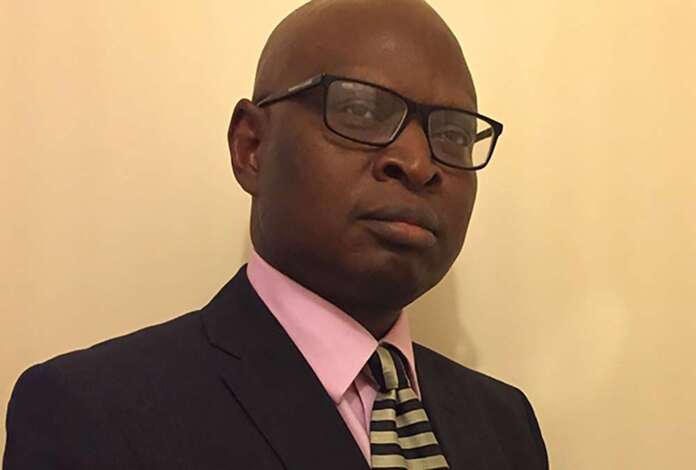
By Dr. Kolawole Olaniyan

One Lere Olayinka on Monday posted a so-called press release on his X (formerly known as Twitter) account, with the heading, “How many major cases did you win to become SAN?”, referring to Femi Falana, SAN. This is very ill-judged!

His venomous and deeply personal attacks on Falana, one of the finest advocates of his generation, clearly portray Lere as a grumpy critic! His purported question as to the ‘major cases’ that have been won by Falana reflects either Lere’s wilful ignorance or mischief, or both.

If Lere needed someone to defend him, who would he choose? Falana, a passionate advocate, or his clueless paymaster, on whose behalf he wrote the nonsense?

In case Lere cares to know, Falana is a formidable advocate and a defender of the voiceless, the vulnerable and the disadvantaged, and who has for many decades demonstrated absolute command of the courtroom.

Let’s look at some of Falana’s legal victories in the field of human rights.

Unlike Lere’s paymaster, Falana’s legal career has been devoted to bringing about systemic, material change to peoples’ lives, through law and with law. He wields his legal skills to save others from injustice, as aptly demonstrated by his very successful representation of civil society organizations and victims of human rights violations at the ECOWAS Court of Justice in Abuja and the African Commission on Human and Peoples’ Rights in Banjul.

His winning appearance for SERAP in July 2022 in the Twitter (X) ban case is one of several legal victories over the government’s abuse of power and crackdown on human rights, something which clearly has given Lere a chance to express himself on X.

In November 2010, Falana won another landmark decision for SERAP from the ECOWAS Court of Justice, which declared for the first time that the right to education is a legally enforceable human right in Nigeria.

Falana also won a major legal victory for SERAP when the ECOWAS Court of Justice in March 2022 ordered the Nigerian government to amend the repressive provisions of the Cybercrime Act and bring them in conformity with the country’s international human rights obligations.

In June 2008, Falana successfully defended a Gambian journalist Ebrimah Manneh at the ECOWAS Court of Justice. In the case, the court ordered the Gambian government to release Ebrimah and to pay him $100,000.00 as compensation for his unlawful arrest and detention.

Through Falana’s brilliant legal advocacy on behalf of SERAP, the African Commission on Human and Peoples’ Rights in October 2009 ordered the Libyan authorities to stop the execution of Nigerians on death row in that country. Following the Commission’s decision, Libya under the late Muammar Gaddafi suspended the execution of Nigerians on death row.

In September 2022, Falana persuaded the African Court on Human and Peoples’ Rights to denounce the Moroccan occupation of Western Sahara as a serious violation of the Saharawi people’s right to self-determination. The court has upheld the right to self-determination and independence of the Saharawi people and underlined the obligation of African States to assist it. The decision has reverberated throughout the African regional human rights system.

Falana routinely provides pro bono legal services– without a fee–to victims of human rights violations.

Falana brings clarity and insight to complex legal concepts through his excellent work as a writer and academic. He has written extensively about the law, human rights and the ECOWAS Court of Justice, including his seminal books on Fundamental Rights Enforcement (2004), ECOWAS Court: Law and Practice (2010), and Nigerian Law on Socio-Economic Rights (2017).

Falana is deeply principled and utterly independent. His outstanding achievements are a product of his deep commitment to human rights, social justice, the legal profession and a fearless approach to the practice of law, as well as to the rule of law.

The ECOWAS Court regularly pay tribute to his legal advocacy skills and the mark he has made (and continues to make) on the case-law of the court. The International Bar Association in 2008 saluted his abilities by awarding him the prestigious Bernard Simons Memorial Award.

These are the qualities and achievements to which Lere’s paymaster ought to aspire.

What, exactly, does Lere’s paymaster stand for?

Will Lere tell Nigerians the intellectual contribution of his paymaster to the development of the legal profession and legal jurisprudence? Or shut up!

Kolawole Olaniyan, PhD, is the author of Ownership of Proceeds of Corruption in International Law, Oxford University Press (2023)

The views expressed by contributors are strictly personal and not of Law & Society Magazine.

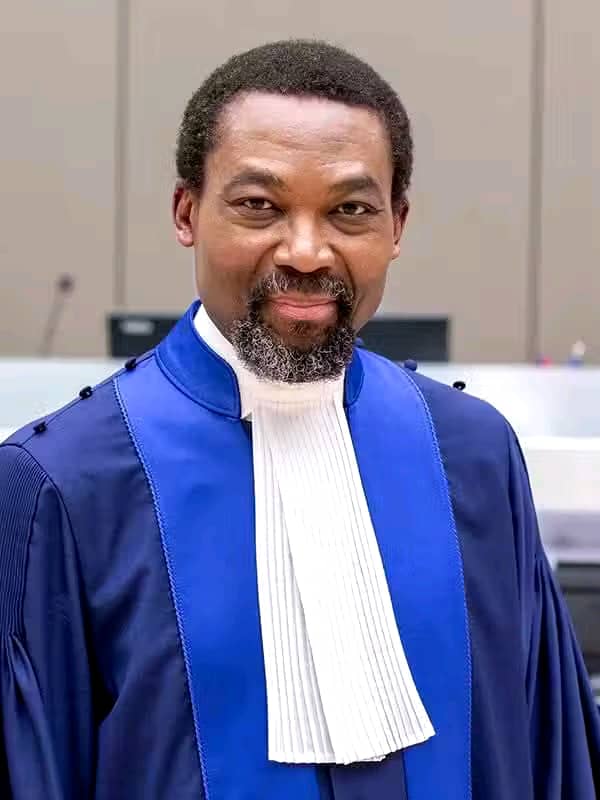
Nigeria’s international jurist, Chile Eboe-Osuji appointed Judge of the Caribbean Court of Justice

Nigeria’s own Honourable Justice Chile Eboe-Osuj on Tuesday, 15 April 2025, took the oath of office as a Judge of the Caribbean Court of Justice.

An International Jurist at the Lincoln Alexander School of Law, a Special Advisor to the President’s Office at Toronto Metropolitan University, Canada, Osuji is also a member of the Media Freedom Coalition’s High-Level Panel of Legal Experts on Media Freedom.

Justice Osuji, who hails from Anara Osuh, Isiala Mbano Local Government Area, Okigwe zone in Imo state, Nigeria, first made history by becoming the very first and only black person in the world to be elected as President of the International Criminal Court (ICC), Hague, Netherlands/Holland.

He was the 4th president of the International Criminal Court of Justice, at The Hague.

A Judge and a professor of Law, he presided over the ICC from 2018 to 2021.

Thousands from around world wait hours to visit coffin of Pope Francis

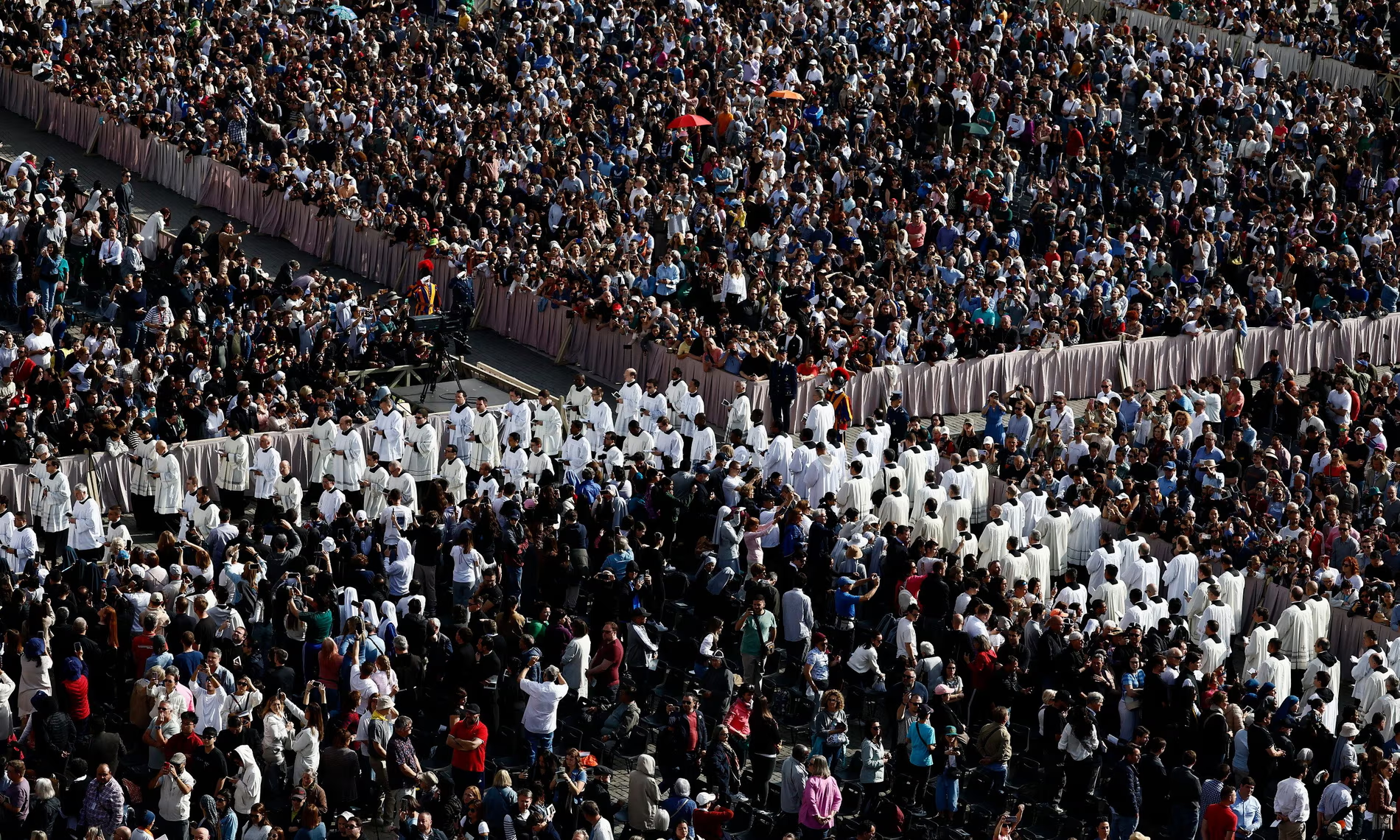
Crowds in St Peter’s Square as the pope’s coffin was taken into the basilica. Photograph: Cecilia Fabiano/LaPresse/Rex/Shutterstock

Pope’s simple open casket lies on the main altar of St Peter’s Basilica as mourners say: ‘It’s a privilege to be here’

Thousands of people queued for hours under the hot spring sun in St Peter’s Square on Wednesday to pay their final respects to Pope Francis, whose simple wooden coffin has been placed on the main altar of the 16th-century basilica, where he will lie in state until Friday evening.

The pope, the head of the world’s 1.4 billion Catholics, died at his home in Casa Santa Marta on Monday aged 88 after a stroke and subsequent heart failure. He had been recovering from double pneumonia, which had kept him in hospital for five weeks.

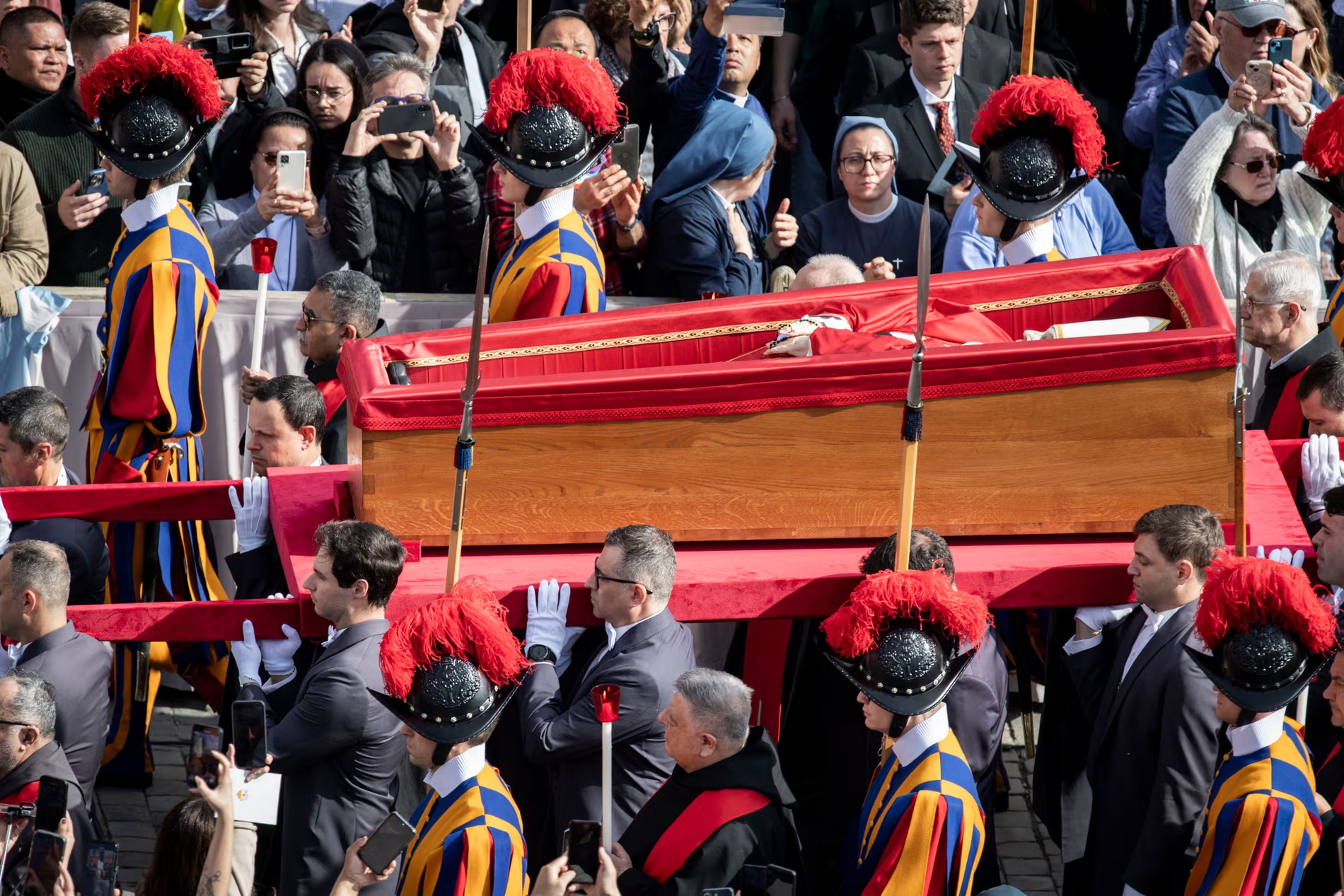
In keeping with his requests for simple funeral rites, Francis was dressed in his vestments, holding a rosary, with his open casket lined with red cloth.

Unlike those of most of his predecessors, his coffin, which is being watched over by two Swiss Guards, has not been raised on a platform. That was one of the rituals Francis shunned when he simplified rules for papal funerals last year.

His funeral mass will take place at St Peter’s Square on Saturday morning, an event that will be attended by a host of world leaders and royals, including the British prime minister, Keir Starmer, the US president, Donald Trump, and Prince William. He will then be buried at the Santa Maria Maggiore Basilica in Rome’s Esquilino neighbourhood, breaking with longstanding Vatican tradition.

On Wednesday morning, mourners erupted into a prolonged but sombre applause as Francis’s coffin was carried through the square by pallbearers in a solemn procession involving dozens of cardinals and bishops, and watched over by Swiss Guards.

The bells of the basilica gently tolled as a choir chanted psalms and prayers in Latin, repeating the call to “pray for us”.

“It was the most profound moment,” said Cardinal Thomas Christopher Collins, the former archbishop of Toronto, who was among the procession. “But from the simple prayers to the incense, it was no different to a [funeral] ritual that any baptised person would have.”

As of Wednesday night, a Vatican official said almost 20,000 people, from all parts of the world, had joined the queue, which stretched along the road leading to Vatican City, to pay their respects to Francis, many holding umbrellas to shield themselves from the sun.

Braced for a long wait, Abigail and her family, from California, brought food. “We’re happy to wait as long as it takes,” she said. “It’s a privilege to be here.”

It was only a few days ago that Francis had made his way through St Peter’s Square aboard the popemobile before appearing on the basilica’s central balcony to give a blessing to the crowds gathered for Easter Sunday mass. It was his final public appearance.

Even though people were aware that Francis was seriously ill, some of those waiting in the queue to pay tribute were still struggling to digest the fact of his death.

“It feels strange that he is no longer with us,” said Piotr Grzeszyk, from Poland.

Their shoulders wrapped with the flag of Francis’s native Argentina, Vicky Cabral and her family arrived in Rome from Buenos Aires on Saturday and saw Francis on the balcony the next day.

They had been hoping to get another glimpse of him during the now suspended canonisation of Carlo Acutis, which had been due to take place on 27 April.

“We came to Italy for the Catholic jubilee year and for Carlo Acutis,” said Cabral. “But it now feels like a real blessing to be here for this special moment. Francis was a great pope and I think he should be made a saint too.”

Once through the huge bronze doors and inside the cavernous basilica, pilgrims fell silent as they shuffled slowly towards the altar.

Francesco Catini, who travelled to Rome from Venice, had waited for four hours to see Francis’s body. “It was a beautiful experience,” he said. “To me, Francis was a living example of peace, of love, and especially of humility and solidarity.”

Chiara Frassine, from Brescia in northern Italy, had waited a similar amount of time. “I’m very happy to be here,” she said as she left the basilica. “Pope Francis had a pure soul. He was a humble point of reference for many people, not just Catholics.”

Not everyone waiting to pay their respects was Catholic. Standing at the end of the queue was Gunnar Prieß, from Germany, who arrived in the Italian capital on Wednesday morning.

“I booked a flight only to be here to see this,” he said. “I am not Catholic, but this is so majestic. What we’re seeing here today is the expression of a holy ritual that goes back 2,000 years. There’s an aura in the Vatican and I wanted to experience it.”

As the funeral rituals continue, speculation is rife about who will succeed Francis. Some 103 cardinals met on Wednesday evening and approved nine days of mourning from the date of the funeral, with a conclave – the secret election process to choose a new pope – therefore not expected to begin before 5 May.

There is no clear frontrunner, although Luis Antonio Tagle, a reformer from the Philippines, and Pietro Parolin, from Italy, who were among the procession, are early favourites.

Collins will be involved in the conclave too and, at 78, will be among the 135 cardinals eligible to vote. But he declined to give any hint of who he thought might succeed Francis.

Culled from The Guardian

Many Nigerian politicians are political prostitutes, engage in political sexual intercourse, By J.S. Okutepa, SAN

Nigeria is a theatre of political absurdities. Nothing in Nigerian politics surprises me. Politics is not people-based. No, it is not. Nigerian politicians are not predictable. They changed political parties at will depending on where their personal interests are buttered, even when the constitution may have prohibited it. I think political parties in Nigeria are just associations of the same fellows in different vehicles. These politicians can abandon any of the vehicles and their fellows beings for the other vehicles just for their comforts and not the interests of the people.

I think we have no party and party discipline in Nigeria. The political parties we have are just parties in name. The political parties are just vehicles for misconduct. Nigerian politicians, except a few, have no respect for parties’ discipline. I think the best thing in the Nigerian political lexicon is prostitution.

Many Nigerian politicians have polygamous political platforms. They are not faithful to any political party. Politics of political fornication and waywardness has destroyed political maturity and principled politics founded on ideologies that better the lot of the people. Once a Nigerian politician senses that he or she is out of water of sharing of the national cake, he or she returns to the same dirty water condemned day before yesterday. Such is the brand of our democracy. That is why today, Nigerians are at the mercy of bad governance.

In Nigeria, many of the politicians are members of almost all political parties. These politicians have their hands and legs in almost all political parties’ activities, though dual membership of political parties is outlawed. You see politicians in one party canvassing for votes or promoting candidates of other parties, and nothing happens to them. There is political rascality openly professed and displayed by people who ought to show leadership. Nigeria is almost doomed. I weep for my country.

Most of these Nigerian politicians do such unlawful activities that one wonders why nothing is being done to curtail their misconduct and indiscipline. There is no party discipline in Nigeria. Virtually all politicians are just dishonest. I have no respect for these crooked politicians. Only a few Nigerian politicians are decent. The decent ones are almost frustrated by followerships that may even be worse than the leaders they follow.

Many of these Nigerian politicians are just political prostitutes. They engage in political sexual intercourse anyhow and anywhere so long as their selfish interests are buttered. No nation of good conscience should think twice before replacing many of those politicians and even most of those in the corridors of power. The performance of these crops of leadership has been too abysmal for continuity. But in Nigeria, those who performed abysmally very low always pride themselves as the best that Nigerians can get. Many Nigerians are not optimistic about anything better than what we have now. Nigerians have decided to look unto God for a miracle of good leadership.

Those who should be in prisons are not in prisons. In fact, they are the ones who may even send decent Nigerians to prison. People worship these crooked politicians. Many celebrate corruption and praise the promoters of crooks. Countries that promote, celebrate, worship, honour, and accord respect to only those with unexplained wealth but refuse to honour and celebrate those with impeccable honesty and integrity cannot be taken seriously in the eyes of right-thinking members of any reasonable society.

Nigeria seems to fall within the categories of these countries where, in most cases, some charlatans determine the fortunes of the best, while the best of the best are left to be wasted away. Sad, but that is the reality of our society. I am not a fan of those who celebrate the so-called philanthropists of our time, whose sources of wealth are of doubtful origin. Stealing the commonwealth of the people and pretending to be philanthropists is the worst heights of robbery and corruption. You can’t be a thief and pretend to be a philanthropist. No, you are just a thief.

Today, those who have no love of the people have started plotting how to continue to enslave Nigerians in the years ahead. Things are not getting better as it should be. Something must be done about political indiscipline and prostitution if our democracy must yield dividends for the good of the people. The brand of democracy today in Nigeria appears to fall within the family of political tyranny and terrorism, and only those who can endure such political terror and become slaves to a clean conscience hope to survive the primordial partisan tsunami.

The views expressed by contributors are strictly personal and not of Law & Society Magazine.

Illegality Cannot Beget legality: A Rebuttal to Dr. Monday Ubani, SAN’s Justification of House of Reps’ Power to Oversee Rivers’ Sole Administrator

By Obioma Ezenwobodo

I just read – The Limits of Emergency Powers: A Rebuttal to Dr. Jaja’s Misinterpretation of Legislative Oversight, a rebuttal written by an eminent and renowned Senior Advocate of Nigeria, Dr. Monday Ubani SAN and for sake of justice and the rule of law, felt the need to exposit the constitutional and contextual basis on the limitation of the powers of the House of Representatives to oversee or summon the unconstitutional, but almighty Sole Administrator in Rivers State.

Mind you, Dr. Ubani SAN, is my ‘Nnukwu Oga’ whom I have enormous respect and reverence for.  The basis of Dr. Ubani’s argument is that emergency powers do not abrogate legislative oversight. That the National Assembly is not a spectator in emergency governance. That it remains a co-actor with constitutional authority to oversee all public functionaries, including those appointed under emergency conditions. Citing Section 305(6)(c) of the 1999 Constitution, Dr. Ubani explained that a state of emergency must be approved by the National Assembly and therefore subject to its scrutiny.

He further referred to Sections 88 and 89, which empower the legislature to investigate and summon any public official involved in the administration of public affairs. Inasmuch as I appreciate the angle taken by Dr. Jaja in marshaling his argument and the subsequent rejoinder by Dr. Ubani, I am compelled to base my views on the provisions of the Constitution and constitutional principles since the issues revolve around the Constitution stricto sensu.

Firstly, the state of emergency in Rivers State that had the Governor and other elected functionaries suspended is an attack and abuse on the soul of our Constitutional Democracy. It is a defective contraption that taints and will continue to taint any structure on which it is built, including the House of Representatives summons on the Sole Administrator.

In analyzing or interpreting provisions of the Constitution, the primary and most effective approach to adopt is originalism or textualism, which emphasizes interpreting the constitutional provisions by their original public meaning at the time they were adopted. This principle was noted by the Supreme Court in NPF & ORS v. POLICE SERVICE COMMISSION & ANOR (2023) LPELR-60782(SC) at pages 29-30, where the apex court held thus:

“The duty of the Court to interpret the relevant provisions of the Constitution and determine the intention of the legislature is a fundamental aspect of constitutional jurisprudence. It involves the application of legal principles and techniques to ascertain the meaning and purpose behind constitutional provisions, particularly those enacted by the legislature. The primary approach that has been adopted by the Courts in the interpretation of the Constitution is known as originalism or textualism, which emphasizes interpreting constitutional provisions according to their original public meaning at the time they were adopted. In most cases, the intention of the legislature can be discerned from the text itself, as well as the historical context surrounding its adoption. This approach seeks to limit judicial discretion and promote stability and predictability in the interpretation of the Constitution. Although there are other recognized rules of interpretation of statutes, the golden rule remains that every statute is to be expounded according to its manifest and express intention.”

Based on the above principle, the original and textual essence of section 305 (6) of the Constitution of the Federal Republic of Nigeria 1999 (as altered) seems not appreciated.  To appreciate its essence vis-à-vis the House of Representatives’ summons to the Sole Administrator in Rivers State, the crucial question is whether a proclamation of a state of emergency in Rivers State based on section 305 necessarily displaces state government institutions/functionaries. Certainly, the answer to this question is a capital ‘NO’. Section 305 is a conditional provision which begins with the phrase, ‘subject to the provisions of the Constitution’. In other words, the section is subject to other overriding provisions in the Constitution relevant to same.

Thus, everything relating to the declaration of a state of emergency must be done following the provisions of the Constitution. Nowhere is it provided in section 305, or any other provision, for the Governor and other elected functionaries of a State to be suspended from office by a declaration of a state of emergency, and in its place, have a Sole Administrator appointed to be scrutinised by the members of the National Assembly. Section 188 specifically provides for the removal of the Governor and Deputy Governor. Section 92 provides for the removal of the Speaker of the House of Assembly. Section 109 provides for the removal of a member of the House of Assembly, while section 110 provides for his recall. As argued in my article: https://thesourceng.com/house-of-reps-has-no-powers-to-oversee-rivers-administration/ and https://thenigerialawyer.com/nba-ex-chair-ezenwobodo-slams-manifest-illegality-in-rivers-calls-, that Nigeria being a federation with three (3) tiers of government, the only situation where the National Assembly can make laws for a State is provided by section 11 (4). The section provides that when the State’s House of Assembly is unable to perform its functions by reason of the situation prevailing in that State, the National Assembly may make such laws for the peace, order, and good government of the State.

It is significant to note that the Constitution expressly prohibits the National Assembly from removing the State Governor or his Deputy by the proviso to section 11(4) which clearly states that nothing in this section shall be construed as conferring on the National Assembly power to remove the Governor or the Deputy Governor of the State from office. It is without doubt that the power of the National Assembly to make laws for a State is only possible under a democratically elected Governor and Deputy Governor, not under a constitutionally unrecognised Sole Administrator. With the above explication, where is the power and moral authority of the House of Representative that breached sections 1(2) and 11 (4) of the Constitution by coalescing with the Executive Arm to forcefully take over elected government in Rivers State to now seek to participate in the governance of Rivers State by summoning the Sole Administrator.

Secondly, the reference to sections 88 and 89, which empower the legislature to investigate and summon any public official involved in the administration of public affairs, is another point in issue. These provisions are inapplicable to this scenario, and I tried to dilate the powers of the National Assembly to issue summons and investigate public officials in my article published on May 12, 2025, by the Nigerian Lawyers Blog, thus:  https://thenigerialawyer.com/shunned-summons-limitation-of-senate-power-to-summon-the-igp-any-public-functionary-and-any-person-legal-analysis/. In the referenced article, I wrote thus:

“A careful perusal of section 88(1) of the Constitution reveals the following:

  1. The National Assembly can, by a published or gazetted resolution, cause an investigation into any matter or thing,
  2. The investigation must be into a matter or thing it has the power to make laws on, and 
  3. The investigation can be on the conduct of affairs of any person, authority, ministry, or government department with responsibility to administer laws or disburse moneys appropriated by the National Assembly.

By section 88(2) of the Constitution, investigation can only be exercised for the purpose of enabling the National Assembly to:

  1. Make laws on a matter within its competence or correct any defects in existing laws,
  2. Expose corruption, inefficiency, or waste in the execution of laws, and
  3. In the disbursement of funds appropriated by it.

In other words, any investigation by the National Assembly that is not for these purposes is null and void. It therefore implies that the National Assembly power of summoning any person to appear before it in accordance with section 88(1)(c) of the Constitution can only be exercised when the purposes for the investigation accords with the qualifications specified in section 88(2)(a)(b) of the Constitution.”

An attempt to contextualise the powers of the House of Representatives to issue summons to the Sole Administrator in Rivers State and sections 88 and 89 would invariably bring us back to the crucial and burning question of the illegality of the removal of elected functionaries in Rivers State. A clear deduction from the provisions of sections 88 and 89 and happenings in Rivers State is that the removal of Governor Sim Fubara as Governor of Rivers State is not what the National Assembly has power on. The Sole Administrator appointed by the Executive Fiat and approved by the National Assembly has no constitutional responsibility to administer laws or disburse moneys, as all actions taken by him, including appointing Caretaker Chairmen for the Local Government Areas in the State, are flagrant disobedience to a subsisting Supreme Court decision and the Constitution.

The National Assembly cannot make laws or correct any defect in existing laws for Rivers State, as the unconstitutional Sole Administrator cannot sign or veto such laws. The National Assembly cannot equally expose corruption or inefficiency of a Sole Administrator, as such power is not donated by the Constitution. Further, the National Assembly cannot investigate the disbursement of funds by the Sole Administrator as they have no power to appropriate same to him…this justifies the swiftness in releasing the Rivers State backlog of federal allocation to the Sole Administrator, who has sole appropriation power.

Finally, it is crystal clear that the National Assembly rendered itself a mere spectator, rather than a co-actor, in the strange imposition of the State of Emergency in Rivers State. Except by a private arrangement or political expediency, the Sole Administrator in Rivers State is not under any obligation or compulsion to honour the summons issued by the House of Representatives. Likewise, the House cannot direct the Inspector General of Police to effect his arrest upon his refusal to honour the summons. The Sole Administrator is what he is called, the SOLE ADMINISTRATOR. The only opportunity for the National Assembly to redeem itself and restore is by restoring democracy in Rivers State is by exercising its powers under section 305 (5) (d) to revoke the unjust, illegal, and unconstitutional Proclamation of State of Emergency in Rivers State.

Obioma Ezenwobodo LL.M

Managing Partner, Resolution Attorneys

Executive Director, Policy & Legislative Advocacy Network (PLAN)

Pioneer Chairman, Nigerian Bar Association, Garki Branch, Abuja (2022/24)

[email protected]

The views expressed by contributors are strictly personal and not of Law & Society Magazine.

Nyesom Wike: The Adolf Hitler of Nigeria should resign as Life Bencher

By Dr Vincent Adedara (Solicitor in Nigeria, England and Wales)

Mr Nyesom Wike is now the Adolf Hitler in Nigeria. His ungrateful attitude to God’s kindness to him makes him to always demand a pound of flesh from everyone standing on his way. The people that helped Mr Nyesom Wike didn’t demand that he should donate his liver and kidney. Today, he is demanding livers and kidneys from those he helped like Governor Fubara with overbearing attitude and claiming to be God over them, forgetting that Herod received an instant answer for similar arrogance in the bible. He has the antecedent of turning against his helpers.

Let Mr Wike be reminded that he didn’t fall from heaven. He was recommended by Senator Mbata he fell out with, to Dr Peter Odili for Local Govt Chairman of Obio Akpor, and Justice Mary Odili took him as a son and made sure he became the chairman. That’s the same woman he’s abusing today.

Mr Amaechi made him his Chief of Staff, which was well deserved considering the role Mr Wike played in helping the former reclaim his mandate at the courts. Mr Amaechi recommended him as minister to represent Rivers State at the federal level when he was becoming too overbearing in the state. He was so tough and torn in the flesh of the sitting Governor that he could stop Amaechi’s convoy so as to sign any document he wanted. He is still tough and rough till now, he is not a gentleman.

He didn’t want to leave Rivers State for the FCT to be a minister because he was aspiring to be a governor after Mr Amaechi. Due to his governorship ambition, he was unhappy with that recommendation. He capitalised on the issues between Mr Amaechi and President Jonathan at the time to further his ambition and warm his way into President Jonathan’s heart. At every stage of his career, he was helped by somebody, and he betrayed all of them with no exception. This same man is talking about loyalty and gratitude that he deserves from people. Can you avoid karma? The law of sowing and reaping is sacrosanct, and Mr Wike is reaping his sowing. Ask those who were in Port Harcourt around 2003 or 2004 when he was the local government chairman. They’ll tell you that Mr Wike’s wickedness is inbuilt. It is not impossible that he may turn against President Tinubu before 2027.

ATTACK ON FEMI FALANA SAN

Recently, Mr Wike insulted lawyers in Nigeria, he also called Falana SAN, a television lawyer and also compares himself with Femi Falana SAN, doing that is like comparing heaven with earth, Femi Falana SAN is a gentleman who has made a great name for himself globally, he is not suffering from schizophrenia or Bipolar Disorder. He is not a looter of treasury, he is a democrat and not an autocrat. He talks like a sane individual at every gathering.

Can we say a few out of the numerous things he had done for humanity through his profession, he built several edifices in Lagos for victims and orphans.

Domestic and regional courts have taken judicial notice of Femi Falana’s human rights work and contribution to human rights jurisprudence:

In Socio-Economic and Accountability Rights Project v Nigeria the Federal High Court (Unreported Suit No FHHC/CS/ABJ/CS/640/ 2010  (Kolawole J) said:

“When I read the written address, it is in my view, a classical thesis on international law and conventions on human rights… It confirmed Mr. Falana, SAN as a redoubtable and well grounded human rights activist of deep intellectual learning in this area of the law”.

In All Nigeria Peoples Party v. Inspector-General Party (2008) 12 WRN 65, Adekeye JCA (as she then was) held:

“I am intrigued by the brilliant and elucidating submission of the learned counsel and especially that of the learned counsel for the respondents, Mr. Femi Falana, on the core aspect of this appeal which by all means is the interpretation of sections 39 and 40 of the 1999 Constitution touching on the fundamental rights of the citizens of this country to freedom of expression and right to peaceful assembly and association and the application and the effect of the Public Order Act Cap 382 Laws of the Federation of Nigeria 1990 on same. This court appreciates the level of research put into the preparation of his brief particularly the opinion of courts on contemporary issues from other parts of the world”

In Nigeria Labour Congress v. Federal Government of Nigeria (Unreported) Suit No S.C 33/2008 of February 2, 2008. the Supreme Court (Per Bade JSC) noted:

“The name ˜FEMI FALANA is one that judicial notice may be taken, having attained a positive notoriety, particularly in human rights advocacies in this country and beyond.”

In Tokunbo Oyemade v Ecowas Executive Secretary & 2 Ors- JUD/ECW/CCJ/04/05 the Ecowas Court had this to say:

“Mr. Falana, the President of West African Bar Association, appearing as amicus curiae, addressed the Court on some dicey issues relating to the criteria of granting an interlocutory application and the principle of master/ servant relationship. He relied on the Ghanaian the Supreme Court case of New Patriotic Party v. Inspector-General of Police 2000 2 HRLRA P 1 at 63 and submitted that ECOWAS and its organs owe a duty to ensure that the rights of its citizens are not violated, and that any case alleging violation of rights is very serious issue. The Court appreciates his contributions.

Among the cases handled in the Supreme Court, two stand out:

1. Honourable Justice Kalu Anyah v. Dr. Festus Iyayi (1993) 7 NWLR (PT 305) 290 SC

It was held by the Supreme Court held that the Head of State, as the Visitor to a University, was not competent to dismiss a lecturer.

Based on this judgment, the authorities of the University of Benin decided to recall Professor Festus Iyayi (former ASUU president), Professor Itse Sagay and other lecturers who were sacked by the University and military president Babangida.

Since the judgment was handed down, the President, as the Visitor to all Federal Universities, has always forwarded the reports of visitation panels to the Governing Councils of Federal Universities.

2.Osun State Independent Electoral Commission v. Action Congress & Ors. (2010) 19 NWLR (PT 1226) 273 SC

It was held by the Supreme Court that a state’s independent electoral commission cannot conduct an election without giving notice to registered political parties in line with the provisions of the Electoral Act.

This judgment has always been complied with by state independent electoral commissions. Otherwise, local government elections are liable to be declared illegal.

Ogor & Others v. Kolawole (1983) 1 NCR 342; (1985) 6 NCLR 53
The High Court of Oyo State declared the detention of the applicants on a holding charge illegal and unconstitutional. This was the first case in which a holding charge was pronounced illegal and unconstitutional.

On account of this case, the Administration of Criminal Justice Act provides that a criminal suspect cannot be detained beyond the constitutional limit without a remand order made by a Magistrate.

Bamidele Opeyemi & Ors. v. Prof. Grace Alele-Williams (1989) NPILR 302
The High Court of Edo state declared the suspension of the applicants as undergraduates of the University of Benin illegal and unconstitutional as they were denied right to fair hearing guaranteed by section 33 of the 1979 Constitution and article 7 of the African Charter on Human and Peoples’ Rights (Ratification and Enforcement) Act (Cap A9) Laws of the Federation of Nigeria, 2004.

This was the first case in which a Nigerian court held that the African Charter on Human and Peoples Rights was applicable and enforceable in Nigeria.

In Femi Falana v. Attorney-General of the Federation (No 1) (Unreported) Suit No: FHC/L/ 1122/12, the Federal High Court directed the federal government to establish the Nigerian Education Bank to give loans to indigent undergraduates in tertiary institutions.

The Federal Government under the Tinubu administration has since established a loan scheme for indigent undergraduates in all public universities in Nigeria

In Inspector-General of Police v. All Nigeria Peoples Party (2008) 12 WRN 65, the Federal High Court annulled police permit for public meetings, rallies and demonstrations. Accordingly, certain provisions of the Public Order Act were struck down for being inconsistent with sections 39 & 40 of the Constitution.

In affirming the judgment, the Court of Appeal held that the fundamental rights of Nigerian citizens to freedom of assembly and expression include the right to demonstrate for and against the government. Consequently, section 83(4) of the Police Establishment Act 2020 states that the police shall provide adequate security for participants in public meetings, rallies, and processions.

These were the two Supreme Court cases he handled before becoming a SAN

He fought for Late Bamidele Aturu, Ebunolu Adegboruwa SAN, my goodself and many others when we were Student Union Leaders at Obafemi Awolowo University. He fought for the current Majority leader of the Senate Micheal Opeyemi Bamidele (MOB), when he was expelled by the University of Benin. What long-standing achievements, what can we refer to about Mr Wike than fighting his political protégé on a disagreement over sharing formula?

HOW THE COURTS STOPPED ILLEGAL SUSPENSION OF LEGISLATORS IN NIGERIA DUE TO HIS EFFORTS

In 2010, his law firm handled the case of Hon Dino Melaye and 10 other legislators who were suspended for accusing the Dimeji Bankole-led House of Representatives of wallowing in corruption. The Federal High Court declared the suspension of the legislators illegal and unconstitutional and ordered the payment of their withheld salaries and allowances.

In 2012, his law firm also handled the case of Honourable Rifkatu Danna, the only female member of the 31-member Bauchi State House of Assembly. Danna was suspended in June 2012 for allegedly making uncomplimentary remarks when she challenged the lawmakers’ decision to approve the relocation of the headquarters of Tafawa Balewa Local Government Area of Bauchi State. But the Bauchi State High Court declared her suspension illegal and ordered the Bauchi State House of Assembly to reinstate her and pay her withheld salaries and allowances.

In 2017, the Court of Appeal dismissed the appeal filed against the judgment of the Bauchi State High Court in respect of the illegal suspension of Honourable Rifkatu Danna. The Court upheld his submission to the effect that the suspension of the legislator constituted a breach of the right of the Bogoro Constituency to be represented by her in the state house of assembly. The Court equally held that the decision of the House to withhold the salaries and allowances of the legislator was illegal, as she was not an employee but an elected member of the Bauchi State House of Assembly.

In 2018, his law firm equally handled the case of Honourable Abdulmumin Jibrin, a member of the House of Representatives who was suspended for 180 days for accusing the Yakubu Dogara-led House of padding the 2016 national budget. The Federal High Court nullified the suspension and ordered the payment of the withheld salaries and allowances of the legislator.

Based on the case of the Speaker, Bauchi State House of Assembly v Honourable Rifkatu Danna (2017) 49 WRN 82, which is the locus classicus on the subject matter, the 2017 suspension of Senator Ali Ndume by the Bukola Saraki-led Senate was annulled by the Federal High Court. The case was filed on behalf of the Senator by his lawyer, Marcel Oru Esq.

In the same vein, the 2020 suspension of Senator Ovie Omo-Agege was declared illegal and unconstitutional by the Federal High Court. The case was filed on behalf of the Senator by Edward Omaga Esq.

Sometime in 2020, the Jigawa State House of Assembly suspended a lawmaker, Hon. Sani Iyaku, over alleged criticism of the state governor, Alhaji Muhammad Abubakar Badaru, who was on a visit to Hadejia town for a wedding ceremony. Honourable Iyaku challenged his suspension in the Jigawa State High Court. The trial Judge, Justice Ahmed, ruled that the action of the Assembly did not comply with Order 15 rule 74 (2)(c) and (3) a, b of the state House of Assembly standing orders 2017 and therefore declared the suspension illegal, inappropriate, null and void. The court also directed that the defendant be paid his three months’ allowances withheld to the tune of N3 million.

On November 18, 2020, the Court of Appeal, sitting in Akure, Ondo State, dismissed the motion for stay of execution filed by the state House of Assembly against the judgment of the High Court reinstating the three suspended members of the state assembly. The Presiding Judge, Justice Folayemi Omoleye, queried the appellants for bringing a frivolous appeal before the court, directing that the lawmakers should be reinstated immediately to resume their legislative duties.

On August 13, 2024, the same court reinstated Hon. Iroju Ogundeji as the Deputy Speaker of the State House of Assembly. In a unanimous ruling, Justices Oyebisi Folayemi Omoleye, Frederick Oziakpono-Oho, and Yusuf Alhaji Bashir affirmed the decision made by Justice Akintan Osadebey, which reinstated the two-term legislator representing the Odigbo state constituency.

In the past five years, the High Court sitting in Lokoja, Kogi State, and the National Industrial Court nullified the illegal suspension of members of the Houses of Assembly of Kogi and Edo State, respectively.

In March 2024, the Godswill Akpabio-led Senate suspended Senator Abdul Ningi (PDP; Bauchi) for three months for alleging that Nigeria’s 2024 budget was padded. The Senator instructed his law firm to challenge the suspension in the Federal High Court. In the process,he wrote to the leadership of the Senate to review the suspension, the Senate recalled Senator Ningi and paid his withheld salaries and allowances.

In view of the definitive pronouncements of the several High Court and the Court of Appeal on the illegality of the suspension of elected members of legislative houses in Nigeria, the suspension of Senator Natasha Akpoti-Uduaghan is the height of legislative recklessness. The illegal suspension should be lifted without any further delay. Since the Federal High Court had restrained the Senate Ethics Committee from hearing the complaint against the embattled Senator pending the determination of the motion on notice the Senate ought to have stayed action in accordance with the rule of law.

The official impunity of suspending legislators at the whims and caprices of leaders of the federal and state legislative houses must not be allowed to continue in Nigeria, thanks to proactive action of Femi Falana SAN.

Mr Nyesom Wike worked as a lawyer under Emmanuel Ukala SAN, one of the richest lawyers in Port Harcourt, but did he win any landmark cases like Femi Falana SAN? Nobody could have known Mr Wike if not for the rough and backstabbing politics he played in Rivers State. Mr Wike was made by politics and tax payers money but Femi Falana SAN was made by hard work, self development and providence, this man must be respected for the legitimate means of livelihood devoid of cheap money available to politicians who have livers to rig elections successfully in Nigeria and have access to the treasury to become emergency billionaires and able to donate any amount from the treasury to garner favours, title and positions and stalk more money for future rigging of elections.

Mr Wike donated 500 million Naira to the Body of Benchers before he was made a life bencher, several thousands of lawyers are better than Mr Wike who had never won a single case at the trial court, court of appeal and the Supreme court and l still wonder the reason why he was made a life bencher, his donations to the body of benchers should be returned immediately and let him resign his position as a life bencher, we need people to occupy the exalted position on merit, Mr Wike is not a gentleman. A man who has not won a case should not be considered a life Bencher. He can be a life member of his political party and not the Body of Benchers.

It is an insult on the collective body of lawyers in Nigeria that Mr Wike is a life bencher. Money in the bank and frequent donations should not be criteria for merit. This is what is giving him the guts to insult the highly respected NBA with impunity and casting aspersions on those who had carved niches for themselves in the profession, like Prof Odinkalu and Femi Falana, SAN because he has taxpayers’ money in his pocket.

LERE OLAYINKA: A HIDDEN BETRAYAL IN MR WIKE’S CAMP.

He has a betrayal called Lere Olayinka as SSA on public communication, Lere Olayinka was deserved by Mr Wike, Mr Olayinka was appointed by Fayose as SA public communication on 14th April 2014 but on 18th of July 2016 through press release,he accused Mr Fayose as a master rigger of election, that he deliberately exposed his 1.4 billions Naira poultry scam, he said he killed scores of people in Ekiti including Tunde Omojola, an in-law to Hon. Labaika Suleiman, the National Conscience Party (NCP) candidate in the election. He said his murder was allegedly supervised by Fayose.He said Mr Fayose must visit the families of Tunde Omojola, Dr. Ayo Daramola, nine students of the College of Education, Ikere-Ekiti killed during a mere protest, the likes of Aseweje, Ben Ogundana, Dapo Osunniyi, Kamoru Folorunso, Ojo Sunday and several others that were visited with terror during the 2004 local council polls in Ilawe, Ogotun and Igbara-Odo to seek amnesty.

There was Judas to Jesus, Absalom and Ahitophel to David and there is Lere Olayinka to Mr Fayose and now to Mr Wike, he will soon betray him at every slight tamper with his comfort, Mr Olayinka did it to Mr Fayose and for Mr Fayose to have recommended Olayinka to Mr Wike, Mr Fayose must have a big heart but Leopard Lere can never change his colour, he has history of betraying his benefactor. He will soon betray Mr Wike too or maybe that is who Mr Wike deserves by fate.

‘Ekiti Strength’ on 26th April 2020 as powered by the Ekiti Integrity group reported on Lere Olayinka , Olayinka is from Okemesi Ekiti, nobody can know him better than the people from Ekiti state, in the publication of Ekiti Strength online publisher had this to say about Lere Olayinka in their platform and it is still there, l will copy little out of the publication to know that Lere Olayinka should not be taking serious, he might not be known to Mr Wike but he is well known to Ekiti people.

“UNMASKING LERE OLAYINKA AND HIS SERIAL CRIMES

Some of the crimes committed by Lere Olayinka include theft, burglary,
libel, blackmail, examination misconduct, multiple and mind-boggling fraud, embezzlement of public funds, peddling falsehood, churning out hate speeches and sex scandals.

Lere Olayinka used to be a cobbler in Lagos where he stole his brother-in-law’s money and also confessed to sitting for an examination for his wife at the Nigeria Institute of Journalism, Ogba, Lagos.

Lere Olayinka’s claim to being a journalist is bogus and non-existent as he has no certificate or academic qualification to back such claim. He is an impersonator, period.

He was a dropout at the Nigeria Institute of Journalism, Ogba, Lagos where he failed to complete a diploma course and any certificate he is parading to back such a claim is fake, as such can only be procured from Oluwole, a Lagos Island neighbourbood notorious for producing fake documents.

Lere Olayinka attempted to remedy his academic deficiency at the Ado Ekiti Campus of the International Institute of Journalism but he wanted to use his former position in government to railroad the authorities to issue him a certificate without attending classes,
writing tests and examination a request that was rightly turned down as such certificates are not sold in the open market!

Lere Olayinka fled from Lagos only to land in Akure, the capital of Ondo State, where he committed some crimes while working with Mr. Tunde Alade, the publisher of the now rested CLASS Newspaper and a lawyer and human rights activist, Mr. Morakinyo Ogele including using his position to blackmail innocent people to extort money from them.

During this period, Lere Olayinka stole a printing plate that the production crew wanted to use to produce copies of CLASS Newspaper in a bid to corner all the proceeds from that production to the chagrin of Alade and Ogele.

It is also on record that Lere Olayinka, during his Akure misadventure, broke into the law chambers of Ogele located at Oyemekun Road, Akure and stole N250,000, a fact that is in the public domain and verifiable by anyone who wishes to investigate same.

An impersonation case hanging on Lere Olayinka’s neck was his villainous bravado of posing as an elected lawmaker in the hallowed chamber of Ekiti State House of Assembly in November 2014 during the screening and ratification of nominees for the positions of commissioners and special advisers in the early days of the second tenure of Ayo Fayose.

The Fourth Assembly at the time Fayose came to power in October 2014 had 19 APC lawmakers while PDP had 7 lawmakers in a 26-member House, which needed a quorum of 9 members to hold any valid sitting. The 19 APC members had been run out of town after their 6 PDP counterparts loyal to Fayose illegally impeached Dr. Adewale Omirin as Speaker and replaced him with Mr. Dele Olugbemi on November 20, 2014.

To conduct a sitting to screen and ratify Fayose’s nominees, at least nine members would be needed to form a quorum but on the day of plenary, Lere Olayinka and three other mystery individuals joined the six PDP lawmakers to perform the constitutional act.

Assembly staff, party loyalists, civil servants, journalists and other members of the public in the gallery were stunned when Lere Olayinka and three others who were not elected to sit in the hallowed chambers joined the PDP lawmakers to screen and ratify nominees. It is now up to security agencies to reopen the case file and dig deep.

A case of criminal forgery and doctoring of a witness statement on oath is also hanging ominously on the neck of this vile fellow named Lere Olayinka and this can be investigated by the appropriate security agencies.

In the murder case of the former state Chairman of the National Union of Road Transport Workers, Chief Omolafe Aderiye, Lere Olayinka criminally tampered with a witness statement on oath of Mr. Gbolahan Okeowo.

Okeowo, who served as the Personal Assistant to the late Aderiye while giving evidence before an Ekiti State High Court presided over by Justice Lekan Ogunmoye, revealed that Lere Olayinka tore his witness statement on oath and wrote another one in the chambers of the Attorney General and Commissioner for Justice at the State Secretariat, Ado Ekiti.

Okeowo testified in open court that Lere Olayinka committed the crime because he felt the witness statement on oath did not incriminate and implicate the accused persons. The evidence is available at Ekiti State High Court for interested members of the public for confirmation.

In the earlier statement on oath, the witness deposed to which was torn by Lere Olayinka, Okeowo’s averments exonerated the seven transport workers implicated by the Fayose regime of complicity in the Aderiye murder.

Lere Olayinka personally changed Okeowo’s statement on oath and wrote another one to implicate the accused persons of having hands in the murder of Omolafe Aderiye. What can be criminal more than that?

The accused persons are Adebayo Aderiye alias Ojugo, Adeniyi Adedipe alias Apase, Sola Durodola, Ajayi Kayode, Sola Adenijo alias Solar, Oso Farotimi alias Oso Polo and Rotimi Olanbiwonnu alias Mentillo.

Okeowo, in his testimony, told the court that he was pricked by his conscience and had to depose to another affidavit at the Federal High Court, Akure to contain the original averment in the first statement on oath torn by Olayinka.

The court had on January 28, 2018, discharged and acquitted all the seven persons who were found innocent of the murder charge for which they stood trial for almost four years while being incarcerated in the Federal Prisons, Ado Ekiti.

If former PDP National Publicity Secretary, Olisa Metuh, could be prosecuted for destroying the statement he wrote in EFCC custody, Lere Olayinka should not be allowed by security agencies and shouldn’t not allow Lere to get away with his own crime..

Also awaiting investigation by security agencies is Lere Olayinka’s complicity in allowing the use of the Broadcasting Service of Ekiti State which he supervised for three years and nine months for illegal and criminal declaration of the 2018 governorship result by his boss, Ayodele Fayose when collation was yet to be concluded by INEC.

The treasonable action led to the closure of the station by the National Broadcasting Commission for violation of broadcast code. The usurpation of INEC’s duty by Olayinka in cahoots with his boss who awarded victory to their party heightened tension in the state.

It is on record that Lere Olayinka used his position in BSES to commit several crimes carrying fake news, broadcasting hate speeches,twisting reporters’ stories, embezzlement of millions of Naira, collecting huge cash for seminars not attended, awarding contracts which were not executed, committing diesel fraud, collecting advertisement money from various ministries which were not remitted to the accounts of BSES.

Security agencies must launch a probe into how Lere Olayinka fraudulently and criminally converted a brand new 18-seater bus given to BSES under a barter arrangement with Chief Akintunde Ayeni popularly known as YEMKEM. The deal was sealed between YEMKEM International and BSES for the corporation to be promoting the company with news, special reports, advertisements and documentaries in a relationship that was symbiotic.

Before one knew what was happening, Olayinka hijacked the bus and took it to his Lagos home for his wife’s use only to replace a brand new bus with a problematic second-hand one nobody knew where he brought it from and which had not served the corporation well.

Lere Olayinka during this period was also involved in messy sex scandals including sleeping with corpers and students on industrial attachment (SIWES) to BSES and even contract staff.

A particular case for reference was that of a lady, the late Miss Funbi Oba, who was on SIWES to BSES and served in News and Current Affairs Department. Lere Olayinka should be asked questions on what was responsible for the death of the Ikere-born girl.

Lere Olayinka, using his connection with the government in power then, snatched the lady from her former boyfriend, whom he threatened to hands off the girl for him to have her to himself. Before coming to BSES on SIWES, the late Funmi Oba worked part-time as
a flower bearer/dancer for an undertaker/funeral home, after which Lere Olayinka browbeat her into an unholy relationship.

Lere Olayinka, in a bid to keep the girl to himself, got an accommodation for her in Adebayo area of Ado Ekiti where he used to engage in endless sex romps with her. In the process of the amorous relationship, the girl got pregnant several times, but Lere Olayinka procured abortions for her to prevent the secret from leaking to his wife, who is a gospel musician.

It was a period that Lere Olayinka, who is supposedly a married man, impregnated many of those innocent girls and even procured abortions for them” This publication is known to Lere Olayinka and he has not come openly to deny it and the same man with bad records everywhere has the audacity to insult Femi Falana SAN to ask how many cases he won before he became SAN. Lere Olayinka, an AGIP man, has no record of excellence and achievements other than destroying the good image of people through the media.

Femi Falana, SAN is not in the class of Mr Wike and Lere Olayinka, a man in white garment is only careful of men carrying red oils, integrity built for years can never be rubbished by any money bags full of tax payers sweat and someone like Lere who can open his mouth to say anything so far money is involved should be louder in his insults because he has a lot of money on ground from his master for his vituperative diarrhoea mouth to run like tap water but Mr Wike should beware of this Judas in his camp.

The views expressed by contributors are strictly personal and not of Law & Society Magazine.

Could one of these be the next Pope?

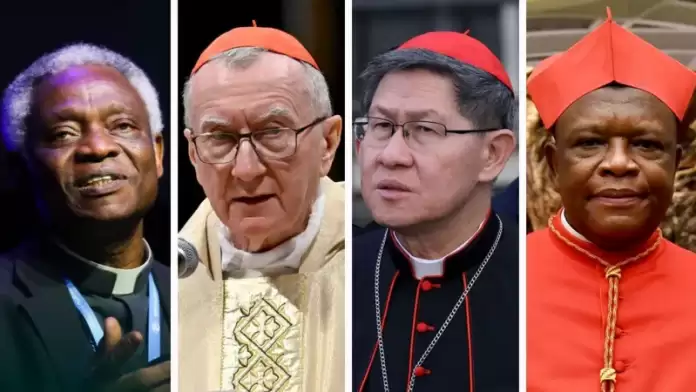
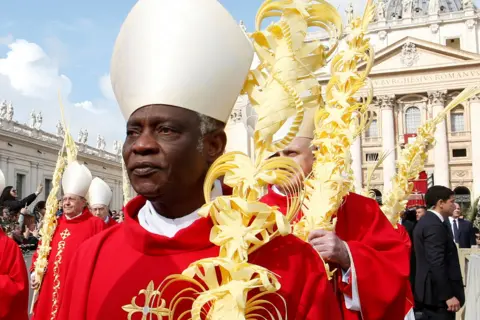
Pope candidates (left to right) Cardinal Peter Kodwo Appiah Turkson, cardinal Pietro Parolin, cardinal Luis Antonio Gokim Tagle, and cardinal Fridolin Ambongo Besungu

By Aleem Maqbool, Rebecca Seales & Paul Kirby

Who will be the next pope? The decision could have a profound impact on the Catholic Church and the world’s 1.4 billion baptised Roman Catholics.

It also promises to be a highly unpredictable and open process for a host of reasons.

The College of Cardinals will meet in conclave in the Sistine Chapel to debate and then vote for their preferred candidates until a single name prevails.

With 80% of the cardinals appointed by Pope Francis himself, they are not only electing a pope for the first time, but will offer a broad global perspective.

For the first time in history, fewer than half of those given a vote will be European.

And although the college may be dominated by his appointments, they were not exclusively “progressive” or “traditionalist”.

For those reasons, it is harder than ever to predict who will be elected the next pope.

Could the cardinals elect an African or an Asian pope, or might they favour one of the old hands of the Vatican administration?

Here are some of the names being mentioned as Francis’s potential successor.

Pietro Parolin

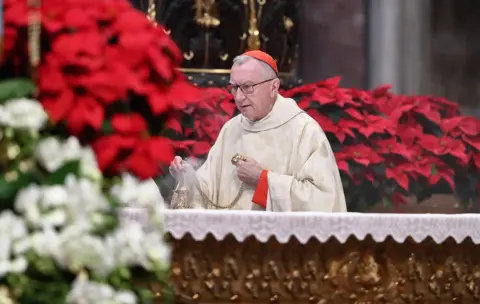
Getty Images Cardinal Pietro Parolin wears a red cap on his head while he holds a smoking urn on a table against a backdrop of red chrysantheums during the Holy Mass on the occasion of the Solemnity of Mary, Mother of God, in St. Peters Basilica, Vatican City on 1 January.

Nationality: Italian

Age: 70

Softly spoken Italian Cardinal Parolin was the Vatican’s secretary of state under Pope Francis – making him the pope’s chief adviser. The secretary of state also heads the Roman Curia, the Church’s central administration.

Having acted effectively as deputy pope, he could be considered a frontrunner.

He is viewed by some as more likely to prioritise diplomacy and a global outlook than the purity of Catholic dogma. His critics consider that a problem, while his supporters see a strength.

But he has been critical of the legalisation of same-sex marriage around the world, calling a landmark 2015 vote in favourin the Republic of Ireland “a defeat for humanity”.

The bookmakers may back him but Cardinal Parolin will be well aware of an old Italian saying that stresses the uncertainty of the pope-picking process: “He who enters a conclave as a pope, leaves it as a cardinal.”

Some 213 of the previous 266 popes have been Italian and even though there has not been an Italian pope in 40 years, the pivot of the upper echelons of the Church away from Italy and Europe may mean there may not be another for now.

Luis Antonio Gokim Tagle

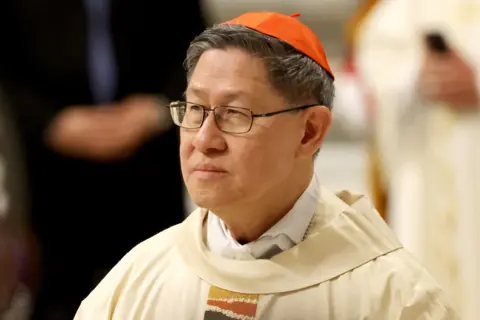
Getty Images Cardinal Luis Antonio Tagle wears a red cap on his head as he looks away from camera in a head and shoulders portrait, while he attends a Mass with newly appointed cardinals presided by Pope Francis at St. Peter's Basilica on 8 December

Nationality: Filipino

Age: 67

Could the next pope come from Asia?

Cardinal Tagle has decades of pastoral experience – meaning he has been an active Church leader among the people as opposed to a diplomat for the Vatican or cloistered expert on Church law.

The Church is massively influential in the Philippines, where about 80% of the population is Catholic. The country currently has a record five members of the College of Cardinals – which could make for a significant lobbying faction if they all back Cardinal Tagle.

He is considered a moderate within the Catholic definition, and has been dubbed the “Asian Francis” because of a dedication to social issues and sympathy for migrants that he shared with the late pope.

He has opposed abortion rights, calling them “a form of murder” – a position in line with the Church’s broader stance that life begins at conception. He has also spoken against euthanasia.

But in 2015 when he was Archbishop of Manila, Cardinal Tagle called for the Church to reassess its “severe” stance towards gay people, divorcees and single mothers, saying past harshness had done lasting harm and left people feeling “branded”, and that each individual deserved compassion and respect.

The cardinal was considered a candidate to be pope as far back as the 2013 conclave in which Francis was elected.

Asked a decade ago how he viewed suggestions he could be next, he replied: “I treat it like a joke! It’s funny.”

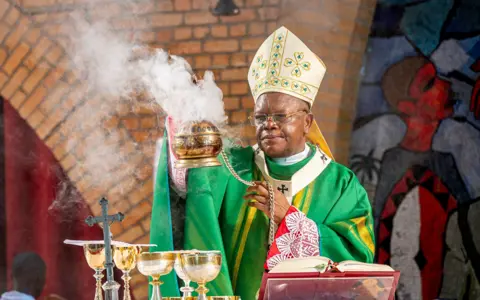
Fridolin Ambongo Besungu

AFP Cardinal Fridolin Ambongo wears a green robe as he holds a smoking urn up above ornate gold wine cups and a cross on a table next to a book inside the Notre Dame du Congo Cathedral in Kinshasa on 9 February.

Nationality: Congolese

Age: 65

It’s very possible the next pope could be from Africa, where the Catholic Church continues to add millions of members. Cardinal Ambongo is a leading candidate, hailing from the Democratic Republic of Congo (DRC).

He has been Archbishop of Kinshasa for seven years, and was appointed cardinal by Pope Francis.

He is a cultural conservative, opposing blessings for same-sex marriage, stating that “unions of persons of the same sex are considered contradictory to cultural norms and intrinsically evil”.

Though Christianity is the majority religion in the DRC, Christians there have faced death and persecution at the hands of jihadist group Islamic State and associated rebels. Against that backdrop, Cardinal Ambongo is viewed as a fierce advocate for the Church.

But in a 2020 interview, he spoke in favour of religious plurality, saying: “Let Protestants be Protestants and Muslims be Muslims. We are going to work with them. But everyone has to keep their own identity.”

Such comments could lead some cardinals to wonder if he fully embraces their sense of mission – in which Catholics hope to spread the Church’s word throughout the world.

Peter Kodwo Appiah Turkson

Reuters A mid-crop of Cardinal Peter Turkson looking solemnly ahead while wearing traditional religious robes along with others outside St. Peter's Basilica in April 2019.

Nationality: Ghanaian

Age: 76

If chosen by his peers, the influential Cardinal Turkson would likewise have the distinction of being the first African pope for 1,500 years.

Like Cardinal Ambongo, he has claimed not to want the job. “I’m not sure whether anyone does aspire to become a pope,” he told the BBC in 2013.

Asked if Africa had a good case to provide the next pope based on the Church’s growth on the continent, he said he felt the pope shouldn’t be chosen based on statistics, because “those types of considerations tend to muddy the waters”.

He was the first Ghanaian to be made a cardinal, back in 2003 under Pope John Paul II.

Like Cardinal Tagle, Cardinal Turkson was considered a potential pope a decade later, when Francis was chosen. In fact, bookmakers made him the favourite ahead of voting.

A guitarist who once played in a funk band, Cardinal Turkson is known for his energetic presence.

Like many cardinals from Africa, he leans conservative. However, he has opposed the criminalisation of gay relationships in African countries including his native Ghana.

In a BBC interview in 2023, while Ghana’s parliament was discussing a bill imposing harsh penalties on LGBTQ+ people, Turkson said he felt homosexuality should not be treated as an offence.

In 2012, he was accused of making fear-mongering predictions over the spread of Islam in Europe at a Vatican conference of bishops, for which he later apologised.

Peter Erdo

Reuters Cardinal Peter Erdo reacts as he enters a vehicle at the Vatican, following the death of Pope Francis, as seen from Rome, Italy, April 22, 2025

Nationality: Hungarian

Age: 72

A cardinal since the age of 51, Peter Erdo is highly regarded in the Church in Europe, having twice led the Council of European Bishops’ Conferences from 2006 to 2016.

He is well known among African cardinals and he has worked on Catholic relations with the Orthodox Church.

The archbishop of Budapest and primate of Hungary grew up in a Catholic family under communism, and he is considered a potential compromise candidate.

Erdo played a prominent role in Pope Francis’s two visits to Hungary in 2021 and 2023, and he was part of the conclaves that elected Francis and his predecessor Pope Benedict.

His conservative views on the family have found favour with some parts of the Church and he has navigated the “illiberal democracy” of Hungarian Prime Minister Viktor Orban. During Europe’s migrant crisis in 2015, he said the Church would not take in migrants as it was tantamount to human trafficking.

Angelo Scola

Getty Images Cardinal Angelo Scola attends the opening of the crypt of Santo Sepolcro, in Milan in 2016

Nationality: Italian

Age: 83

Only cardinals under 80 can vote in the conclave, but Angelo Scola could still be elected.

The former Archbishop of Milan was a frontrunner in 2013 when Francis was chosen, but he is thought to have fallen victim to the adage of entering the conclave as Pope and leaving as cardinal.

His name has resurfaced ahead of the conclave, because of a book he is publishing this week on old age. The book features a preface written by Pope Francis shortly before he was admitted to hospital in which he said “death is not the end of everything, but the beginning of something”.

Francis’s words show genuine affection for Scola, but the college of cardinals might not see his focus on old age as ideal for a new pope.

Reinhard Marx

Getty Images Cardinal Reinhard Marx (L), Archbishop of Munich and Freising, holds an ecumenical funeral service in February 2025

Nationality: German

Age: 71

Germany’s top Catholic cleric is also very much a Vatican insider too.

The Archbishop of Munich and Freising was chosen as an adviser when Francis became pope in 2013. For 10 years he advised the Pope on Church reform and still oversees financial reform of the Vatican.

He has advocated a more accommodating approach towards homosexuals or transgender people in Catholic teaching.

But in 2021 he offered to resign over serious mistakes in tackling child sexual abuse in Germany’s Catholic Church. That resignation was rejected by Francis.

Two years ago he left the Council of Cardinals, the Pope’s most important advisory body, in what was seen in Germany as a setback for his career in the Church.

Marc Ouellet

Reuters Cardinal Marc Ouellet of Canada walks through Saint Peter's Square as he leaves at the end of a meeting in

Nationality: Canadian

Age: 80

Cardinal Ouellet has twice before been seen as a potential candidate for Pope, in 2005 and 2013.

For years he ran the Vatican’s Dicastery for Bishops, which chooses candidates for the episcopate around the world, so he has played a significant and formative role in vetting the future members of the Catholic hierarchy.

As another octogenarian, he will not be able to play a part in the conclave itself, which may hinder his chances.

Ouellet is viewed as a conservative with a modern outlook, who is strongly in favour of maintaining the principle of celibacy for priests.

He opposes the ordination of women priests, but he has called for a greater role for women in running the Catholic Church, saying that “Christ is male, the Church is feminine”.

Robert Prevost

Getty Images US cardinal Robert Francis Prevost attends the Easter Vigil Mass at St. Peter's Basilica on April 19, 2025

Nationality: American

Age: 69

Could the papacy go to an American for the first time?

Chicago-born Cardinal Prevost is certainly seen as having many of the necessary qualities for the role.

Two years ago Pope Francis chose Prevost to replace Marc Ouellet as prefect of the Vatican’s Dicastery for Bishops, handing him the task of selecting the next generation of bishops.

He worked for many years as a missionary in Peru before being made an archbishop there.

Prevost is not just considered an American, but as someone who headed the Pontifical Commission for Latin America.

He is seen a reformer, but at 69 might be viewed as too young for the papacy. His period as archbishop in Peru was also clouded by allegations of covering up sexual abuse claims, which were denied by his diocese.

Robert Sarah

GUY PETERSON/AFP Guinean cardinal Robert Sarah attends a prayer at the Cathedral of Our Lady of Victories in Dakar

Nationality: Guinean

Age: 79

Well-liked by conservatives in the Church, Cardinal Sarah is known for his adherence to doctrine and traditional liturgy and was often considered opposed to Pope Francis’s reformist leanings.

The son of a fruit-picker, Sarah became the youngest archbishop aged 34 when Pope John Paul II appointed him prelate in Conakry in Guinea.

He has had a long and impressive career, retiring in 2021 as head of the Vatican’s office that oversees the Catholic Church’s liturgical rites.

While not considered a favourite for the papacy, he could attract strong support from conservative cardinals.

Michael Czerny

ANGELO CARCONI/EPA-EFE/REX/Shutterstock Cardinal Michael Czerny, Prefect of the Dicastery for Promoting Integral Human Development, leads a Mass as part of the Jubilee of the World of Volunteering, at St. Peter's Square

Nationality: Canadian

Age: 78

Cardinal Czerny was appointed cardinal by Pope Francis and is like him a Jesuit, a leading order of the Catholic Church known for its charitable and missionary work around the world.

Although he was born in the former Czechoslovakia, his family moved to Canada when he was two.

He has worked widely in Latin America and in Africa, where he founded the African Jesuit Aids Network and taught in Kenya.

Czerny is popular with progressives in the Church and was considered close to Pope Francis. He is currently head of the Vatican’s Dicastery for Promoting Human Integral Development.

Although a strong candidate, it seems unlikely the cardinals would choose a second Jesuit pope in succession.

Culled from BBC

TIPS